KitGuru KitGuru.net – Tech News | Hardware News | Hardware Reviews | IOS | Mobile | Gaming | Graphics Cards


Nvidia's driver-level frame generation technology, Smooth Motion, is expanding its compatibility. Before, this technology was limited to DirectX 11 and 12 APIs, but a new update has extended support to games using the Vulkan API.
Driver-level frame generation can be particularly useful for older or unmaintained games, often run via emulation. With the addition of Vulkan support, Nvidia graphics users can now force Smooth Motion frames into console emulators, and naturally, the addition of Vulkan support also extends the number of PC games that can benefit from this technology. However, Smooth Motion is currently only supported on RTX 50 series GPUs, although support for RTX 40 graphics cards is expected in the future.
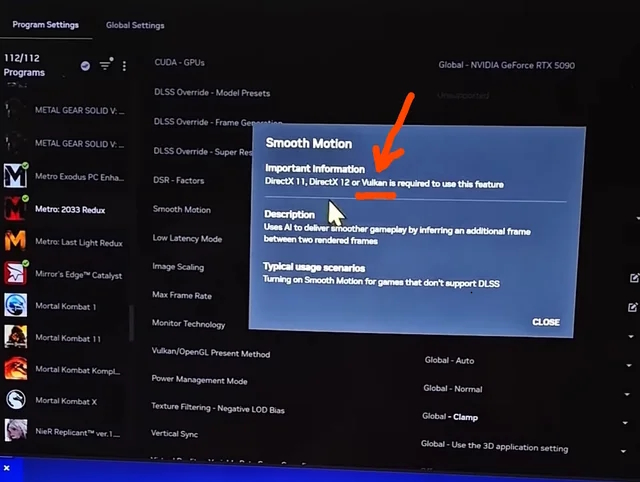
Image credit: DaddyDG
Users on Reddit have stated that emulators such as Cemu (Wii U), RPCS3 (PS3), and even some PS4 emulators can now benefit from Smooth Motion with Vulkan support. While this adds a potentially useful application for RTX 50 series owners, the broader utility of Smooth Motion depends on Nvidia expanding compatibility to previous RTX generations in future driver updates.
To activate Smooth Motion, you can go to the Nvidia App and select the game where you want to enable it in Graphics > Program settings. Search for the setting under “Driver Settings”, and switch Smooth Motion to “on”. Alternatively, you can activate Smooth Motion by setting the environment variable NVPRESENT_ENABLE_SMOOTH_MOTION=1.
Discuss on our Facebook page, HERE.
KitGuru says: Have you ever tried Smooth Motion? Would you like to see Nvidia extending its support to older generations of GPUs?