KitGuru KitGuru.net – Tech News | Hardware News | Hardware Reviews | IOS | Mobile | Gaming | Graphics Cards


We use the Open Source Response Time Tool (OSRTT), developed by TechTeamGB, for our response time testing. This measures grey-to-grey response times and presents the results in a series of heatmaps, the style of which you may be familiar with from other reviews.
Initial Response Time is the time taken for the panel to transition from one colour to another, where lower values are better. We present the initial response time, so overshoot is not taken into account and is measured separately. We use a fixed RGB 5 tolerance for each transition.
Overshoot is the term given for when a monitor's transition exceeds or goes beyond its target value. So if a monitor was meant to transition from RGB 0 to RGB 55, but it hits RGB 60 before settling back down at RGB 55, that is overshoot. This is presented as RGB values in the heatmaps – i.e. how many RGB values past the intended target were measured.
Visual Response Rating is a metric designed to ‘score' a panel's visual performance, incorporating both response times and overdrive. Fast response times with little to no overshoot will score well, while slow response times or those with significant overshoot will score poorly.
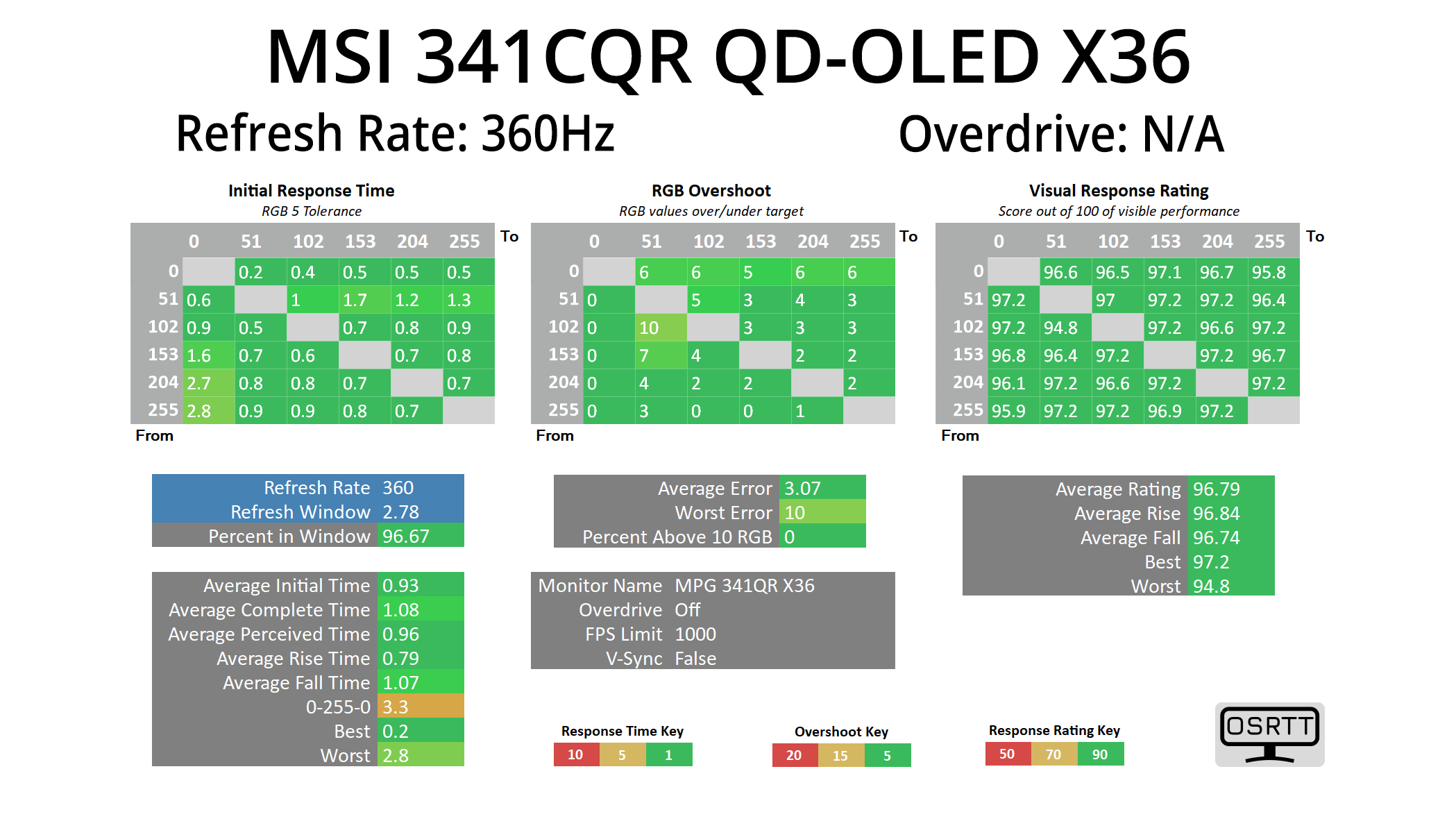
We're not going to focus too heavily on response times here as we know OLEDs are the best of the best in this regard, and they all perform very similarly, meaning near-instant response times and zero ghosting, regardless of the refresh rate used.
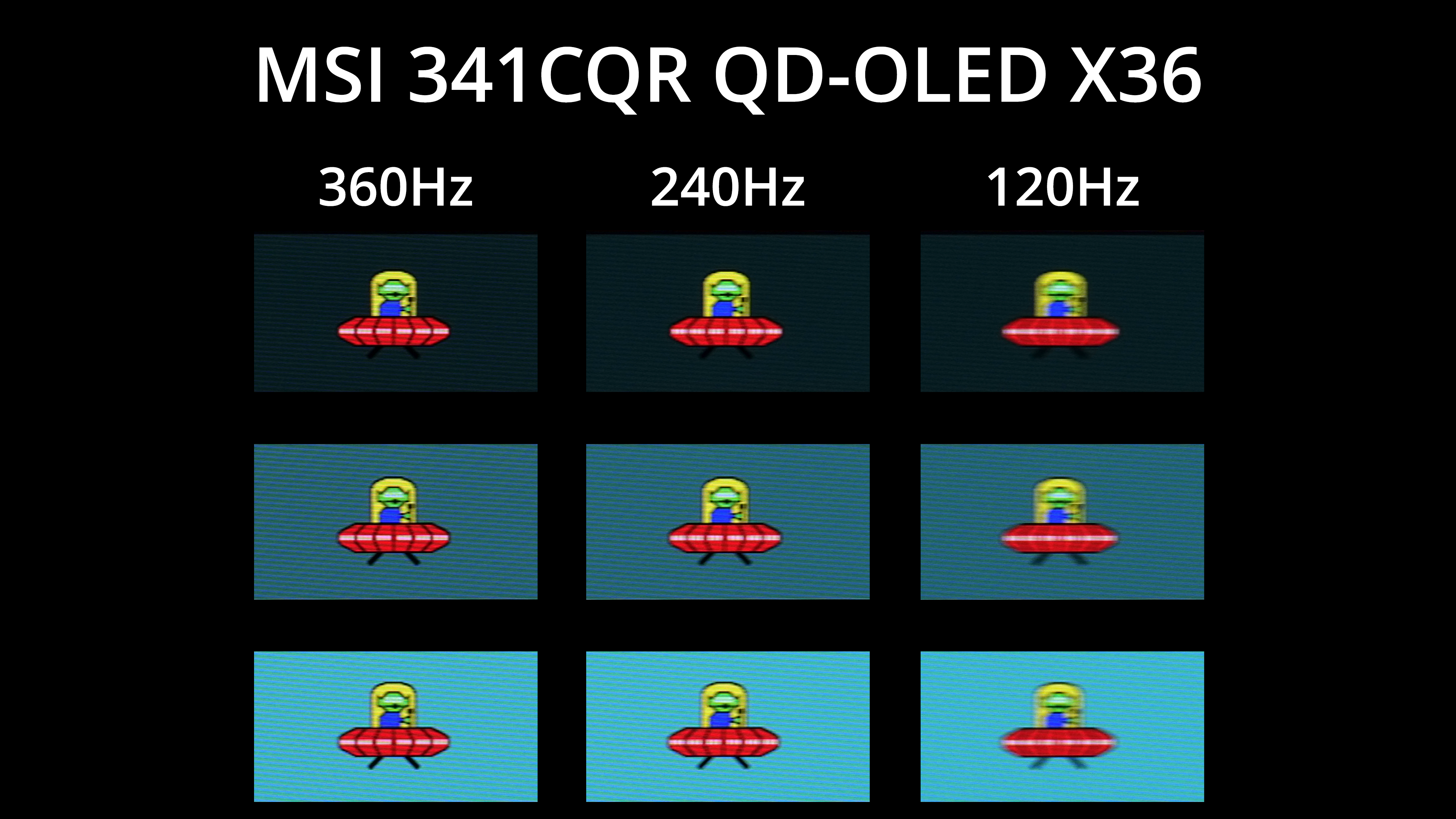
As we know, however, that doesn't mean motion clarity will be the same regardless of the refresh rate – the higher you can push the refresh, the smoother things look. The jump from 120Hz to 240Hz is quite noticeable, and while going from 240Hz up to 360Hz is a smaller improvement, I'd definitely say it's still perceptible, and it's a welcome upgrade for these ultrawide panels.
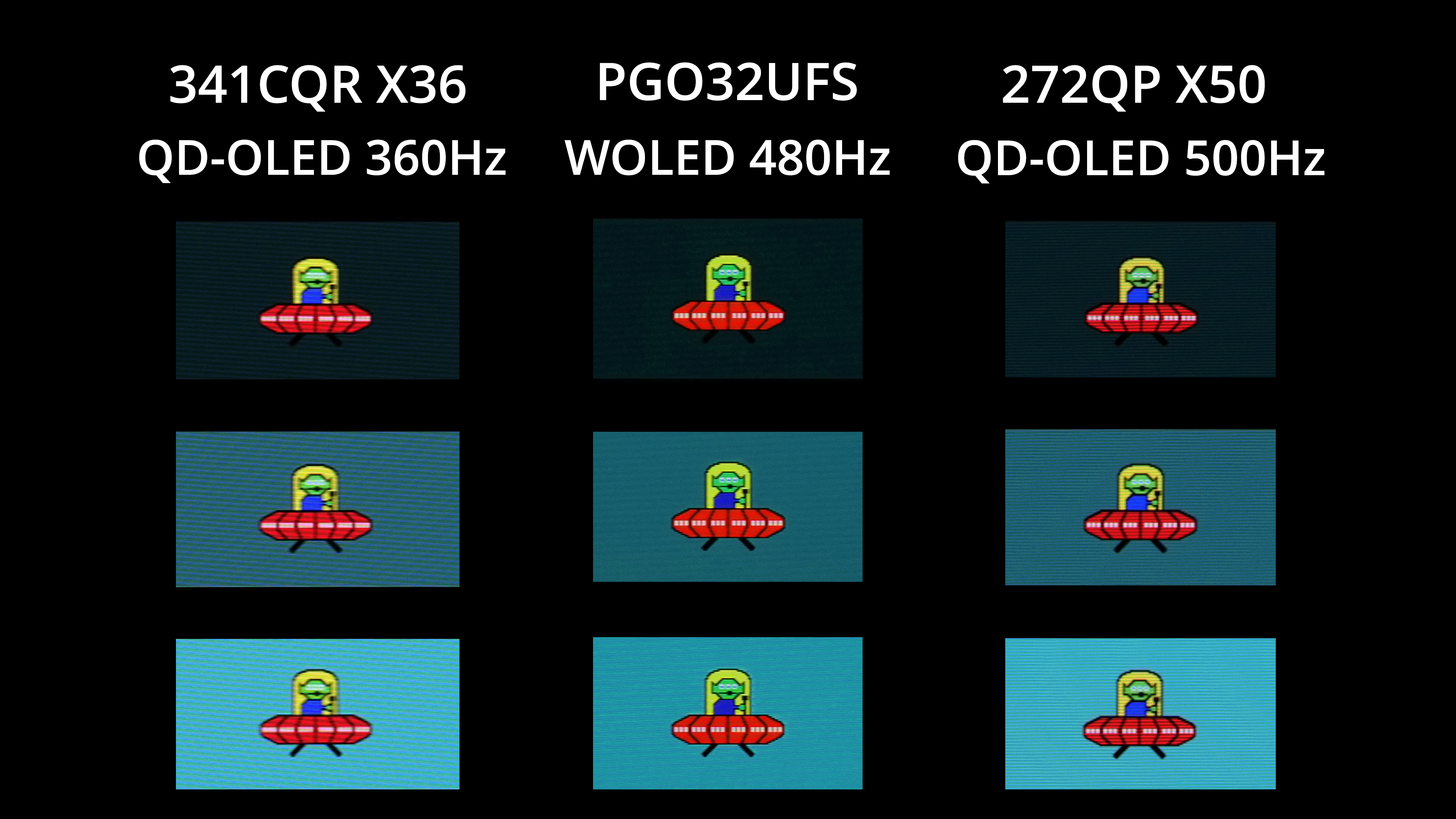
Of course, we know that other OLEDs can deliver even faster refresh rates, with MSI's 272QP X50 capable of 500Hz, while the ASRock PGO32UFS hits 480Hz thanks to its dual mode functionality. Those screens will offer better image clarity due to the higher refresh – but you also have to remember that right now, 360Hz is as fast as it gets for an ultrawide OLED.
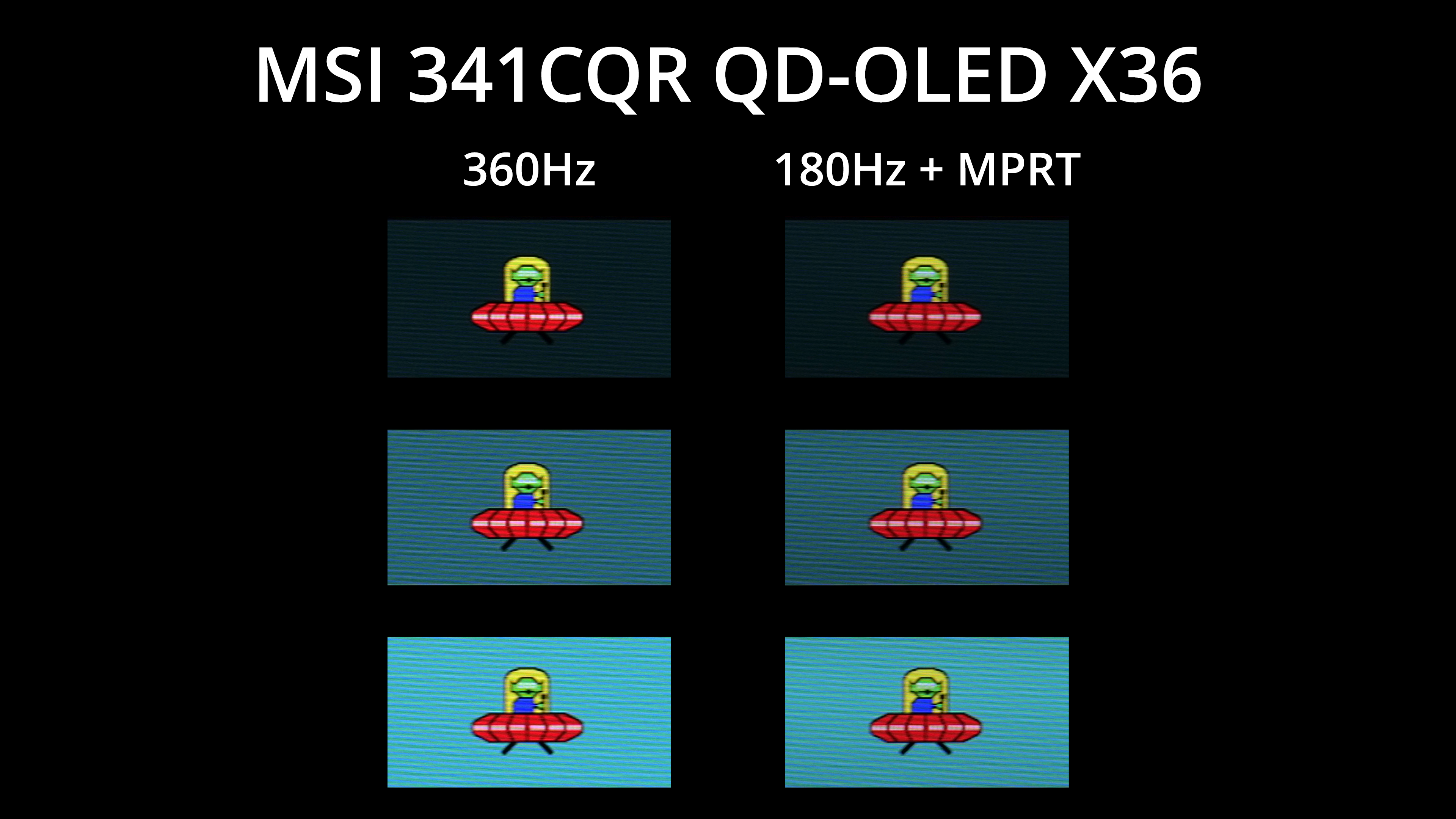
MSI has also included its new MPRT mode – AKA black frame insertion (BFI) – which we first saw with the 272QP X50. This mode places a black frame after every regular frame, meaning you get broadly equivalent motion clarity at 180Hz as you would without BFI at 360Hz, and it's obviously a lot easier to drive games at the lower frame rate! It does disable adaptive sync and brightness is capped at 155 nits max, but it could be well worth using depending on the games you play.