KitGuru KitGuru.net – Tech News | Hardware News | Hardware Reviews | IOS | Mobile | Gaming | Graphics Cards


The MSI Optix MAG301CR is the latest addition to the company's MAG line of gaming monitors. Thanks to its high refresh rate and wider aspect ratio, this new screen is aimed at gamers looking for both a competitive edge, as well as an immersive gaming experience.
The Optix MAG301CR uses a 30-inch curved (1500R) VA panel with a 21:9 aspect ratio, a WFHD resolution (2560x1080p), 200Hz refresh rate, and 1ms response time (MPRT). This 10-bit panel has a contrast ratio of 3000:1, 300 nits of brightness, and 178°(H) / 178°(V) viewing angles, capable of covering 98.3% of the DCI-P3 colour gamut and 127.4% of the sRGB coverage.
This monitor is HDR Ready, and supports AMD Freesync and MSI Mystic Light, allowing you to configure the RGB LEDs in the MAG301CR to your own taste and synchronise it with other MSI Mystic Light compatible products. It also features both Anti-Flicker technology and Blue Light Reduction to reduce the user's eye-fatigue, Night Vision to increase “details in darker areas”, and the Gaming OSD APP 2.0 software to customise the monitor settings, among other gaming-oriented features.
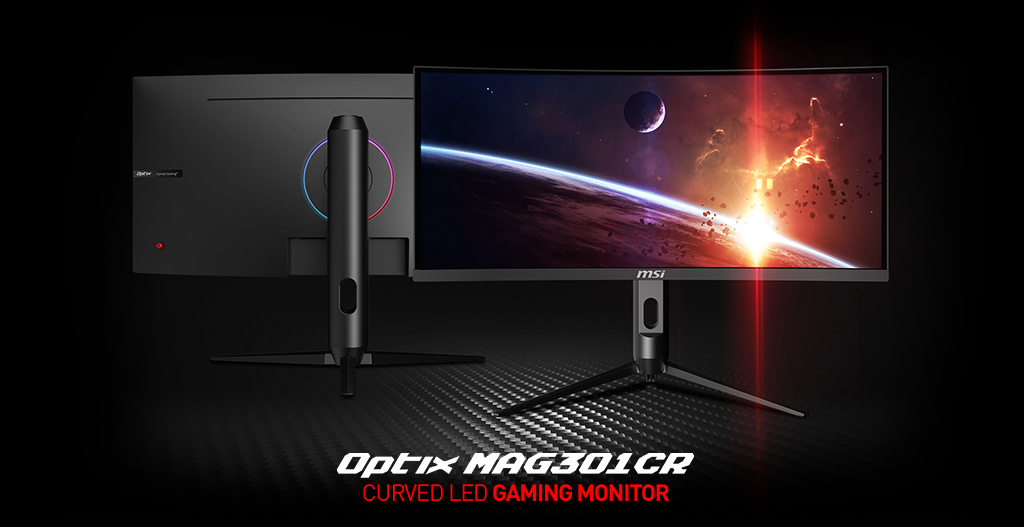
According to MSI, the connectivity options in the MAG301CR include 1x DisplayPort 1.2, 2x HDMI 2.0, 1x USB Type-C, 2x USB 3.2 Gen1 Type-A, 1x USB 3.2 Gen1 Type-B, and 1x 3.5mm headphone jack. This monitor can tilt from -5º to 20º, swivel from -30º to 30º, pivot 90º, and adjust its height by 100mm, but there's also support for a 75x75mm VESA mount.
No details about pricing or availability were shared yet. If you want to learn more about the MSI Optix MAG301CR, click HERE.
Discuss on our Facebook page HERE.
KitGuru says: Are you currently using a 144Hz+ monitor in your setup? If not, would you upgrade to the MSI Optix MAG301CR?