KitGuru KitGuru.net – Tech News | Hardware News | Hardware Reviews | IOS | Mobile | Gaming | Graphics Cards


We tested the Asustor Flashstor 6 Gen 2 with a number of scenarios that it may face in the real world. The settings for these scenarios are as follows.
File Server
512MB file size, 16KB Block size, 80% Read 20% Write 100% Random, I/O queue depth 128
Web Server
1GB file size, 16KB Block size, 100% Read 0% Write 100% Random, I/O queue depth 64
Workstation
Transfer Size: 8K Reads: 80% Writes: 20% Random: 80% Boundary: 8K Outstanding IO: 64 Threads/Workers 4
Database
2GB file size, 4KB Block size, 90% Read 10% Write, 90% Random, 10% Sequential, I/O queue depth 128
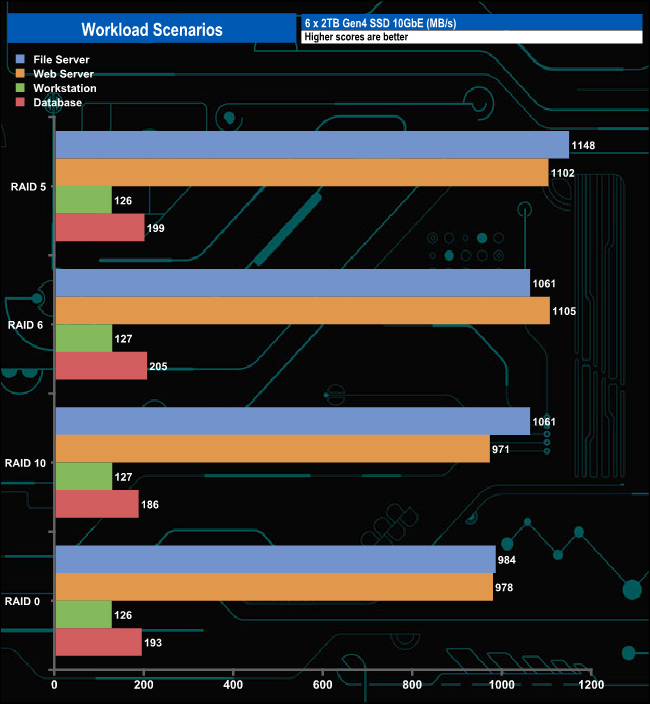
We also tested the NAS in a few scenarios it might be used for in an office environment. The best performance with all the tested arrays came via the File Server test with the fastest speed of 1,148MB/s coming from the RAID 5 array closely followed by the Web Server scenario in a RAID 6 array with a speed of 1,105MB/s.