KitGuru KitGuru.net – Tech News | Hardware News | Hardware Reviews | IOS | Mobile | Gaming | Graphics Cards


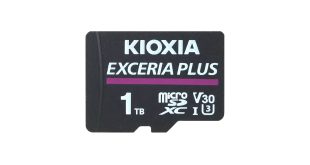
Designed for use in cameras, mobile phones, tablets, and drones, the flagship card of Kioxia's high-performance Exceria Plus range of microSD memory cards is the LMPL1M001TG2, a microSDXC card with a huge 1TB capacity. It's certainly not cheap though, coming in around the £250 mark here in the UK…
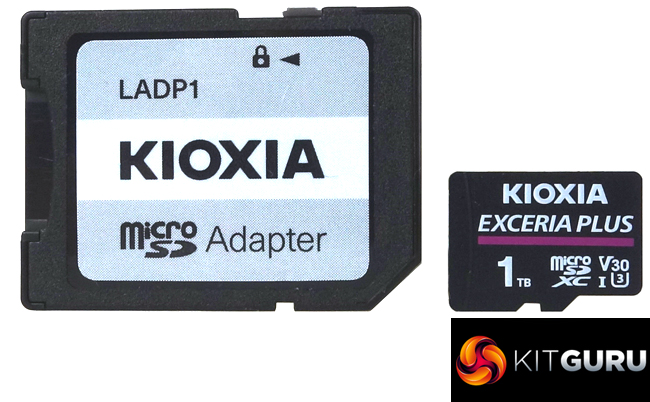
1TB drive is the current flagship of a range of cards that is made of six capacities including the flagship drive; 32GB (microSDHC), 64GB, 128GB, 256GB and 512GB (microSDXC). The card has SDXC I, V30, U3, class10 and A1 certification and Kioxia quote performance figures of up to 100MB/s for reads and up to 85MB/s for writes.
Kioxia back the Exceria Plus range with a 5-year warranty.
Physical Specifications:
- Usable Capacities: 1TB.
- Interface: UHS-I.
- Form Factor: microSDXC.
- Dimensions: 15.0 x 11.0 x 1.0mm.
- Drive Weight: 0.3g.
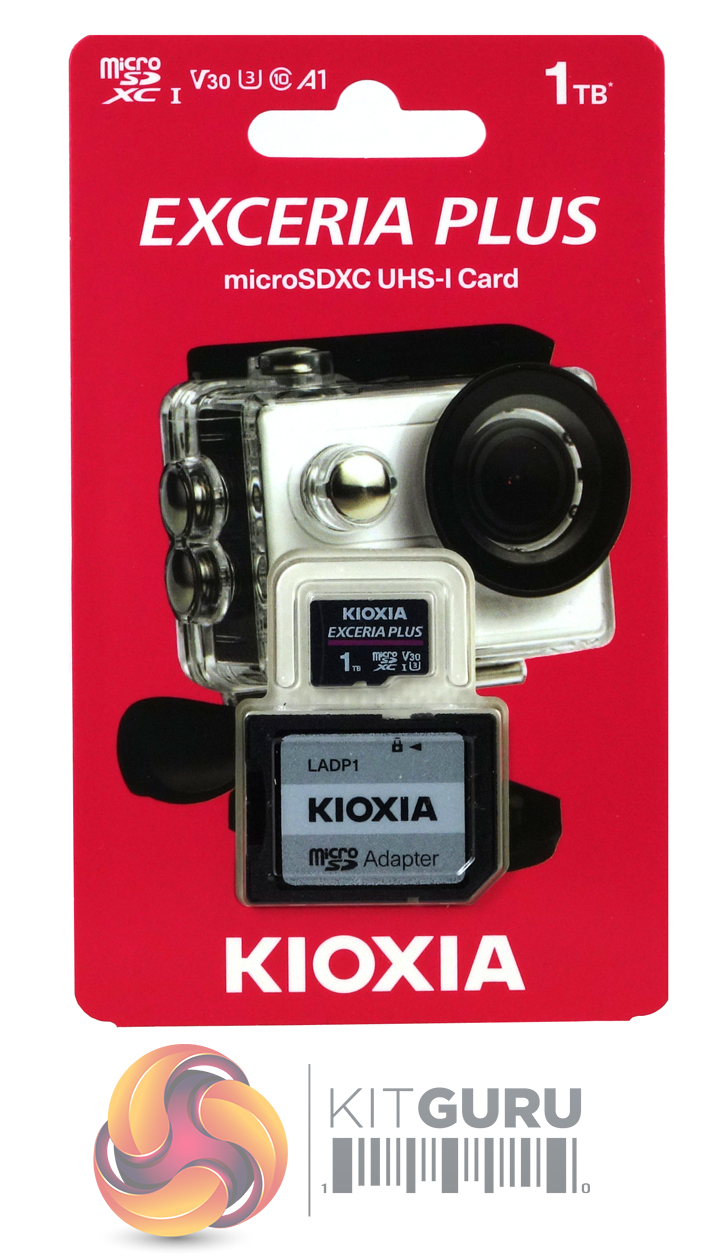
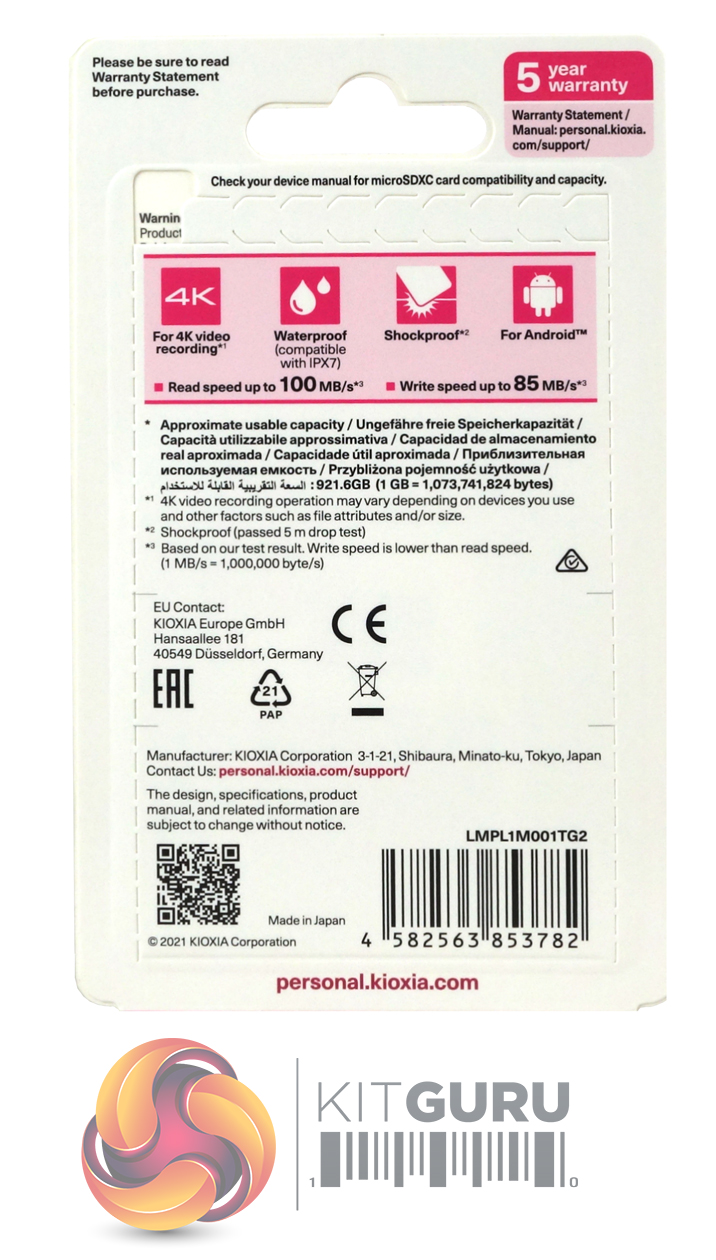
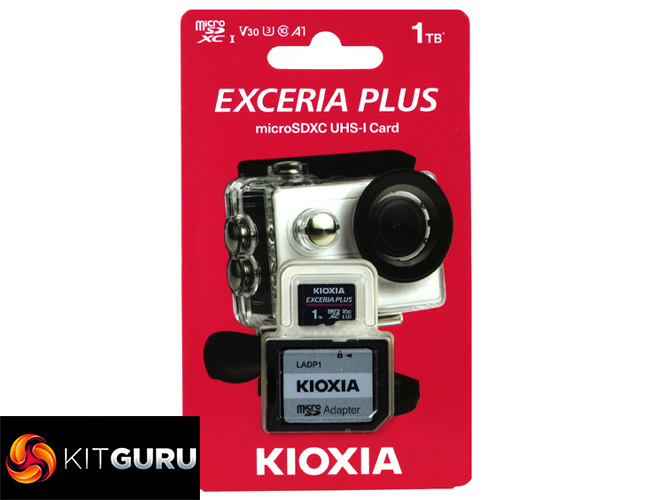
The drive comes in a small blister pack. At the top left of the cardboard backing are icons for the various classes supported by the drive; SDXC I, V30, U3, C10 and A1. Top right is the capacity. At the top of the back of the card is a note about the 5-year warranty the drive is backed by. Under this is a line of icons about some of the drive's features; 4K recording support, waterproof, shockproof and that the drive supports Android. Under these are the speed ratings for the drive.
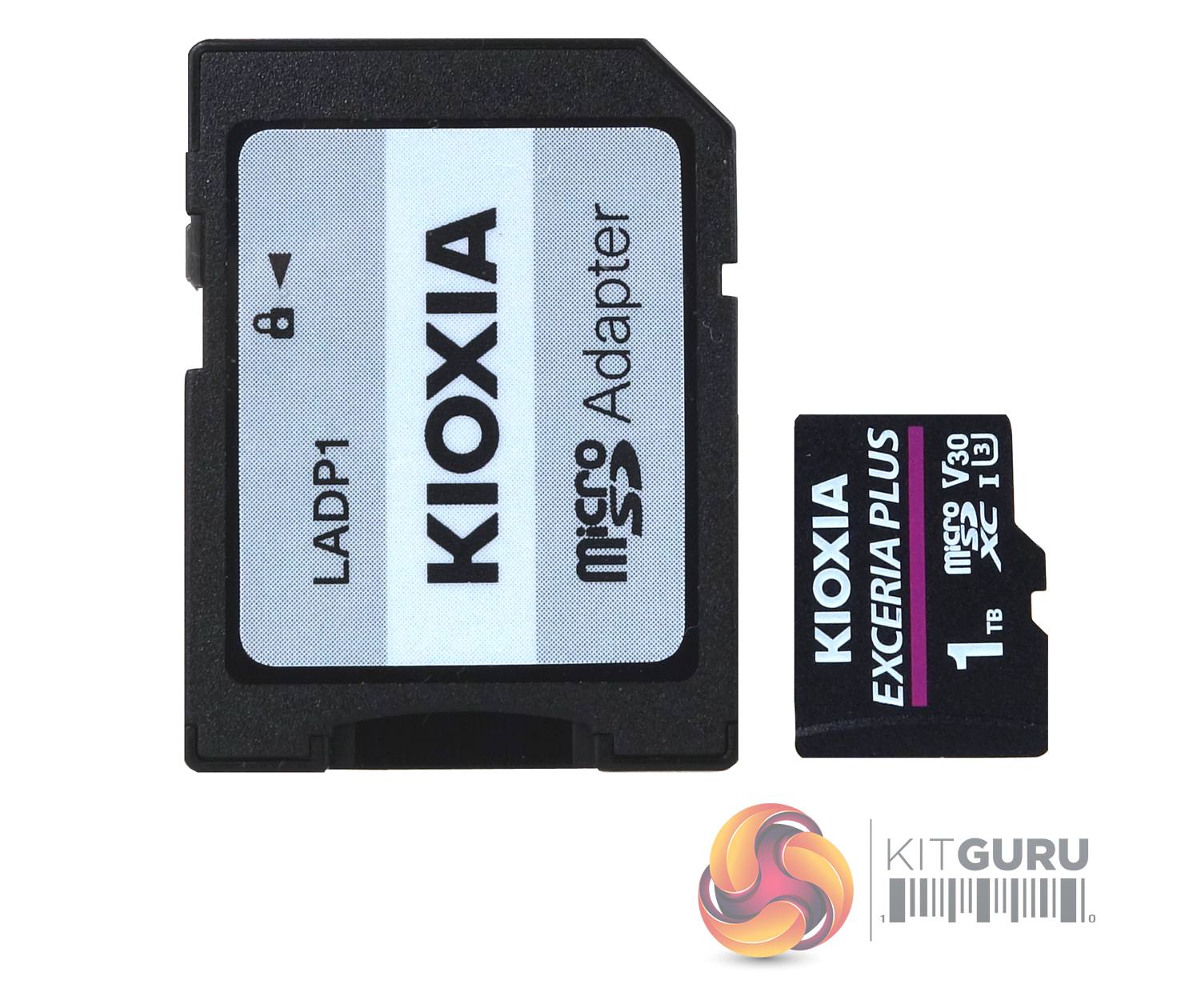
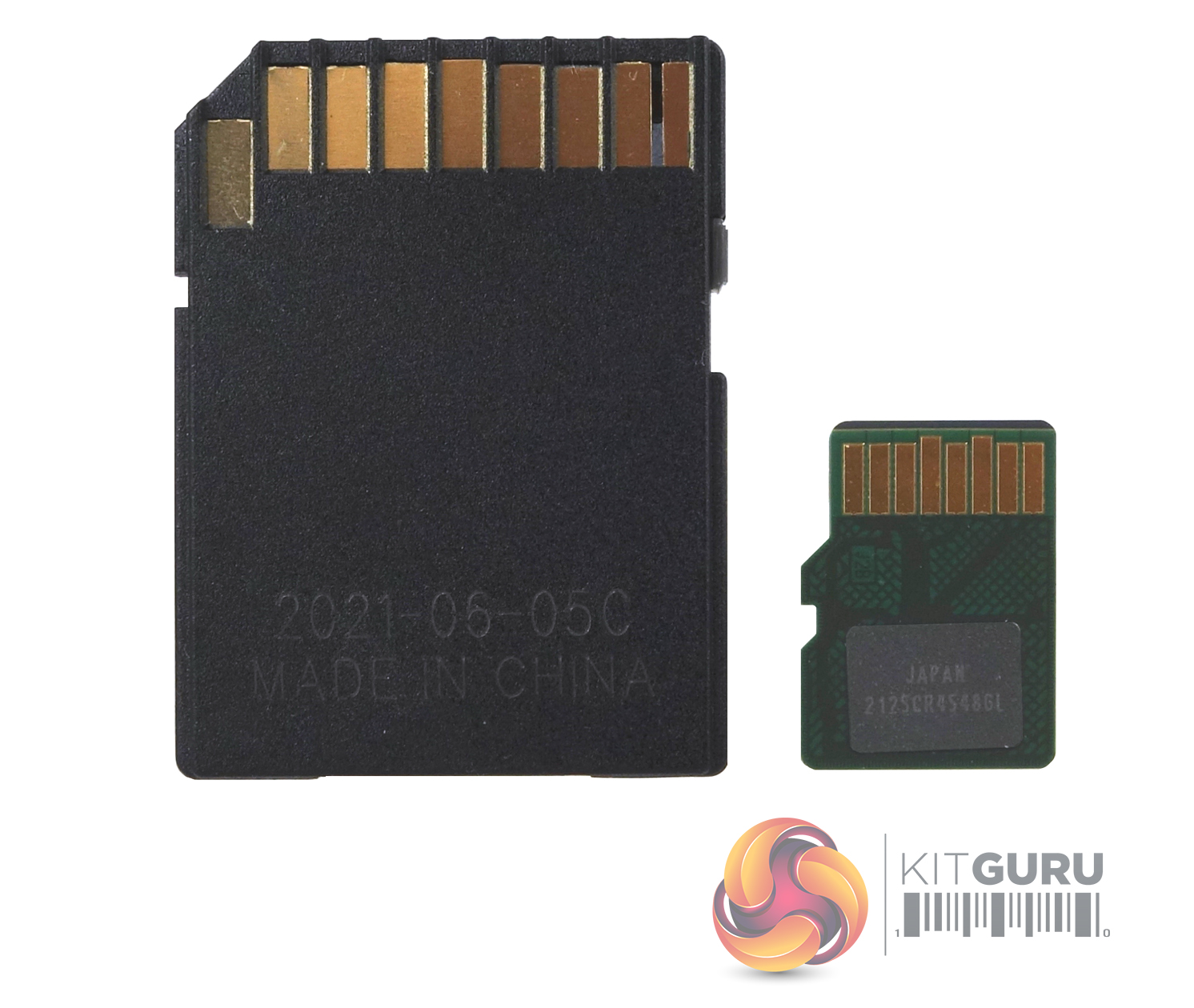
The card itself measures 15.0 x 11.0 x 1.0 mm, weighs 0.3g and is bundled with a LADP1 microSD adapter.
The card itself is pretty well protected. It is compatible with the IPX7 standard for waterproofing (withstand submerging in 1 meter of water for up to 30 minutes) and it can survive being dropped from up to 5 meters. It also has ESD Immunity (resistance to electrostatic discharge (ESD) from the human body) and is compliant with ISO7816-1 meaning it can still function after being subjected to 0.1 Gy of X-rays, i.e airport security X-ray checks.
CrystalDiskMark is a useful benchmark to measure the theoretical performance levels of hard drives and SSDs. We are using V8.
The ATTO Disk Benchmark performance measurement tool is compatible with Microsoft Windows. Measure your storage systems performance with various transfer sizes and test lengths for reads and writes. Several options are available to customize your performance measurement including queue depth, overlapped I/O and even a comparison mode with the option to run continuously. Use ATTO Disk Benchmark to test any manufacturer's RAID controllers, storage controllers, host adapters, hard drives and SSD drives and notice that ATTO products will consistently provide the highest level of performance to your storage.
The PCMark 10 Data Drive Benchmark has been designed to test drives that are used for storing files rather than applications. You can also use this test with NAS drives, USB sticks, memory cards, and other external storage devices.
The Data Drive Benchmark uses 3 traces, running 3 passes with each trace.
Trace 1. Copying 339 JPEG files, 2.37 GB in total, in to the target drive (write test).
Trace 2. Making a copy of the JPEG files (read-write test).
Trace 3. Copying the JPEG files to another drive (read test
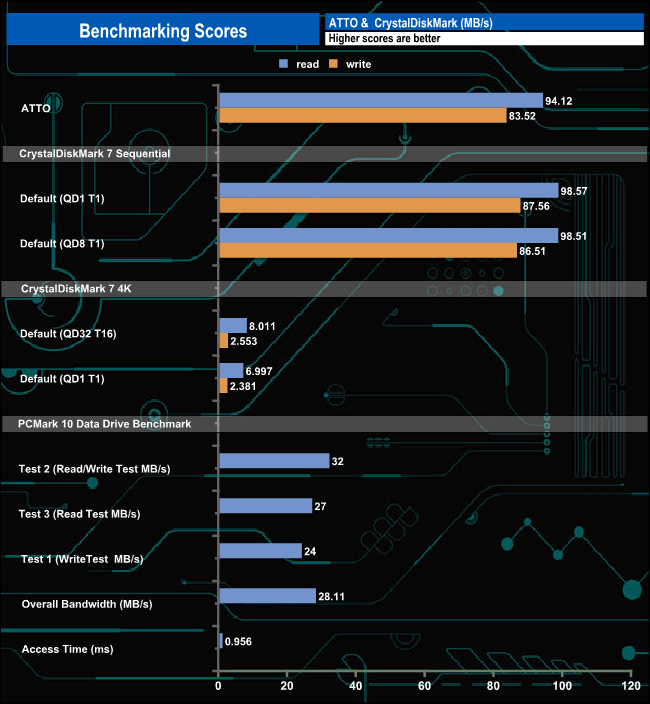
Kioxia's official performance figures for the 1TB Exceria Plus card are up to 100MB/s for reads and up to 85MB/s for writes. The best speeds we saw when testing the drive with the ATTO and CrystalDiskMark 8 benchmarks came from CrystalDiskMark with a best-read result of 98.57MB/s and a best-write figure of 87.56MB/s.
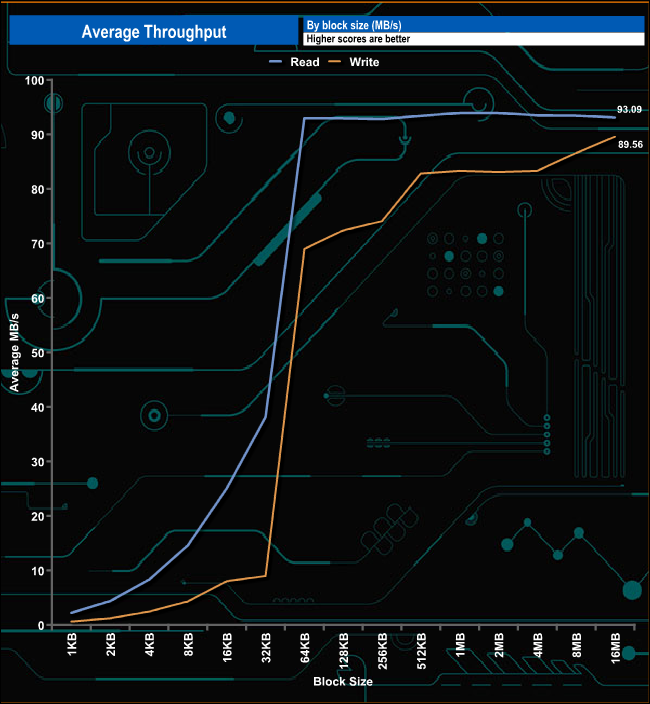
In our throughput tests, the peak read figure of 93.92MB/s came at the 1MB block mark with the test run finishing with a result of 93.09MB/s, just shy of the official 100MB/s maximum. The peak write figure came at the end of the test, the 89.56MB/s result being very slightly better than the official 85MB/s for writes.
To test the real-life performance of a drive we use a mix of folder/file types and by using the FastCopy utility (which gives a time as well as MB/s result) we record the performance of drive reading from & writing to a 256GB Samsung SSD850 PRO.
Transfer Details
12GB Movie folder – (15 files – 8 @ .MKV, 4 @ .MOV, 3 @ MP4).
10GB Photo folder – (304 files – 171 @ .RAW, 105 @ JPG, 21 @ .CR2, 5 @ .DNG).
10GB Audio folder – (1,483 files – 1479 @ MP3, 4 @ .FLAC files).
5GB (1.5bn pixel) photo.
BluRay Movie – 42GB.
21GB 8K Movie demos – (11 demos)
16GB 4K Raw Movie Clips – (9 MP4V files).
4.25GB 3D Printer File Folder – (166 files – 105 @ .STL, 38 @ .FBX, 11 @ .blend, 5 @ .lwo, 4 @ .OBJ, 3@ .3ds).
1.5GB AutoCAD File Folder (80 files – 60 @ .DWG and 20 @.DXF).
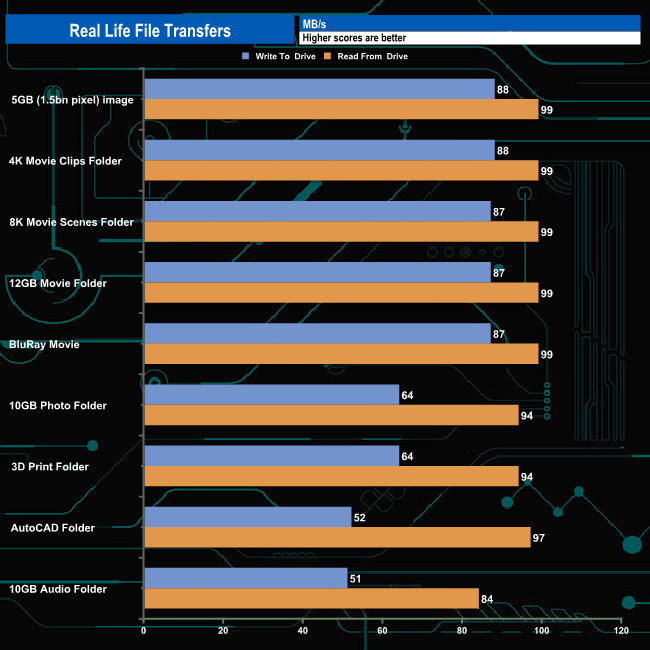
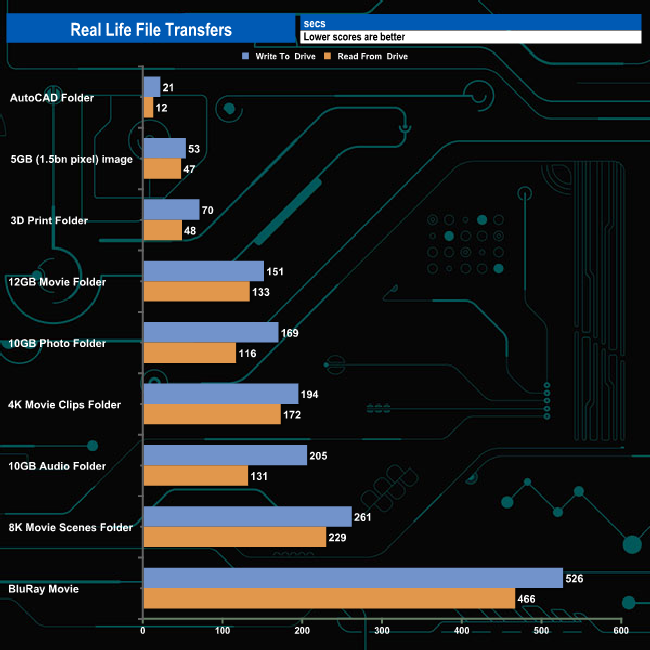
In our real-life file transfer tests the card produced an average read figure of 96MB/s with five of the transfers achieving 99MB/s. When writing the data to the card we saw an average of 74MB/s for the nine transfers. Five of the transfers were a tiny bit faster than the official write rating of 85MB/s, two at 88MB/s with the remaining three at 87MB/s.
The current flagship of Kioxia's Exceria Plus range of microSD cards comes with a huge 1TB (921.6GB usable) capacity. The LMPL1M001TG2 heads a five-card microSDXC line-up; 64GB, 128GB, 256GB and 512GB, with a 32GB microSDHC card completing the product line. Kioxia's Exceria Plus range uses BiCS 3D flash memory and supports SDXC I, V30, U3, class10 and A1.
Kioxia rates the 1TB card's performance as up to 100MB/s for reads and up to 85MB/s for writes. Incidentally, the 256GB and 512GB cards have the same speed ratings, the 128GB and 64GB cards have the same read speed rating but with writes quoted as up to 65MB/s and the 32GB card is rated as up to 98MB/s and 65MB/s for reads and writes respectively.
When testing the card the best read/write figures we got from it came when using CrystalDiskMark 8 with a read result of 98.57MB/s with writes at 87MB/s. When transferring real-life data we got an average read figure of 96MB/s for the nine transfers with five of them at 99MB/s. Writes averaged 74MB/s, the fastest at 88MB/s, and the slowest at 51MB/s.
Just in case you wondering just what you can do with this much storage on a microSD card, Kioxia has a couple of charts on their website to show what the drive can store. For instance, it can hold approx 650,840 5-Megapixel or 154,070 18-Megapixel photos, 5,990 minutes of FullHD or 1,258 minutes of 4K recording time – which is quite something when you realise the card is only 15.0 x 11.0 x 1.0 mm in size.
We found the 1TB Kioxia Exceria Plus card on Concept Direct for £252.66 (inc VAT) HERE.
Discuss on our Facebook page HERE.
Pros
- Performance.
- Huge capacity.
- 5 year warranty.
Cons
- Pricey, very pricey.
KitGuru says: Aimed at sports and action cameras, as well as drones and Android devices, the flagship 1TB Exceria Plus card offers a huge amount of fast storage but it does come with an equally huge price tag.