 KitGuru KitGuru.net – Tech News | Hardware News | Hardware Reviews | IOS | Mobile | Gaming | Graphics Cards


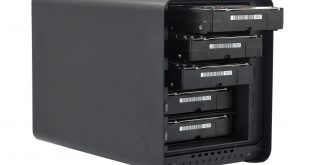
We reviewed Drobo's 5N home/SOHO 5-bay tower NAS last year and now the next generation 5N, the 5N2 has arrived. Drobo claim it's their fastest 5-bay NAS to date with a more powerful processor than the original as well as an additional LAN port to offer improved network performance and failover protection.
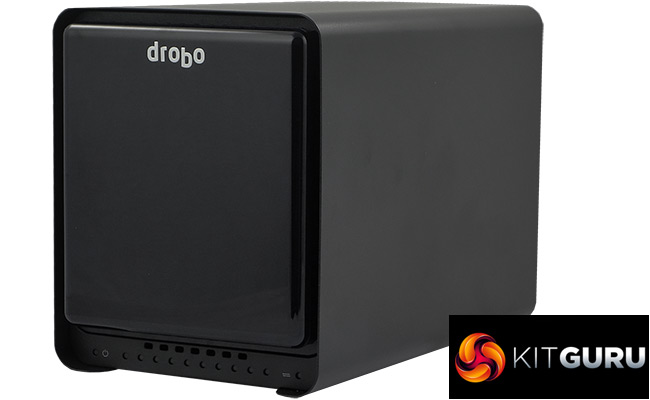
The 5N2 uses a Marvell Armada Quad core 1.6Ghz processor backed by 2GB of memory to give better performance than the original 5N. Also helping to give the performance a boost is the addition of a second LAN port which brings Link Aggregation support to the device.
It provides data protection in the form of DroboDR, the companies disaster recovery solution and an internal battery which writes any data in the cache to disk in the event of power loss to the 5N2.
But as with all Drobo's the real star of the show is the BeyondRAID storage technology the device uses.
BeyondRAID technology
Drobo’s BeyondRAID technology aims to take the best part of RAID – data protection and adds much greater ease of implementation and management while offering larger capacities. Unlike the traditional RAID where there is a protection free option (RAID0), BeyondRAID has only protected levels and then just two; Single disk redundancy (think RAID5) and Dual disk redundancy (akin to RAID6).
BeyondRAID's advantages soon become apparent when you begin to use it. For starters you are not tied to using drives of the same capacity or speed, you can mix and match drive sizes. Just load any drives into the 5N2 and the technology will do the rest.
Another major plus point comes when adding capacity to a RAID group. With traditional RAID the data has to be moved off the group to free all the drive space, then the new drive is added to the group (must be the same size as the others), the array reformatted and the data replaced or the data is migrated to a larger RAID group, either way, it’s a very time-consuming procedure. BeyondRAID simplifies this whole procedure offering two ways of increasing the capacity.
Firstly if the Drobo device has a free drive bay then it’s simply a matter of adding another drive or if all the bays are full just swapping out the smallest drive and replacing it with a larger one and as hot swapping is supported there is no need to power down the device. There can also be huge savings in time as there is no need for any of the data to be moved during the operation.
BeyondRAID Features
- Thin Provisioning
- Instant Expansion
- Mixed Drive Size Utilization
- Automatic Protection Levels
- Single – or Dual-Disk Redundancy
- Virtual Hot Spare
- Data Aware
- Drive Re-ordering
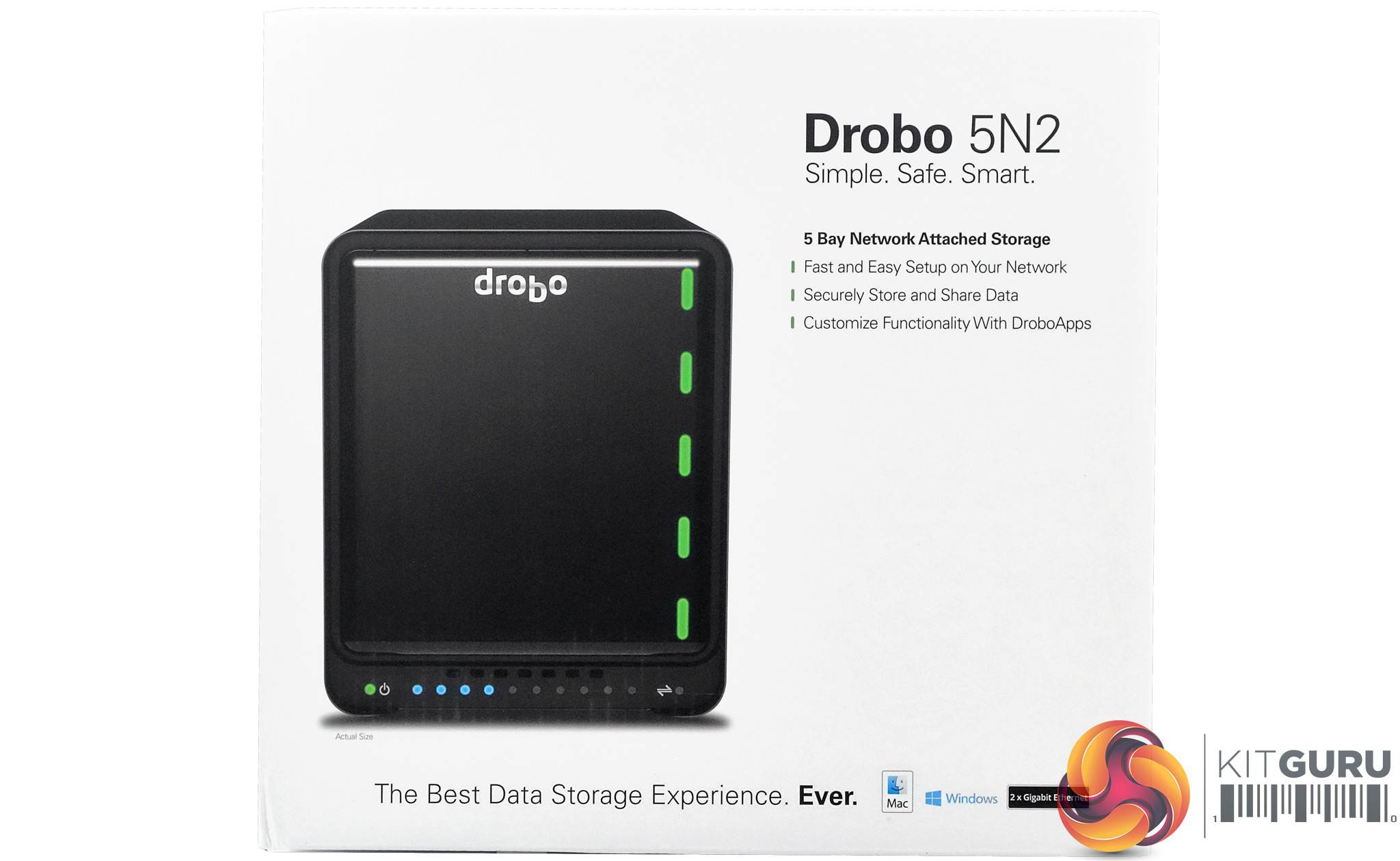
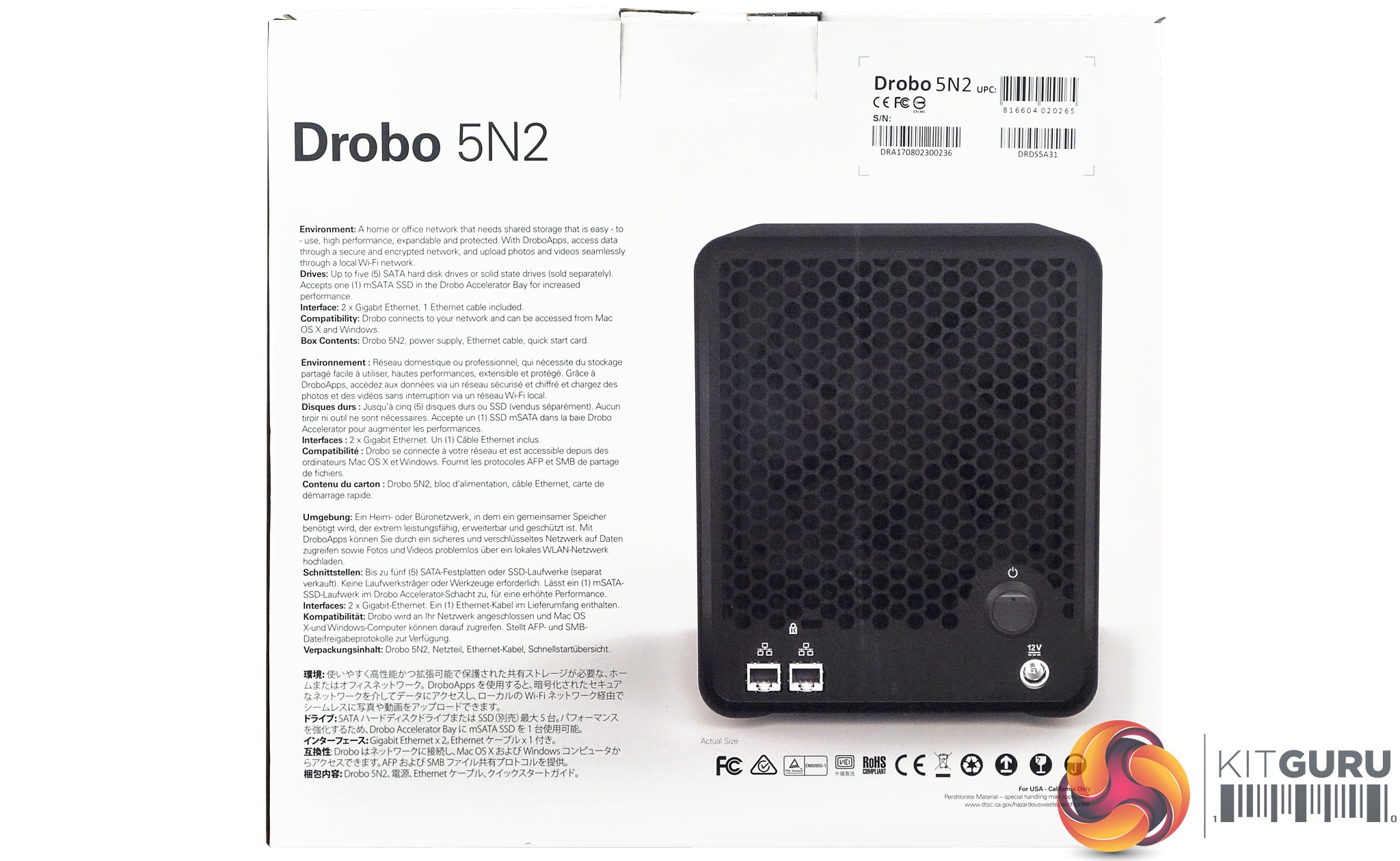
The 5N2 comes in a smart white box with full-size images of the front and back of the unit on the appropriate sides. The rear of the box also has a multilingual list of the units features.
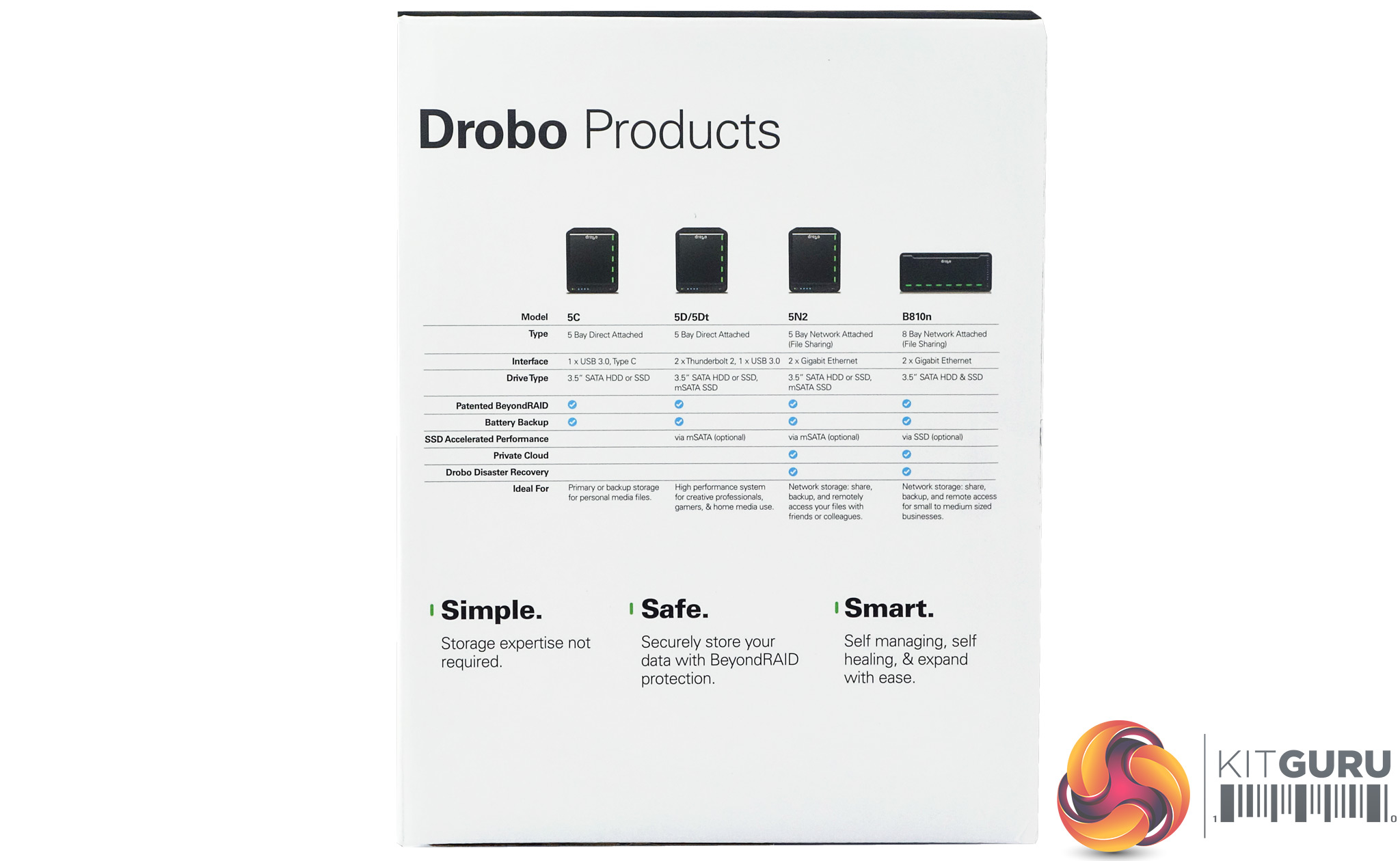
One side of the box has images and specifications of other Drobo devices; the 5C, 5D/5Dt and the B810n as well as the 5N2. The other side of the box has just a Drobo logo on it.
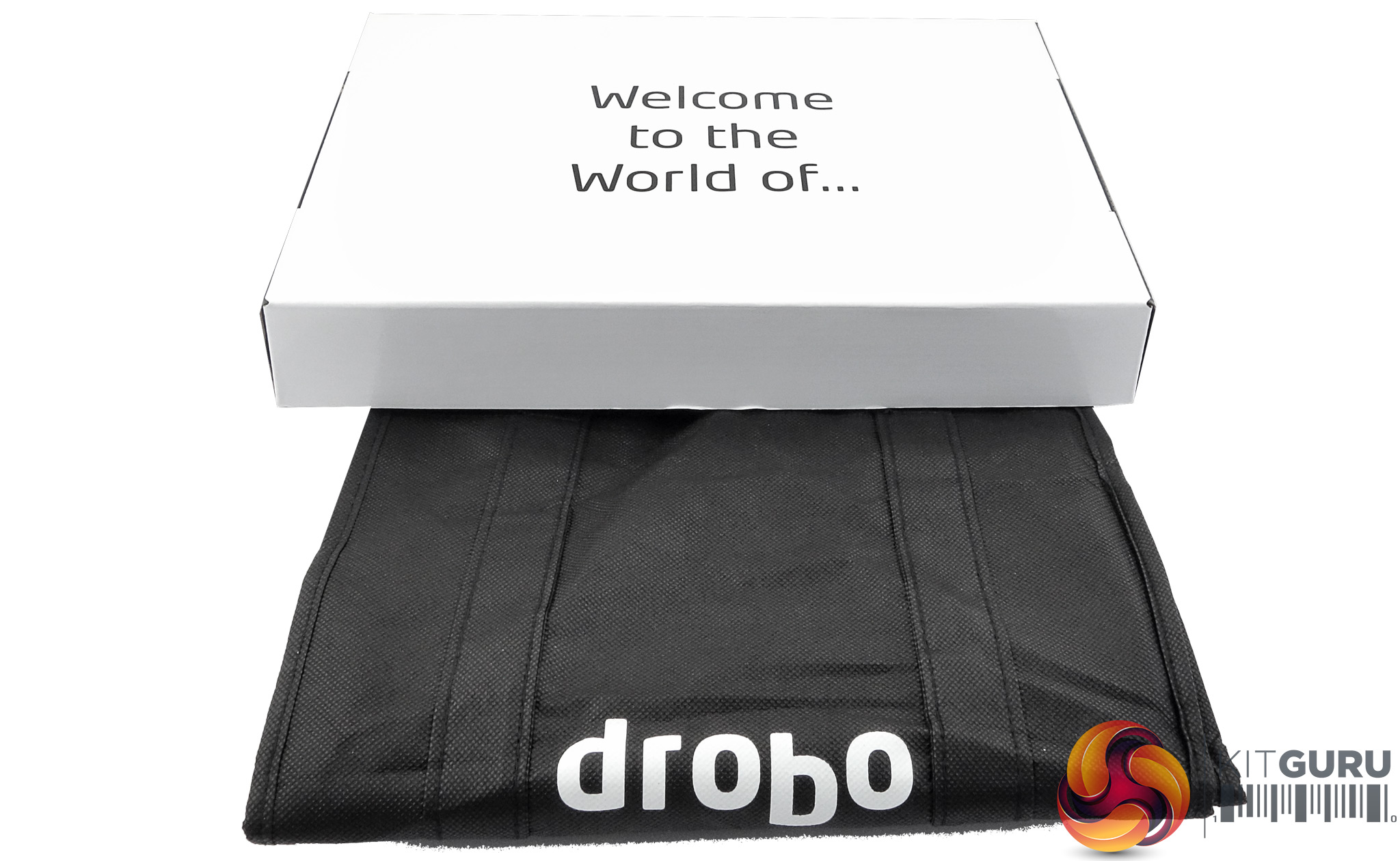
Once you open the box you are confronted by an inner box holding all the bits and pieces to get you started with the 5N2. The NAS itself sits under this box, housed inside a nifty bag, that will come in handy if you ever feel the need to lug the beastie around.
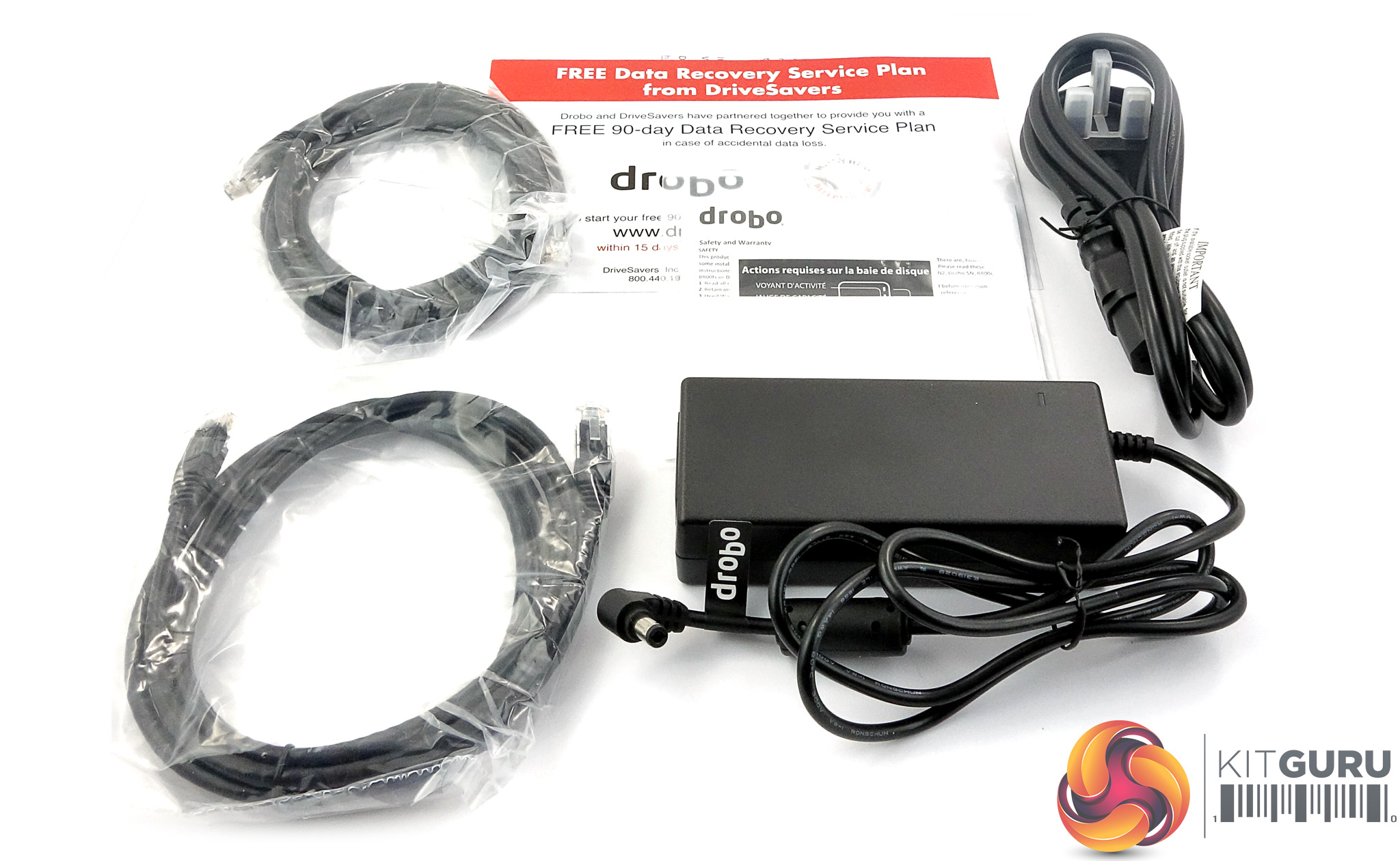
The bundle which comes with the 5N2 comprises of an EDAC EA1101H0120, 120W power adapter, a pair of Ethernet cables, a warranty booklet and at the time of writing an offer for a free 90-day Data Recovery Service Plan.
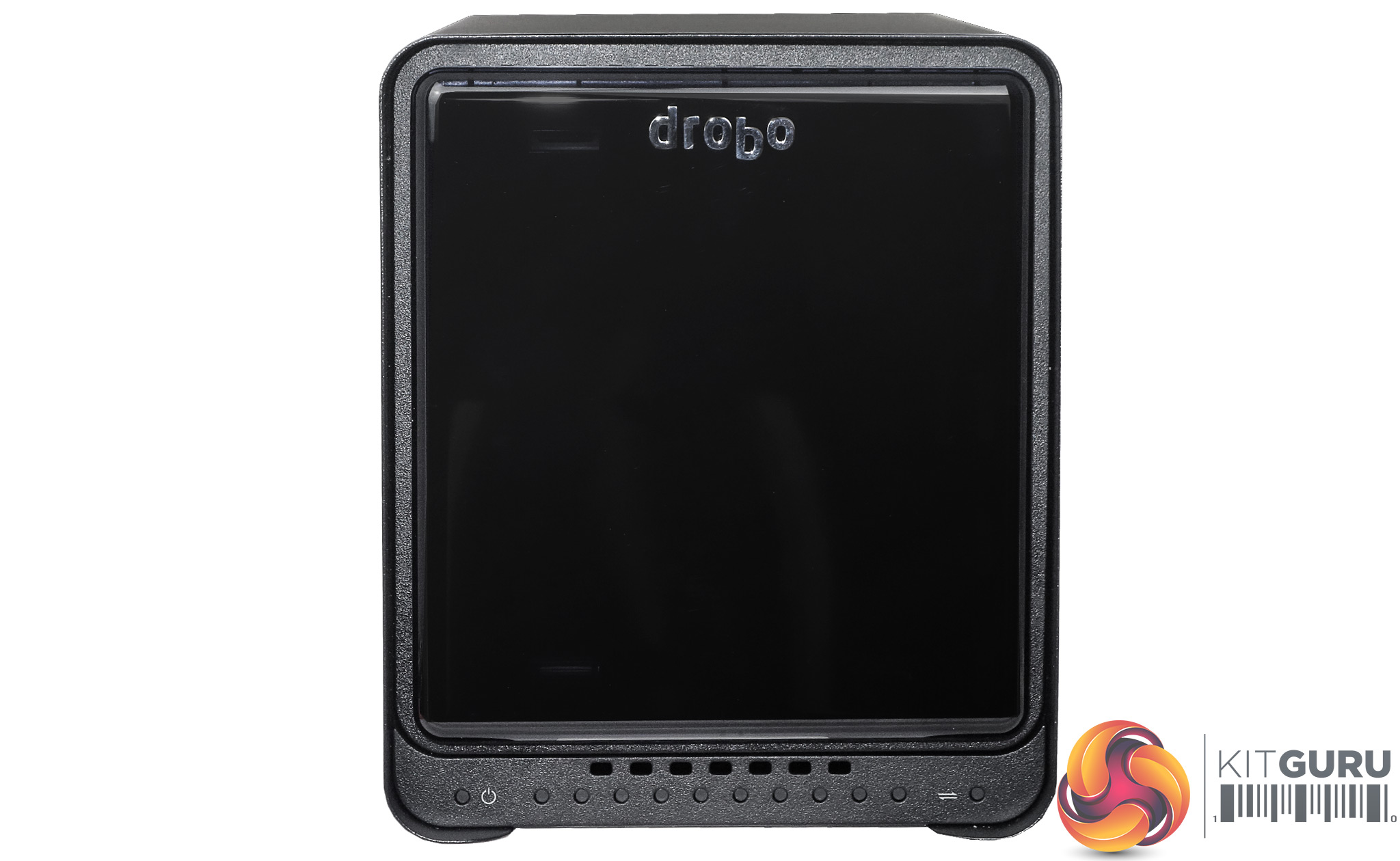
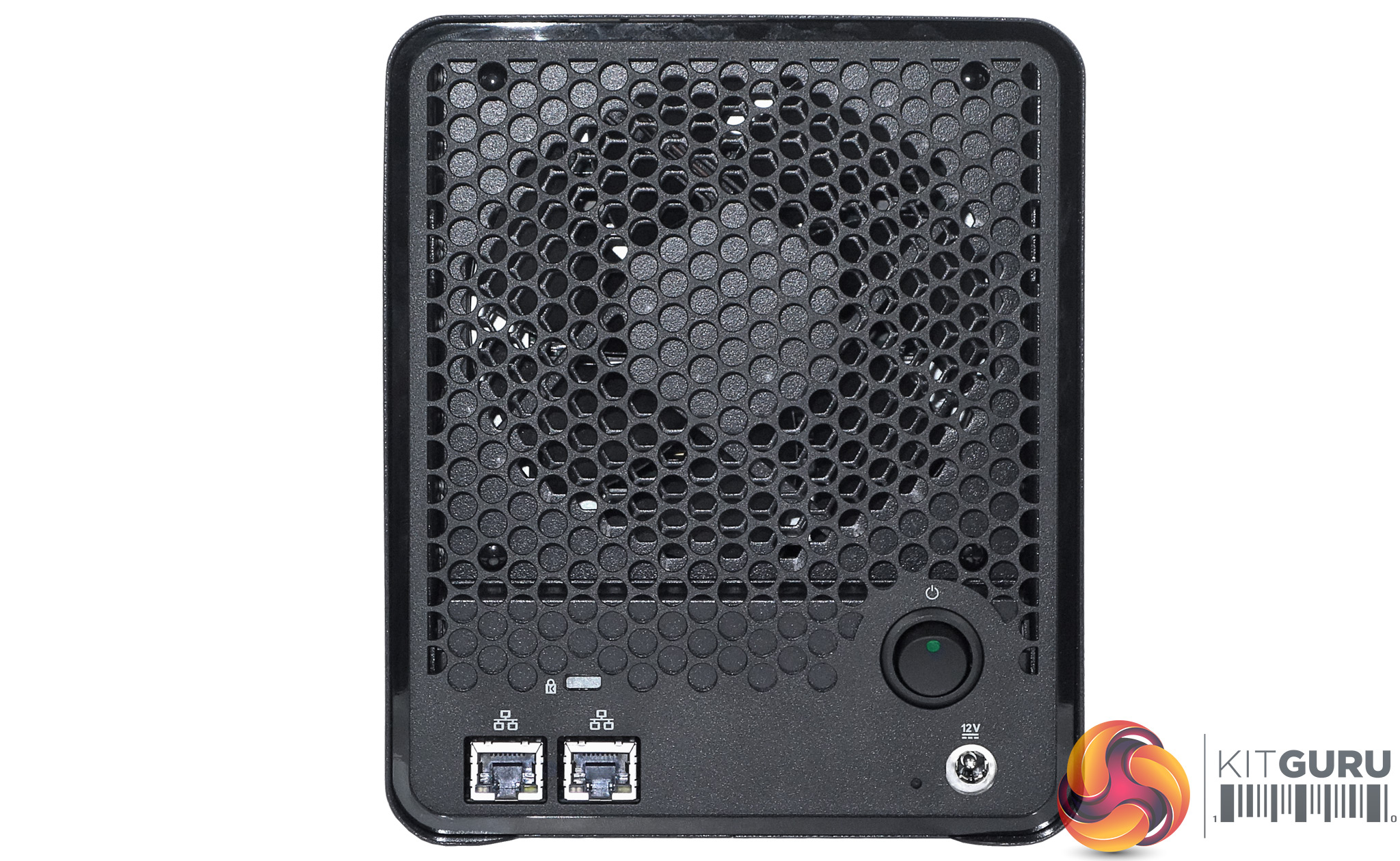
Drobo's 5N2 is a well built and compact five bay tower NAS that is mostly of a metal construction hence its impressive 3.9kg (empty) weight. The detachable front bezel plate is made from good quality plastic, has a shiny finger print attracting Piano Black gloss finish and is held in place by magnets.
Apart from the shiny front bezel, the front of the 5N2 is nothing to write home about – that is until you turn the unit on and it suddenly lights up like the proverbial Christmas tree, with all the indicator LEDS going off at once. The front right-hand side of the unit holds a vertical row of drive bay LEDs which glow green, amber or red depending on the what the drives are up to.
At the base of the front panel sits a row of twelve indicator LEDs. The first one is the power mode indicator (green – power on, yellow – standby, red – over temperature) while the last one indicates data transfer activity. The ten in between these two display the percentage of storage space used and these are blue. You can set the brightness levels for the LEDs in the Drobo Dashboard.
The rear of the unit is dominated by the grill for the cooling fan with the only other things on the rear panel being the port for the power adapter, a pair of Ethernet ports (supporting Link Aggregation) and the power button. That rear-mounted power button will soon have you cursing if you have the Drobo on a shelf or in a cupboard.
The Drobo 5N2 still has no ports to connect an external device to so there’s no way to drop data directly off the unit to an external drive for extra security, which is a bit odd for something designed with the small office environment in mind.
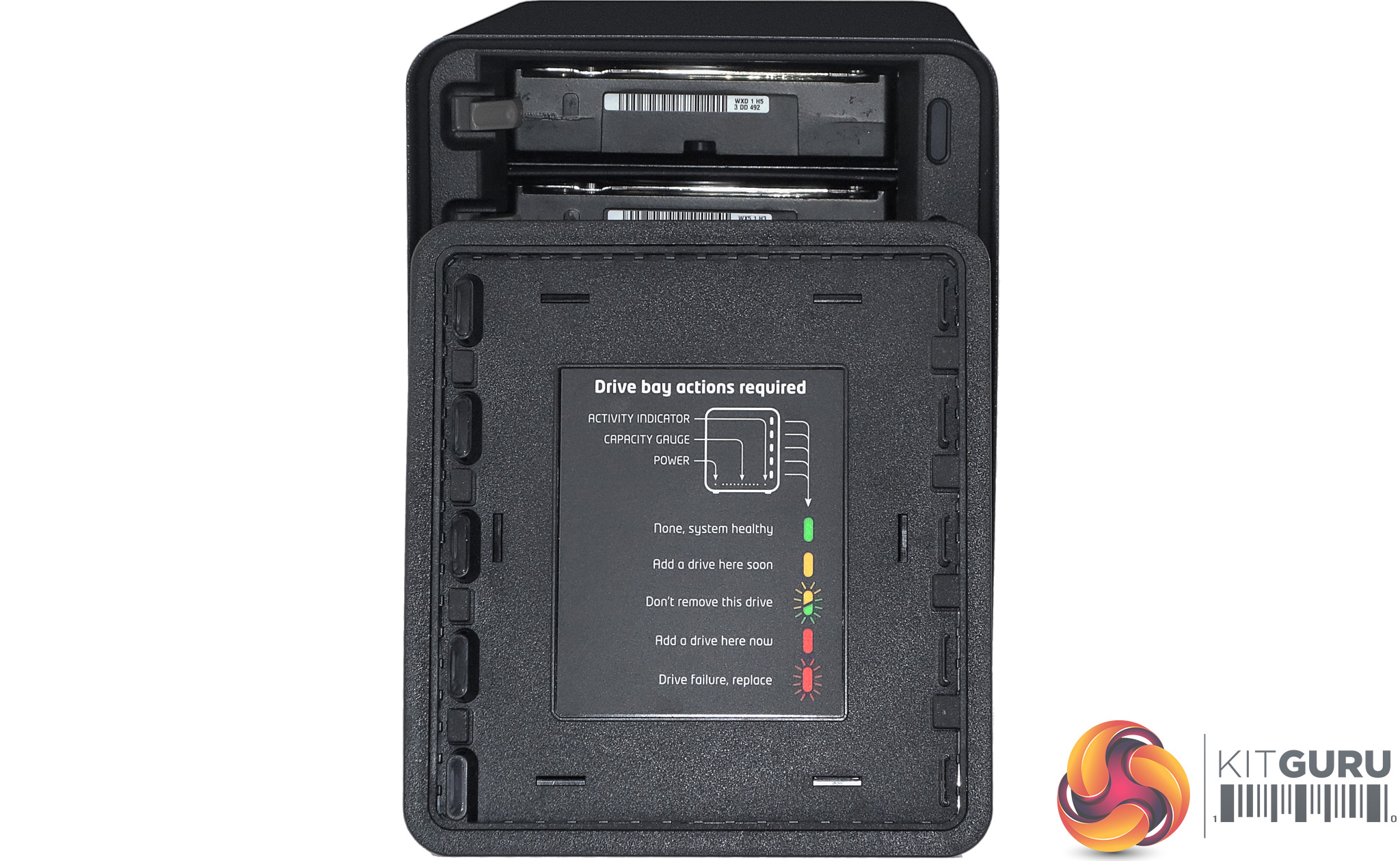
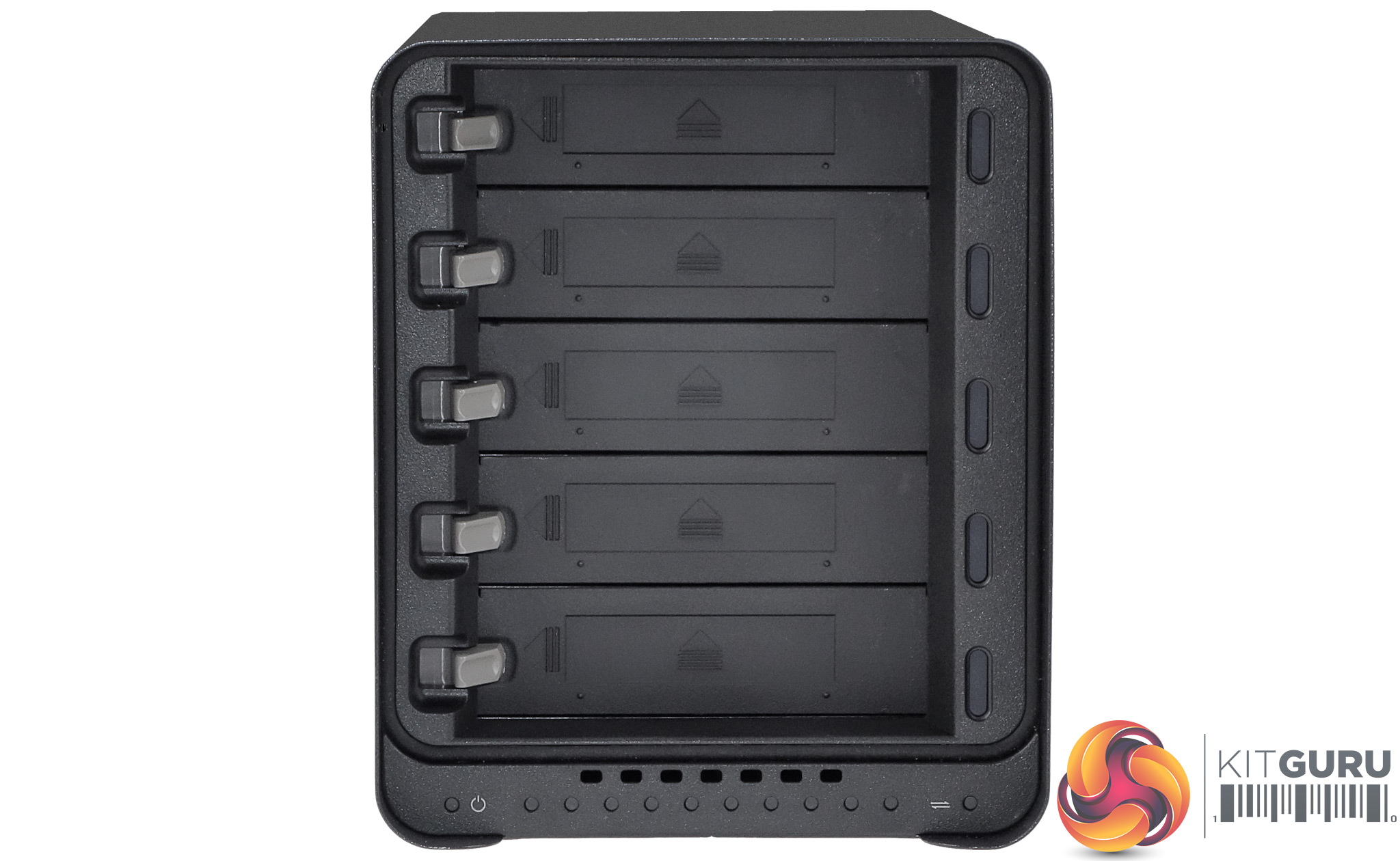
On the inside of the detachable front bezel, there is a useful little schematic that explains what the drive bay LED indicator colours mean and what, if any, action needs to take place. The five drive bays sit behind the detachable front plate and are tool free.
The bays themselves are protected by sprung doors which are forced up and out of the way by pushing a drive into them. Each bay has a latch to hold the drive in place and support drives up to 10TB in capacity but there’s no form of extra physical security in the way of drive bay locks etc which is something to be mindful of if using the Drobo in an office with a lot of through traffic.
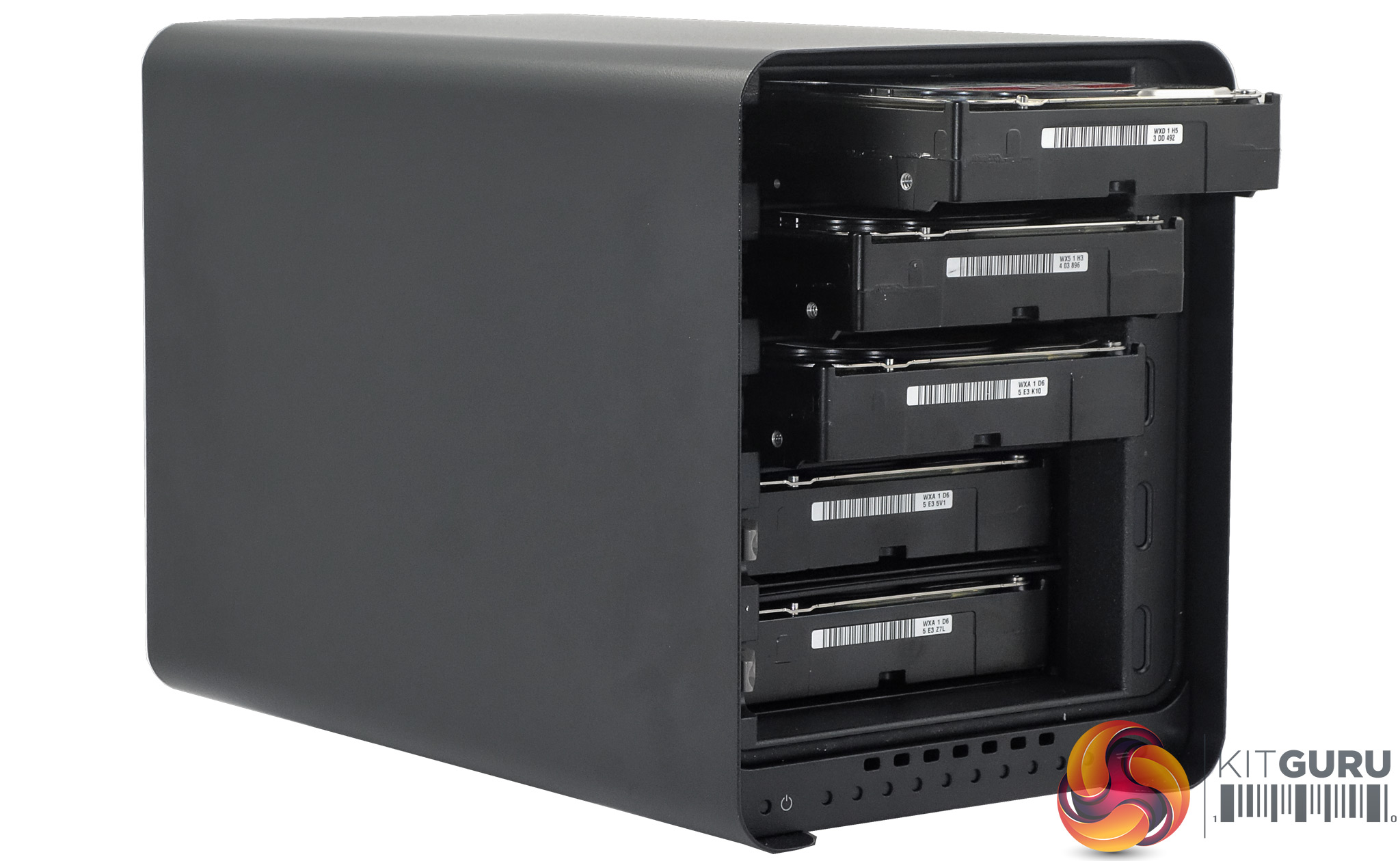
The bays support both 3.5in and 2.5in drives but in the case of 2.5in drives you need to use bay converters. Incidentally, Drobo recommends IcyBox products on their website but we used Startech 25SAT35HDD converters during our tests and they worked perfectly well.
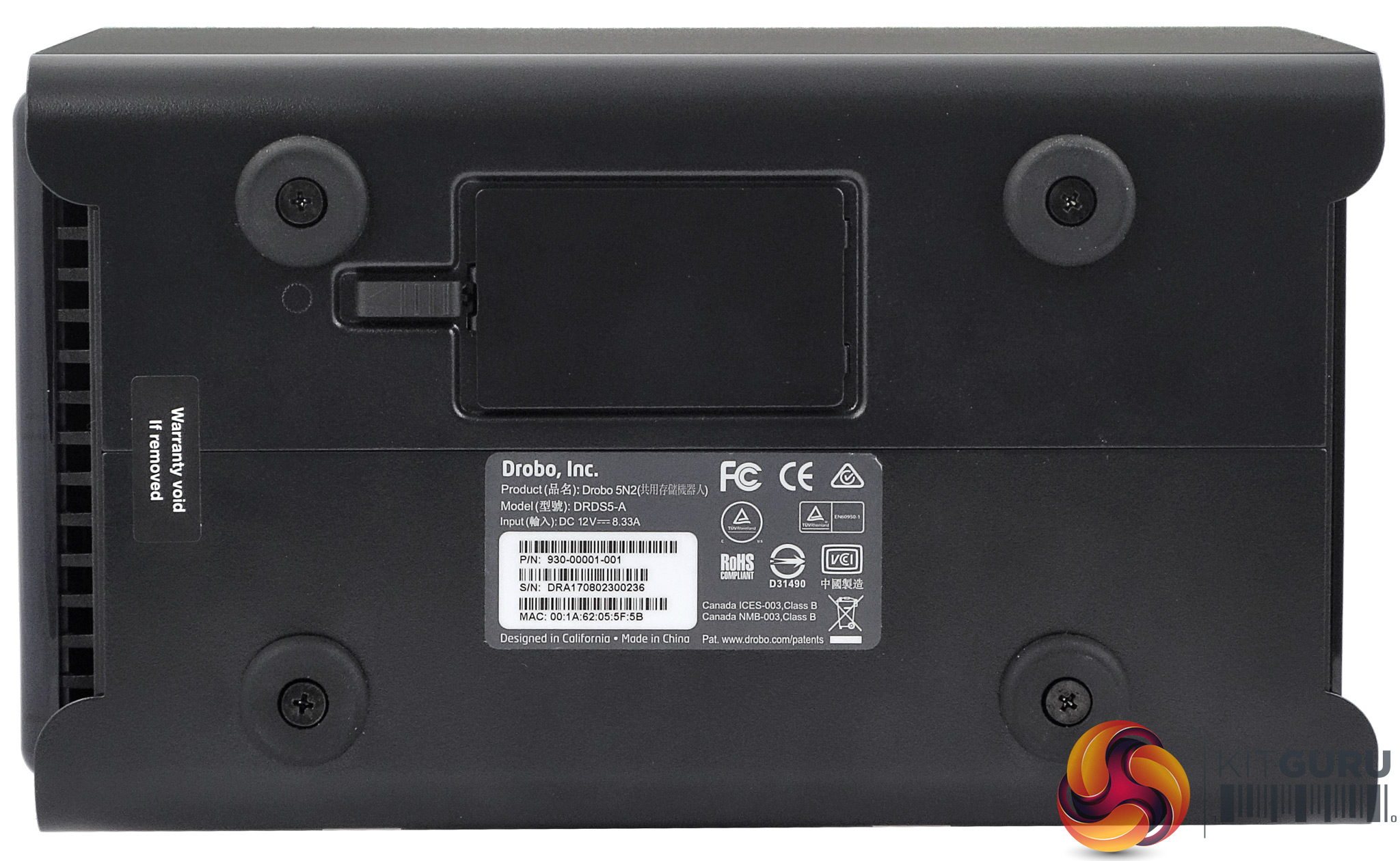
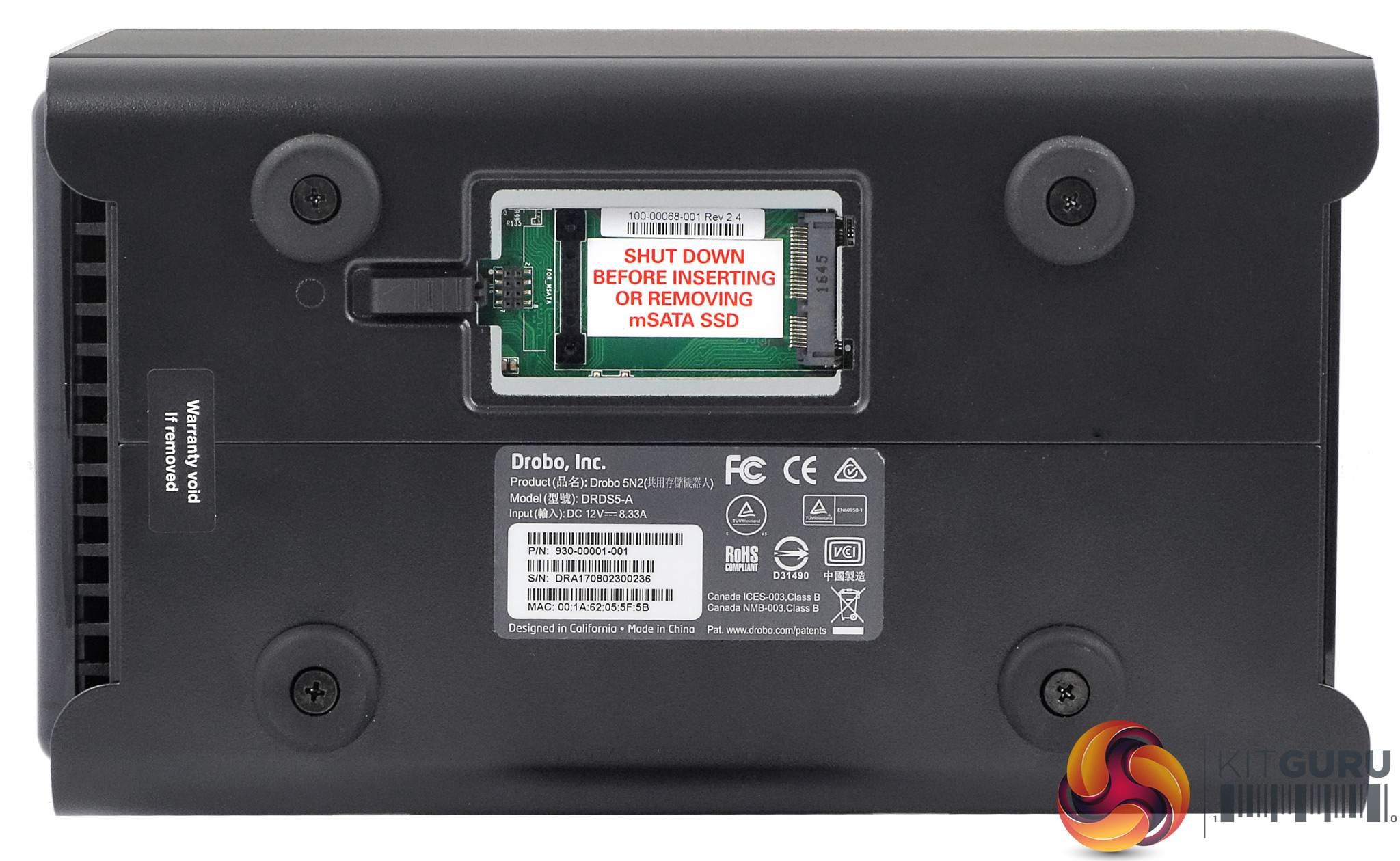
In the base of the 5N2 is what Drobo calls the Accelerator Bay, a compartment that holds an mSATA slot. Access to this compartment is via a small hatch that has a sliding lock to hold in place. Drobo recommends an mSATA drive in the 64GB – 120GB range; going larger provides no real benefit.
At the time of writing the 5N2 does not support SandForce based drives in either the main bays or the Accelerator Bay.
Physical Specifications
Processor: Marvell Armada Quad-core 1.6GHz processor.
Memory: 2GB.
Gigabit Ethernet Ports 2.
Rear panel connectors: 0.
RAID support: none – BeyondRAID technology.
Cooling: active.
Maximum hard drive size supported: 10TB.
Maximum Capacity: 50TB.
Drive bays: 5.
Tool free bays: Yes.
Other drive bays: 1 x mSATA.
Dimensions (D x W x H): 262.3 x 150.3 x 185.4mm.
Weight (empty): 3.9kg.
Warranty: 2 years.
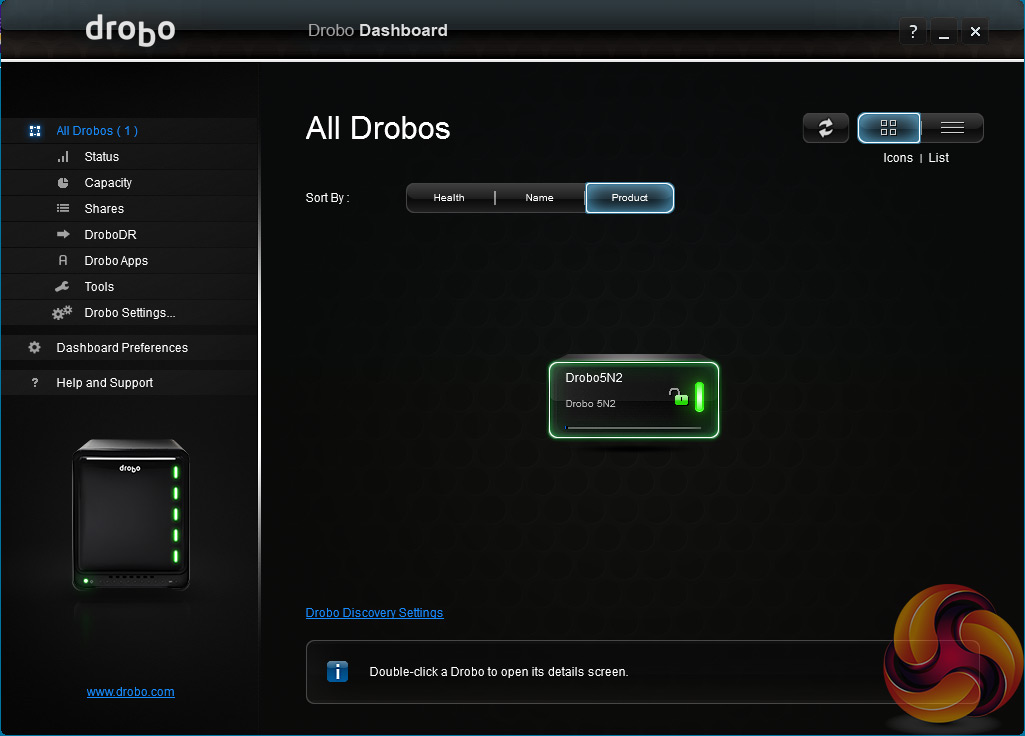
Drobo’s NAS OS is called Dashboard. It’s not as feature rich as say Asustor’s ADM or Synology’s DSM but crucially it’s easy to navigate through and covers most of the basics really well. What it does do rather cleverly is to make use of animated graphics to display individual drive status.
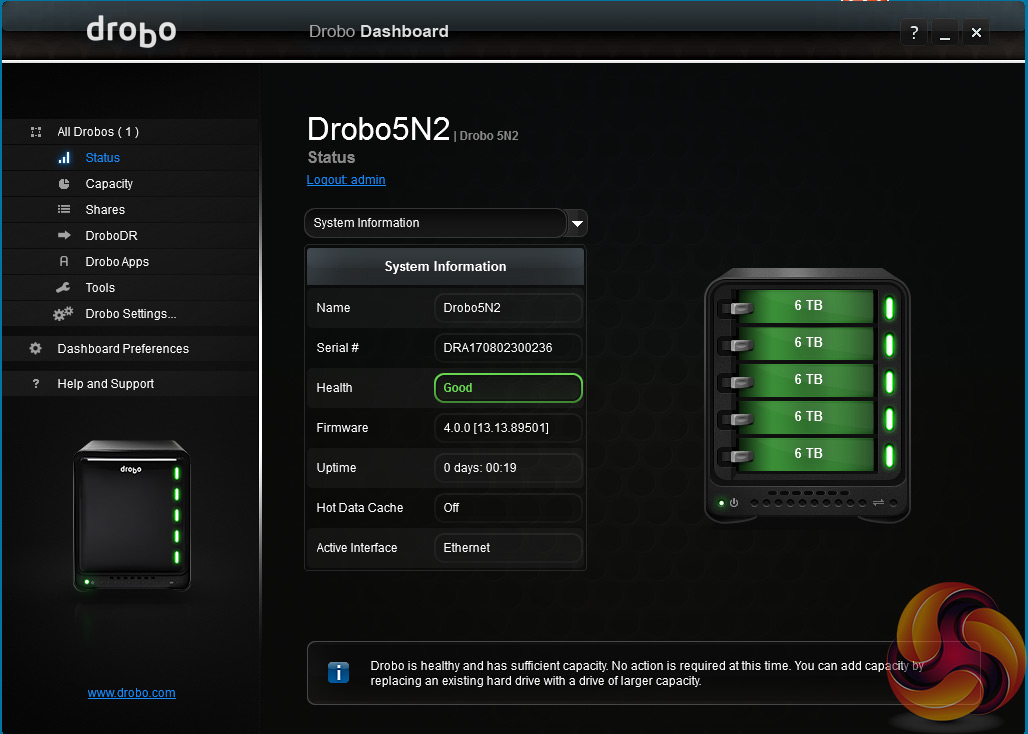
The right-hand side of Dashboard main page has an image of the Drobo with the front bezel removed revealing the drive bays. The image is animated so it mimics what the Drobo is doing, for example, if the drive indicators on the unit are green so are the drive bays in the image, if they should start to flash on the unit, the animation follows suite. There is a smaller animated image of the unit on the right-hand side that does the same.
Drobo DR
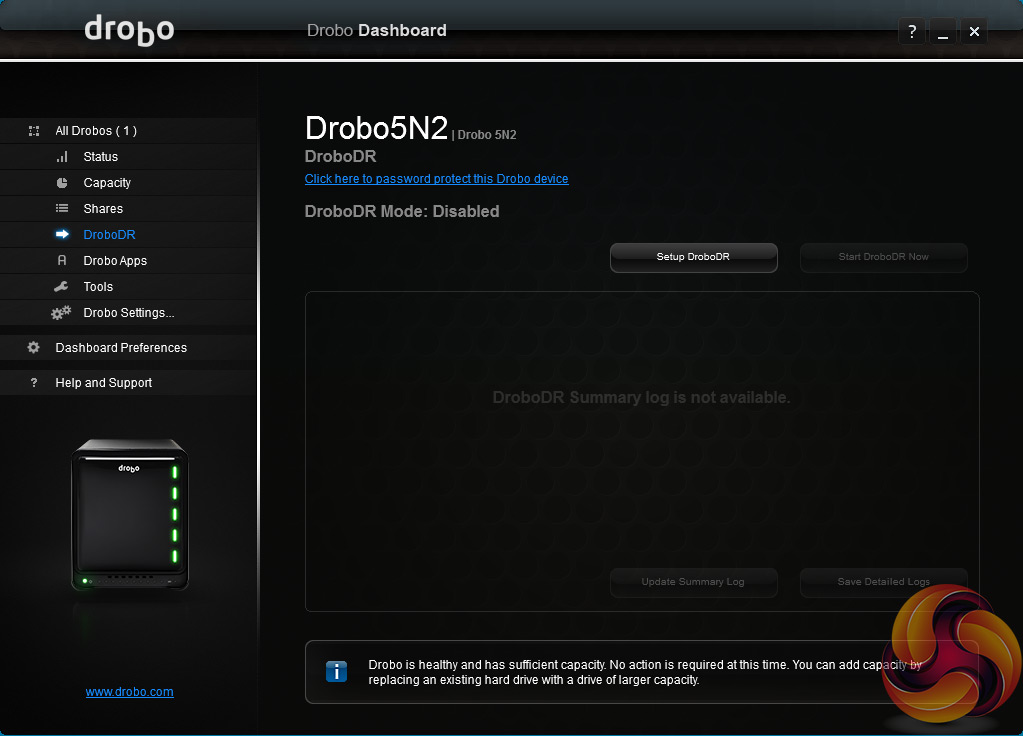
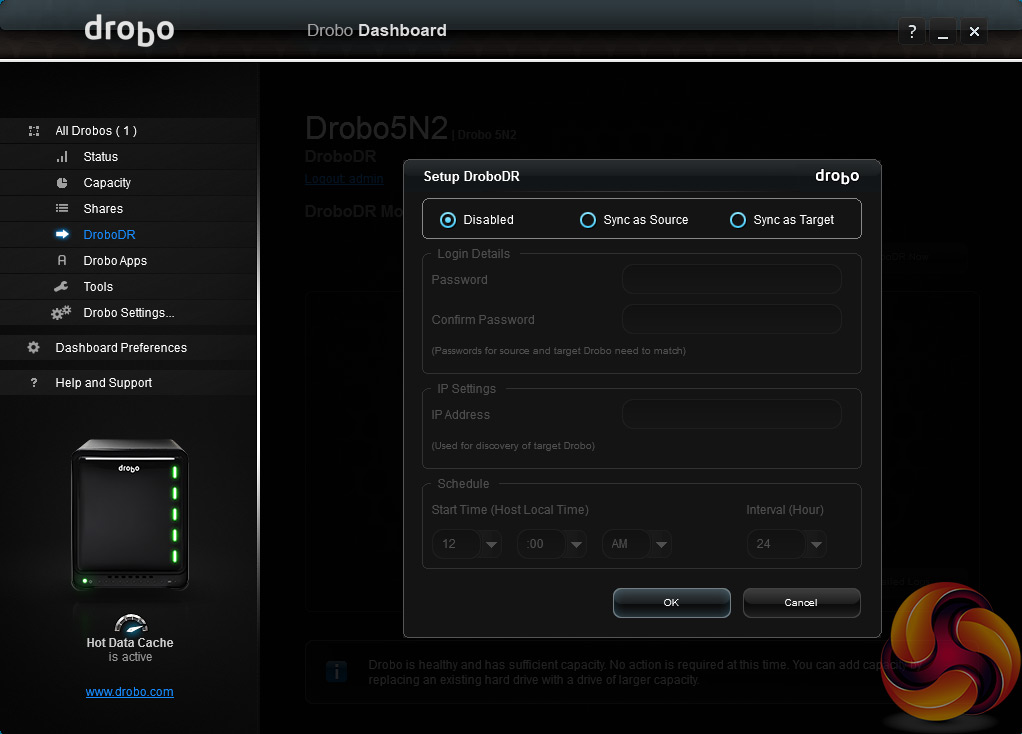
With Drobo's Disaster Recovery feature, you copy data from one 5N2 to another either on the same network or at a remote location via a VPN connection. After the initial copying of the data, DroboDR only updates the receiving unit with any changes made to the original data. The remote 5N2 also stores the user account details so should the worst happen, recovery is that much easier.
Drobo Apps
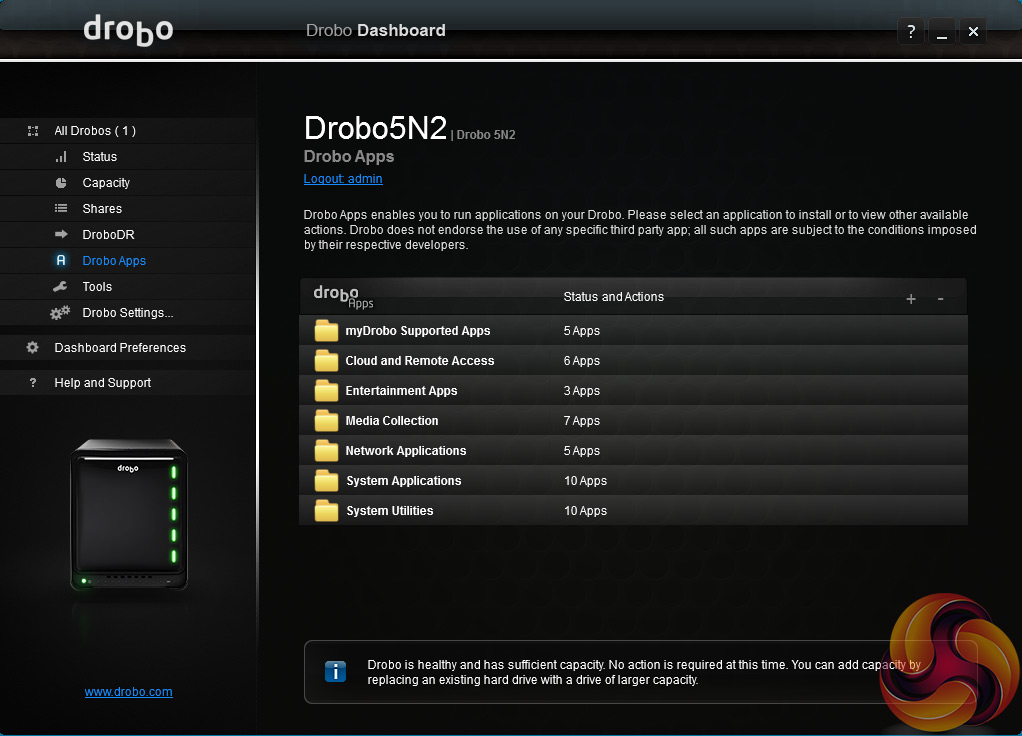
When we reviewed the 5N, the apps section of Dashboard just had a list of apps to scroll through. However, the latest 3.0.0 version of the software we downloaded for the 5N2 sees the apps grouped into folders depending on their usage, a much better solution. Although still nowhere near the number of apps provided by Asustor, Synology or QNAP for example, there are some useful bits of software on the list:-
myDrobo Supported Apps: myDrobo, DroboAccess, Drobopix, Koken, WordPress.
Cloud & Remote Access: BitTorrent Sync, ElephantDrive, ownCloud, Pydio, Resilio Sync.
Entertainment: Firefly, MiniDLNA, Plex.
Media Collection: Aria2, CouchPotato, Headphones, NZBGet, SABnzbd, SickBeard, Transmisson
Network: Koken, Modoboa Mailserver, NFSv3, ProFTPd, WordPress
System Applications: Apache, Java 8, Locale, Mono 4, MySQL, Node.js, Perl5, Python 2 (2.7.11), Python 3 (3.4.3), Ruby 2
System Utilities: P7zip, Bash, Dropbear, Git SCM, htop, Midnight Commander, Nano Par2, Screen, subversion.
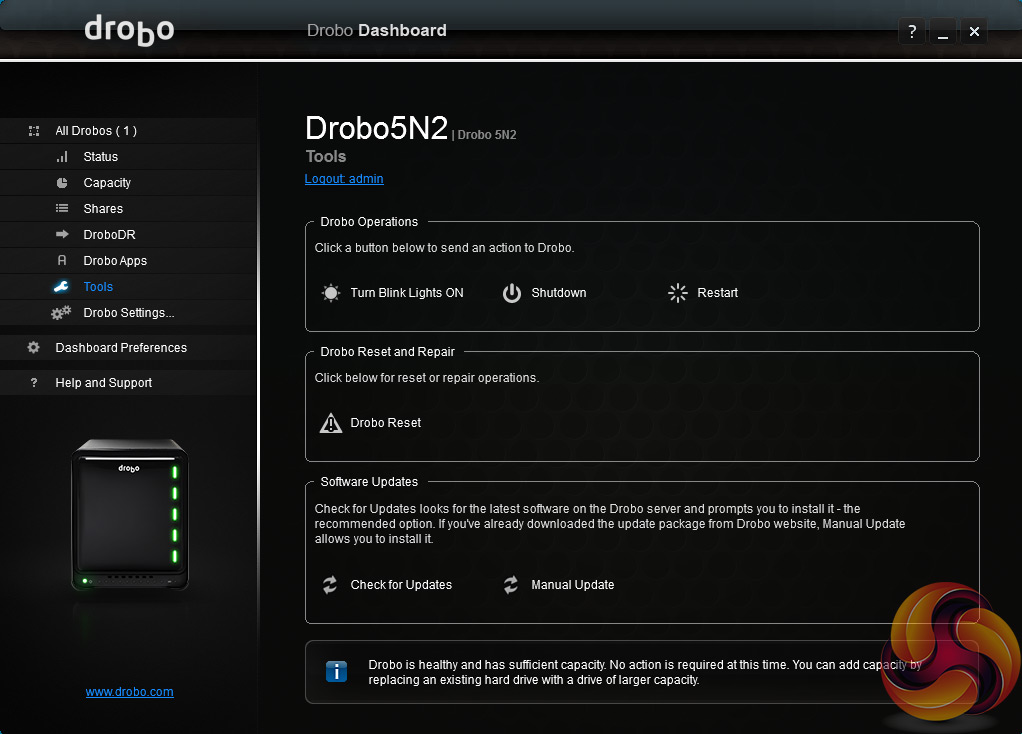
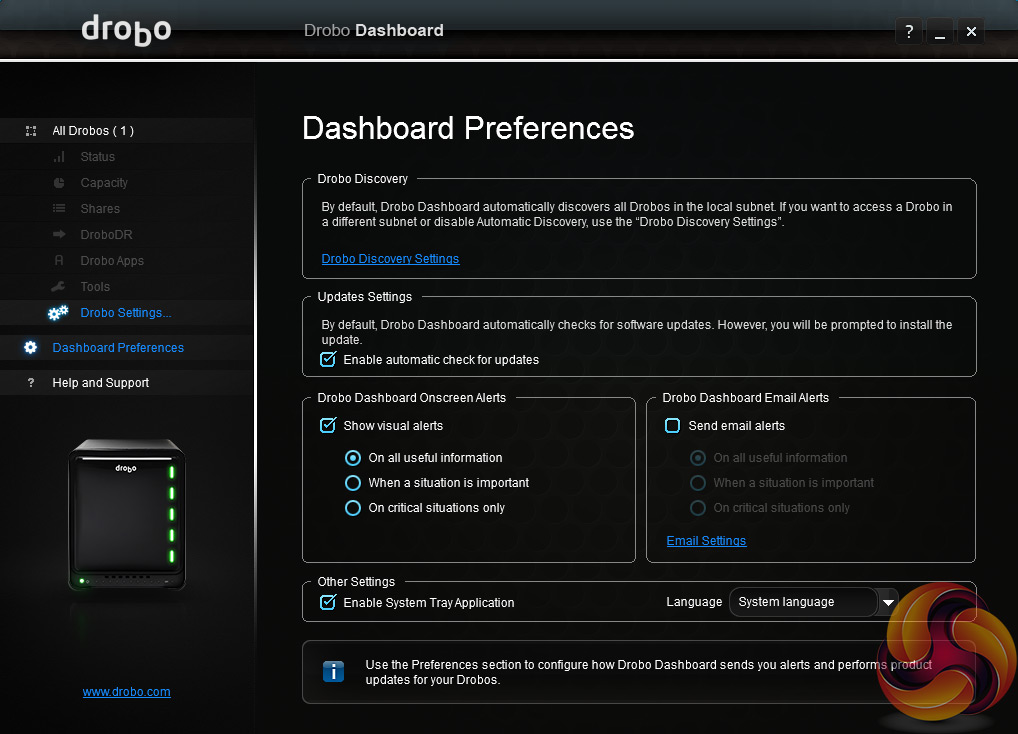
In the Tools section, you can shut down and restart the 5N2, reset it and check online for updates and install them or search for updates already downloaded and install them once found. The Dashboard Preferences page allows you to configure update settings, on-screen alerts or set up email alerts.
Features
myDrobo – end to end secure access the internet.
Drobo Apps
DroboAccess – access to files on a Drobo from a web browser, or a mobile device.
DroboPix – automatically upload photos and videos from Android or iOS device to a NAS Drobo.
DroboDR – Disaster Recovery.
The Drobo 5N2 is really easy and straightforward to set up. Once the drives are loaded it's a matter of downloading Drobo's Dashboard OS and begin the install. Once the installation starts, the main Dashboard screen appears with an icon of the 5N2 complete with yellow alert lights. Once the install is complete, the yellow lights turn green. The whole procedure takes around 20 minutes to complete.
Increase Capacity
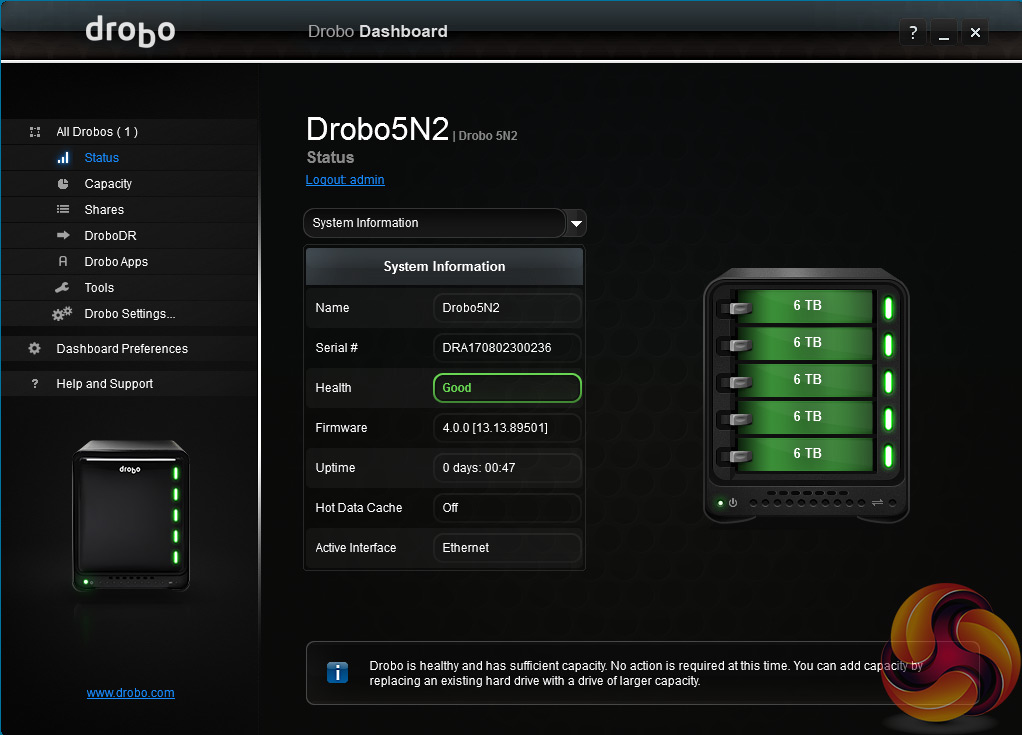
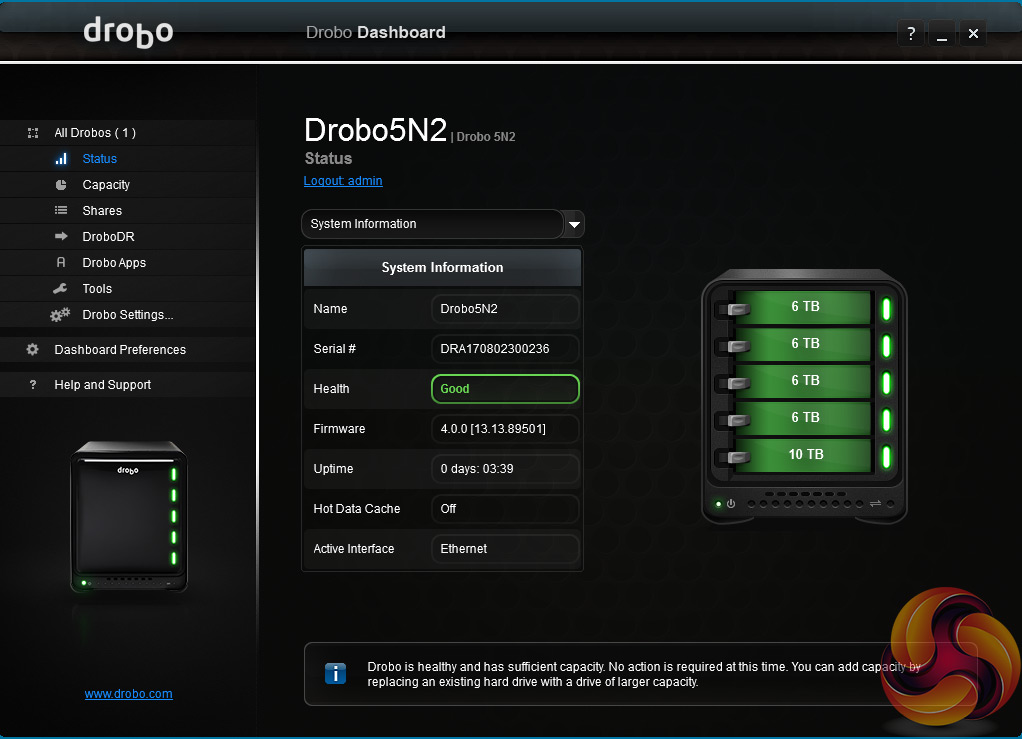
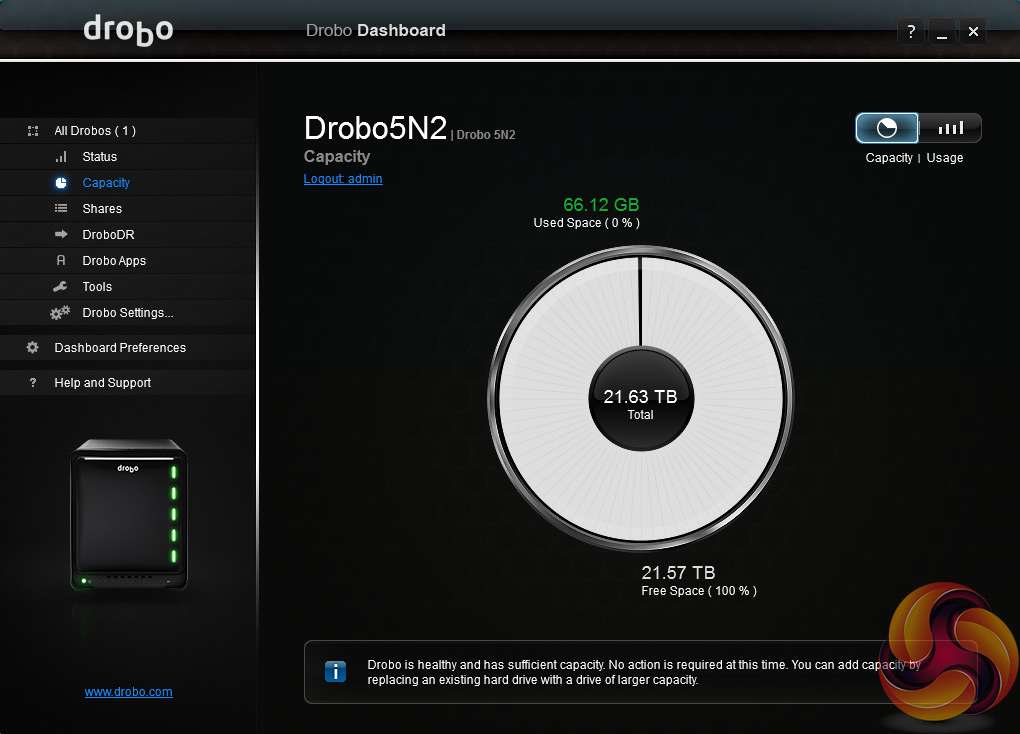
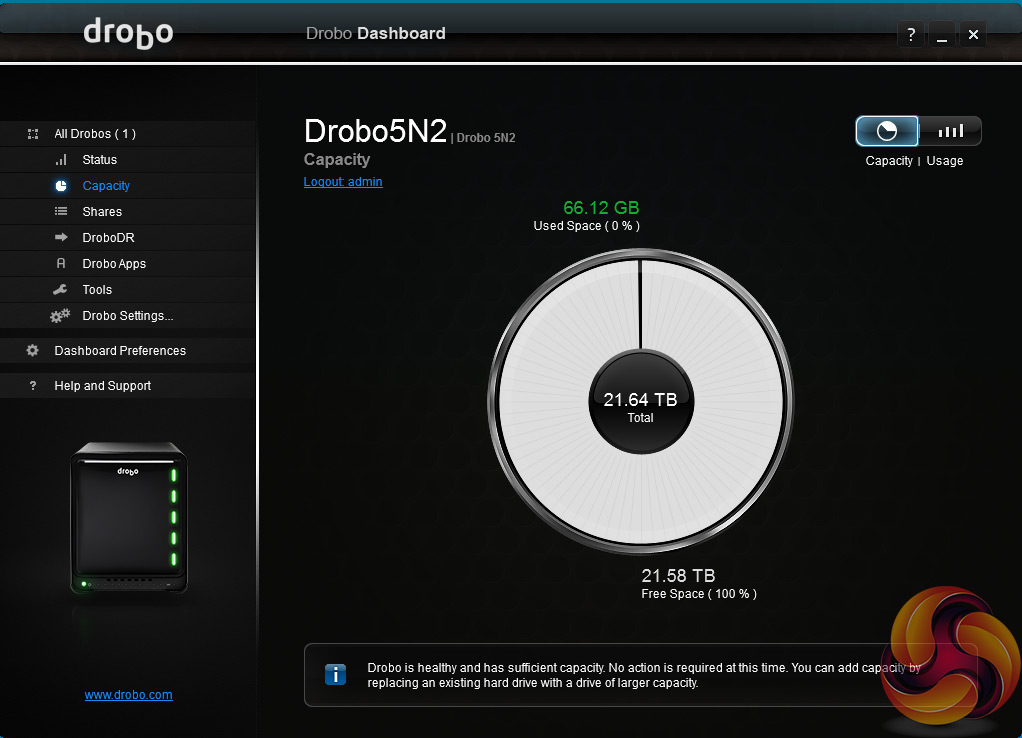
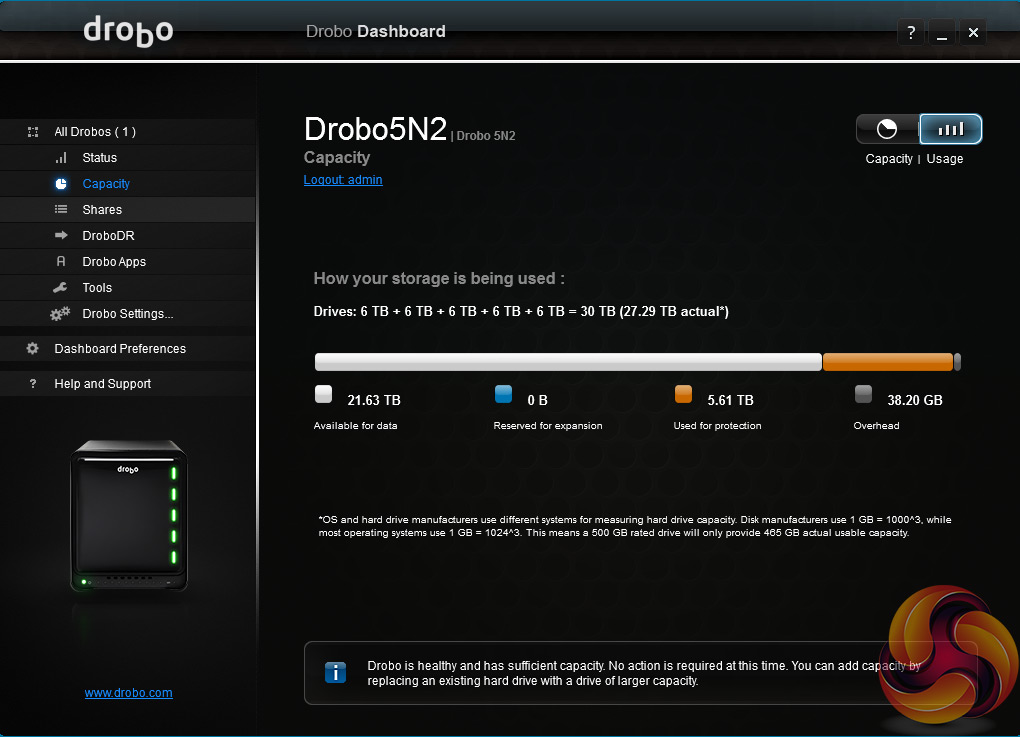
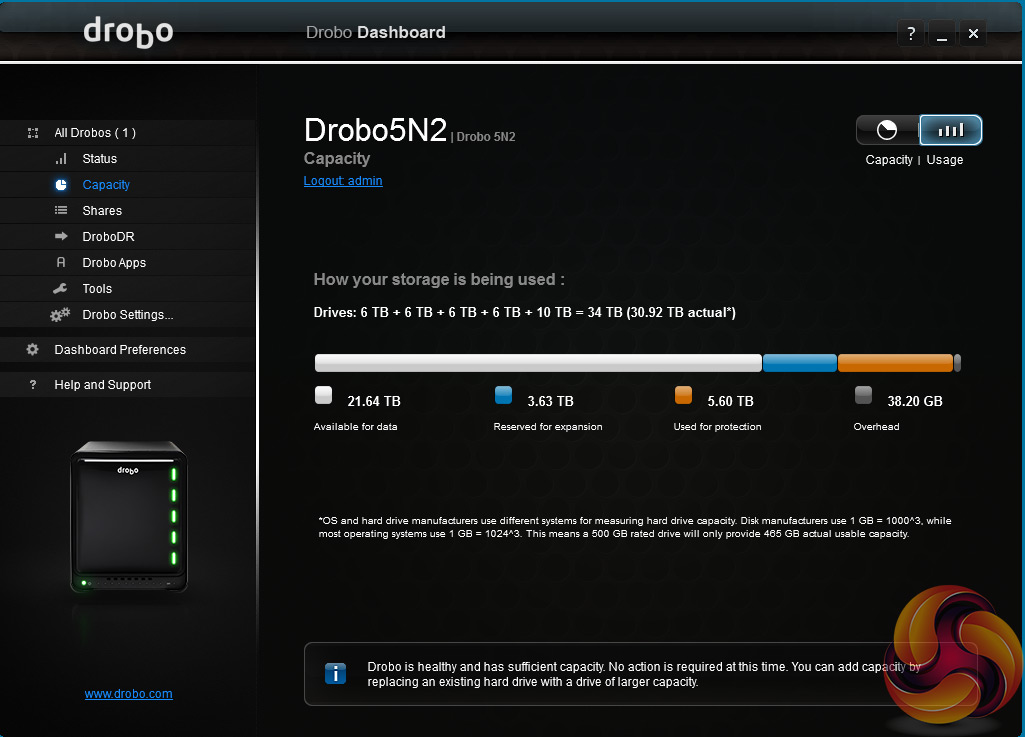
One of the real joys of the BeyondRAID technology is the ease at which you can increase the capacity of the 5N2. You either just sick a drive in an empty drive bay or failing that, simply take the lowest capacity drive out of the system and add a new larger drive.
Now the clever bit is that you can do this on the fly, no need to turn the device off or back up any data, indeed you can still access your data while the unit is rebuilding the storage.
It doesn't hang about while it's doing either. For instance, we took out a 6TB drive out of the 5N2 and replaced it with a 10TB drive and 25 minutes later the storage was rebuilt.
Single to Dual Disk Redundancy.
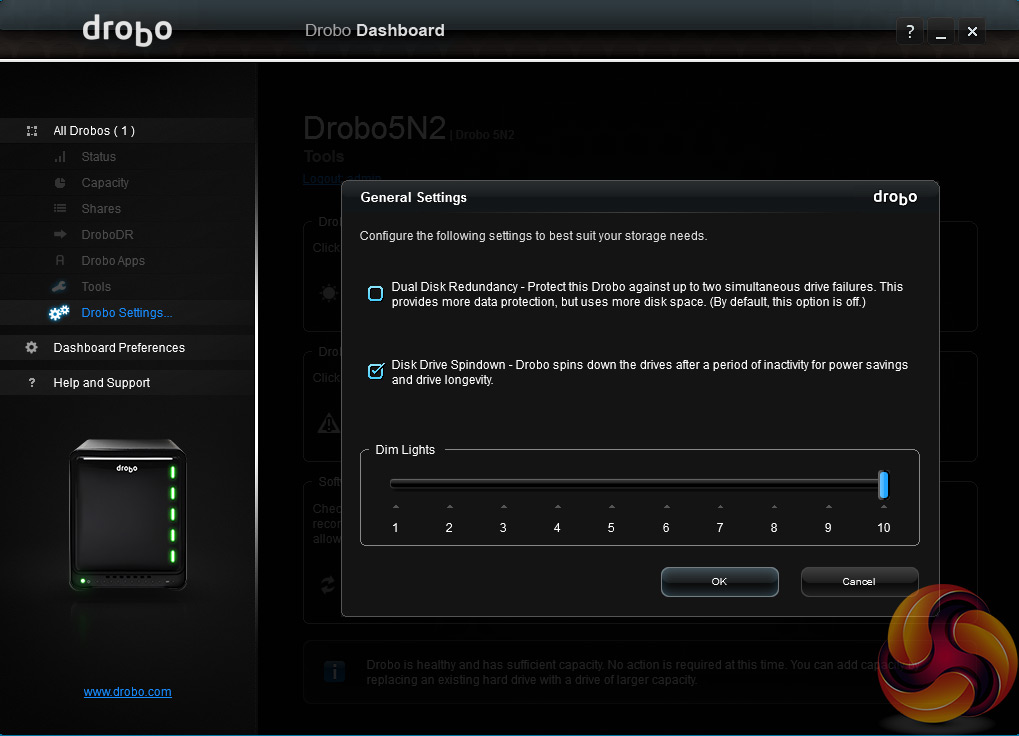
Switching from the default single disk redundancy to dual redundancy is a nothing more complicated than a single mouse click. Once again it's done on the fly and data can be accessed while the 5N2 is converting between redundancy modes.
As the Drobo 5N2 doesn't support RAID in the conventional sense, we made up three disk sets to test it with. Drobo supplied two Seagate drives with the unit so we added another three random disks ( 1 x WD Red 6TB, 1 x WD Red 8TB and 1 x Seagate IronWolf 10TB) to show the flexibility of the BeyondRAID technology. We tested each disk set in the default Single Disk Redundancy mode and again in the optional Dual Disk Redundancy Mode using a single Ethernet connection.
Disk Set 1 – 5 x HDD mix
1 x Seagate NAS 3TB (ST3000VN000, 5,900rpm 64MB cache)
1 x Seagate Desktop 4TB (ST4000DM00, 5,900rm, 64MB cache)
1 x WD Red 6TB (WD60EFRX, 5,400rpm 128MB cache)
1 x WD Red 8TB (WD80EFZX 5,400rpm 128MB cache)
1 x Seagate IronWolf 10TB (ST10000VN004, 7,200rpm, 256MB cache)
Disk Set 2 – 5 x HDD same drives
5 x WD Red 6TB (WD60EFRX, 5,400rpm 128MB cache)
Disk Set 3 – 4 x SSD mix (using Startech 25SAT35HDD bay converters)
3 x Samsung SSD845DC 960GB (MZ-7GE960EW)
1 x Crucial MX300 2TB (CT2050MX300SSD1)
Software:
Atto Disk Benchmark.
CrystalMark 3.0.3.
IOMeter.
Intel NASPT.
To test real life file/folder performance we use a number of different file/folder combinations to test the read and write performance of the NAS device. Using the FastCopy utility to get a MB/s and time taken for each transfer, the data is written from and read back to a 240GB SSD.
60GB Steam folder: 29,521 files.
50GB Files folder: 28,523 files.
12GB Movie folder: 24 files – mix of Blu-ray and 4K files.
10GB Photo folder: 621 files – mix of .png, .raw and .jpeg images.
10GB Audio folder: 1,483 files – mix of .mp3 and .flac files.
Crystalmark is a useful benchmark to measure theoretical performance levels of hard drives, SSD’s and other storage devices.We are using V3.0.3.
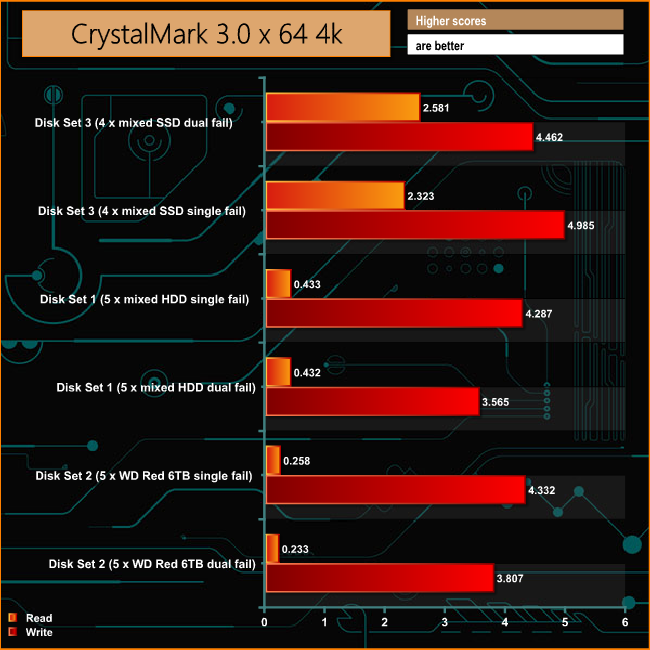
It's no real surprise to see the SSD disk sets completely outperforming the HDD sets when it comes to reading the very small files of everyday use as can be seen by the read result of CrystalDiskMark's 4K test. The faster spin speeds of 3 out of the 5 disks in the mixed HDD disk set give it the edge over the WD Red set when it comes to read performance.
The ATTO Disk Benchmark performance measurement tool is compatible with Microsoft Windows. Measure your storage systems performance with various transfer sizes and test lengths for reads and writes. Several options are available to customize your performance measurement including queue depth, overlapped I/O and even a comparison mode with the option to run continuously.
Use ATTO Disk Benchmark to test any manufacturers RAID controllers, storage controllers, host adapters, hard drives and SSD drives and notice that ATTO products will consistently provide the highest level of performance to your storage.
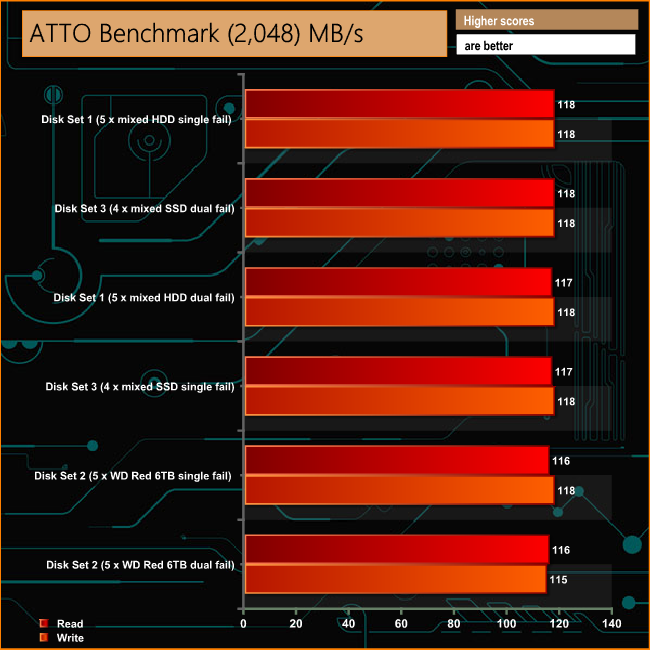
The results from the ATTO benchmark shows that it doesn't matter what type of drive mix you use, the BeyondRAID technology in the Drobo 5N2 builds them into effective arrays, all of which topped 100MB/s for reads and writes.
Intel’s NASPT (NAS Performance Toolkit ) is a benchmark tool designed to enable direct measurement of home network attached storage (NAS) performance. NASPT uses a set of real world workload traces (high definition video playback and recording, video rendering/content creation and office productivity) gathered from typical digital home applications to emulate the behaviour of an actual application.
We’ve used some of the video and office apps results to highlight a NAS device’s performance.
HD Video Playback
This trace represents the playback of a 1.3GB HD video file at 720p using Windows Media Player. The files are accessed sequentially with 256kB user level reads.
4x HD Playback
This trace is built from four copies of the Video Playback test with around 11% sequential accesses.
HD Video Record
Trace writes an 720p MPEG-2 video file to the NAS. The single 1.6GB file is written sequentially using 256kB accesses.
HD Playback and Record
Tests the NAS with simultaneous reads and writes of a 1GB HD Video file in the 720p format.
Content Creation
This trace simulates the creation of a video file using both video and photo editing software using a mix of file types and sizes. 90% of the operations are writes to the NAS with around 40% of these being sequential.
Office Productivity
A trace of typical workday operations. 2.8GB of data made up of 600 files of varying lengths is divided equally between read and writes. 80% of the accesses are sequential.
Photo Album
This simulates the opening and viewing of 169 photos (aprrox 1.2GB). It tests how the NAS deals with a multitude of small files.
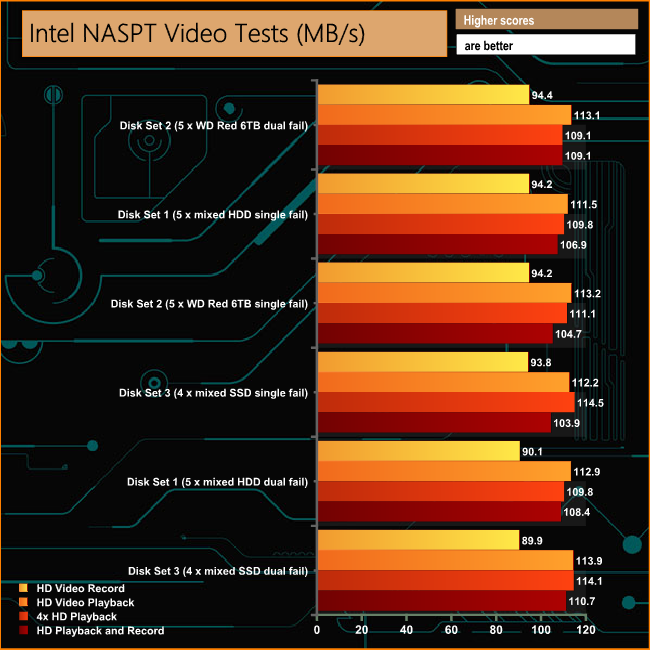
The Drobo 5N2 shows a great deal of consistency across the disk types and single/dual disk redundancy options in the Intel's NASPT video tests.
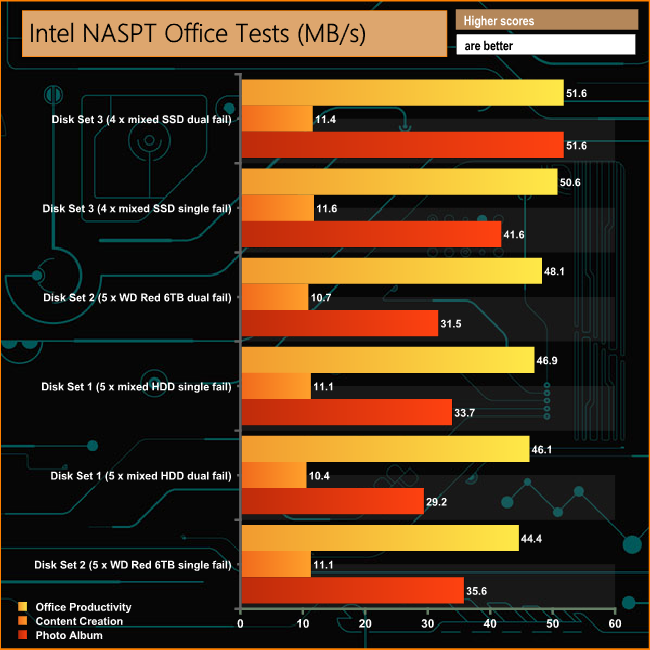
No real surprise here to see the SSD-based disk setups having the advantage when it comes to dealing with the small bity files of the Office Productivity tests and the multitude of small files in the Photo Album tests.
IOMeter is another open source synthetic benchmarking tool which is able to simulate the various loads placed on hard drive and solid state drive technology.
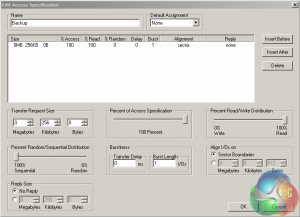
We set IOmeter up (as shown above) to test both backup and restore performance on a 100GB partition.
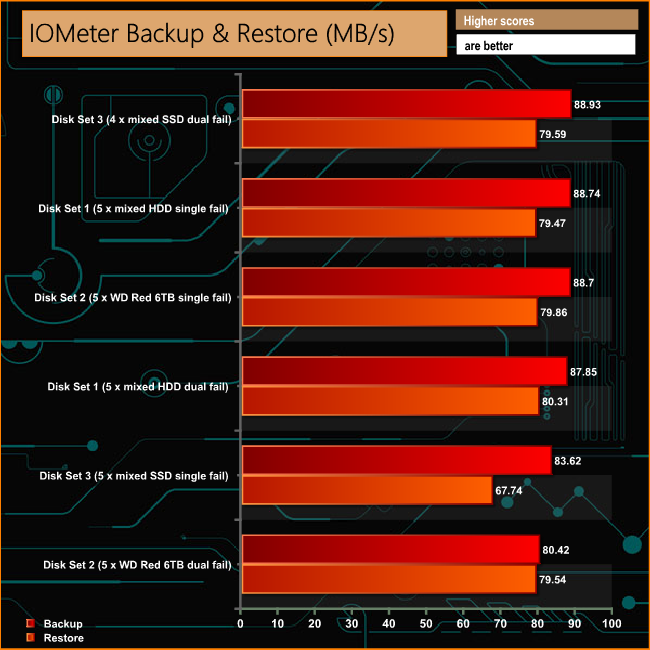
The 5N2 dealt fairly easily with our backup/restore test showing a good level of consistency across all the disk sets with the exception of the performance of the mixed SSD drive set in single disk redundancy mode which dropped off in the restore test.
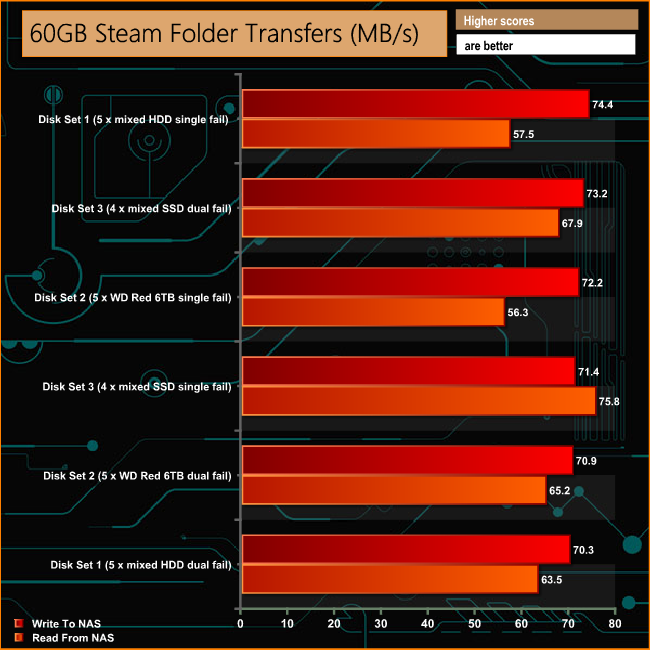
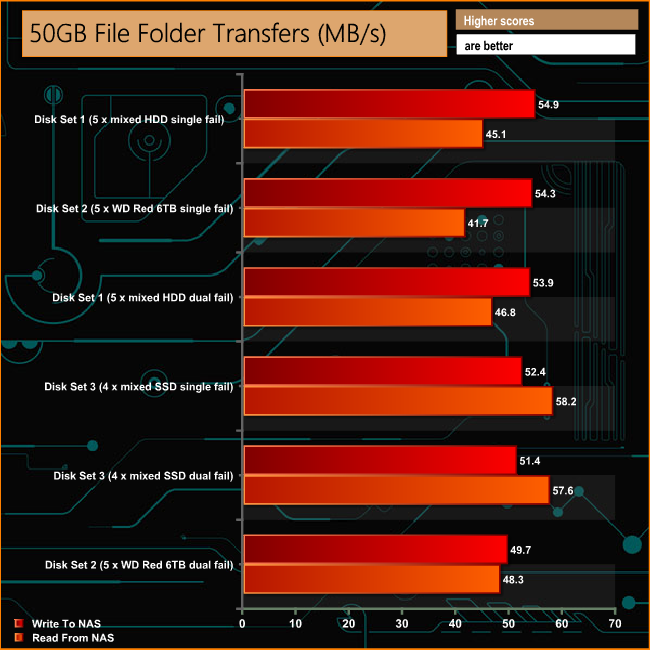
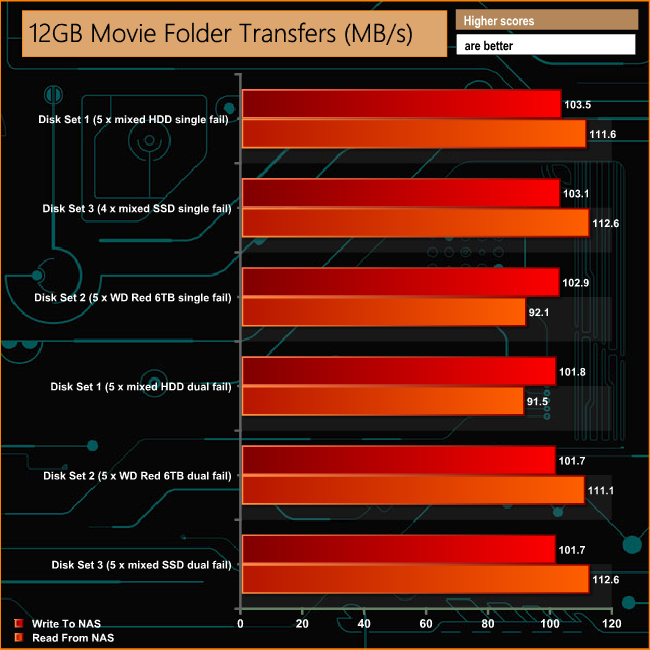
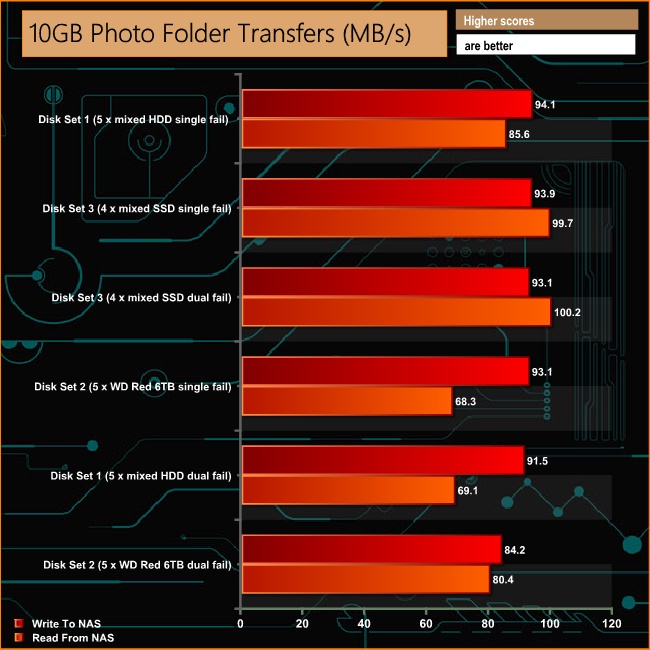
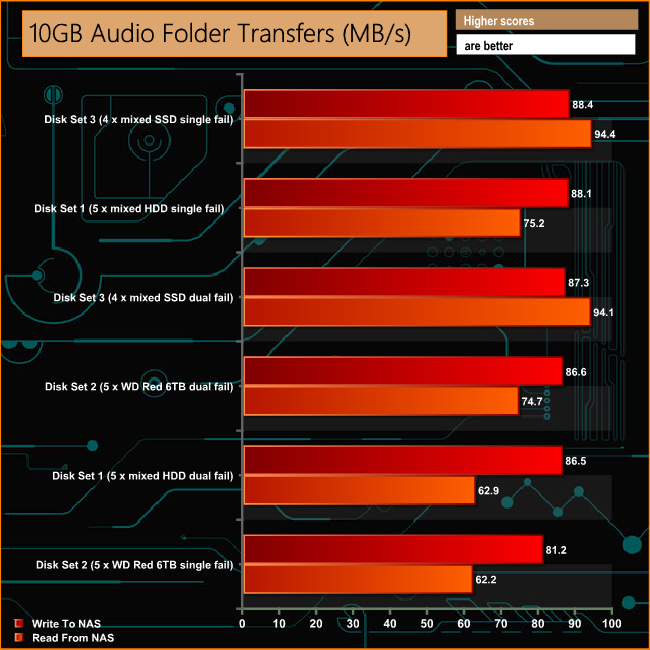
Although the 5N2 isn't the fastest NAS we have seen when it comes to dealing with our real life tests, it dealt with them well enough. Having said that the performance in both the mixed HDD dual redundancy mode and the WD Red single redundancy mode did falter slightly when reading data back from the device throughout the tests.
We tested the peak power consumption of a NAS at the wall during a run of CrystalDiskMark 5.0.2 as this version of the benchmark runs the read and write benchmark suites separately so it's easier to monitor what power the device is using during each function.
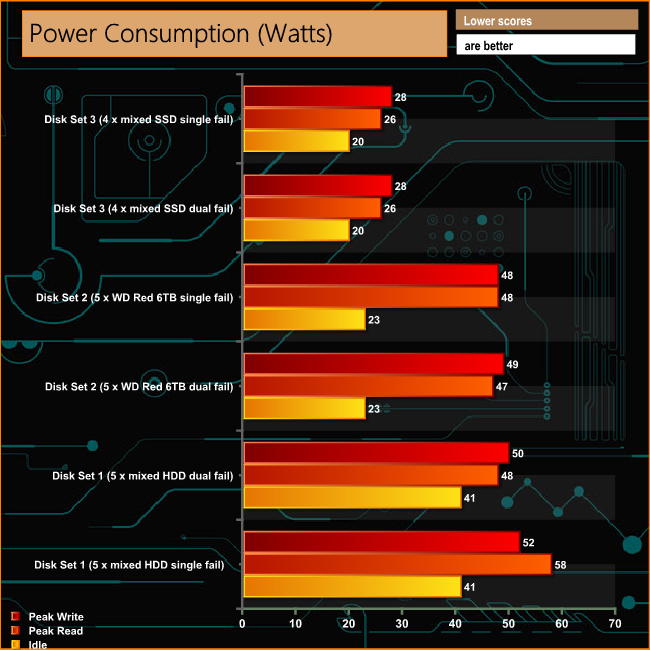
No surprise to see that the SSD setups used the least amount of power, followed by the WD Red drives. The idle power usage of the WD Reds at just 3.4W each was in marked contrast to the mixed disk setup which averaged out at 5.8W.
Drobo's BeyondRAID technology really does make the setting up and maintenance of the 5N2 so much easier than the conventional RAID systems used in other NAS devices. It literally is just a matter of loading up the device with any drives you have to hand, downloading the software and installing it.
It's just as easy maintaining it. Adding capacity to the 5N2 is just a matter of adding a drive to an empty drive bay or if there is no empty bay, just remove the lowest capacity drive and fit the larger one in. All on the fly.
Want to change from Single Disk Redundancy to Dual Disk? not a problem – its done with a simple mouse click. All of these actions can also be done on the fly, without unloading any data or for that matter even switching the unit off – you don't even have to stop using the data stored on it! Try doing that with a conventional RAID setup.
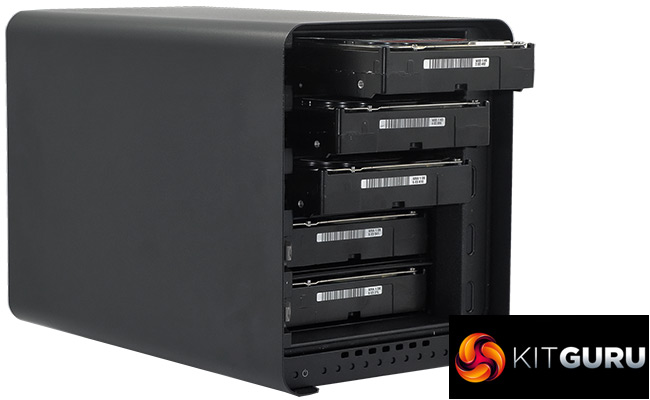
The uprated processor in the 5N2 does improve the outright performance of the NAS compared to the 5N. The speed of the 5 x 6TB WD Red hard drive performance in 5N topped out at 106MB/s for reads and 100MB/s for writes in the ATTO benchmark. In the 5N2 this rises to 116MB/s for reads with writes getting a slightly better boost at 118MB/s.
Having a separate bay for the or the mSATA cache drive to help boost random reads is a good design feature as it leaves all the main drive bays free to use for storage.
The Drobo Dashboard may not be a complex or as graphically rich as some of its competitors but most of the basics are there and it’s easy to navigate through and use. One trick it does have up its sleeve however, is in the use of animations to display drive bay and drive status. Whatever the indicator lights on the Drobo itself are doing are mimicked by the software.
Now you might well think this is a gimmick but if the drive is in a cupboard so the lights can’t be seen the software can show exactly where any problem is in a clear and easy to understand way.
The one puzzling missing feature of the 5N2 as with the original 5N is the lack of any external ports to backup data to. Yes, you can use the Drobo DR to make sure you have a copy of the data but many small business owners like the idea of the extra security offered by being able to drop data directly onto an external device to be carried away and stored off-site, especially ones that don't trust any form of Cloud storage.
One feature that the Drobo 5N2 does have, is a built-in UPS of sorts. If the unit suffers a power failure, the onboard rechargeable battery provides enough power for any data in the memory or cache to be written to disk.
We found the 5N2 on sale for £523.20 (inc VAT) at Span.com HERE
Pros
- BeyondRAID technology.
- Ease of use.
- On board UPS.
Cons
- No ports for external devices.
Kitguru says: Drobo's BeyondRAID technology makes the 5N2 one of the simplest NAS devices around to install and maintain without any of the usual complications associated with standard RAID setups, especially when it comes to adding capacity.


Why didn’t you do the benchmarks with link aggregation enabled? The 5N2 has 2 gigabit LAN ports. This is one of the main reasons anyone would want to upgrade.