 KitGuru KitGuru.net – Tech News | Hardware News | Hardware Reviews | IOS | Mobile | Gaming | Graphics Cards


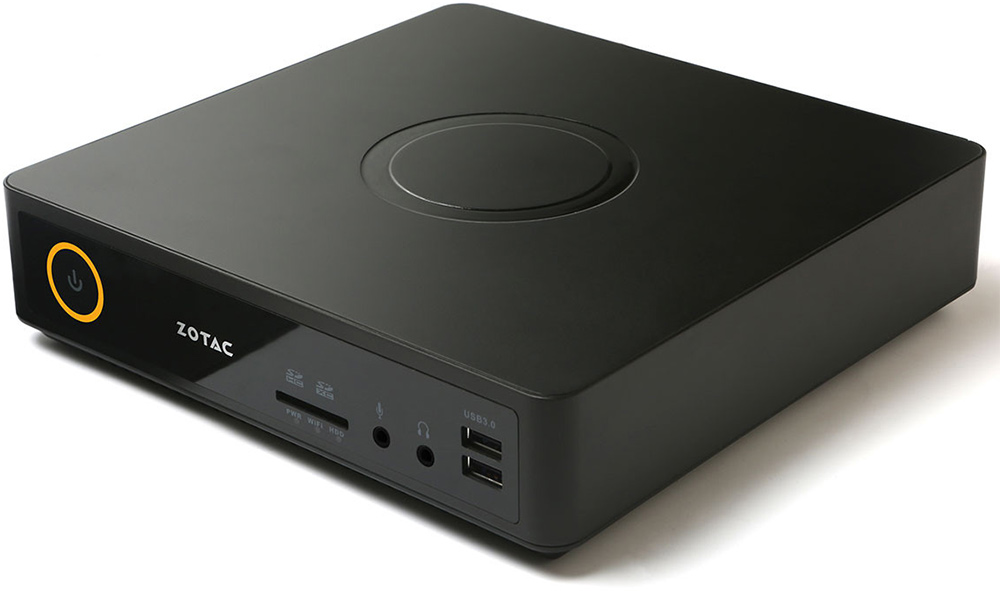
Zotac has introduced its new miniature personal computer designed for gamers. Despite of small form-factor, the Zotac Zbox Magnus EN970 PC can deliver rather high performance in video games thanks to powerful specifications and a unique GeForce GTX 960 graphics adapter with 3GB of memory.
The Zotac Zbox Magnus EN970 is powered by dual-core Intel Core i5-5200U “Broadwell” microprocessor and can be equipped with up to 16GB of DDR3L memory, one M.2 solid-state drive and two 2.5” storage devices. The system comes with 802.11ac + Bluetooth 4.0 module, 3-in-1 SD card reader, two Gigabit Ethernet ports, four USB 3.0 and two USB 2.0 ports as well as four HDMI 2.0 outputs. The Zotac Zbox Magnus EN970 Plus comes with pre-installed 8GB DDR3L memory and 120GB M.2 SSD.
The new small form-factor system from Zotac is equipped with a unique GeForce GTX 960 graphics card featuring 3GB of memory and 192-bit memory bus. Previously it was believed that Nvidia’s GM206 graphics processor features 128-bit memory interface, but it appears that the GPU actually has 192-bit memory controller. The Zotac GeForce GTX 960 with 3GB GDDR5 should offer considerably higher performance than the regular GeForce GTX 960 with 2GB of memory in high resolutions.
The Zotac Zbox Magnus EN970 comes in a stylish black plastic case, which can be easily opened to upgrade hardware.
Pricing of the Zotac Zbox Magnus EN970 is unknown.
Discuss on our Facebook page, HERE.
KitGuru Says: The Zotac Zbox Magnus EN970 looks to be a very interesting small form-factor PC that should deliver rather high performance in games despite of its small sizes. Usage of a newer “Skylake” processor would be preferable, but “Broadwell” CPU also delivers fine performance that should be enough for modern games.

Nice specs, impressive I/O and there are options for upgradability. I’m sold.