KitGuru KitGuru.net – Tech News | Hardware News | Hardware Reviews | IOS | Mobile | Gaming | Graphics Cards


Asus is expanding its case lineup with the new TUF Gaming GT301, a compact mid-tower with a tempered glass side panel. With a mesh front panel and mesh on top, this case is designed with airflow in mind- it also ships with four fans included, so temperatures should be kept in check.
The four 120mm fans are distributed through the front (3x ARGB fans) and the back (1x fan without ARGB). The front meshed panel is mostly made of ABS, with a “honeycomb outer grille and a metal inner mesh”, while the rest of the case is mostly made of SECC steel. According to TechPowerUp, there's also a nylon strap that zig-zags through the front panel.
The ARGB front fans can synchronise with other Asus AURA RGB components, and there's a dedicated front panel control button on the I/O panel to turn on/off the LEDs. Besides this, the I/O panel has a power button, 2x USB 3.2 Gen1 (USB 3.0) ports, and one headphone + microphone 3,5mm jack. There's a headset hook included as an accessory that can be mounted on either side of the I/O panel.
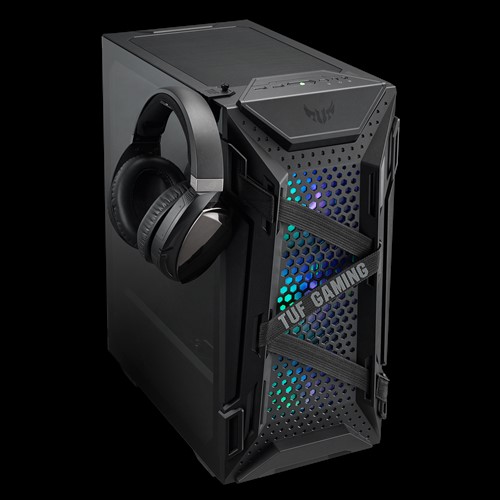
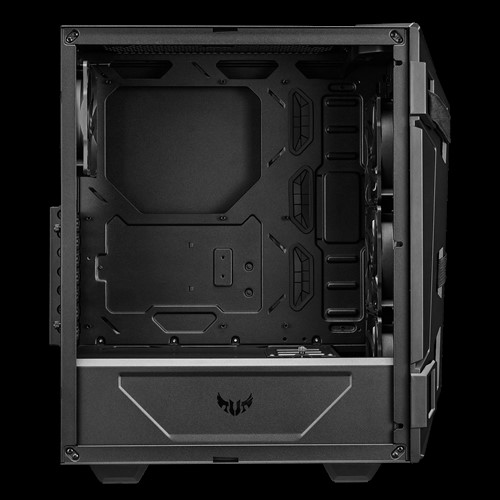
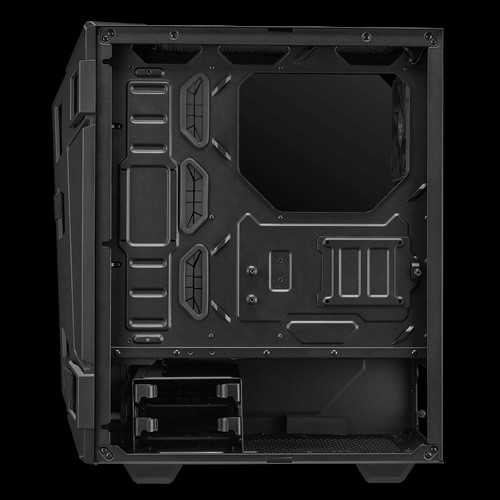
Measuring 426x214x482 mm (LxWxH) and weighing about 7.2 kg, the GT301 can take up to 2x 140mm or 3x 120mm fans on the front, while on the top and the back it can only take 2x 120mm fans and 1x 120mm fan, respectively. Regarding radiators, it's possible to install 1x 120 radiator on the back and 1x 120/140/240/280/360 radiator on the front.
There are four slots for 2.5-inch drives, two slots for 3.5-inch drives and removable dust filters on the front, top and back of the case. There are also 7x PCI-E expansion slots, and the maximum CPU cooler height and maximum GPU length are 160mm and 320mm, respectively.
No pricing or availability details were shared but we will update when those details come through.
KitGuru says: What do you think of the Asus TUF Gaming GT301 case? Are you a fan of the straps on the front panel?