KitGuru KitGuru.net – Tech News | Hardware News | Hardware Reviews | IOS | Mobile | Gaming | Graphics Cards


Synology has announced its newest 8-bay rackmounted storage servers, which it claims ‘deliver high performance in a space-efficient manner.'
Today we have not one, but two new servers from Synology – the RS1221+ and the RS1221RP+, the latter of which has power redundancy support thanks to its two PSUs. Designed for small businesses, Synology claims these units can offer impressive performance but at a ‘modest depth for 2U units in their class', with the RS1221+ measuring 298mm deep, compared to 399mm for the RS1221RP+.
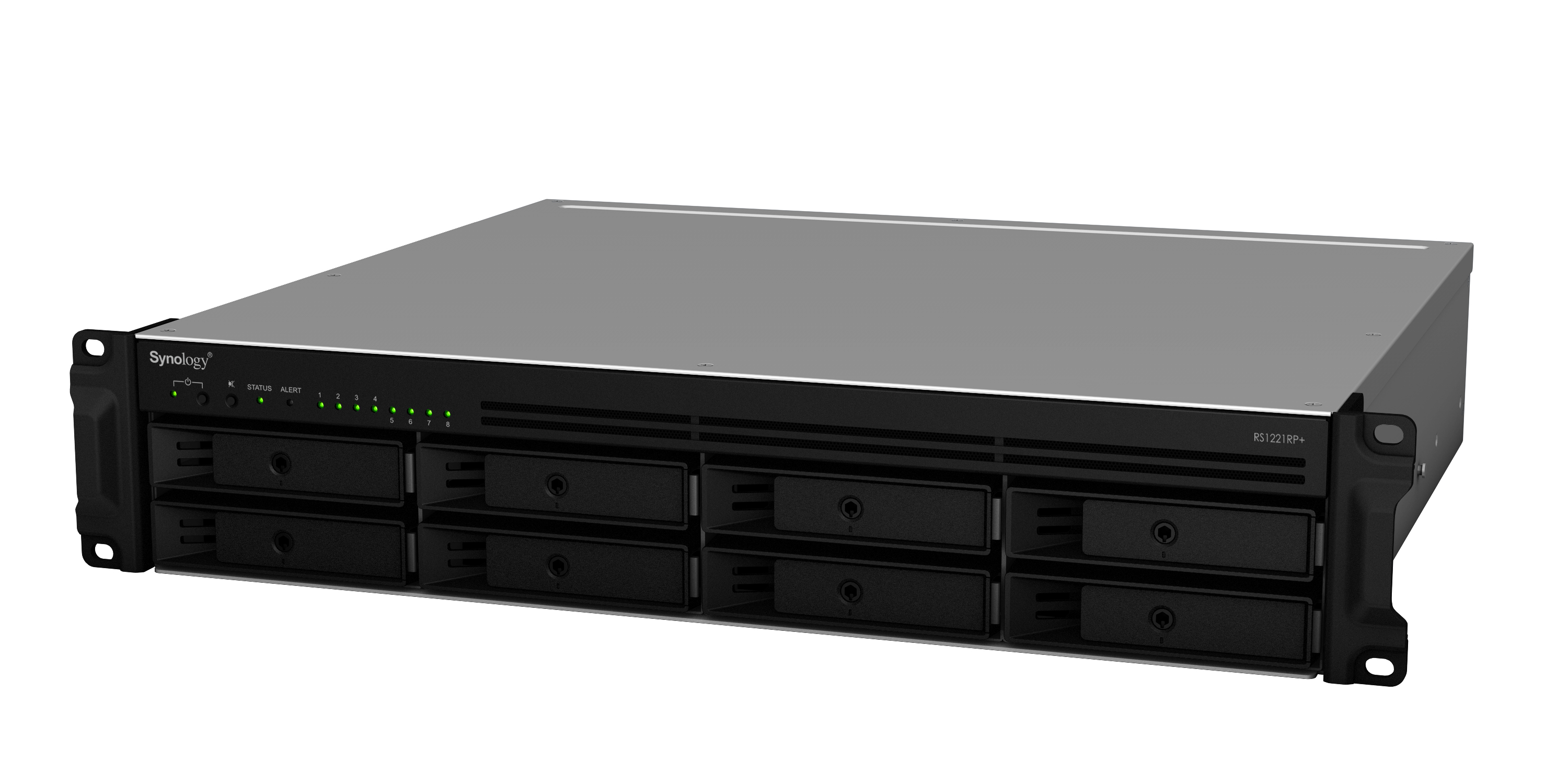
Powered by the AMD Ryzen V1500B processor, Synology says the RS1221+ is up up to 3.6x faster than than its predecessor in terms of compute performance, and 2.3x faster when looking at sequential write performance. On that topic, these units are rated for up to 2315MB/s sequential reads and 1147MB/s sequential writes.
By default, these units ship with 4GB DDR4 ECC memory, but this is upgradeable to 32GB. A PCIe 3.0 4-lane x8 slot is also built in which allows for an upgrade to a 10GbE NIC if you want more than the 4x 1GbE ports which are natively supported. What's more, if you need more space than can be installed via the 8 bays, the 4-bay RX418 expansion unit is also compatyivle with the RS1221+.
Synology says the RS1221+ and RS1221RP+ are available globally from today. We found the RS1221+ on Span for pre-order, priced at £3797.28.
KitGuru Says: If you own a small business and want to get set up with a storage server, the RS1221+ looks like a good bet.