KitGuru KitGuru.net – Tech News | Hardware News | Hardware Reviews | IOS | Mobile | Gaming | Graphics Cards


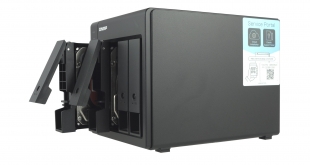
QNAP's TS-451D2-G4 is a dual-core powered, 4-bay NAS aimed at home and SOHO users. It features DDR4 memory, 4K/60Hz HDMI 2.0 output, real-time transcoding and AES-NI encryption. Priced around the £440 mark, we find out if it is worth buying.
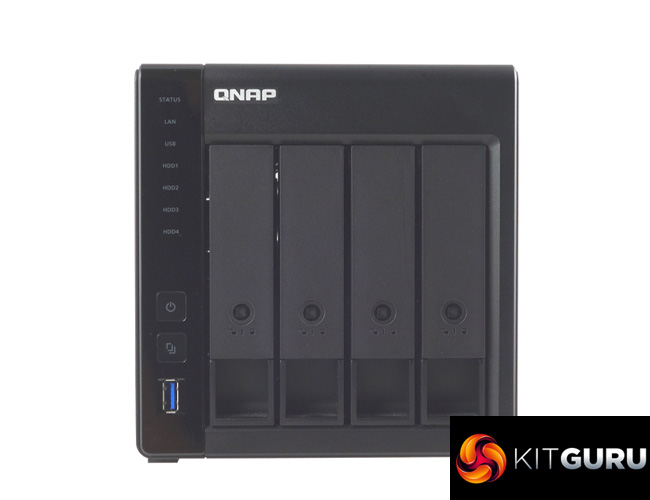
At the heart of the TS-451D2 is an Intel Celeron J4025, a dual-core CPU that is rated at 2.0GHz (boosting up to 2.9GHz). The NAS is available in two versions, the D2-4G (the system we are looking at here) with 4GB of DDR4-2400 memory and the D2-2G with 2GB of memory. The NAS supports a maximum of 8GB of memory via the two SO-DIMM slots so if you need to upgrade to more memory for any reason, the option is there. It also supports an AES-NI hardware encryption engine and hardware-accelerated transcoding.
QNAP quotes Sequential throughput performance for the TS-451D2 as up to 220MB/s for reads and up to 224MB/s for writes with both LAN ports being used in Link Aggregation mode. With a single Ethernet connection, the official figures are 113MB/s reads and 112MB/s writes.
QNAP back the TS-451D2 with a 2-year warranty but this can be extended up to 5 years by purchasing a warranty extension.
Physical Specifications
- Processor: Intel Celeron J4025 2.0GHz (boosting up to 2.9GHz).
- Memory: 4GB DDR4-2400.
- Gigabit Ethernet Ports: 2.
- Rear panel connectors: 2 x 1GbE RJ-45, 3 x USB 3.2 Gen 1 (Type-A), 1 x HDMI 2.0.
- Front panel connectors: 1 x USB 3.2 Gen 1.
- RAID support: 0, 1, 5, 6, 10, JBOD.
- Cooling: Active, 1 x 120mm fan.
- Drive Bays Supported: 4
- Maximum hard drive size supported: 18TB.
- Maximum Capacity: 72TB.
- Internal File System support: EXT4.
- Dimensions (D x W x H): 219.4 x 160 x 165.3mm.
- Weight: 2.09kg.