KitGuru KitGuru.net – Tech News | Hardware News | Hardware Reviews | IOS | Mobile | Gaming | Graphics Cards


Nvidia have experienced great success with their Maxwell architecture – cards such as the GTX750ti impressed my colleague Allan when he first analysed them back in February 2014. At prices around £100 the GTX 750ti firmly targeted the budget gamer working with a restrictive budget. If you have a bit more cash on hand then the recently announced GTX950 is priced between the GTX750ti and GTX960 – targeting AMD's R7 370. Today we look at the modified, highly overclocked Gigabyte GTX950 Xtreme Gaming partner card.
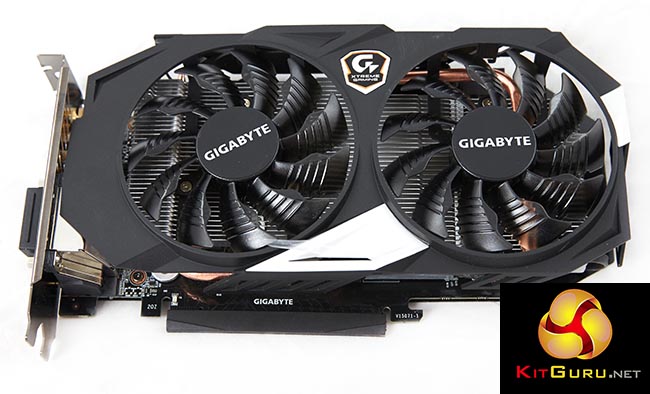
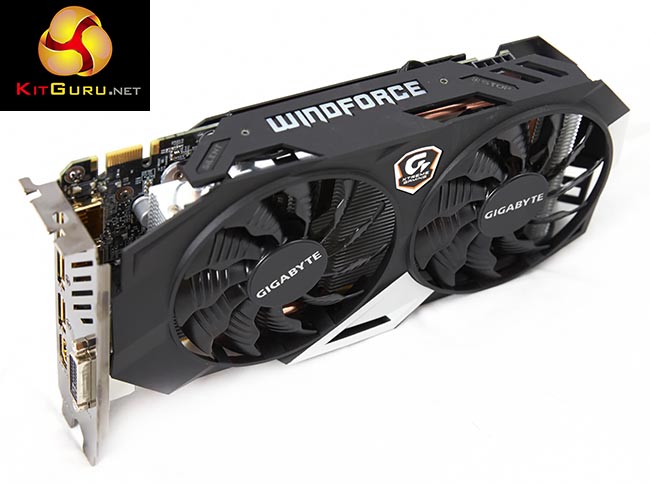
The Gigabyte GTX950 Xtreme Gaming 2GB incorporates dual, ridged fans with the company logo visible in the centre. The white racing stripe adds a bit of pizazz to the black.
| GPU | GeForce GTX 750 Ti (Maxwell) |
GeForce GTX 950 (Maxwell) |
GeForce GTX 960 (Maxwell) |
GeForce GTX 970 (Maxwell) |
GeForce GTX 980 (Maxwell) |
| GPU Codename | GM107 | GM206 | GM206 | GM204 | GM204 |
| Streaming Multiprocessors | 5 | 6 | 8 | 13 | 16 |
| CUDA Cores | 640 | 768 | 1024 | 1664 | 2048 |
| Base Clock | 1020 MHz | 1024 MHz | 1126 MHz | 1050 MHz | 1126 MHz |
| GPU Boost Clock | 1085 MHz | 1188 MHz | 1178 MHz | 1178 MHz | 1216 MHz |
| Total Video memory | 2GB | 2GB | 2GB | 4GB | 4GB |
| Texture Units | 40 | 48 | 64 | 104 | 128 |
| Texture fill-rate | 40.8 Gigatexels/sec | 49.2 Gigatexels/sec | 72.1 Gigatexels/sec | 109.2 Gigatexels/sec | 144.1 Gigatexels/sec |
| Memory Clock | 5400 MHz | 6600 MHz | 7010 MHz | 7000 MHz | 7000 MHz |
| Memory Bandwidth | 86.4 GB/sec | 105.6 GB/sec | 112.16 GB/sec | 224 GB/s | 224 GB/sec |
| Bus Width | 128bit | 128bit | 128bit | 256bit | 256bit |
| ROPs | 16 | 32 | 32 | 56 (following correction) |
64 |
| Manufacturing Process | 28nm | 28nm | 28nm | 28nm | 28nm |
| TDP | 60 Watts | 90 Watts | 120 Watts | 145 Watts | 165 Watts |
On a technical level, the cut-down iteration of the GM206 GPU is, in many areas, effectively 75% of the core used on a GTX 960. The GTX 950 version of the GM206 GPU ships with 768 CUDA cores and 48 texture units. Those numbers are more closely aligned with the GTX 750 Ti version of Nvidia’s first-gen Maxwell GM107 core, however specifically focusing on the number of ROPs puts clear daylight between the GTX 950 and its lower-end sibling.
The same 128bit memory interface found on the GTX 960 is present, however that may be less of a potential choking point given the reduced raw horsepower of the GTX 950’s cut-down GPU. As was the case with the GTX 960, the same argument for more efficient utilisation of the GM206’s 128bit memory interface, in comparison to Kepler, is made by Nvidia.
Clock speeds for the GTX 950 are sliced by comparison to GTX 960 frequencies. The reference core clock is rated at 1024MHz, with a maximum boost speed of 1188MHz. The 2GB of GDDR5 memory is rated to run at 1650MHz (6.6Gbps effective) to produce a bandwidth level of 105.6GB/sec. With that said, most board partners will be unlocking the GM206 core’s overclocking potential and shipping their cards with higher, factory-overclocked frequencies. Gigabyte are a case in point today, for instance.
Extending to the GTX 950’s features, the card supports the DirectX 12 API at feature level 12.1. A H.265 (HEVC) encoder/decoder engine built into the GPU, along with HDMI 2.0, shout loudly for the GTX 950 to be used inside a gaming HTPC. With the 90W TDP being low enough to comfortably fit inside SFF cases, the ability to output 60Hz video to a 4K TV (most of which do not have DisplayPort connections) is an important feature. HDMI 2.0 is a feature that team red’s competitor card cannot offer.
One of the more notable changes between the GTX 75x cards and the GTX 950 is the TDP differential. While the GTX 750 Ti had a 60W TDP, the GTX 950 ups that number to 90W. Approximating TDP as an indicator of power consumption, the 90W rating narrowly tips the GTX 950 into a region where it requires a 6-pin PCIe power connector. This emphasises that Nvidia is focused on gaming performance with its new card, while the GTX 750 Ti, for example, still remains to cater for those wanting a graphics card to run on a PSU without a 6-pin PCIe cable.
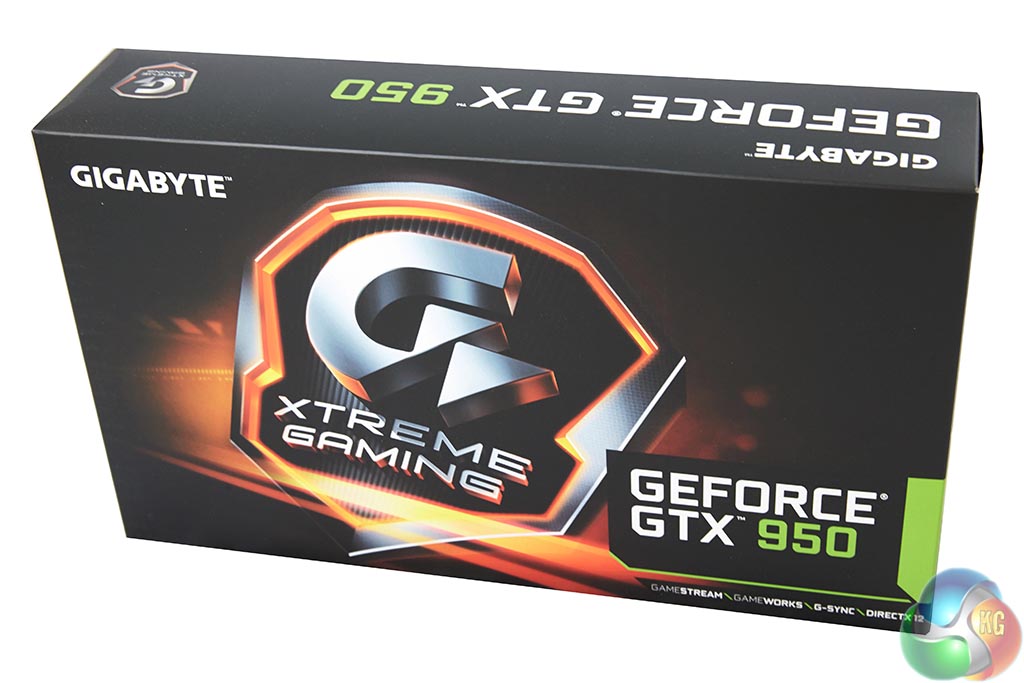
Gigabyte have opted for a colourful box this time around, with ‘Xtreme Gaming' their centerpoint. No pictures of the card are visible on the front of the box.
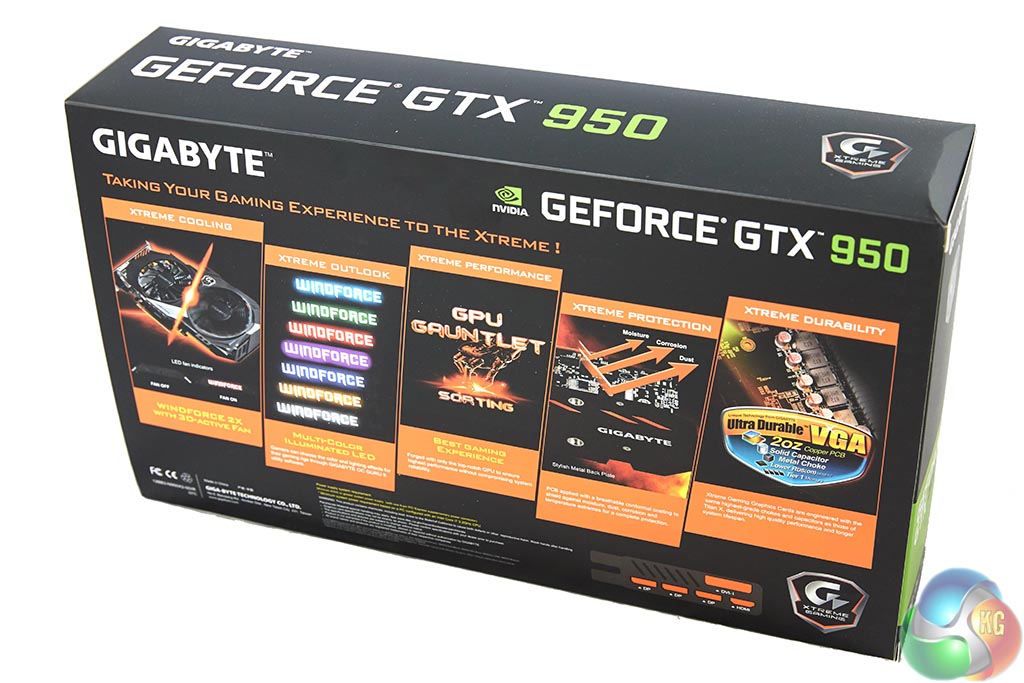
The rear of the box highlights some of the key selling points with ‘Xtreme' written before everything, shown above.
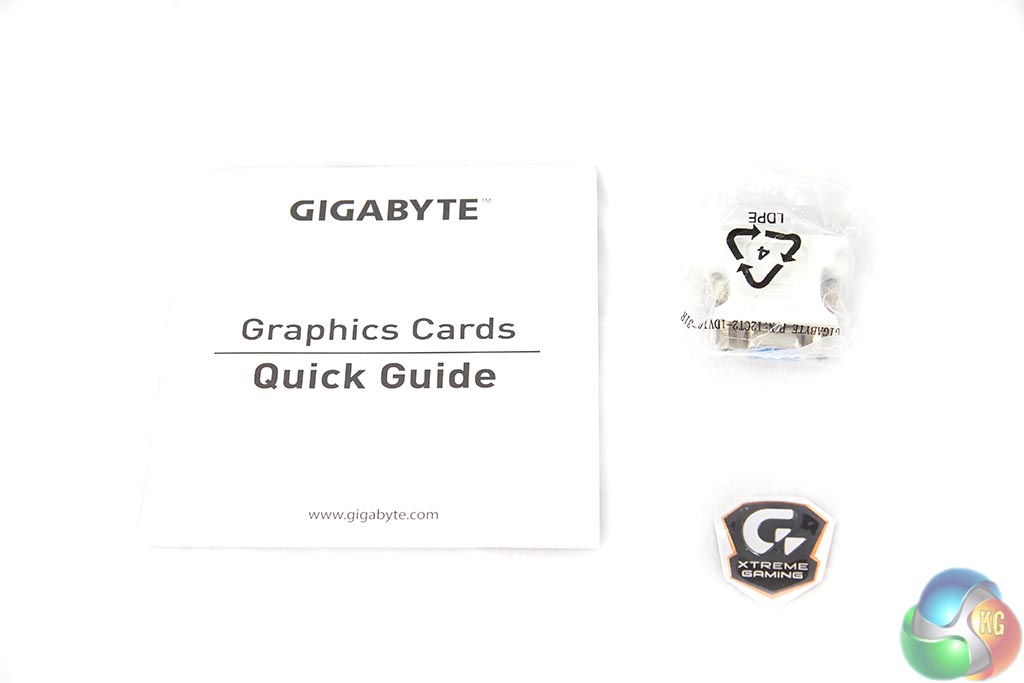
The box contents are spartan, although we know from past experiences that Gigabyte tend to remove items from reviewer sample boxes shipped directly from the factory. A case badge, video converter and a ‘quick start' guide are included.
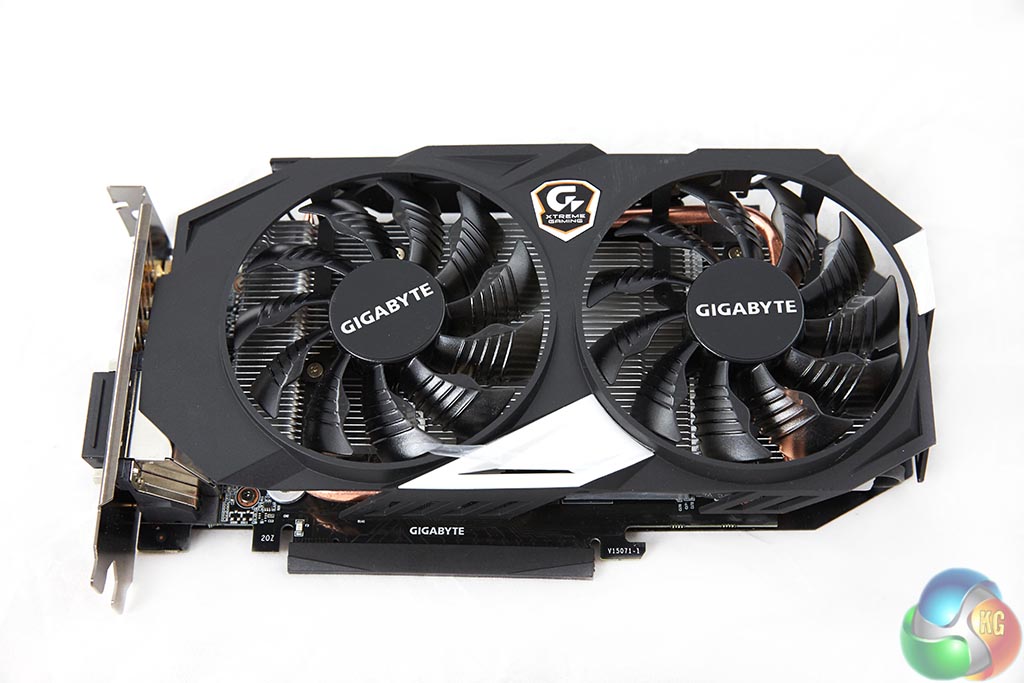
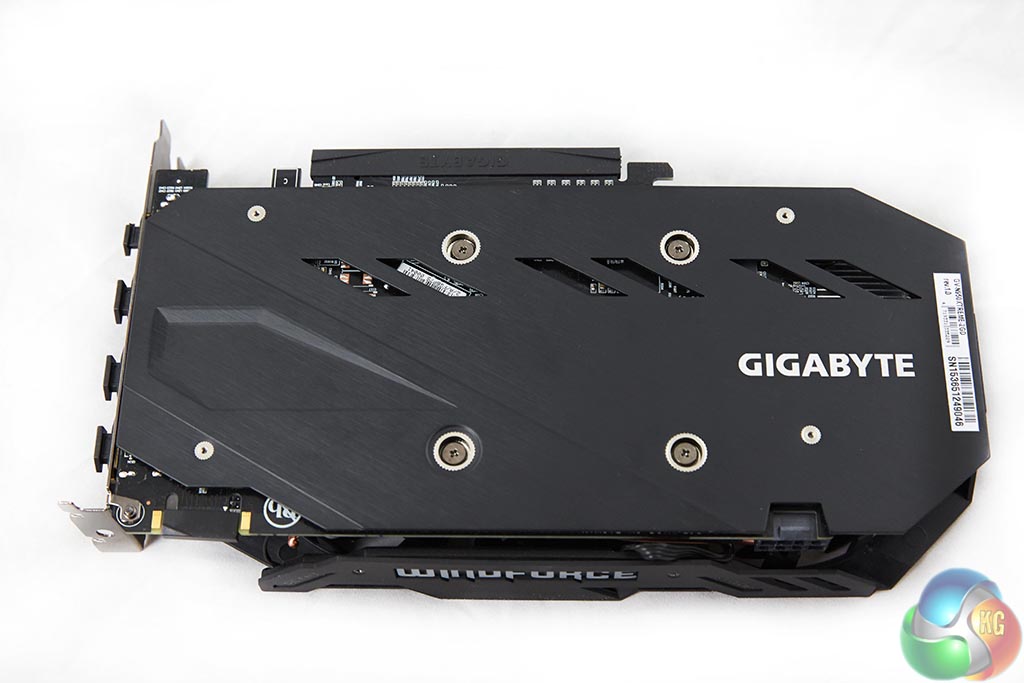
The card measures 227 mm long, and the cooler is formed around two 90mm fans, also in black. It is great to see the inclusion of a backplate – normally a feature of flagship products.

We like the appearance of the Gigabyte GTX950 Xtreme Gaming 2GB, it is a chunky card and due to the predominately black colour scheme will fit into any system build.
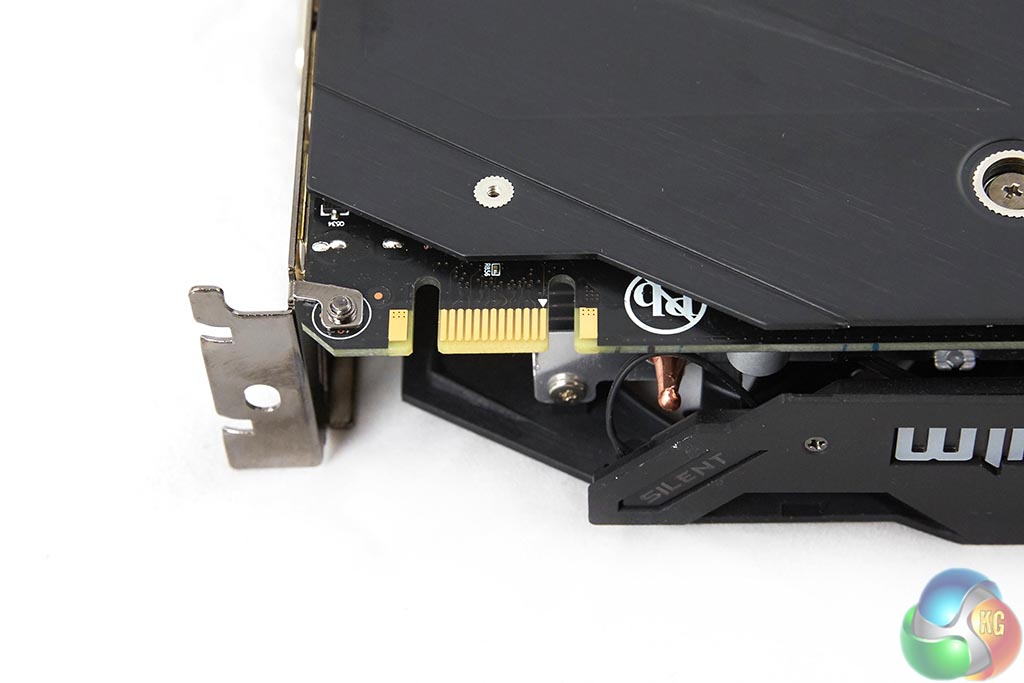
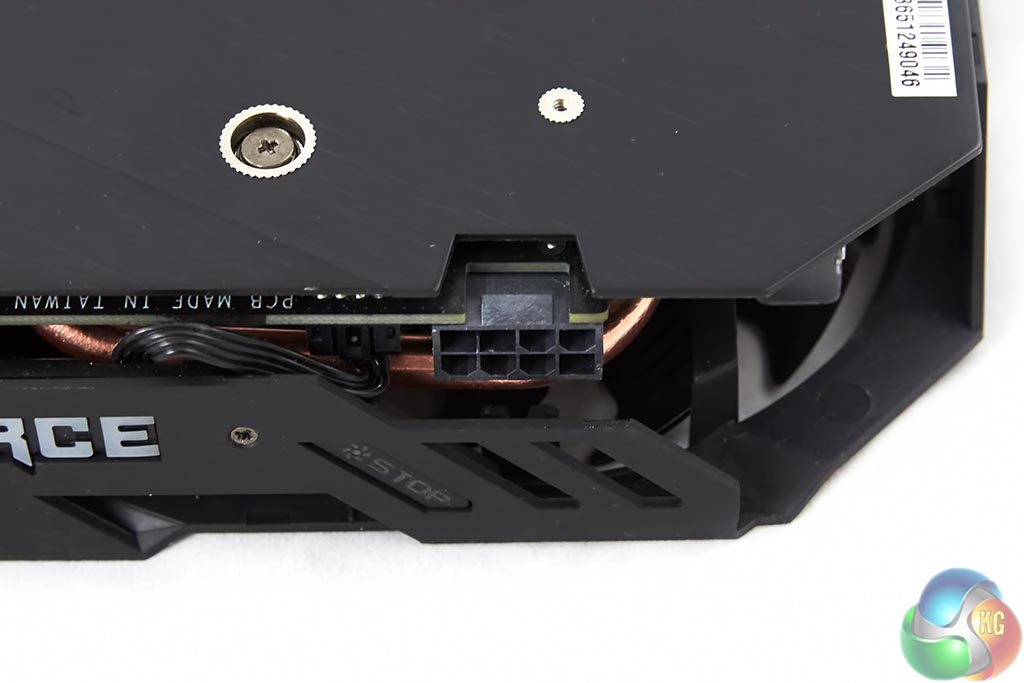
The Xtreme Gaming 2GB is equipped with a single SLi connector. It takes power from a single 8-pin power connector which may be less convenient than the typical 6-pin version for some users and their PSUs.
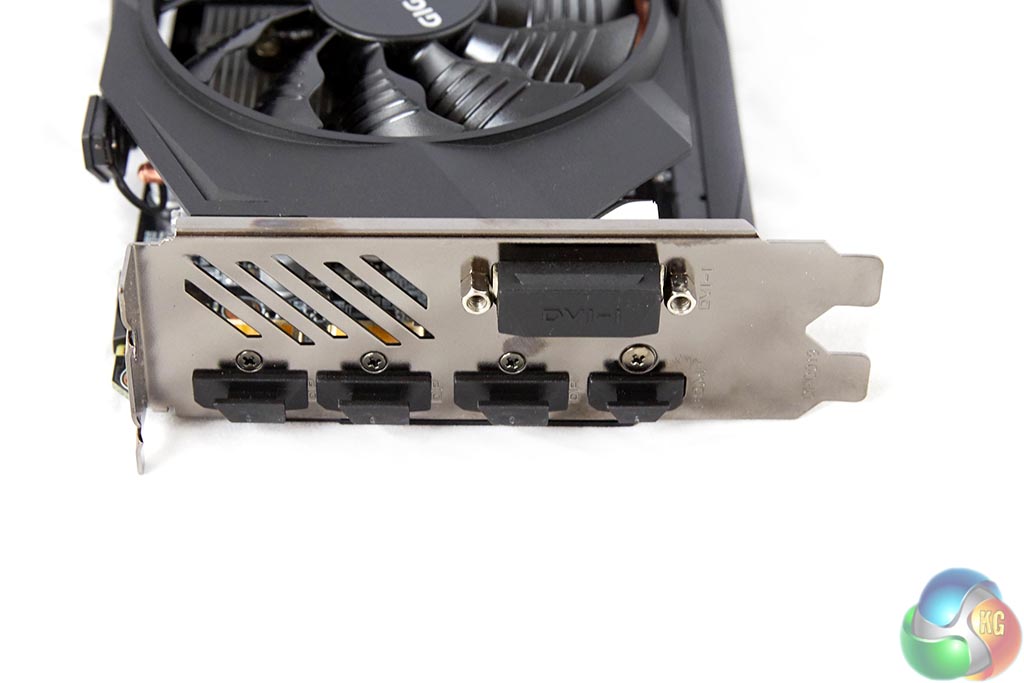
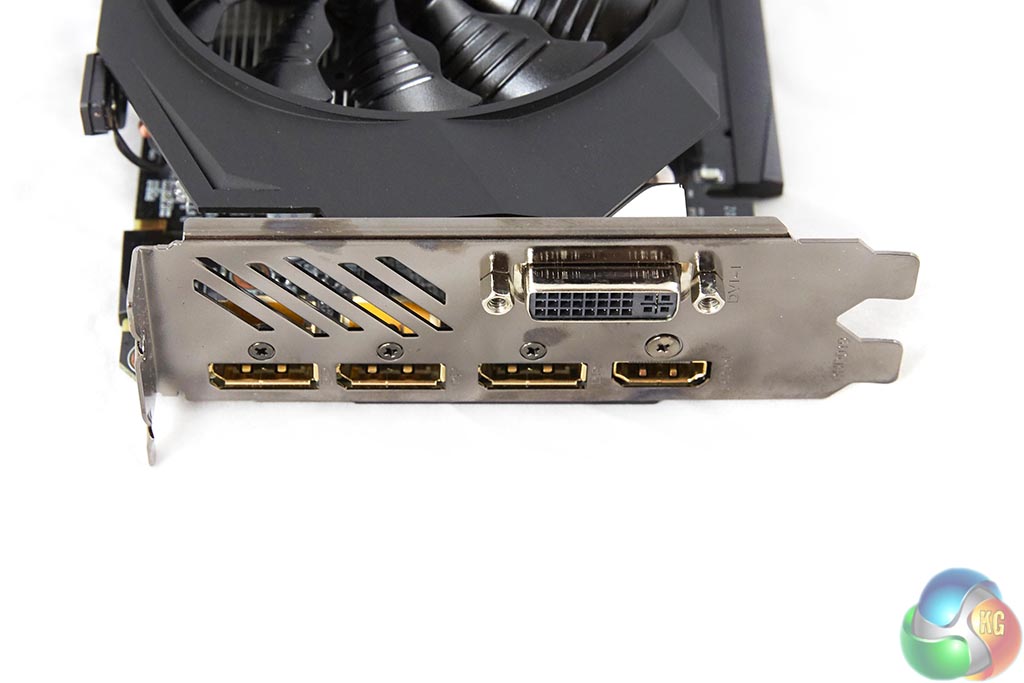
Hurrah for full sized ports we say. A DVI port, HDMI 2.0 port and three DisplayPorts are incorporated into the backplate I/O panel.
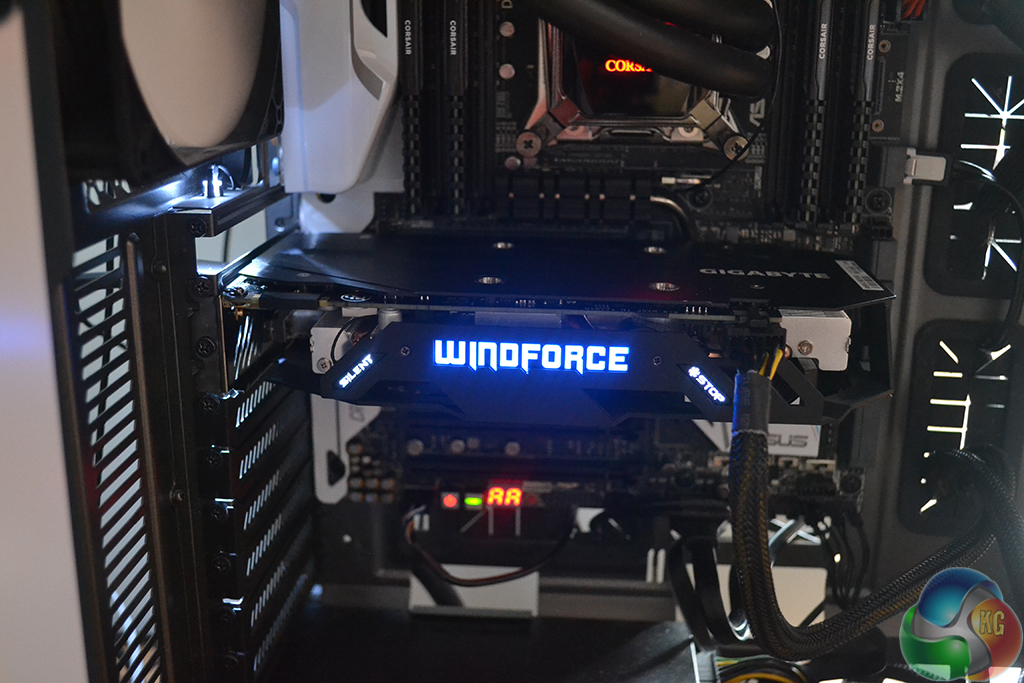
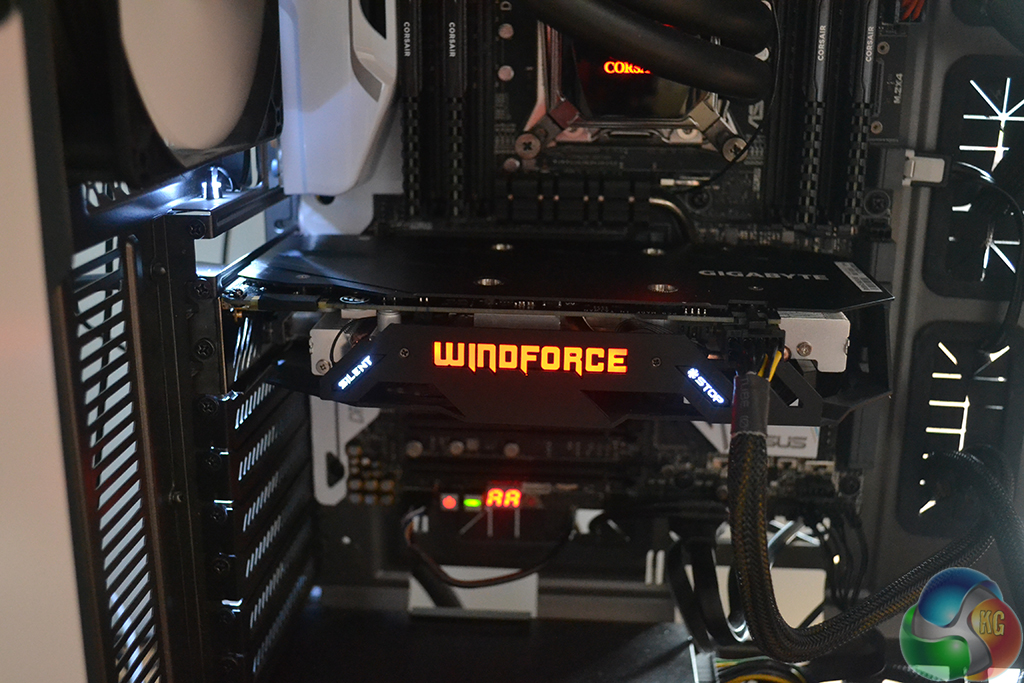
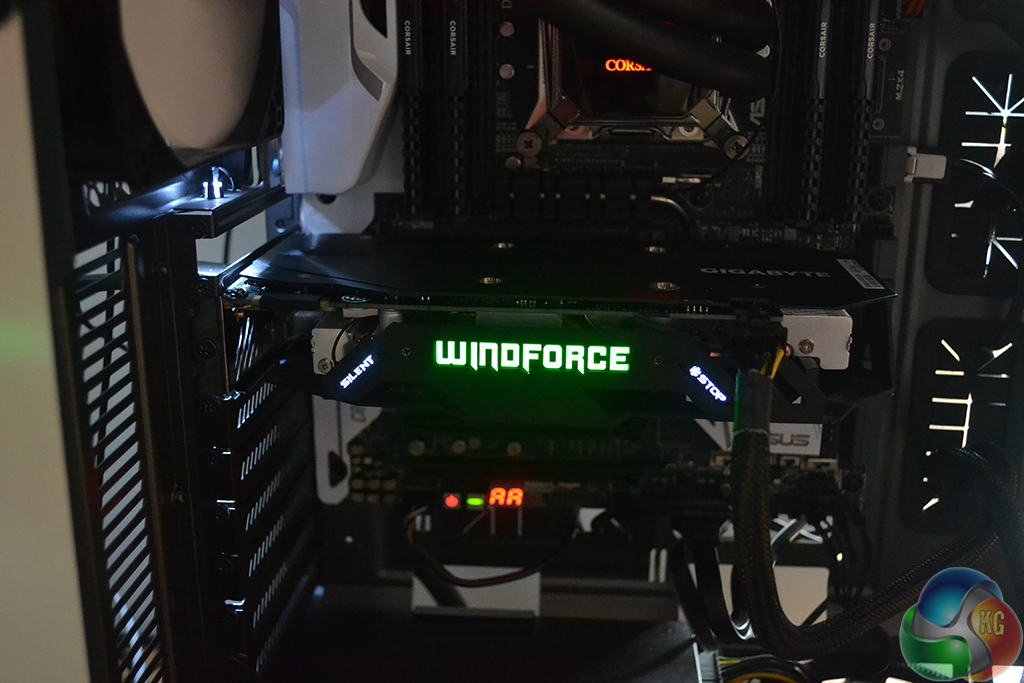
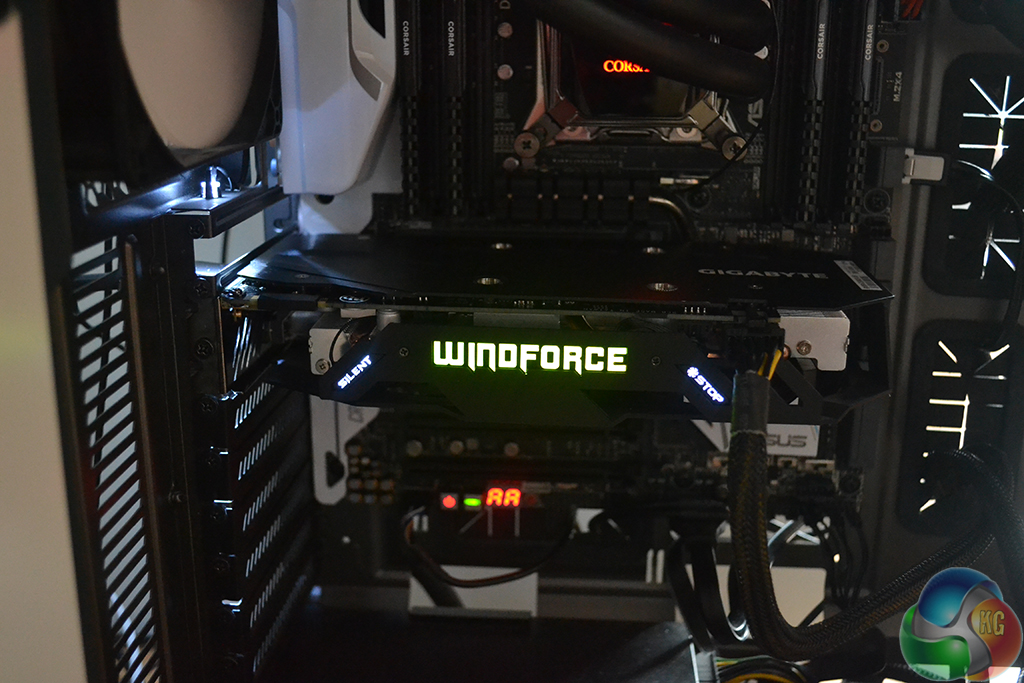
Gigabyte gives users control over the side LED colouring through the OS-based OC Guru II software.Blue, red, green, and yellow can be selected and the card can be set to activate its coloured LEDs all of the time, none of the time, or only when heavily loaded.
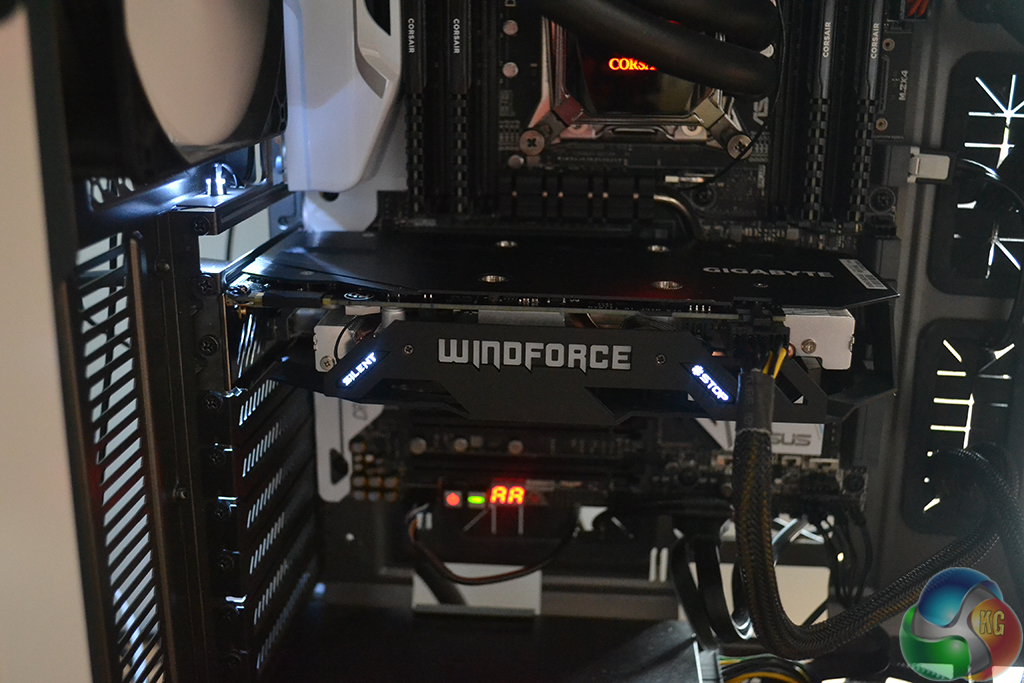
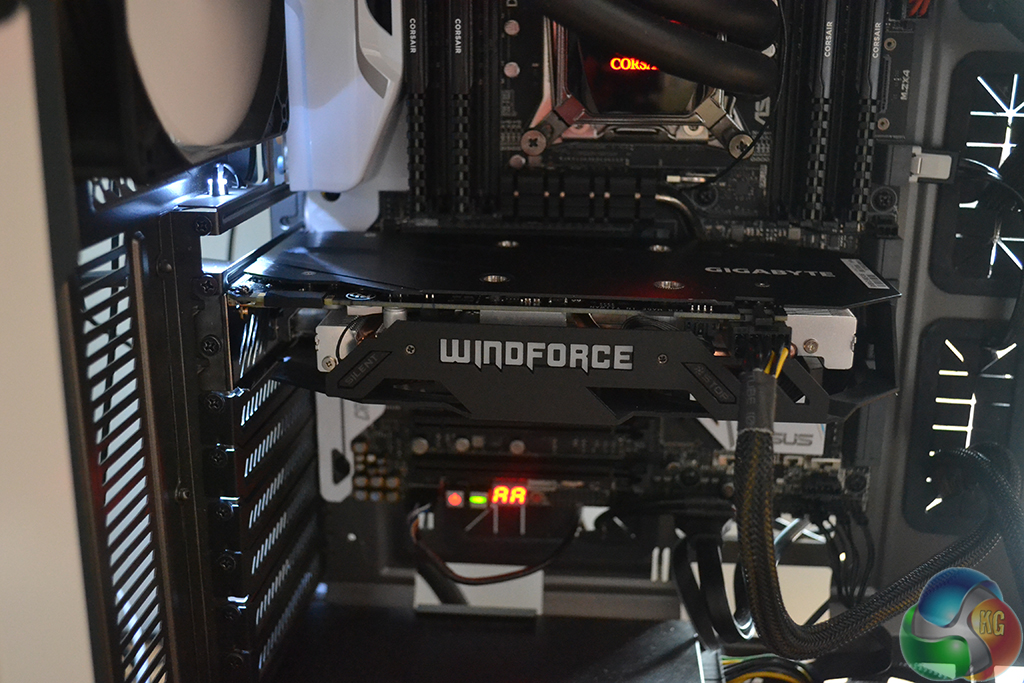
Under low load the cooler's fans shut off and this is indicated by a pair of white LEDs saying ‘Silent' and ‘Stop'. If preferred, the software allows for all LEDs to be deactivated.
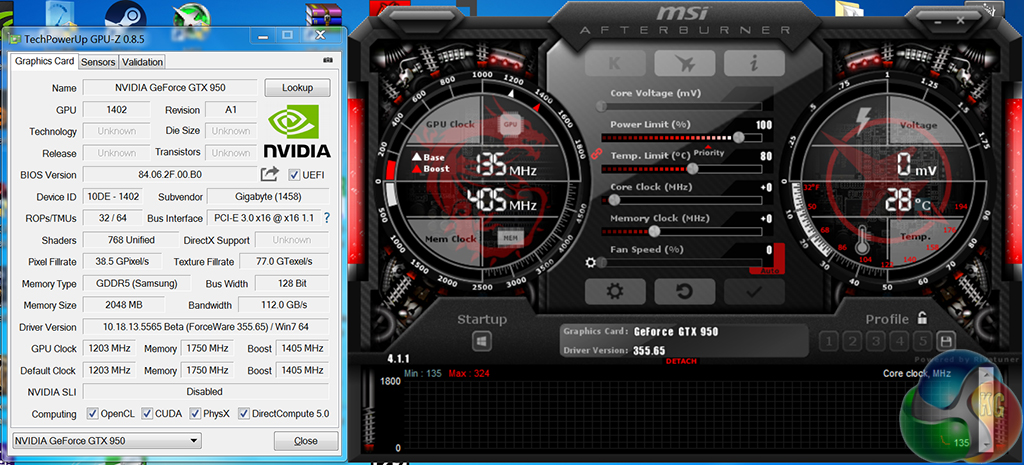
Gigabyte overclocks the core frequency to 1203MHz which is a significant increase over the 1024MHz reference GPU speed. The boost clock is rated at 1405MHz, but we actually saw the card hitting 1481MHz during gaming. In a less common move these days, Gigabyte also overclocks the memory by 100MHz, resulting in an effective data rate of 7000MHz for the 2GB of GDDR5.
For the review today we are using the latest Nvidia 355.65 drivers which were supplied with the GTX 950 cards by Nvidia themselves. All Nvidia hardware was tested using this driver in order to eliminate performance discrepancies relating to newer driver updates. The AMD cards were tested with the Catalyst 15.7.1 driver or the 15.201.1102 driver provided for the R9 Nano launch.
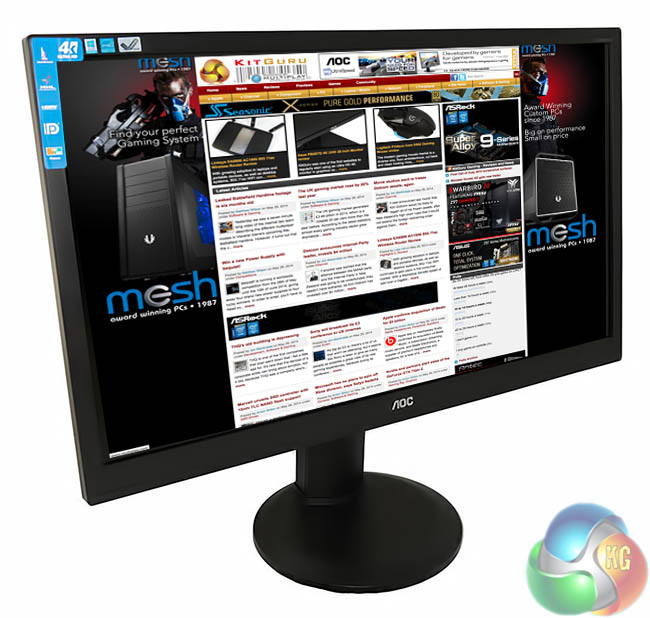
We test using the AOC U2868PQU 4K monitor that scored highly in our review that can be found HERE. AOC's 28″ offering is one of the most affordable 4K monitors on the market and makes the realms of 4K gaming more accessible to a wider audience. It also allows us to test comfortably at the 1920×1080 and 2560×1440 resolutions.
Test System
- Processor: Intel Core i7 5960X ES (4.4GHz OC).
- Memory: 16GB (4x 4GB) Corsair Vengeance LPX 3200MHz DDR4.
- Motherboard: Asus X99-Deluxe.
- System Drive: 500GB Samsung 840.
- CPU Cooler: Corsair H100i.
- Case: NZXT Phantom 630.
- Power Supply: Seasonic Platinum 1000W.
- Operating System: Windows 7 Professional with SP1 64-bit.
Comparison Graphics cards:
- Palit GTX 750 Ti StormX Dual 2GB (ForceWare 355.65)
- Asus GTX 950 STRIX DC2 OC 2GB (ForceWare 355.65)
- Palit GTX 950 StormX Dual 2GB (ForceWare 355.65)
- PNY GTX 950 2GB (ForceWare 355.65)
- Palit GTX 960 Super JetStream 2GB (ForceWare 355.65)
- Sapphire R9 380 Nitro 4GB (Catalyst 15.201.1102)
- HIS Radeon HD 7850 2GB overclocked to reference R7 370 frequencies to give an insight into the R7 370 graphics card (Catalyst 15.7.1)
Software:
Unigine Heaven Benchmark
3DMark
Fraps
Steam Client
MSI Afterburner
TechPowerUp GPU-Z
Games:
Battlefield 4
Bioshock Infinite
Grand Theft Auto V
Metro: Last Light
Middle Earth: Shadow of Mordor
Tomb Raider
Game descriptions edited with courtesy from Wikipedia.
3DMark is an essential tool used by millions of gamers, hundreds of hardware review sites and many of the world’s leading manufacturers to measure PC gaming performance.
Futuremark say “Use it to test your PC’s limits and measure the impact of overclocking and tweaking your system. Search our massive results database and see how your PC compares or just admire the graphics and wonder why all PC games don’t look this good.
To get more out of your PC, put 3DMark in your PC.”
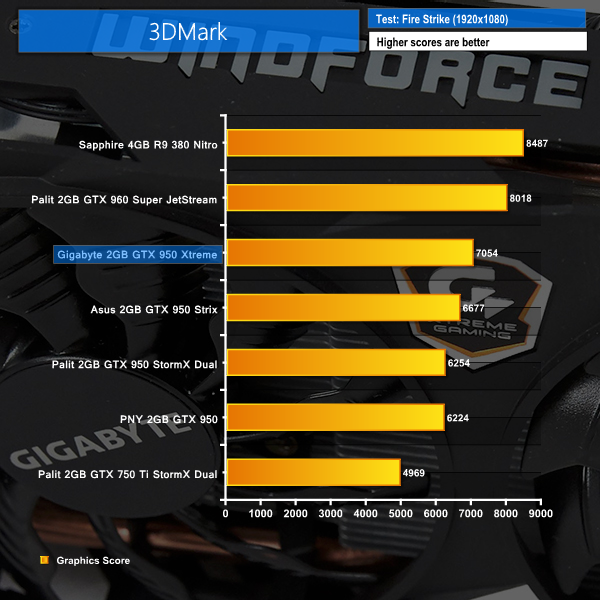
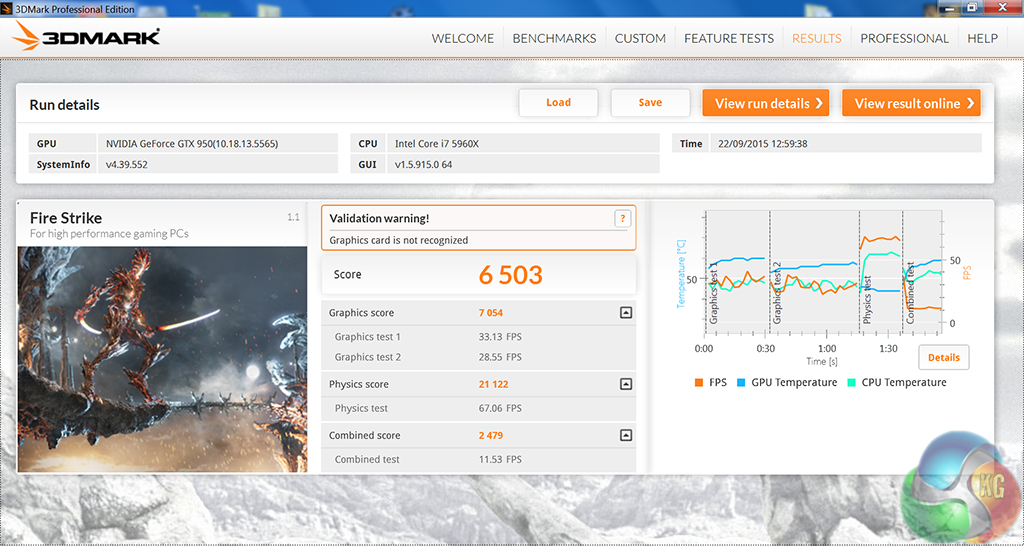
The massively overclocked speed of the Gigabyte GTX950 Xtreme Gaming card propels the solution ahead of other cards in the same price zone. It is only 1,000 points behind the Palit GTX960 Super JetStream.
Unigine provides an interesting way to test hardware. It can be easily adapted to various projects due to its elaborated software design and flexible toolset. A lot of their customers claim that they have never seen such extremely-effective code, which is so easy to understand.
Heaven Benchmark is a DirectX 11 GPU benchmark based on advanced Unigine engine from Unigine Corp. It reveals the enchanting magic of floating islands with a tiny village hidden in the cloudy skies. Interactive mode provides emerging experience of exploring the intricate world of steampunk. Efficient and well-architected framework makes Unigine highly scalable:
- Multiple API (DirectX 9 / DirectX 10 / DirectX 11 / OpenGL) render
- Cross-platform: MS Windows (XP, Vista, Windows 7) / Linux
- Full support of 32bit and 64bit systems
- Multicore CPU support
- Little / big endian support (ready for game consoles)
- Powerful C++ API
- Comprehensive performance profiling system
- Flexible XML-based data structures
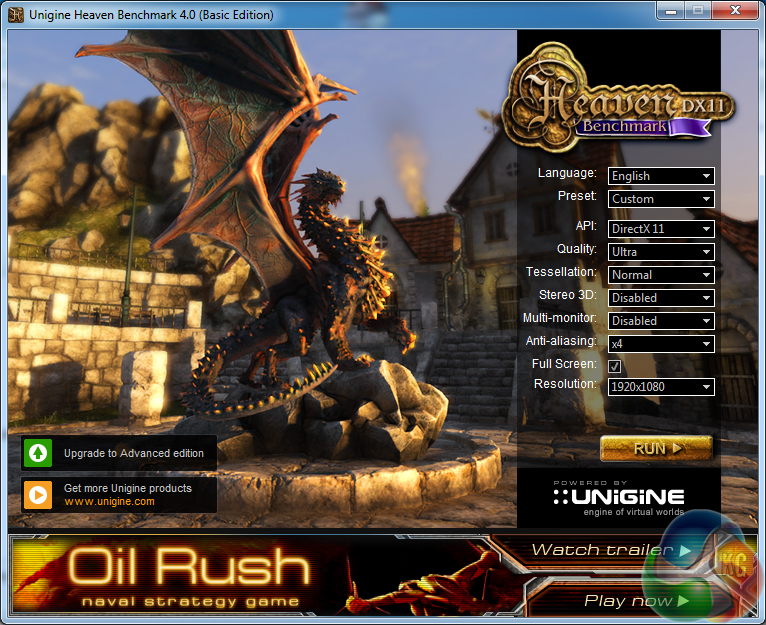
We set Quality to ‘Ultra', Tessellation to ‘Normal', Anti Aliasing to 4x and the resolution to 1920×1080 (1080p).
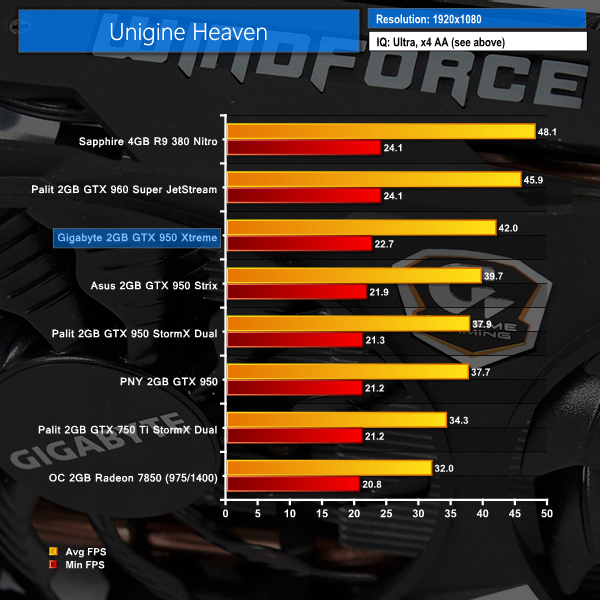
Over a 2 frame rate advantage against the ASUS GTX950 Strix card in the same price zone.
Battlefield 4 ’s single-player Campaign takes place in 2020, six years after the events of its predecessor. Tensions between Russia and the United States have been running at a record high, due to a conflict between the two countries that has been running for the last six years. (Wikipedia).
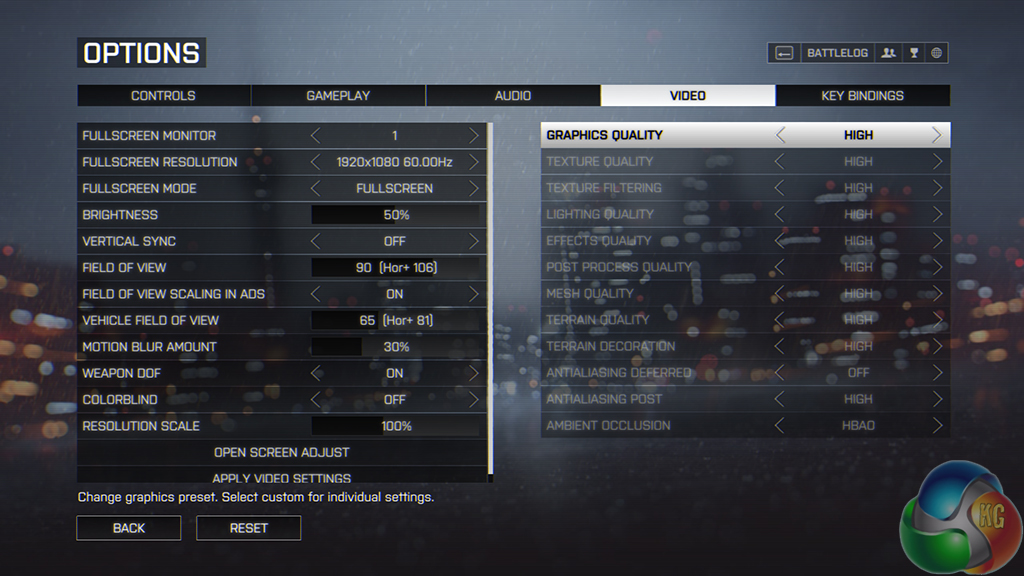
We opted for Battlefield 4's High IQ preset and did not apply AA in order to make the 60 FPS target obtainable for these cards. Our frame rates are recorded using a section of the game.
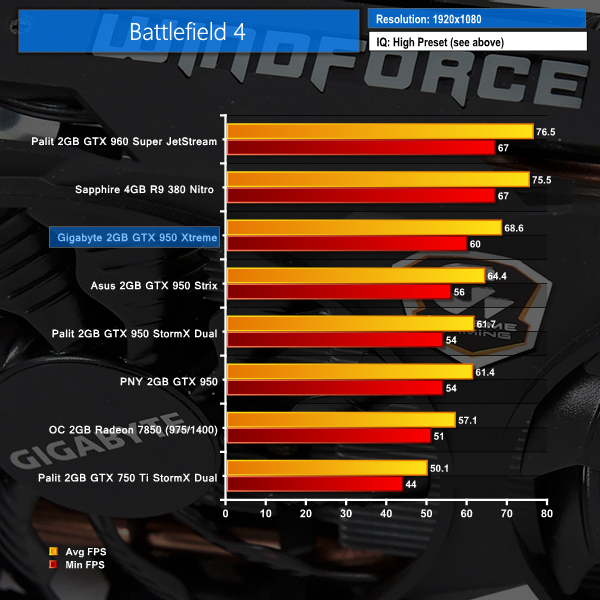
Superb results, holding a 60+ frame rate throughout our test section. Super smooth real world gameplay.
Set in 1912, in Bioshock Infinite, players assume the role of former Pinkerton agent Booker DeWitt, sent to the flying city of Columbia on a rescue mission. His target? Elizabeth, imprisoned since childhood.
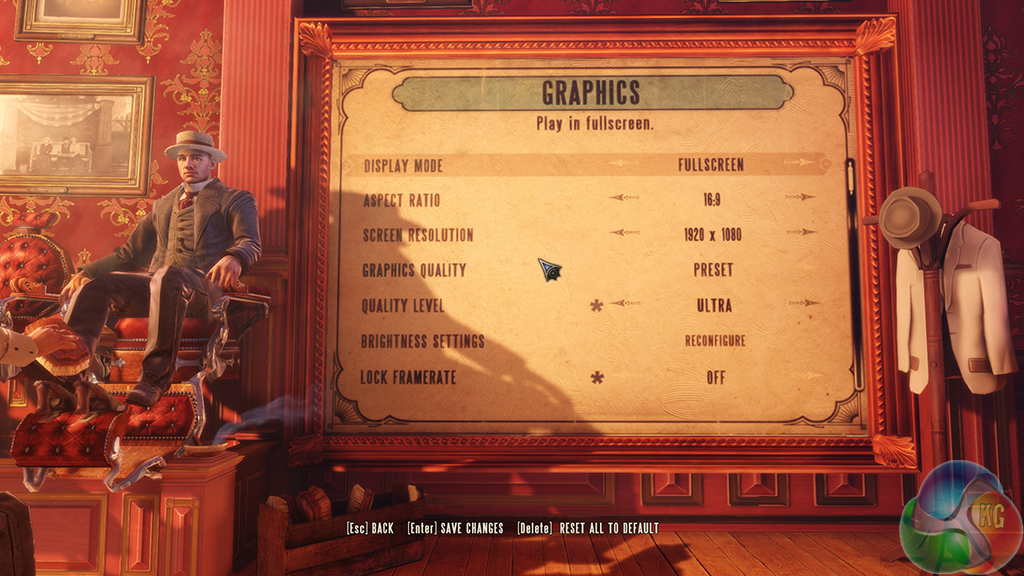
Bioshock Infinite is set to its highest image quality settings. We test a section of the game.
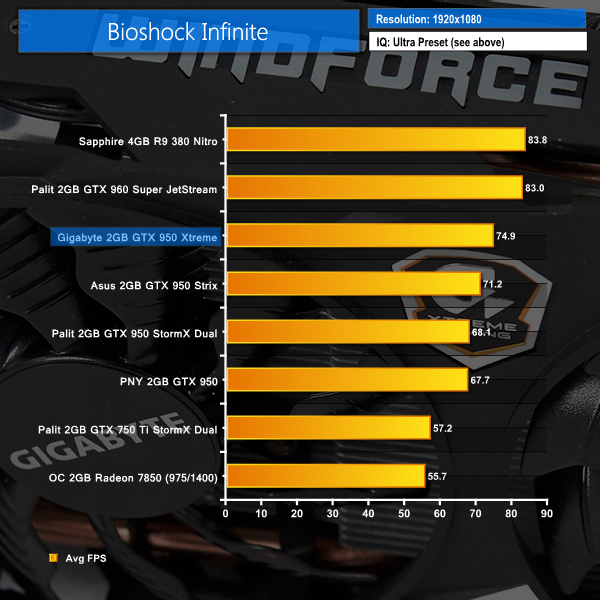
We still love this game, and we can see the Gigabyte GTX950 Xtreme Gaming 2GB card holds a marked 4 frames per second advantage over the GTX950 Strix – averaging almost 75 frames per second.
Grand Theft Auto V is an action-adventure game played from either a first-person or third-person view. Players complete missions—linear scenarios with set objectives—to progress through the story.
Outside of missions, players can freely roam the open world. Composed of the San Andreas open countryside area and the fictional city of Los Santos, the world of Grand Theft Auto V is much larger in area than earlier entries in the series.
The world may be fully explored from the beginning of the game without restrictions, although story progress unlocks more gameplay content. (Wikipedia).
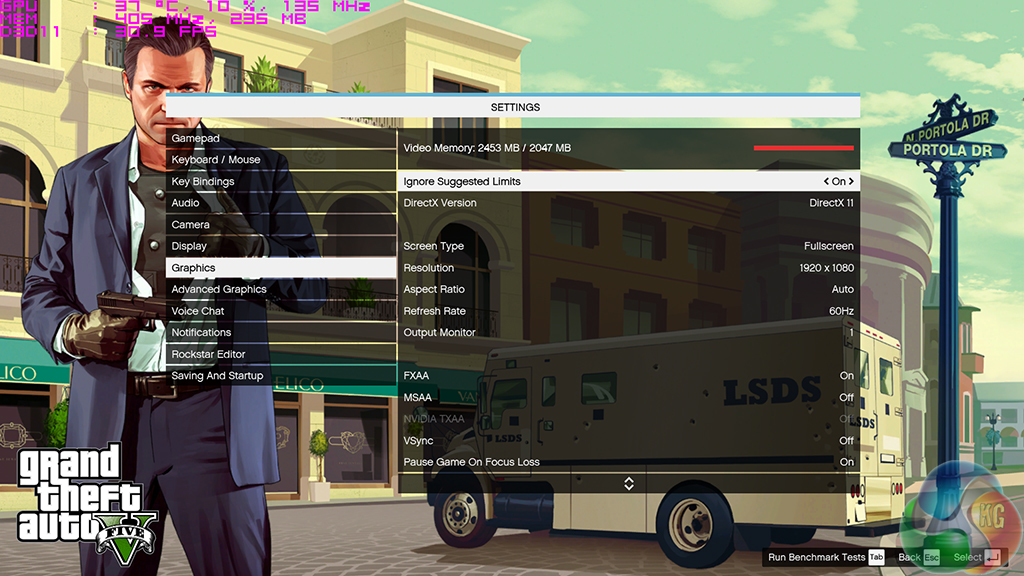
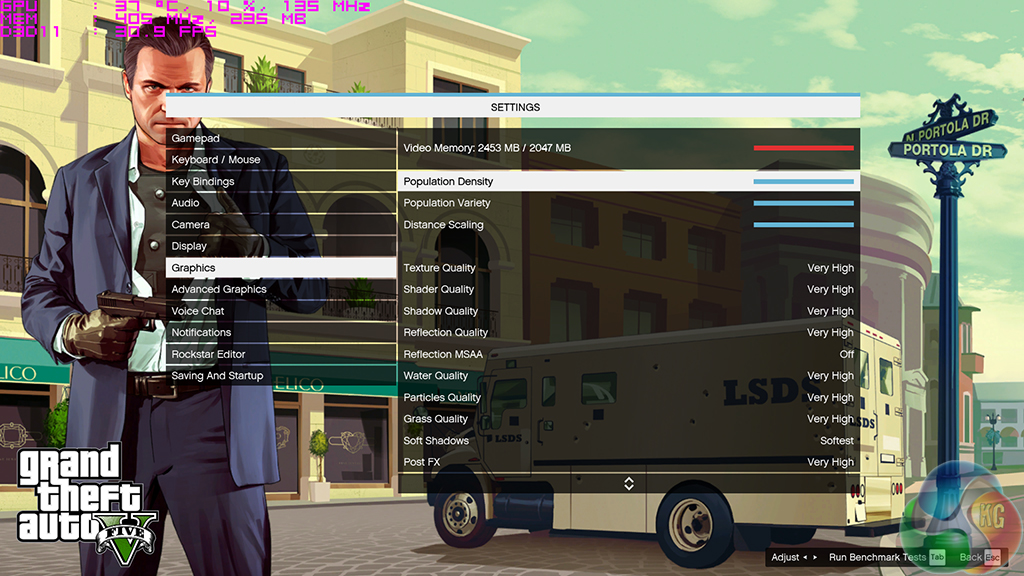
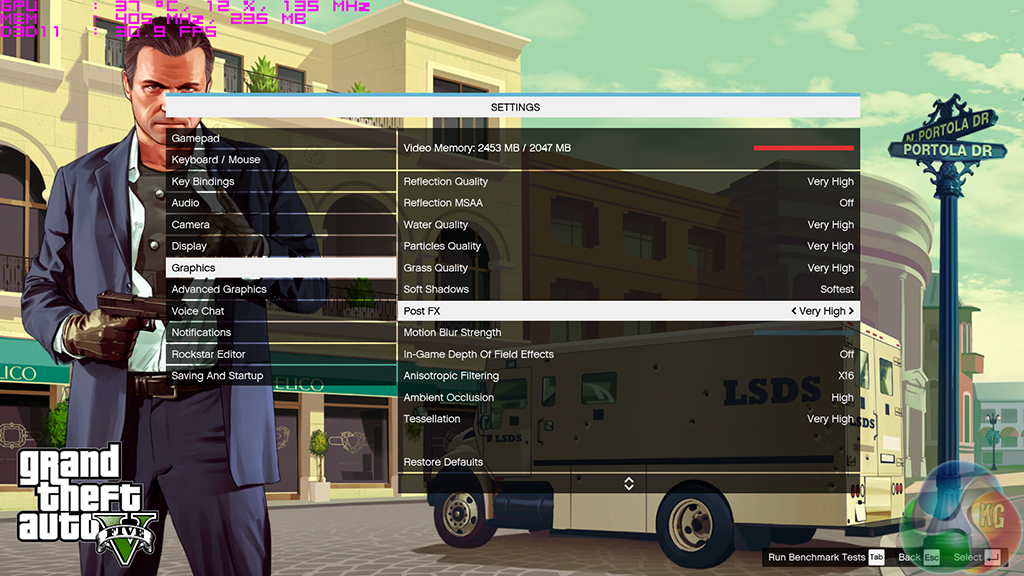
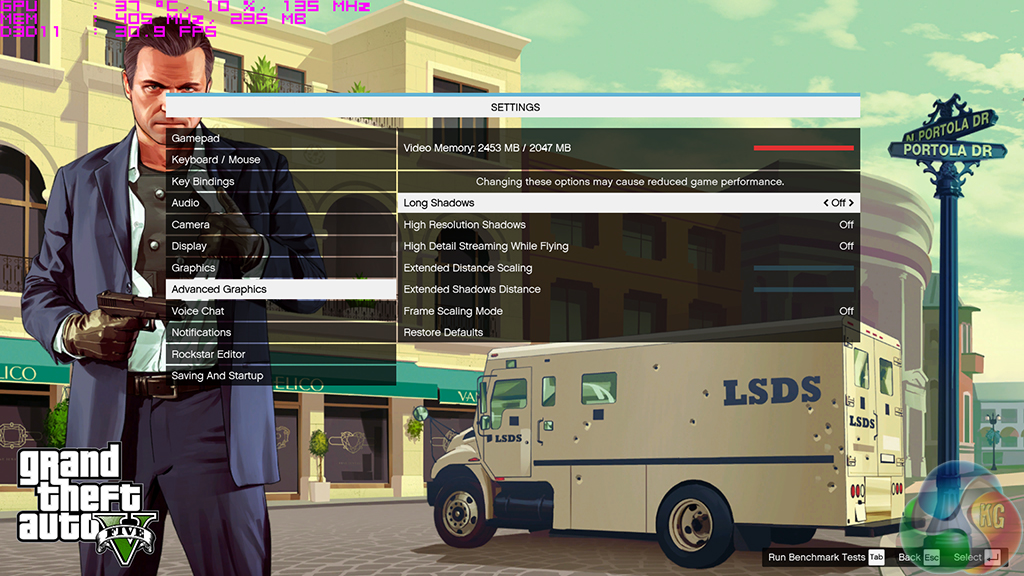
We set all of GTA V's primary settings to the Very High level (ambient occlusion was High). MSAA was turned off as it deals a harsh blow to the graphics cards' frame rates. The built-in benchmark is used to gather performance data.
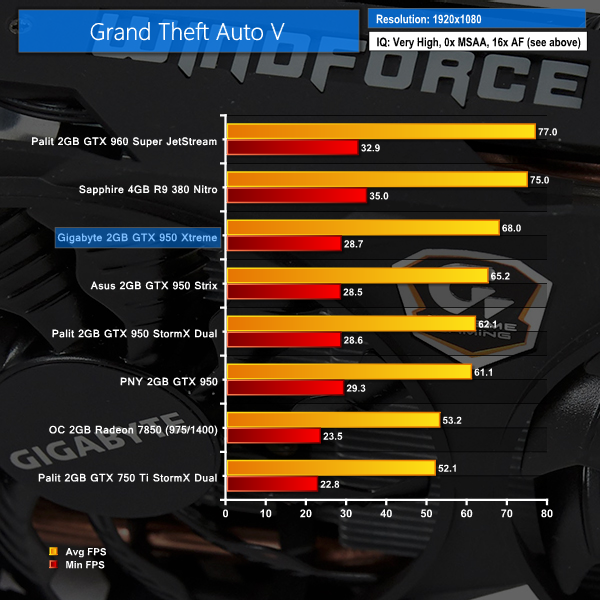
These are quite demanding settings for a lower cost graphics card – however we can see that the frame rates are playable. While there is much debate over what people consider ‘smooth' – over 25fps is considered by many to be acceptable. (It is the same frame rate for instance as PAL video playback). Image quality could be reduced a little to improve this further.
Metro: Last Light takes place one year after the events of Metro 2033, proceeding from the ending where Artyom chose to call down the missile strike on the Dark Ones. The Rangers have since occupied the D6 military facility, with Artyom having become an official member of the group. Khan, the nomad mystic, arrives at D6 to inform Artyom and the Rangers that a single Dark One survived the missile strike.
4A Games’ proprietary 4A Engine is capable of rendering breathtaking vistas, such as those showing the ruined remnants of Moscow, as well as immersive indoor areas that play with light and shadow, creating hauntingly beautiful scenes akin to those from modern-day photos of Pripyat’s abandoned factories and schools.
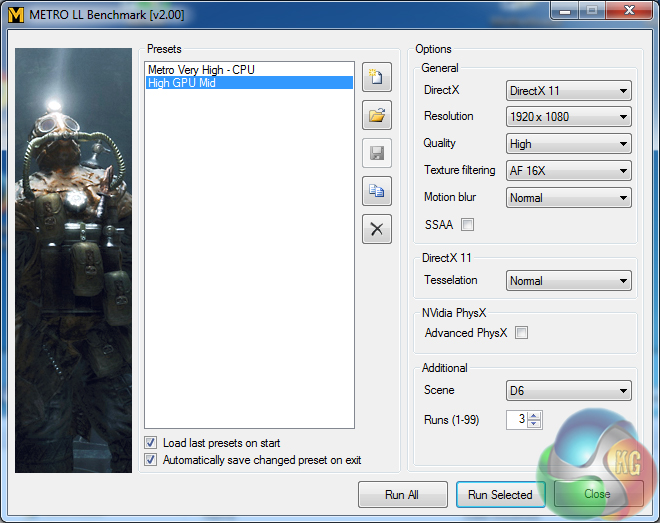
We opted for the High quality preset in the ever-demanding Metro: Last Light benchmark. AA was kept off, AF was applied as 16x, and tessellation was set to normal.
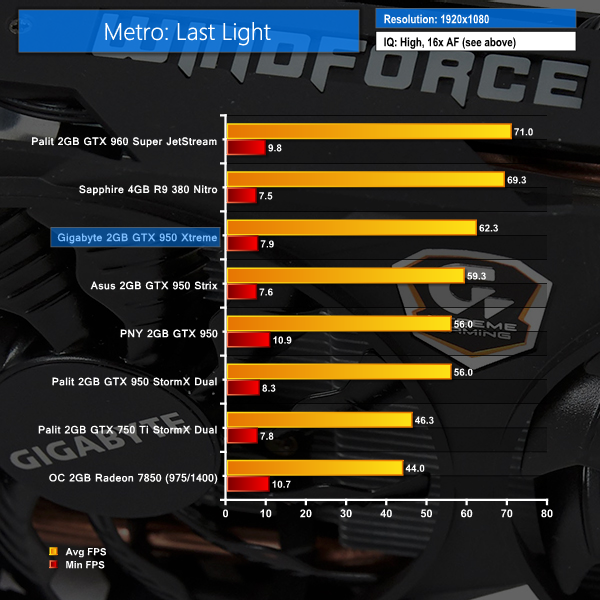
A smooth gaming experience in the real world, as the synthetic benchmark tends to task the graphics card more intensively than ‘in game' sections.
In Middle-earth: Shadow of Mordor, the player plays as a ranger by the name of Talion who has wraith-like abilities.In this open world video game, players have the freedom to pursue side quests and roam around the world.
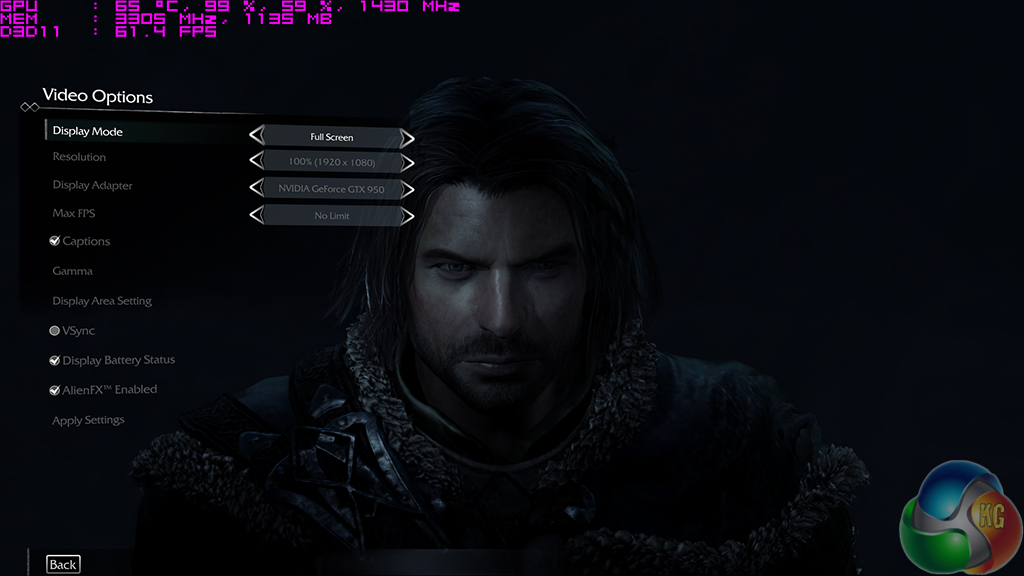
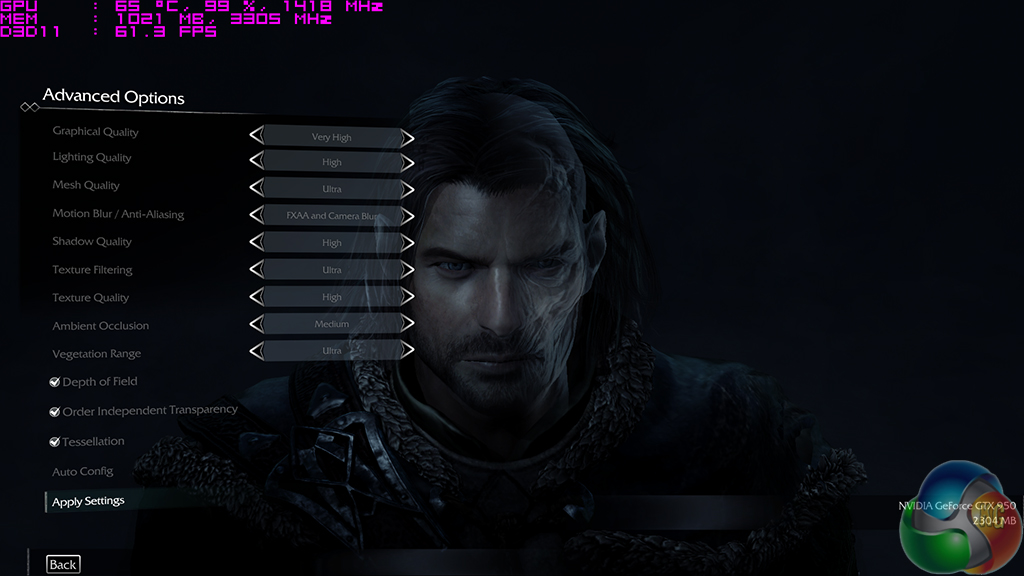
We used Shadow of Mordor's Very High image quality preset and test using the built-in benchmark.
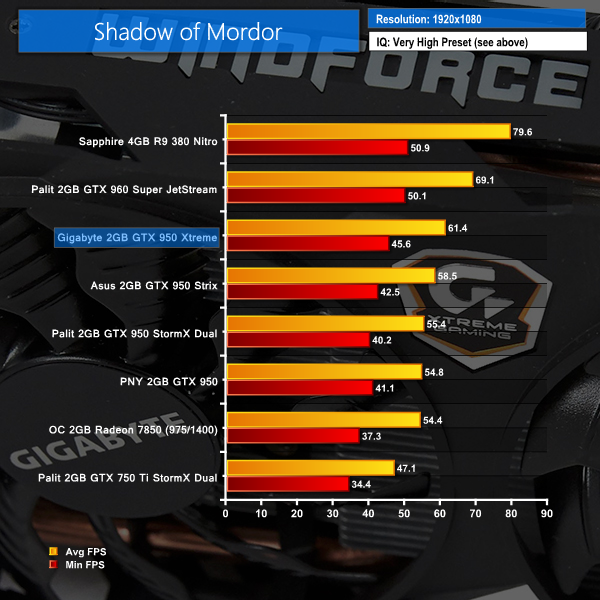
Overall we are pleased with the gaming experience from the Gigabyte GTX950 Xtreme Gaming 2GB. We averaged over 61 frames per second, and it held above 45 frames per second at all times.
Tomb Raider received much acclaim from critics, who praised the graphics, the gameplay and Camilla Luddington’s performance as Lara with many critics agreeing that the game is a solid and much needed reboot of the franchise. Much criticism went to the addition of the multiplayer which many felt was unnecessary. Tomb Raider went on to sell one million copies in forty-eight hours of its release, and has sold 3.4 million copies worldwide so far. (Wikipedia).
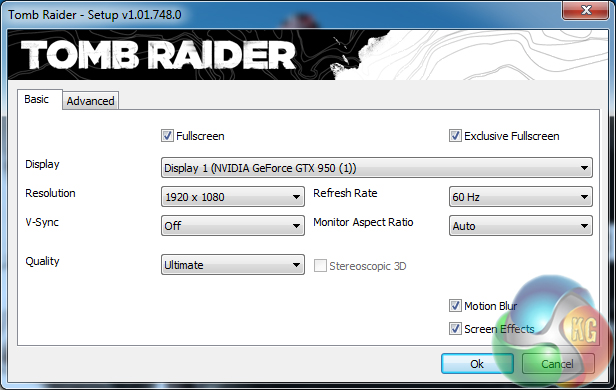
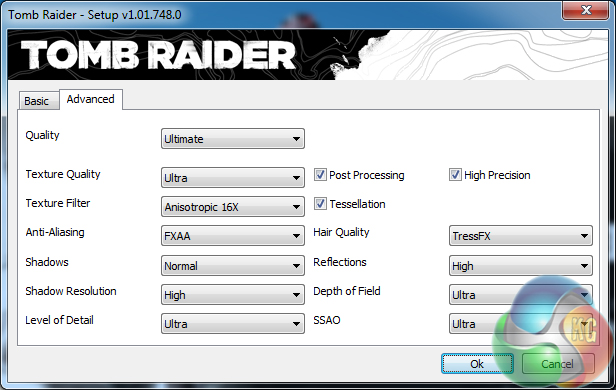
We test using the Ultimate quality profile enabled. The in-game benchmark is used.
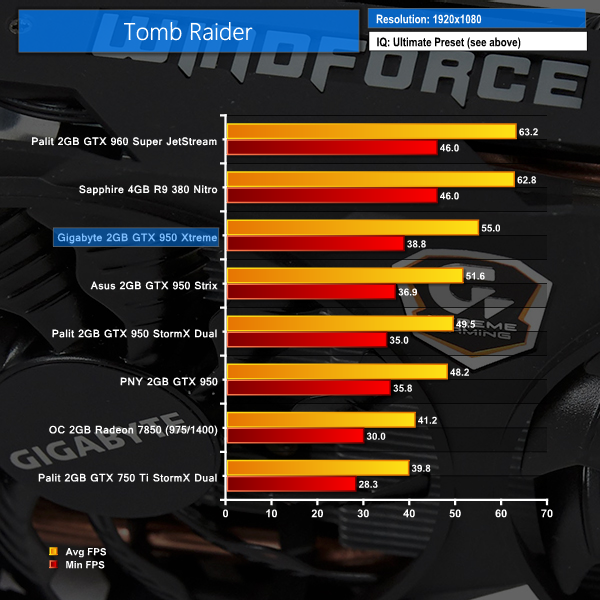
The huge ‘out of the box' overclock speeds help drive frame rates past other solutions at the same price point. The Asus GTX950 Strix for instance is more than 3 frames per second slower.
The tests were performed in a controlled room with temperatures maintained at a constant 25c – a comfortable summer environment for the majority of people reading this. Idle temperatures were measured after sitting at the desktop for 15 minutes. Gaming measurements were acquired by repeating the GTA V benchmark for 15 minutes and taking the stabilised reading. We also have included Furmark results, recording the core temperature after a 15 minute stress test. All fan settings were left on automatic.
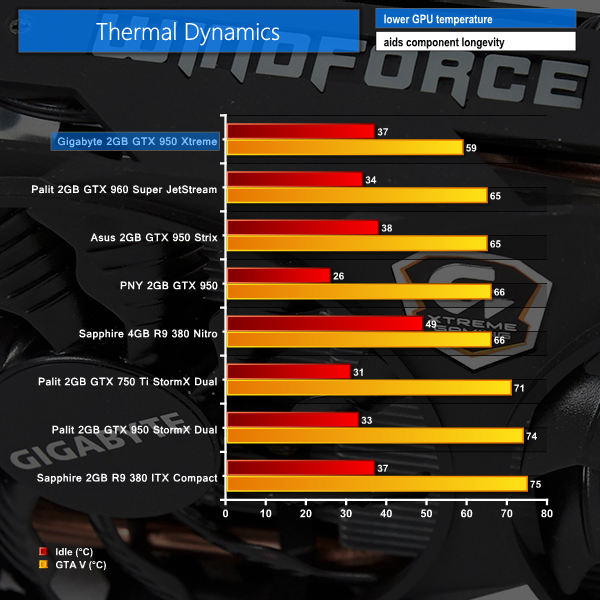
Thermal performance from Gigabyte's twin fan cooler is superb. The fans remain stationary under idle and low loads to completely mitigate the card's noise output.
Despite a high out-of-the-box GPU core clock, the core on Gigabyte's card manages to stay below 59°C under Grand Theft Auto V load.
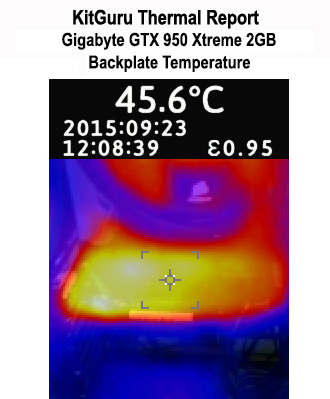
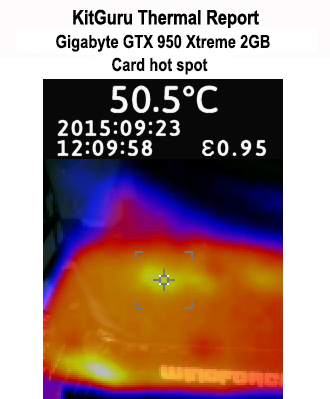
Thermal images show that Gigabyte's metal backplate is doing a good job at distributing thermal energy. The contact temperature for the backplate stays below the 50C-mark in most areas, so there is no need to worry if other components make contact with the card's backplate.
The hot spot that we recorded was a small cut-out in the backplate where the PCB's temperature was highlighted.
We measure graphics card acoustic emissions in our test system while all other fans are disabled, leaving our Corsair H100i’s pump unit as the sole noise-producing component.
We measure at a distance of around 1m from the front of the test system and around 1m from the ground. The positioning of a graphics card’s AIO liquid cooler (if the card has one) will have a noticeable effect on the recorded sound level and the system’s perceived loudness.
Unfortunately the city-centre positioning of our test location creates a relatively high ambient noise level of a little over 40 dBA. This has an effect on the perceived loudness of each card at the lower end of the noise scale.
KitGuru noise guide
10dBA – Normal Breathing/Rustling Leaves
20-25dBA – Whisper
30dBA – High Quality Computer fan
40dBA – A Bubbling Brook, or a Refrigerator
50dBA – Normal Conversation
60dBA – Laughter
70dBA – Vacuum Cleaner or Hairdryer
80dBA – City Traffic or a Garbage Disposal
90dBA – Motorcycle or Lawnmower
100dBA – MP3 player at maximum output
110dBA – Orchestra
120dBA – Front row rock concert/Jet Engine
130dBA – Threshold of Pain
140dBA – Military Jet takeoff/Gunshot (close range)
160dBA – Instant Perforation of eardrum
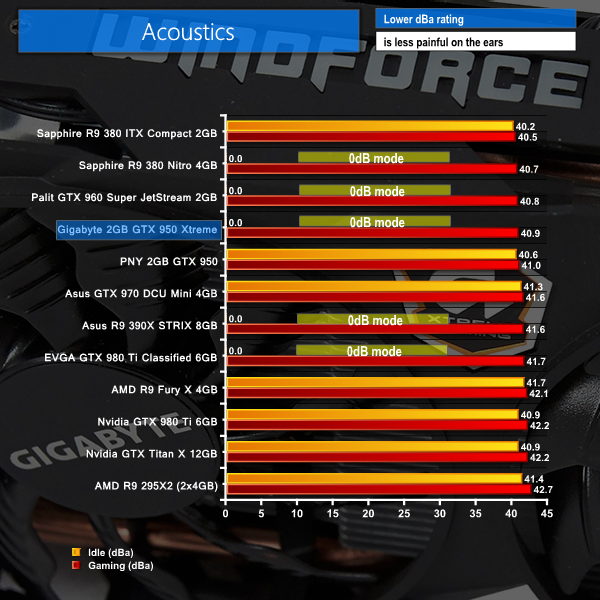
The card's fans completely stop rotating under low loads and even while gaming the card was inaudible over our background environment from 1m away. I actually stood far closer to the system in order to try to identify the fan noise but I could not.
The card sound levels are far from intrusive and the two fans only required a speed level of 35% while gaming. Coil whine was not an issue whatsoever.
We measure the amount of power drawn from the wall by the entire test system. Our Core i7-5960X CPU is heavily overclocked and has a large bearing on the power draw readings when it is heavily loaded in GTA V. The important information is the difference in power draw levels between each card.
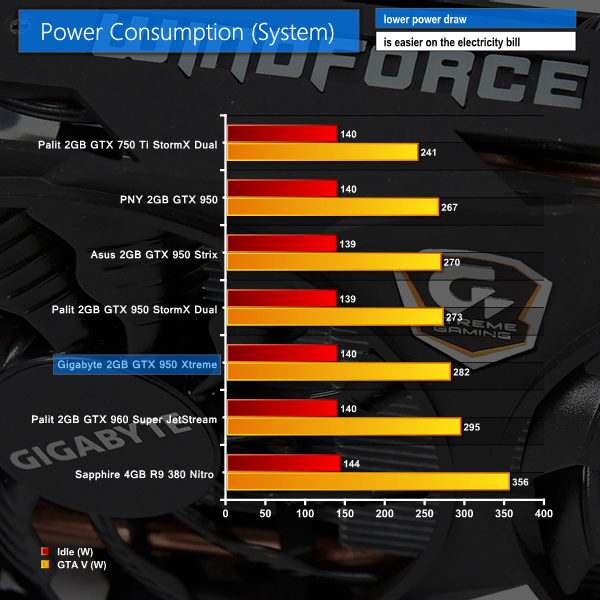
Gigabyte's heavily-overclocked GTX 950 uses more power than competing vendors' offerings while gaming. This is unsurprising given the card's 1481MHz core clock while gaming and its higher performance than other GTX 950 solutions that we have tested.
We know that the GM206 GPU has more headroom in it than reference or board partner speeds would suggest, so we pushed to see how far we could overclock Gigabyte GTX 950 Xtreme Gaming card.
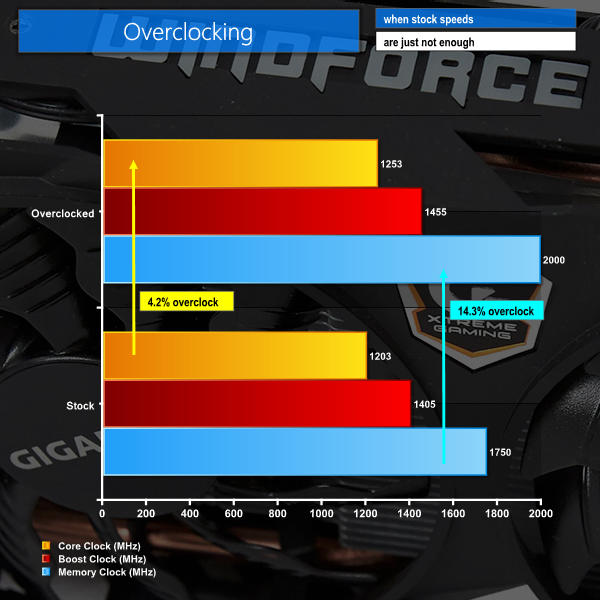
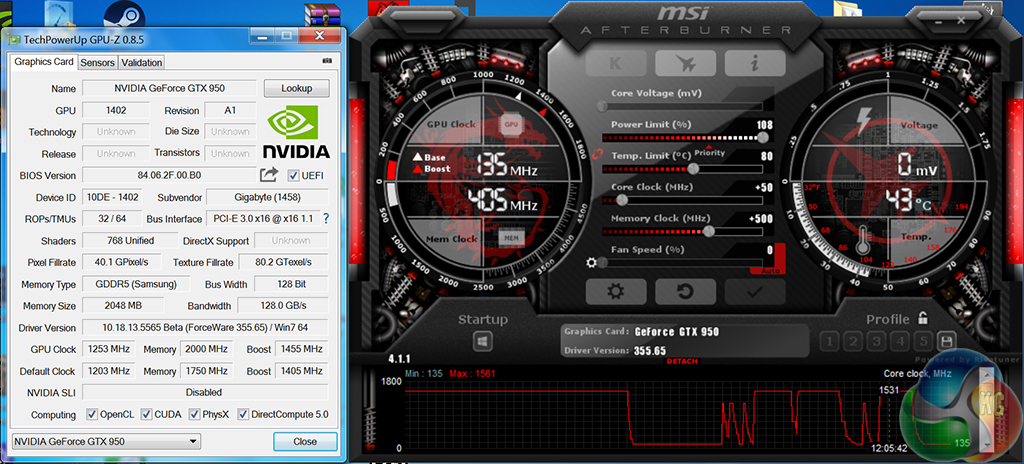
Without increasing voltage we managed to push the GPU core clock 50MHz higher than its already high out-of-the-box operating state, resulting in a recorded GPU frequency of 1531MHz while gaming. The memory had plenty of headroom in it, pushing to 2000MHz (8000MHz effective). This is higher than the GDDR5 clock speeds that we have managed with the other GTX 950 cards tested.
It is worth noting that Gigabyte's card could only be set to use a 108% power limit by default (in both MSI Afterburner and Gigabyte's own software). I would have liked to see this limit extended, especially given the 8-pin PCIe power connector however there is the option to manually adjust the GPU core voltage for greater overclocking headroom.
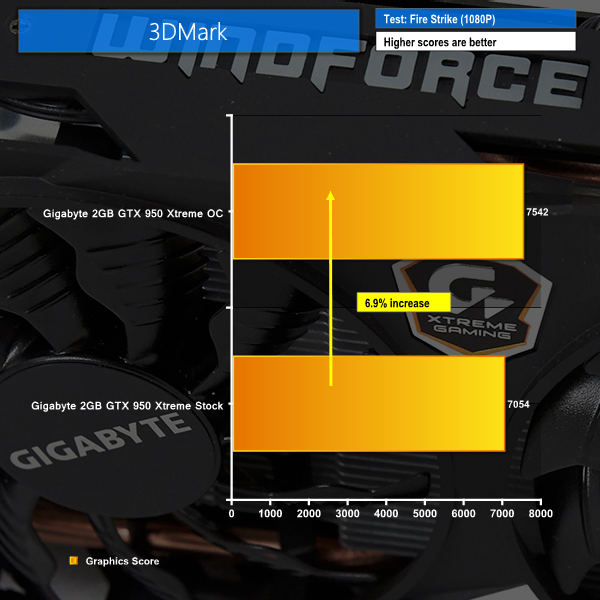
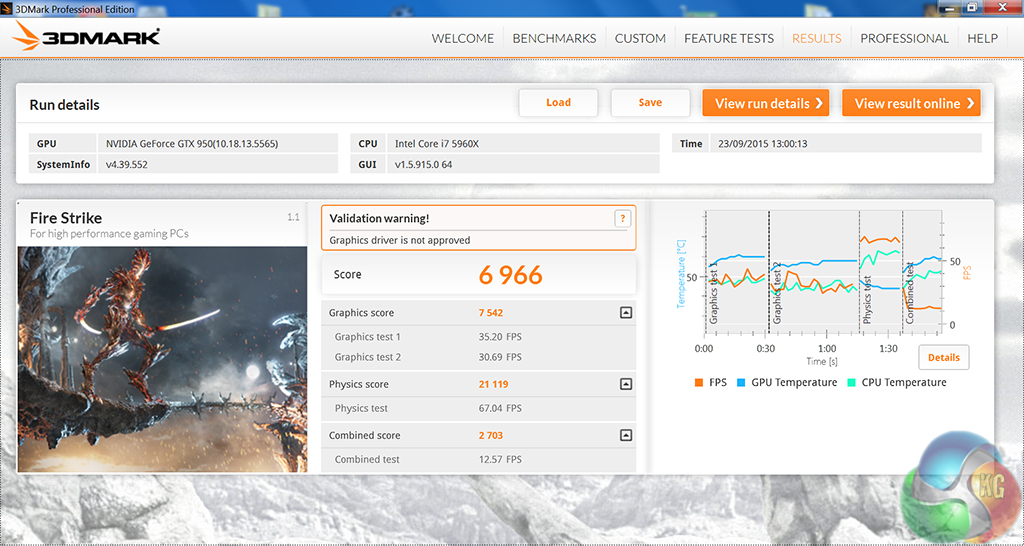
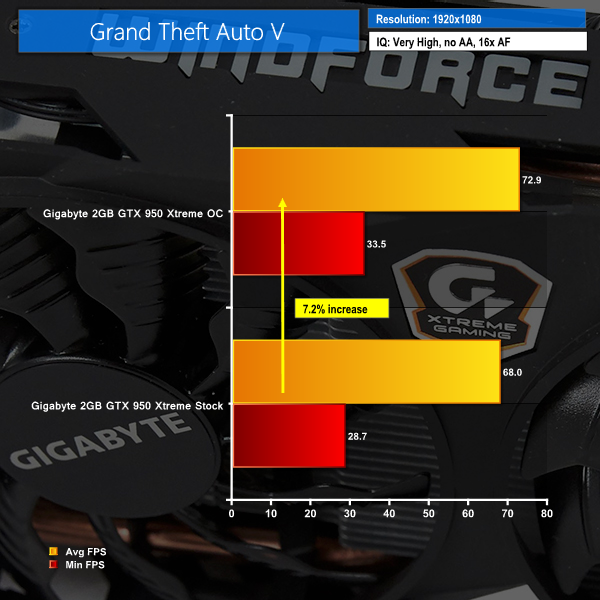
3DMark and GTA V both showed healthy performance gains of around 7% using the overclocked configuration. The minimum frame rates in GTA V were also pushed past the 30 frames per second mark which could be useful for gamers with a G-Sync monitor.
The Gigabyte GTX 950 Xtreme Gaming 2GB graphics card is certainly worth serious consideration and at the price point it looks to be one of the fastest graphics cards that money can buy.
While the reference card is impressive enough on paper, Gigabyte have taken the core clock speed and cranked it significantly – therefore pushing frame rate performance into a different zone. They have increased core speeds to 1203MHz which is a significant increase over the 1024MHz reference GPU speed. The boost clock is rated at 1405MHz, but we actually saw the card hitting 1481MHz during gaming. In a less common move these days, Gigabyte also overclocks the memory by 100MHz, resulting in an effective data rate of 7000MHz for the 2GB of GDDR5.
That in itself is impressive enough, but we manually overclocked the card even further resulting in a recorded GPU frequency of 1531MHz while gaming. We also were able to push the memory clocks to 2,000MHz (8Gbps effective) – which is quite remarkable and ahead of competitor products, by a clear margin.
Gaming performance is surprisingly good. We were able to play a suite of new and older AAA titles with Ultra and High image quality settings. Grand Theft Auto V was a great gaming experience at 1080p, with image quality set at Very High, albeit with frame killing MSAA disabled. Tomb Raider was super smooth at 1080p with the Ultimate preset enabled. At the same resolution with High image quality settings Battlefield 4 managed to hold at 60 frames per second or greater – at all times. These are the kind of frame rates we don't normally expect to see at 1080p within this price sector.
Availability of Gigabyte's GTX 950 Xtreme Gaming is limited, although we did find the card selling for £147.76 at Lambda-Tek. Pricing of the higher-end GTX 950 parts presents issues currently. Many of the more expensive boards are priced too closely to GTX 960 solutions to make them compelling options when looking at the bigger picture. We saw the same thing happen with Asus' GTX 950 STRIX, which hit retail for £149 rather than the anticipated £139.
At just under £150 the card is a hard sell compared to some of the lower-end GTX 960 cards available. But as far as GTX 950 solutions go, Gigabyte's GTX 950 Xtreme Gaming is one of the best options on the market. What Gigabyte has in its favour is one of the fastest out-of-the-box GTX 950 solutions that ships with a superb twin-fan cooler and customisable lighting. Buyers wanting a GTX 950 should take note of Gigabyte's GTX 950 Xtreme Gaming.
Discuss on our Facebook page, over HERE.
Pros:
- Extremely high out-of-the-box GPU core clock.
- Memory is overclocked by default.
- Quiet and effective twin-fan cooler.
- Customisable lighting.
- Well-designed backplate.
- Good overclocking headroom.
Cons:
- Higher-end GTX 950 solutions are priced to closely to some GTX 960 cards.
KitGuru says: If you have your sights set on a GTX 950, Gigabyte's GTX 950 Xtreme Gaming is one of the best options available.