KitGuru KitGuru.net – Tech News | Hardware News | Hardware Reviews | IOS | Mobile | Gaming | Graphics Cards


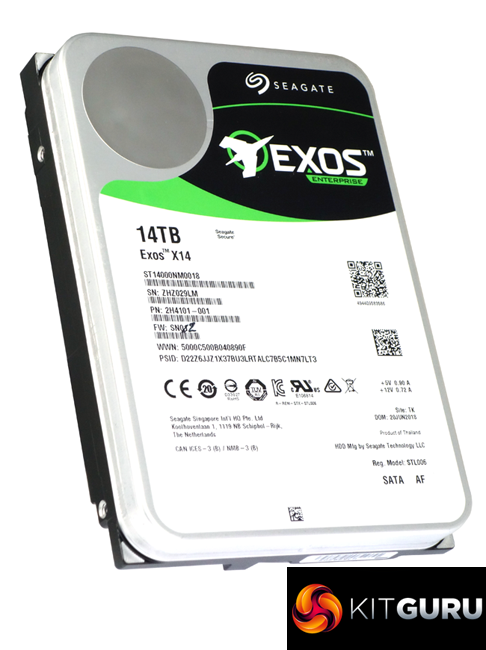
A few months ago, Seagate refreshed its range of drives with new 14TB flagship drives aimed at consumers (BarraCuda Pro), NAS users (IronWolf and IronWolf Pro) and the SkyHawk drive for surveillance applications. Launched at the same time was the latest top-end drive for the Exos enterprise range, the 14TB Exos X14.
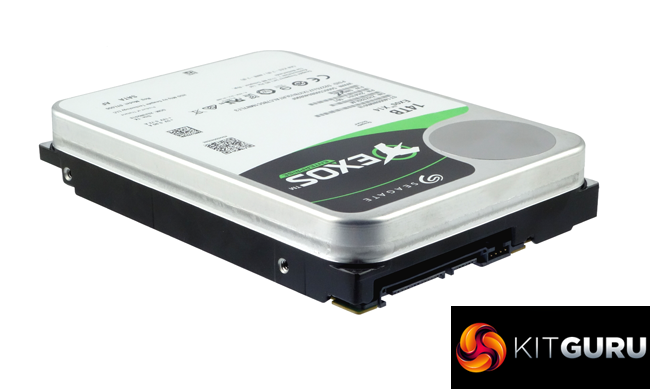
The 14TB Exos X14 uses Helium technology which allows for 8 x 1.75TB CMR (conventional magnetic recording) platters together with 16 TDMR heads to be crammed into a 3.5in format drive with a height of just 26.11mm. The drive has a spindle speed of 7,200rpm and is equipped with 256MB of cache. The official transfer rates for the Exos X14 are up to 261MB/s while the average latency is 4.16ms. As with most of the Exos product range, the X14 is available with either 6Gb/s SATA (ST14000NM0018, the drive being reviewed) or 12Gb/s SAS interfaces.
Power ratings for the SATA drive are quoted as 5W average idle and 7.8W average active (9.7W reads, 5.8W writes).
Seagate quotes a workload rating of 550TB/year with a MTBF of 2.5M hours and Seagate backs the drive with a 5 year warranty.
Physical Specifications:
- Usable Capacities: 14TB.
- Spindle Speed: 7,200rpm.
- No. Of Heads: 16
- No. Of Platters: 8
- Cache: 256MB.
- Recording Method: conventional magnetic recording (CMR)
- Interface: Serial ATA (SATA) 6Gb/s (SATA III).
- Form Factor: 3.5in.
- Dimensions: 26.11 x 101.85 x 146.99 mm
- Drive Weight: 690g
Firmware Version: SN02
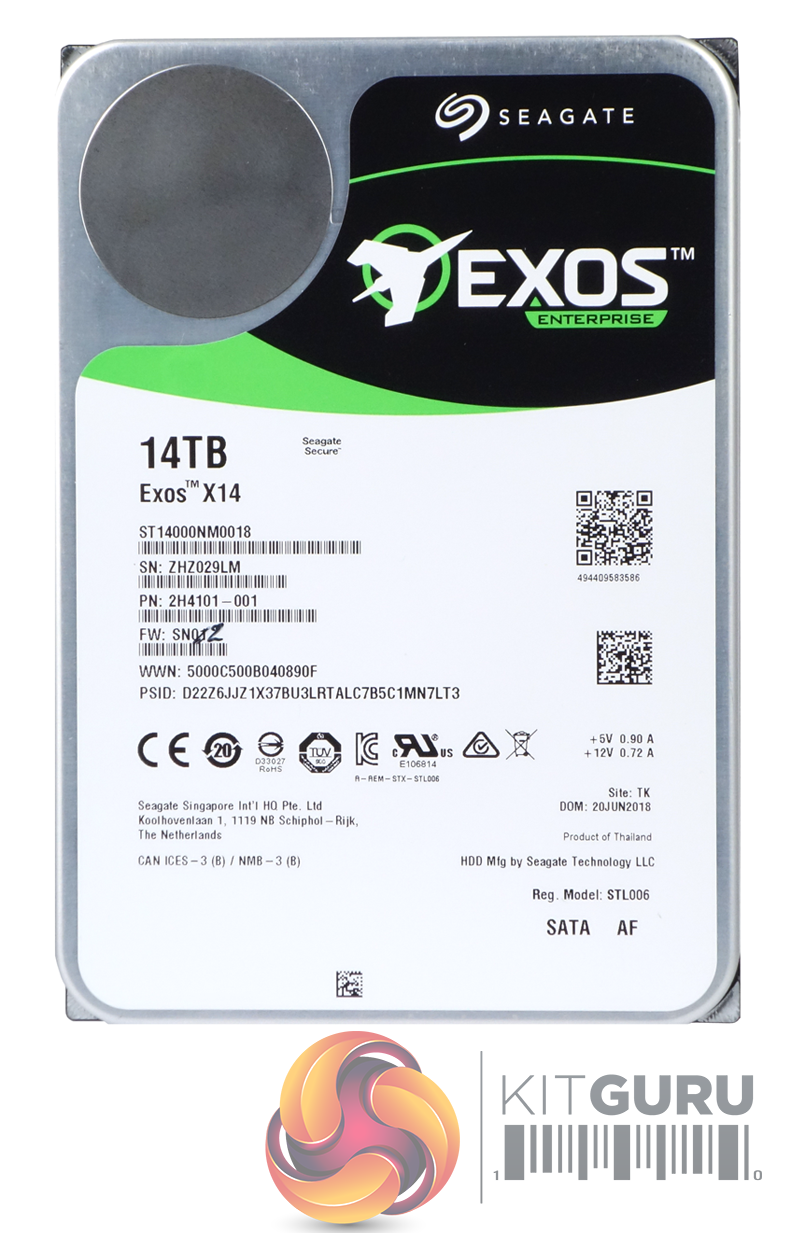
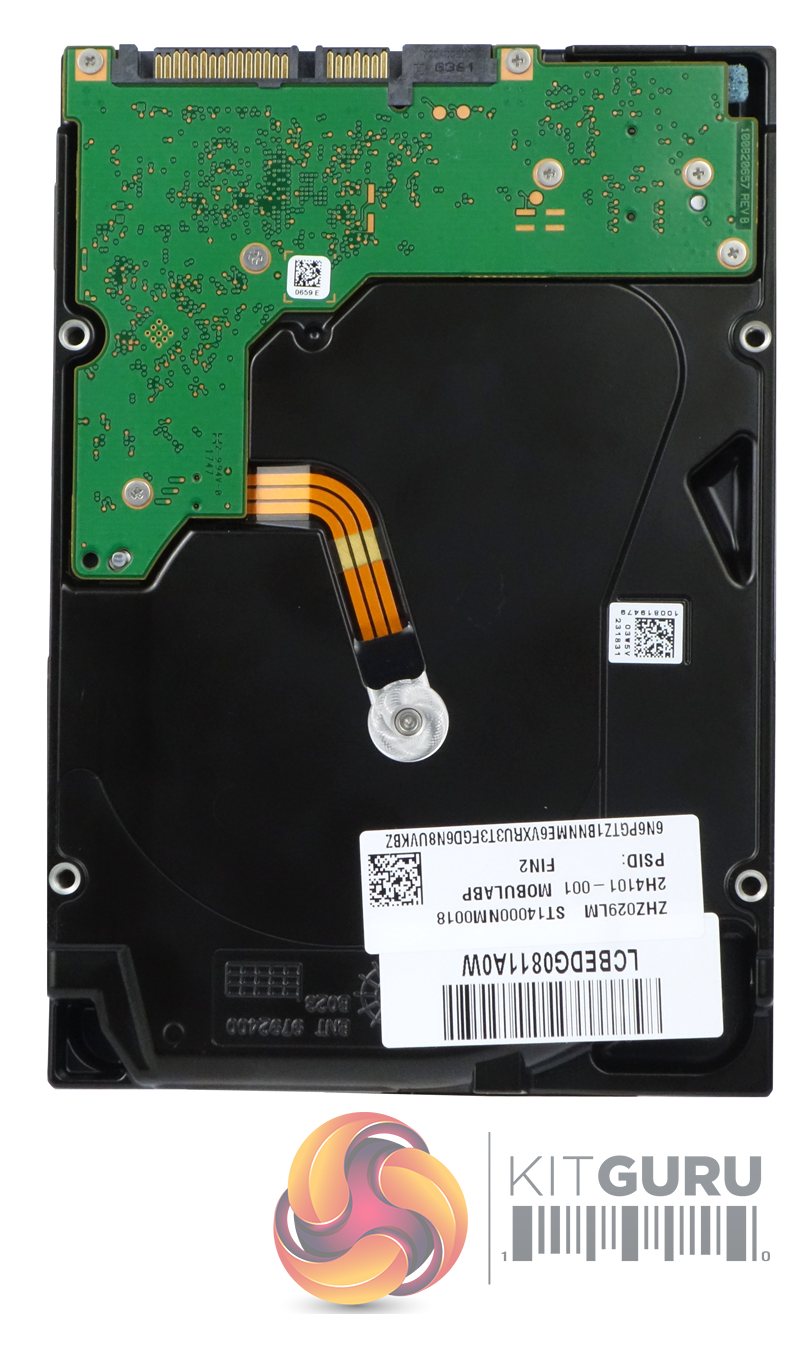
Seagate’s Exos X14 is built on a standard 3.5in format but with a thickness of 26.11mm. The drive has a spindle speed of 7,200rpm and 256MB of cache.
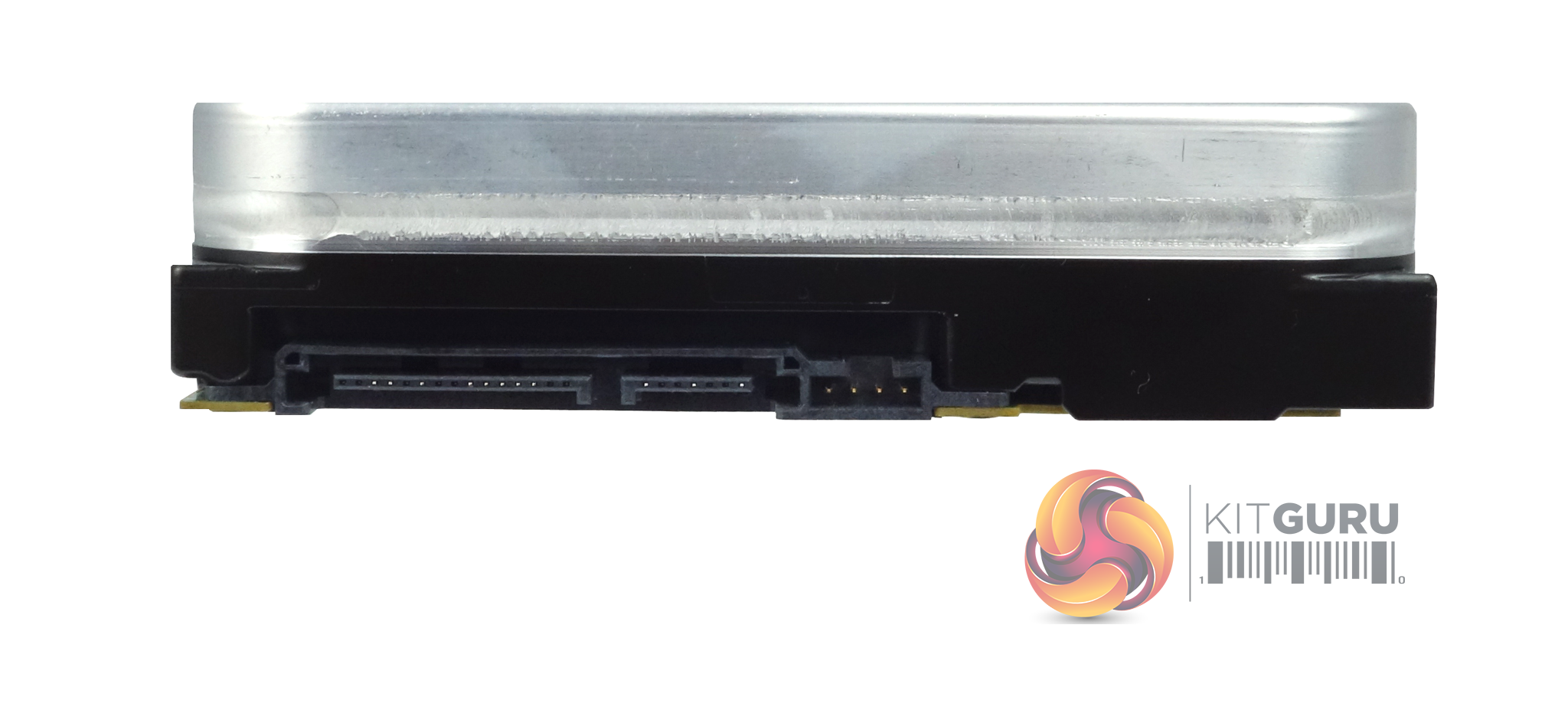
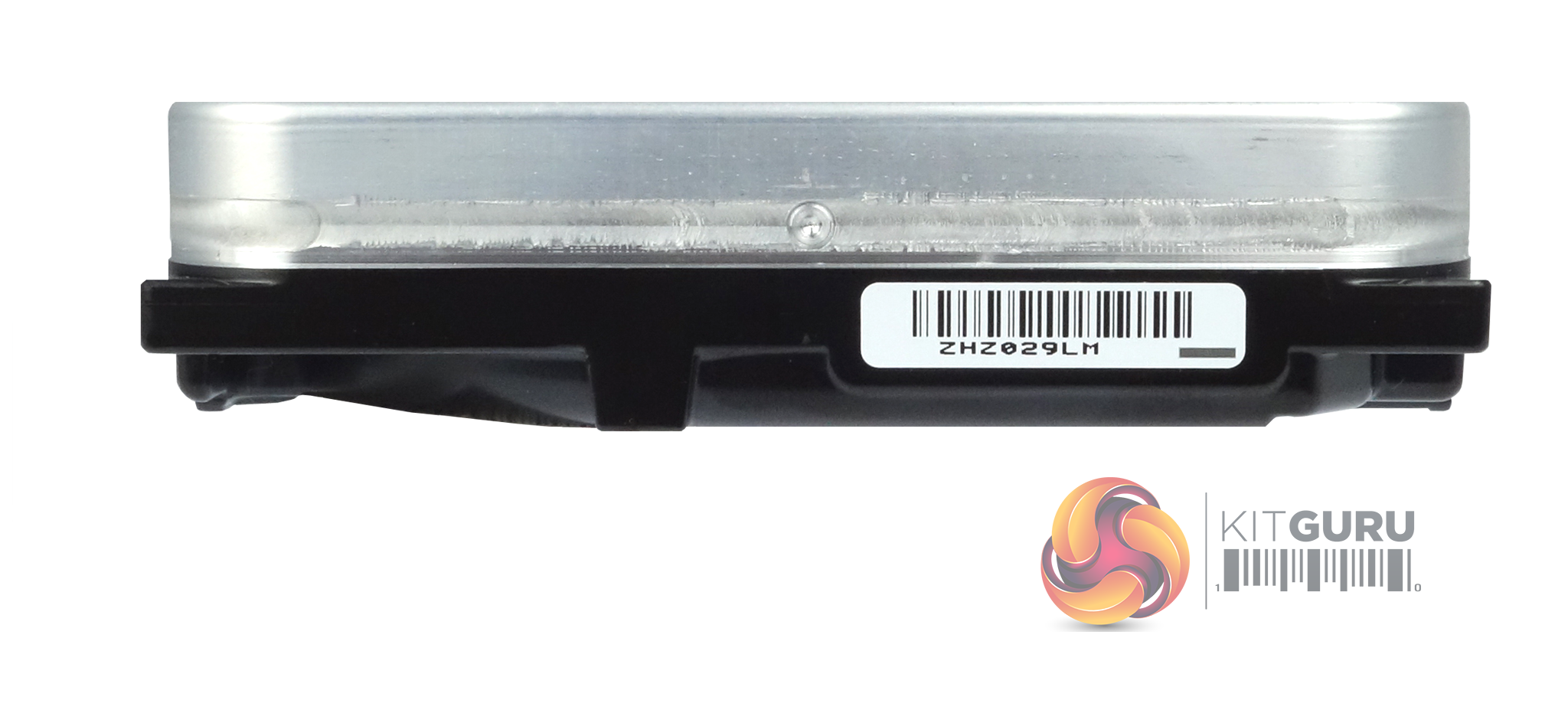
The drive uses Helium technology which enables Seagate to use eight 1.75TB (areal density of 1058 GB/in2) CMR (Conventional Magnetic Recording) platters and 16 TDMR (Two-Dimensional Magnetic Recording) reading heads into the drive.
TDMR technology has come about because as the areal density of hard drive platters (discs) increases, tracks get ever narrower and as a result, magnetic inter-track interference (ITI) becomes problematic for the writer part of the drive head. TDMR uses two or more heads to read data from a single or even several nearby tracks at the same time to improve the signal-to-noise ratio delivered to the controller.
For testing, the drives are all wiped and reset to factory settings by HDDerase V4. We try to use free or easily available programs and some real world testing so you can compare our findings against your own system. This is a good way to measure potential upgrade benefits.
Main system:
Intel Core i7-7700K with 16GB of DDR4-3200 RAM, Sapphire R9 390 Nitro and an Asus Prime Z270-A motherboard.
Other drives:
Seagate NAS 8TB
Seagate IronWolf Pro 14TB
Seagate BarraCuda Pro 12TB
Seagate IronWolf Pro 12TB
Seagate IronWolf 10TB
Toshiba N300 8TB
Toshiba P300 3TB
Toshiba X300 6TB
WD Gold 12TB
WD Black 6TB
WD Black 4TB
WD Red 8TB
WD Red 4TB
Software:
Atto Disk Benchmark.
CrystalMark 3.0.3.
IOMeter
All our results were achieved by running each test five times with every configuration, as this ensures that any glitches are removed from the results.
CrystalDiskMark is a useful benchmark to measure theoretical performance levels of hard drives and SSDs. We are using V3.0.3.
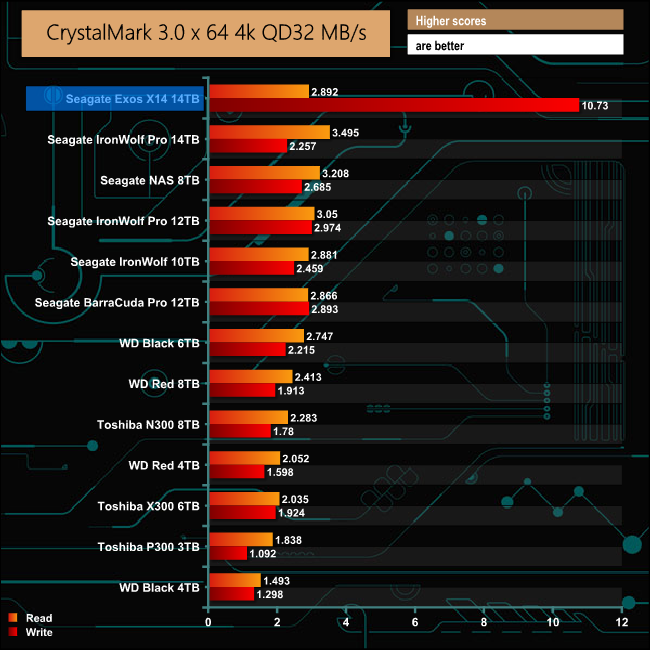
The Exos X14 uses Advanced Write Caching technology which employs enhanced algorithms to provide a very large boost to the random write performance of the drive as can be clearly seen in the CrystalDiskMark write result.
The ATTO Disk Benchmark performance measurement tool is compatible with Microsoft Windows. Measure your storage systems performance with various transfer sizes and test lengths for reads and writes. Several options are available to customize your performance measurement including queue depth, overlapped I/O and even a comparison mode with the option to run continuously.
Use ATTO Disk Benchmark to test any manufacturers RAID controllers, storage controllers, host adapters, hard drives and SSD drives and notice that ATTO products will consistently provide the highest level of performance to your storage.
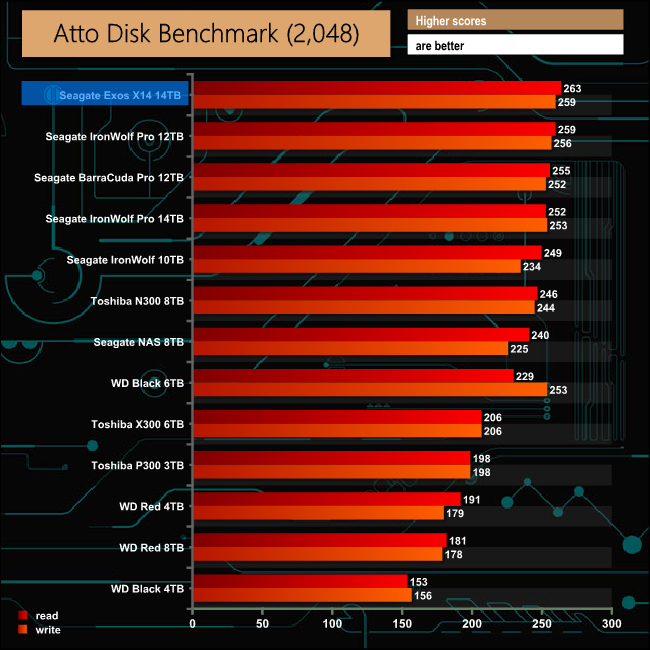
The official transfer rate figure for the 14TB Exos X14 is up to 261MB/s which can be confirmed with the ATTO benchmark. The tested drive produced figures of 263MB/s for reads and 259MB/s for writes.
IOMeter is another open source synthetic benchmarking tool which is able to simulate the various loads placed on hard drive and solid state drive technology.
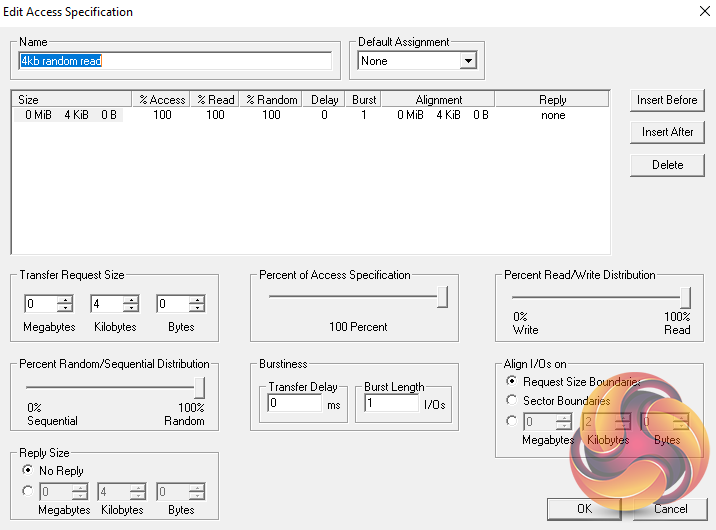
We test with both random read and write 4k tests, as shown above. There are many ways to measure the IOPS performance of a hard drive, so our results will sometimes differ from manufacturer’s quoted ratings. We do test all drives in exactly the same way, so the results are directly comparable.
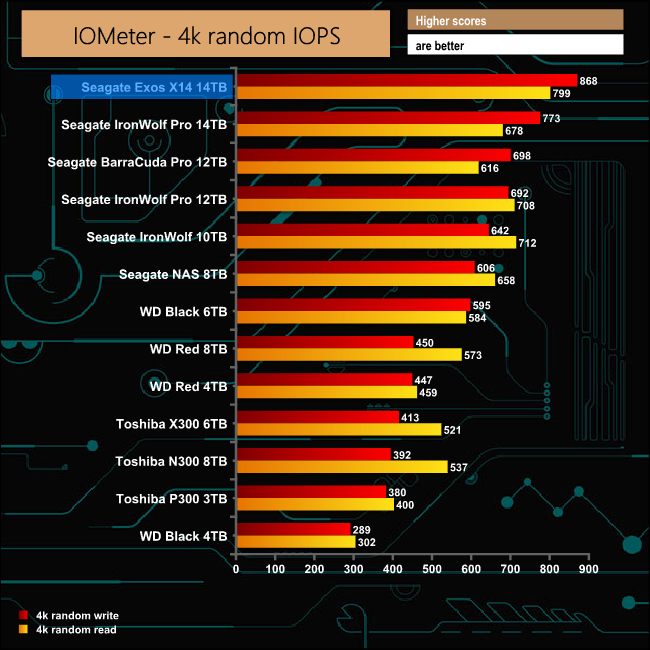
Thanks to the Advanced Write Caching technology used by the Exos 14 it goes straight to the top of the performance graph in our 4K random read/write tests.
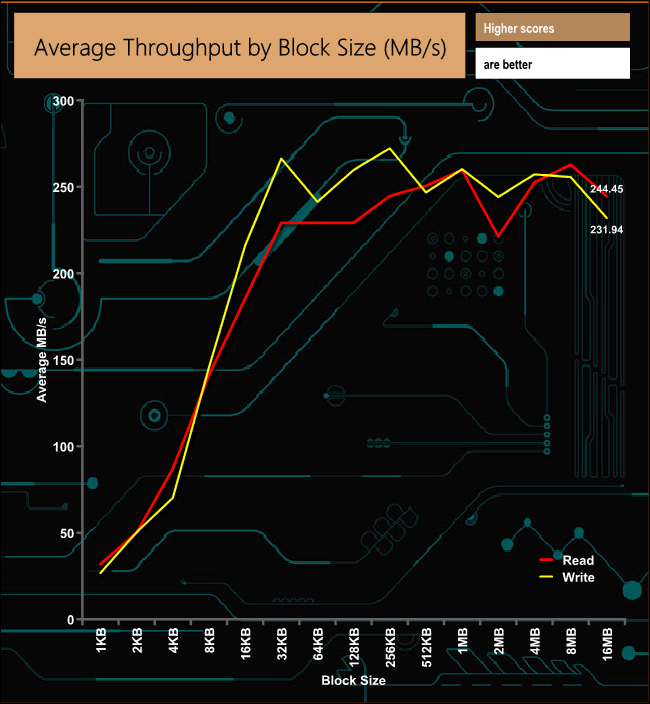
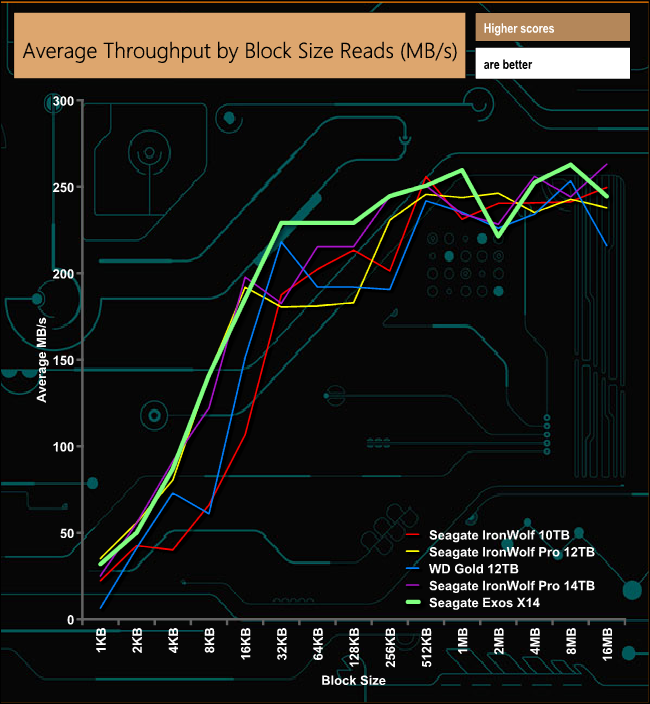
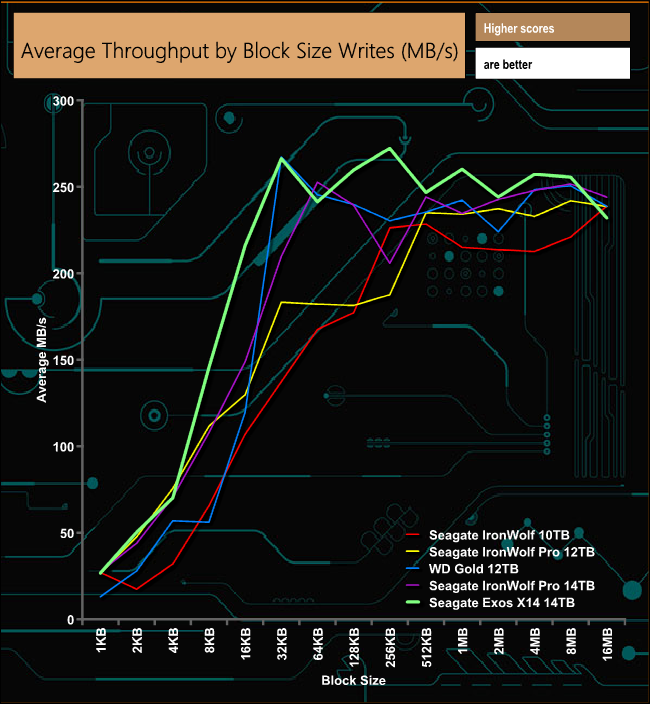
In our throughput test, reads peak at the 8MB block size at 262MB/s before falling back to end the test at 244MB/s. Writes peak at 272MB/s as the drive passes through the 256KB block size, before dropping back to finish the test at 231MB/s. Both of these peak figures confirm the official Seagate transfer rate for the drive of 261MB/s.
We tested the Exos X14 with a number of scenarios that it may face in the real world. The settings for these scenarios are as follows.
File Server
512MB file size, 16KB Block size
80% Read 20% Write 100% Random
I/O queue depth 128
Web Server
1GB file size, 16KB Block size
100% Read 0% Write 100% Random
I/O queue depth 64
Database
2GB file size, 4KB Block size
90% Read 10% Write, 90% Random, 10% Sequential
I/O depth 128
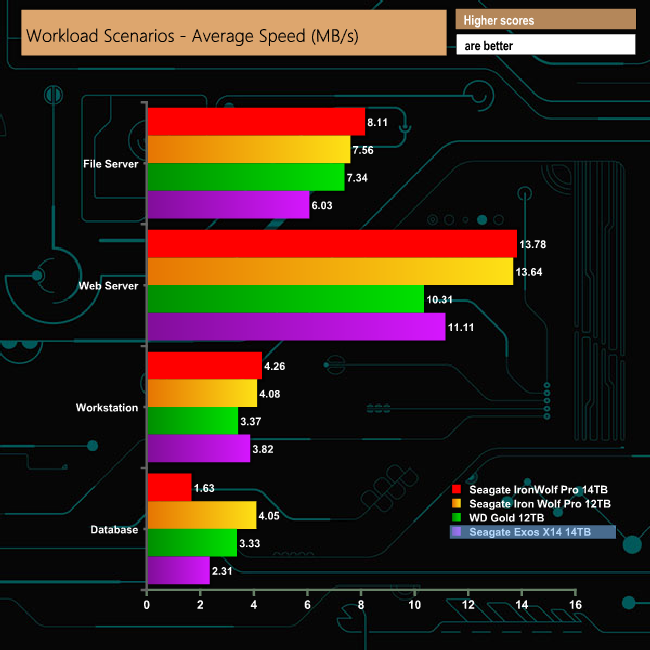
In our workload tests, the Exos X14 isn't as fast as the other 14TB Seagate drive we've recently tested, the IronWolf Pro, with the exception coming in the Database test where the Exos X14 is a good deal quicker.
To test real life performance of a drive we use a mix of folder/file types and by using the FastCopy utility (which gives a time as well as MB/s result) we record the performance of drive reading from & writing to a 256GB Samsung SSD850 PRO.
We use the following folder/file types:
- 100GB file.
- 60GB ISO image.
- 60GB Steam folder – 29,521 files.
- 50GB File folder – 28,523 files.
- 12GB Movie folder – 24 files (mix of Blu-ray and 4K files).
- 10GB Photo folder – 621 files (mix of .png, raw and .jpeg images).
- 10GB Audio folder – 1,483 files (mix of mp3 and .flac files).
- 5GB (1.5bn pixel) photo.
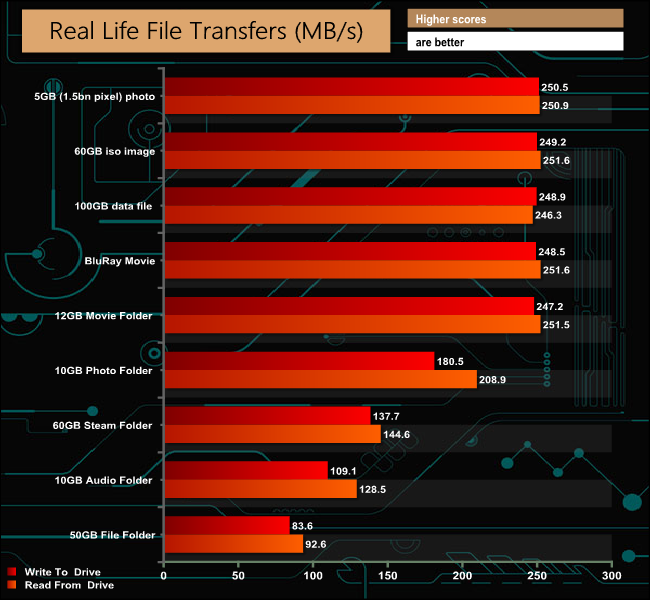
The only time the Exos X14 fell below the 100MB/s bandwidth figure in our real life file transfer test was when it was dealing with the multitude of small files in the 50GB file folder transfer.
Seagate's 14TB Exos X14 has been designed to meet the growing needs of hyperscale and cloud data centres for ever greater amounts of efficient, cost-effective storage capacity. The drive uses conventional magnetic recording technology (CMR) rather than the latest shingled magnetic recording (SMR).
While it is all well and good having racks and racks of drives offering colossal amounts of storage, the real challenge is to keep the power consumption and therefore the operating costs for said drives as low as possible. The Exos X14 has a couple of tricks up its sleeve to deal with this issue as it supports Seagate's PowerChoice and PowerBalance technologies.
PowerChoice is Seagate's own implementation of the T10/T13 Approved Standard and uses four step by step modes to enhance power savings while the drive is in idle periods longer than a second. Seagate claims that savings up to 54% can be made on drive power consumption in enterprise environments with PowerChoice technology.
Typically PowerChoice is enabled via a SATA Set Feature command (or via the SAS Mode Page for a SAS drive). This allows flexibility so that optimal idle times can be set for a particular storage application. Once the technology has been enabled it puts the drive into deeper and deeper idle power states the longer the drive is idle.
Seagate’s PowerBalance feature helps optimise the IOPS/Watt for even greater efficiency in environments with the focus on random read/write operations. These power saving features, coupled with the overall solid performance from the 14TB drive, make the Exos X14 a very good option for the data centre market.
At the time of writing, a UK price for the Exos X14 wasn't available but current pricing in US dollars is $614.99.
Pros
- Performance.
- Power saving features.
- 5-year warranty.
Cons
- Pricey.
KitGuru says: The Exos X14 adds more capacity to Seagate's enterprise range of hard drives and in its natural environment of a data centre, its power-saving technologies will be a very welcome feature.