KitGuru KitGuru.net – Tech News | Hardware News | Hardware Reviews | IOS | Mobile | Gaming | Graphics Cards


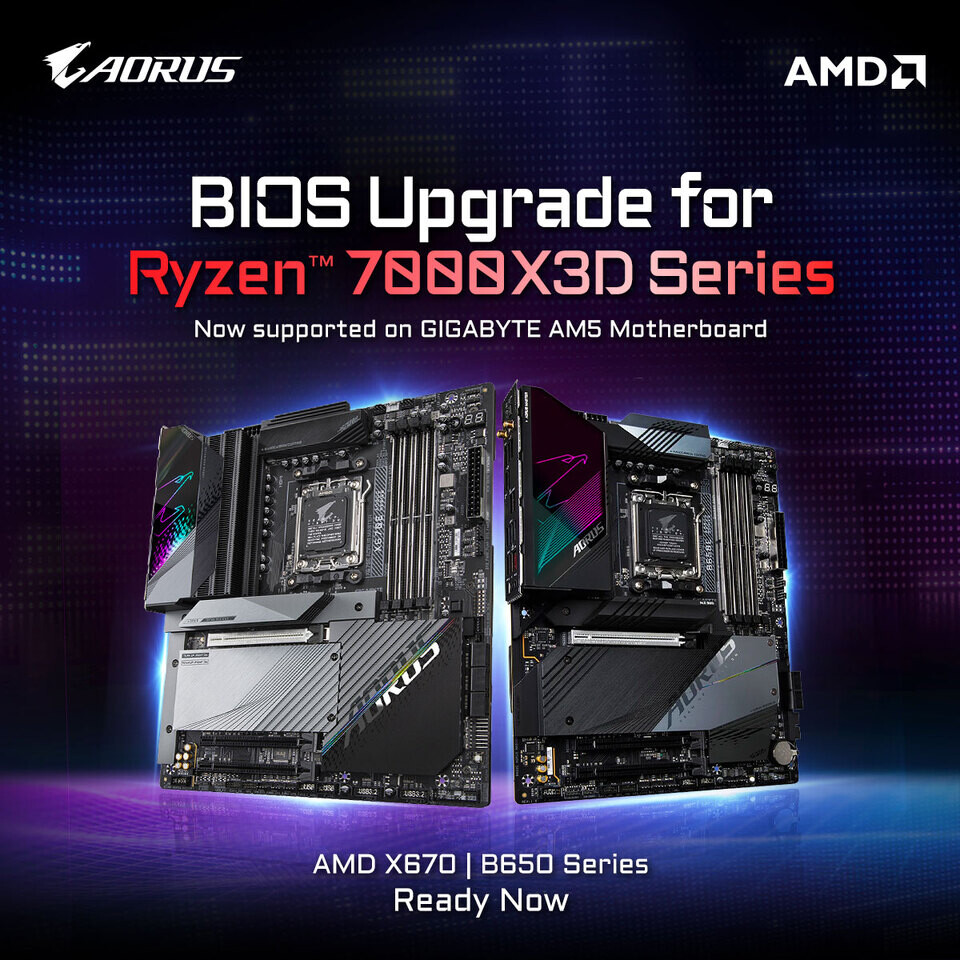
In a few days, AMD will release the Ryzen 7000X3D chips to the public. These chips will be supported by X670 and B650 series motherboards, but you'll first have to update your BIOS if you've already got a motherboard. Fortunately for those with a Gigabyte motherboard, a BIOS update has now arrived.
Gigabyte has already launched the latest BIOS version for its X670 and B650 series motherboards. This version includes the AGESA 1.0.0.5C, which introduces support for the upcoming AMD Ryzen 7000X3D processors: AMD Ryzen 9 7950X3D, Ryzen 9 7900X3D, and Ryzen 7 7800X3D.
To download the new BIOS for a specific motherboard, go to its official product page and select the “Support” tab. Once there, on the Download tab, go to the BIOS section and look for the one that mentions the AMD AGESA 1.0.0.5 C in the patch notes (should be dated 21/02/2023).
Once you have the BIOS file, you can update it via @BIOS (utility software to update the BIOS from the OS), Q-Flash (BIOS flashing tool accessible through the BIOS), or Q-Flash Plus (update BIOS via USB stick without any component installed). The methods available will depend on your motherboard model.
Discuss on our Facebook page, HERE.
KitGuru says: Do you own a Gigabyte X670 or B650 series motherboard? Will you update the BIOS to support the AMD Ryzen 7000X3D chips?