 KitGuru KitGuru.net – Tech News | Hardware News | Hardware Reviews | IOS | Mobile | Gaming | Graphics Cards


It’s not often that a new manufacturer comes into a mature market, but that’s what we’re seeing in the KitGuru Labs today. SK hynix, one of the world’s largest producers of memory chips, has decided to get serious in the SSD market with the latest SH910A – almost a year after its toe-in-the-water product. Join us as we put the SK hynix SH920/910A 128GB SSD under the microscope.
Mass market shipment on these drives was originally scheduled for a little later in 2014, but the company believes that it is ready for a summer launch. We will get into detailed product descriptions in a second, first let’s have a quick look at SK hynix as a company.

SK hynix, to give them their full name, is a South Korean semiconductor specialist that was established in 1983. Revenues for 2013 were a healthy $13.3 Billion and it has over 17,000 employees spread across a number of sites. Technically, it was born out of Hyundai (HYundai electroNICS) and it bought the Maxtor hard drive company in 1993.
Behind rival Samsung, SK hynix claims to be the world’s second largest memory chip maker and sixth biggest semiconductor company overall.
At some stage or another, every major player on the planet is likely to have used SK hynix memory modules – including IBM (System X servers), Asus (Nexus 7) and Apple (some MacBook and MacBook Pro models).
Promoted from Head of R&D to CEO in February 2013, Park Sung-Wook has a clear vision for the future: He wants SK hynix to become number one in its market. After a few hiccups with a plant fire and forced changes in senior personnel last year, SK hynix definitely seems to be driving forward now.
These drives will be available in a variety of flavours, from 64GB to 512GB.
Today, we’re looking at the 128GB version, which – in KitGuru’s experience – is a good size for budget systems and renewing the life of a laptop.
If you're looking for this in the channel, from resellers, then it will be labelled as the 910A.
SK hynix say that the SH920/910A range of SSD products is good for embedded and server solutions. The claimed average time between failures (MTBF) is put at 1.2 million hours, a little shy of the Toshiba HG6 that we looked at in March, but still seriously reliable.
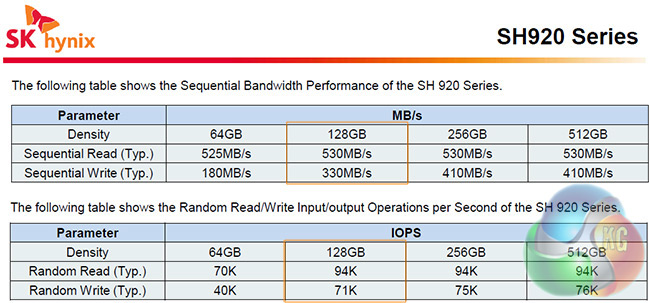
Claimed performance is 530MB/sec read and 330MB/sec write with the 128GB version, but SK hynix says that the write speed will peak closer to 410MB/sec on the 256GB and 512GB capacity drives. Be aware that the smallest 64GB model has reduced sequential write speeds around 180 MB/s.
The IOPS results also look to scale with capacity, which makes it a little strange that SK hynix have chosen to begin sampling on a drive that is ‘less than the fastest in the range'. That said, price points are a key factor and maybe that was a more important consideration when it comes to making an impact at launch.
SK hynix sent us one of the only full retail boxed products available. Here we go with a look at the consumer-friendly packaging. Remember, click on the image to get a larger version that you can investigate more fully.

One thing we realised straight away is that it is not easy to understand which drive you are looking at. Maybe there will be a sticker of some sort when it arrives on the shelves, but on our review sample there was no obvious, or visible SH9xx logo.
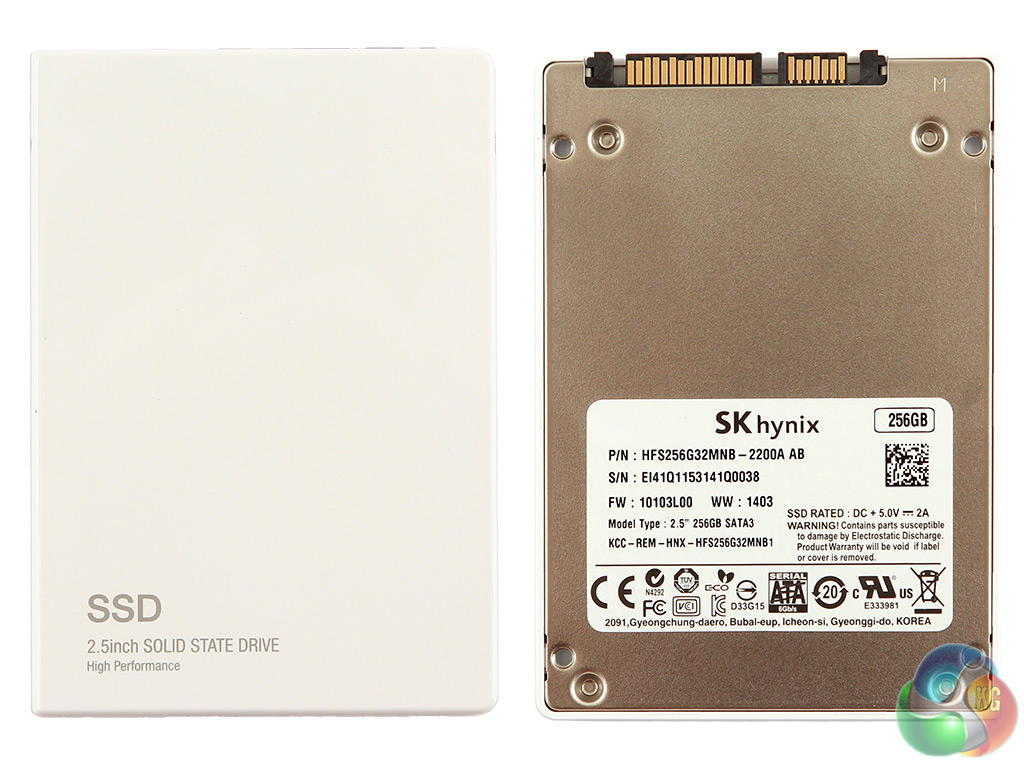

The clean, white units seem professional and functional. We thought the inclusion of multiple pre-threaded screw holes was strange, given that this model was physically sealed with no screws visible. That said, if a company can use the same shell for a number of products, then maybe these additional holes give manufacturing flexibility. The white shell makes it seem Apple-friendly and when we spoke with the head of sales for SK hynix in our region, he said that they expect the drive to have universal appeal.
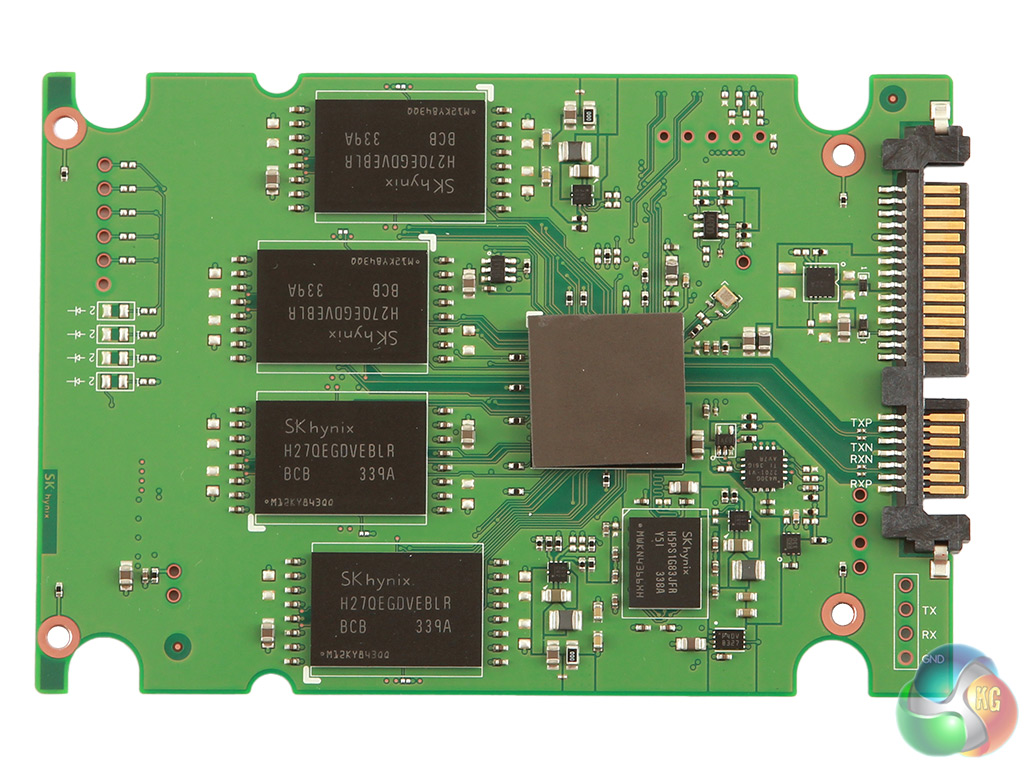
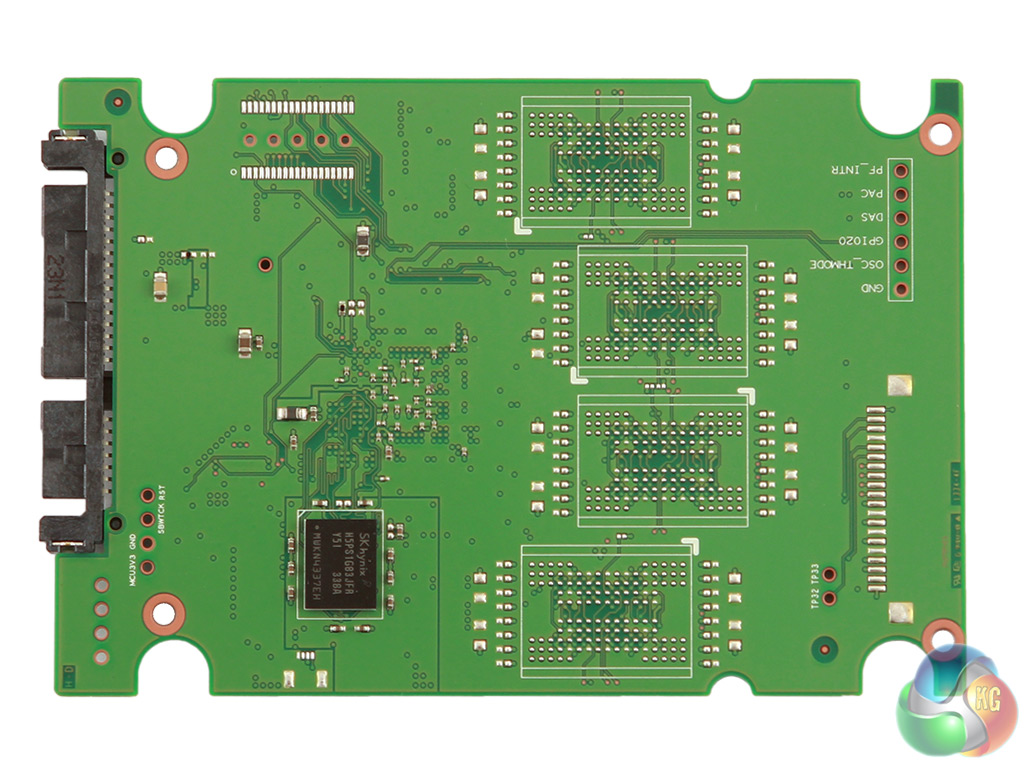
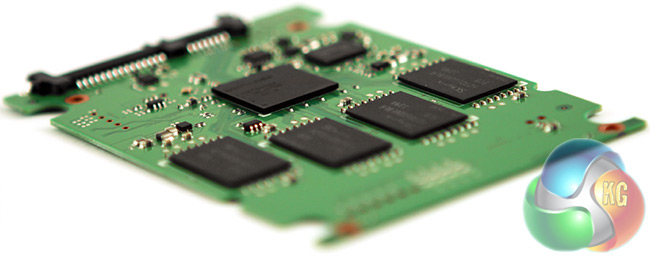
After some careful work on the outer shell, the SSD gave up its inner secrets.
Internally, the SSD is set up using a SOC (System On a Chip) design. This is a cost effective way to manage the 6Gb/sec from multiple flash memory devices on multiple channels. It has an 8 channel, 4-way data path.
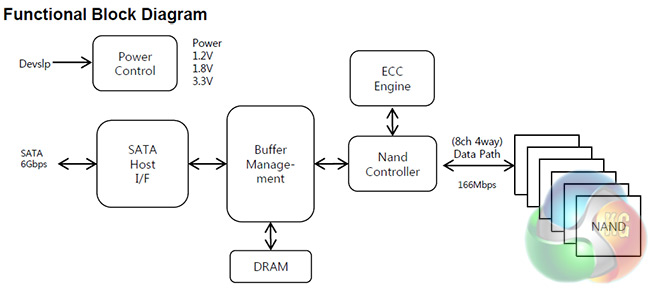
The NAND itself is 20nm MLC, designed and built by SK hynix themselves. The DRAM shown is a cache, which varies in size according to the storage capacity of the SSD unit. The 128 and 256GB versions have 2GB here, while the 512GB version has double that.
Here's another interesting section from Hynix's documentation. It shows the expected performance levels. It will be interesting to see how the speeds that SK hynix officially quote actually map out in KitGuru's testing later on in this review.
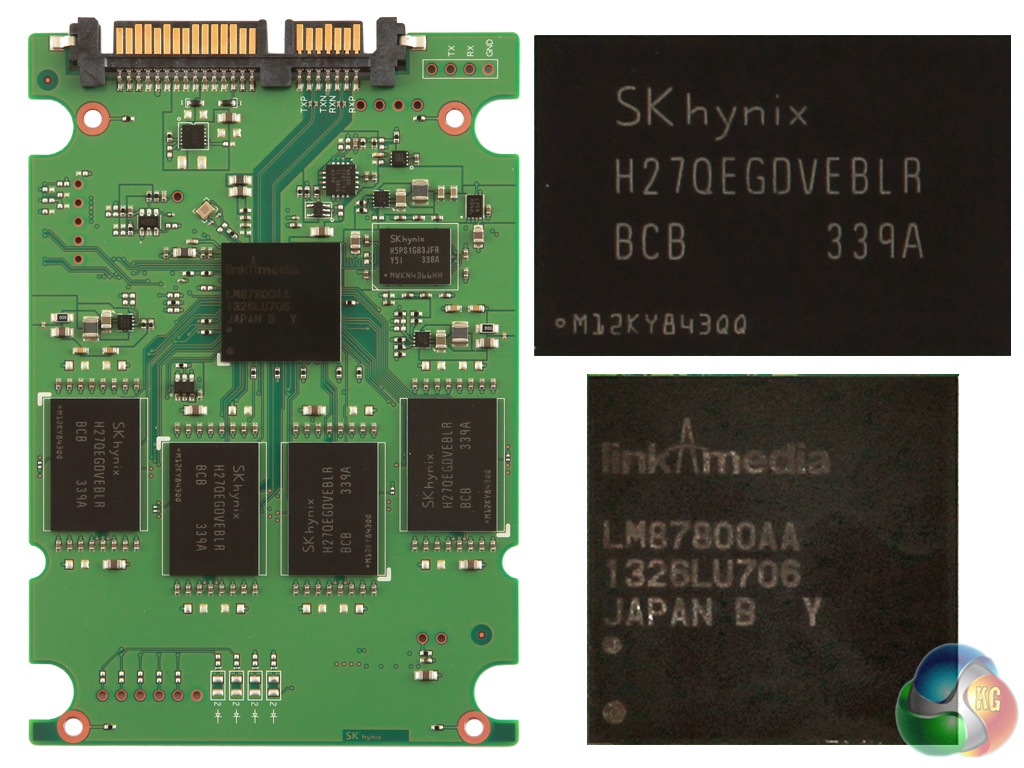
Clicking on this image will give you the specific chip details from our model. We removed the small sticky ‘buffer pad' to get the center chip shot.
One last snapshot from the SK hynix documentation. Let's have a look at how latency and capacity also vary by model.
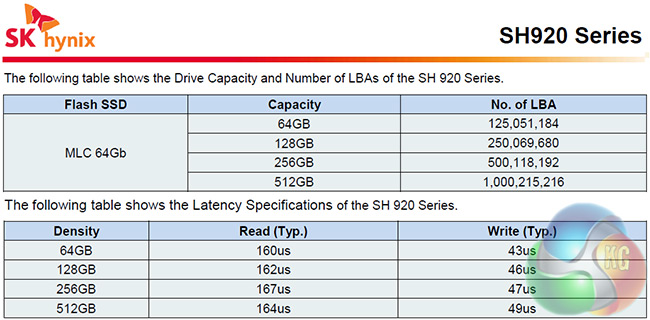
While the difference in number from row to row might not change much, every small change does have an impact on measured speed.
Will that measured difference be perceptible in the real world? Now that's a different question.
For testing, the drives are all wiped and reset to factory settings by HDDerase V4. We try to use free or easily available programs and some real world testing so you can compare our findings against your own system.
This is a good way to measure potential upgrade benefits.
Main system:
Kitguru Test Rig 3
Other Drives
OCZ RevoDrive 350 480GB
OCZ RevoDrive 3 x2 480GB
Intel 520 Series 240GB
Intel 730 240GB
Samsung 840 EVO 1TB
OCZ Vector 150 256GB
OCZ Vector 240GB
OCZ Vertex 450 256GB
OCZ Vertex 4 512GB
OCZ Vertex 4 128GB (1.4 fw)
ADATA Premier Pro SP900 128GB
Intel 730 240GB
OCZ RevoDrive Hybrid 1TB HDD/SDD
SanDisk Extreme II 240GB
Corsair Performance Pro 256GB
OCZ Agility 4 256GB
SanDisk Ultra Plus 256GB
Samsung 830 Series 512GB
Patriot Wildfire 240GB
OCZ Vertex 3 240GB MAX IOPS
ADATA S510 120GB
Kingston HyperX 3K 120GB
OCZ Octane 512GB (fw 1.13)
Samsung Spinpoint F3 1TB
Software:
Atto Disk Benchmark.
CrystalMark 3.0.3.
AS SSD.
IOMeter.
All our results were achieved by running each test five times with every configuration this ensures that any glitches are removed from the results. Trim is confirmed as running by typing fsutil behavior query disabledeletenotify into the command line. A response of disabledeletenotify =0 confirms TRIM is active.
 Crystalmark is a useful benchmark to measure theoretical performance levels of hard drives and SSD’s. We are using V3.0.3.
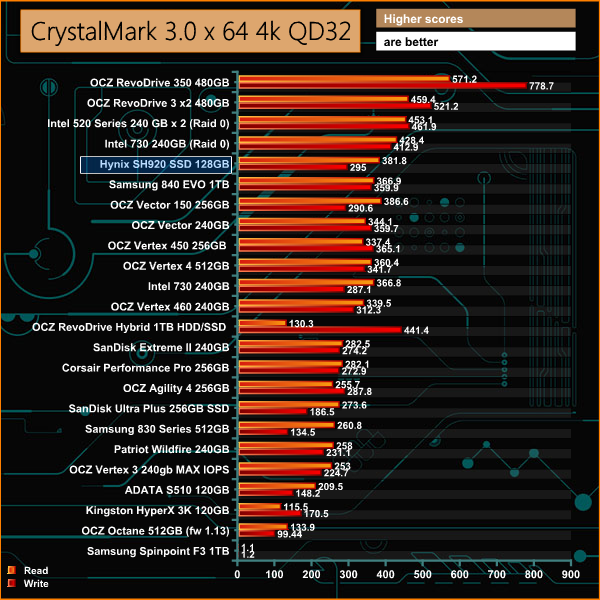
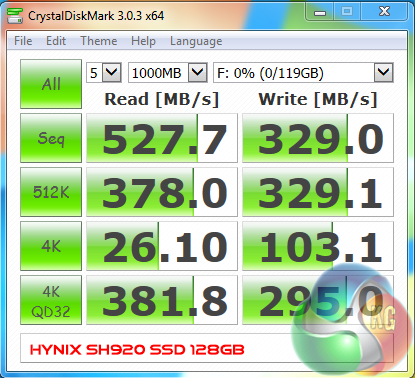
Overall performance is very strong indeed – peaking at just under 528MB/s in the sequential read test.
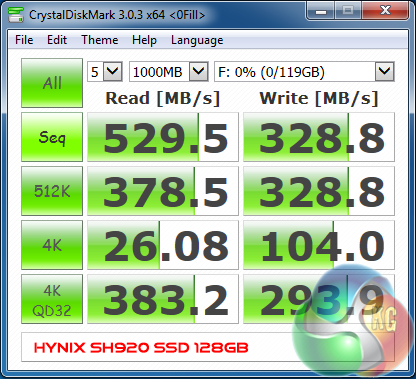
The drive deals exceptionally well with compressible data as well and it's good to see that the claimed speed matches our test results.


Above, some included compares from other leading solid state drives which we have reviewed in the last year.
The ATTO Disk Benchmark performance measurement tool is compatible with Microsoft Windows. Measure your storage systems performance with various transfer sizes and test lengths for reads and writes. Several options are available to customize your performance measurement including queue depth, overlapped I/O and even a comparison mode with the option to run continuously. Use ATTO Disk Benchmark to test any manufacturers RAID controllers, storage controllers, host adapters, hard drives and SSD drives and notice that ATTO products will consistently provide the highest level of performance to your storage.
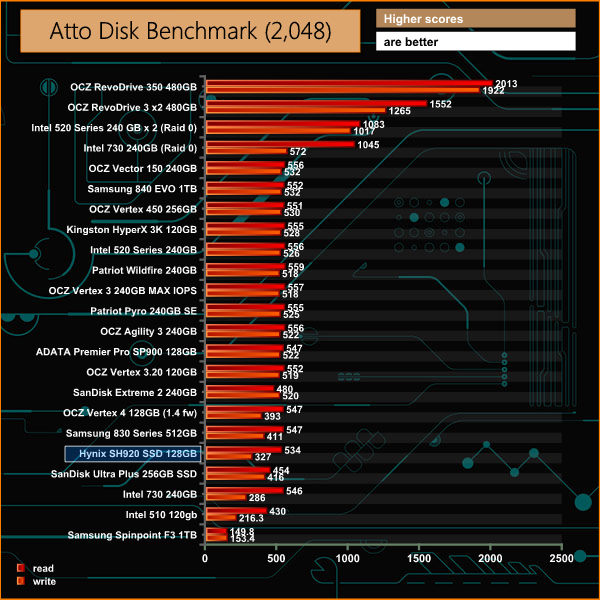
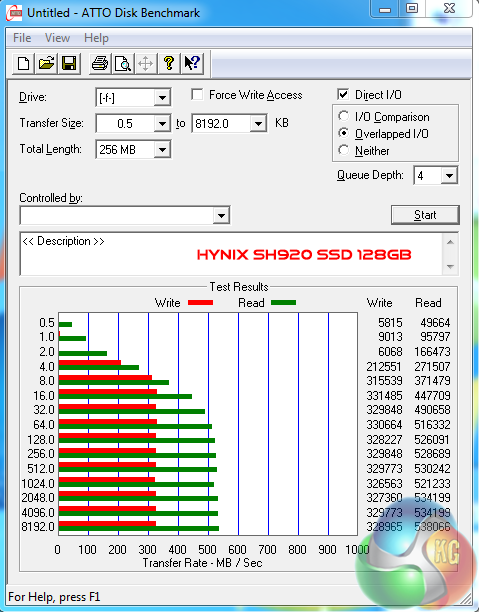
Read performance (534 MB/s) is a lot better than write performance (327 MB/s) – which lowers the overall position in this chart. The larger 256GB and 512GB versions of this drive are officially rated to deliver 410MB/s in the write test. If this is important, it would be advised to get a higher capacity unit.


Some comparison results from other leading products available on the market today.
AS SSD is a great free tool designed just for benching Solid State Drives. It performs an array of sequential read and write tests, as well as random read and write tests with sequential access times over a portion of the drive. AS SSD includes a sub suite of benchmarks with various file pattern algorithms but this is difficult in trying to judge accurate performance figures.
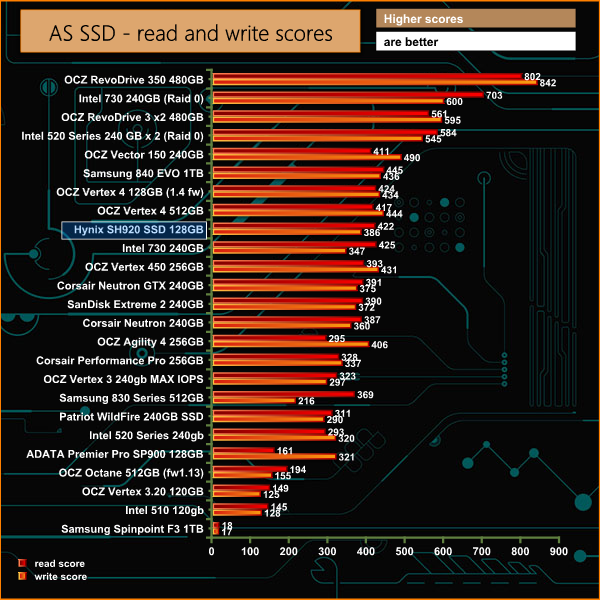
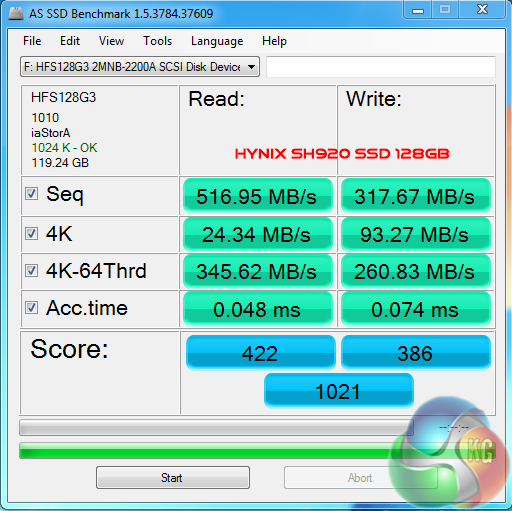
AS SSD deals exclusively with incompressible data and we get further verification that the Hynix drive performs very well in both environments. The total score of 1,021 is very strong.


Some other comparisons from leading manufacturer drives, which we have tested in recent months.
IOMeter is another open source synthetic benchmarking tool which is able to simulate the various loads placed on hard drive and solid state drive technology.
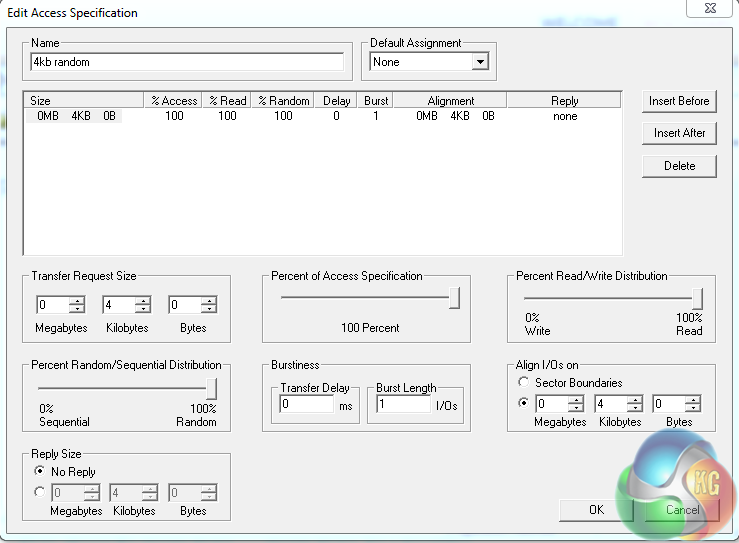
We test with both random read and write 4k tests, as shown above. There are many ways to measure the IOPS performance of a Solid State Drive, so our results will often vary between the manufacturer’s quoted ratings.
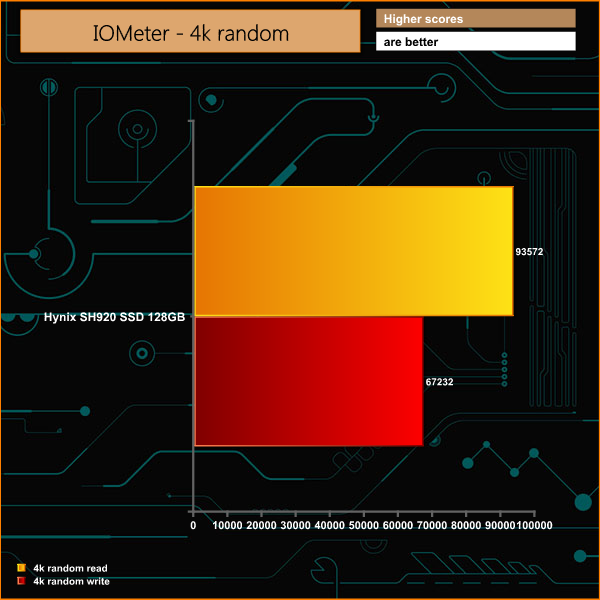
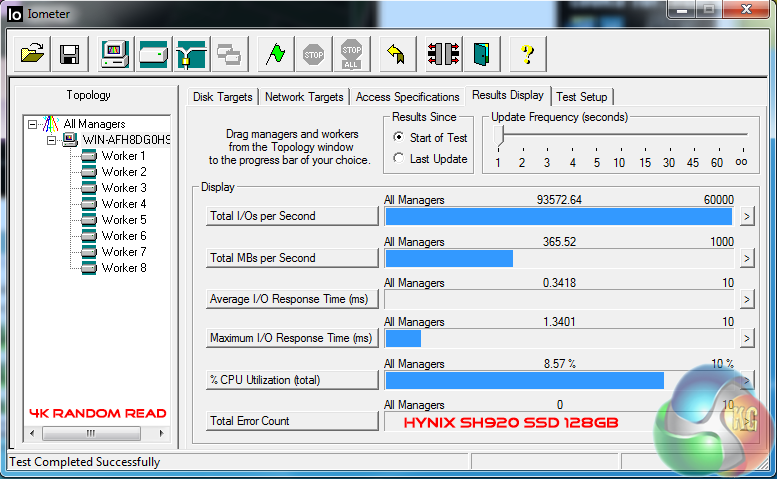
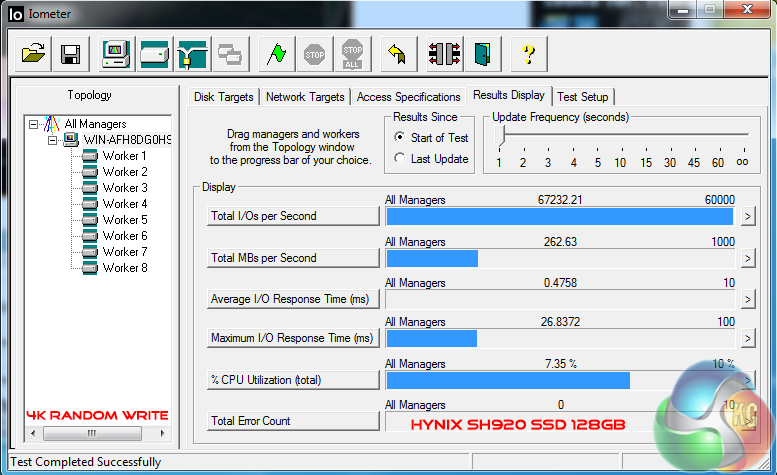
The SK hynix SH920/910A scores well in the IOPS 4k random test, and our results are actually very close to the official company claims (94k random read/71k random write). Minor variables are related to different testing methodologies.
When systems like the Yoyotech Fi7EPOWER smashed world records for performance around the launch of the original Intel Core i7 965 in November 2008 it was booting from a 40GB Intel X25 drive that had a street price around the £400 mark.
In the 6 years that have passed since then, the humble Solid State Drive has moved from lifestyles of the ‘rich and famous' to being the drive of choice for anyone with an ounce of tech savvy.
Still, the cost per gigabyte can be around 8x that of a slower mechanical drive, which means we need to make a value judgement.
While the write performance of the SK hynix SH920/910A 128GB tops out around 330MB/sec, short of the speeds you're likely to achieve with the fastest Solid State Drives on the market, the read speed of up to 534MB/sec puts it near the top of what is possible through a SATA 6Gbps connector.
That leads us to the price. While memory is a commodity whose price will fluctuate over the course of a year, the SK hynix SH920/910A 128GB will be £49.99 at launch – exclusively from eBuyer. At this price it is going to be difficult to ignore.
Discuss on our Facebook page, over HERE.
You can buy now for £49.98 inc vat from Ebuyer over HERE.
Pros:
- Fast drive.
- Attractive price point.
- Equally capable with compressible and incompressible data.
- IOPS is strong.
Cons:
- Facing a lot of competition in the market.
- Smaller drive has weaker sequential write performance.
KitGuru says: Useful size, major brand name and solid performance results mean that, at £49.99, this drive is a bit of a bargain. If you're not a ‘front to back' manufacturer of SSD products (i.e. from chips to final, packaged product), then seeing the name SK hynix entering the market with aggressive SSD pricing must be a worrying sight. For less than £50, this is a Must Have.

great upgrade for a lower end laptop.
I just scanned this review 2 times and can’t find a mention of what controller is used in this thing. Is it under that pad in image 4 four or do I need a better microscope? Omitting that major data point makes for a very strange review.