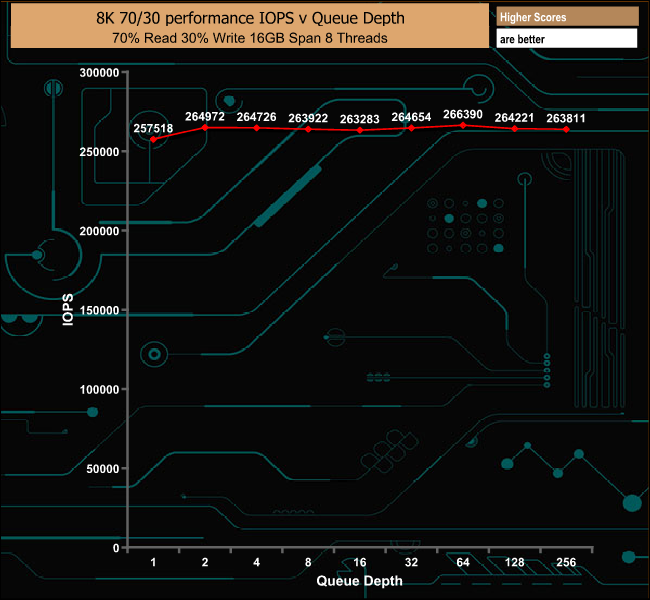
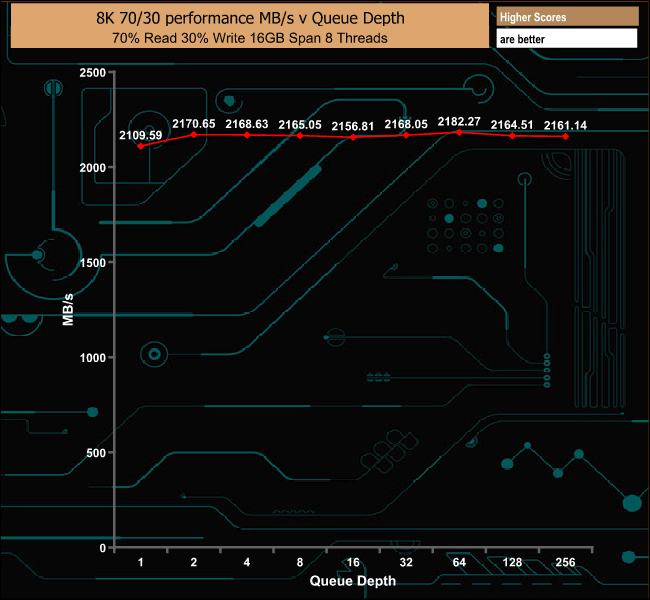
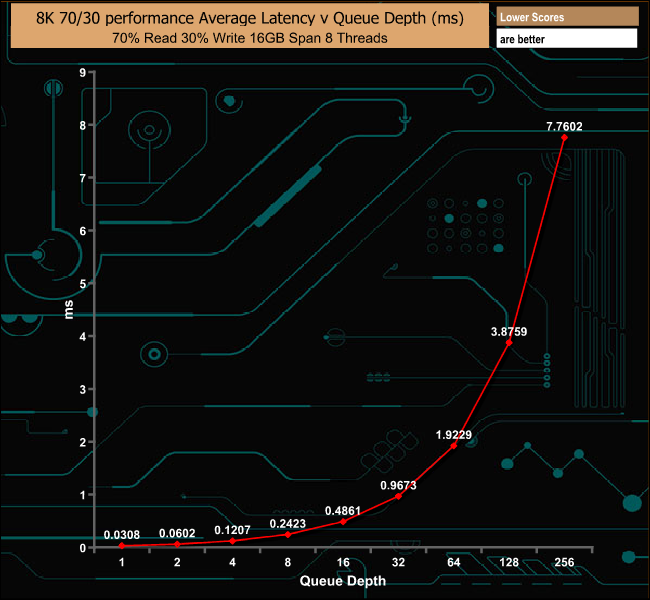
Today we go hands on with Intel's Optane SSD DC P4800X enterprise-class NVMe drive that uses Intel's 3D XPoint memory technology designed for use in data centres. It's only available in two capacities, 350GB and 750GB, and two formats - a 2.5in 15mm U.2 drive, and a HHHL AIC. For this review we are looking at the 750GB U.2 version. Loaded with Intel's 3D XPoint memory together with a 7-channel controller, the official quoted Sequential performance figures for the 750GB drive are up to 2,500MB/s for reads and up to 2,200MB/s for writes. The 350GB drive has reads of up to 2,400MB/s with writes up to 2,000MB/s Random 4K figures are up to 555,000 IOPS for both reads and writes (these figures are for 100% span tests). The 350GB drive has the same read figure but with up to 500,000 writes. Intel quotes an active power rating for the 750GB P4800X of 18W, and 6W when idling. Needless to say, a drive aimed at data centres needs some pretty cast iron endurance figures and the P4800X doesn't disappoint. It's rated at 30DWDP, which works out to around 41PBW (yes that's petabytes) over the length of the 5-year warranty Intel backs the drive with. Physical Specifications: Usable Capacities: 750GB NAND Components: 128Gb 20nm Intel 3D XPoint NAND Controller: Intel SSL3D 7-channel Cache: none Interface: U.2 PCIe 3.0 x4 NVMe Form Factor: 2.5in 15mm Dimensions: 101mm x 70mm x 15mm Drive Weight: 140gmm Firmware Version: 0325 Our DC P4800X came in a plain white box with nothing bundled with it, which isn't really surprising as this is a drive aimed at the enterprise market segment. The drive uses an aluminium casing with both the front and back areas styled into large heatsinks. Even with this design, the drive got pretty warm to the touch after some of our benchmarking runs. The drive is thicker than a standard SSD at 15mm and uses the U.2 interface. The drive uses 128Gb 20nm Intel 3D XPoint packages looked after by an Intel SSL3D 7-channel controller. The Intel Toolbox SSD management utility is a pretty comprehensive tool for looking after your SSD. The home screen displays information about the drive, how the capacity is being used, its health and estimated life remaining. There are seven buttons on the right hand side of the utility main screen. These are for Intel’s SSD Optimiser, two drive diagnostic scans - one quick and the other full - secure erase, firmware updates, a system tuner and a page for system information. For testing, the drives are all wiped and reset to factory settings by HDDerase V4. We try to use free or easily available programs and some real world testing so you can compare our findings against your own system. This is a good way to measure potential upgrade benefits. Main system: Intel Core i7-7700K with 16GB of DDR4-3200 RAM, Sapphire R9 390 Nitro and an Asus Prime Z270-A motherboard. Software: Atto Disk Benchmark 3.5. IOMeter. Futuremark PC Mark 8 All our results were achieved by running each test five times with every configuration this ensures that any glitches are removed from the results. Trim is confirmed as running by typing fsutil behaviour query disabledeletenotify into the command line. A response of disabledeletenotify =0 confirms TRIM is active. To aid in the testing of the drive, Intel kindly supplied us with an U.2 adaptor and the appropriate data/power cabling. The ATTO Disk Benchmark performance measurement tool is compatible with Microsoft Windows. Measure your storage systems performance with various transfer sizes and test lengths for reads and writes. Several options are available to customize your performance measurement including queue depth, overlapped I/O and even a comparison mode with the option to run continuously. Use ATTO Disk Benchmark to test any manufacturers RAID controllers, storage controllers, host adapters, hard drives and SSD drives and notice that ATTO products will consistently provide the highest level of performance to your storage. The official Sequential performance figures Intel gives for the drive are up to 2,500MB/s for reads and 2,200MB/s for writes. Both of these figures we could confirm using the ATTO benchmark, with a tested read figure of 2,572MB/s and 2,236MB/s for writes. In our 128KB Sequential tests, the DC P4800X peaked at the QD2 mark at 2,680MB/s before finishing the test run at 2,434MB/s - quite a steep drop off in performance at QD32. Writes also peaked at QD2 at 2,410MB/s, but the write performance was much more consistent finishing the test at 2,407MB/s. We also tested the drive at a much deeper queue depth of 256 in various block sizes to see how the drive performed when pushed hard. Both the read and write figures surpassed the official figures, with the tested read score topping out at 2,913MB/s at the end of the test. The write performance was much more erratic, dropping to 2,065MB/s at one point before recovering to finish the test at 2,372MB/s. Intel's 3D XPoint memory technology has been designed to offer very quick performance at low queue depths and at low latencies. This can be seen in action by the 4K Random results - both reads and writes rocket away in queue depths 1-4 and then plateau out. Testing the random performance at 8K, which is more akin to the data centre environment that the drive has been designed for, sees much consistent read performance from the off. The write performance starts behind the reads but soon catches up and surpasses it, before once again settling down in a consistent pattern until right at the end of the test where the performance rises a little. In our 70/30 mix of read and writes, the drive once again shows a great deal of consistency through the queue depths it's being tested at. Comparing the Optane DC P4800X to a standard 64-layer NAND flash equipped Intel data centre drive (in this case Intel's 8TB DC P4510), tested at 8K (more akin to data centre traffic), shows the huge advantage 3D XPoint brings in IOPS performance at low queue depths (QD1-4), and at very low latencies - particularly when it comes to read performance. As the queue depth deepens, the performance of the DC P4800X plateaus out while the DC P4510 overtakes it and climbs out of sight. In our throughput tests, the DC P4800X fell a little shy of the official figures. Reads peaked at 2,384MB/s at the 4MB block point, some way back from the official 2,500MB/s. Writes peaked at the 8MB block point at 2,174MB/s, much closer to the official maximum figure of 2,200MB/s. We also tested the drive with a number of workload scenarios that it may be used for in its natural environment of the data centre. Database Transfer Size: 8K Reads: 67% Writes: 33% Random: 100% Boundary: 4K Outstanding IO: 64 Threads/Workers: 8 SQL Server 2008 OLTP Transfer Size: 8K Reads: 70% Writes: 30% Random: 100% Boundary: 8K Outstanding IO: 60 Threads/Workers: 1 Web File Server 64KB Transfer Size: 64K Reads: 95% Writes 5% Random: 75% Boundary: 4K Outstanding IO: 64 Threads/Workers: 8 Web File Server 8KB Transfer Size: 8K Reads: 95% Writes: 5% Random: 75% Boundary: 4K Outstanding IO: 64 Threads/Workers: 8 Web File Server 4KB Transfer Size: 8K Reads: 95% Writes: 5% Random: 75% Boundary: 4K Outstanding IO: 64 Threads/Workers: 8 Media Streaming Transfer Size: 64K Reads: 98% Writes: 2% Sequential: 100% Boundary: 4K Outstanding IO: 64 Threads/Workers: 8 Video On Demand Transfer Size: 128K Reads: 100% Writes: 0% Random: 100% Boundary: 4K Outstanding IO: 512 Threads/Workers: 8 Decision Support DB Transfer Size: 1MB Reads: 100% Writes: 0% Random: 100% Boundary: 4K Outstanding IO: 64 Threads/Workers: 8 Mail Server Transfer Size: 32K Reads: 58% Writes: 42% Random: 95% Boundary: 4k Outstanding IO: 64 Threads/Workers:8 Search Engine Transfer Size: 4K Reads: 100% Writes: 0% Random: 100% Boundary: 4K Outstanding IO: 64 Threads/Workers:8 OS Paging Transfer Size: 64K Reads: 90% Writes: 10% Sequential: 100% Boundary: 4K Outstanding IO: 64 Threads/Workers:1 Digital Video Surveillance Transfer Size: 512K Reads: 90% Writes: 10% Sequential: 100% Boundary: 512K Outstanding IO: 64 Threads/Workers:8 Workstation Transfer Size: 8K Reads: 80% Writes: 20% Random: 80% Boundary: 8K Outstanding IO: 64 Threads/Workers 4 The DC P4800X showed some very strong performance figures in workload scenario tests with high IOPS bandwidth figures for the Search Engine and 4K Web Server test traces in particular. Futuremark’s PCMark 8 Standard Storage test saves a large amount of performance data. The default test runs through the test suite of 10 applications three times. Here we show the total bandwidth performance for each of the individual test suites for the third and final benchmark run. As with the workload tests, the DC P4800X produced some, quite frankly amazing, bandwidth results when tested with PCMark 8's Standard Storage benchmark, scoring over 1GB/s for all of the tests and over 2GB/s in the Photoshop Heavy test. For the long term performance stability test, we set the drive up to run a 20-minute 4K random test with a 30% write, 70% read split, at a Queue Depth of 256 over the entire disk. The 750GB Optane DC P4800X averaged 173,382 IOPS for the test with a performance stability of 98.87%, or 99% if you prefer, which is the stability figure you should expect from a dedicated enterprise drive. To test real life performance of a drive we use a mix of folder/file types and by using the FastCopy utility (which gives a time as well as MB/s result) we record the performance of drive reading from & writing to a 256GB Samsung SSD850 PRO. We use the following folder/file types: 100GB data file. 60GB ISO image. 60GB Steam folder – 29,521 files. 50GB File folder – 28,523 files. 12GB Movie folder – 24 files (mix of Blu-ray and 4K files). 10GB Photo folder – 621 files (mix of png, raw and jpeg images). 10GB Audio folder – 1,483 files (mix of mp3 and .flac files). 5GB (1.5bn pixel) photo. Intel's Optane DC P4800X handled our real life file transfer tests without any problems. It dealt with the larger file sizes much more efficiently than the small bity files in the 60GB Steam, 50GB File and 10GB Audio folders. To get a measure of how much faster PCIe NVMe drives are than standard SATA SSDs, we use the same files but transfer to and from a 512GB Toshiba OCZ RD400. Taking the SATA drive out of the picture gives an idea of how fast the drive is when dealing with our real life file transfer tests - although as with the previous test, the performance drops considerably when dealing with smaller file sizes. Intel's Optane DC P4800X has been designed to handle storage workloads such as SAN, cloud, database, big data, high-performance computing and software defined storage at low latencies. At launch the drive was only available in a 375GB capacity and in two form factors: 2.5in 15mm U.2 and an HHHL add-in card. The larger flagship 750GB drive we are reviewing here came along a few months later and again it's offered in the two form factors. As Intel points out "Increased capacity and multiple form factors expand data centre implementation options and deliver both solution-level and total cost of ownership flexibility for customers". Intel quotes Sequential performance figures for the 750GB DC P4800X as up to 2,500MB/s for reads and up to 2,200 MB/s for writes, figures which are not earth shattering when compared to NAND flash based NVMe drives. But clearly, out and out Sequential performance is not what the drive is about. In any case, we could confirm both the official read and write numbers with the ATTO benchmark, with the review drive producing a read figure of 2,572MB/s and writes at 2,236MB/s. When benchmarked with our 128KB Sequential tests the drive peaked at 2,680MB/s for reads and 2,410MB/s for writes. By using Intel 3D XPoint memory technology, the DC P4800X brings high throughput at low latencies, particularly when it comes to read performance. This is just what is needed to service latency sensitive workloads in the data centre environment more efficiently and at lower transaction costs than with standard NAND flash. The endurance numbers quoted by Intel for the drive are also very impressive to say the least. It's rated at 30DWDP, which works out to around 41PBW (petabytes!) over the length of the 5-year warranty Intel back the drive with. We found the 750GB Intel Optane DC P4800X for sale from Ballicom for £2251 HERE. Pros Overall performance. Performance at low queue depths. Performance stability. Endurance. Choice of form factors. Cons Sequential performance isn't exactly earth shattering. Drive range only extends to 750GB. KitGuru says: Designed for use in data centres, Intel's Optane DC P4800X may not have the out and out Sequential performance of some NVMe drives in the marketplace, but that's not what it's really about. What it does offer, thanks to the 3D XPoint memory technology, is high throughputs at low latencies and queue depths.