KitGuru KitGuru.net – Tech News | Hardware News | Hardware Reviews | IOS | Mobile | Gaming | Graphics Cards


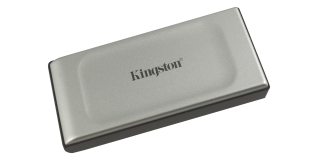
Kingston's XS2000 is an extremely diminutive external SSD, measuring less than 70mm long. But while it might be small in stature, with a USB 3.2 Gen 2×2 (20Gbps) interface, it is certainly not small in terms of the performance… We find out if it can justify the £240 asking price.
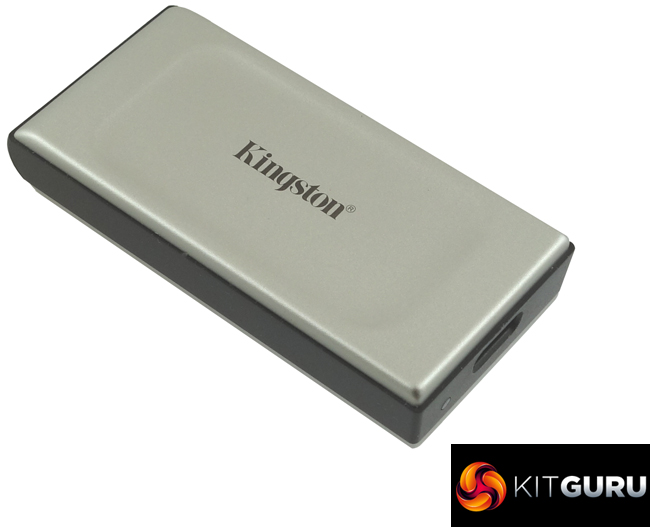
There are just three capacities in the current XS2000 lineup; 500GB, 1TB and the 2TB flagship drive we are looking at here. At the heart of the drive is a Silicon Motion SM2320 controller, which thanks to its built-in USB 3.2 Gen 2 interface offers much better performance than a controller that has to rely on a bridge chip. For the XS2000, Kingston have paired the SM2320 up with 96-Layer 3D TLC NAND.
Kingston rate the XS2000 Sequential performance as up to 2,000MB/s for both reads and writes across the range.
The XS2000 doesn't come with any hardware encryption but is backed with a 5-year warranty.
Physical Specifications:
- Usable Capacities: 2TB.
- NAND Components: 96-layer TLC NAND.
- Interface: USB 3.2 Gen 2×2 (20Gbps).
- Form Factor: external.
- NAND Controller: Silicon Motion SM2320.
- Dimensions: 69.5 x 32.6 x 13.5mm.
- Drive Weight: 28.9g
Firmware Version: 1000.
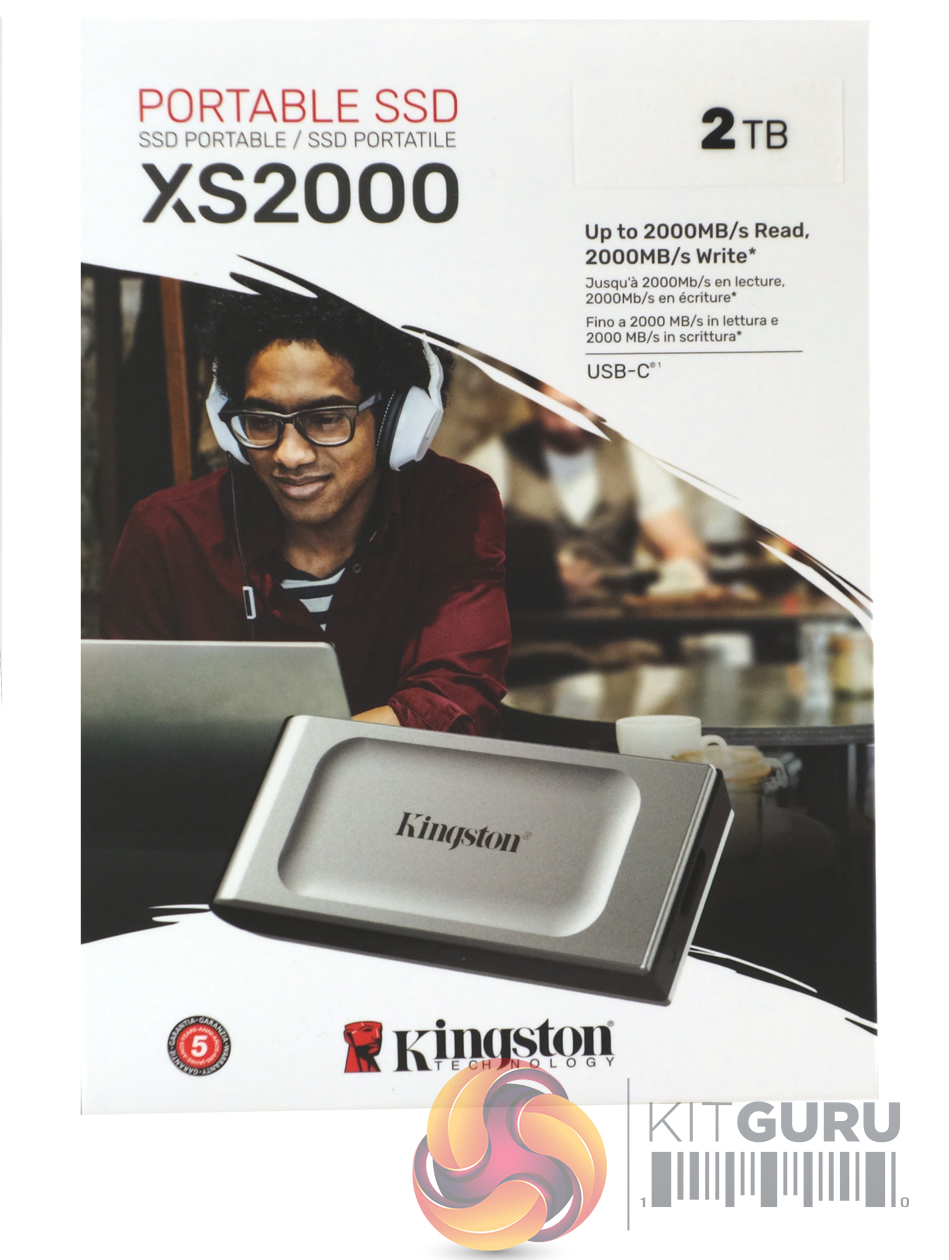
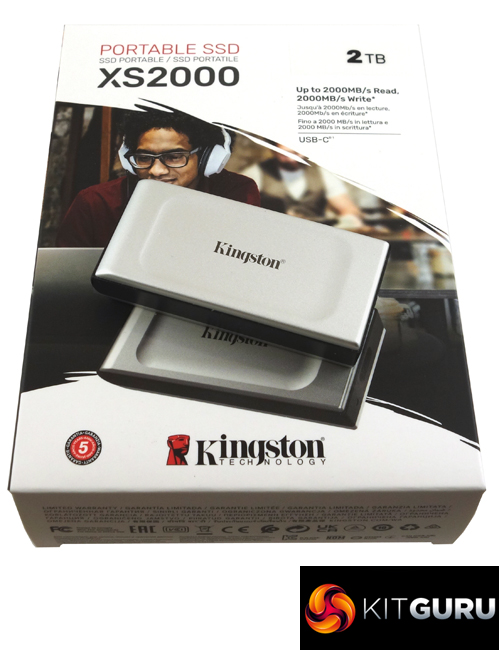
Kingston's XS2000 comes in a box that is many times bigger than the drive itself. At the top right-hand side of the box is a sticker with the capacity of the drive on it, and between this and the image of the drive towards the bottom of the box are the maximum read/write speeds (2,000MB/s for both) and the fact that it uses a USB-C interface.
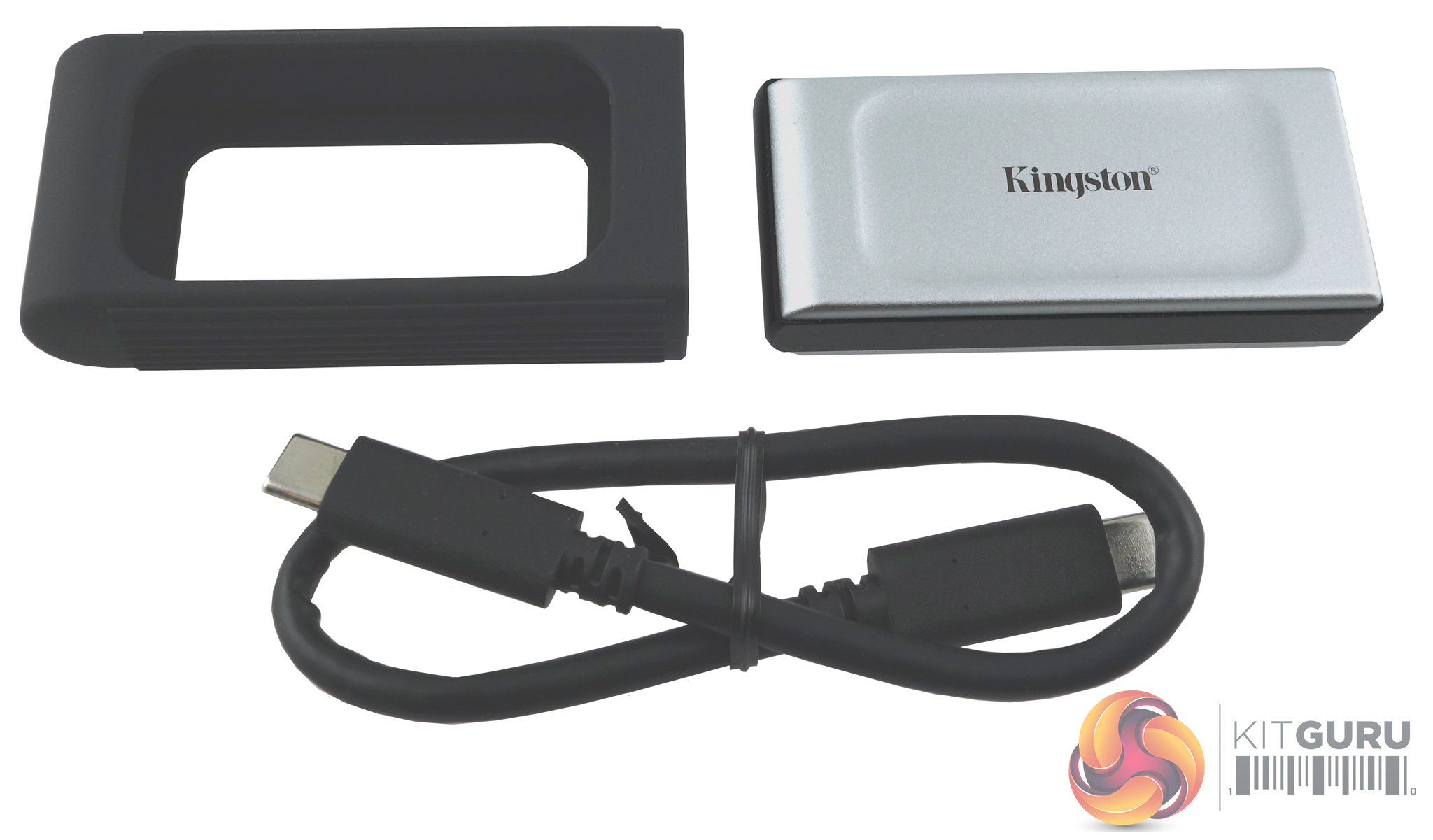
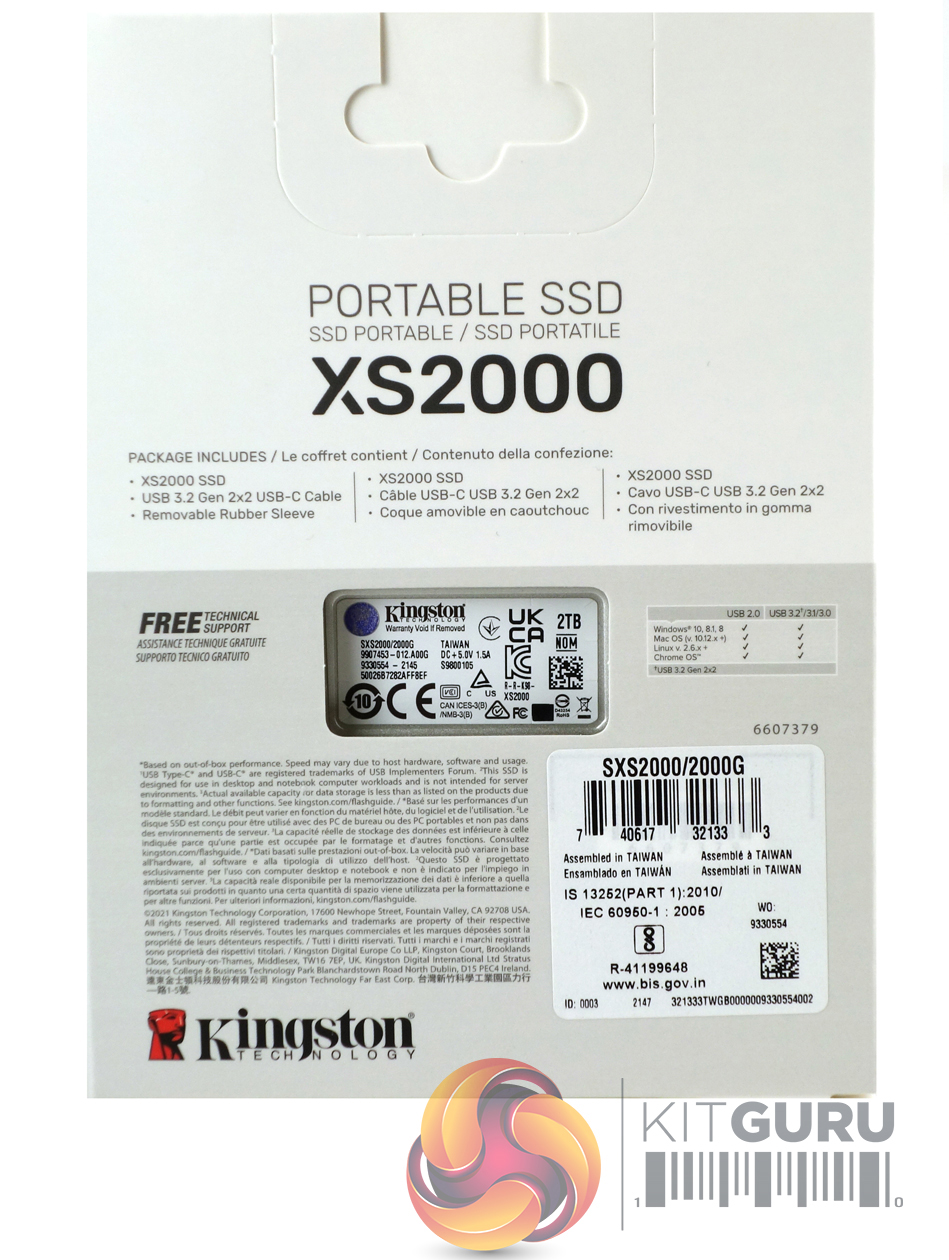
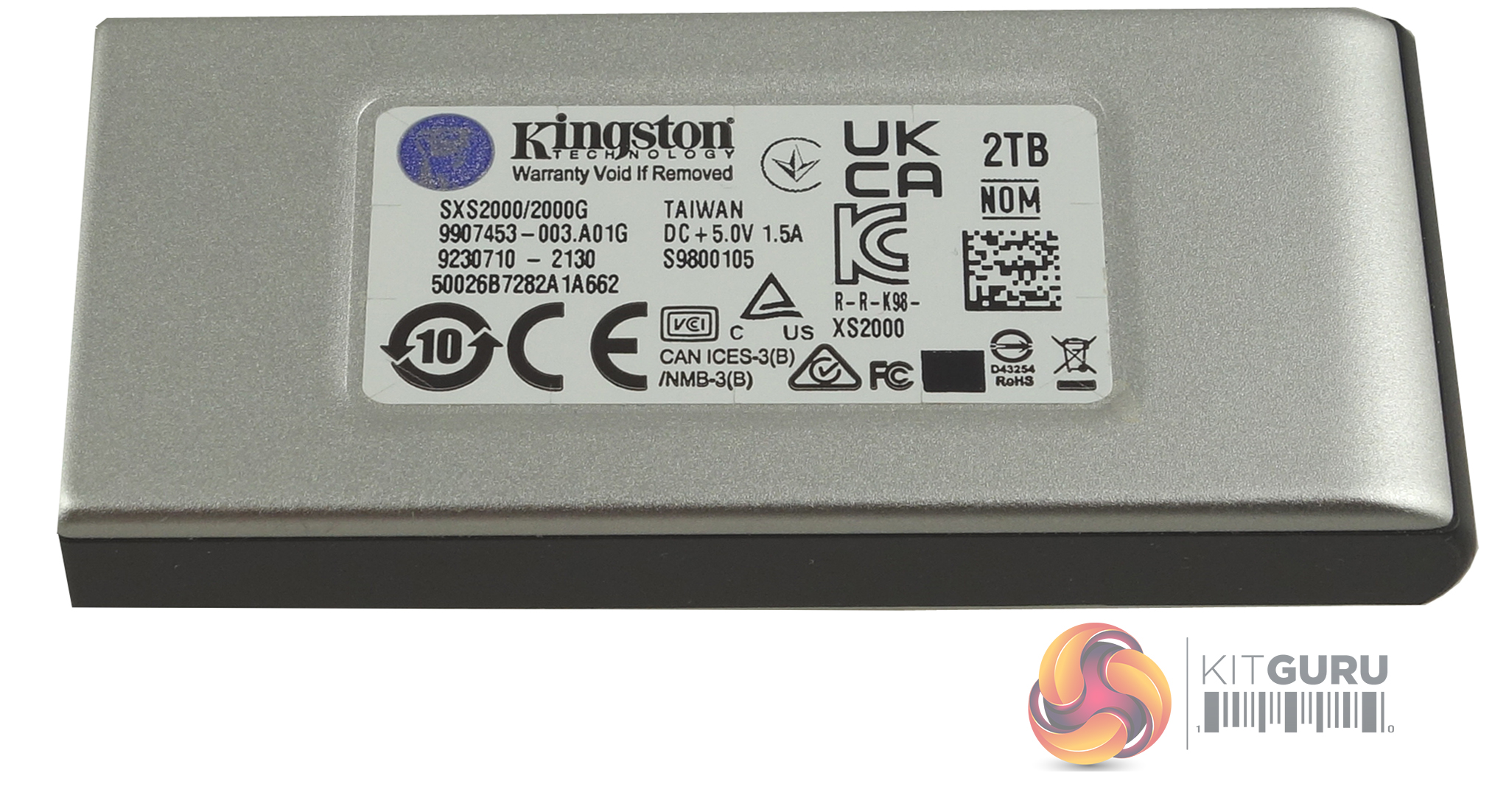
The rear of the box has a hole in it so you can see the product label of the drive sitting in the plastic inner box. Above this ‘window' is a list of the box contents; the drive, a USB Type-C cable and a removable rubber sleeve.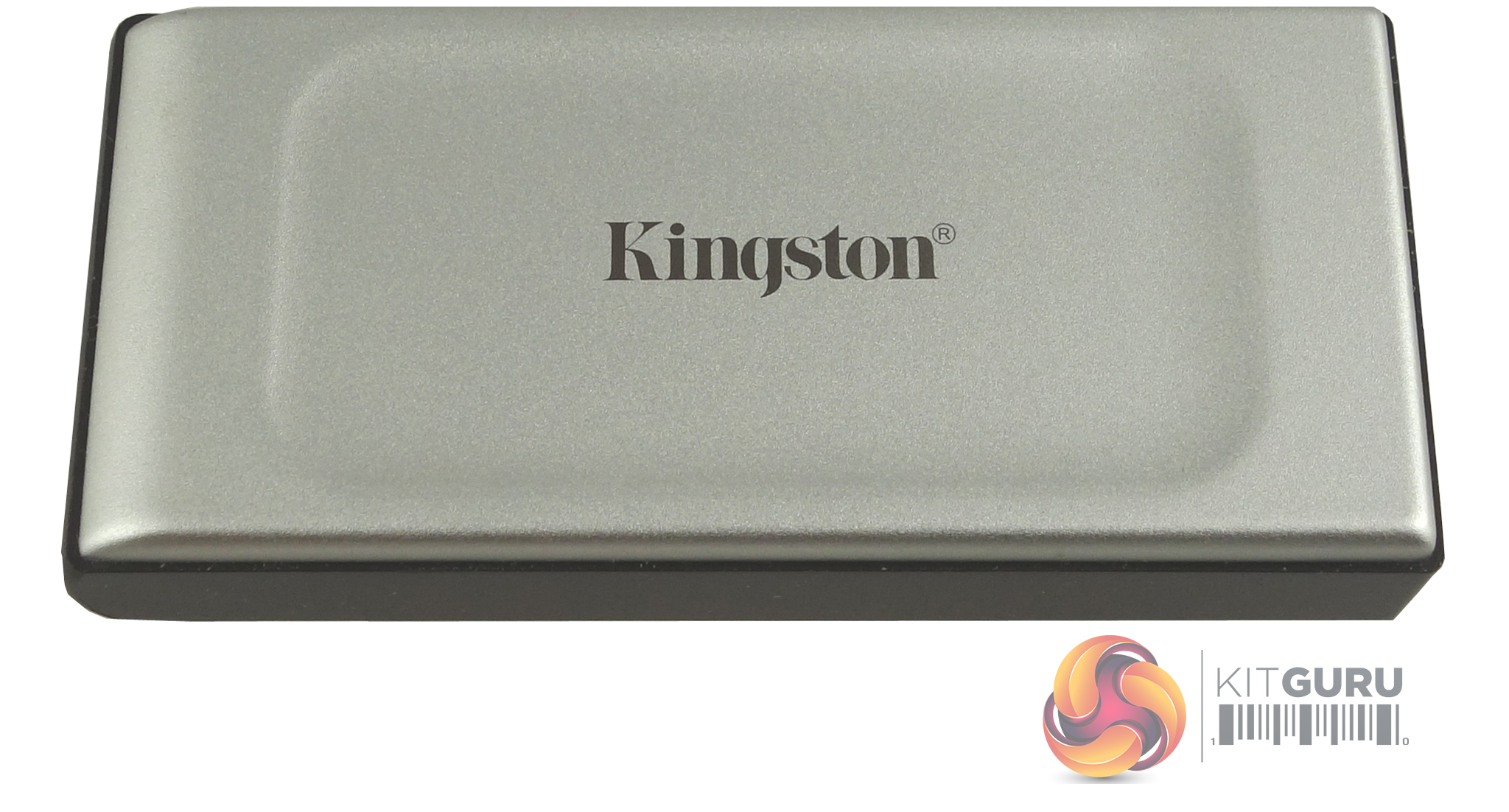
Measuring just 69.5 x 32.6 x 13.5mm and weighing in at a mere 28.9g, the XS2000 uses metal and plastic in its construction. At the heart of the drive is a Silicon Motion SM2320 controller looking after 96-Layer NAND.
Silicon Motion's SM2320 is a single-core, four-channel controller that has a built-in USB 3.2 Gen 2 interface so enabling smaller drives like the XS2000 to be built as there is no need for a separate bridge chip taking up space.
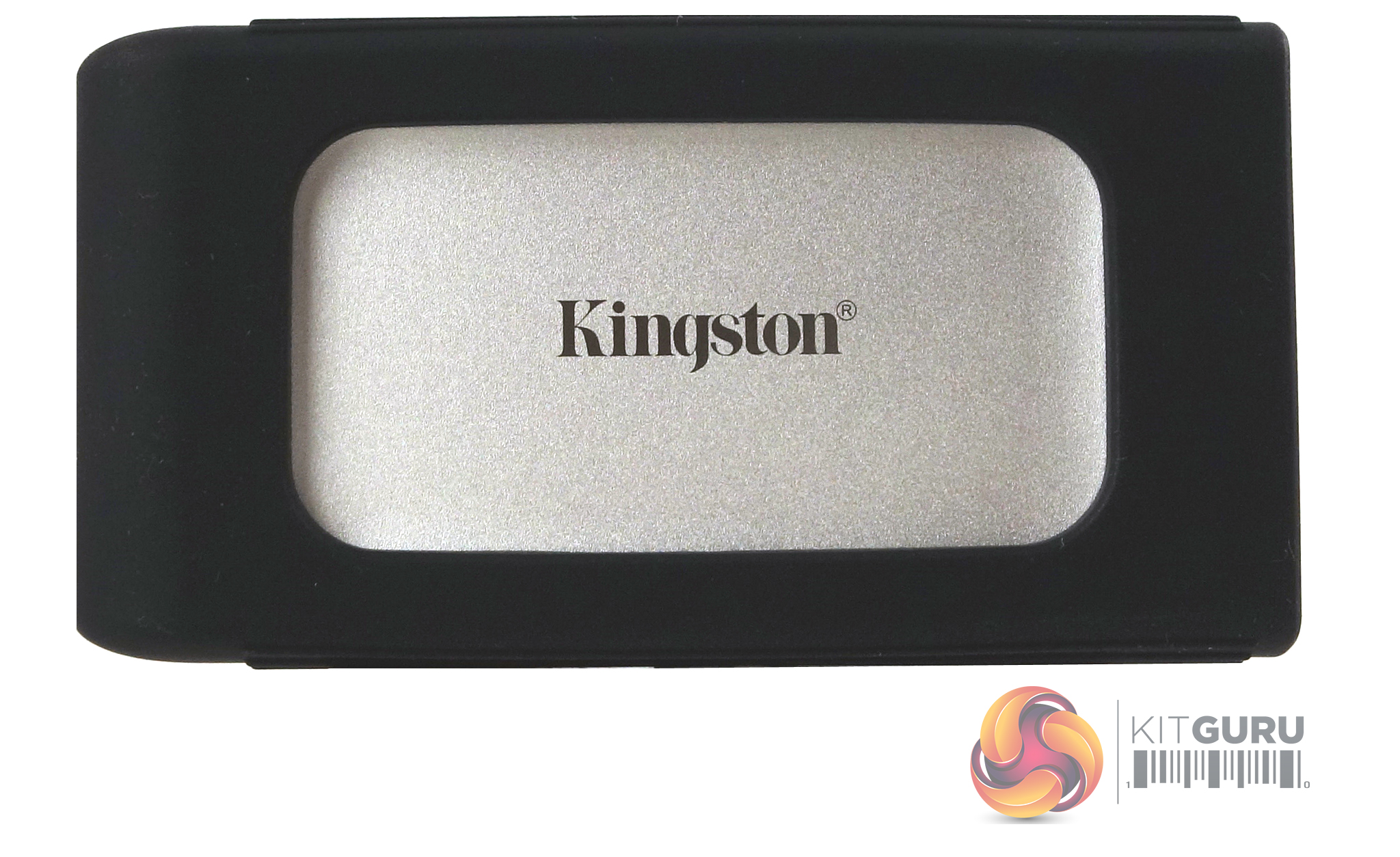
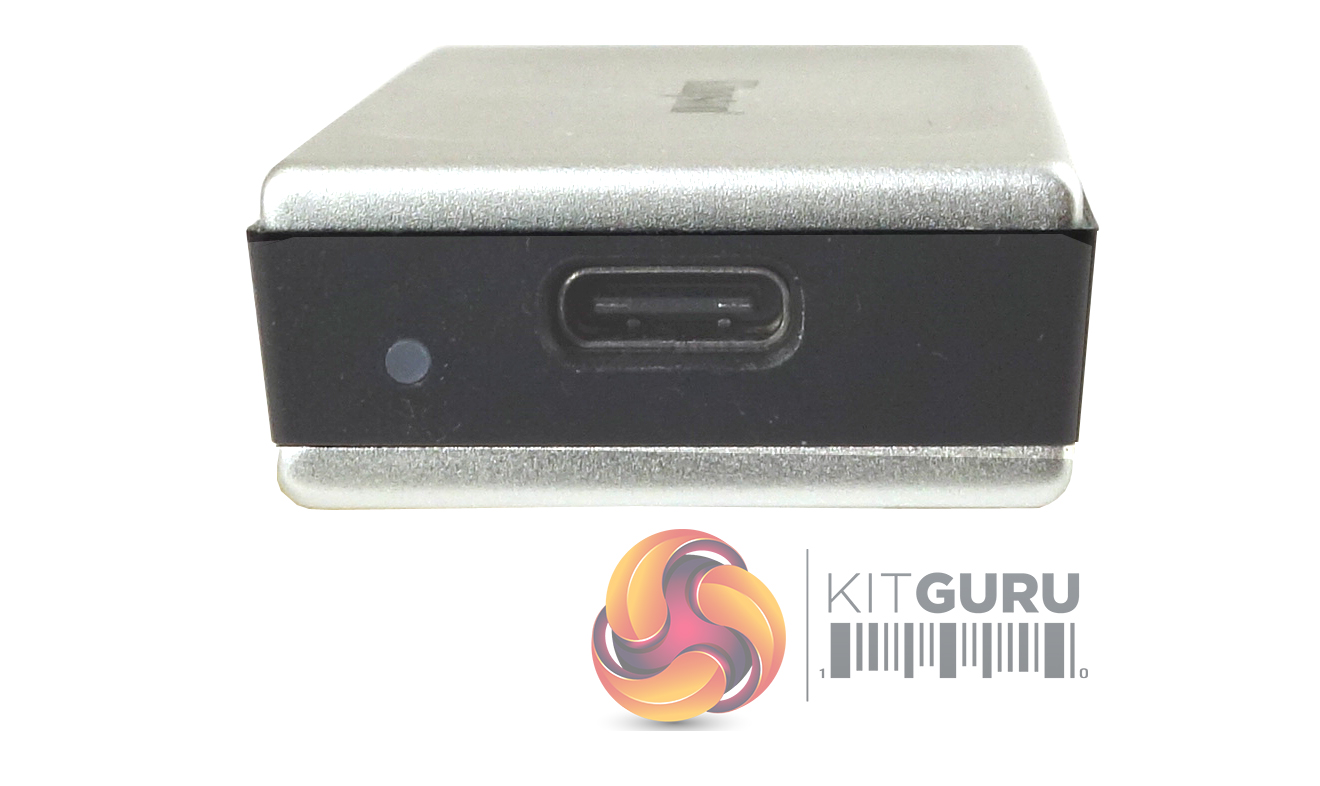
The XS2000 carries an IP55 rating for water and dust protection and Kingston provides a snug-fitting rubber sleeve for even more protection from everyday bumps and scrapes. The drive uses a USB-C port, next to which is a blue LED drive activity light.
Out of the box is factory formatted as exFAT but for testing purposes, we re-formatted it in NFTS.
CrystalDiskMark is a useful benchmark to measure theoretical performance levels of hard drives and SSDs. We are using V7.
The ATTO Disk Benchmark performance measurement tool is compatible with Microsoft Windows. Measure your storage system's performance with various transfer sizes and test lengths for reads and writes. Several options are available to customize your performance measurement including queue depth, overlapped I/O and even a comparison mode with the option to run continuously. Use ATTO Disk Benchmark to test any manufacturer's RAID controllers, storage controllers, host adapters, hard drives and SSD drives and notice that ATTO products will consistently provide the highest level of performance to your storage.
AS SSD is a great free tool designed just for benching Solid State Drives. It performs an array of sequential read and write tests, as well as random read and write tests with sequential access times over a portion of the drive. AS SSD includes a sub suite of benchmarks with various file pattern algorithms but this is difficult in trying to judge accurate performance figures.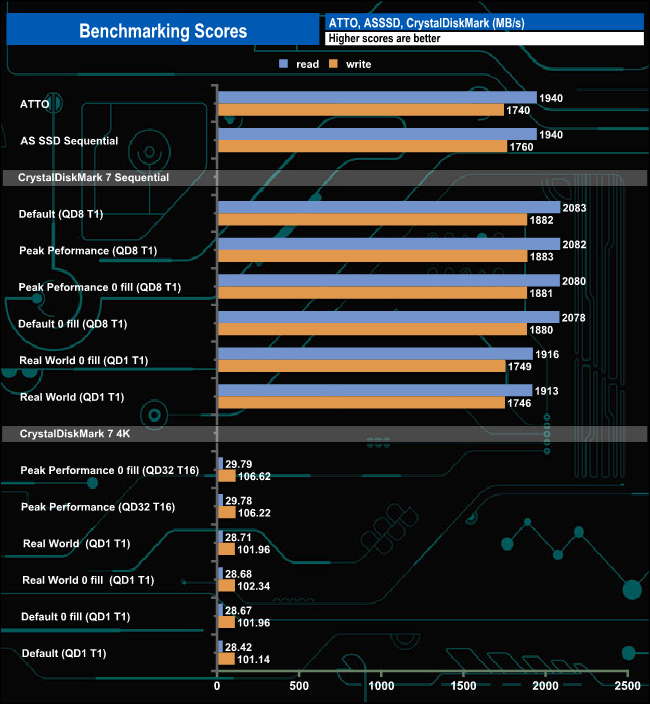
Kingston rate the XS2000 at up to 2,000MB/s for both Sequential reads and writes. Using CrystalDiskMark7 we could confirm the 2,000MB/s read performance with a best test figure of 2,083MB/s (CrystalDiskMark 7 default). The best write performance we saw was 1,883MB/s using the Peak Performance profile in CrystalDiskMark.
IOMeter is another open-source synthetic benchmarking tool that is able to simulate the various loads placed on the hard drive and solid-state drive technology.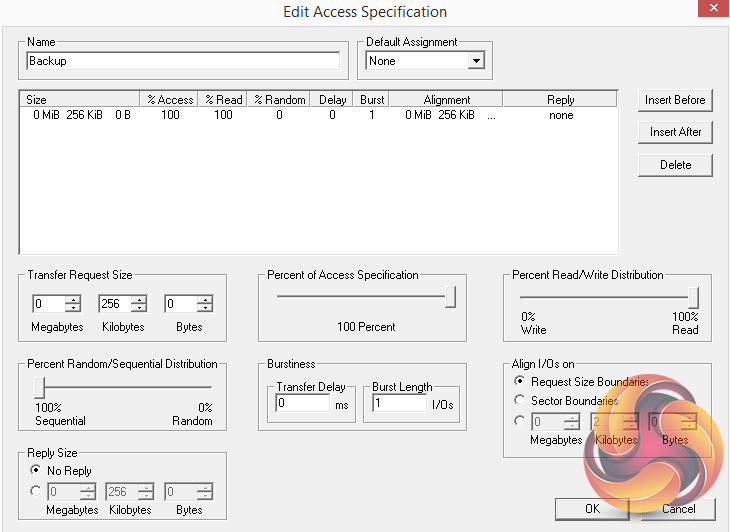
We set IOmeter up (as shown above) to test both backup and restore performance on a 100GB file.
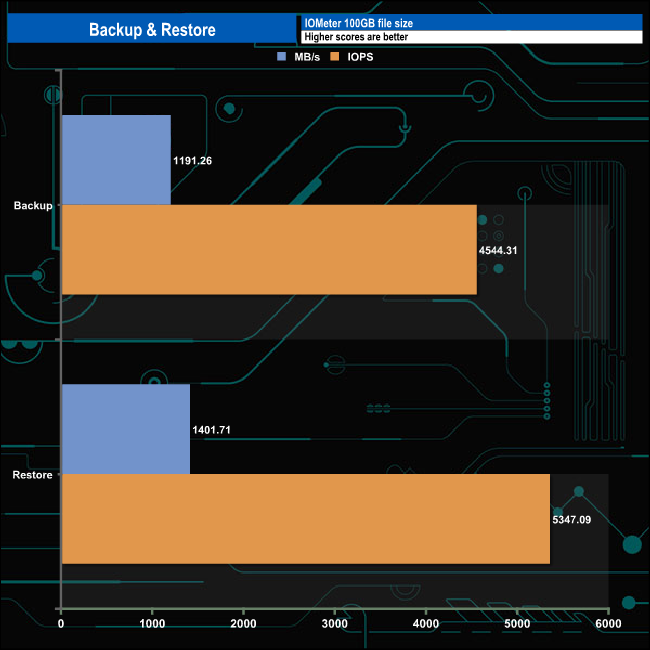
Our backup/restore tests didn't cause the XS2000 any problems, the drive producing strong performance figures for both backup (1,191MB/s, 4,544.31 IOPS) and restore (1,401MB/s, 5,347.09 IOPS) jobs.
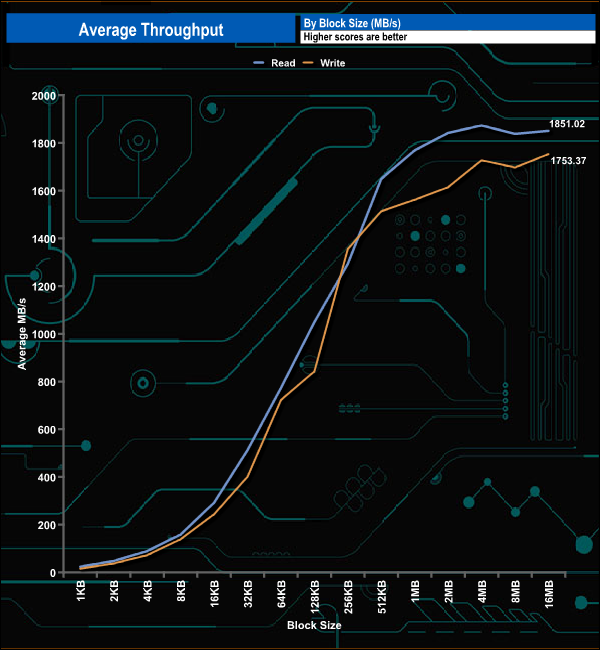
Kingston rate the Sequential performance of the 2TB XS2000 as up to 2,000MB/s for both read and writes. In our throughput tests, the drive didn't quite hit those official maximums with a tested best read figure of 1,873.47MB/s with writes at 1,752MB/s.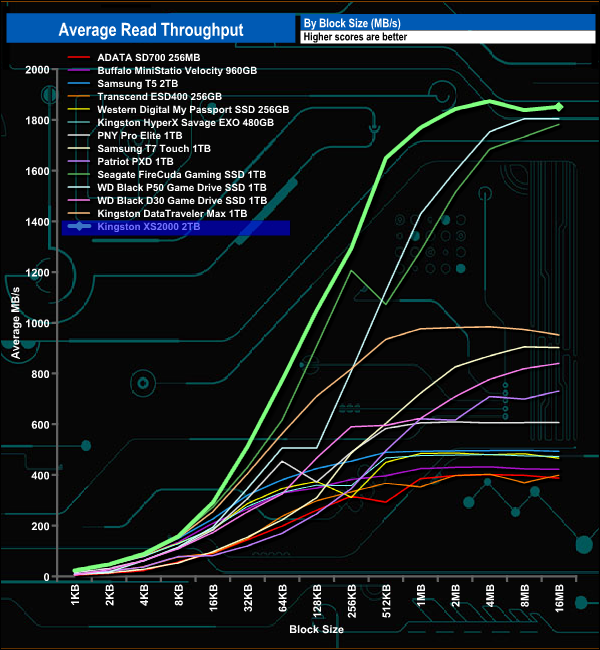
In the read throughput test, the drive peaked at the 4MB block mark at 1,873.47MB/s before dropping back slightly to finish the test run at 1,851.02MB/s. Although the peak and finishing figures are shy of the official read figure, the drives peak performance figure and finally test result make it the fastest USB external drive we've seen to date in terms of read performance.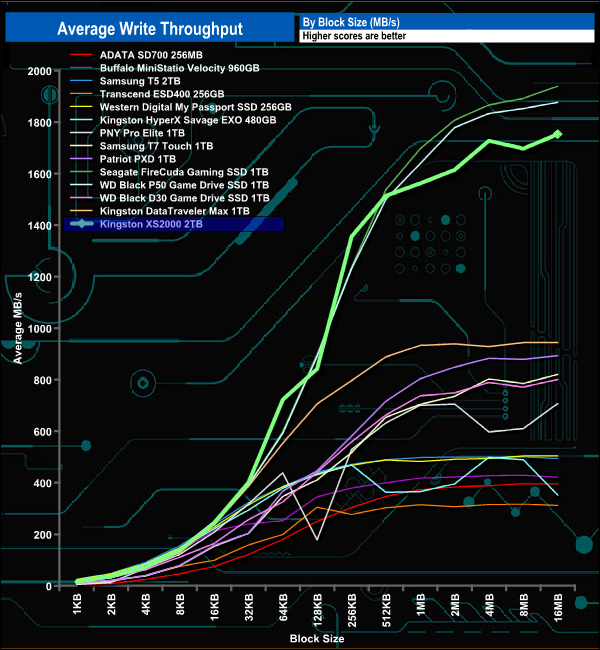
In the write throughput test, the Kingston XS2000 peaked at the end of the test run (16MB block) at 1,753.37MB/s.
The PCMark 10 Data Drive Benchmark has been designed to test drives that are used for storing files rather than applications. You can also use this test with NAS drives, USB sticks, memory cards, and other external storage devices.
The Data Drive Benchmark uses 3 traces, running 3 passes with each trace.
Trace 1. Copying 339 JPEG files, 2.37 GB in total, onto the target drive (write test).
Trace 2. Making a copy of the JPEG files (read-write test).
Trace 3. Copying the JPEG files to another drive (read test)
Here we show the total bandwidth performance for each of the individual traces.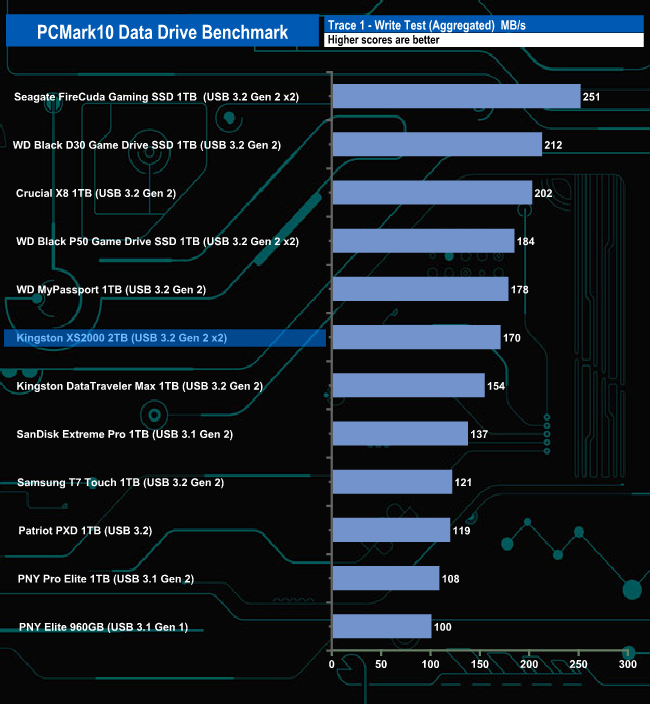
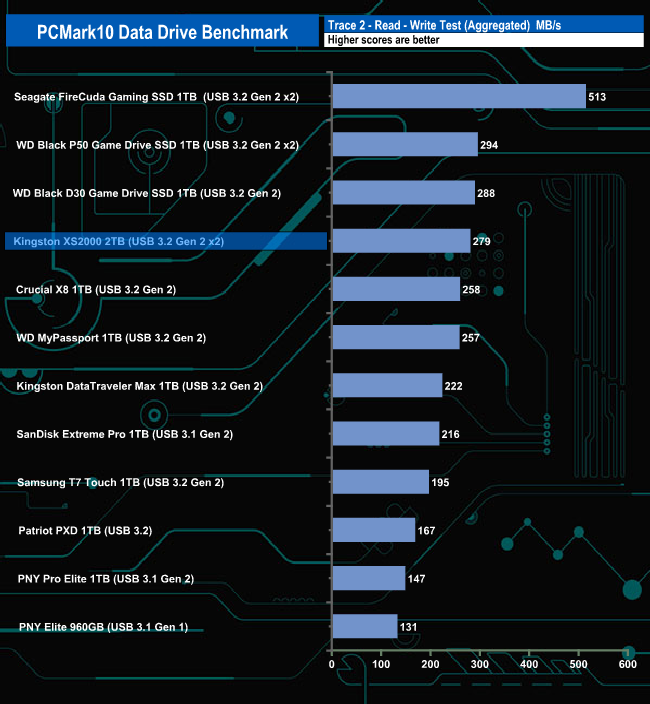
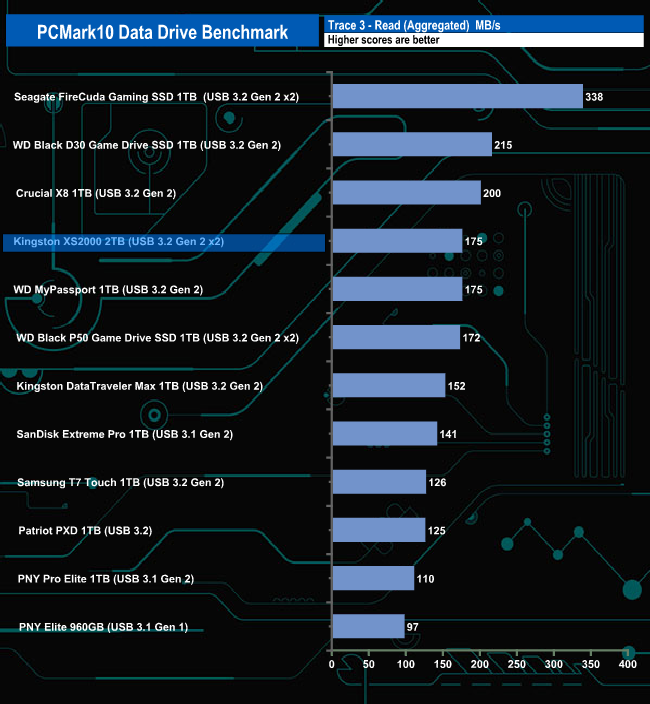
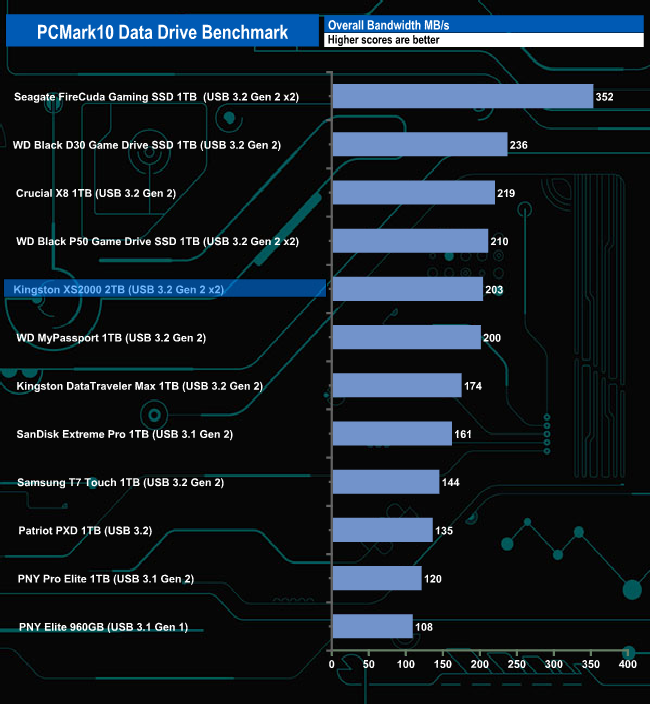
The XS2000 does pretty well in PCMark 10 Data Drive Benchmark sitting in the top half of all the results charts, although it must be said it didn't perform as well in the write trace test as it did in the read and read/write tests.
To test the real-life performance of a drive we use a mix of folder/file types and by using the FastCopy utility (which gives a time as well as MB/s result) we record the performance of drive reading from & writing to a 256GB Samsung SSD850 PRO.
We use the following folder/file types:
- 100GB data file.
- 60GB iso image.
- 60GB Steam folder – 29,521 files.
- 50GB File folder – 28,523 files.
- 12GB Movie folder – (15 files – 8 @ .MKV, 4 @ .MOV, 3 @ MP4).
- 10GB Photo folder – (304 files – 171 @ .RAW, 105 @ JPG, 21 @ .CR2, 5 @ .DNG).
- 10GB Audio folder – (1,483 files – 1479 @ MP3, 4 @ .FLAC files).
- 5GB (1.5bn pixel) photo.
- BluRay Movie – 42GB.
- 21GB 8K Movie demos – (11 demos)
- 16GB 4K Raw Movie Clips – (9 MP4V files).
- 4.25GB 3D Printer File Folder – (166 files – 105 @ .STL, 38 @ .FBX, 11 @ .blend, 5 @ .lwo, 4 @ .OBJ, 3@ .3ds).
- 1.5GB AutoCAD File Folder (80 files – 60 @ .DWG and 20 @.DXF).
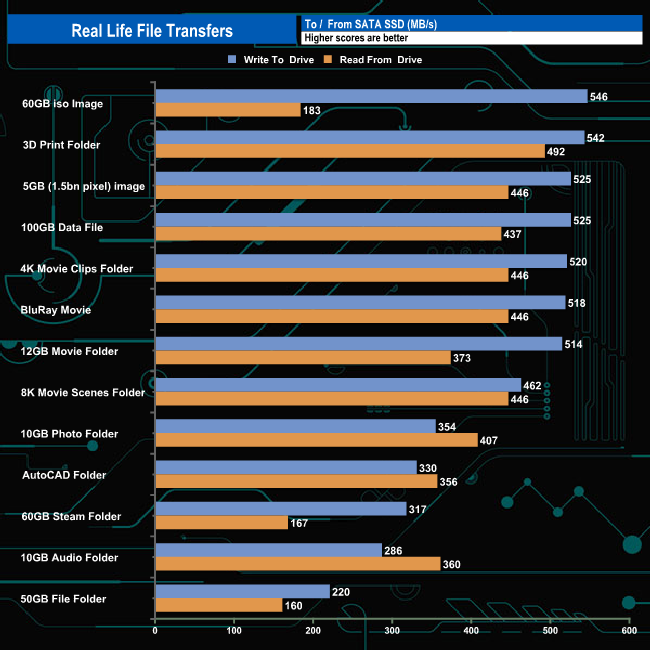
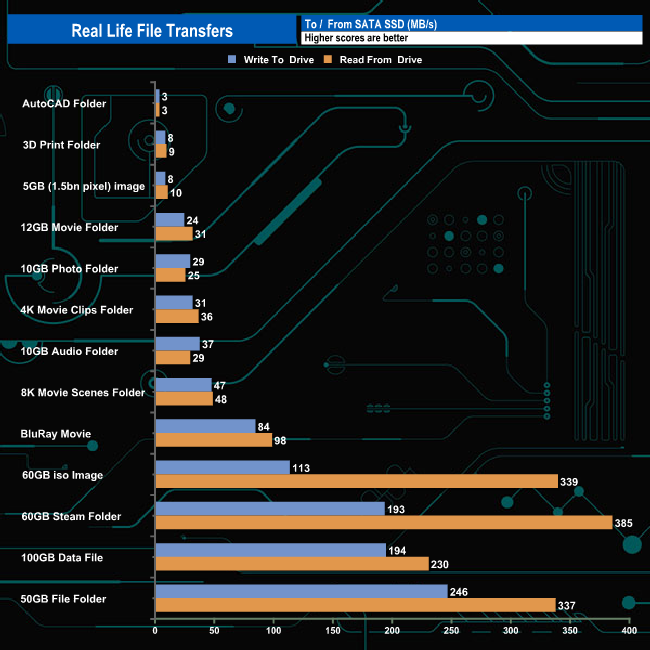
Overall the XS2000 handled our real-life file transfers without any real problems. The fastest write transfer was the 60GB iso image (546MB/s) while the fastest read performance came from the 3D Print folder transfer at 492MB/s.
To get a measure of how much faster PCIe NVMe drives are than standard SATA SSD's we use the same files but transfer to and from a 512GB Toshiba OCZ RD400: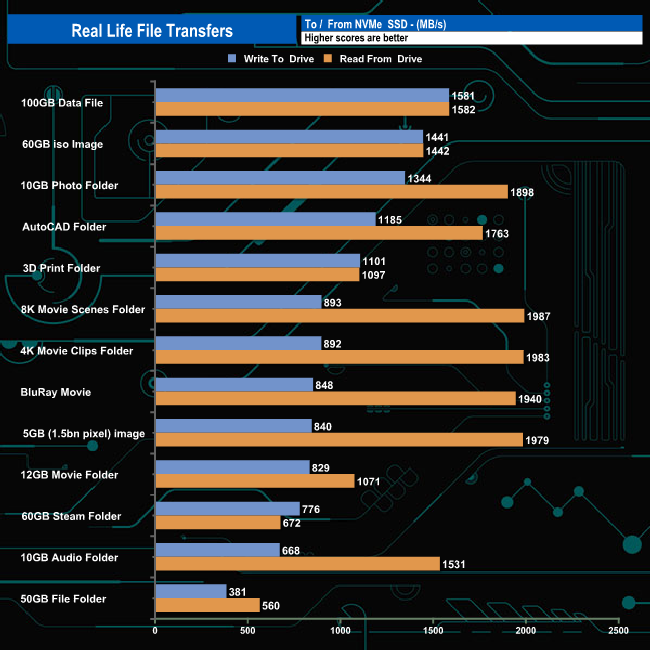
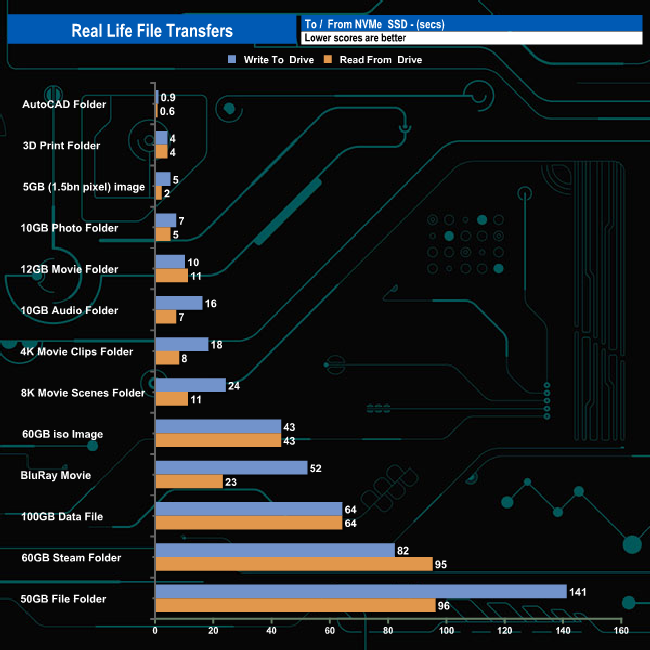
Switching over to transferring the files to and from an NVMe drive saw performance rocket as you might expect particularly read performance. The fastest read bandwidth came from the 5GB image transfer at 1,979MB/s while the fastest write performance, 1,581MB/s, came via the 100GB data file transfer.
The last Kingston external drive we looked at was the latest member of the DataTraveler series – the DataTraveler Max. At the time we thought that drive was fast, but the XS2000 can show that drive a clean pair of heels as it carries a speed rating of 2000MB/s, that's twice as fast for both read and writes than the DataTraveler Max thanks to its USB 3.2 Gen 2×2 (20Gbps) interface. The XS2000 currently comes in three capacities; 500GB, 1TB and a 2TB flagship which we have reviewed here.
At the heart of the XS2000 is a Silicon Motion SM2320 4-channel, USB 3.2 Gen 2 controller which looks after 96-layer 3D TLC NAND. The controller is a DRAM-less design and although it supports AES 256-bit encryption, the XS2000 doesn't use it.
We couldn't hit the official maximum 2,000MB/s for either reads or writes using the ATTO or AS SSD benchmarks but got closer with the read test result, 1,940MB/s than we did with the write figures (1,740MB/s ATTO, 1,760MB/s AS SSD). However, we could confirm 2,000MB/s read performance using the CrystalDiskMark benchmark default setting with a test result of 2,083MB/s. The fastest write figure we saw came from CrystalDiskMark's Peak Performance profile at 1,883MB/s, not far off the official maximum.
The XS2000 is also very pocket-friendly, measuring 69.5 x 32.6 x 13.5mm and weighing less than 30g. It's also IP55 rated and comes with a snug rubber sleeve to give added protection from any knocks or bumps.
We found the 2TB Kingston XS2000 on CCL Computers for £242.20 (inc VAT) HERE.
Pros
- Overall Performance.
- Diminutive size.
- Large capacity.
- Durability.
Cons
- Needs USB 3.2 Gen 2 x2 compatible system to get the best performance.
- Lacks hardware encryption.
KitGuru says A small pocket-sized drive that packs a punch, Kingston's XS2000 is a very quick drive, especially when it comes to read performance.