KitGuru KitGuru.net – Tech News | Hardware News | Hardware Reviews | IOS | Mobile | Gaming | Graphics Cards


MSI's Spatium M480 is the company's first SSD offering, having announced its entry into the storage market earlier this year. Based around a Phison E18 controller and 96-Layer 3D TLC NAND, the 2TB model is (at the time of writing) the largest capacity drive in the M480 series.
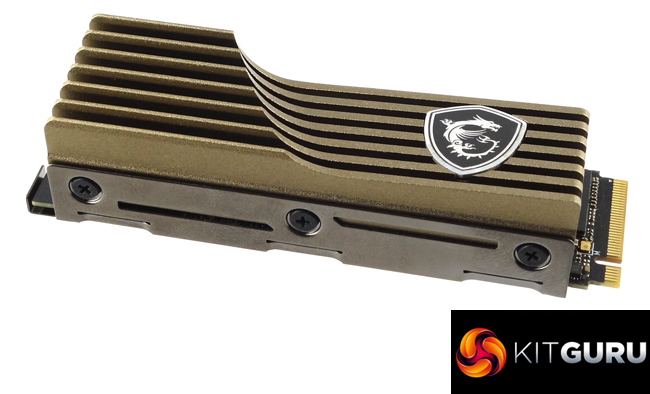
The Spatium M480 model line consists of three capacities; 500GB, 1TB and 2TB. At the heart of the drive is a Phison PS5018-E18 controller, the go-to controller for most of the 2nd generation Gen 4 drives we've seen to date. For the M480, MSI has paired the controller with Micron 96-layer 3D TLC NAND which gives the Spatium M480 some impressive Sequential performance figures.
The official Sequential ratings for the 2TB drive are up to 7,000MB/s for reads and up to 6,800MB/s for writes. The 1TB drive is rated at the same 7,000MB/s for reads but with a lower write speed of up to 5,500MB/s. The entry 500GB model makes do with up to 6,500MB/s and 2,850MB/s for read and writes respectively.
Random performance is quoted as up to 650,000 IOPS for reads and up to 700,000 IOPS for writes for the 2TB drive, up to 350,000 IOPS and 700,000 IOPS for read and writes respectively for the 1TB model and up to 170,000 IOPS read and up to 600,000 IOPS writes for the 500GB model.
The HS SKU of the M480 comes with a chunky bronze-coloured aluminium stacked fin heatsink which adds 18mm to the overall height of the drive which may be a bit problematic using the drive with compact PCs.
Endurance for the 2TB drive is stated at 1400TBW and MSI back the drive with a 5-year warranty. Power consumption for the 2TB drive is listed as 8.2W for maximum operating power, 22mW for idle power and 3mW in low power mode.
Physical Specifications:
- Usable Capacities: 2TB.
- NAND Components: Micron 96-layer 3D TLC NAND.
- NAND Controller: Phison PS5018-E18.
- Cache: 2GB DDR4.
- Interface: PCIe 4.0 x4, NVMe 1.4.
- Form Factor: M.2 2280.
- Dimensions: 80 x 22 x 2.15mm (80.4 x 23 x 20.40mm with heatsink).
Firmware Version: EIFM21.1
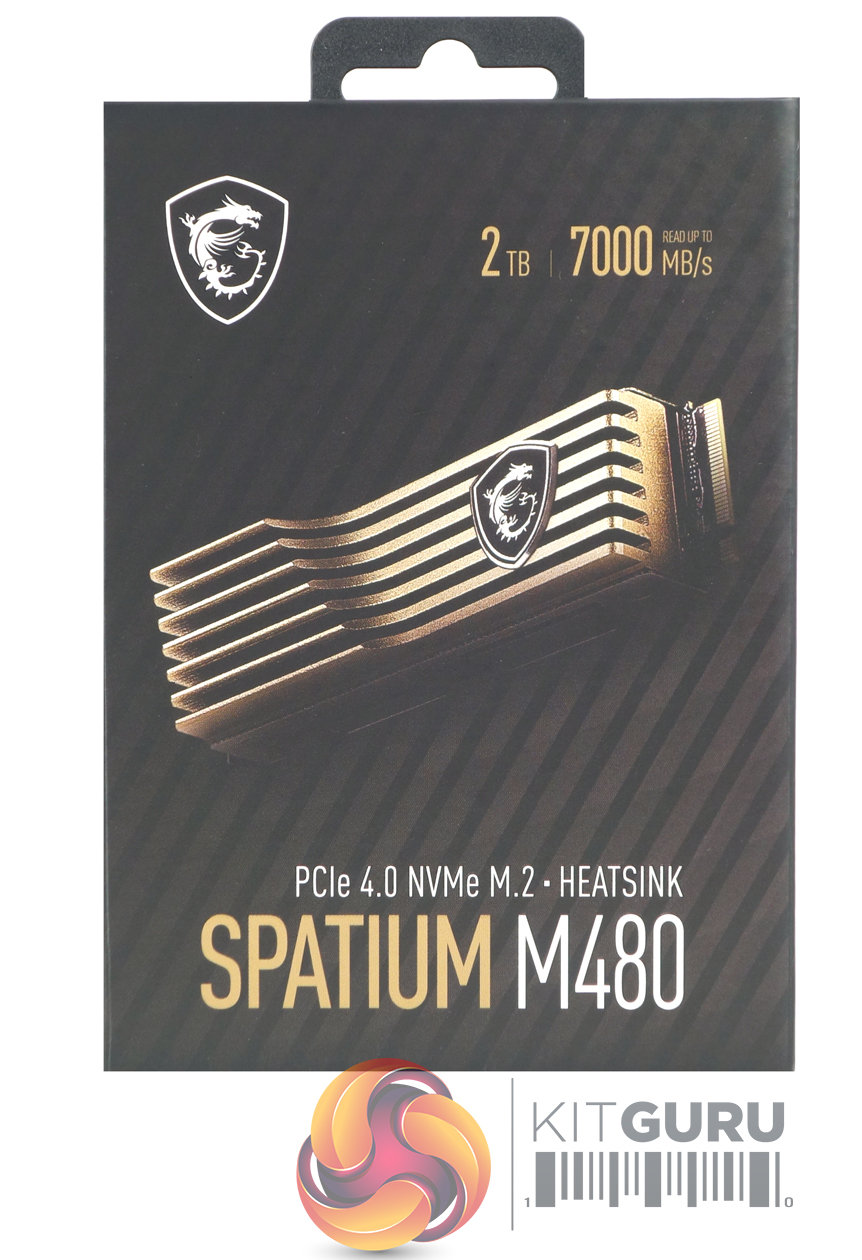
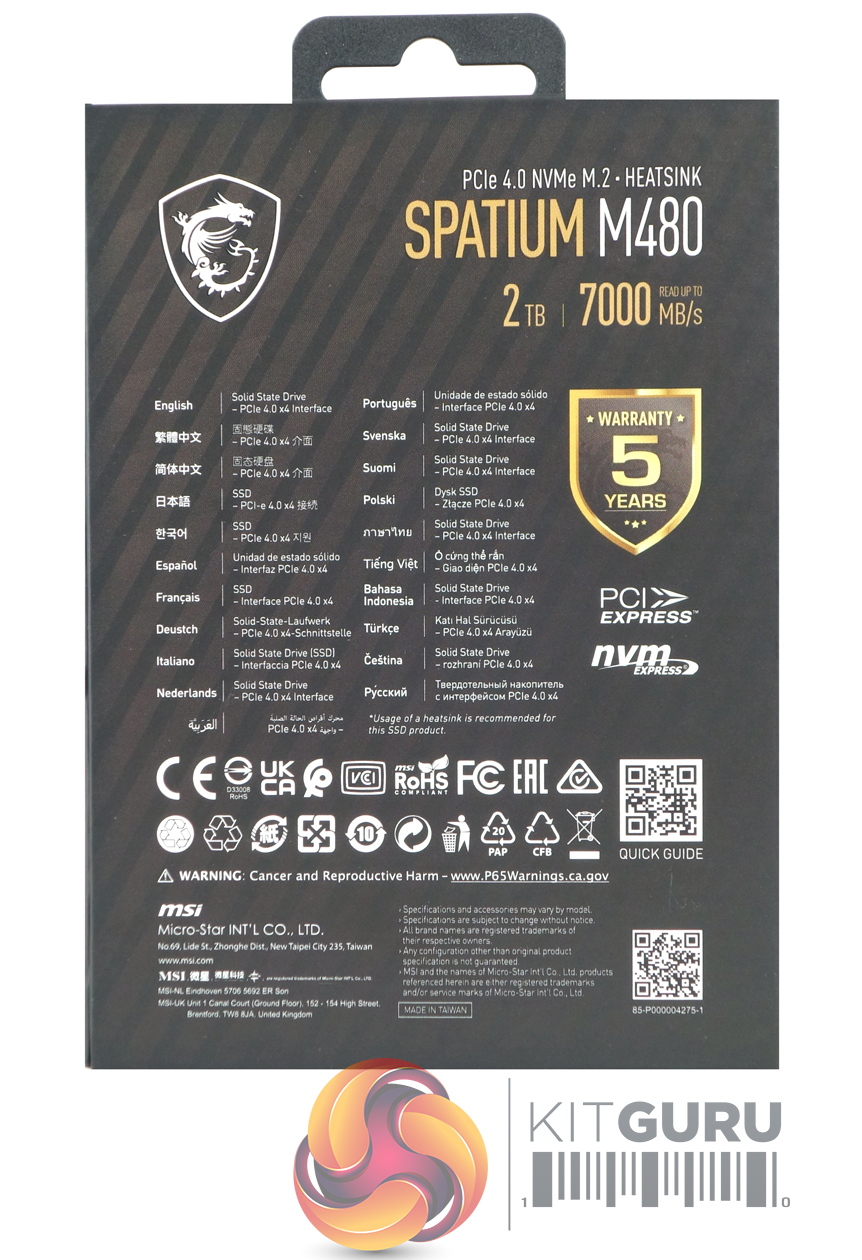
The Spatium M480 comes in a well-constructed box with a large image of the drive on the front with the capacity and Sequential read speed listed above the image and the fact that it is a PCIe 4.0 drive under it, above the drive name.
The back of the box repeats the same information as the front along with a logo stating that the drive is covered by a 5-year warranty. To the left of this logo is some multi-lingual marketing information.
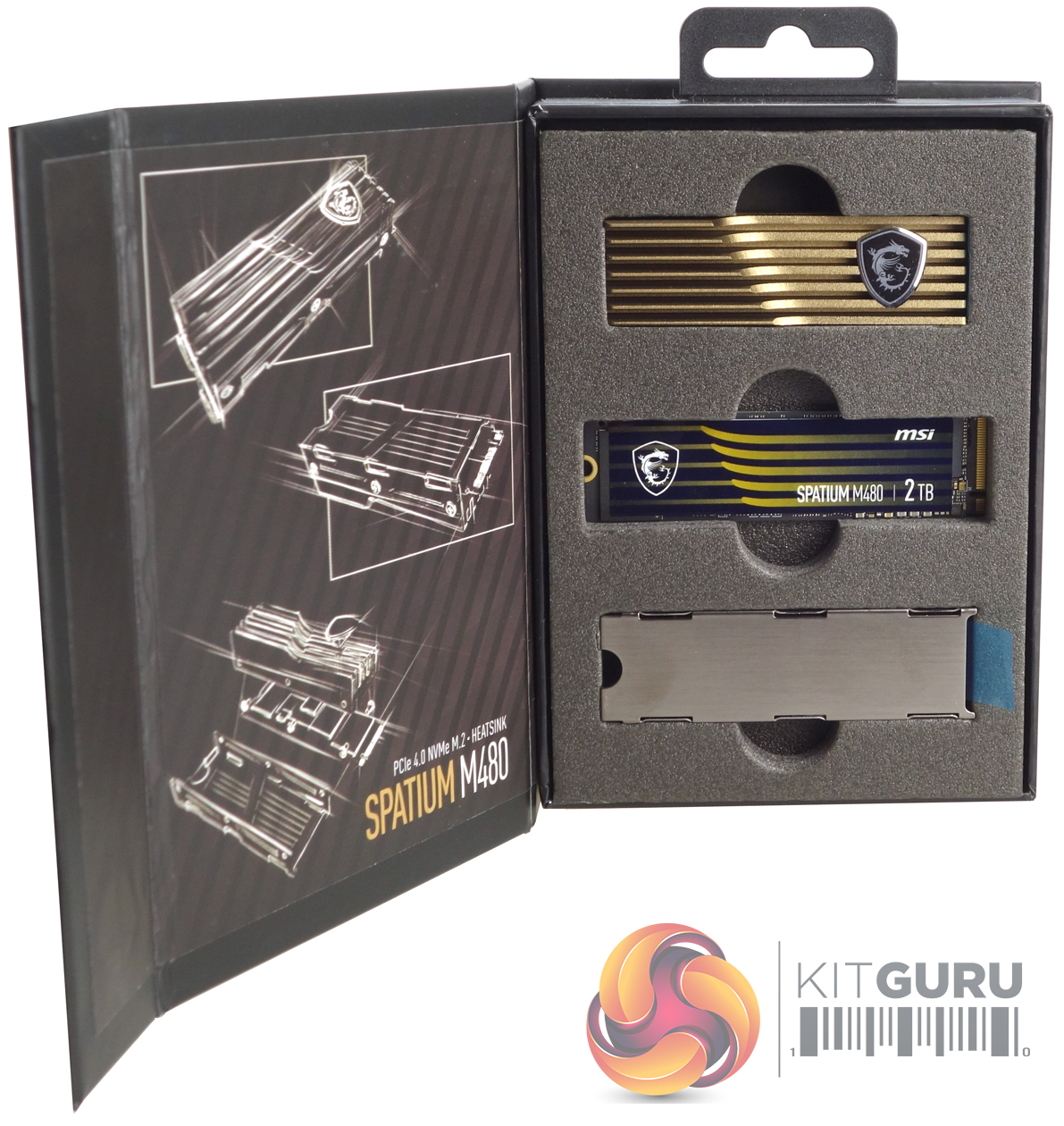
Opening the box reveals very well packed individual components; the chunky aluminium heatsink (with a thermal pad on its base), the Spatium M480 drive and the cradle for both drive and heatsink and finally the fixing screws to connect heatsink to cradle. There's also a fixing guide and a warranty booklet included in the box.
Searching the old great matter, we're not sure we've ever come across a drive packed quite like the Spatium M480 but it does mean that if you using any motherboard with its own integrated cooling system then it's a simple installation, but even if you have to use the heatsink, it only takes a couple of minutes to put the heatsink together.
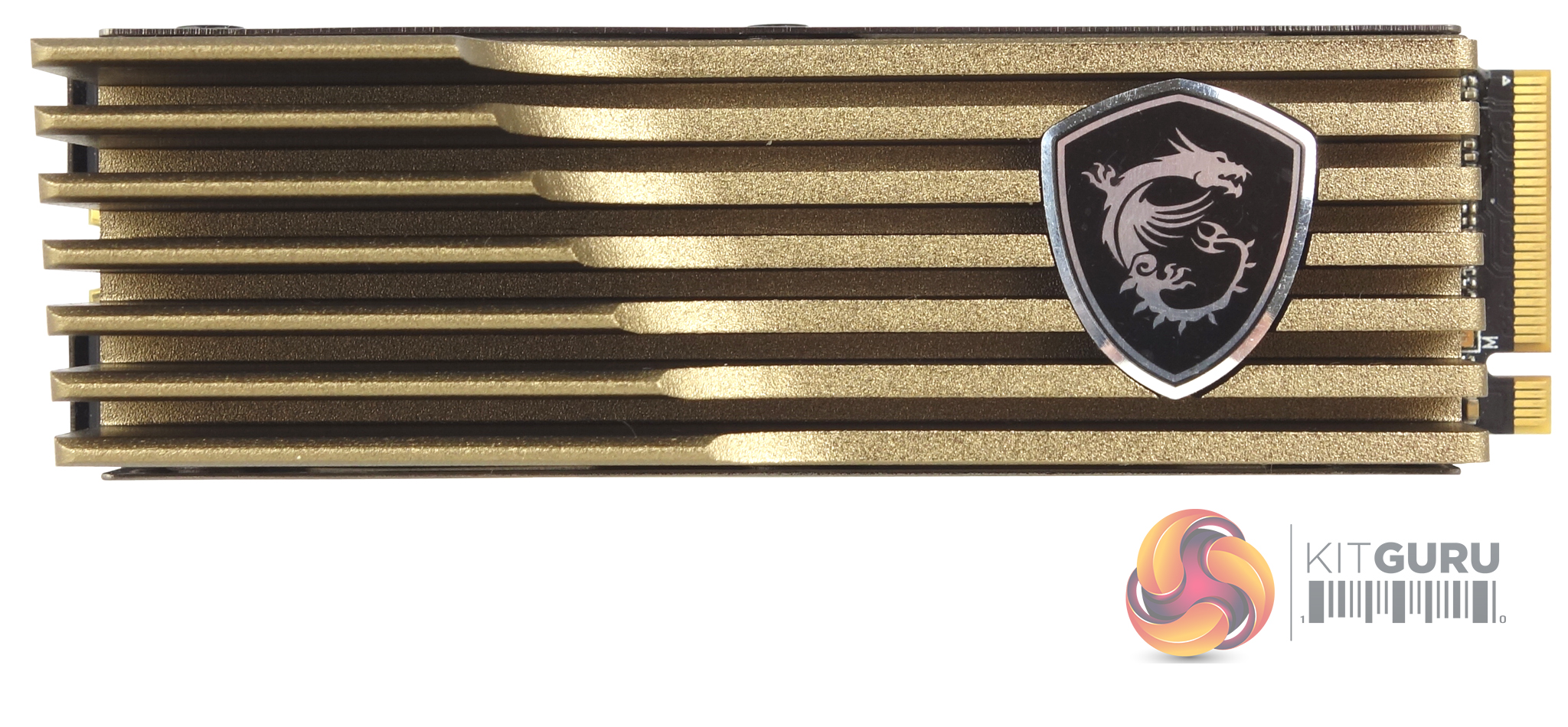
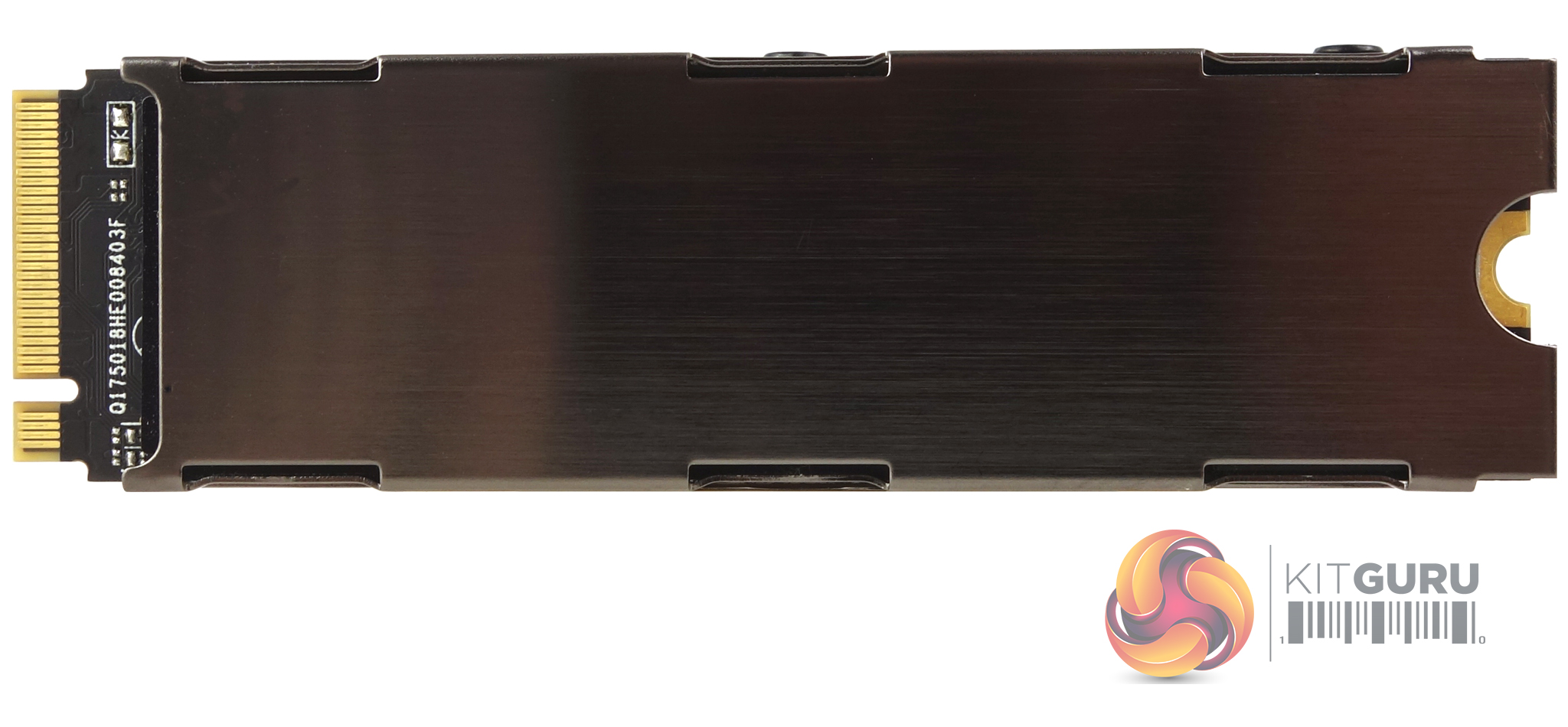
The Spatium M480 2TB drive is built on a dual-sided format. One side of the PCB holds the Phison PS5018-E18 controller, a 1GB SkHynix DDR4-2666 (H5AN8G6NCJR-VKC) IC to store mapping tables and four 256GB packages of Micron 96-Layer 3D TLC NAND (IA7BG64AIA). The other side of the PCB has another 1GB DRAM IC together with another four 256GB NAND packages.
For testing, the drives are all wiped and reset to factory settings by HDDerase V4. We try to use free or easily available programs and some real-world testing so you can compare our findings against your own system.
This is a good way to measure potential upgrade benefits.
Main system:
AMD Ryzen 5 3600X, 16GB DDR4-2400, Sapphire R9 390 Nitro and an MSI MPG X570 Gaming Edge Wifi motherboard
Other drives
Corsair MP600 PRO 2TB
Corsair Force MP600 1TB
Gigabyte AORUS 7000s 2TB
Patriot Viper VP4300 2TB
Patriot Viper VPN4100 1TB
PNY XLR8 CS3140 1TB
PNY XLR8 CS3040 1TB
Sabrent Rocket 4 Plus 1TB
Sabrent Rocket 4 Plus 2TB
Sabrent Rocket 4 Plus 4TB
Samsung SSD980 PRO 1TB
Seagate FireCuda 520 1TB
Teamgroup T-Force Cardea Zero Z440 1TB
WD Black SN850 1TB
Software:
Atto Disk Benchmark 4.
CrystalMark
AS SSD 2.0.
Futuremark PC Mark 10.
All our results were achieved by running each test five times with every configuration this ensures that any glitches are removed from the results. Trim is confirmed as running by typing fsutil behavior query disabledeletenotify into the command line. A response of disabledeletenotify =0 confirms TRIM is active.
CrystalDiskMark is a useful benchmark to measure theoretical performance levels of hard drives and SSD’s. We are using v6.0 and v8.0
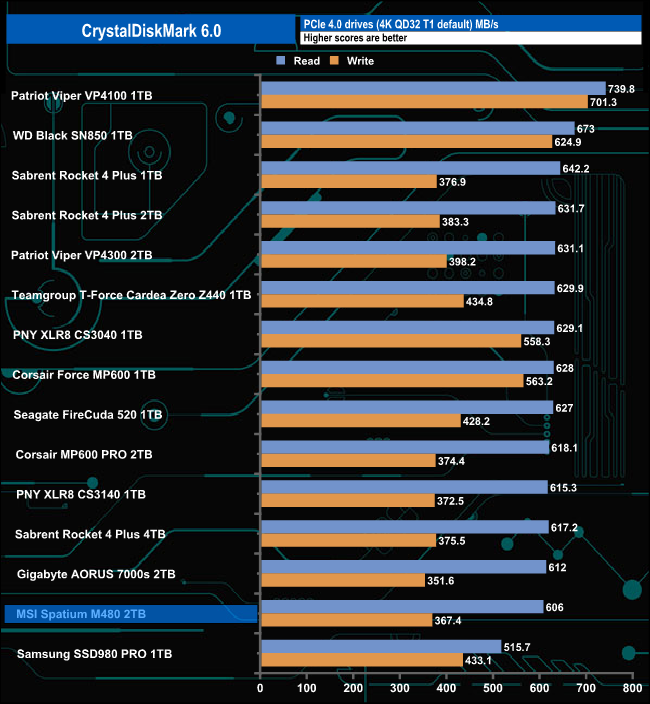
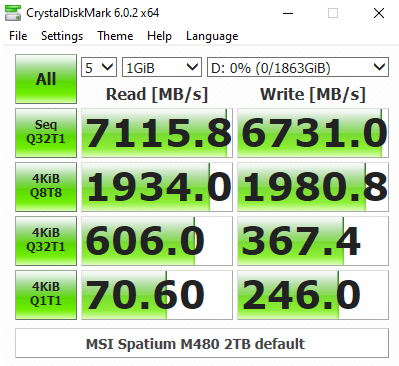
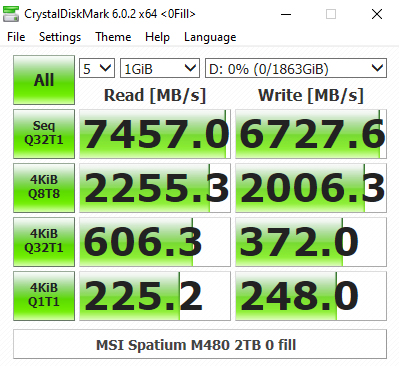
The Spatium M480 doesn't fare so well in the QD32 test of CDM 6 but looking at the benchmark result screens we can confirm and indeed better the official read figure of 7,000MB/s with a default test result of 7,115.8MB/s and 7,457MB/s when the drive is dealing with compressible data. Tested Sequential writes were a little short of the official maximum of 6,800MB/s at 6,731MB/s.
CrystalDiskMark 8
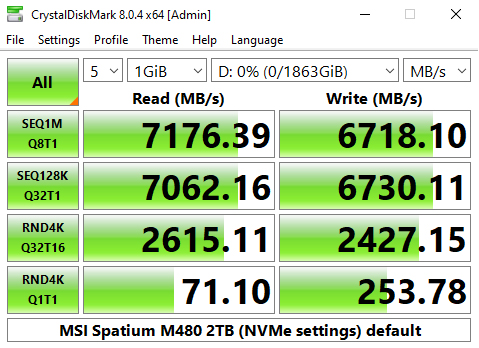
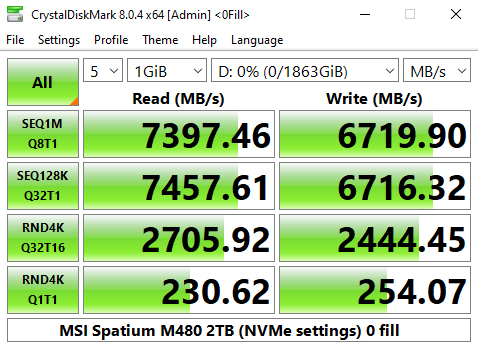
CrystalDiskMark 8 Peak Performance Profile
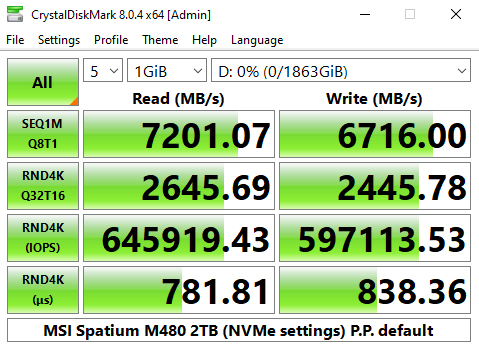
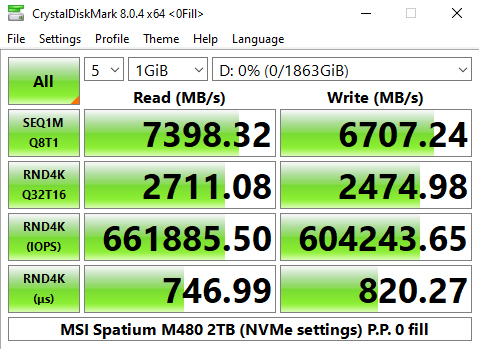
CrystalDiskMark 8 Real World Performance Profile
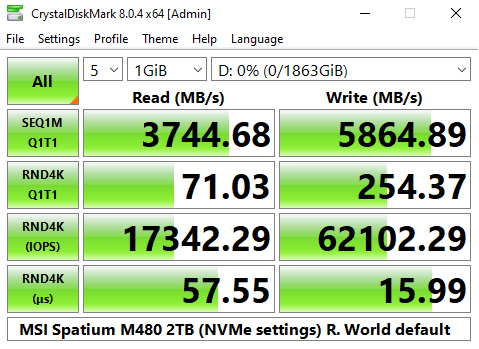
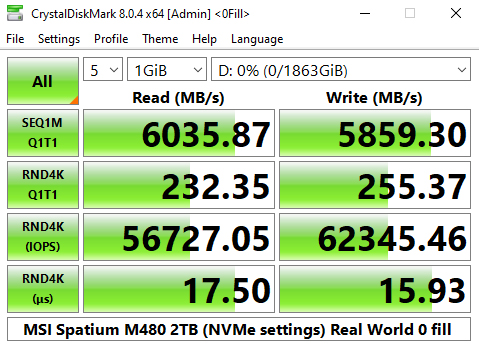
CrystalDiskMark 8 comes with a couple of interesting ready-made testing profiles as well as a dedicated NVMe setting. The best tested Sequential figures for reads, 7,398.32MB/s, more than confirms the official maximum figure of 7,000MB/s while the best Sequential write test result of 6,719.90MB/s is a little shy of the official maximum of 6,800MB/s.
The best tested random 4K figures in CDM8 for the drive are 661,885.50 IOPS for reads which confirms the official maximum for the drive of 650,000 IOPS. The best write score of 604,243 IOPS is a little short of the write maximum of 700,000 IOPS.
Looking at the CrystalDiskMark results screens we can see that the Phison E18 controller that the Spatium M480 uses is much more efficient when reading compressible sequential and 4K data at certain queue depths.
The ATTO Disk Benchmark performance measurement tool is compatible with Microsoft Windows. Measure your storage systems performance with various transfer sizes and test lengths for reads and writes. Several options are available to customize your performance measurement including queue depth, overlapped I/O and even a comparison mode with the option to run continuously. Use ATTO Disk Benchmark to test any manufacturers RAID controllers, storage controllers, host adapters, hard drives and SSD drives and notice that ATTO products will consistently provide the highest level of performance to your storage.
We are using version 4.0 for our NVMe drive testing.
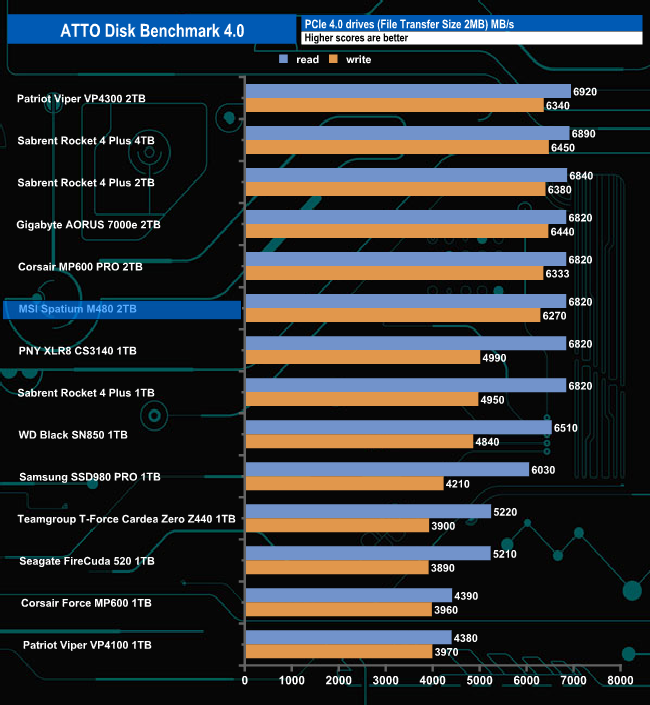
Using the ATTO benchmark we couldn't reach the official maximums of 7,000MB/s for reads and up to 6,800MB/ for writes, although we were closer with the read performance than writes with benchmark results scores of 6,820MB/s and 6,270MB/s for reads and writes respectively. That tested read result score puts the MSI Spatium M480 into the middle of the pack in our results chart.
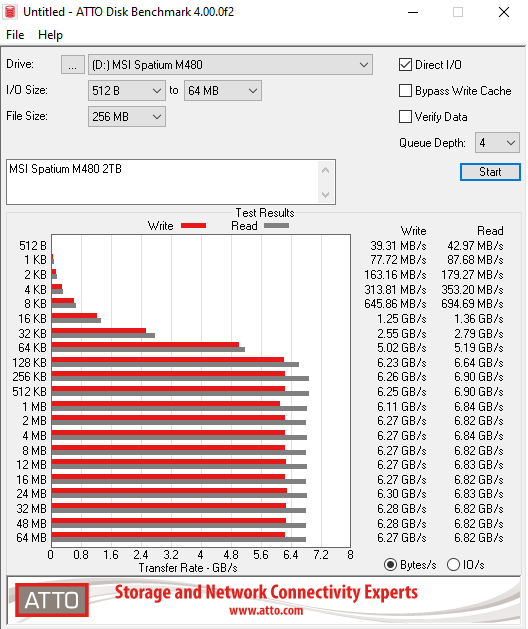
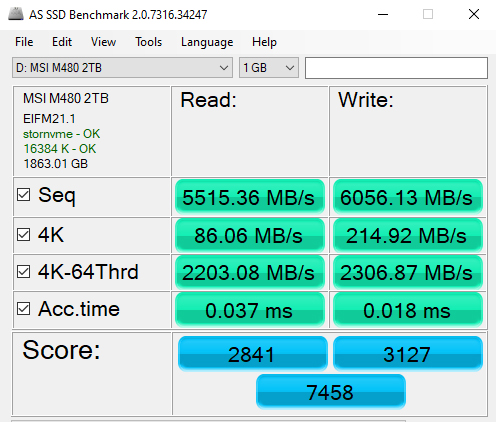
AS SSD is a great free tool designed just for benching Solid State Drives. It performs an array of sequential read and write tests, as well as random read and write tests with sequential access times over a portion of the drive. AS SSD includes a sub suite of benchmarks with various file pattern algorithms but this is difficult in trying to judge accurate performance figures.
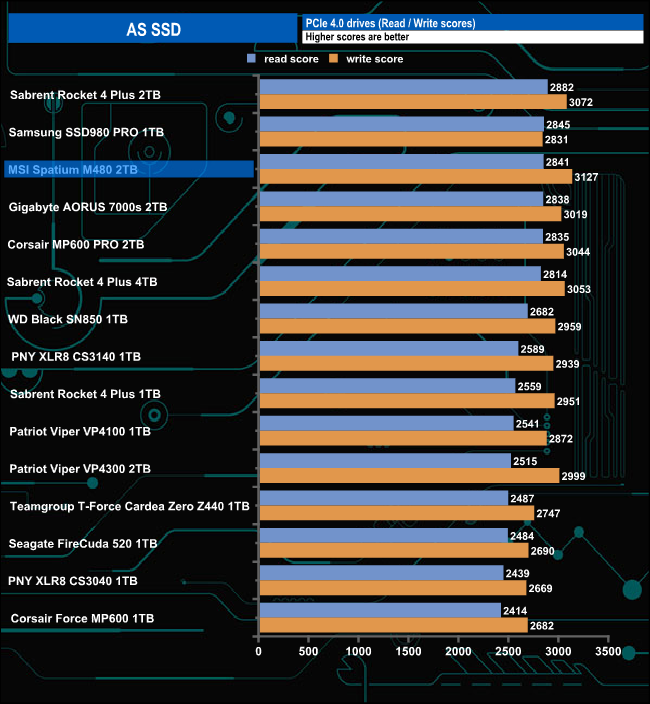
The Spatium M480's read score of 2841 puts the drive into third place on the results chart but the write score of 3127 is the fastest we've seen to date for a consumer Gen 4 drive.
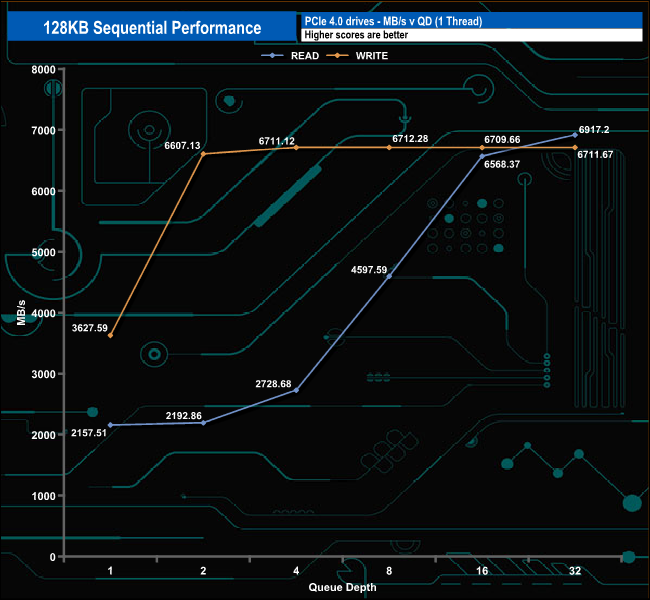
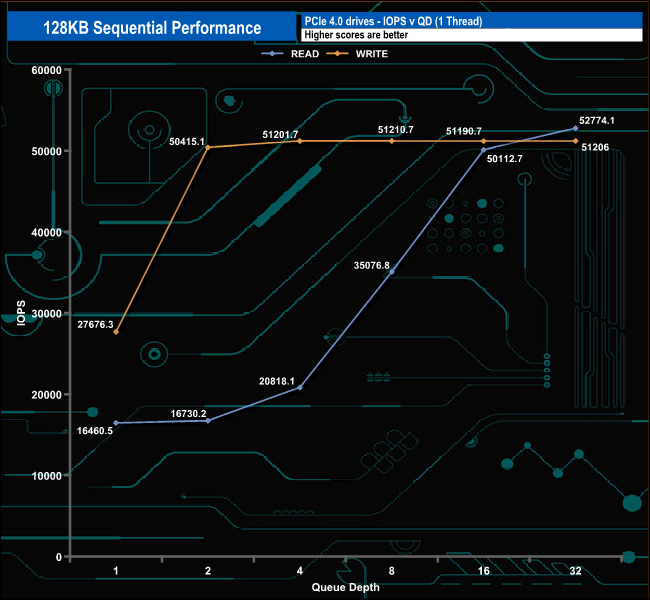
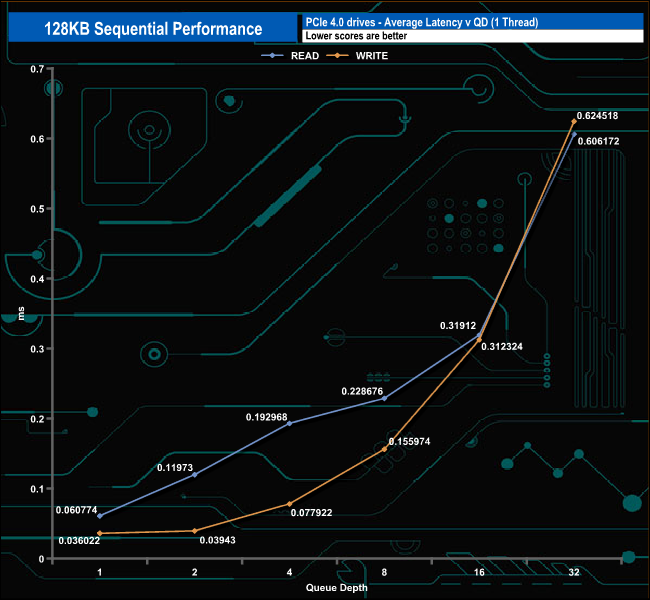
In our Sequential tests, the Spatium M480 produced a peak read score of 6,917.2MB/s just shy of the official maximum of 7,000MB/s. Sequential writes peaked at 6,712.28MB/s (QD8) again just shy of the official maximum figure of 6,800MB/s.
128KB Sequential Read Performance Compared.
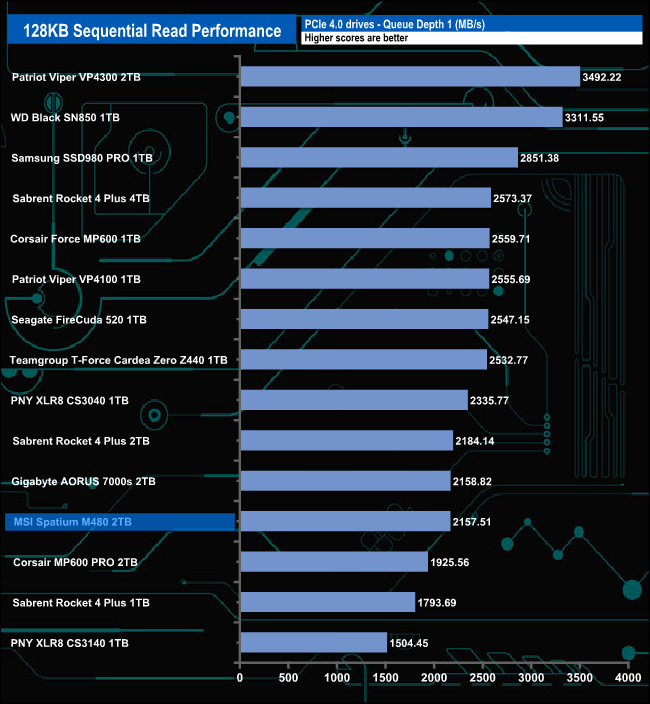
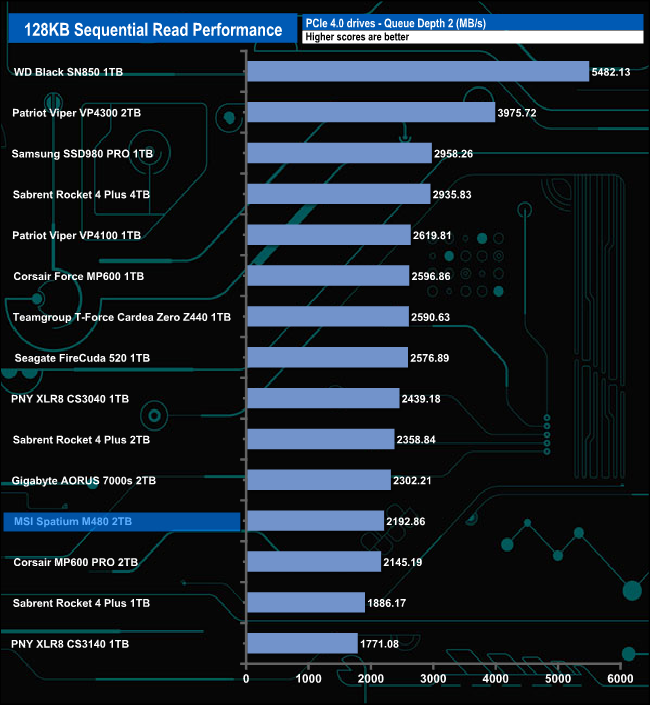
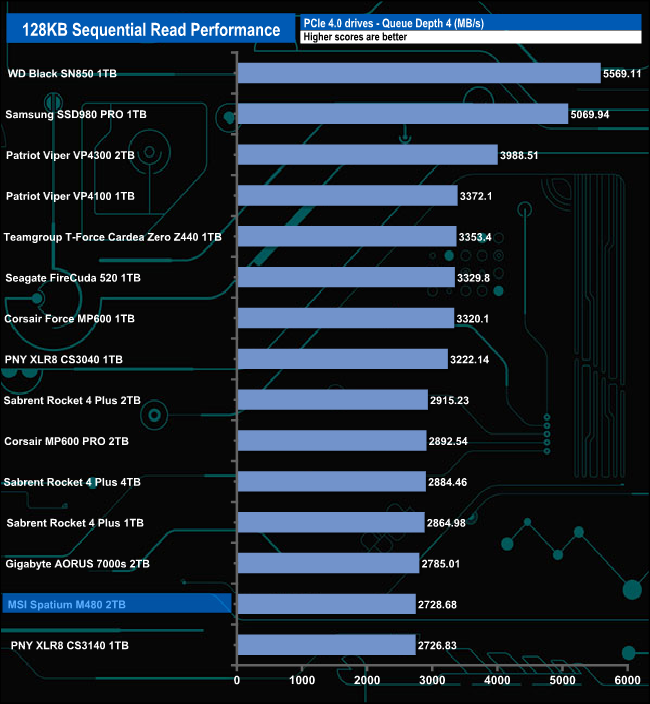
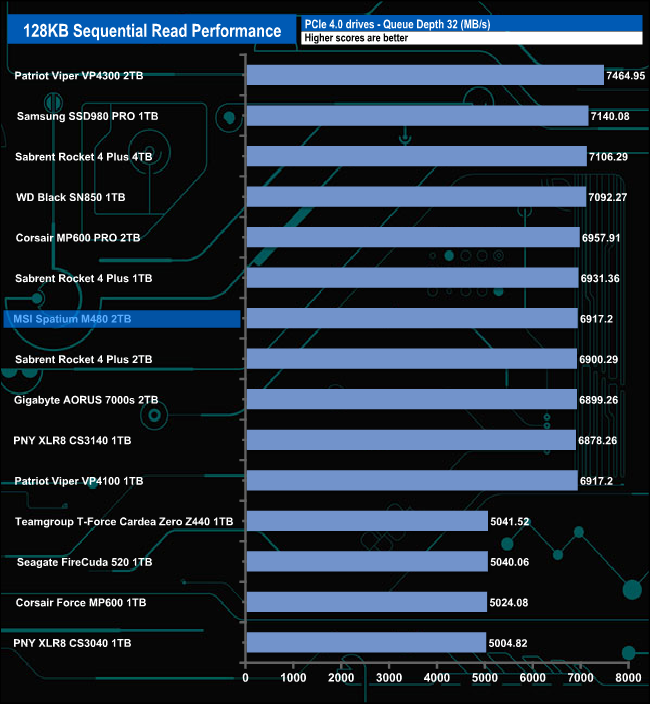
In comparison to its competitors, the Spatium M480 performed strongest at QD32 where it sits halfway in the results chart.
128KB Sequential Write Performance Compared,
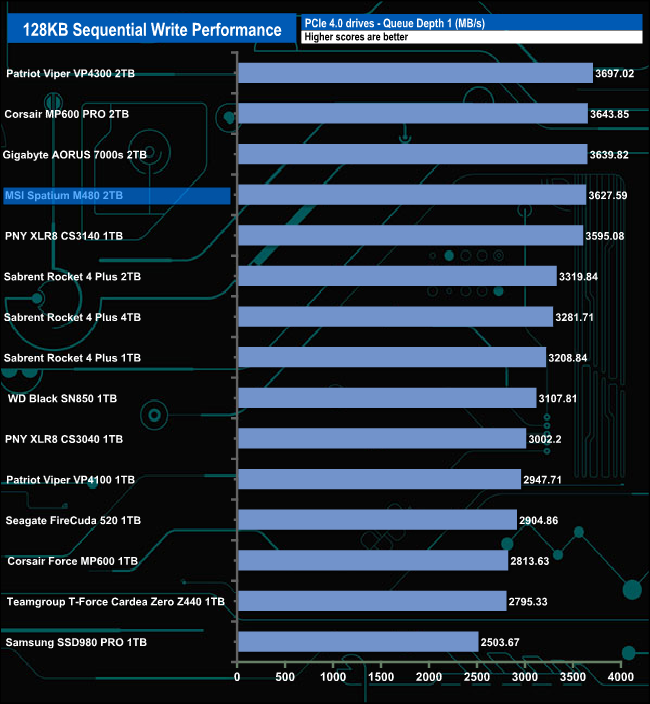
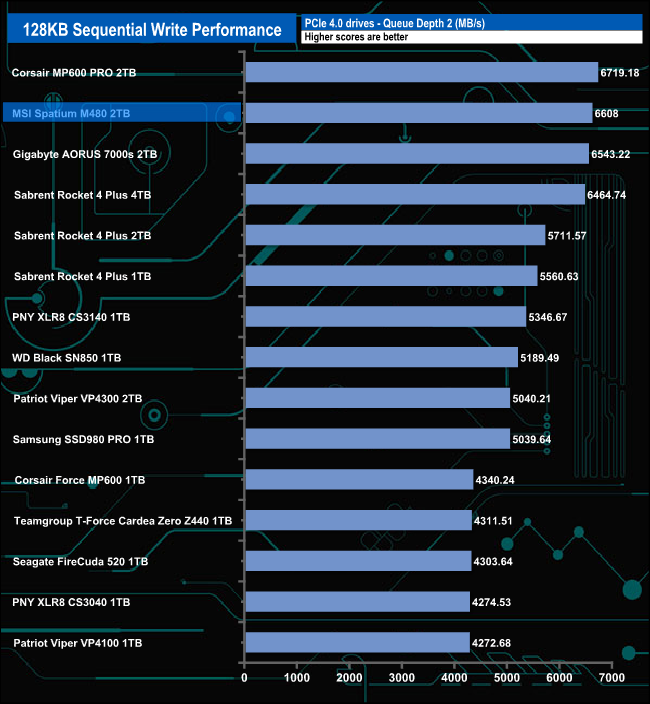
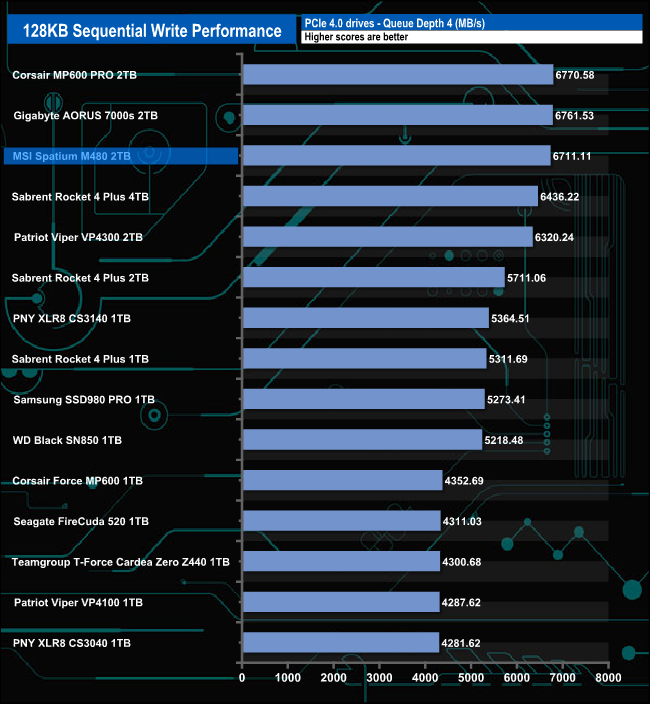
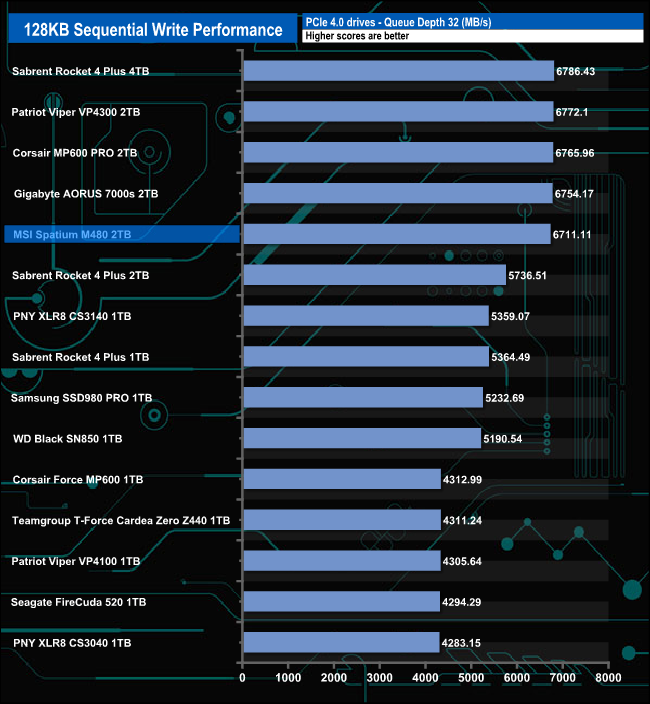
In contrast to the Sequential read results, the write performance is very strong, sitting in the top five fastest drives in every tested queue depth. The best performance came at QD2 where it sits in second place behind Corsair's MP600 PRO.
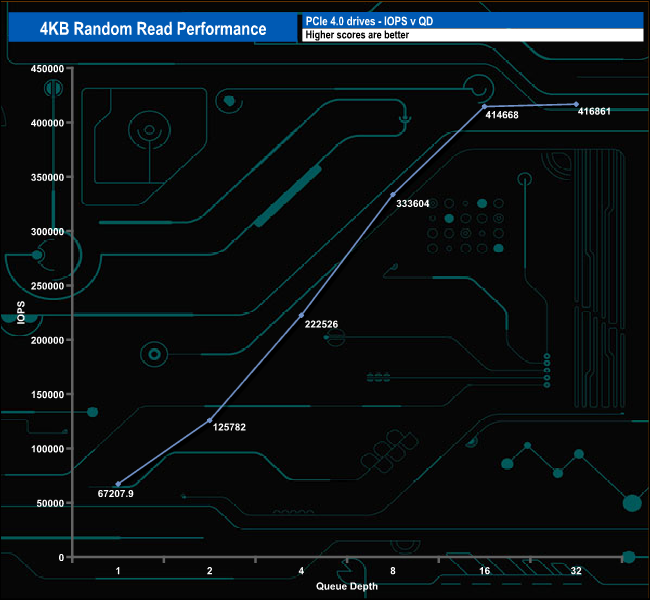
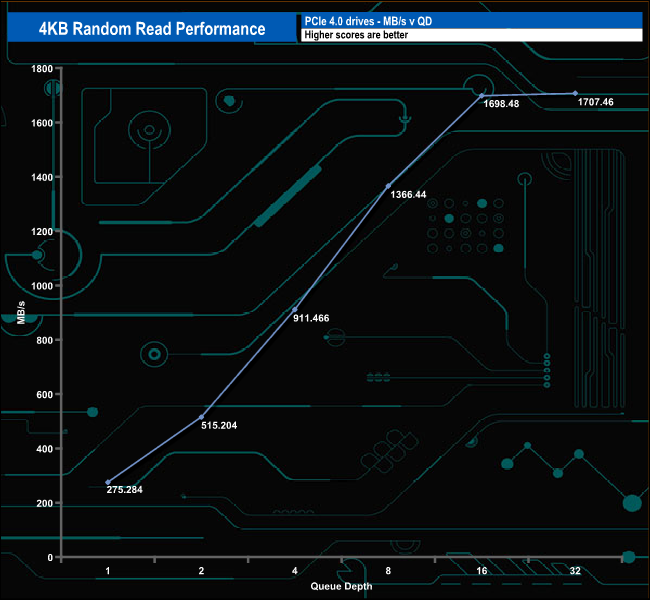
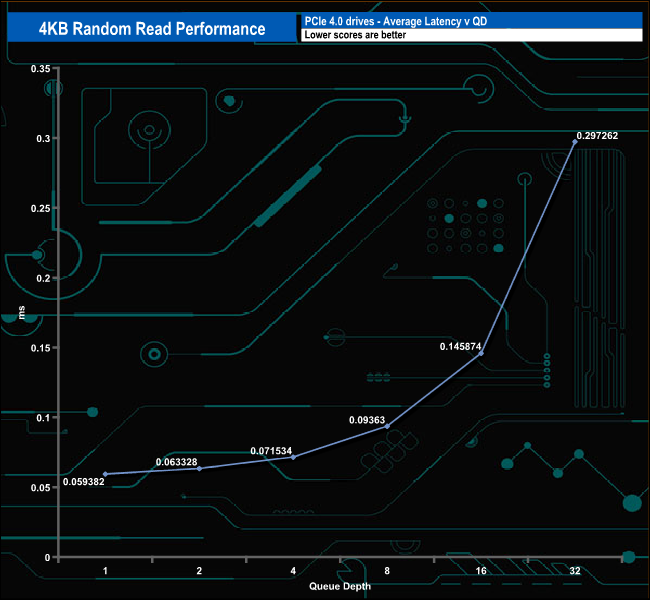
In our four-threaded random read tests, the best figure we saw was 416,861 IOPS at QD32, a long way short of the maximum 650,000 IOPS. We ran a quick test at QD32 using 8 threads and saw the performance rise to 590,013.1 IOPS, still shy of the official maximum.
4K Random Read v QD Performance Compared.
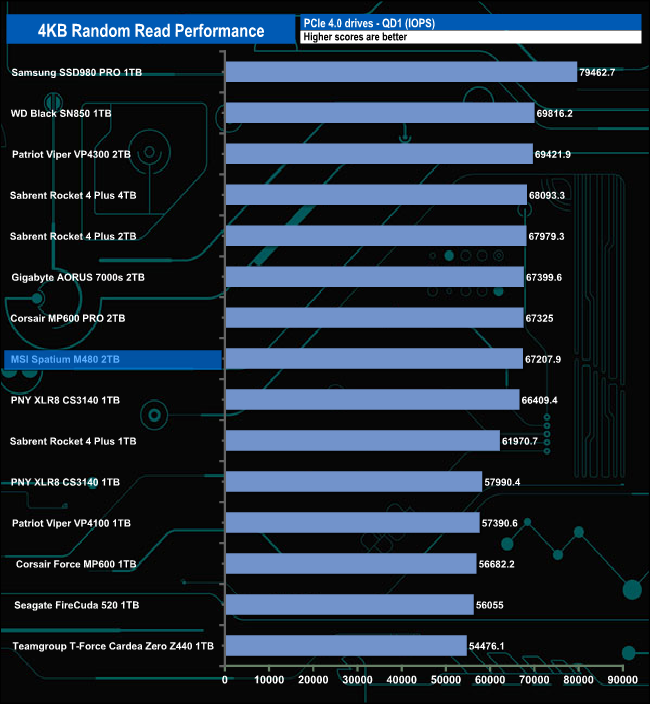
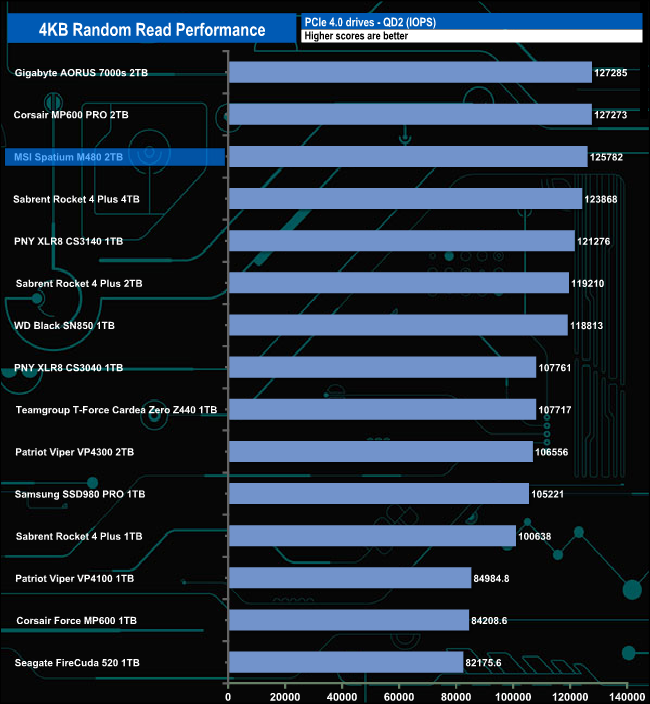
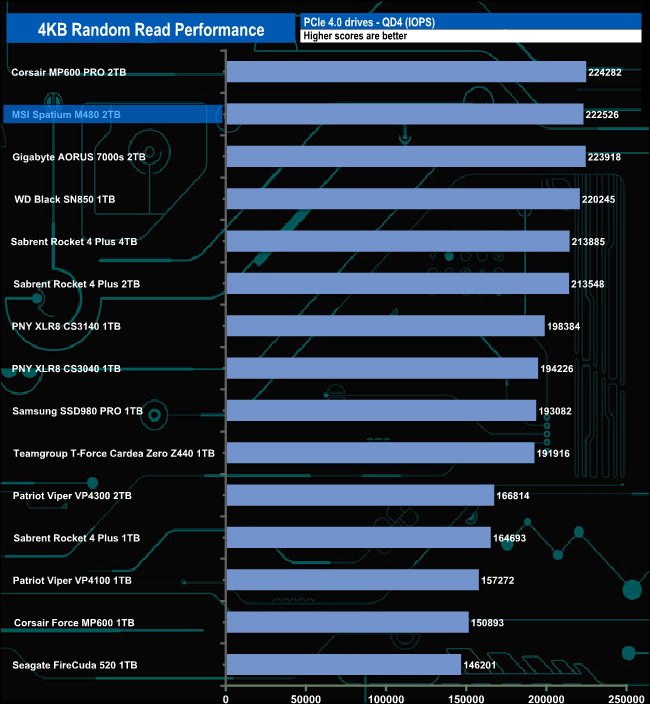
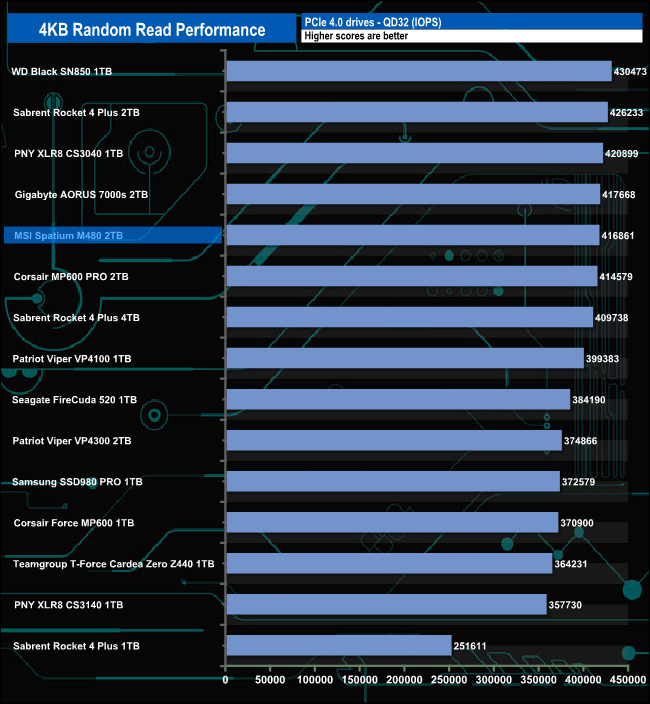
The drive's performance picks up as the queue depth deepens with the best performance in comparison with its competitors coming at QD4 at 222,526 IOPS.
 ~
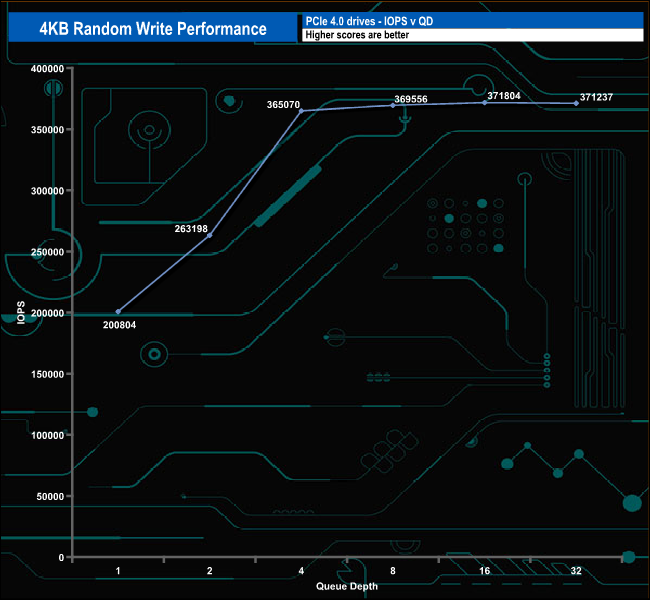
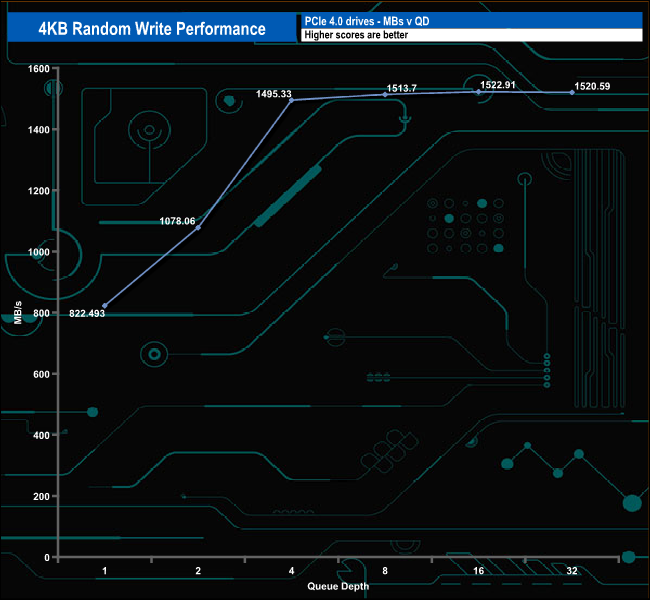
~When it came to random writes, the best performance figure we saw using our 4-threaded tests was 371,804 IOPS (QD8), nowhere close to the official maximum of 700,000 IOPS. We ran a test at QD32 using 8 threads which saw the performance figure rise to 488,107.5 IOPS, still well short of the official maximum.
4K Random Write v QD Performance Compared.
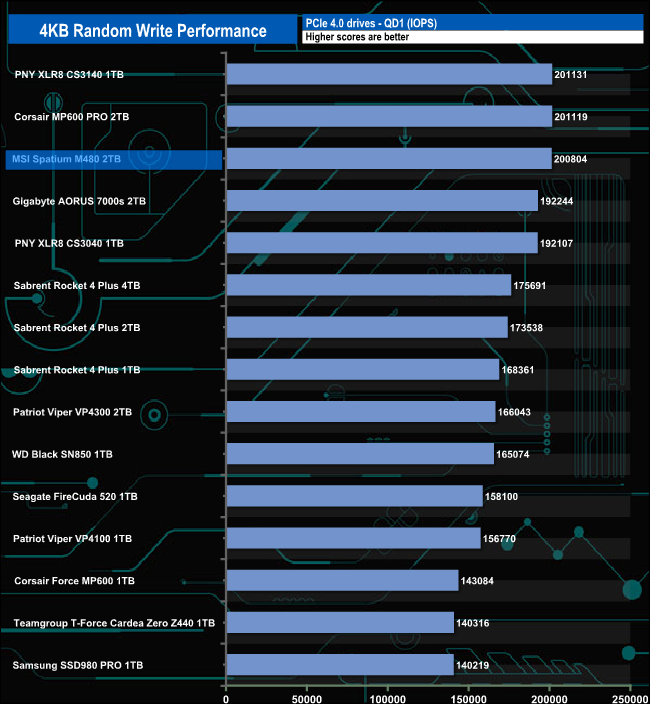
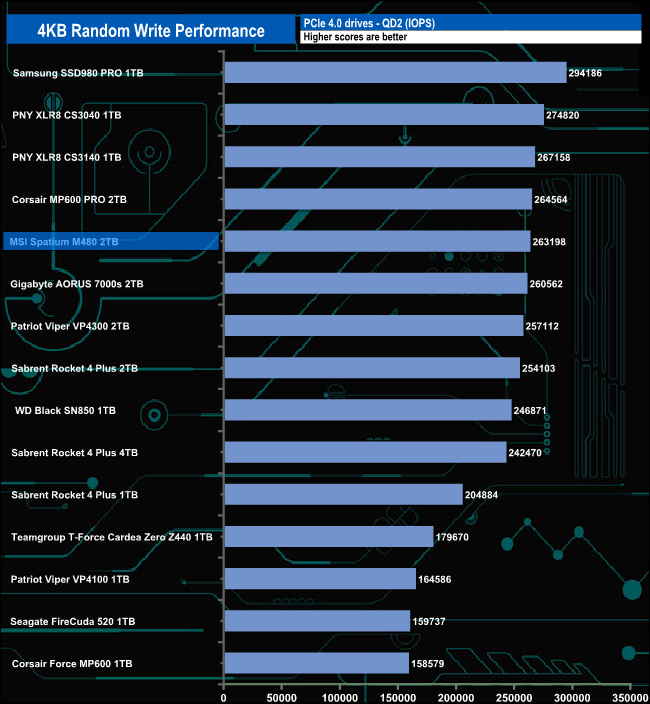
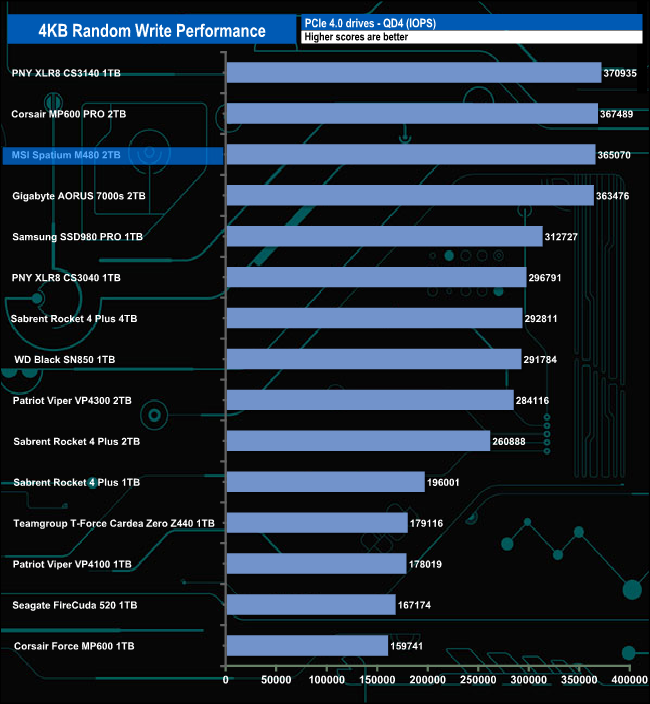
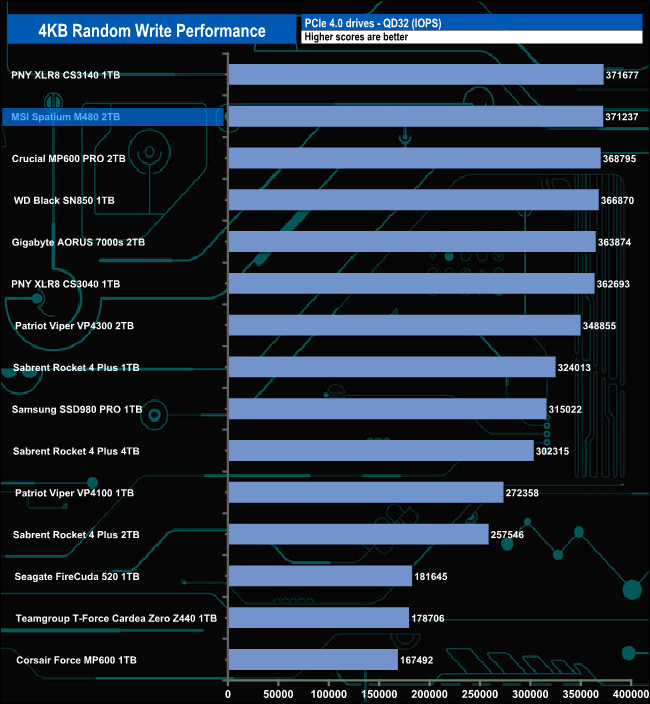
Although we couldn't match the official random write figure with our 4-threaded testing, the MSI Spatium M480 is still a fast drive when it comes to random writes. There is only one tested queue depth, QD2, where the drive doesn't sit in the top three in the results charts.
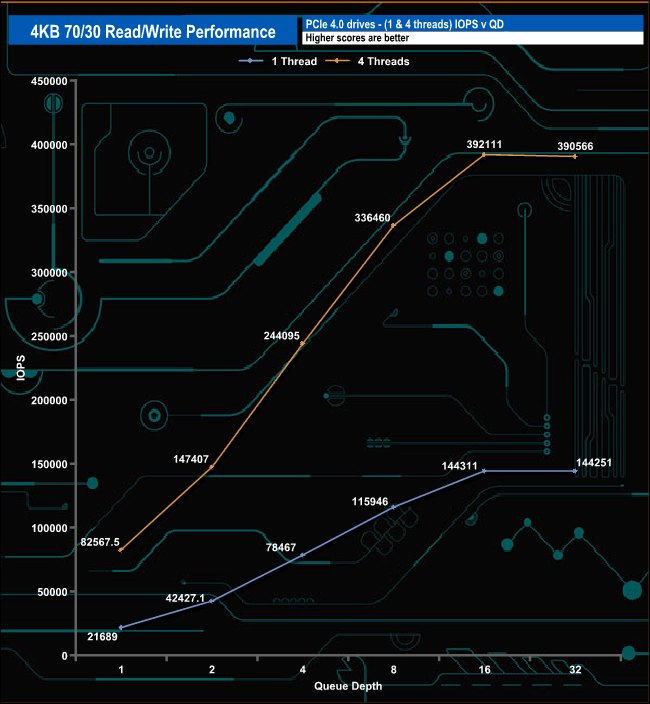
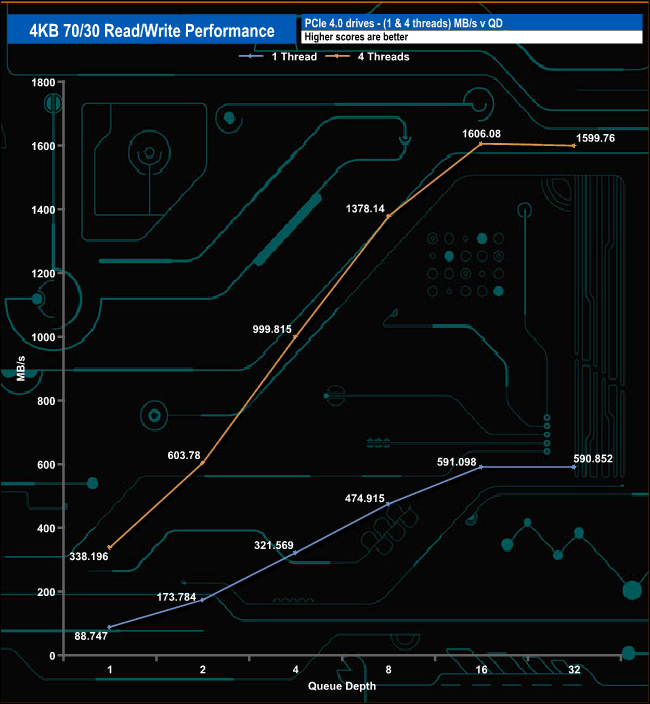
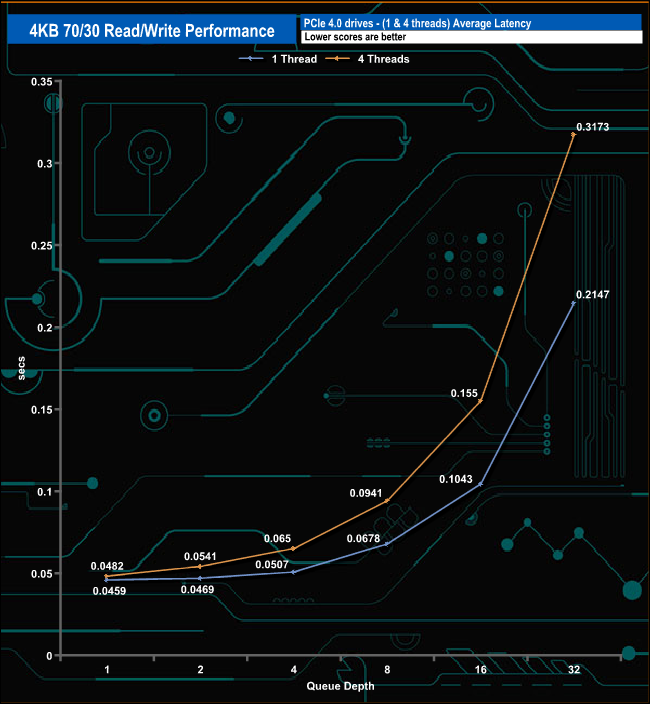
In the 4K 70/30 read/write test the drive peaks at a QD of 16 using both one thread (144,311 IOPS) and 4 threads (392,111 IOPS) before dropping back slightly finishing the test run (QD32) at 144,251 IOPS with a single thread and 390,566 using four threads.
4K Random Read Performance QD1-QD8
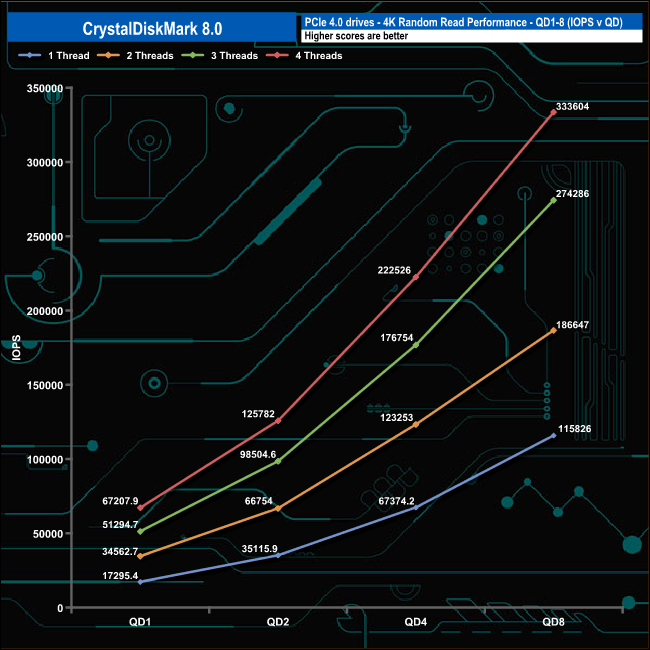
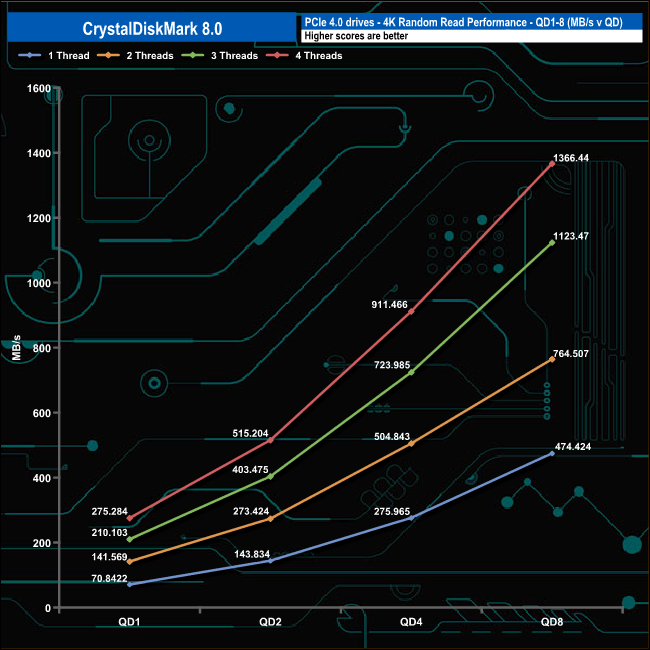
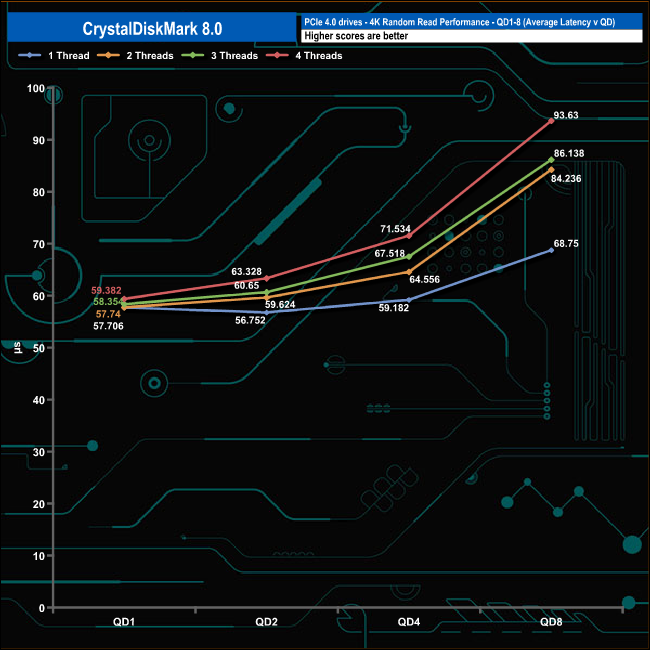
The 2TB MSI Spatium M480's 4K read performance climbs smoothly throughout the tested queue depths and threads. At QD1 the performance of the drive ranges from 17,295 IOPS (70.84MBs) using a single thread up to 67,207 IOPS (275.28MB/s) using four threads.
4K Random Write Performance QD1-QD8
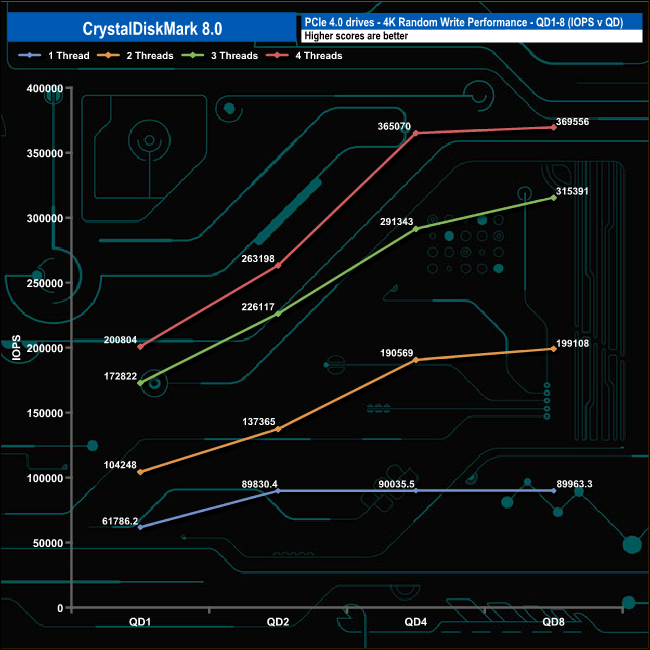
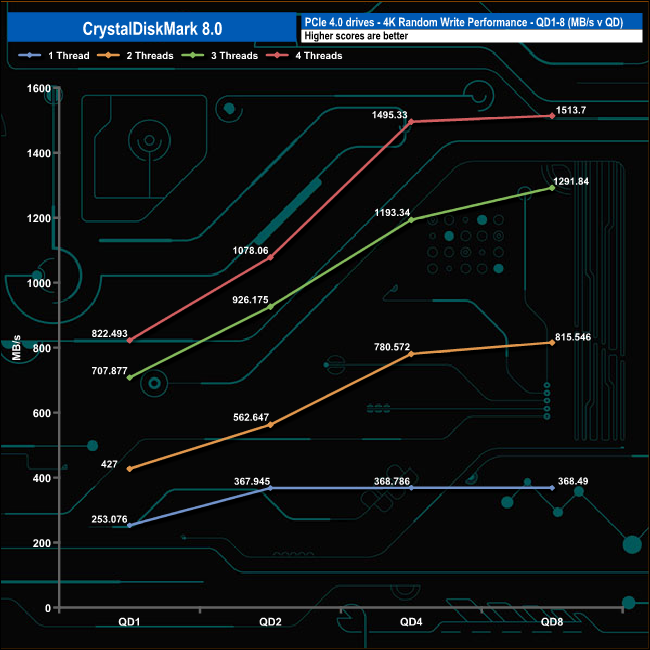
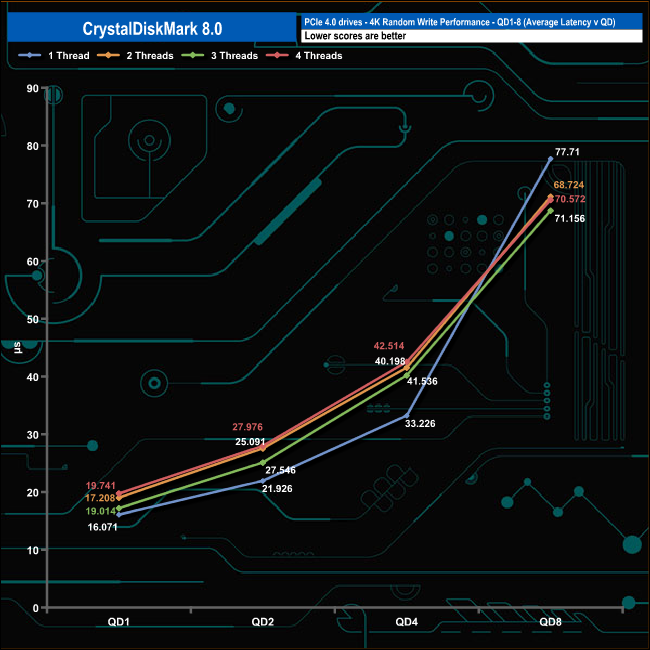
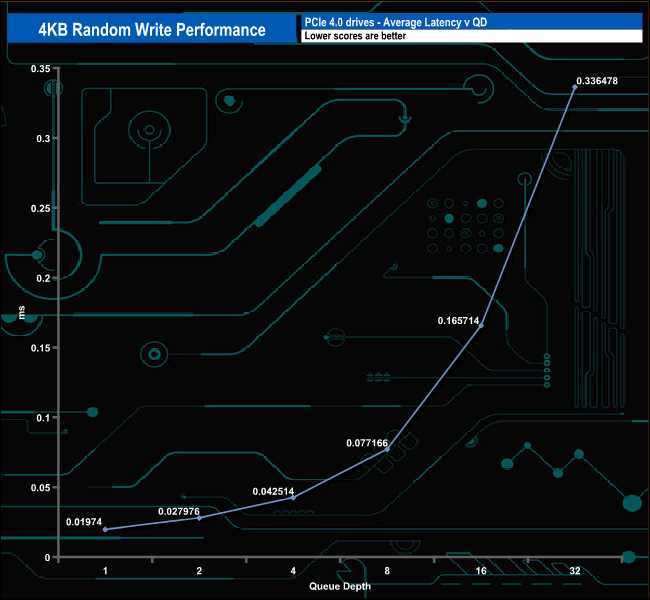
When it comes to 4K random writes, the performance using a single thread ranges from 61,786.2 IOPS (253.076MB/s) up to a peak of 90,035.5 IOPS (368.78MB/s) at QD4. The performance drops off a little between QD's 4 and 8 with a very noticeable rise in the average latency between these two queue depths.
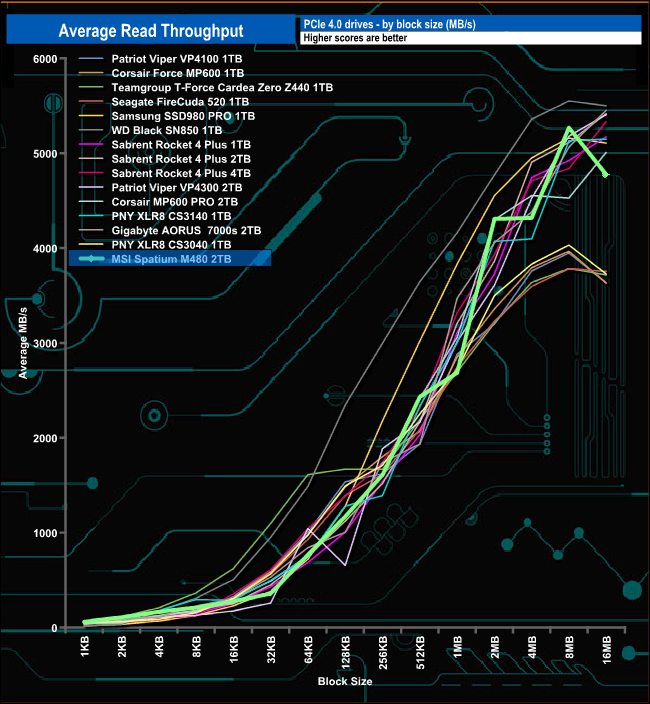
In our read throughput test the MSI Spatium M480 peaks at 5,269.25MB/s before dropping back to finish the test run at 4,774.16MB/s.
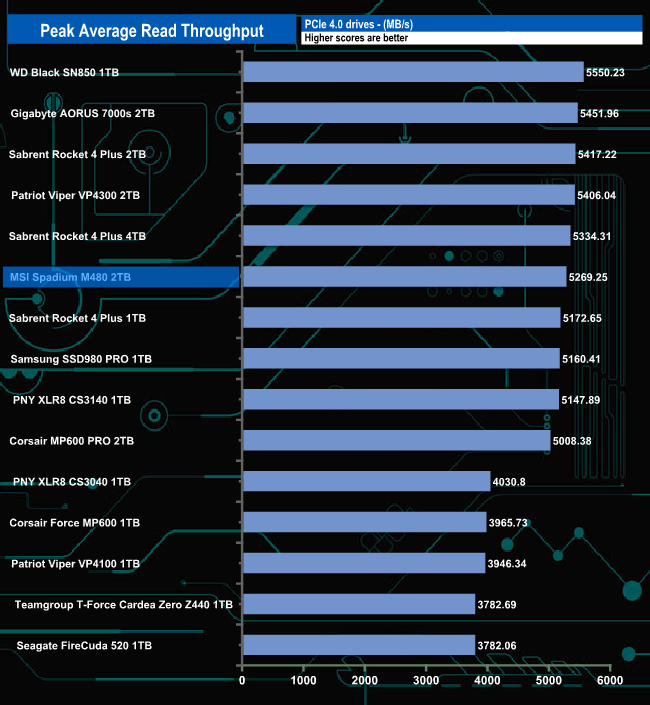
The read throughput score of 5,269.25MB/s places the drive just outside the top 5 drives we have tested.
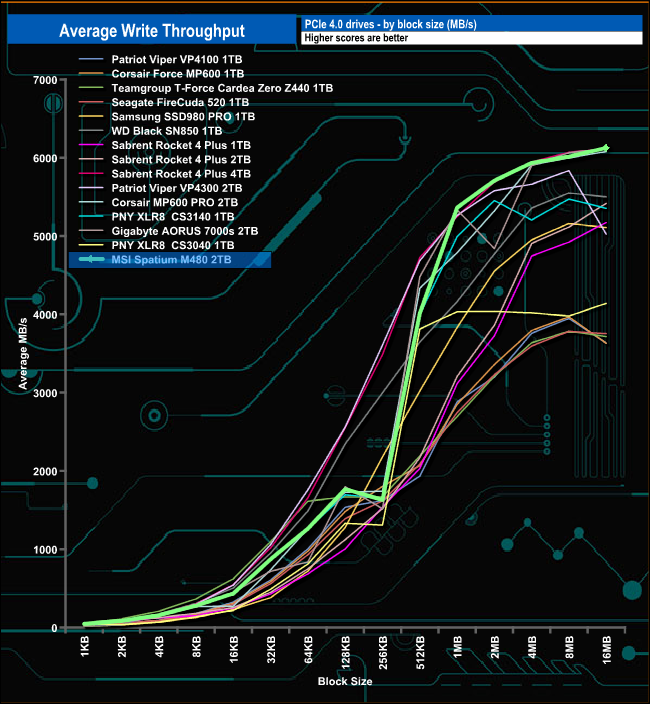
In the write throughput test, the drive peaks at the end of the test run (16MB block size) at 6,124.98MB/s.
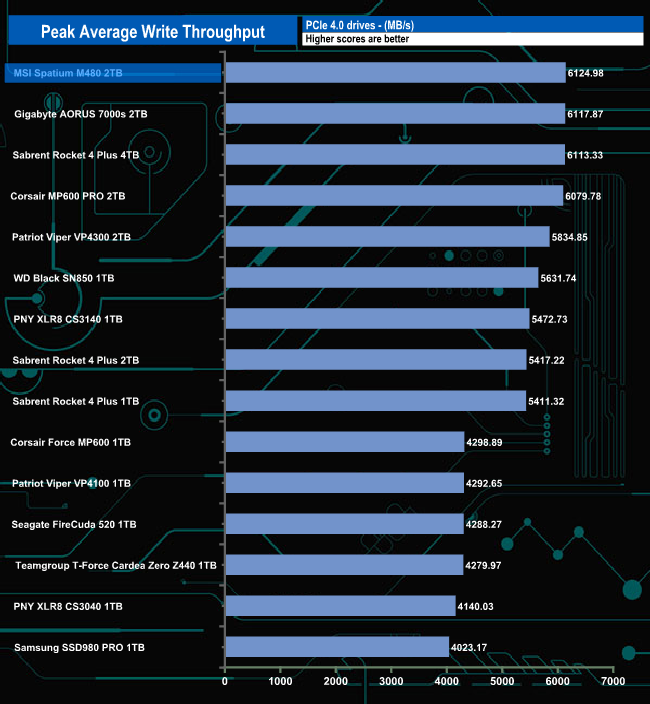
MSI's 2TB Spatium M480 sits on top of the write throughput result chart, its 6,124.98MB/s is the fastest we've seen for a consumer Gen 4 drive.
The PCMark 10 Full System Drive Benchmark uses a wide-ranging set of real-world traces from popular applications and common tasks to fully test the performance of the fastest modern drives. The benchmark is designed to measure the performance of fast system drives using the SATA bus at the low end and devices connected via PCI Express at the high end.
The goal of the benchmark is to show meaningful real-world performance differences between fast storage technologies such as SATA, NVMe, and Intel’s Optane. The Full System Drive Benchmark uses 23 traces, running 3 passes with each trace. It typically takes an hour to run.
Traces used:
Booting Windows 10.
Adobe Acrobat – starting the application until usable.
Adobe Illustrator – starting the application until usable Adobe Premiere Pro – starting the application until usable.
Adobe Photoshop – starting the application until usable.
Battlefield V – starting the game until the main menu.
Call of Duty Black Ops 4 – starting the game until the main menu.
Overwatch – starting the game until main menu.
Using Adobe After Effects.
Using Microsoft Excel.
Using Adobe Illustrator.
Using Adobe InDesign.
Using Microsoft PowerPoint.
Using Adobe Photoshop (heavy use).
Using Adobe Photoshop (light use).
cp1 Copying 4 ISO image files, 20 GB in total, from a secondary drive to the target drive (write test).
cp2 Making a copy of the ISO files (read-write test).
cp3 Copying the ISO to a secondary drive (read test).
cps1Copying 339 JPEG files, 2.37 GB in total, to the target drive (write test).
cps2 Making a copy of the JPEG files (read-write test).
cps3 Copying the JPEG files to another drive (read test).
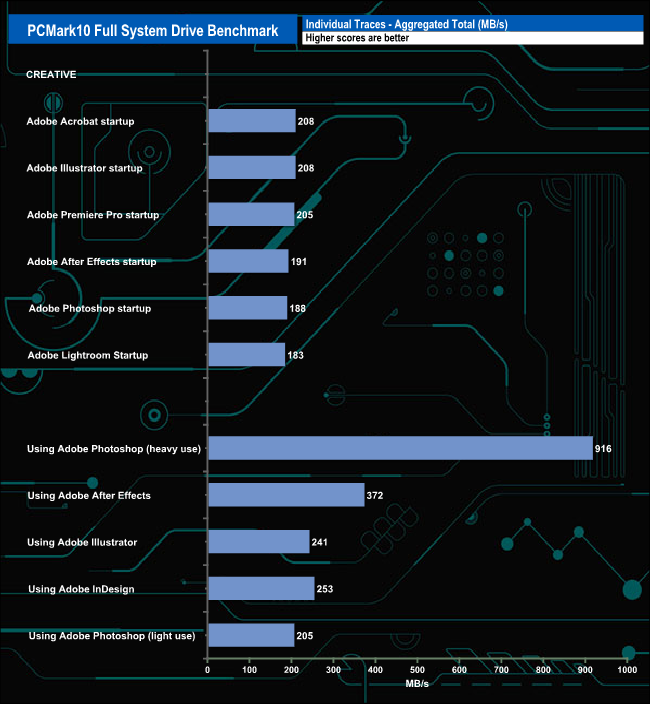
PCMark10’s Full System Drive benchmark didn't cause the Spatium M480 any real problems. It averaged 197.16MB/s for the six Adobe startup tests and 397.40MB/s for the five Adobe usage test traces. The best individual score was the 916MB/s for the heavy use Adobe Photoshop trace.
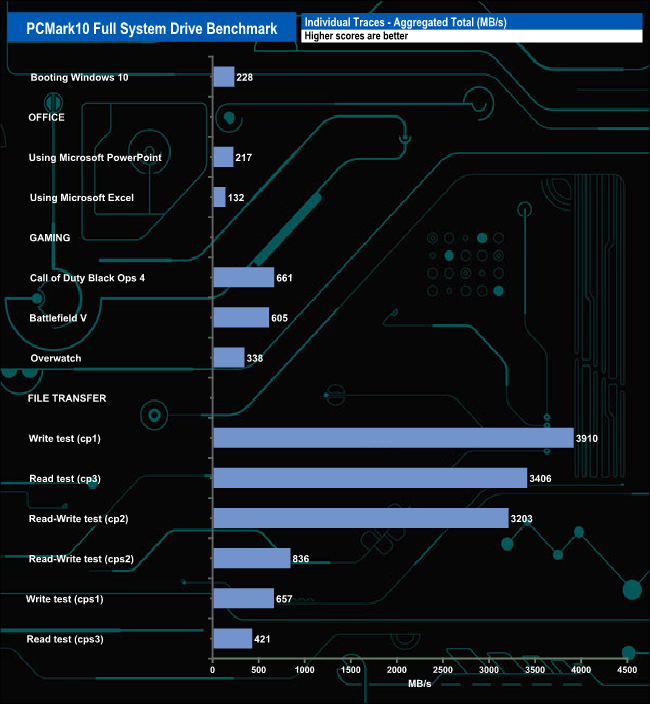
In the file transfer set of tests, the best performance from the drive came in the cp1 Write test at 3,910MB/s.
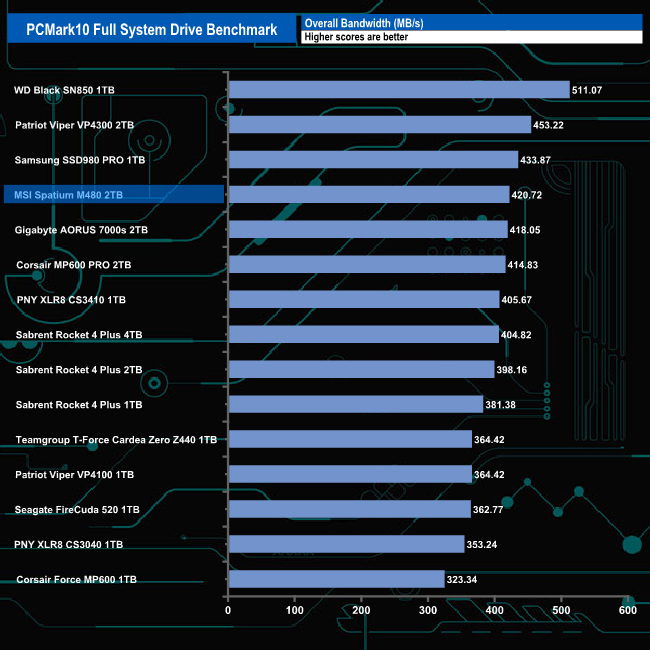
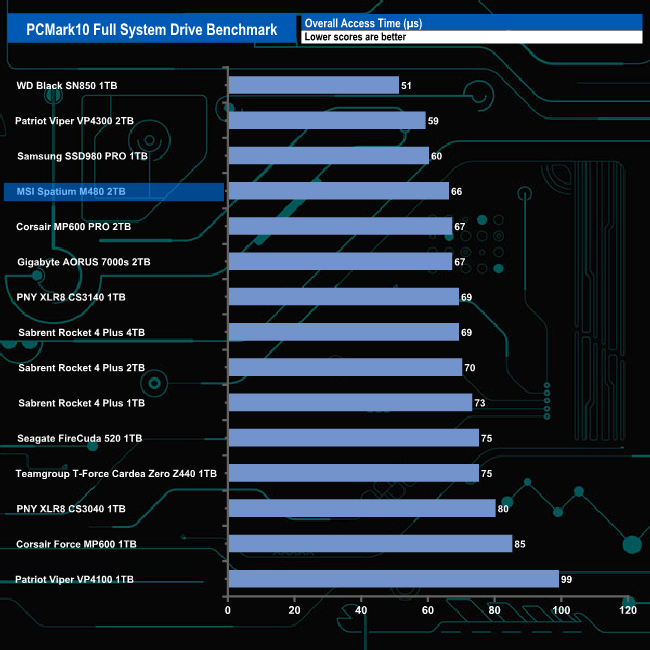
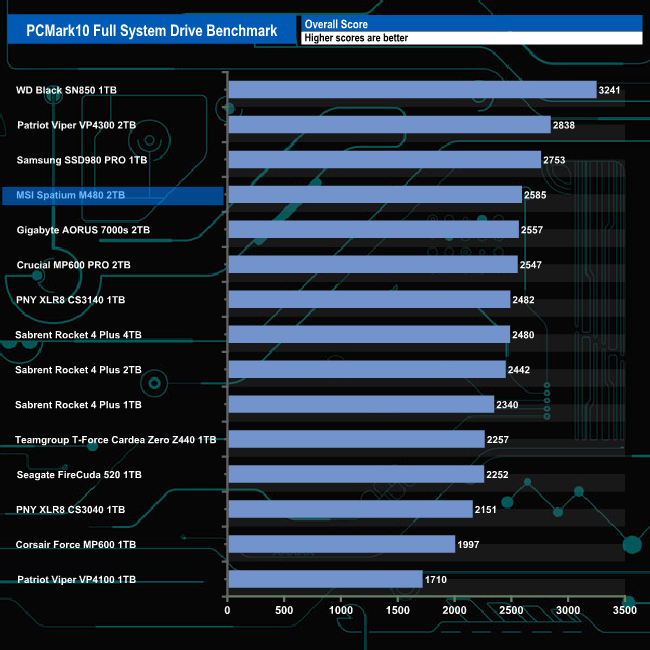
Overall MSI's Spatium M480 performs well in PCMark10’s Full System Drive benchmark with an overall bandwidth score of 420.72MB/s, the fastest we’ve seen to date for a drive using Phison’s E18 second-generation controller.
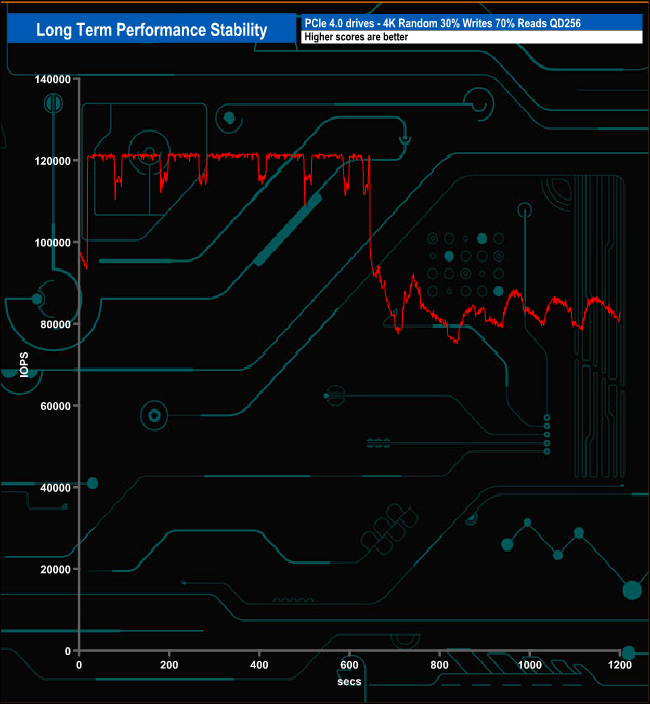
For the long term performance stability test, we set the drive up to run a 20-minute 4K random test with a 30% write, 70% read split, at a Queue Depth of 256 over the entire disk. The 2TB MSI Spatium M480 averaged 102,828 IOPS for the test with a very good performance stability of 84%.
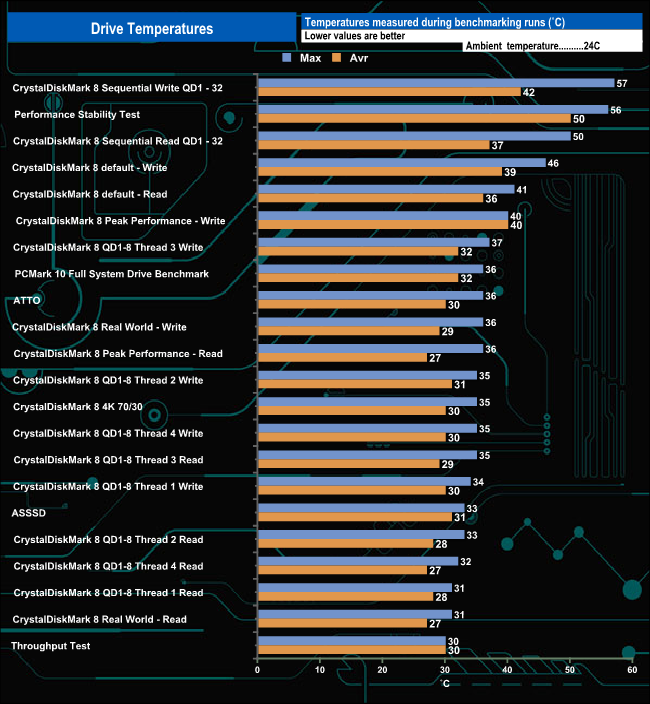
The MSI Spatium M480 comes with the option to use the drive without a heat sink to use with any motherboard cooling system or using the chunky heatsink MSI bundled with the drive. We ran a couple of tests with the plain drive (no heatsink) and it got hot very quickly when being pushed:
- ATTO 56° C
- CrystalDiskMark 8 default Read 63° C
- CrystalDiskMark 8 default Write 67° C
As you can see from the test results using the drive with the heatsink installed, it makes quite some difference:
- ATTO 36° C
- CrystalDiskMark 8 default Read 41° C
- CrystalDiskMark 8 default Write 46° C
To test the real-life performance of a drive we use a mix of folder/file types and by using the FastCopy utility (which gives a time as well as MB/s result) we record the performance of drive reading from & writing to a 256GB Samsung SSD850 PRO.
We use the following file/folder types:
- 100GB data file.
- 60GB iso image.
- 60GB Steam folder – 29,521 files.
- 50GB File folder – 28,523 files.
- 12GB Movie folder – (15 files – 8 @ .MKV, 4 @ .MOV, 3 @ MP4).
- 10GB Photo folder – (304 files – 171 @ .RAW, 105 @ JPG, 21 @ .CR2, 5 @ .DNG).
- 10GB Audio folder – (1,483 files – 1479 @ MP3, 4 @ .FLAC files).
- 5GB (1.5bn pixel) photo.
- BluRay Movie – 42GB.
- 21GB 8K Movie demos – (11 demos)
- 16GB 4K Raw Movie Clips – (9 MP4V files)
- 4.25GB 3D Printer File Folder – (166 files – 105 @ .STL, 38 @ .FBX, 11 @ .blend, 5 @ .lwo, 4 @ .OBJ, 3@ .3ds).
- 1.5GB AutoCAD File Folder (80 files – 60 @ .DWG and 20 @.DXF).
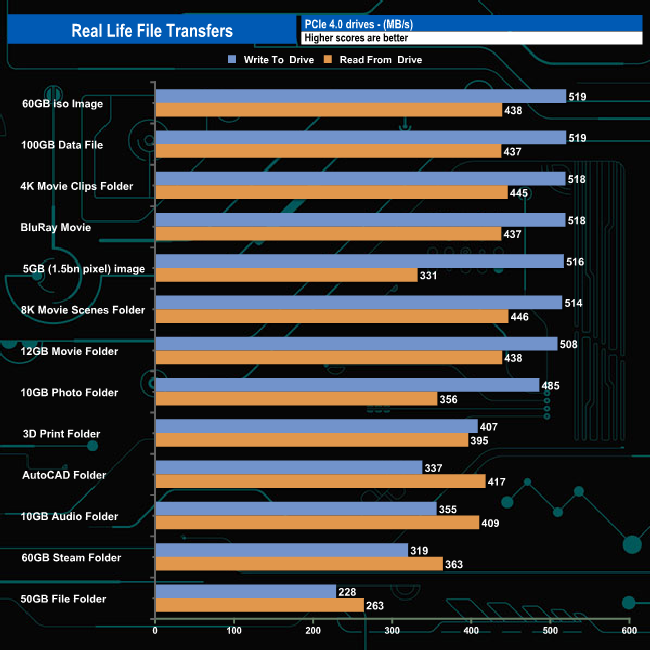
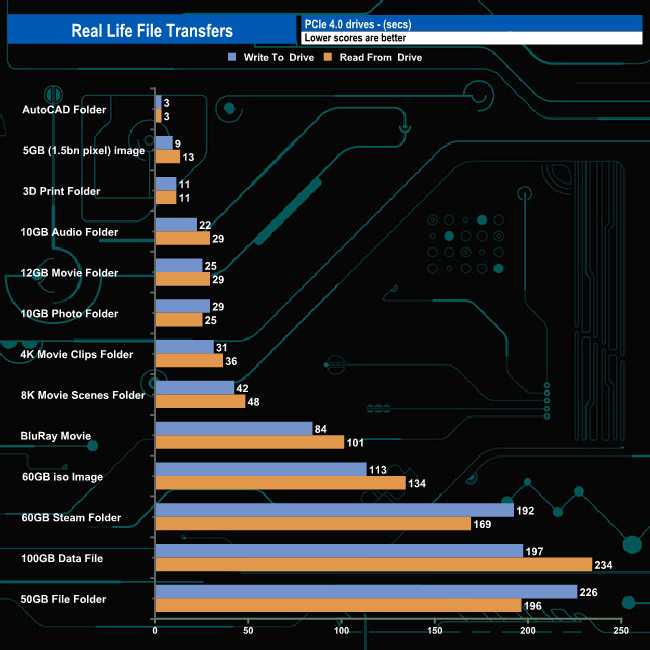
The MSI Spatium M480 handled our real-life file testing without displaying any problems. It averaged 516MB/s when writing the larger test files to the drive and 424MB/s when reading the data back again. It was slower when dealing with small bity data such as the 60GB Steam folder (319MB/s write, 363MB/s read) and the 50GB file folder transfer (228MB/s write, 263MB/s read).
To get a measure of how much faster PCIe NVMe drives are than standard SATA SSD's we use the same files but transfer to and from a 2TB Kioxia Exceria Plus drive:
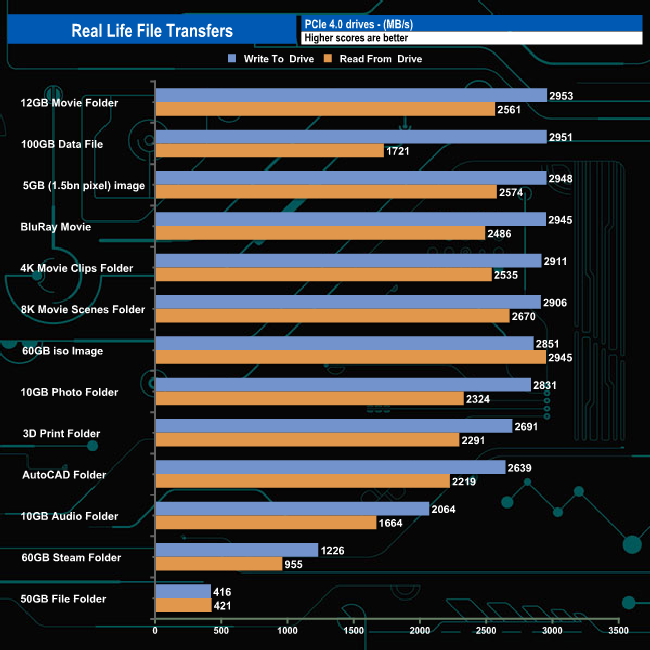
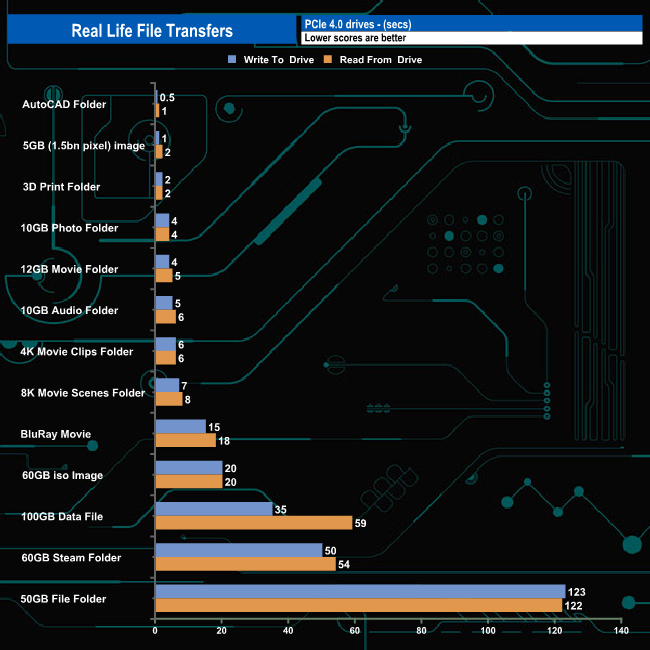
Switching over to an all NVMe storage environment we see write speeds approaching 3GB/s, the fastest being the 2,953MB/s when writing the contents of the 12GB Movie folder. Eleven of the thirteen transfers were over 2GB/s for writes with nine over 2GB/s reads. The performance when the drive was reading the 100GB Data file was very much slower than all the other large data reads.
Well known for their huge range of motherboards and graphics cards, MSI also have a wide range of other devices and peripherals in their portfolio, which has now been bolstered by a range of M.2 NVMe SSDs using both PCIe Gen 4 & Gen 3 interfaces. The current flagship drive series of this line-up of SSDs is the PCIe Gen 4 Spatium M480.
Coming in three capacities (at the time of writing), 500GB, 1TB and 2TB, the Spatium M480 uses a combination of a Phison PS5018-E18 controller and 96-layer 3D TLC NAND.
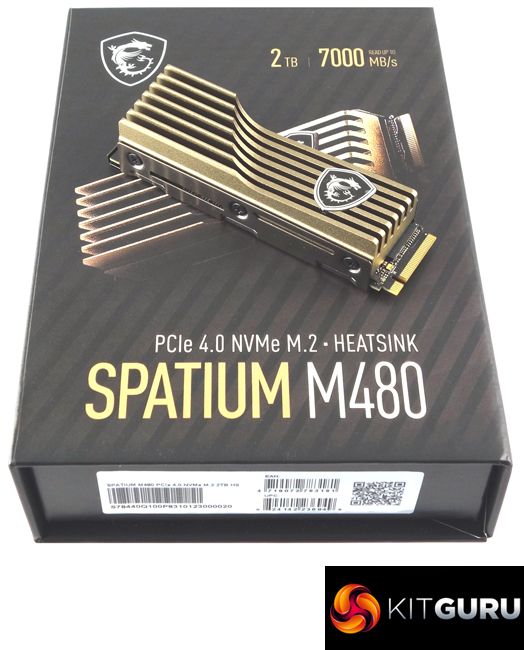
Officially the Sequential read speeds for the Spatium M480 series are up to 6,500MB/s for the 500GB drive and 7,000MB/s for both the 1TB and the 2TB flagship drive we are looking at here. Sequential write performance is quoted as up to 2,850MB/s (500GB), 5,500MB/s (1TB) and 6,800MB/s for the 2TB model.
Using the ATTO benchmark, we couldn't meet the official maximums for reads or writes, although a read test result of 6,820MB/s was closer to the official figure than the 6,270MB/s write result. However by using the CrystalDiskMark benchmark we could confirm and even better the read figure with a best test result of 7,457MB/s, but as with the ATTO benchmark, the best write result of 6,731MB/s was short of the official figure.
Random performance is quoted as up to 650,000 IOPS for reads and up to 700,000 IOPS for writes for the 2TB drive. The two other drives in the range are rated as up to 350,000 IOPS and 700,000 IOPS for reads and writes respectively for the 1TB model and up to 170,000 IOPS read and up to 600,000 IOPS writes for the 500GB model. The best 4K random read result we saw came from the CrystalDiskMark 8 Peak Performance test run at 661,885.50 IOPS, slightly faster than the official figure. The best write figure of 604,243.65 IOPs came in the same test but is somewhat short of the official figure.
The HS SKU of the drive offers two choices of how the drive can be used, either plain to be used with a motherboard integrated cooling system or by using the chunky heatsink provided for installing into other situations. To see what difference the heatsink makes we ran a couple of tests without and with the heatsink. Using the ATTO benchmark we saw temperatures rise sharply without the heatsink to peak at 56° C. Running the benchmark again with the heatsink installed saw the temperature peak some twenty degrees lower at 36° C. It was a similar story using the CrystalDiskMark 8 benchmark at default settings: 41° C and 46° C for reads and writes respectively with the heatsink, against 63° C for reads and 67° C for writes without it.
The standard version of the 2TB Spatium M480 is priced at £329 so expect to pay an extra £10-30 for the heatsink version. We are waiting on MSI to confirm this.
Discuss on our Facebook page HERE.
Pros
- Overall performance.
- Endurance.
- Well designed and effective heatsink.
Cons
- Couldn’t match the maximum official random write 4K figures.
- Runs hot without the heatsink.
KitGuru says: With the flagship Spatium M480, MSI has entered the already competitive Gen 4 NVMe SSD market with serious intent. A very fast performing drive, using Phison's 2nd generation E18 controller, it also offers a very good endurance rating. But it does need either installing under a motherboard cooling system or using the bundled heatsink to prevent any thermal throttling as it does run hot without any cooling.