KitGuru KitGuru.net – Tech News | Hardware News | Hardware Reviews | IOS | Mobile | Gaming | Graphics Cards


The latest PCIe Gen 5 SSD to hit the market is the FireCuda 540 from storage giants Seagate. Powered by the current standard combination for a Gen 5 SSD of a Phison controller and 232-layer NAND, needless to say, it is the fastest consumer Seagate drive to date. We check out the 2TB model, landing at £300 here in the UK.
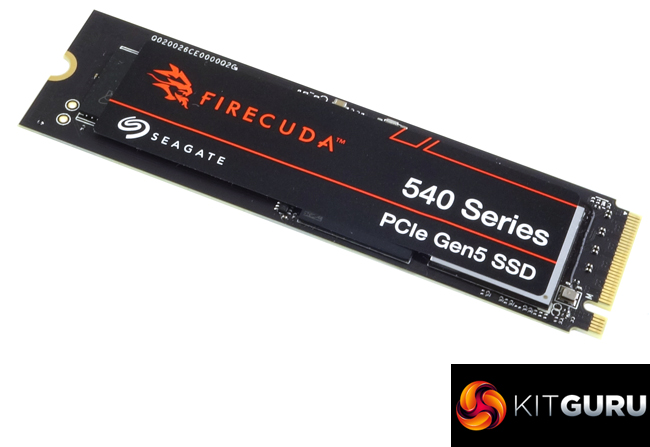
At launch, the FireCuda 540 family is made up of just two drives with capacities of 1TB and 2TB (the drive we are reviewing). A future option in the pipeline is a 4TB flagship drive. At the heart of the FireCuda 540 is Phison's PS5026-E26 8-channel controller which is looking after Micron 232-Layer TLC NAND.
Sequential performance for the 2TB drive is quoted as up to 10,000MB/s for both reads and writes while the official random read/write performance is quoted as up to 1,490,000 IOPS and up to 1,500,000 IOPS respectively. The 1TB drive has Sequential ratings of up to 9,500MB/s and up to 8,500MB/s for reads and writes respectively. It has the same up to 1,500.000 IOPS write rating as the 2TB drive with reads at up to 1,300,000 IOPS.
One thing that you must use with the FireCuda 540 is some form of motherboard cooling as it is a bare drive devoid of any form of heatsink.
Stated TBW endurance for the range is very impressive; 1,000TB for the 1TB drive and 2,000TB for the 2TB drive. Seagate back the drive with a 5-year warranty and a very useful bonus is the addition of 3 years of Seagate's Data Recovery Services.
Physical Specifications:
- Usable Capacities: 2TB.
- NAND Components: 232-Layer Micron B58R TLC NAND.
- NAND Controller: Phison PS5026-E26.
- Cache: LDDR4.
- Interface: PCIe Gen5 x4, NVMe 2.0.
- Form Factor: M.2, 2280.
- Dimensions: 80.15 x 22.15 x 3.58mm.
- Drive Weight: 7.4g.
Firmware Version: SUESR010.
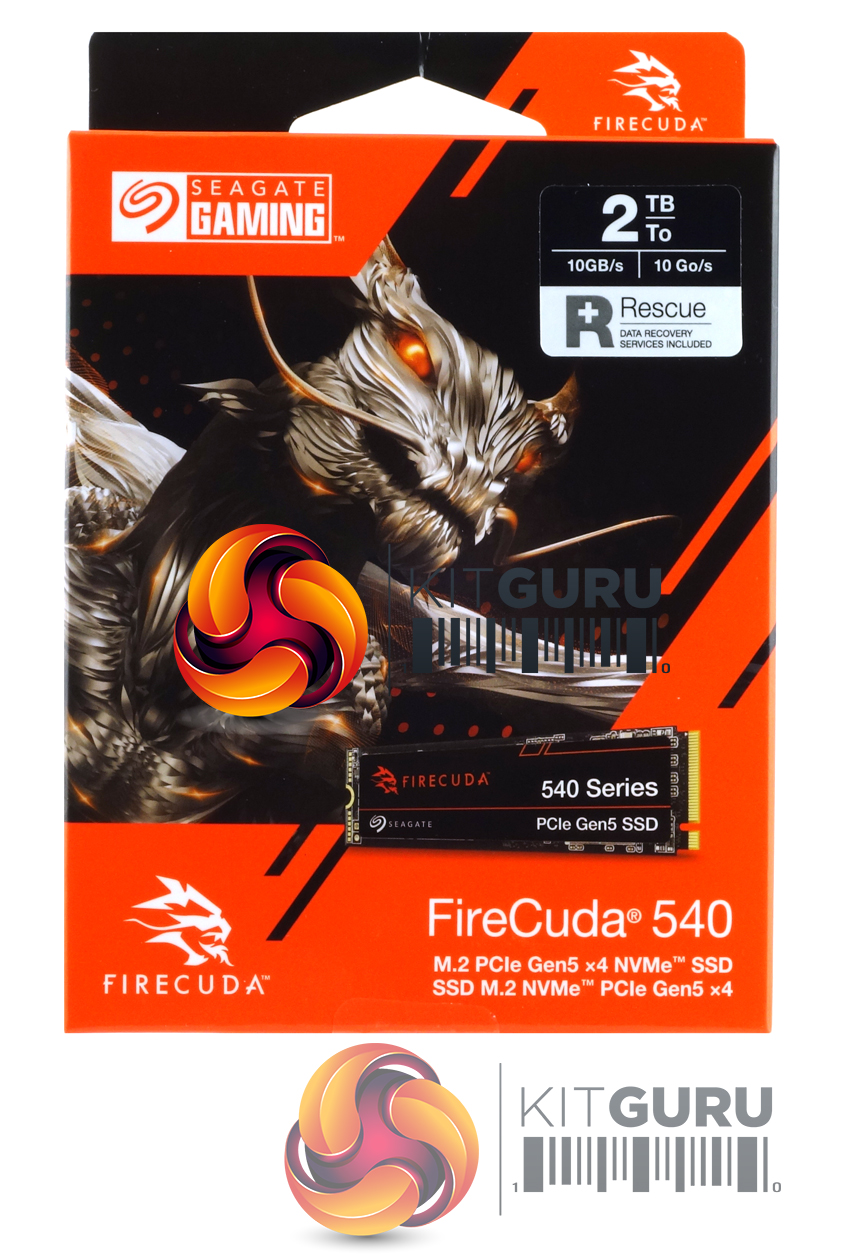
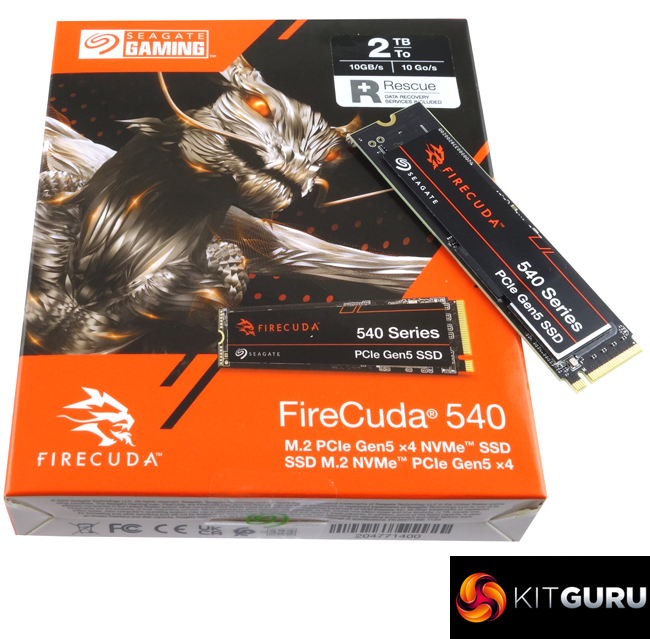
Seagate’s FireCuda 540 comes in a striking orange and white box with Seagate’s FireCuda dragon mascot prominently displayed along with a small image of the drive on the front. At the top of the box is a sticker that displays the drive’s capacity and the Sequential read speed of the drive along with the fact that the drive is supported by Seagate's Data Recovery Service. Towards the bottom of the box is some text displaying the interface of the drive.
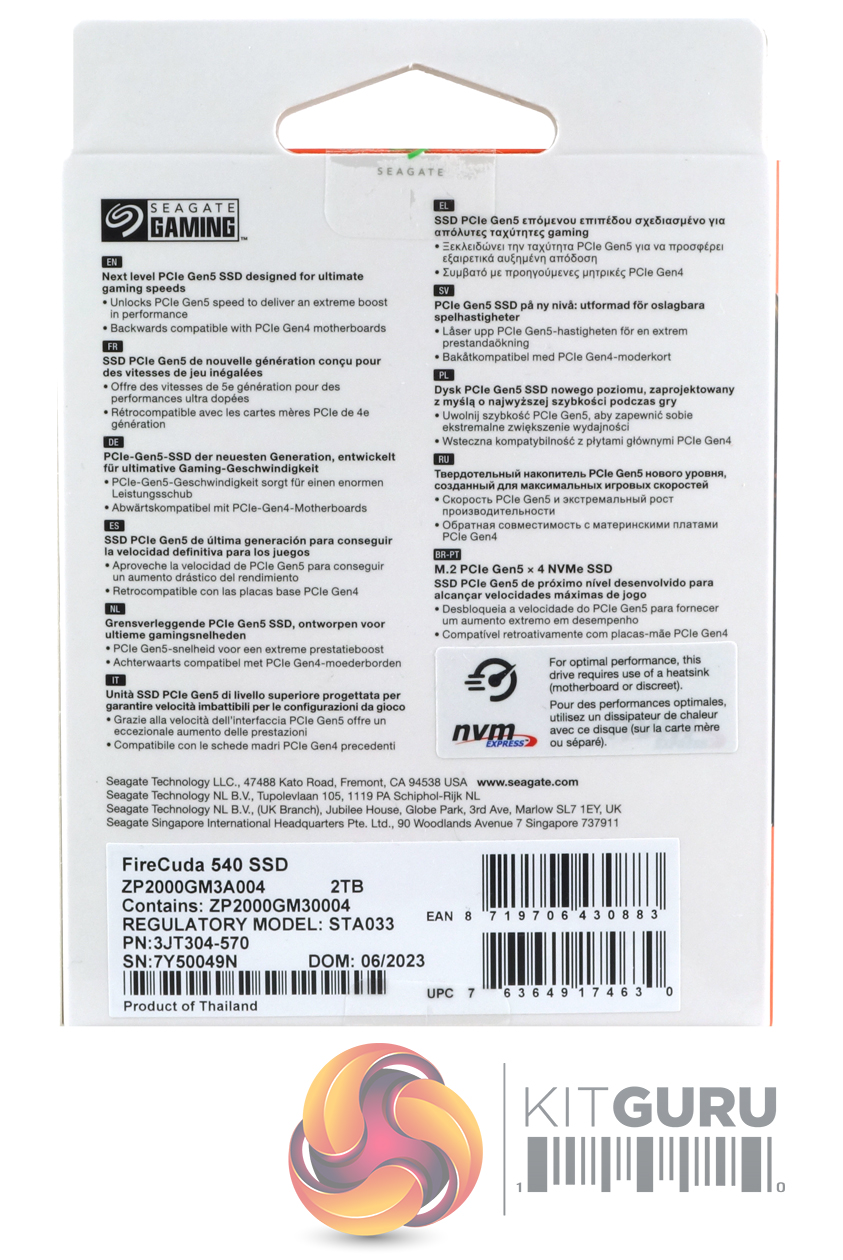
The rear of the box is covered by multilingual bullet points about the interface speed and the cache. There is also a prominent sticker displaying the fact that the drive needs some form of cooling, motherboard or otherwise, for optimal performance.
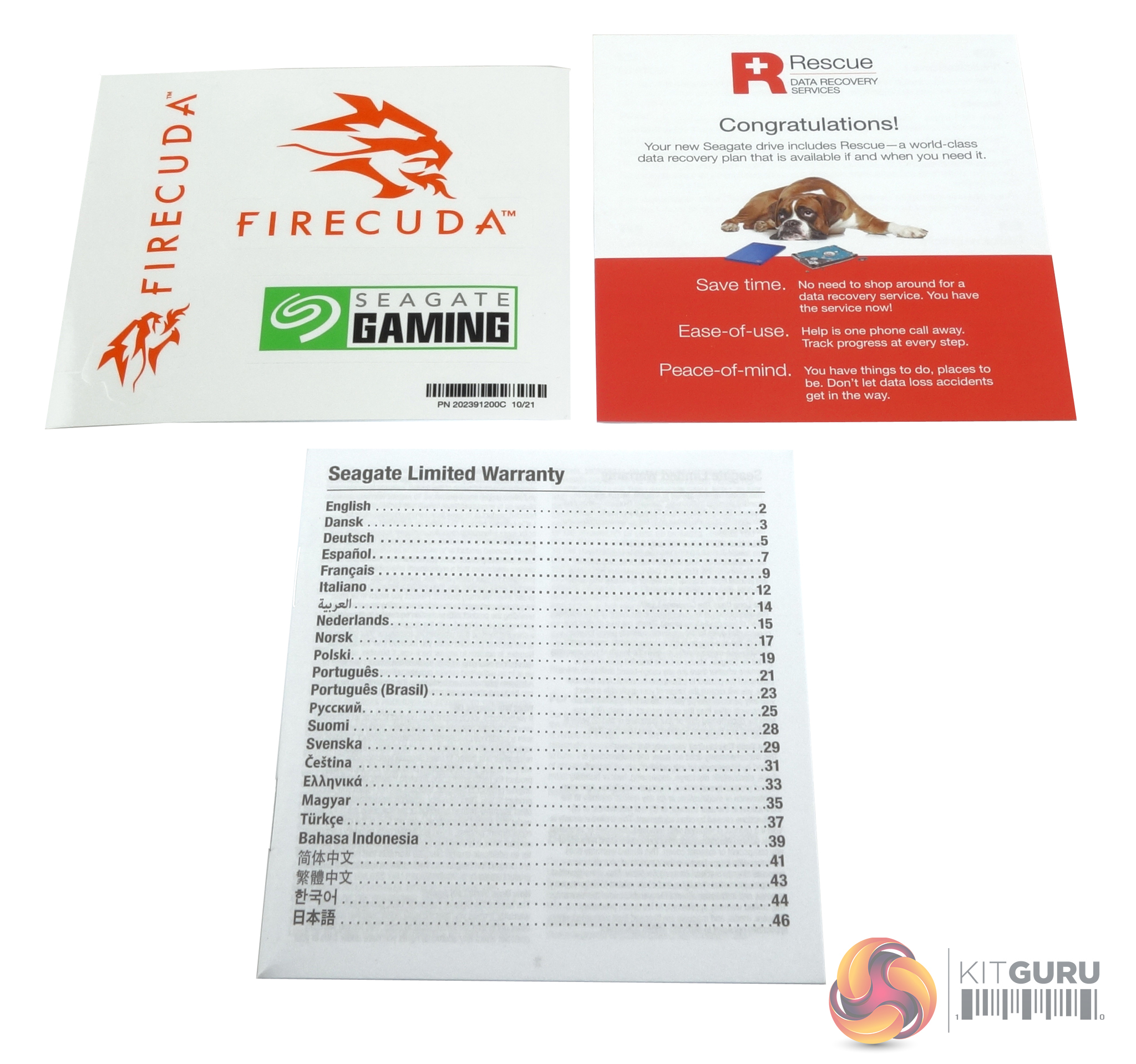
Bundled with the drive are a set of FireCuda branded stickers, data recovery service information and warranty info booklets.
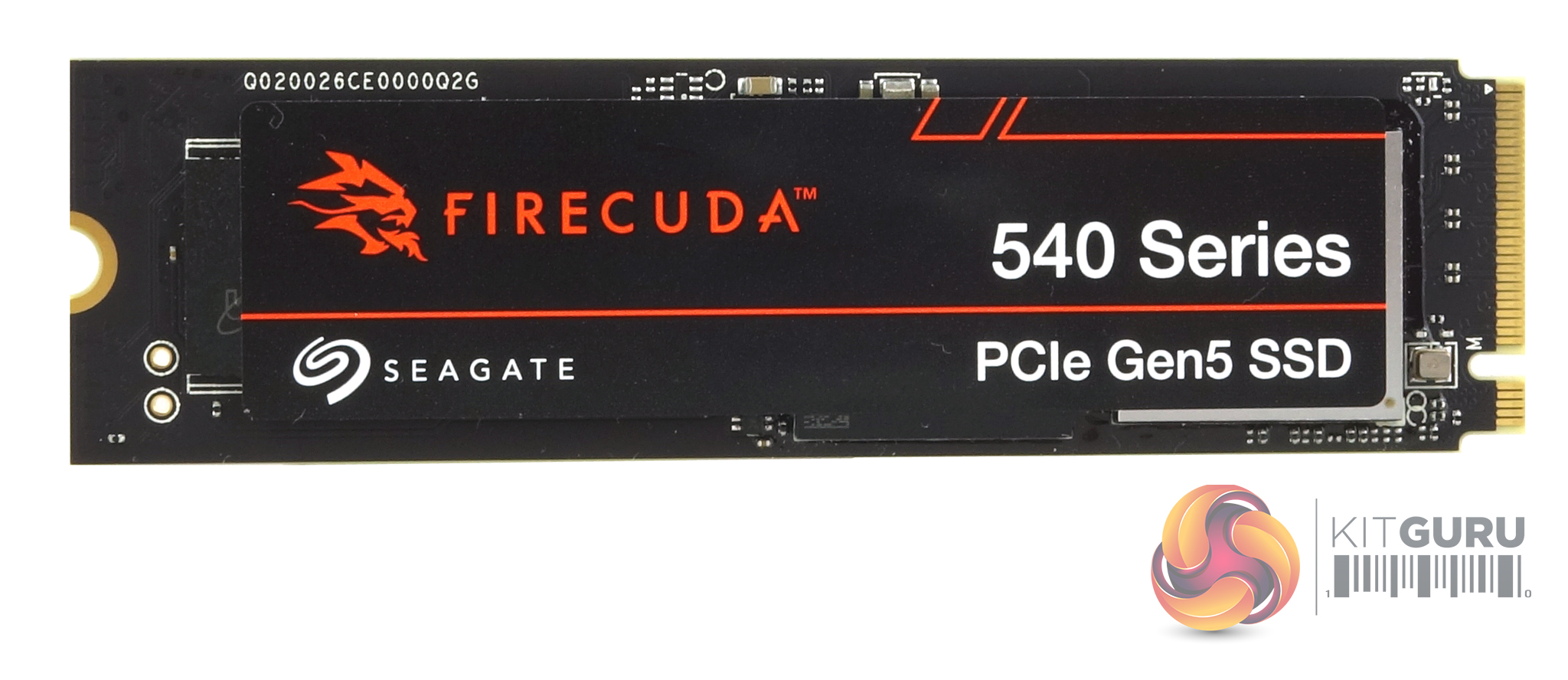
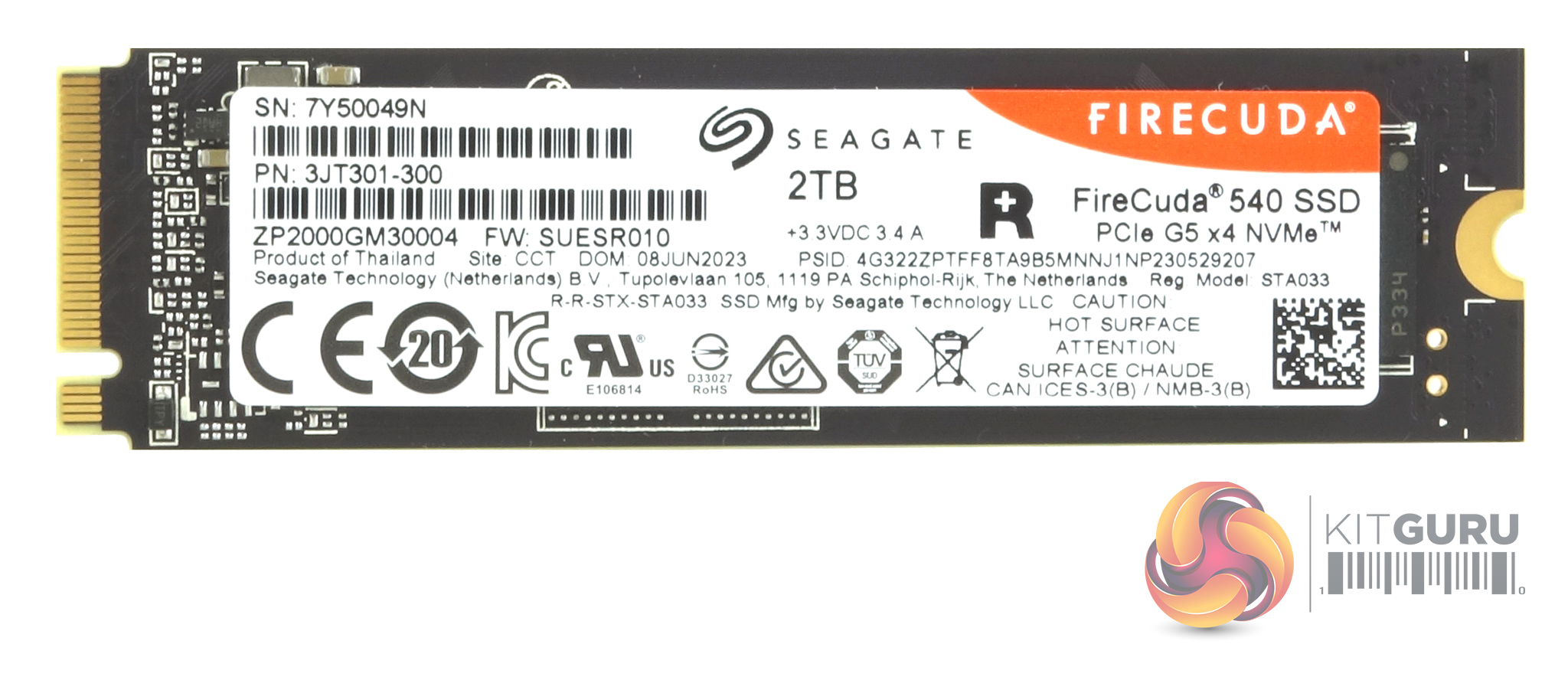
Seagate's 2TB FireCuda 540 is built on a double-sided M.2 2280 format and has no heatsink fitted so some form of motherboard cooling is a must.
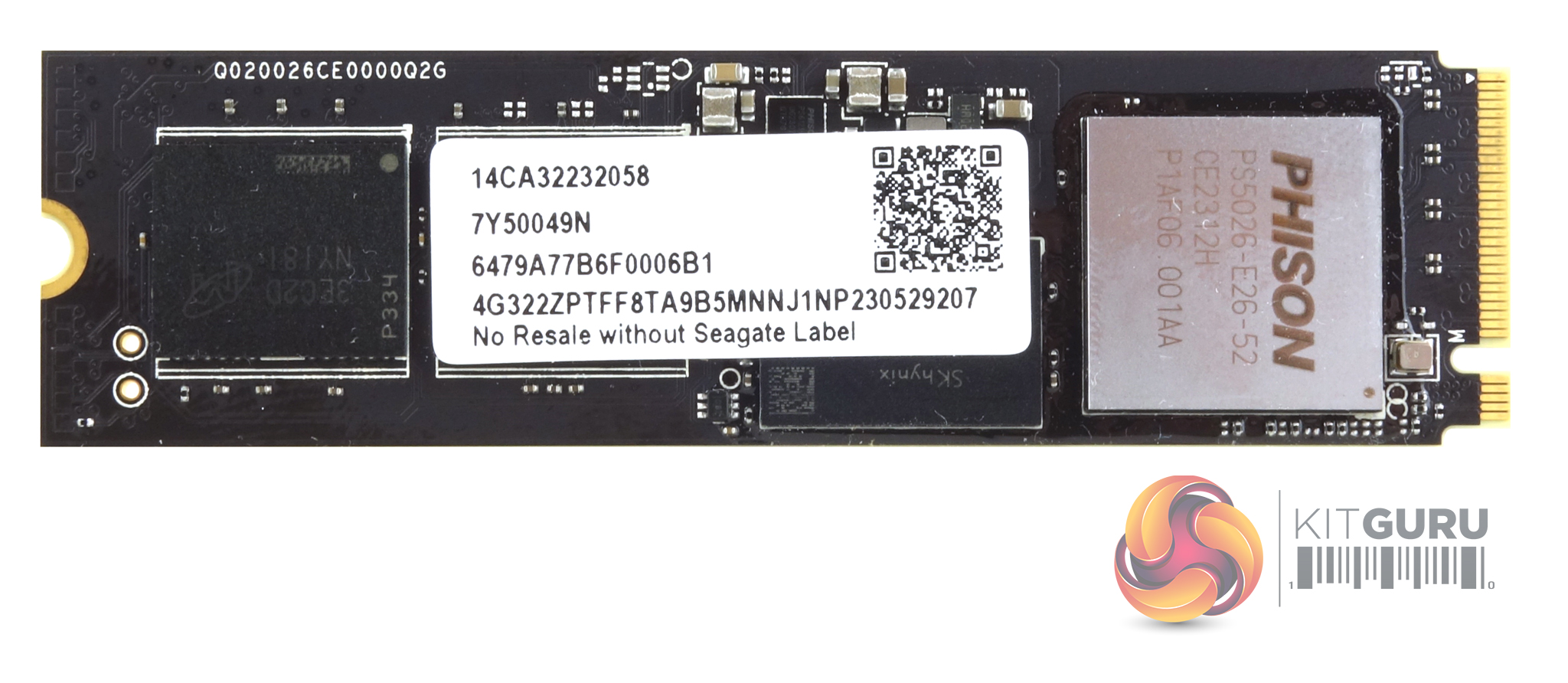
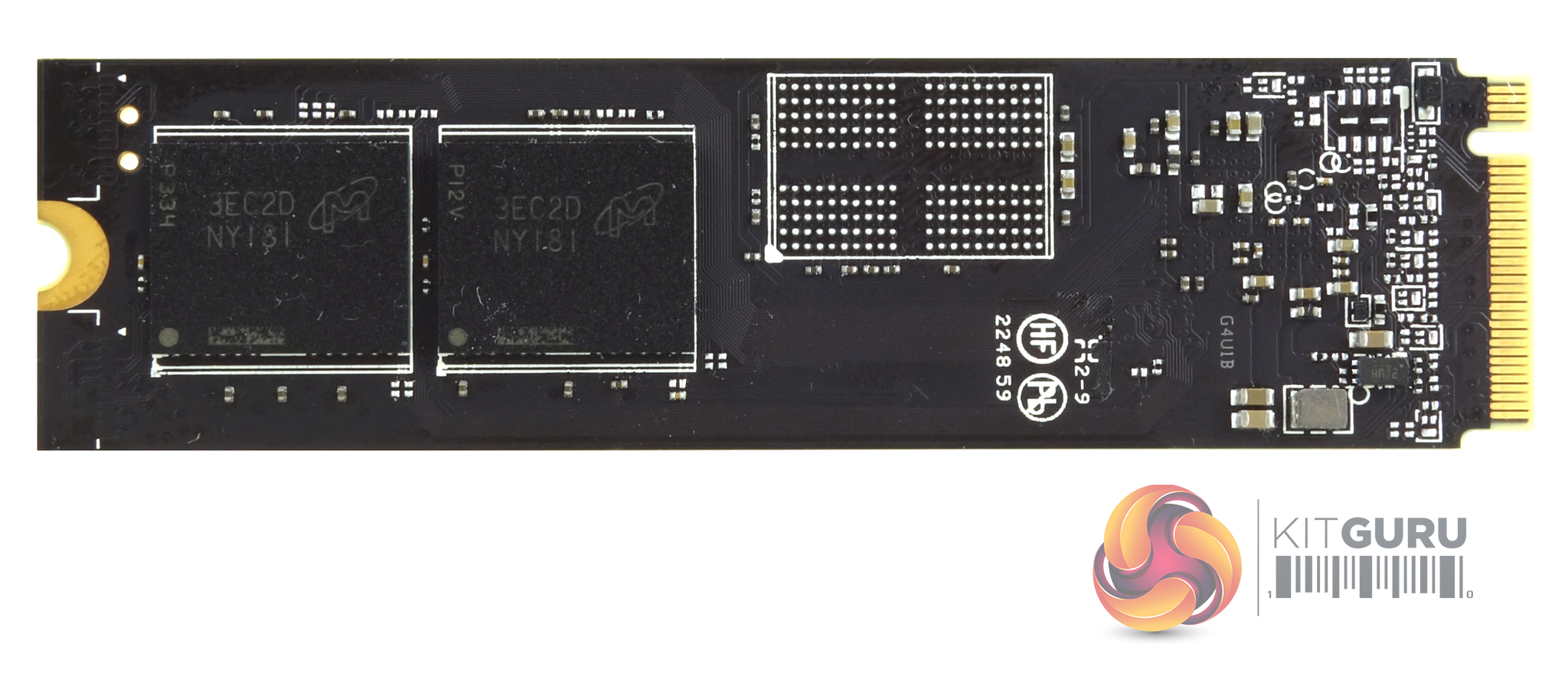
One side of the PCB holds the Phison PS5026-E26 controller and two packages of 232-Layer Micron B58R TLC NAND (each package uses four 1Tbit dies), along with a 2GB LDDR4 DRAM chip. The other side of the PCB is home to another two NAND packages.
The World's first consumer Gen5 controller, Phison's PS5026-E26 is an eight-channel controller built on a 12nm process. It uses dual Arm Cortex-R5 cores working together with Phison’s own CoXProcessor 2.0 specialized accelerators. The controller supports the company's 5th Generation LDPC ECC engine.
The E26 supports up to 32TB of TLC or QLC NAND flash memory with data transfer speeds of up to 2,400 MT/s, although in the case of the FireCuda 540, this has been dialled back to 1,600MT/s.
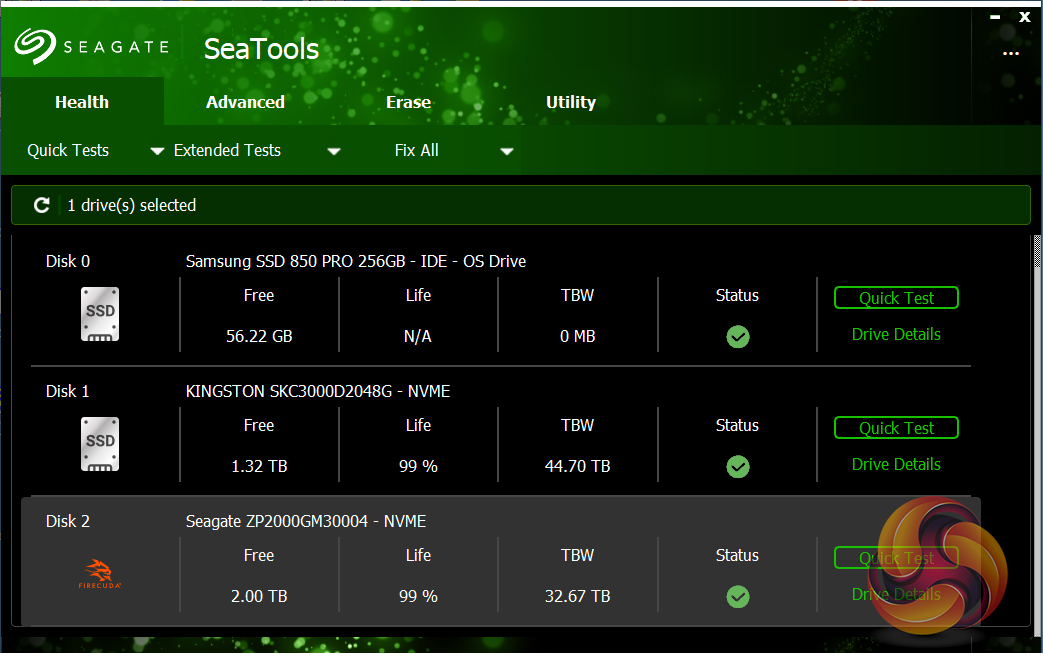
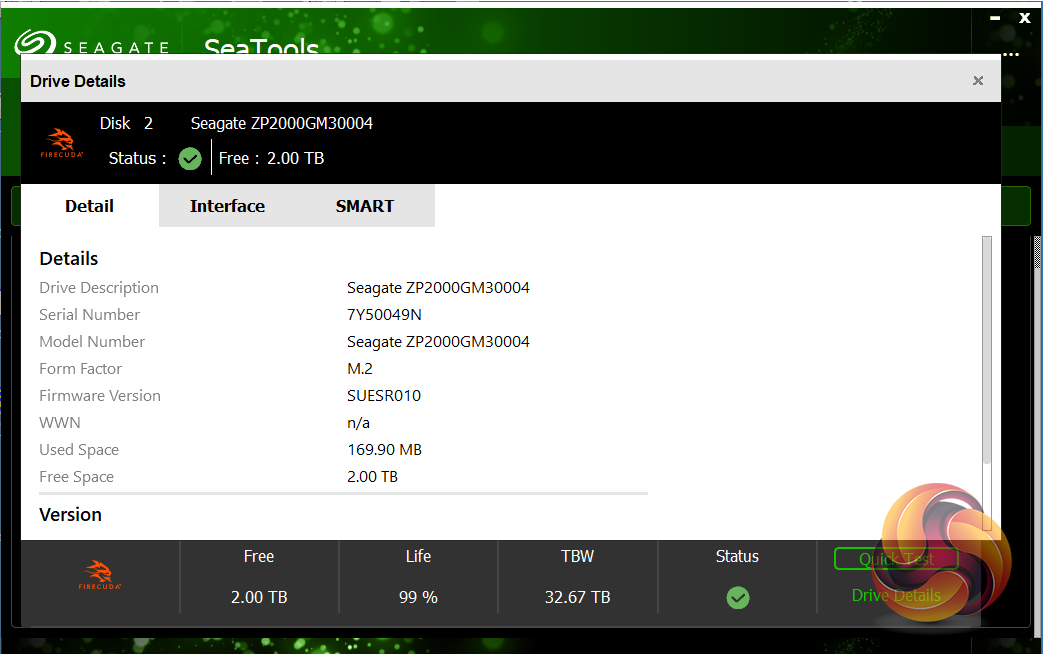
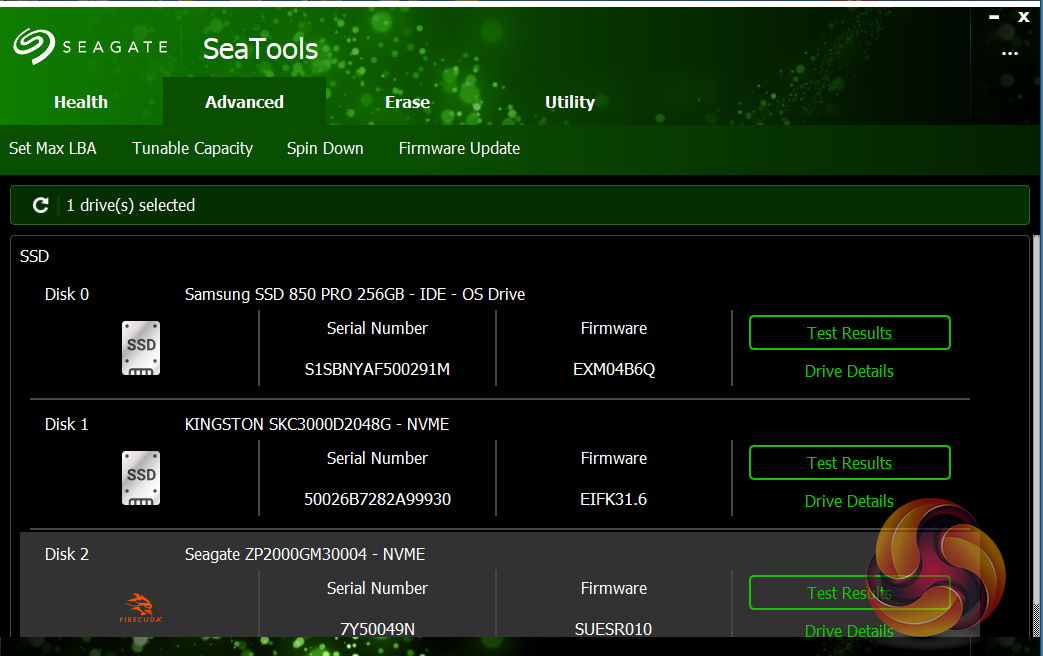
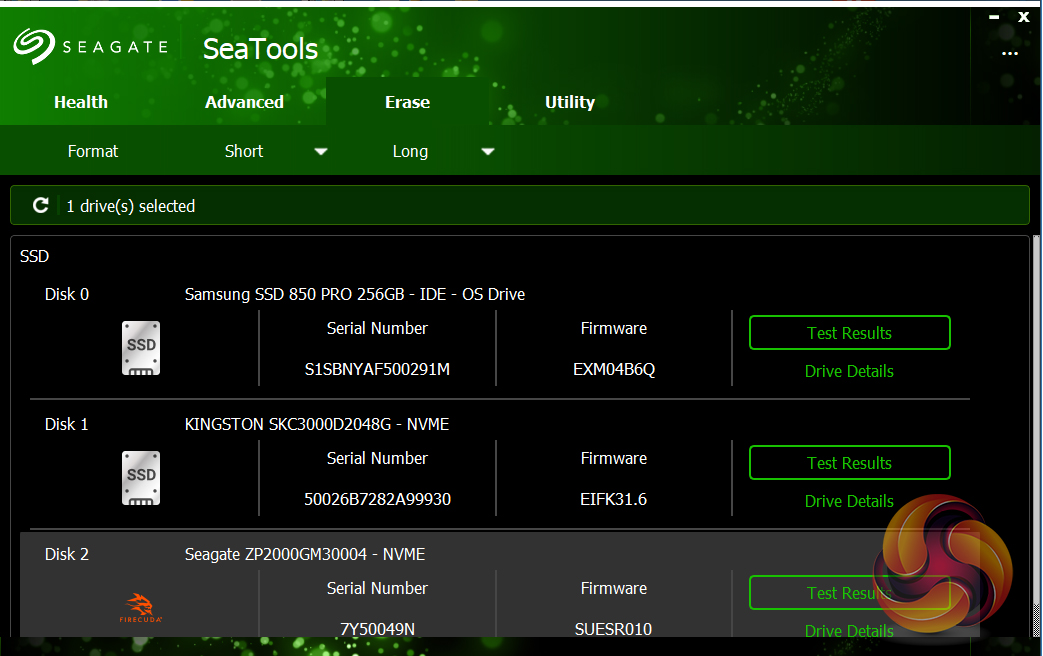
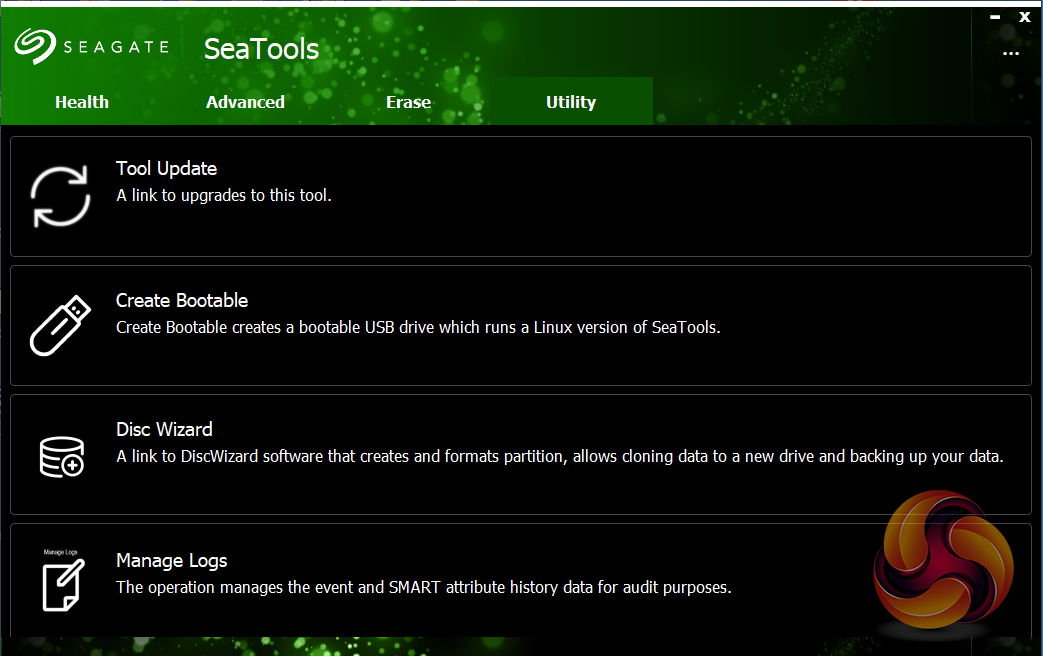
Seagate’s management software for the FireCuda is the SSD version of their SeaTools software. SeaTools SSD displays the drive’s health and supports firmware upgrading and secure erase. Although SeaTools SSD doesn’t come with any drive cloning utility built-in per se it does provide a link to download Seagate’s DiscWizard cloning software. It even gives you a choice of two themes, the standard one or one more suited to the drives gaming role.
For testing, the drives are all wiped and reset to factory settings by HDDerase V4. We try to use free or easily available programs and some real world testing so you can compare our findings against your own system.
This is a good way to measure potential upgrade benefits.
Main system:
AMD Ryzen 7 7700X, 32GB DDR5-6000, Nvidia GeForce RTX 3050 and a Gigabyte AORUS X670E Xtreme motherboard.
Other drives
PCIe Gen5 2TB+
Crucial T700 2TB
Crucial T700 with Heatsink 2TB
Gigabyte AORUS 10000 2TB
PCIe Gen4 2TB+
Corsair MP600 GS 2TB
Corsair MP600 PRO 2TB
Corsair MP600 PRO XT 2TB
Gigabyte AORUS 7000e 2TB
HP FX900 Pro 2TB
Kingston Fury Renegade Heatsink 2TB
Kingston KC3000 2TB
Kioxia Exceria Pro 2TB
Lexar Professional NM800PRO Heatsink 2TB
MSI Spatium M480 2TB
Patriot Viper VP4300 2TB
Sabrent Rocket 4 Plus 2TB
Sabrent Rocket 4 Plus 4TB
Samsung SSD990 PRO 2TB
Solidigm P41 Plus 2TB
Seagate Lightsaber Collection Special Edition FireCuda 2TB
Seagate FireCuda 530 2TB
WD Black SN850X Heatsink 2TB
Software:
Atto Disk Benchmark 4.
CrystalMark 8.0.0.
AS SSD 2.0.
IOMeter.
UL Solutions PC Mark 10.
UL Solutions 3DMark Storage Benchmark.
Final Fantasy XIV Endwalker Official Benchmark.
All our results were achieved by running each test five times with every configuration this ensures that any glitches are removed from the results. Trim is confirmed as running by typing fsutil behavior query disabledeletenotify into the command line. A response of disabledeletenotify =0 confirms TRIM is active.
CrystalDiskMark is a useful benchmark to measure the theoretical performance levels of hard drives and SSDs. We are using v8.0.
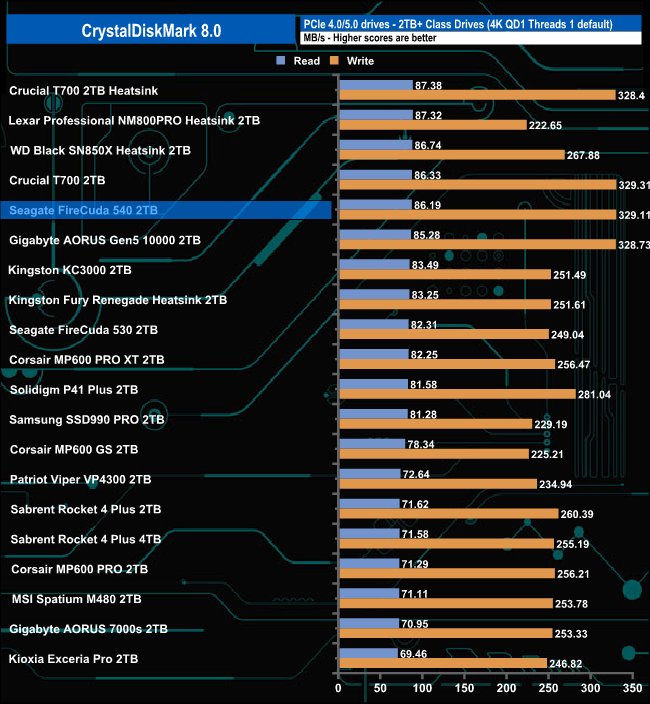
In CrystalDiskMark 8's 4K QD1 T1 test, the Seagate FireCuda 540's read result sees the drive sitting in fifth place behind the two Crucial T700 drives and the two fastest Gen 4 drives we've seen to date in this test, Lexar's Professional NM800 PRO and WD's Black SN850X. However, the FireCuda 540 has the second fastest write performance we've seen to date.
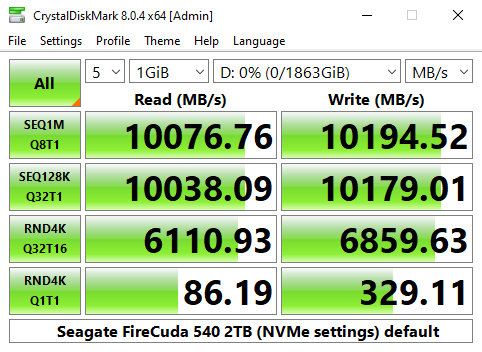
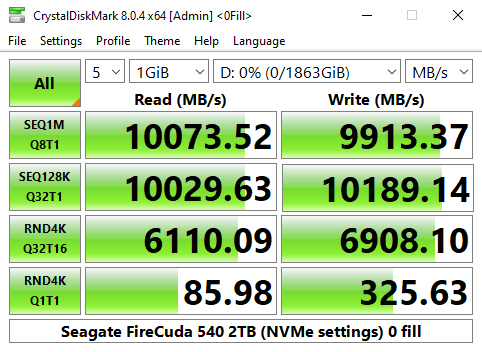
As you can see from the benchmark result screens we can confirm the official Sequential read/write figures of 10,000MB/s with test result figures of 10,076MB/s for reads and 10,194MB/s for writes.
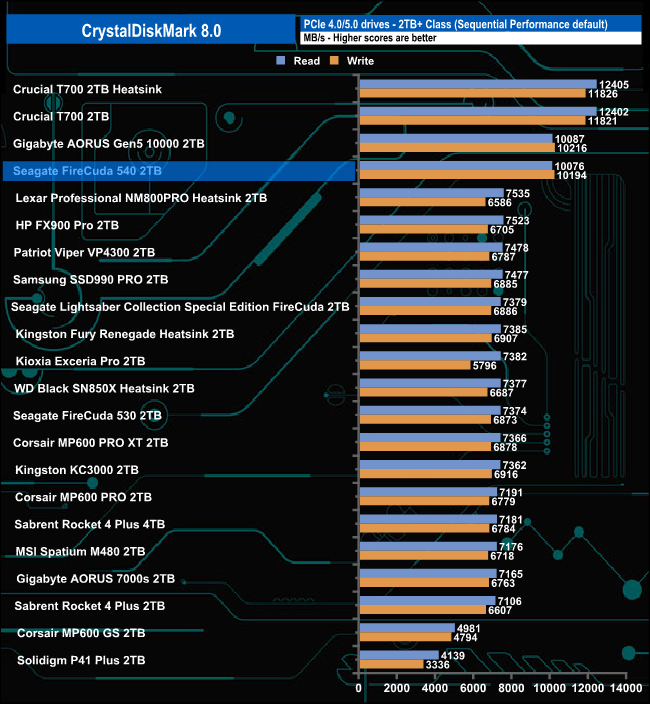
Those Sequential scores see the drive sitting in fourth place in the results chart. It also shows just how much faster the Sequential performance of a Gen 5 drive is over the previous Gen 4 ones as the FireCuda 540 is some 2,700MB/s faster for reads and 3,127MB/s faster for writes than the previous generation flagship drive, the FireCuda 530.
Peak Performance Profile
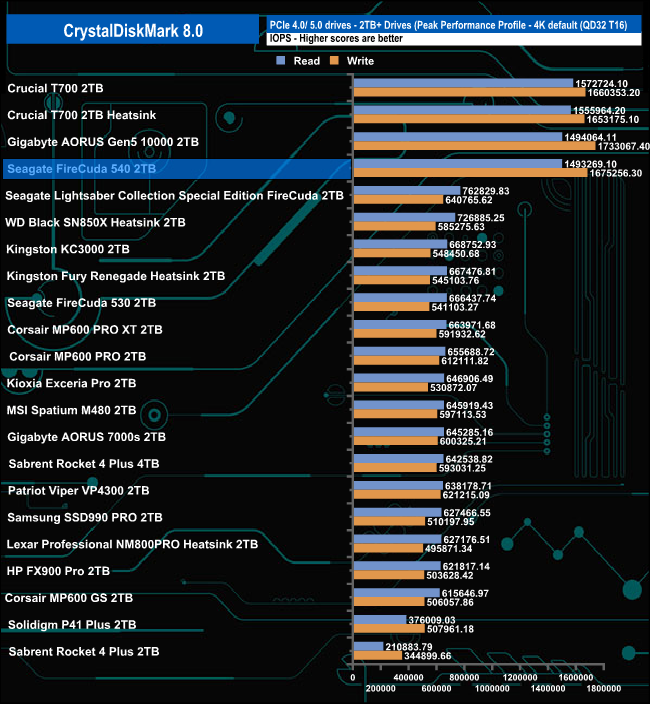
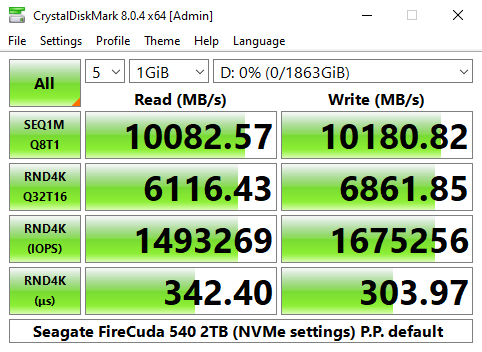
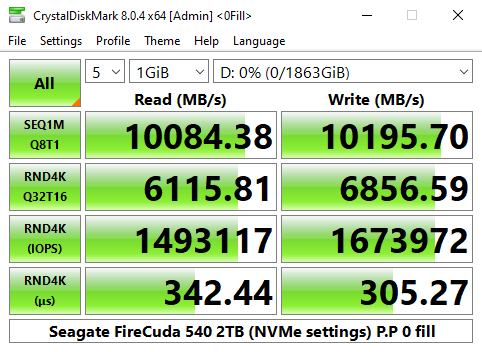
Using the Peak Performance profile of the CrystalDiskMark benchmark we could confirm the official 4K random read/write figures for the drive of up to 1,490,000 IOPS for reads and up to 1,500,000 IOPS for writes with test results of 1,493,269 IOPS for reads and 1,675,256 IOPS for writes.
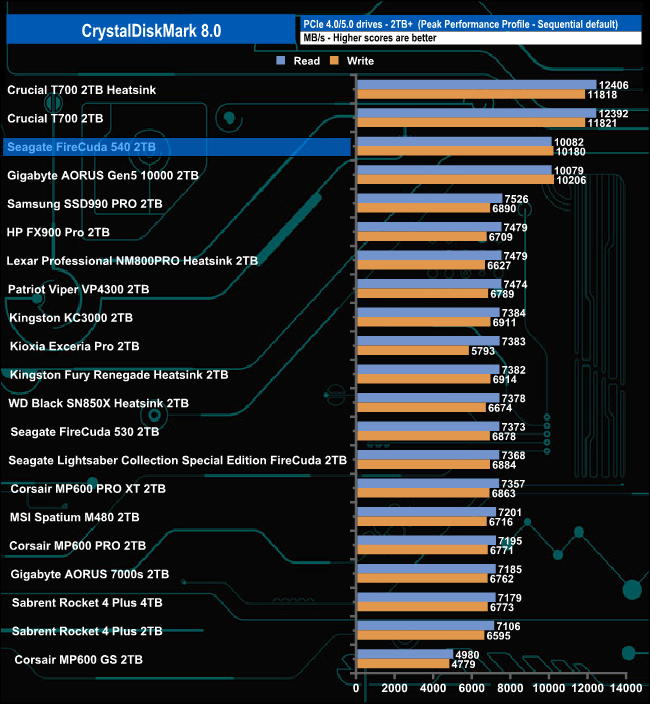
With the Peak Performance profile could once again confirm the official Sequential performance figures with the drive slipping into third place behind the two Crucial drives. The Crucial T700 drives have the advantage as they have their NAND flash memory clocked at 2,000MT/s whereas the FireCuda 540 NAND runs at 1,600MT/s.
Real World Profile
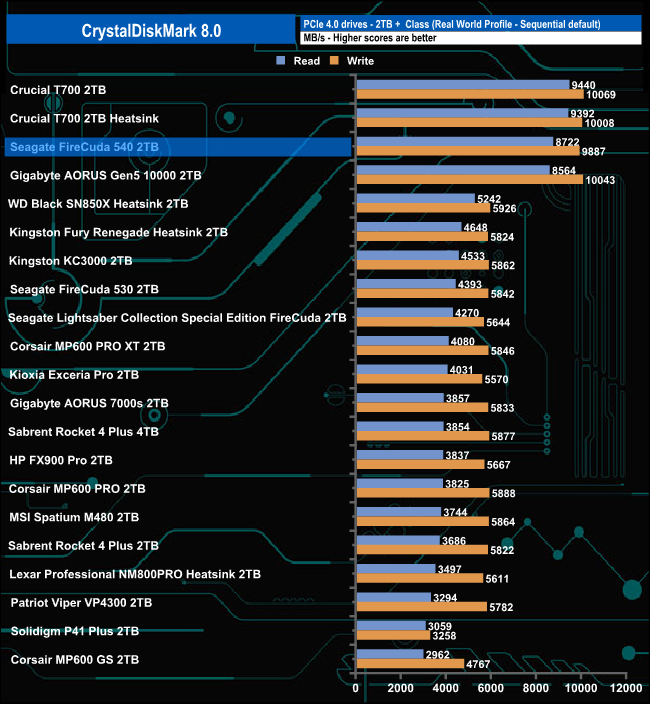
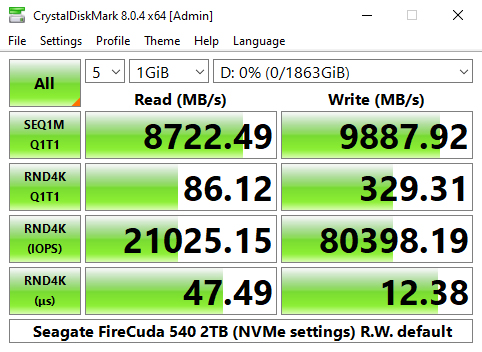
Seagate's FireCuda 540 sits in third place in the Real World Profile chart with Sequential read/write scores of 8.722MB/s and 9,887MB/s respectively, a fair way off both versions of Crucial's T700 that lead the way.
The ATTO Disk Benchmark performance measurement tool is compatible with Microsoft Windows. Measure your storage systems performance with various transfer sizes and test lengths for reads and writes. Several options are available to customize your performance measurement including queue depth, overlapped I/O and even a comparison mode with the option to run continuously. Use ATTO Disk Benchmark to test any manufacturer's RAID controllers, storage controllers, host adapters, hard drives and SSD drives and notice that ATTO products will consistently provide the highest level of performance to your storage.
We are using version 4.1 for our NVMe disk tests.
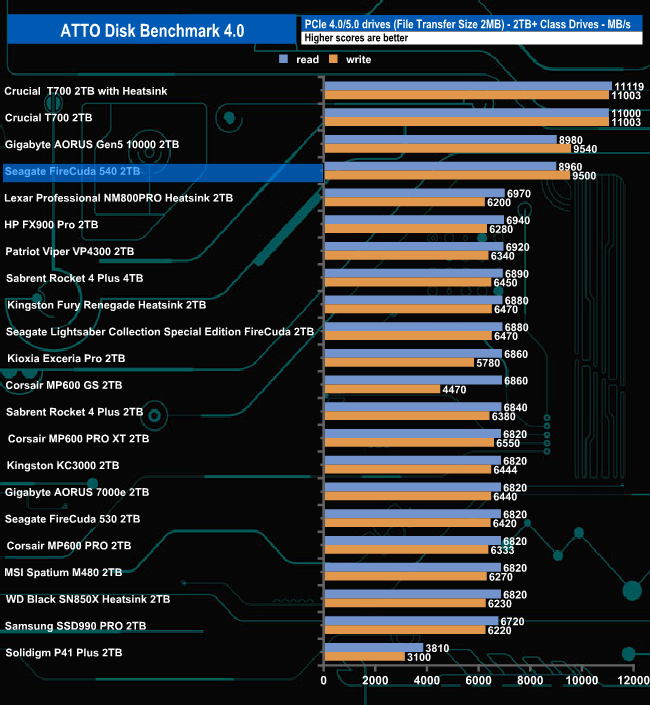
Using the ATTO benchmark we couldn't quite get to the official maximum Sequential figures of up to 10,000MB/s for both reads and writes, The best we saw from testing was 8,950MB/s for reads with writes a little faster at 9,500MB/s.
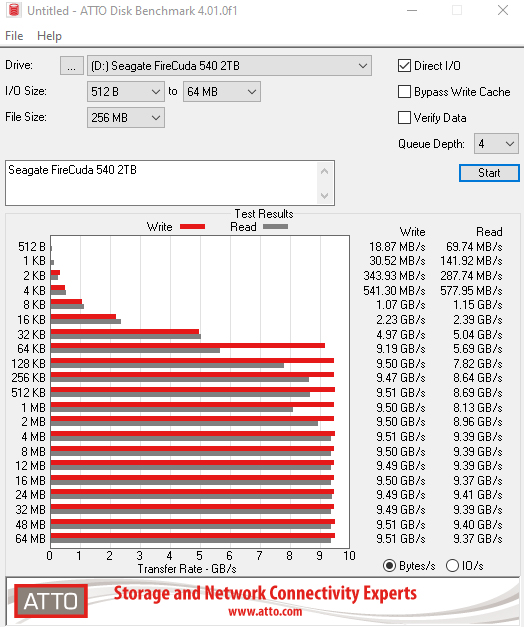
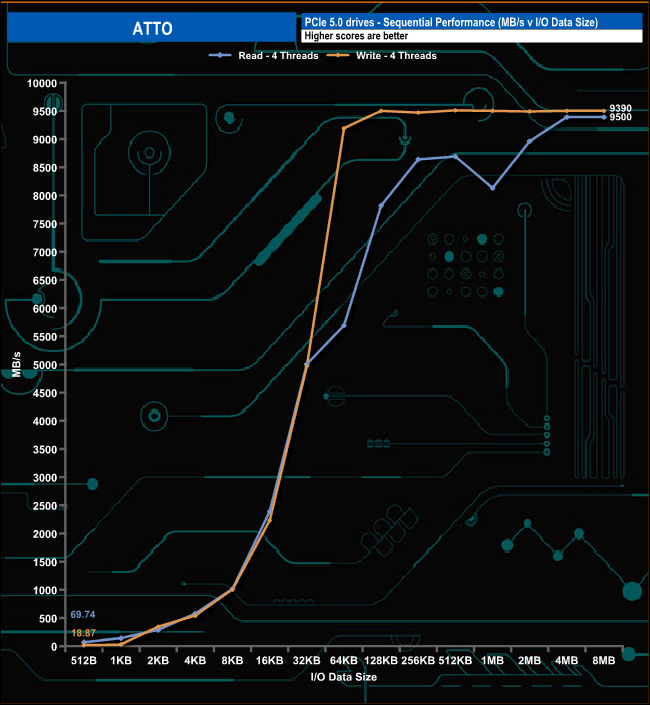
Using the ATTO benchmark, the read performance began to plateau out at 4MB (9,390MB/s), but the write performance levels off way before that, at the 128KB mark with a figure of 9,500MB/s.
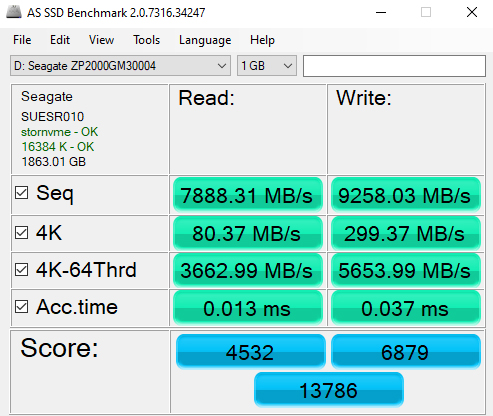
AS SSD is a great free tool designed just for benching Solid State Drives. It performs an array of sequential read and write tests, as well as random read and write tests with sequential access times over a portion of the drive. It uses
incompressible data samples which many drives struggle with, so results can be viewed as the worst case scenrios.
AS SSD includes a sub suite of benchmarks with various file pattern algorithms but this is difficult in trying to judge accurate performance figures.
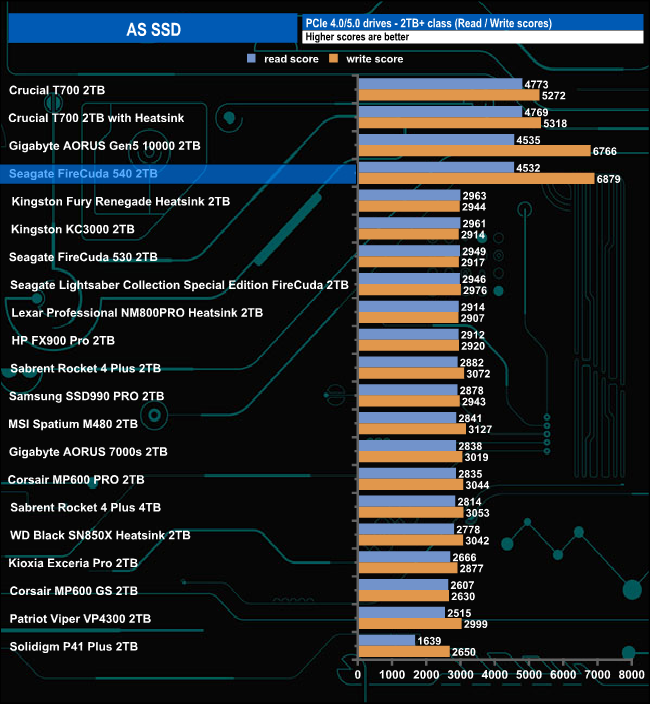
The AS SSD read score of 4532 sees the 2TB Seagate FireCuda 540 sitting in fourth place but it does have the best write score of all the Gen 5 drives tested to date.
We used CrystalDiskMark 8‘s custom settings to test the Sequential read and write performance of the drive through a range of queue depths. The setup for the tests is listed below.
128KB Sequential Read / Write.
Transfer Request Size: 128KB, Thread(s): 1, Outstanding I/O: 1-32.
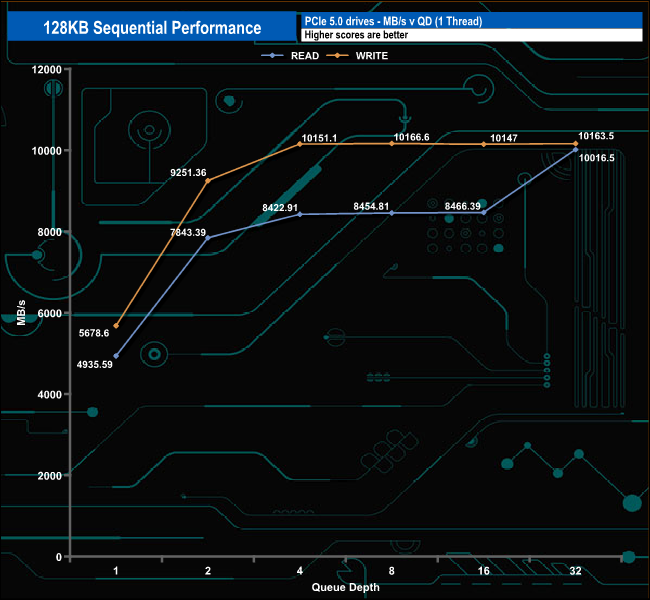
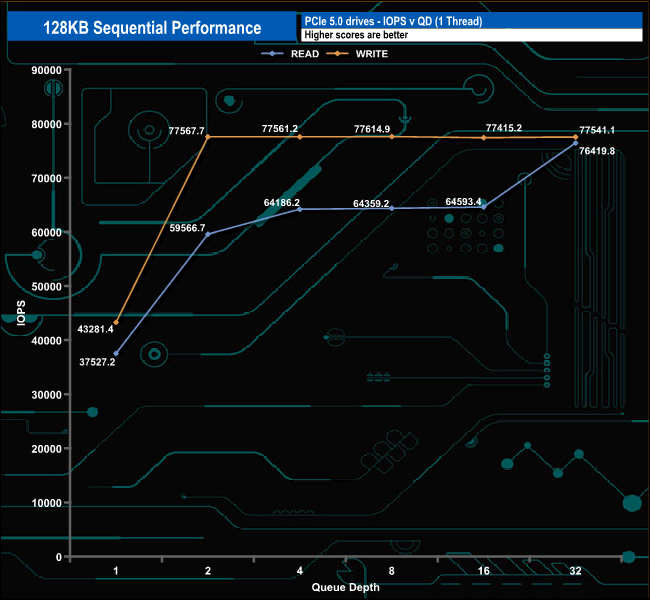
In these tests, the read performance of the drive accelerates between QDs 1 and 2 before levelling off between QD4 and 16 before slowly climbing again to finish the test run at 10,016MB/s.
The write performance does a similar thing but there is no kick-up in performance towards the end of the test run like in the read performance, the drive finishing the test run at 10,163MB/s. Both these figures confirm the official Sequential read/write figure of 10,000MB/s.
128KB Sequential Read v QD compared.
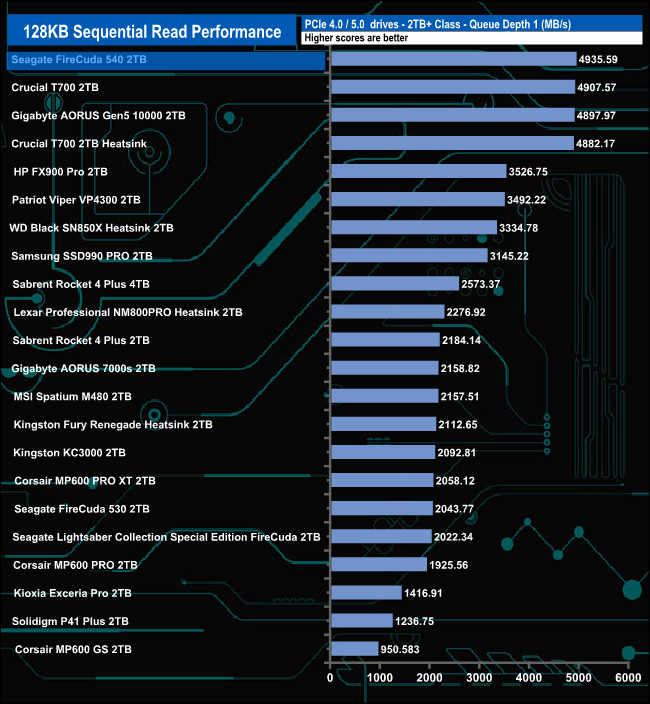
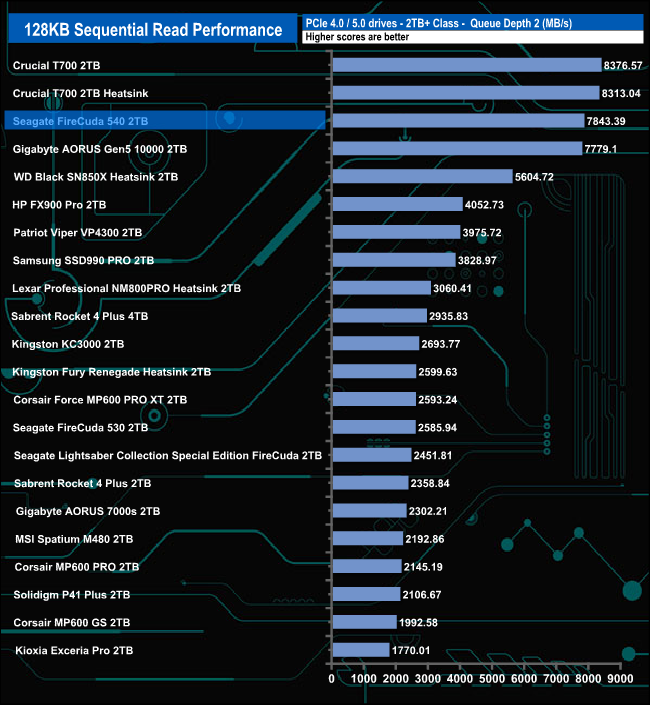
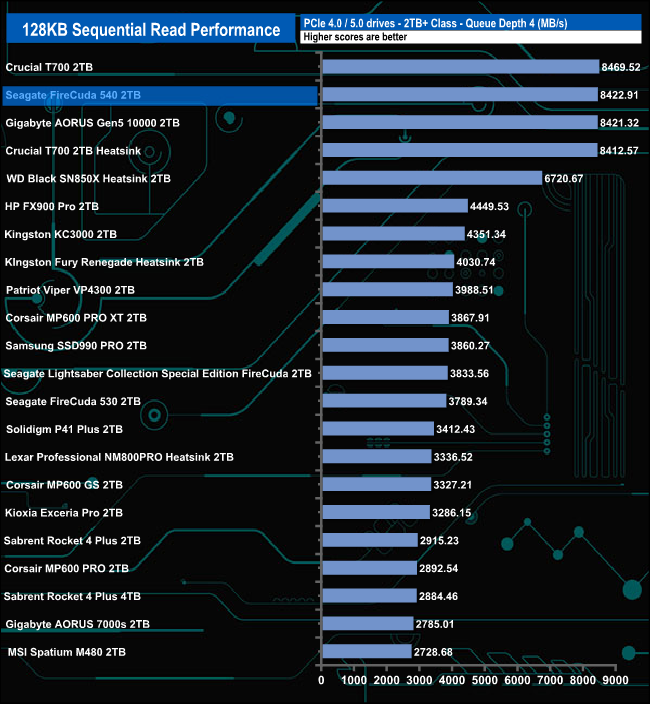
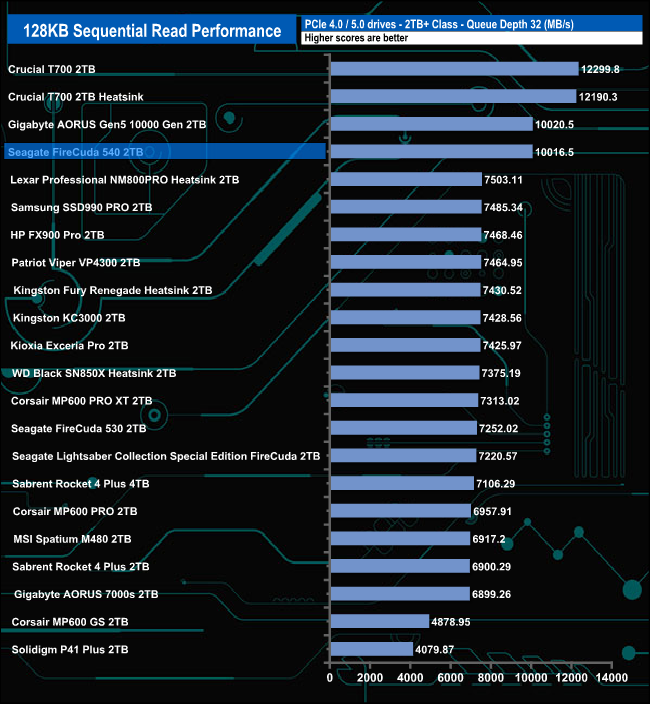
At QD1, the Seagate FireCuda 540 is the fastest consumer drive we've tested to date when it comes to Sequential reads. At QD2 it drops below both the Crucial T700 drives while at QD4 it sits in second place. At QD32 it sits behind the three other Gen 5 drives we've tested to date.
128KB Sequential Write v QD compared.
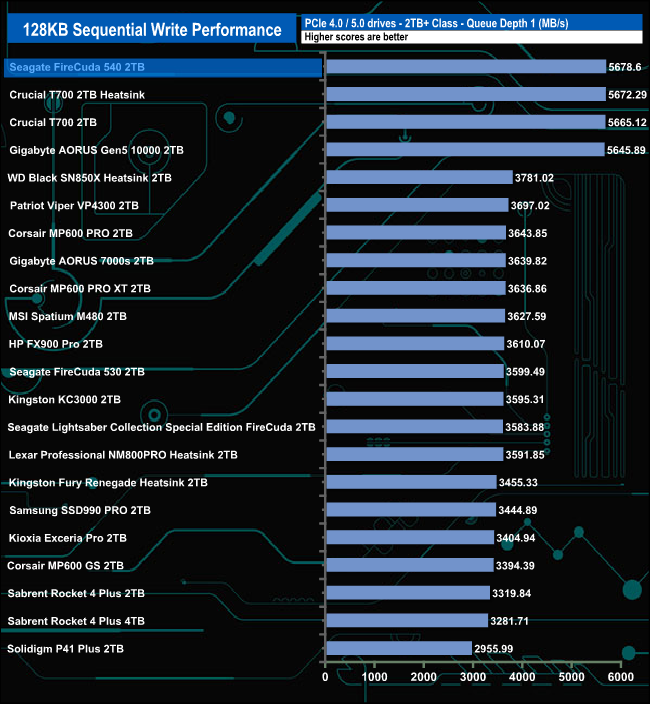
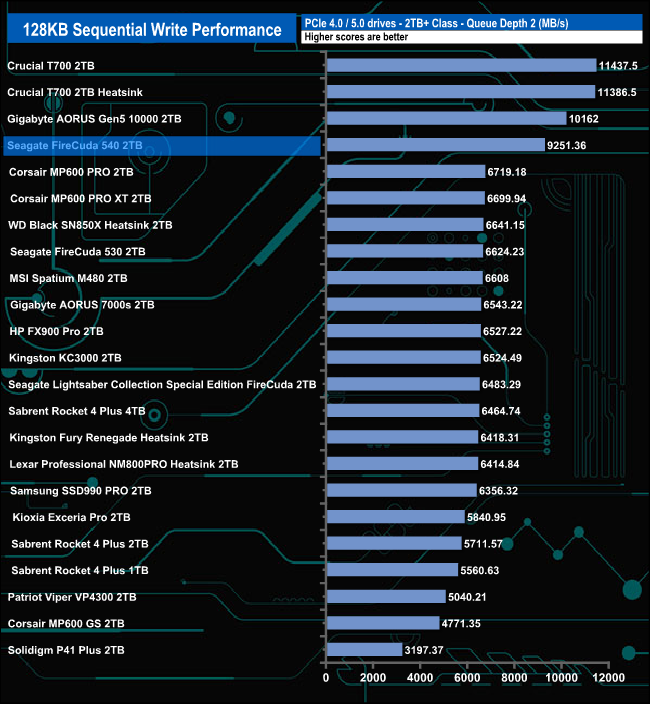
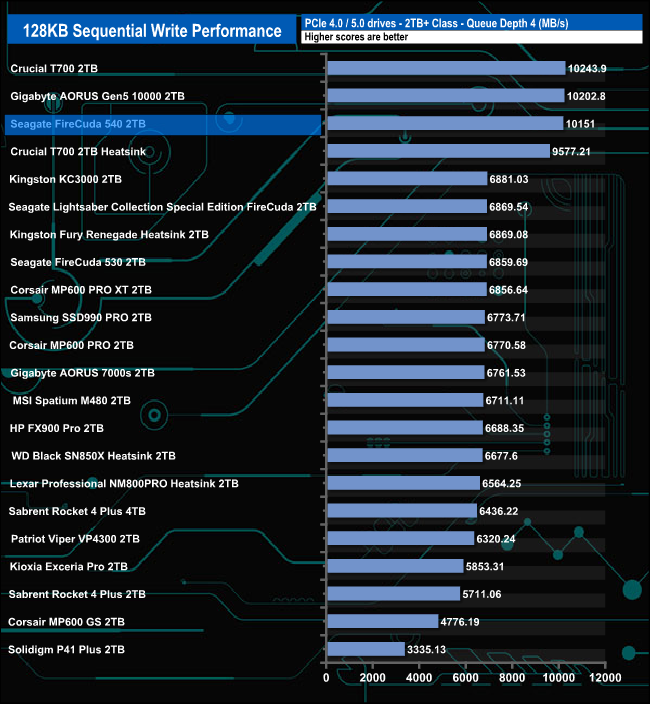
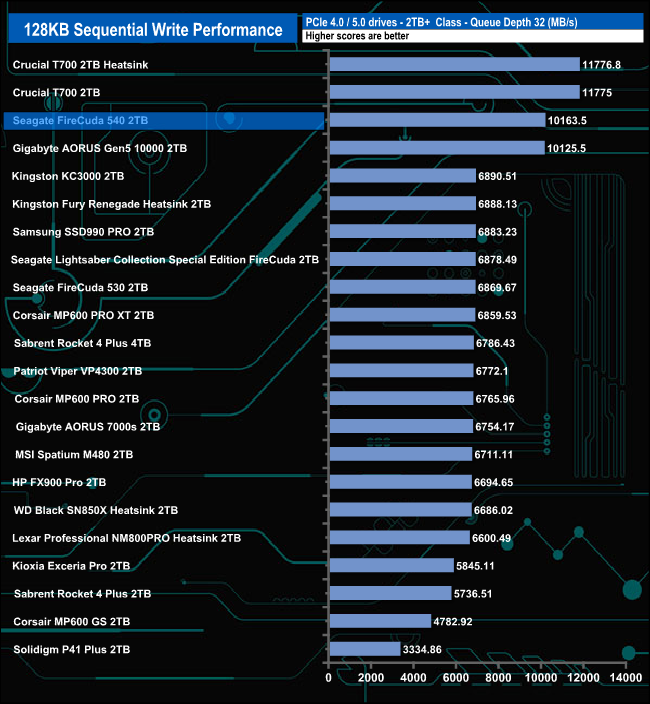
As with the Sequential read test, the drive tops the Sequential write test at QD1. At QD2 it drops to fourth place but for QD's 4 and 32, it rises to third place.
We used CrystalDiskMark 8‘s custom settings to test the 4K random read performance of the drive through a range of queue depths. The setup for the tests is listed below.
Transfer Request Size: 4KB, Outstanding I/O: 1-32.
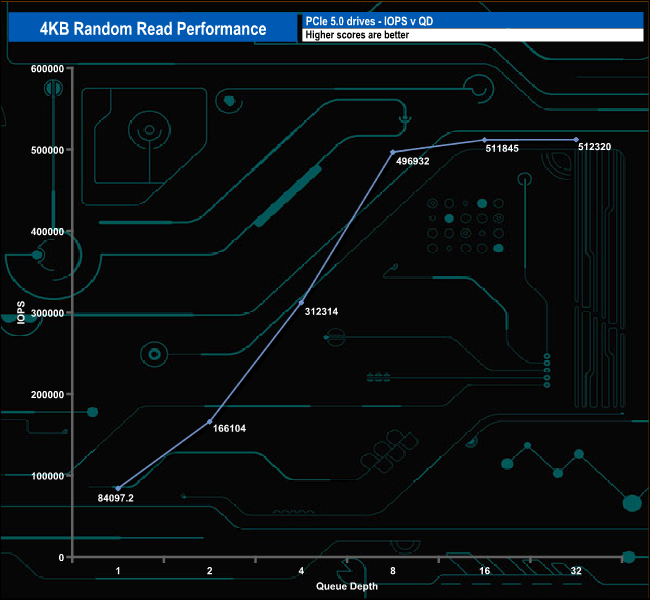
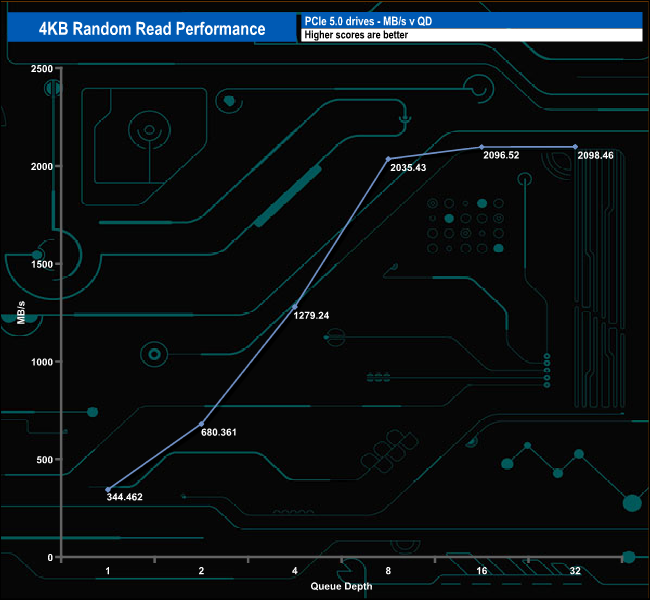
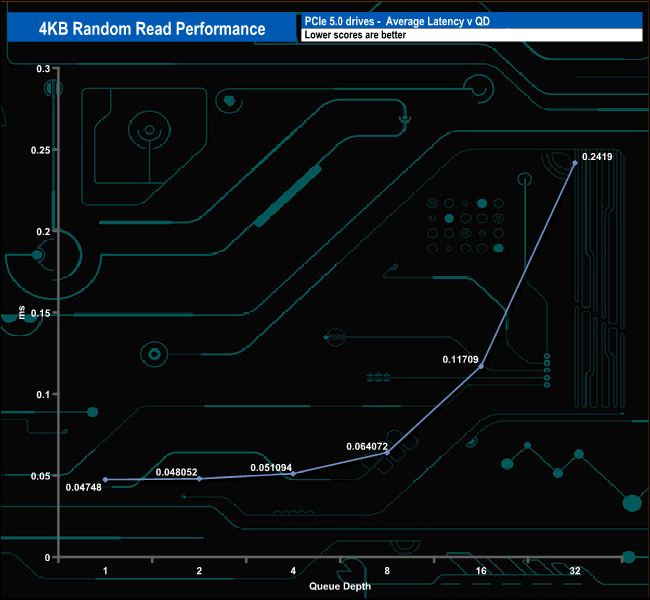
Our four-threaded 4K random read tests couldn't get close to the official maximum of 1,490K IOPS. The best figure we saw was 512,320 IOPS (2,098.48MB/s) at the end of the test run at QD32.
Random Read QD v IOPS compared.
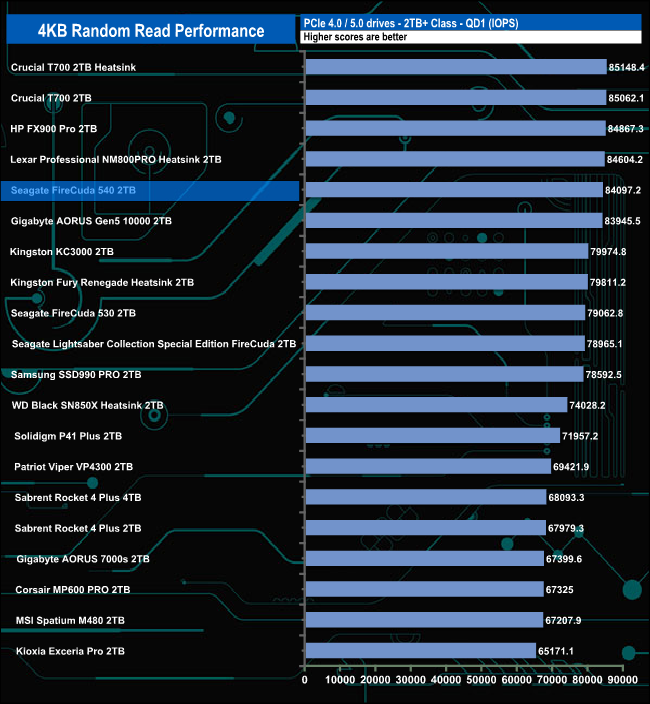
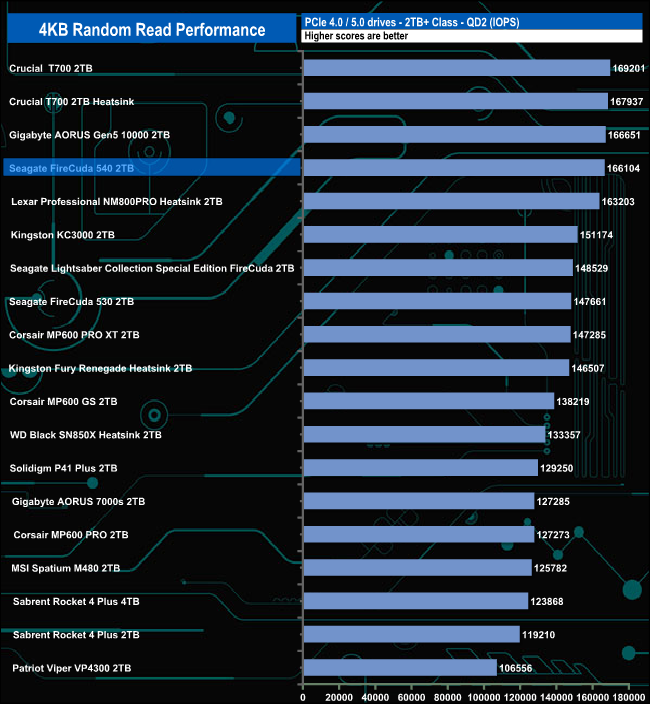
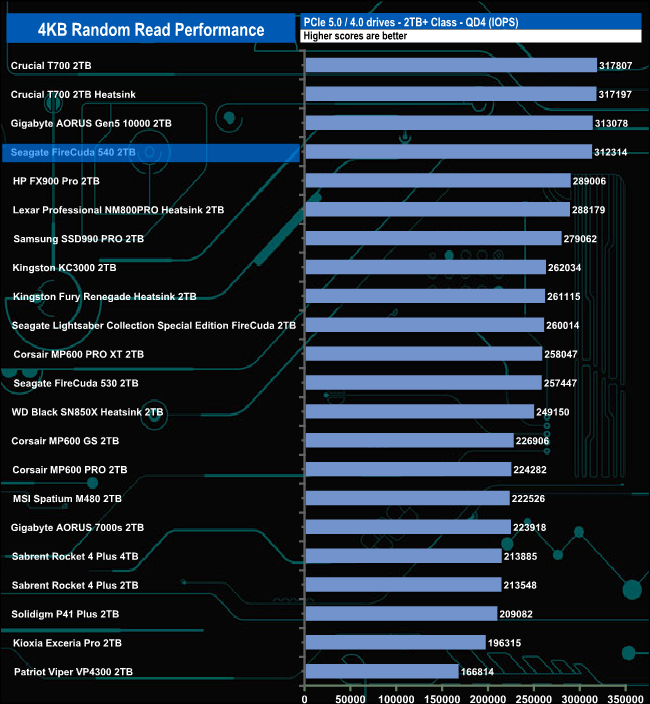
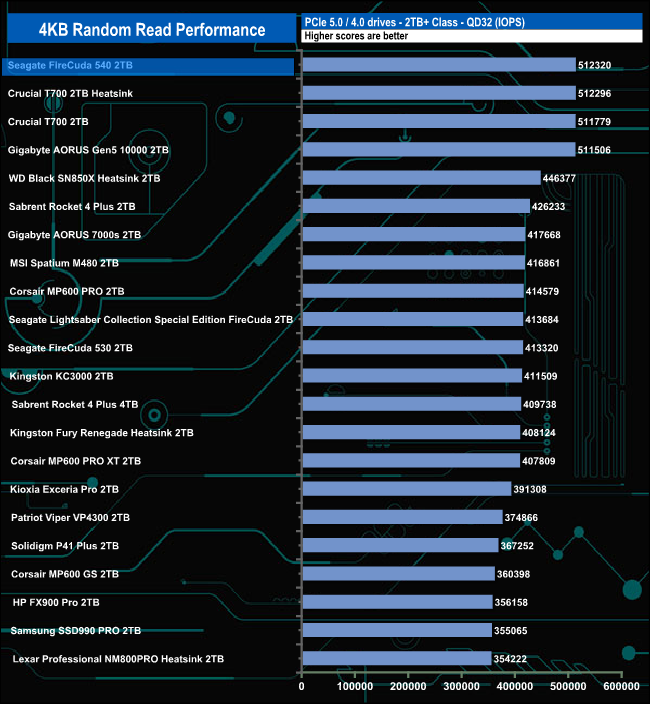
At QD1 the drive sits in fifth place behind both Crucial T700 Gen 5 drives and two Gen 4 drives, HP's FX900 Pro and Lexar's Professional NM800PRO. The drive moves up a position at QDs 2 and 4. However, at QD32, the FireCuda 540 is the fastest consumer drive we've seen to date.
We used CrystalDiskMark 8‘s custom settings to test the 4K random write performance of the drive through a range of queue depths. The setup for the tests is listed below.
Transfer Request Size: 4KB, Outstanding I/O: 1-32.
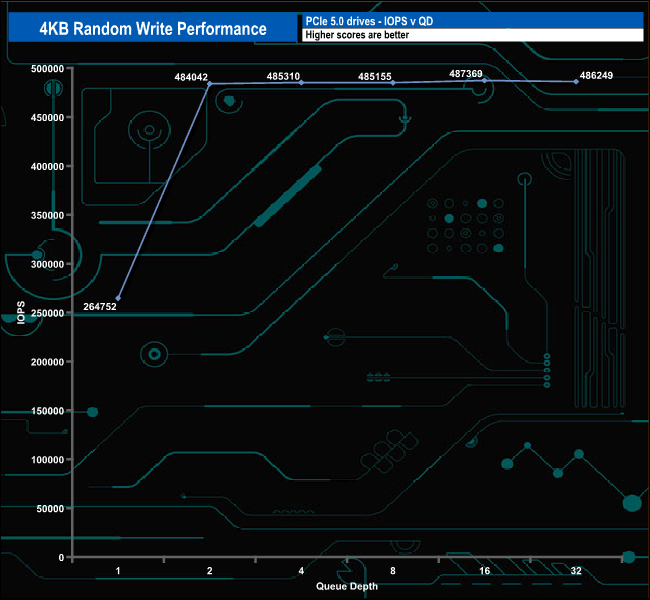
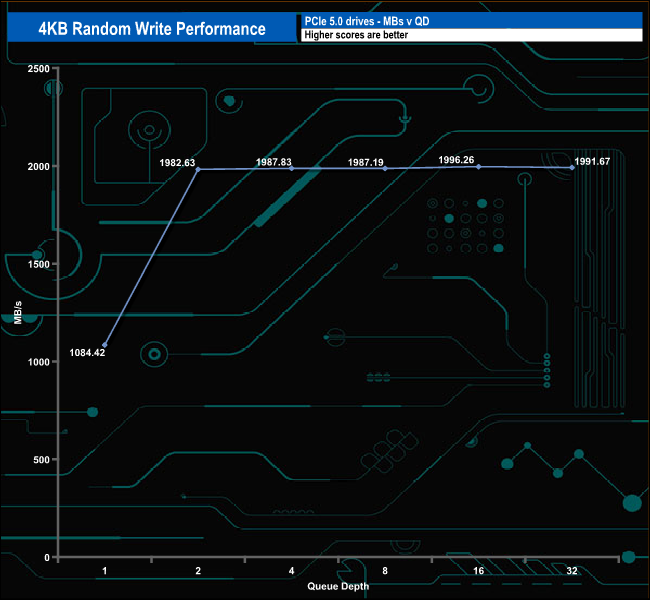
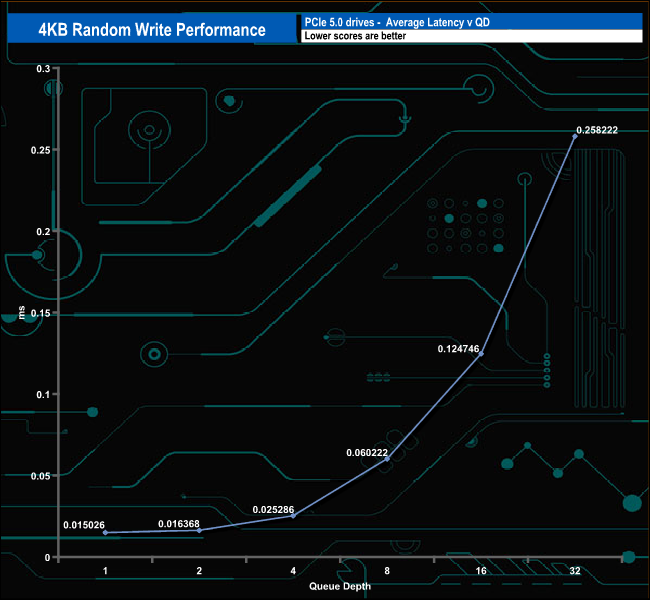
As with the random read results with our four threaded random write tests, we couldn't get close to the official maximum of 1,500K IOPS. The best we saw from testing was 487,369 IOPS (1,996.25MB/s) at QD16.
4K Random Write v QD compared.
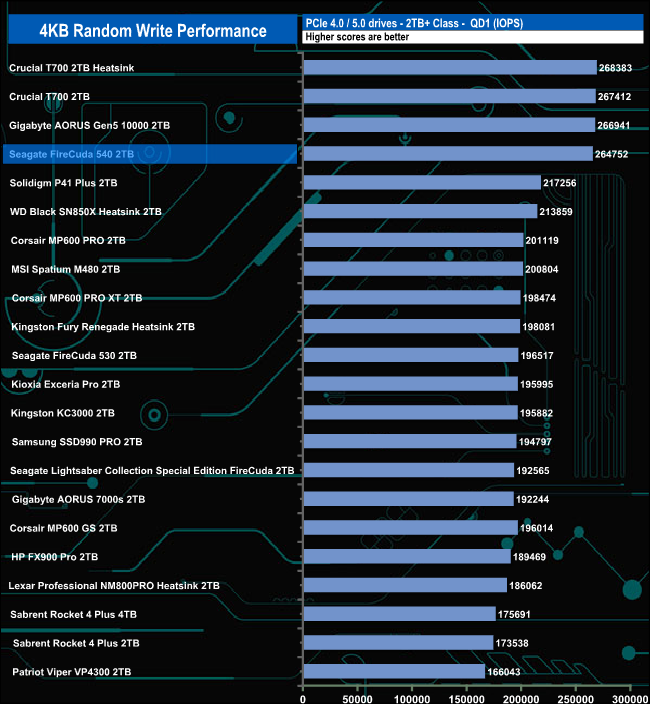
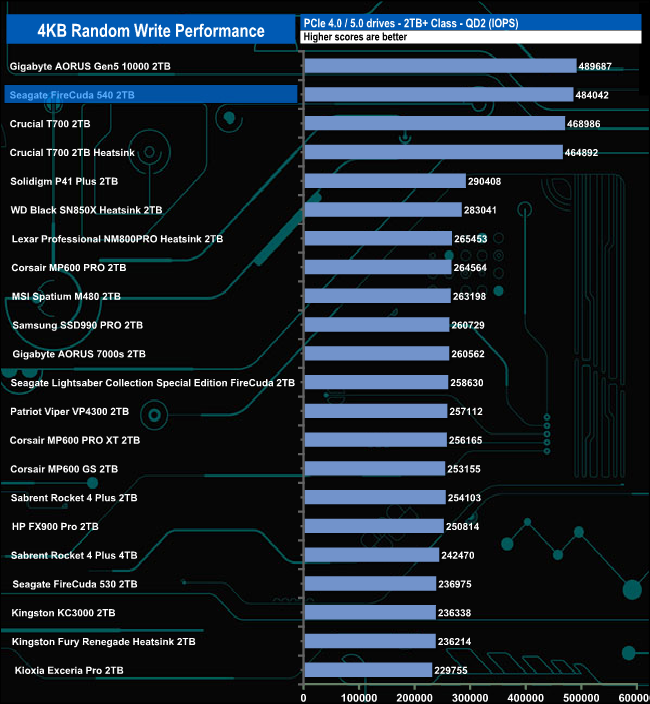
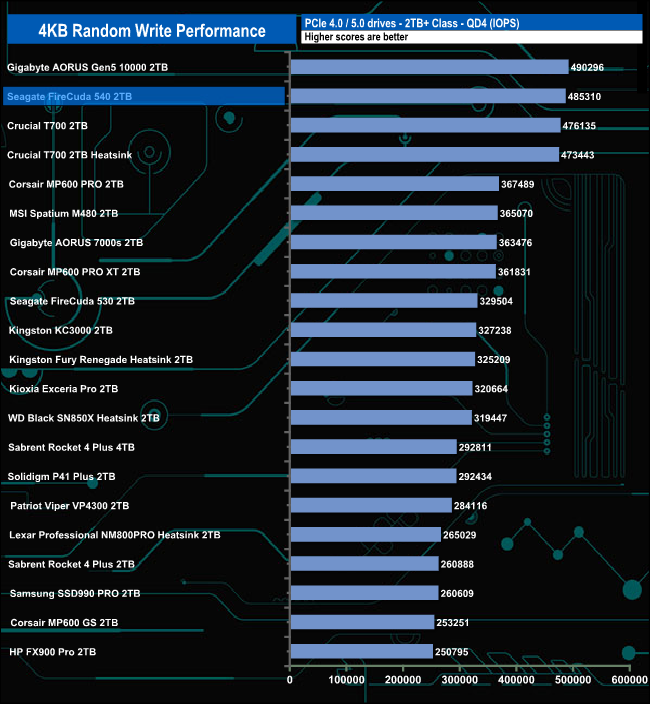
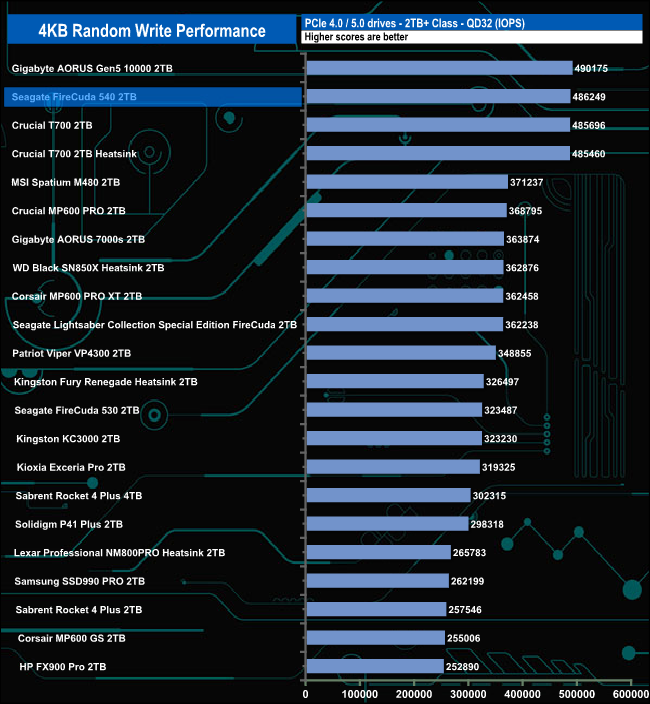
Seagate's FireCuda 540 seems to perform better at deeper queue depths when it comes to random writes as it's the second fastest consumer drive we've tested at QD's 2, 4 and 32 and fourth fastest at QD1.
We used CrystalDiskMark 8’s custom settings to test the 4K 70/30 mixed read/write performance of the drive through a range of queue depths using a single thread and four threads.
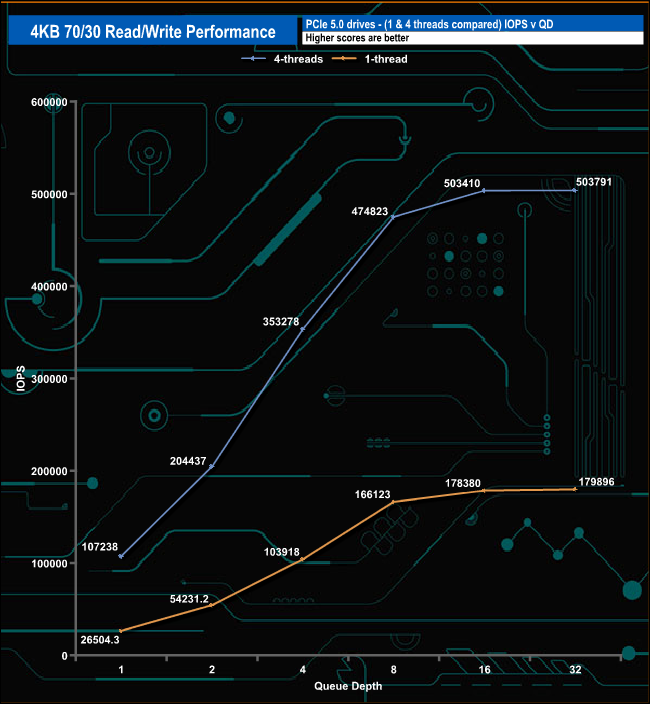
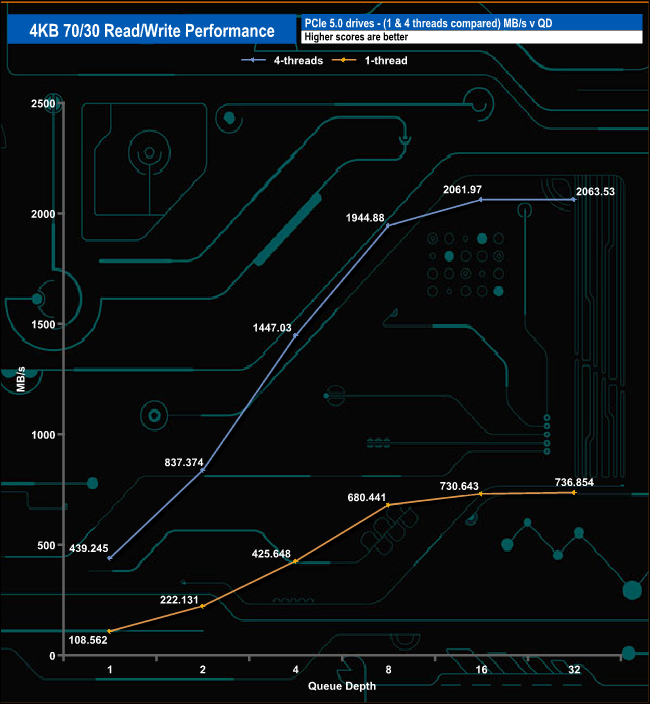
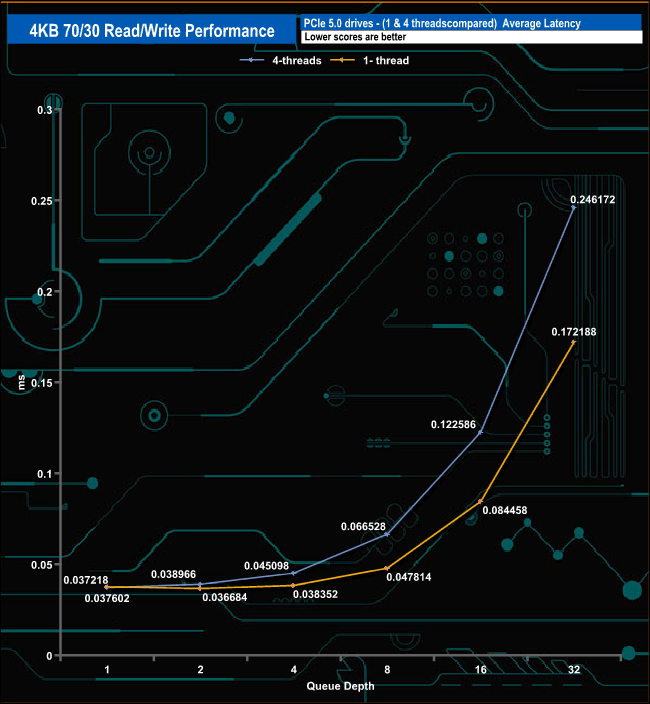
Using four threads in our 70/30 read/write tests, the performance of the 2TB FireCuda 540 ranges from 107,238 IOPS (439.24MB/s) at QD1 to 503,791 IOPS (2,063MB/s) at QD32. Switching over to a single thread the performance runs from 26,504 IOPS (109.56MB/s) at QD1 up to 179,896 IOPS (735.85MB/s) at QD32.
We used CrystalDiskMark 8 to test the random performance of the drive at lower queue depths (QD1 – QD8 where most of the everyday workloads occur) using 1 to 4 threads.
Random Reads
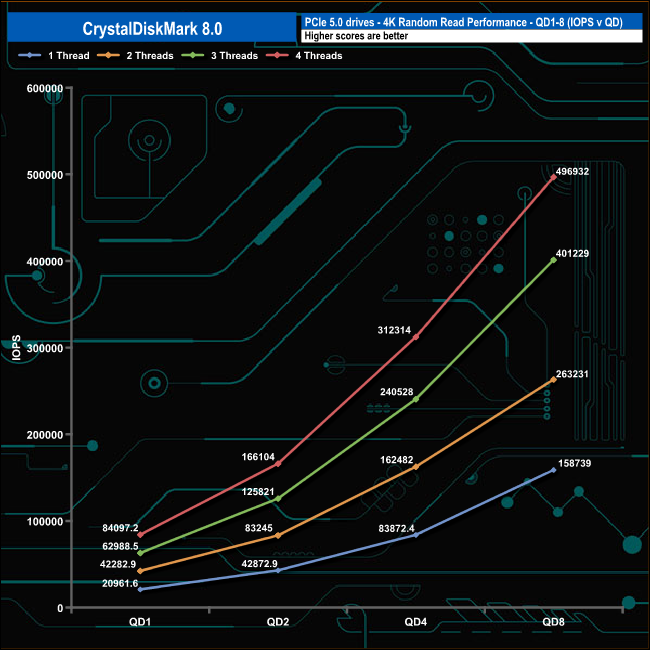
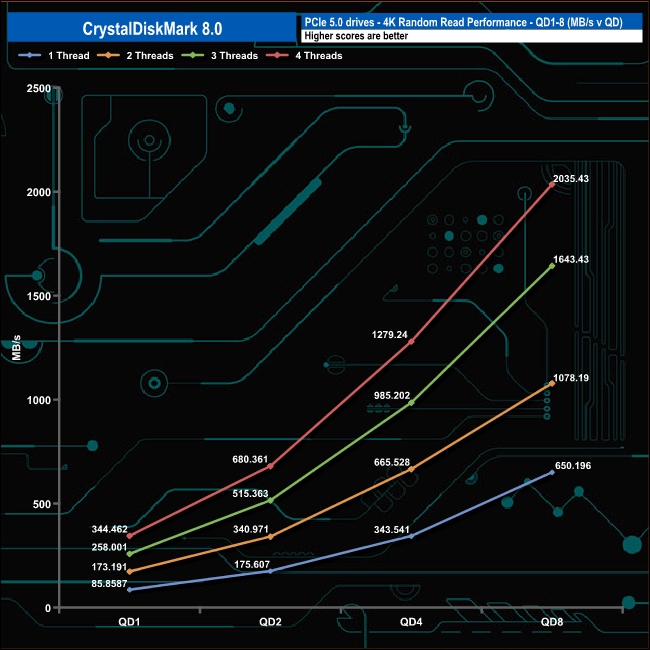
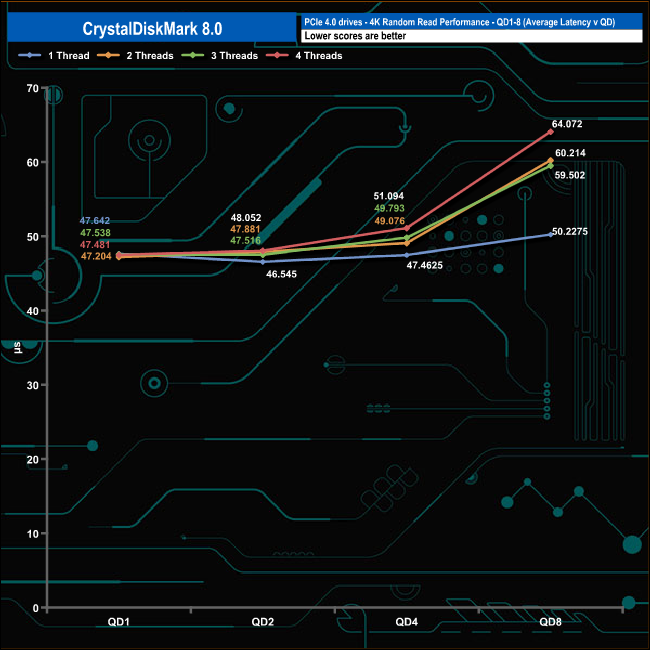
In the random read tests, all four of the tested threads displayed smooth increases in performance as the queue depth deepened with no nasty shocks. The drive speed ranges from 158,739 IOPS using a single thread up to 496,932 IOPS using four threads at QD8.
Random Writes.
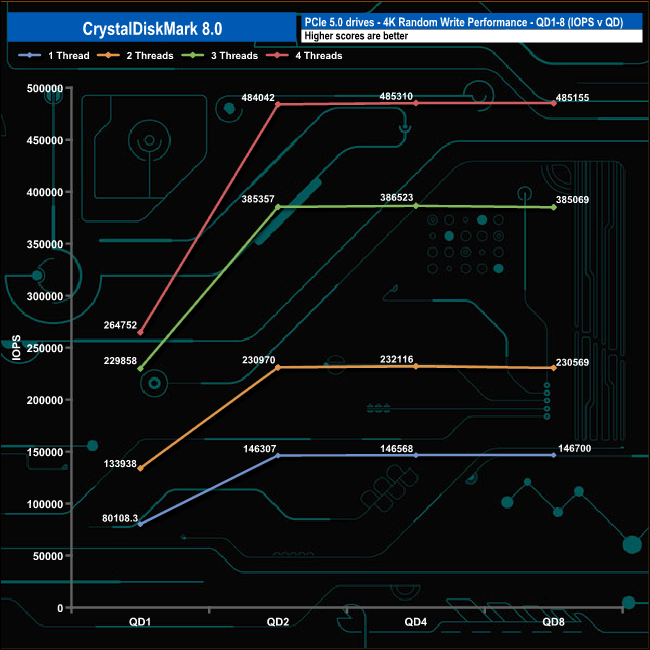
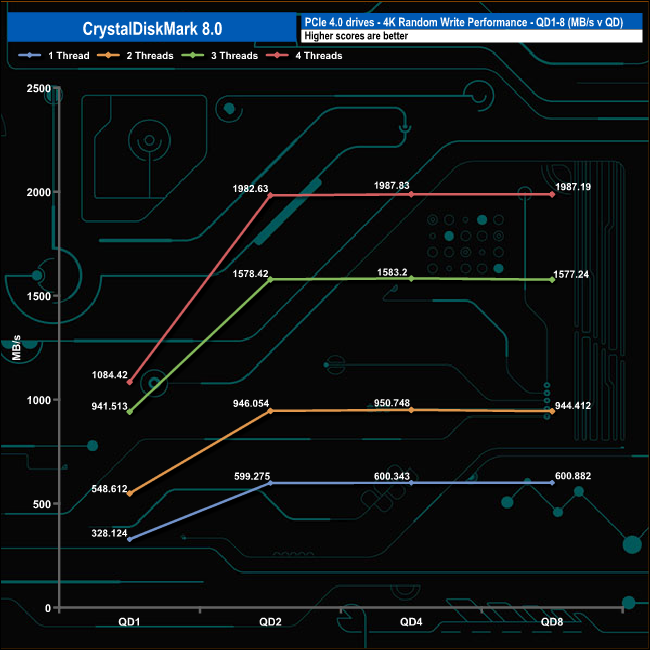
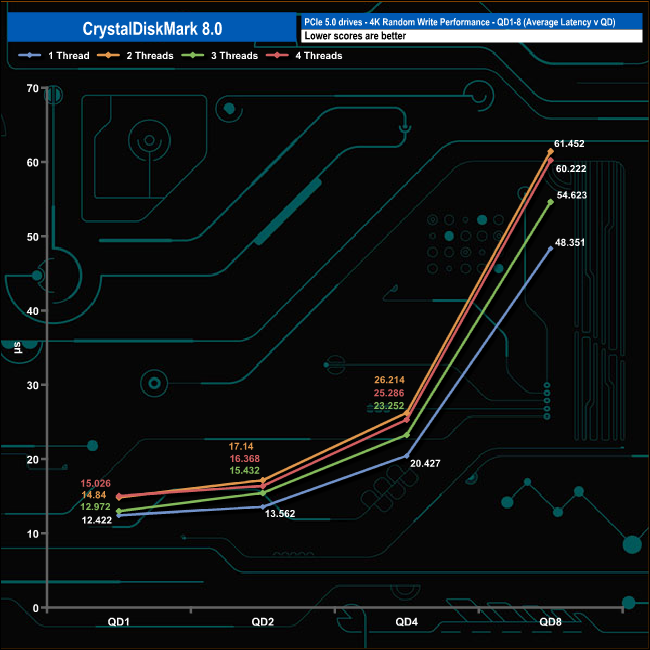
In the 4K write tests the performance rose quickly from QD1 to QD2 for all four tested threads with the fastest rise seen in the four-threaded test. All four threads see the performance start levelling off from QD2 onwards up to the end of the test run at QD8.
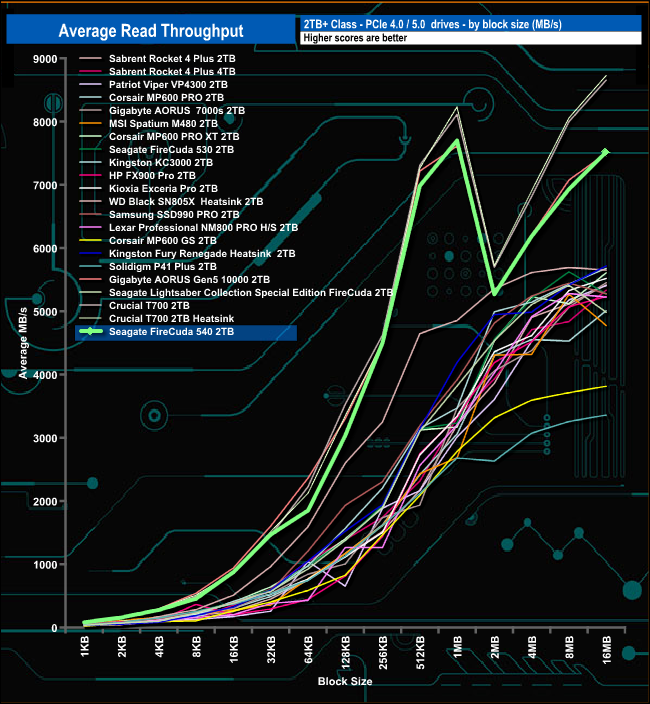
In our read-throughput tests, the Seagate FireCuda 540 performance climbed smoothly through the block marks until the 1MB mark where the drives performance peaks at 7,700MB/s before dropping sharply back to 5,268MB/s at the 2MB block mark. From this point onwards the drive makes a steady recovery to finish the test run at 7,517MB/s. Both the peak figure and the test end figure are some way off of the official maximum of 10,000MB/s.
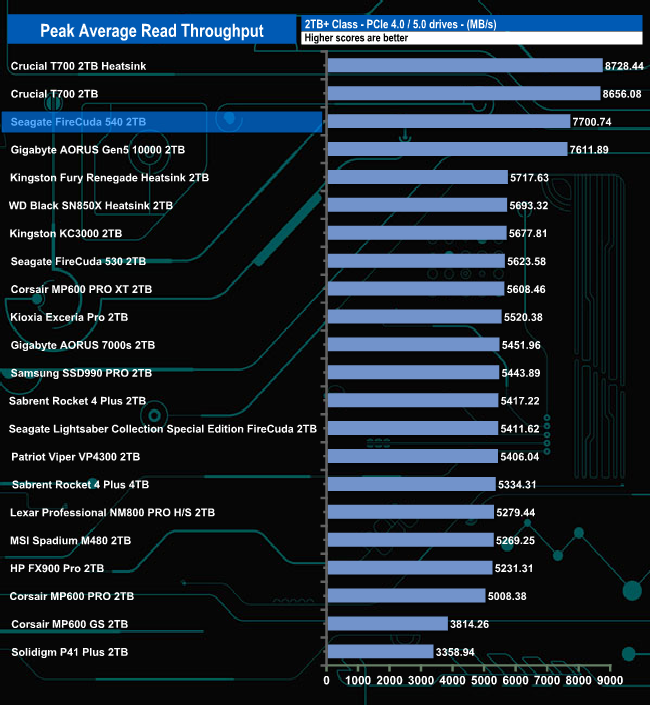
Even though the peak read result is nowhere near the official maximum figure, it puts the drive into third place on the results chart behind the two Crucial T700 drives which are using a higher clocked NAND than the Seagate drive.
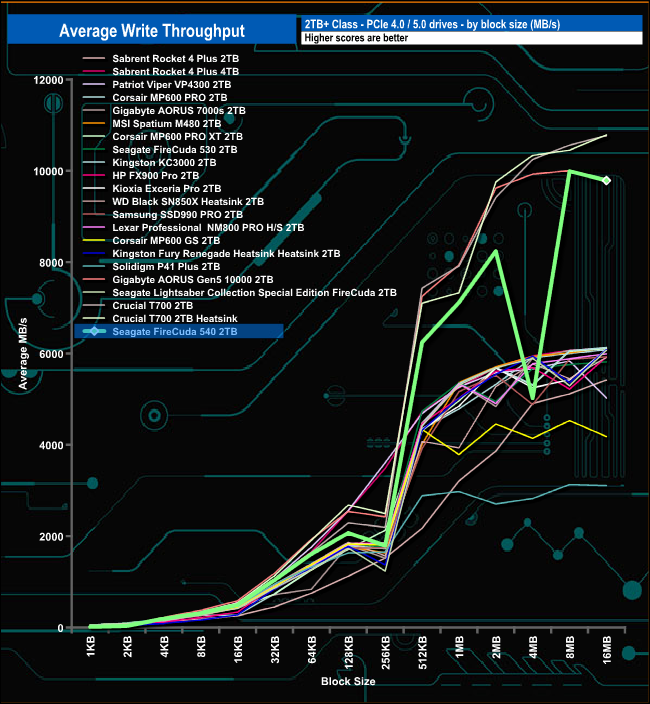
The write throughput performance is somewhat erratic to look at. At the 4MB block mark, there is a significant drop in the trace but the drive seems to recover very well, with the performance peaking at the 8MB mark at 9,992MB/s before dropping back to finish the test run at 9,787MB/s. As with the read throughput test result these figures are behind the official maximum but the write test result is a lot closer to the official maximum.
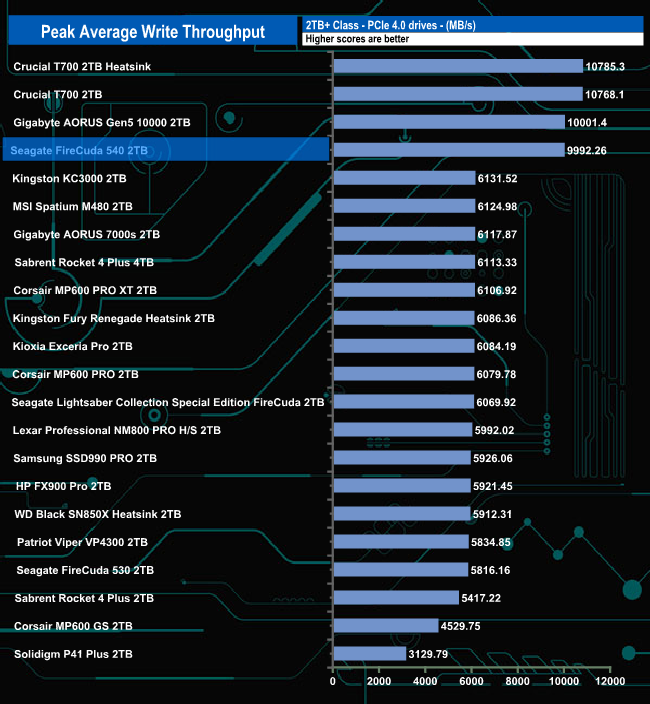
The tested peak write result of 9,992MB/s puts the drive in fourth place on our results chart. To give an idea of how much faster the Gen 5 interface is in terms of throughput than Gen 4, the FireCuda 540's score of 9,992MB/s is 4,176MB/s faster than the previous flagship FireCuda drive, the 530.
The PCMark 10 Full System Drive Benchmark uses a wide-ranging set of real-world traces from popular applications and common tasks to fully test the performance of the fastest modern drives. The benchmark is designed to measure the performance of fast system drives using the SATA bus at the low end and devices connected via PCI Express at the high end.
The goal of the benchmark is to show meaningful real-world performance differences between fast storage technologies such as SATA, NVMe, and Intel’s Optane. The Full System Drive Benchmark uses 23 traces, running 3 passes with each trace. It typically takes an hour to run.
Traces used:
Booting Windows 10.
Adobe Acrobat – starting the application until usable.
Adobe Illustrator – starting the application until usable Adobe Premiere Pro – starting the application until usable.
Adobe Photoshop – starting the application until usable.
Battlefield V – starting the game until the main menu.
Call of Duty Black Ops 4 – starting the game until the main menu.
Overwatch – starting the game until main menu.
Using Adobe After Effects.
Using Microsoft Excel.
Using Adobe Illustrator.
Using Adobe InDesign.
Using Microsoft PowerPoint.
Using Adobe Photoshop (heavy use).
Using Adobe Photoshop (light use).
cp1 Copying 4 ISO image files, 20 GB in total, from a secondary drive to the target drive (write test).
cp2 Making a copy of the ISO files (read-write test).
cp3 Copying the ISO to a secondary drive (read test).
cps1Copying 339 JPEG files, 2.37 GB in total, to the target drive (write test).
cps2 Making a copy of the JPEG files (read-write test).
cps3 Copying the JPEG files to another drive (read test).
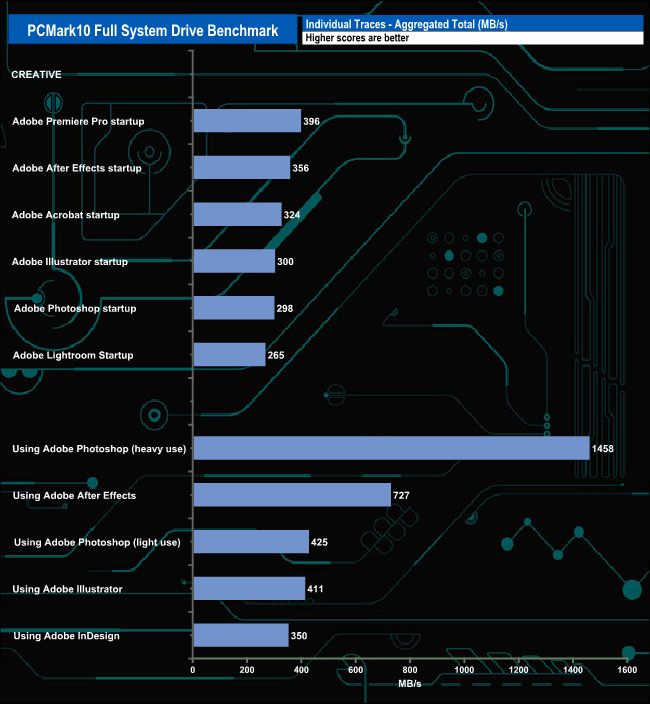
The 2TB FireCuda 540 averaged 323MB/s for the six Adobe startup traces, the fastest being the 396MB/s for the startup test of Premiere Pro. When tested with the Adobe usage traces the drive averaged 674MB/s for the five tests, with the fastest being the Adobe Photoshop heavy usage trace at 1,458MB/s.
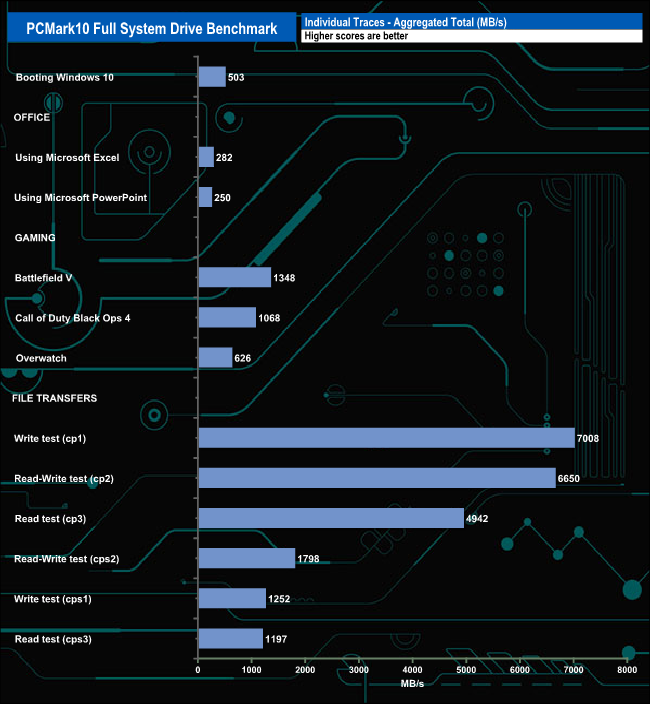
The drive averaged 1,014MB/s for the three gaming tests, the fastest being Battlefield V at 1,348MB/s. When it came to the file transfers, the fastest was the cp1 Write test at 7,008MB/s with the drive averaging 3,807MB/s for the six file transfer tests.
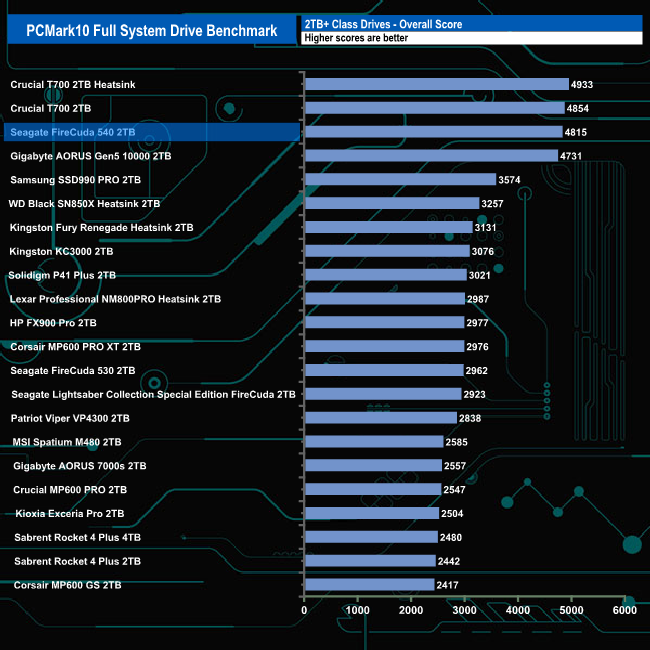
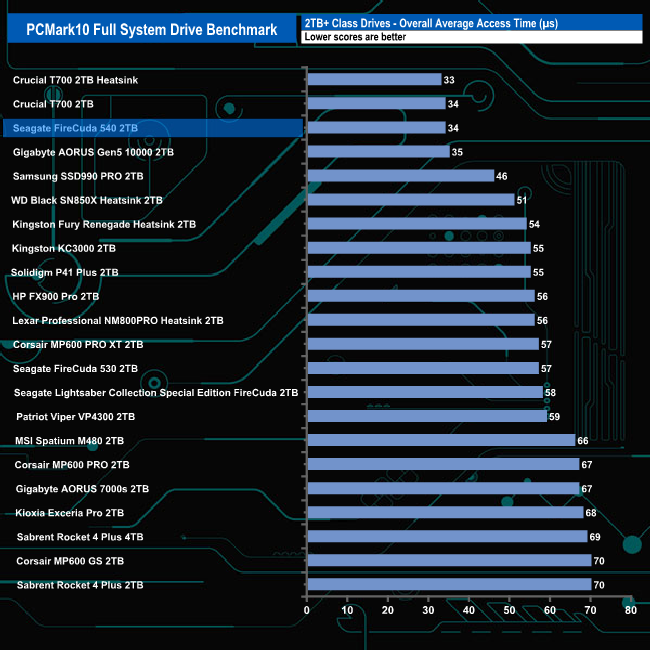
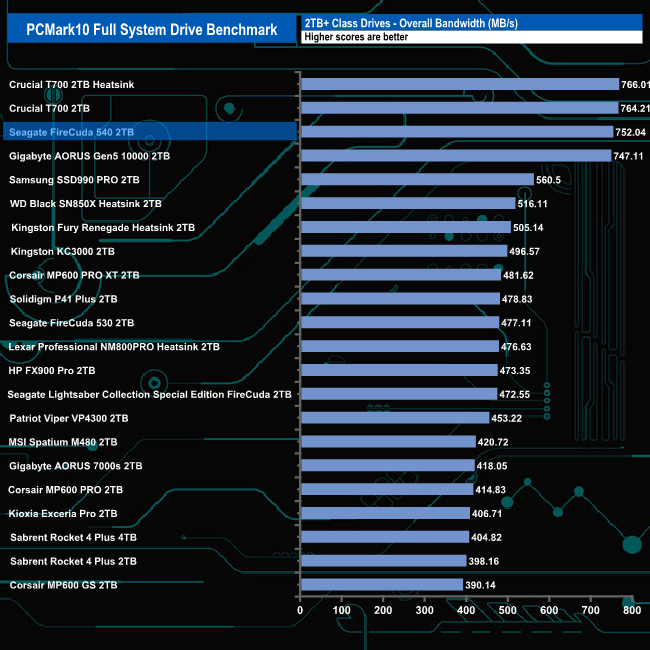
With an overall bandwidth figure of 752MB/s, the Seagate FireCuda 540 slots into the third spot on the results chart.
The 3DMark Storage Benchmark uses traces recorded from popular games and gaming-related activities to measure real-world gaming performance.
Traces used –
Battlefield V
Loading Battlefield™ V from launch to the main menu.
Call of Duty Black Ops 4
Loading Call of Duty®: Black Ops 4 from launch to the main menu.
Overwatch
Loading Overwatch® from launch to the main menu.
Game Move
Copying the Steam folder for Counter-Strike®: Global Offensive from an external SSD to the system drive.
Game Recording
Recording a 1080p gameplay video at 60 FPS with OBS (Open Broadcaster Software) while playing Overwatch®.
Installing Game
Installing The Outer Worlds® from the Epic Games Launcher.
Game Saving
Saving progress in The Outer Worlds game.
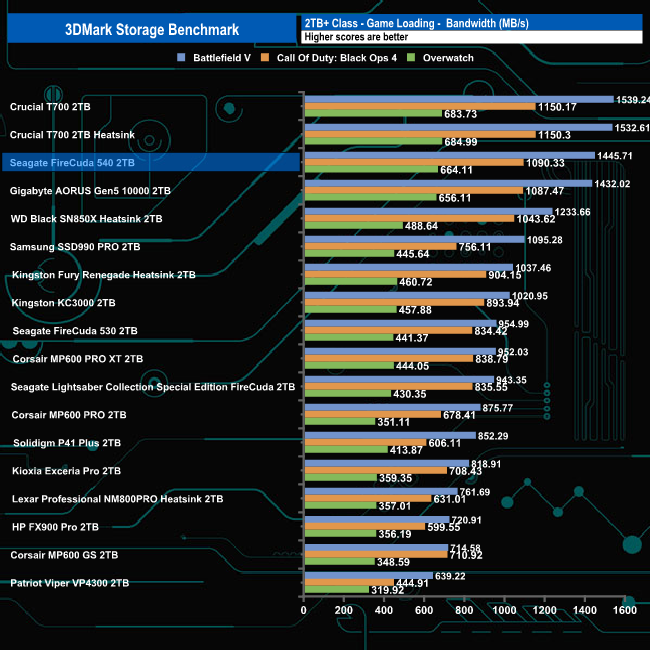
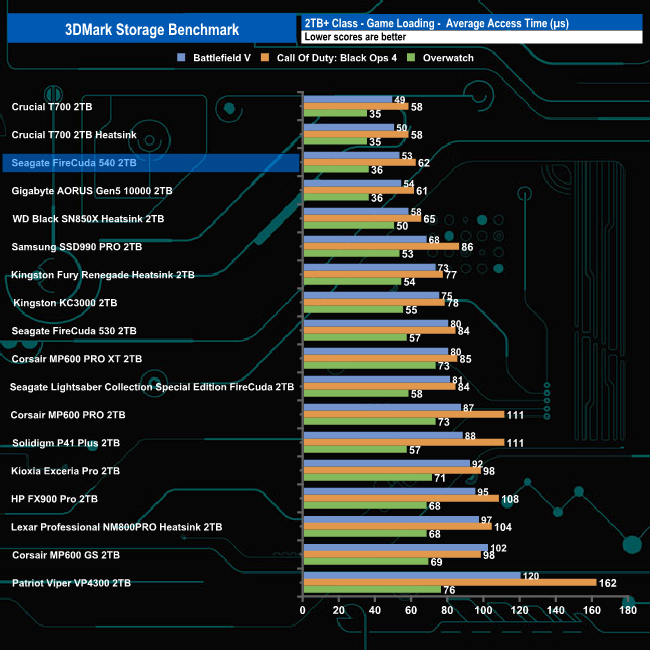
In 3DMark’s Storage Test, the FireCuda 540 had an average game loading bandwidth figure for the three games of 1,066MB/s with an average access time of 50µs.
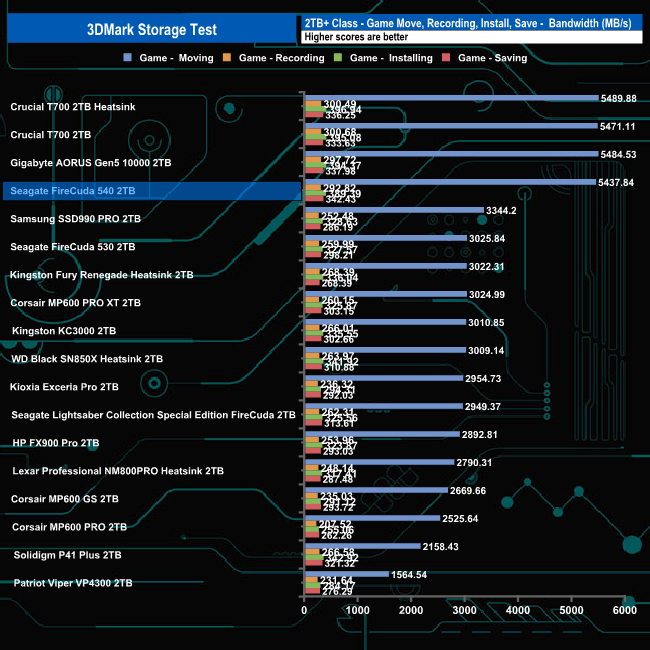
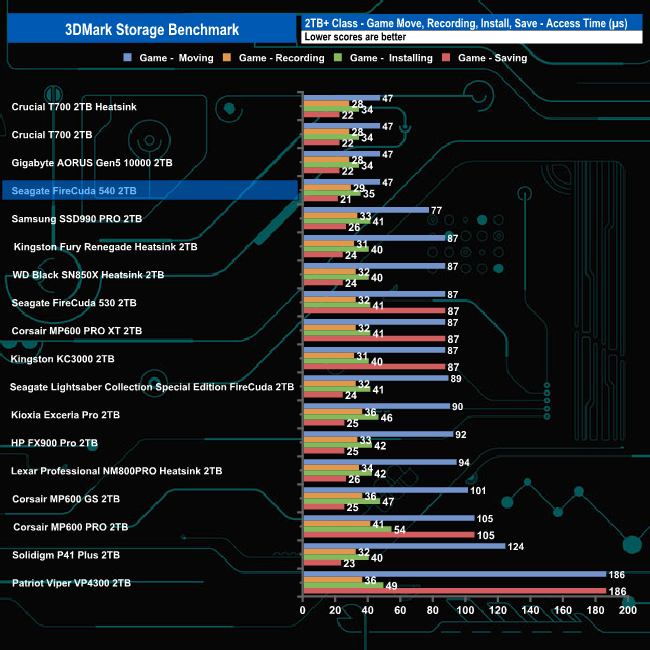
In the game moving, recording, installing and saving test traces the drive averaged 1,615.62MB/s with an average access time of 33µs for the four tests.
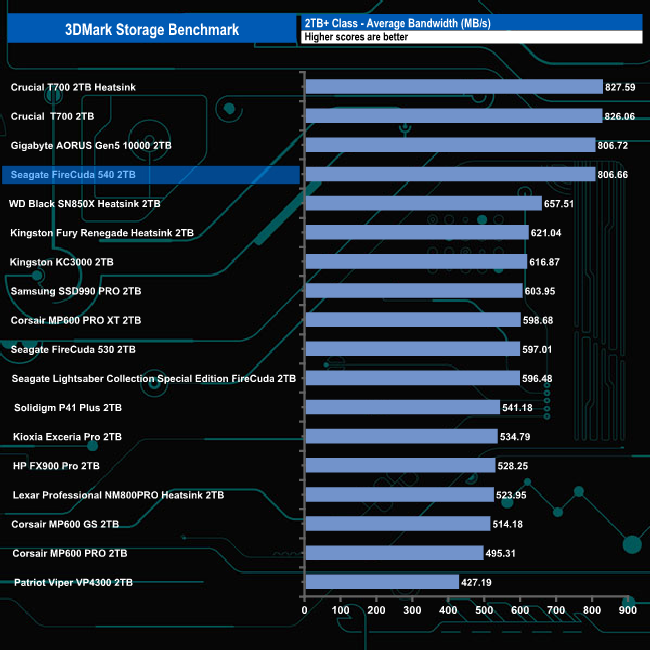
The average bandwidth for the 2TB Seagate FireCuda 540 for the complete benchmark run was 806.66MB/s.
The Final Fantasy XIV Endwalker Official Benchmark uses actual maps and playable characters to assign a score to your PC and rate its performance including scene loading times.
The benchmark gives an overall load time as well as loading times by scene.
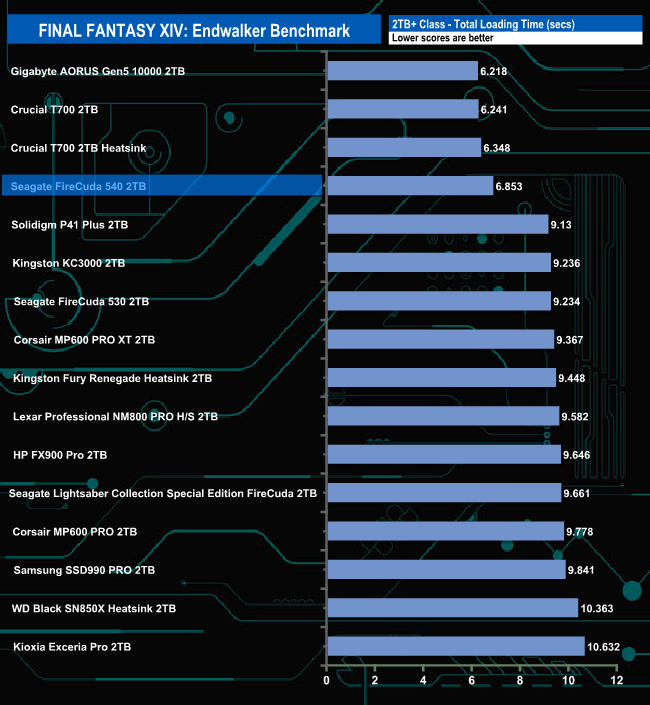


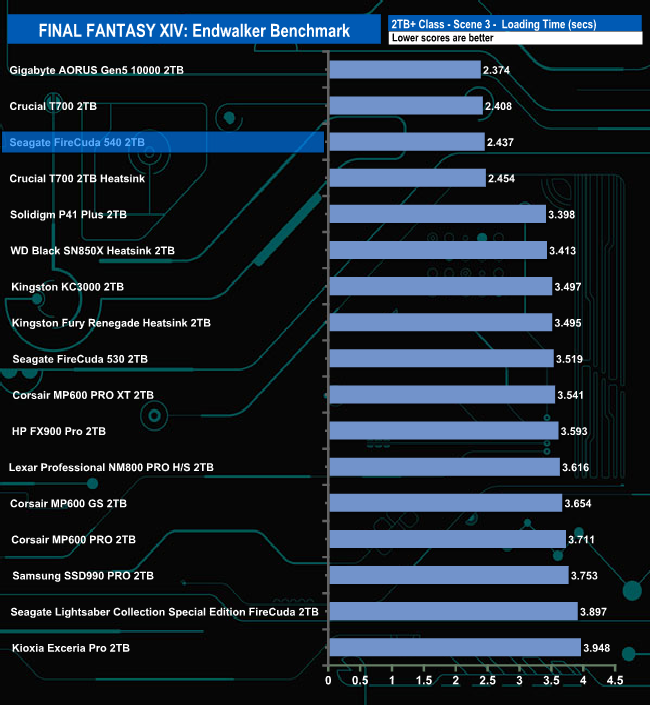
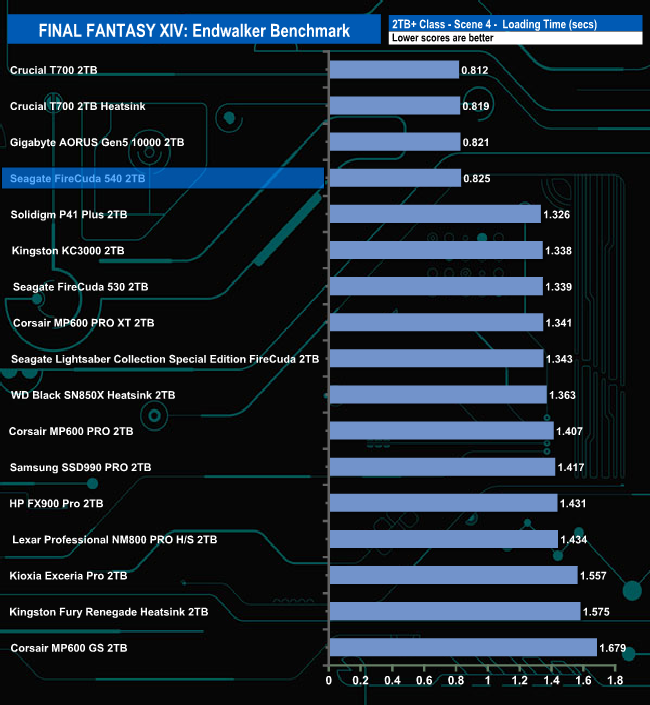
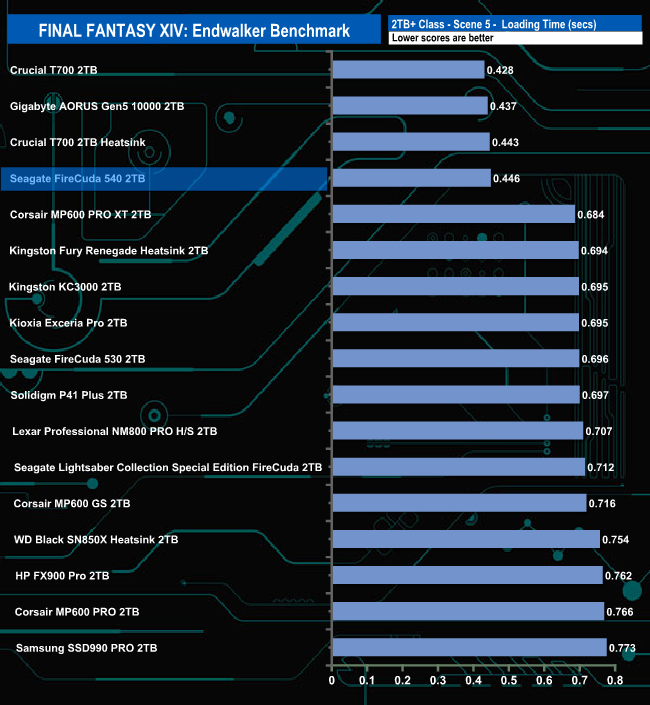
The Seagate FireCuda 540 does well enough in the Final Fantasy XIV Endwalker Official Benchmark. It doesn't top any of the results charts and indeed, oddly, it sits near the bottom of the Scene 1 load time chart but sits in fourth place in the overall load time chart.
We took note of the drive’s temperature during some of our benchmarking runs.
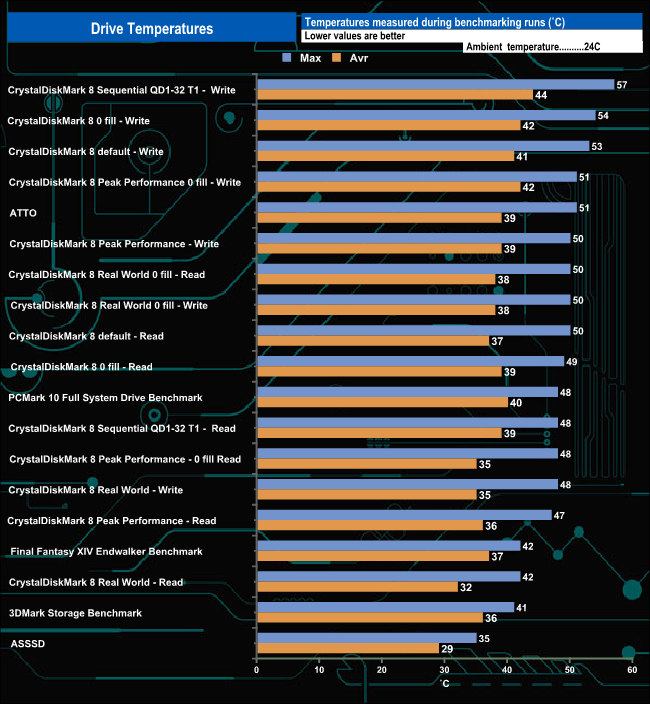
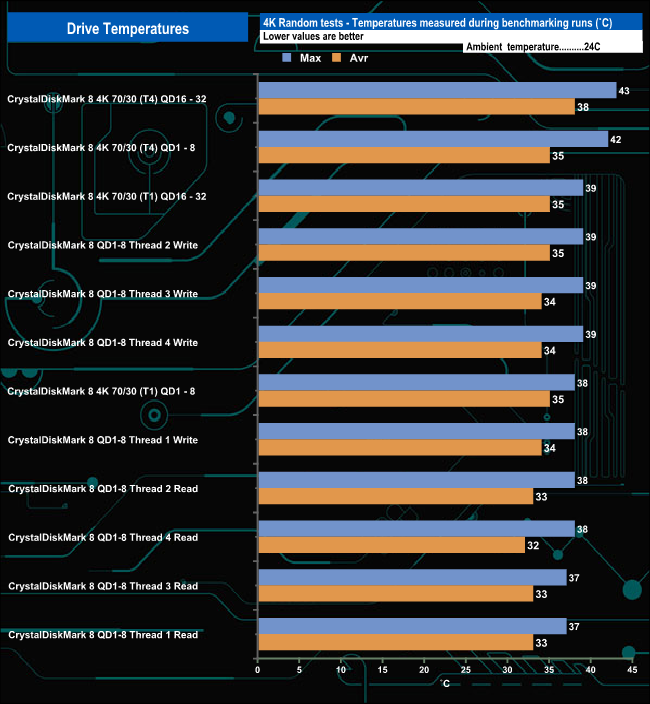
Seagate's FireCuda 540 comes without any form of heatsink and therefore must be used with a third-party heatsink or a motherboard cooling solution to stop the drive throttling back or worse still thermally shutting down if it gets too hot. We did our testing using the built-in heatsink on our Gigabyte AORUS X670E Xtreme motherboard.
During our benchmarking runs, the hottest the drive got was 57° C during CrystalDiskMark 8 Sequential QD1-32 T1 Write test, which is only 13°C away from the maximum operating temperature of 70°C, a wee bit too close for comfort. For the non-4 K tests the drive averaged 48.10°C while for the 4K-based tests, the average was 45.41°C.
To test the real-life performance of a drive we use a mix of folder/file types and by using the FastCopy utility (which gives a time as well as MB/s result) we record the performance of drive reading from & writing to a 2TB Kingston KC3000.
Transfer Details
Windows 10 backup – 118GB.
Data file – 100GB.
BluRay Movie – 42GB.
Windows 11 iso – 5.4GB.
File folder – 50GB – 28,523 files.
Steam folder – 222GB (8 games: Alien Isolation, Battlefield 4, BioShock Infinite, Crysis 3, Grand Theft Auto V, Shadow Of Mordor, Skyrim, The Witcher3 Wild Hunt).
Movie demos 8K – 21GB – (11 demos).
Raw Movie Clips 4K – 16GB – (9 MP4V files).
Movie folder – 12GB – 15 files – (8 @ .MKV, 4 @ .MOV, 3 @ MP4).
Photo Folder – 10GB – 304 files – (171 @ .RAW, 105 @ JPG, 21 @ .CR2, 5 @ .DNG).
Audio Folder – 10GB – 1,483 files – (1479 @ MP3, 4 @ .FLAC files).
Single large image – 5GB – 1.5bn pixel photo.
3D Printer File Folder – 4.25GB – (166 files – 105 @ .STL, 38 @ .FBX, 11 @ .blend, 5 @ .lwo, 4 @ .OBJ, 3@ .3ds).
AutoCAD File Folder – 1.5GB (80 files – 60 @ .DWG and 20 @.DXF).
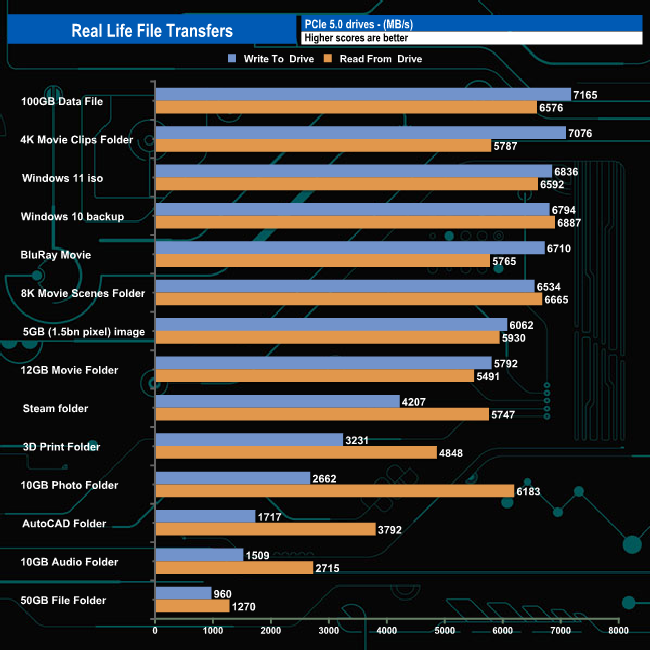
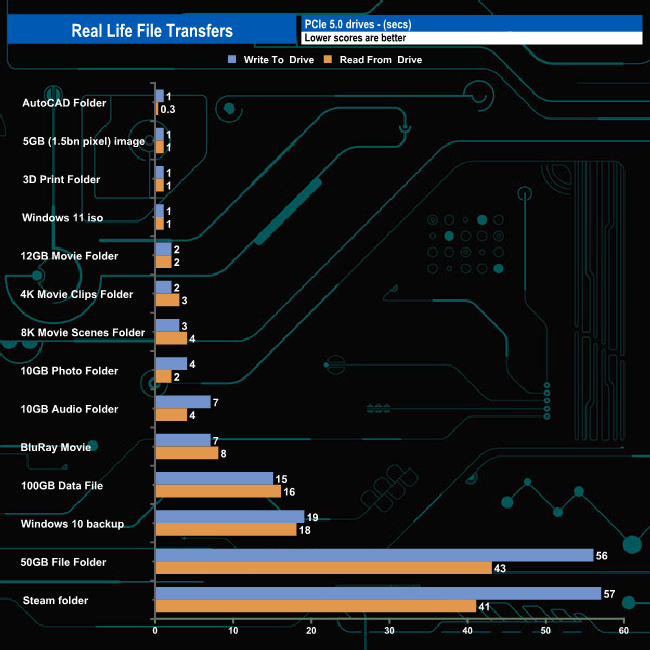
The drive averaged 4,803MB/s when writing the 14 transfer tests, with the fastest being the 7,165MB/s for the 100GB Data file transfer and the slowest being the 960MB/s for the 50GB file folder transfer. Reading back the data the average was a bit faster at 5,303MB/s. This time around the fastest transfer was for the Windows 10 backup at 6,887MB/s while the slowest was once again the 50GB file folder transfer at 1,270MB/s.
The latest SSD drive from storage giants Seagate is their first Gen 5 offering, the FireCuda 540. The drive takes over flagship duties from the Gen 4 FireCuda 530 and is, needless to say, (at the time of writing) the fastest Seagate consumer drive.
Seagate's FireCuda 540 uses the same controller/NAND combination as the other three Gen 5 drives we've tested; Phsion S5026-E26 controller and 232-Layer Micron B58R TLC NAND, with Seagate paying close attention to the controller firmware. The E26 supports NAND data transfer speeds of up to 2,400 MT/s but Seagate have chosen to run the NAND at 1,600MT/s, hence the 10,000MB/s Sequential speed ratings. Running at this speed offers a better balance of performance and thermal control which is especially important as the drive doesn't come with a heatsink.
At launch, the FireCuda 540 range consists of just two models, 1TB and 2TB with a 4TB drive an option some time in the future.
Seagate rates the Sequential performance of the 2TB FireCuda 540 as up to 10,000MB/s for both reads and writes. Using the ATTO benchmark we couldn't quite get to the maximum Sequential figures with test results of 8,960MB/s for reads and 9,500MB/s for writes. Switching over to the CrystalDiskMark 8 benchmark we could confirm the official figure with test results of 10,076MB/s for reads and 10,194MB/s for writes.
As for random performance Seagate quotes figures of up to 1,490K IOPS for reads and up to 1,500K IOPS for writes. Using our normal four-threaded tests we couldn't get close to these figures with test results of 512,320 IOPS and 487,369 IOPS for reads and writes respectively. Once again switching to the CrystalDiskMark 8 benchmark confirms the official figures. Using the Peak Performance profile we saw a best test result of 1,493,269 IOPS for reads and 1,675,256 IOPS for writes.
One thing to remember if using this drive is that it needs some form of motherboard cooling or dedicated heatsink. There is a warning sticker on the back of the box on this very point.
Seagate has used its experience in the enterprise SSD sphere to provide the FireCuda 540 with class-leading endurance figures. The 2TB drive has a 2,000TB TBW (works out a rewriting 1TB of data for the length of the 5-year warranty) rating which is 600TBW more than its nearest competitor. Not only does Seagate back the drive with a 5-year warranty you also get three years of their Rescue Data Recovery Services.
We found the 2TB Seagate FireCuda 540 on Overclockers for £299.99 (inc VAT) HERE

Discuss on our Facebook page HERE.
Pros
- Fast performance.
- Rescue Data Recovery Services included.
- Endurance.
Cons
- Needs a PCIe 5.0 M.2 slot to get the best out of it.
- Some form of extra cooling is required.
KitGuru says: Seagate's new flagship consumer SSD is a fast-performing drive that comes with excellent endurance and three years of the company's Rescue Data Recovery Services bundled with it. Just remember it needs some form of cooling to keep it happy.