KitGuru KitGuru.net – Tech News | Hardware News | Hardware Reviews | IOS | Mobile | Gaming | Graphics Cards


It's been a while since I last looked at a prebuilt system, but the PCSpecialist Topaz Spark has certainly caught my eye. This gaming PC ships with a six-core Zen 4 CPU, RX 6700 graphics, 32GB DDR5 memory and a 750W 80+ Gold power supply – all for £999. Surely it's too good to be true? We put this system through its paces to find out…

Specification:
- Case: CORSAIR 3000D AIRFLOW MID TOWER GAMING CASE
- Processor (CPU): AMD Ryzen 5 7500F Six Core CPU (3.7GHz-5.0GHz/38MB CACHE/AM5)
- Motherboard: ASUS® PRIME B650-PLUS (DDR5, USB 3.2, 6Gb/s) – ARGB Ready!
- Memory (RAM): 32GB Corsair VENGEANCE RGB DDR5 6000MHz (2 x 16GB)
- Graphics Card: 10GB AMD RADEON™ RX 6700 – HDMI, DP – DX® 12
- 1st M.2 SSD Drive: 1TB SOLIDIGM P41+ GEN 4 M.2 NVMe PCIe SSD (up to 4125MB/s R, 2950MB/s W)
- Power Supply: CORSAIR 750W RMe SERIES™ MODULAR 80 PLUS® GOLD
- Power Cable: 1 x 1.5 Metre UK Power Cable (Kettle Lead)
- Processor Cooling: PCS FrostFlow 100 V3 Series High Performance CPU Cooler
-
WIRELESS INTEL® WI-FI 6E AX210 2,400MBPS/5GHZ, 300MBPS/2.4GHZ PCI-E CARD + BT 5.0
- Windows 11 Home 64 Bit – inc. Single Licence [KK3-00027]
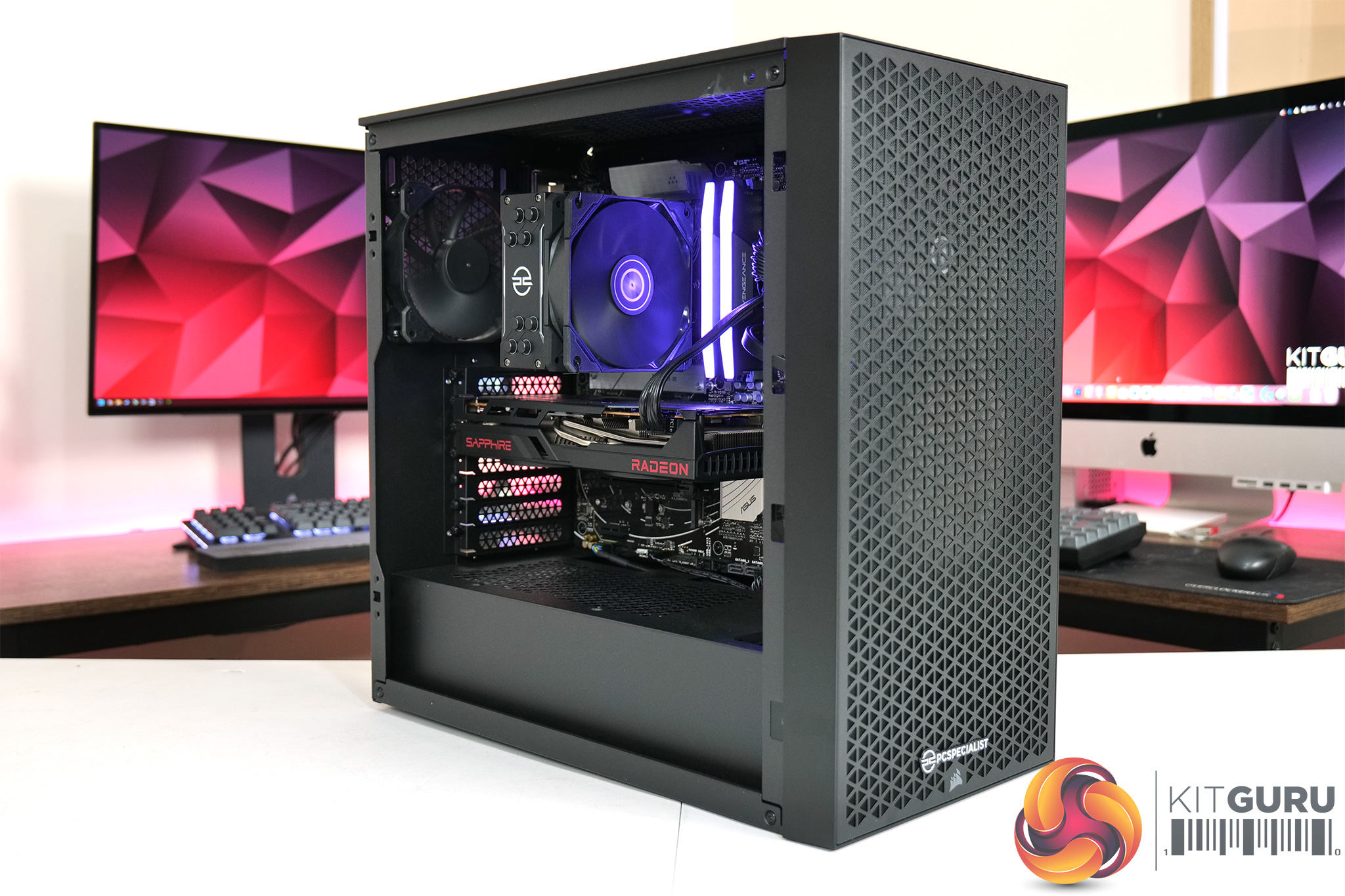
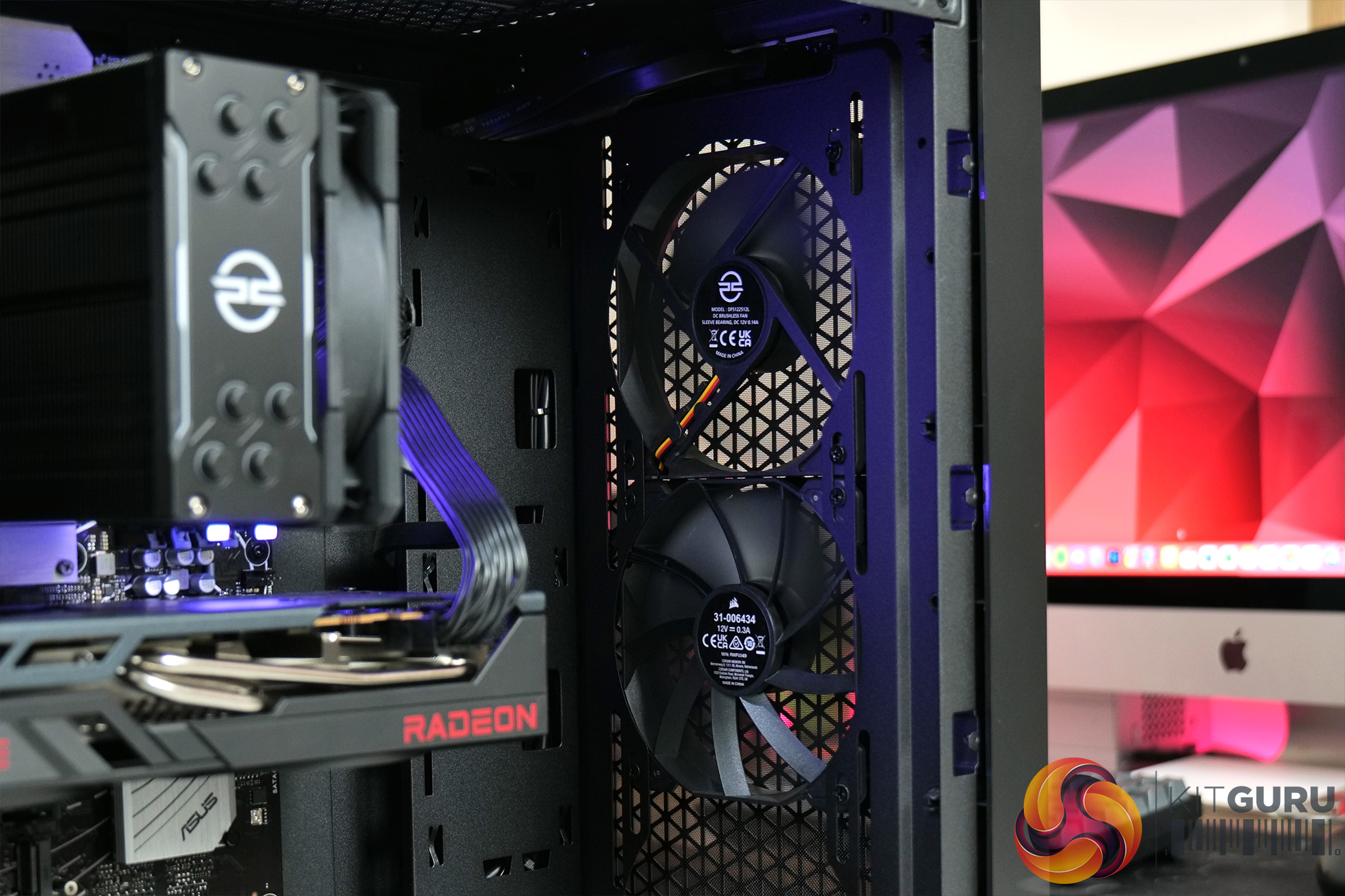
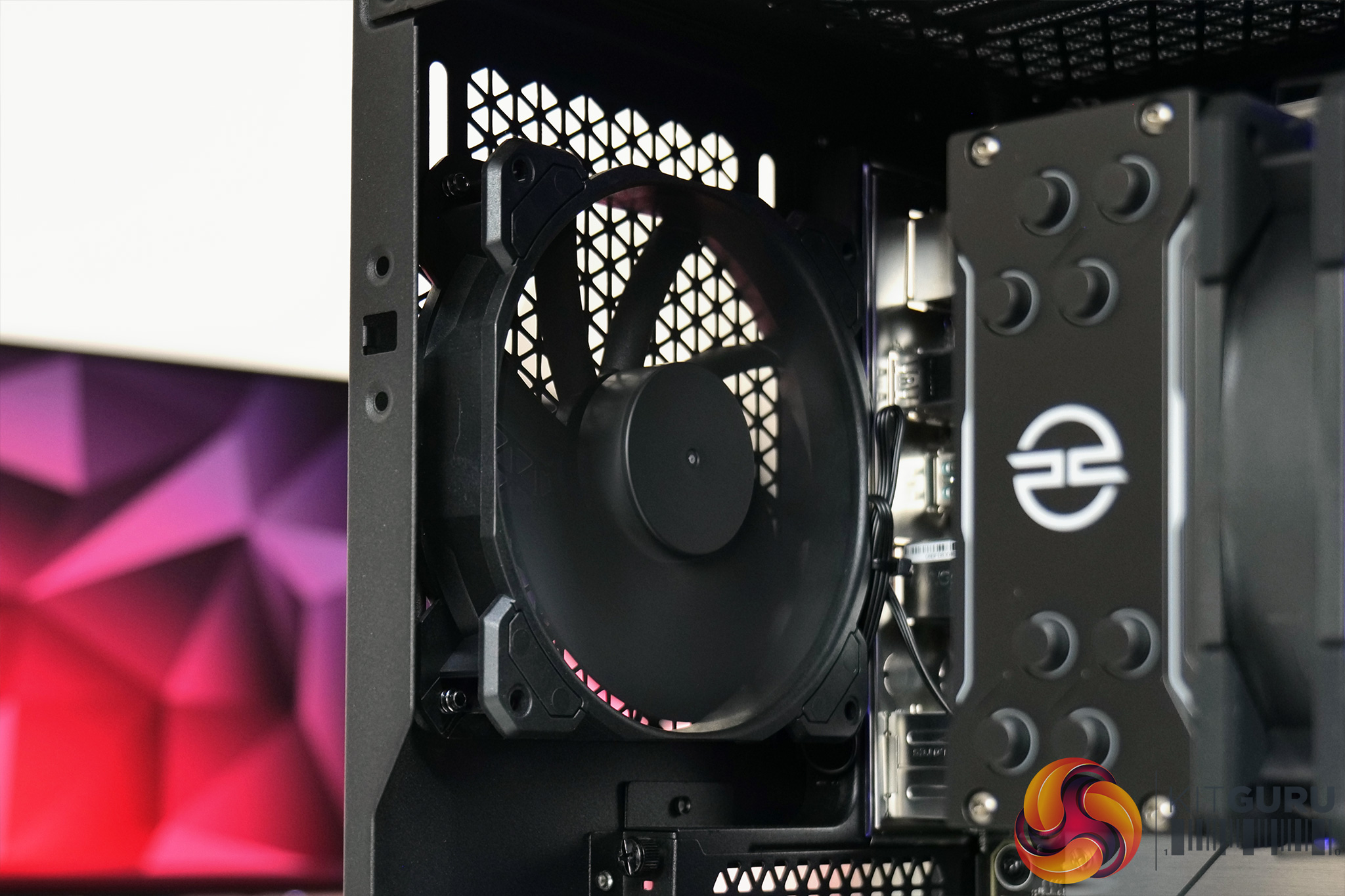
Taking a closer look at the system, we start with the Corsair 3000D Airflow case. We've not reviewed this one but it's an affordable, compact mid-tower with a tempered glass side panel and vented front panel so we shouldn't have any concerns about airflow. PCSpecialist has fitted two 120mm fans in the front acting as intakes, while there's a single 120mm in the rear acting as exhaust, with some assistance provided by the 120mm CPU air cooler.
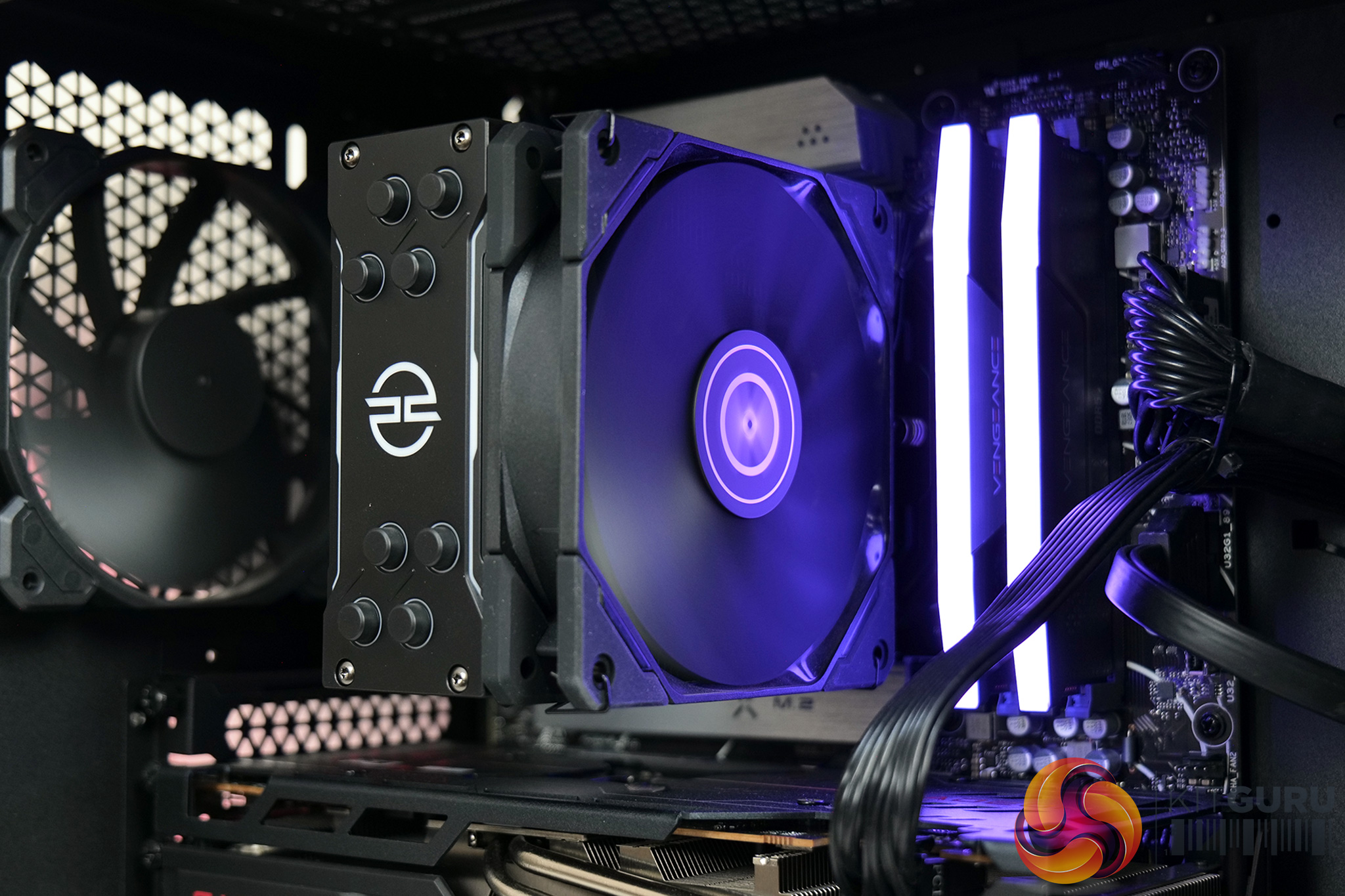
The CPU itself is a new one to KitGuru, as we've got the Ryzen 5 7500F. This is essentially a Ryzen 5 7600X, offering the same 6-core 12-thread configuration, but with slightly shaved down clock speeds and no iGPU. A six-core Zen4 CPU at this price range is certainly appealing so it'll be interesting to see how that performs in our testing. The 7500F is also cooled by a PCSpecialist-branded FrostFlow 100V3 air cooler in our system, but due to stock it will be replaced by a DeepCool AG400 ARGB cooler for any retail purchases. Both are fairly standard-looking 4-heatpipe tower coolers so I have no concerns there but it is worth noting.
Paired with the CPU we find 32GB of Corsair Vengeance DDR5 memory, running at 6000 MT/s. It has to be said the timings aren't the tightest, as this is a CL40 kit, however I think it is hugely impressive to get 32GB at this price point. It's arguably overkill for now, but the longevity this provides is pretty remarkable at the £999 price-point. When we initially spoke to PCSpecialist about taking this review unit they were planning on including a 16GB kit, but told us they could do 32GB for basically the same price – so why not?!
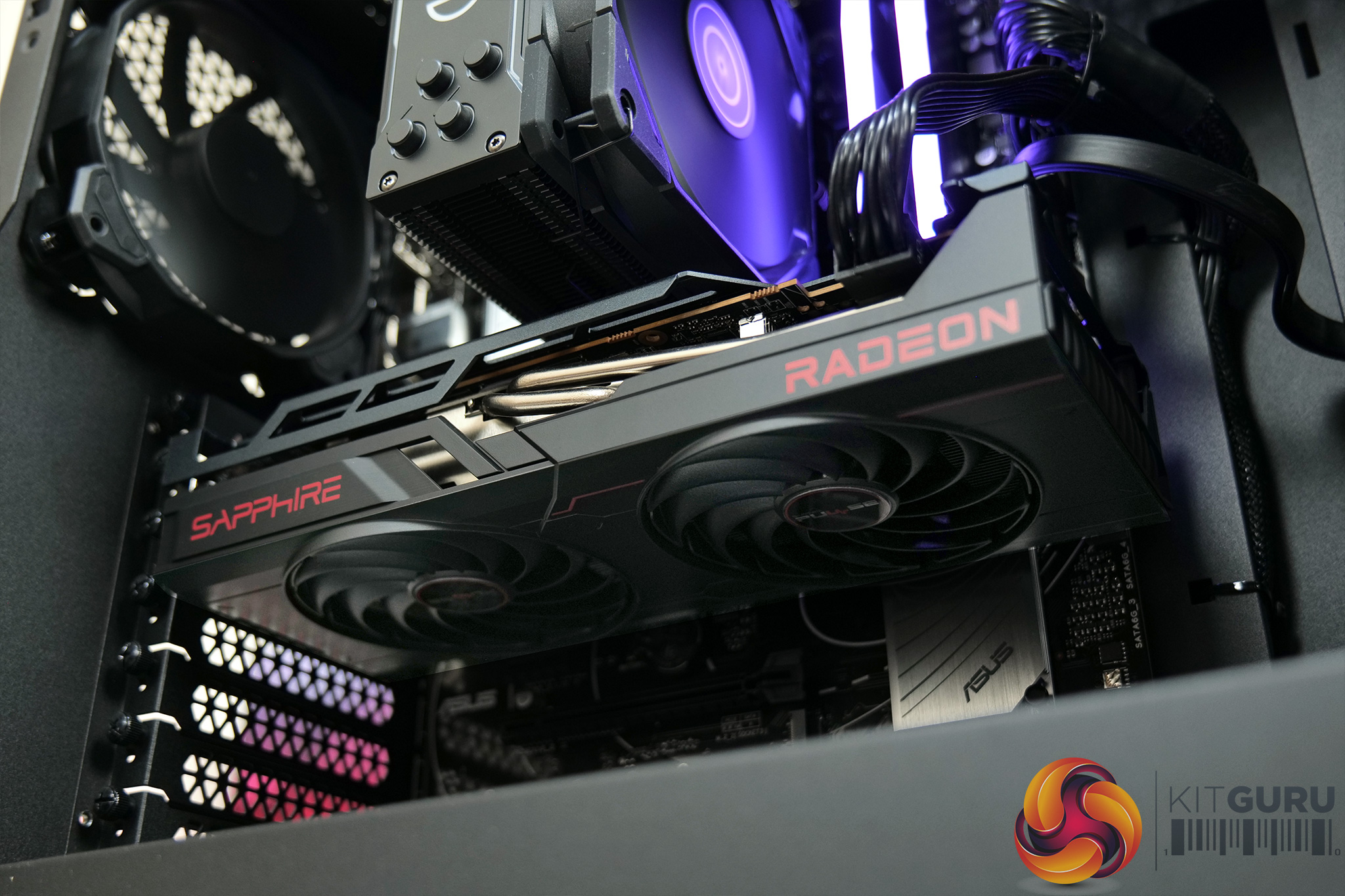
To provide the graphical grunt, PCSpecialist has opted for an AMD Radeon RX 6700, and we have the Sapphire Pulse model to be specific. This isn't the same thing as the RX 6700 XT, it's cut-down in terms of core-count and has 10GB GDDR6 memory, but we're still expecting it to do a very solid job once we get to our game benchmarks.
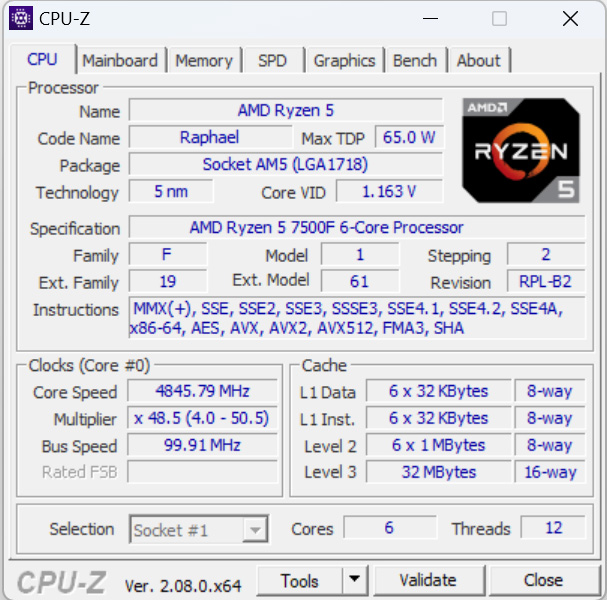
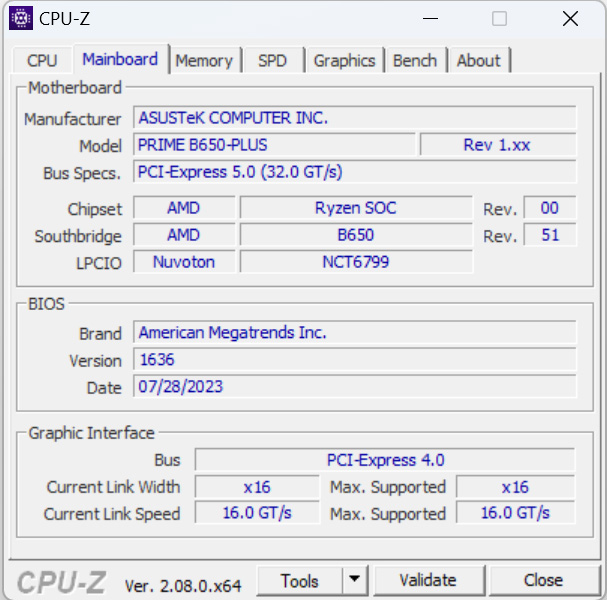
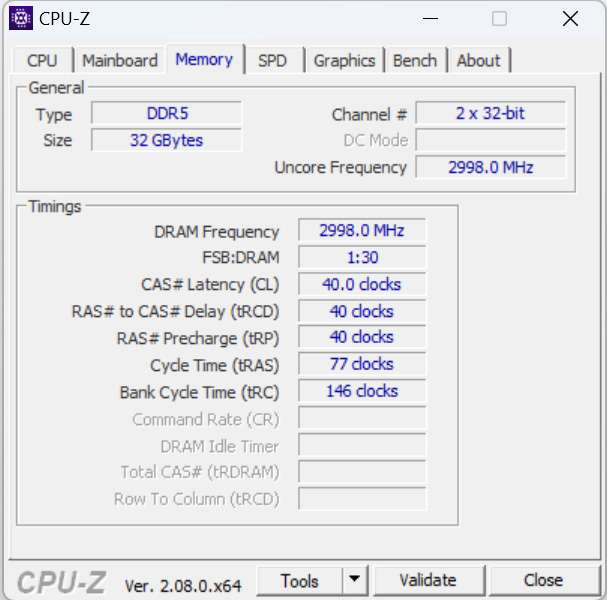
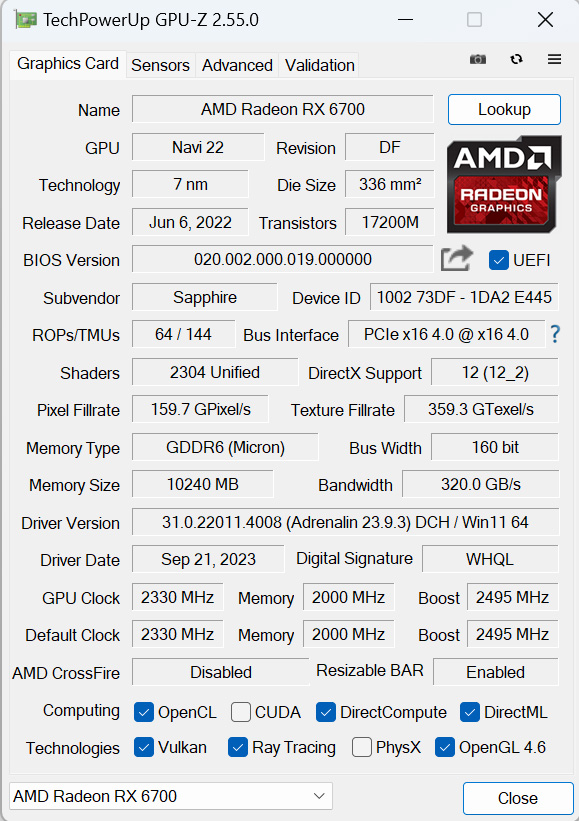
All that hardware is plugged into the ASUS Prime B650-Plus motherboard. We've not reviewed this one but it didn't give me any problems in my testing and taking a quick look into the BIOS shows most things left on Auto, though XMP and ReBar were enabled as we'd expect. The BIOS version isn't the absolute latest, as there was one newer update prior to the system shipping to me, but it was still from August 2023 so we can't knock PCSpecialist too hard there.
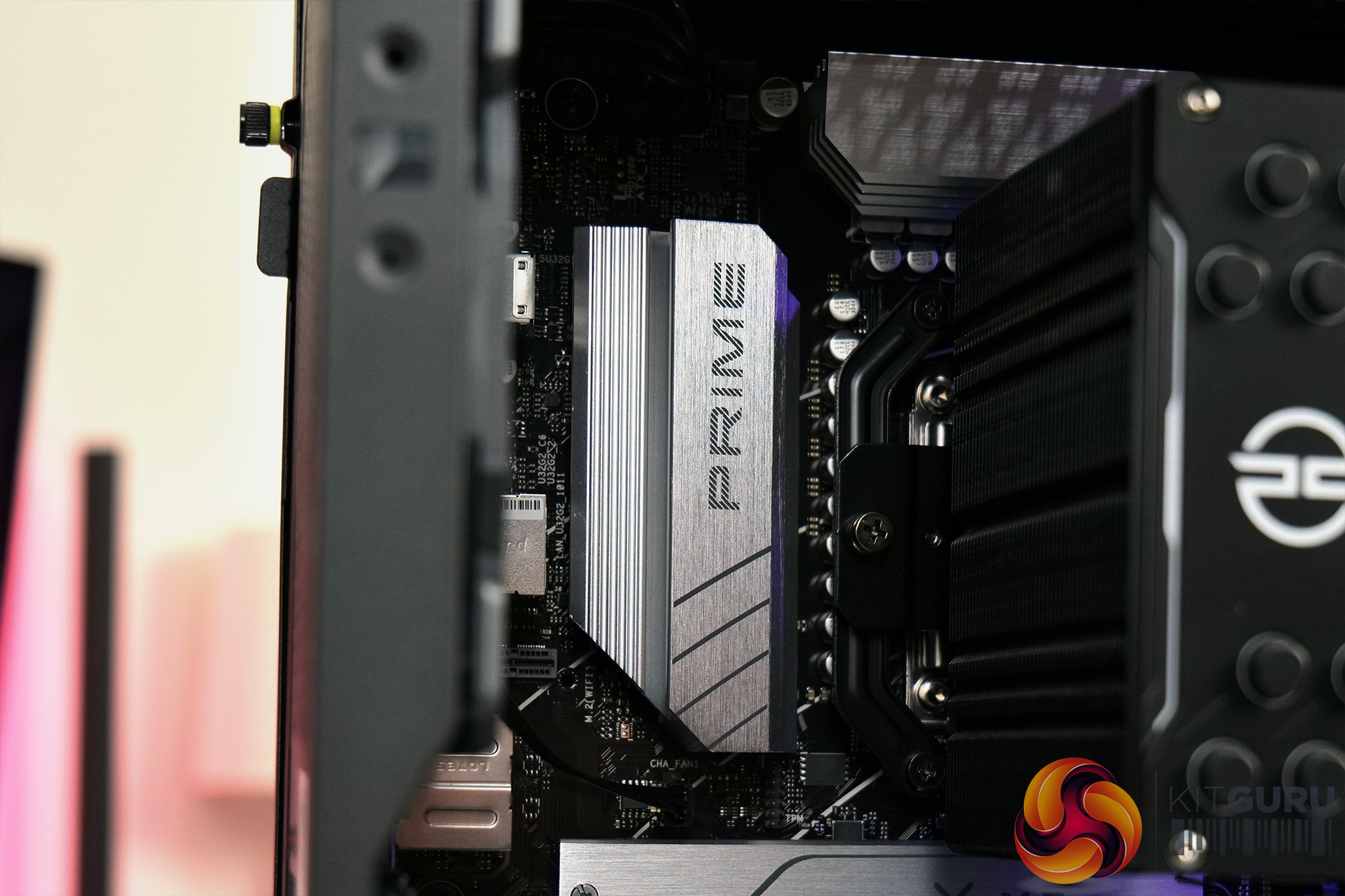
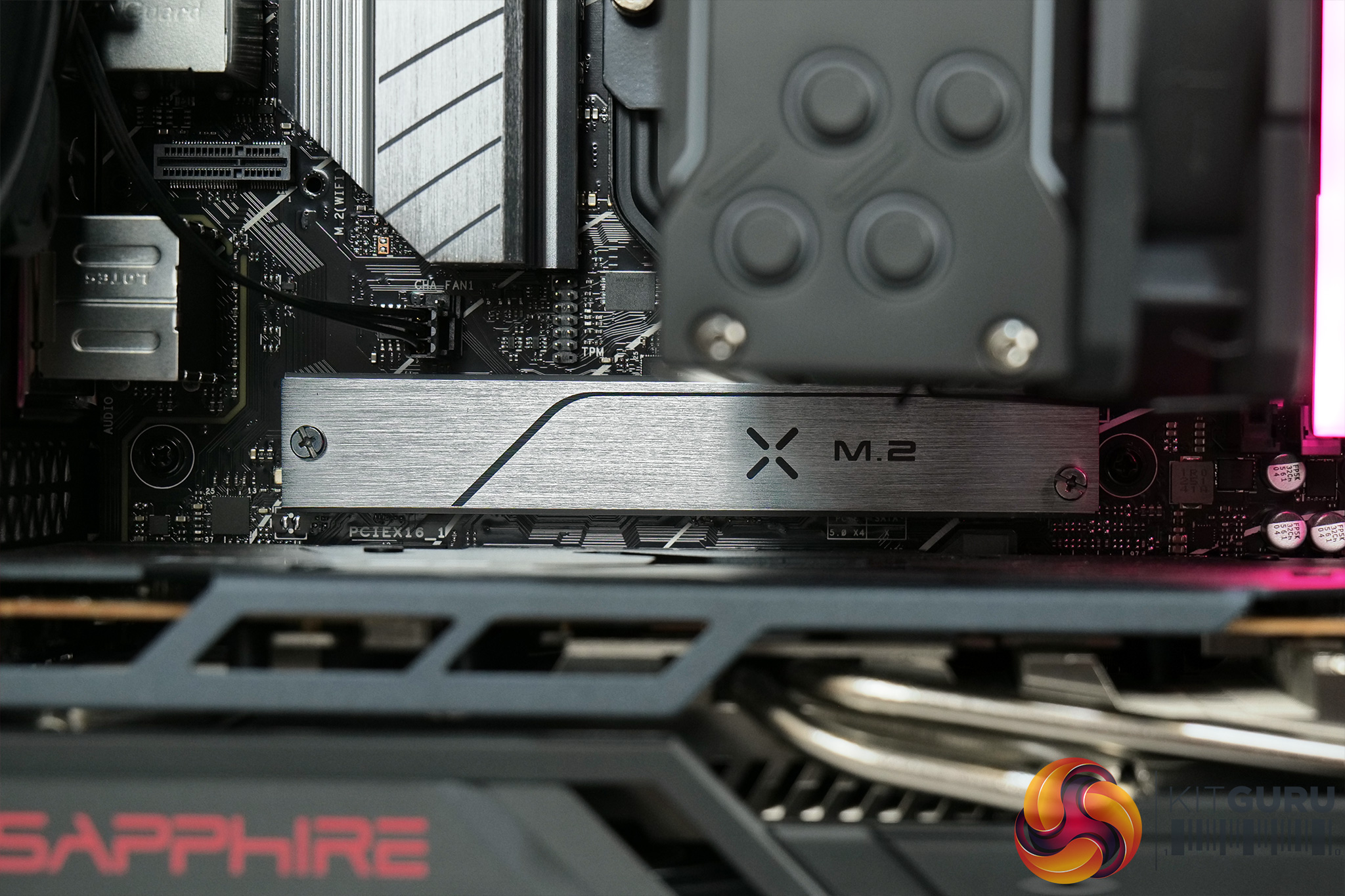
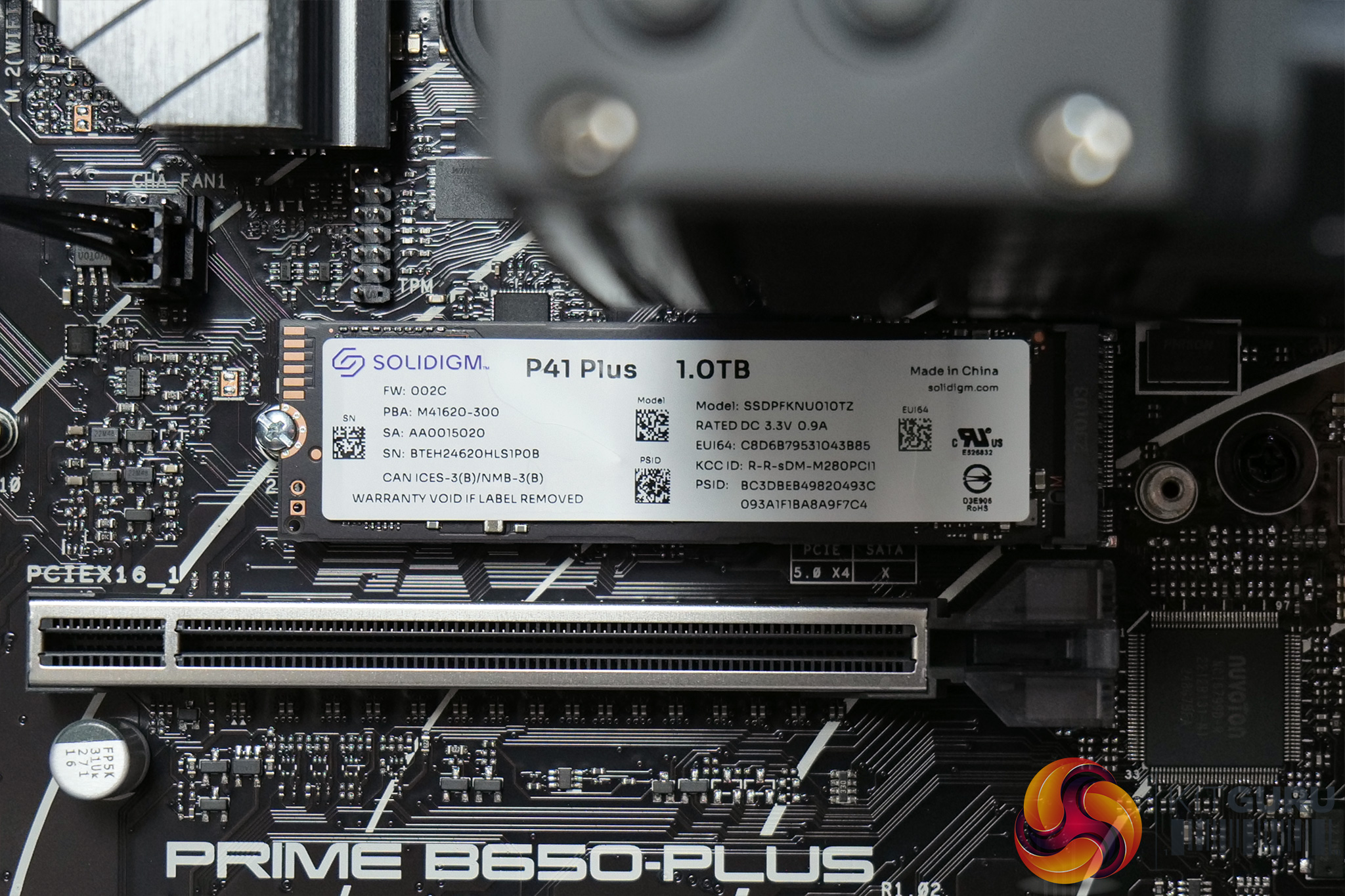
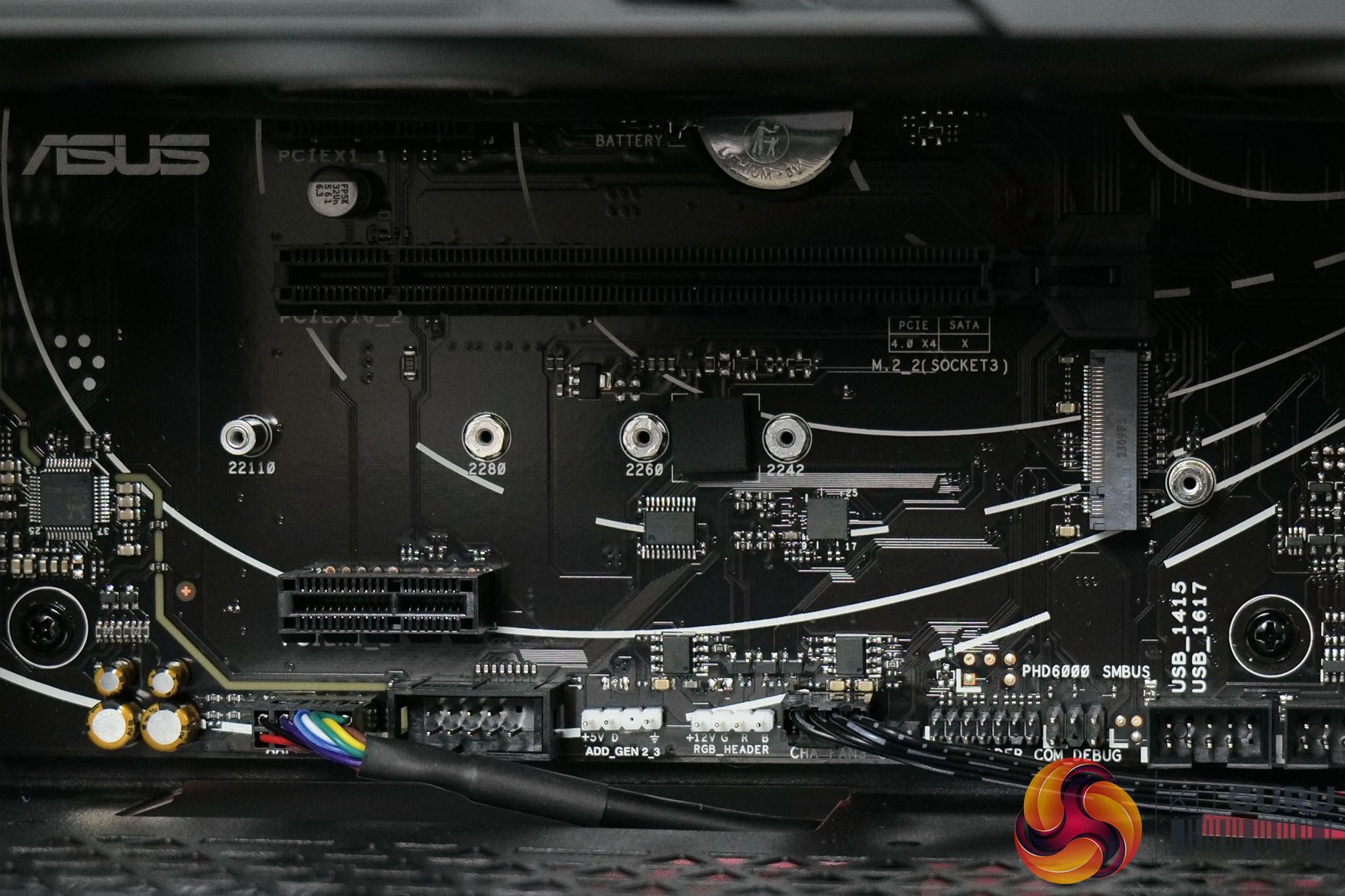
One thing not immediately visible is the SSD. PCSpecialist has opted for a single M.2 drive, and this has been installed in the primary slot underneath the integrated heatsink. Specifically we have a 1TB Solidigm P41 Plus that we have reviewed in the past. It's not the fastest drive in the world, but it will get the job done. That is the only drive in the system though, and with the sizes of current games, 1TB won't get you too far these days – but we appreciate there are some limitations with the £999 price tag. The good news is another M.2 slot is very easily accessible just underneath the graphics card, and this operates at PCIe 4.0 x4 speed, so adding another 1 or 2TB drive down the line would be a doddle.
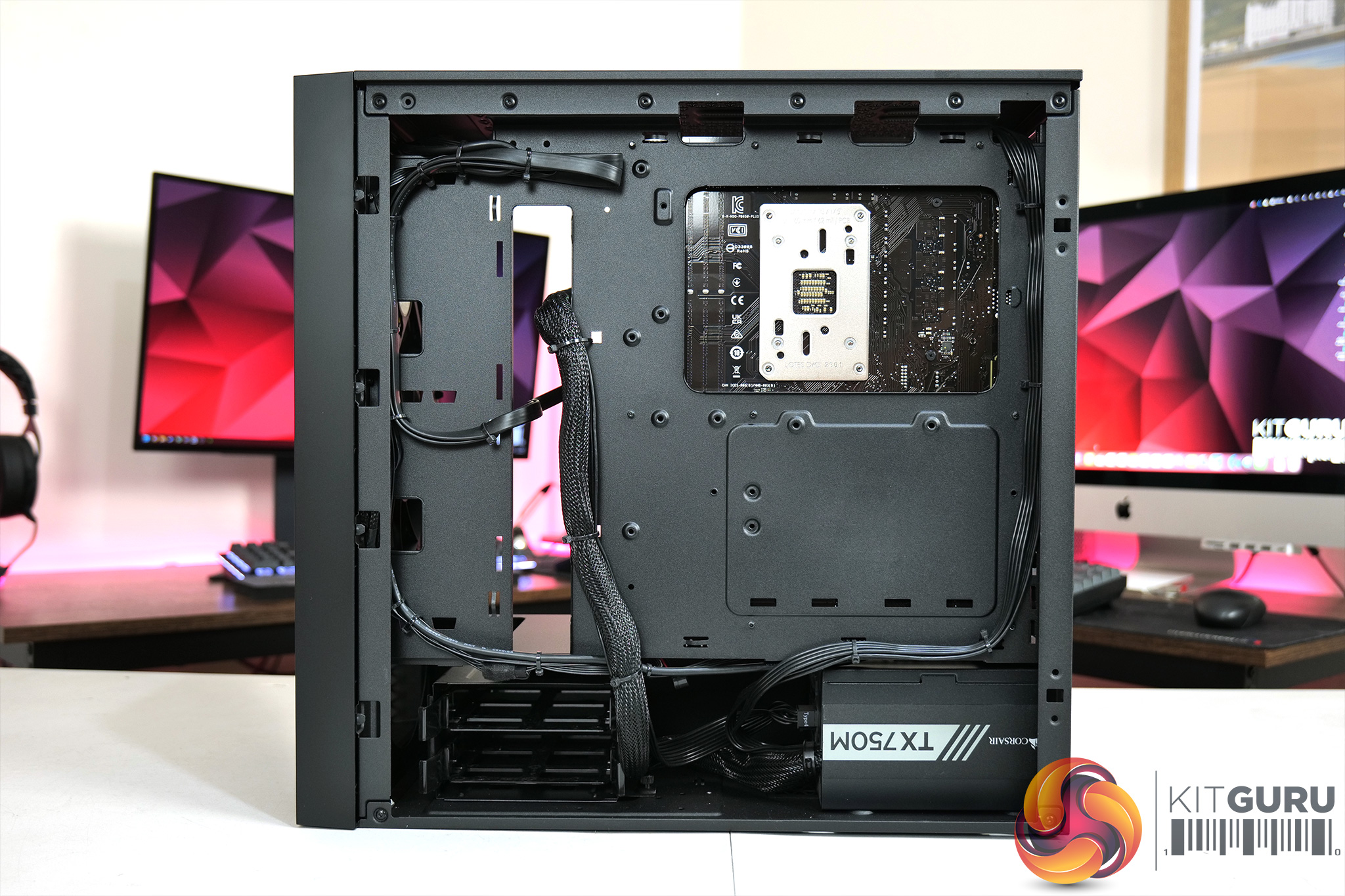
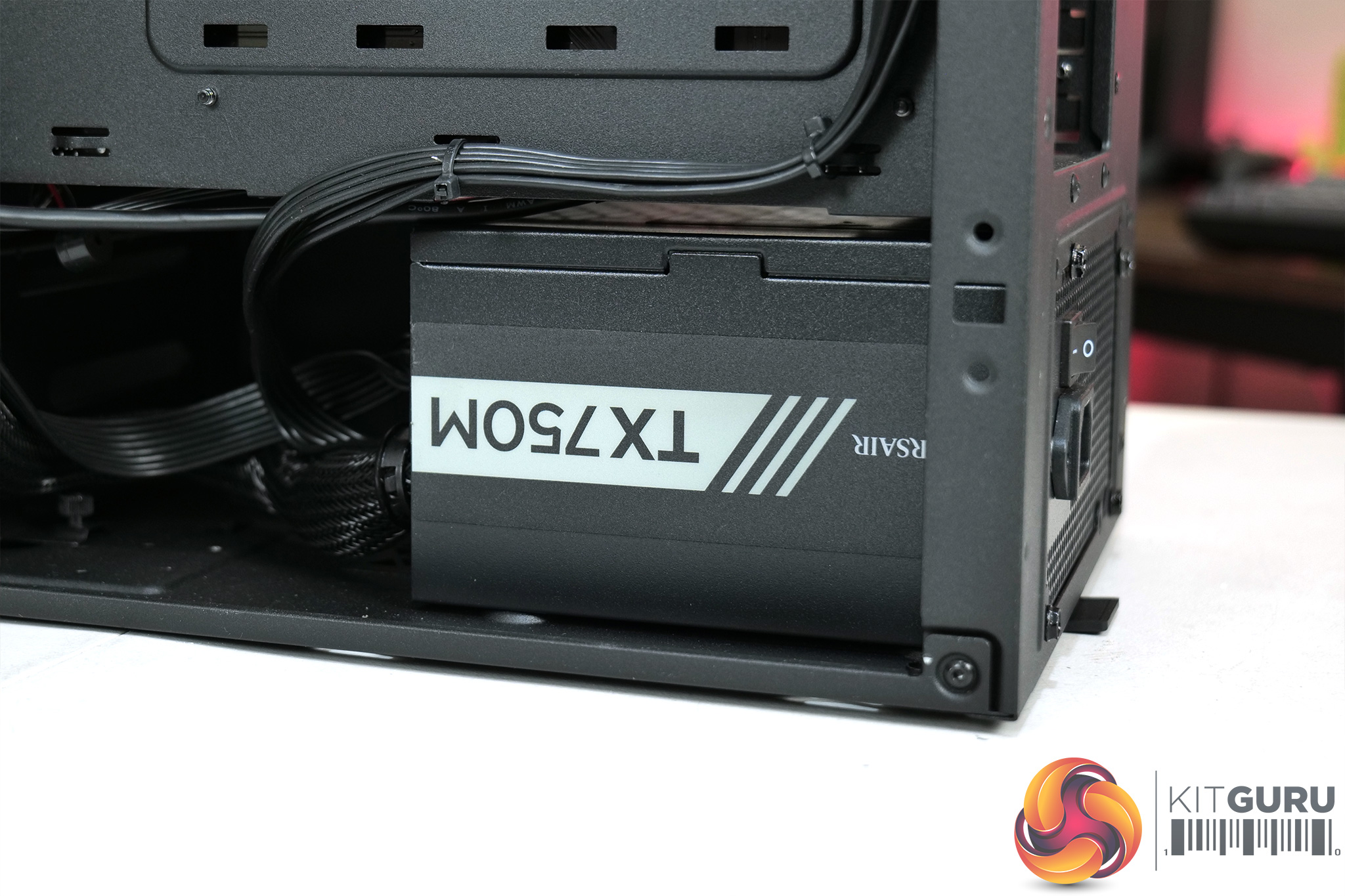
Round the back of the case we can get a look at the power supply, a Corsair 750TXm semi-modular 80+ Gold unit. As it happens, the final spec of this system will actually be changed to a Corsair RMe series due to low stock of the TXm model, but that's actually an upgrade – PCSpecialist is clearly not skimping here, 80+ Gold efficiency is great at this price-point and 750W is more than enough for the current spec and will carry forward if you upgrade the CPU and GPU down the line, so I'd say it's a very shrewd move.
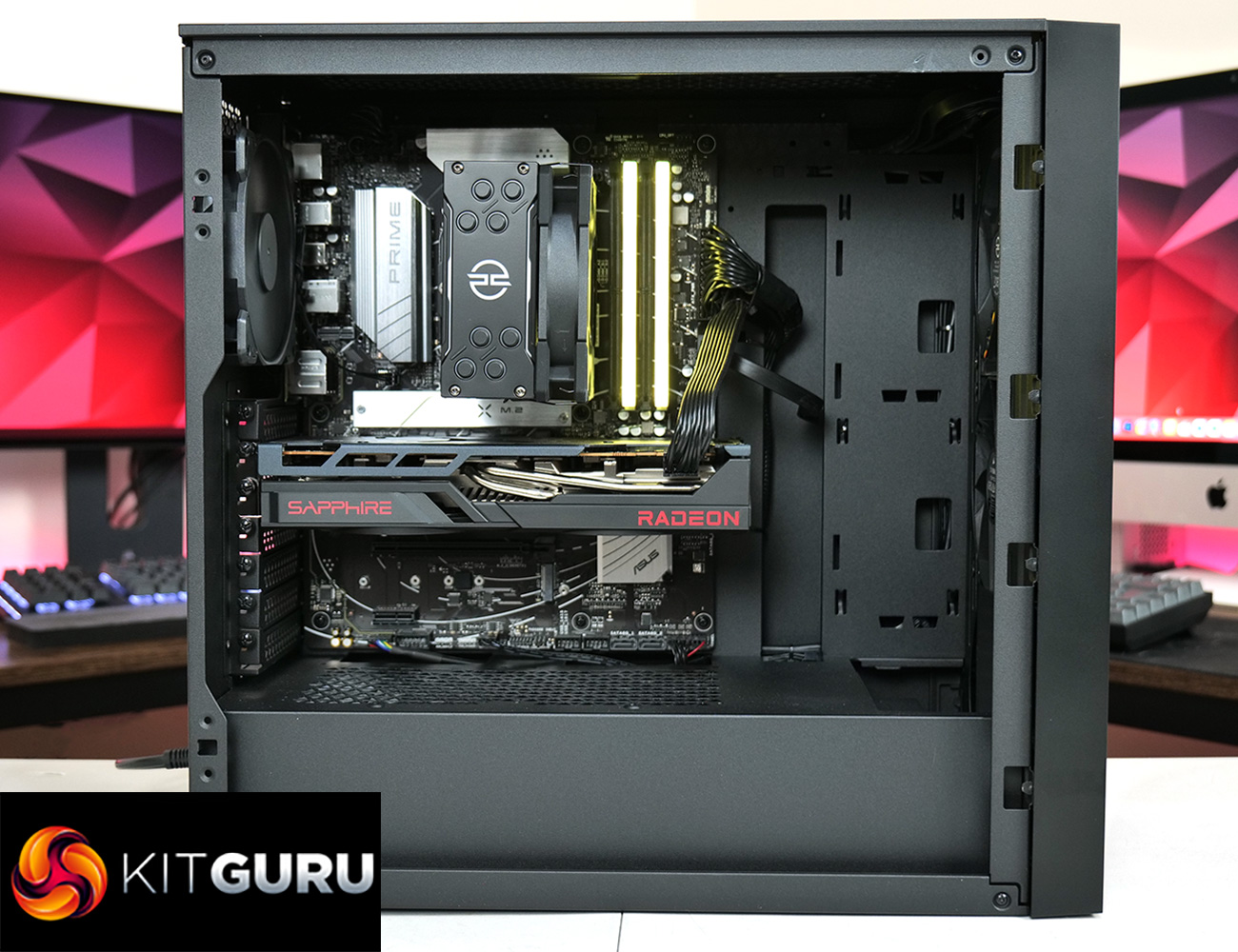
General cable management is fantastic as well. We can see everything has been tied neatly down behind the motherboard tray and nothing looks unsightly, while the GPU and motherboard 24-pin cables round the front have been tied together and tucked away as best as possible. I can't fault the overall build in general – nothing fell loose in transit, no cables were left unplugged or anything like that, it was a flawless setup experience.
The only other point to mention is relatively minor but if you like a bit of an RGB light show with your PC, the Topaz Spark won't float your boat – the only bit of lighting in the entire system comes from the RGB memory, so for the most part it looks pretty dark and stealthy. Some may like that, some may not, but that's what PCSpecialist has opted for.
Software and Games
To test the PCSpecialist Magnus Supreme, we used the following software/games:
- 3DMark Time Spy
- AIDA64 Engineer
- Cinebench R23
- CrystalDiskMark
- PCMark 10
- Cyberpunk 2077
- F1 23
- Forza Horizon 5
- Horizon Zero Dawn
- The Last of Us Part 1
- Ratchet and Clank: Rift Apart
- Resident Evil 4
- Spider-Man: Miles Morales
- Shadow of the Tomb Raider
- Starfield
We used the AMD Adrenalin 23.9.3 driver, which was the latest at the time of testing.
Comparison Systems
Not every system below is compared against the Topaz Spark in every benchmark, but where applicable we have used the following systems as a point of reference:
- PCS P209 ARGB MID TOWER CASE
- Intel® Core™ i5 Six Core Processor i5-12400F (2.5GHz)
- ASUS® PRIME B660-PLUS D4 (DDR4, USB 3.2, 6Gb/s)
- 16GB Corsair VENGEANCE DDR4 3200MHz (2 x 8GB)
- 8GB AMD RADEON™ RX 6600 – HDMI, DP – DX12
- 1TB PCS PCIe M.2 SSD (2200 MB/R, 1500 MB/W)
- CORSAIR 550W TXm SERIES™ SEMI-MODULAR 80 PLUS® GOLD
- PCS FrostFlow 100 RGB V3 Series High Performance CPU Cooler
- 1x 120mm Black Case Fan
- WIRELESS INTEL® Wi-Fi 6 AX200 2,400Mbps/5GHz, 300Mbps/2.4GHz PCI-E CARD + BT 5.0
- Windows 11 Home 64 Bit
We also use some CPU data from Leo's Ryzen 5 5600X3D review, using his test bench setup:
- Processors: AMD Ryzen 5 5600X3D, Ryzen 5 5600X and Ryzen 7 5800X3D
- CPU Cooler: Corsair H150i Elite LCD
- Motherboard: Gigabyte B550 Aorus Master
- Memory: 32GB Corsair Vengeance LPX DDR4-3600 C16
- Graphics card: Gigabyte RTX 4080 16GB
- Power supply: Seasonic Prime PX-1600 ATX 3.0
- SSD: PNY CS3140 M.2 NVMe
- OS: Windows 11
- Processor: AMD Ryzen 5 7600X
- CPU Cooler: Corsair H150i Elite LCD
- Motherboard: Gigabyte X670 Aorus Elite
- Memory: 32GB G.Skill Trident Z5 Neo DDR5-6000 C30
- Graphics card: Gigabyte RTX 4080 16GB
- Power supply: Seasonic Prime PX-1600 ATX 3.0
- SSD: Sabrent Rocket 4.0 M.2 NVMe
- OS: Windows 11
And some of my own data from our GPU reviews has also been used, with the following hardware configuration:
- CPU: Intel Core i9-13900KS
- Motherboard: Gigabyte Z790 Gaming X AX
- Memory: 32GB (2x16GB) Corsair Dominator Platinum RGB DDR5 6000MHz
- Graphics Card: RTX 4060 Ti, RX 6700 XT, RX 6650 XT, RX 5700 XT
- SSD: 4TB Seagate Firecuda 530 Gen 4 PCIe NVMe
- Chassis: Corsair 5000D Airflow Tempered Glass Gaming Case
- CPU Cooler: Corsair iCUE H150i Elite RGB High Performance CPU Cooler
- Power Supply: Corsair 1600W Pro Series Titanium AX1600i Digital Modular PSU
- Operating System: Windows 11 22H2
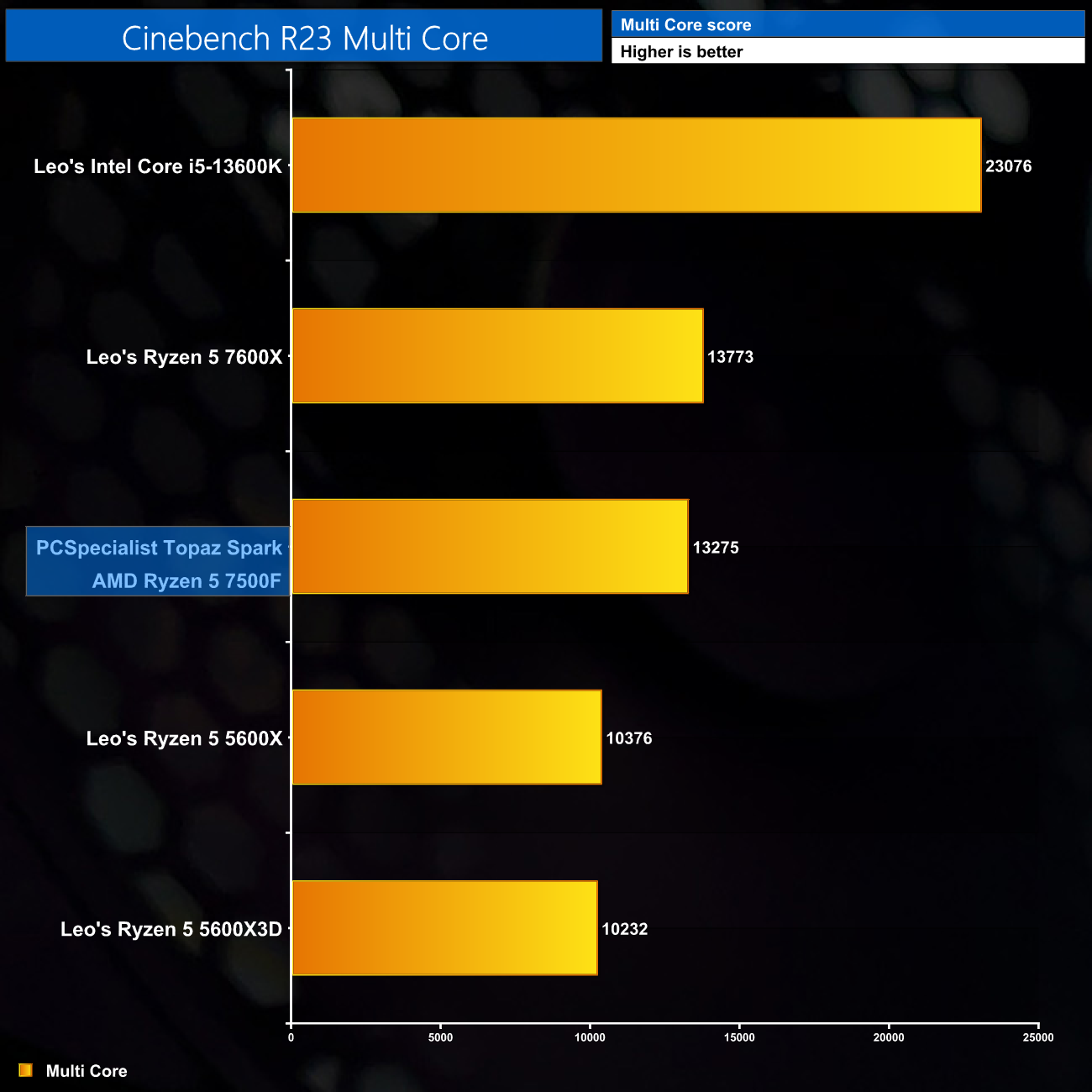
Starting our benchmarks with Cinebench Multi Core, despite a clock speed deficit, the Ryzen 5 7500F is performing very similarly to the Ryzen 5 7600X that Leo tested as part of our Ryzen 5 5600X3D review. That's a very good thing for the Topaz Spark though, everything is functioning as it should and we're getting six Zen4 cores to crunch through the workload.
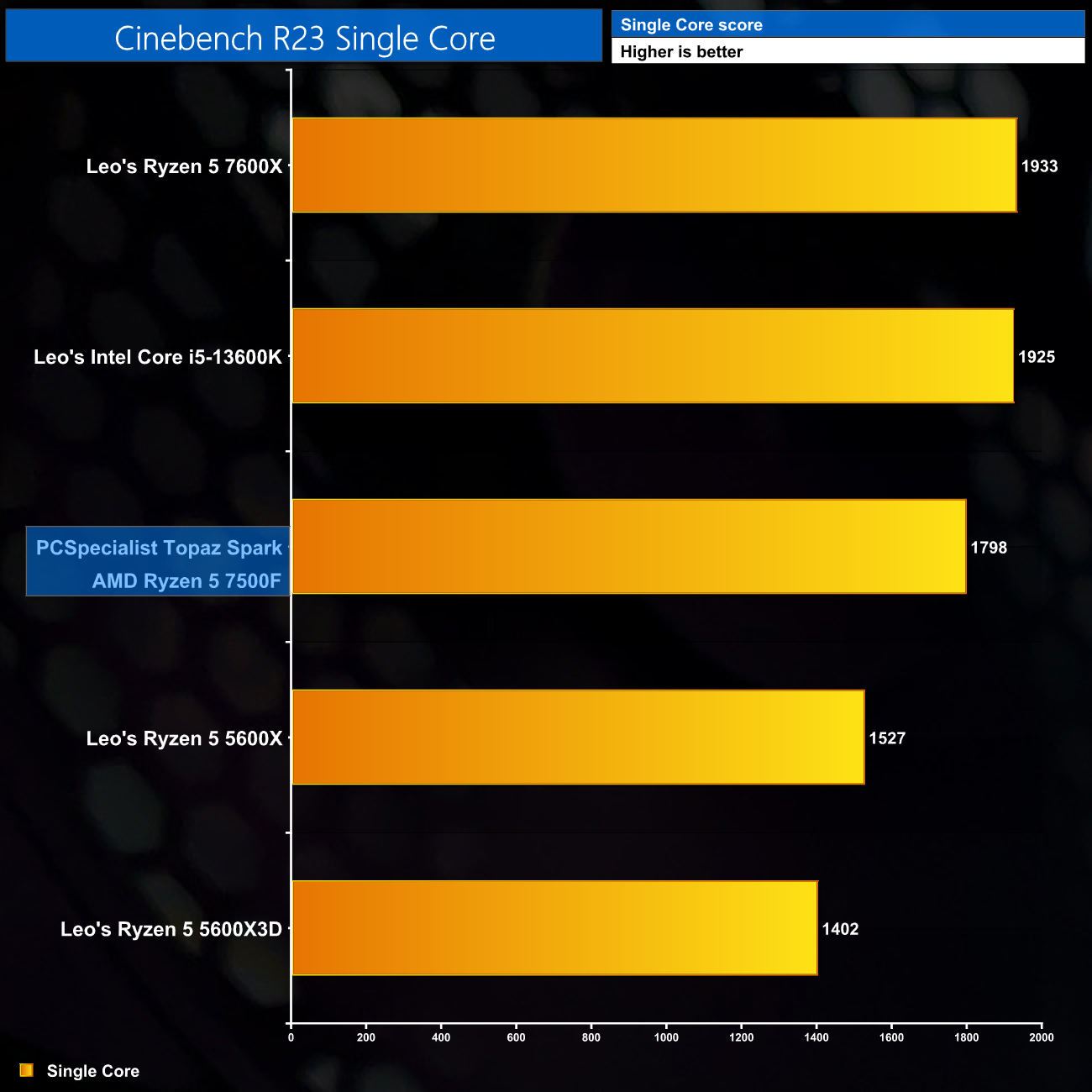
The Single Core result does drop back slightly which makes sense as the 7500F runs about 300MHz slower than the 7600X, but it's still a clear upgrade from a Zen3 CPU like the 5600X.
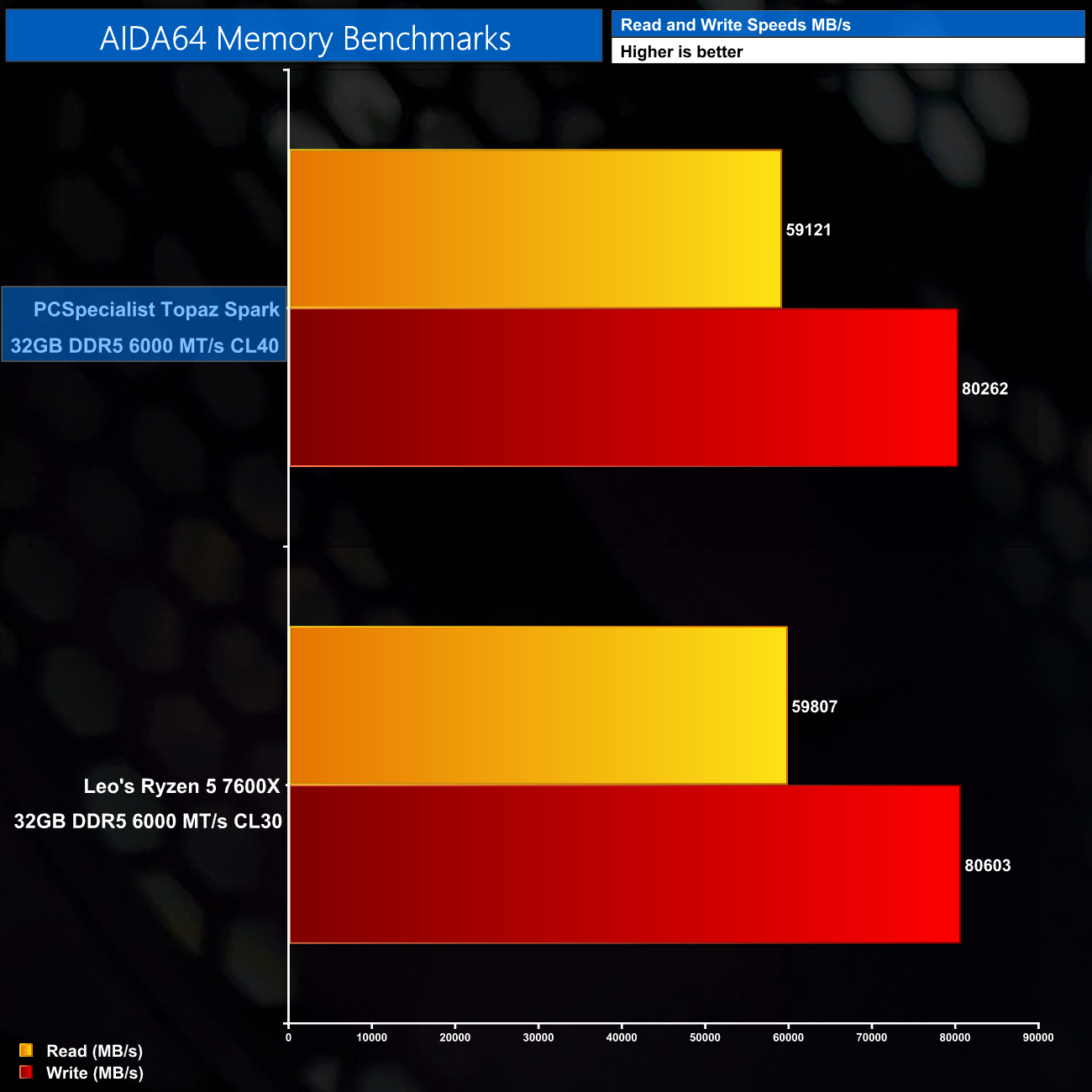
As for memory bandwidth, the Corsair kit may not have particularly tight timings but its read and write scores are almost identical to the G.Skill kit Leo used with his Ryzen 5 7600X testing so we can have no complaints.
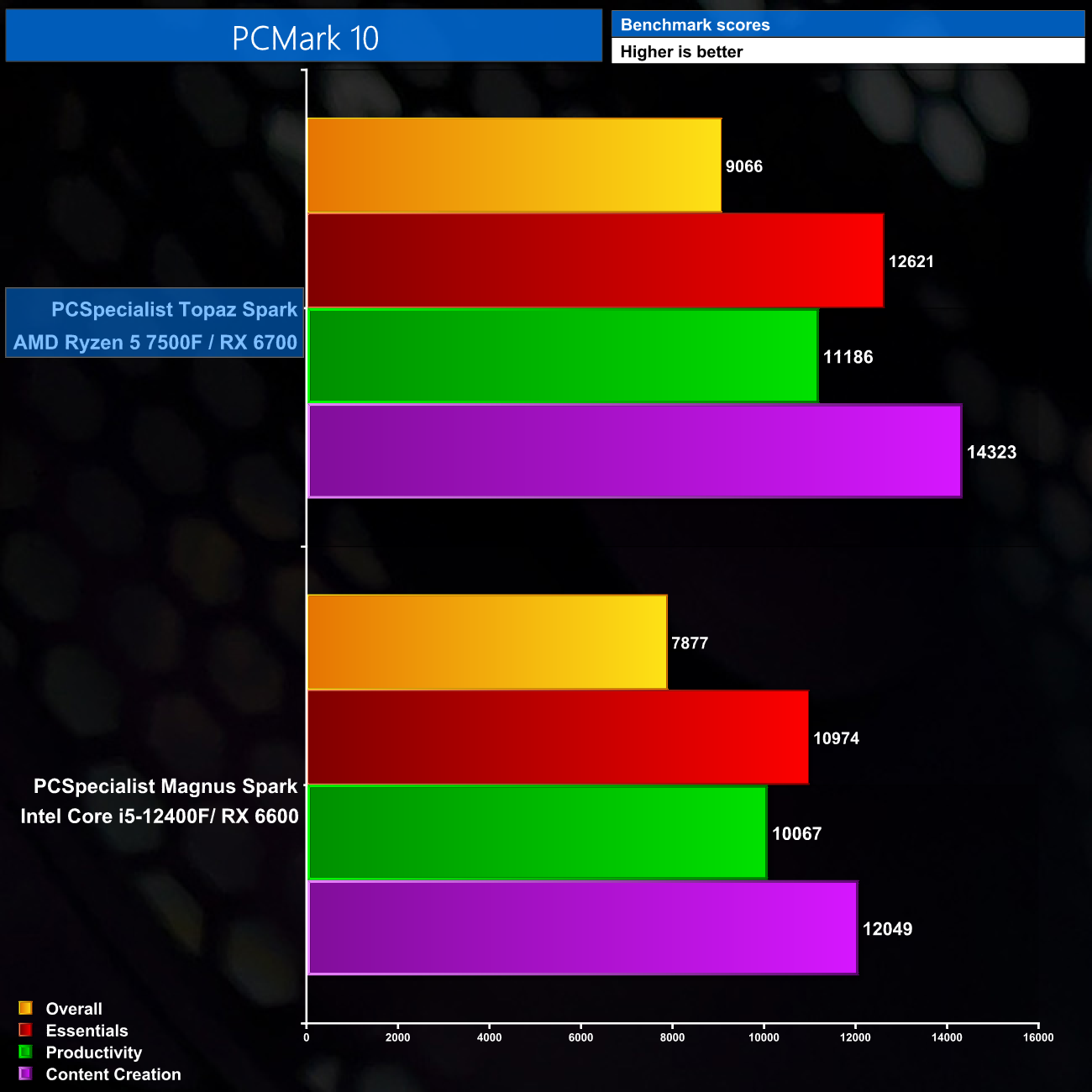
PCMark 10 is next and for this one I've compared the Topaz Spark to the Magnus Spark – another PCSpecialist unit I reviewed last year that was also priced at £999. It's good to see clear improvements across the board here, with a 15% increase to the Overall score, despite both systems being launched at the same price point.
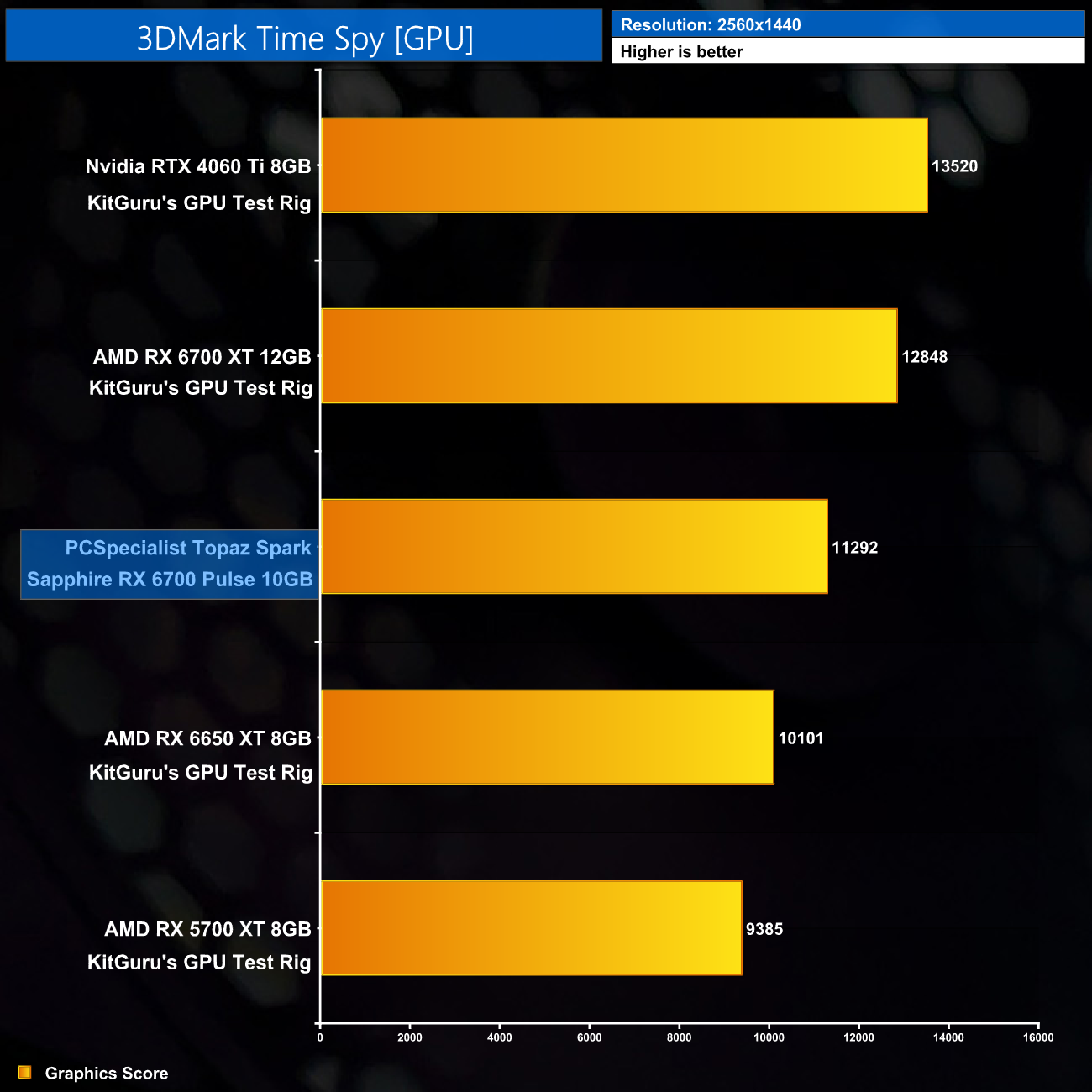
As for the GPU and 3DMark Time Spy, the RX 6700 is about 1500 points below the RX 6700 XT, but it's comfortably faster than the RX 6650 XT and even further ahead of the RX 5700 XT, so it looks like a suitable option in this £999 PC.
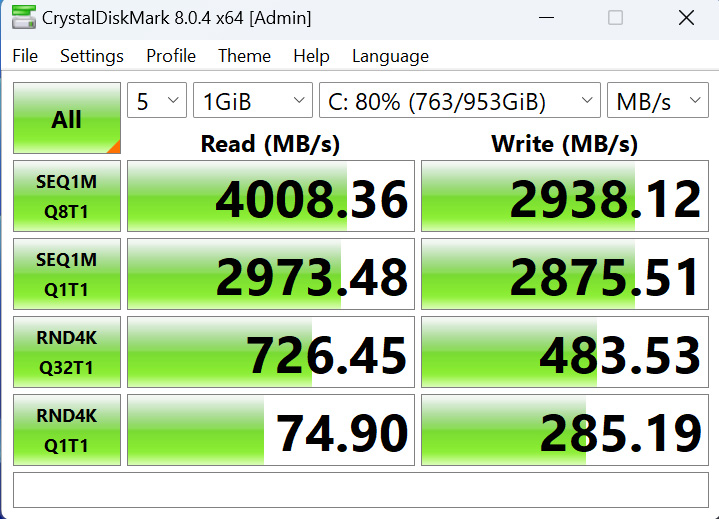
The final component to look at is the SSD, and by modern standards it's not the fastest – we're talking reads of 4GB/s and writes below 3GB/s. It'll be more than adequate for gaming, but considering we're now in the age of Gen5 SSDs, this is probably the most obvious corner that's been cut to hit the price-point.
For our game benchmarks we tested at both 1080p and 1440p resolution. Usually we exclusively test using Ultra settings, but this time we made sure to test High settings (or the equivalent) as well. After all, some modern games may be too demanding to play maxed-out on a £999 PC, so it's good to see what it can offer if you dial down the image quality by a small amount.
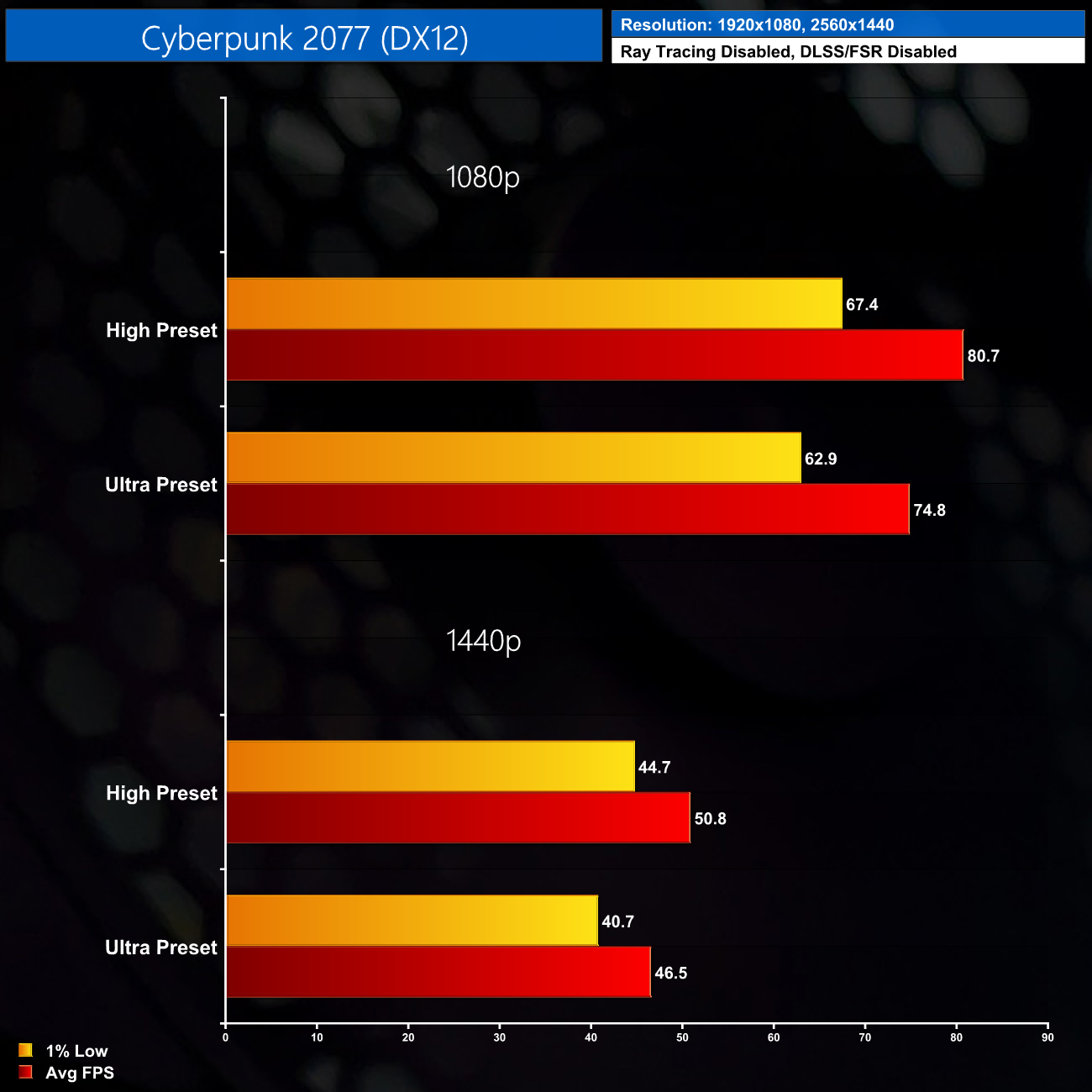
Starting with Cyberpunk 2077 and the new 2.0 update, at 1080p the Topaz Spark delivers well over 70FPS regardless of the settings used, though at 1440p we had to drop to the High preset to ensure we hit 50FPS, but that's still a great result in one of the best looking games currently on the market.
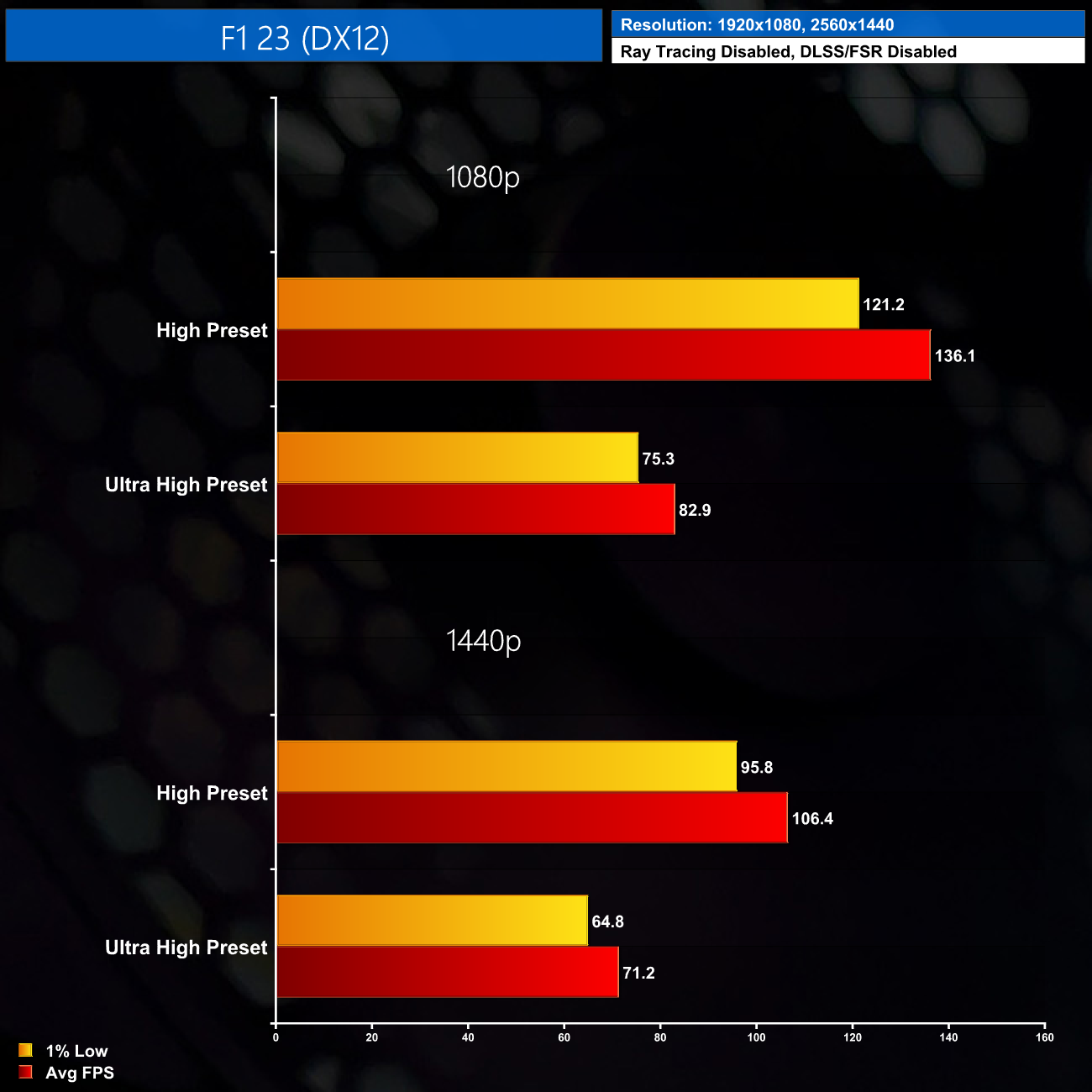
F1 23 is much less demanding and we hit 83FPS at 1080p Ultra, or you can boost FPS to 136 by using High settings. Likewise at 1440p, you still get 71FPS at Ultra or 106FPS at High, so this is very very playable.
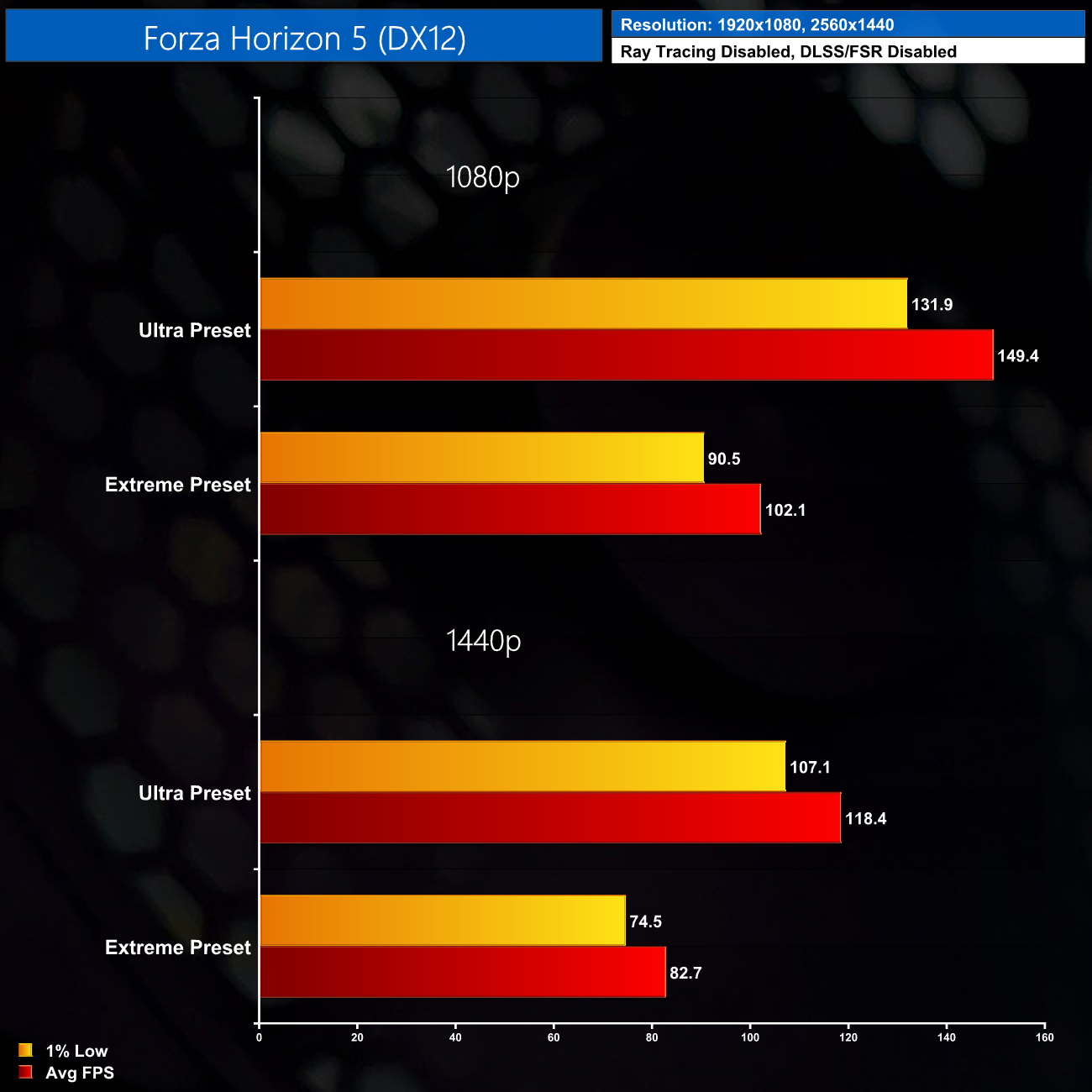
Forza Horizon 5 is even easier to run, fully maxed out the Topaz Spark can hit 102FPS at 1080p or 83FPS at 1440p, so you won't even need to drop settings for a smooth experience.
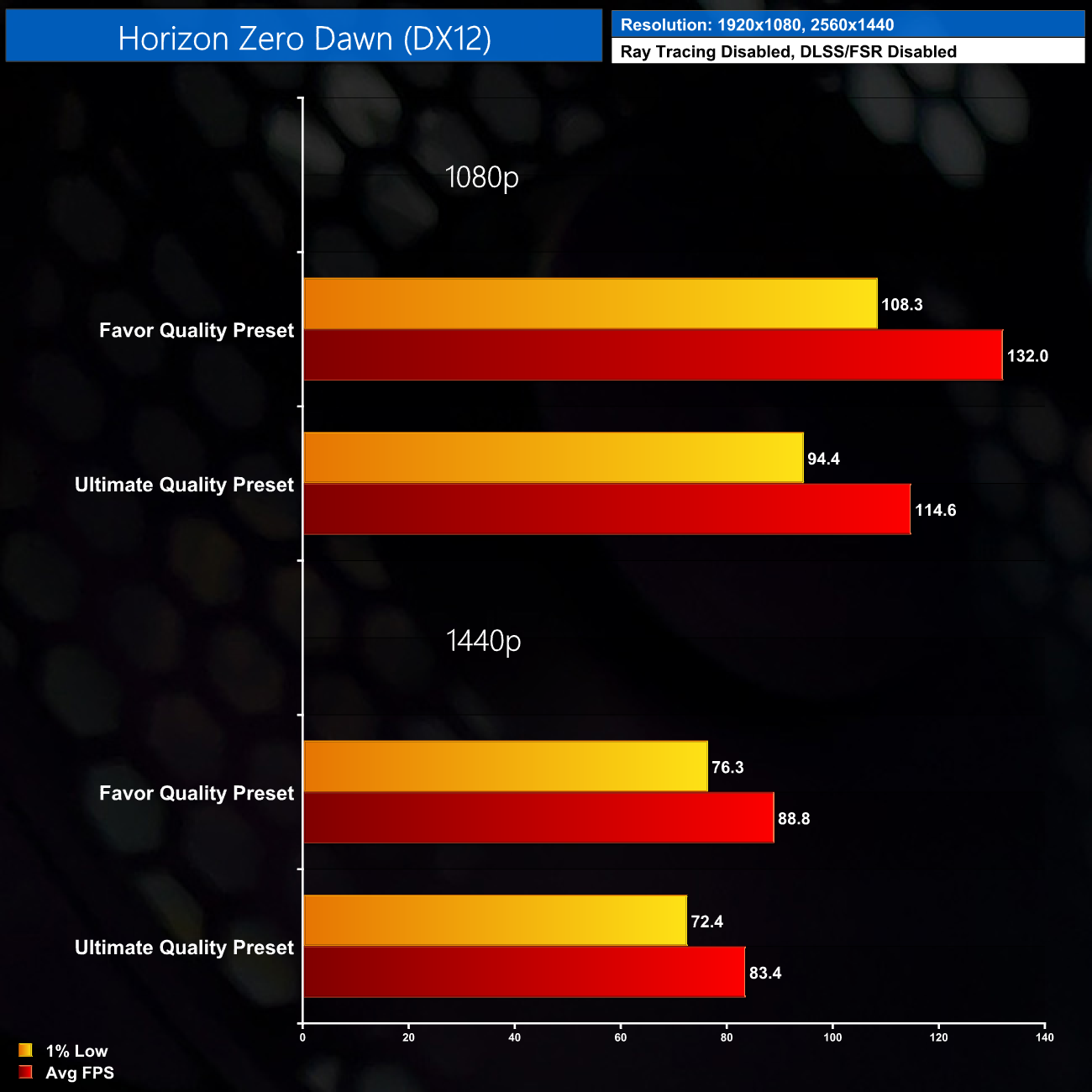
The same goes for Horizon Zero Dawn – this one is a bit older but still looks great and plays very nicely with the all-AMD system – maxed out at 1440p we got 83FPS average, so we can have no complaints there!
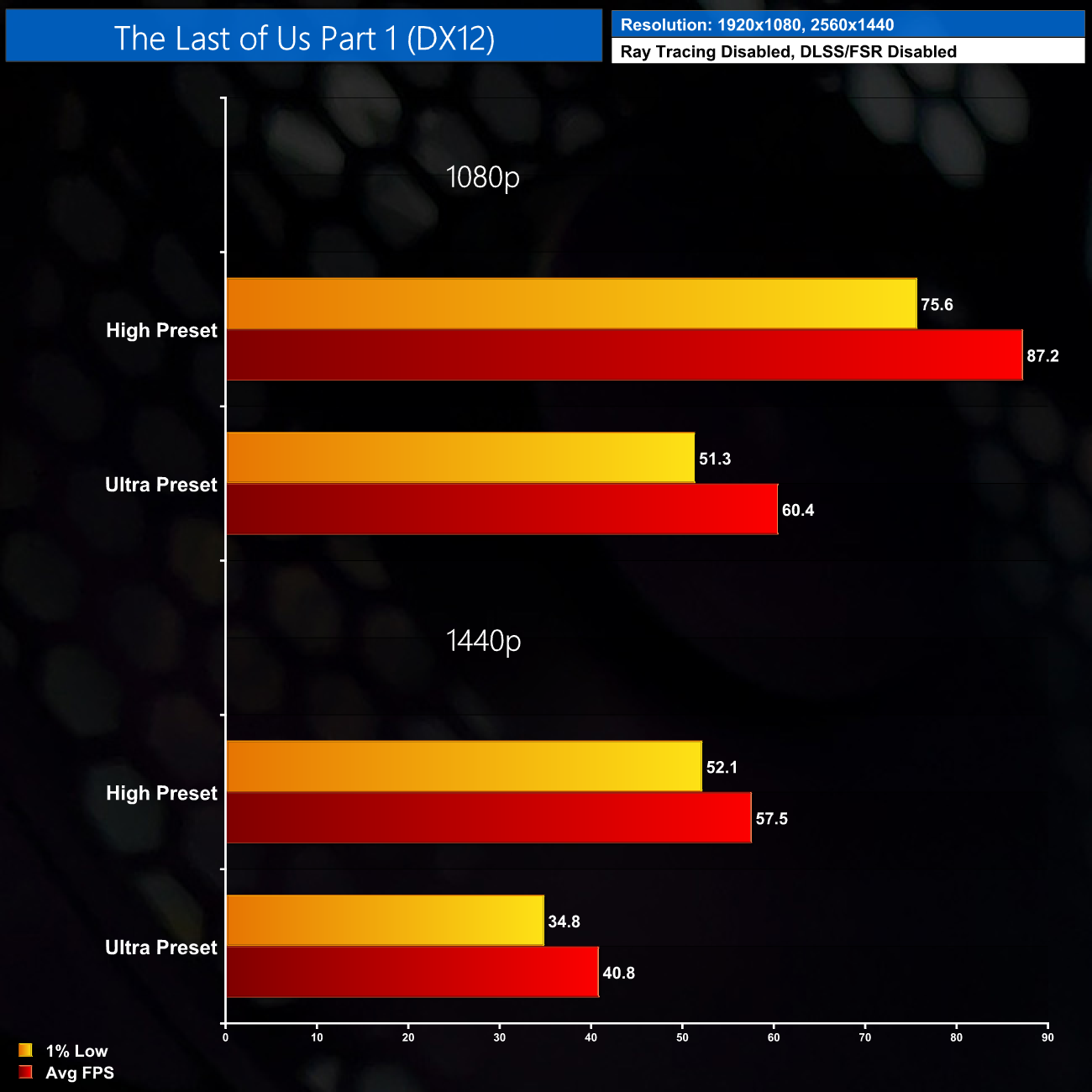
The Last of Us Part 1 is definitely more demanding though, but 60FPS is still possible at 1080p Ultra settings, or you can go for High settings and get 87FPS. You'll probably want to stick with High at 1440p too, where it came in just below 60FPS.
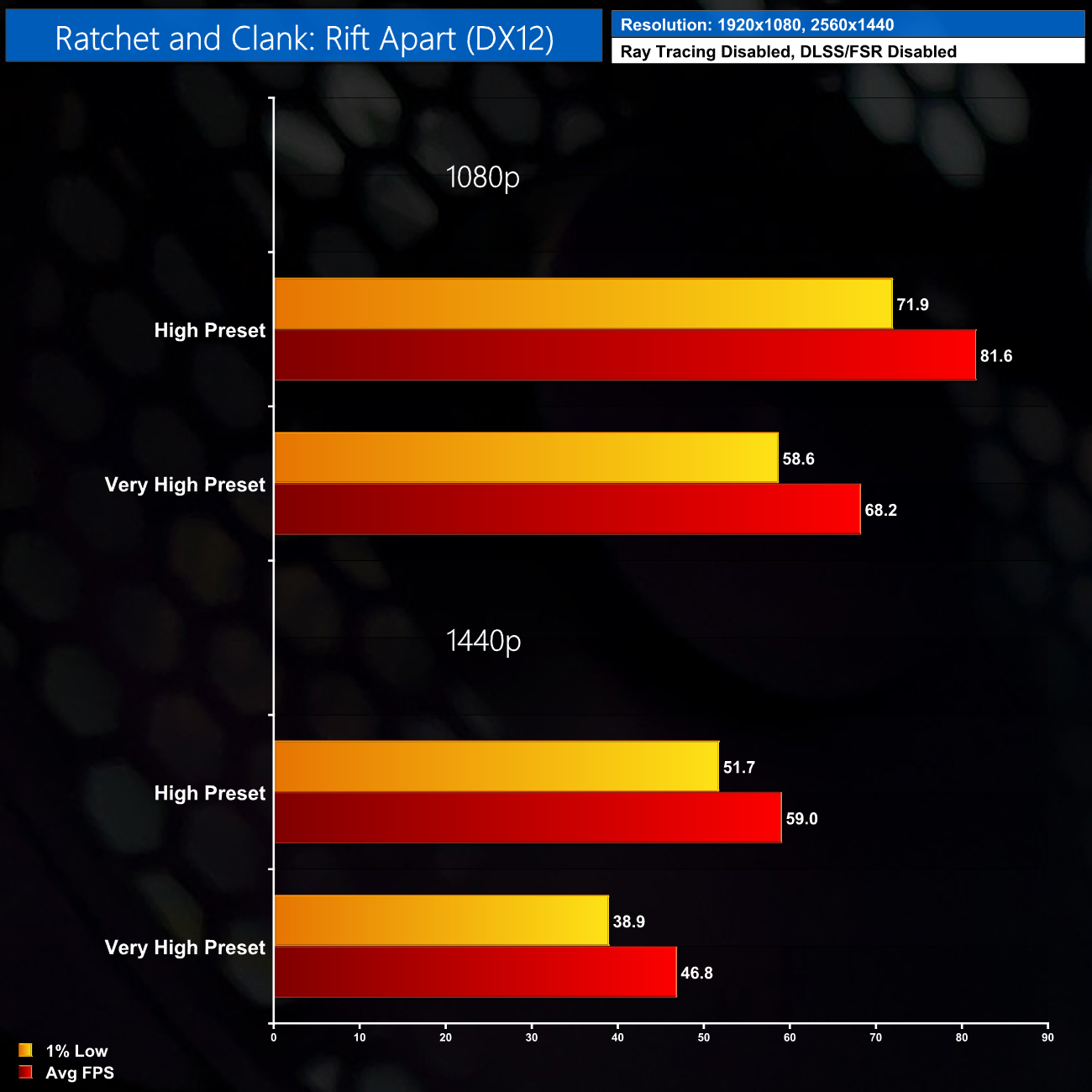
The same goes for Ratchet and Clank – the RX 6700 can do 1080p max settings no problem, but it suffers slightly at 1440p, at which case you'd want to drop down to the High Preset.
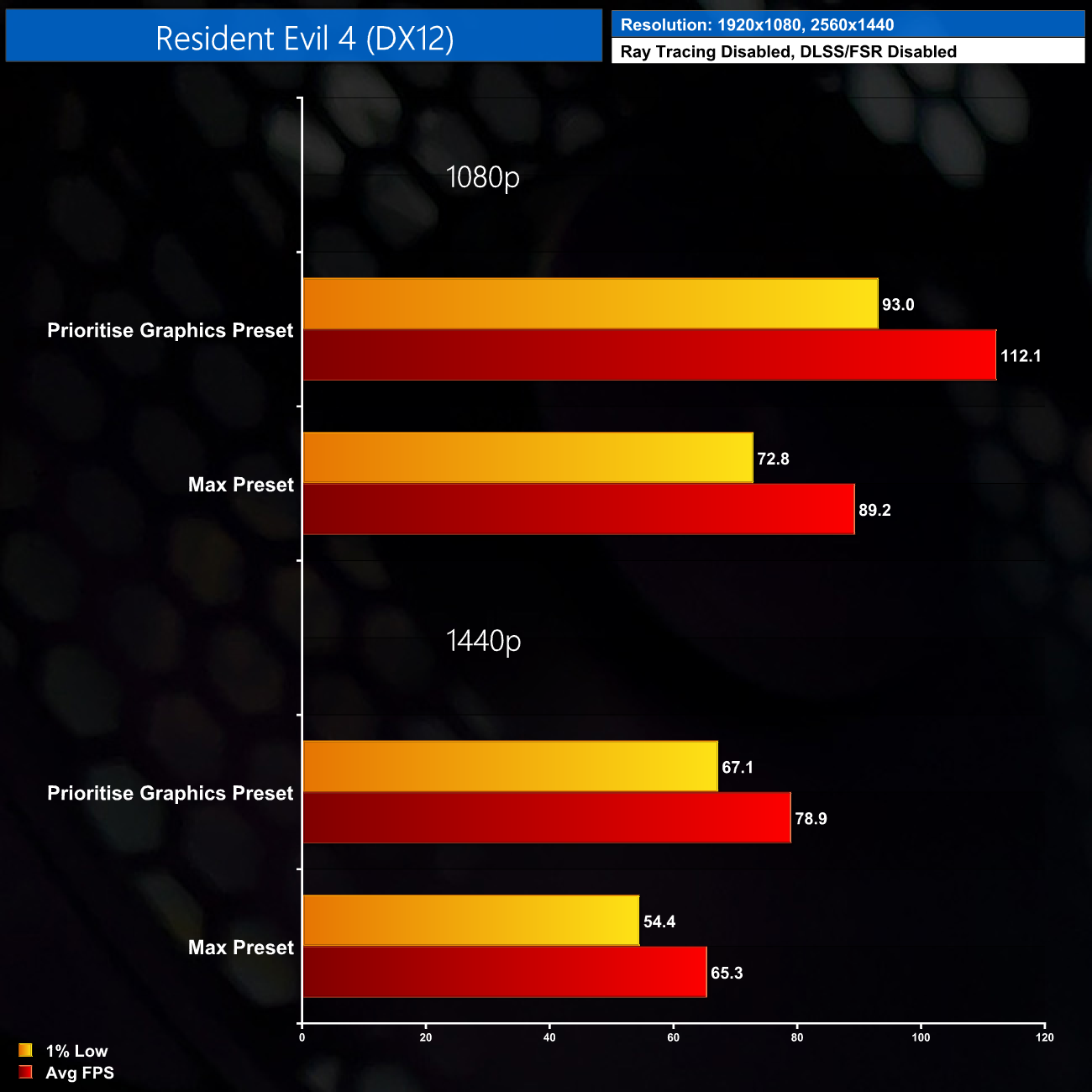
No such issue for Resident Evil 4 though, this game isn't too demanding and is playable at 1440p 60FPS using the Max preset, so job done there.
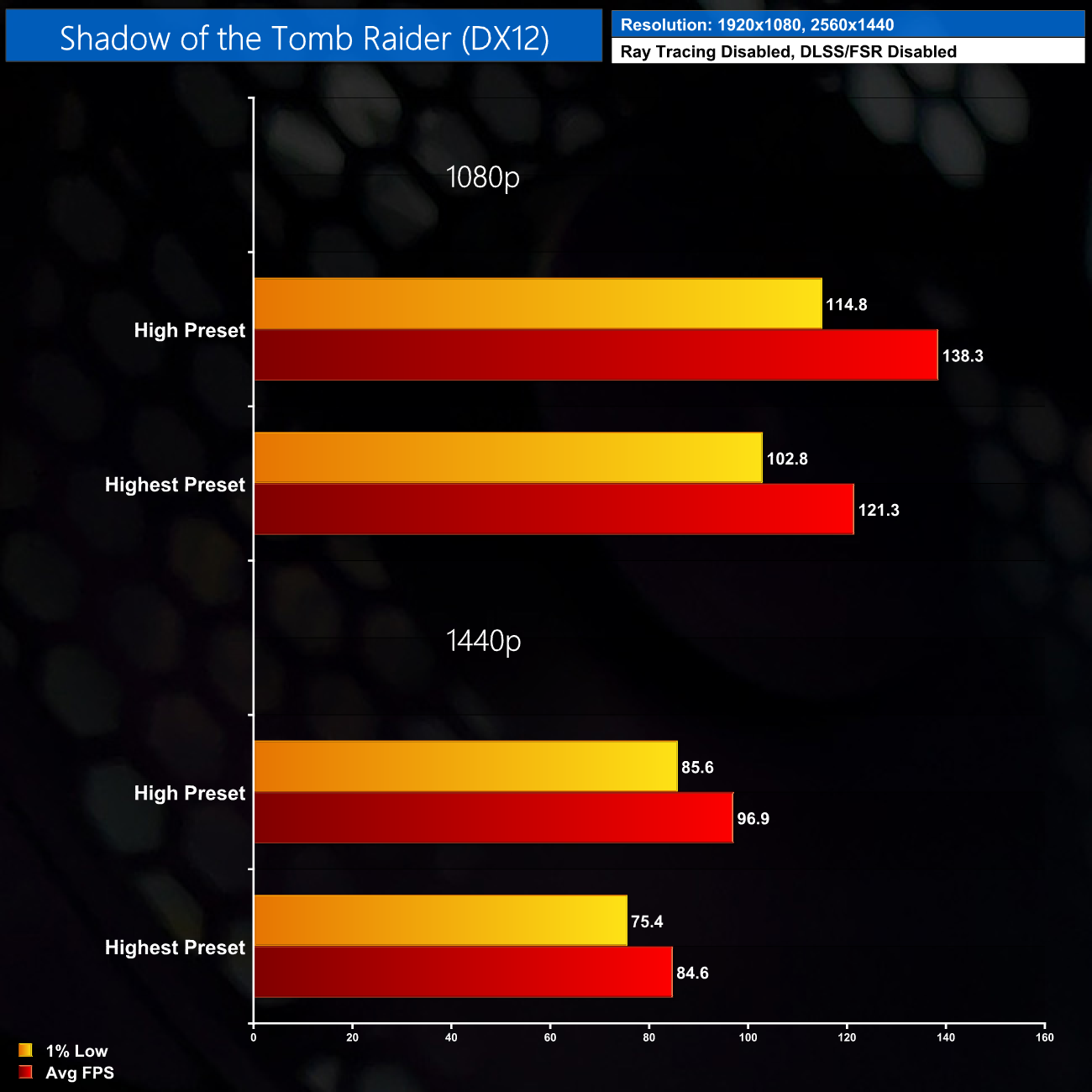
Same again for Shadow of the Tomb Raider – this one is getting on a bit now but still looks great and you can get over 80FPS at maxed settings using the RX 6700 at 1440p.
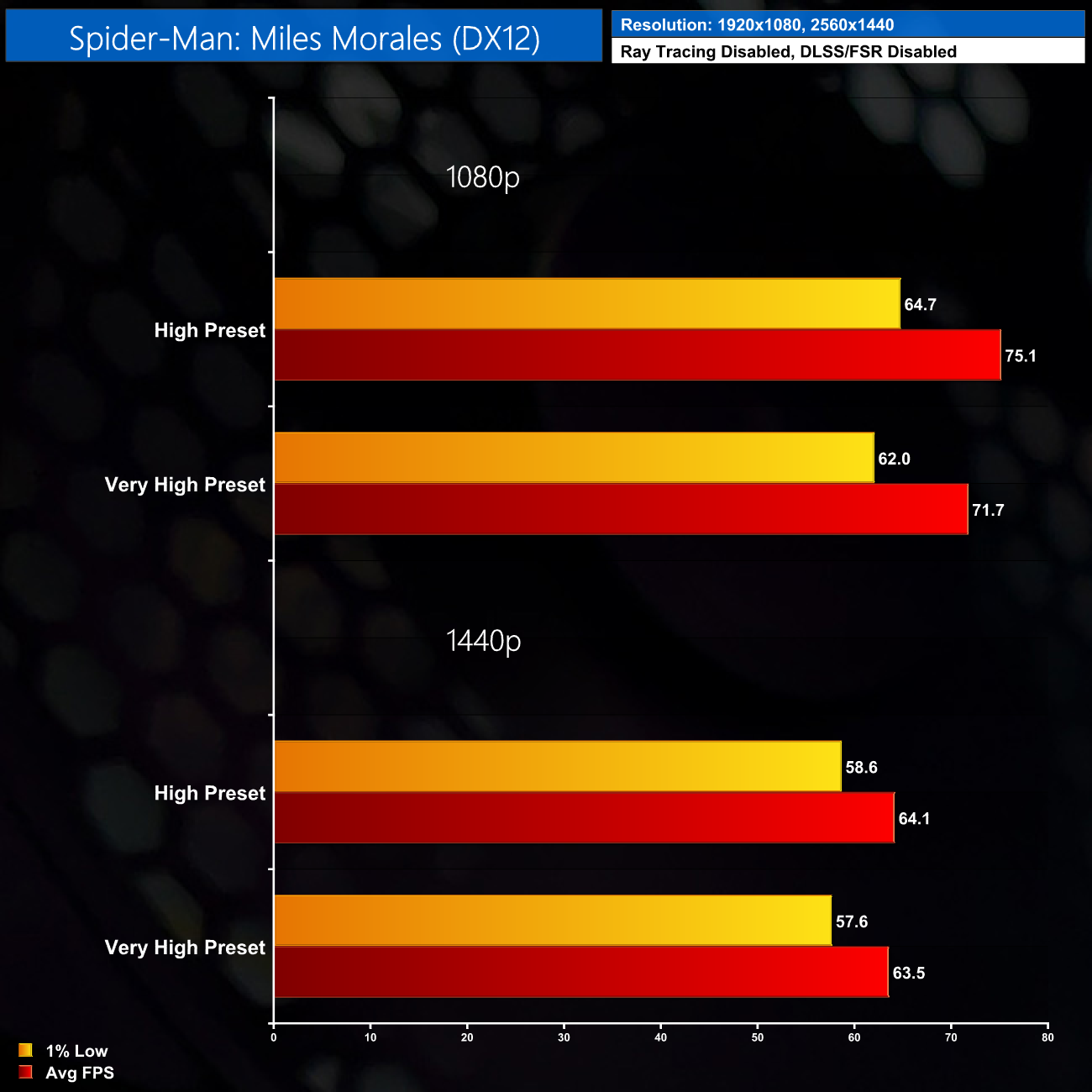
Miles Morales is much more CPU-bound and we see very little difference regardless of settings or resolution. You can still get 64FPS on average at 1440p using the Very High preset, though it will be hard to hit higher frame rates due to how CPU-heavy this game is.
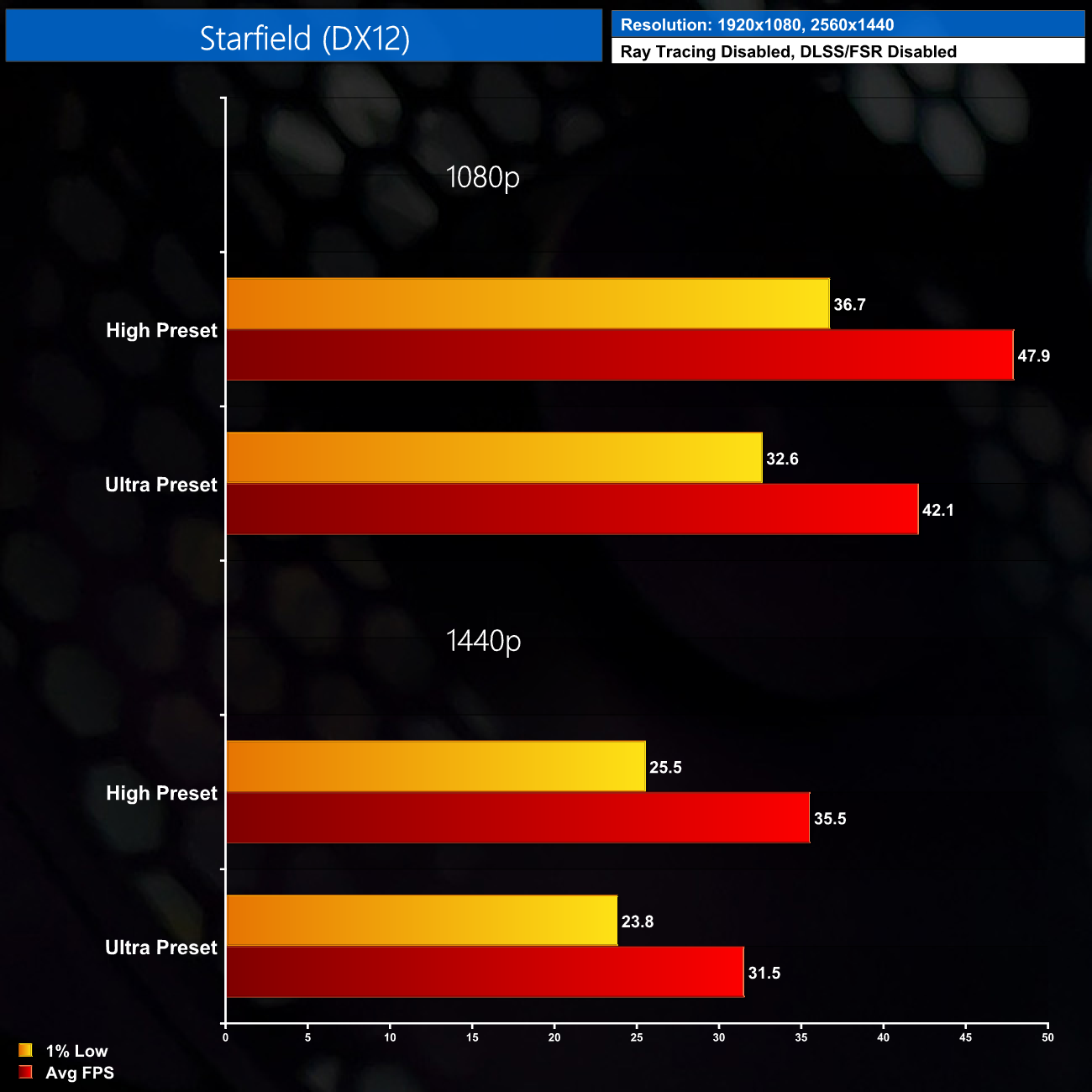
Finally we finish up with Starfield, and we're testing in the forested area of Jemison. This is a worst-case scenario but goes to show just how demanding Starfield is – you may even want to consider Medium settings, or enabling upscaling for a higher frame rate.
Average results
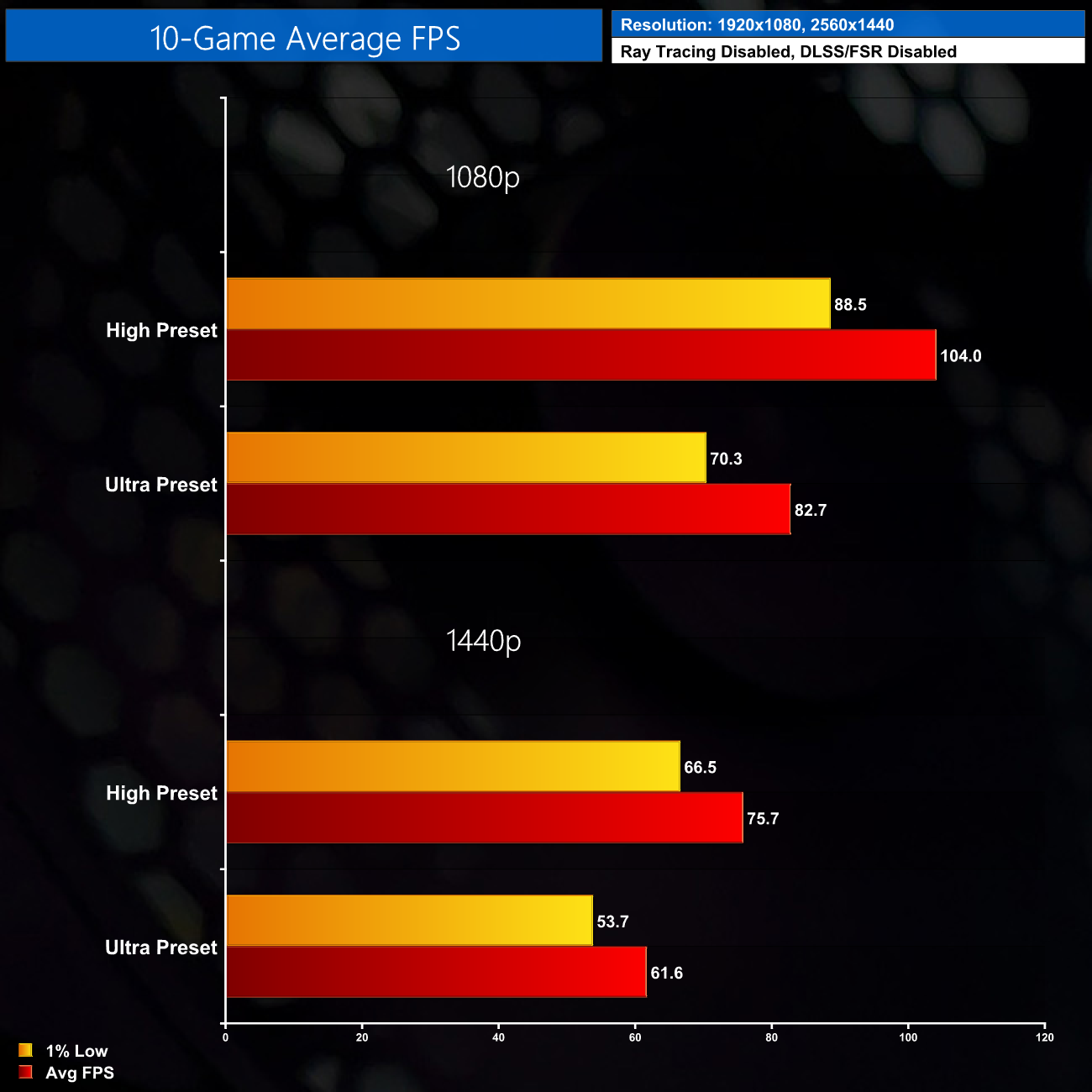
Overall then, over the 10 games tested, the Topaz Spark is very capable for 1080p and 1440p gaming. It won't hit 60FPS at 1440p Ultra setting in every game, but you can always drop down to High setting if need be. If you're playing at 1080p as well, it'll be even smoother still.
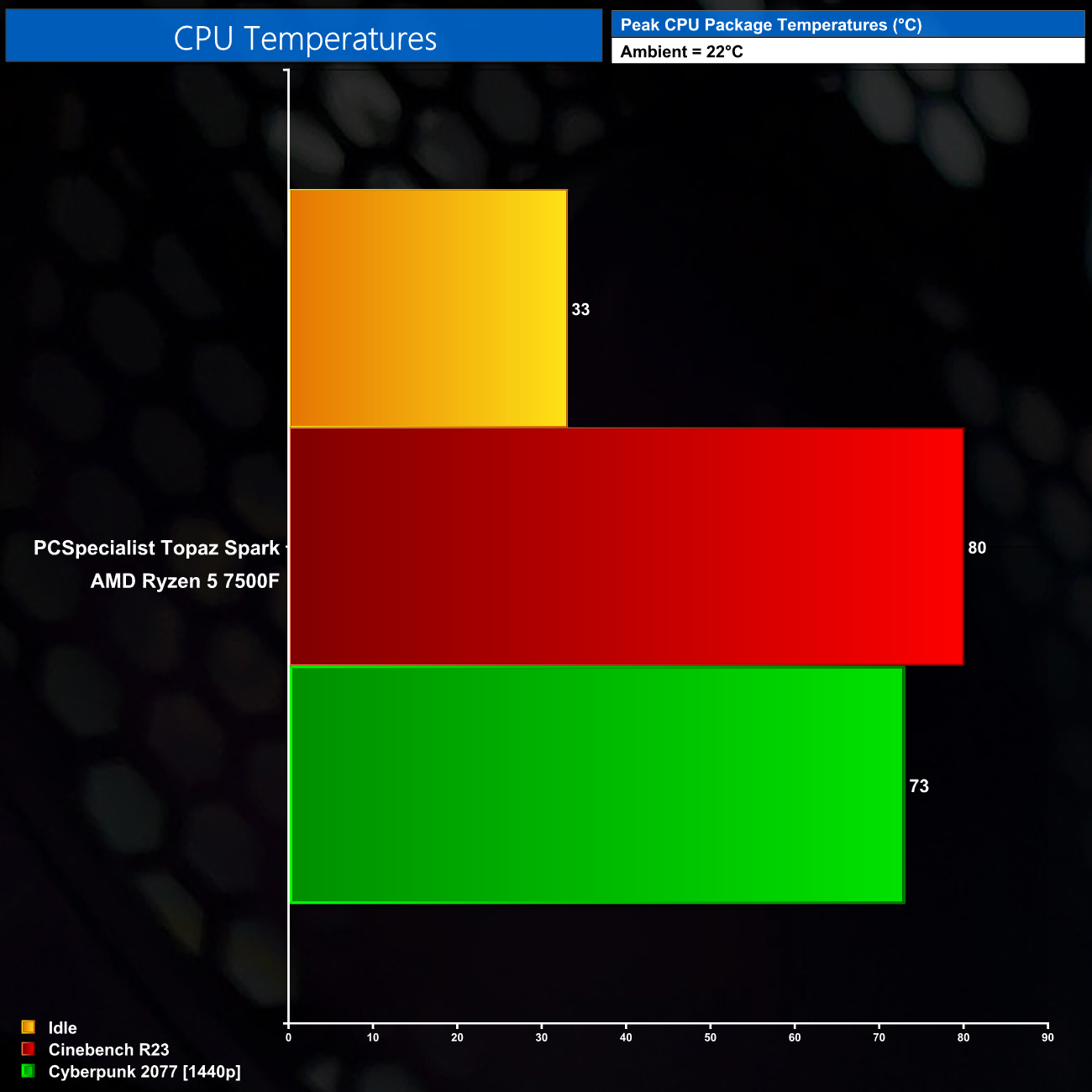
In terms of CPU thermals, the compact PCS FrostFlow air cooler had zero issues dealing with the Ryzen 5 7500F. During an all-core Cinebench workload, the CPU drew 90W package power but was kept to just 80C, and it ran even cooler while gaming, peaking at 73C during a 30-minute stress test in Cyberpunk 2077.
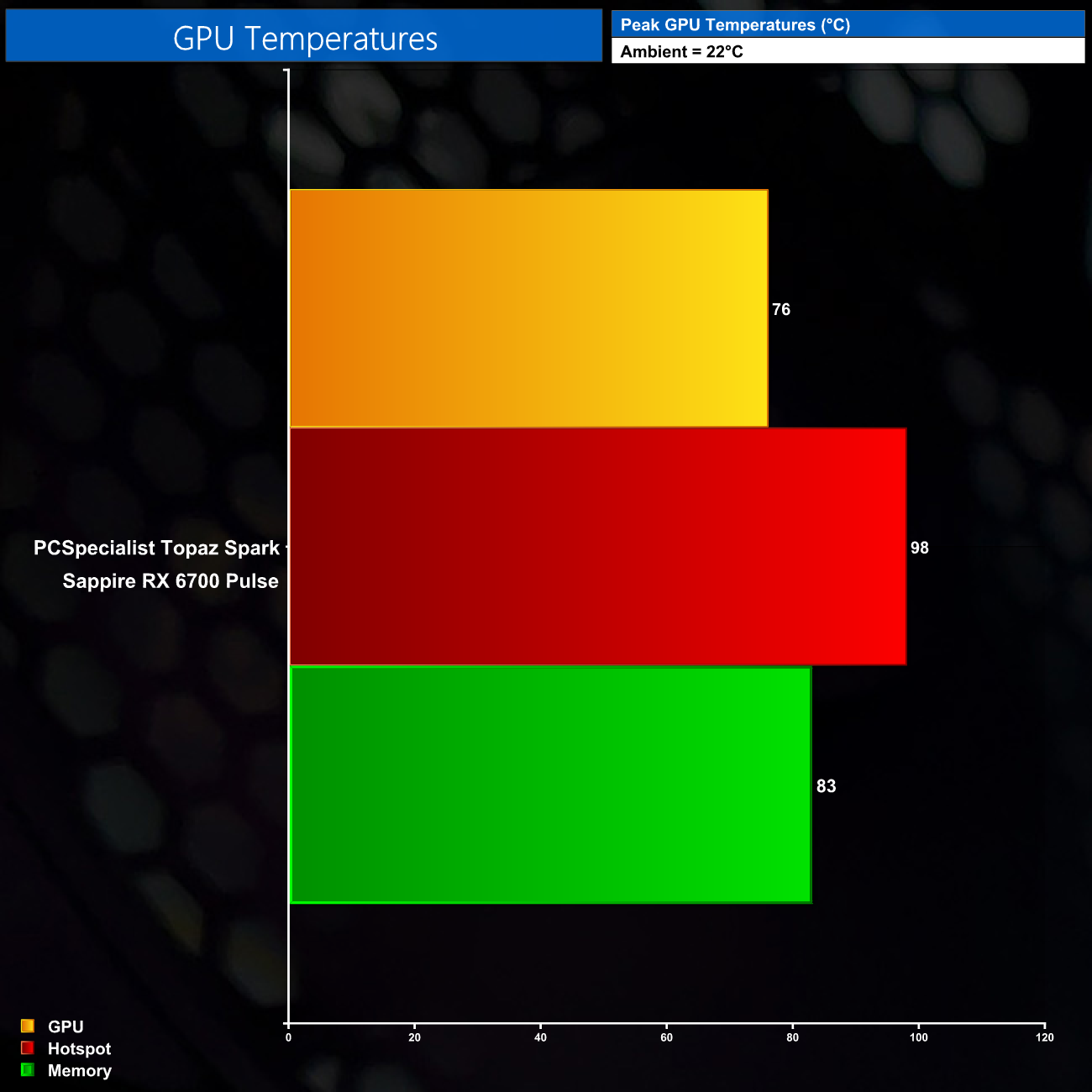
The GPU is also nothing to worry about. The hot spot is slightly higher than I'd like at 98C, though AMD is very clear this can safely go up to 110C. You could set a custom fan curve however if you want to see lower temperatures, as the Sapphire Pulse does favour low-noise, running the fans at just 1000rpm or so.
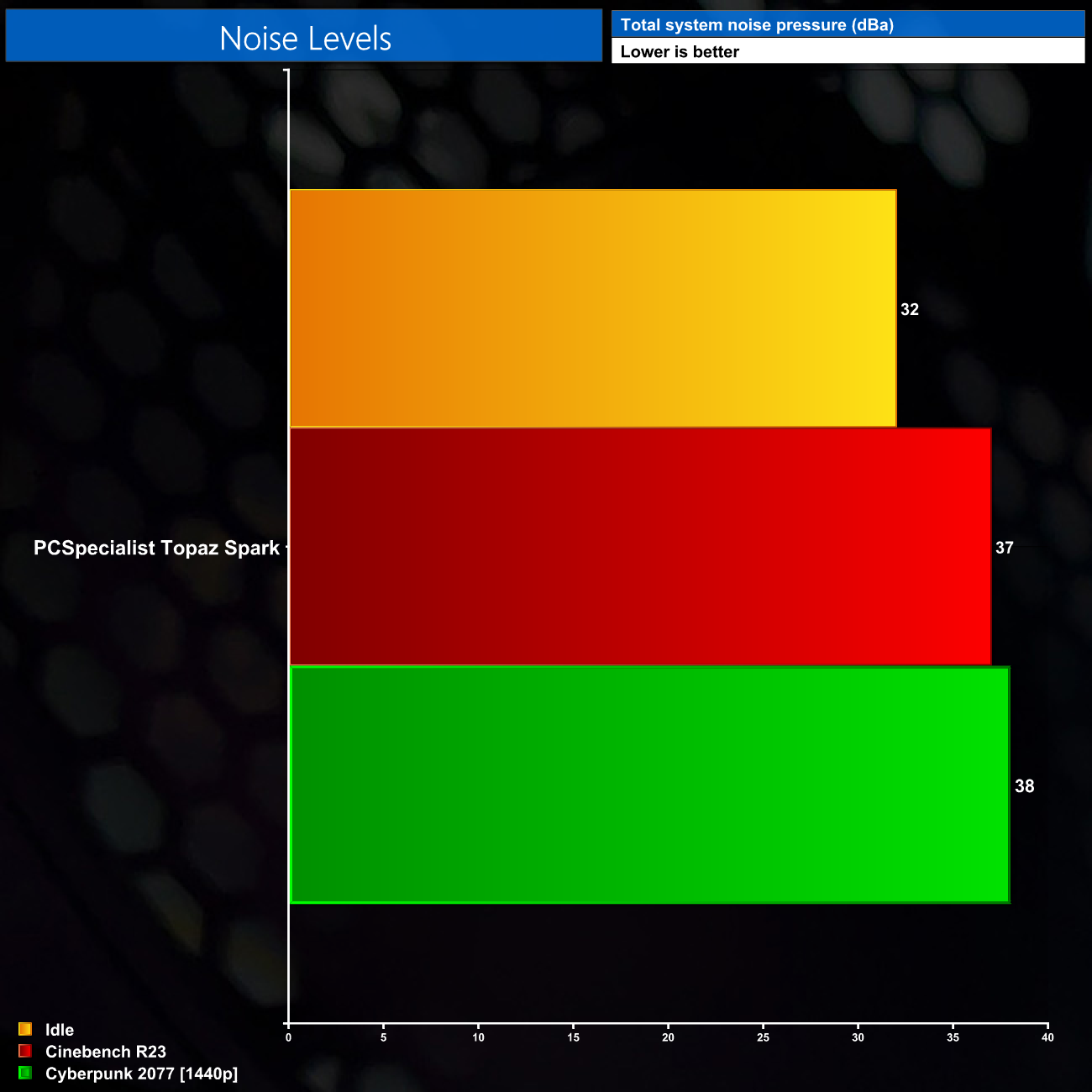
That ties in nicely with overall noise levels, as the Topaz Spark is a pretty quiet gaming PC. With our sound meter just 30cm from the system, it produced just 38dBa of noise while running Cyberpunk 2077, so it was really not intrusive at all and would easily be blocked out by a headset.
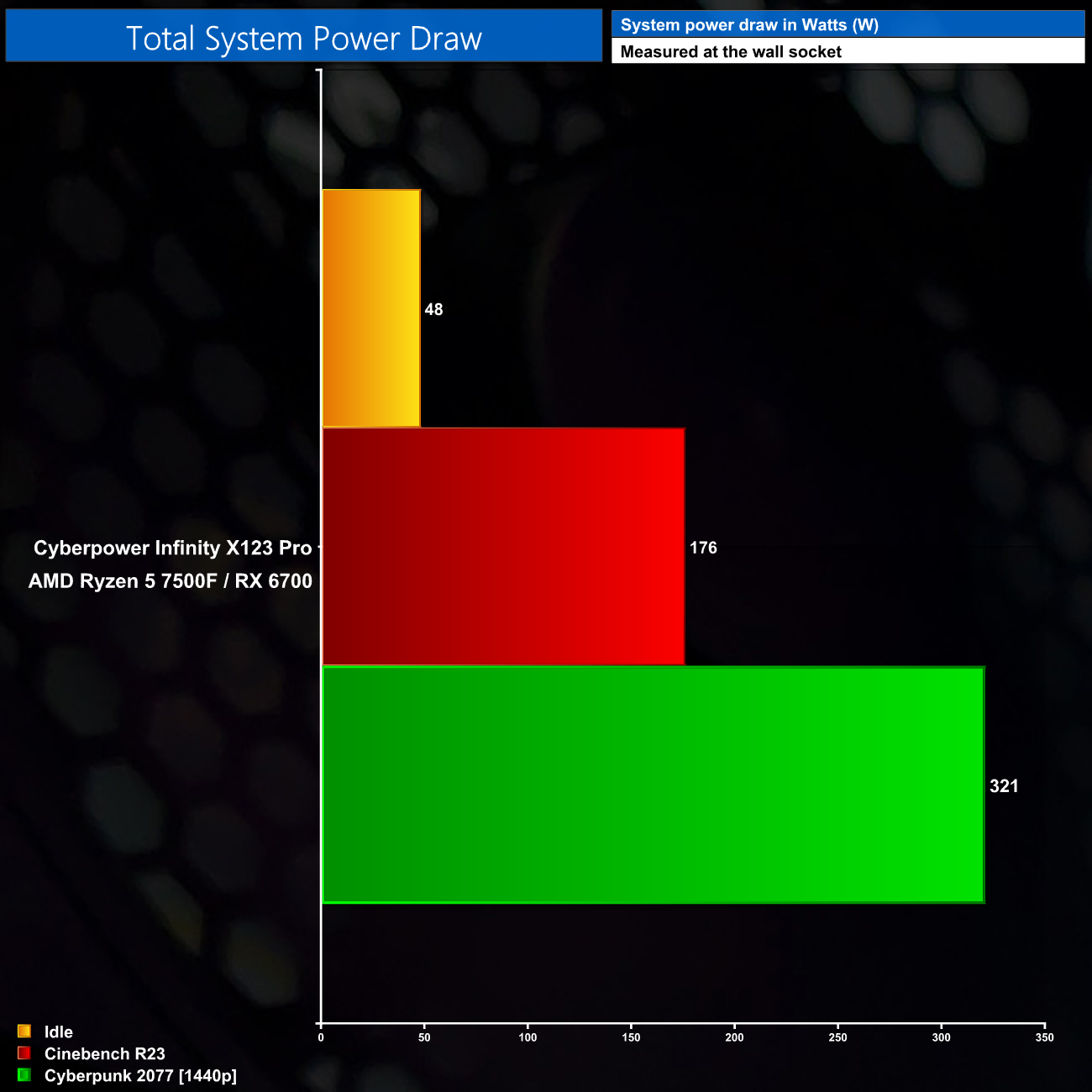
Finally, taking a look at total system power draw, in our gaming tests we saw power draw hit around 320W at 1440p. That is well below the 750W capacity of the Corsair unit but goes to show how much headroom there is for upgrades – you could easily upgrade to a higher power CPU and GPU without causing the PSU to break sweat, which is great for system longevity.
I have to say I was intrigued by the spec of the Topaz Spark when PCSpecialist got in touch about a review, and after testing it for the last week, I have to say it is one of the best prebuilt systems we have reviewed over the last few years. Not because it is ridiculously fast or an all-singing all-dancing machine, but because it offers a very sensible spec at an achievable price point, while also leaving plenty of room for upgrades down the line.
The AMD Ryzen 5 7500F, for instance, is a great budget CPU at this point in 2023, offering six-cores and twelve-threads of Zen4 goodness, and it runs at about 5GHz while gaming. Thanks to the AM5 platform though and the B650 motherboard used here, we already know AMD has promised to support said platform through to 2026, so it’d be a drop in upgrade for a Zen6 CPU, or whatever they’ll be called, into the Topaz Spark.
That’s only bolstered by the fact the system already offers 32GB of DDR5 RAM – admittedly not with the tightest of timings, but this is an exceedingly generous amount considering the price and will serve you well into the future and with any CPU upgrade.
The RX 6700 GPU is in a similar position. Right now, it’s a very smart choice for gamers on a tighter budget, offering great 1080p and even 1440p frame rates as we've seen today. But with the inclusion of a 750W Gold-rated PSU, you could stick something in that draws twice as much power as the RX 6700 and there'd still be plenty of headroom left over.
I wouldn't say there are many obvious drawbacks, either. The storage situation is definitely the main one, as a single 1TB drive doesn’t go very far these days, and the Solidigm P41 Plus used here isn't the fastest considering that the motherboard does support Gen5 SSDs. That said, a spare M.2 slot is easily accessible if you do need to add another drive down the line, it's just worth pointing out you may not get quite as many games installed on the machine as you might have liked.
You could also make a point about the air cooler, which will be the DeepCool AK400 ARGB for any buyers – it is fairly basic and may be a limitation if you wanted to stick in a 16-core Ryzen CPU down the line, but realistically it's proved more than adequate for the 90W power draw of the 7500F so I don't see it as much of a problem.
All told, the Topaz Spark is a mightily impressive system from PCSpecialist. Not only does it make a lot of sense at this point in 2023, with a well-balanced spec that can easily handle 1080p or 1440p gaming now, but it leaves a huge amount of scope for future upgrades – all while coming in at £999.
The cherry on the cake is the fact that I also priced up the components individually, and while I couldn’t get an exact match as the CPU and GPU are hard to find standalone, the total price was actually a touch higher than what PCSpecialist is asking for – with that price including the fact that they’ll build it, ship it and cover it with warranty – leaving me feeling pretty darn good indeed!
You can buy the PCSpecialist Topaz Spark, as reviewed, for £999 HERE.
Discuss on our Facebook page HERE.
Pros
- Six-core Zen 4 CPU on the AM5 platform.
- RX 6700 handles 1080p and 1440p gaming.
- 32GB DDR5 memory.
- Large 750W PSU provides tons of headroom for upgrades.
- Very well built with excellent cable management.
- Spare M.2 slot is easily accessible for a drop-in storage upgrade.
Cons
- Only a 1TB drive, and it's not overly fast.
- DDR5 memory timings aren't the tightest.
KitGuru says: It's affordable, plays games at 1080p or 1440p, and has plenty of scope for future upgrades. What's not to like?