KitGuru KitGuru.net – Tech News | Hardware News | Hardware Reviews | IOS | Mobile | Gaming | Graphics Cards


Today we are back with another laptop review, this time we are checking out the ASUS ROG Strix Scar 15 G533QS-HQ132T. Packing an 8-core Ryzen 9 5900HX and RTX 3080 Laptop graphics, we know this machine is going to be fast. It's also got a 1440p 165Hz display, 32GB of DDR4 memory and two 1TB SK Hynix NVMe SSDs running in RAID 0. It's certainly strong on paper, but let's find out how it stacks up in the real world.


Specifications:
- Operating System: (Free upgrade to Windows 11, when available)
- Processor: AMD Ryzen™ 9 5900HX Mobile Processor 3.3 GHz (16M Cache, up to 4.6 GHz)
- Graphics:NVIDIA® GeForce RTX™ 3080 Laptop GPU, with ROG Boost up to 1645MHz at 115W (130W with Dynamic Boost) 16GB GDDR6
- Display: 15.6-inch QHD (2560 x 1440) 16:9 anti-glare display, 165Hz IPS-level
- Memory: 16GB DDR4-3200 SO-DIMM x 2
- Storage: 1TB + 1TB M.2 NVMe™ PCIe® 3.0 SSD (RAID 0)
- I/O Ports:
- 1x 3.5mm Combo Audio Jack
- 1x HDMI 2.0b
- 3x USB 3.2 Gen 1 Type-A
- 1x USB 3.2 Gen 2 Type-C support DisplayPort™ / power delivery
- Keyboard and Touchpad: Optical Mech Keyboard Per-Key RGB
- Audio:
- Smart Amp Technology
- Audio by Dolby Atmos
- AI mic noise-canceling
- Built-in array microphone
- 2x 4W speaker with Smart Amp Technology
- 2x 2W tweeter
- Network and Communication: Wi-Fi 6(802.11ax)+Bluetooth 5.1 (Dual band) 2*2;(*BT version may change with OS upgrades.) -RangeBoost
- Battery: 90WHrs, 4S1P, 4-cell Li-ion
- Power Supply: ø6.0, 240W AC Adapter, Output: 20V DC, 12A, 240W, Input: 100~240C AC 50/60Hz universal
- Weight: 2.30 Kg (5.07 lbs)
- Dimensions (W x D x H): 35.4 x 25.9 x 2.26 ~ 2.72 cm (13.94″ x 10.20″ x 0.89″ ~ 1.07″)
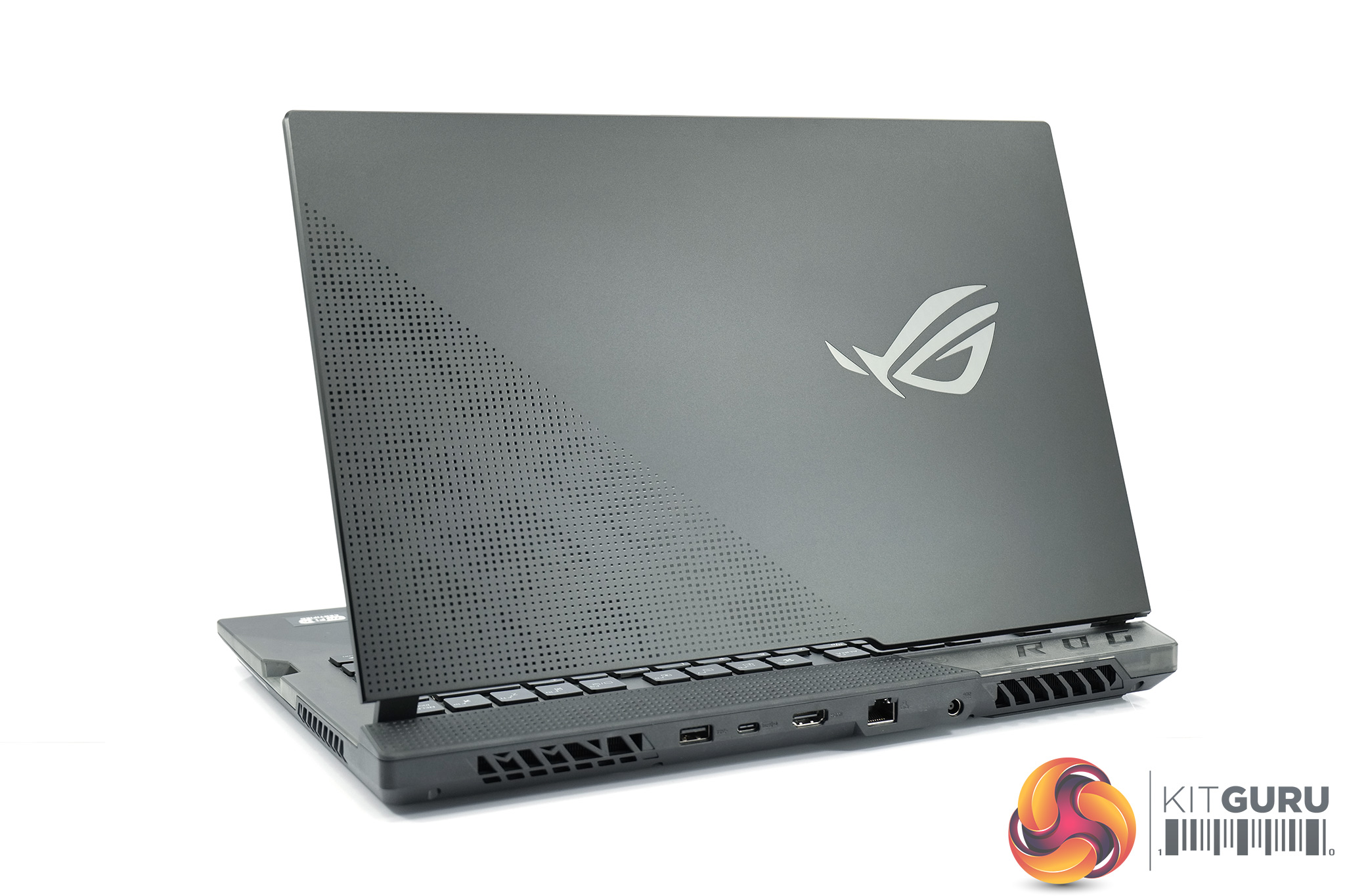
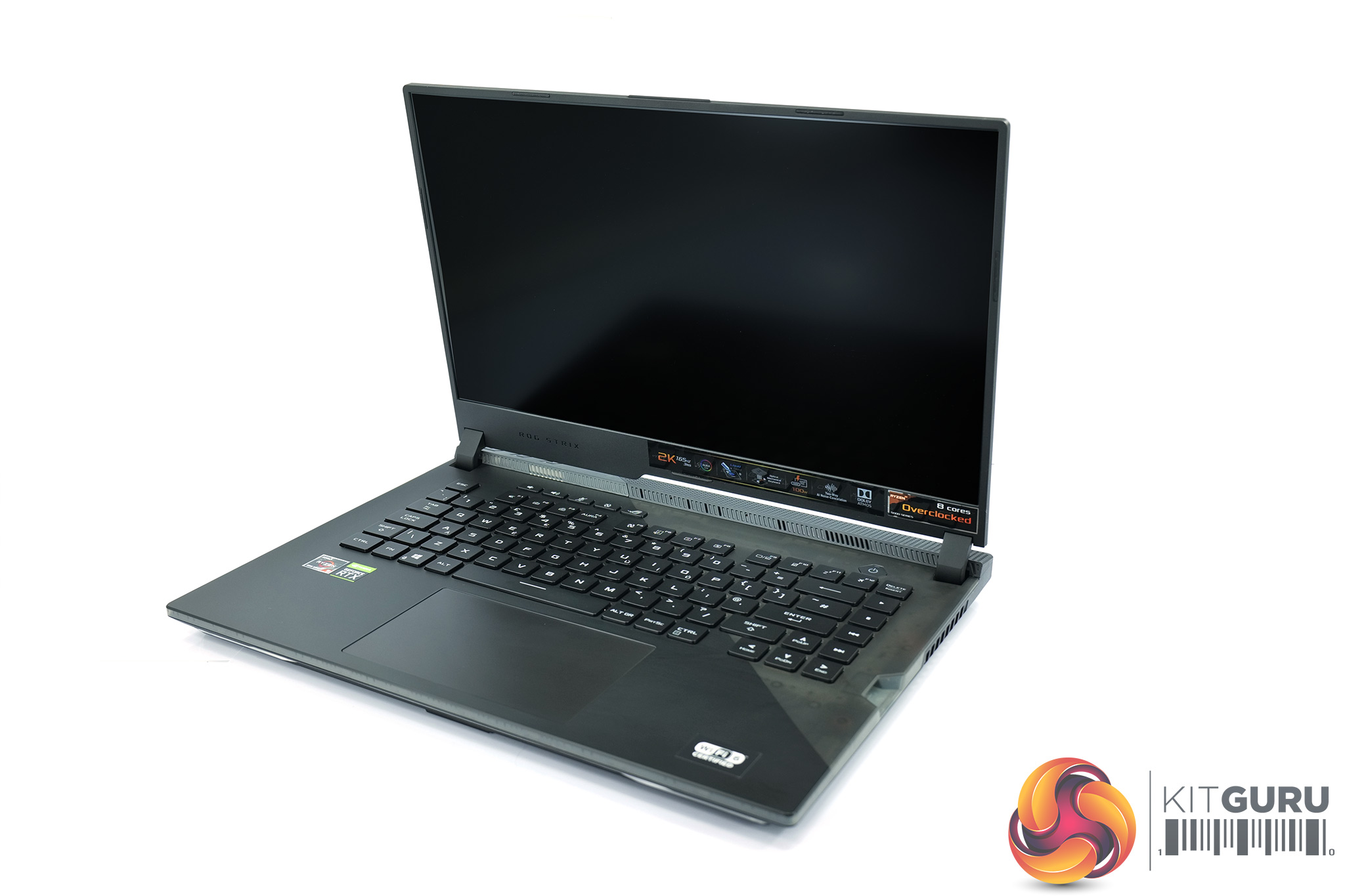
If we start by taking a look at the overall package, the Strix Scar 15 is remarkably similar to the TUF Gaming A15 we recently reviewed in terms of its size and weight. They both weigh 2.3KG, with broadly the same dimensions too – the Scar 15 is just slightly thicker and its thickest point. That means, again, it's not the most sleek of machines, but equally there are far more monstrous designs with significantly reduced portability levels.
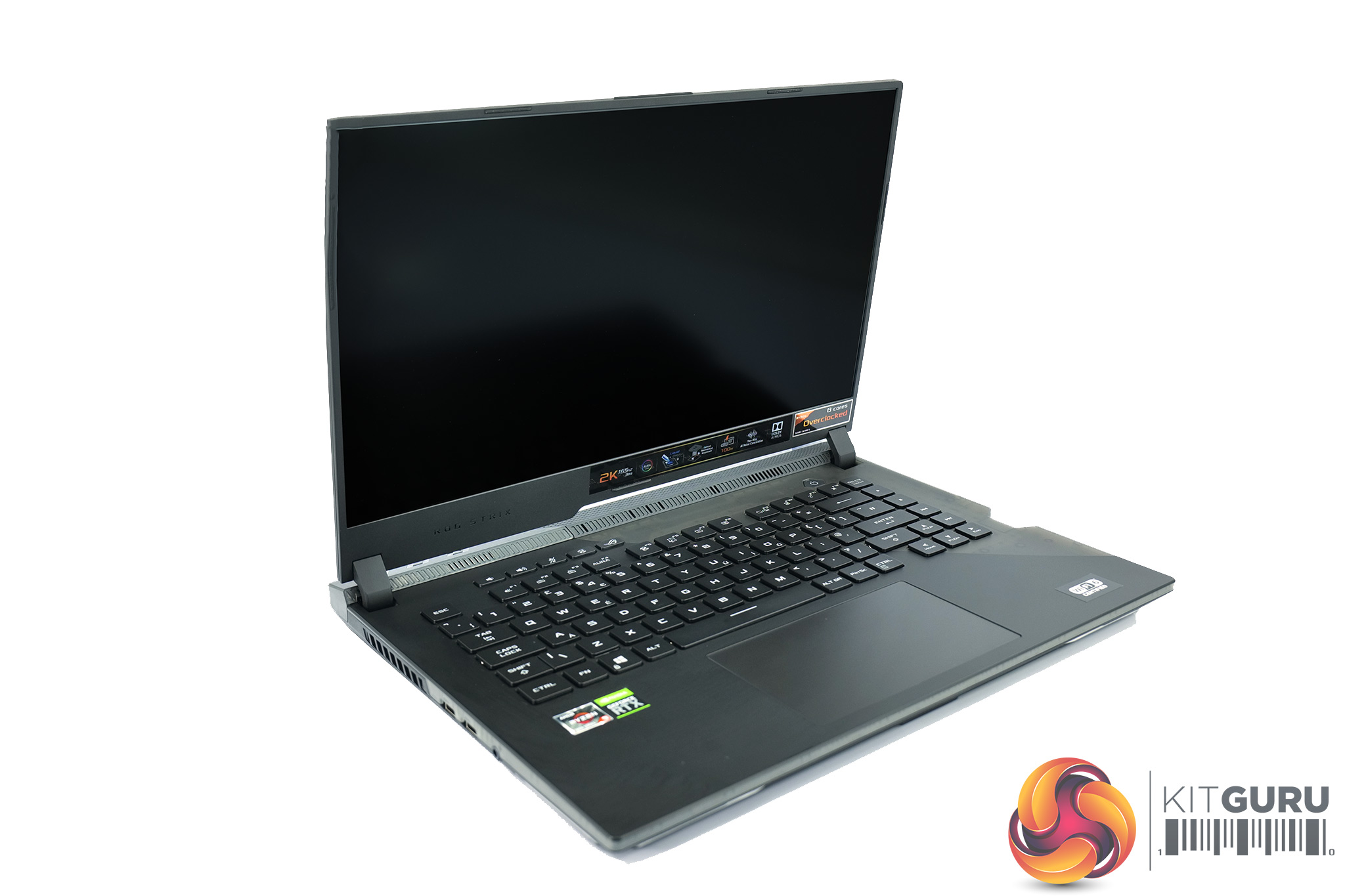
I do like the look of the Scar though. You can tell it's a gaming machine just by glancing at it, with a cool dotted design on the lid that extends down to the screen's hinge, while about a third of the laptop deck is even constructed with semi-transparent plastic – reminiscent of an old Game Boy. There's also plenty of Aura RGB lighting, stretching from the ROG logo on the lid, to the keyboard and then an extended LED bar running along the chassis' front edge.
Build quality is pretty solid too. The lid is metal-backed and only flexes a small amount, while the rest of the machine is made from plastic as far as I can tell. That means there is still a bit of flex around the keyboard deck is you push hard enough, but I didn't notice this while typing. The plastic used on the deck though is a real fingerprint magnet, something which did end up annoying me a bit, so be sure to keep a microfibre cloth handy.
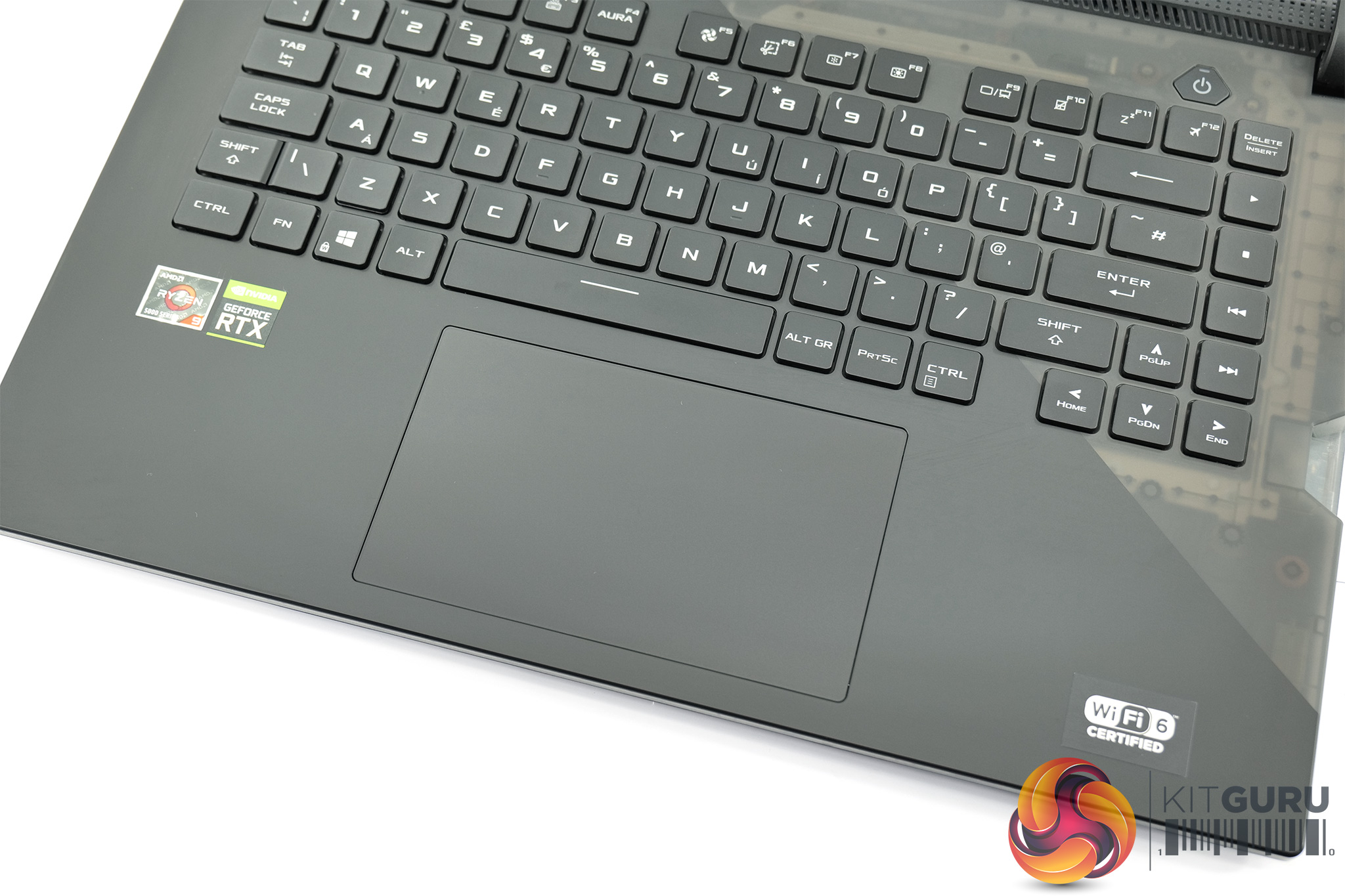
The keyboard itself though is a real highlight of the Scar 15. It uses optical-mechanical switches, providing a light but clicky actuation that – for me – is miles better than any scissor-switch laptop keyboard. Unfortunately, despite getting a UK sample, I do have complaints about the keyboard layout in that the enter key is half-height, with the hash key directly above it, instead of the backspace key we are used to seeing on standard UK ISO layouts. It's a real pain, to be frank, if you've spent your whole life using a double-height enter key to have to adjust to anything else.
I did get on really well with the trackpad too. It's nice and large, something I wish more manufacturers did – if the space is there, why not use it? Add in the smooth tracking experience, and relatively decent integrated buttons, and I'd say this would be more than good enough if you are out and about, answering emails in a coffee shop, and don't have a proper mouse with you.
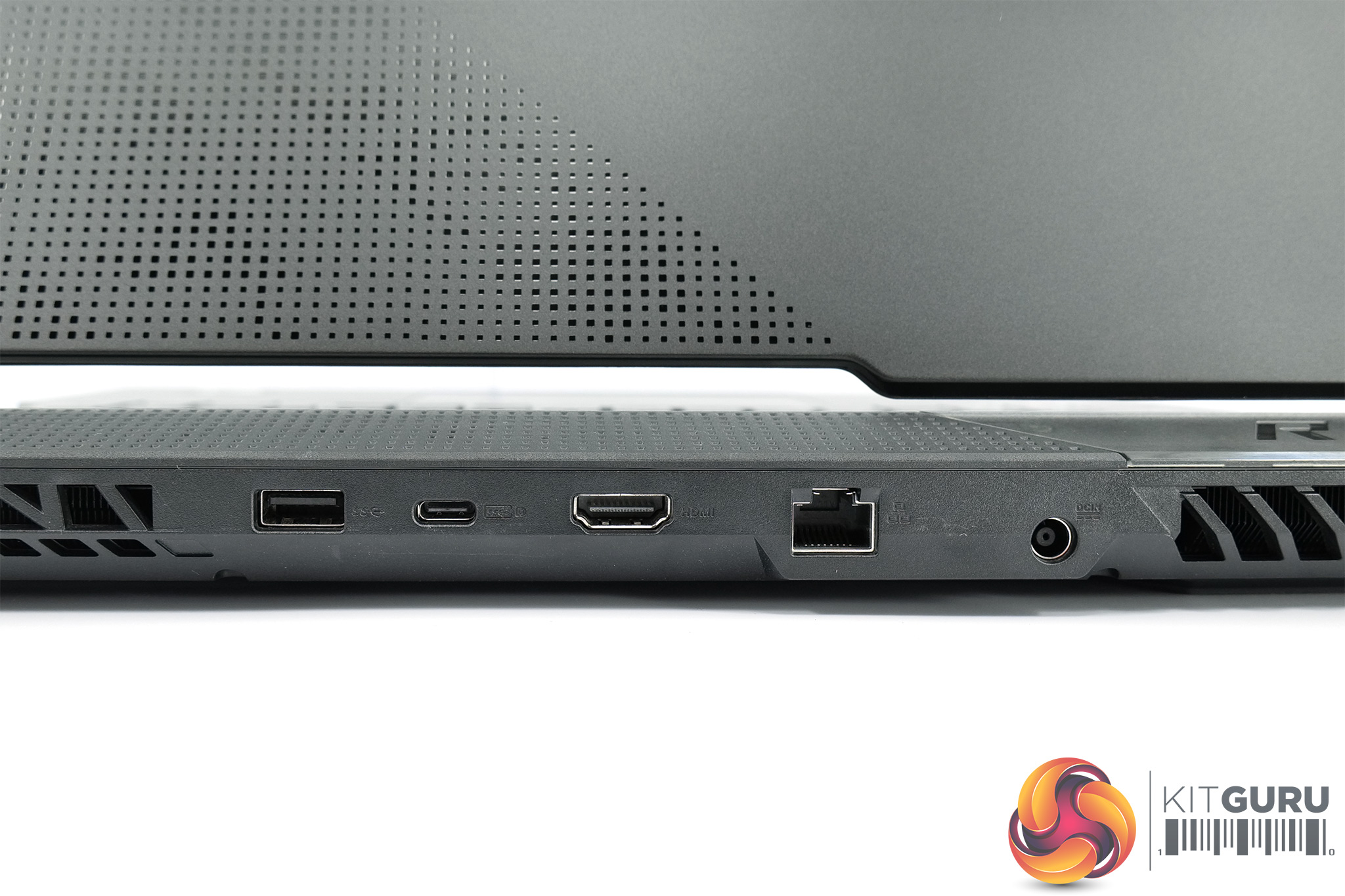
Before touching on the display, let's talk connectivity. Here ASUS has provided us with three USB 3.2 Gen 1 Type-A (AKA USB 3.0) ports, as well as one USB 3.2 Gen 2 Type-C port which also carries a DisplayPort signal. Then there's a single 3.5mm jack, plus a full-size HDMI 2.0b output and Ethernet. While this array of ports is fine for the TUF Gaming A15, I'd expect a bit more from a machine of this calibre. No SD card reader is a pain, and I'd probably expect Thunderbolt at this price-point, too. One thing we often forget to mention is the webcam, and here there simply isn't one, which I don't think was a well thought-out idea in the age of Teams & Zoom.
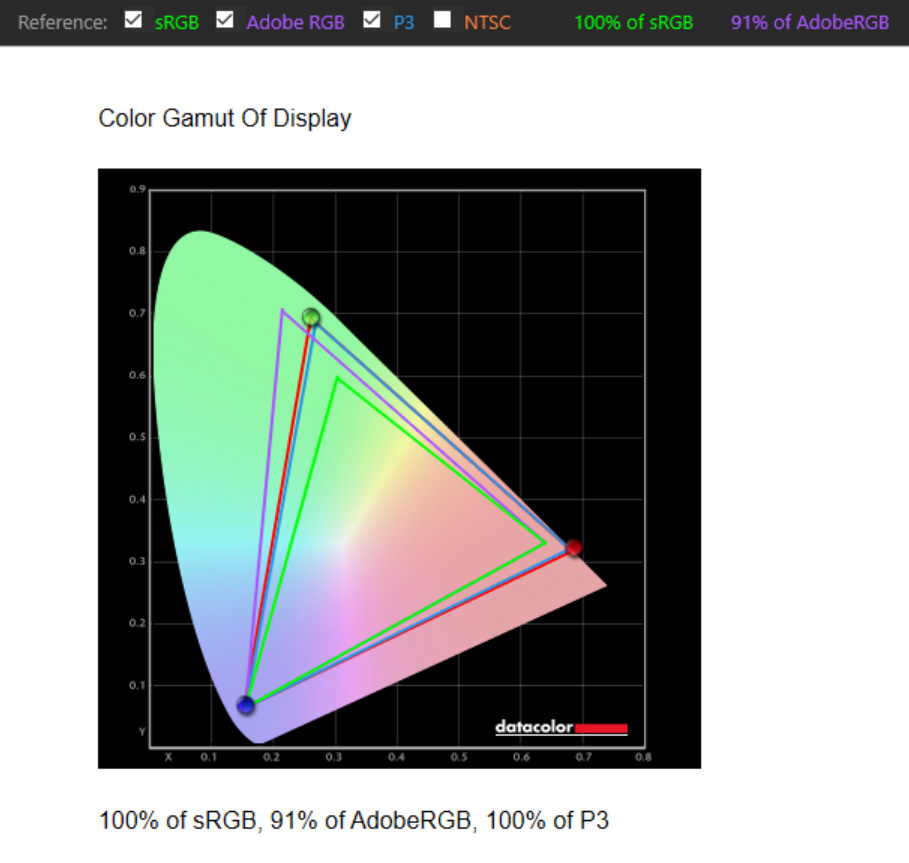
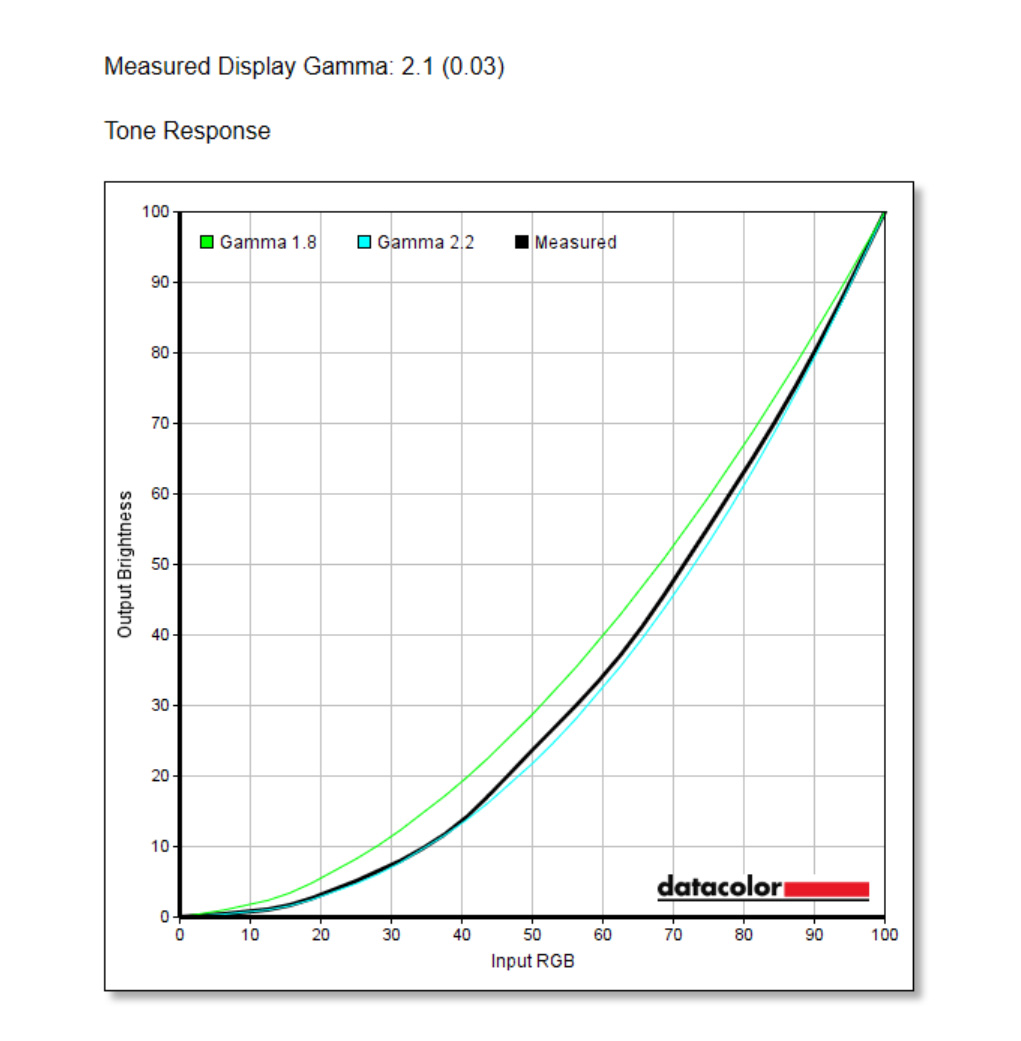
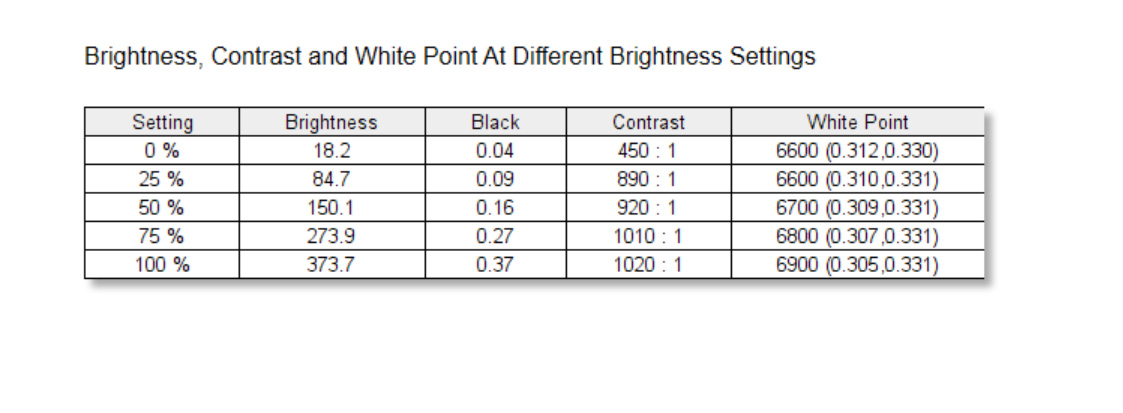
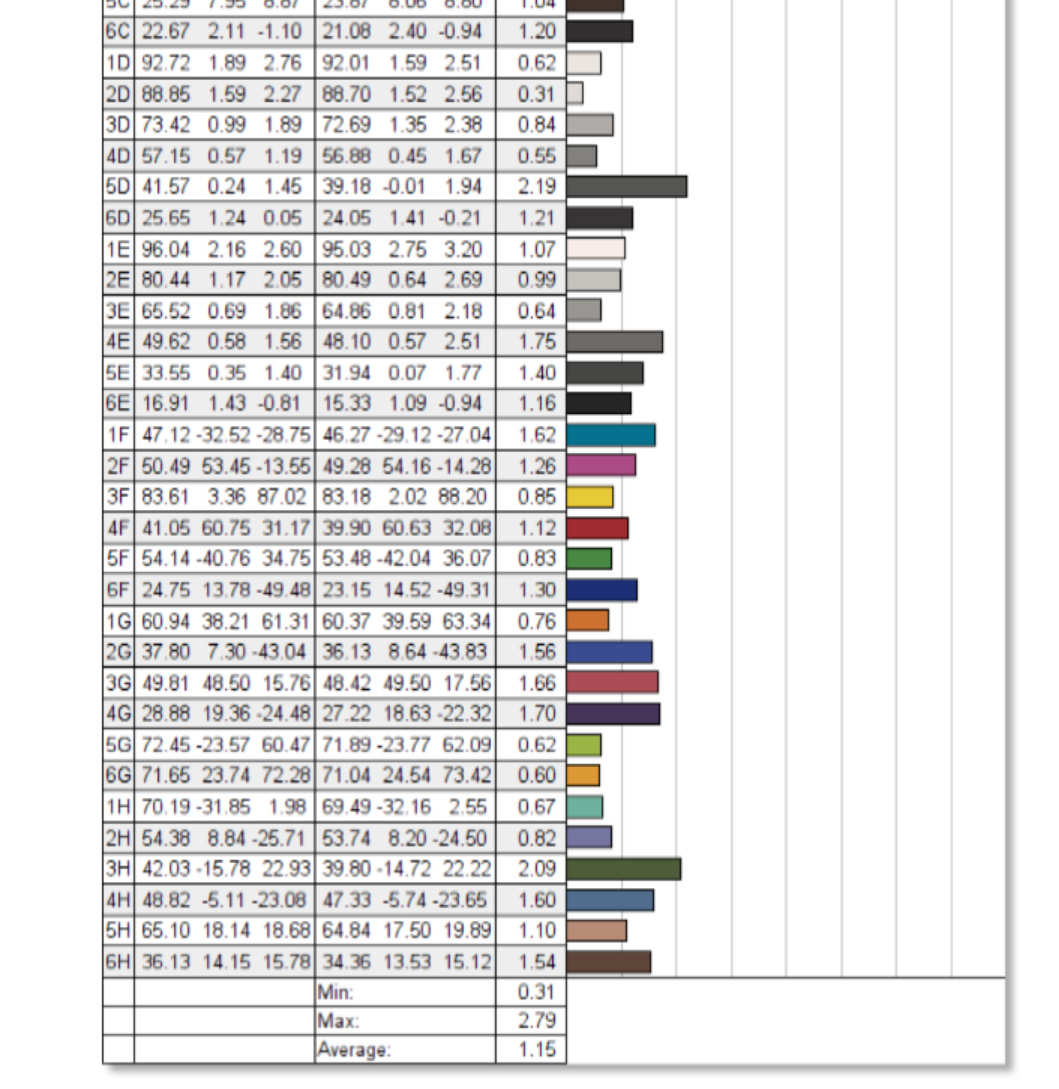
Back to the display, ASUS has knocked it out of the park here. Not only do we have a 1440p resolution at 165Hz (hallelujah!), but it's a very high quality panel, offering 100% sRGB and DCI-P3 gamut coverage. Contrast peaks at over 1000:1, as we'd expect for an IPS-level display, while colour accuracy is great with an average deltaE of just 1.15. The only slight hiccup is a gamma value of 2.2, instead of 2.1, but it's hardly a major complaint.
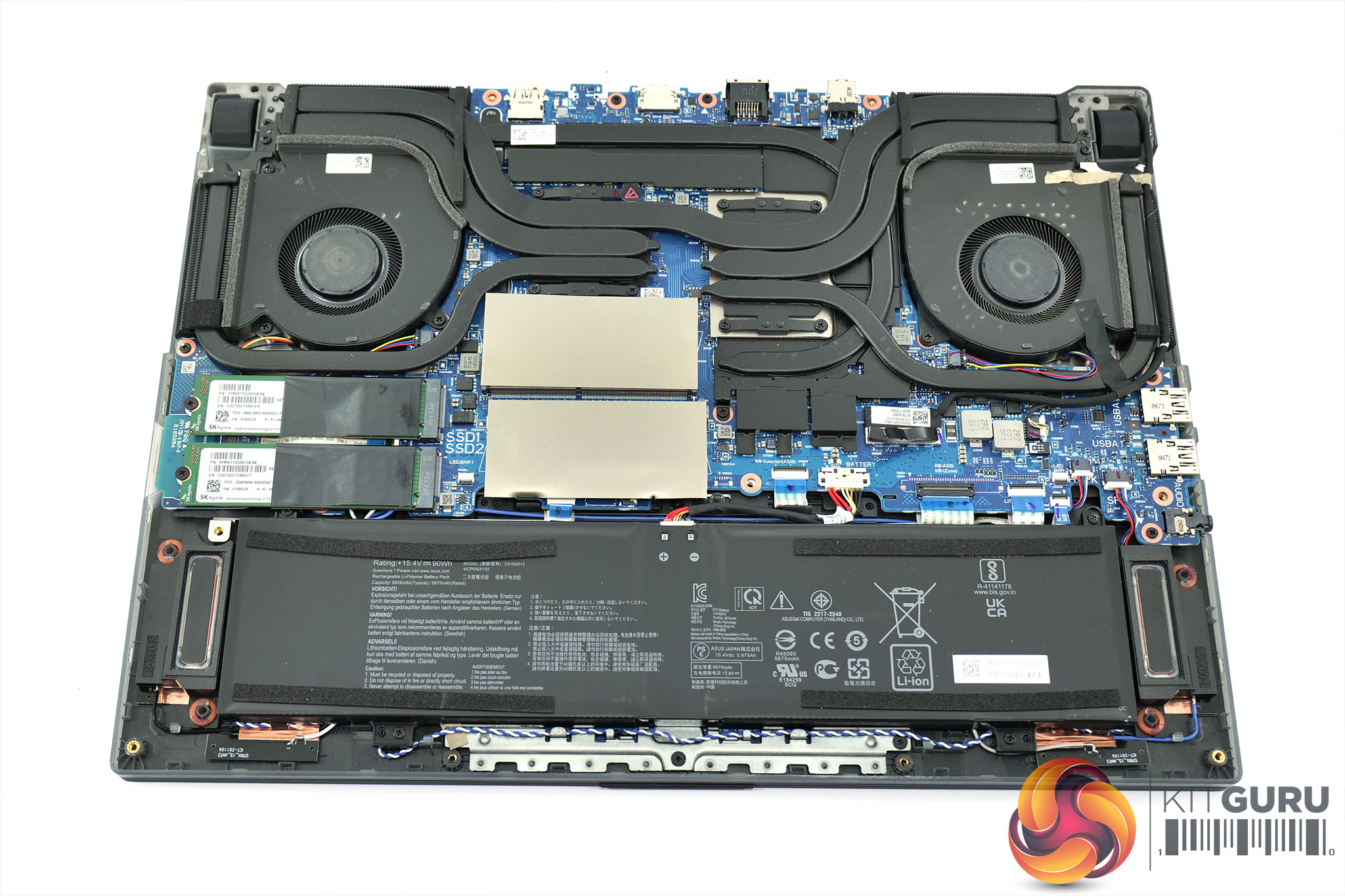
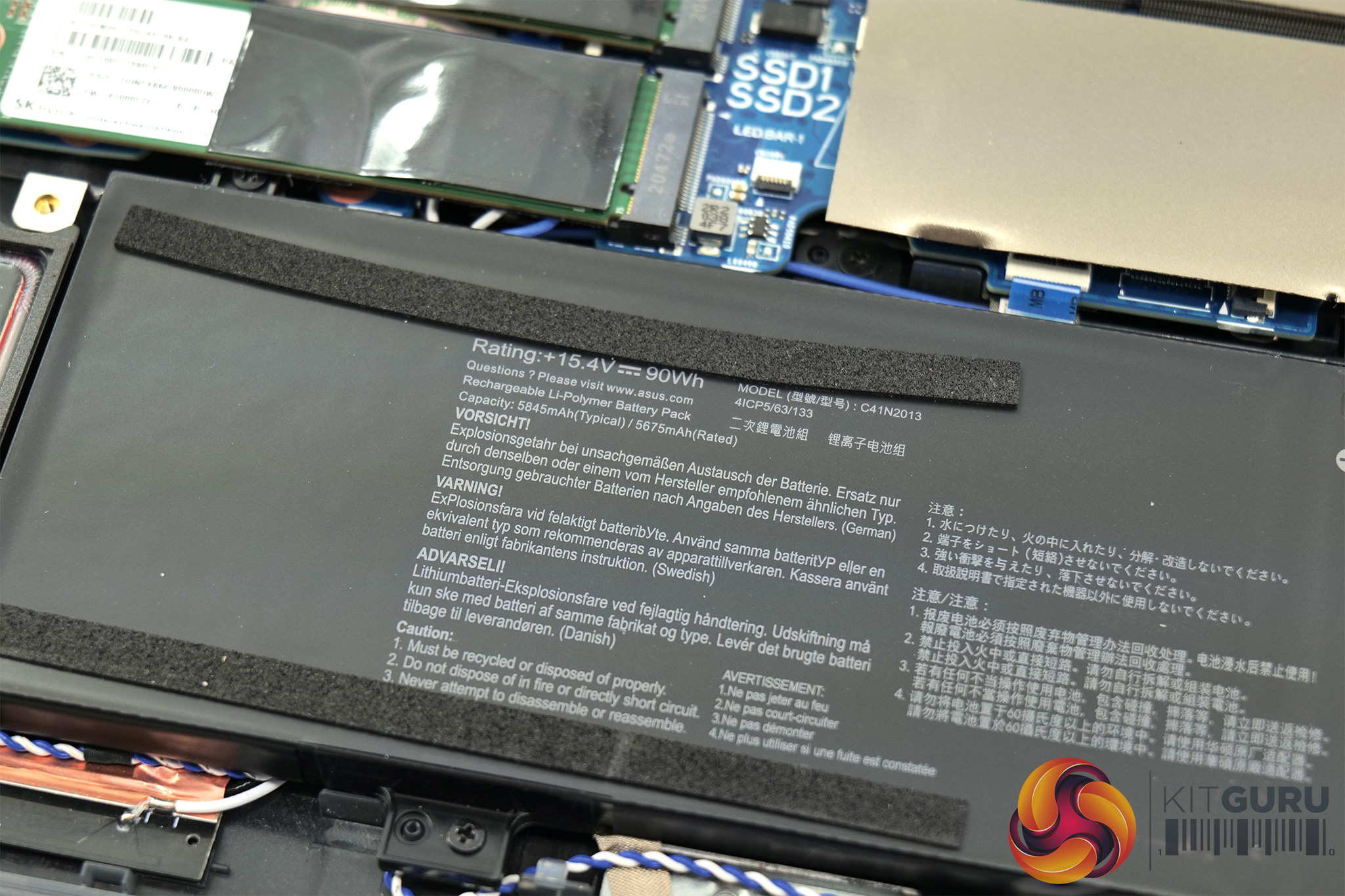
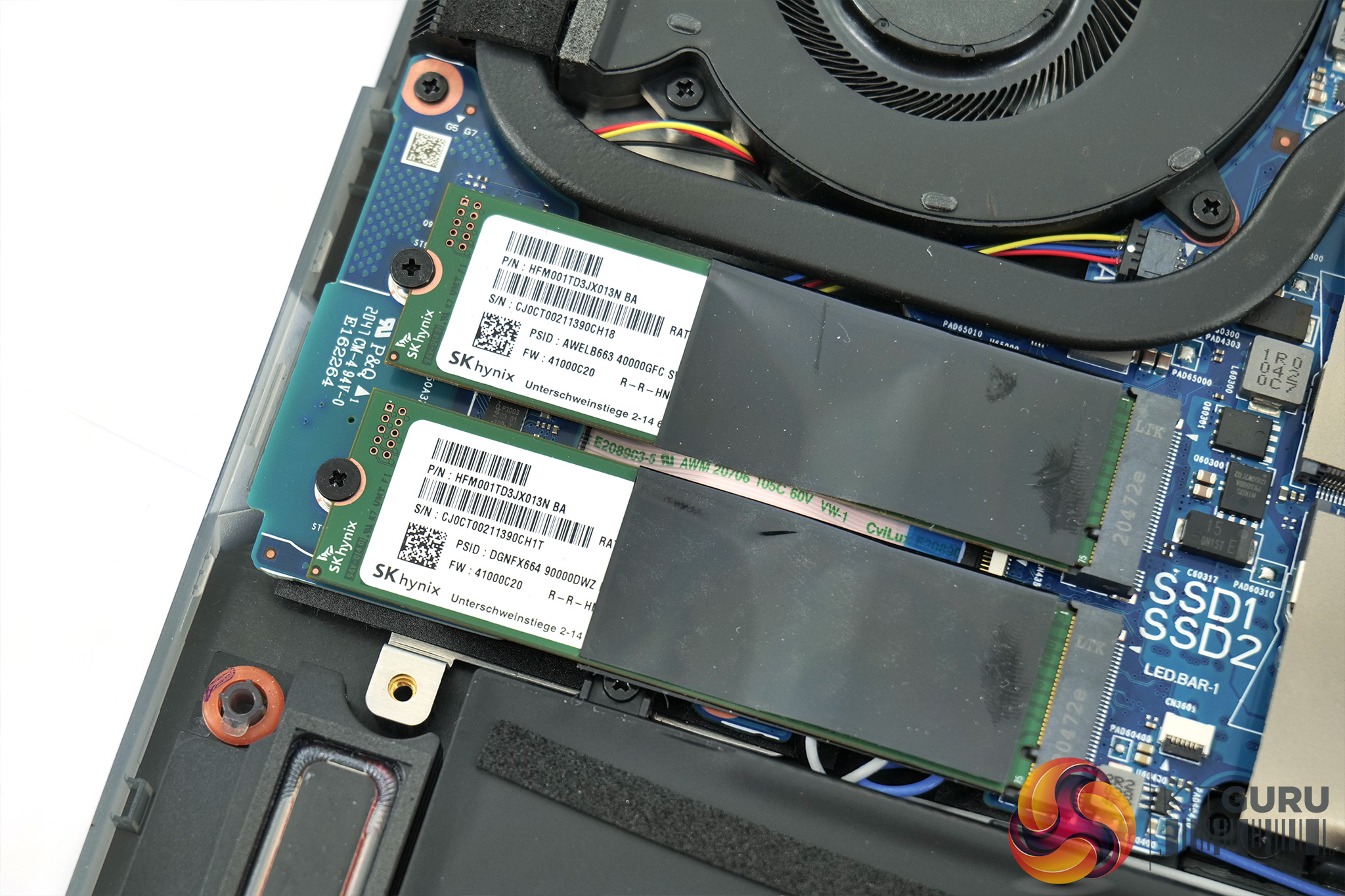
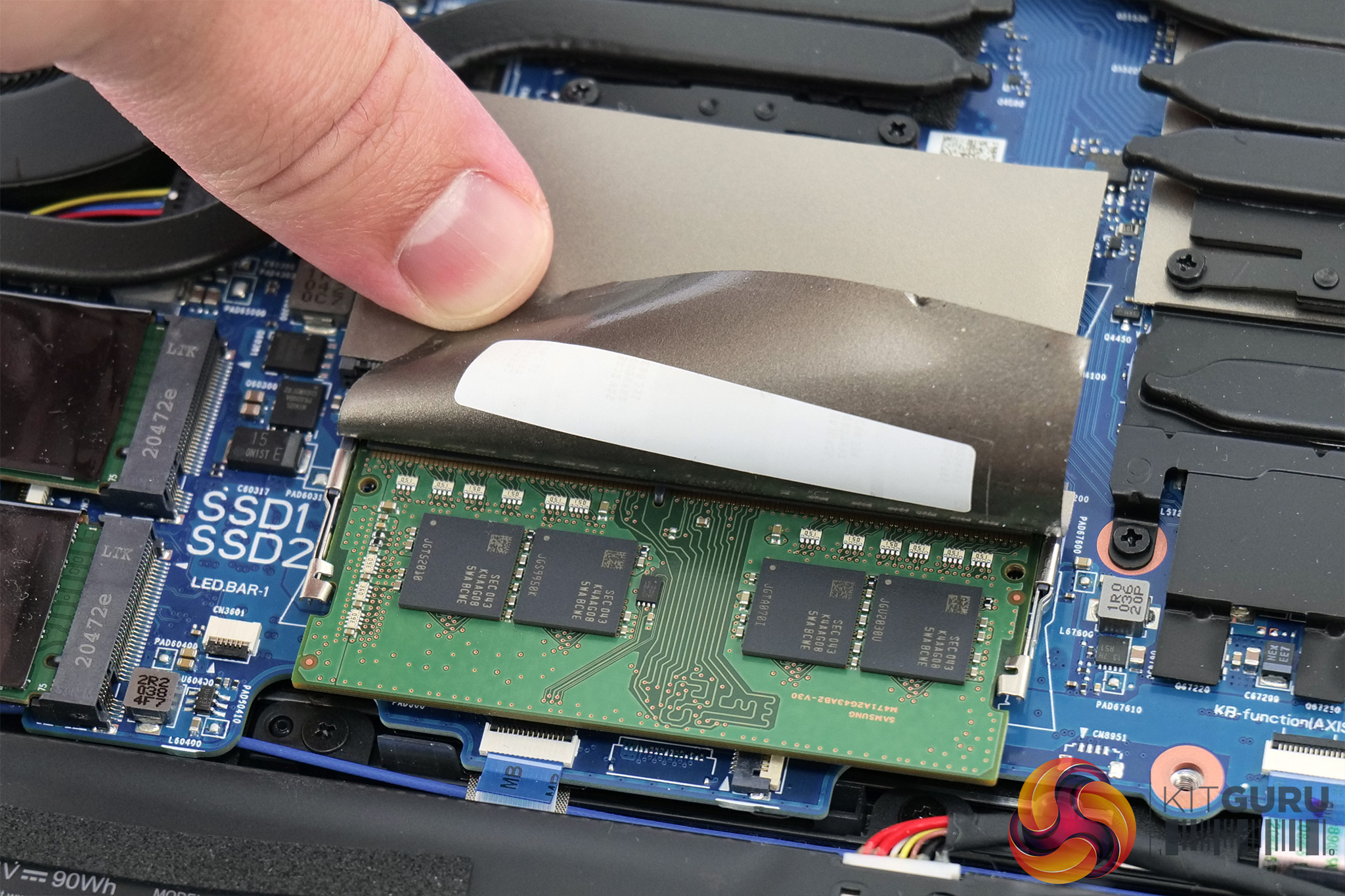
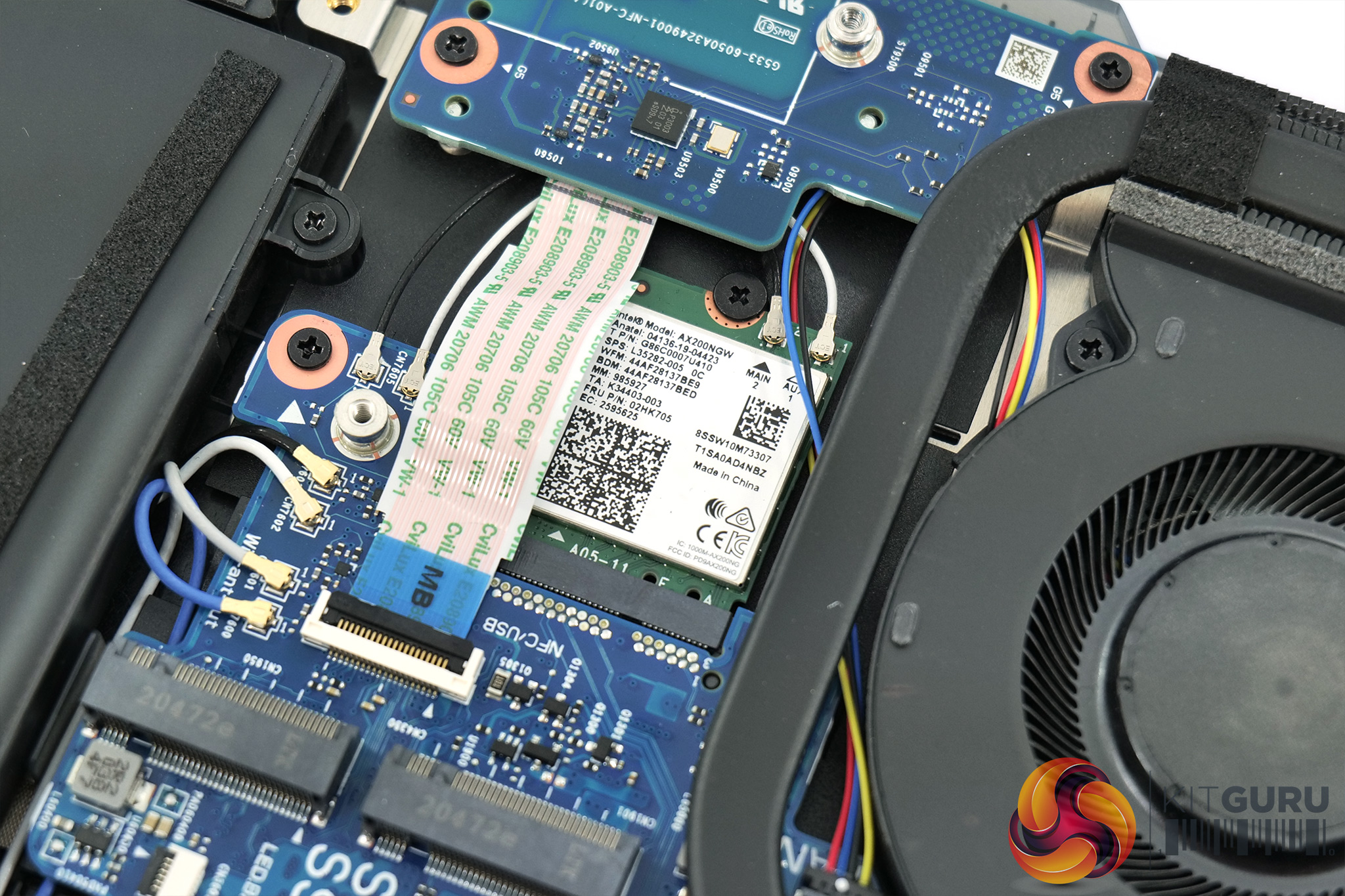
Moving on to look at the internals, if you do open up the Scar 15 it's important to note that two thin (and fragile) ribbon cables run from the motherboard to the underside panel itself, so caution is advised when removing said panel. After that, we can note the 90Whr battery as well as the two SK Hynix BC711 1TB SSDs, configured in RAID 0. There's also two 16GB DDR4 modules from Samsung, while ASUS is using Intel's AX200N WiFi 6 module.
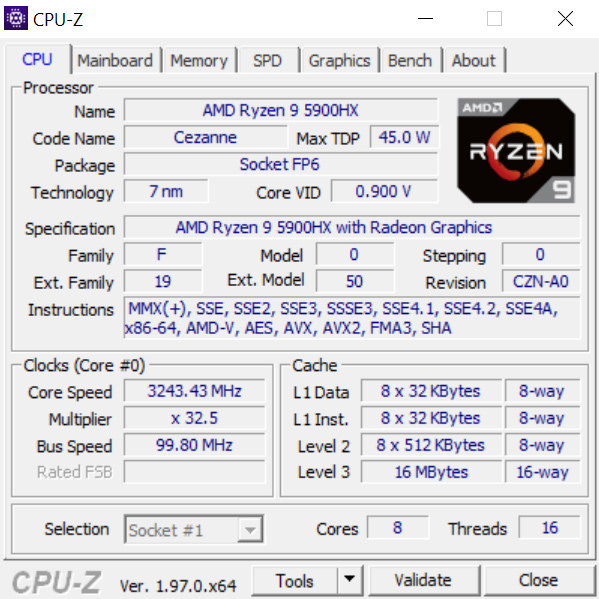
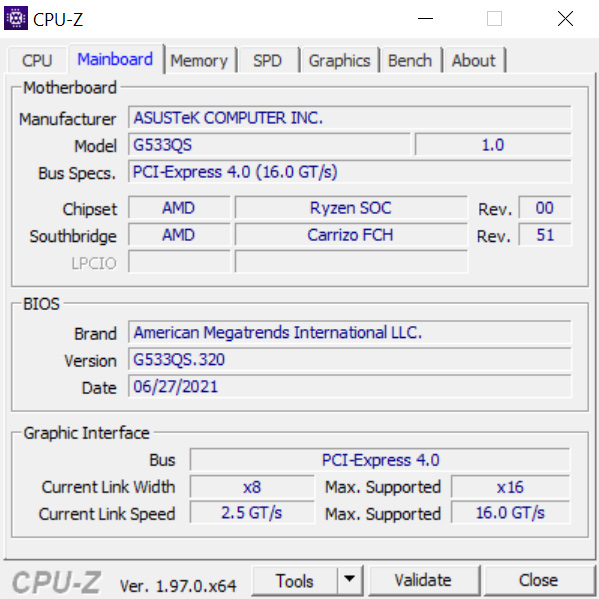
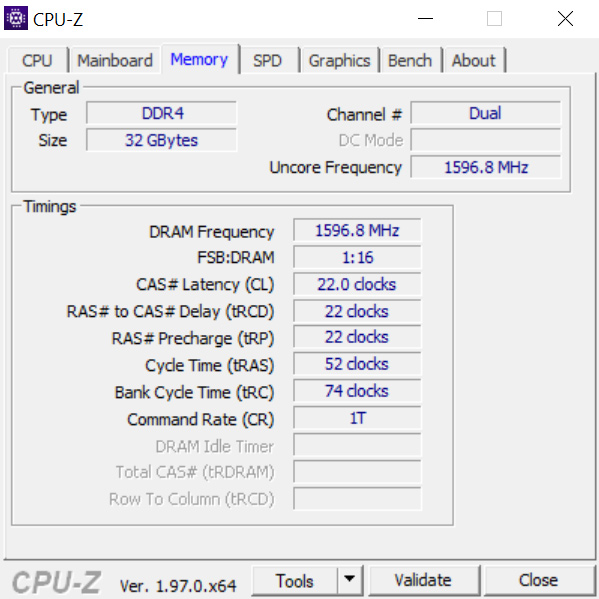
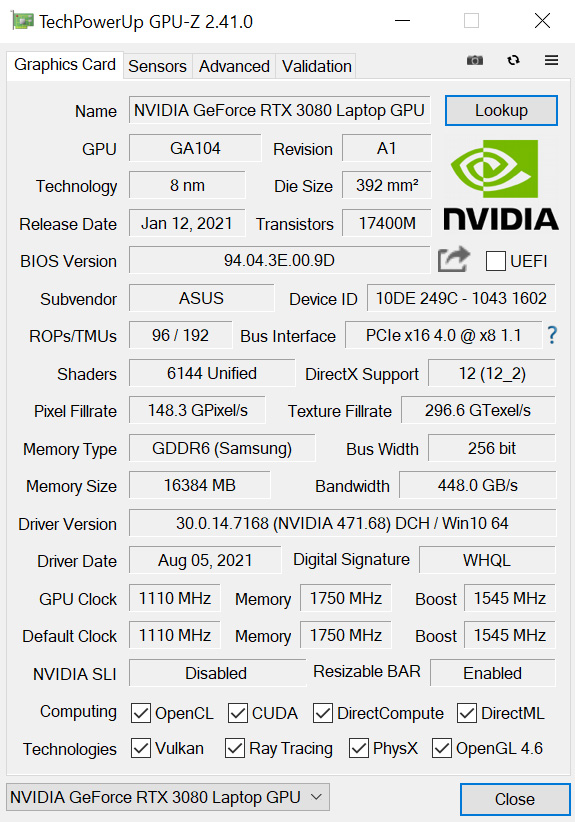
Lastly, just to confirm the key specs, we have the Ryzen 9 5900HX processor, packing in eight Zen 3 cores with SMT in a 45W power budget. That's alongside 32GB of 3200MHz DDR4 memory with 22-22-22-52 timings. For the graphics grunt, Nvidia's RTX 3080 Laptop is present with 16GB GDDR6 memory and a nominal 115W power budget, though this can increase to 130W via Dynamic Boost.
CPU Performance
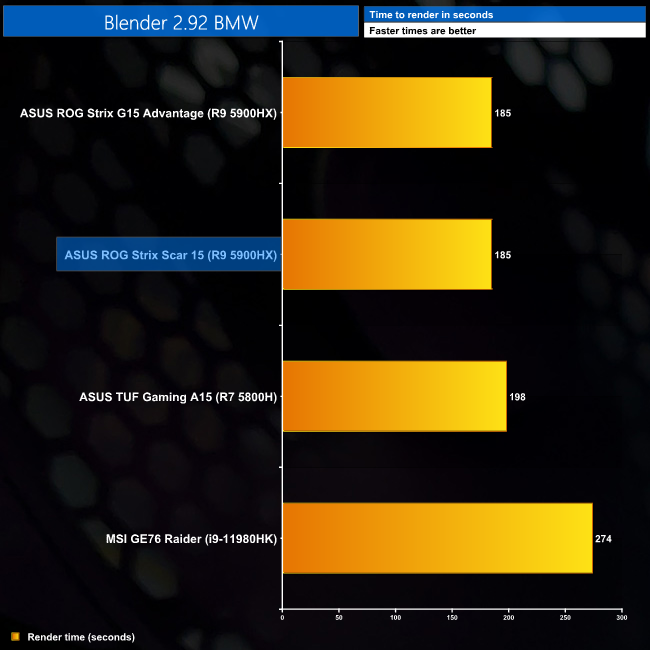
Blender 2.92:
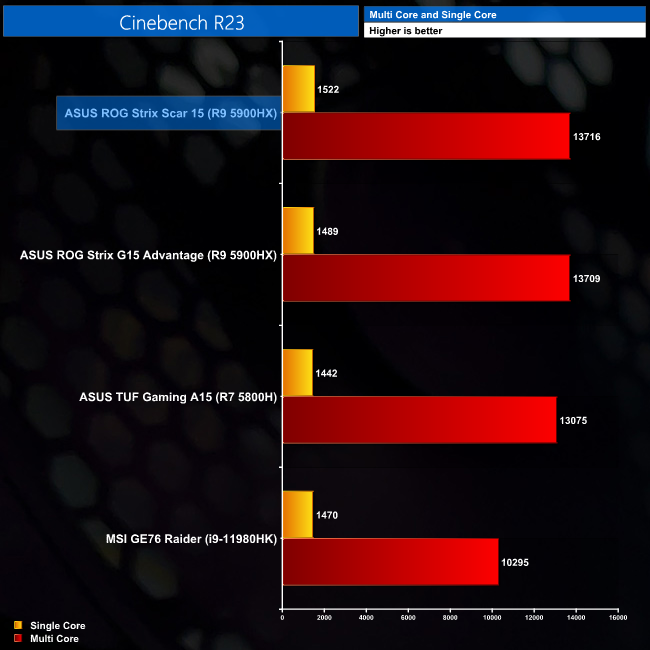
Cinebench R23:
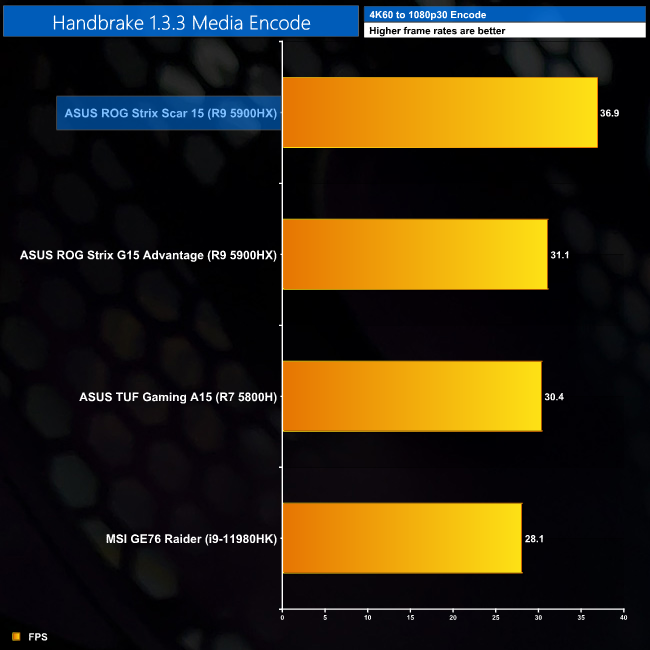
Handbrake 1.3.3:
CPU Performance Summary:
We see similar, but overall slightly better CPU performance from the Scar 15's 5900HX than that of the Strix G15 Advantage, which seems to be down to the Scar's ability to maintain higher all-core clock speeds under load. The Handbrake media encode is also a fair bit faster, but the 32GB DDR4 memory – with seemingly higher quality modules than the G15 – also helps matters here.
Memory Performance
AIDA64:
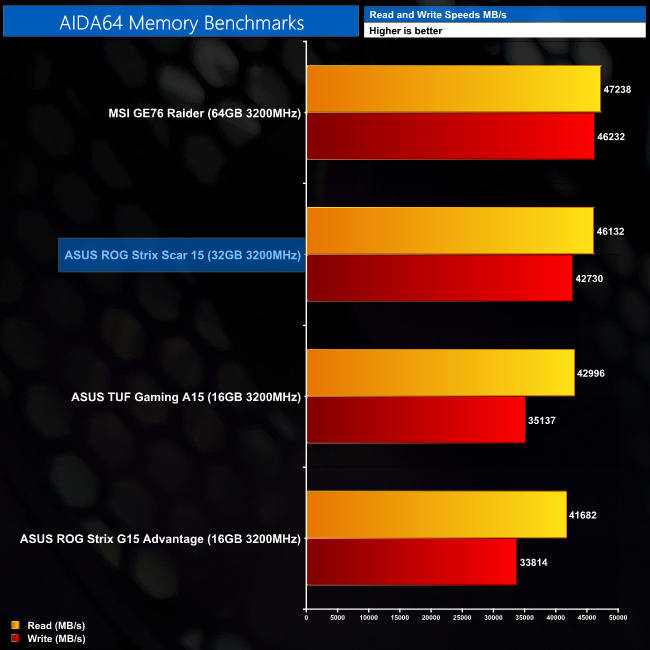
Speaking of the memory, bandwidth is higher than the other two ASUS laptops we have tested, but still not quite at the same levels as the MSI GE76 Raider, though do remember that machine is priced at over £4000.
Drive Performance
CrystalDiskMark:
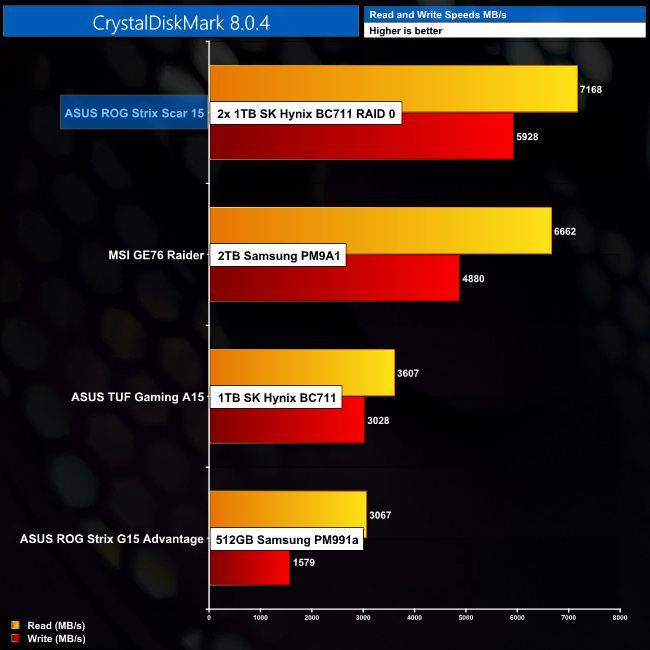
It may not be as optimal as a single PCIe Gen4 SSD – both because of long-term reliability and the fact that a single 2TB PCIe 4.0 SSD would leave a second slot for future upgrades – but the 2x 1TB SK Hynix BC711 drives, configured in RAID 0, really deliver the goods in our sequential read/write speed test.
3DMark
Fire Strike GPU:
Time Spy GPU:
Time Spy CPU:
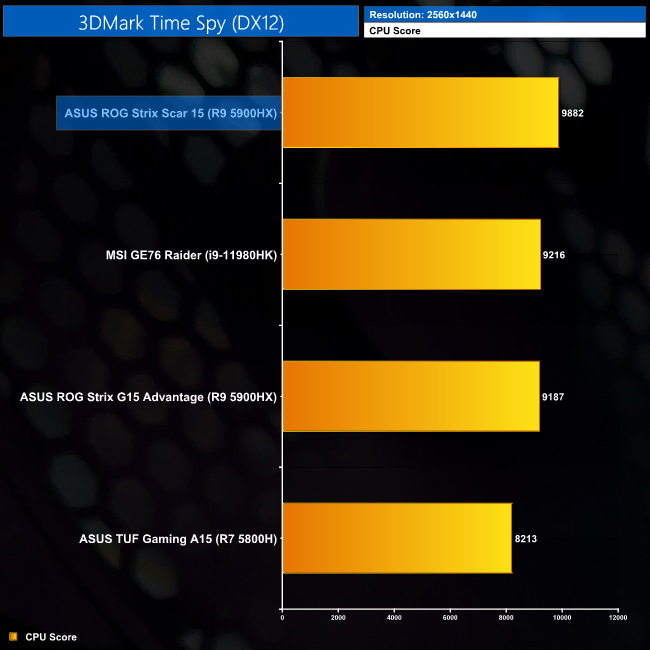
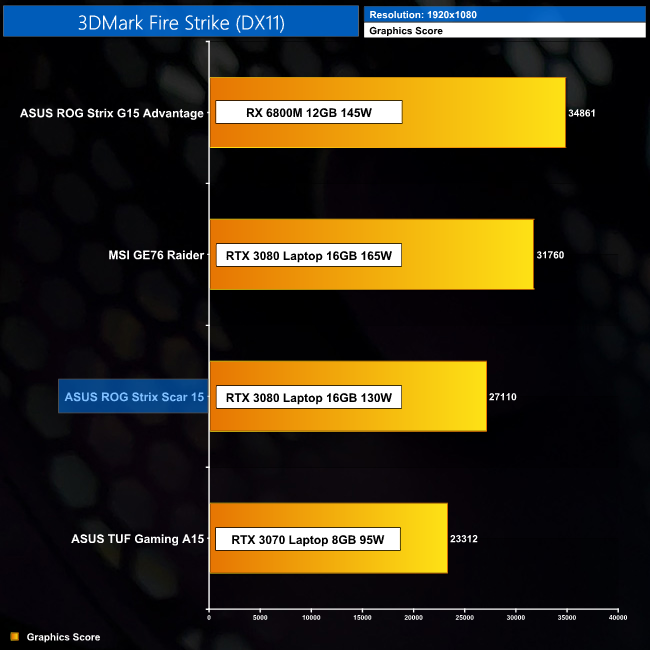
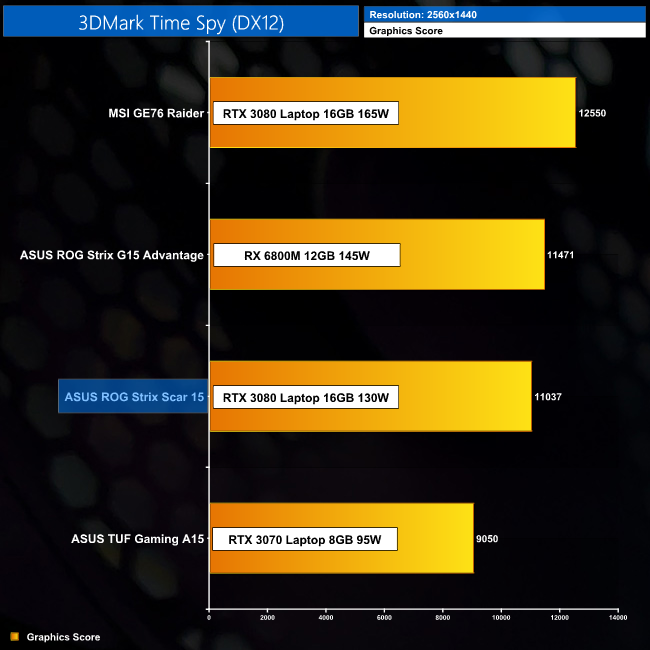
3DMark performance is pretty much where we'd expect. The RX 6800M wipes the floor with the competition in Fire Strike, but Time Spy is a much closer affair and the Scar 15's RTX 3080 Laptop GPU is only just behind. Meanwhile, for the Time Spy CPU test, the 5900HX used in the Scar 15 is again able to out-pace the same CPU found in the G15 Advantage, likely with some help from its superior memory modules.
Gaming
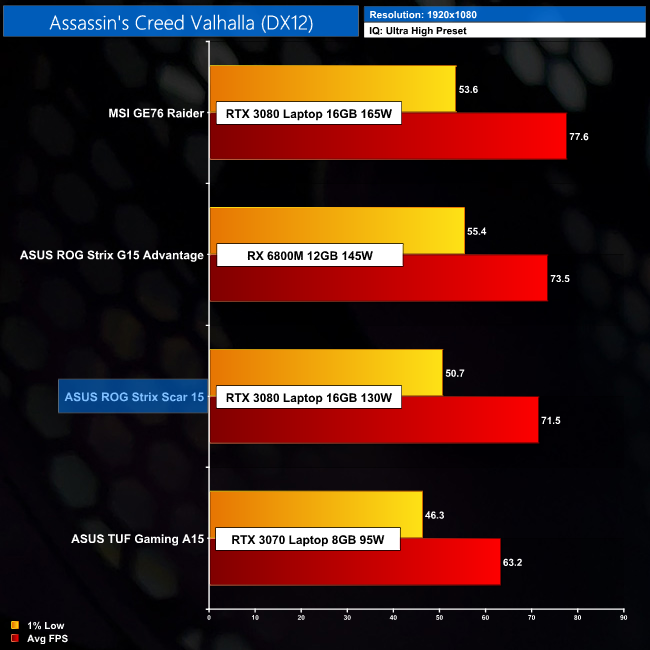 ]
]
1440p: 59.1 average, 43.7 1% low
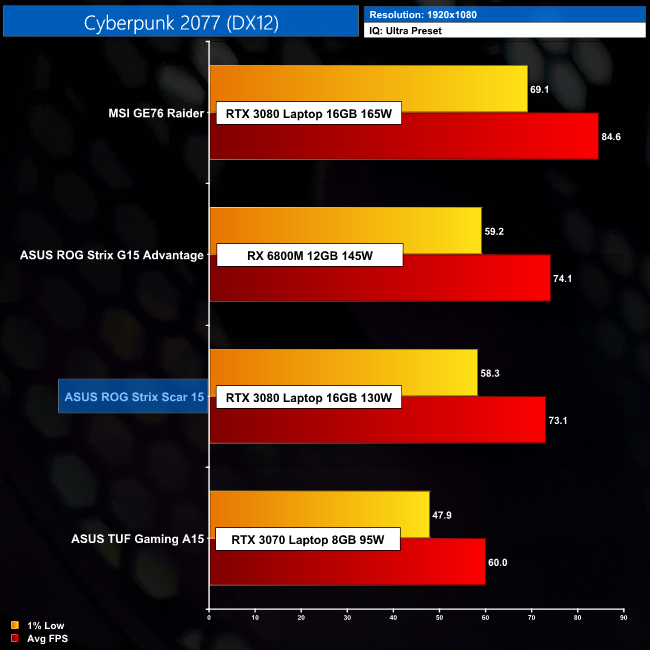
1440p: 47.1 average, 40.1 1% low
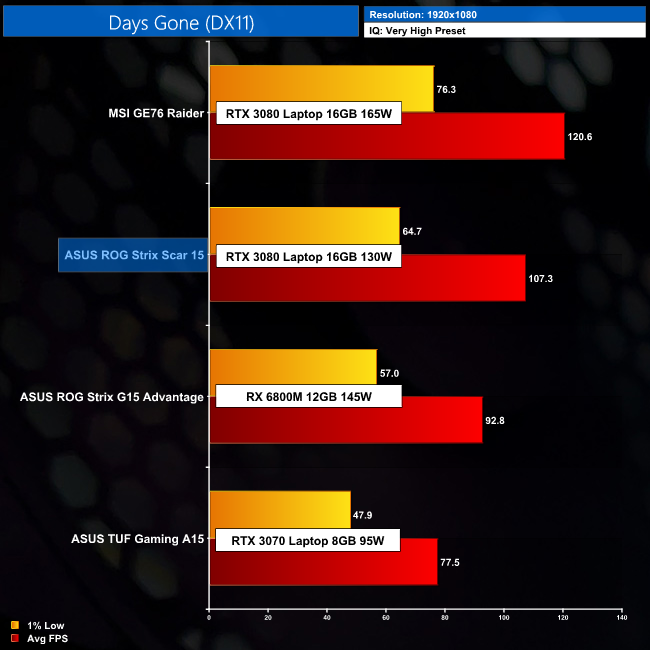
1440p: 80.8 average, 48.9 1% low
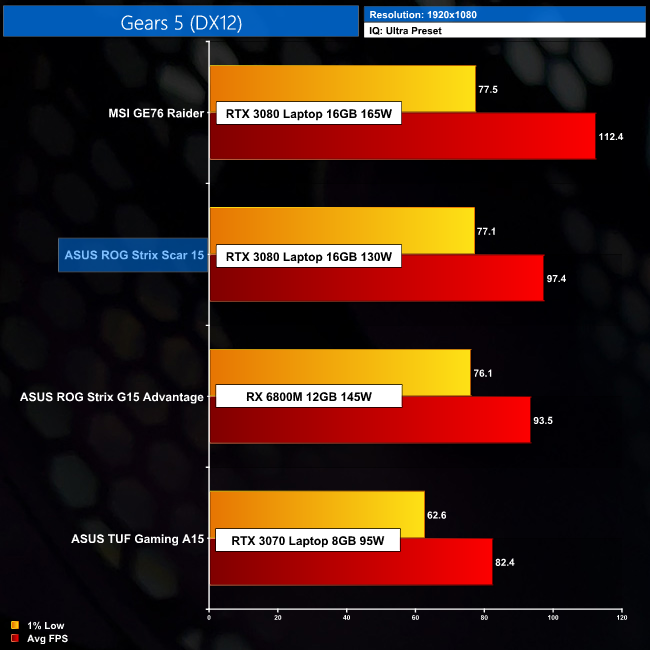
1440p: 70.2 average, 58.3 1% low
1440p: 103.7 average, 76.6 1% low
1440p: 108.3 average, 93.5 1% low
1440p: 53.6 average, 45.7 1% low
Gaming Performance Summary:
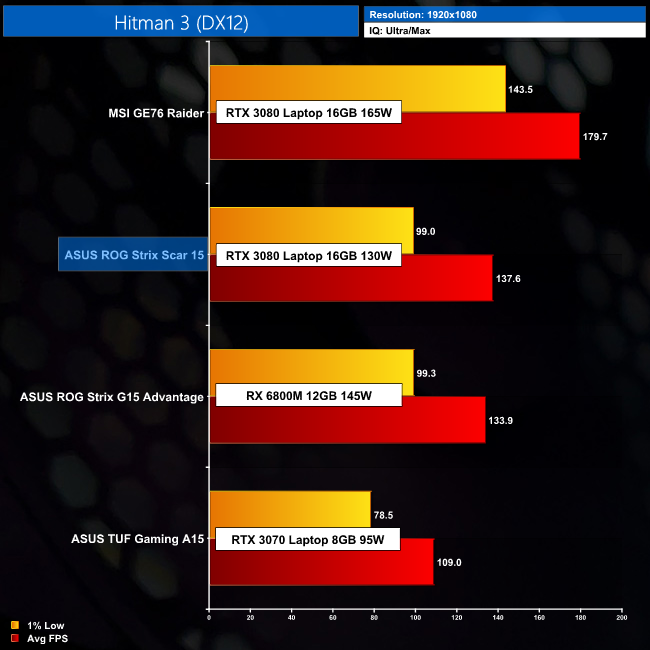
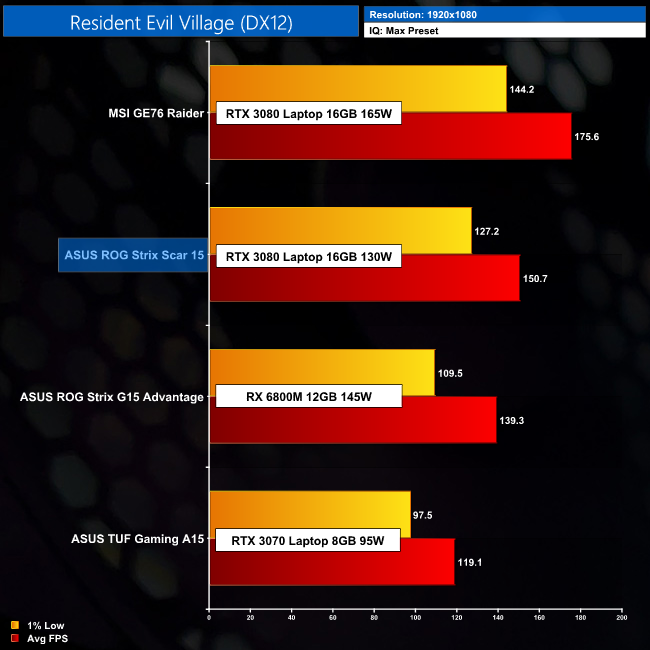
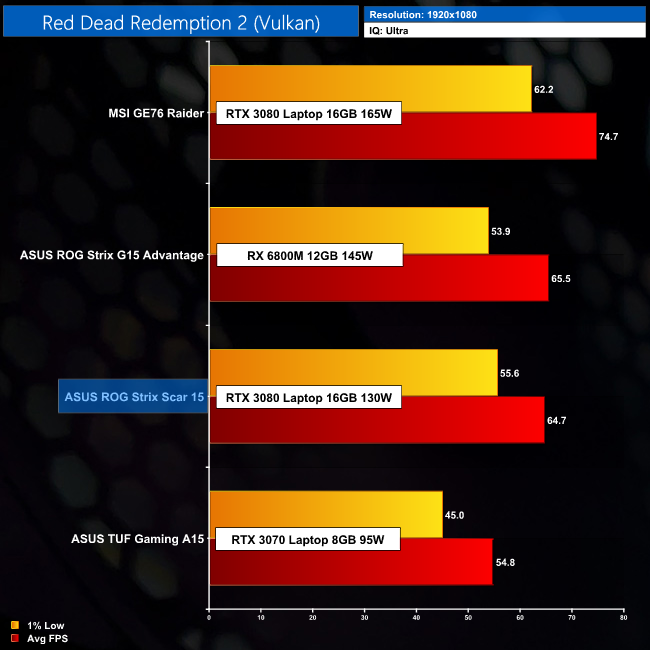
The 1080p gaming performance from the Scar 15 is pretty much neck-and-neck with that of the G15 Advantage. The RTX 3080 Laptop, in its 115W (plus 15W from Dynamic Boost) edges it ahead in some titles – like Resident Evil Village and Hitman 3 – but the RX 6800M does better in Red Dead Redemption 2 and Assassin's Creed Valhalla. Either way, the deltas are very small, so the real-world gaming performance of both machines is close enough to be called a tie.
Of course, the Scar 15 has a 1440p display and it can offer playable frame rates at that resolution. It won't get you a locked 60FPS, particularly not in the likes of RDR2 or Cyberpunk 2077, but for less demanding titles it is very feasible.
Thermals:
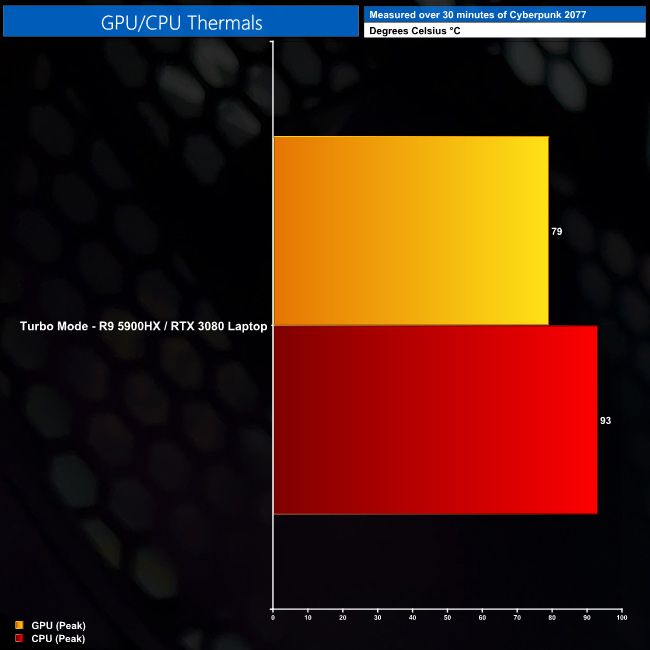
Thermally we can have no complaints from the Scar 15. The RTX 3080 Laptop peaked at 79C when using the ASUS Turbo mode, and that was with the GPU operating at around xxxxMHz. The 5900HX did run hotter, peaking at 93C, but impressively it maintained all-core clock speeds of over 4GHz during extended runs of Cinebench R23.
Noise:
Just like the TUF Gaming A15, we recorded a sound level of 47dBa when holding the sound meter 1 foot from the display, and that's with Turbo mode engaged. It's clearly audible and not great fun if you're not using a headset, but as gaming laptops go, I have used far louder machines.
Battery:
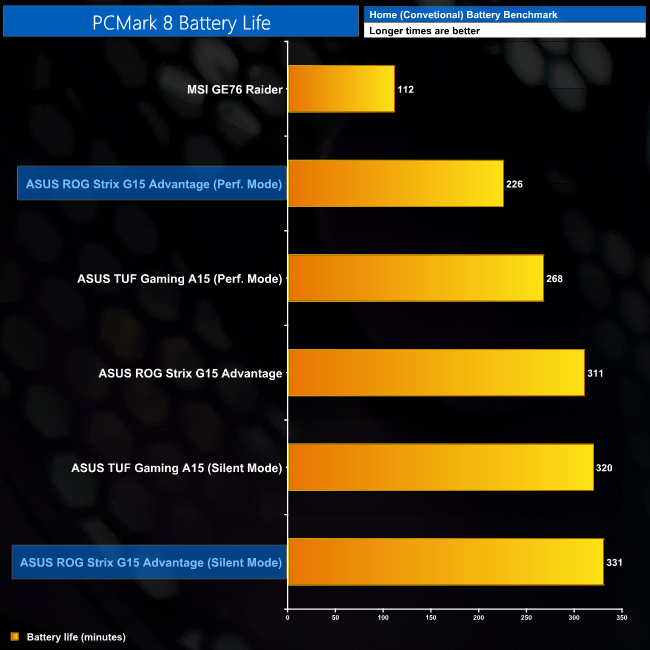
Lastly, battery life is pretty similar to the TUF Gaming A15. It didn't last quite as long using the Performance profile, but a result of over three hours is still very solid. If you switch to the Silent mode though, which operates with a lower power budget, this can be stretched to almost six hours, and bearing in mind that is six hours of constant use, the Scar offers more than enough juice to keep you going if you're out and about and need to send a few emails or surf the web.
There's a lot to like about the ASUS ROG Strix Scar 15. It's the first gaming laptop I've tested with a 1440p display – the perfect in-between resolution that's sharper than 1080p, but not as GPU-intensive as 4K. It's a top quality panel too, as we measured 100% DCI-P3 coverage and a terrific average deltaE of just 1.15.
The combination of the eight-core Ryzen 9 5900HX and RTX 3080 Laptop 16GB GPU also delivers the good when it comes to gaming. If you play at 1080p, you're guaranteed excellent frame rates in anything you can chuck at this machine. Stepping up to 1440p will mean certain games – the likes of Cyberpunk 2077 and Red Dead Redemption 2 – won't quite manage a locked 60FPS, but there's still plenty of headroom to game at that resolution.
I've loved using the optical-mechanical keyboard too, as it simply delivers a far better typing and gaming experience than a traditional chiclet or scissor-switch laptop keyboard. The large trackpad is also of good quality, while the 90Wh battery is more than enough to let you use the Scar 15 on the go, provided you're not trying to play AAA games.
It doesn't do much wrong either. Admittedly, seeing the same selection of ports as the TUF Gaming A15 is a bit disappointing considering the significant price differences – there's no SD card reader or Thunderbolt hear – while the lack of webcam is somewhat mystifying in this day and age.
For most gamers though, I'd suggest the biggest problem with the Strix Scar 15 is ASUS' own Strix G15 Advantage. We've shown in this review that the G15 and Scar 15 perform almost identically in game, yet the G15 retails at £1699 currently, while the Scar 15 (in its configuration as reviewed here) is listed at £2699.99. Admittedly, there are a few quality of life differences between the two, with the Scar offering a better keyboard, double the RAM and a 1440p display… but it's hard to escape the fact that for £1000 less you can get essentially the same gaming performance in what is still a very good all-round package.
That would be my main recommendation for those looking for a laptop in this performance class. Unless you absolutely must have the higher-resolution display or need that 32GB of DDR4 memory, while the ASUS ROG Strix Scar 15 is a very capable machine, it's just hard to argue with the sheer bang-for-buck offered by the G15 Advantage.
The Scar 15 is listed on ASUS' own retail store HERE, though it is currently out of stock.
Discuss on our Facebook page HERE.
Pros
- High quality 1440p display.
- Great optical-mechanical keyboard.
- Large and smooth trackpad.
- Solid build quality.
- More than capable of 1080p and most 1440p gaming.
- RAID 0 array is very fast.
Cons
- ASUS' own G15 Advantage offers very similar gaming performance for significantly less cash.
- Would've expected an SD card reader and even Thunderbolt at this price point.
- Half-height enter key is not ideal for the UK model.
- No webcam is a definite mis-step.
KitGuru says: It's a very impressive laptop, but if I had this much to spend on a portable gaming machine, the Strix G15 Advantage would be my first port of call.