KitGuru KitGuru.net – Tech News | Hardware News | Hardware Reviews | IOS | Mobile | Gaming | Graphics Cards


Seasonic has recently updated its power calculator to include the yet-to-be-announced Nvidia RTX 50 series. Notably, the updated list provides TDP (thermal design power) levels, which have not been disclosed before.
While the TDP data isn't immediately visible, as shown by Everest's screenshots, VideoCardz explains that users can download the computations in a text format, where the TDP data is revealed. The 5090 model is expected to have the highest TDP in the RTX 50 series, coming in at a staggering 500W. This is a 50W increase compared to the RTX 4090.
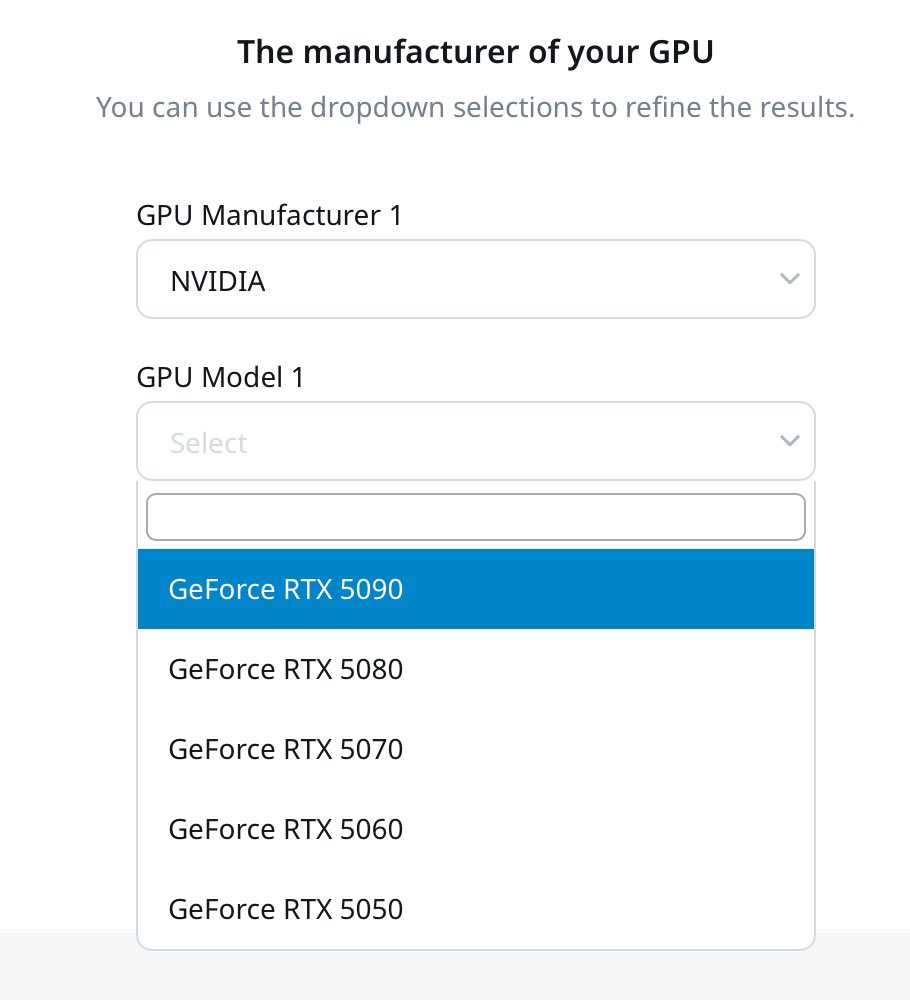

Image credit: Everest
The other models in the RTX 50 series are expected to have the following TDPs: 350W for the RTX 5080, 220W for the RTX 5070, 170W for the RTX 5060, and 100W for the RTX 5050. It's worth noting that all of these SKUs are reportedly designed to use a 16-pin power connection.
In a surprising twist, Seasonic has also mentioned unannounced Radeon RX 7000 variants in its updated list. Despite AMD not officially disclosing any details about its RDNA3 desktop portfolio, the list hints at upcoming products such as the RX 7990 XTX and RX 7500 XT.
It's unclear whether Seasonic is privy to inside information or if this is simply placeholder data. Nvidia is expected to officially announce the RTX 50 series between late 2024 and early 2025.
Discuss on our Facebook page, HERE.
KitGuru says: While it remains to be seen how accurate this list is, the TDP values are plausible and not far off expectations.