KitGuru KitGuru.net – Tech News | Hardware News | Hardware Reviews | IOS | Mobile | Gaming | Graphics Cards


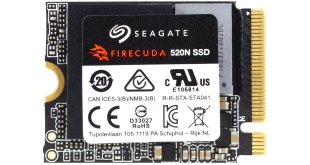
The latest addition to Seagate's FireCuda gaming range is the FireCuda 520N, an M.2 2230 Gen4 drive aimed at the storage upgrade market for portable gaming and compute or ultra-thin devices. We analyse the 1TB model, hitting the market at about £110 here in the UK.
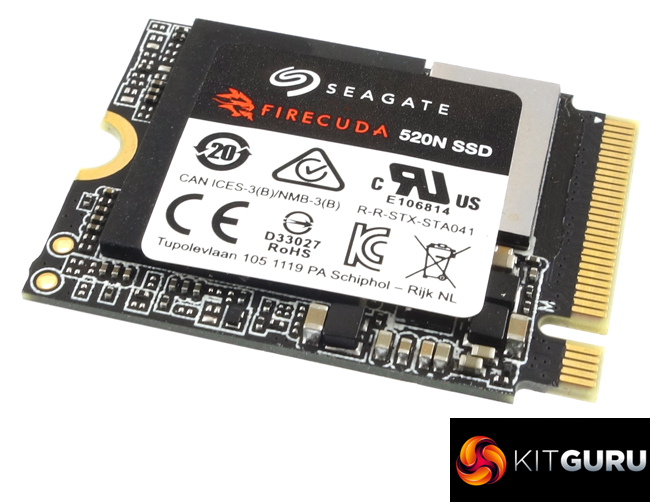
Just two capacities make up the FireCuda 520N product line (at the time of writing) 1TB and the flagship 2TB drive. At the heart of the drive is Phison’s PS5021-E21T 4-channel DRAM-less design controller looking after a 1TB package of Micron 176-layer 3D TLC NAND.
Seagate quotes Sequential performance figures of 5,000MB/s and 3,200MB/s for read and writes respectively for the 2TB drive while the 1TB drive is slower for reads at 4,800MB/s but at 4,700MB/s it has faster write performance than the 2TB model.
Seagate rates the random 4K performance of the 2TB 520N as up to 480,000 IOPs for reads and up to 750,000 IOPS for writes. The 1TB drive is much faster, rated at up to 800,000 IOPS and 900,000 IOPS for reads and writes respectively.
The TBW endurance figure for the 1TB drive is quoted at 600TB. Seagate backs the drive with a 5-year warranty but also includes three years of the company's Rescue Data Recovery Service, a handy bonus.
Physical Specifications:
- Usable Capacities: 1TB.
- NAND Components: Micron B47R FortisFlash 176-layer 3D TLC NAND.
- NAND Controller: Phison PS5021-E21T.
- Cache: none, DRAM-less design.
- Interface: PCIe Gen4 x4, NVMe 1.4.
- Form Factor: M.2 2230.
- Dimensions: 30.15 x 22.15 x 2.23mm.
- Drive Weight: 3g.
Firmware Version: SUMSM000