KitGuru KitGuru.net – Tech News | Hardware News | Hardware Reviews | IOS | Mobile | Gaming | Graphics Cards


Intel recently released an upgraded version of its XeSS upscaler, version 1.3. This version offers improved performance over the previous version, including changing the resolution scaling for the upscaling profiles and introducing new ones.
While these profiles share the same title, Intel compares them with varying scaling, resulting in better performance due to lower resolution rather than improved XeSS performance. For example, the Ultra Quality profile resolution scaling has increased from 1.3x to 1.5x, while the Quality profile has changed from 1.5x to 1.7x. Similarly, balanced profiles now have a new upscaling ratio, rising from 1.7x to 2.0x, while Performance has increased from 2.0x to 2.3x. Additionally, Intel added the Ultra Quality Plus profile, which replaces the previous Ultra Quality with a 1.3x resolution scaling, and Ultra Performance, which has a 3.0x resolution scaling.
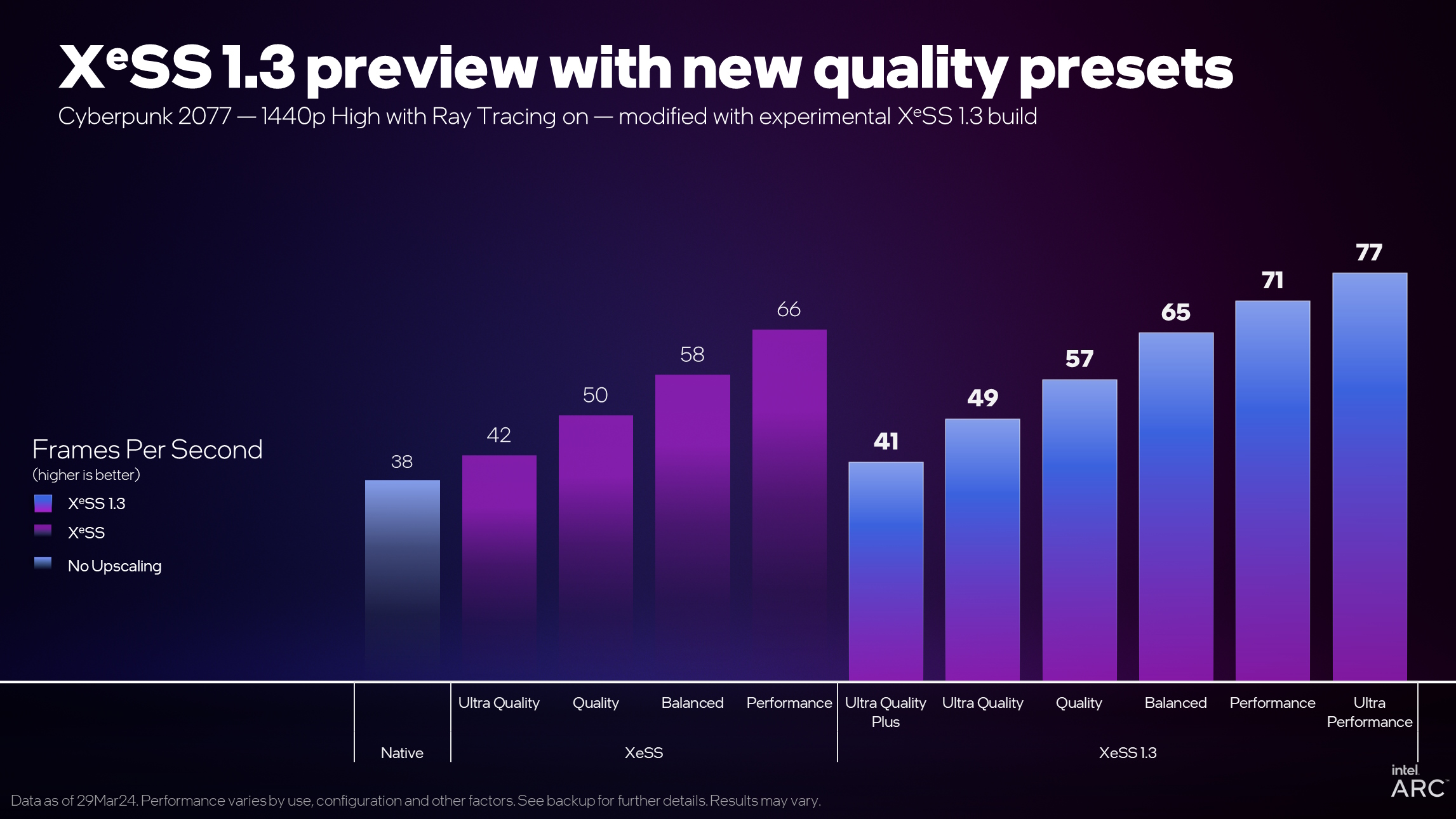

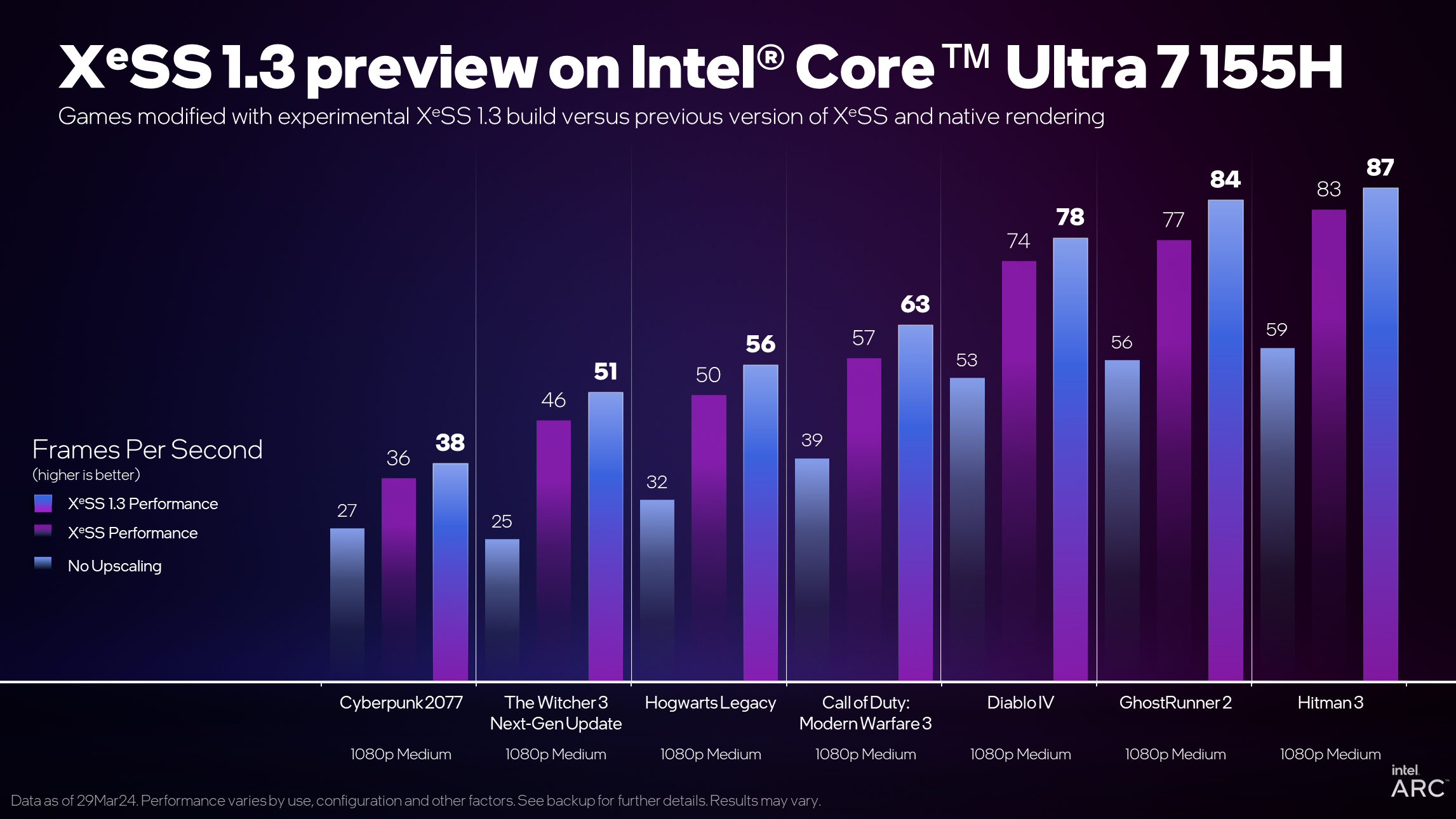
Intel has conducted a range of comparisons between XeSS 1.2 and 1.3. However, the comparisons may not be entirely relevant to gamers, as each profile was modified. Once XeSS is made available, both profiles can be compared in terms of performance and quality, which is more significant for gamers.
XeSS 1.3 also benefits from the new AI model employed by Intel, enhancing its capabilities. It allows it to display more visually complex features and provides superior picture reconstruction, anti-aliasing, ghosting reduction, and temporal stability enhancement. As part of the upgrade, Intel has also added two new profiles, Ultra Performance and Ultra Quality Plus. Furthermore, Intel has introduced a rival to Nvidia DLAA called Native Anti-Aliasing (anti-aliasing without upscaling). The company has announced that developers can now integrate XeSS 1.3, as the software development kit was released this week.
Discuss on our Facebook page, HERE.
KitGuru says: Intel has been gradually improving its GPU segment over the past year, with massive performance-boosting drivers and continued development of features like XeSS. It will be interesting to see if there is another leap for XeSS later in the year, when Intel should be introducing its 2nd Gen Arc graphics cards.