KitGuru KitGuru.net – Tech News | Hardware News | Hardware Reviews | IOS | Mobile | Gaming | Graphics Cards


Intel has recently unveiled a new technology designed to improve picture quality and performance, much like what DLSS and FSR do. Based on frame extrapolation, the framework is described in a research paper presented at the SIGGRAPH Asia 2023 event in Sydney.
The paper (via Wccftech) named “ExtraSS: A Framework for Joint Spatial Super Sampling and Frame Extrapolation” describes combining two methods to improve frame rates and image quality: spatial upscaling and frame extrapolation. This approach distinguishes Intel's technology from AMD FSR 3 and DLSS 3, both based on frame interpolation. Unlike these techniques, Intel's framework uses only old frames, which has advantages and disadvantages.
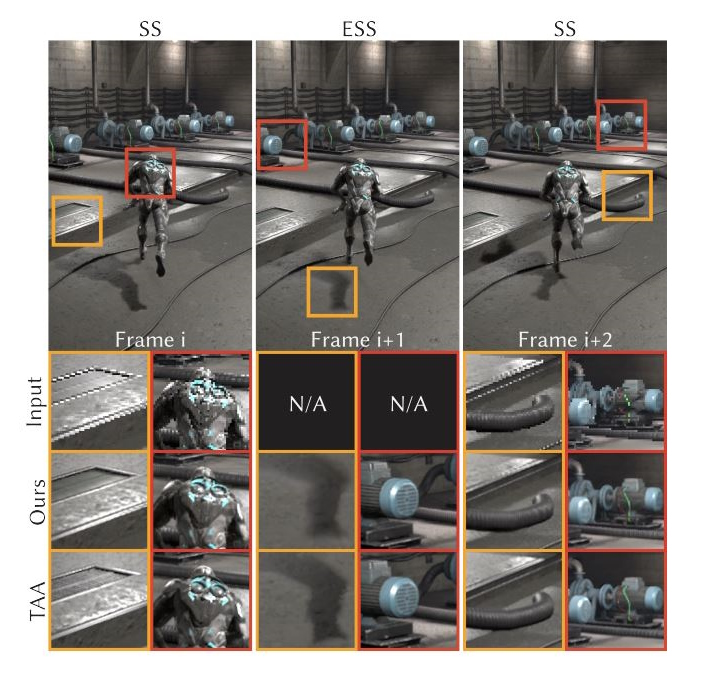
The research paper explores the challenges of achieving high-quality real-time rendering. It discusses spatial and temporal supersampling principles and current approaches such as DLSS, XeSS, and FSR. To rival these methods, Intel proposes a single architecture that combines spatial upscaling with frame extrapolation: ExtraSS.
Intel points out that frame interpolation delays the rendering process, so Nvidia and AMD rely on technologies like Reflex or Anti-Lag+ to compensate. However, Intel's scenario does not require these technologies. While frame generation based only on preceding frames can produce artefacts, there are ways to counter them using motion vectors mixed with neural networks. Intel's proposed framework uses a combination of spatial supersampling and frame extrapolation.
To warp the frames better, Intel developed the G-buffer (geometry buffer) technology by reusing temporal and spatial information. For spatial-temporal extrapolation, the authors propose using motion vectors with G-buffer-directed information, followed by a lightweight flow-based model to optimise moving shadings. The ExtraSS framework will then accept low-resolution rendered pictures as input to produce high-resolution images with refined outcomes. According to Intel, testing on Unreal Engine 4 shows that the approach outperforms standard spatial or temporal-only supersampling methods in performance and quality.
The conclusion acknowledges the framework's limitations, such as potential artefacts in complicated scenarios. Although Intel has not yet published any public blog entries regarding this technology, this research paper and patents do not necessarily result in the technology being released to end customers.
Discuss on our Facebook page, HERE.
KitGuru says: ExtraSS may be just what Intel needs to challenge DLSS and FSR frame generation technologies.