KitGuru KitGuru.net – Tech News | Hardware News | Hardware Reviews | IOS | Mobile | Gaming | Graphics Cards


At the time of writing, the largest dual memory kit offered by G.Skill is 128GB, available across four product lines. One of these is the Trident Z5 Neo RGB, available at DDR5-6000 with three latency choices. We review the CL34 model and find out just how well it performs.
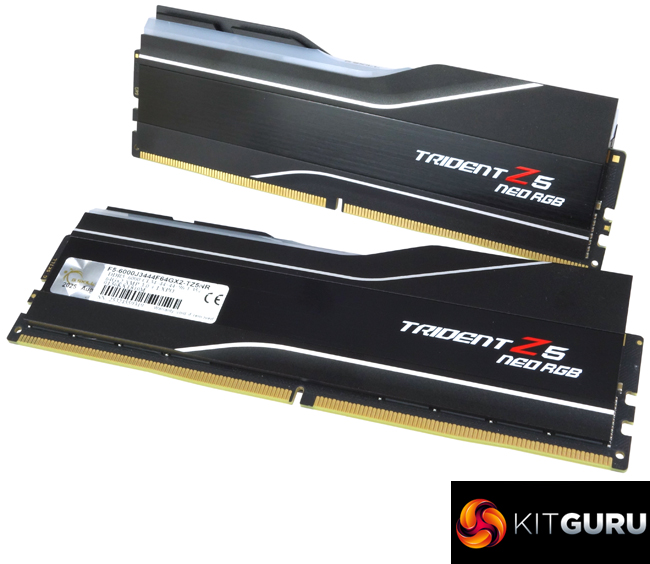
G.Skill's Trident Z5 Neo RGB memory has been designed for overclocking on AMD platforms with EXPO support. It is available with a choice of two coloured aluminium heat spreaders and features customisable RGB lighting.
The 128GB DDR5-6000 kits are available in three latencies: CL32 (1.40V), CL34 (1.35V) and CL36 (1.25V). The CL32 has EXPO support only, while the other two support EXPO and Intel's XMP technology. The Trident Z5 Neo RGB kit we are reviewing here uses a pair of dual-ranked 64GB DIMMs (each using, according to the Thaiphoon Burner utility, 16 Samsung M-die ICs), EXPO rated at 6000MHz at 34-44-44-96 at 1.35V.
G.Skill backs the modules with a lifetime warranty.
Specification:
- Model Number: F5-6000J3444F64GX2-TZ5NR.
- Capacity: 128GB (64GB x 2).
- Rated Frequency: 6000MT/s.
- Rated Timings: 34-44-44-96.
- Voltage: 1.35V.
- Memory IC: Samsung M-die (K4RBH086VM-BCWM).
- Module Height: 42mm.
- XMP/EXPO: EXPO/XMP.