KitGuru KitGuru.net – Tech News | Hardware News | Hardware Reviews | IOS | Mobile | Gaming | Graphics Cards


We first saw Gigabyte's RGB memory modules about two years ago, and now the company has updated its DDR4 series. Alongside the plentiful RGB lighting, the memory kits now sport frequencies of up to 3600 MHz.
One of the main features of the AORUS RGB modules from Gigabyte is the RGB lightning – as indicated by the name. The modules are 100% compatible with RGB Fusion 2.0 software giving the user the option to customise the modules with 11 different lighting modes. Five of the available lighting modes are unique to the AORUS RGB Memory, namely “Color strobe, Cascade, Color Cascade, Droplet and Color Droplet.”
As we have seen with previous AORUS RGB modules, this time around there are two ‘active' memory modules, and two ‘dummy' models to give the lighting a more complete look.
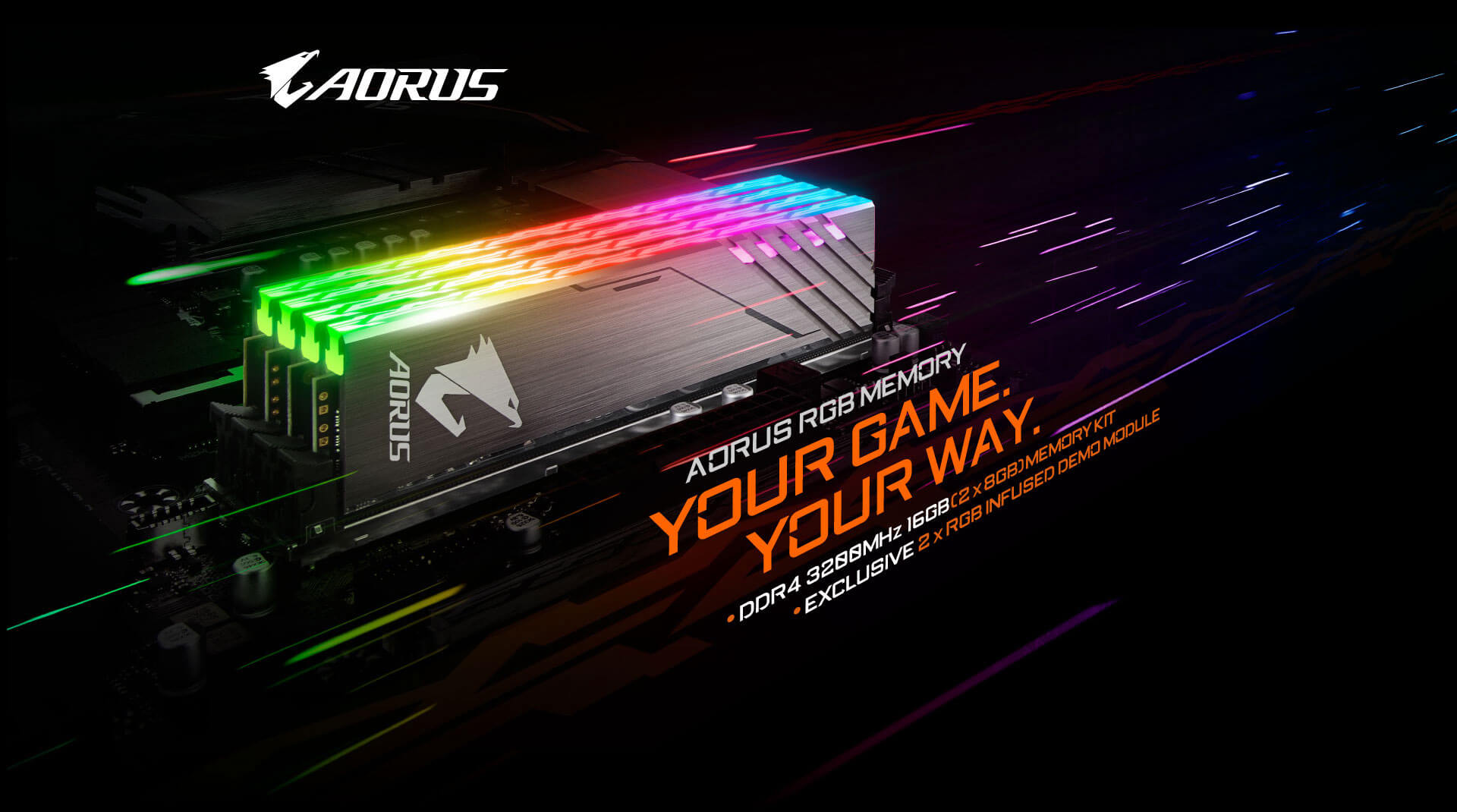
Image credit: Gigabyte
Gigabyte's new AORUS RGB memory kits support XMP 2.0. The standard operating voltage is 1.2V, with a clock of 2,666MHz, but when XMP is activated the operating voltage increases to 1.35V, with the frequency going up to 3,600MHz. Additionally, AORUS motherboards have a unique ‘AORUS memory boost' feature which can push speeds to 3733MHz, beyond the XMP value.
Gigabyte offers a limited lifetime warranty for its AORUS RGB memory. You can find more product details HERE.
Discuss on our Facebook page HERE.
KitGuru says: What are your thoughts on the upcoming AORUS RGB memory kit?