KitGuru KitGuru.net – Tech News | Hardware News | Hardware Reviews | IOS | Mobile | Gaming | Graphics Cards


The PCMark 10 Data Drive Benchmark has been designed to test drives that are used for storing files rather than applications. You can also use this test with NAS drives, USB sticks, memory cards, and other external storage devices.
The Data Drive Benchmark uses 3 traces, running 3 passes with each trace:
- Trace 1. Copying 339 JPEG files, 2.37 GB in total, in to the target drive (write test).
- Trace 2. Making a copy of the JPEG files (read-write test).
- Trace 3. Copying the JPEG files to another drive (read test)
Here we show the total bandwidth performance overall and for each of the individual traces.
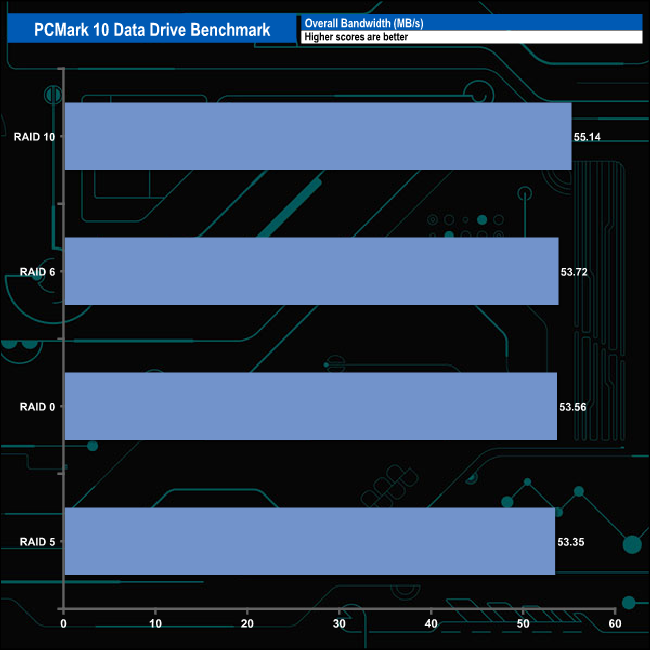
The TS-451D2-4G displays a very consistent level of overall performance in the PCMark 10 Data Drive Benchmark across all the tested arrays.
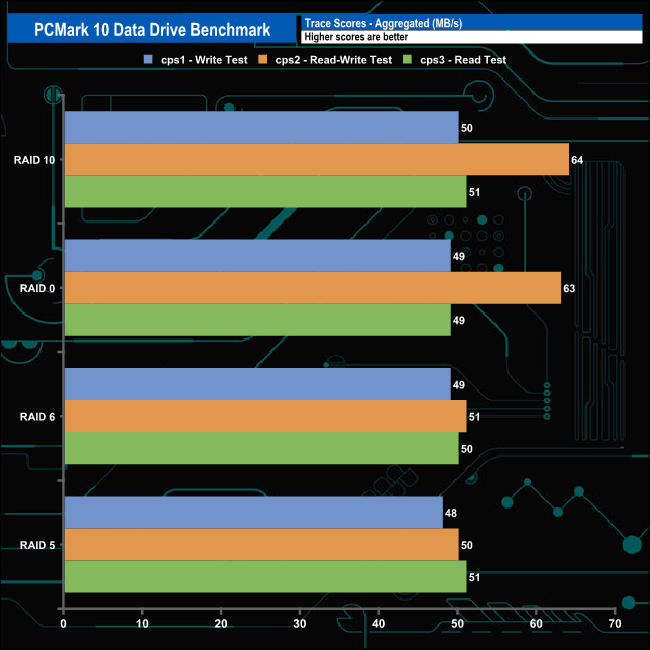
The fastest performance from the test traces came using a RAID 10 array and the cps2 Read-Write test (64MB/s) very closely followed by the RAID 0 result of 63MB/s. Apart from these two results, all the others displayed a very high level of consistency across the tested RAID arrays.