KitGuru KitGuru.net – Tech News | Hardware News | Hardware Reviews | IOS | Mobile | Gaming | Graphics Cards


To test the TVS-1282 we used eight 6TB Red drives (WD60EFRX, 5,400rpm class, 64MB cache), built into RAID 0, 5, 6, 10, 50 and 60 arrays and then tested with a 1GbE connection. The tests were then repeated using a 10GbE connection.
We also used 4 960GB Samsung 845DC EVO SSDs in the four 2.5in drive bays which were built into RAID 0,5,6 and 10 and tested as normal storage areas, not as cache, again with both 1GbE and 10GbE connections. Although the 845DC EVO isn't on QNAP's compatibility list for the TVS-1282 we were able to build them into RAID arrays without any problems.
For 10GbE testing, QNAP kindly supplied us with a QM2-2P10G1T card to install in the TS-877 while in the test rig we used an ASUS XG-C100C 10GbE card. To connect the two we used a Cat7 cable.
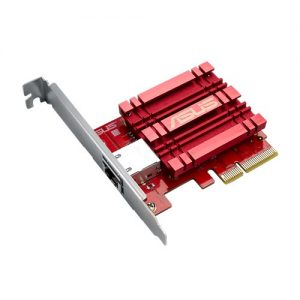
Thanks to Asus for their support with this. You can see more information on this card on the ASUS site, over HERE.
QM2-2P10G1T
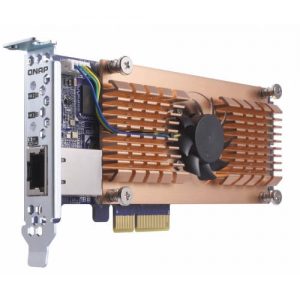
The QM2 family of add-in cards support either SATA or PCIe M.2 SSDs and/or 10GbE networking. The QM2-2P10G1T provides two M.2 2280 PCIe Gen 2 x2 slots as well as a single 10GbE port.
Thanks to QNAP for their support for this. You can see more information on this card on the QNAP site, over HERE.
Software:
Atto Disk Benchmark.
CrystalMark 3.0.3.
IOMeter.
Intel NASPT.