KitGuru KitGuru.net – Tech News | Hardware News | Hardware Reviews | IOS | Mobile | Gaming | Graphics Cards


While there is no doubt that in the not too distant future we will be transferring gigabytes quickly across the planet at very little cost – right now the movement of very large files still requires a physical device. Always happy to play at the high end in terms of quality and price, we are happy to see the SanDisk Extreme pro 128GB USB 3 drive land in our offices. Let's see if it is driven to succeed.
If the folks at SanDisk are to be believed, then the 128GB Extreme Pro USB 3 drive is the ‘be-all-end-all' product for personal storage.
In terms of storage capacity, it is difficult to argue. While we all moved from 1TB to 2TB to 3TB and so on a few years back the overpowering advantage of having an SSD-based PC has changed the mindset of most enthusiasts/professionals.
We have become used to the idea of a smaller area of storage for our current project, with lightning fast data transfer and a much larger, slower storage system in the background (be it NAS or cloud).
If you are working with video or need to install a ton of software onto a new system etc then the SSD-like transfer speeds of an external USB3.0 device can be very useful. Adding in a stylish aluminium casing and SanDisk SecureAccess software is a bonus. You never know when you might lose a data storage device.
According to SanDisk, the products highlights are clear to see:-
- Transfer files up to 60 times faster than with standard USB 2 drives
- Read speeds up to 260MB/s and write speeds of up to 240MB/s
- 128GB storage capacity lets you take your media collection with you
- Sophisticated design with durable aluminum metal casing protects against wear and tear
- SanDisk SecureAccess software included for 128-bit AES file encryption and password protection
So what about the all important numbers? Technical Specifications:-
- Available capacity: 128GB
- Performance/Speed: Up to 240MB/s write; Up to 260MB/s read
- Dimensions: 11.0 x 21.0 x 71.0 mm; 0.45 x 0.84 x 2.79 in
- Operating Temperature: 0 C to 45 C
- Storage Temperature: -10 C to 70 C
- Compatibility: USB 3.0 and USB 2.0
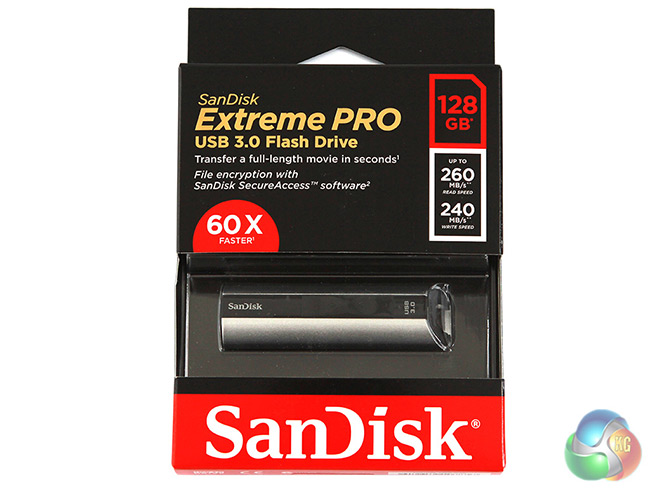
Designed to stand out and say ‘Expensive', SanDisk's traditional Extreme packaging is very pleasing on the eye.
It's declaration of serious performance is emblazoned across the front. We'll be putting this to the test shortly.
Given that traditional USB 2 transfers were in the tens of megabytes range, anything that claims to move data over 100MB/sec has to be a welcome relief for video editors and other serious professionals.
.
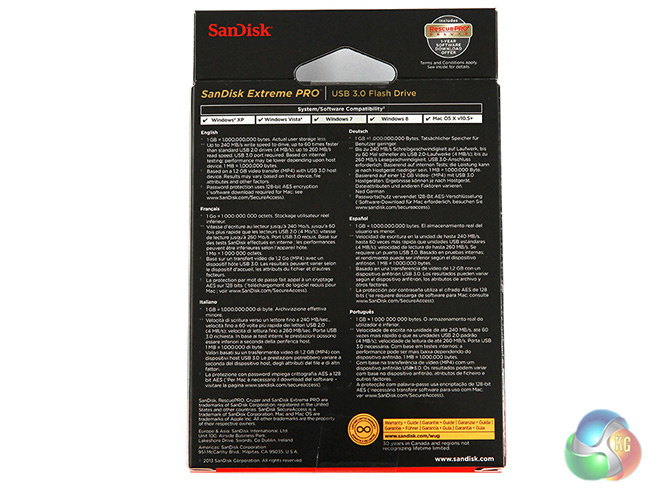
The reverse of the packaging is reserved for a multilingual explanation of what a gigabyte and megabyte might be – just to avoid confusion with the ‘special people' when it doesn't report what they thought it might.
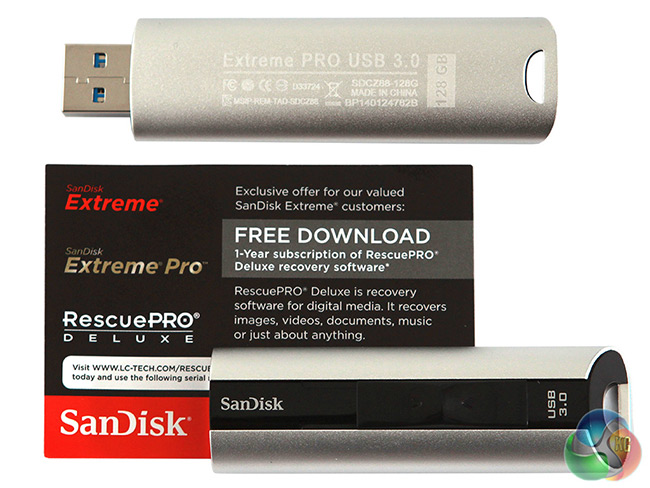
Inside the packaging, you get the neat little drive – as well as a card that tells you that you're the lucky recipient of a one year free subscription to RescuePRO, which is recovery software. We have all lost data at one point or another, so it would be nice if there was a chance to rescue it.
Other companies do make things like this available, but they normally play it down and make you ask nicely. SanDisk's approach makes for smoother marketing and opens up the possibility of a future revenue stream (assuming years 2, 3 and beyond have a cost associated with them).
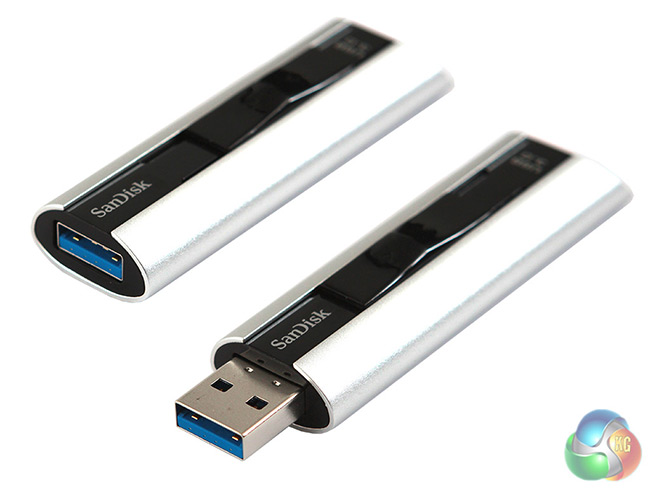
Utilising a simple push mechanism, the SanDisk Extreme Pro protects its sensitive blue end with a simple retraction.
Now you see me, now you don't has been given a high-speed USB twist.
Enough of the aesthetics. On with the testing.
Testing products like high-speed USB drives is a simple enough process.
We use a combination or ATTO and CrystalDiskMark.
For our performance testing, we used a workstation built on the ASUS Rampage IV Gene mainboard with a XEON E5-2660 processor and 16GB of memory. As you will read, we tried by the top mounted and ‘direct to mainboard' USB3 ports.
Crystalmark is a useful benchmark to measure theoretical performance levels of hard drives and SSDs. We are using V3.01 x64 to test throughput.
Results were very similar for the default settings and the 0X00 fill option – similar performance with compressible and incompressible data streams.
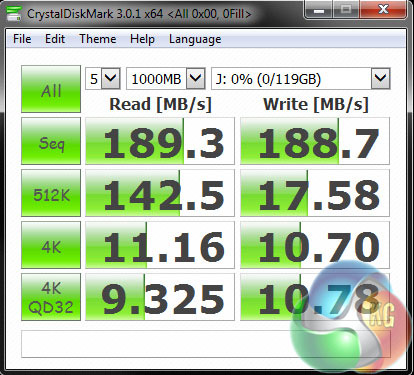
This drive is significantly faster than a USB 2.0 device, but falls 70MB/sec short on the read speed claimed on the packaging and just over 50MB/sec short on writes.
We then put the drive through a full set of ATTO tests.
The ATTO Disk Benchmark performance measurement tool is compatible with Microsoft Windows. Measure your storage systems performance with various transfer sizes and test lengths for reads and writes. Several options are available to customize your performance measurement including queue depth, overlapped I/O and even a comparison mode with the option to run continuously. Use ATTO Disk Benchmark to test any manufacturers RAID controllers, storage controllers, host adapters, hard drives and SSD drives and notice that ATTO products will consistently provide the highest level of performance to your storage.
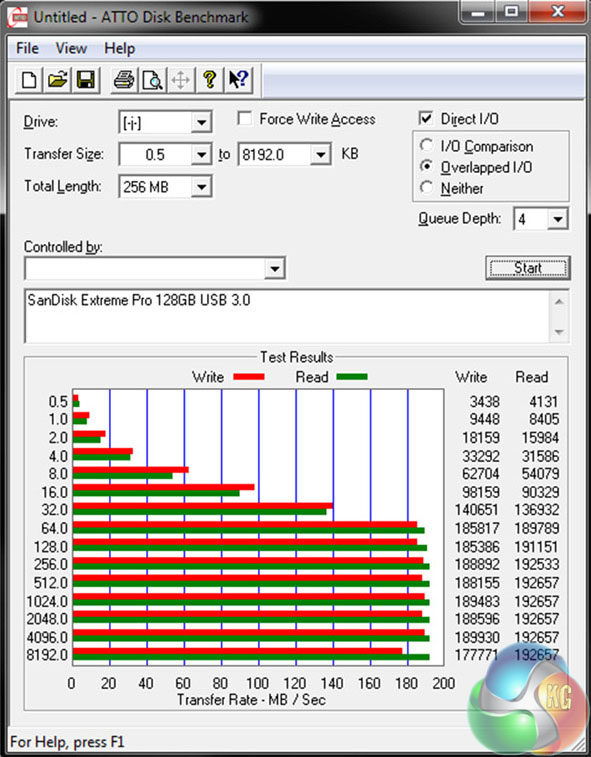
With a peak read that falls just under 193MB/sec and a write speed of just under 190MB/sec, we can see that ATTO rates the drive faster than CrystalDiskMark.
That said, we're still short of the claimed speeds – around 20-25% slower than the official speeds quoted on the packaging.
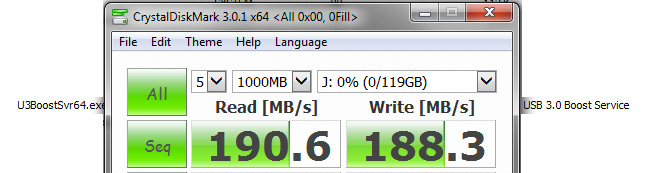
UPDATE: Several readers contacted KitGuru to ask if we had made ‘every effort' to secure the best performance figures possible. Specifically, if we had used ASUS' famous USB 3.0 Boost technology. The answer is yes and we apologise for not mentioning this earlier. Here's a segment of a screen grab with CrystalDiskMark shown on top of the appropriate line from Task Manager. In multiple tests, the numbers only vary by a megabyte/sec or so.
In life, winning and losing is not just a matter of who goes past the post first. There is also the margin of victory/loss to consider and how much it cost to achieve that result. In order words, value.
The price on the SanDisk 128GB Extreme Pro is looking to be around the £120 mark. With that price/spec combo, it comes right up next to products like the ADATA SE720 external SSD (just over £100) and the Patriot 256GB Supersonic Magnum (around £185).
These are serious/professional tools, so the people using them won't be thinking in terms of money alone – they will be looking for a solution to a problem. The problem being the movement of a serious amount of data. So transfer speed will be an issue.
Security is also going to be important for the target market, and we welcome SanDisk's efforts to try and secure the data in transit.
In terms of size and speed, The Sandisk Extreme PRO competes nicely with portable SSD products like the ADATA SE720. It is far less bulky and requires no special cable. Sure, it's not as fast as the larger Patriot Supersonic Magnum drive, but it does offer some additional features while saving you £70.
You can buy the SanDisk Extreme Pro 128GB USB 3 drive direct from Amazon, for £115 inc vat.
Discuss on our Facebook page, over HERE.
Pros
- Gorgeous looking product.
- Significant improvement over USB2 devices.
- Pricing is decent for a premium product.
- Sensible software bundle.
Cons
- Not as fast as the Patriot SuperSonic Magnum.
- Misses the claimed speeds.
KitGuru says: The black, red and gold design of the SanDisk Extreme range has been designed to make you feel that you have bought the best product in that class. SanDisk could have picked up our top award if the drive had achieved closer to the officially claimed read and write speeds.