 KitGuru KitGuru.net – Tech News | Hardware News | Hardware Reviews | IOS | Mobile | Gaming | Graphics Cards


Today we are looking at another 5000 series card from HIS, the HIS HD5850 iCooler V Turbo. The last HIS card we reviewed was the IceQ 5 5770 and in a similar fashion the HD5850 shares a factory pre-overclock.
This particular product features a center mounted fan to disperse air across the fins of the heatsink to provide a cooler, faster and quieter solution when compared to a reference design 5850. As Sapphire offer the Vapor-X lineup and Power Color have the PCS+ models, the HIS card is up against some stiff competition if it expects the public to part with hard earned cash.
iCooler V Cooling Technology
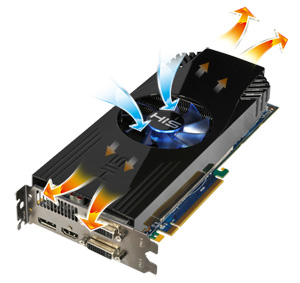
iCooler V features a high performance dual slot cooler. It comes with an excellent cooling setup which transfers heat effectively from the GPU to the internal fins around the central fan. Thanks to the elegant design and smoothness of iCooler fan shroud, massive amounts of cool air are drawn from the central cooler to cool the internal fins directly.
Feature Advantage
* Faster: Heat transfers rapidly out of GPU and reduces temperature instantly
* Cooler: Award-winning and performance leading iCooler Technology with enhancement of heatsink to transfer heat out faster
* Quieter: Lower noise level than original cooler on ATI reference design.
 |
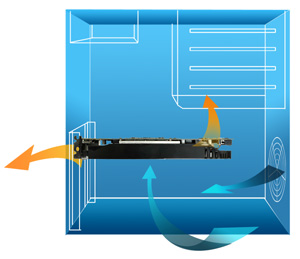 |
| Massive amount of air is drawn from the central cooler to cool down the fins inside | iCooler V transfers heat from the GPU effectively. |
 |
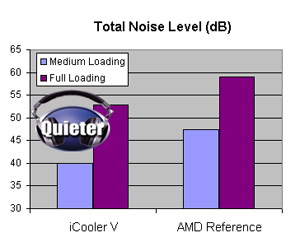 |
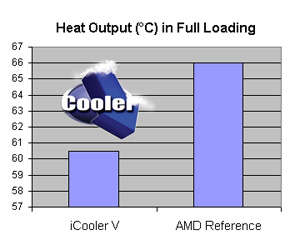
| Equipped with a specially-designed cooling spreader, iCooler V has a much larger cooling capacity than the AMD reference cooler, temperature is driven down by up to 5.5°C cooler in 21°C ambient temp. | iCooler V fan blades are 5mm thinner than AMD reference cooler, dramatically lowering the noise level by up to 11dB at the same fan speed. |
| Product | HIS HD5850 iCooler V Turbo |
| GPU | 5850 |
| Core Clock | 765 MHz |
| Memory Clock | 4.5Gbps /// MHz |
| Memory Size | 1024 MB |
| Memory Type | GDDR5 |
| Memory Interface | 256 bit |
| Interface | PCI Express x16 (PCI Express 2.1) |

The HIS HD5850 is supplied within a tall thin package paired with a cardboard outer shell. The front of the box sports an image of Call of Duty Modern Warfare 2 – and the game is included with the bundle.

Turning the package around reveals some features offered by the HIS 5850 as well as more detailed info on the Call of Duty game.


Inside the outer shell is a sturdy Grey cardboard box that contains the Diver installation CD and a manual. There is also a free coupon for the Steam version of Call of Duty MWF2, a Crossfire connect bridge, a DVI-VGA adapter and two Molex to 6 pin PCI-e power cables.


Next we have an overhead view of the HIS 5850 Turbo which shows off the center mounted fan. The tapered shroud that covers the heatsink is branded with an image from Call of Duty MWF2. Looking at the back of our card we have the retention bracket that is used to support and secure the heatsink to the graphics card. The retention bracket helps to distribute the stress caused by the weight of the cooling solution which should prevent any bending of the PCB.


This card is supplied with a center mounted fan that will distribute air across the fins of the heatsink and will also direct a percentage of the air out the rear of the chassis. The HIS 5850 Turbo model requires 2 x 6 pin power connectors to provide the required amount of power for our card. This is the same requirement as the reference design.


As with most 5000 series cards there are 2 dual link DVI ports, 1 HDMI port as well as a single Display Port connection. The display port is required if we want to get into an Eyefinity multiple monitor setup. There is also a small area with vents cut out of the faceplate to allow air to exhaust from the rear of the chassis. The 2nd image above shows where we will connect our Crossfire Bridge when it comes time to do some Crossfire testing.

The reference clock speeds for an HD5850 are core clock 725 MHz and GDDR5 clocked to 1000 MHz (4000mhz effective). HIS have enhanced the core from 725 MHz to 765 MHz and the memory benefits from a tasty 125mhz clock increase to 1125mhz (4500mhz effective).
We know that reference 5850 cards overclocked quite frequently to 5870 speeds or higher using 3rd party applications to increase the voltage level of the GPU however the HIS 5850 Turbo is locked to the reference settings. This may reduce the overclocking potential of our review sample but we will get further into that later on.
At KitGuru when we test graphics cards we try our best to build a test system that suits the intended target audience. As an example when we reviewed the HIS 5770 Ice Q 5 we paired it with a budget level Athlon II 255 CPU and an entry level AM3 motherboard. Since the 5850 is a more powerful card our test system will be built using a Gigabyte GA-890GPA-UD3H v2.0 Crossfire ready motherboard and an overclocked HexaCore AMD Phenom II X6 1055T processor running at 3.5 GHz. Our OS drive in this build is a 64GB Kingston V-Series Rev2 SSD and files are stored on a 500 GB WD SATA II drive.
The test system is built from scratch with a fresh Windows 7 Professional install, all patches have been installed via Windows Update. We have chosen to use our Asus 5850 as a reference model in this review. All of our testing will include results from both cards generated by what speed they are clocked to out of the box.
Test System
Gigabyte GA-890GPA-UD3H v2.0
HexaCore AMD Phenom II X6 1055T
HIS 5850 Turbo 1GB PCI-e 765/1125 MHz
Asus EAH5850 1GB PCI-e 725/1000 MHz
8GB G Skill DDR III 1600
Corsair HX850 modular PSU (80 Plus Silver rating)
NZXT Phantom Full Tower
Kingston 64 GB V-Series SSD (OS drive)
Western Digital 500 GB SATA II(Storage)
LG 16X DVDRW optical drive
Samsung SyncMaster 245BW
Software
Windows 7 Professional x64
FRAPS Professional x64
Catalyst 10.7
3DMark Vantage
Unigine Heaven Benchmark 2.1
Games
Aliens vs Predator
Crysis Warhead
Dirt 2
Metro 2033
Far Cry 2
Left 4 Dead 2
All the latest bios updates and drivers are used during testing. We perform under real world conditions, meaning KitGuru test all games across five closely matched runs and average out the results to get an accurate median figure.
Our minimum frame rate game graphs have three main zones. These are sampled over a specific 30 interval period of time and then mapped into a chart. These are handy reference guides to detail worst case performance of the product being reviewed. When we test video cards we try to find the best combination of resolution and image quality settings while still maintaining playable frame rates.

Over 30fps is the zone most people want at all times, this means perfectly smooth frame rates with no hitching.
Between 30fps and 25fps is the KitGuru ‘Playable’ zone, although some people might notice occasional stuttering in specific scenes.
Under 25fps is classed as the KitGuru ‘Danger Zone’ which means that the game experience will be less than impressive. Settings and/or resolution would need lowered to help smooth out the frame rate.
Futuremark released 3DMark Vantage, on April 28, 2008. It is a benchmark based upon DirectX 10, and therefore will only run under Windows Vista (Service Pack 1 is stated as a requirement) and Windows 7. For today we will be testing focusing on both Performance and Extreme resolutions. The default setting that most people use to compare their scores world wide is 1280×1024 which is referred to as the Performance level. As the HIS 5850 iCooler V Turbo is one of the higher performing cards today, we will also focus on the Extreme settings. This setting uses the resolution of 1920×1200 and puts far more strain on the GPU then the default settings.


Both of our cards scored reasonably well at both resolutions we used for our testing. The numbers clearly show that the Extreme preset is by far the more demanding test. The higher clock speed of the HIS 5850 iCooler V gave it the edge in all tests when we compare it against the reference clocked 5850.
Unigine is a top-notch technology, that can be easily adapted to various projects due to its elaborated software design and flexible toolset. A lot of our customers claim that they have never seen such an extremely-effective code, which is so easy to understand. It is already used in the development of different projects (mostly games).
Heaven Benchmark is a DirectX 11 GPU benchmark based on advanced Unigine engine from Unigine Corp. It reveals the enchanting magic of floating islands with a tiny village hidden in the cloudy skies. Interactive mode provides emerging experience of exploring the intricate world of steampunk.
Efficient and well-architected framework makes Unigine highly scalable:
- Multiple API (DirectX 9 / DirectX 10 / DirectX 11 / OpenGL) render
- Cross-platform: MS Windows (XP, Vista, Windows 7) / Linux
- Full support of 32bit and 64bit systems
- Multicore CPU support
- Little / big endian support (ready for game consoles)
- Powerful C++ API
- Comprehensive performance profiling system
- Flexible XML-based data structures
We always test Unigine at 1920×1080 (1080p) at default settings so comparisons with other graphics cards in Kitguru reviews are possible.


The HIS 5850 iCooler V Turbo generated good results in this demanding benchmark test. The HIS 5850 iCooler V Turbo maintained an average of 31.9 frames per second and produced a maximum of 82 FPS. The latest nVidia Fermi cards are stronger in this benchmark.
Aliens vs Predator is an entirely new title for PC and high-definition consoles from acclaimed British developer Rebellion, the team behind the 1999 original PC gaming classic. Bringing the most intense war between two of science-fiction’s most popular characters FPS fans, AvP delivers three outstanding single player campaigns and provides untold hours of unique 3-way multiplayer gaming. Experience distinctly new and thrilling first person gameplay as you survive, hunt and prey in the deadly jungles and swamps surrounding the damned colony of Freya’s Prospect.
As the Marine, you’ll experience a claustrophobic and terrifying experience where light is your friend, but there’s never enough. However, the United States Marine Corps are humanity’s last line of defence, and as such they are armed to the teeth with the very latest in high explosive and automatic weaponry.
As the Predator, you will stalk from the shadows and from above, passing athletically through the treetops to ambush your victims. Although equipped with an array of powerful, exotic weapons and tracking equipment, honour ultimately dictates that you must get in close and take your trophies face to face.
As the most deadly species in the universe, the Alien offers you the chance to play as the very stuff of nightmares – the monster in the dark swarming forward with countless others, jaws like a steel trap and claws like blades.
Play all sides off against each other in a series of unique 3-way online modes and go tooth-to-claw-to-pulse rifle in the reinvention of one of multiplayer gaming’s defining moments.
To test the HIS 5850 iCooler V Turbo we will play some AVP at 1920×1200 with DX 11 Texture Quality on Very High, Shadow Complexity High, Tessellation on, ambient occulsion on, Motion Blur, MSAA Samples 1, 16af,. It should be interesting to see how the cards deal with this DX11 based shooter at the highest resolution our display allows.


This 5850 iCooler V Turbo performed very well in this game with our minimum FPS hitting 26 which is a few frames below our comfort zone of 30 FPS. The vast majority of our testing was extremely smooth, averaging close to 43 frames per second with all the eye candy enabled and producing maximum frames rates of 73 FPS.
Take on the fight as the volatile Sergeant “Psycho” Sykes in a new parallel story Crysis Warhead which takes place during the events of Crysis. Psycho’s secret mission will take him to the other side of the island on a ruthless pursuit of a North Korean general hell-bent on obtaining powerful technology. With the versatile powers of his Nanosuit and an arsenal of fully customizable weapons & vehicles at his disposal, Sykes will do whatever it takes to carry out his top-secret objective.
Action on the other side of the island is more intense, the battles are fierce, and the mission protocol is no longer “Adapt to Survive”. As Sergeant Sykes, now you must adapt to dominate the battle. Twin SMG’s blazing, seizing new vehicles, or going stealth, the action and the victory is on your terms.
- Pulse-racing new installment from 2007’s PC Game of the Year: Play as Sergeant Sykes and experience a whole new side of the battle. A standard combat mission behind enemy lines becomes critical when you discover your enemies have captured something of vital importance to the ensuing war. It’s down to you to retrieve the cargo, at any cost.
- M ore explosive and dynamic minute to minute game play: new customizable weapons, new vehicles, new photorealistic locations to explore, and a fully interactive war zone to dominate.
- Enhanced human and alien AI: Intelligent enemies, bigger challenges, and all-new ally squad support.
- Includes Crysis Wars, an expanded new multiplayer experience with new online modes and 21 maps including seven all-new maps to battle it out against other players.
- Crysis Warhead is a standalone release and does not require ownership of Crysis to play.
Initially we planned to only run this on Enthusiast setting but our frame rates dropped into the danger zone a few times so we decided to also test at the Gamer settings. We will re visit this game later on with some Crossfire action.

Testing our cards at Enthusiast provided beautiful visuals but was obviously stressing our GPU's throughout the testing.The HIS 5850 once again had slightly higher numbers then the reference model. Overall the gaming at enthusiast was enjoyable even though we did experience occasional drops in our FPS that took us into the danger zone. Both cards averaged close to 30 frames per second which is definitely a respectable result at this resolution with all in game settings on Enthusiast.

After lowering the in game setting to Gamer our testing was very smooth through the entire test. The HIS and Asus 5850 cards both had minimum frames per second below 25 FPS but only occurred during an intense section of our testing. Other then that one particular area we averaged close to 45 FPS, which is very good when taking into consideration the 1920×1200 resolution.

Stay tuned for some Crossfire results a bit further on in the review.
Dirt 2 is a racing game released in September 2009, and is the sequel to Colin McRae: Dirt. This is the first game in the McRae series since McRae’s death in 2007. It was announced on 19 November 2008 and features Ken Block, Travis Pastrana, Tanner Foust, and Dave Mirra. The game includes many new race-events, including stadium events. Along with the player, an RV travels from one event to another, and serves as ‘headquarters’ for the player. It features a roster of contemporary off-road events, taking players to diverse and challenging real-world environments. The game takes place across four continents: Asia, Europe, Africa and North America. The game includes five different event types: Rally, Rallycross, ‘Trailblazer,’ ‘Land Rush’ and ‘Raid.’ The World Tour mode sees players competing in multi-car and solo races at new locations, and also includes a new multiplayer mode.
This engine support DX11 and was one of the integral releases for ATI when they launched the 5xxx series cards a while ago. Hardware tessellation is used on the crowd, as well as water and cloth objects. DirectCompute 11 accelerated high definition ambient occulsion is also integrated with full floating point high dynamic range lighting.
We enabled maximum settings, including hardware tessellated animated crowds and dynamic water via ULTRA settings and ran the game at 1920×1200 resolution.


It's quite obvious the 5850 cards easily handle Dirt 2 even at the highest available settings. The HIS 5850 iCooler V Turbo maintained great frame rates at all times and the gameplay was very smooth. We are not at all surprised at these numbers since we had demonstrated in our Sapphire Toxic 5850 review just how well these cards can do even when attached to a 30″ screen.
Far Cry 2 (commonly abbreviated as “FC2”) is an open-ended first-person shooter developed by Ubisoft Montreal and published by Ubisoft. It was released on October 21, 2008 in North America and on October 23, 2008 in Europe and Australia. It was made available on Steam on October 22, 2008. Crytek, the developers of the original game, were not involved in the development of Far Cry 2.
Ubisoft has marketed Far Cry 2 as the true sequel to Far Cry, though the sequel has very few noticeable similarities to the original game. Instead, it features completely new characters and setting, as well as a new style of gameplay that allows the player greater freedom to explore different African landscapes such as deserts, jungles, and savannas. The game takes place in a modern-day East African nation in a state of anarchy and civil war. The player takes control of a mercenary on a lengthy journey to locate and assassinate “The Jackal”, a notorious arms dealer.
We included this title today even though we feel it has to rank as one of the worst sequels ever released. Their is no resemblance to the original title which we thoroughly enjoyed here at KitGuru. For testing we used a resolution of 1920×1200 and Ultra High presets.


When considering the testing was done with 1920×1200 resolution and all the eye candy to the max, the HIS 5850 managed very impressive frame rates, actually never dropping below 40 FPS the entire time. The different clock speeds had a very minimal effect on our overall numbers. The reference clocked card was able to produce numbers very similar to the HIS 5850 iCooler V in this specific test.
Left 4 Dead 2 is a cooperative first-person shooter game. It is the sequel to Valve Corporation's award-winning Left 4 Dead. The game launched on November 17, 2009, for Microsoft Windows and Xbox 360 in the United States; it launched November 20 in Europe. It builds upon the cooperatively-focused gameplay of the original and uses Valve's proprietary Source engine, the same game engine used in Left 4 Dead. The game made its world premiere at E3 2009 with a trailer during the Microsoft press event.
Like the original, Left 4 Dead 2 is set during the aftermath of an apocalyptic pandemic, and focuses on four survivors fighting against hordes of the infected. The survivors must fight their way through levels, interspersed with safe houses that act as checkpoints, with the goal of reaching a rescue vehicle at the campaign's finale. The gameplay is procedurally altered by an artificial intelligence engine dubbed the “Director” that monitors the players' performance and adjust the scenario to provide a dynamic challenge. Several new features have been introduced: new types of infected, melee weapons, and a story-arc that connects the game's five campaigns together.


Both our test cards easily handle Left4Dead2's offering excellent gameplay throughout todays tests. Minimum frames per second stayed in the 50 zone with both cards and average frame rates were in the mid 80's with the HIS 5850.
Today we are going to look at how Crossfire scales with 2 5850 cards. We will use the Asus 5850 and the HIS 5850 as our pair of cards for these tests. We are going to re visit Vantage and Heaven Benchmark as our synthetic benchmarks and then move on to Metro 2033 and Crysis Warhead for some real life gaming comparisons.


Vantage uses DirectX 10 technologies and it scales very well in Crossfire. We saw significant gains across the board in this test.

Heaven Benchmark uses the latest DirectX 11 technology and can be a very demanding engine. It also happens to scale very well in our Crossfire testing once again producing significant gains.

Metro 2033 uses a very demanding game engine but produces state of the art visuals. Testing this game at 1080p resolution proved to be taxing on the 5850's in general. Even when running our Crossfire setup our minimum frames per second dropped as low as 21 FPS. We saw excellent scaling of our average frames per second almost doubling our average of 22. We also experienced noticeable increases in our maximum frames per second in this game with Crossfire enabled reaching as high as 65 FPS.
Idle temperatures were measured after sitting at the desktop for 30 minutes. Load measurements were acquired by playing Crysis Warhead for 30 minutes and measuring the peak temperature. We also have included Furmark results, recording maximum temperatures throughout a 30 minute stress test.

When we compare our “Out of Box” temperatures the HIS 5850 is on average 5 degrees Celsius cooler then the reference design Asus 5850 even though it is running at the lower reference clocks.

Additional overclocking of our card had a minimal effect on our overall temperatures. This is a good indication that HIS has implemented an efficient and effective cooling solution on their 5850 Turbo model.
The HIS HD 5850 iCooler V is supplied factory overclocked out of the box which makes it an attractive option. HIS have increased the default clock speeds from 725 MHz/1000 MHz to 765 MHz/1125 MHz. Is that enough of an increase to satisfy a KitGuru? Of course not, we will always be looking to squeeze a few additional MHz out of our prized possessions. The GDDR5 used on this card comes from Samsung and is rated at 1250 MHz (5Gb/s effective) .
HIS has set their desired overclocking limits to 775 MHz/1150 MHz so if we were to only rely on using the Catalyst Control Center to push the card further, there is not much room left. We opted instead to use MSI Afterburner which is a 3rd party application built around one of the most popular tools on the web, Riva Tuner.
The ATI's memory controller that is part of the 5000 series handles things differently then in the past and overclocking the memory on these cards can be somewhat deceiving. Instead of freezing up or artifacting, the memory controller instead will attempt to correct the issue instead. This can lead to thinking we have more headroom then we really do.
It's been my experience with these cards that when clocking the ram I pay close attention to performance gains. Once I hit a plateau in performance regardless of whether I can increase the value further I stop and call that my maximum. I have run countless tests and feel confident that this approach is effective in determining my max overclock. In today's testing if we pushed the core above 800 MHz our benchmarks would consistently crash. Once we took the ram speed beyond 1175 MHz we started to notice drops in our overall performance so we settled for 1175 MHz which then translates to 4.7 GHz or 700 MHz (effective) higher then the reference values.

Increasing our clocks to 800/1175 increased the results in each test but only marginally. The reference clocked card produced an overall GPU score of 14354. Our HIS 5850 clocked to 800/1175 produced an overall GPU score 15648 which is 1294 points higher then the reference clocked card and 526 points higher then the factory overclock.

When we pushed our card to higher speeds in Crysis Warhead we managed to increase performance to 25 frames per second. Unfortunately even with our card running at 800/1175 we could not achieve the desired minimum of 30 FPS. To be honest we achieved only marginally better performance when overclocking the HIS 5850, which is somewhat of a disappointment.
Recenttly we changed our method of measuring noise levels. We have built a system inside a Lian Li chassis with no case fans and have used a fanless cooler on our CPU. We are using a heatpipe based passive power supply and an Intel SSD to keep noise levels to a minimum. The motherboard is also passively cooled. This gives us a build with completely passive cooling and it means we can measure noise of just the graphics card inside the system when we run looped 3dMark tests. Ambient noise in the room is around 20-25dBa. We measure from a distance of around 1 meter from the chassis and 4 foot from the ground to mirror a real world situation.
Why do this? Well this means we can eliminate secondary noise pollution in the test room and concentrate on only the video card. It also brings us slightly closer to industry standards, such as DIN 45635.
KitGuru noise guide
10dBA – Normal Breathing/Rustling Leaves
20-25dBA – Whisper
30dBA – High Quality Computer fan
40dBA – A Bubbling Brook, or a Refridgerator
50dBA – Normal Conversation
60dBA – Laughter
70dBA – Vacuum Cleaner or Hairdryer
80dBA – City Traffic or a Garbage Disposal
90dBA – Motorcycle or Lawnmower
100dBA – MP3 player at maximum output
110dBA – Orchestra
120dBA – Front row rock concert/Jet Engine
130dBA – Threshold of Pain
140dBA – Military Jet takeoff/Gunshot (close range)
160dBA – Instant Perforation of eardrum

The HIS HD5850 is relatively quiet when idle, but is easily heard under load situations. It is not the quietest card we have had in our labs, but the HIS cards we have tested in the past are generally a little louder than other designs on the market.
To test our power draw we will be using the P3 Kill A Watt. This handy little utility will show tell us how much power we are pulling directly from the wall socket. The results we will show are based total system power draw as apposed to being able to narrow it down specifically to our graphics card. It will however provide useful information pertaining to what sort of power usage to expect if you are using a comparable system at home. The results will be done with our monitor powered from a seperate socket so we get just the system draw as our results.

The first image below shows that our system without a monitor is using 143 watts of power when it is in an idle state. Not bad at all for an overclocked six core AMD CPU and the HIS 5850 as our graphics card.

When we fire up Crysis our system is now using 253 watts of total power during our game testing.

The final image was taken with Furmark running. During this test our total system power usage topped out at 284 watts which again very respectable for a system like the one we used for our testing.

Just to make sure there is no confusion, these numbers are not the power draw of the HIS 5850 we are testing, the values are the total amount of power the full system (minus monitor) is consuming.
We have spent the past week putting the HIS 5850 iCooler V Turbo through its paces only to discover what we have known for some time now, the HD5850 is a fantastic graphics card. HIS has taken the 5850 and replaced the cooling solution with an iCooler V model. These changes mean that this product runs cooler than a reference HD5850. The iCooler V Turbo model performed exceptionally well in all the games we tested with only Metro 2033 and Crysis Warhead causing it to break a sweat.
It is faster than a reference design but we feel the inability to increase the voltage to the GPU hinders the overclocking potential. We were able to use MSI Afterburner to push beyond the factory overclocked speeds, but not close to the level that we have seen with specific other 5850's in the past. We were able to push this particular card as high as 800 MHz core and 1175 MHz on memory, which is fine, but not great. After completing this review I looked elsewhere to see the maximum clock speeds others had reached in their tests and they were often higher then the numbers I achieved … so it could well be just this particular sample that is limited. The Asus card that sat patiently at it's reference speed throughout the entire review; has been benched on numerous occasions with the core as high as 1000 MHz and the ram at 1250 MHz using MSI Afterburner to increase both voltage and clock speeds.
It seems AMD raised their game with the 5000 series cards and recent drivers; when we paired the cards they worked flawlessly together.
KitGuru says: The HIS 5850 iCooler V Turbo model provides better performance than a 5850 clocked at reference speeds, and earns our “Worth Buying” award … but HIS will have to price this card aggressively to make it stand out against the competition. There are many similar factory overclocked cards in this congested and competitive market place. With tough competition from the likes of Sapphire and Power Color pricing will be directly responsible for it's level of success.
HIS offer a 2-year product warranty for all product models in the North America Region.
You can find more detailed information and RMA procedures at the following web address: HIS North American Support


Looks like a good board, HIS seem to be making a name for t hemselves lately
Good review, shame they didnt allow voltage increases on this card, it would overclock much better.
HIS arent very well known here, but they have a full range of cards for sale and they seem to be well designed.
Cant seem to see it for sale locally here for some reason.
Not a bad looking card, but the 5850 seems to be a bit of a not so good deal now with the 460 out.
Seems a good card, but nothing specatular.
Anyone think this is a good buy now,. HD5850 is a little overprice now I think, well it is here.
HIS, never heard of them 😉
Well this seems a solid, if someone bland card by todays standards. noise levels are decent and performance is good, overclocking is poor though and thats what tends to sell specific 5850s.
Powercolor make a good 5850 which seems quieter and a little better value, but this is good too.
I like this card seems to be competitively priced in Europe.
Shame about the voltage support, it would have possibly reached 5870 performance if it handled it.