KitGuru KitGuru.net – Tech News | Hardware News | Hardware Reviews | IOS | Mobile | Gaming | Graphics Cards


As mini ITX systems have become more popular in the last few years, it looks like Intel is trying to capitalise on the trend. The first render of the Intel ‘Beast Canyon' NUC 11 Extreme has been shared, showing an mITX case with enough space to pack big graphics cards.
Based on the render shared by VideoCardz, the Beast Canyon NUC front panel features 2x USB-A ports and a plate with Intel's Skull Canyon logo with RGB lighting. The plate looks to be removable, possibly allowing the user to mount a front fan and increase the system's airflow.
The top panel can't be seen, so we can't comment on how it was made. However, we got a good look from the right panel, which is 90% mesh to help with airflow. It's unclear if the left panel is the same as the right one or if Intel chose to use an opaque or tempered glass panel.
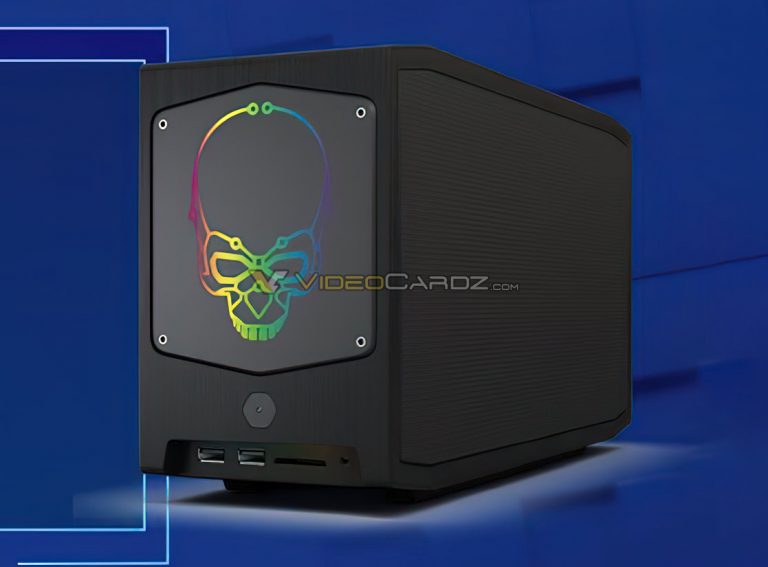
Image credit: VideoCardz
Inside the system, there will be a NUC 11 Extreme Compute Element equipped with a Tiger Lake-H45 processor (i5, i7, or i9), up to 64GB of DDR4-3200, and up to three M.2 devices. There will also be support for Intel Optane Memory M10, H10 and Optane SSDs. Connectivity options include an HDMI 2.0b connector, 2x Thunderbolt 4 ports, 6x USB-A 3.1 connectors, Intel 2.5G and/or 10G network interfaces, Bluetooth 5, and Wi-Fi 6.
Besides the compute element, the case will also support full-sized GPUs. The list of GPUs hasn't been detailed yet, but we expect Intel will allow users to equip the NUC 11 Extreme with an AMD or Nvidia graphics card, or even the upcoming Intel DG2 cards.
With Computex coming up, we might get the chance to learn more about the Intel NUC 11 Extreme in the coming days.
KitGuru says: Considering what has been discussed about Intel's NUC 11 Extreme, would you consider using it as your main system? What graphics card would you choose for it?