KitGuru KitGuru.net – Tech News | Hardware News | Hardware Reviews | IOS | Mobile | Gaming | Graphics Cards


As Intel prepares for the late 2026 debut of its Core Ultra Series “Nova Lake-S” processors, new leaks have revealed the details for the accompanying 900-series “Nova Point” chipset family. This generation marks a significant shift in platform architecture, introducing the LGA 1954 socket and a more granular approach to chipset segmentation.
According to Jaykihn (via VideoCardz), the lineup will include five distinct PCH variants: Z990, Z970, W980, Q970, and B960. Most notably, Intel is reportedly skipping the “H970” tier entirely due to consistently low demand, instead focusing on two enthusiast-grade options. Starting with the flagship Z990, it will be the only consumer chipset to offer both multiplier and base clock (BCLK) overclocking, alongside a massive I/O boost. It reportedly features 48 PCIe lanes in total, including 12 PCIe 5.0 lanes directly from the chipset.
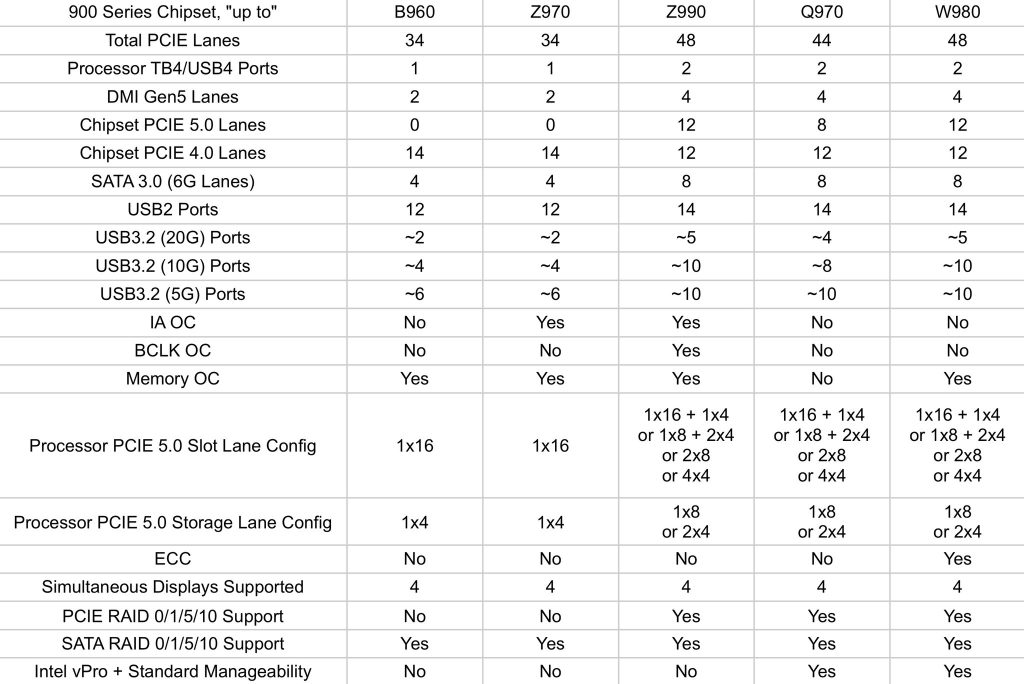
Image credit: Jaykhin
A new entry to the lineup is the Z970, which sits just below the flagship and targets the enthusiast-mainstream crowd. While it retains support for multiplier-unlocked “K” series processors and memory overclocking, it reportedly lacks BCLK tuning. Moreover, it does not provide any PCIe 5.0 lanes from the chipset itself, sticking to a 14-lane PCIe 4.0 configuration. This model reportedly shares a smaller physical PCH die with the B960, which acts as the high-volume mainstream choice. The B960 maintains memory overclocking support but strips away CPU frequency adjustments entirely.
The “Nova Point” platform is claimed to significantly widen the communication pipe between the CPU and the motherboard. While the Z990, W980, and Q970 are claimed to use a DMI Gen 5 x4 link (delivering roughly 128 Gbps of bandwidth), the more affordable Z970 and B960 use a narrower DMI Gen 5 x2 link. This segmentation suggests that high-end Z990 boards will be significantly better equipped for systems running multiple Gen 5 NVMe drives and high-bandwidth USB4 peripherals simultaneously without hitting a data bottleneck.
From the processor side, Nova Lake-S is rumoured to provide up to 32 PCIe Gen 5 lanes. This is a massive jump from the 20 lanes found on Arrow Lake, theoretically allowing a full x16 Gen 5 graphics card to run alongside two or even three Gen 5 x4 SSDs connected directly to the CPU. The processor's direct connectivity is also getting a decent boost, with the high-end chipsets supporting two 40 Gbps USB4/Thunderbolt 4 ports routed through the processor.
Discuss on our Facebook page, HERE.
KitGuru says: Intel's decision to split the Z-series into Z990 and Z970 could lower the entry price for overclocking-ready motherboards. By using smaller, more efficient silicon for the Z970 and B960, manufacturers can likely produce cheaper boards that still satisfy the core “K-series” audience, which only cares about multiplier tuning. However, for those looking to build “god-tier” workstations with quadruple Gen 5 SSDs and dual Thunderbolt ports, the Z990 seems to be the only path forward.