KitGuru KitGuru.net – Tech News | Hardware News | Hardware Reviews | IOS | Mobile | Gaming | Graphics Cards


Hot on the heels of the RTX 5090, today we can present our full review of Nvidia's RTX 5080. While still hugely expensive at £979/$999, this GPU is at least slightly more accessible than the RTX 50 series flagship given it comes in at roughly half the price. But does that mean the RTX 5080 is only half as fast? Today we assess raw performance, ray tracing, DLSS 4, power draw, efficiency and more in this in-depth analysis.
Timestamps
00:00 Intro
00:48 RTX 5080 specs
02:01 Test setup
03:49 Alan Wake 2
04:30 Black Myth: Wukong
05:01 Cyberpunk 2077
05:33 Final Fantasy XVI
06:06 Forza Horizon 5
06:38 Ghost of Tsushima
07:02 Horizon Forbidden West
07:26 The Last of Us Part 1
08:01 Plague Tale: Requiem
08:27 Senua’s Saga: Hellblade 2
08:52 Starfield
09:21 Total War: Warhammer III
09:45 12-game average results
11:03 Cost per frame analysis
12:21 RT Alan Wake II
12:50 RT Black Myth: Wukong
13:15 RT Cyberpunk 2077
13:39 RT F1 24
14:03 RT Ratchet & Clank
14:28 RT Returnal
14:53 RT Shadow of the Tomb Raider
15:22 RT Star Wars Outlaws
15:44 RT 8-game average
17:13 DLSS 4 – Multi Frame Generation
19:46 AI & productivity benchmarks
21:02 Founders Edition design, thermals & acoustics
22:33 Power draw and efficiency
24:23 Closing thoughts
Launching at retail on January 30th, we're hearing that there will be slightly wider availability of the RTX 5080 than the RTX 5090, though it will certainly take at least a few weeks for supply to stabilise. But before you rush to try and buy one, you’ll want to know exactly what you're getting for the £979 asking price—so without further ado, let’s dive into the review.
| RTX 5090 | RTX 5080 | RTX 4090 | RTX 4080 Super | RTX 4080 | |
| Process | TSMC N4 | TSMC N4 | TSMC N4 | TSMC N4 | TSMC N4 |
| SMs | 170 | 84 | 128 | 80 | 76 |
| CUDA Cores | 21760 | 10752 | 16384 | 10240 | 9728 |
| Tensor Cores | 680 | 336 | 512 | 320 | 304 |
| RT Cores | 170 | 84 | 128 | 80 | 76 |
| Texture Units | 680 | 336 | 512 | 320 | 304 |
| ROPs | 176 | 112 | 176 | 112 | 112 |
| GPU Boost Clock | 2407 MHz | 2617 MHz | 2520 MHz | 2550 MHz | 2505 MHz |
| Memory Data Rate | 28 Gbps | 30 Gbps | 21 Gbps | 23 Gbps | 22.4 Gbps |
| L2 Cache | 98304 KB | 65536 KB | 73728 KB | 65536 KB | 65536 KB |
| Total Video Memory | 32GB GDDR7 | 16GB GDDR7 | 24GB GDDR6X | 16GB GDDR6X | 16GB GDDR6X |
| Memory Interface | 512-bit | 256-bit | 384-bit | 256-bit | 256-bit |
| Memory Bandwidth | 1792 GB/Sec | 960 GB/Sec | 1008 GB/Sec | 736 GB/Sec | 716.8 GB/Sec |
| TGP | 575W | 360W | 450W | 320W | 320W |
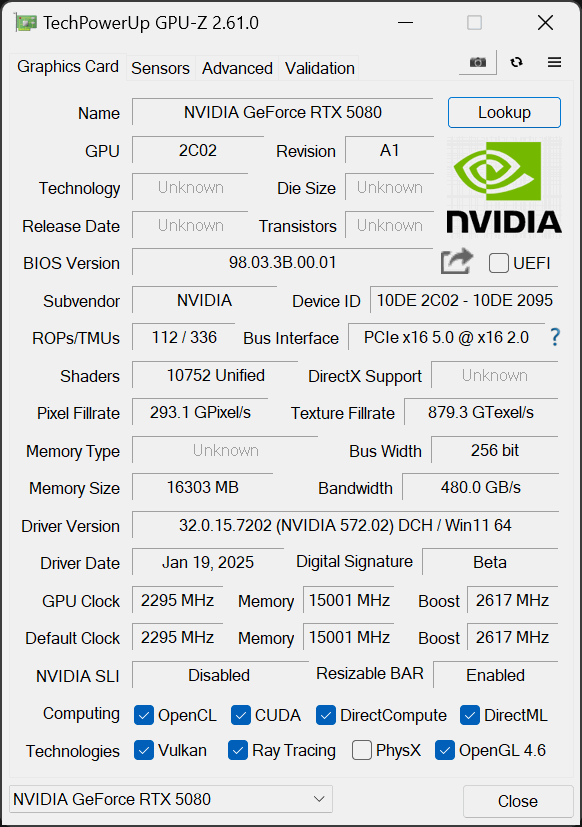
First, a quick spec recap. Unlike the RTX 5090, which is built on the GB202 die, RTX 5080 uses smaller silicon as it is a full implementation of the GB203 die, measuring 378mm2. Comprised of 7 Graphics Processing Clusters (GPCs), each holds up to eight Texture Processing Clusters (TPCs), with a total of 42. Each TPC is home to two Streaming Multiprocessors (SMs), giving us 84, and each SM still holds 128 CUDA Cores, meaning the RTX 5080 has a total of 10752 shaders. We also find 84 RT cores, 336 Tensor cores, 336 Texture Units, and 112 ROPs.
This time around, however, there's no node-shrink, and GB203 remains fabricated on TSMC's N4 node, as per the RTX 40-series. As such, rated clock speed is barely changed this generation, with the RTX 5080 rated at 2617MHz, compared to the RTX 4080 Super's 2550MHz boost.
The memory configuration is also fairly similar, but sports one key upgrade – GDDR7 memory. The RTX 5080 comes equipped with 16GB, running at 30Gbps, and that puts total memory bandwidth at 960 GB/s, a 30% increase over the RTX 4080 Super. L2 cache remains at 65MB.
Power draw has also increased, with the RTX 5080 sporting a 360W TGP. This is something we focus on closely in this review, using our enhanced GPU power testing methodology, so read on for our most detailed power and efficiency testing yet.
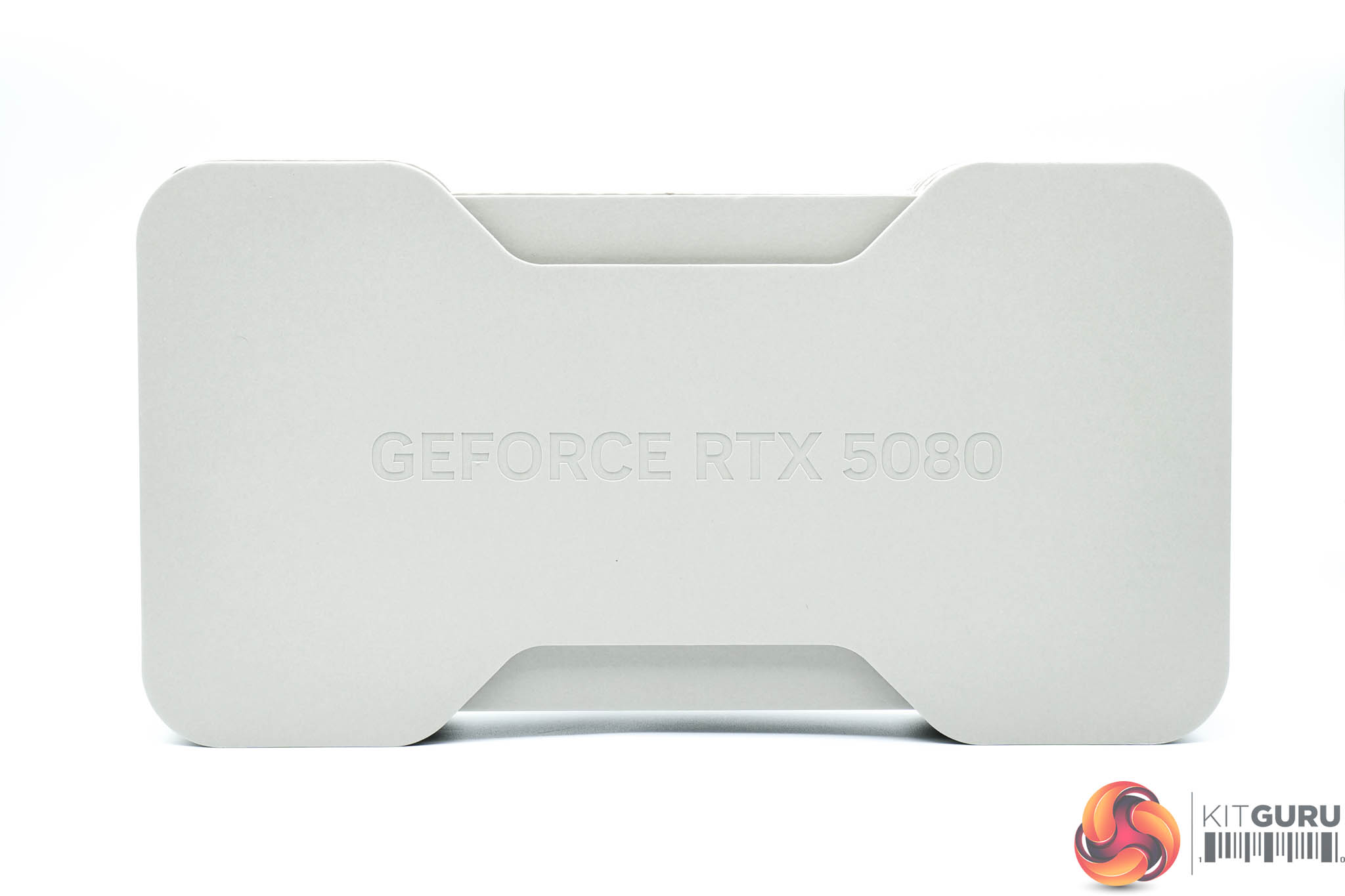
Just like the RTX 5090, the RTX 5080 ships in a compact eco-friendly box.
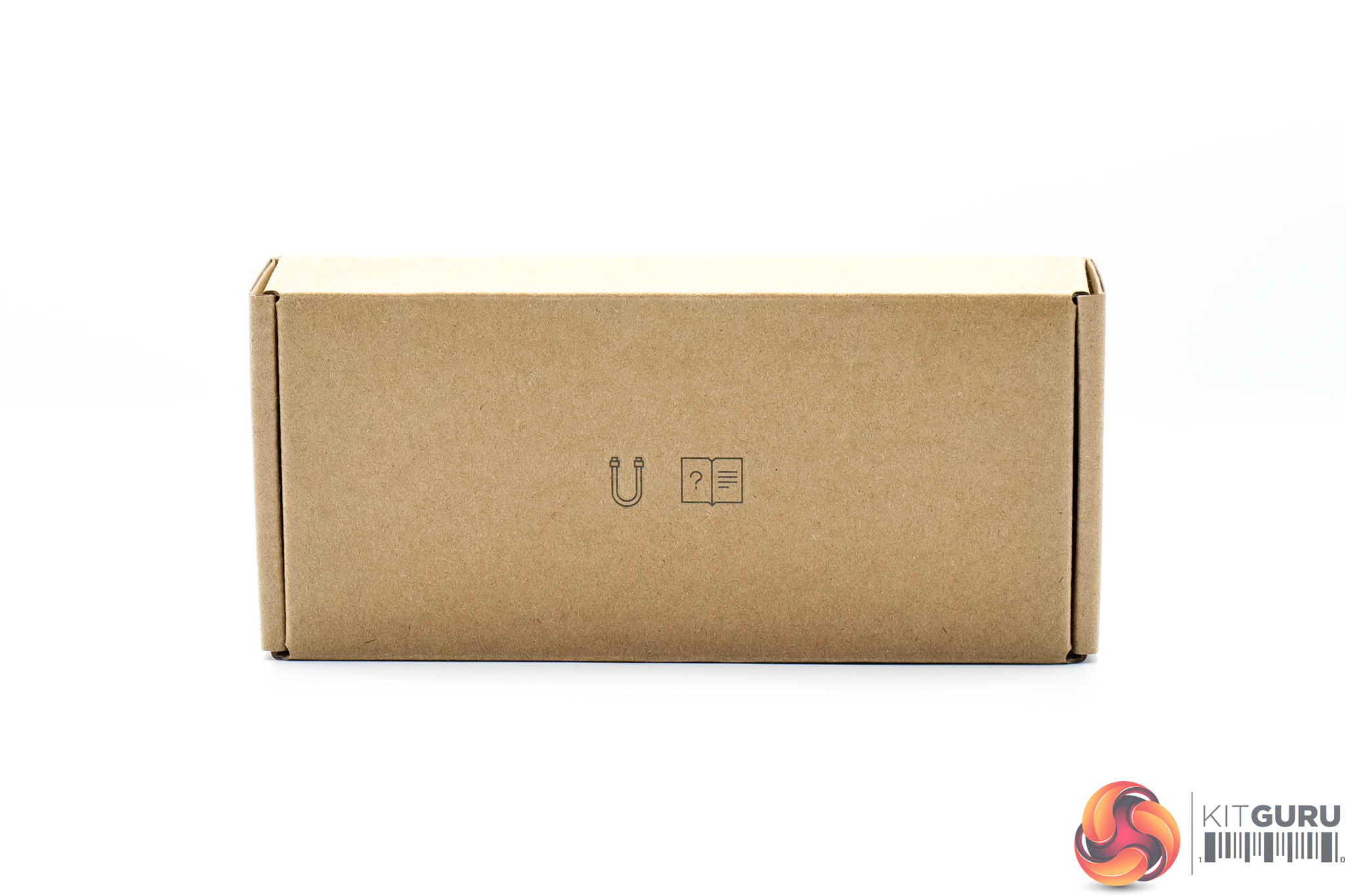
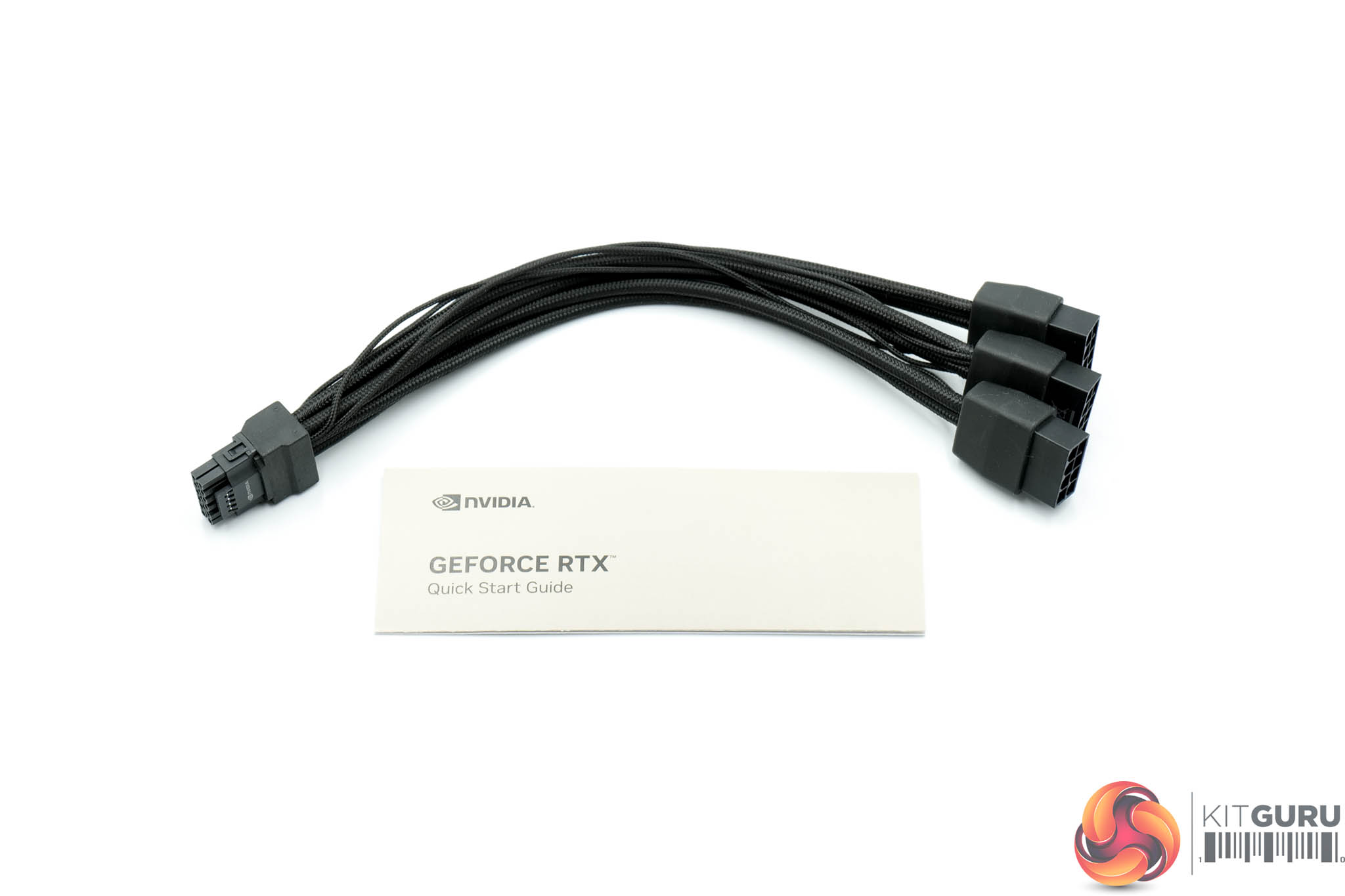
Inside, a smaller box houses the quick-start guide and triple 8-pin to 12VHPWR adapter.
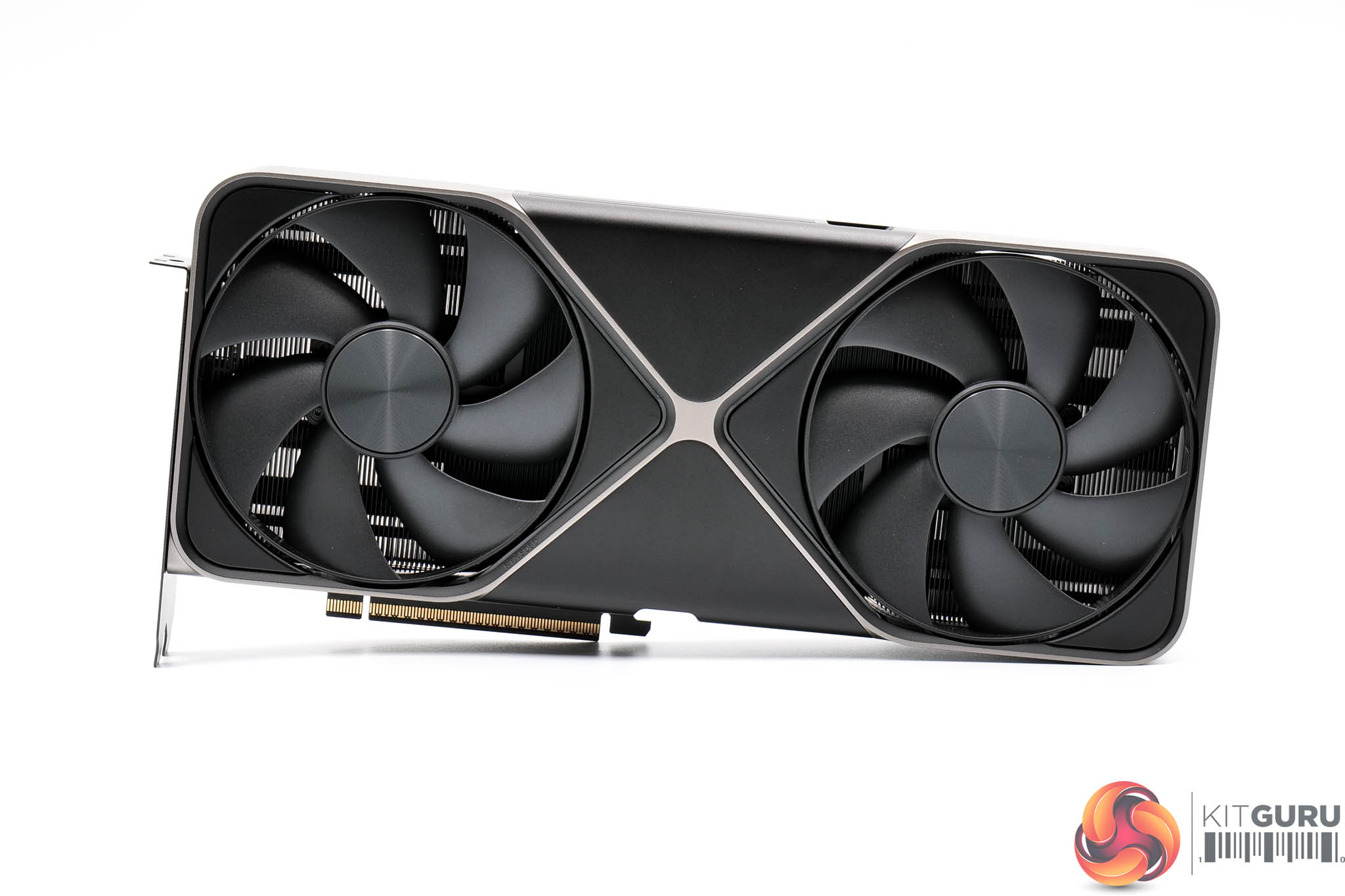
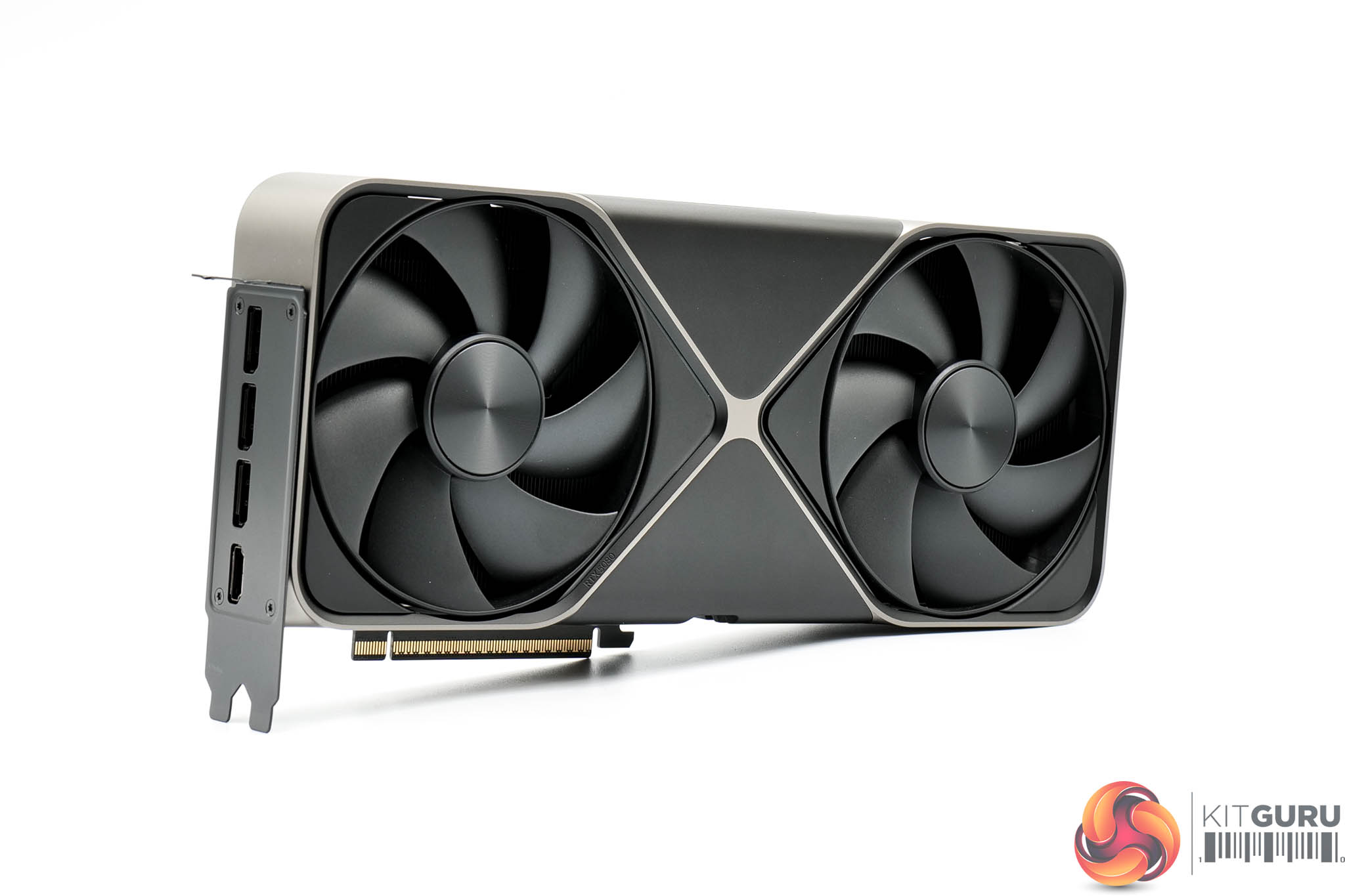
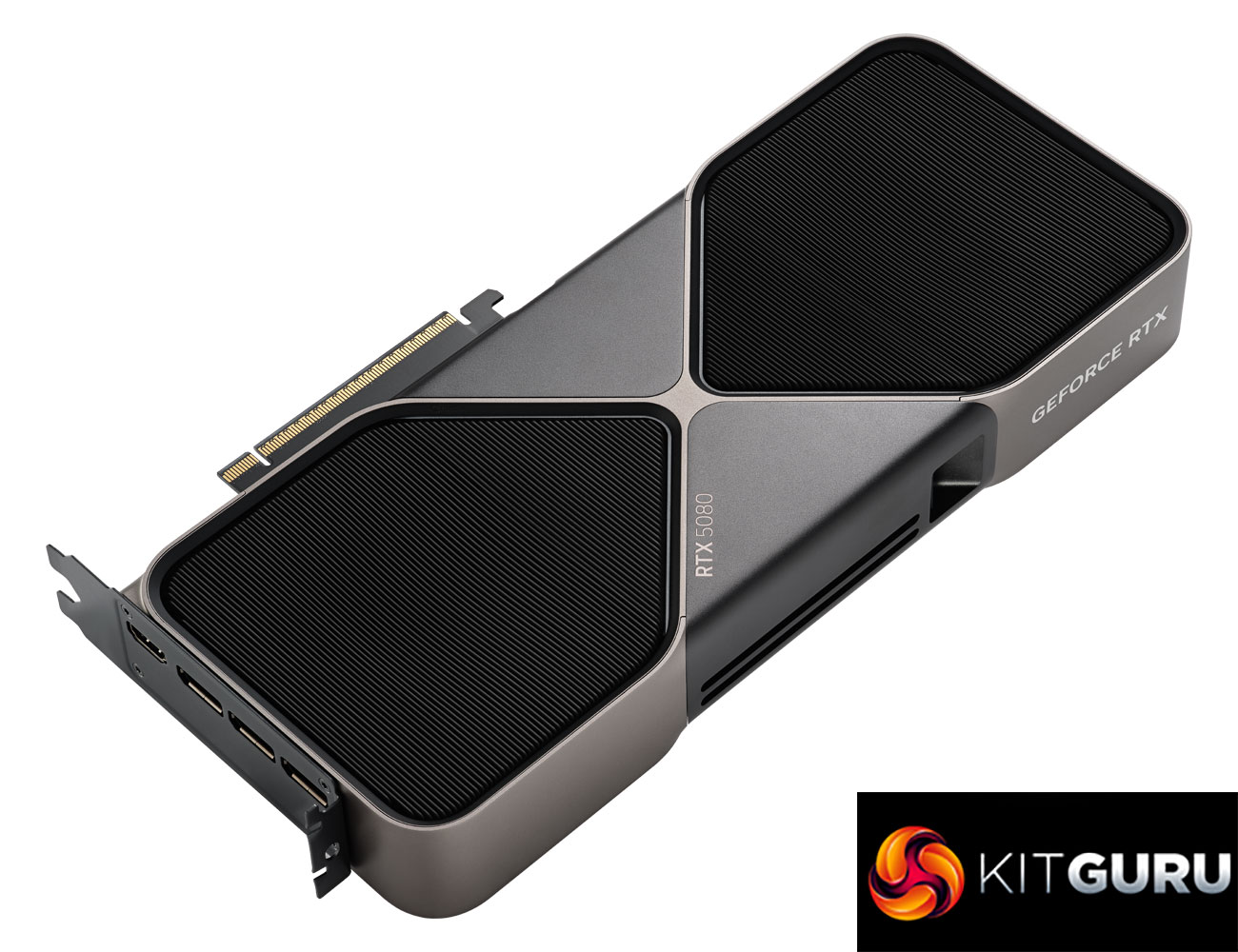
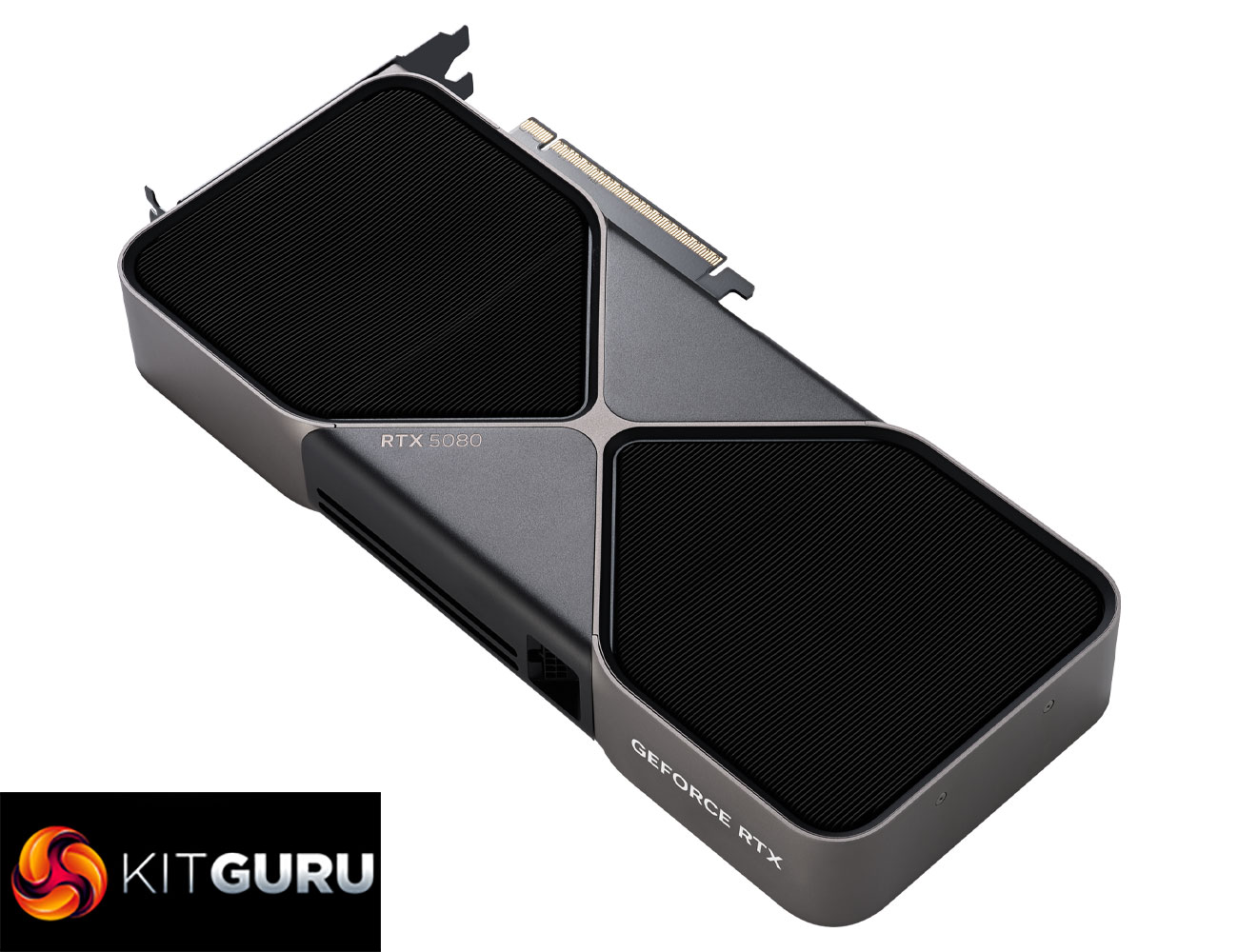
Visually, the RTX 5080 Founders Edition is identical to the RTX 5090. It sports the same industrial design language, with the two large fans part of what Nvidia calls the ‘double flow through' cooler, given the PCB has been moved to the dead centre of the card itself to allow maximum airflow to pass through the heatsink.
Internally, though, we are told there have been a few changes. Gone is the 3D Vapour Chamber of the RTX 5090, and instead the RTX 5080 uses a more traditional heatpipes and baseplate configuration. It has also ditched the liquid metal thermal interface material (TIM), presumably to save on cost.
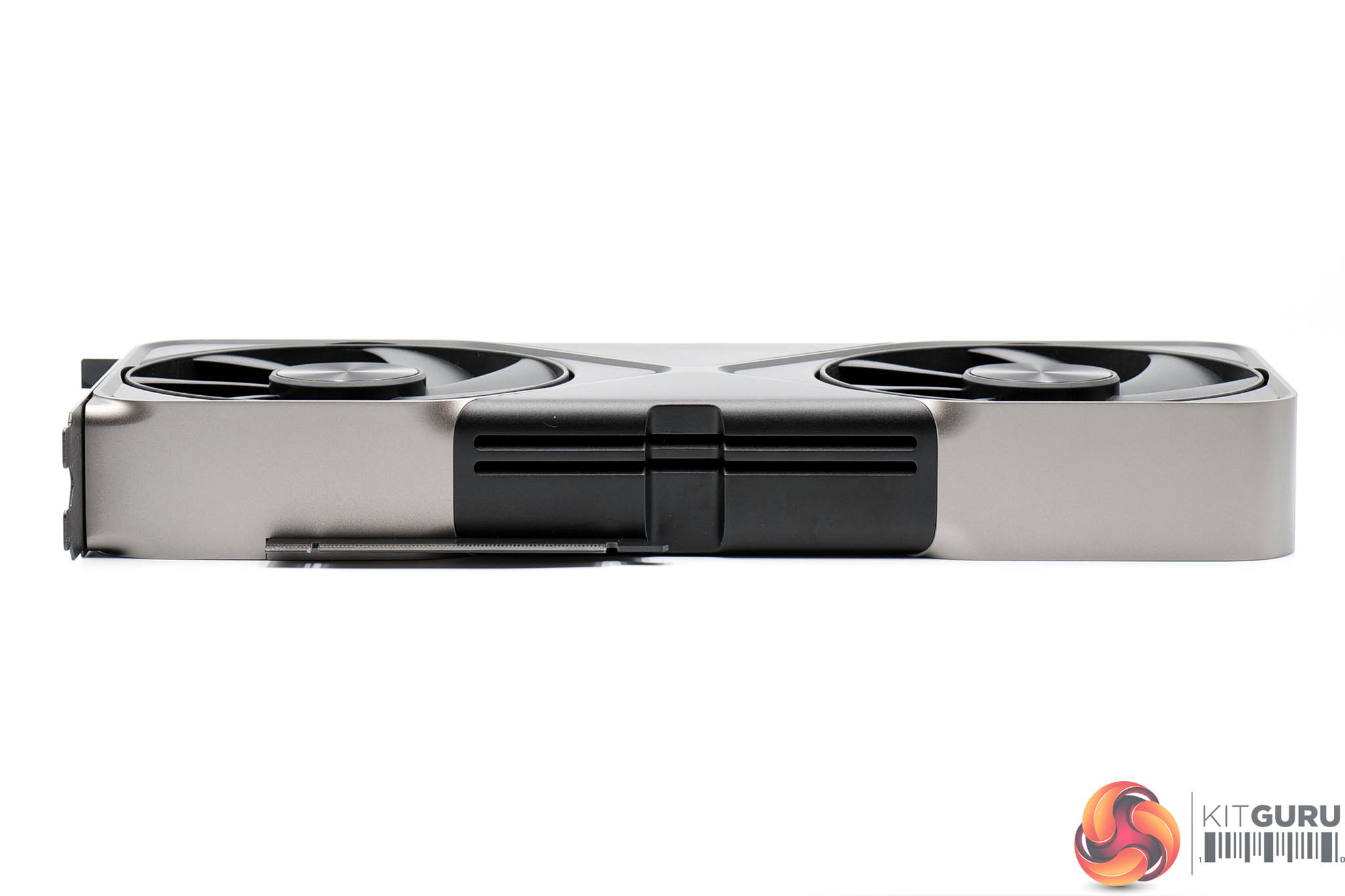
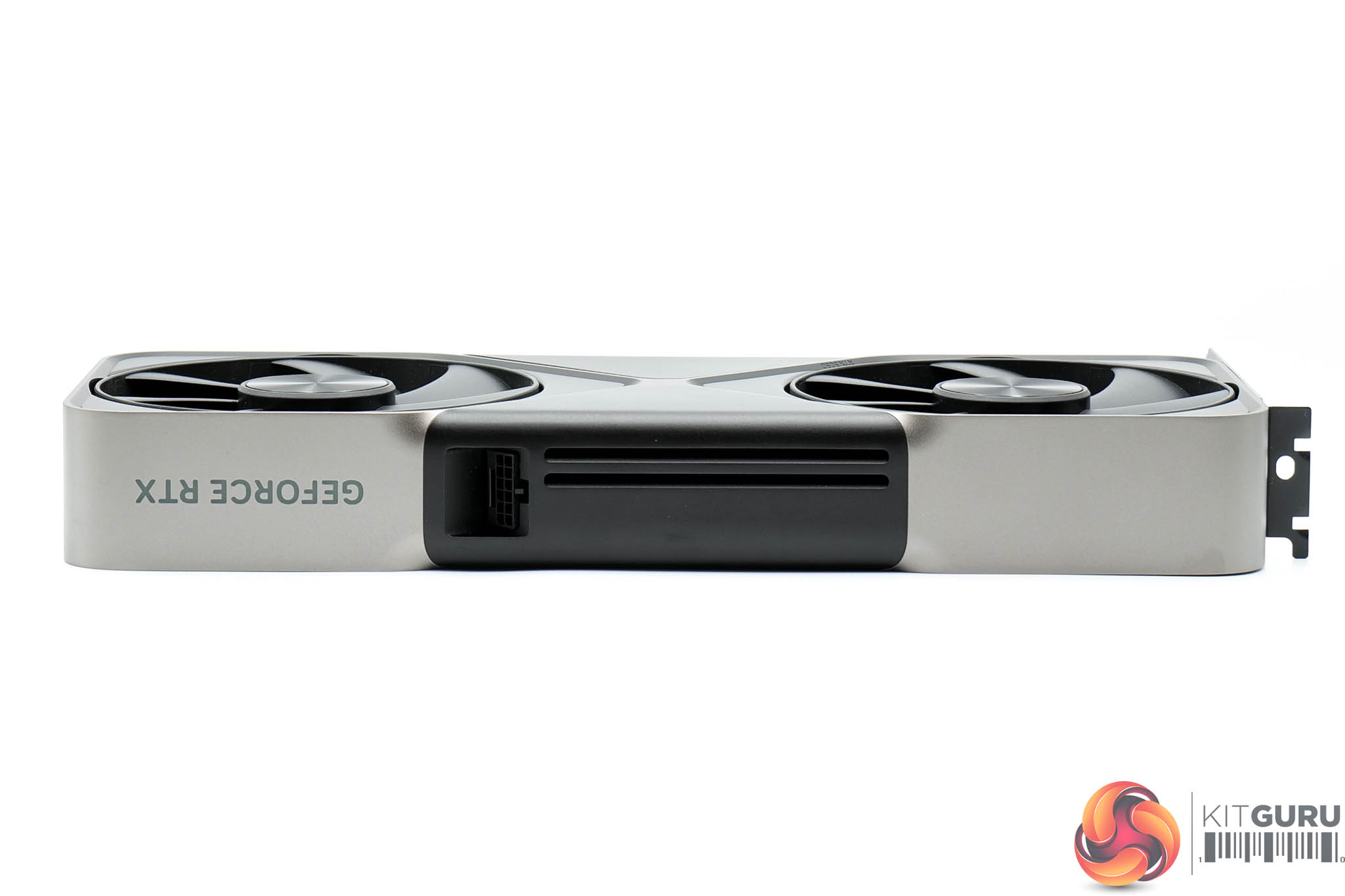
As per the RTX 5090 though, the 5080 is still just a dual-slot card and it measures 304mm long and 137mm tall.
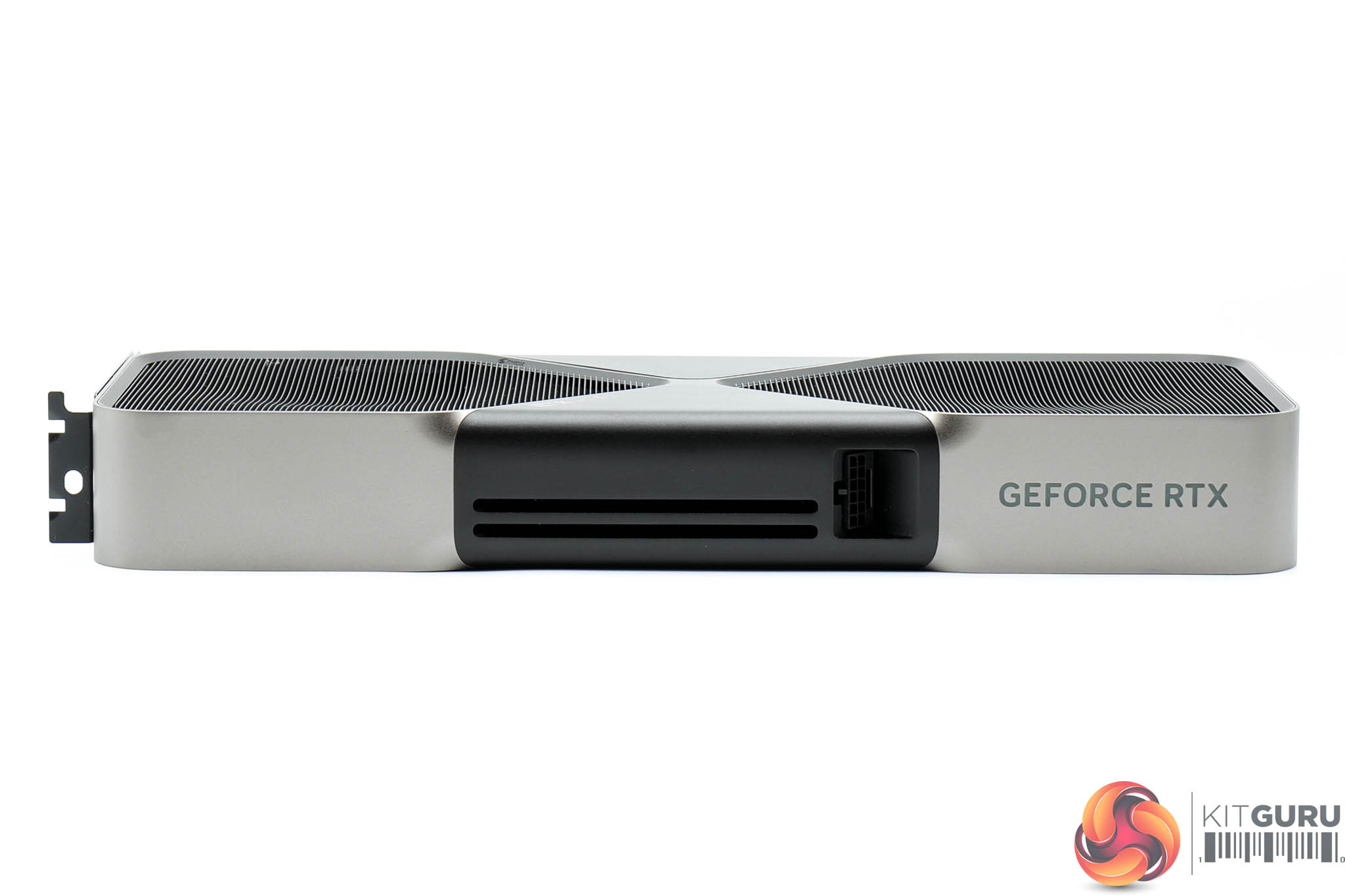
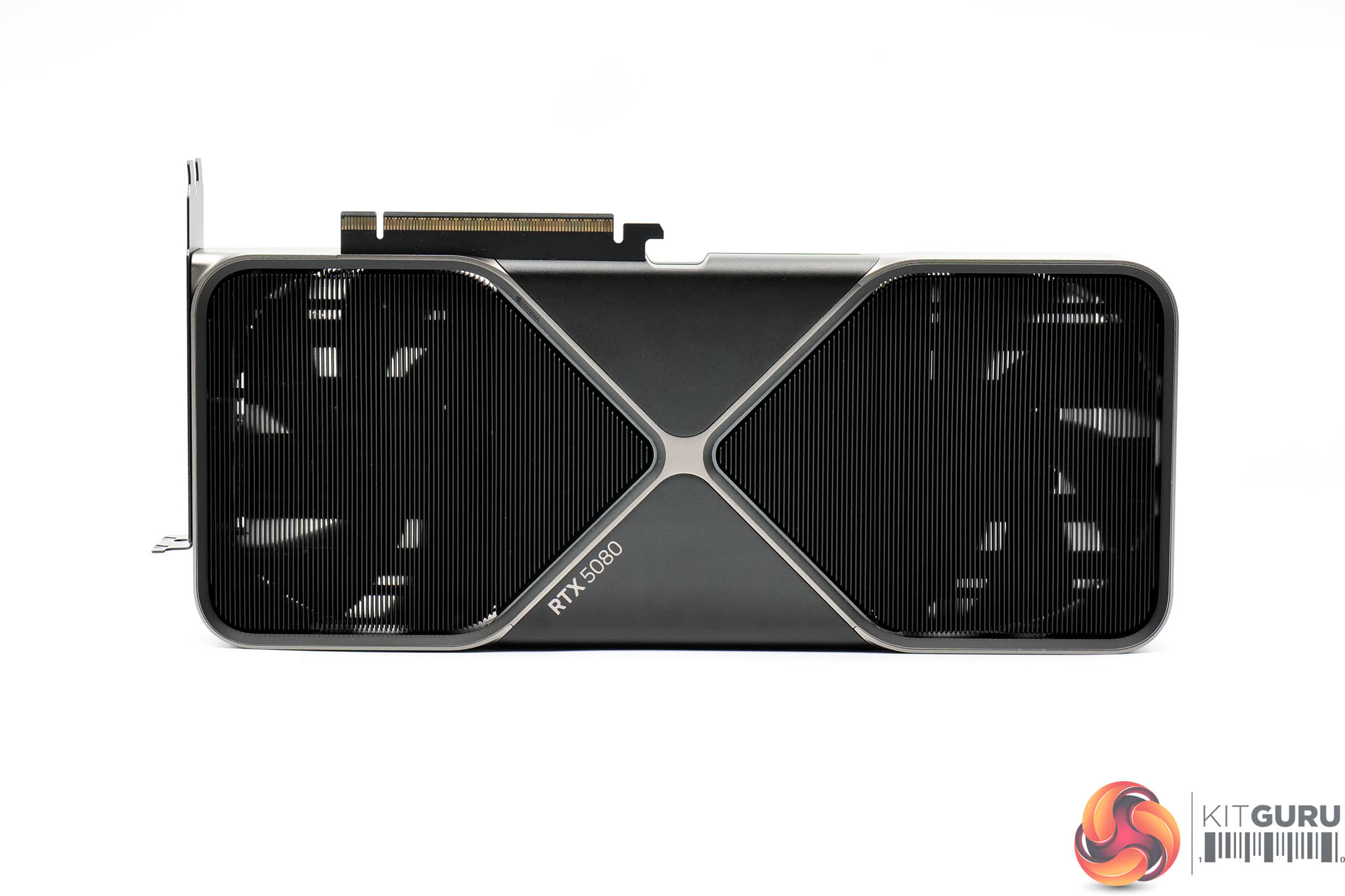
The front side is home to the GeForce RTX logo, which lights up with a white LED once powered on. We also get a look at the back of the card, and you can even see the outline of the two fans coming through the fin stack – that shows just much how of a focus the ‘flow through' design has been for Nvidia when manufacturing this card, as airflow is almost completely unobstructed.
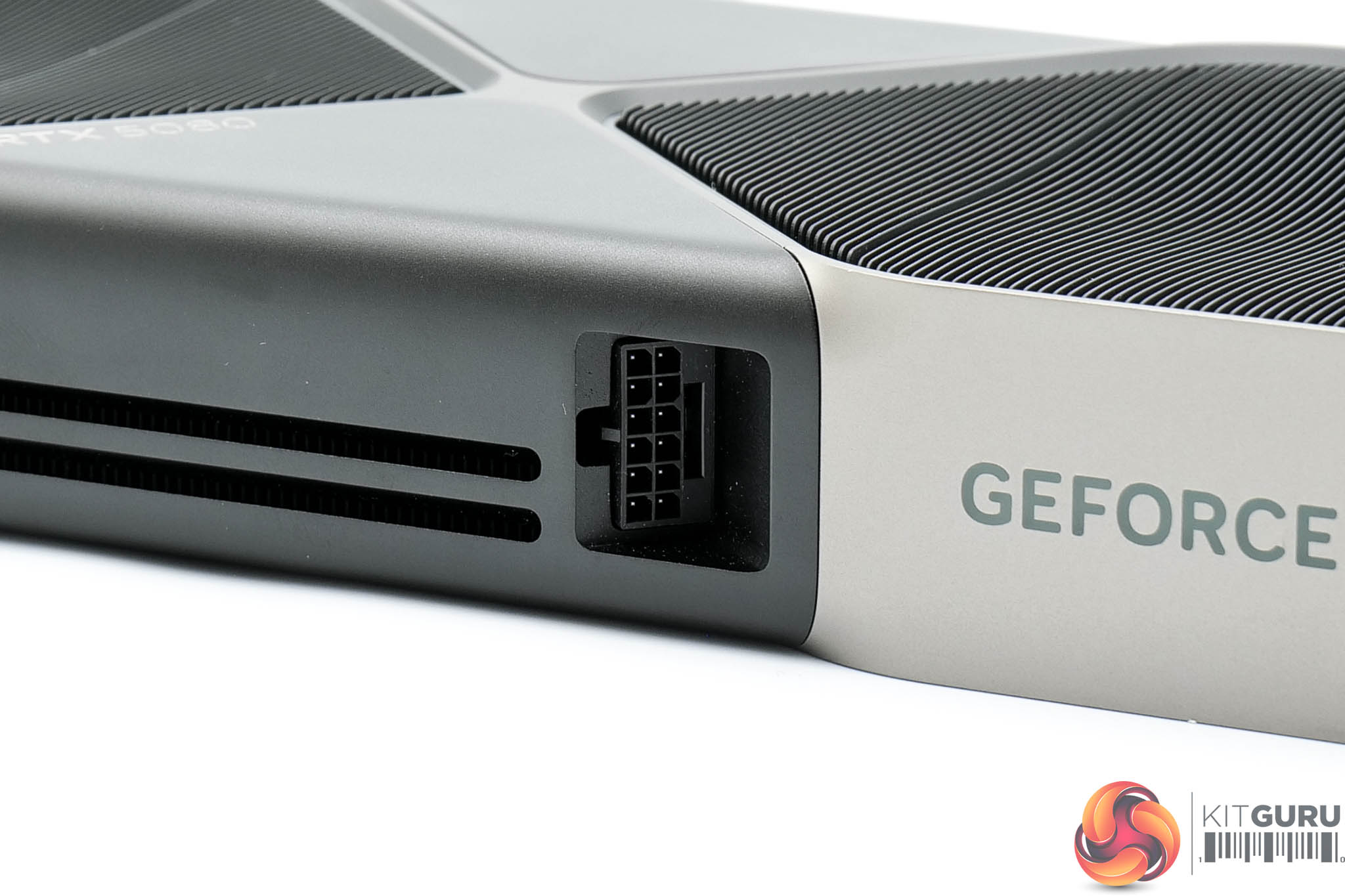
Power is delivered by a single 12VHPWR, AKA PCIe 5.0, connector, rated for up to 600W.
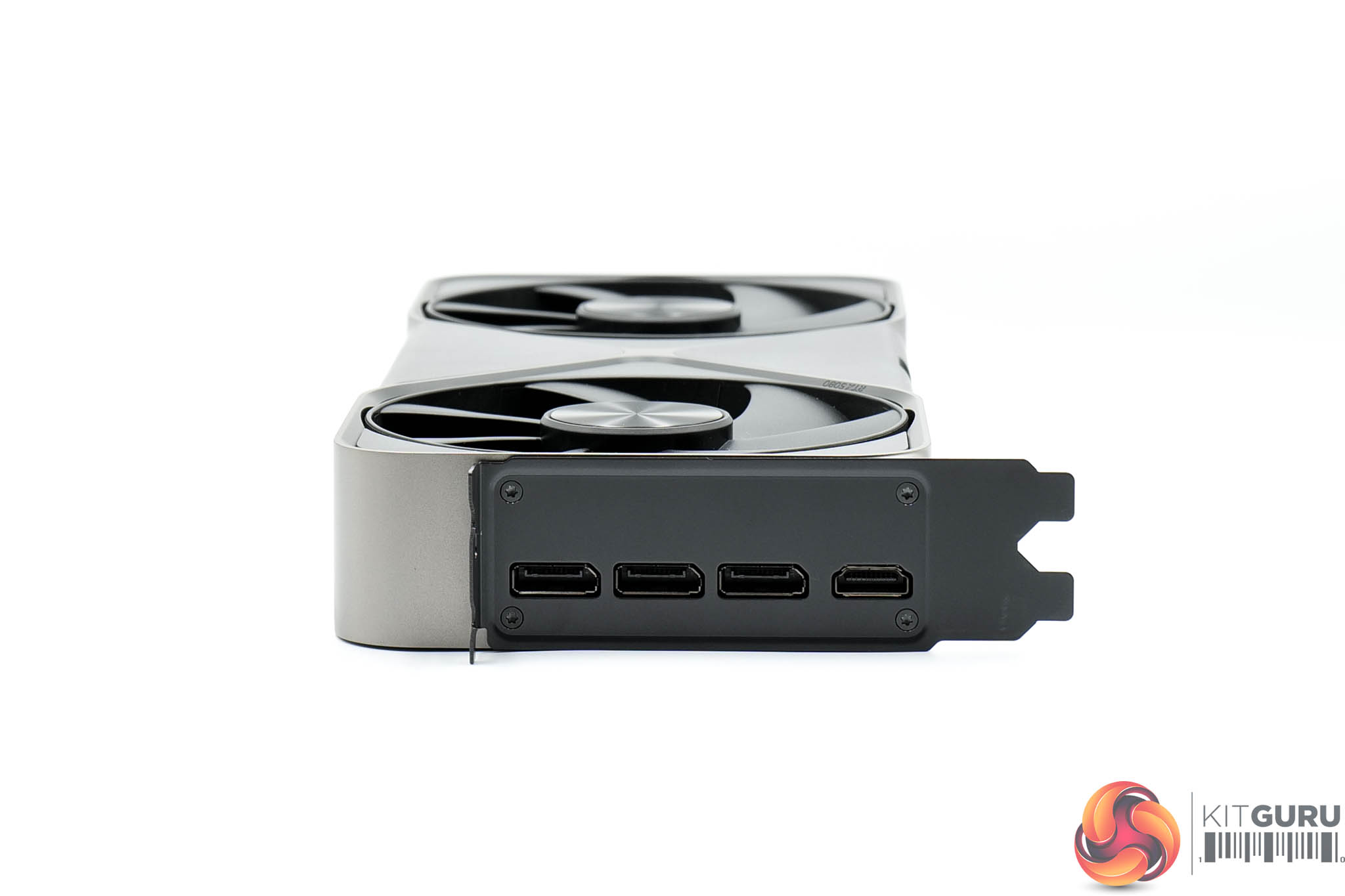
Video outputs are also upgraded for this generation, with the RTX 5080 offering three DisplayPort 2.1 UHBR20 connectors and one HDMI 2.1.
Driver Notes
- AMD GPUs were benchmarked with the Adrenalin 24.12.1 driver.
- Nvidia GPUs (except for RTX 5090 and RTX 5080) were benchmarked with the 566.14 driver.
- RTX 5090 was benchmarked with the 571.86 driver supplied to press.
- RTX 5080 was benchmarked with the 572.02 driver supplied to press.
Results are only directly comparable where this exact configuration has been used.
Test System:
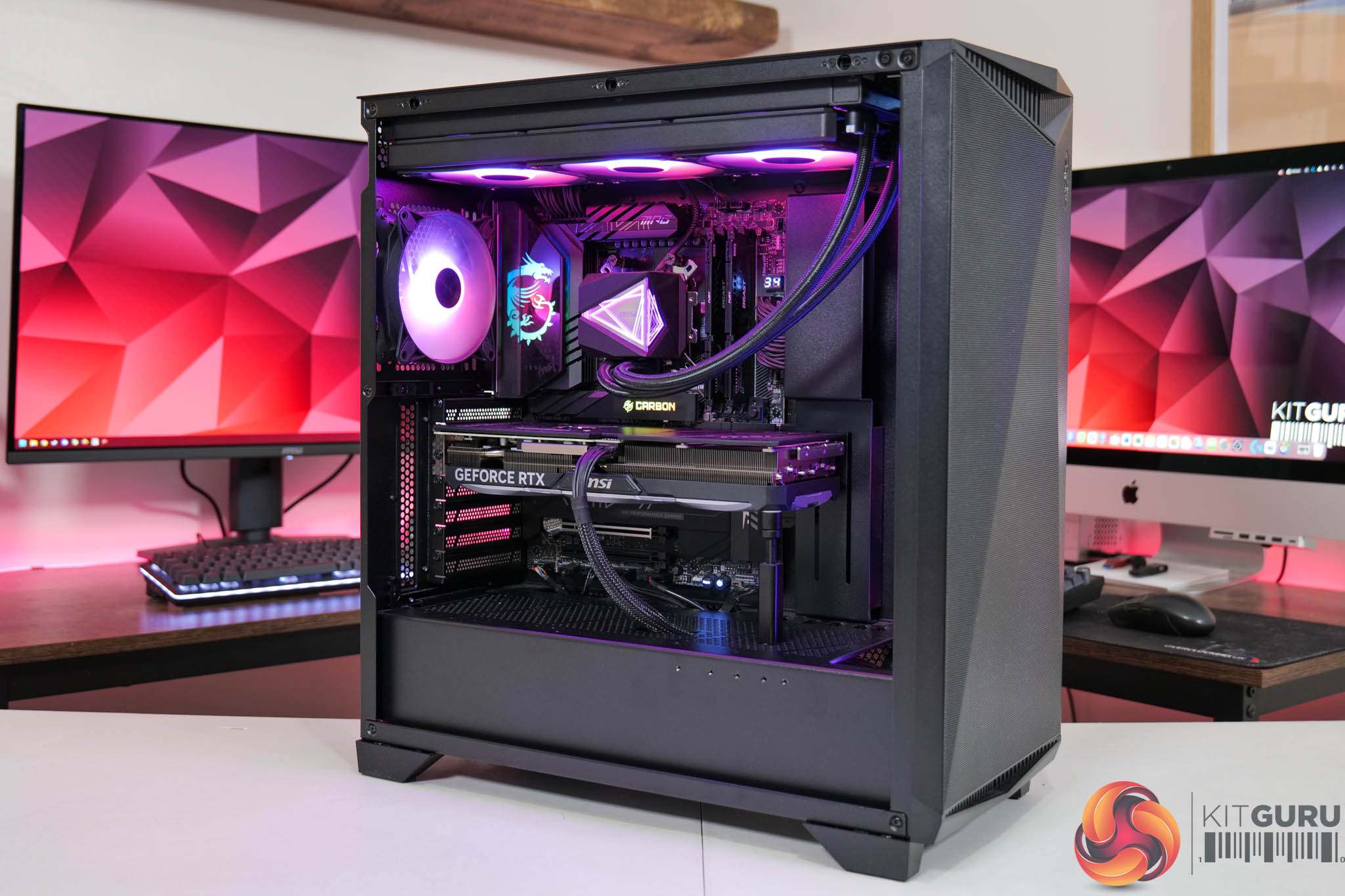
We test using a custom built system powered by MSI, based on AMD's Zen 5 platform. You can view the Powered by MSI store on AWD-IT's website HERE.
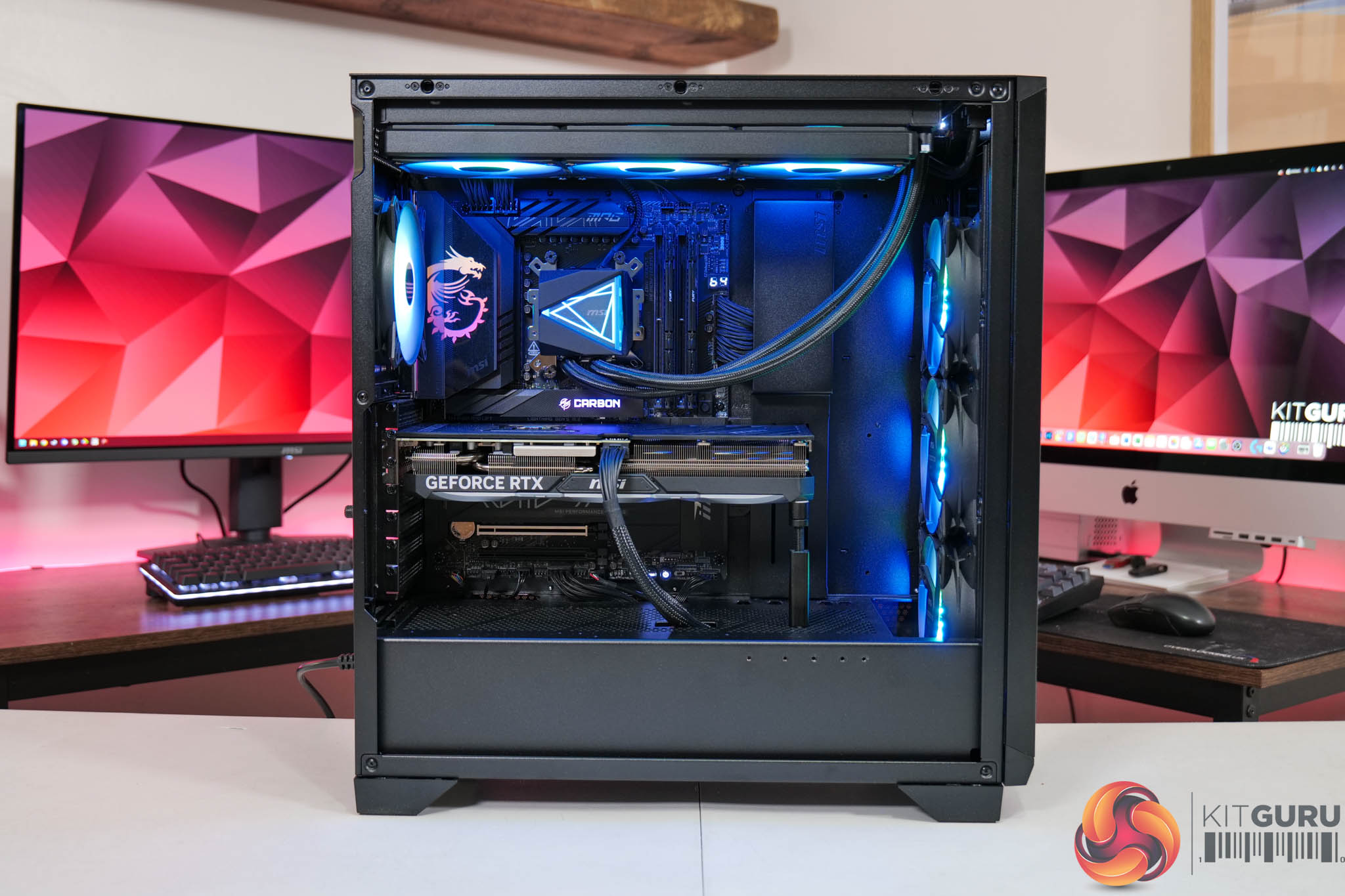
| CPU |
AMD Ryzen 7 9800X3D
|
| Motherboard |
MSI MPG X870E Carbon WiFi
|
| Memory |
64GB (2x32GB) Kingston Fury Beast DDR5 6000MT/s CL30
|
| Graphics Card |
Varies
|
| SSD |
4TB Kingston NV3 Gen 4 PCIe NVMe
|
| Chassis | MSI MPG Gungnir 300R Airflow |
| CPU Cooler |
MSI MAG CoreLiquid i360
|
| Power Supply |
MSI MEG Ai1300P
|
| Operating System |
Windows 11 23H2
|
| Monitor |
MSI MPG 321URX QD-OLED
|
| Resizable BAR |
Enabled for all supported GPUs
|
Comparison Graphics Cards List
- AMD RX 7900 XTX 24GB
- AMD RX 7900 XT 20GB
- Sapphire RX 7900 GRE Nitro+ 16GB
- AMD RX 7800 XT 16GB
- Sapphire RX 7700 XT Pulse 12GB
- Nvidia RTX 5090 FE 32GB
- Nvidia RTX 4090 FE 24GB
- Nvidia RTX 4080 Super FE 16GB
- MSI RTX 4070 Ti Super Ventus 3X 16GB
- Nvidia RTX 4070 Super FE 12GB
- Nvidia RTX 4070 FE 12GB
- Nvidia RTX 4060 Ti FE 8GB
- Nvidia RTX 3080 Ti FE 12GB
All cards were tested at reference specifications. For factory overclocked cards, this means we manually ‘undo' the overclock via MSI Afterburner or AMD/Intel's built-in tuning tools. Or, for cards like the Sapphire RX 7900 GRE Nitro+, we enable the reference-clocked BIOS instead of the default OC BIOS.
Software and Games List
- Alan Wake II (DX12)
- Black Myth: Wukong (DX12)
- Cyberpunk 2077 (DX12)
- F1 24 (DX12)
- Final Fantasy XVI (DX12)
- Forza Horizon 5 (DX12)
- Ghost of Tsushima (DX12)
- Horizon Forbidden West (DX12)
- The Last of Us Part 1 (DX12)
- A Plague Tale: Requiem (DX12)
- Ratchet and Clank: Rift Apart (DX12)
- Returnal (DX12)
- Senua's Saga: Hellblade 2 (DX12)
- Shadow of the Tomb Raider (DX12)
- Starfield (DX12)
- Star Wars Outlaws (DX12)
- Total War: Warhammer III (DX11)
We run each benchmark/game three times, and present mean averages in our graphs. We use FrameView to measure average frame rates as well as 1% low values (99th percentile) across our three runs.
Alan Wake 2 is a 2023 survival horror game developed by Remedy Entertainment and published by Epic Games Publishing. A sequel to Alan Wake, the story follows best-selling novelist Alan Wake, who has been trapped in an alternate dimension for 13 years, as he attempts to escape by writing a horror story involving an FBI special agent named Saga Anderson. The game was released for PlayStation 5, Windows, and Xbox Series X/S on 27 October 2023. (Wikipedia).
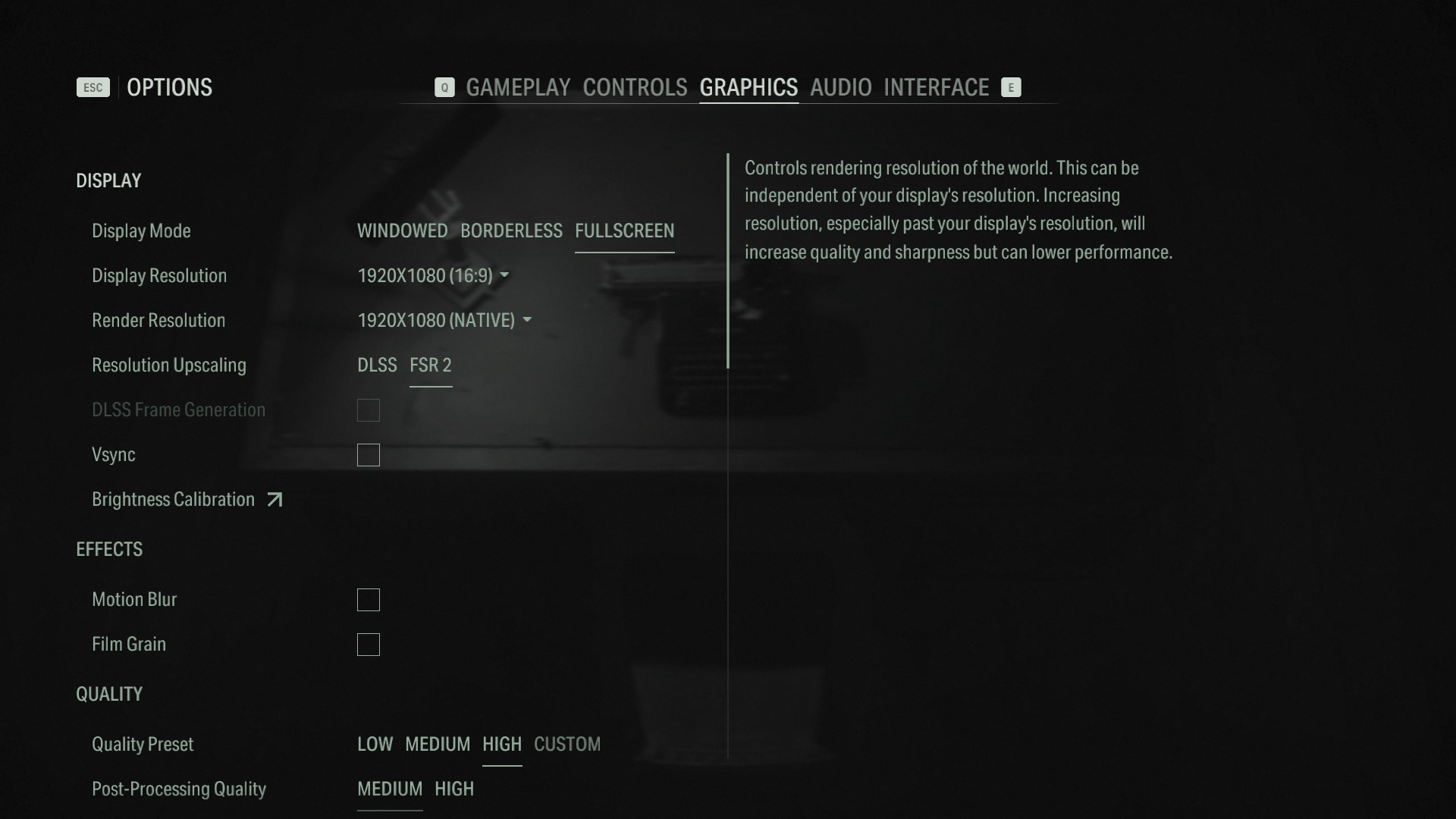
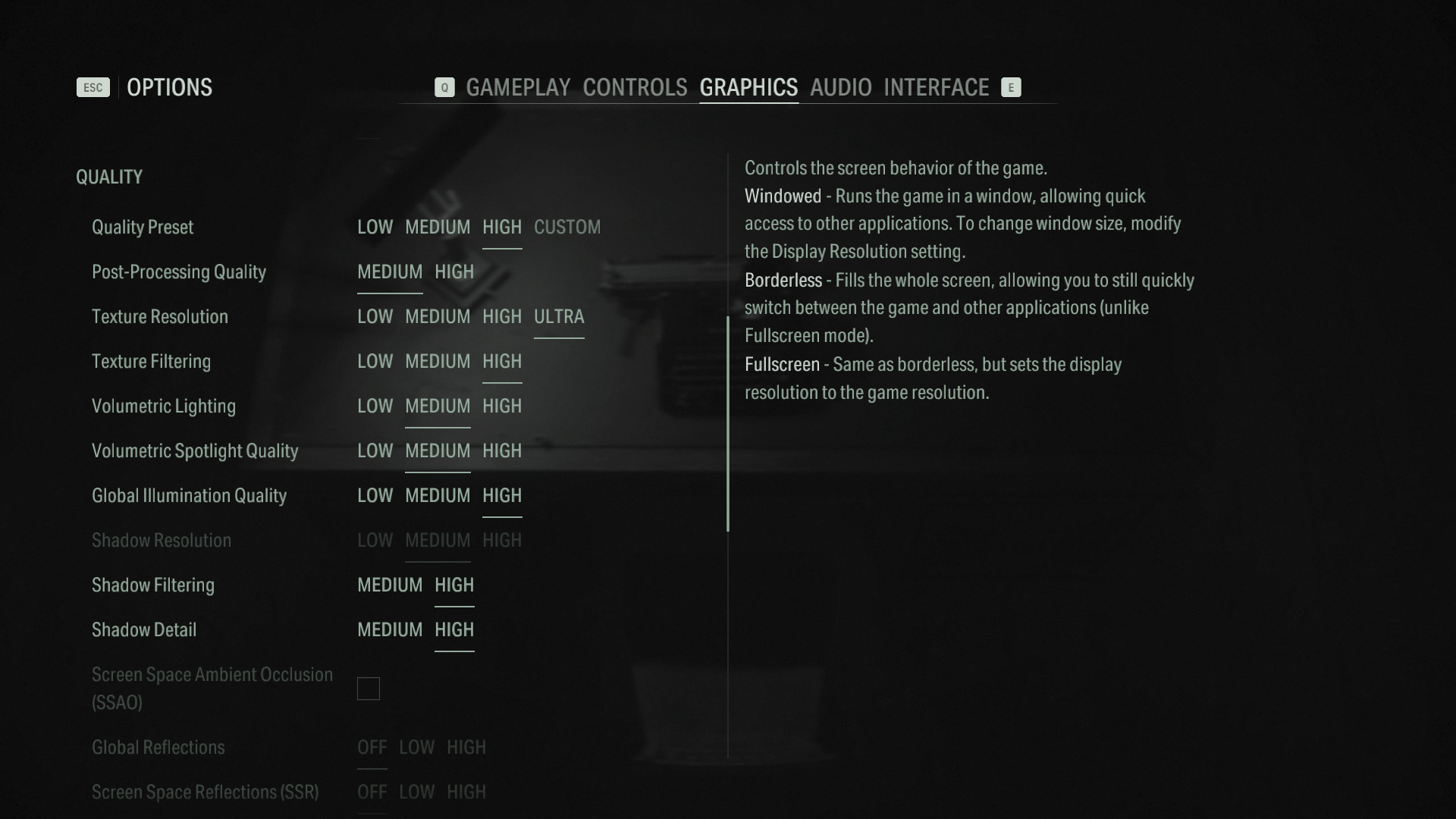
Engine: Northlight. We test using the High preset, FSR set to native resolution, DX12 API.

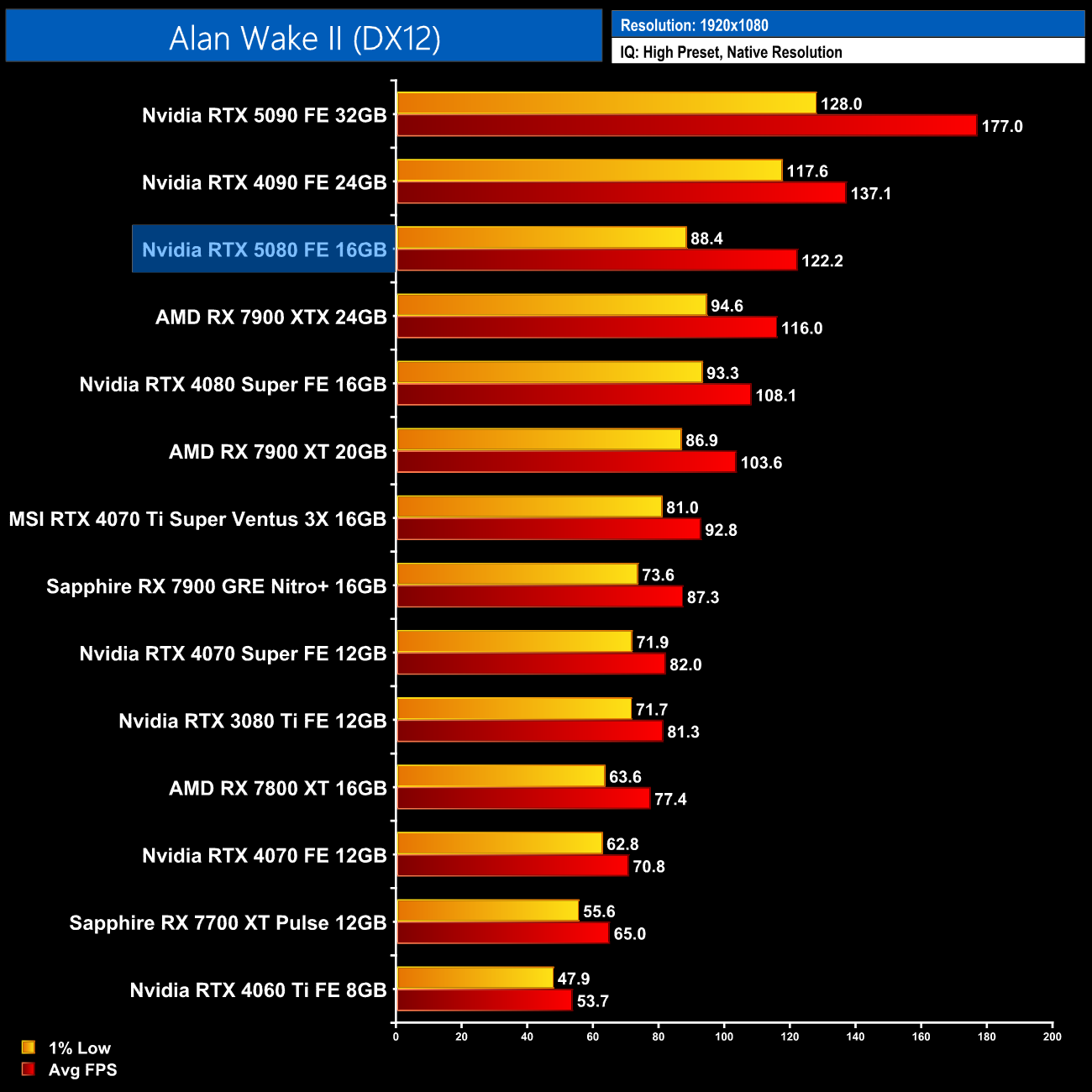
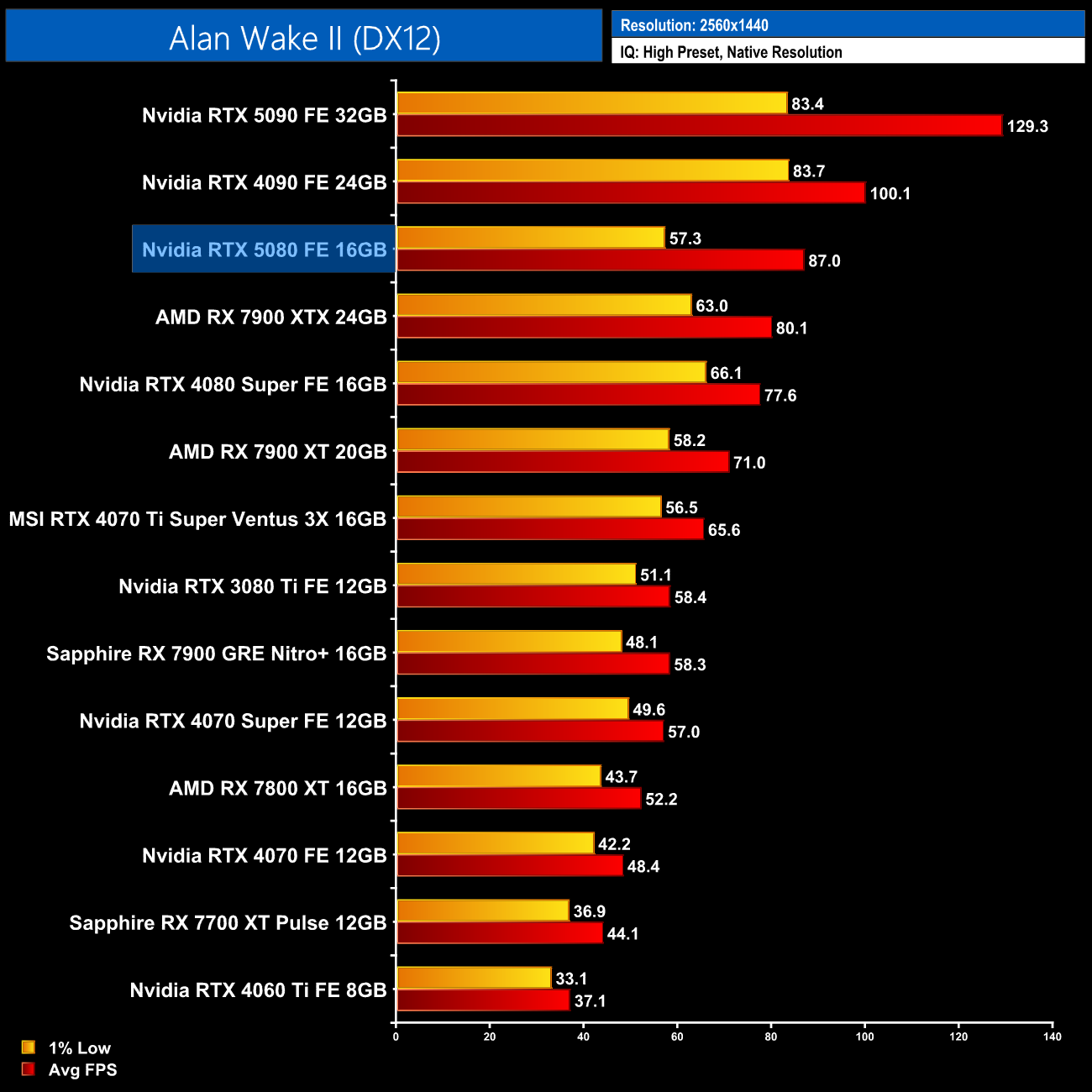
Kicking off the benchmarks with Alan Wake 2, as mentioned in the RTX 5090 review, we're still experiencing frametime issues with the new Blackwell GPUs, something I'd expect to be fixed soon with a driver update. However, looking at average frame rate, the RTX 5080 delivers 87fps at 1440p, putting it 9% ahead of AMD's RX 7900 XTX, while it's 13% faster than the RTX 4080 Super.
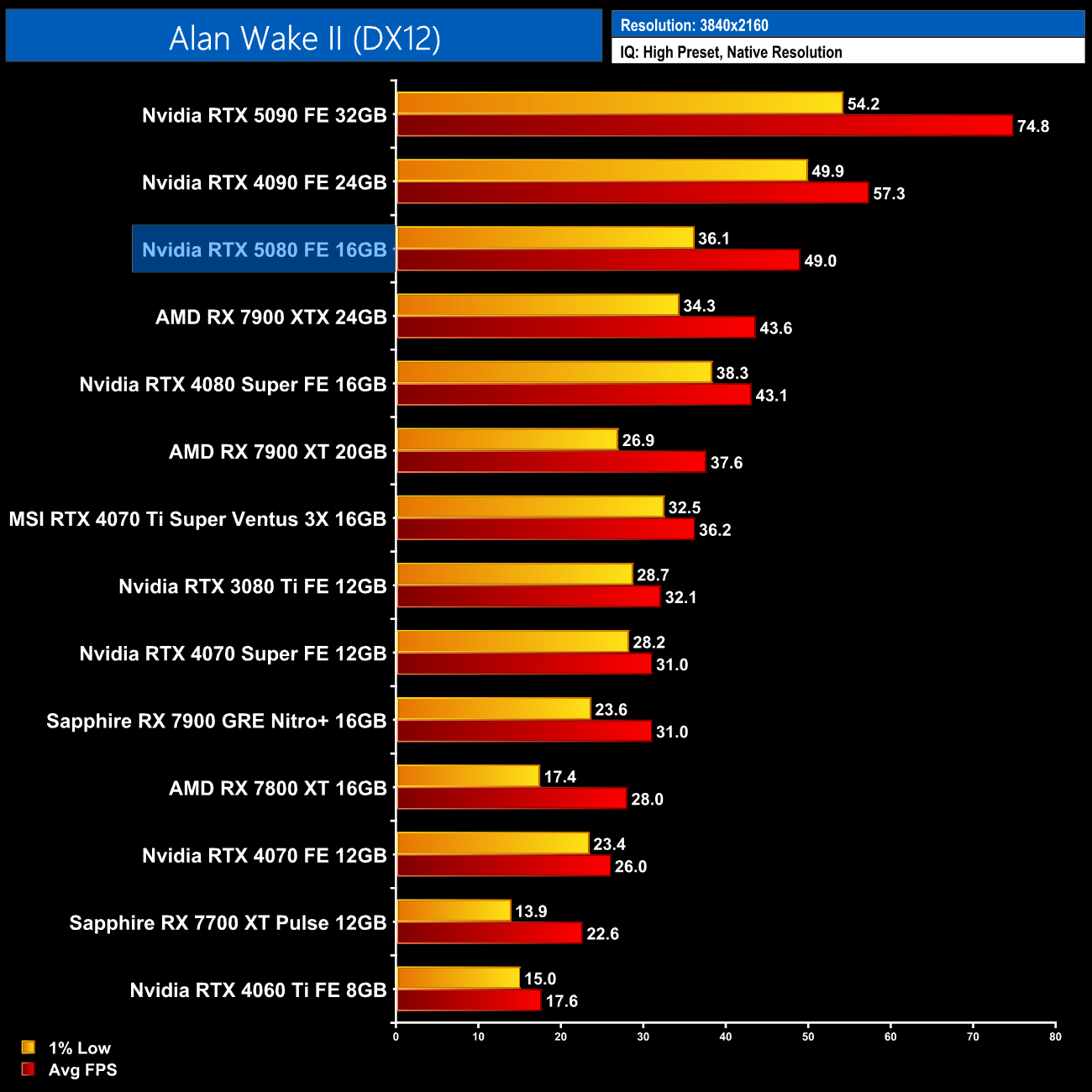
Stepping up to 4K sees the 5080 now average 49fps, giving it 12% and 14% gains over the 7900 XTX and 4080 Super, respectively. It's 15% slower than the RTX 4090, and 35% behind the RTX 5090.
Update: Frametime issue has been fixed

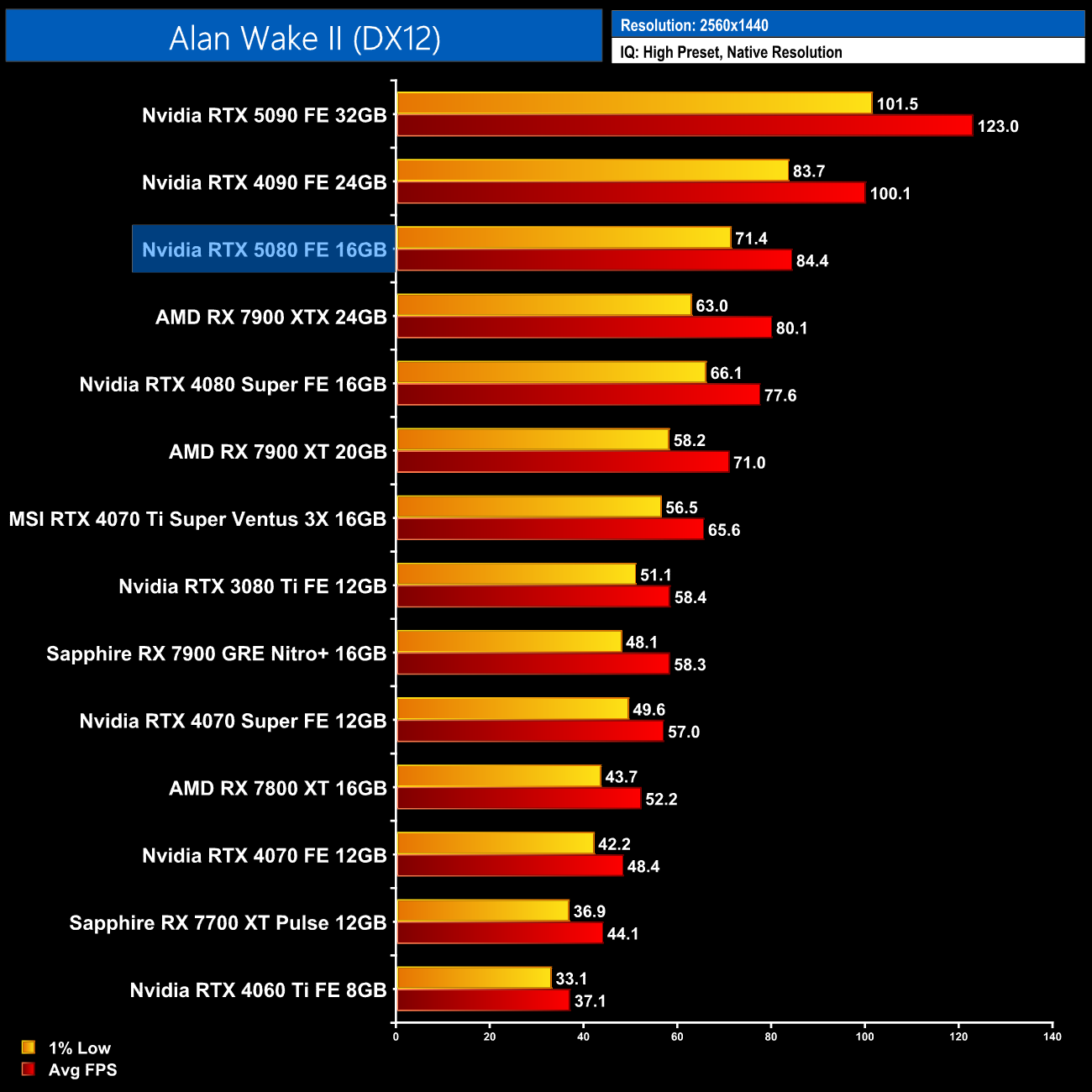

Just a day before this review was scheduled to go live, Nvidia let us know that a new driver had been issued which was designed to fix the frametime issues in Alan Wake 2. I tested it and, sure enough, the 1% lows are now much more consistent than what we saw before. Average frame rates have dropped by a few frames, but nothing of real significance.
Black Myth: Wukong is a 2024 action role-playing game developed and published by Game Science. The game is inspired by the classical Chinese novel Journey to the West and follows an anthropomorphic monkey based on Sun Wukong from the novel. Black Myth: Wukong was released for PlayStation 5 and Windows on August 20, 2024, with an Xbox Series X/S version to be released at a later date. (Wikipedia).
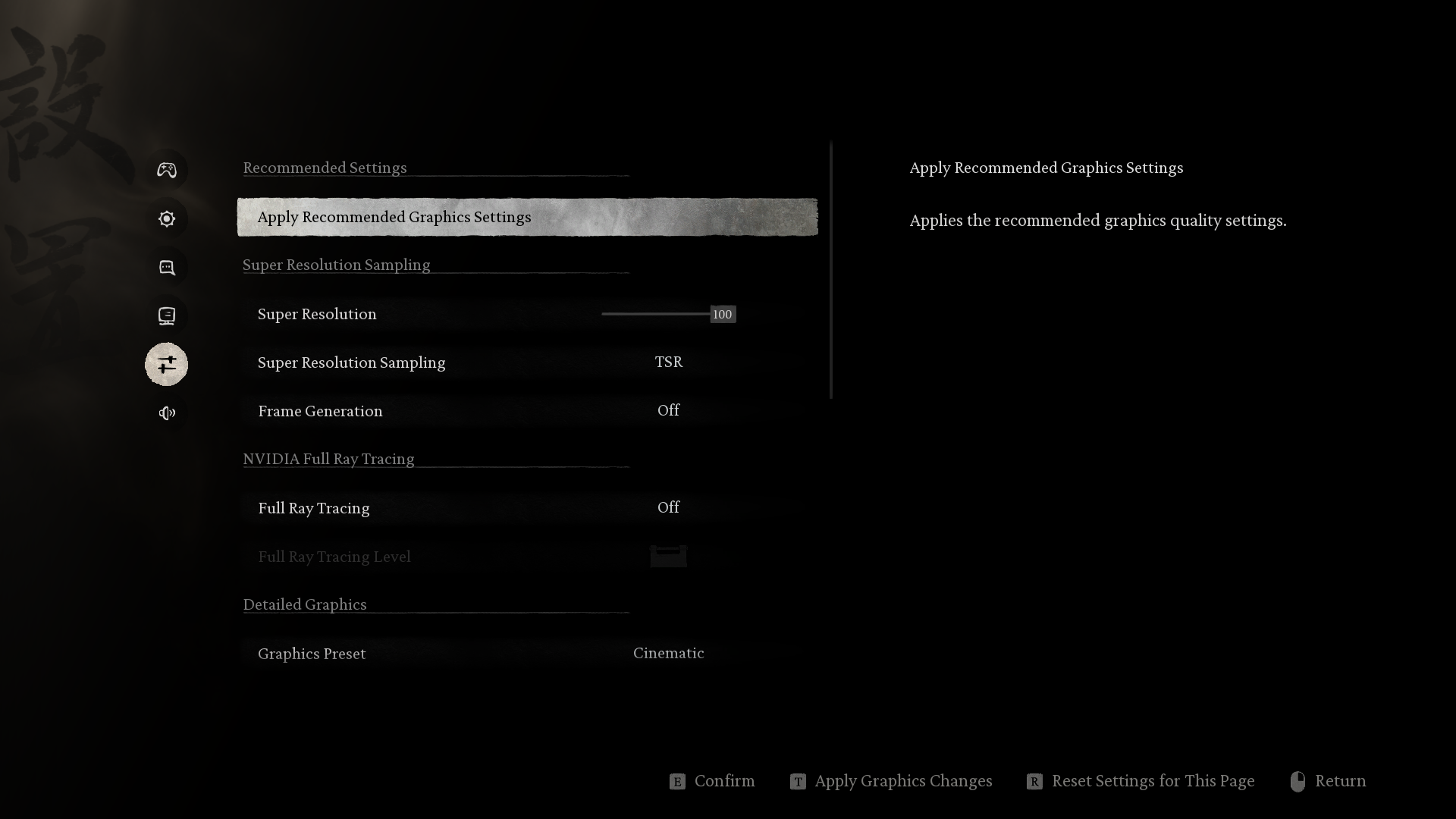
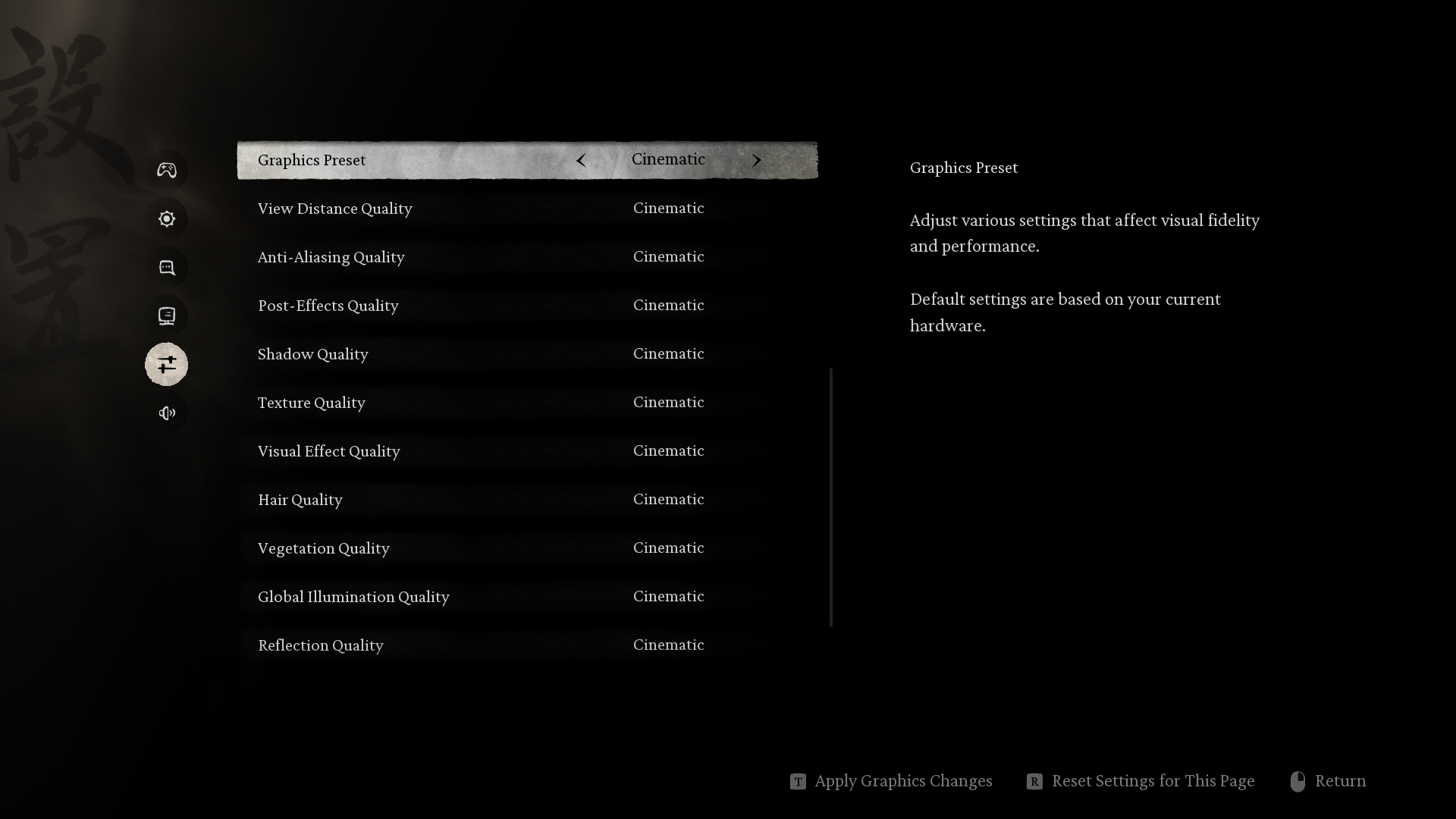
Engine: Unreal Engine 5. We test using the Cinematic preset, TSR set to 100% render scale, DX12 API.
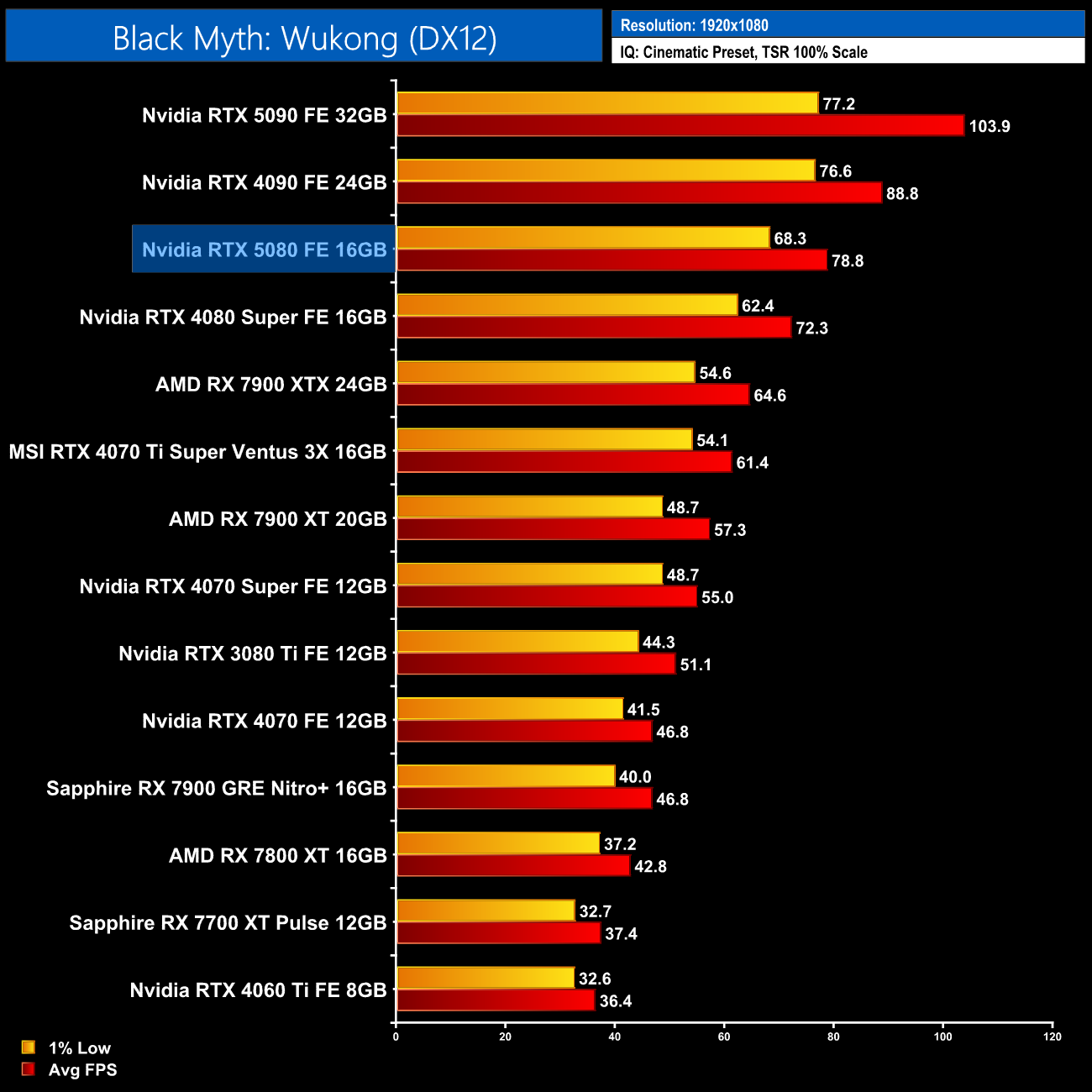
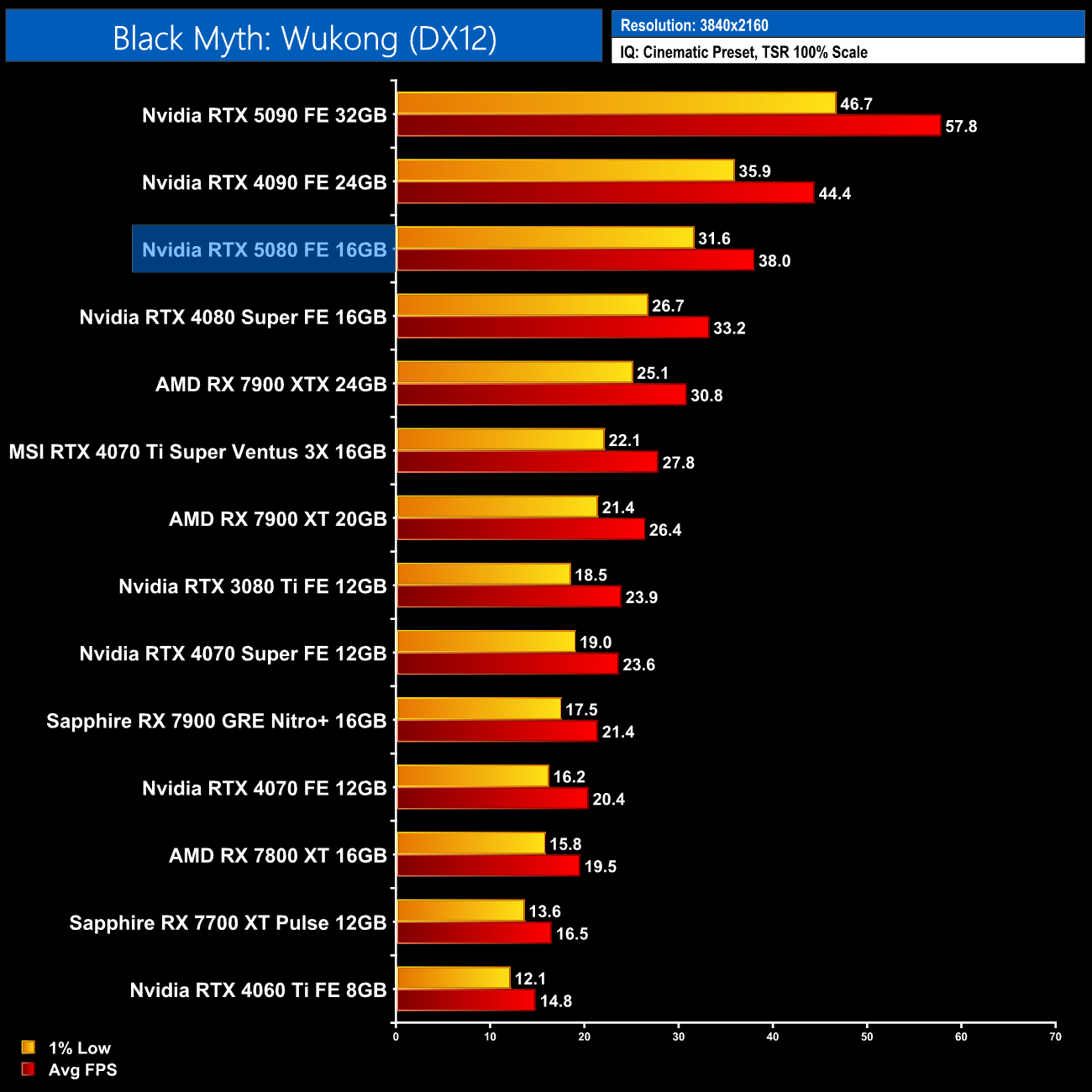
Moving onto Black Myth: Wukong, at 1440p the RTX 5080 is good for 62fps on average, giving it a 12% lead over the 4080 Super. It's also 12% slower than the 4090, and 29% behind the 5090.
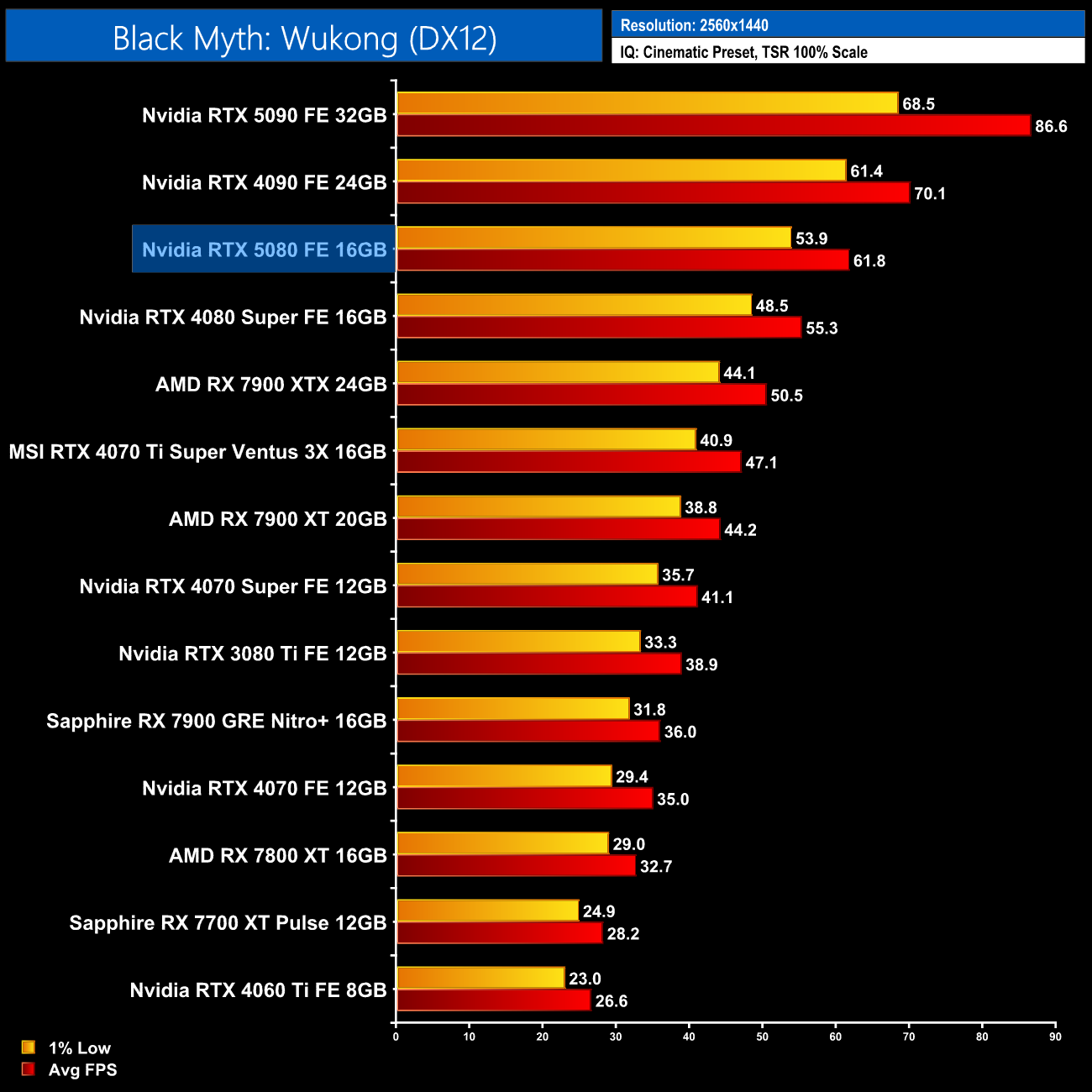
Increasing the resolution to 4K sees even the mighty RTX 5090 drop below 60fps, so upscaling is definitely required to hit higher frame rates. Still, the 5080 is 15% faster than the 4080 Super now, and 14% slower than the 4090.
Cyberpunk 2077 is a 2020 action role-playing video game developed and published by CD Projekt. The story takes place in Night City, an open world set in the Cyberpunk universe. Players assume the first-person perspective of a customisable mercenary known as V, who can acquire skills in hacking and machinery with options for melee and ranged combat. Cyberpunk 2077 was released for Microsoft Windows, PlayStation 4, Stadia, and Xbox One on 10 December 2020. (Wikipedia).
Engine: REDengine 4. We test using the Ultra preset, FSR disabled, DX12 API.
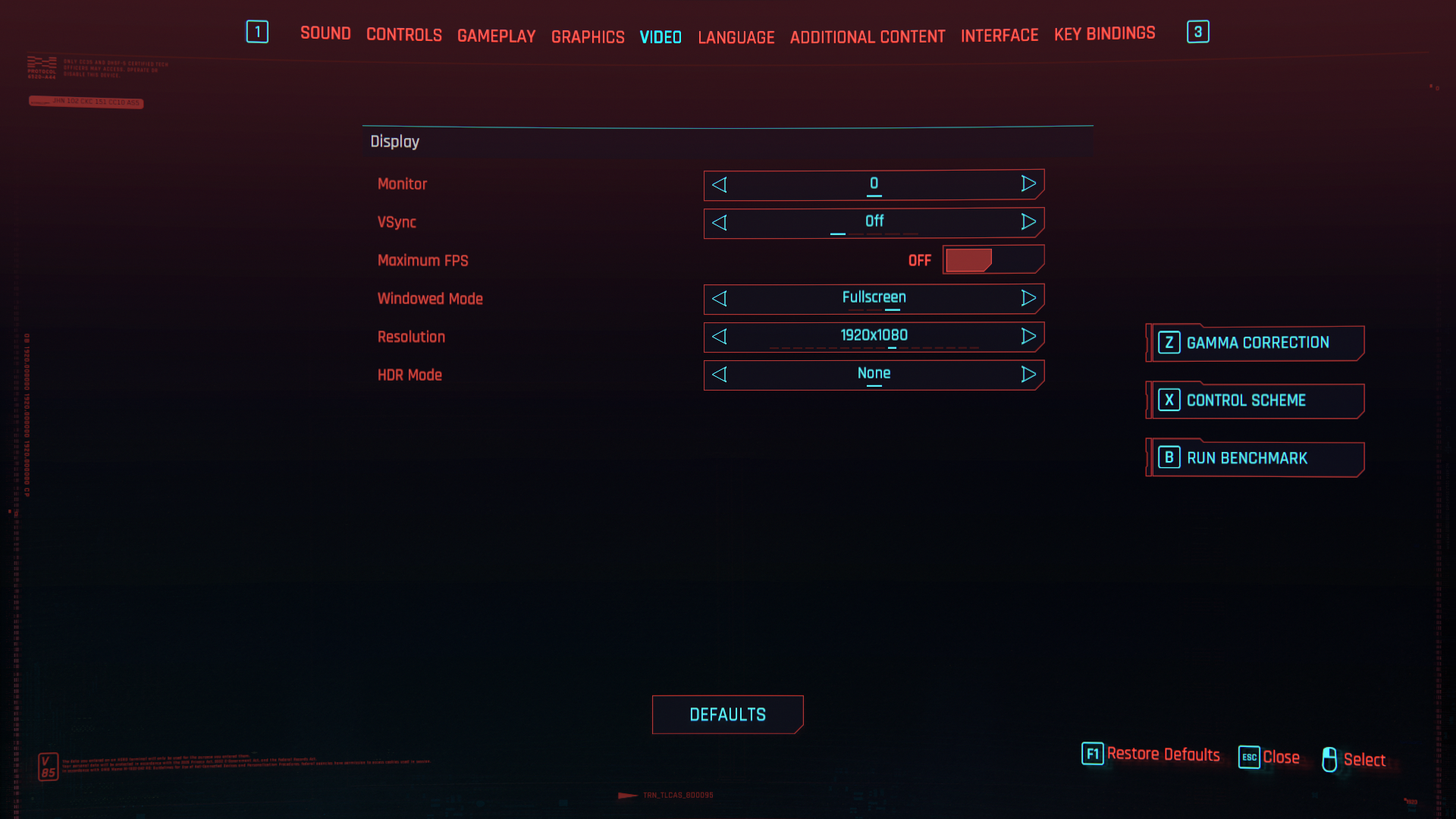
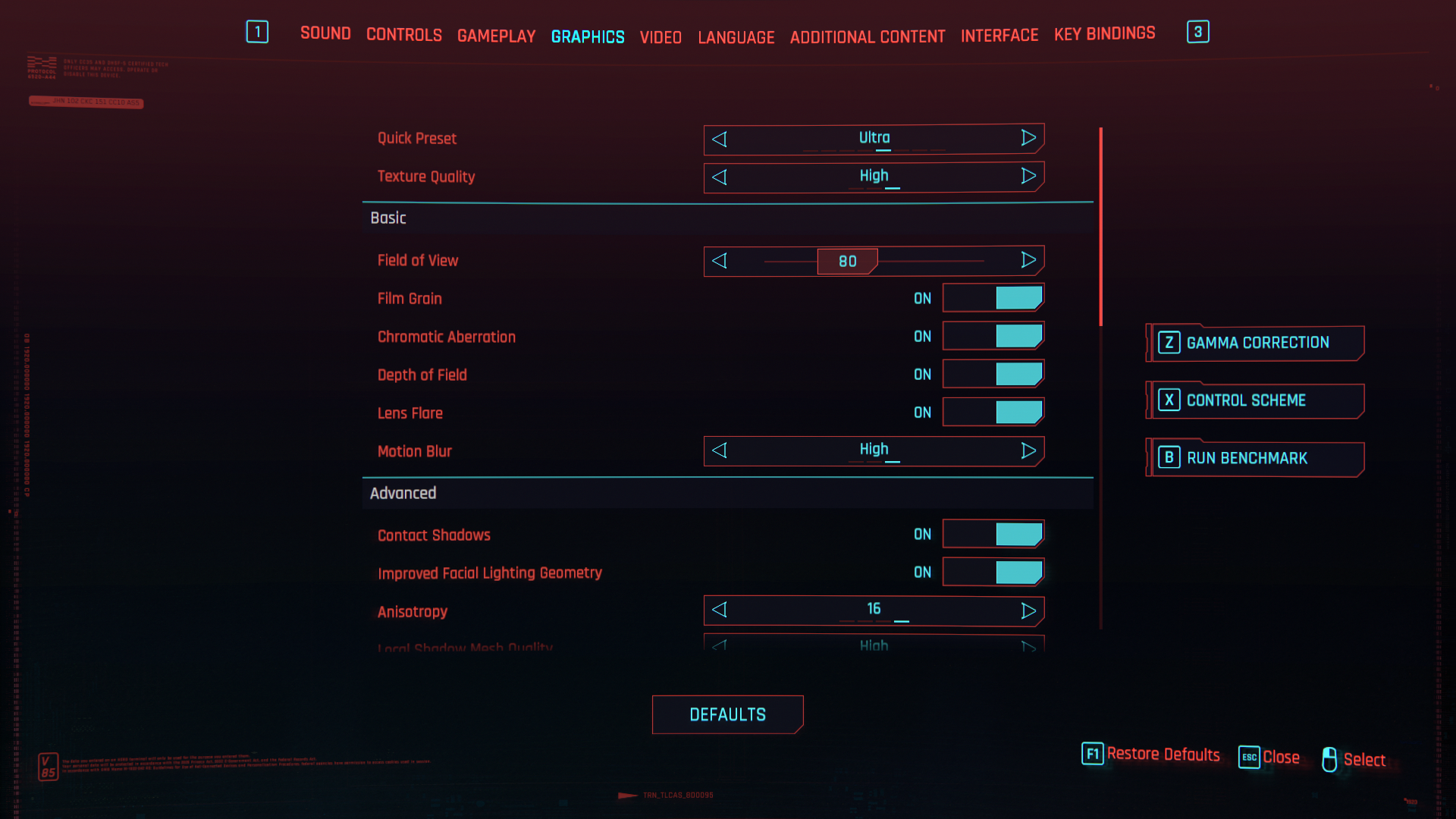
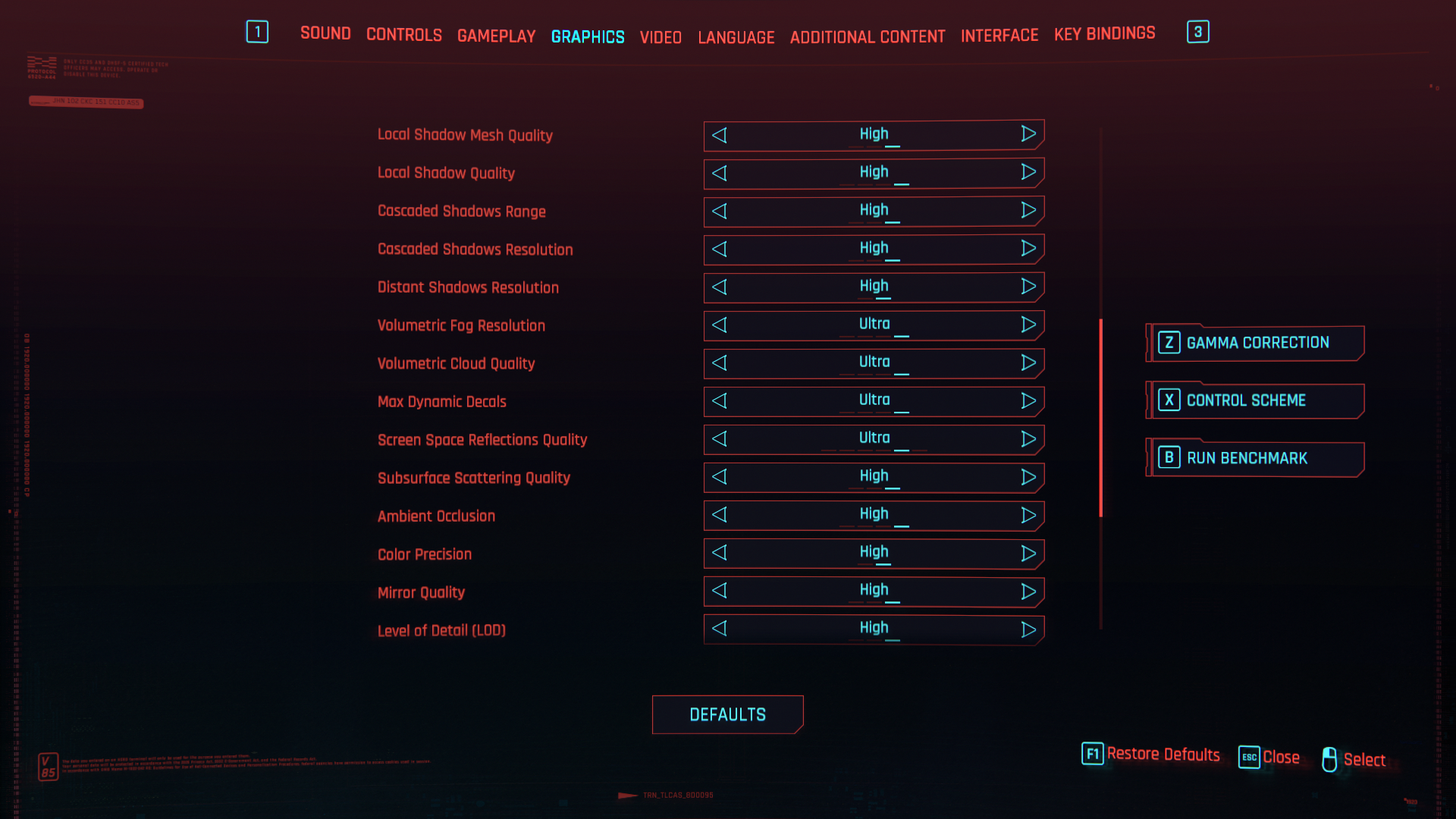
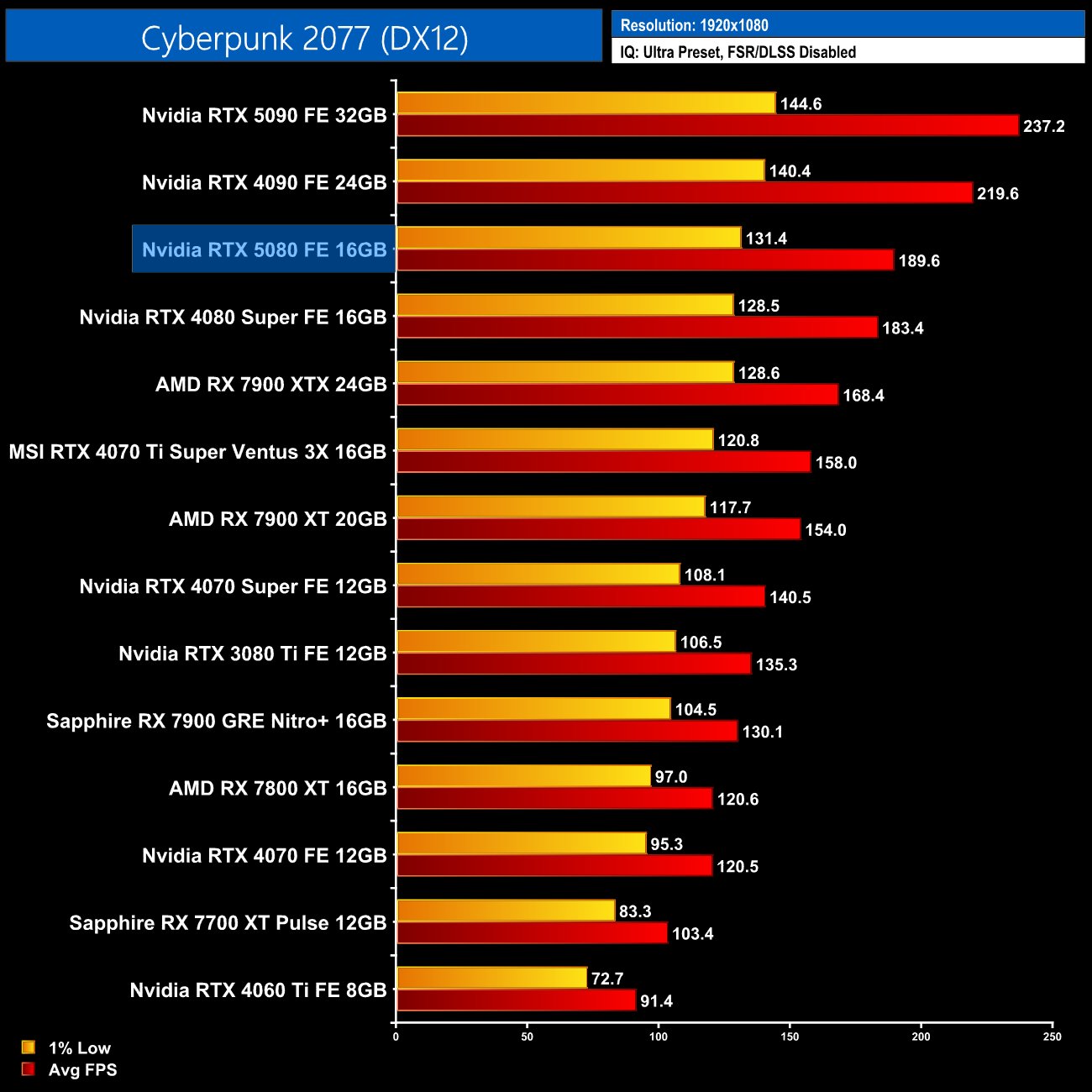

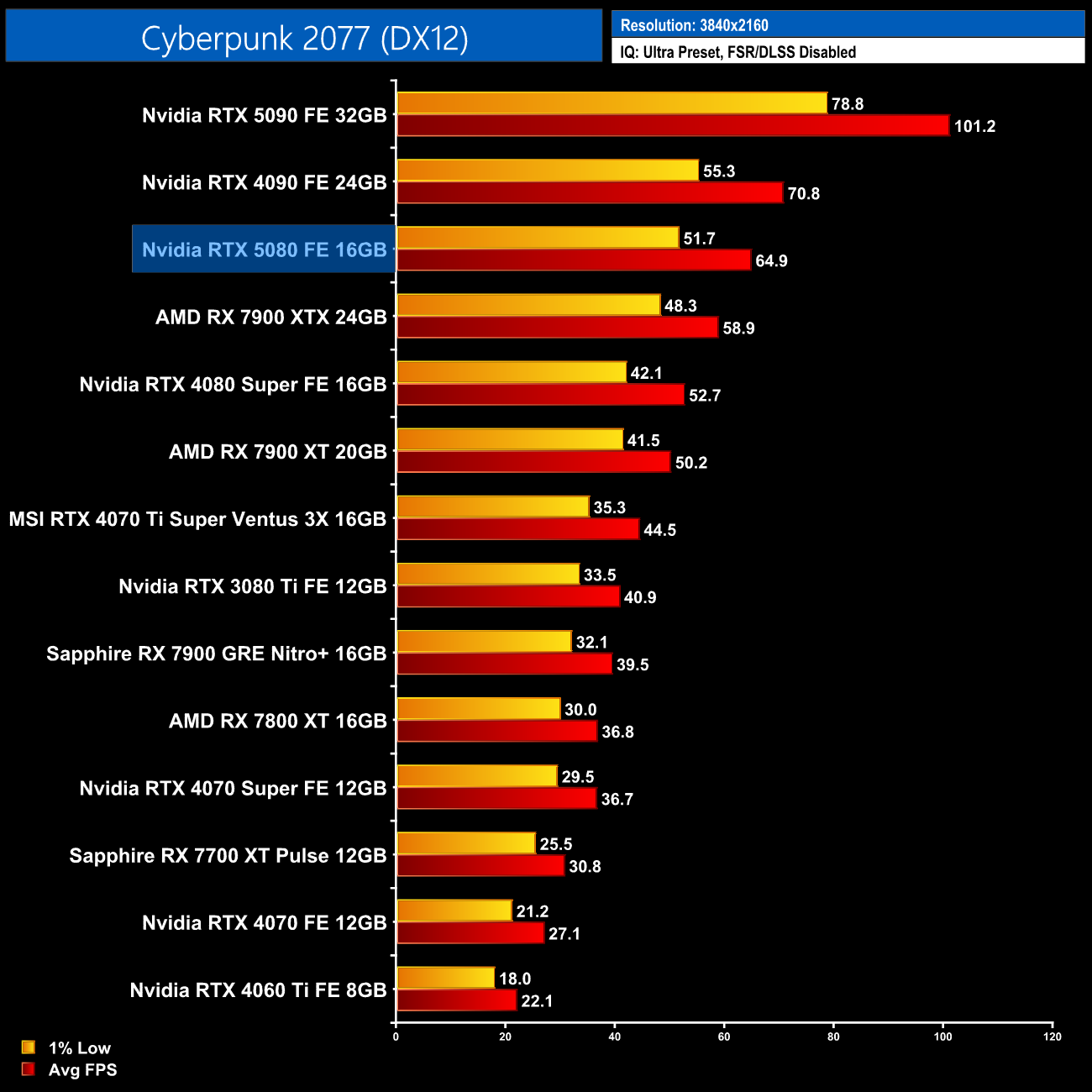
Cyberpunk 2077 is next and this one is definitely favourable to the RTX 50 series. At 1440p the 5080 delivers 131fps on average, making it 10% faster than the 7900 XTX and 14% ahead of the 4080 Super.
Things improve as we increase the resolution to 4K though, and now we see a 23% gain over the 4080 Super – the largest increase we will see from our gaming benchmarks today! It's also just 8% slower than the 4090.
Final Fantasy XVI is a 2023 action role-playing game developed and published by Square Enix. The sixteenth main installment in the Final Fantasy series, it was released for the PlayStation 5 in June 2023, with a Windows version released in September 2024.
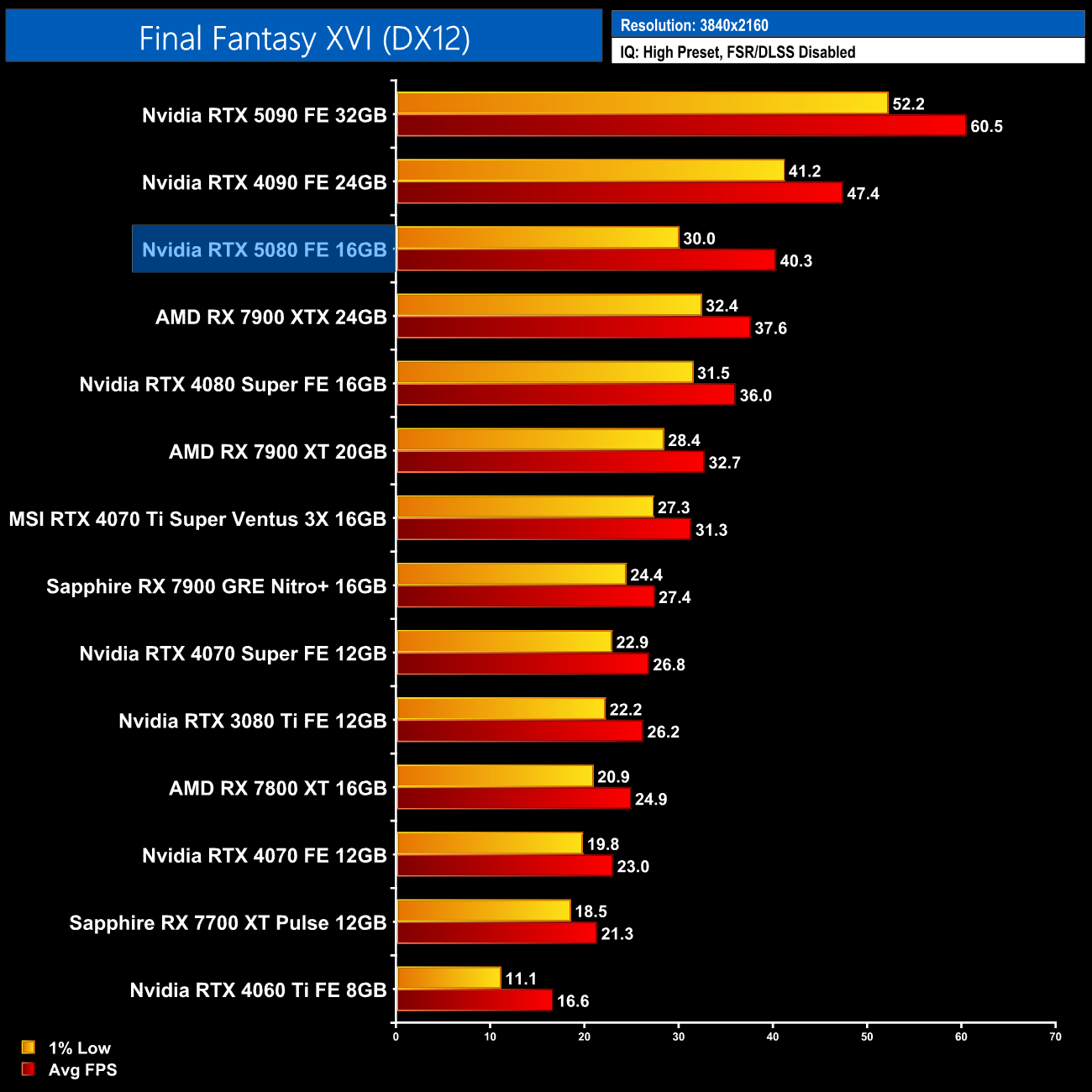
Engine: Square Enix in-house engine. We test using the Ultra preset, DLSS/FSR disabled, DX12 API.
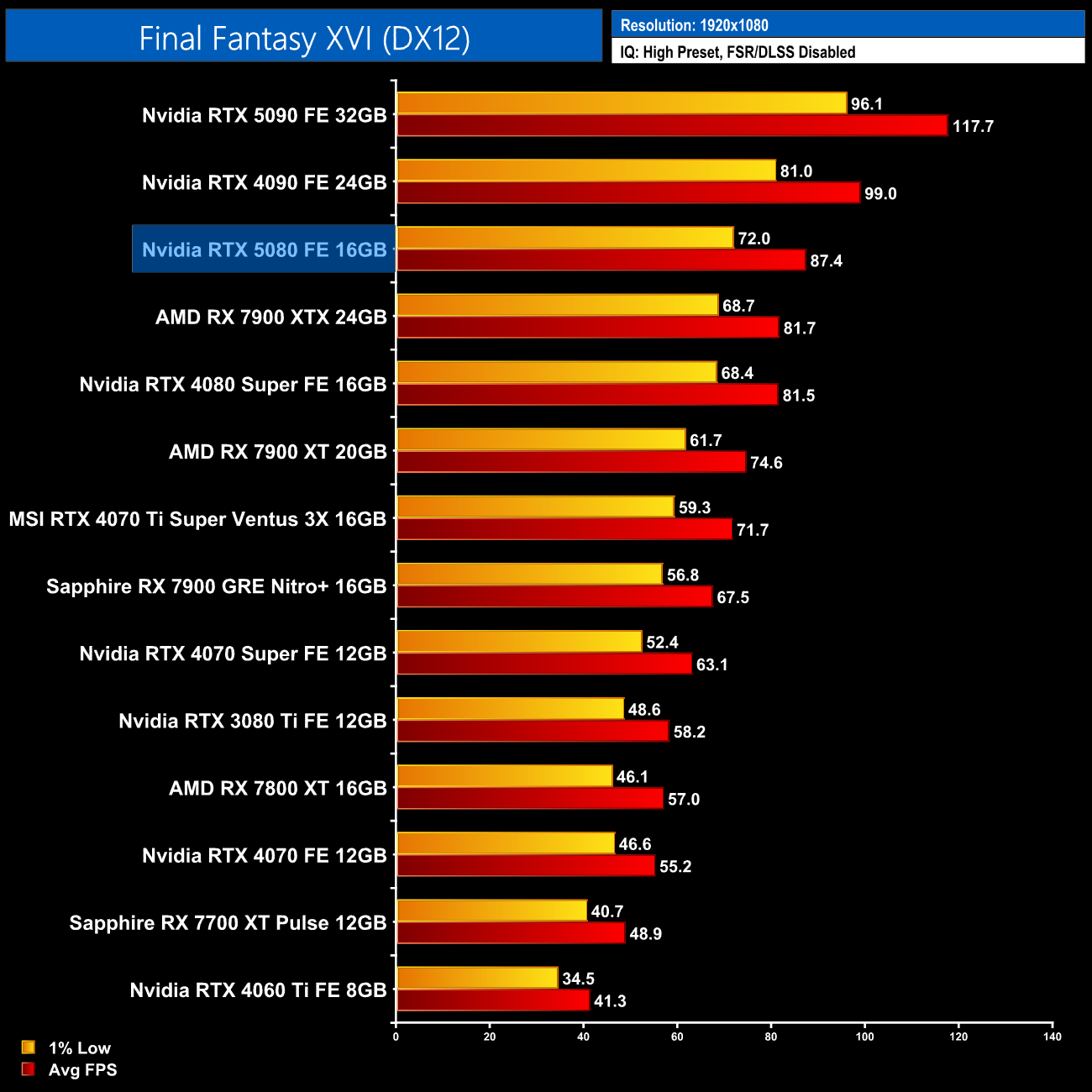
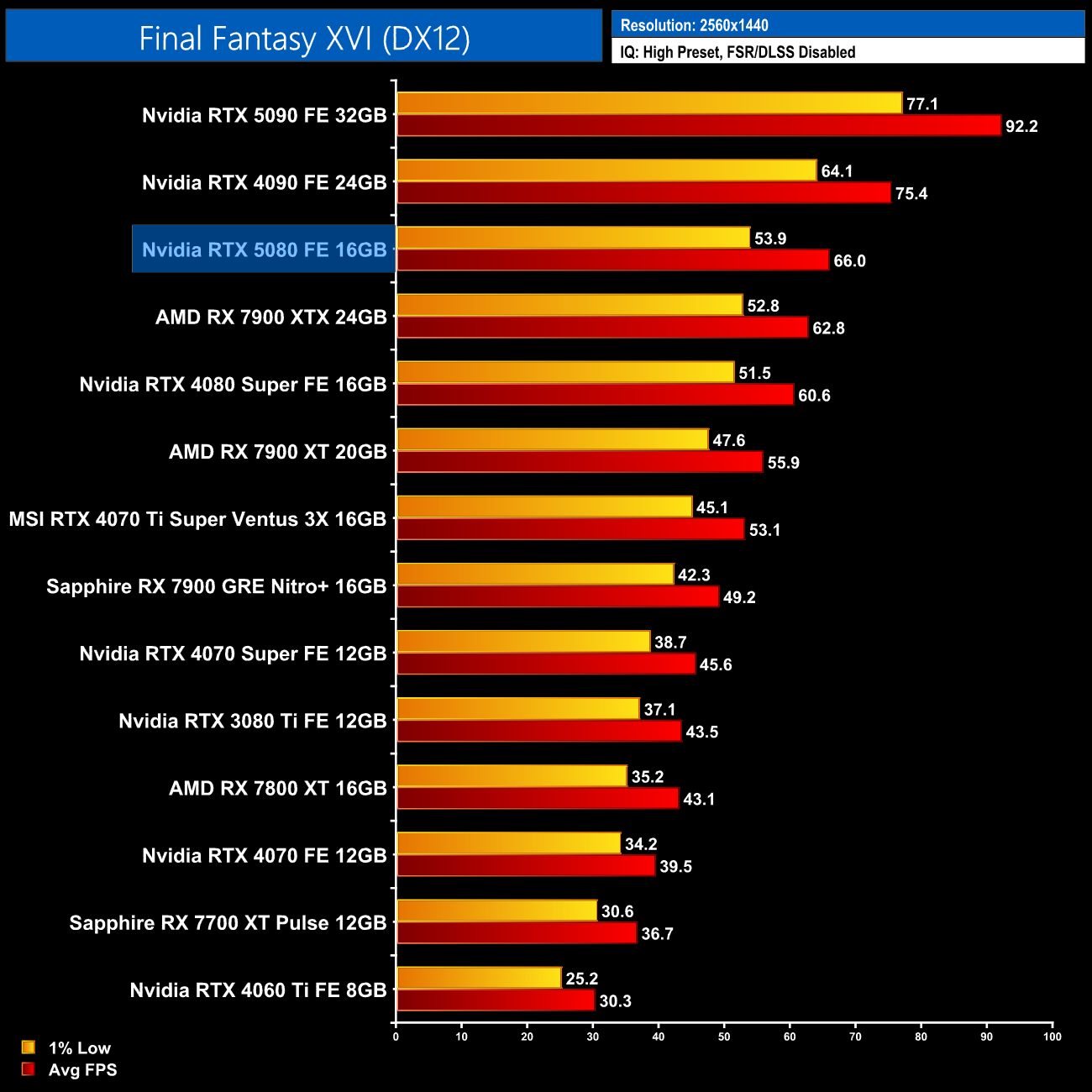
Next is Final Fantasy XVI, another very intense game, resulting in an average frame rate of just 66fps for the 5080 at 1440p. That gives it just a 5% lead over the 7900 XTX, while it's 9% faster than the 4080 Super.
At 4K, the 5080 now holds a 12% advantage over its predecessor, the 4080 Super, but it's only 7% faster than AMD's current consumer flagship. It's also 33% slower than the 5090.
Forza Horizon 5 is a 2021 racing video game developed by Playground Games and published by Xbox Game Studios. The twelfth main instalment of the Forza series, the game is set in a fictionalised representation of Mexico. It was released on 9 November 2021 for Microsoft Windows, Xbox One, and Xbox Series X/S. (Wikipedia).
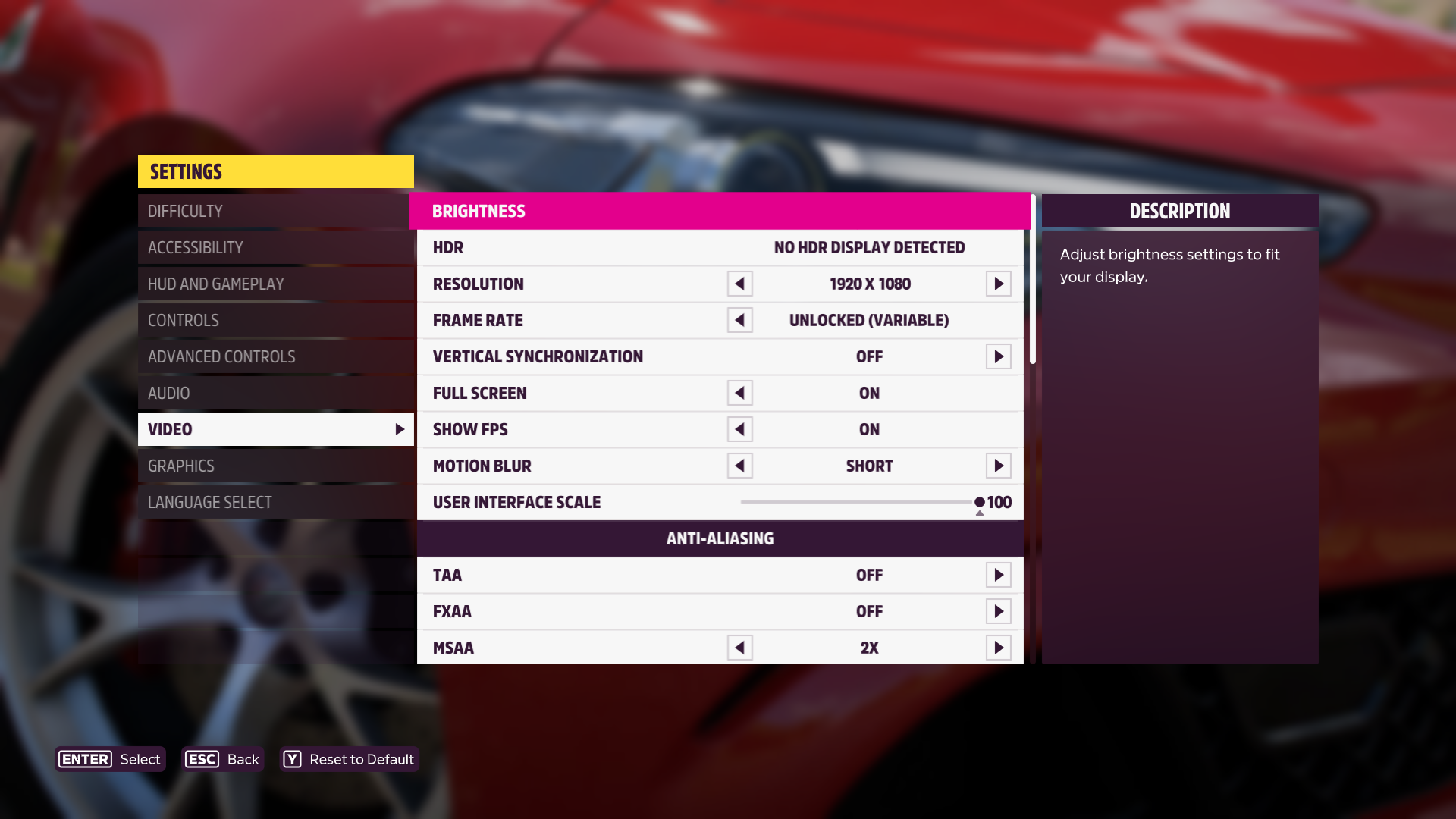
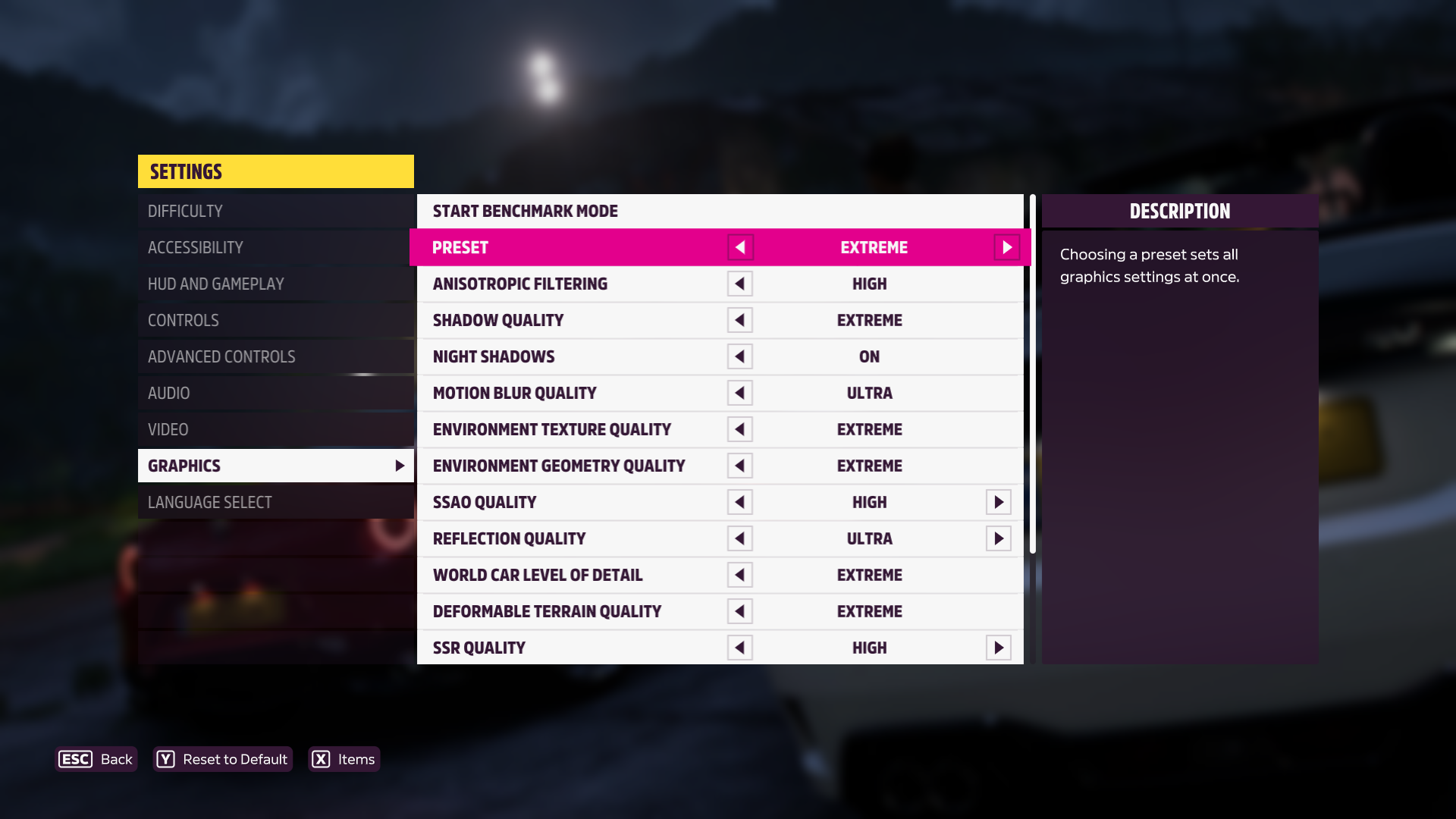
Engine: ForzaTech. We test using the Extreme preset, DX12 API.
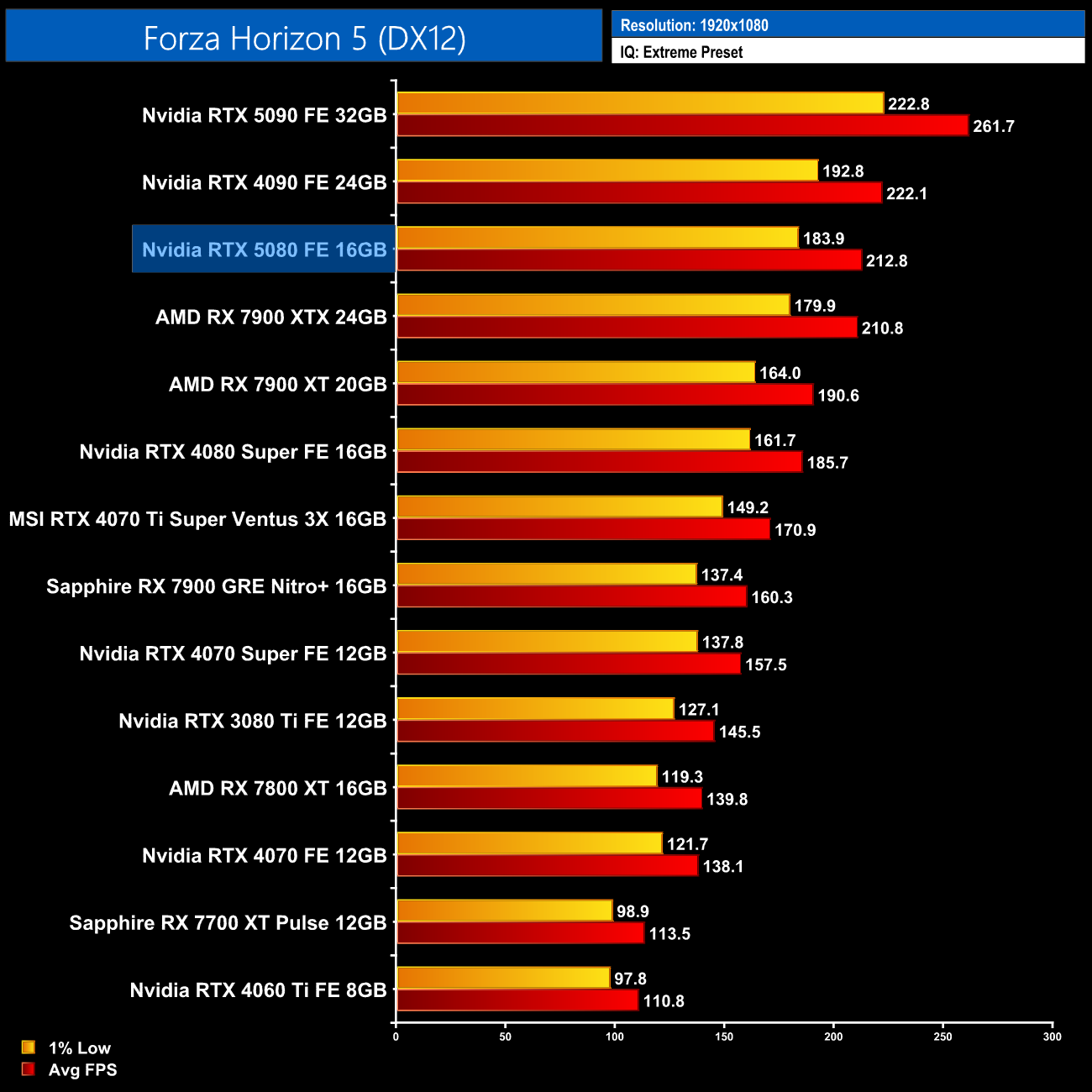
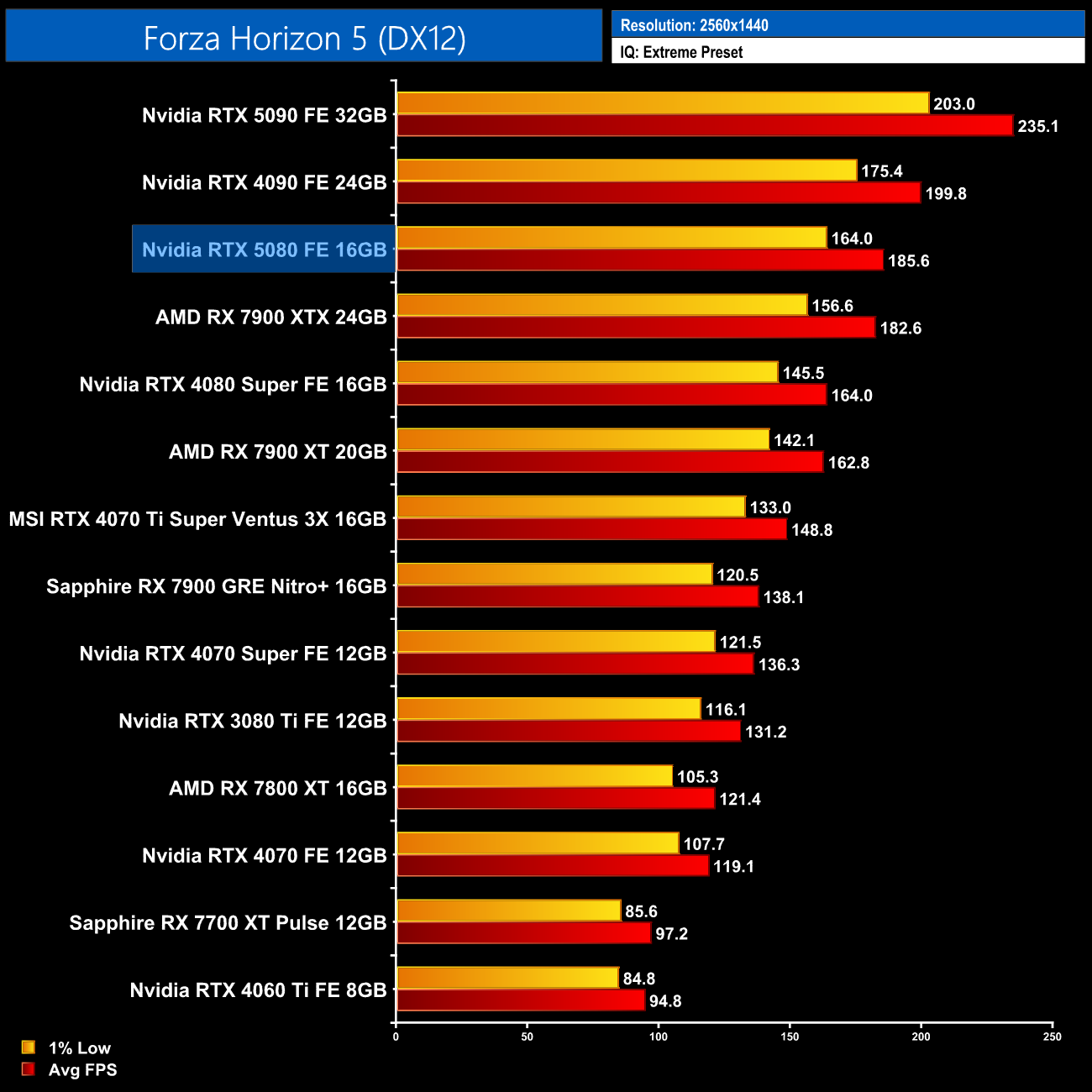
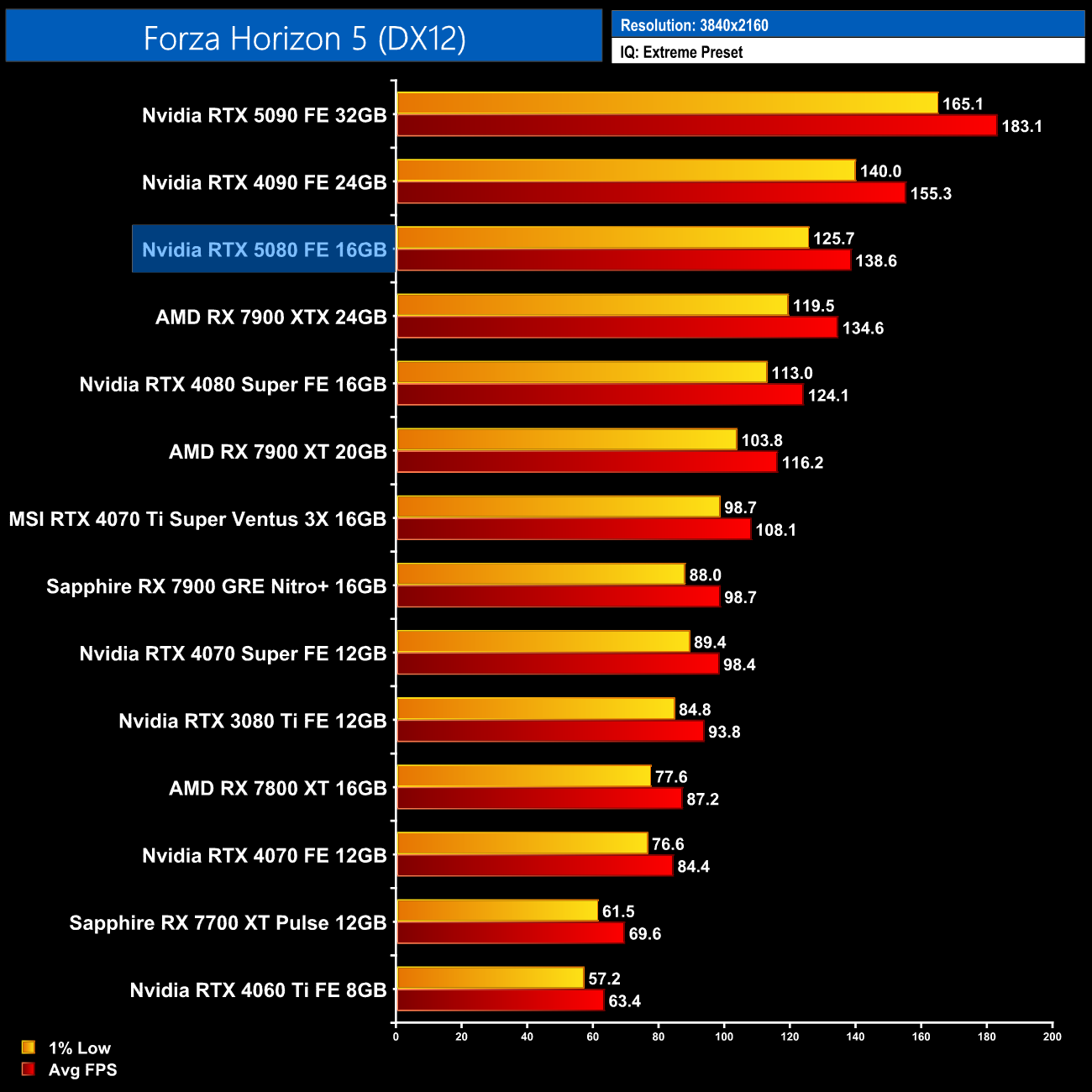
Forza Horizon 5 is a game I love to test as it delivers very high frame rates even at maximum image quality – as we can see at 1440p, with the 5080 averaging 186fps. It is, however, only level with the 7900 XTX – a great result for the AMD GPU, but perhaps a disappointing one if you're Nvidia.
Up at 4K, the margins don't really change, with the 7900 XTX and 5080 still neck-and-neck. Versus the 4080 Super, we're looking at a 12% gain for the new Blackwell GPU.
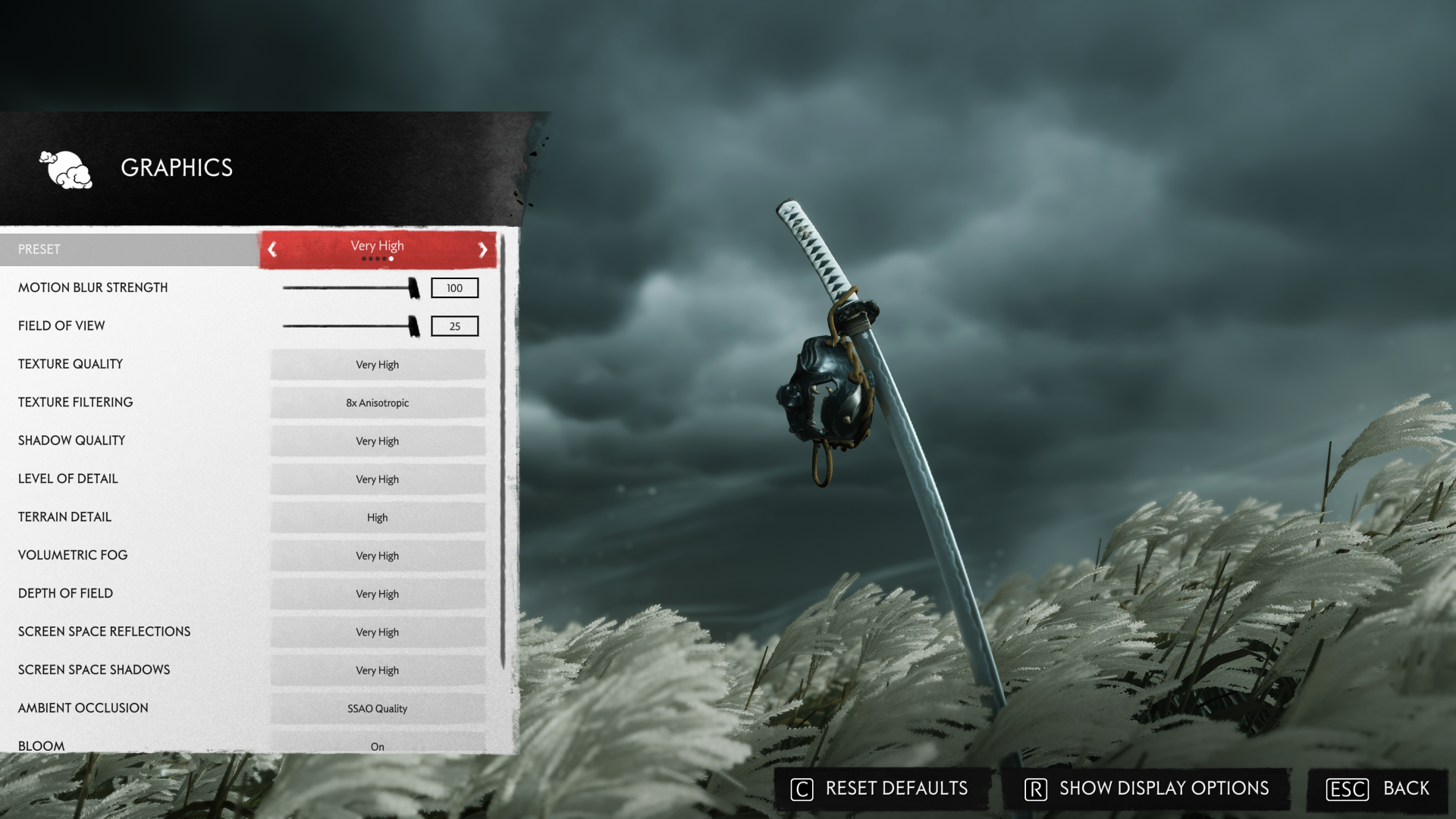
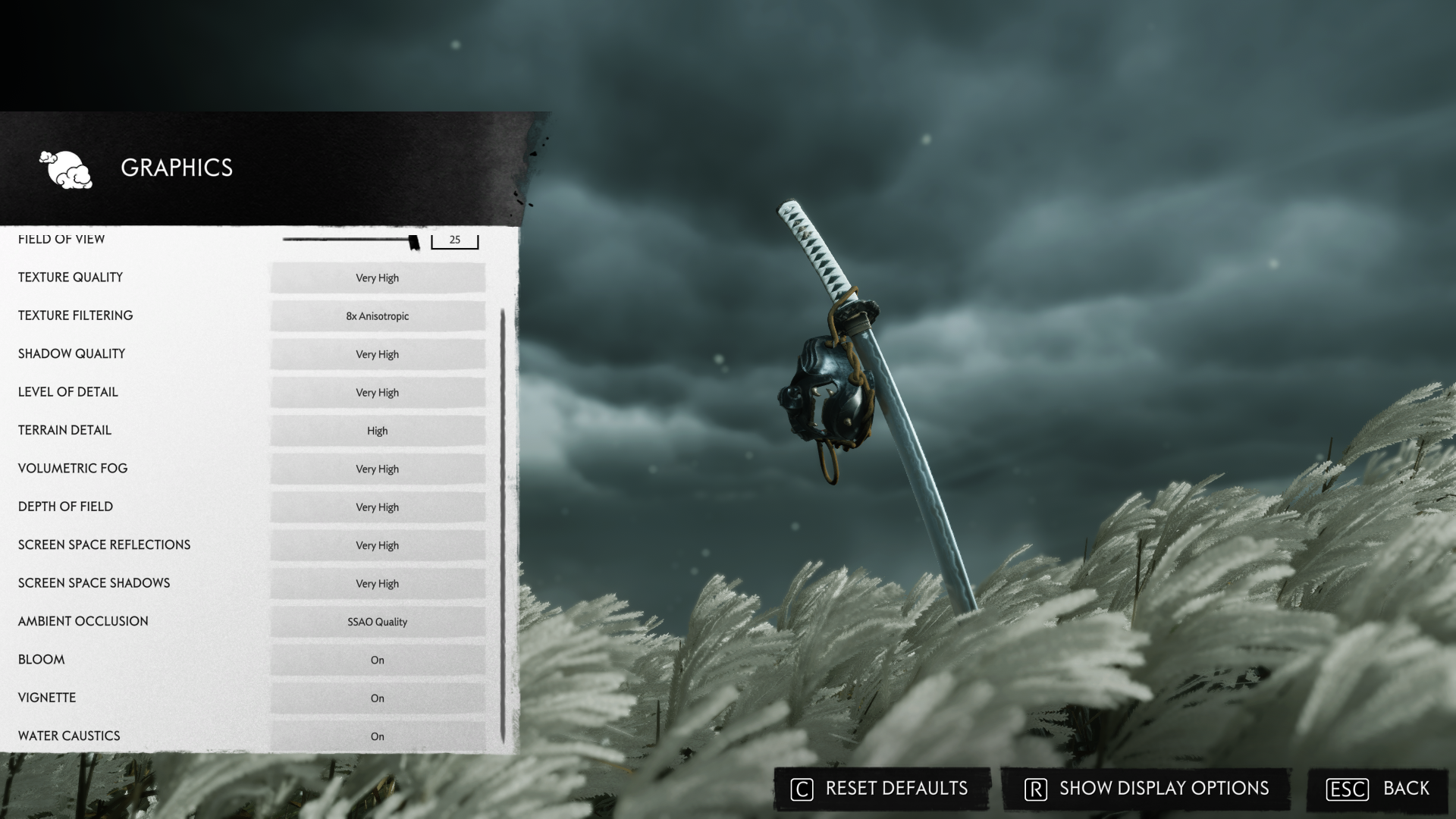
Ghost of Tsushima is a 2020 action-adventure game developed by Sucker Punch Productions and published by Sony Interactive Entertainment. The player controls Jin Sakai, a samurai on a quest to protect Tsushima Island during the first Mongol invasion of Japan.Ghost of Tsushima was released for the PlayStation 4 in July 2020, and an expanded version for PlayStation 4 and PlayStation 5, subtitled Director's Cut and featuring the Iki Island expansion, was released in August 2021. A Windows version of Director's Cut, developed by Nixxes Software, was released in May 2024. (Wikipedia).
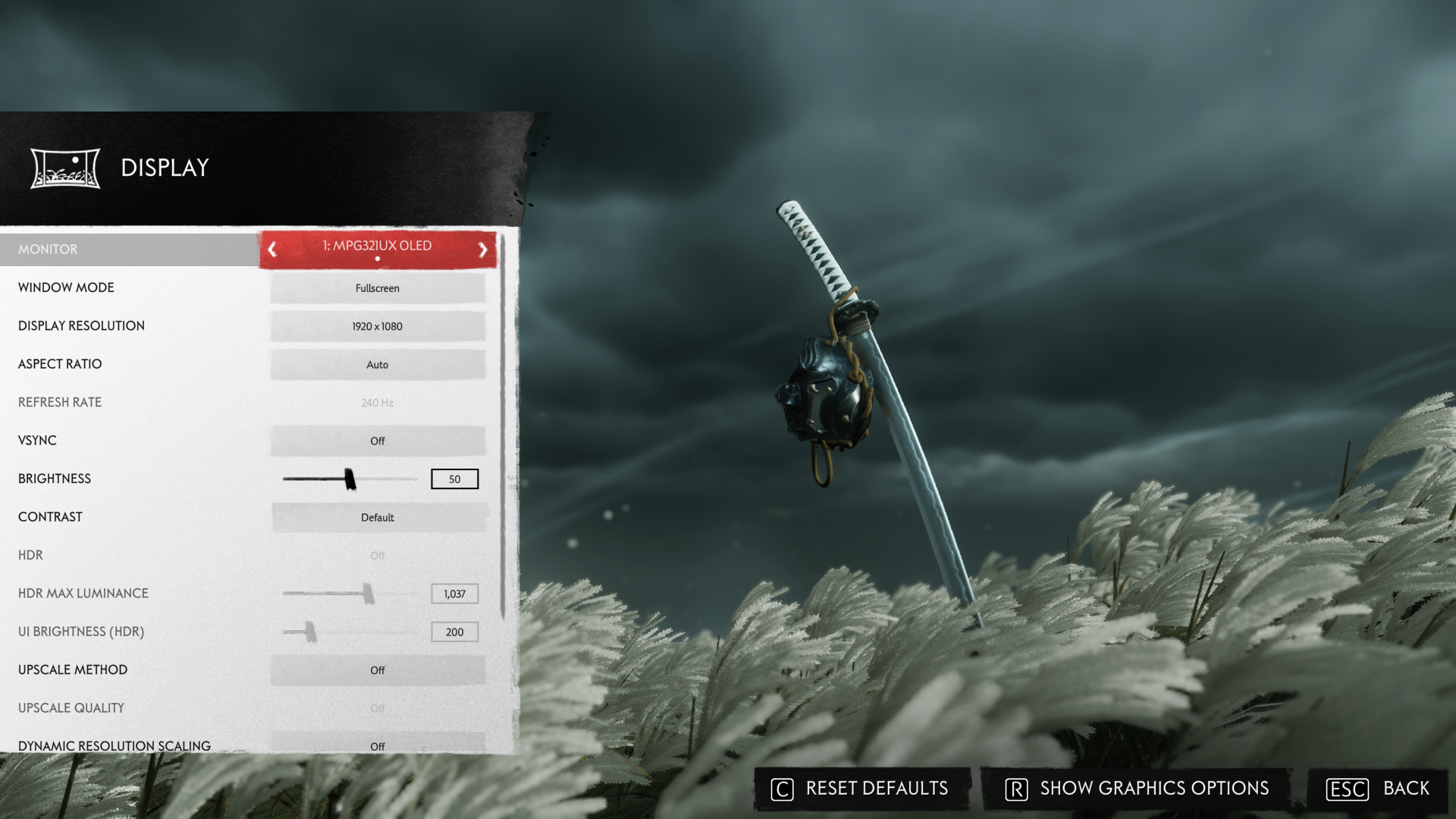
Engine: Sucker Punch in-house engine. We test using the Very High preset, DX12 API.
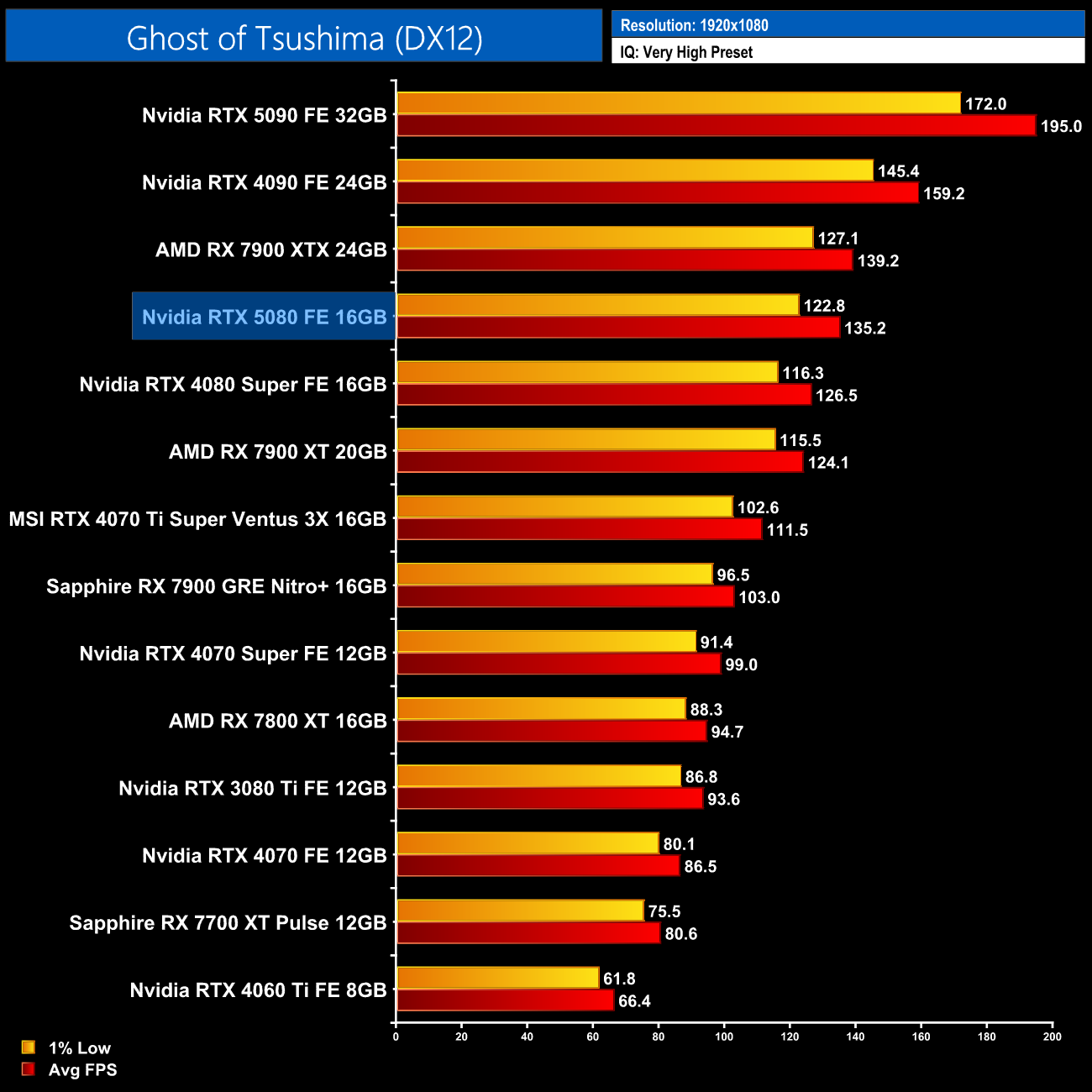
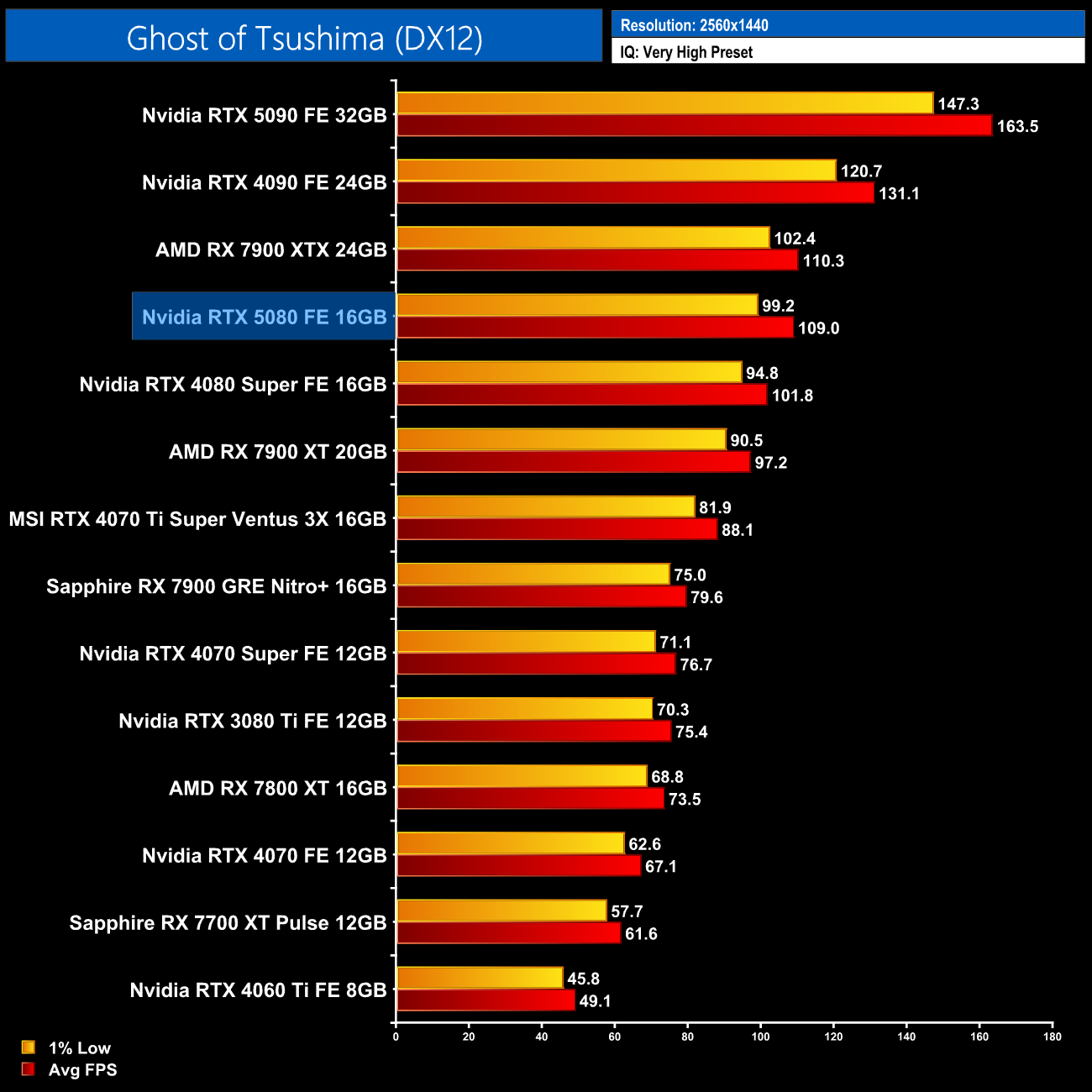
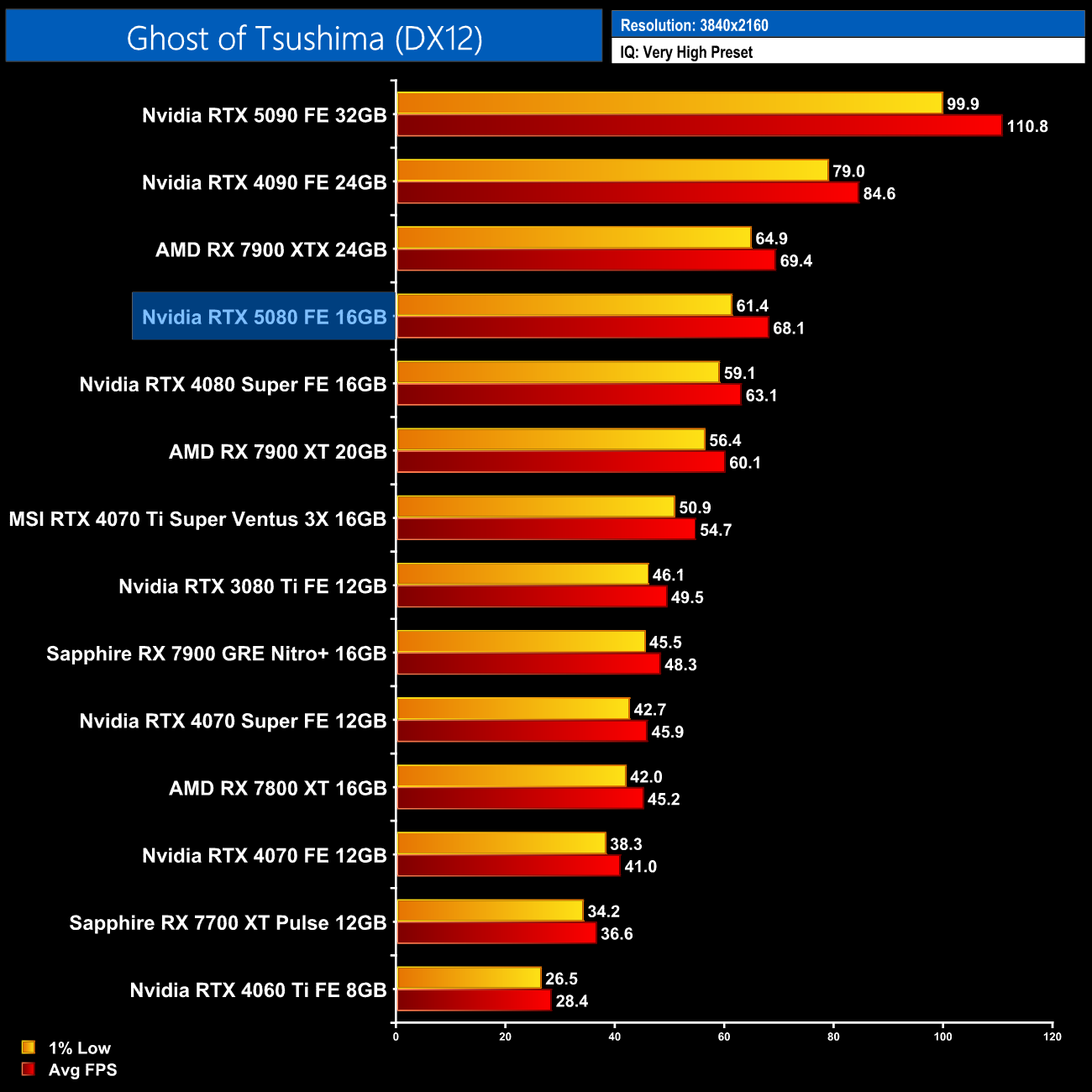
Ghost of Tsushima is another well optimised title, but one that does scale very well on AMD GPUs – the 7900 XTX is again on par with the RTX 5080, despite launching over two years ago at a similar price.
At 4K, that picture doesn't really change. We can also see the 5080 coming in just 7% faster than the 4080 Super, a fairly unimpressive gain it has to be said.
Horizon Forbidden West is a 2022 action role-playing game developed by Guerrilla Games and published by Sony Interactive Entertainment. The sequel to Horizon Zero Dawn (2017), the game is set in a post-apocalyptic version of the Western United States, recovering from the aftermath of an extinction event caused by a rogue robot swarm. The game and the Burning Shores expansion were collected together, re-released as Horizon Forbidden West Complete Edition for PlayStation 5 in October 2023, and ported to Windows by Nixxes Software in March 2024. A sequel is in development. (Wikipedia).
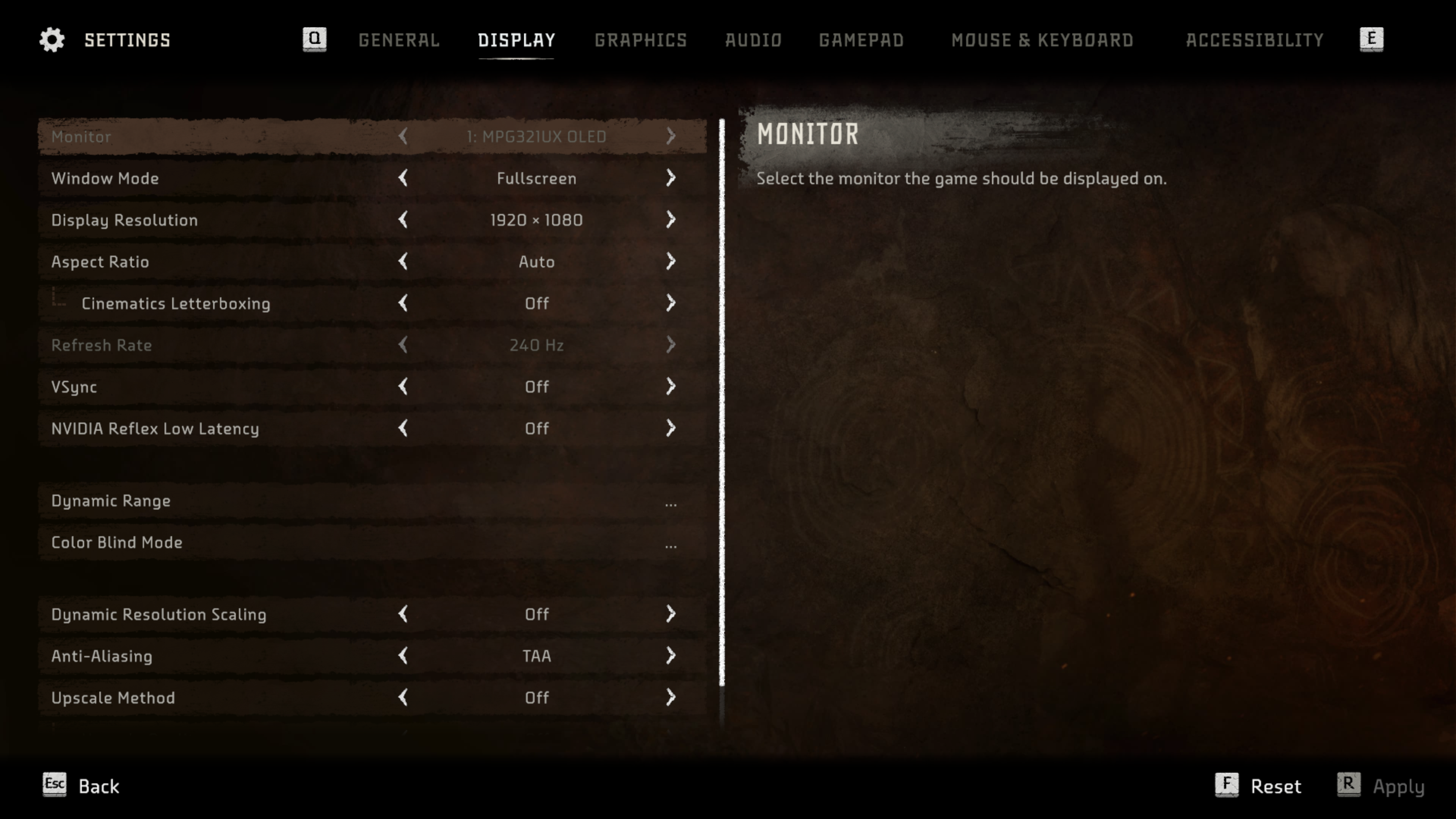
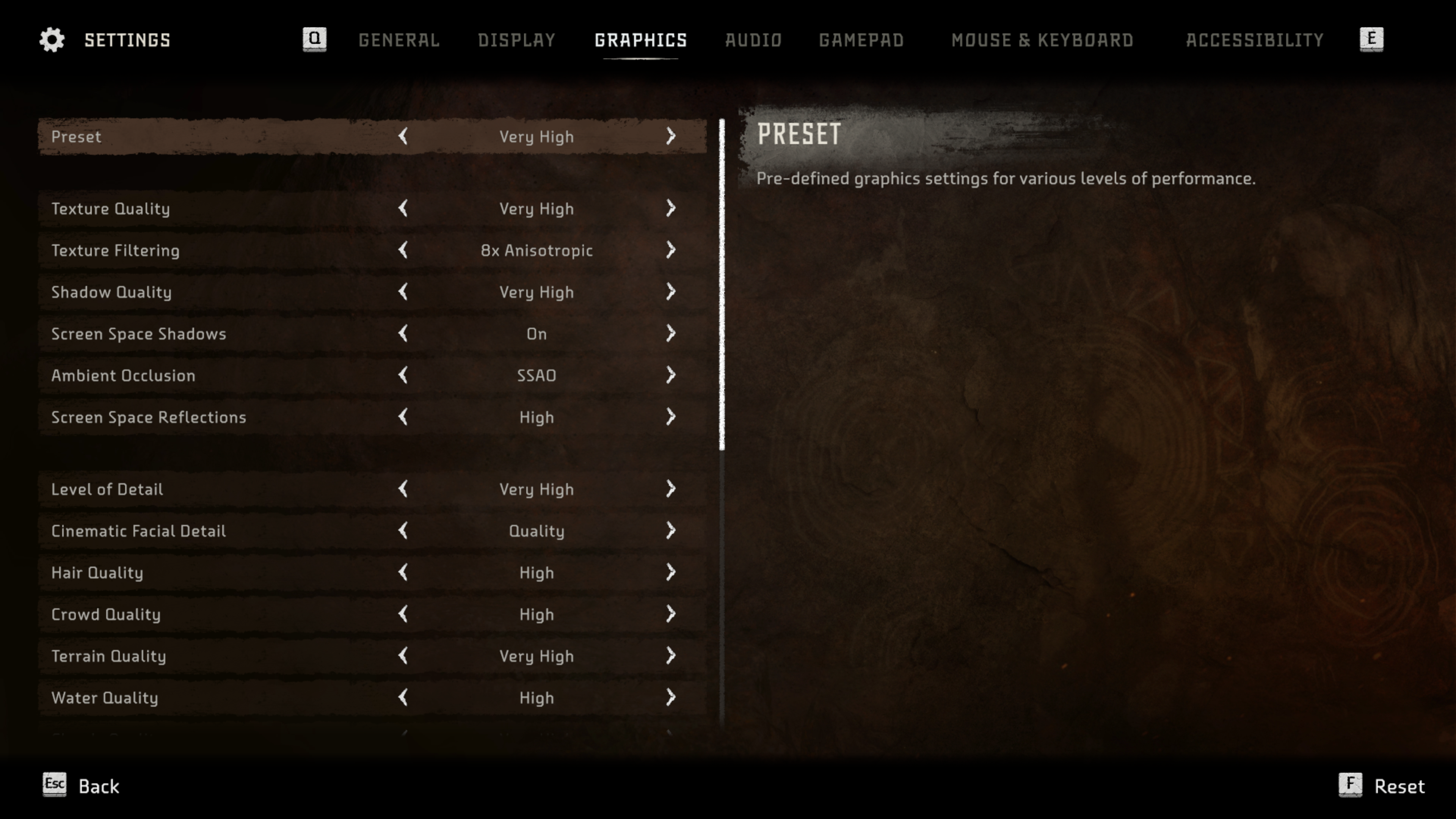
Engine: Decima. We test using the Very High preset, DX12 API.
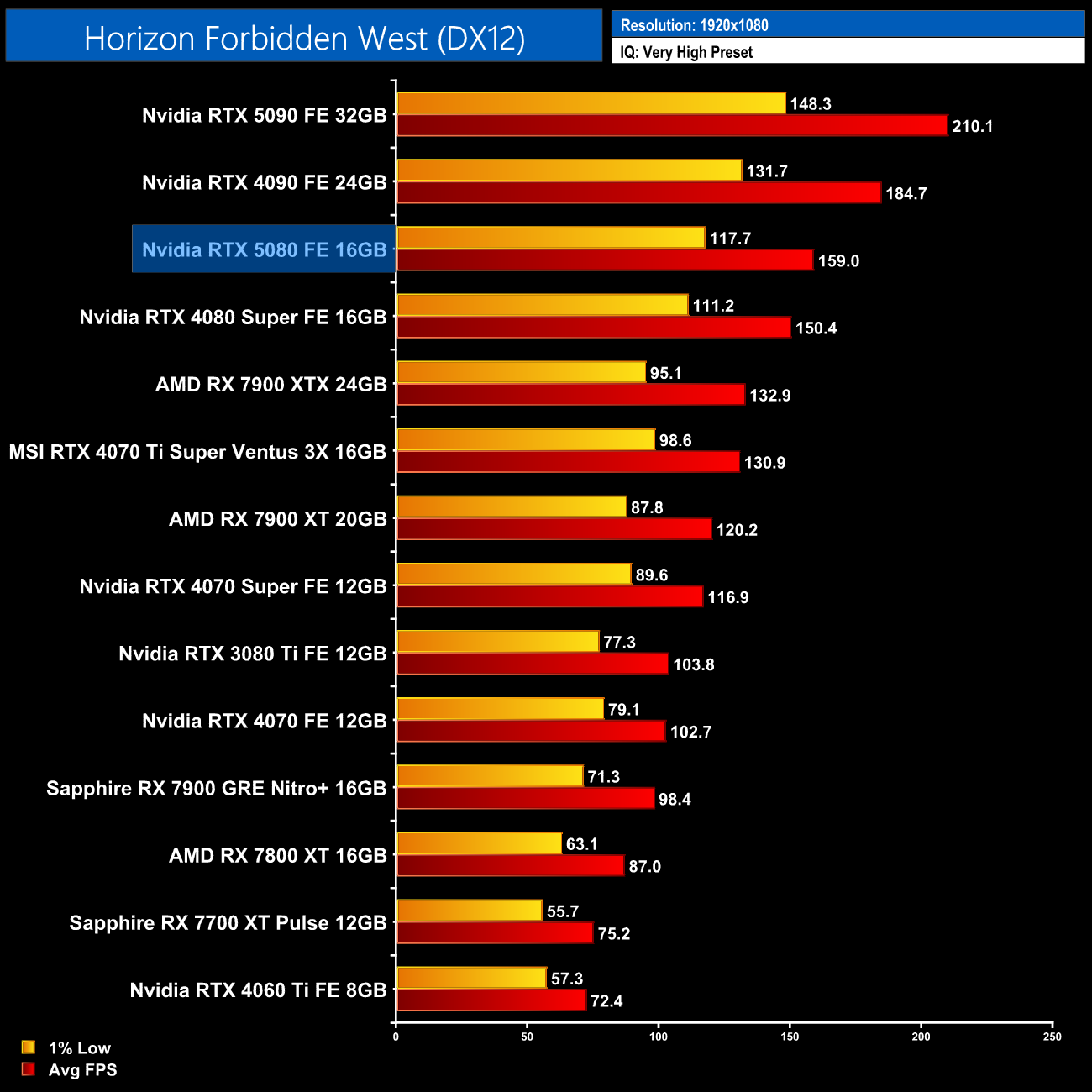
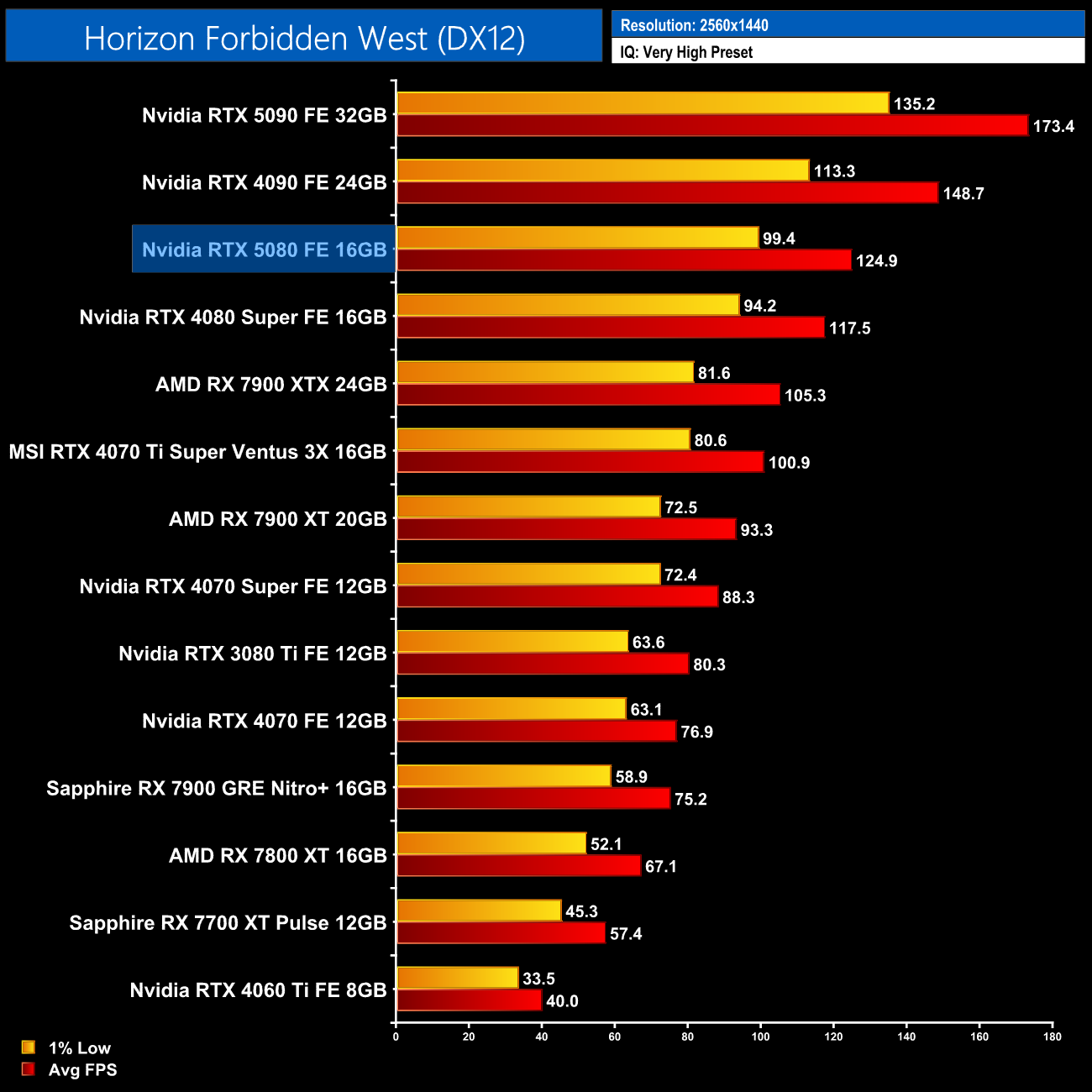
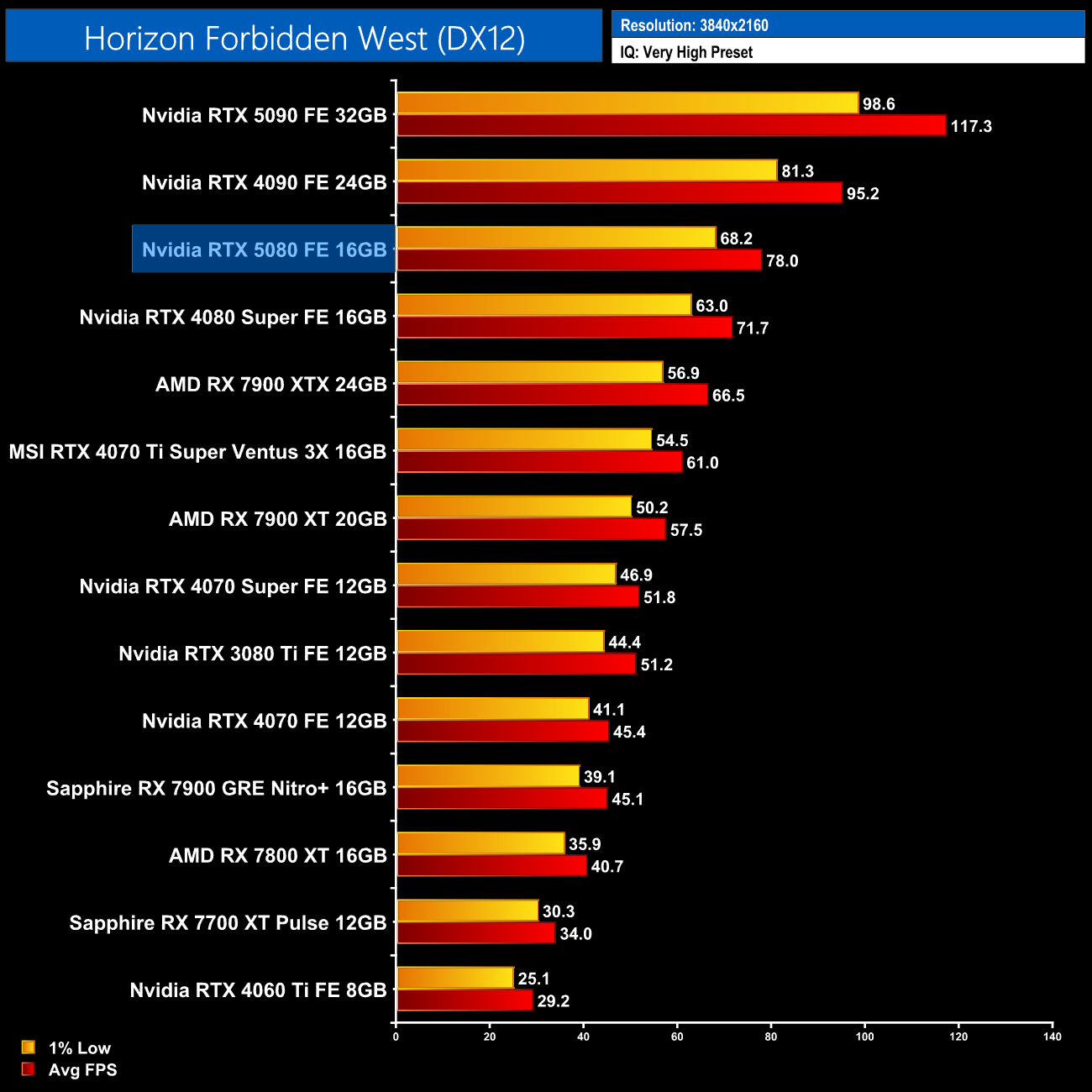
Horizon Forbidden West is another title where the RTX 50 series doesn't particularly impress versus the 4080 series – the 5080, for instance, is barely 6% faster than the 4080 Super at 1440p, while it's 16% slower than the 4090 here.
Even at 4K the gains over the 4080 Super are just 9%, and that means the 5080 is 34% slower than the 50 series flagship, the RTX 5090.
The Last of Us Part I is a 2022 action-adventure game developed by Naughty Dog and published by Sony Interactive Entertainment. A remake of the 2013 game The Last of Us, it features revised gameplay, including enhanced combat and exploration, and expanded accessibility options. It was released for Microsoft Windows in March 2023. (Wikipedia).
Engine: Naughty Dog in-house engine. We test using the Ultra preset, DX12 API.
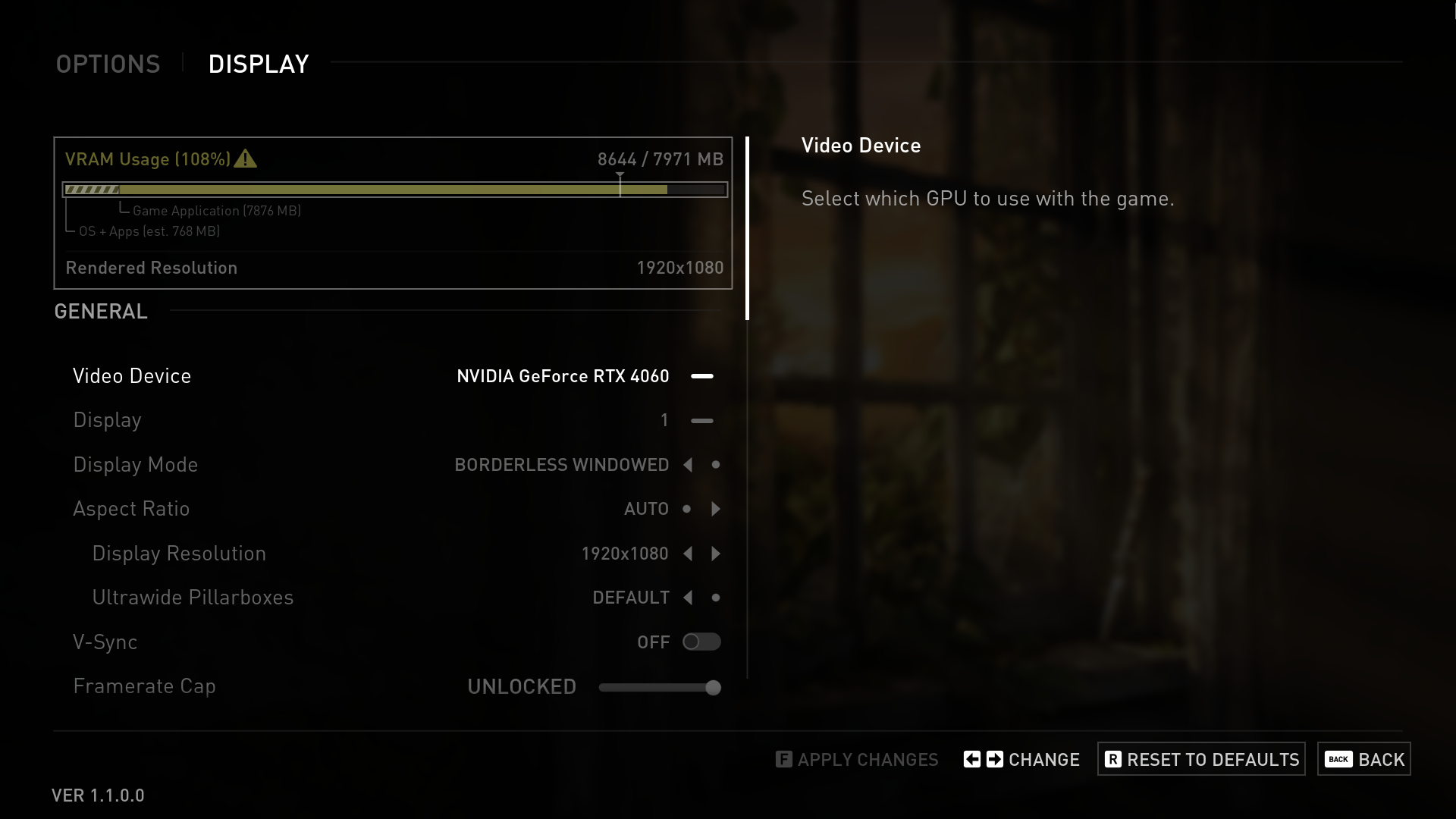
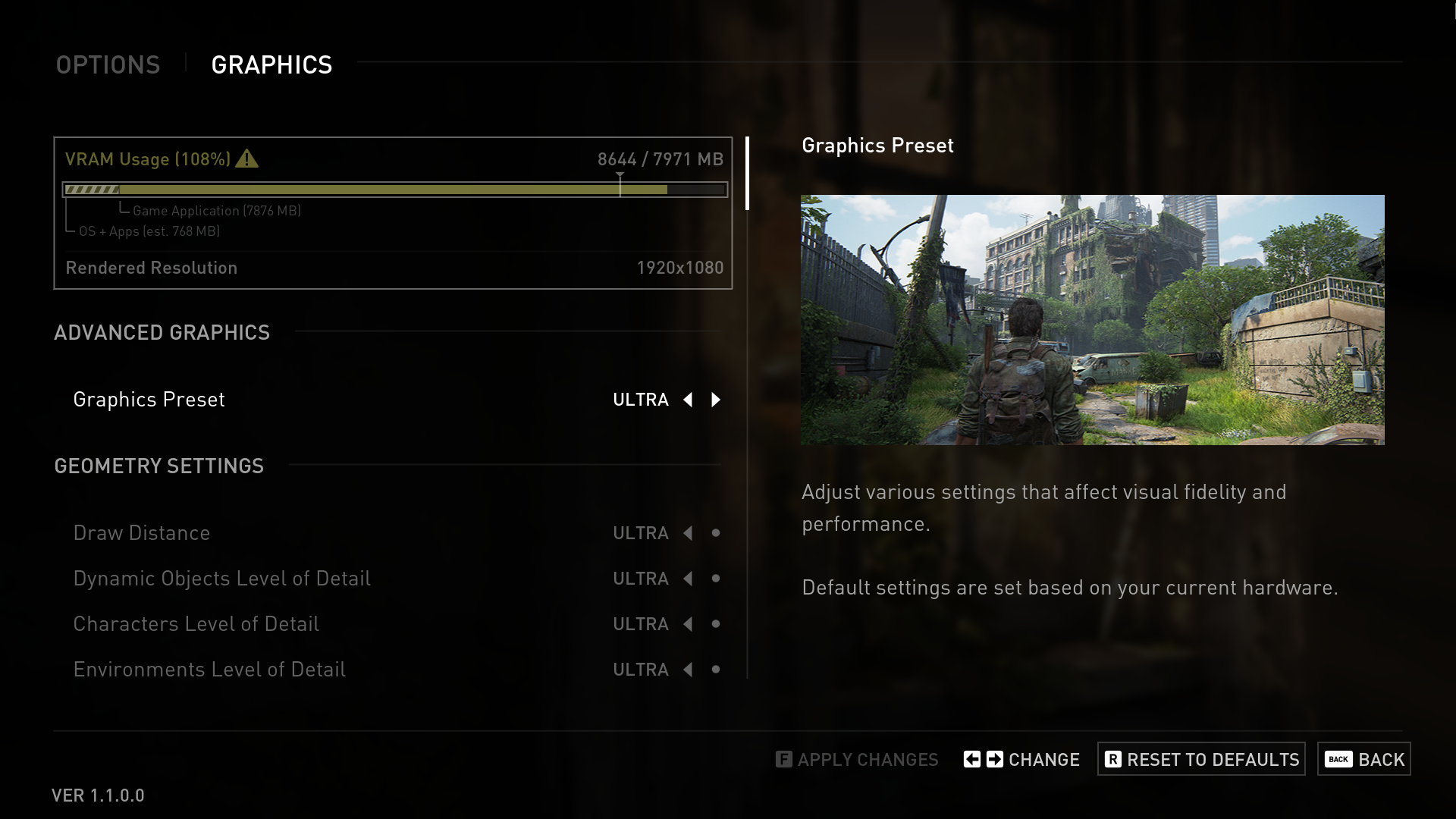
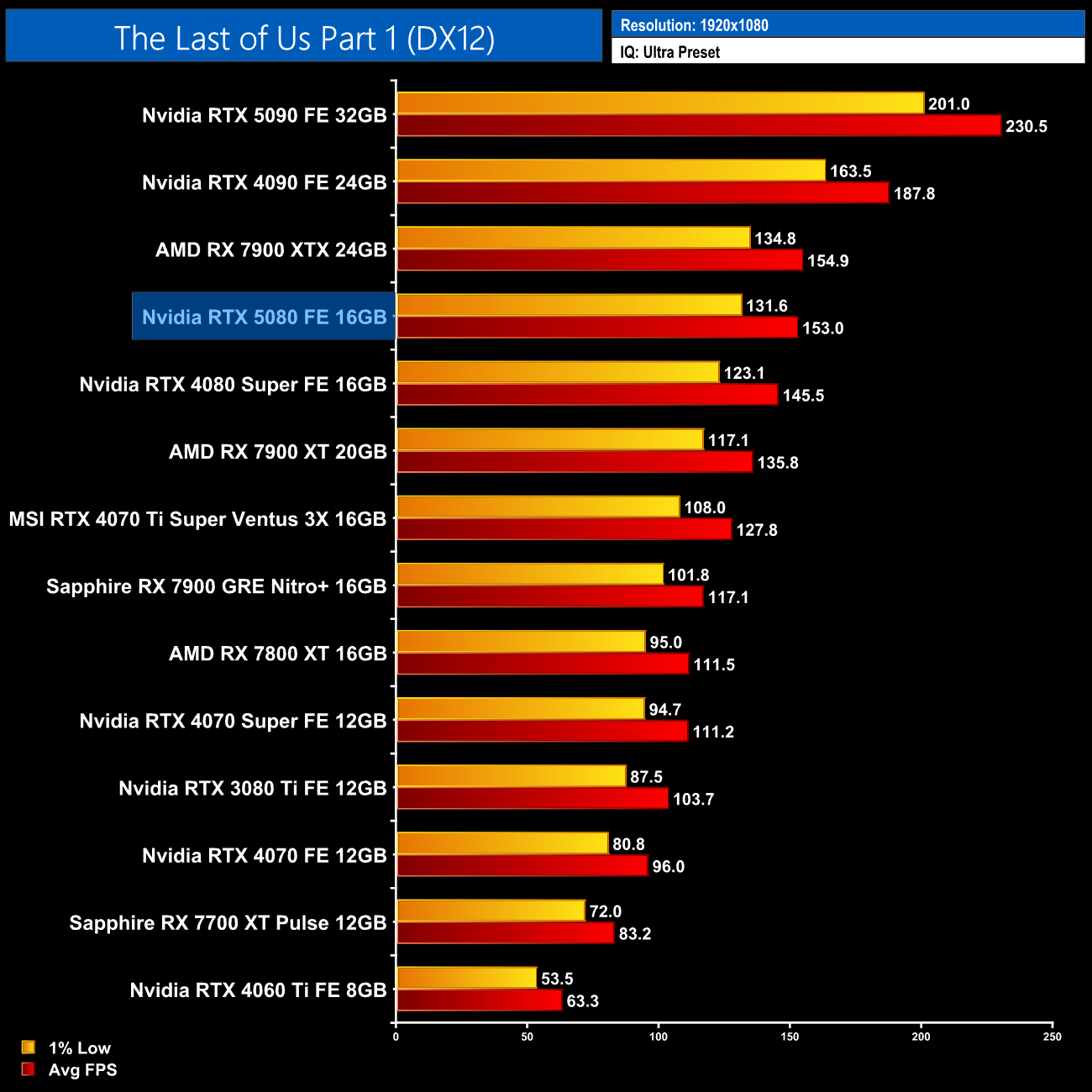
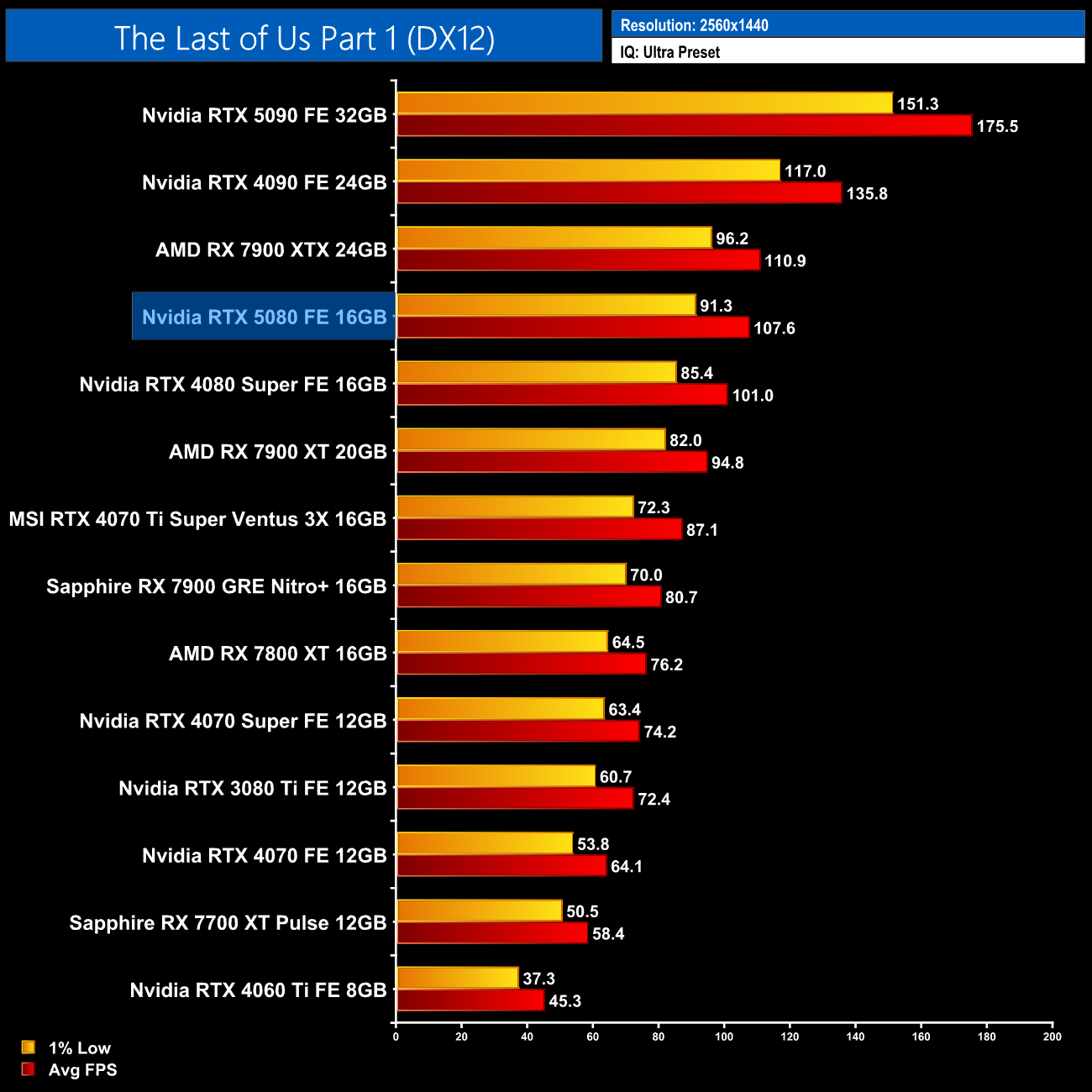
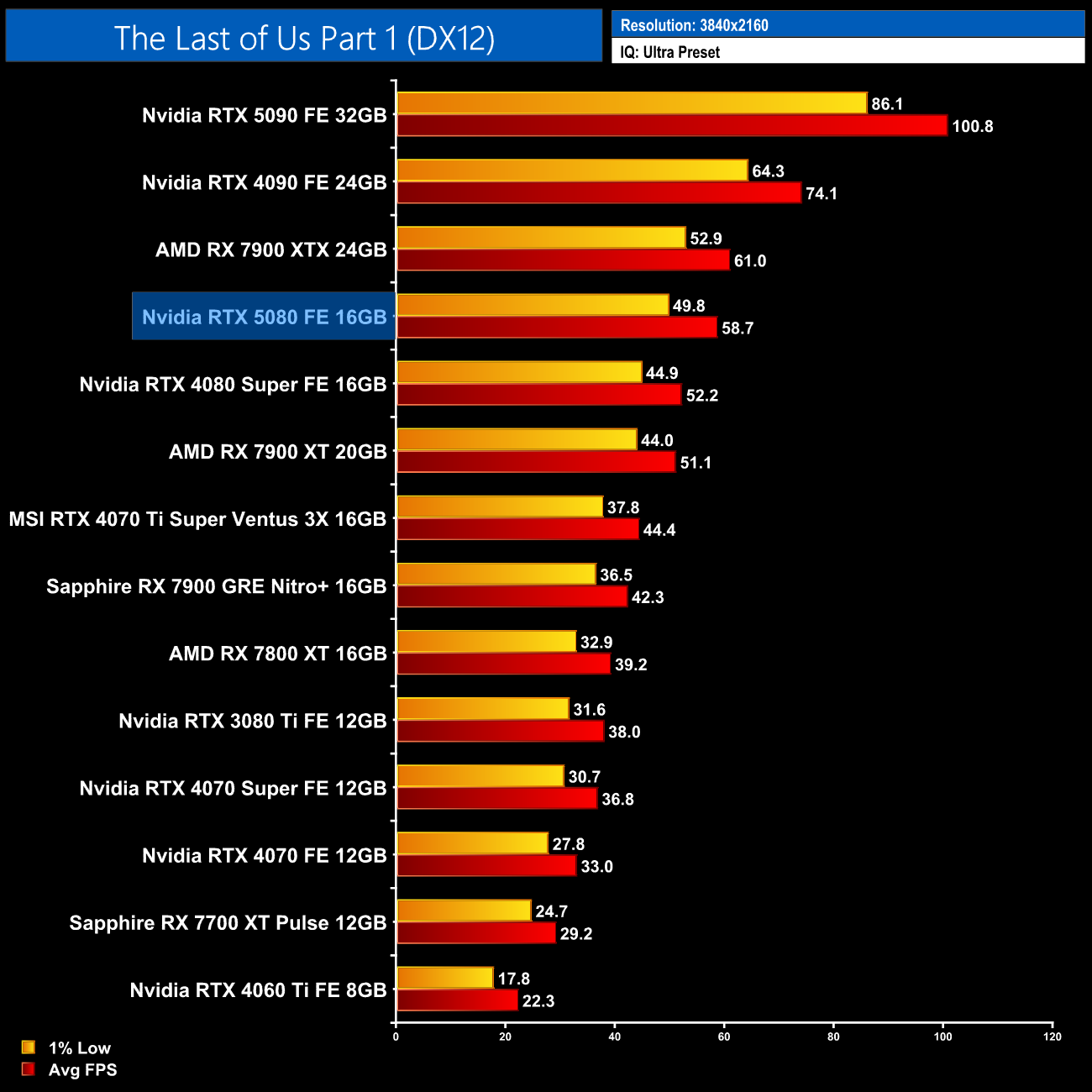
Moving onto The Last of Us Part 1, this is another title where the 5080 is unable to offer any meaningful gains over the RX 7900 XTX, in fact it is 3% slower at 1440p, and that makes it just 7% faster than the 4080 Super.
Thankfully, things do look better at 4K, where the 5080 is able to hit 59fps on average, and that works out as a 13% lead over the 4080 Super, but it's still just behind the 7900 XTX and comes in 21% slower than the 4090.
A Plague Tale: Requiem is an action-adventure stealth game developed by Asobo Studio and published by Focus Entertainment. It is the sequel to A Plague Tale: Innocence (2019), and follows siblings Amicia and Hugo de Rune who must look for a cure to Hugo's blood disease in Southern France while fleeing from soldiers of the Inquisition and hordes of rats that are spreading the black plague. The game was released for Nintendo Switch, PlayStation 5, Windows, and Xbox Series X/S on 18 October 2022. (Wikipedia).
Engine: Asobo Studio in-house engine. We test using the Ultra preset, DX12 API.
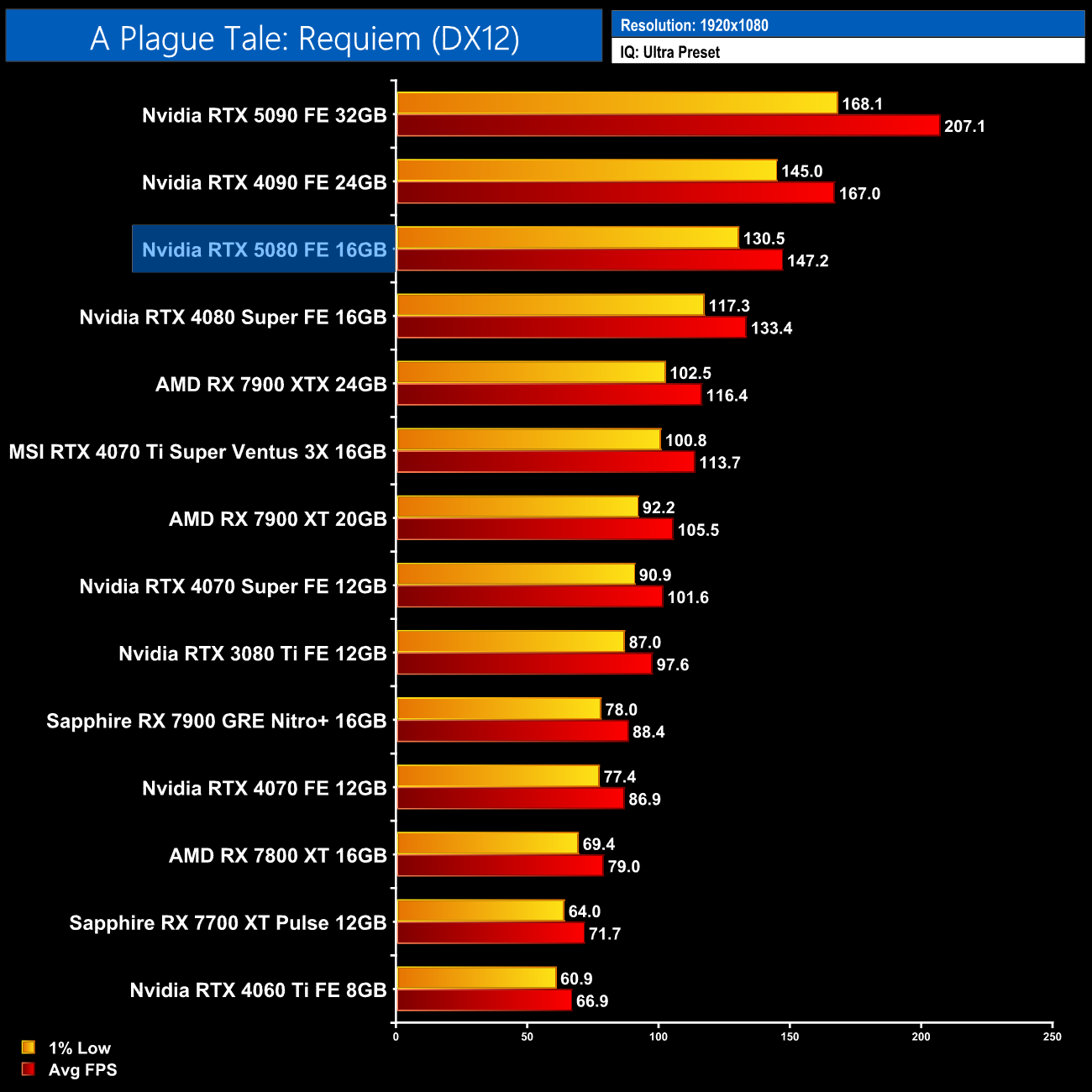
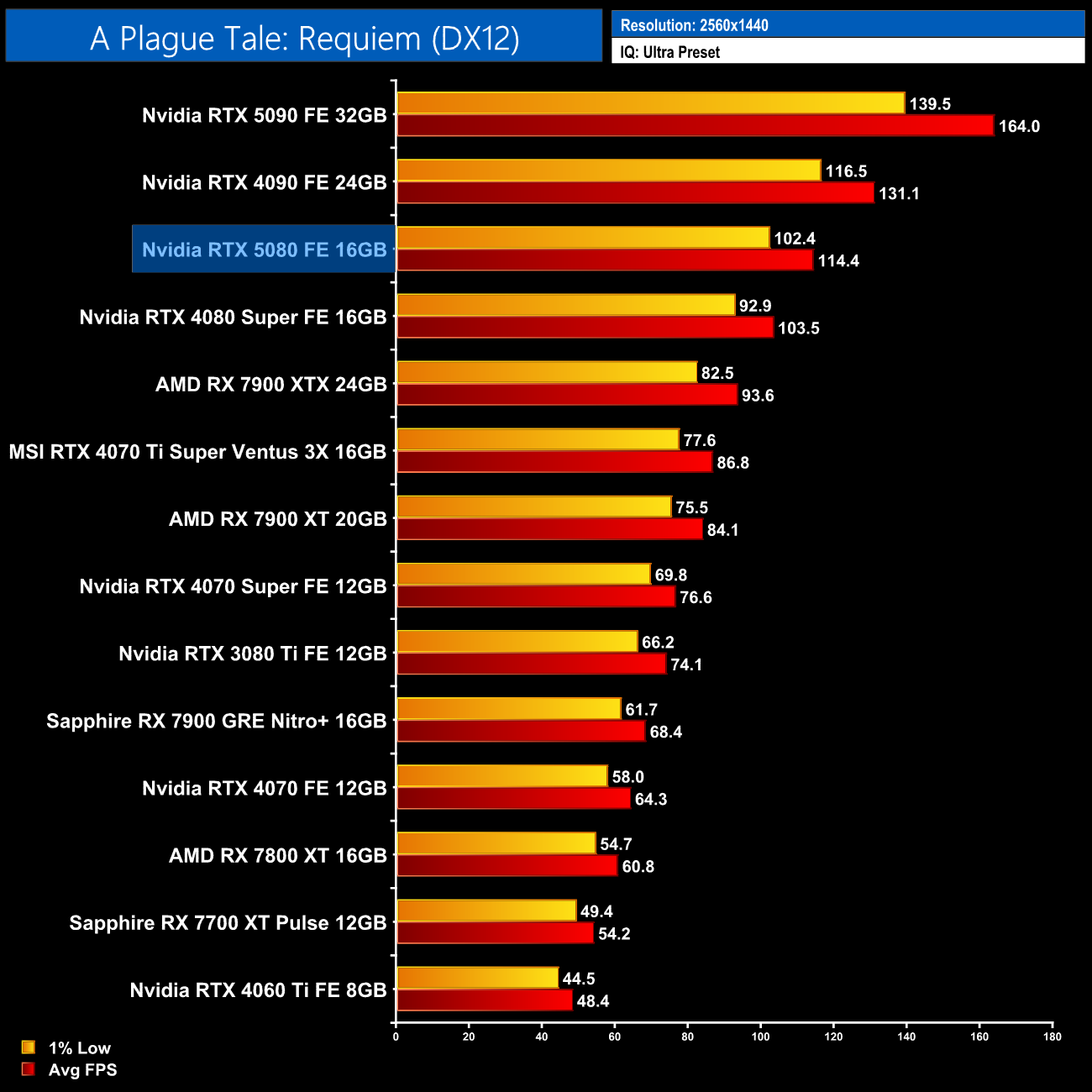
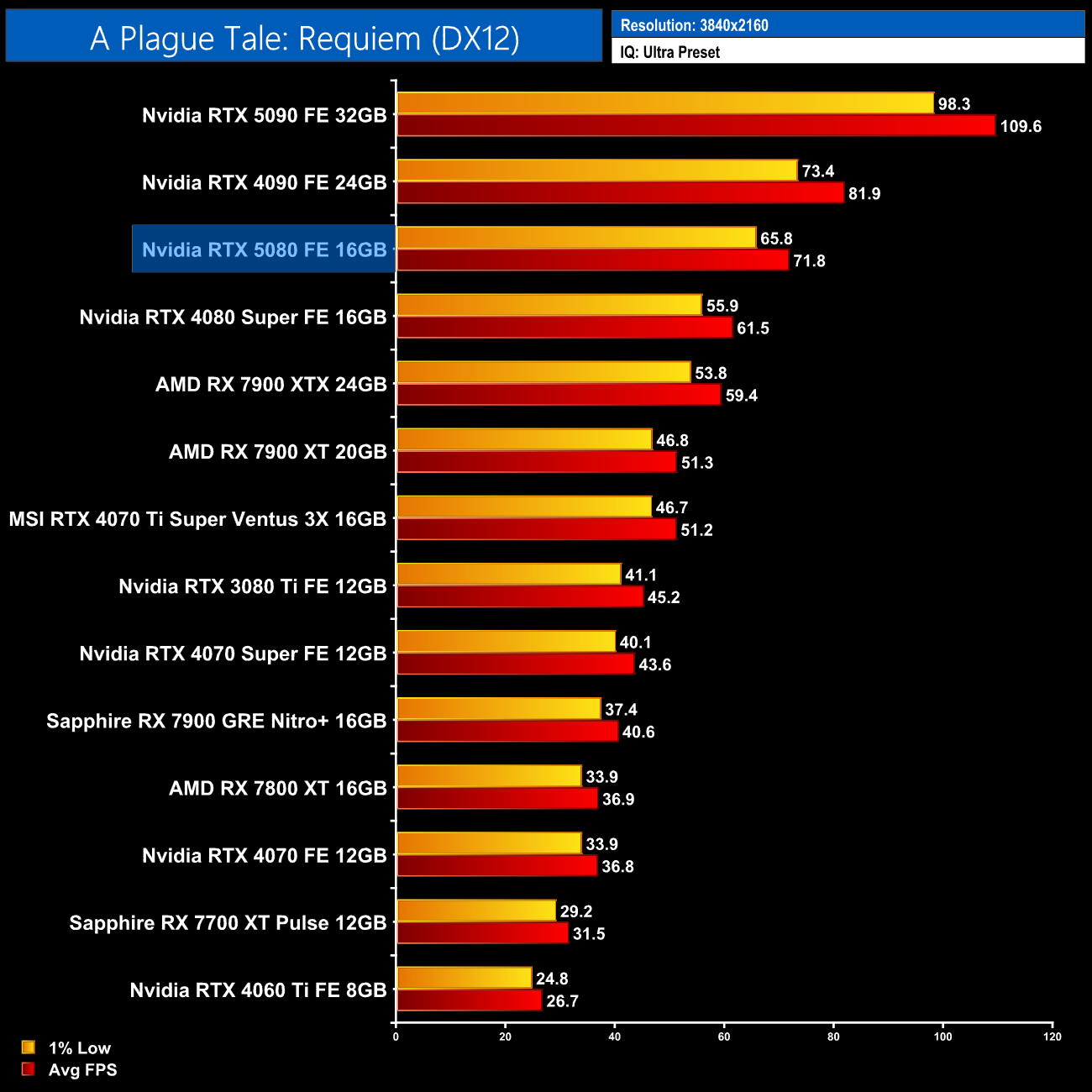
A Plague Tale: Requiem restores some semblance of expected behaviour, with the 5080 hitting 114fps at 1440p, and that makes it 11% faster than the 4080 Super and 13% slower than the 4090.
Up at 4K it increases its lead over the 4080 Super to 17%, which is a bit more like it, but it's still well behind the 5090, coming in 35% slower.
Senua's Saga: Hellblade II is a 2024 action-adventure game developed by Ninja Theory and published by Xbox Game Studios. The game serves as the sequel to Hellblade: Senua's Sacrifice (2017) and is set in 9th century Iceland, drawing inspiration from Norse mythology and culture. Senua's Saga: Hellblade II was released for Windows and Xbox Series X/S on 21 May 2024.
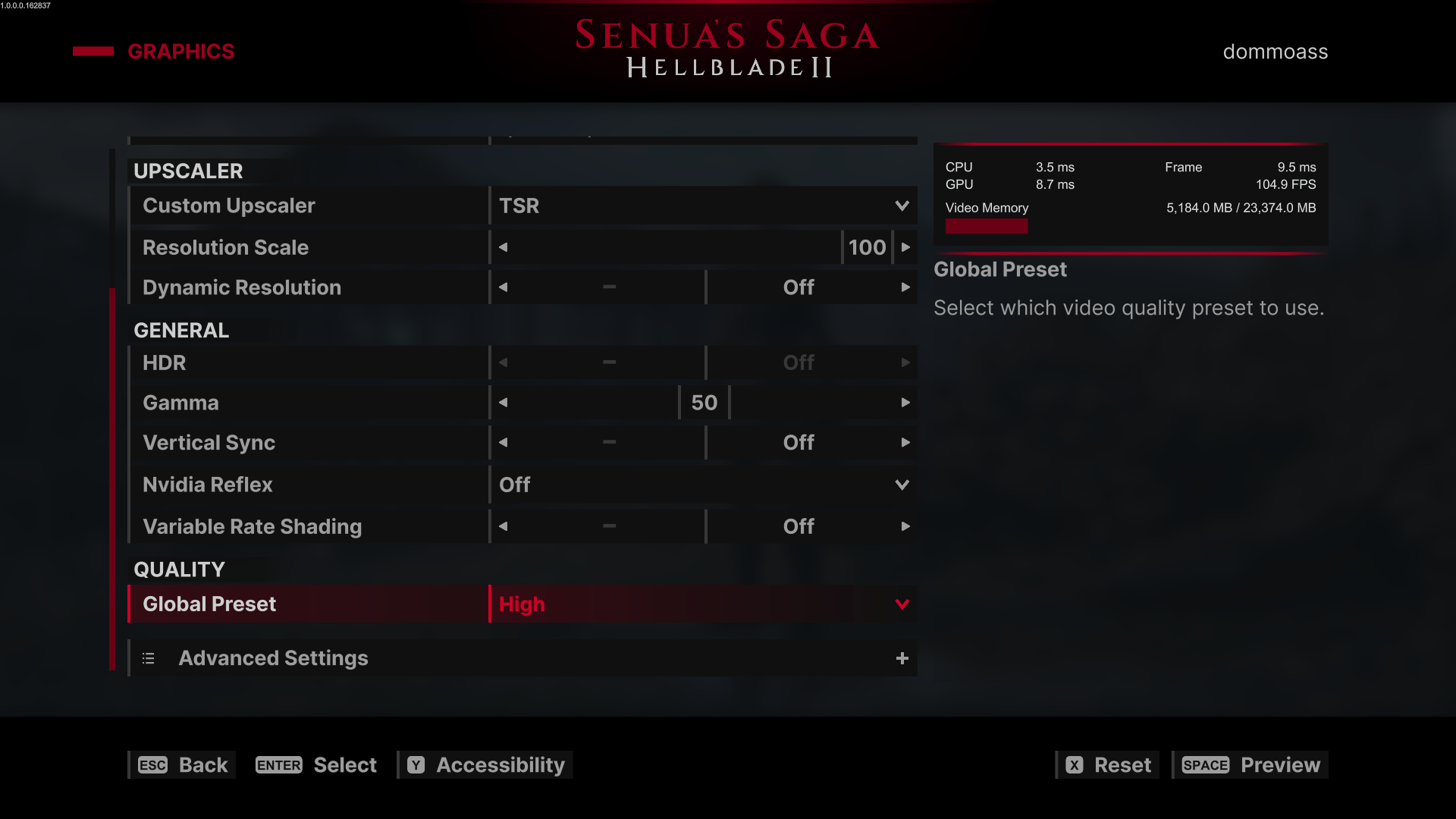
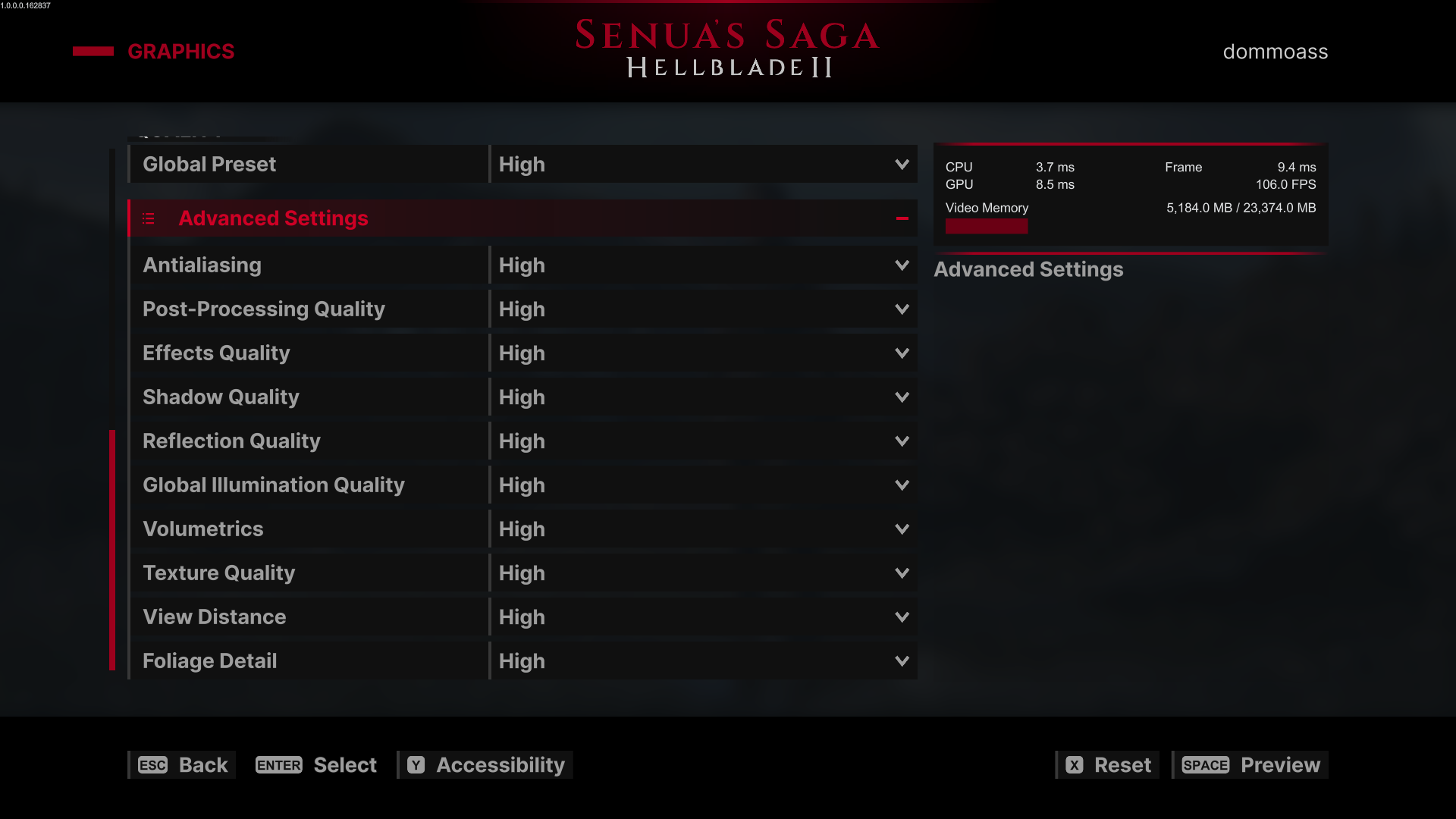
Engine: Unreal Engine 5. We test using the High preset, TSR set to 100% render scale, DX12 API.

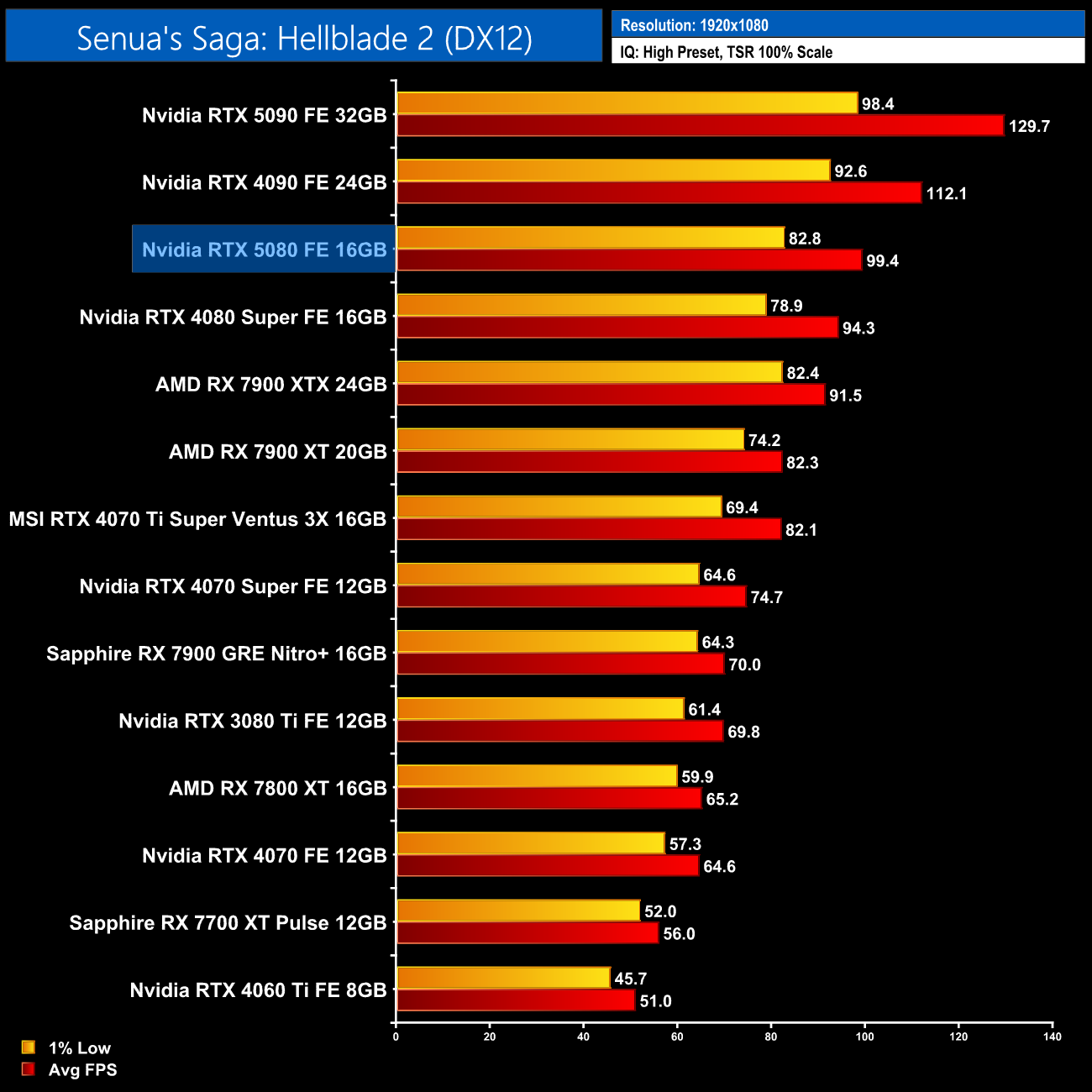
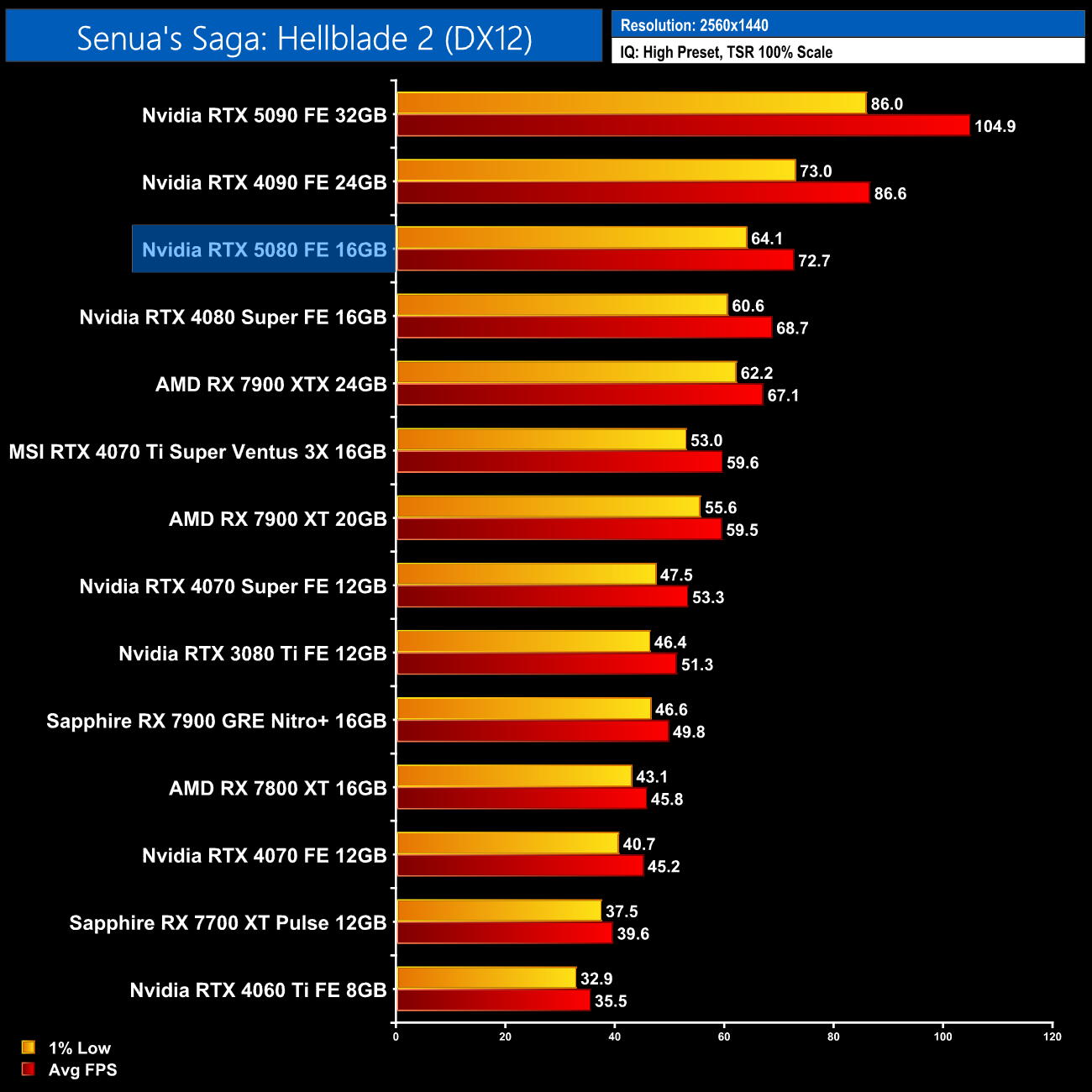
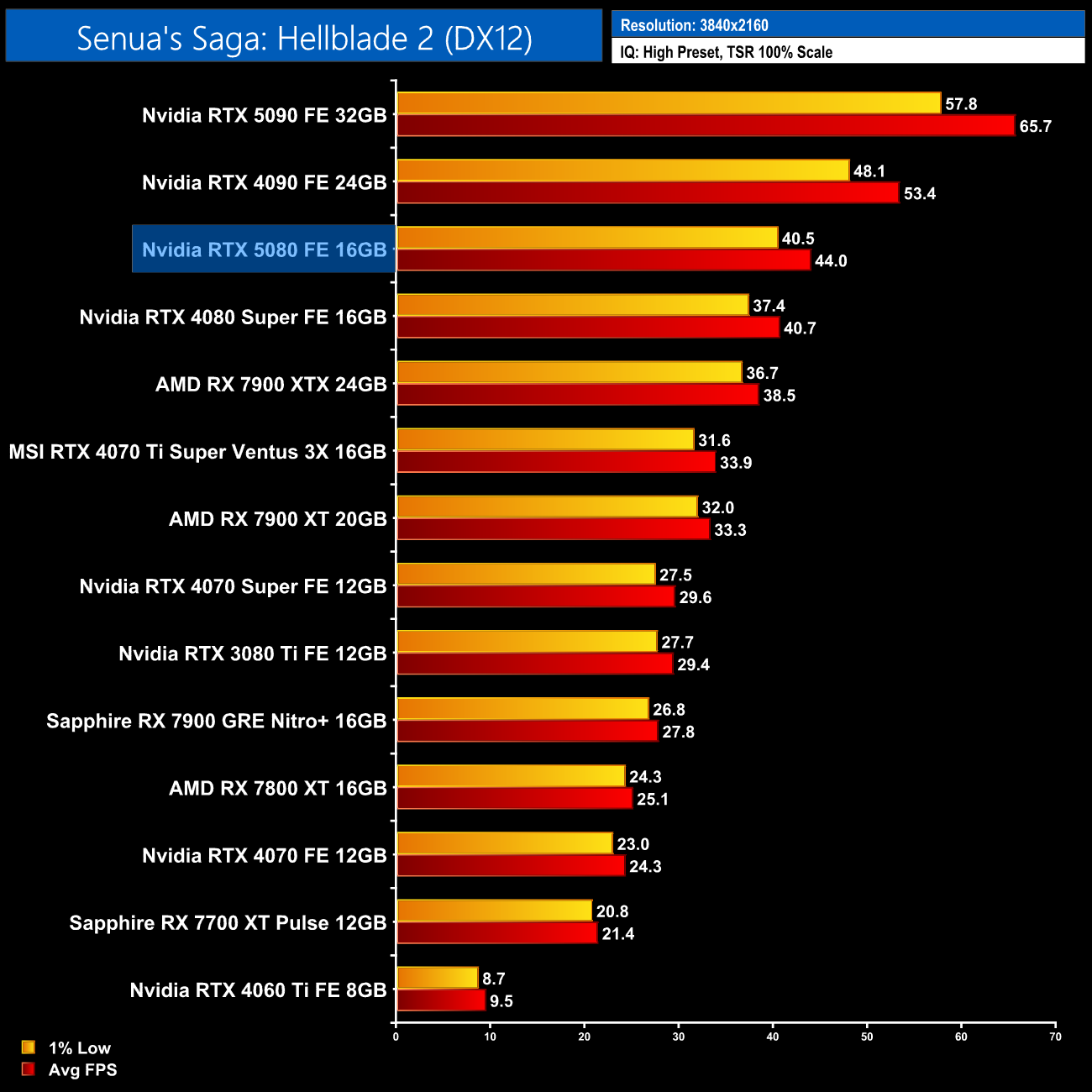
As for Senua's Saga: Hellblade 2, the gains over the 4080 Super are much more limited here – we're looking at just a 6% uplift at 1440p, while the 5080 is 8% faster than the 7900 XTX.
Even at 4K, we're only looking at an 8% uplift for the 5080 versus its predecessor, though it does stretch its lead to 15% over the 7900 XTX.
Starfield is a 2023 action role-playing game developed by Bethesda Game Studios and published by Bethesda Softworks. Announced in 2018, Starfield was delayed several times. The game was released for Windows and Xbox Series X/S on September 6, 2023. (Wikipedia).
Engine: Creation Engine 2. We test using the Ultra preset, with 100% resolution scale, dynamic resolution disabled, DX12 API.
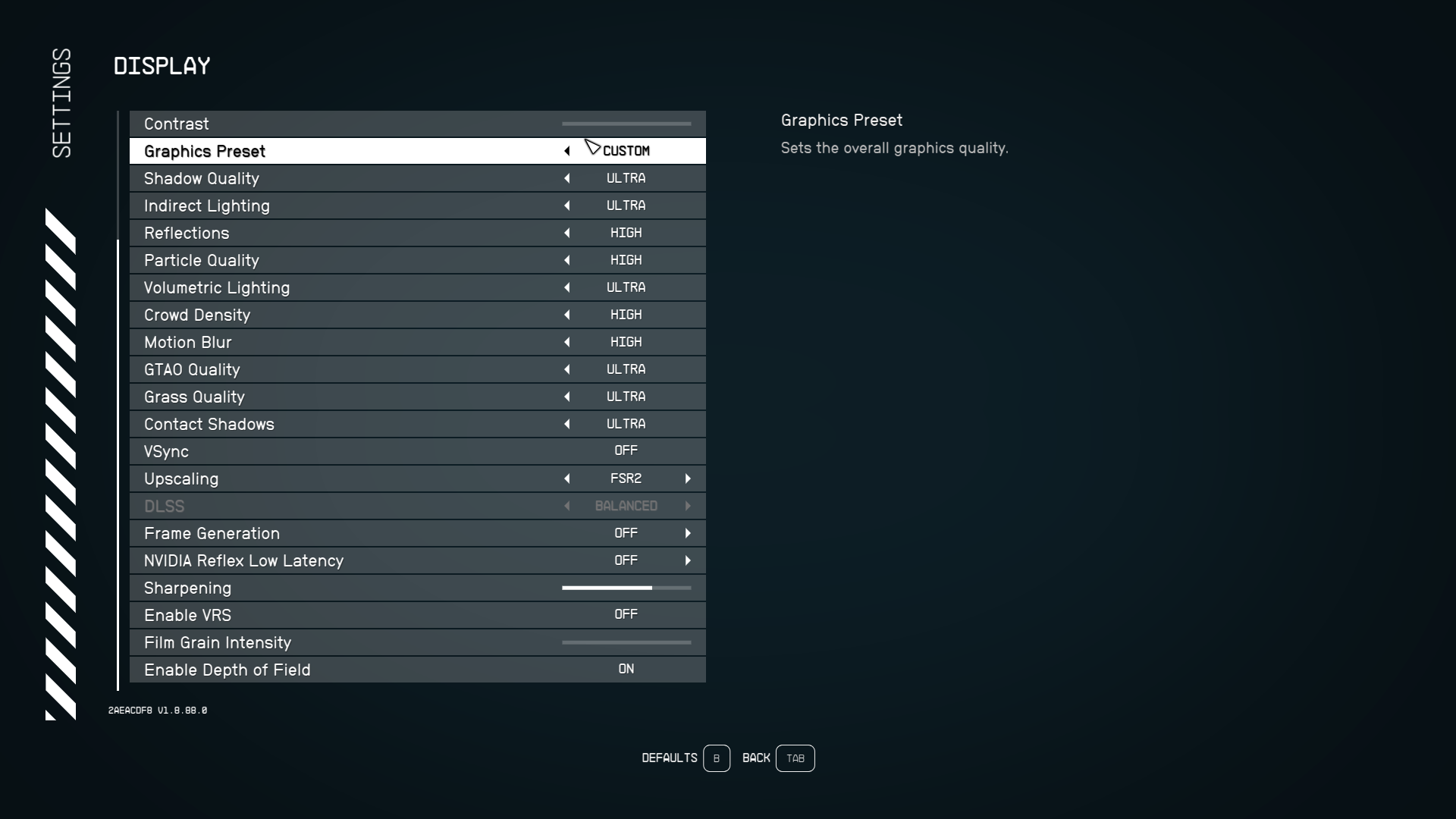
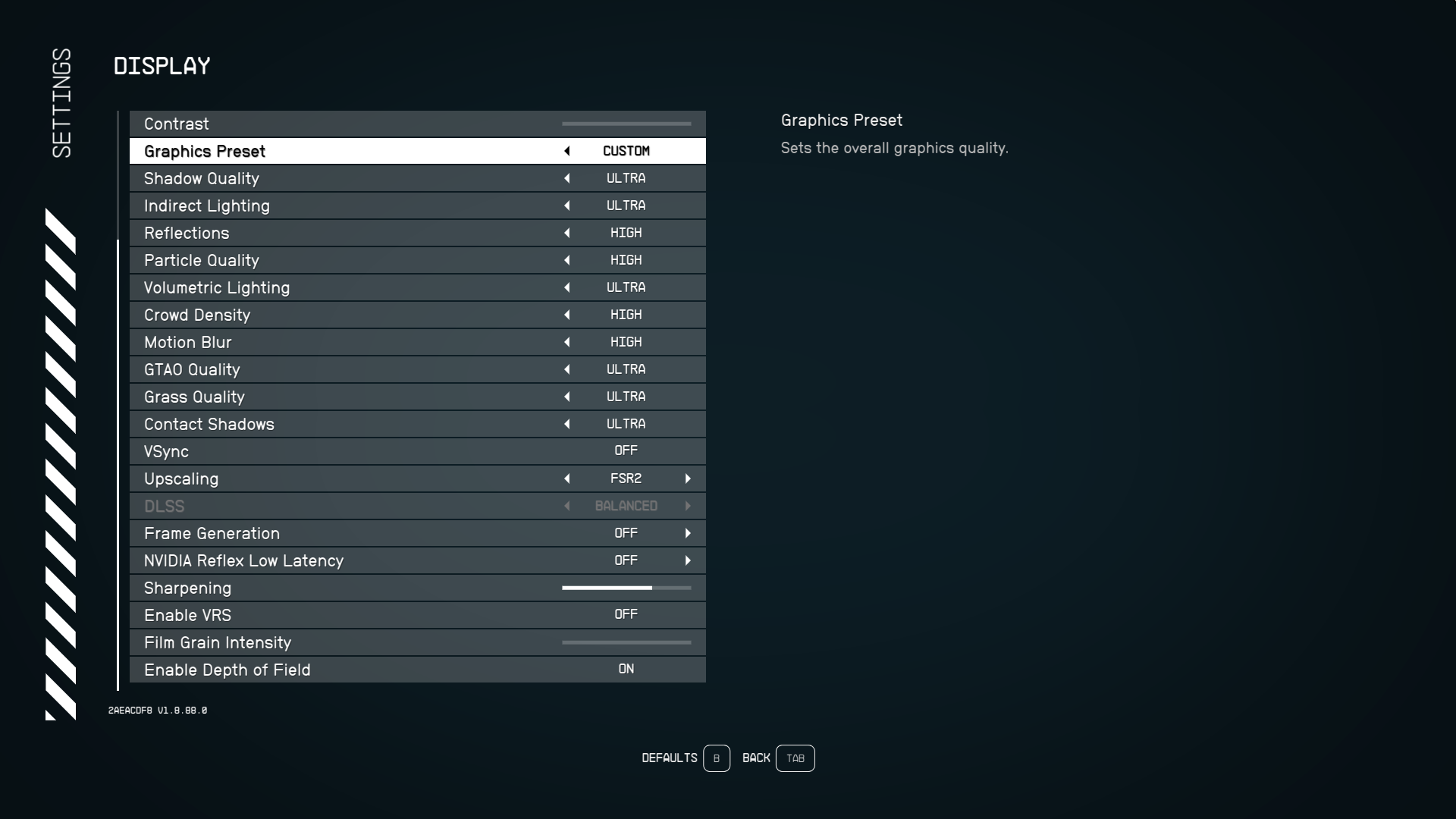
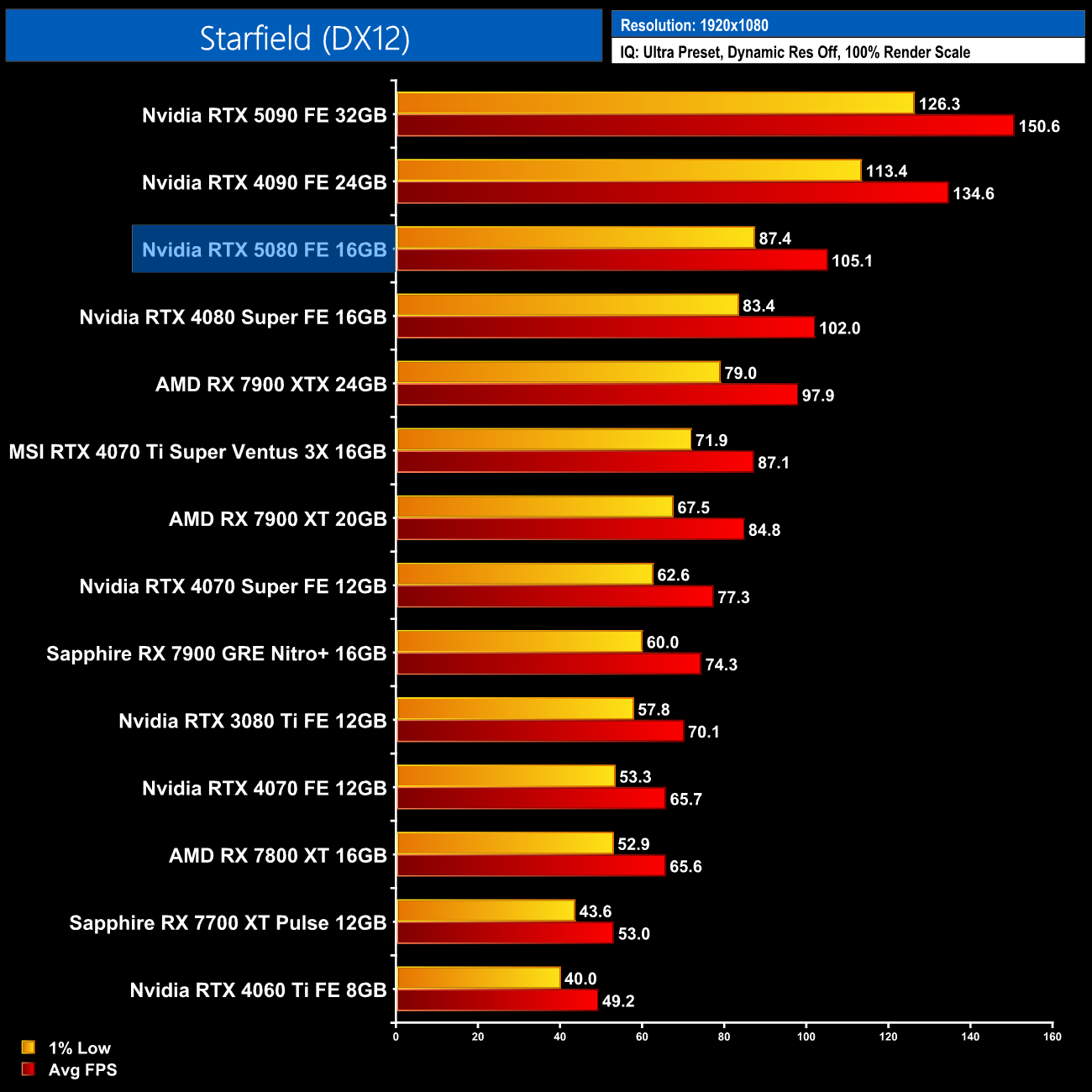
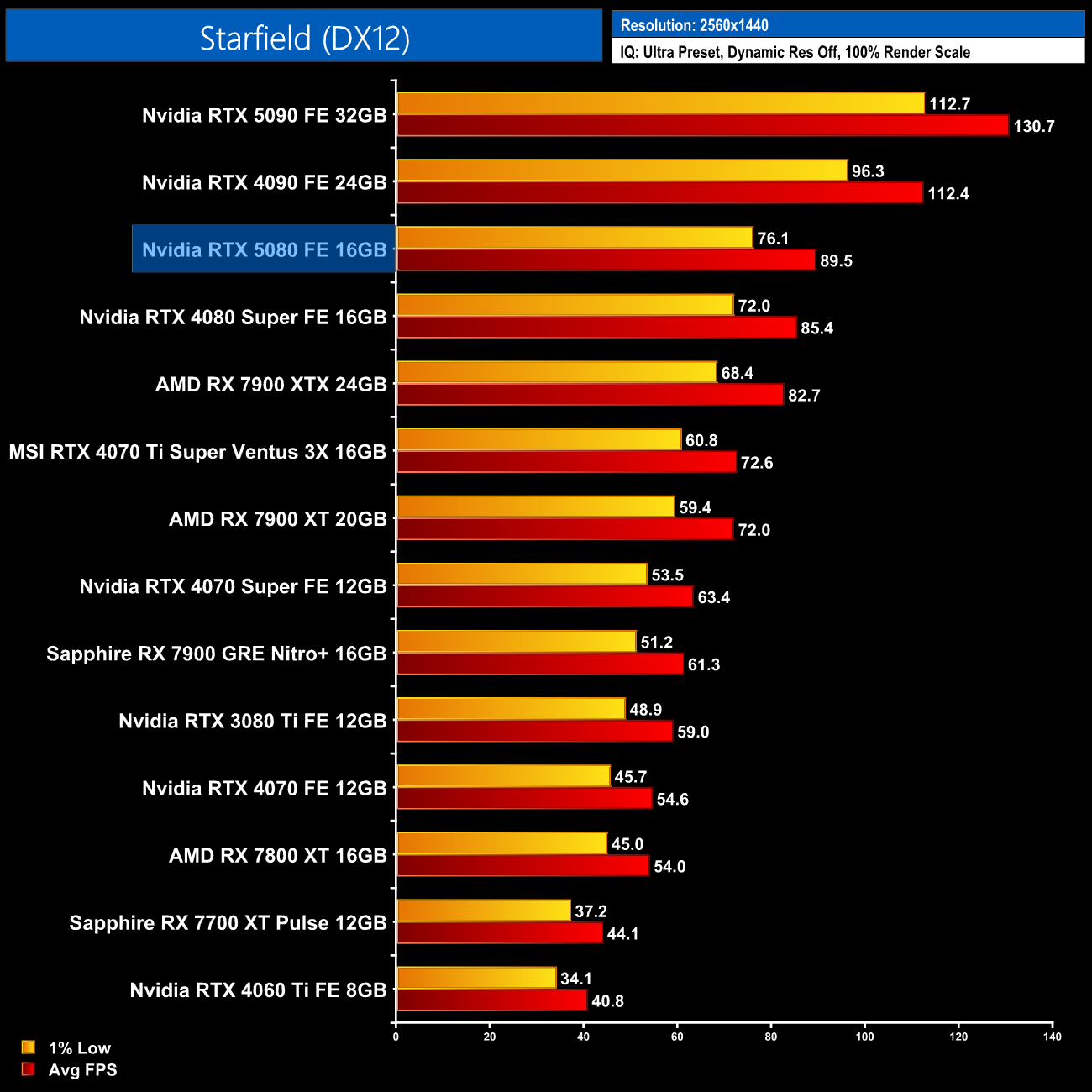
Starfield is another title that doesn't seem to scale particularly well on Blackwell GPUs, we're looking at just a 5% gain for the 5080 over the 4080 Super at 1440p, while it's 20% slower than the 4090.
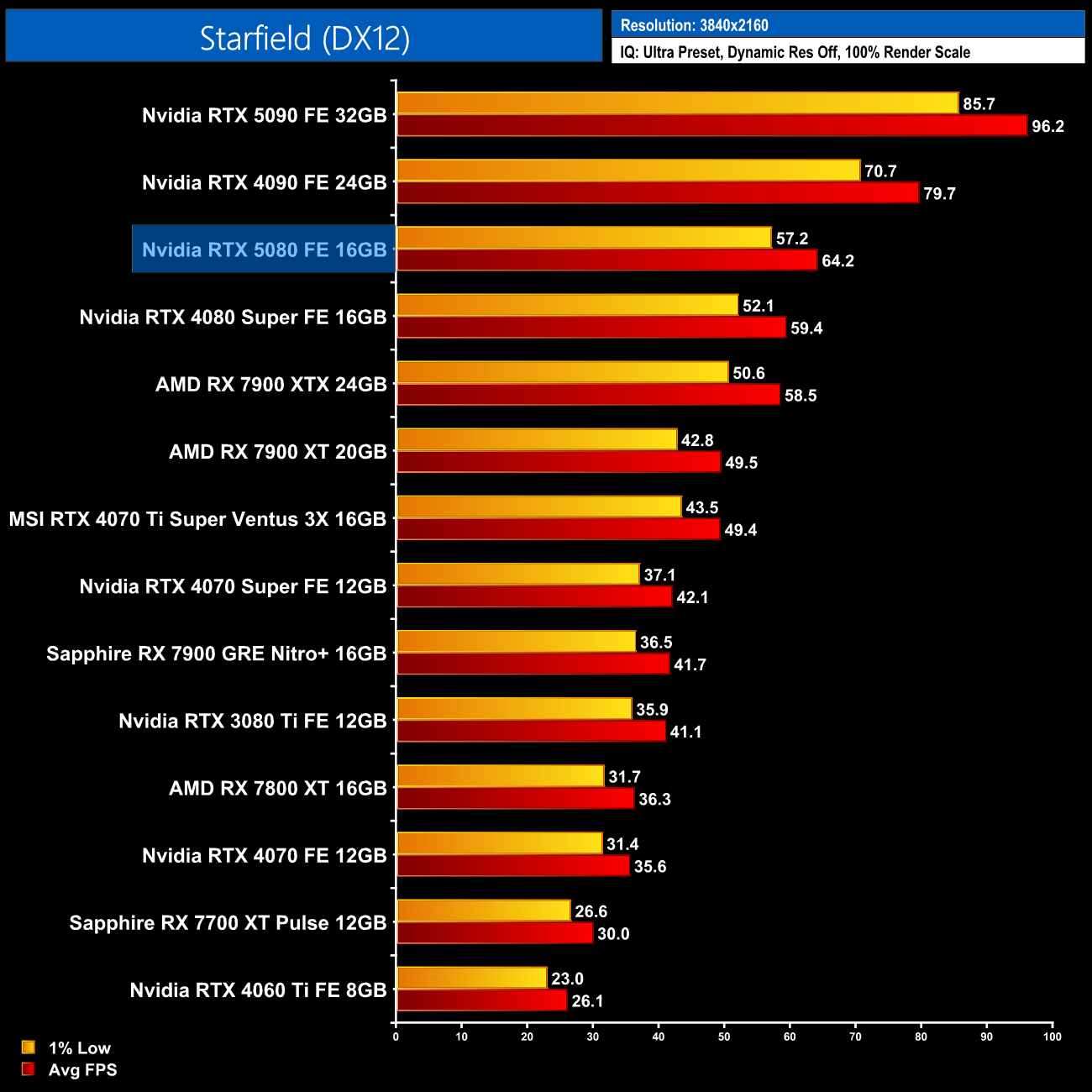
At 4K, the 5080 does claw back some performance, now coming in 8% faster than the 4080 Super, with an average frame rate of 64fps. It's once again 33% slower than the 5090 here.
Total War: Warhammer III is a turn-based strategy and real-time tactics video game developed by Creative Assembly and published by Sega. It is part of the Total War series, and the third to be set in Games Workshop's Warhammer Fantasy fictional universe (following 2016's Total War: Warhammer and 2017's Total War: Warhammer II). The game was announced on February 3, 2021 and was released on February 17, 2022. (Wikipedia).
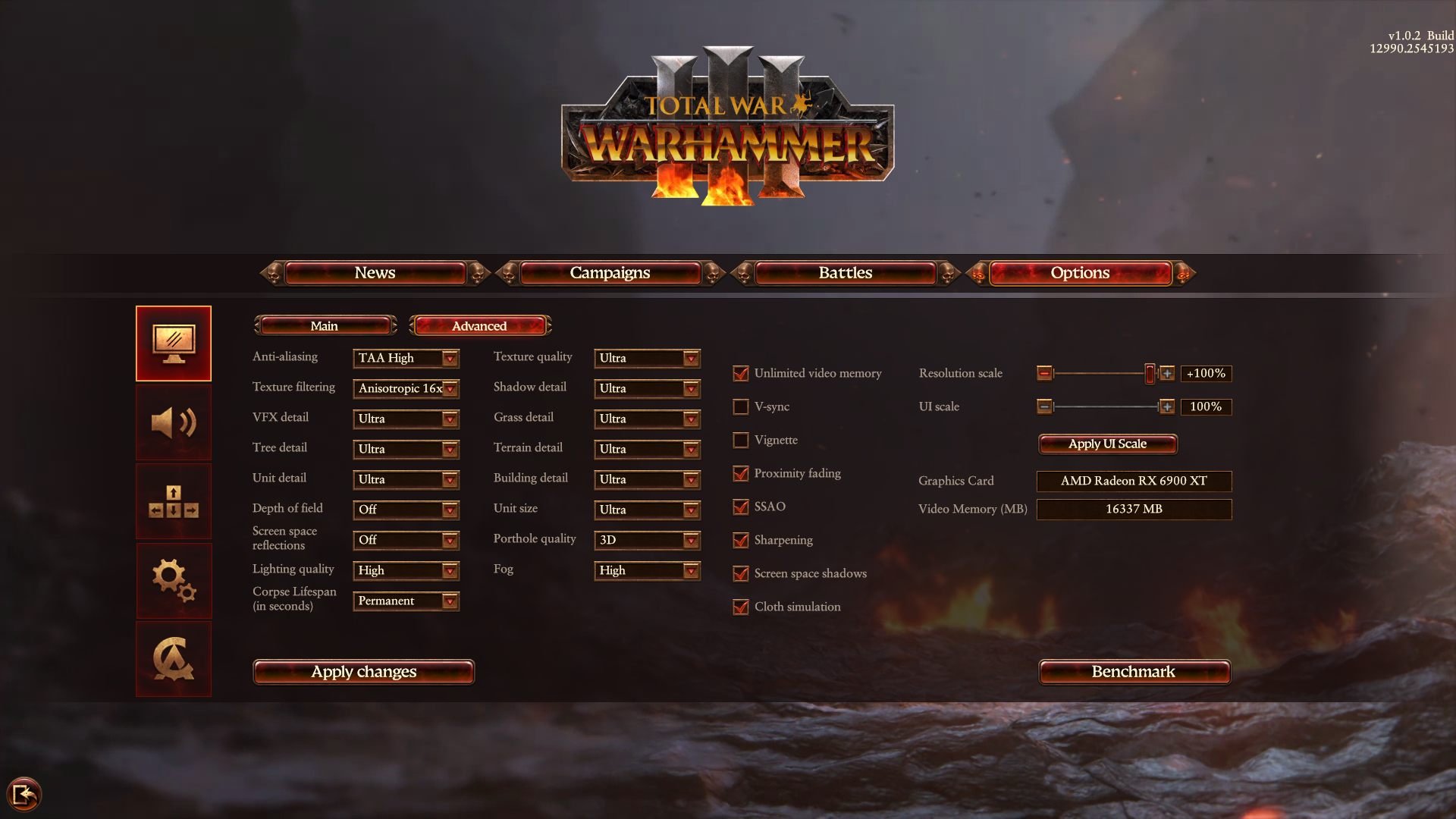
Engine: TW Engine 3 (Warscape). We test using the Ultra preset, with unlimited video memory enabled, DX11 API.
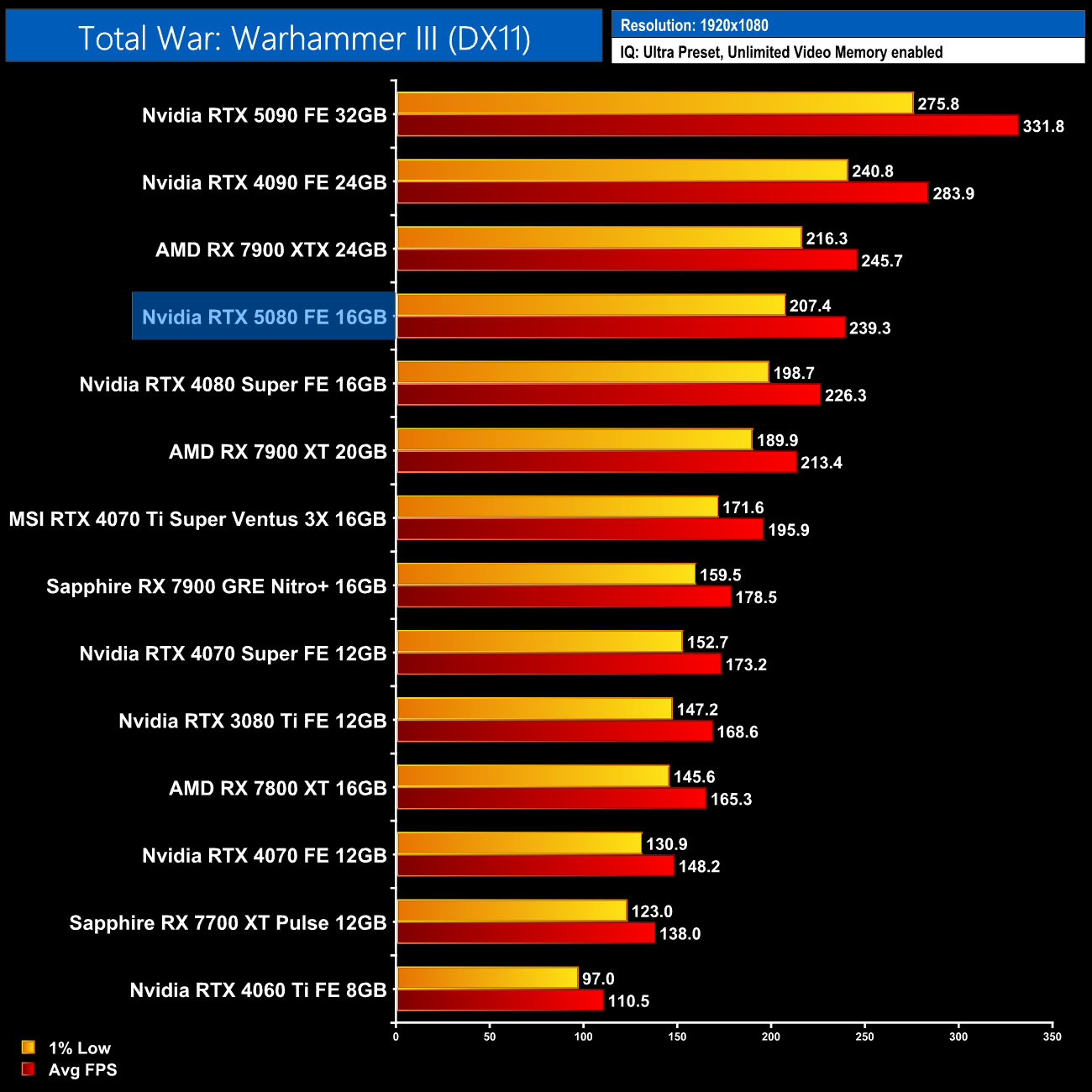
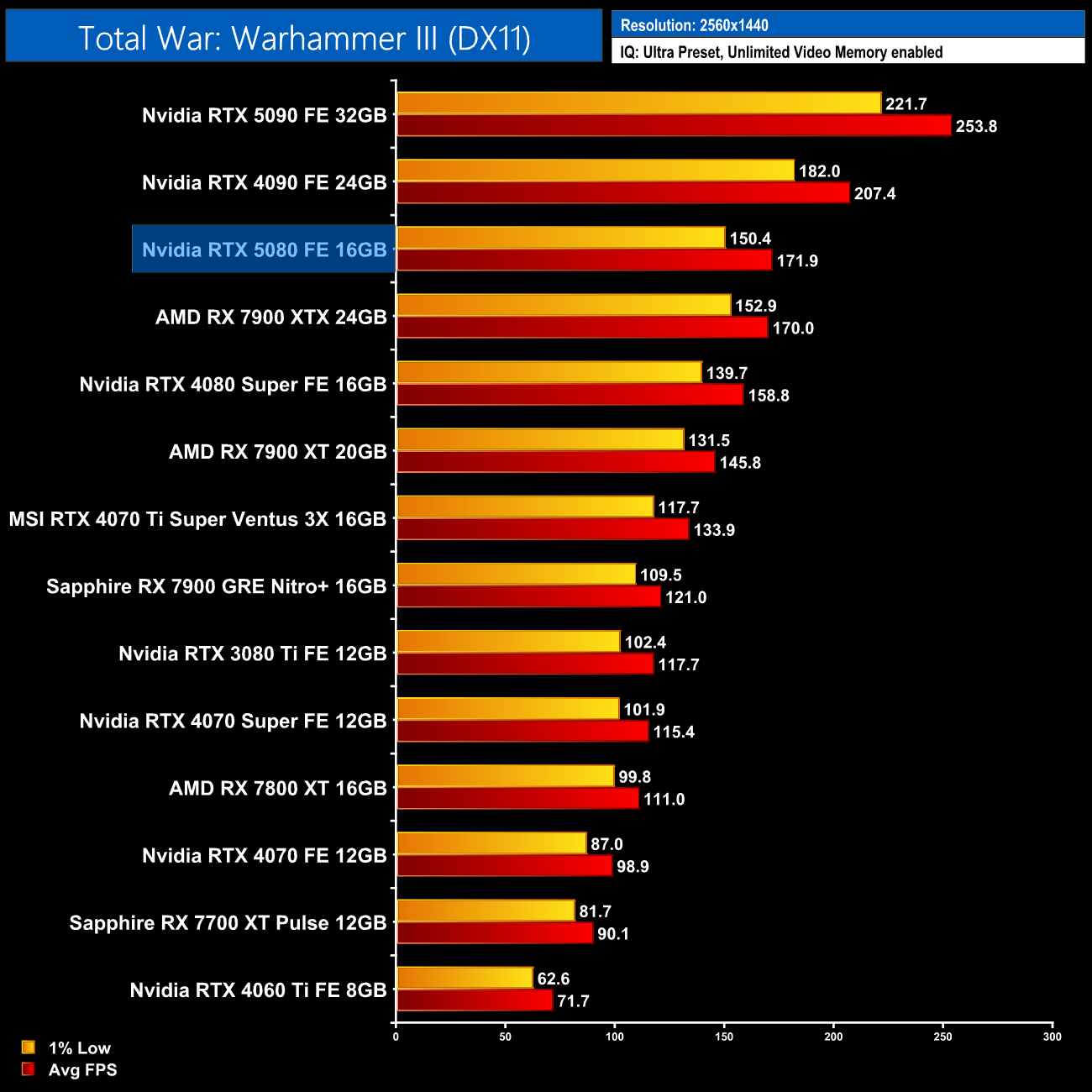
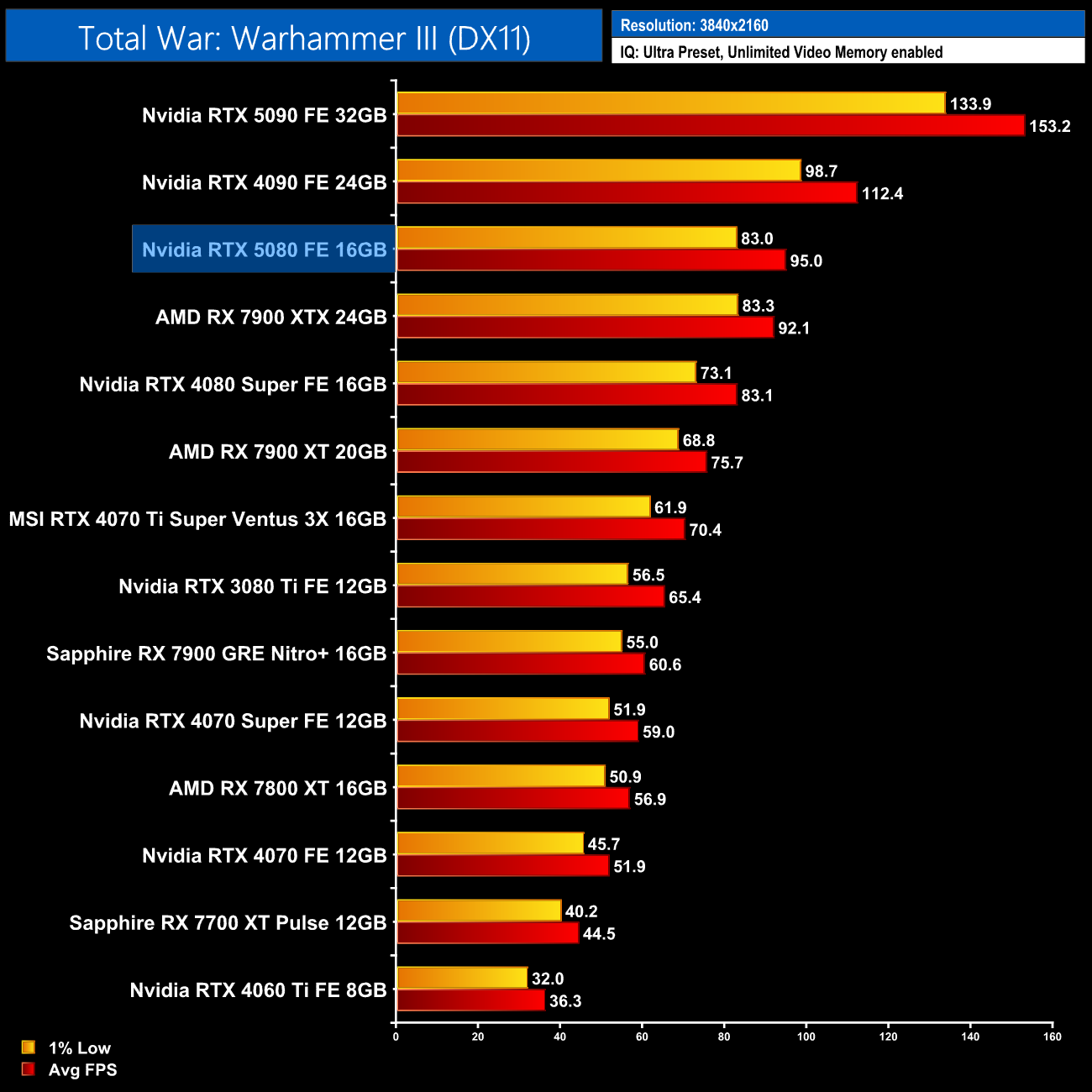
We close out our raster benchmarks with Total War: Warhammer III. While the 5080 is no faster than the 7900 XTX at 1440p, it does deliver an 8% advantage over the 4080 Super.
That lead is stretched to 14% as we increase the resolution to 4K, though the 5080 is still on par with the 7900 XTX, also coming in 16% behind the RTX 5090.
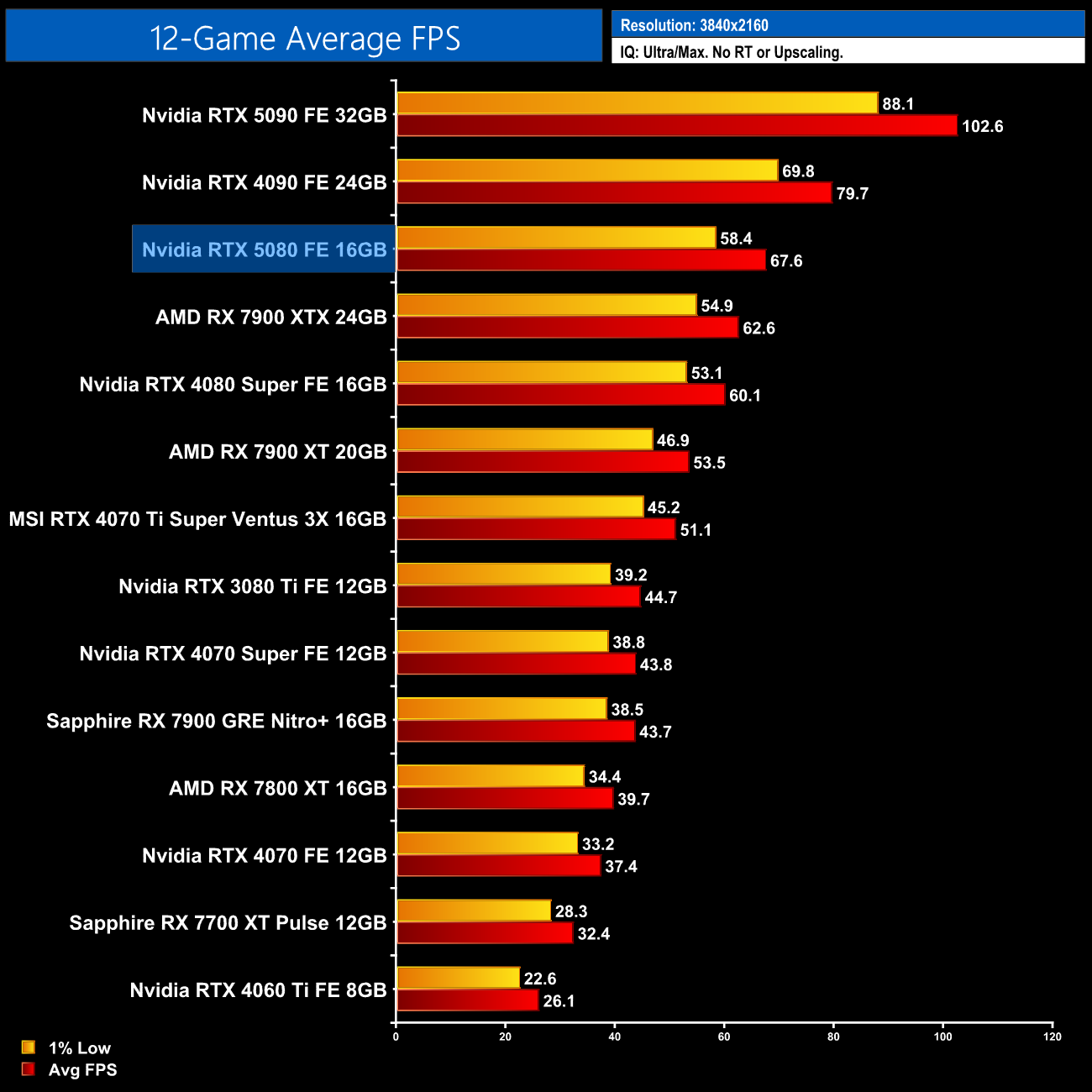
Here we present frame rate figures for each graphics card, averaged across all 12 games on test today. These figures can disguise significant variations in performance from game to game, but provide a useful overview of the sort of performance you can expect at each resolution tested.
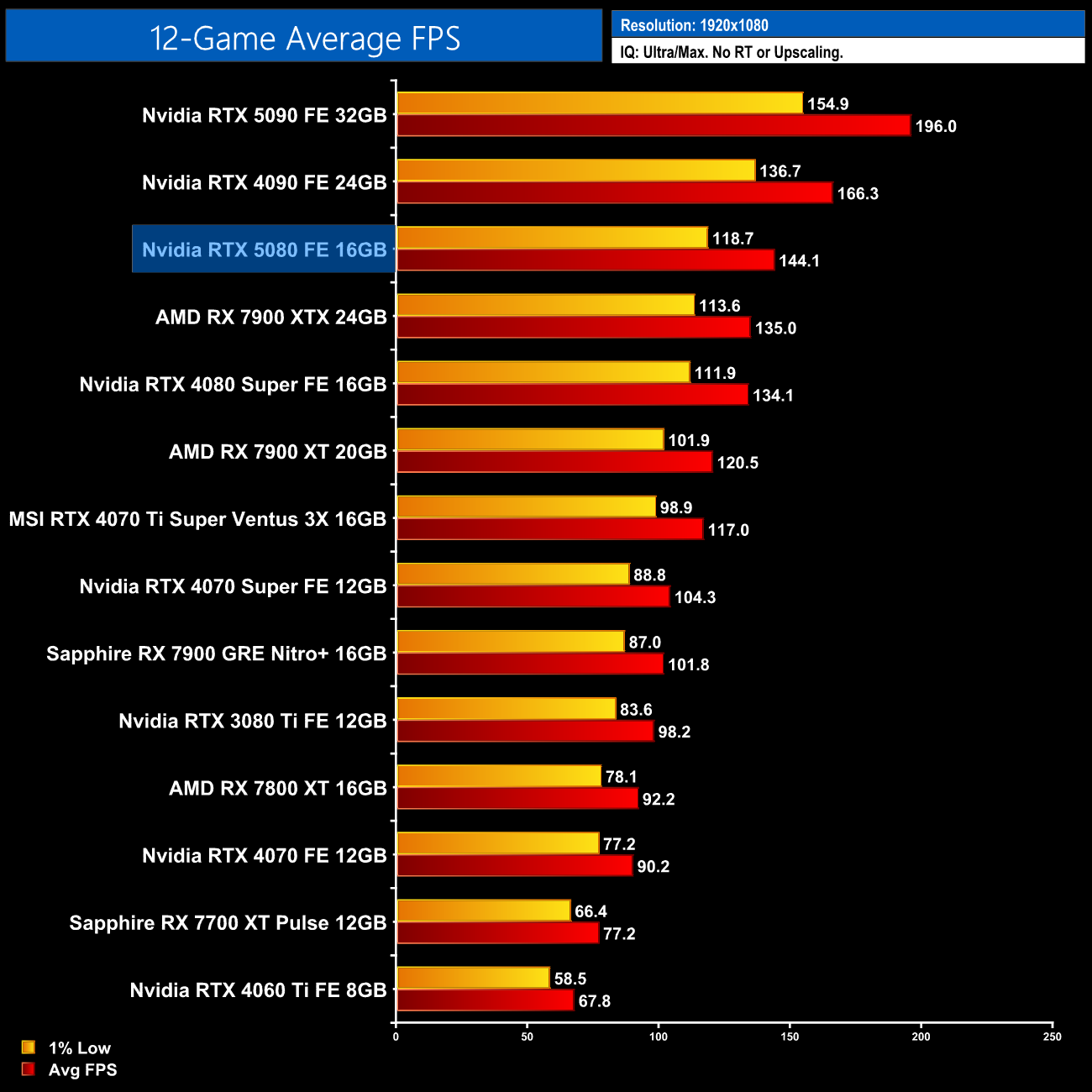
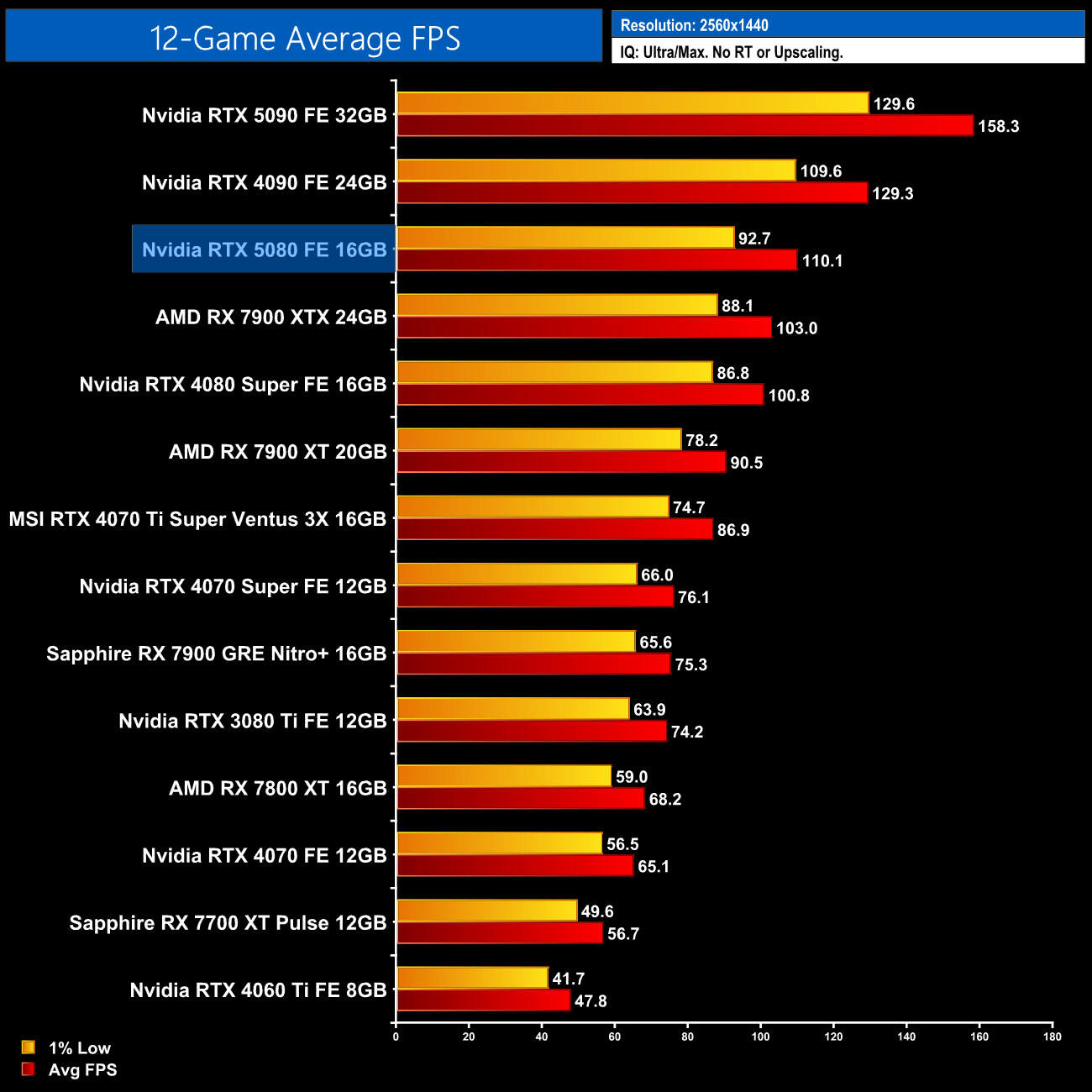
Overall then, across the 12 games tested, at 1440p the RTX 5080 delivered an average frame rate of 110fps, and that makes it 9% faster than the RTX 4080 Super. It's also just 7% faster than the RX 7900 XTX, while it's 15% and 30% slower than the RTX 4090 and RTX 5090, respectively.
At 4K the gains over the 4080 Super do get slightly wider, with the 5080 now 13% faster on average, while it's 8% ahead of the 7900 XTX. It still lags behind the RTX 4090 by 15%, and it's now 34% slower than the RTX 5090. For one final comparison though, one I've not focused on today is the matchup against the RTX 3080 Ti, which launched at £1049 back in mid-2021; the RTX 5080 comes in 51% faster on average at 4K.
Relative performance versus the RTX 4080 Super
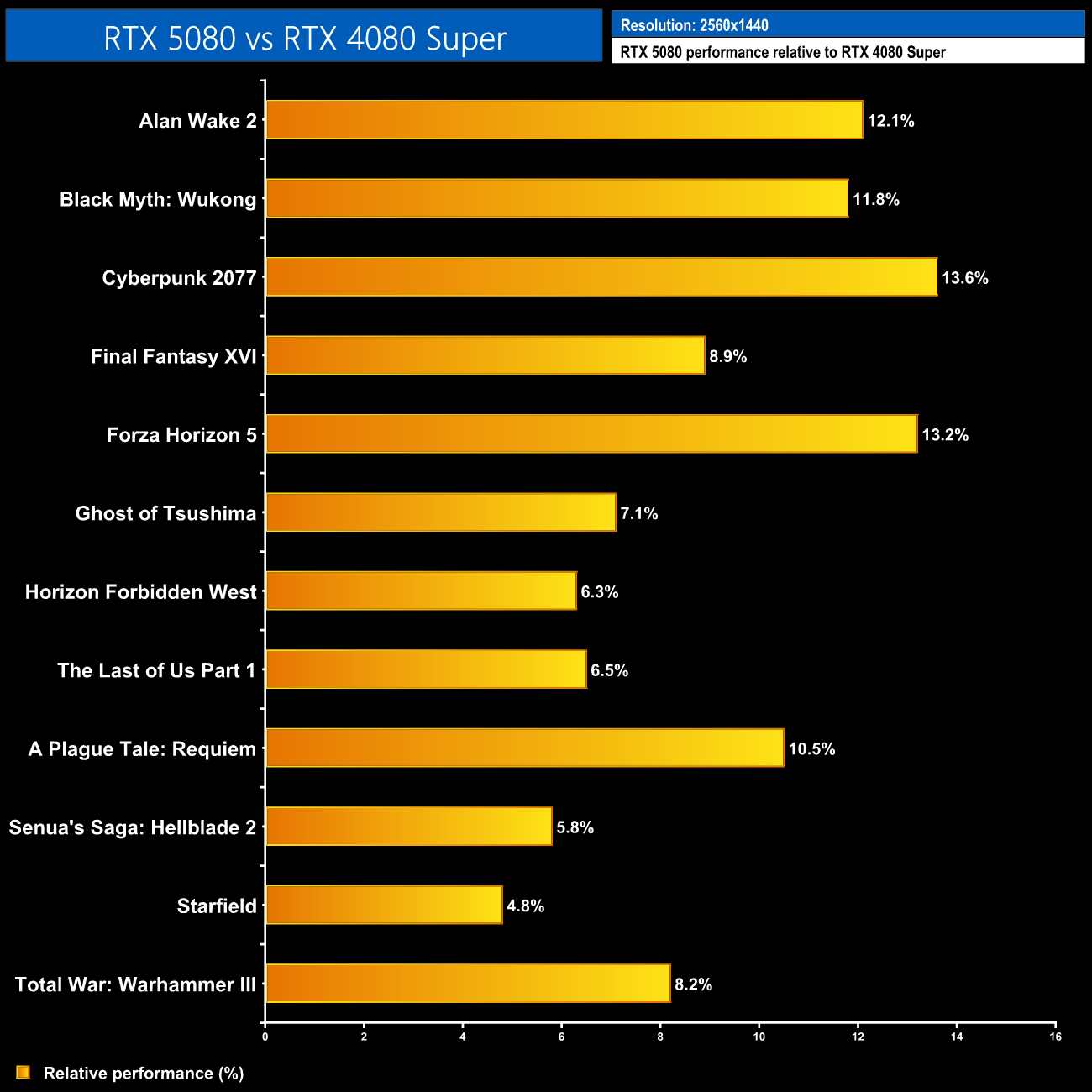
Just to breakdown the relative rasterisation performance versus the 4080 Super, at 1440p we saw gains between 5% up to 14%.
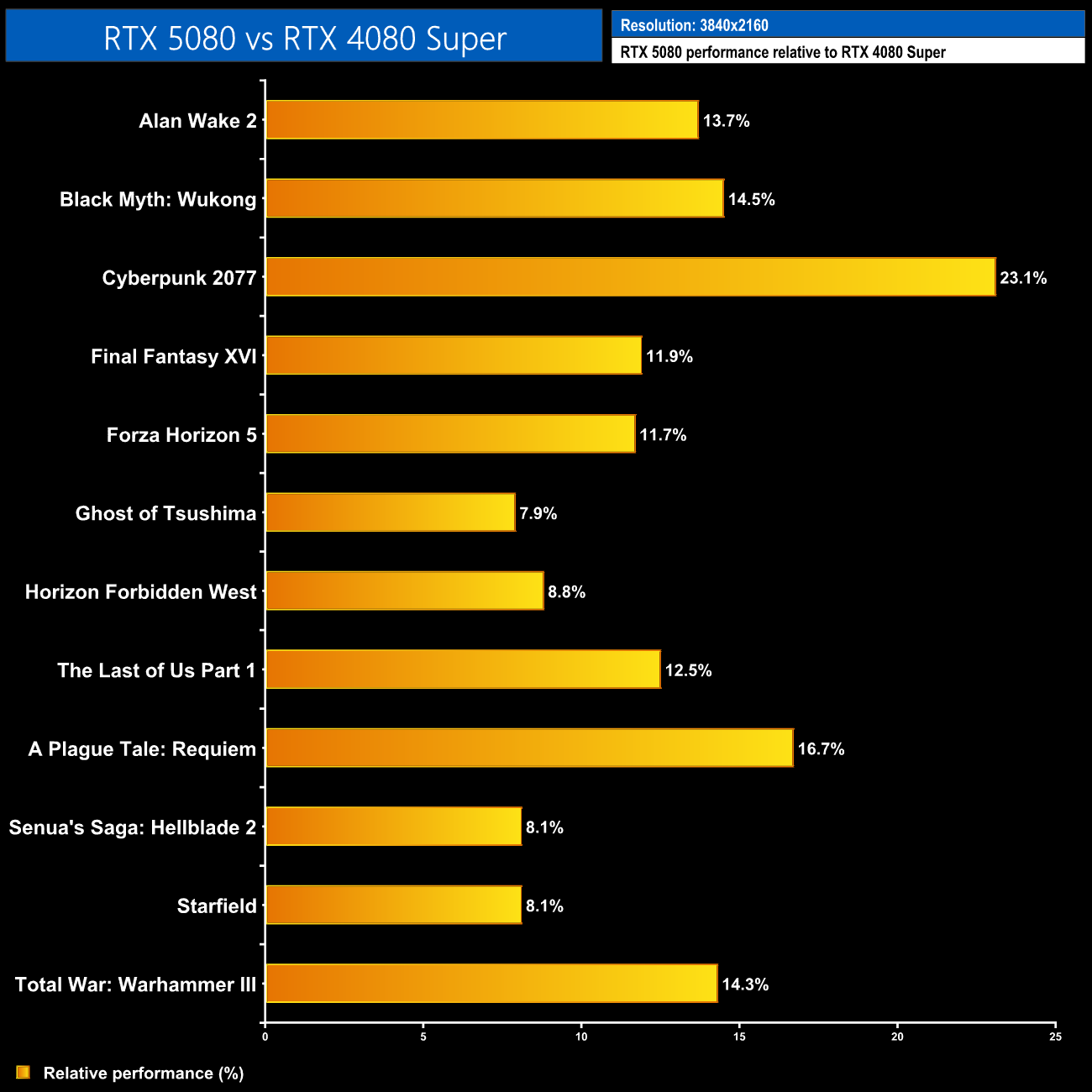
As mentioned, the 5080 can stretch its legs somewhat at 4K, where it proved to be 8-23% faster than the 4080 Super, depending on the exact game – four of twelve titles tested showed less than a 10% difference, mind.
The MSRPs
Using the average frame rate data presented earlier in the review, here we look at the cost per frame using the UK MSRP launch prices for each GPU. Please note this only compares rasterised performance and value.
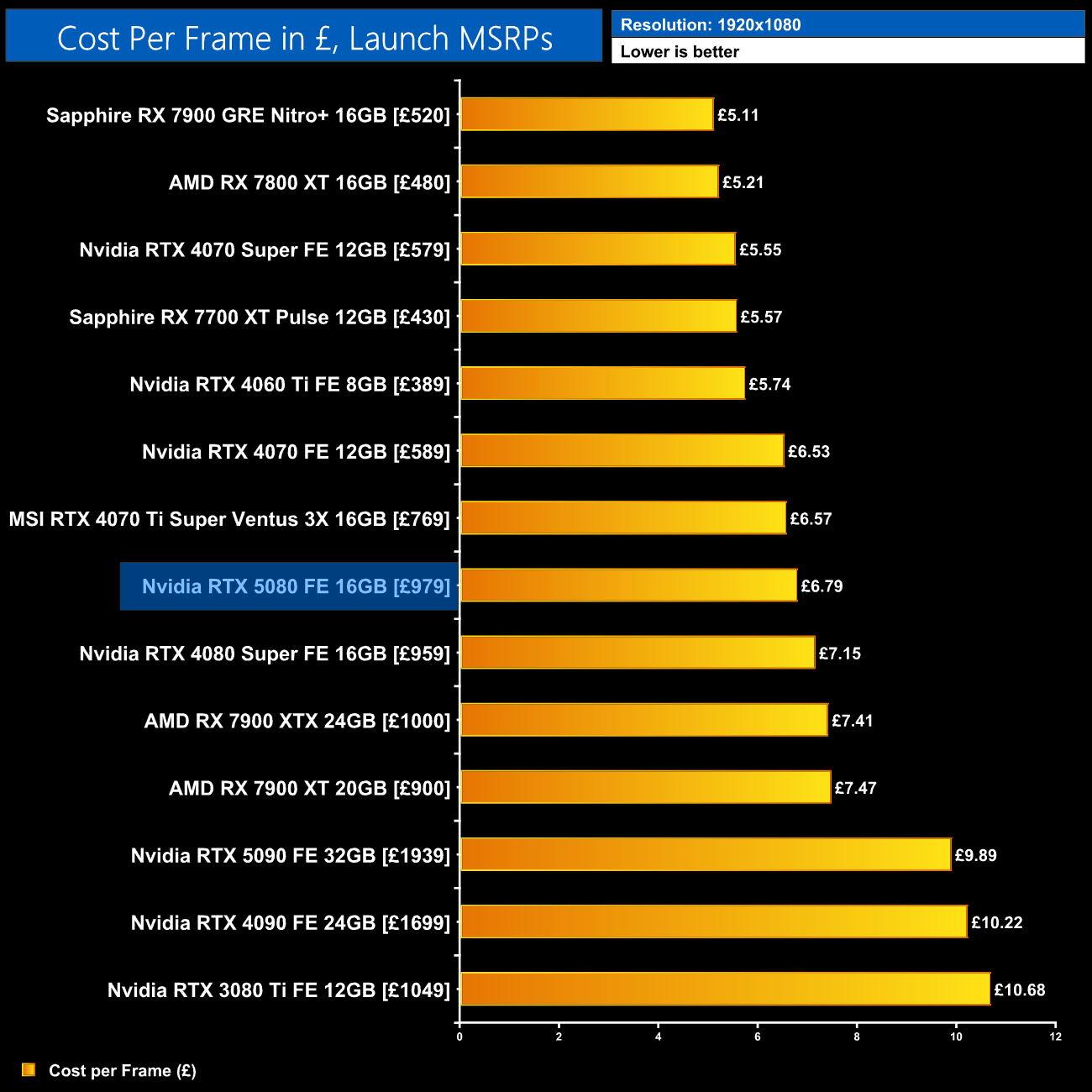
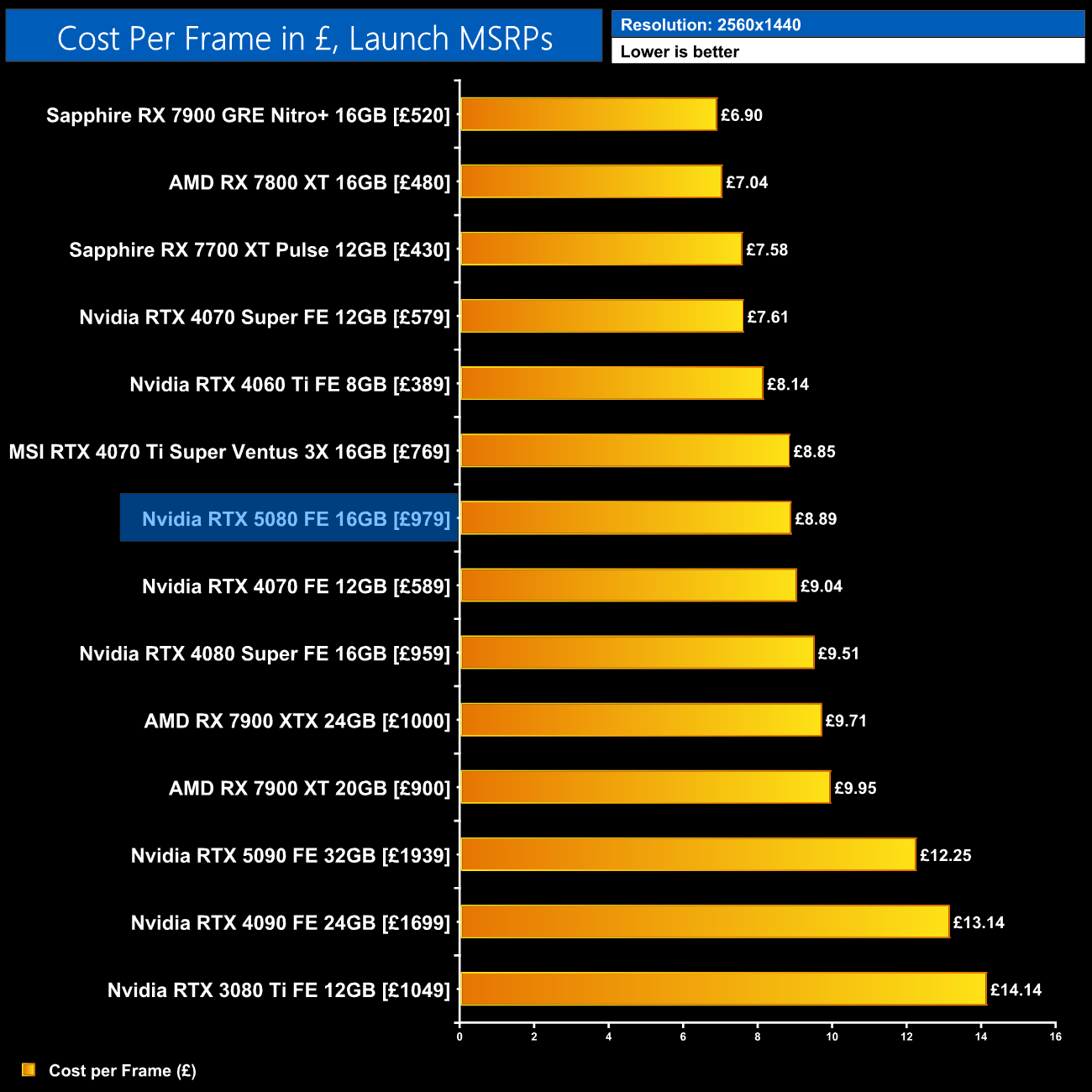
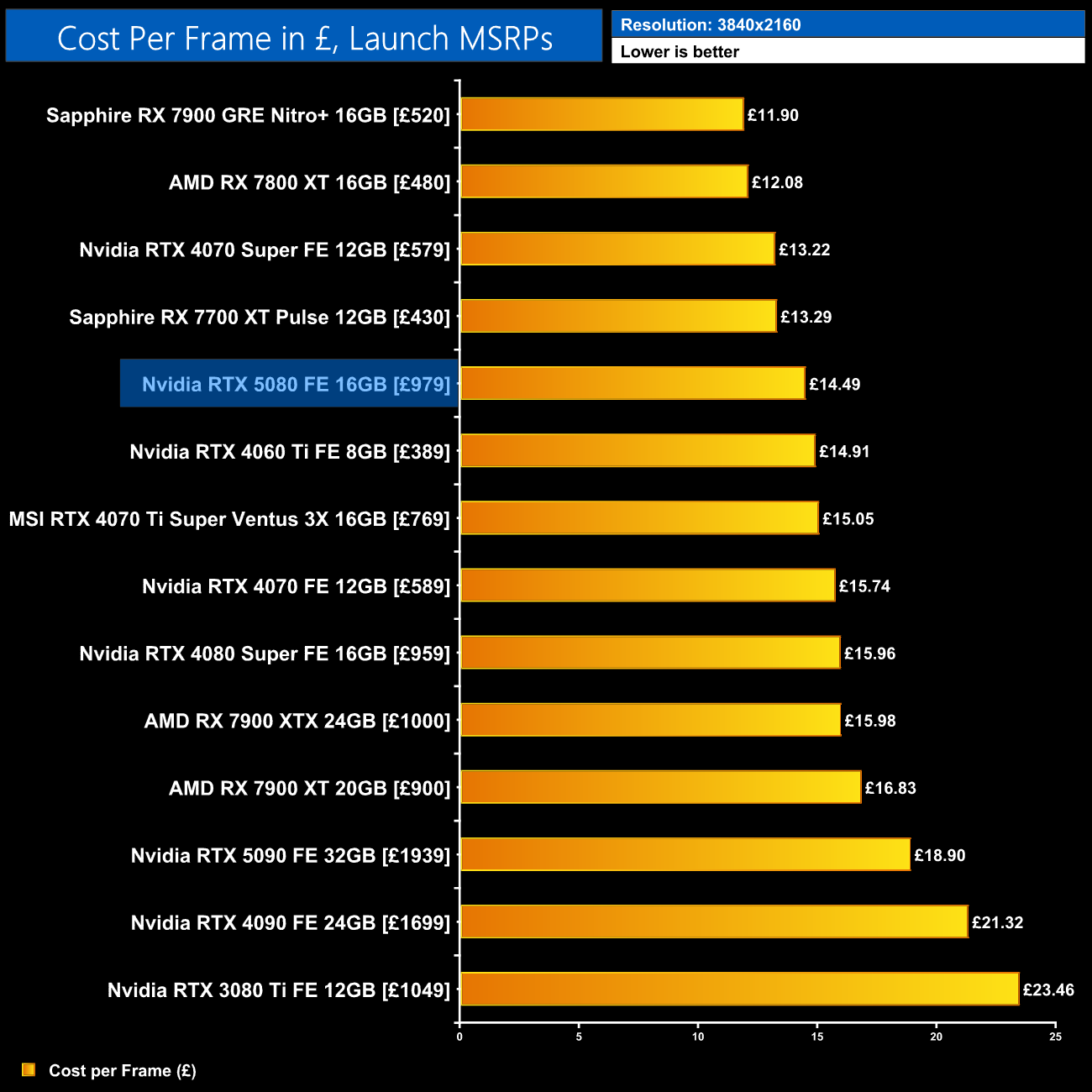
While the overall performance may not be mind-blowing, there is at least the positive point that the RTX 5080 has not increased its price over the 4080 Super, and that means a small improvement to cost per frame – 9%, to be exact, when using the MSRP data. It's hardly a revolution and still lags behind other GPUs like the RTX 4070 Super and RX 7800 XT, but it's, at least, a step in the right direction.
Current retail pricing
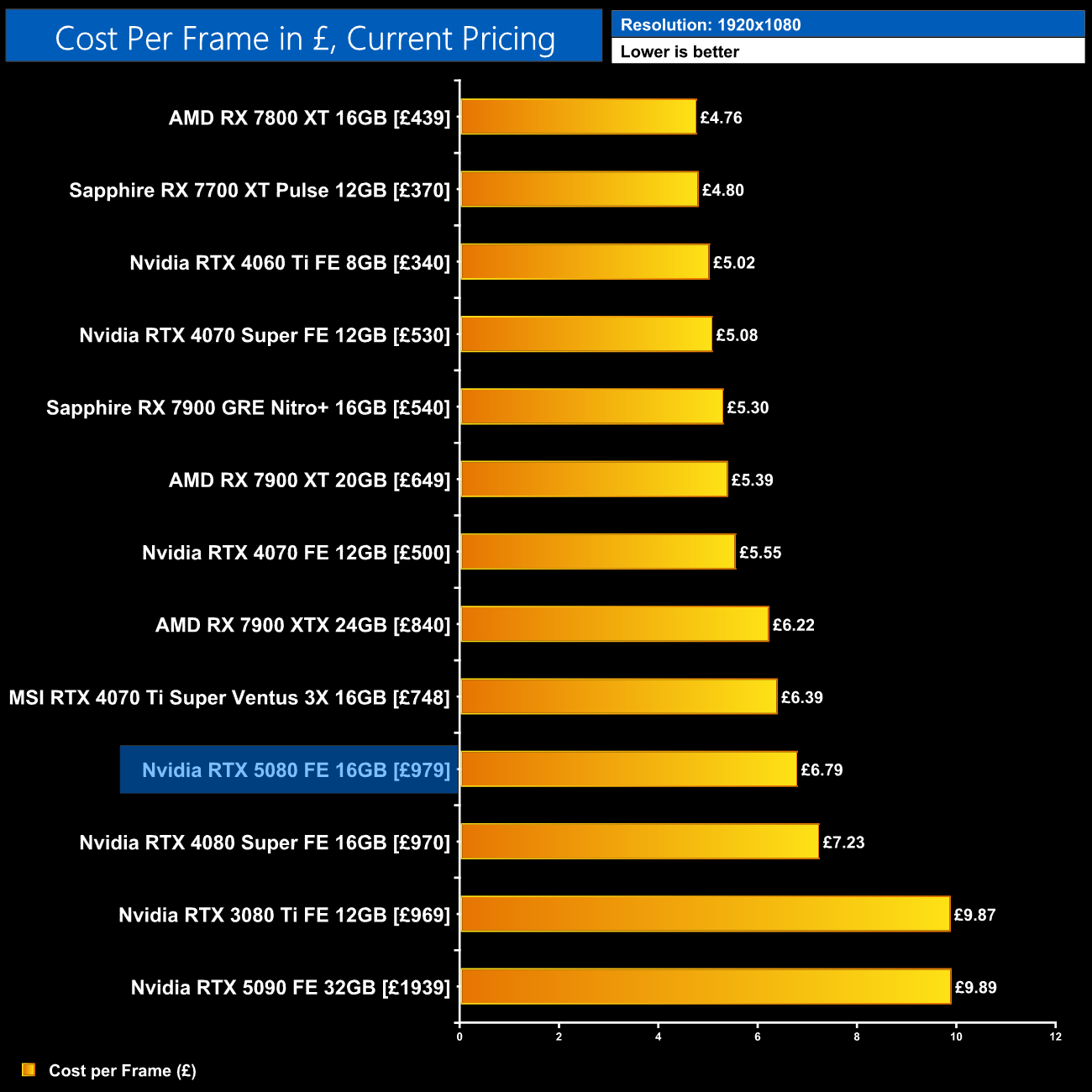
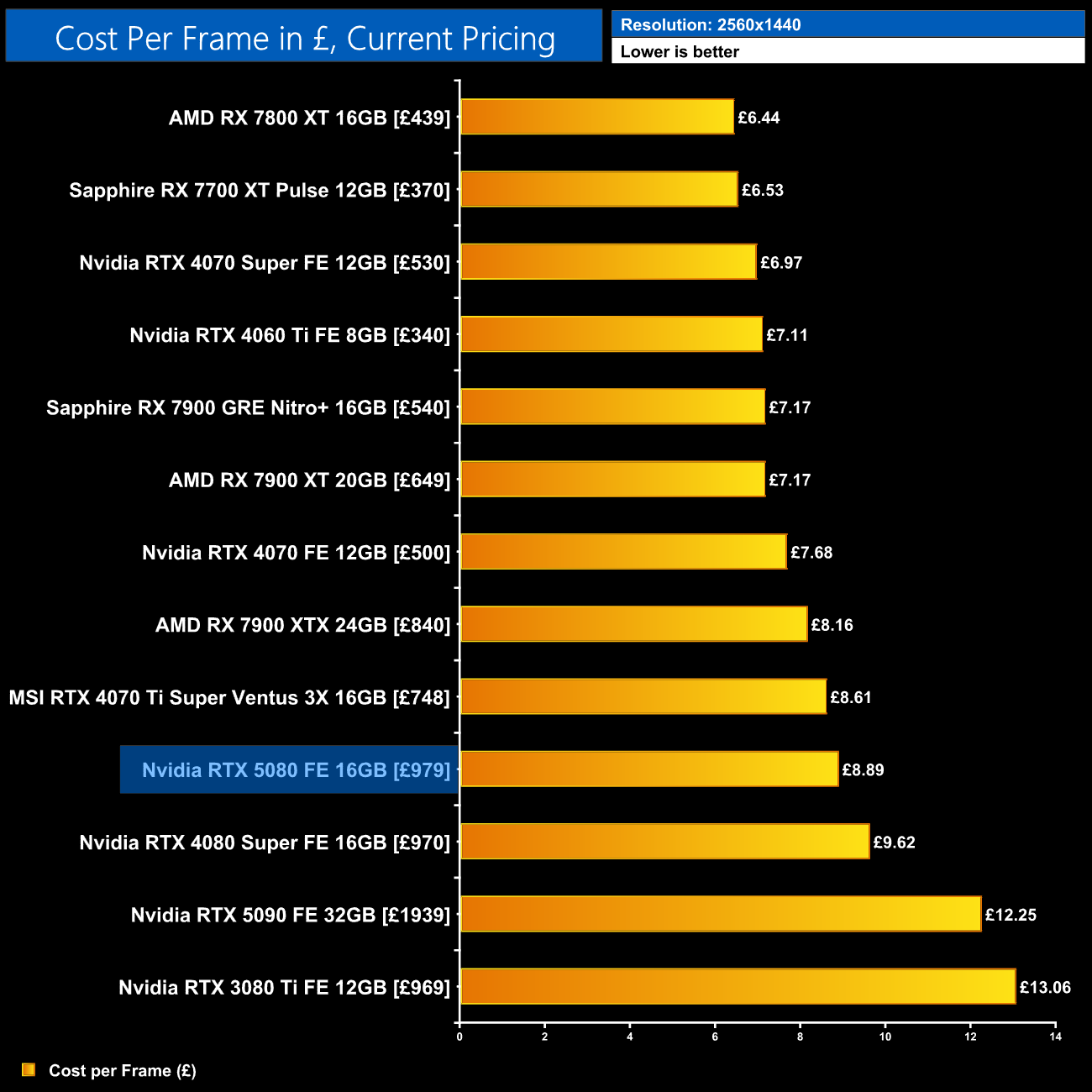
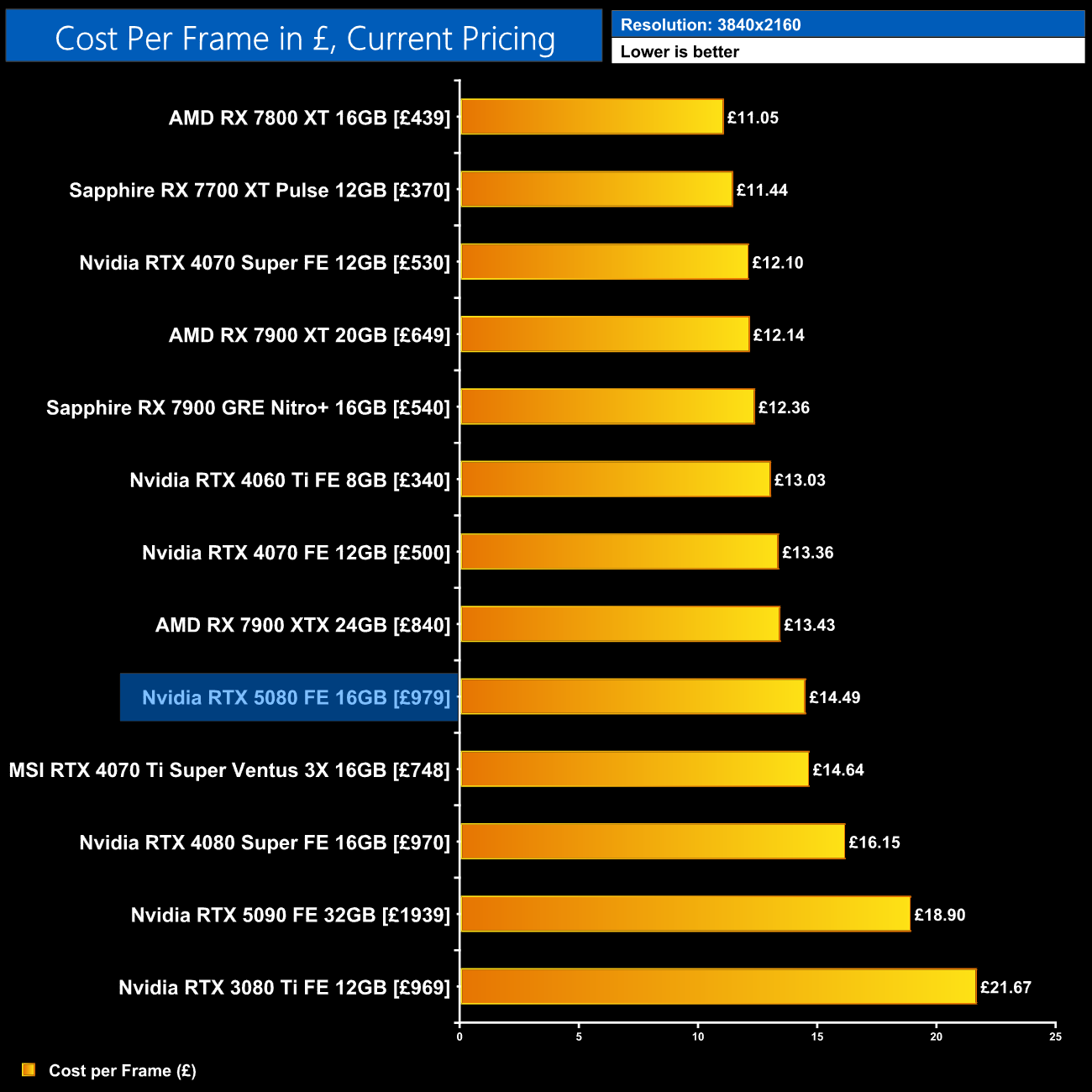
Calculating cost per frame based on current street pricing is another matter however, and we can see the RX 7900 XTX does technically offer better value with a couple of choice deals on at the minute – though, it has to be said general availability of that GPU is drying up fast and I don't expect it to last much longer. Still, cost per frame remains improved compared to the 4080 Super, which I wasn't able to find cheaper than £970 here in the UK.
Alan Wake 2 is a 2023 survival horror game developed by Remedy Entertainment and published by Epic Games Publishing. A sequel to Alan Wake, the story follows best-selling novelist Alan Wake, who has been trapped in an alternate dimension for 13 years, as he attempts to escape by writing a horror story involving an FBI special agent named Saga Anderson. The game was released for PlayStation 5, Windows, and Xbox Series X/S on 27 October 2023. (Wikipedia)
Engine: Northlight. We test using the High preset, High Ray Tracing preset, FSR set to Quality upscaling, DXR API.
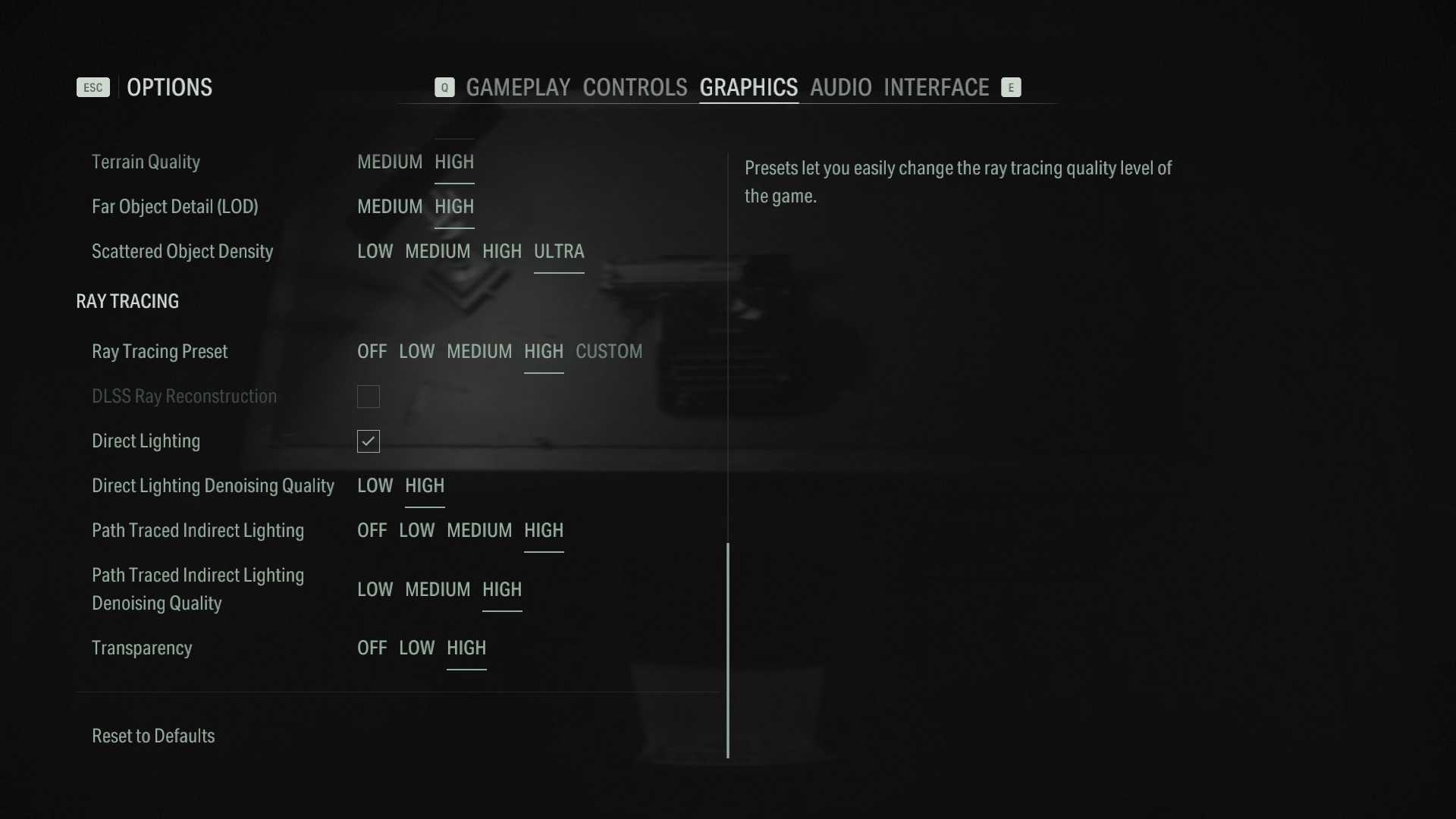
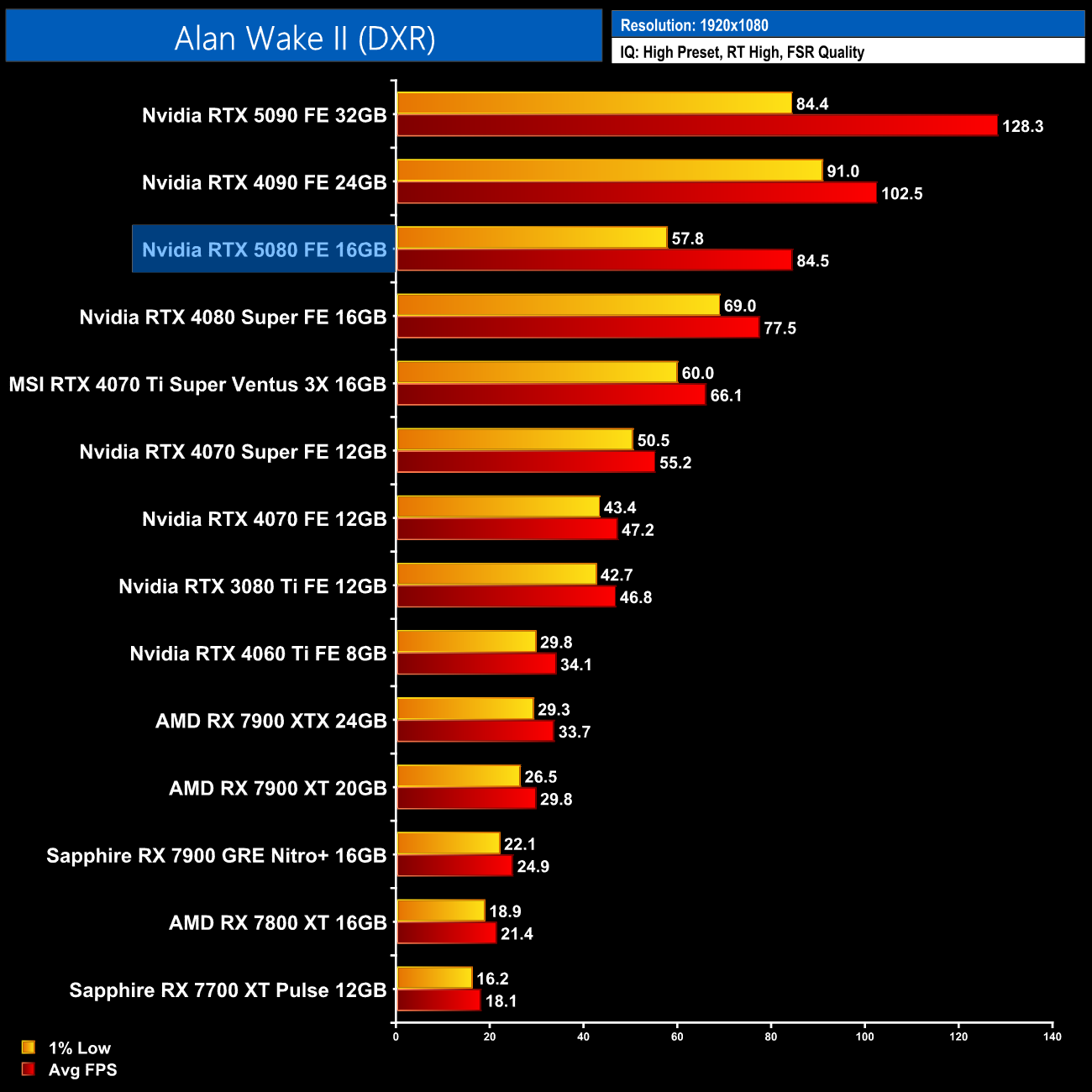
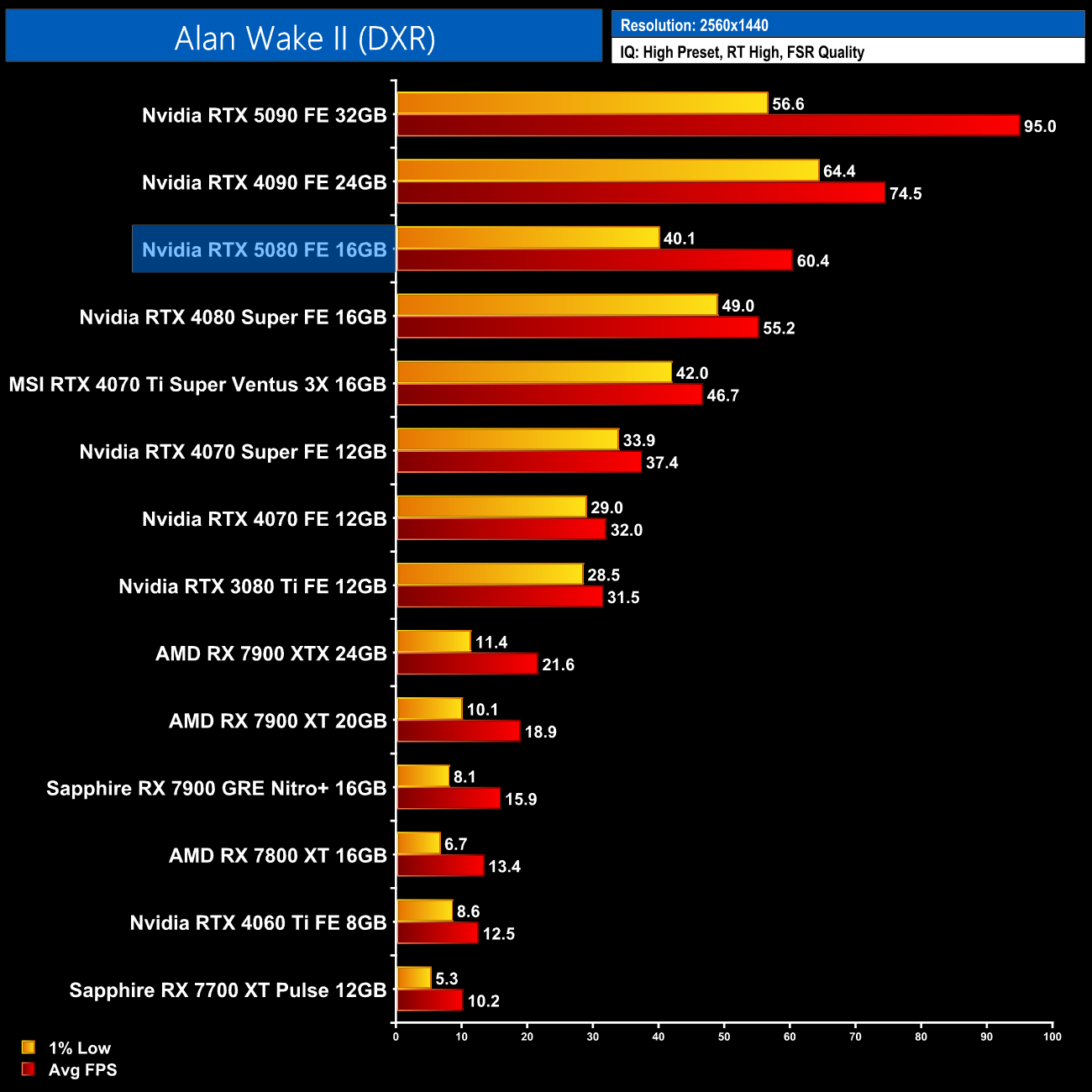
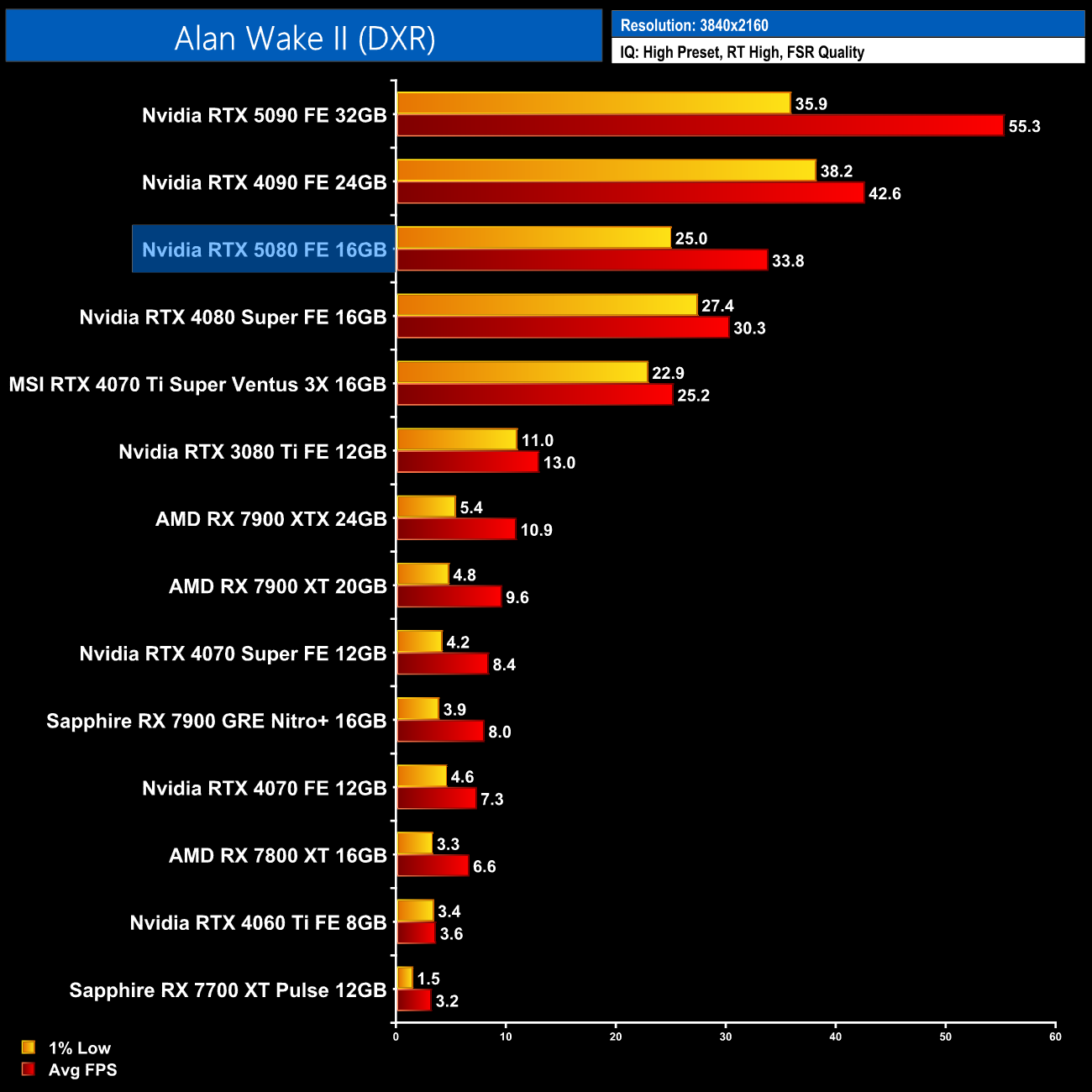
Moving onto ray tracing performance, Alan Wake 2 still exhibits those frame pacing issues mentioned earlier in the review. On average though, at 1440p the RTX 5080 is good for 60fps, making it 9% faster than the RTX 4080 Super. It's almost three times as fast as AMD's RX 7900 XTX, however, showing the clear gulf when it comes to ray tracing performance.
Then, at 4K, we're looking at 34fps on average, working out as an 11% boost over the RTX 4080 Super.
Update: Frametime issue has been fixed
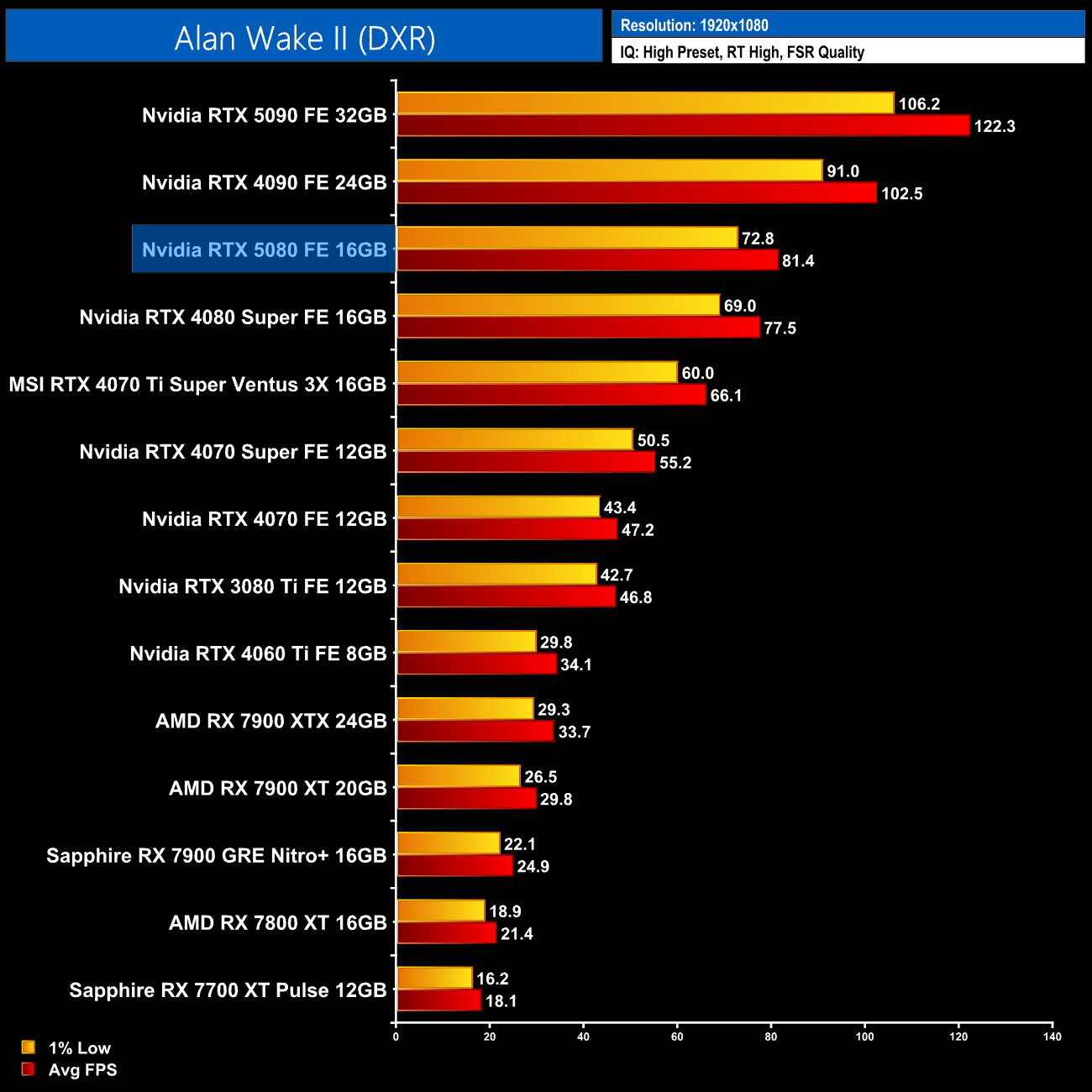

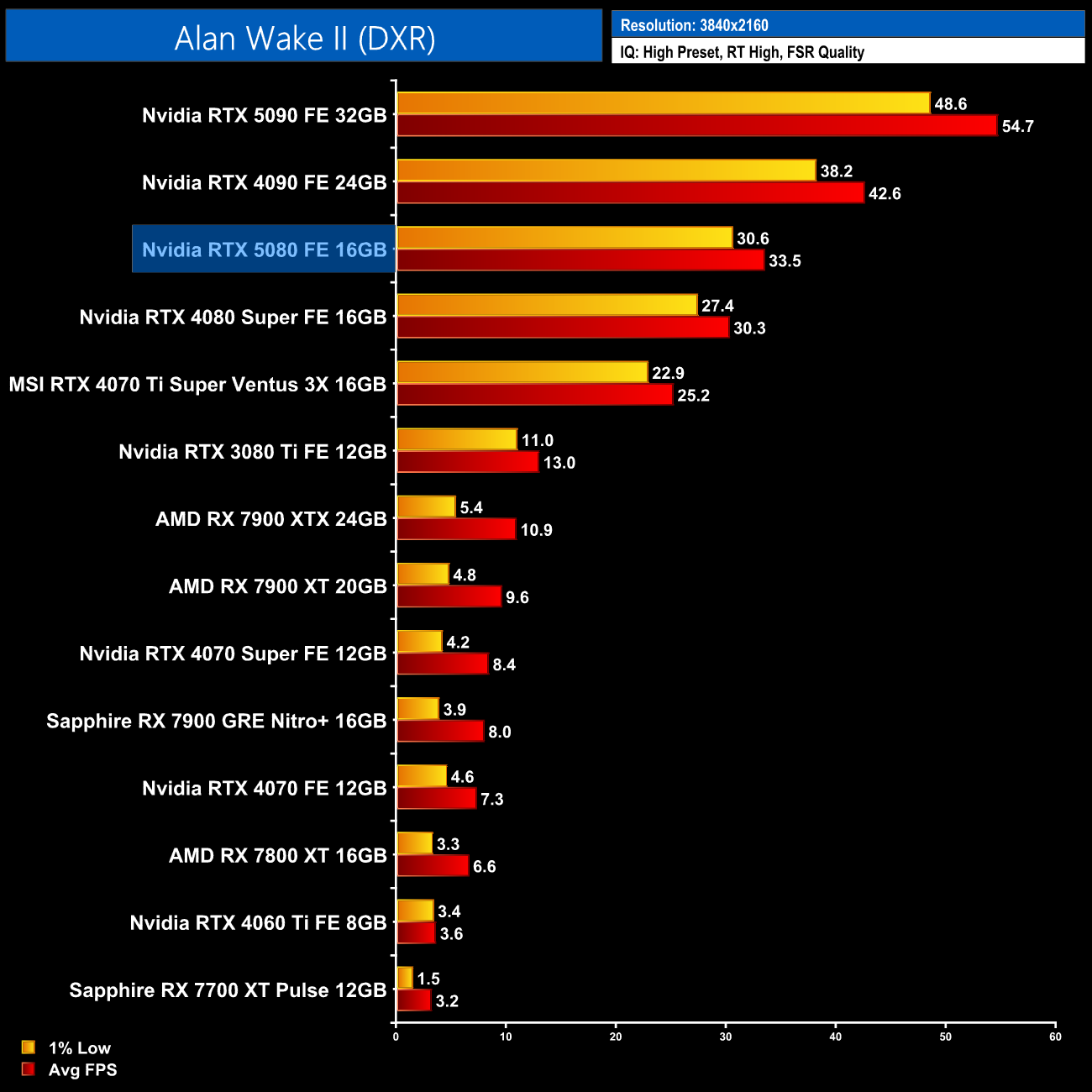
As mentioned earlier in the review, just yesterday Nvidia let us know that a new driver had been issued which was designed to fix the frametime issues in Alan Wake 2. I tested it and, sure enough, the 1% lows are now much more consistent than what we saw before. Average frame rates have dropped by a couple frames, but nothing of real significance.
Multi Frame Generation
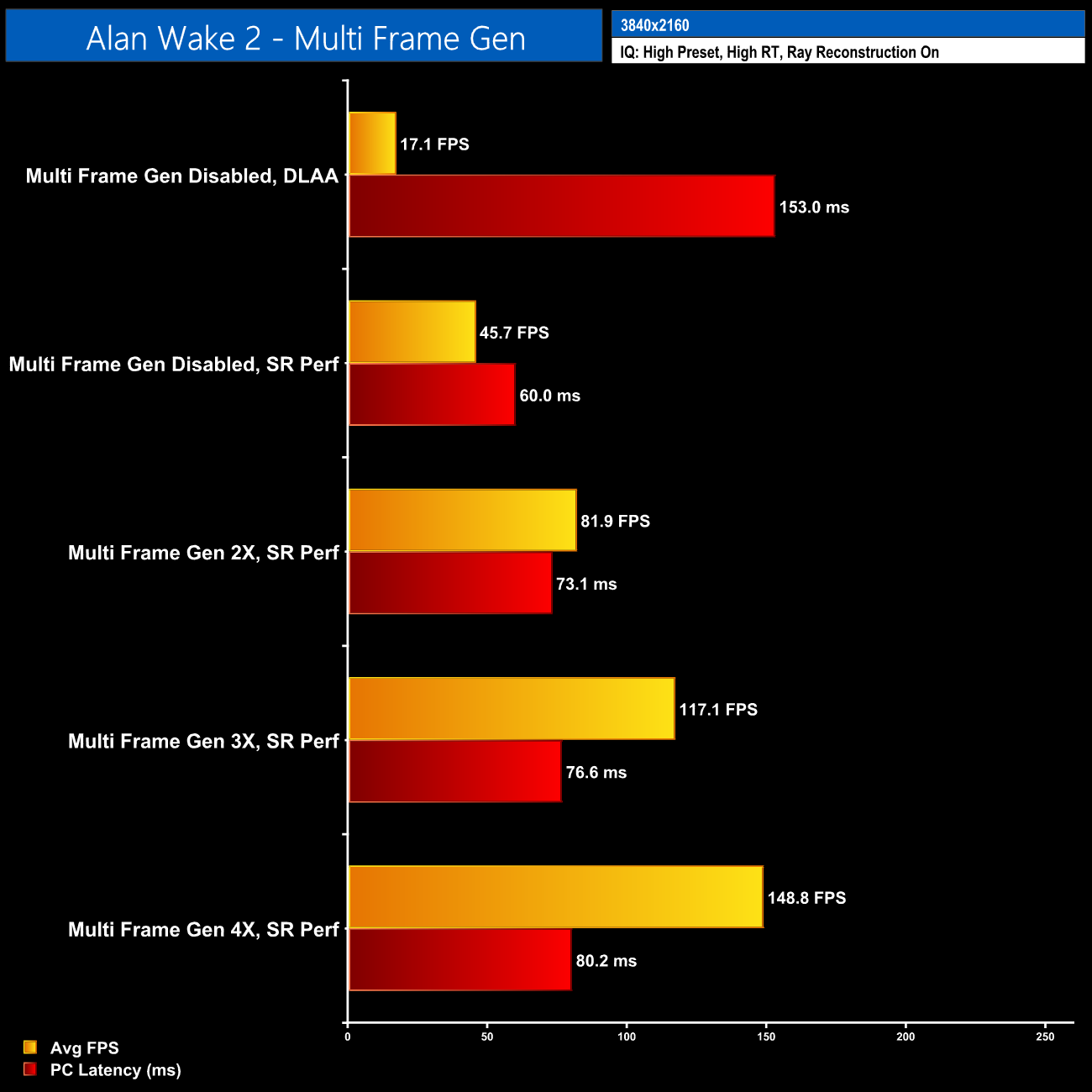
We do have a dedicated section exploring DLSS 4 and Multi Frame Generation later in the review, but here's the frame rates that are achievable if you want to enable the technology in Alan Wake 2.
Black Myth: Wukong is a 2024 action role-playing game developed and published by Game Science. The game is inspired by the classical Chinese novel Journey to the West and follows an anthropomorphic monkey based on Sun Wukong from the novel. Black Myth: Wukong was released for PlayStation 5 and Windows on August 20, 2024, with an Xbox Series X/S version to be released at a later date. (Wikipedia).
Engine: Unreal Engine 5. We test using the Cinematic preset, Ray Tracing set to Very High, TSR set to 67% render scale, DXR API.
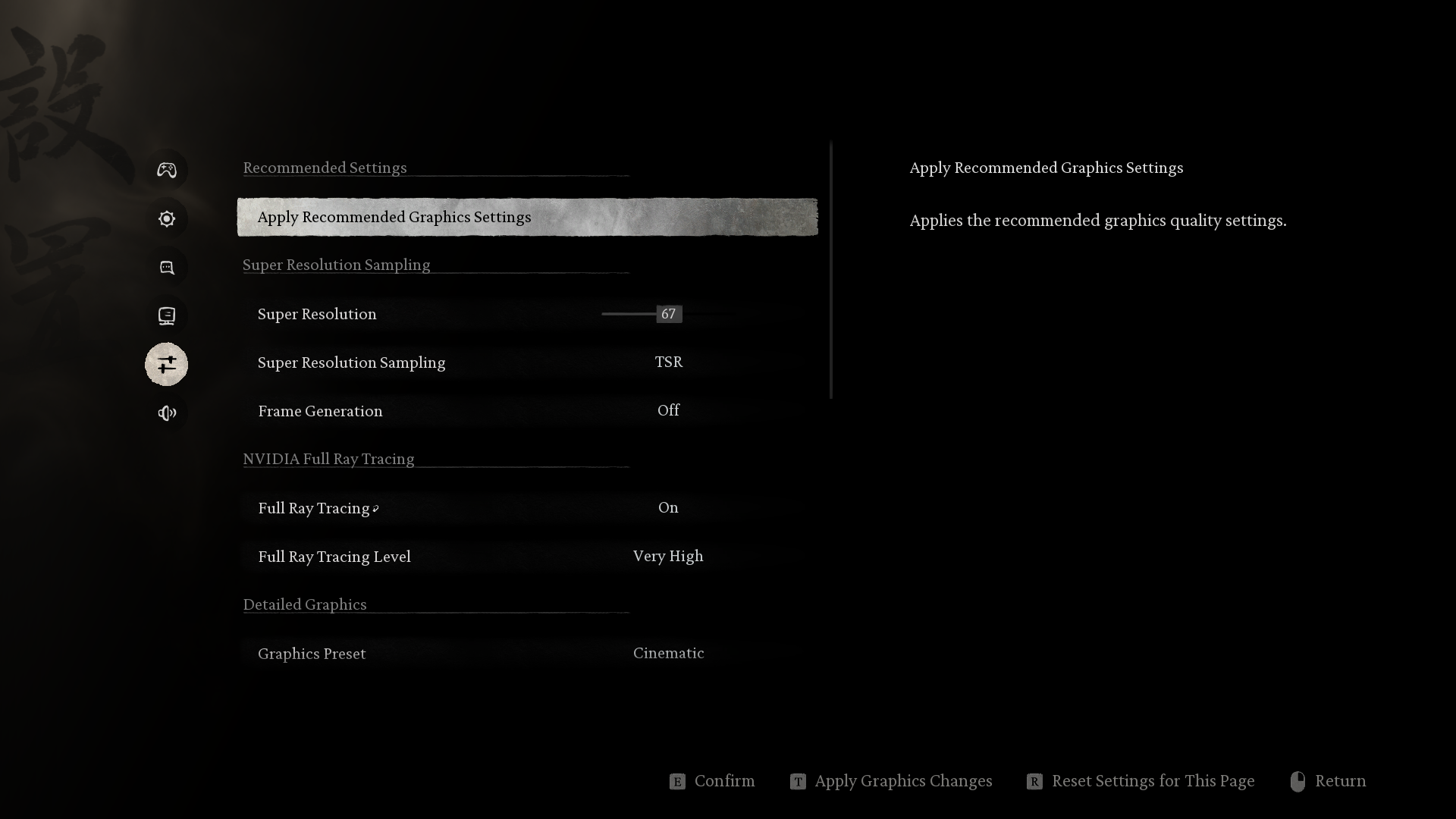
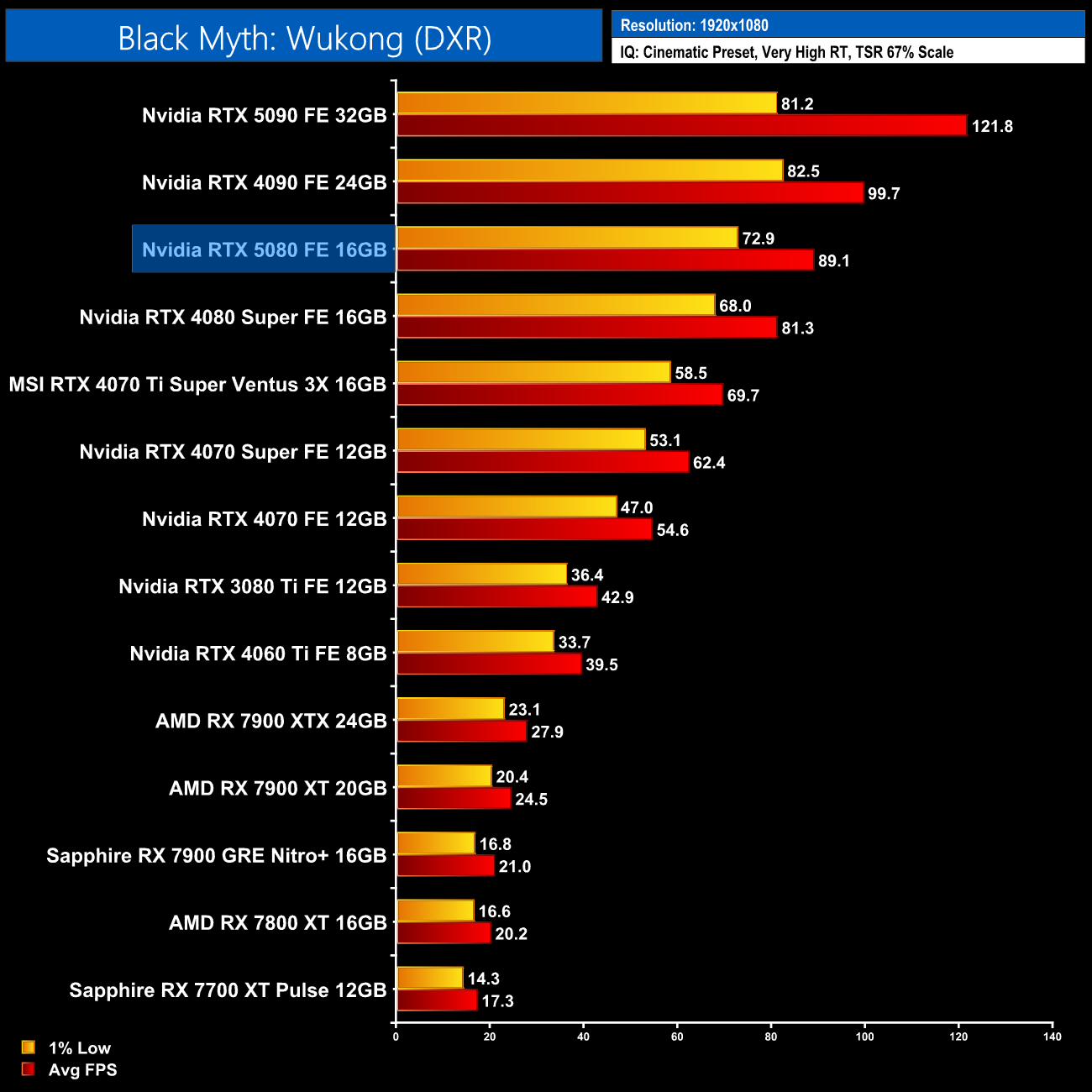
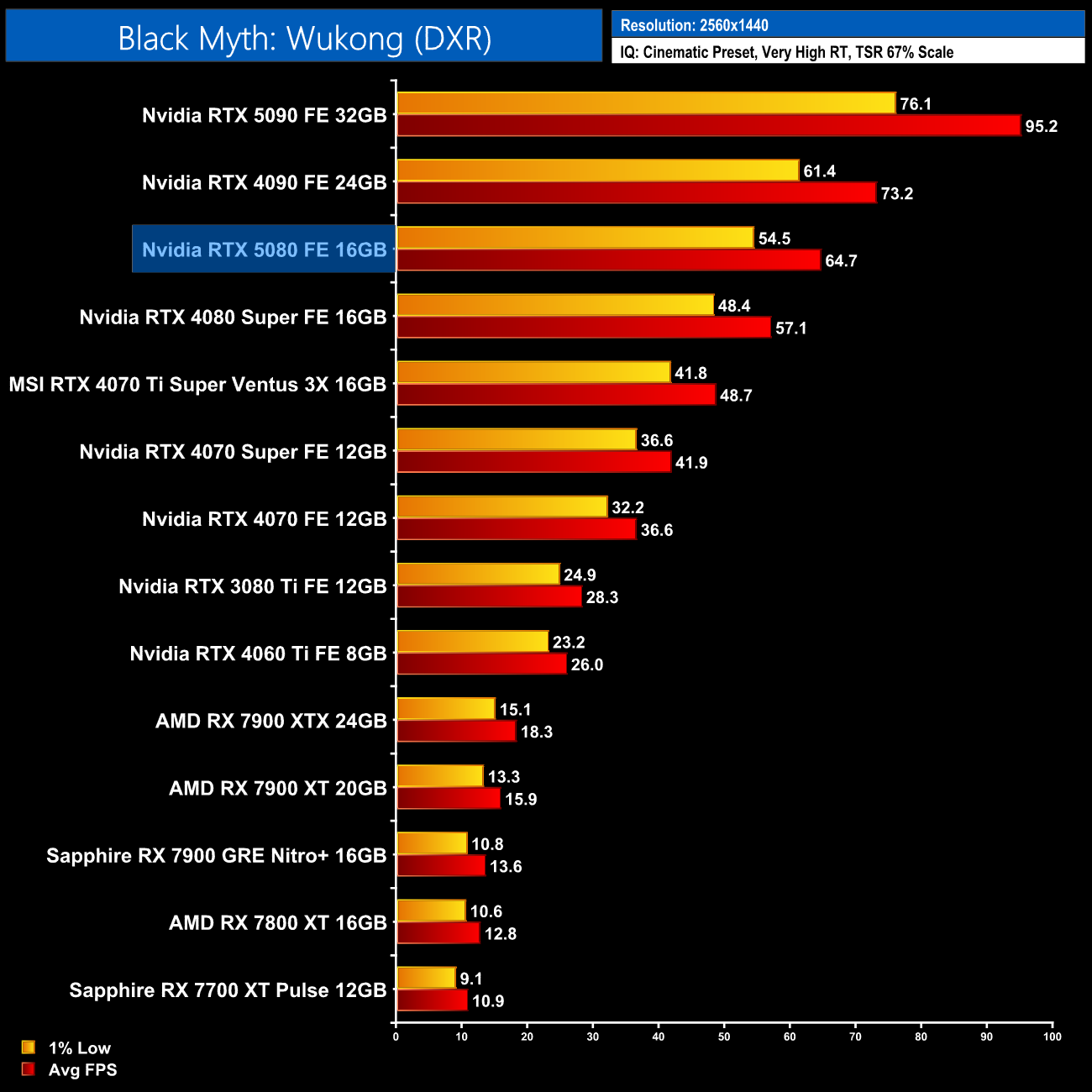
As for Black Myth: Wukong, this one is another punishing title when path tracing is enabled, and at 1440p the 5080 manages 65fps on average, even when using Quality upscaling. That makes it 13% faster than the 4080 Super, but its 12% slower than the 4090.
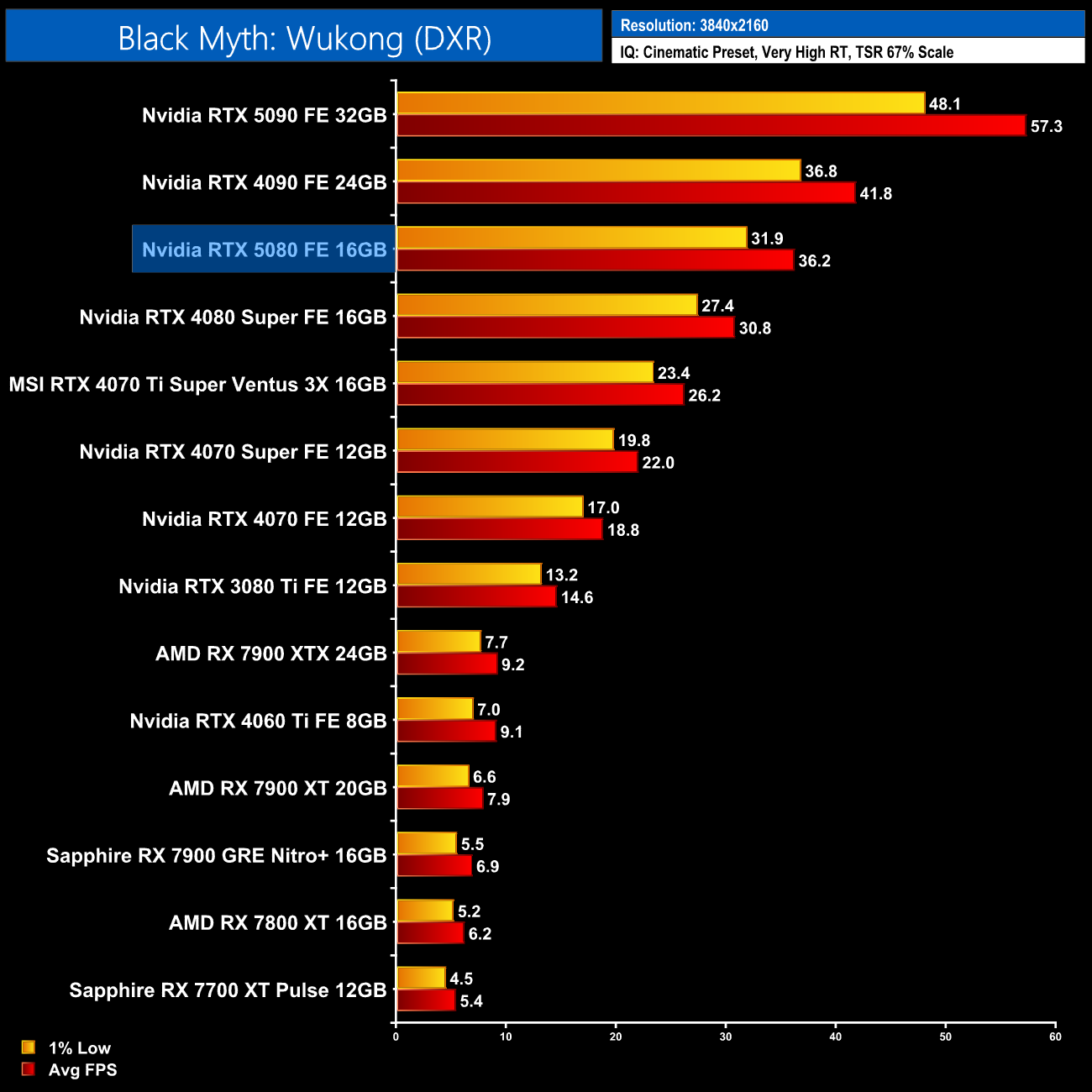
4K sees frame rates drop to just 36fps on average, though that works out as an 18% lead over the 4080 Super.
Cyberpunk 2077 is a 2020 action role-playing video game developed and published by CD Projekt. The story takes place in Night City, an open world set in the Cyberpunk universe. Players assume the first-person perspective of a customisable mercenary known as V, who can acquire skills in hacking and machinery with options for melee and ranged combat. Cyberpunk 2077 was released for Microsoft Windows, PlayStation 4, Stadia, and Xbox One on 10 December 2020. (Wikipedia).
Engine: REDengine 4. We test using the Ray Tracing: Ultra preset, DXR API. DLSS/FSR are disabled.
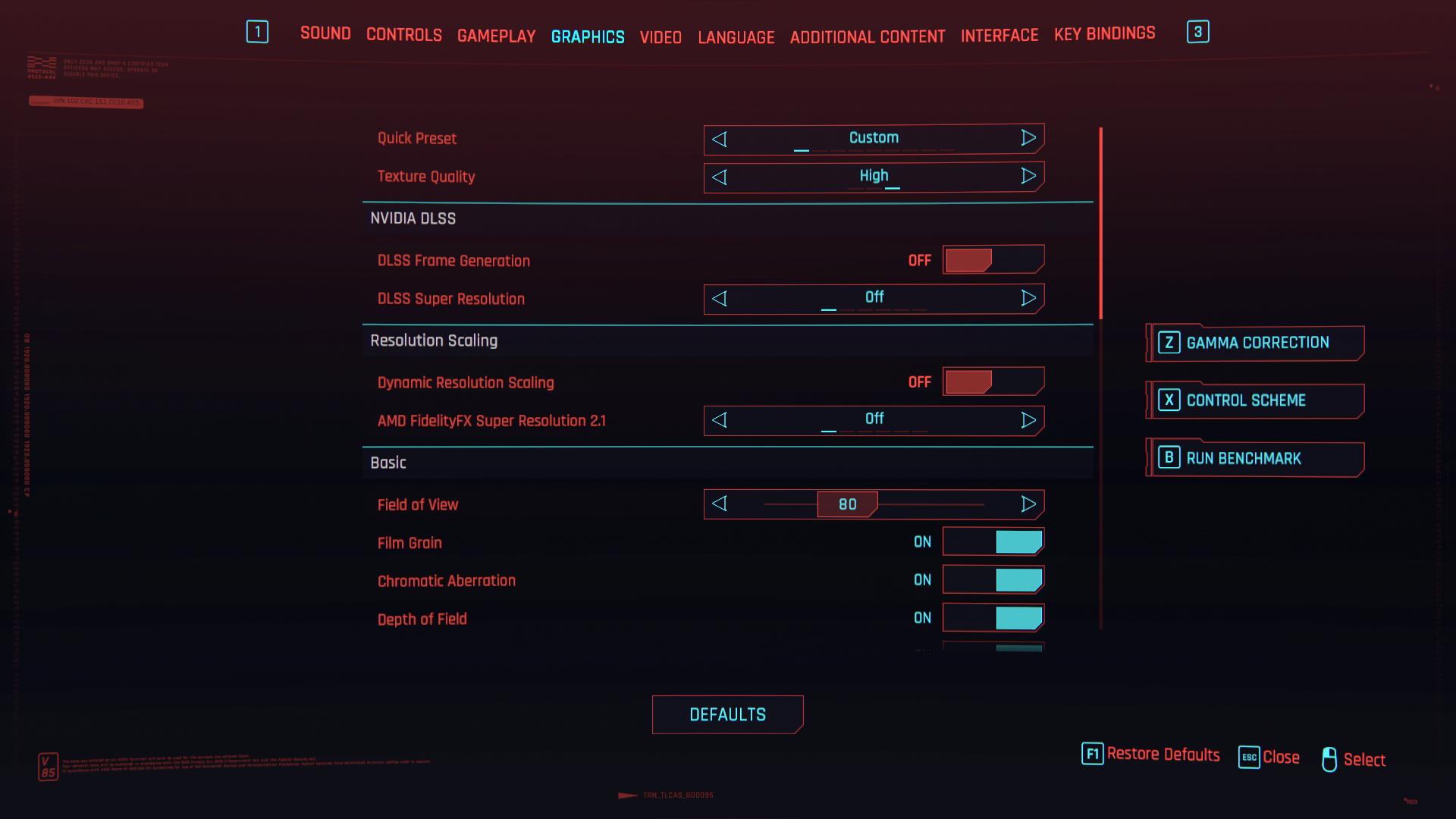
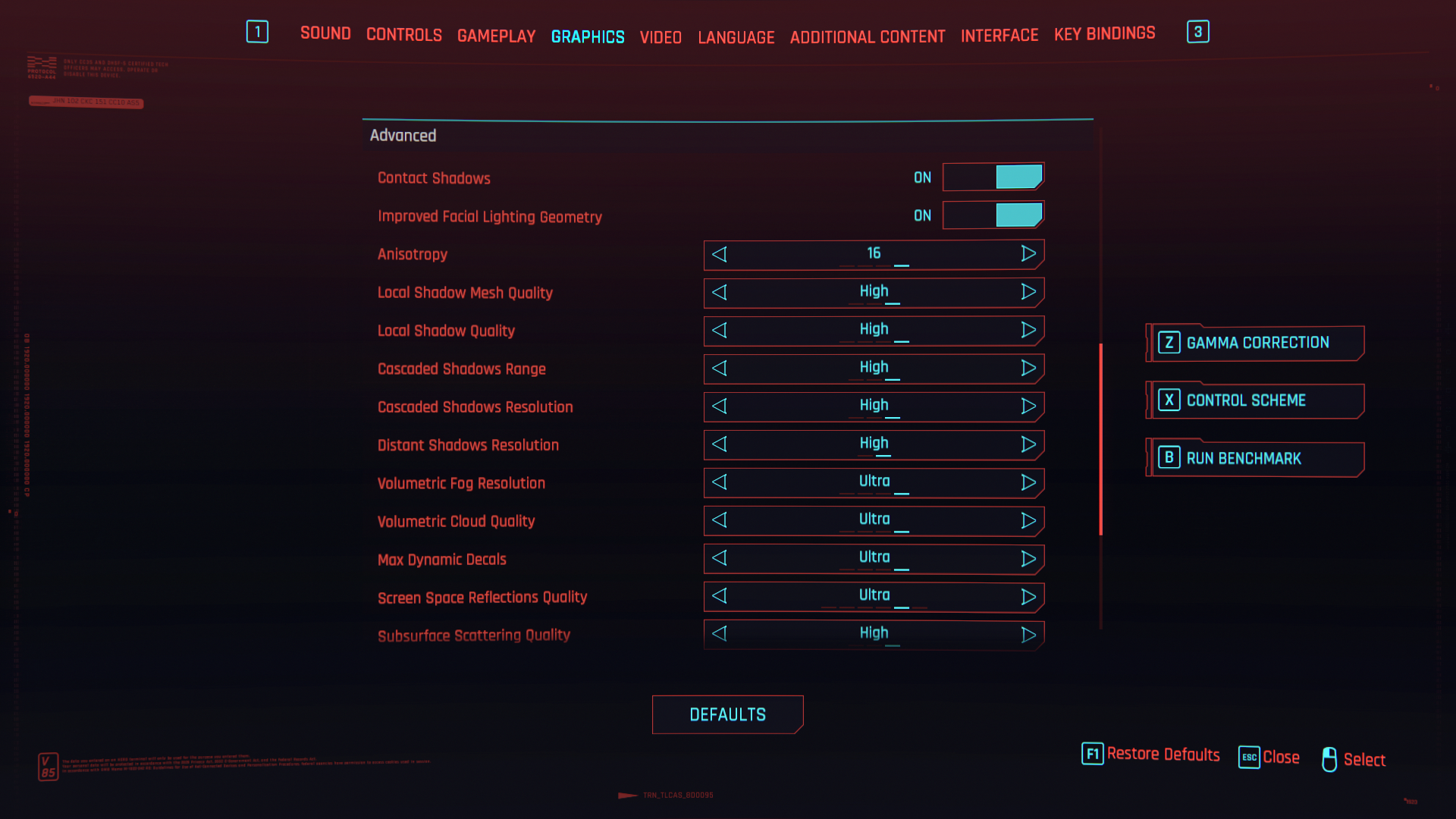
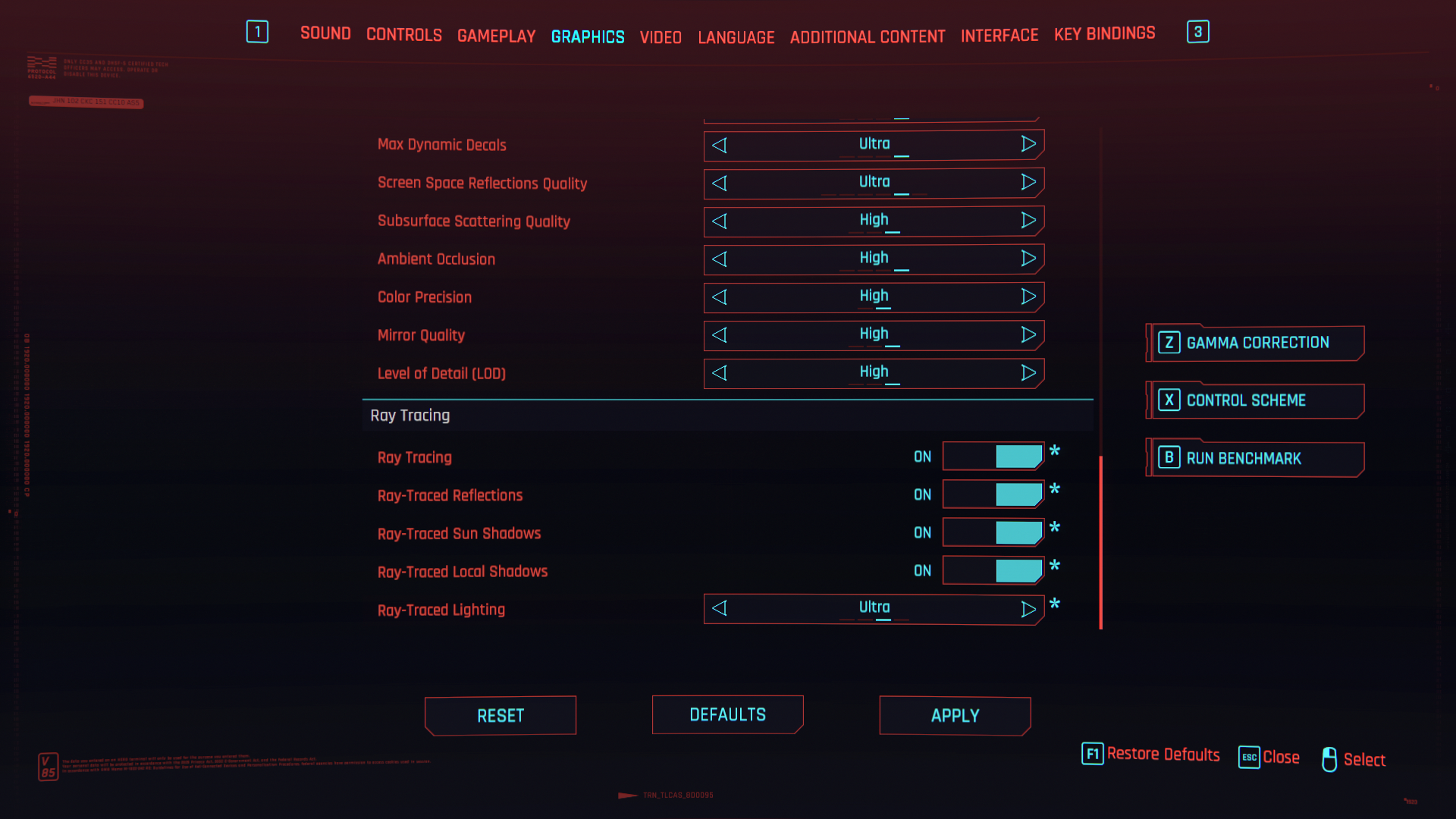
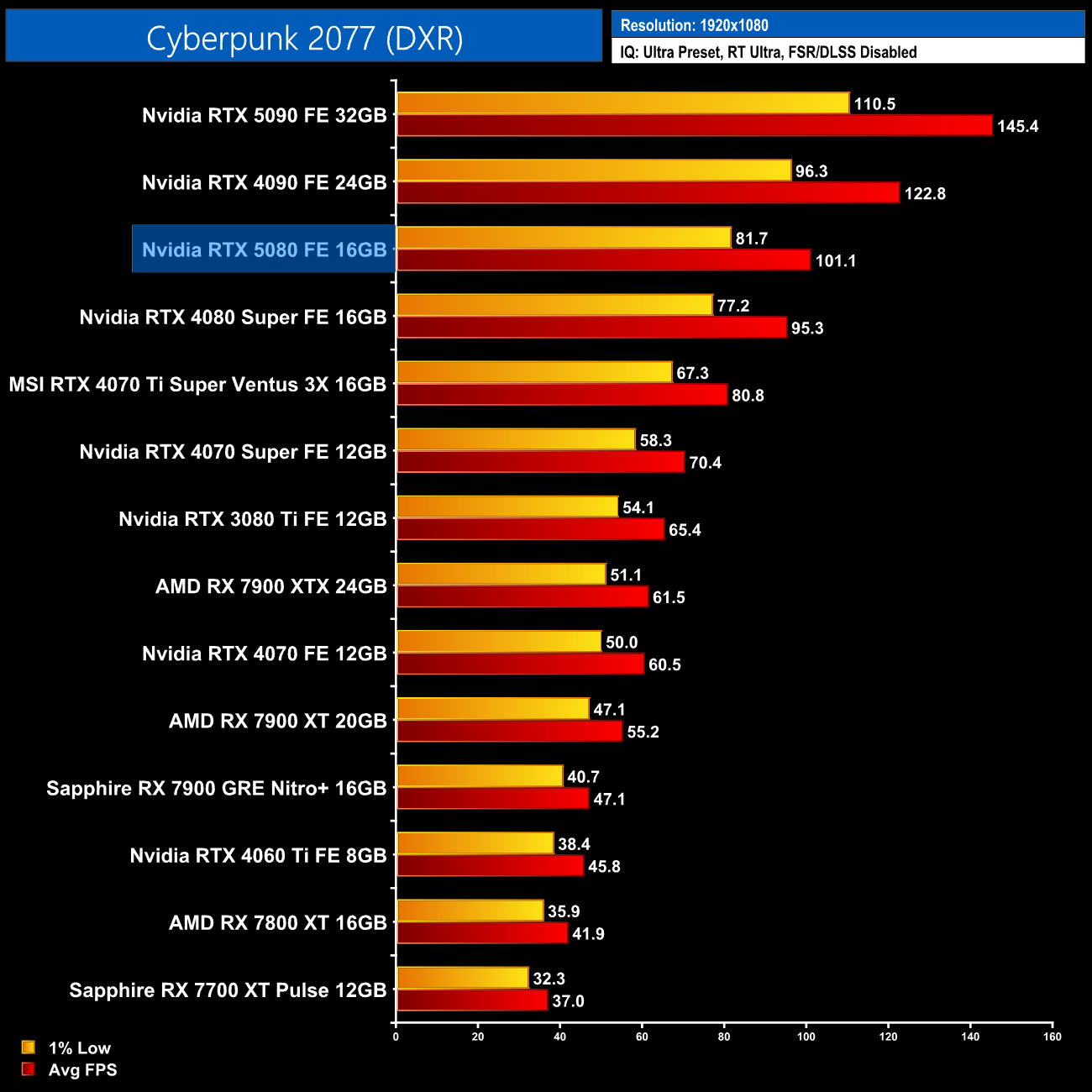
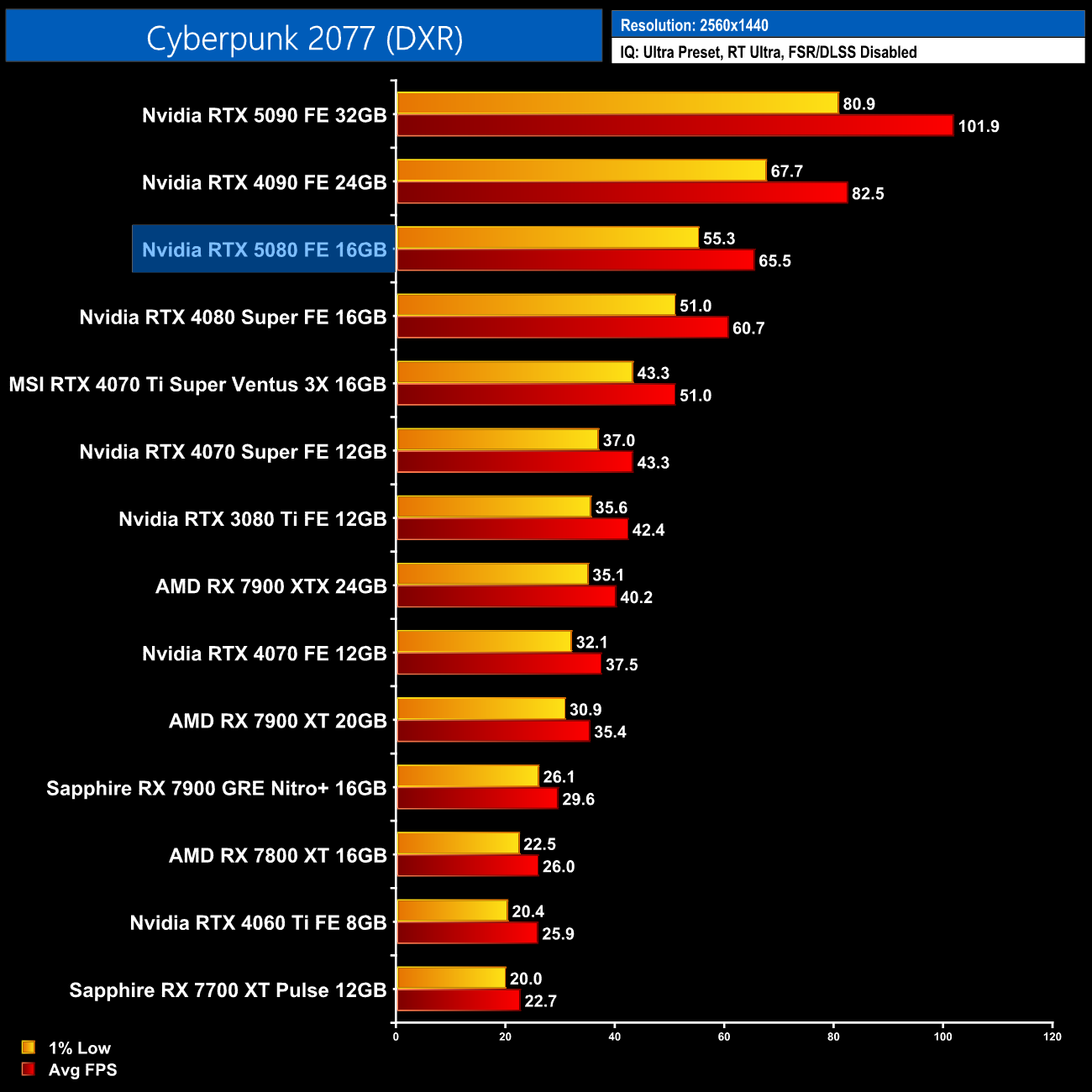
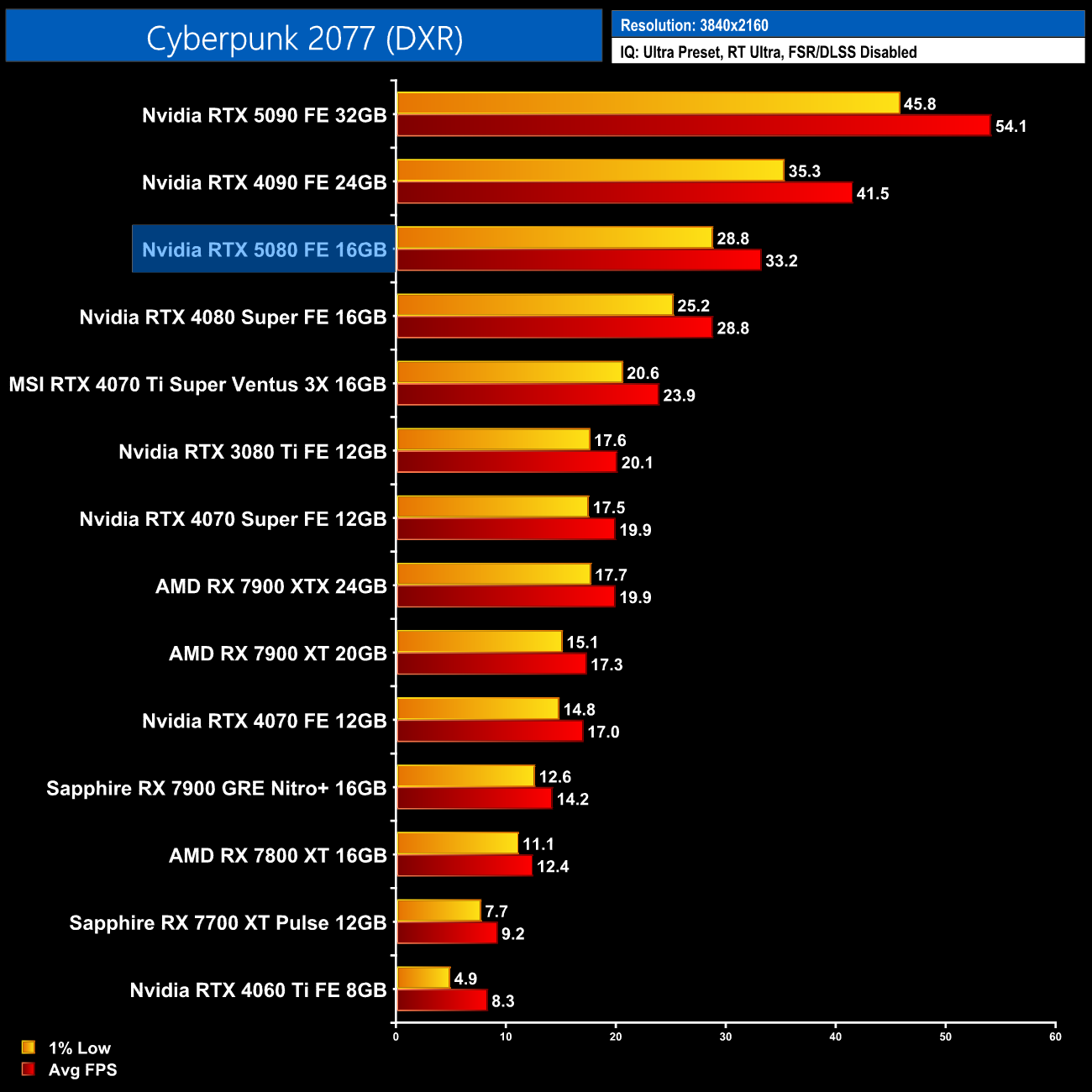
Next is Cyberpunk 2077, where we are not using any kind of upscaling. At 1440p the 5080 delivers an 8% gain over the 4080, though it's 63% faster than the RX 7900 XTX.
4K sees the 1% lows drop below 30fps, though, so you'd certainly want to enable DLSS here, and the 5080 comes in 20% slower than the 4090.
Multi Frame Generation
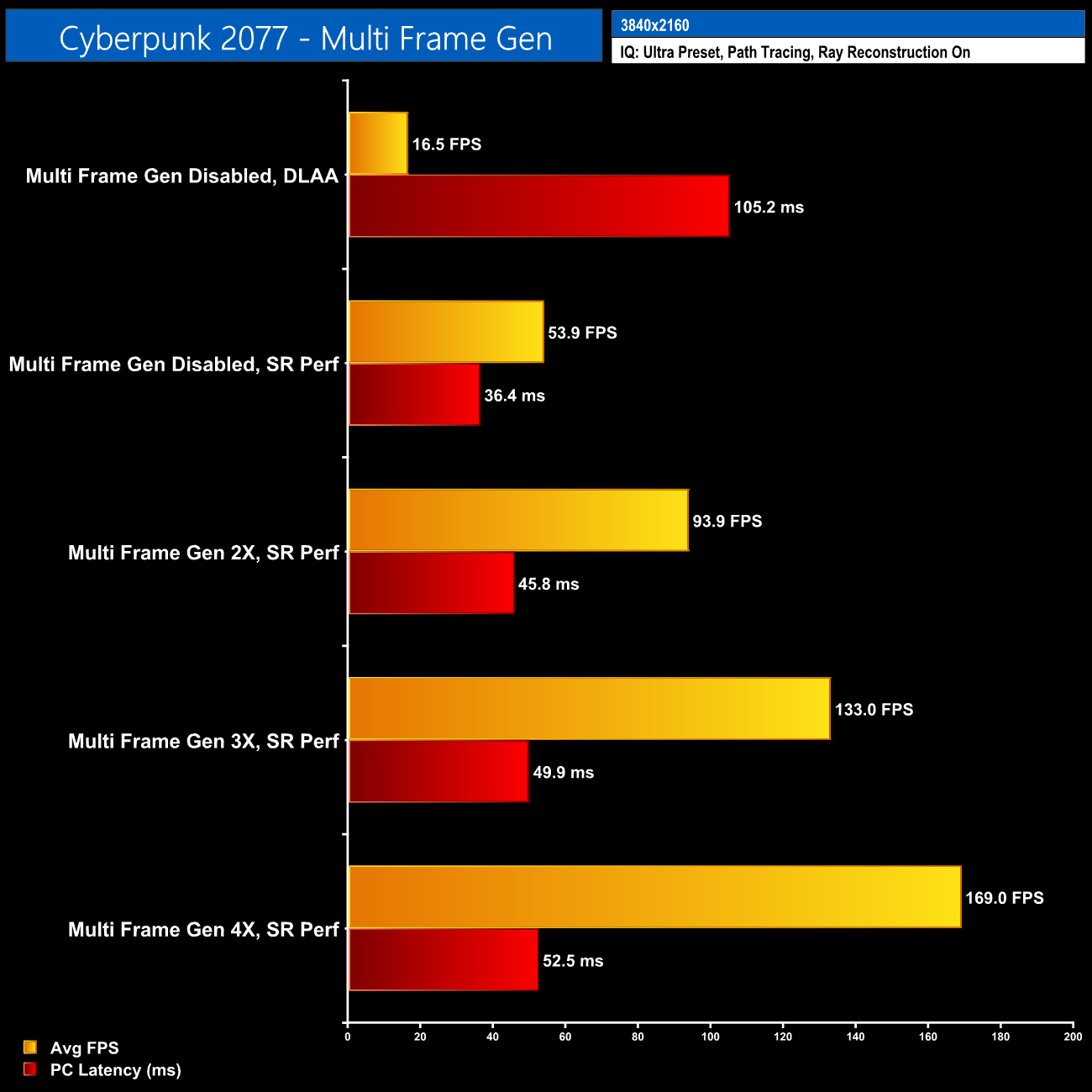
We do have a dedicated section exploring DLSS 4 and Multi Frame Generation later in the review, but here's the frame rates that are achievable if you want to enable the technology in Cyberpunk 2077, along with path tracing in the RT Overdrive mode.
F1 24 is a racing video game developed by Codemasters and published by EA Sports. It is the sixteenth entry in the F1 series by Codemasters. It holds the official licence for the 2023 Formula One and Formula 2 championships. The game was released for Microsoft Windows, PlayStation 4, PlayStation 5, Xbox One, Xbox Series X/S, and Linux (through Valve's Proton compatibility layer) on 16 June 2023. (Wikipedia).
Engine: EGO. We test using the Ultra High preset, High ray tracing quality, DXR API. DLSS/FSR are disabled.


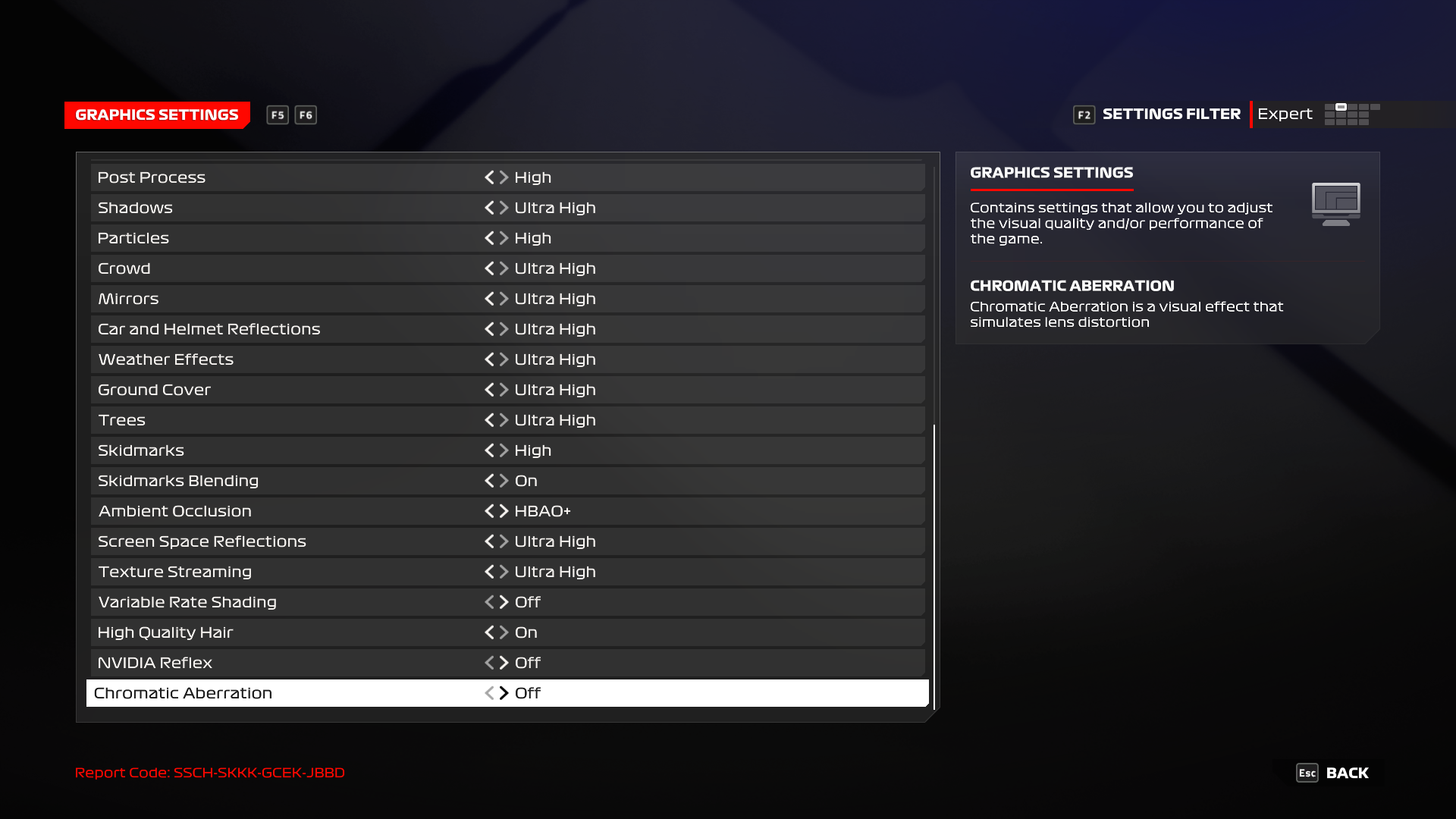
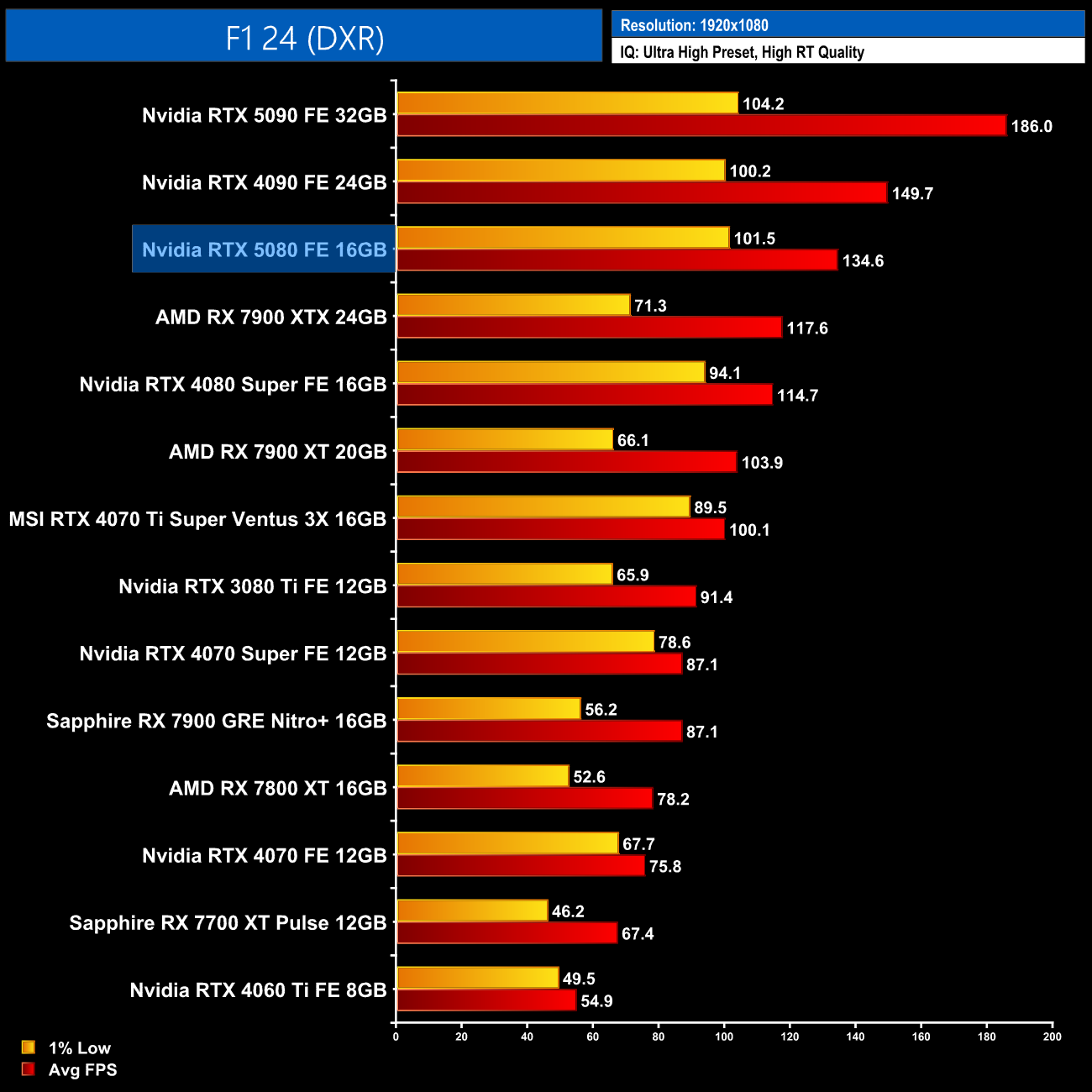
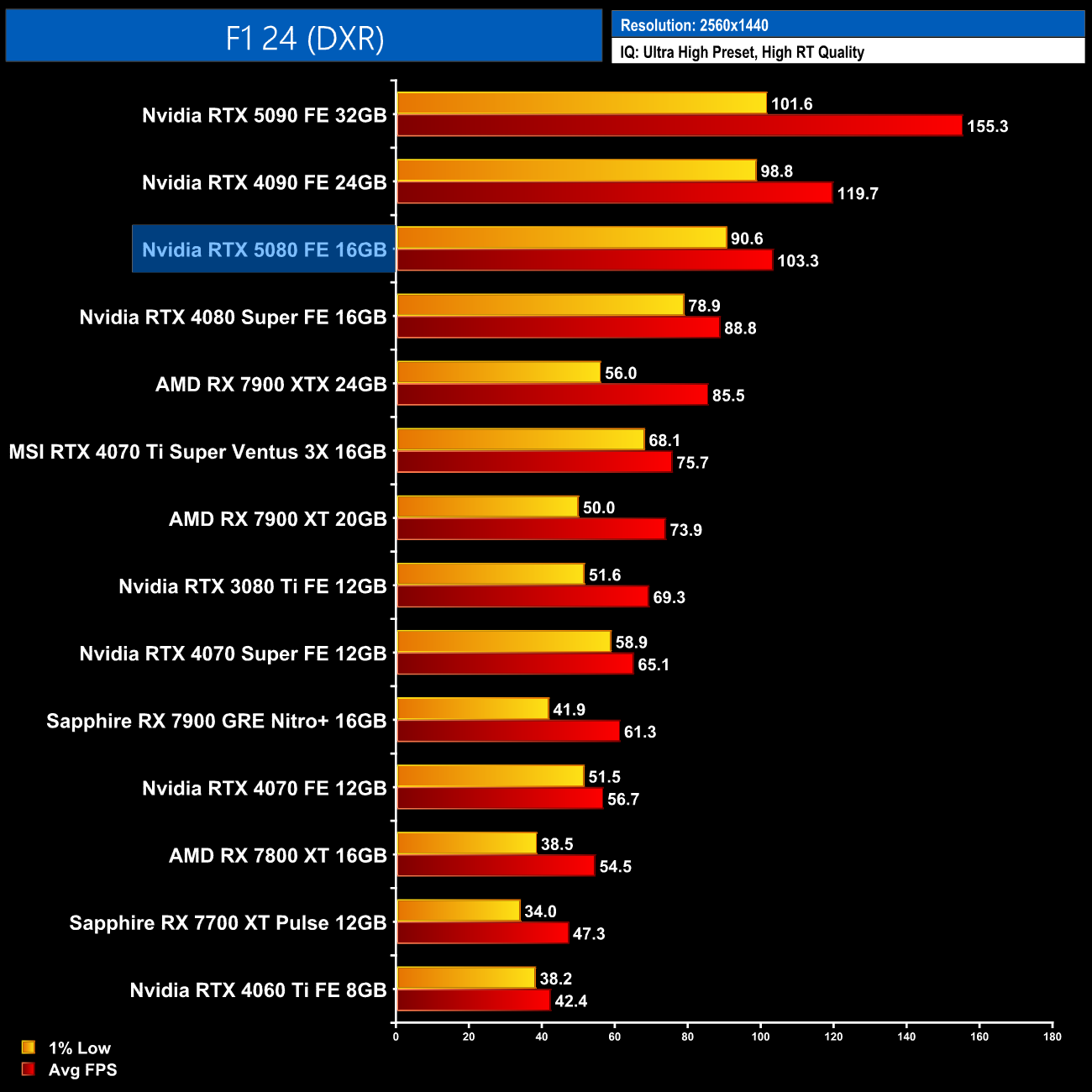
Next up is F1 24, where the 5080 is able to deliver 103fps with ray tracing cranked to the max. That gives it a 16% lead over the 4080 Super at 1440p, though it still can't catch the 4090.
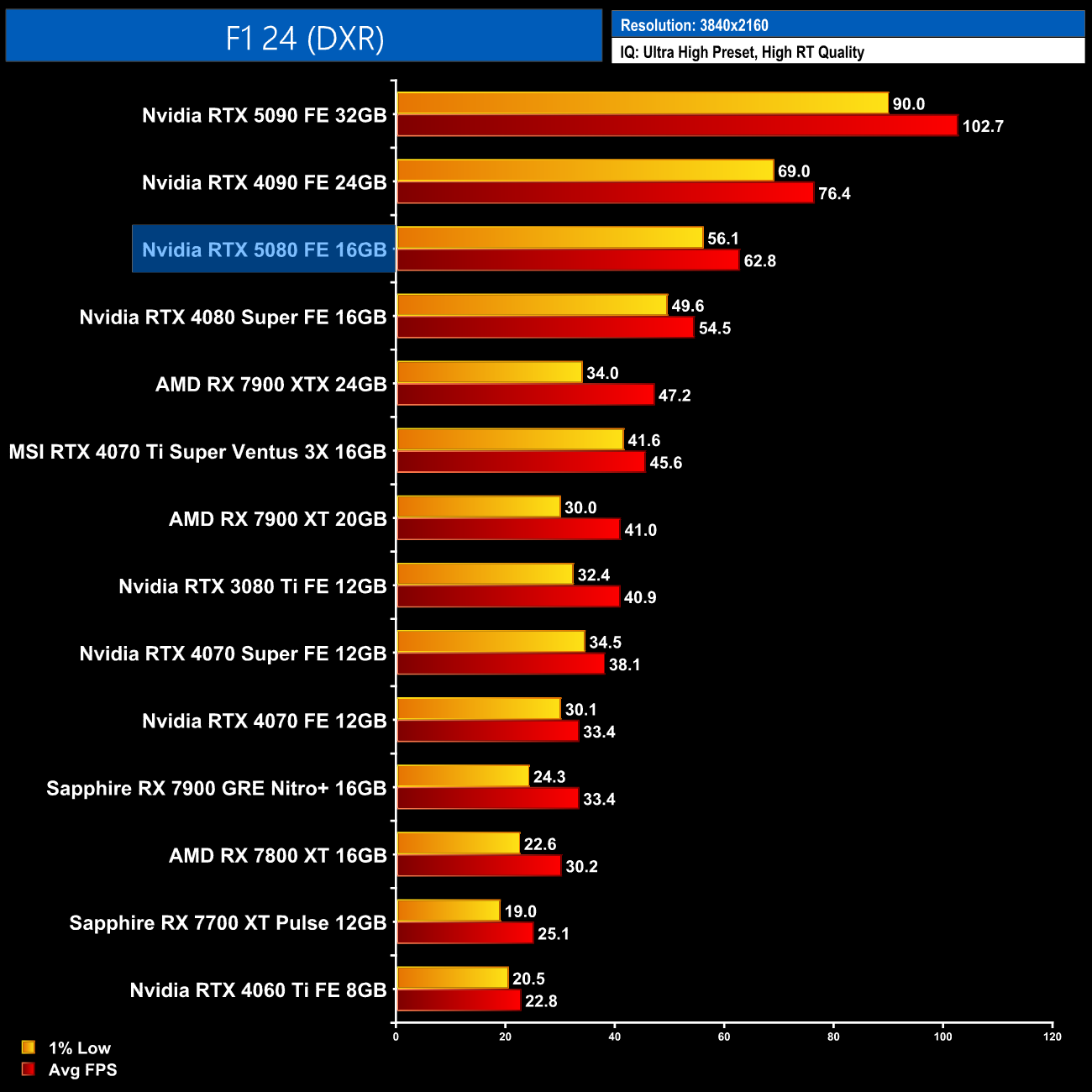
At 4K, the overall margins haven't really changed, with the 5080 still sitting third on our chart – faster than the 4080 Super, but slower than the 4090.
Ratchet & Clank: Rift Apart is a 2021 third-person shooter platform game developed by Insomniac Games and published by Sony Interactive Entertainment for the PlayStation 5. It is the ninth main installment in the Ratchet & Clank series and a sequel to Ratchet & Clank: Into the Nexus. Rift Apart was announced in June 2020 and was released on June 11, 2021. A Windows port by Nixxes Software was released on July 26, 2023. (Wikipedia).
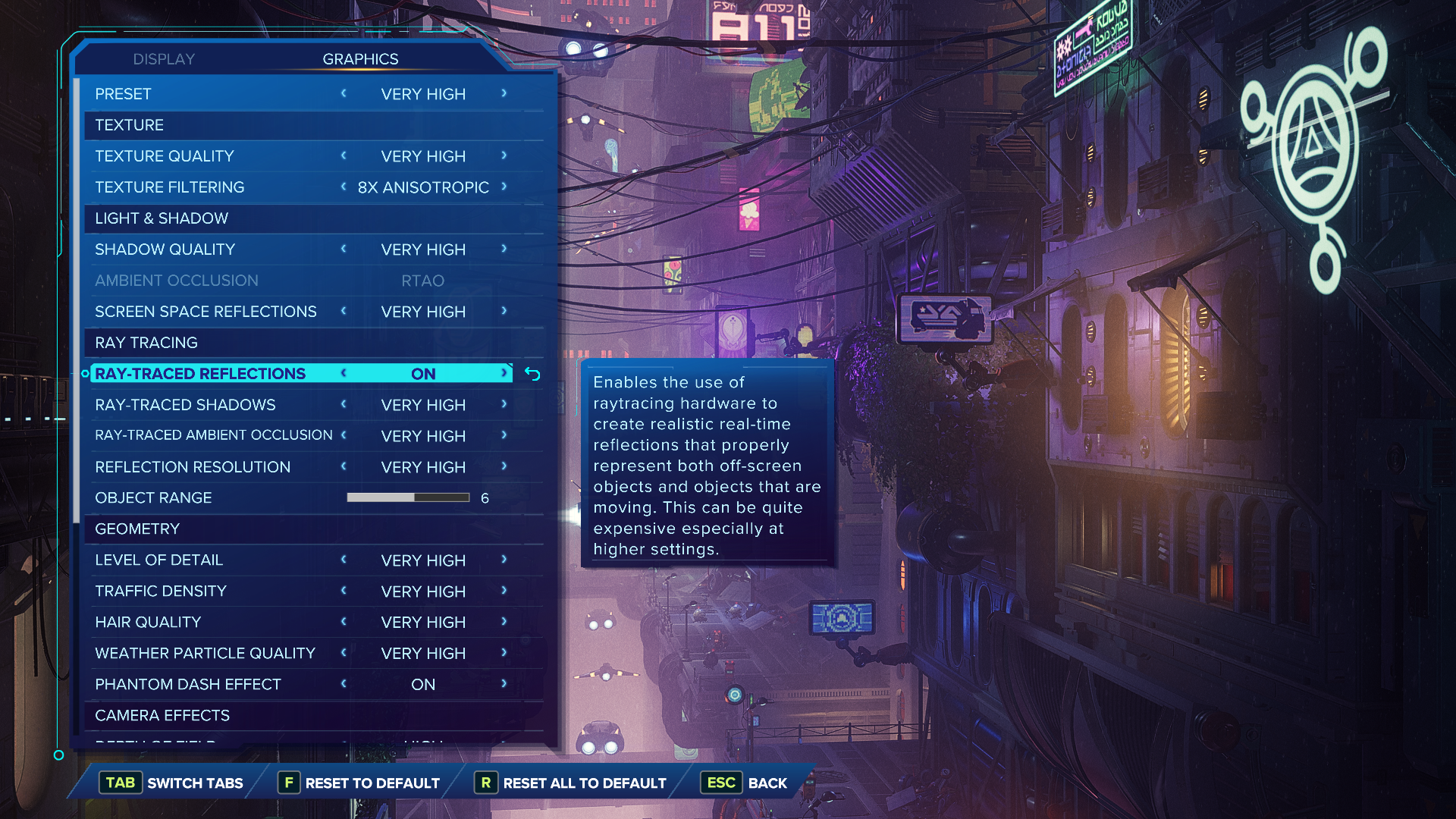
Engine: Insomniac Games in-house engine. We test using the Very High preset, Very High ray tracing, DXR API. DLSS/FSR are disabled.
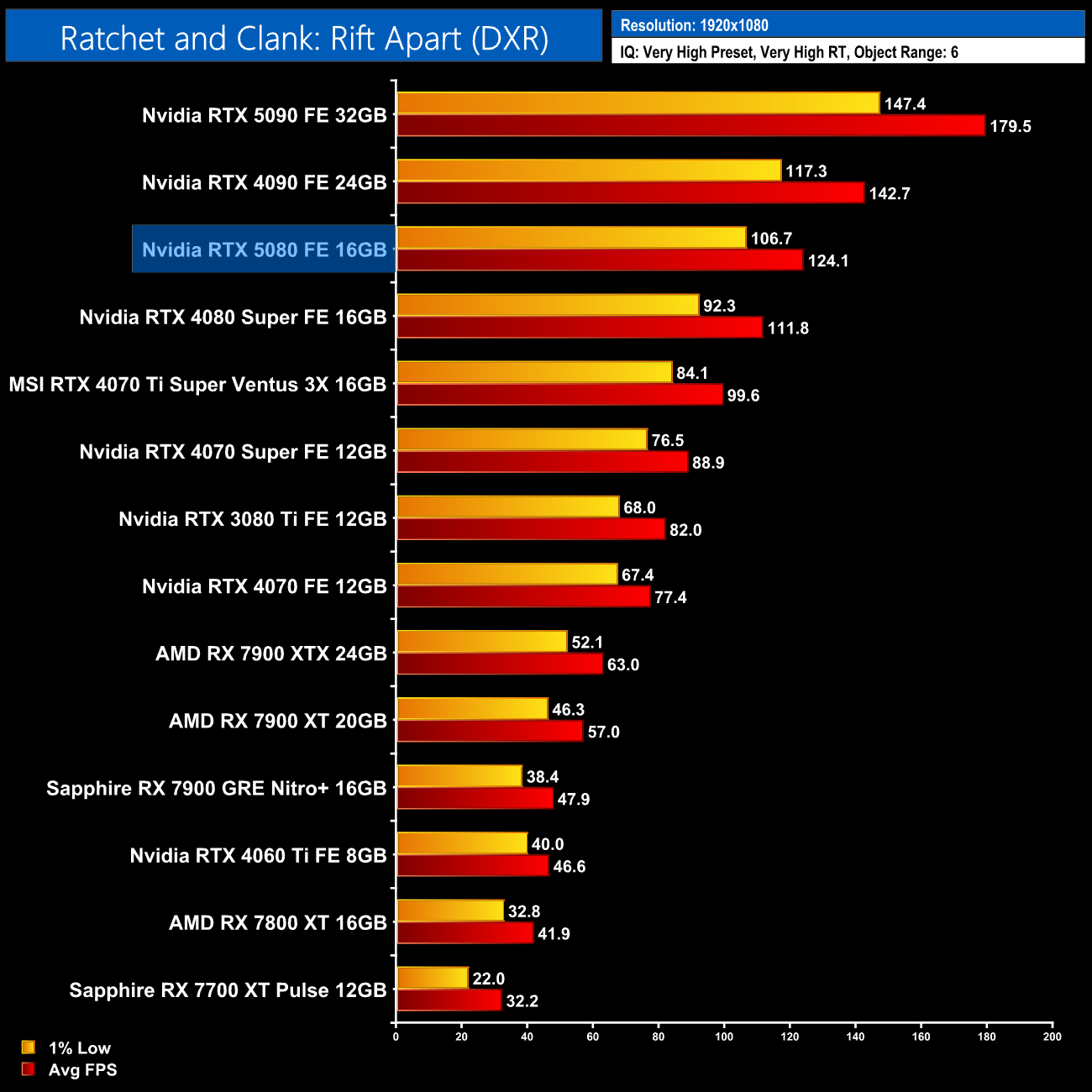
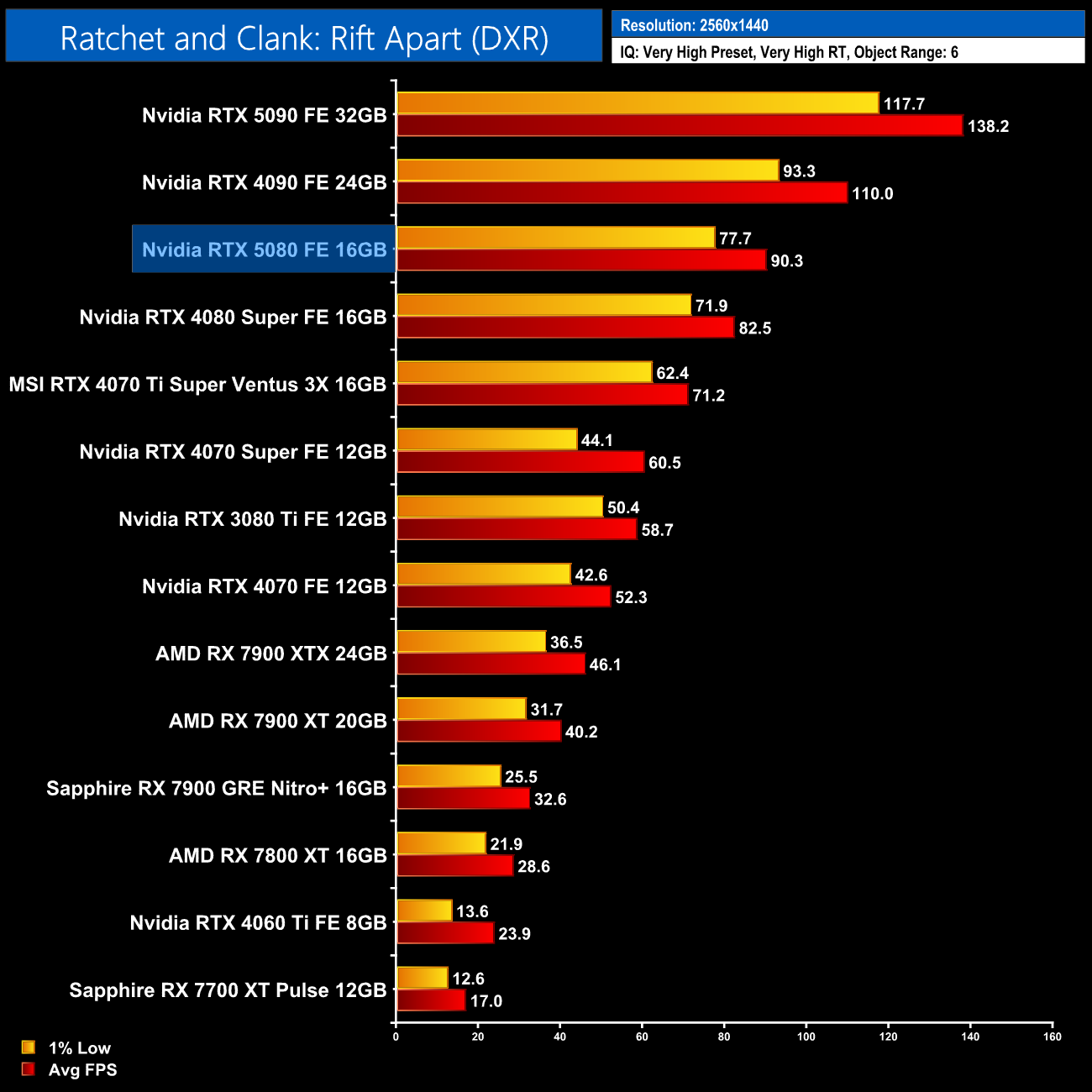
Ratchet and Clank shows smaller gains for the 5080 over the 4080 Super, however, with the Blackwell GPU coming in 10% faster at 1440p. It is almost double the performance of the RX 7900 XTX, however, while it's 18% slower than the 4090.
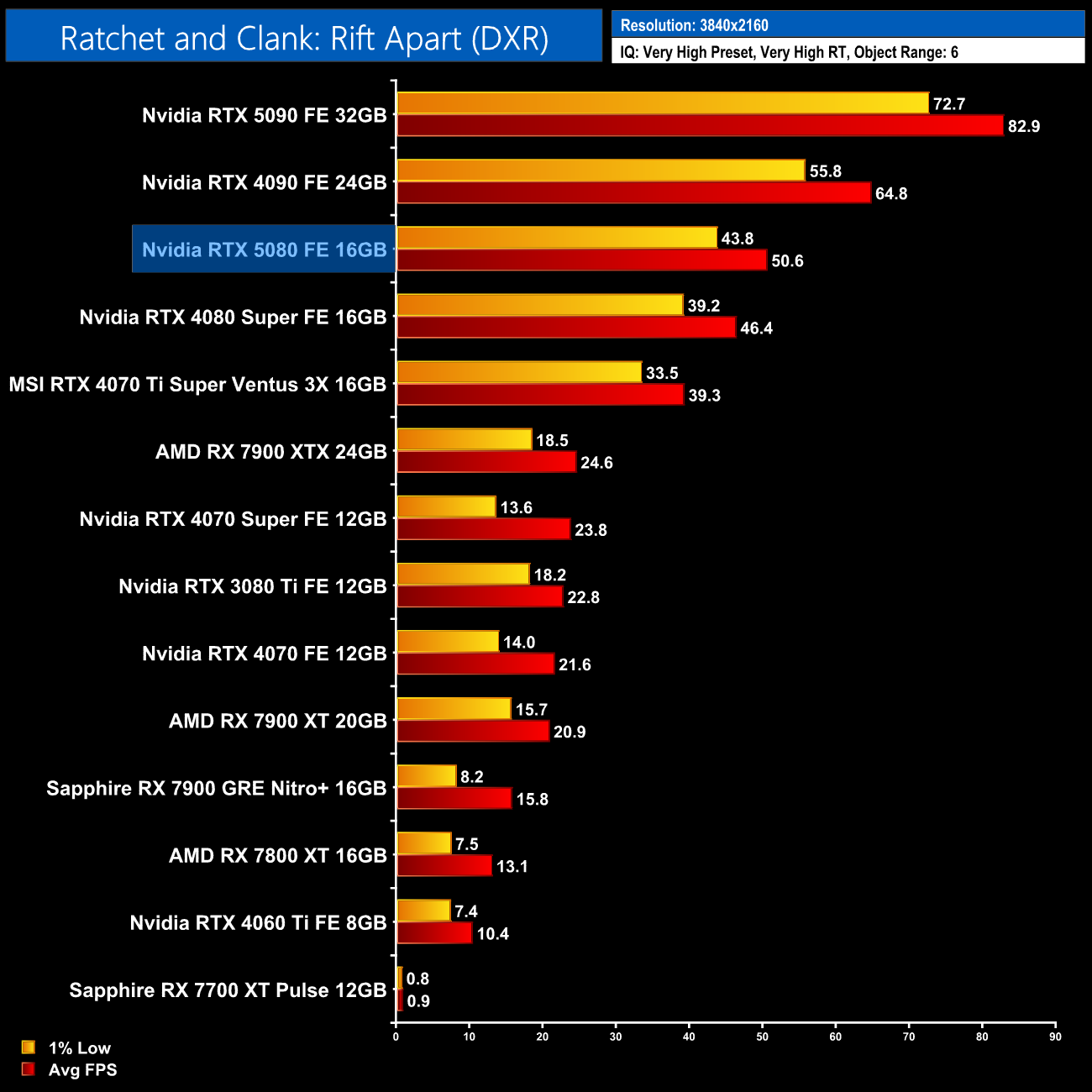
Up at 4K we're now looking at a 9% gain over the 4080 Super, though the 5080 is 22% behind the RTX 4090.
Returnal is a 2021 roguelike video game developed by Housemarque and published by Sony Interactive Entertainment. It was released for the PlayStation 5 on April 30, 2021 and Windows on February 15, 2023. The game follows Selene Vassos, an astronaut who lands on the planet Atropos in search of the mysterious “White Shadow” signal and finds herself trapped in a time loop. (Wikipedia).
Engine: Unreal Engine 4. We test using the Epic preset, Epic ray traced shadows and reflections, DXR API. DLSS/FSR are disabled.
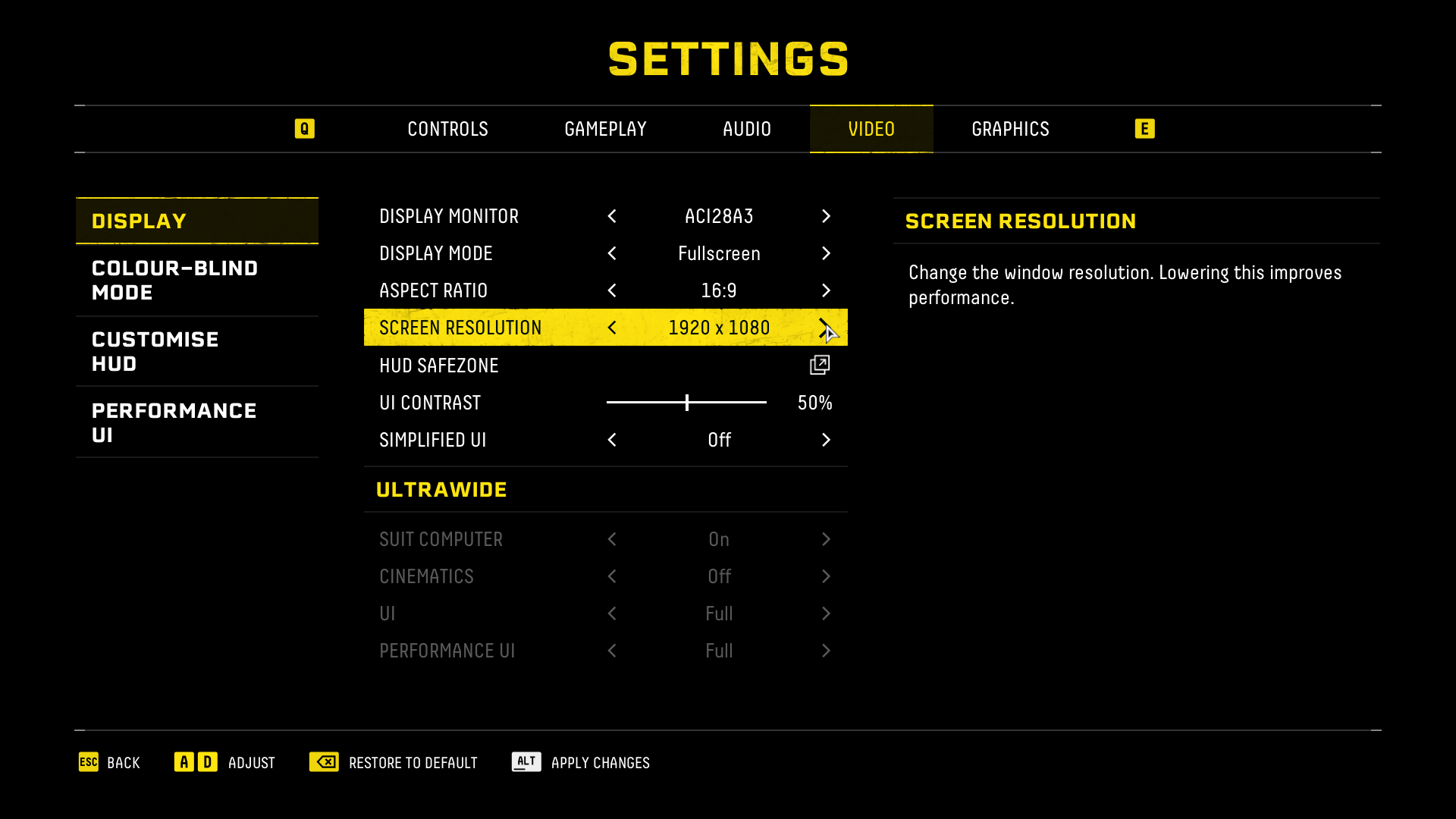
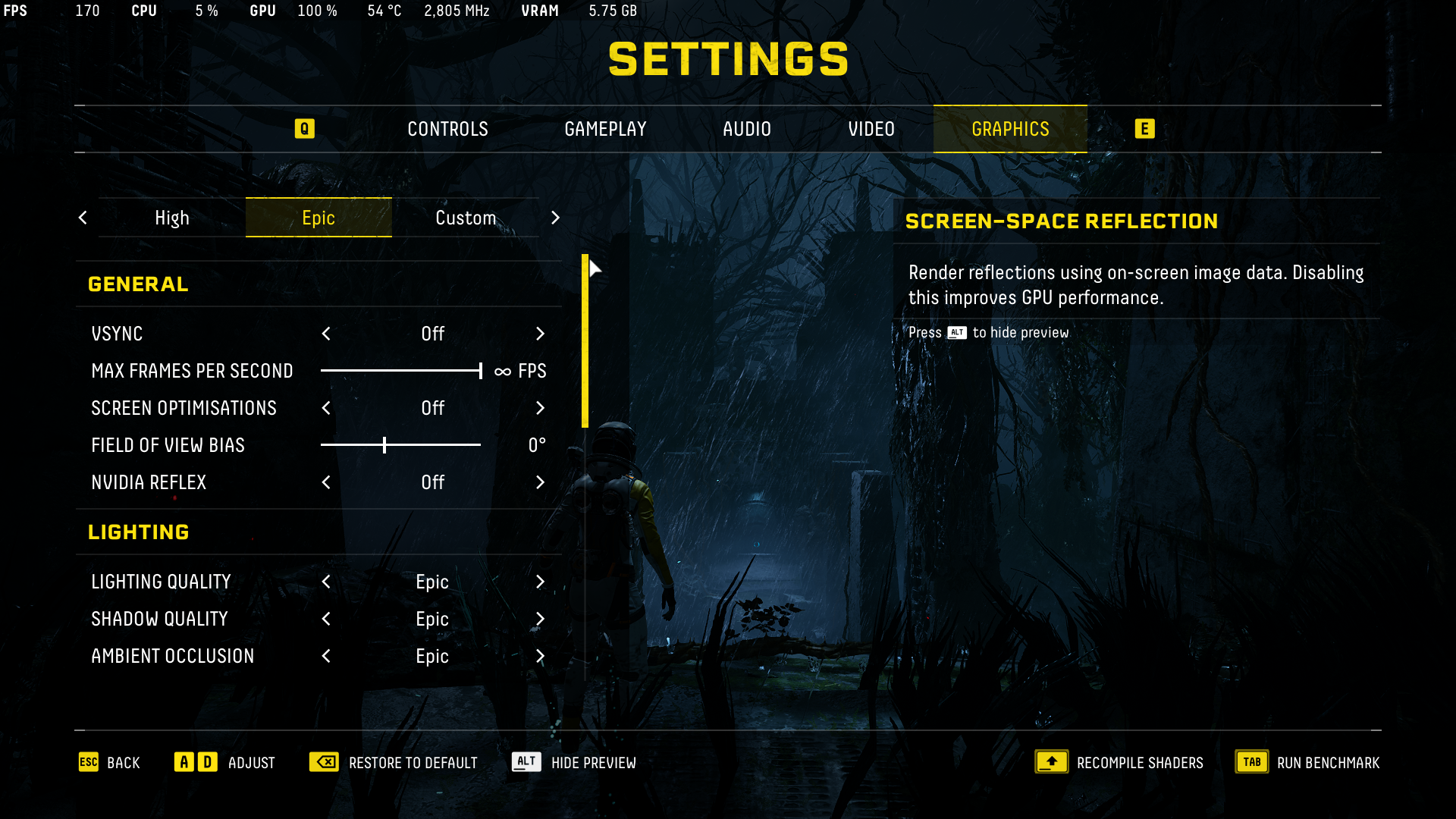
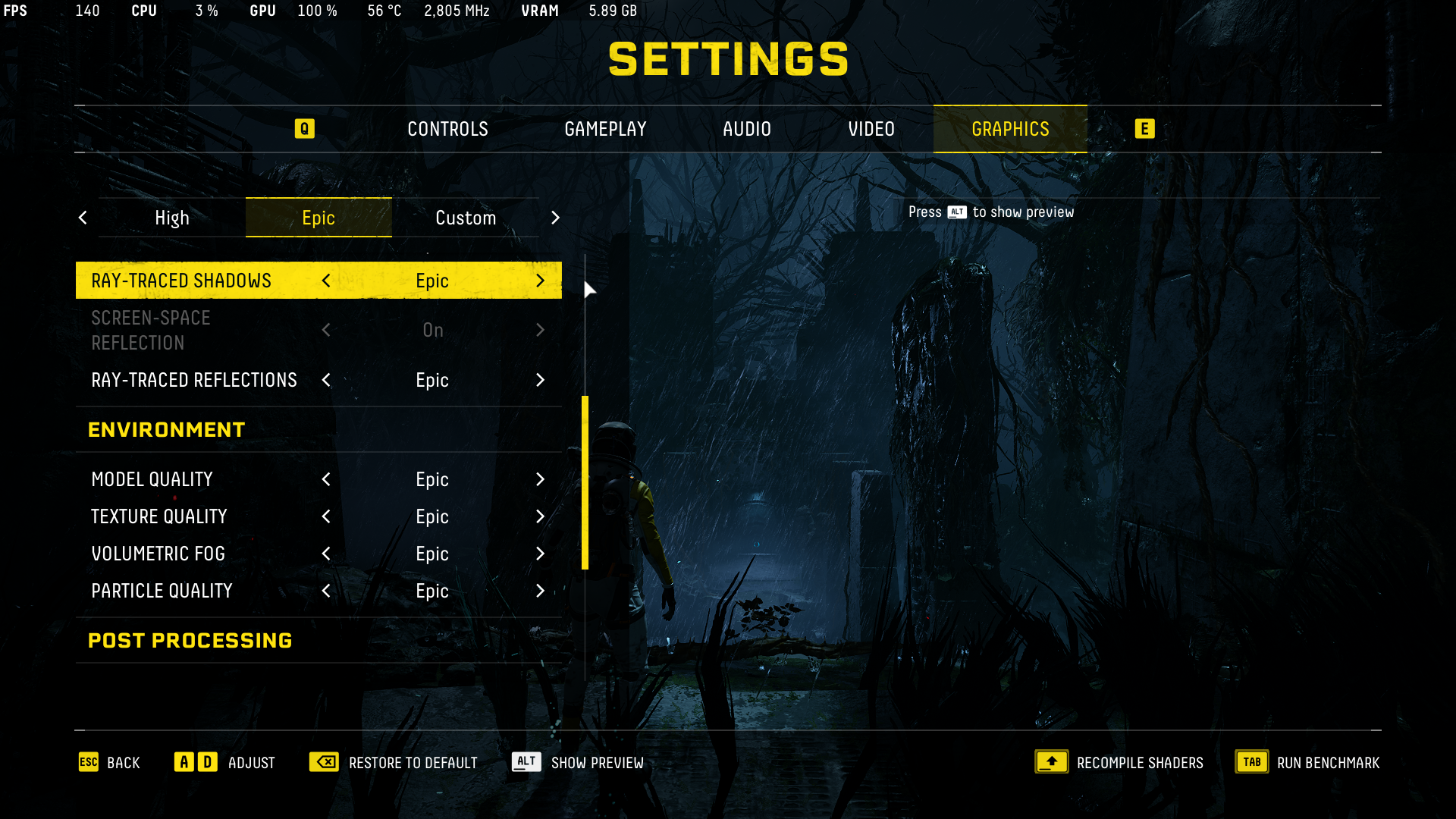
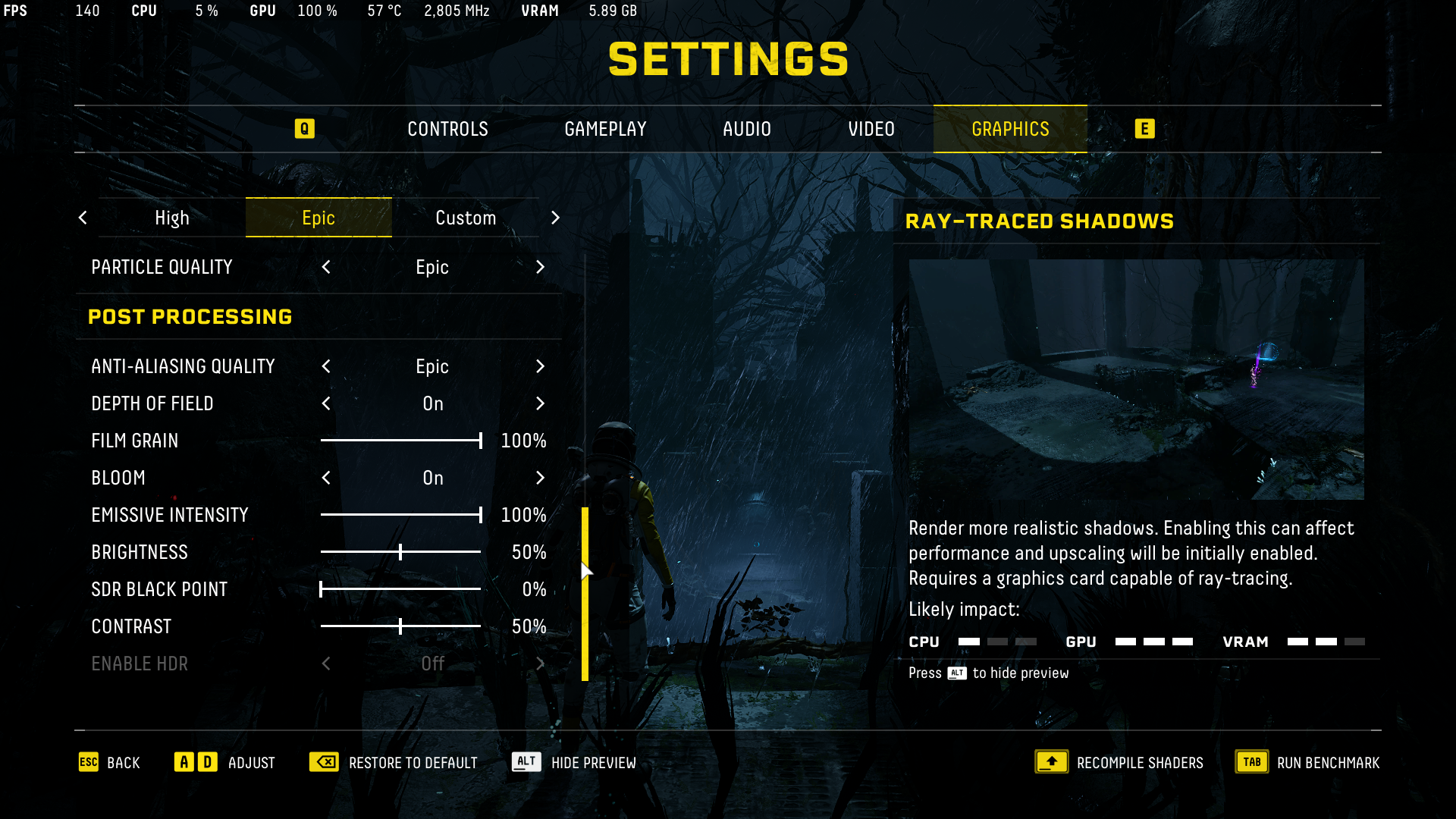
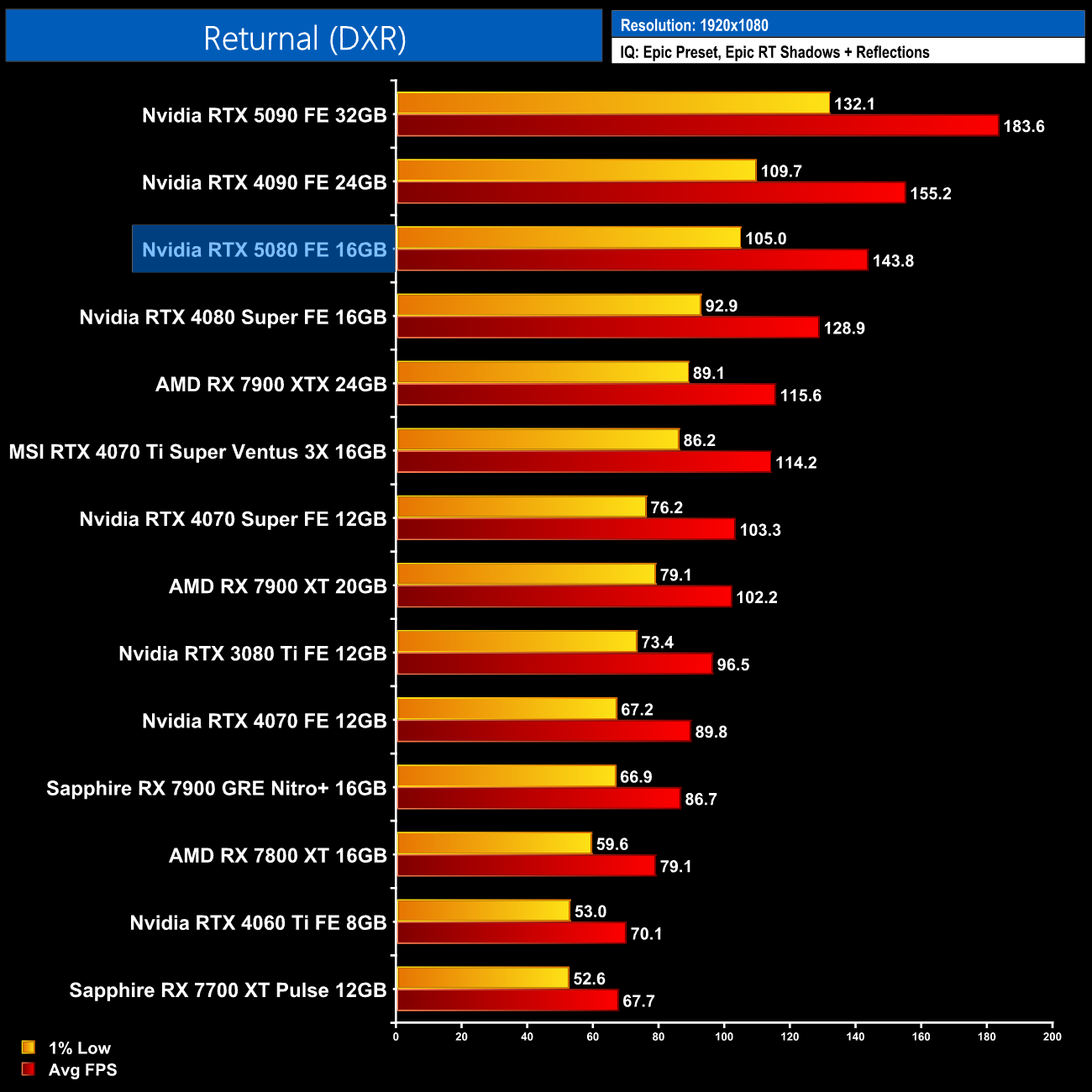
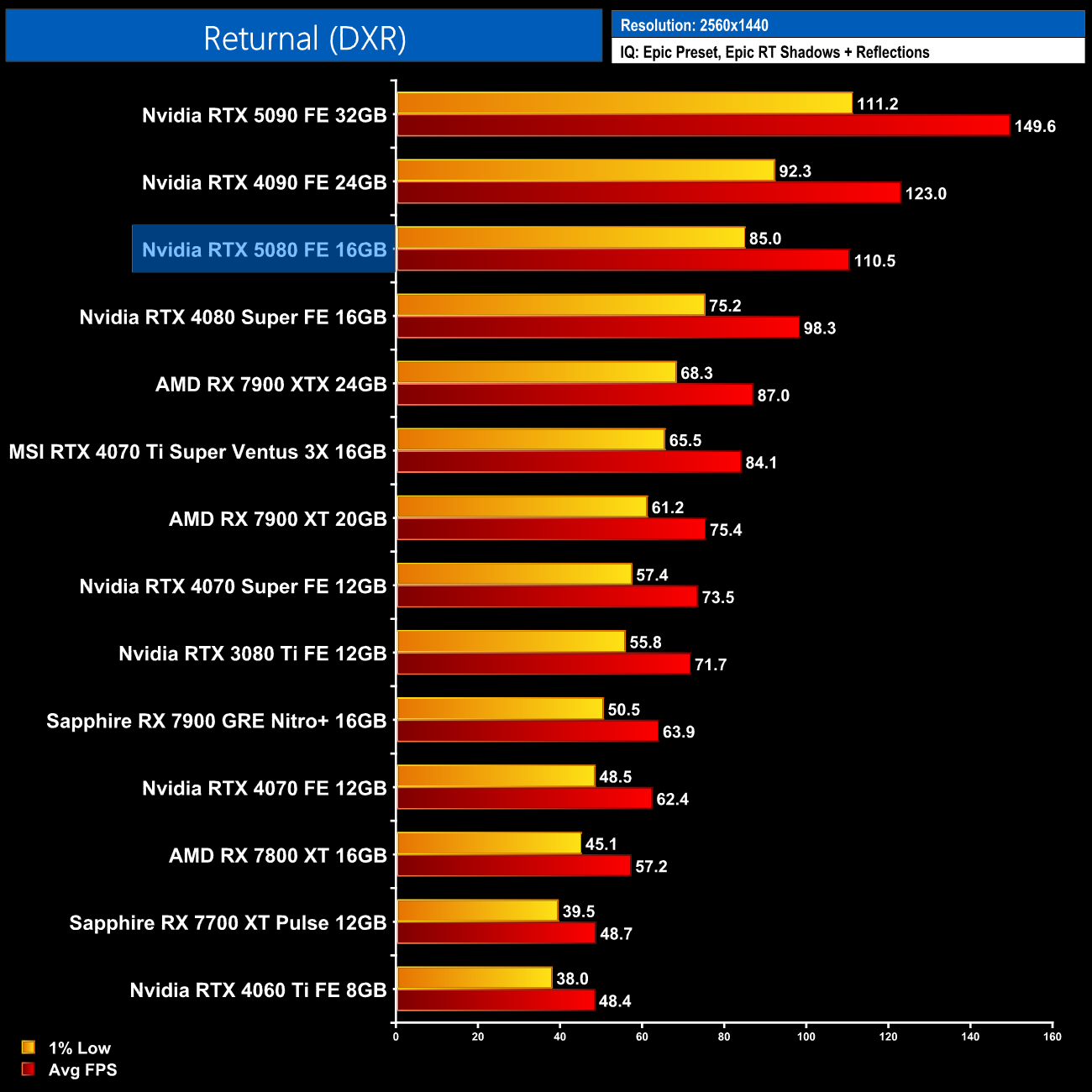
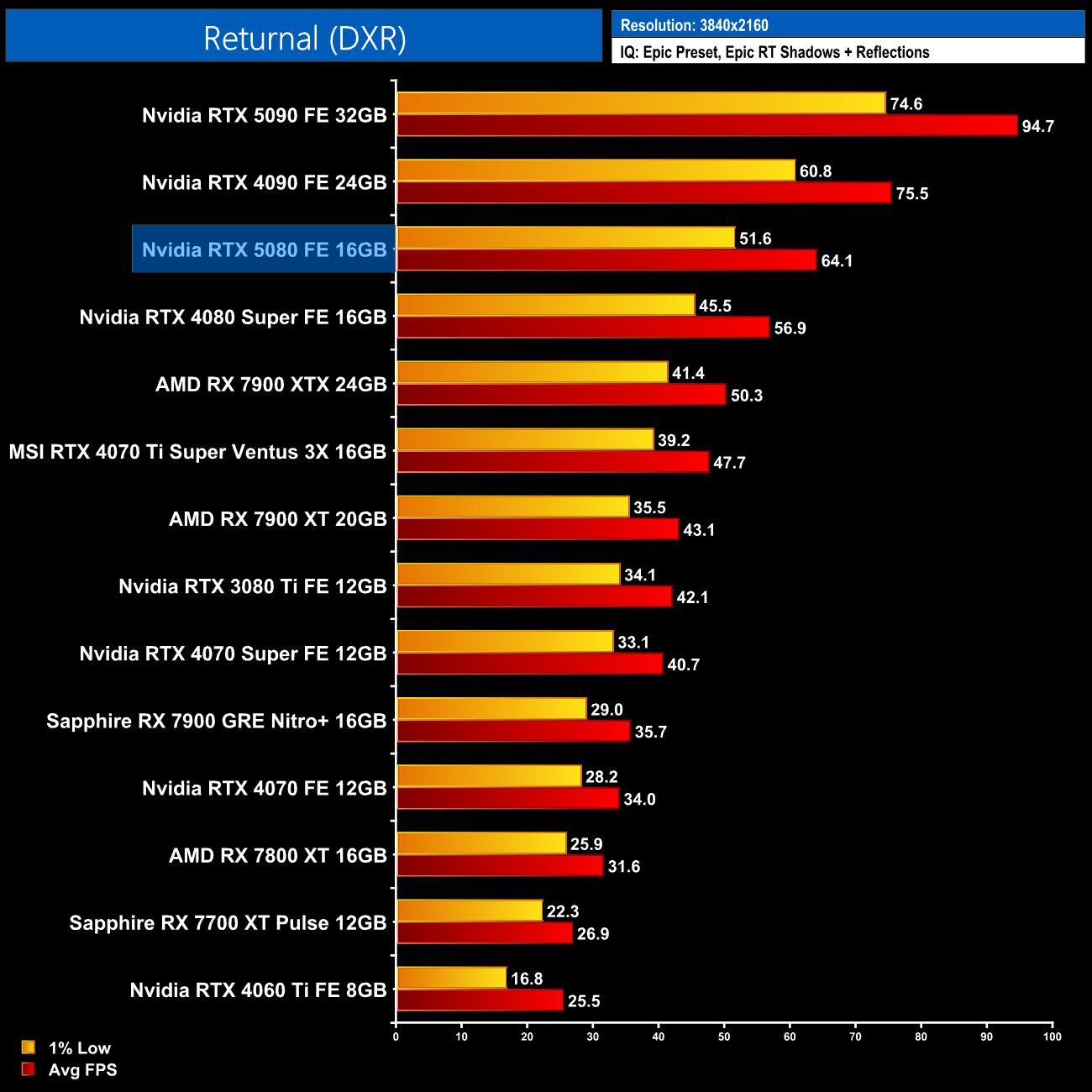
Returnal is a relatively light workout when it comes to ray tracing – at least by modern standards – and at 1440p the RTX 5080 delivers 111fps, putting it 10% behind the 4090 and 12% faster than the 4080 Super.
At 4K, that lead stretches to 13% over the 4080, but the 4090 has also pulled away somewhat, and the 5080 is now 15% slower.
Shadow of the Tomb Raider is a 2018 action-adventure video game developed by Eidos-Montréal and published by Square Enix's European subsidiary. It continues the narrative from the 2015 game Rise of the Tomb Raider and is the twelfth mainline entry in the Tomb Raider series, as well as the third and final entry of the Survivor trilogy. The game was originally released worldwide for PlayStation 4, Windows, and Xbox One. (Wikipedia).
Engine: Foundation Engine. We test using the Highest preset, RT Ultra Shadows, DXR API. DLSS/FSR are disabled.
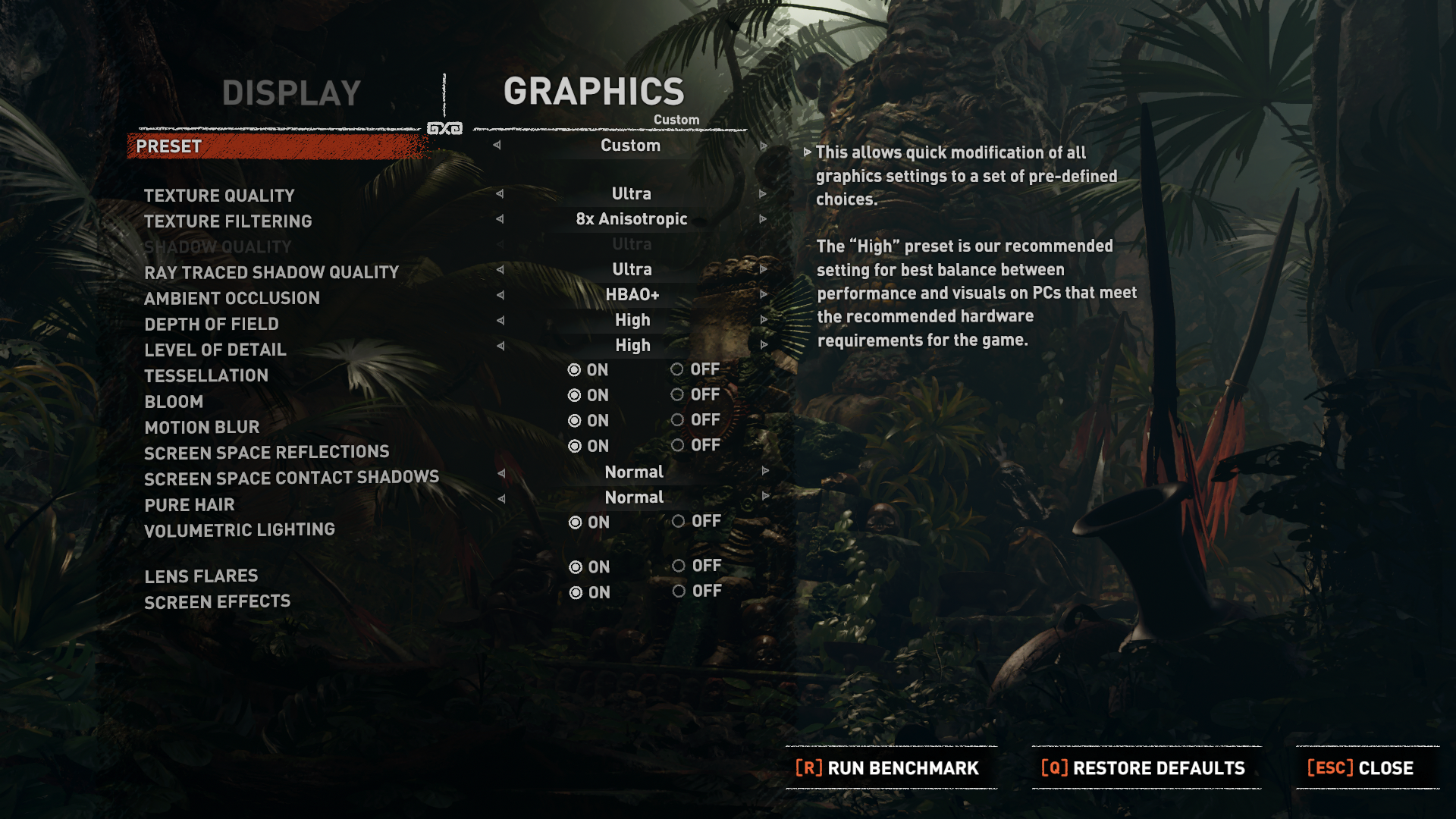
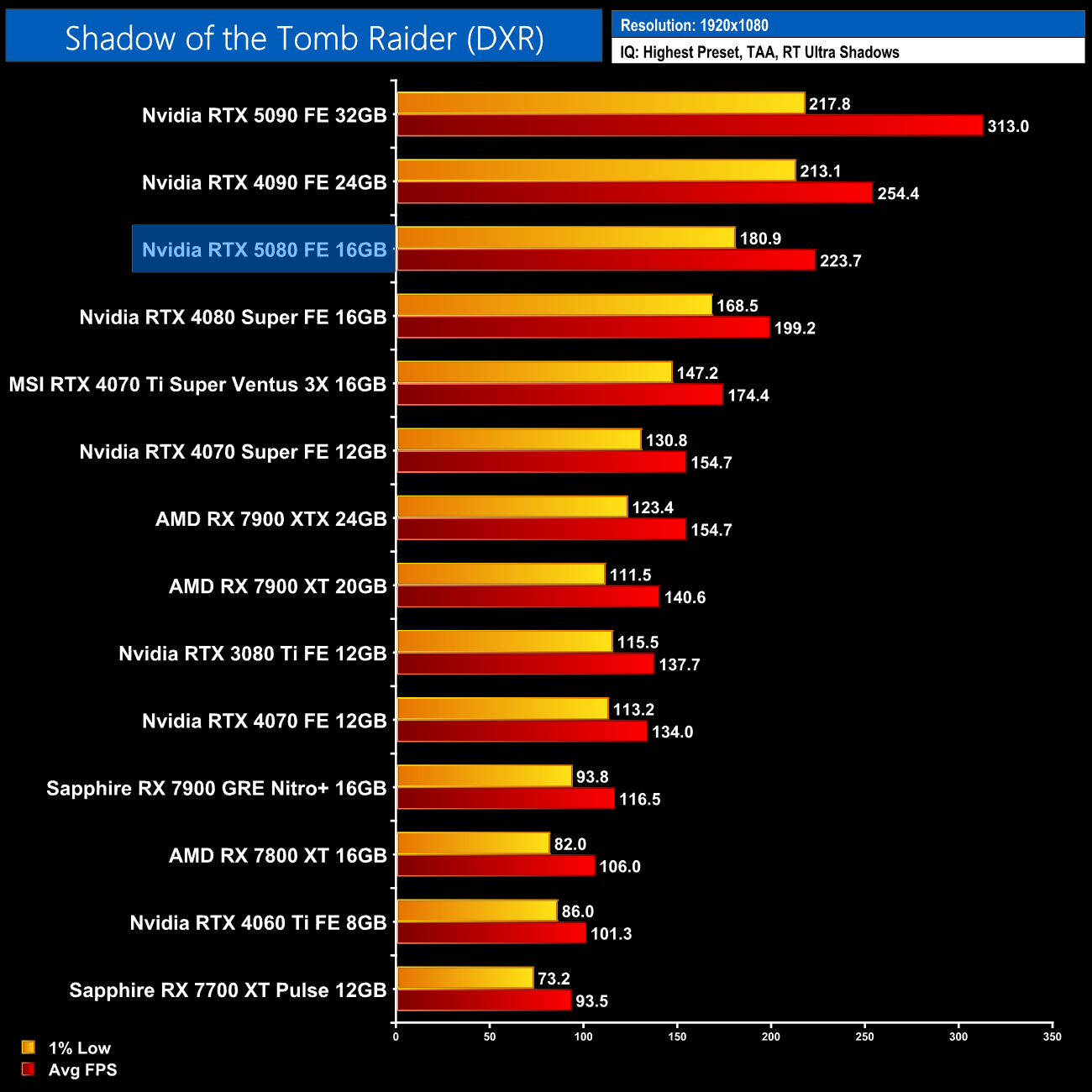

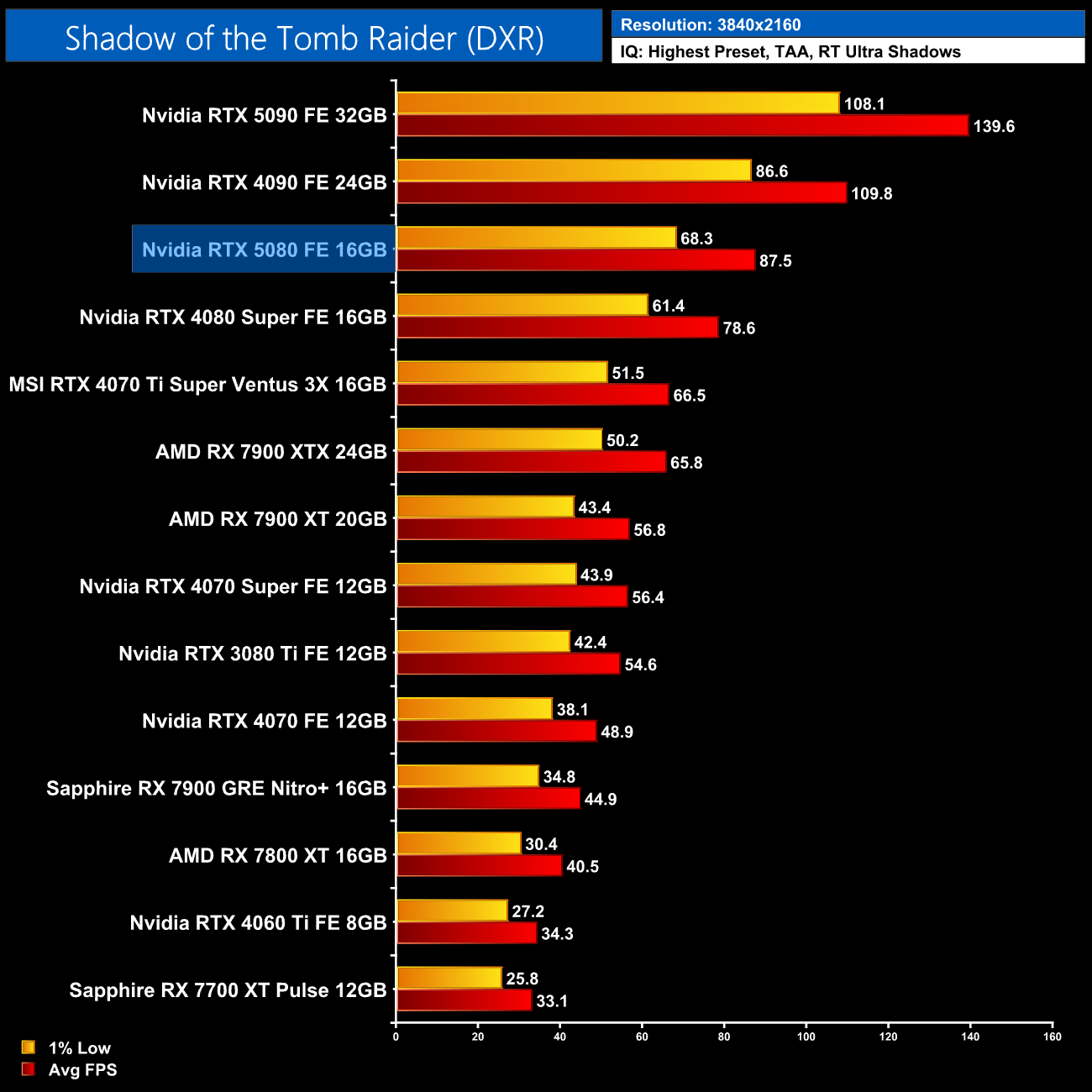
As for Shadow of the Tomb Raider – an oldie but definitely a goodie – at 1440p the RTX 5080 cranks out 158fps with ray tracing maxed out, and that makes it 10% faster than the 4080 Super, while it's 40% ahead of the 7900 XTX.
Even at 4K it barely breaks a sweat, hitting 88fps without any upscaling, an 11% uplift versus the 4080 Super, though it's still well behind the RTX 4090.
Star Wars Outlaws is a 2024 action-adventure game developed by Massive Entertainment and published by Ubisoft. Set in the Star Wars universe between the events of The Empire Strikes Back (1980) and Return of the Jedi (1983), the story follows Kay Vess, a young scoundrel who assembles a team for a massive heist in order to pay off a crime syndicate. Star Wars Outlaws was released for PlayStation 5, Windows, and Xbox Series X/S on August 30, 2024.
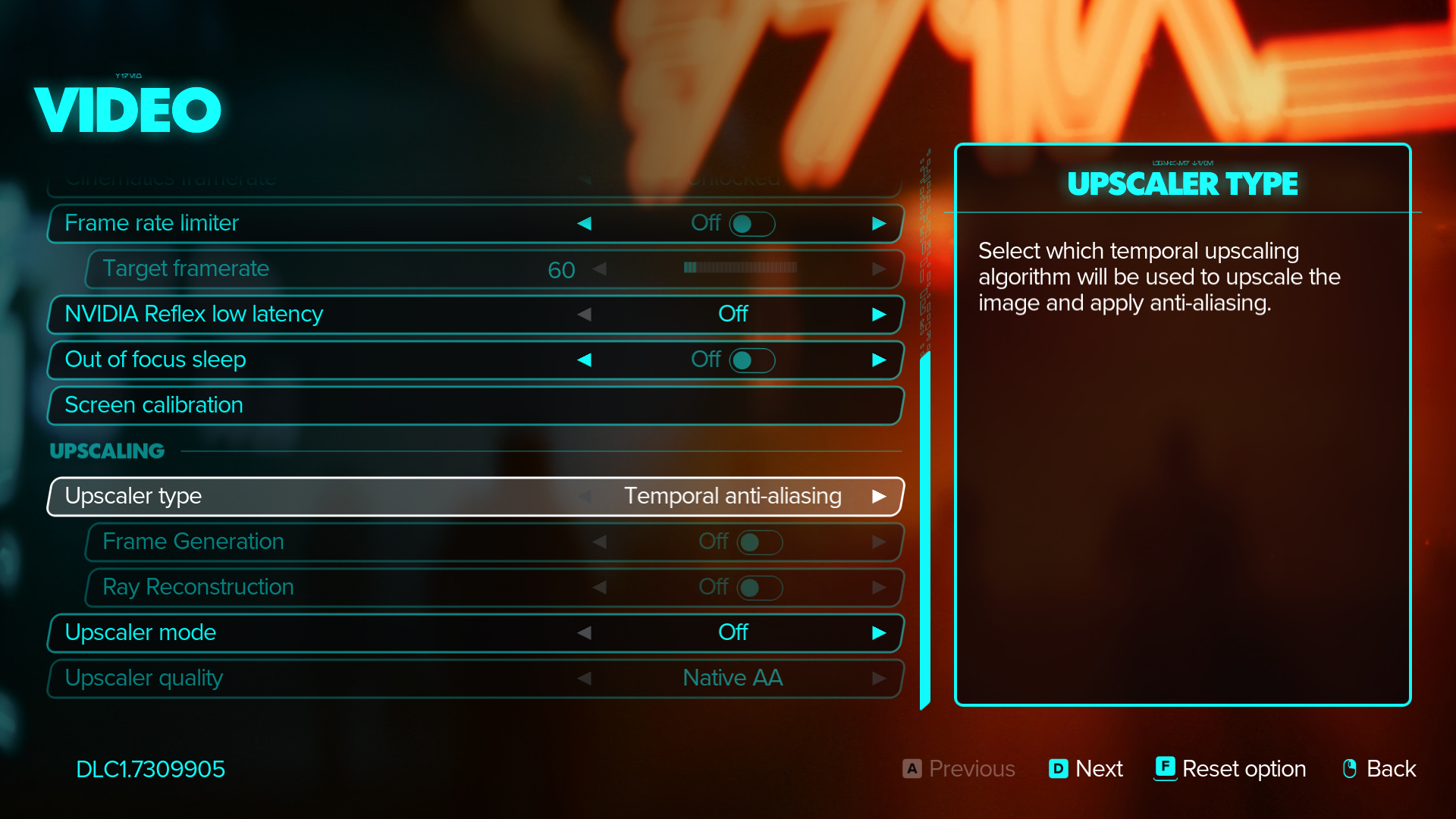
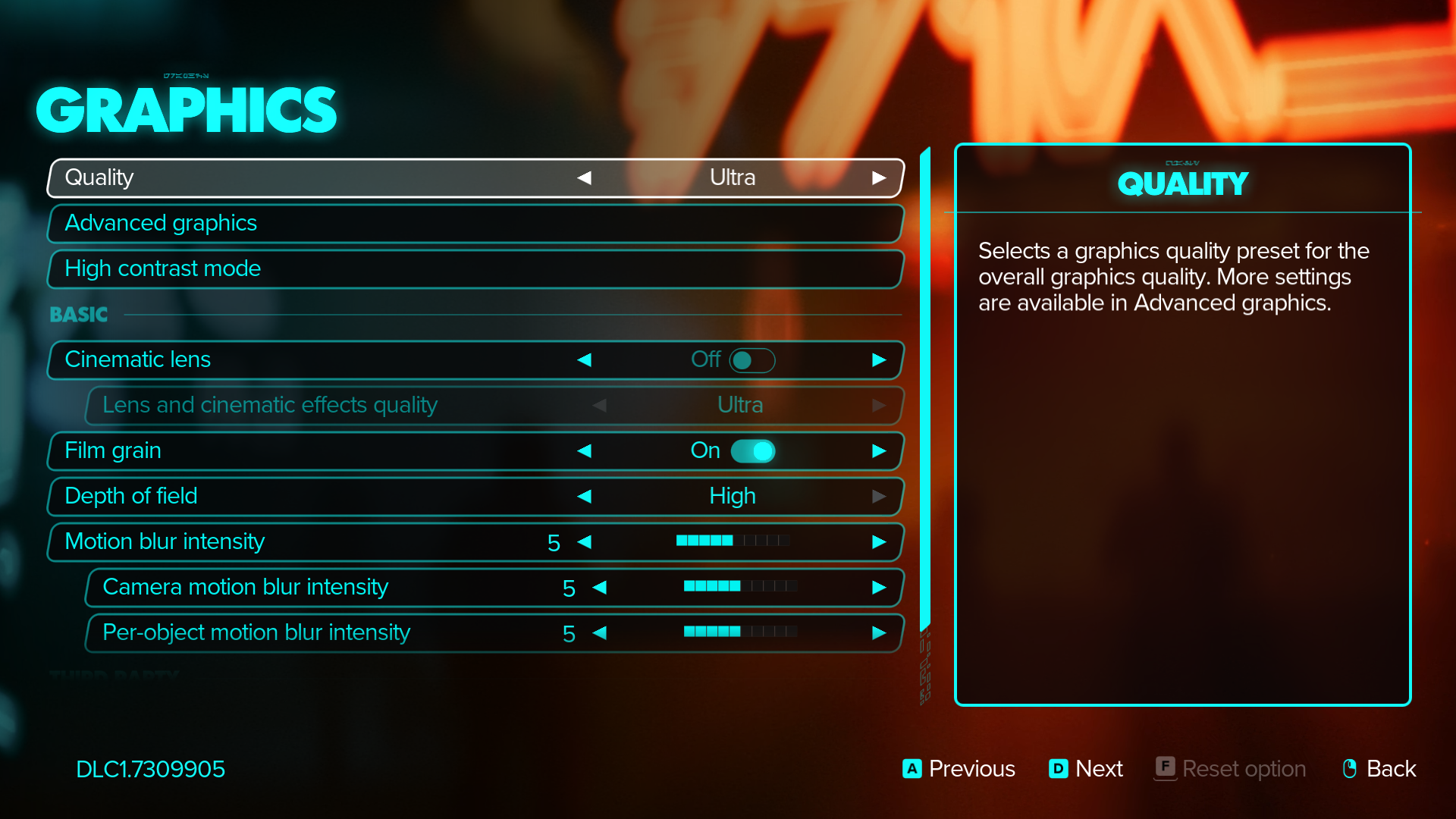
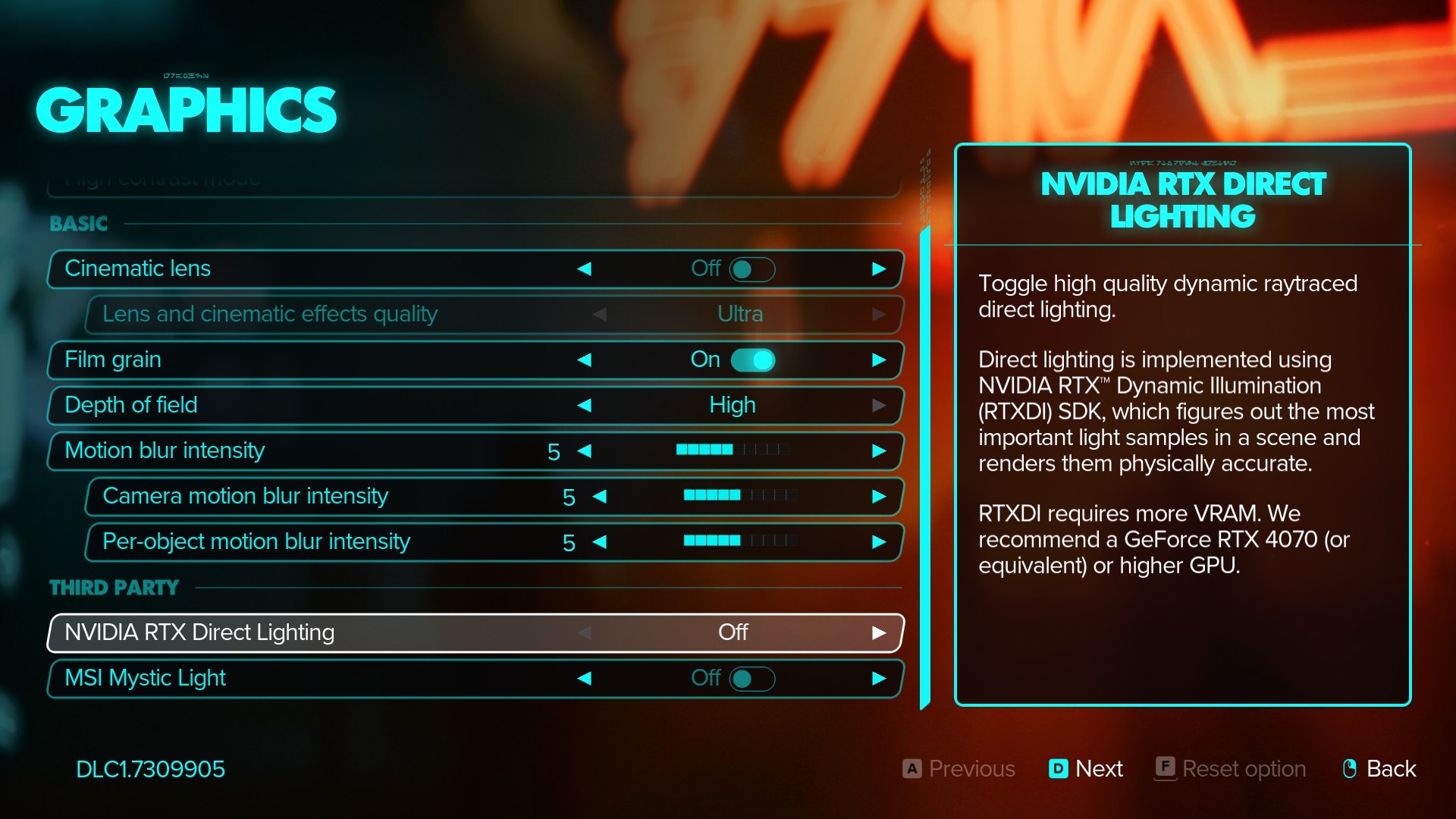
Engine: Snowdrop. We test using the Ultra preset but with Nvidia RTXDI disabled, DXR API. DLSS/FSR are disabled.
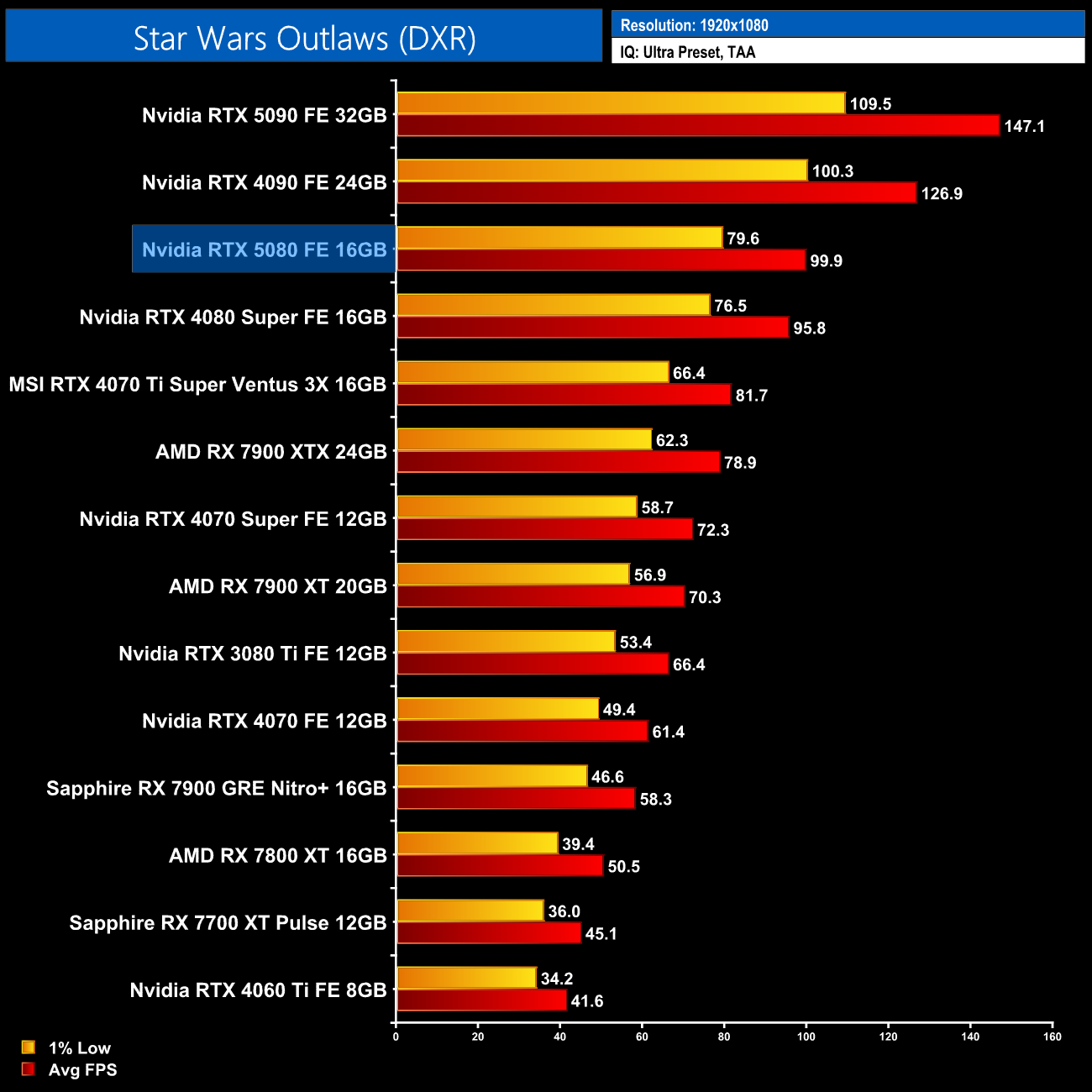
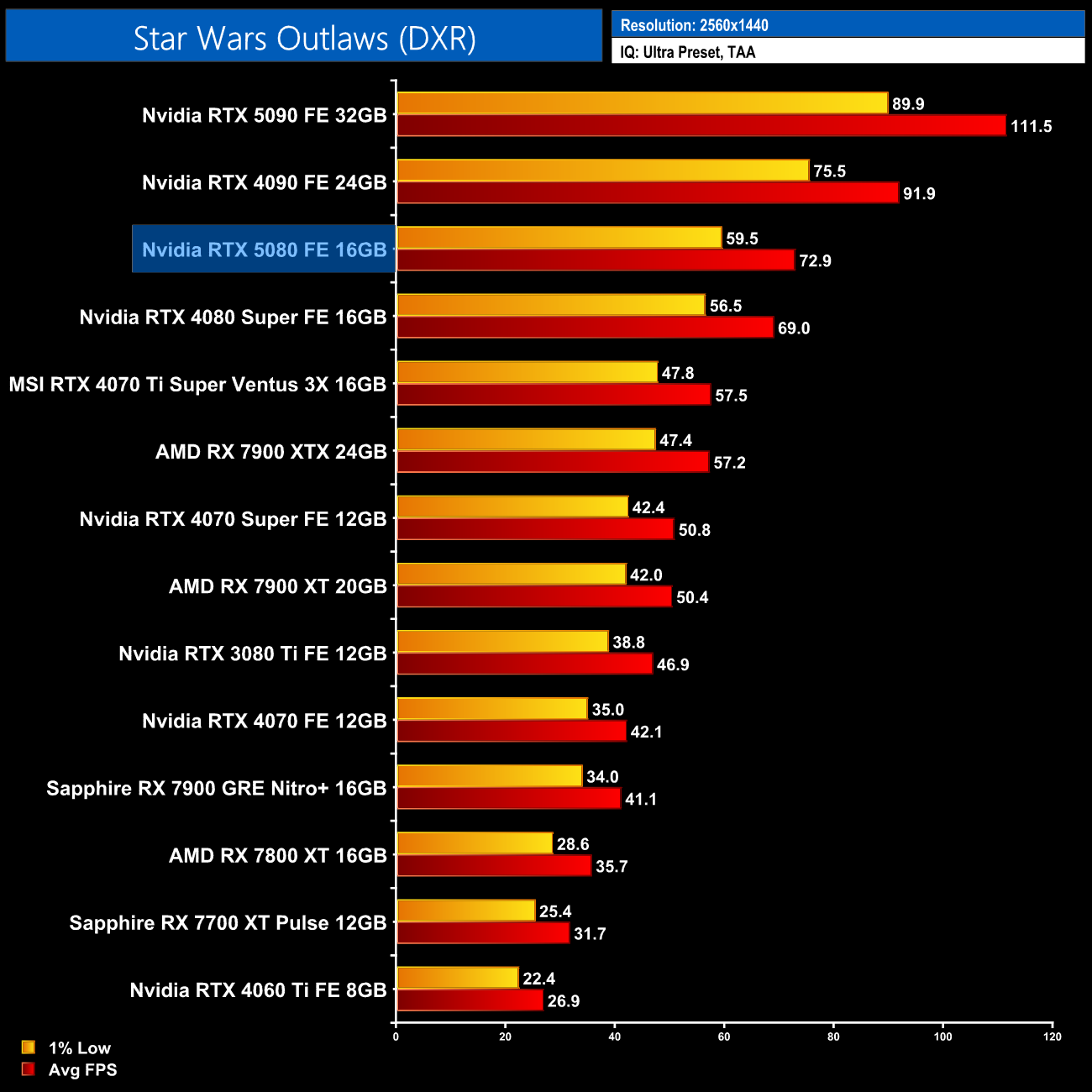
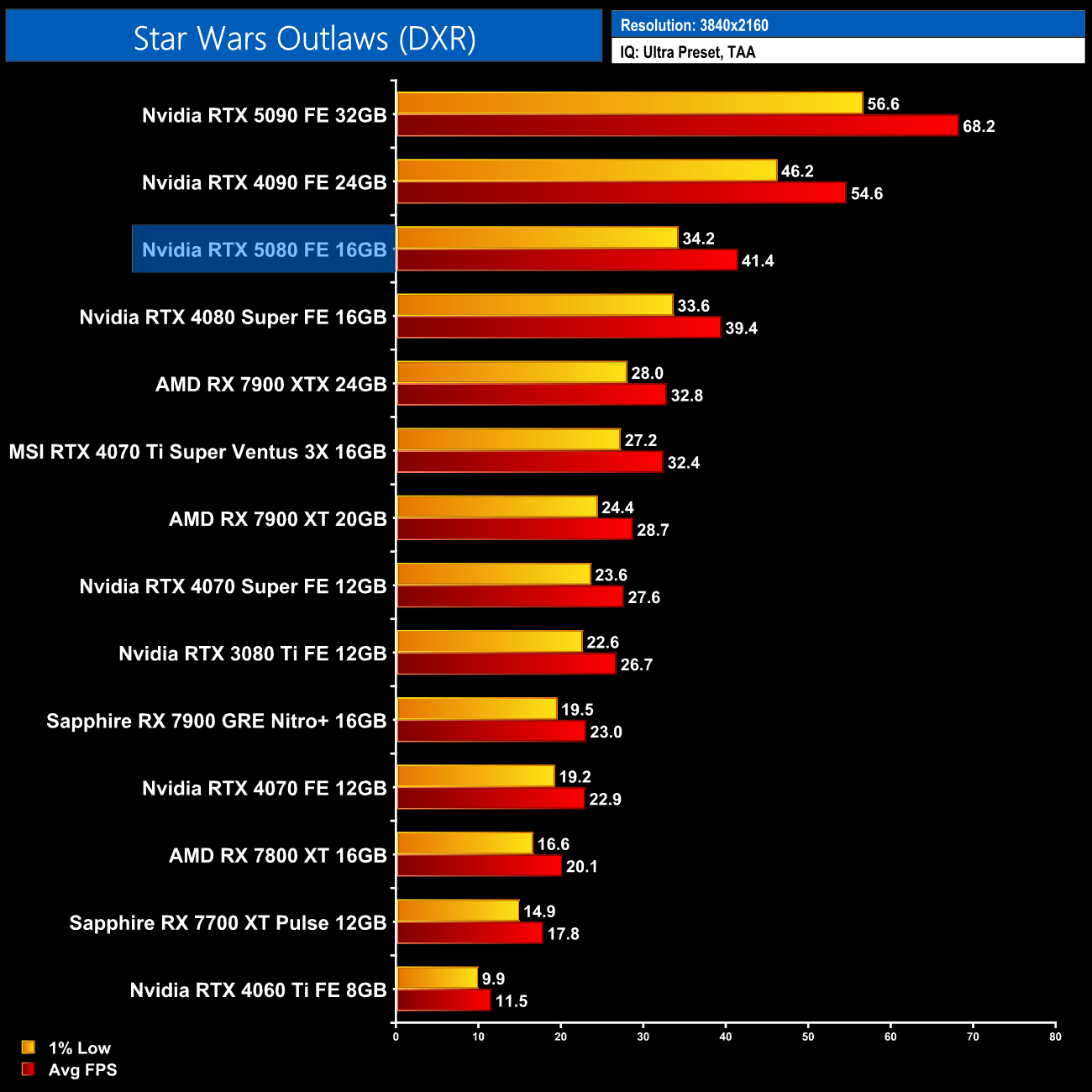
Lastly, we finish off with Star Wars Outlaws, a game that shows precious little gain for the 5080 versus the 4080 Super – just 6% at 1440p, to be exact, which is barely 4fps difference.
At 4K, we're talking just 2fps difference, but at least the 5080 is coming in 26% faster than the RX 7900 XTX.
Ray tracing 8-game average FPS
Here we present frame rate figures for each graphics card, averaged across all 8 ray traced games on test today. These figures can disguise significant variations in performance from game to game, but provide a useful overview of the sort of performance you can expect at each resolution tested.
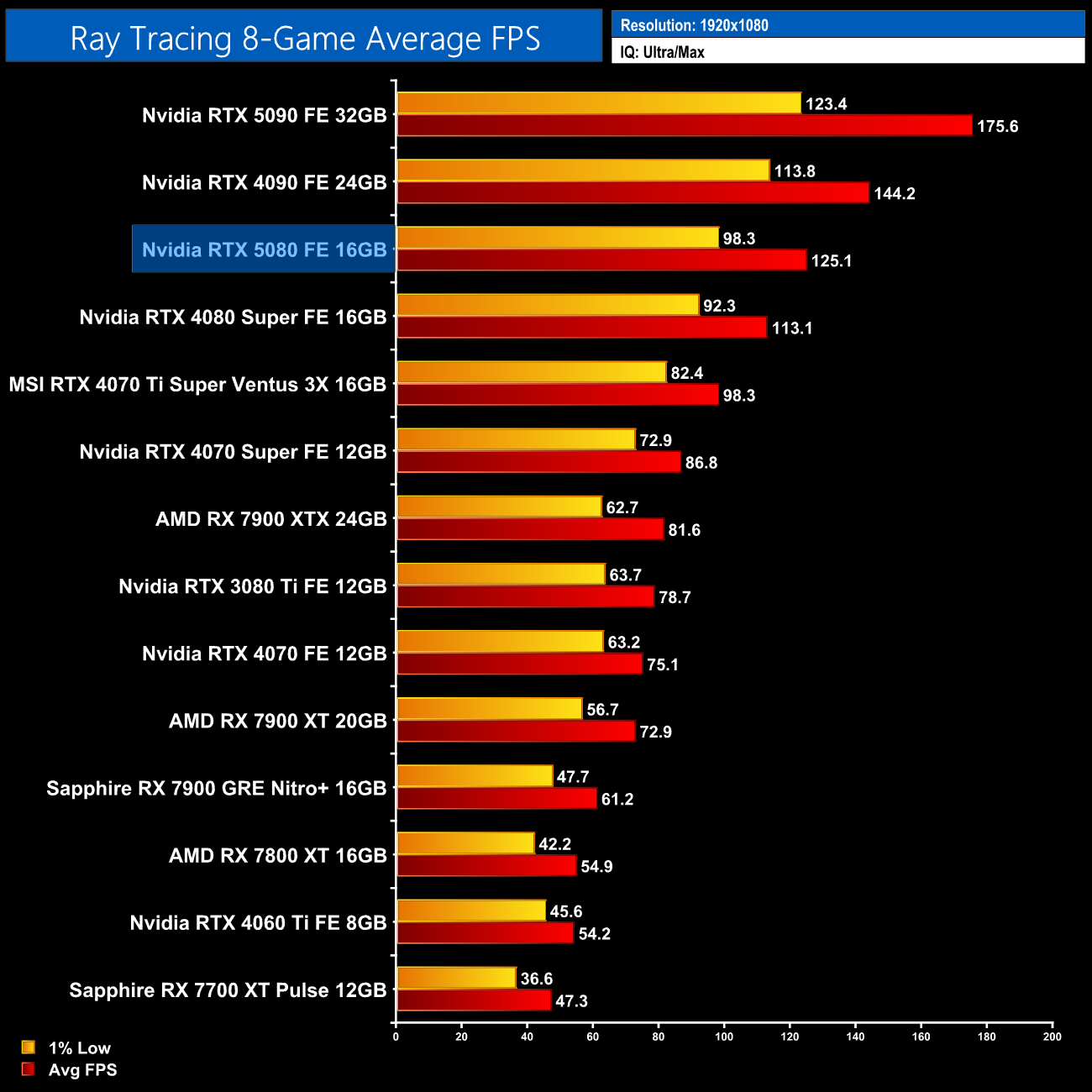
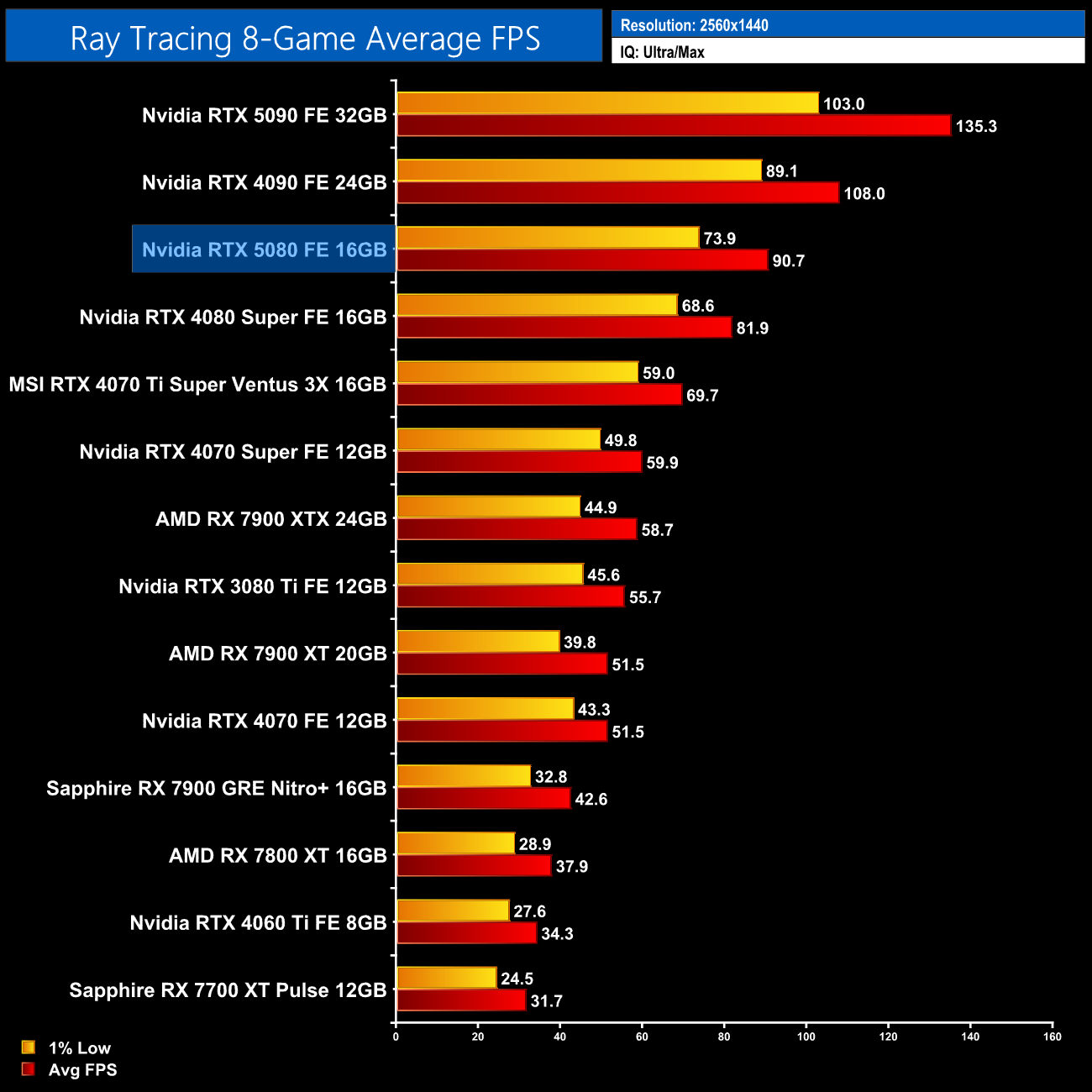
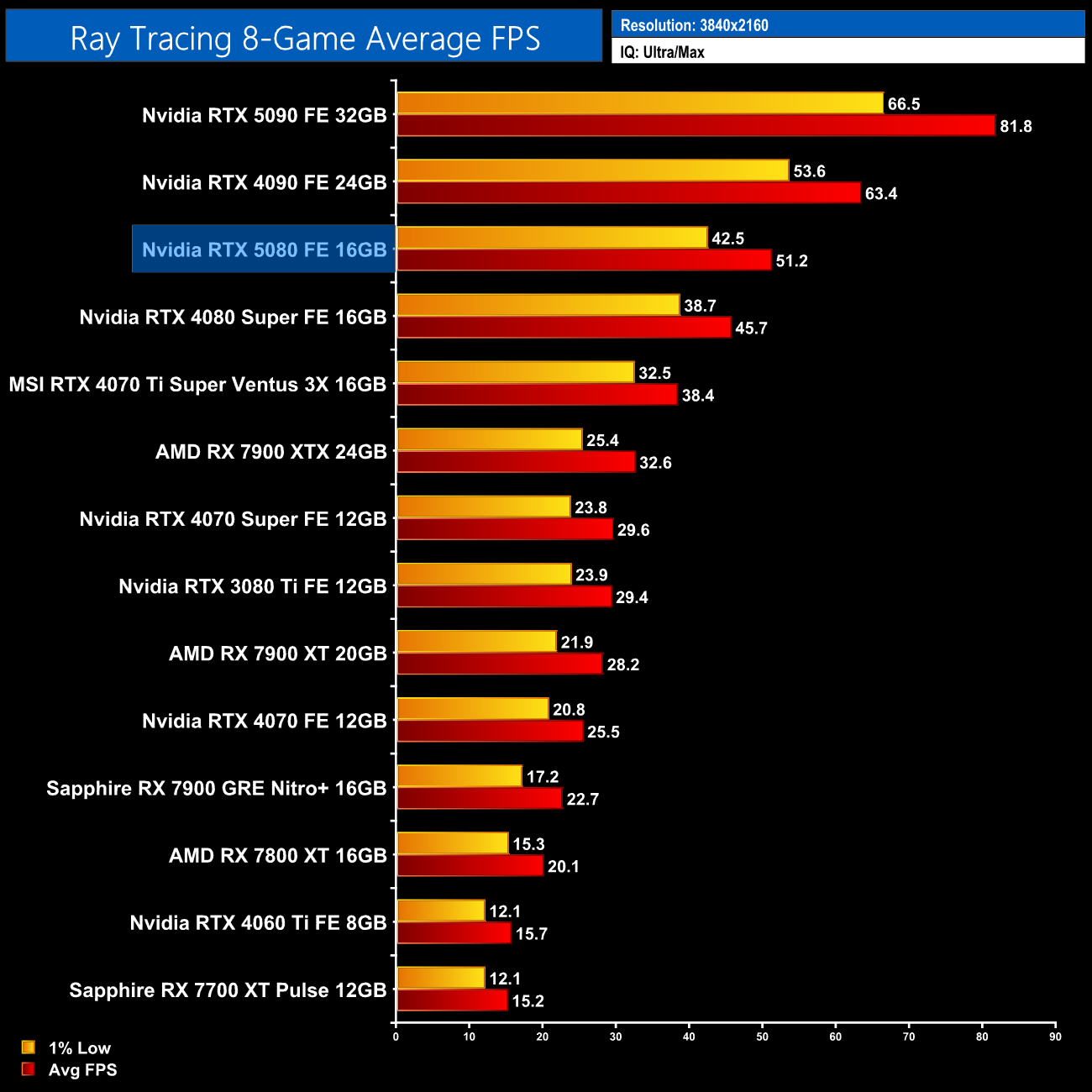
Overall then, averaged over the eight ray traced games tested, the RTX 5080 comes in 11% faster than the 4080 Super at 1440p. It's miles ahead of AMD's RX 7900 XTX, with a 55% advantage there, but it's still 16% slower than the RTX 4090.
At 4K, we can see a 12% gain over the 4080 Super, so scaling is very similar to the raster performance we looked at earlier in the review. The 5080 is now 57% faster than the 7900 XTX, and it's also 74% better than the RTX 3080 Ti, showing how far things have come in two generations.
Cost per frame, launch MSRP data
Please note this only compares ray traced performance and value.
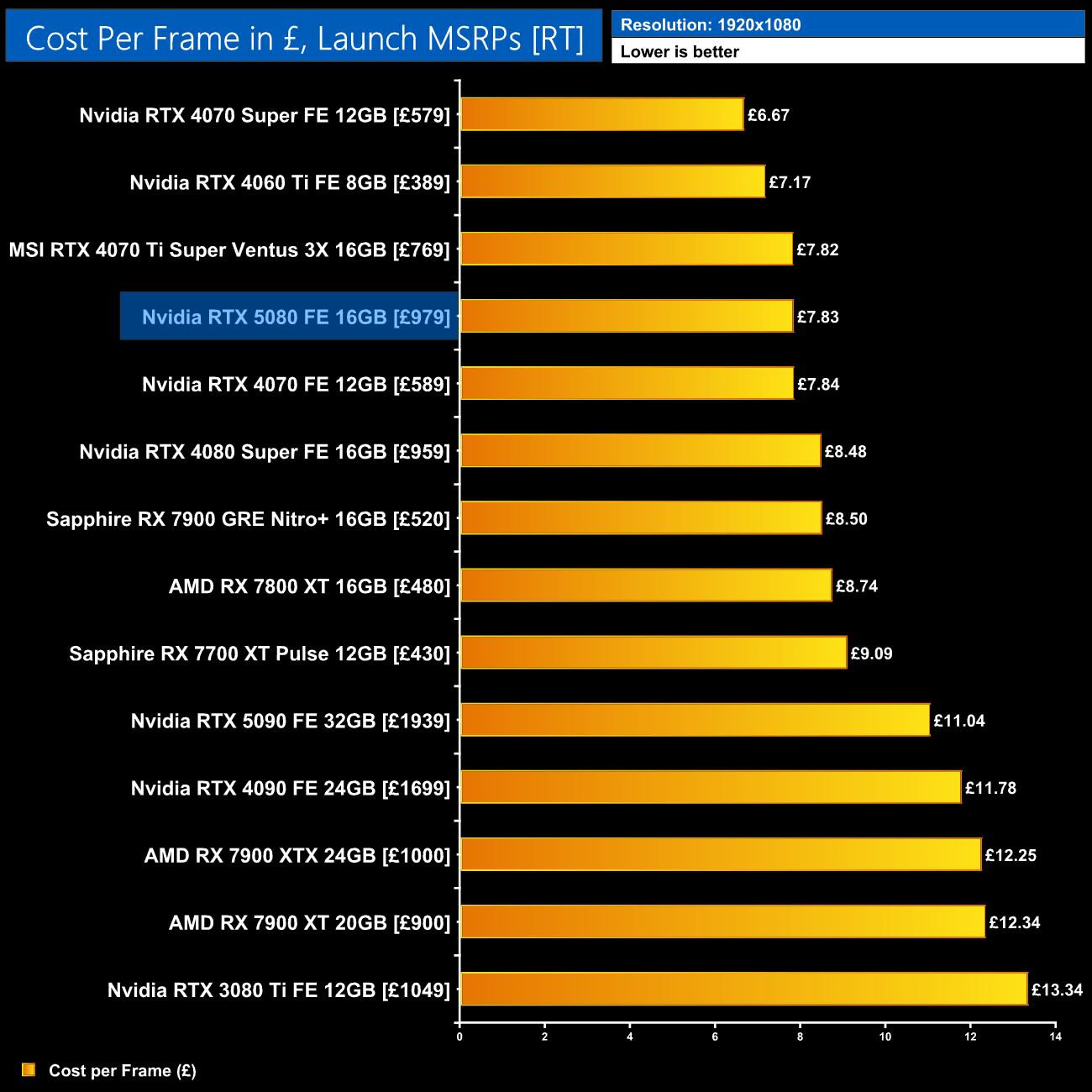
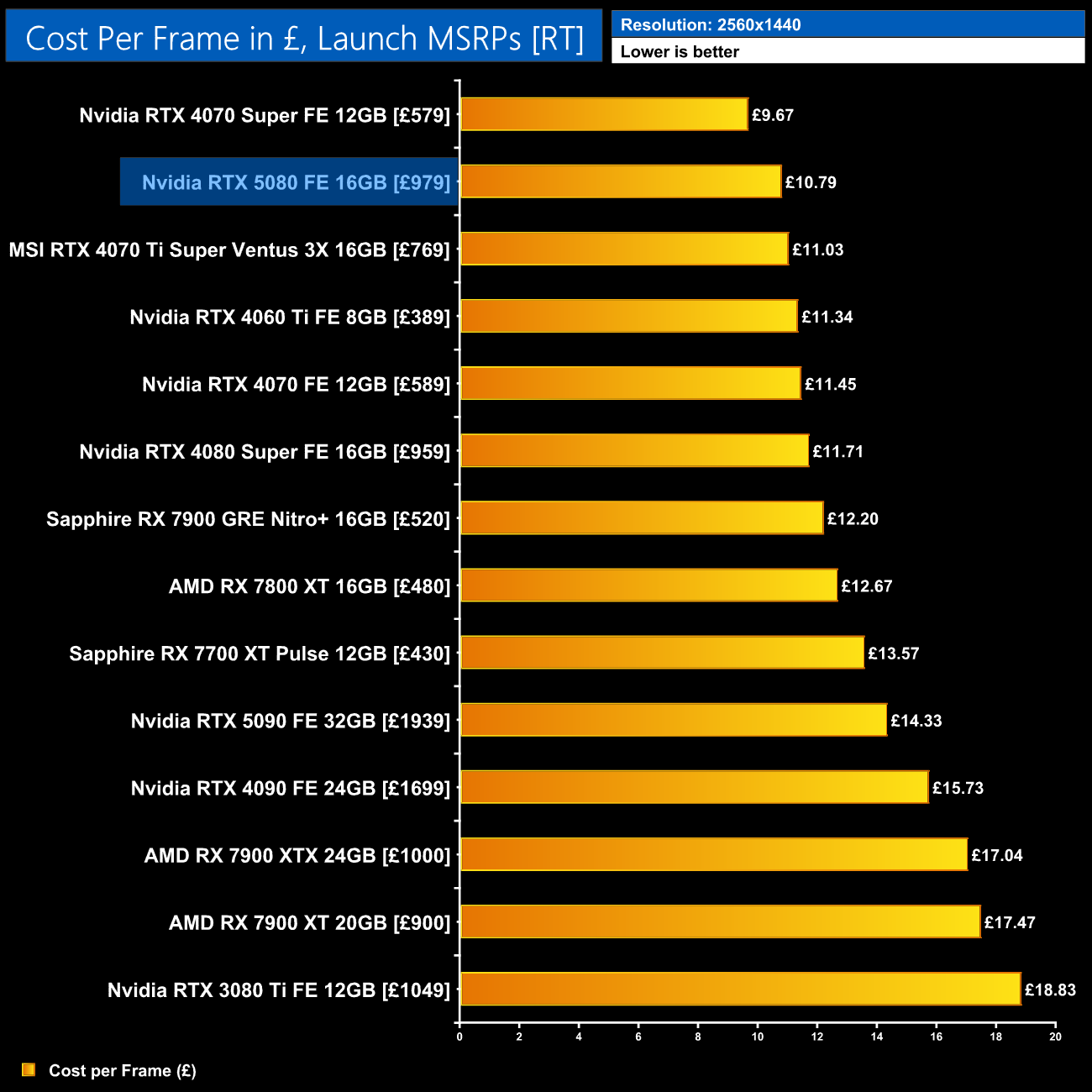
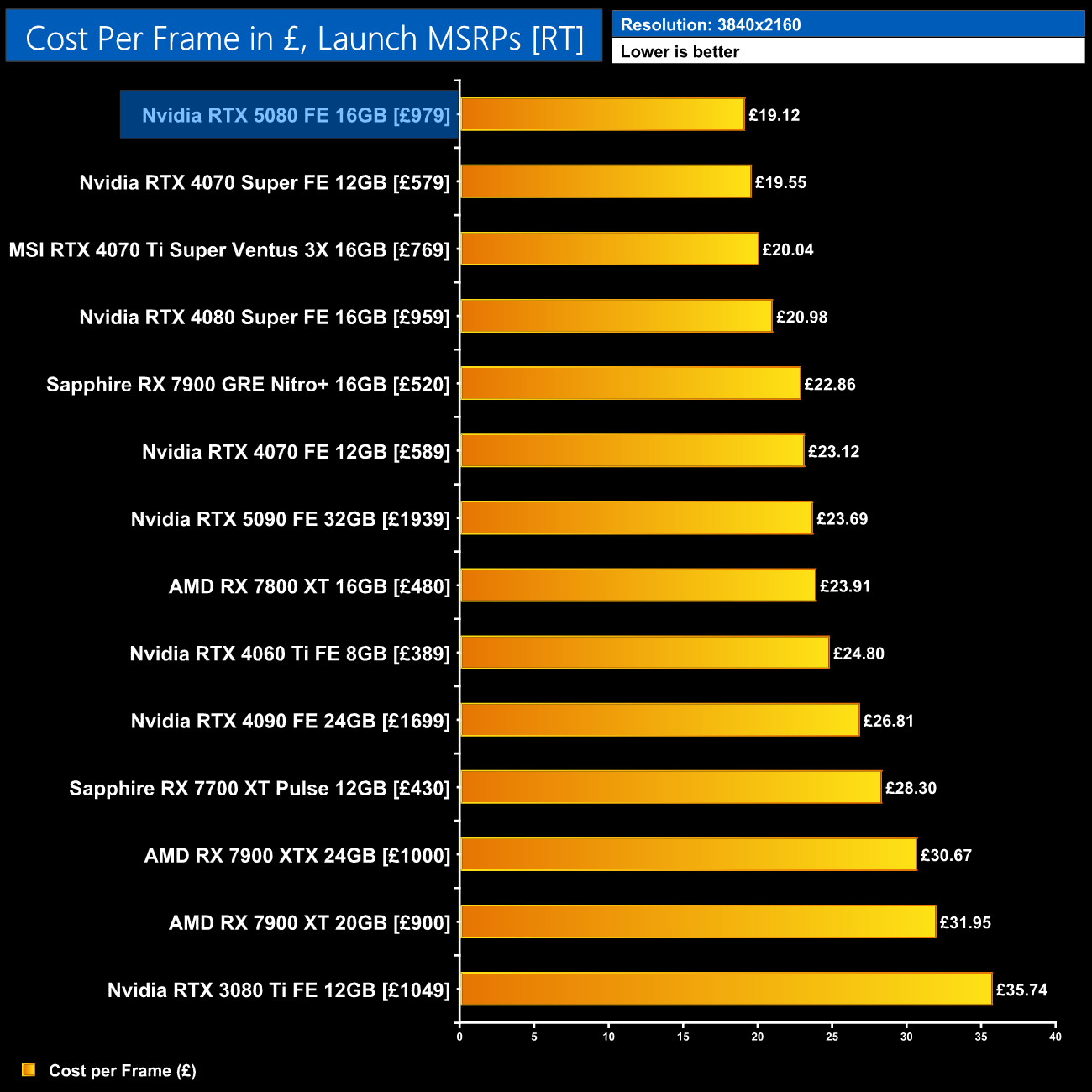
Cost per frame for ray tracing performance looks much more favourable for the RTX 5080, given it sits top of the chart – though only just, as it's just 2% better value than the RTX 4070 Super. Compared to the 4080 Super, we're looking at another 9% improvement to cost per frame.
Cost per frame, current pricing data
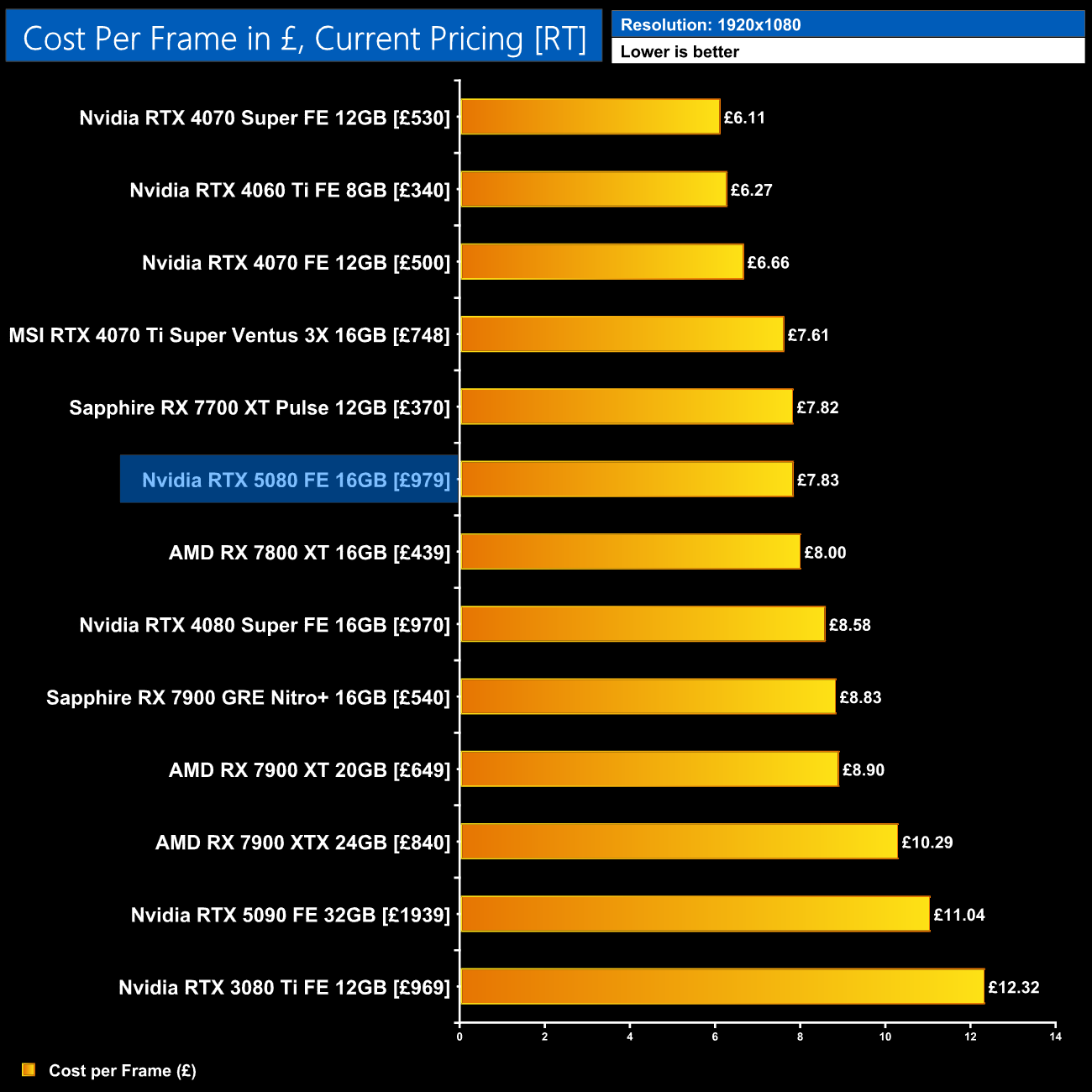
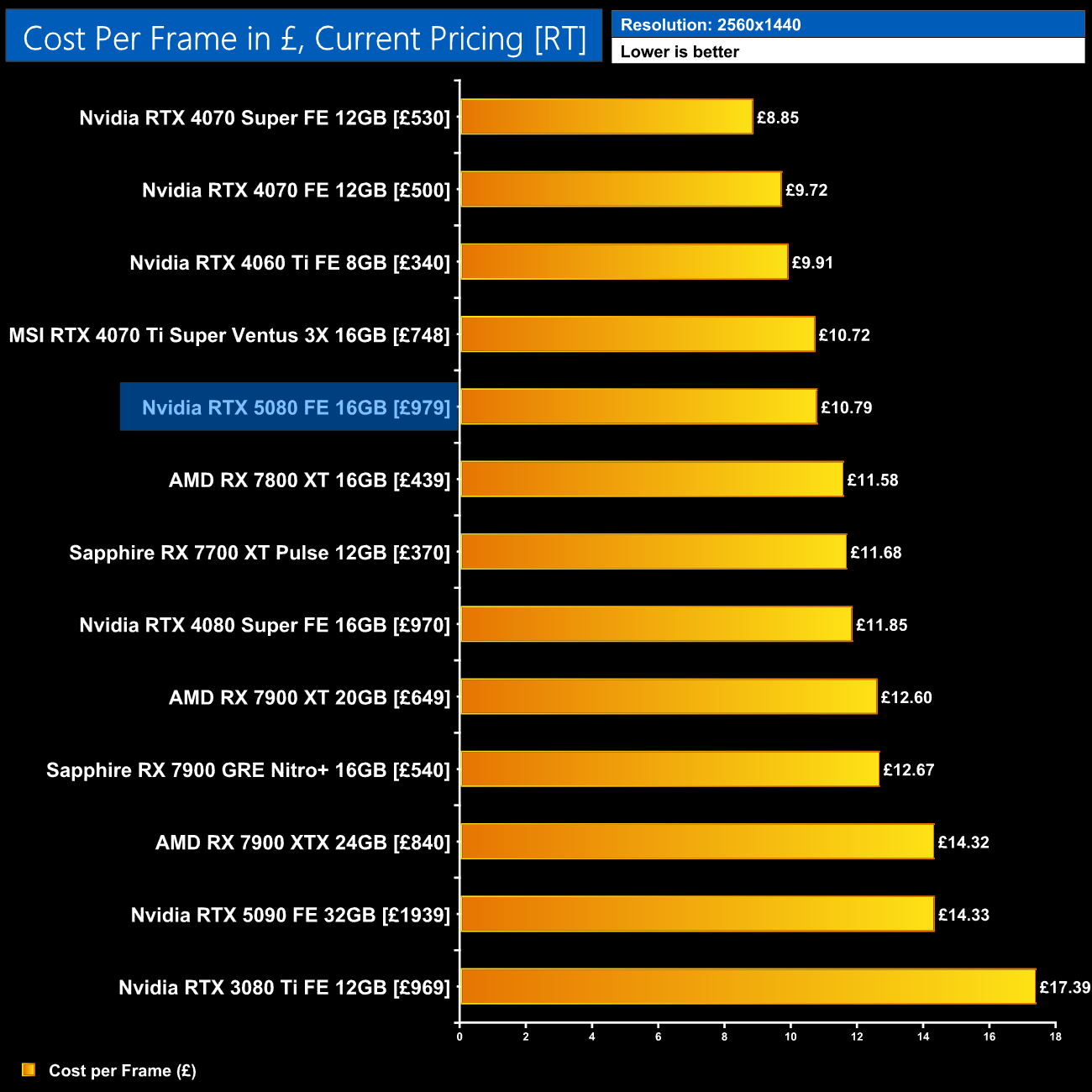
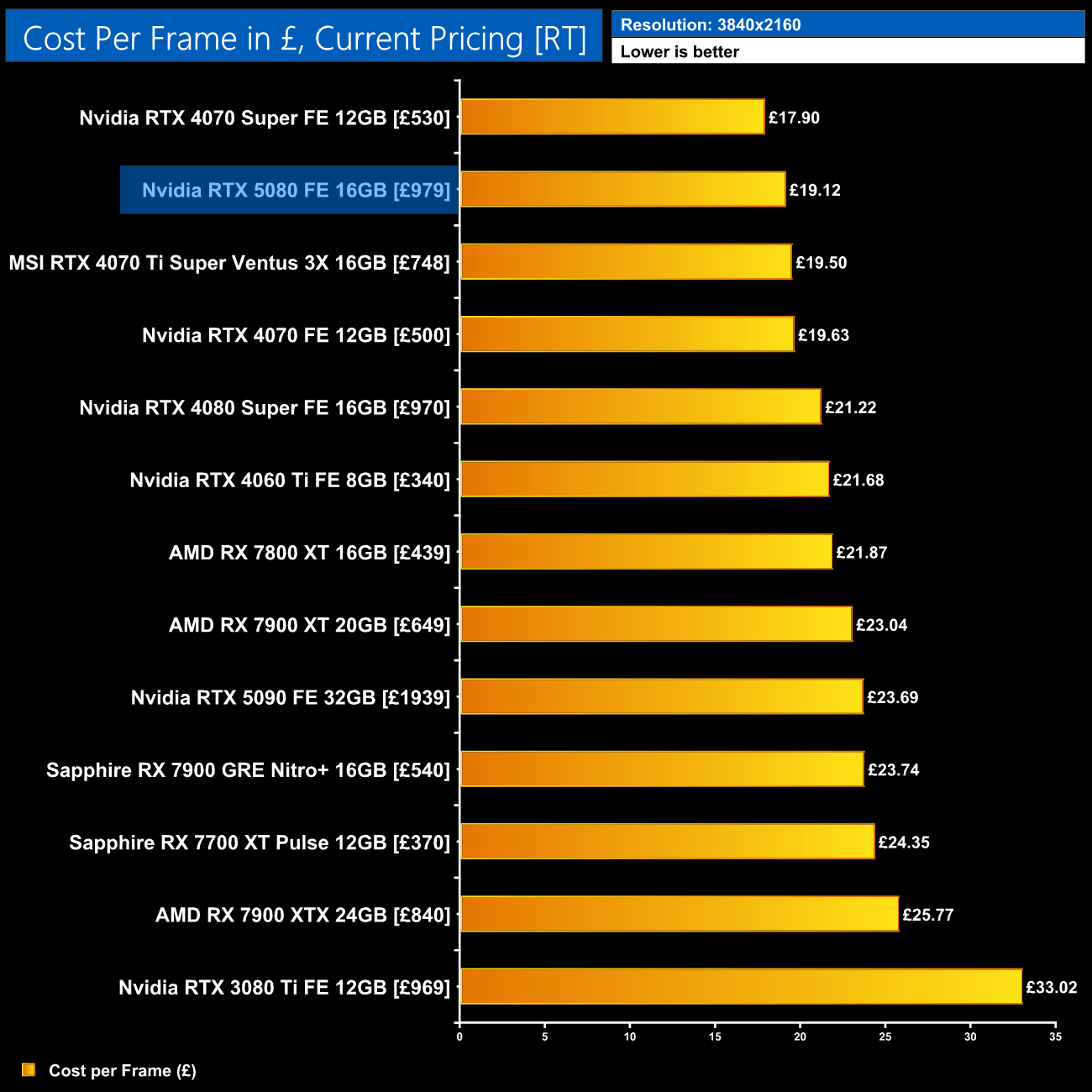
Things aren't quite so impressive when looking at the ray traced cost per frame data using current street pricing, with the 4070 Super retaking the lead, but the RTX 5080 is still in second place, offering marginally better value than the RTX 4070 Ti Super.
DLSS Multi Frame Generation
Next, we give a few examples of the sort of frame rates – and latency numbers – you can expect when using Multi Frame Generation (MFG) with the RTX 5080. This isn't going to be as complete an analysis as per our RTX 5090 review, so please do check out that content if you are interested.
What we can see, however, is very similar overall behaviour when cycling through the various DLSS modes. Naturally, with all settings cranked to the max in Alan Wake 2, performance is very low when using DLAA, and using Super resolution Performance mode alone (with no MFG) brings us from 17fps up to 46fps, alongside a substantial decrease to latency. Then using the 2X, 3X and 4X modes for mfg further boosts frame rates, though latency does increase slightly with each mode.
The same can also be observed in Cyberpunk 2077 – good luck using path tracing without any form of upscaling, and even with Super Resolution alone, 54FPS isn't super smooth. MFG does what it's designed to do and boosts frame rate significantly, up to 169fps when using its 4X mode, though latency does increase by just under 16ms compared to not using MFG at all, so it is something to bear in mind.
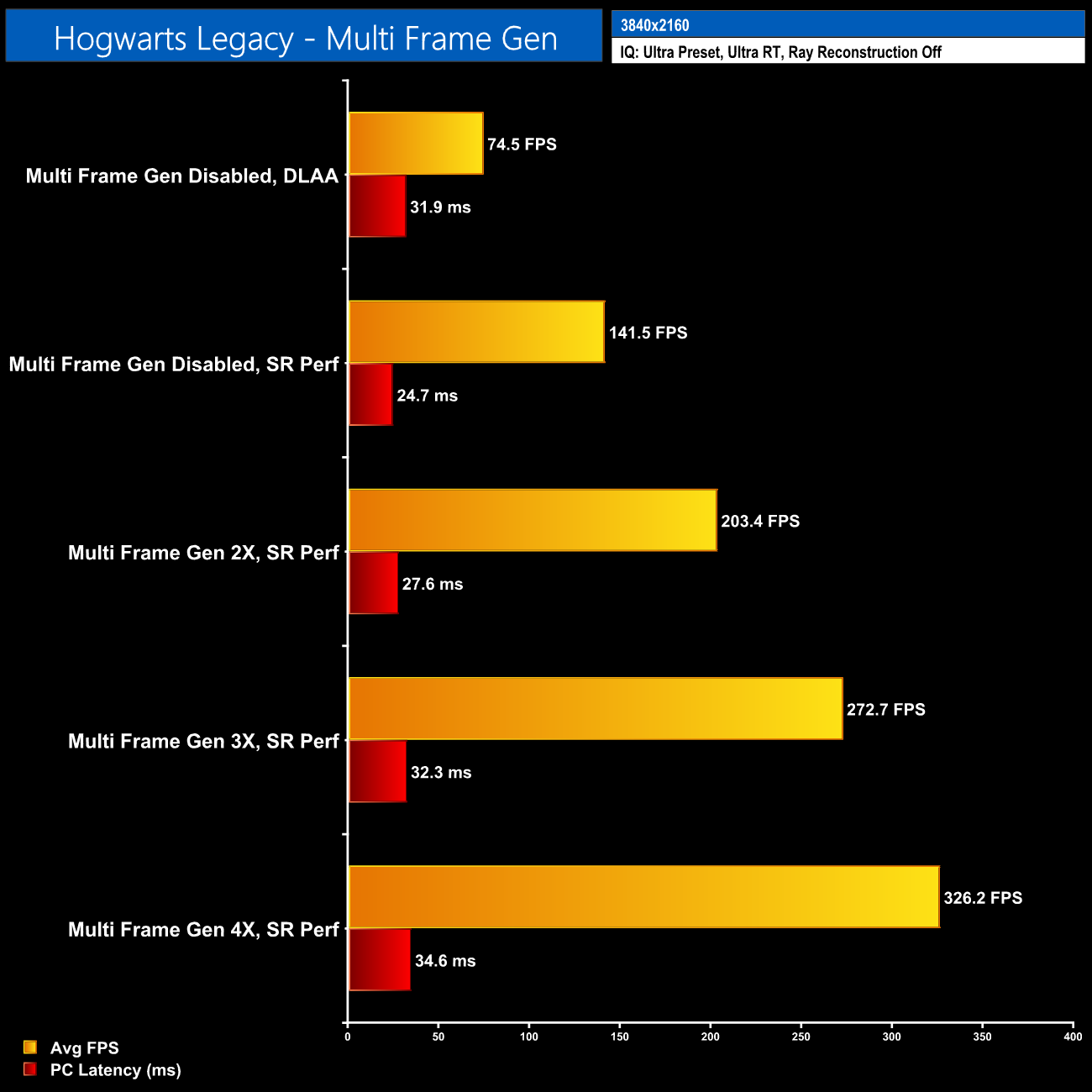
Hogwarts Legacy is that bit easier to run – even with ray tracing maxed out – and as such, we see even higher frame rates when using MFG. We're looking at an average of 142fps when only using Super Resolution Performance mode, but enabling MFG 4X whacks that up to 326fps. Latency is also lower across the board here, though it is still 40% higher using MFG 4X compared to only using Super Resolution.
Performance versus RTX 4080 Super
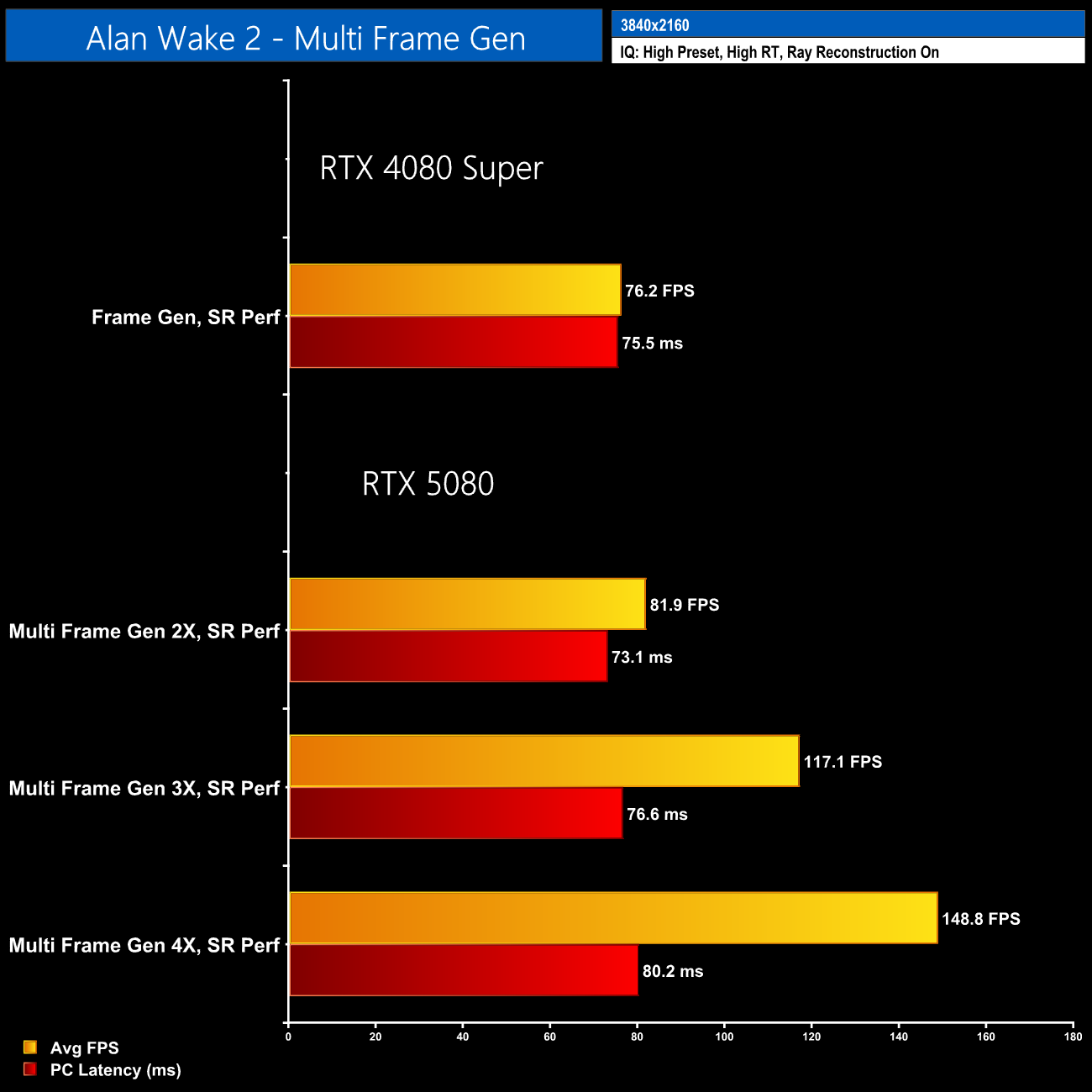

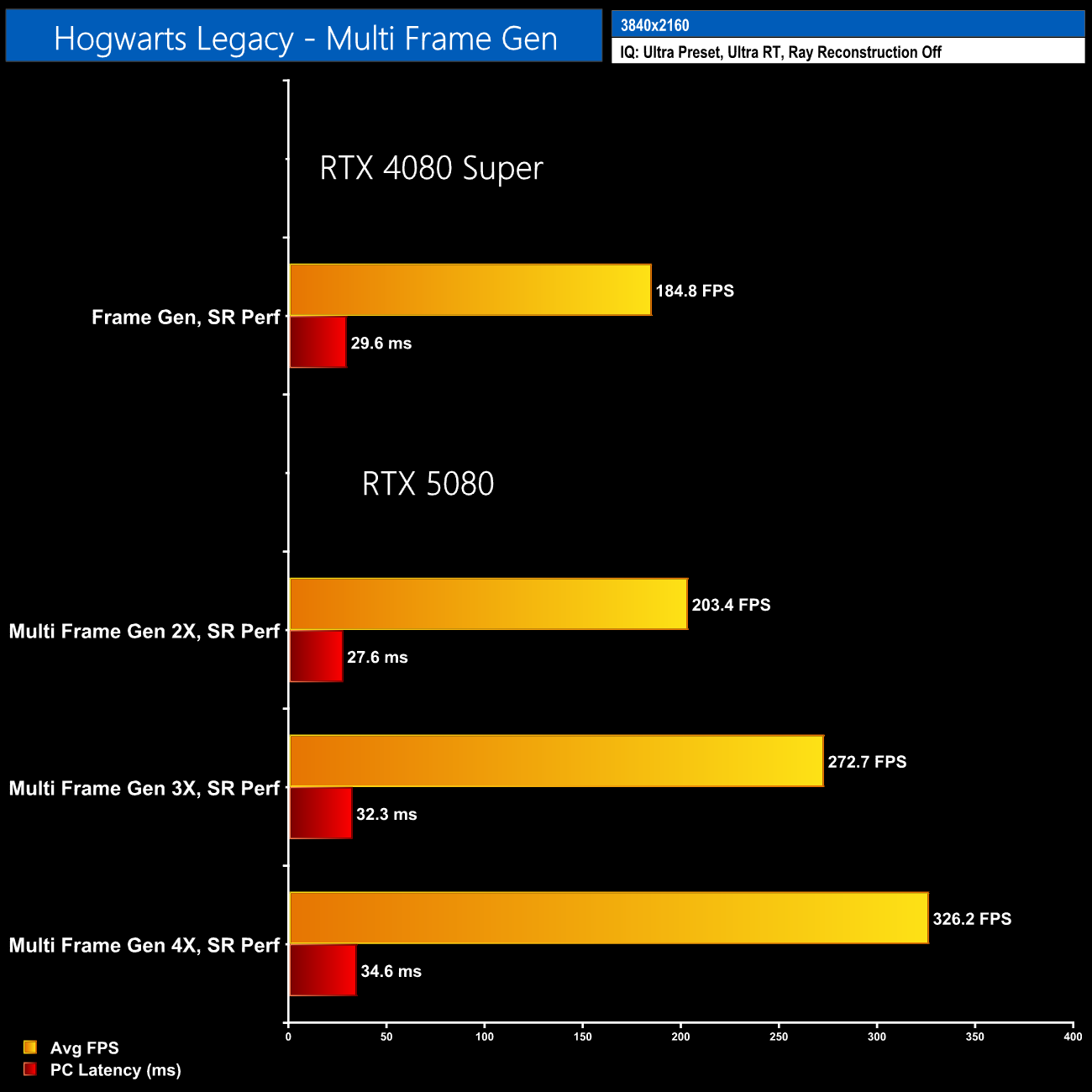
We also re-tested the RTX 4080 Super in these games, being an Ada GPU it is limited to using ‘Frame Generation' instead of ‘Multi Frame Generation', i.e. the insertion of one AI-generated frame rather than up to three on the RTX 50 series. As such, that means you can get significantly higher frame rates with the 5080, and this is what was behind Nvidia's claims of ‘2X' the performance of the 4080. Obviously this is dependent on the game supporting Frame Gen, and these aren’t the raw performance increases we saw earlier in the review, but it’s worth pointing out if MFG is a feature you might value.
Here we present a range of AI and productivity benchmarks, designed to offer insight into the sort of workloads that might be undertaken by someone purchasing this calibre of GPU.
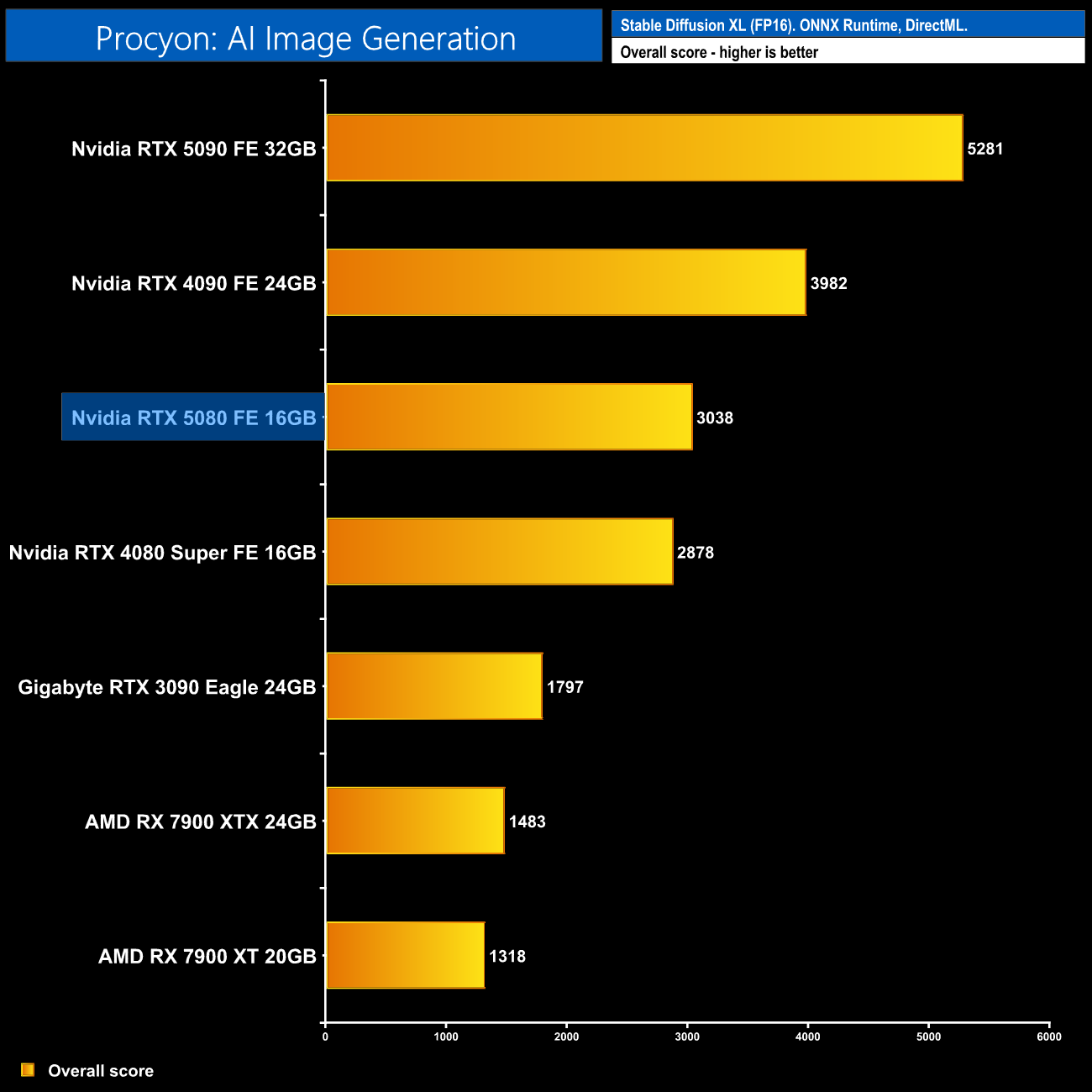
Starting with our Stable Diffusion XL FP16 image generation test, here the RTX 5080 delivers just a modest 6% gain over the RTX 4080 Super, while it's 24% slower than the RTX 4090.
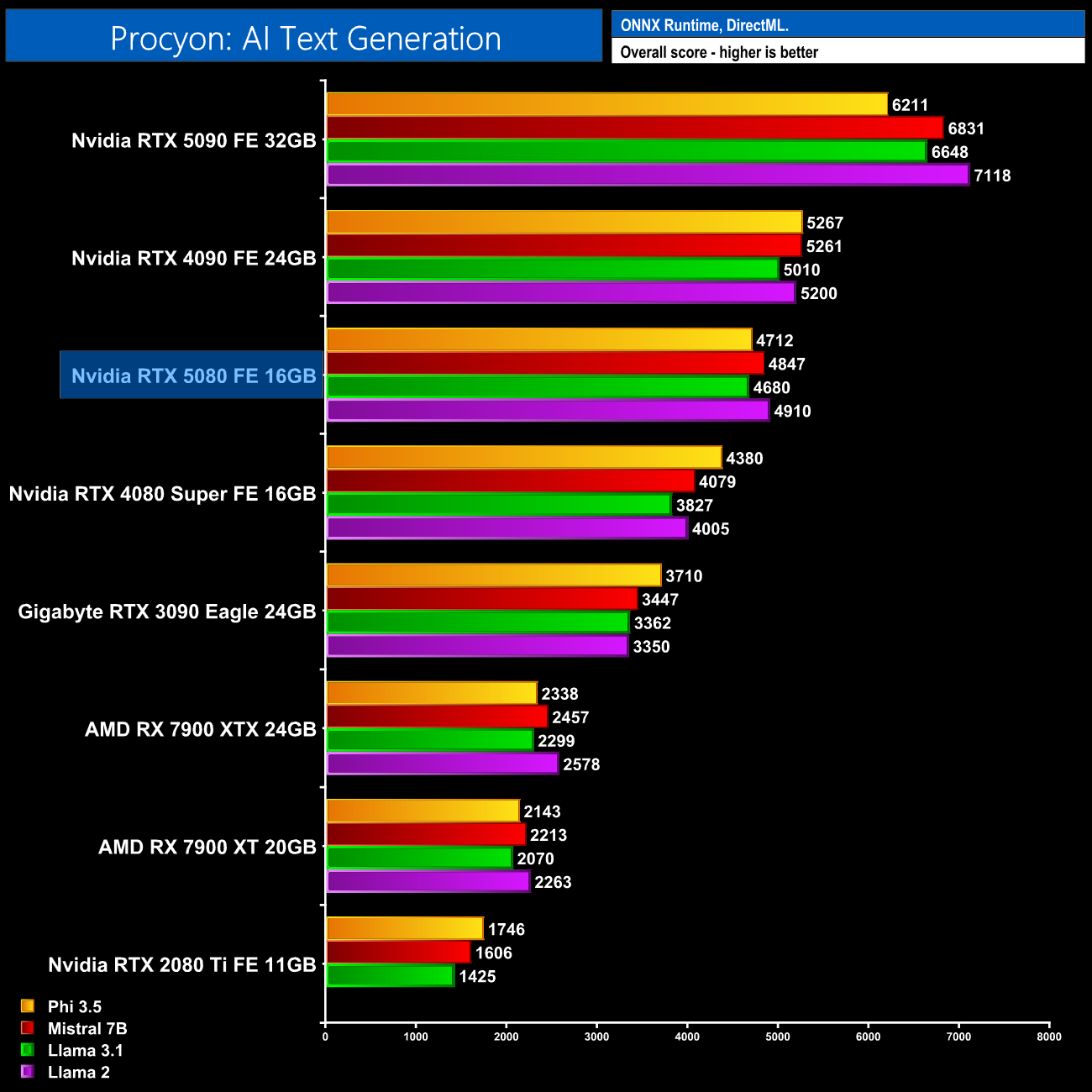
There are more positives to take from the AI Text Generation test however, particularly looking at performance from the two Llama models – in both cases, the RTX 5080 delivers gains of over 20% compared to the RTX 4080 Super.
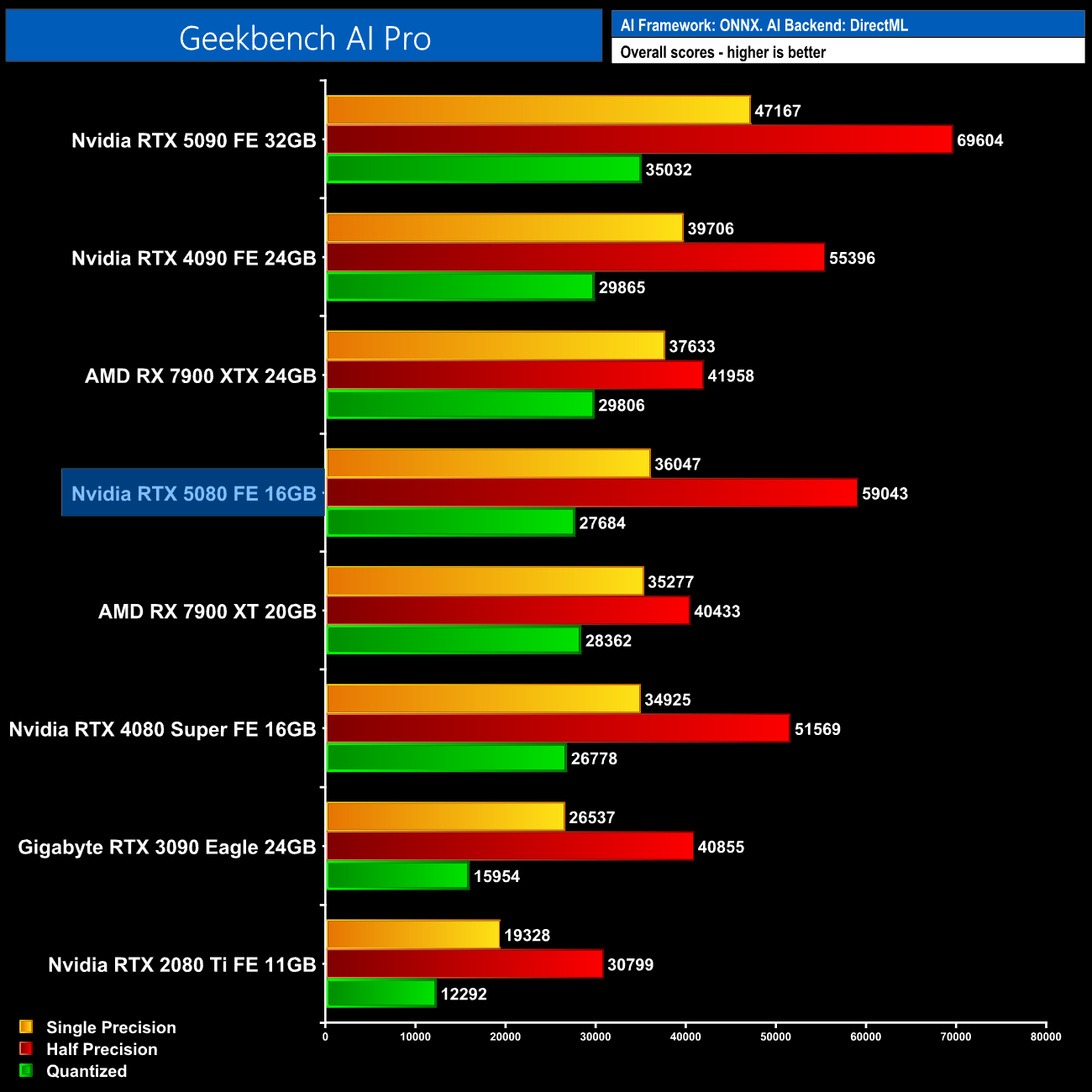
Geekbench AI Pro's performance is more mixed, with the single precision results slightly slower than even the RX 7900 XTX, but the half precision results are faster than even the RTX 4090 and mark a gain of 14% over the RTX 4080 Super.
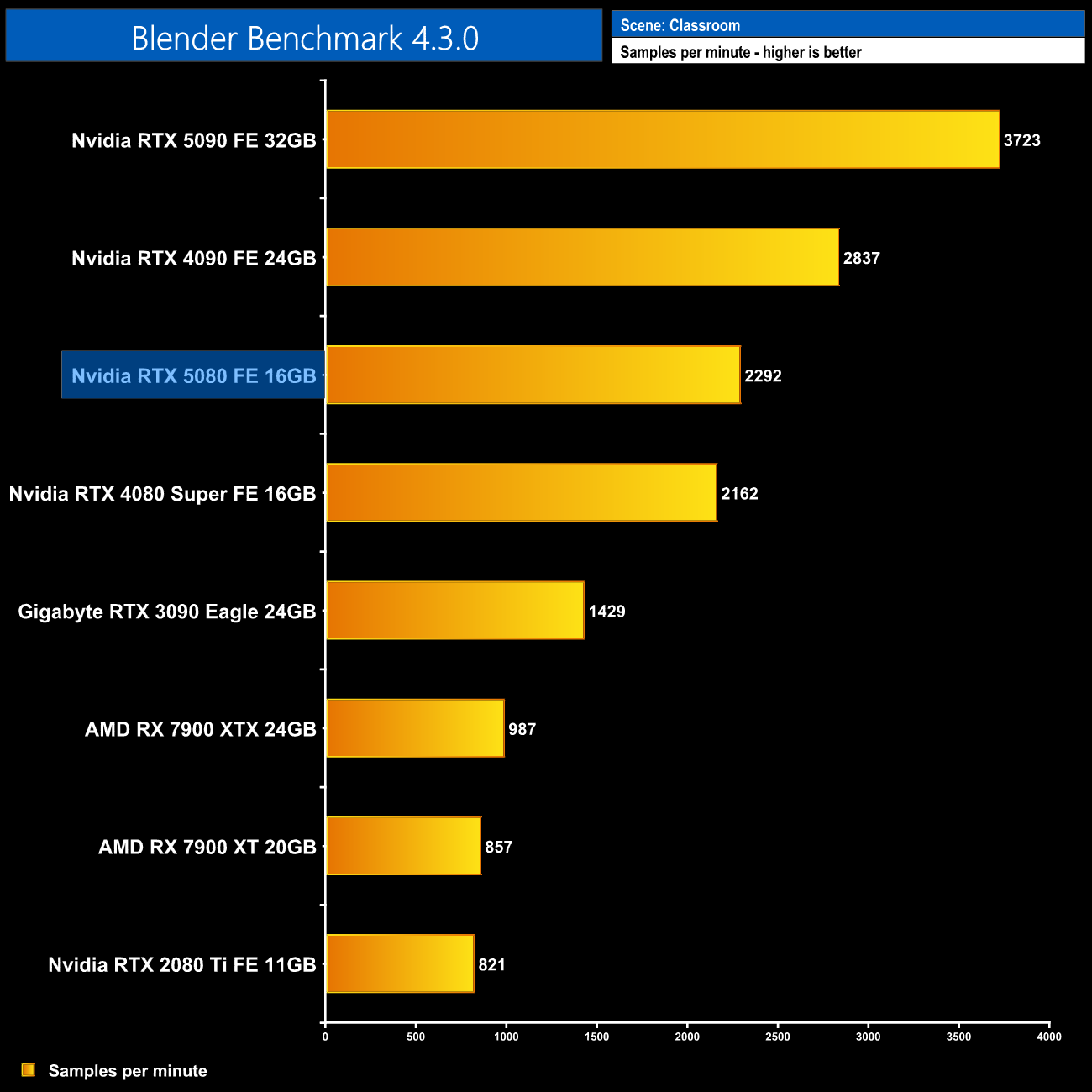
Moving onto Blender performance, we're once again look at just a 6% gain over the RTX 4080 Super.
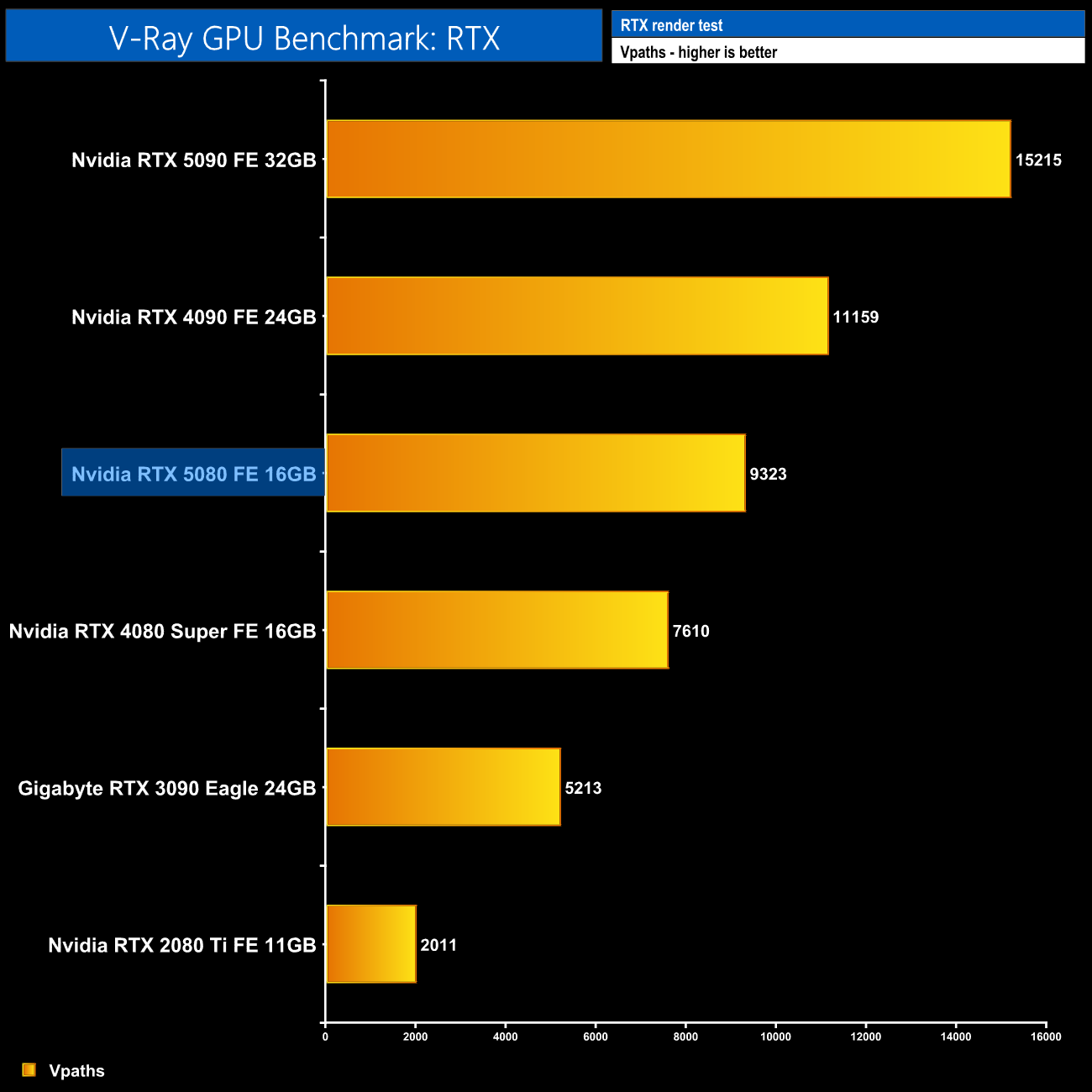
V-Ray GPU Benchmark is more impressive, however, when using the RTX path. Here, the RTX 5080 is 23% faster than the 4080 Super and 16% slower than the 4090.
Here we present the average clock speed for each graphics card while running A Plague Tale: Requiem for 30 minutes. We use GPU-Z to record the GPU core frequency during gameplay. We calculate the average core frequency during the 30 minute run to present here.
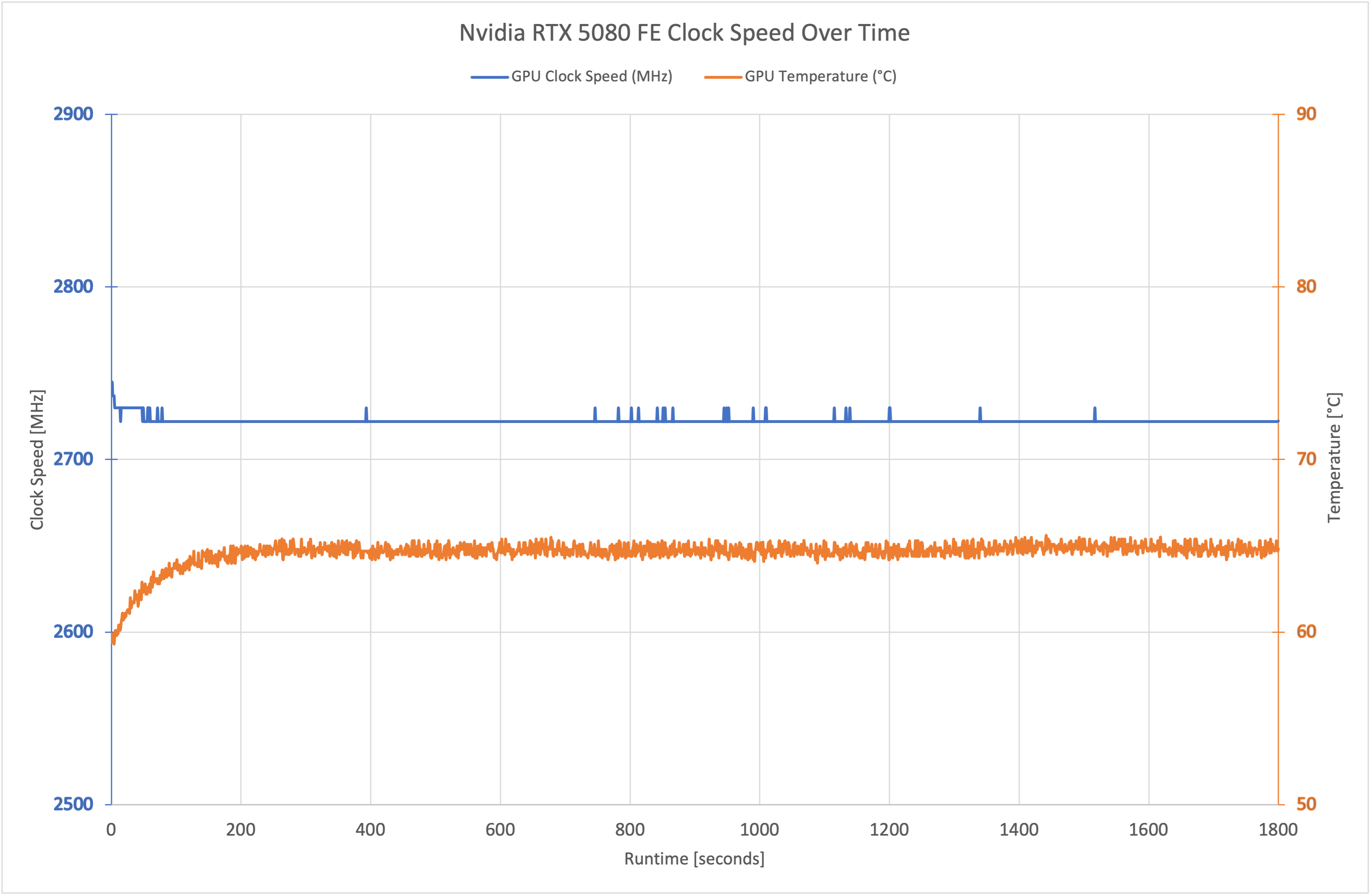
Looking now at clock speed of the Founders Edition model, it ran at a very consistent frequency during the 30-minute stress test. In fact, apart from the first thirty seconds or so, it ran almost the entire test at 2722MHz, with just a few minor spikes here and there. This is about on par, give or take 20MHz, with the RTX 4080 Super, so clock speeds are fairly consistent from Ada to Blackwell.
For our temperature testing, we measure steady-state GPU temperatures under load. A reading under load comes from running A Plague Tale: Requiem for 30 minutes.
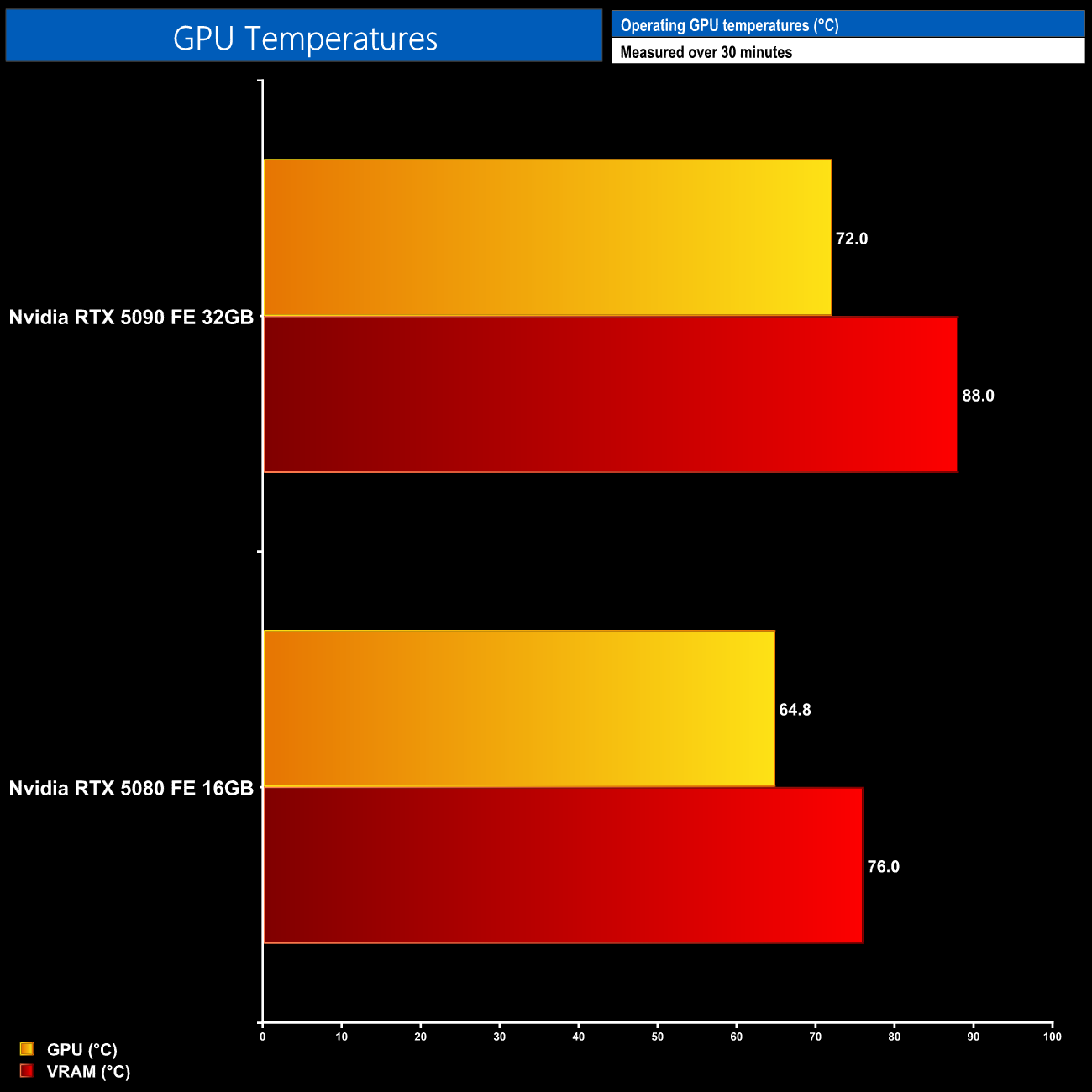
Despite rocking a few internal changes, such as the lack of the 3D Vapour Chamber, the RTX 5080 Founders Edition cooler is still more than a match for this 360W GPU, and temperatures hit just below 65C over our thirty minute stress test. VRAM, meanwhile, was slightly warmer at 76C, but still nothing to worry about. It's be interesting to see what performance would be like if Nvidia had used the same exact cooler for the 5080 as with the 5090, but even with a few cut backs, this is more than good enough.
We take our noise measurements with the sound meter positioned 1 foot from the graphics card. I measured the noise floor to be 32 dBA, thus anything above this level can be attributed to the graphics cards. The power supply is passive for the entire power output range we tested all graphics cards in, while all CPU and system fans were disabled. A reading under load comes from running A Plague Tale: Requiem for 30 minutes.
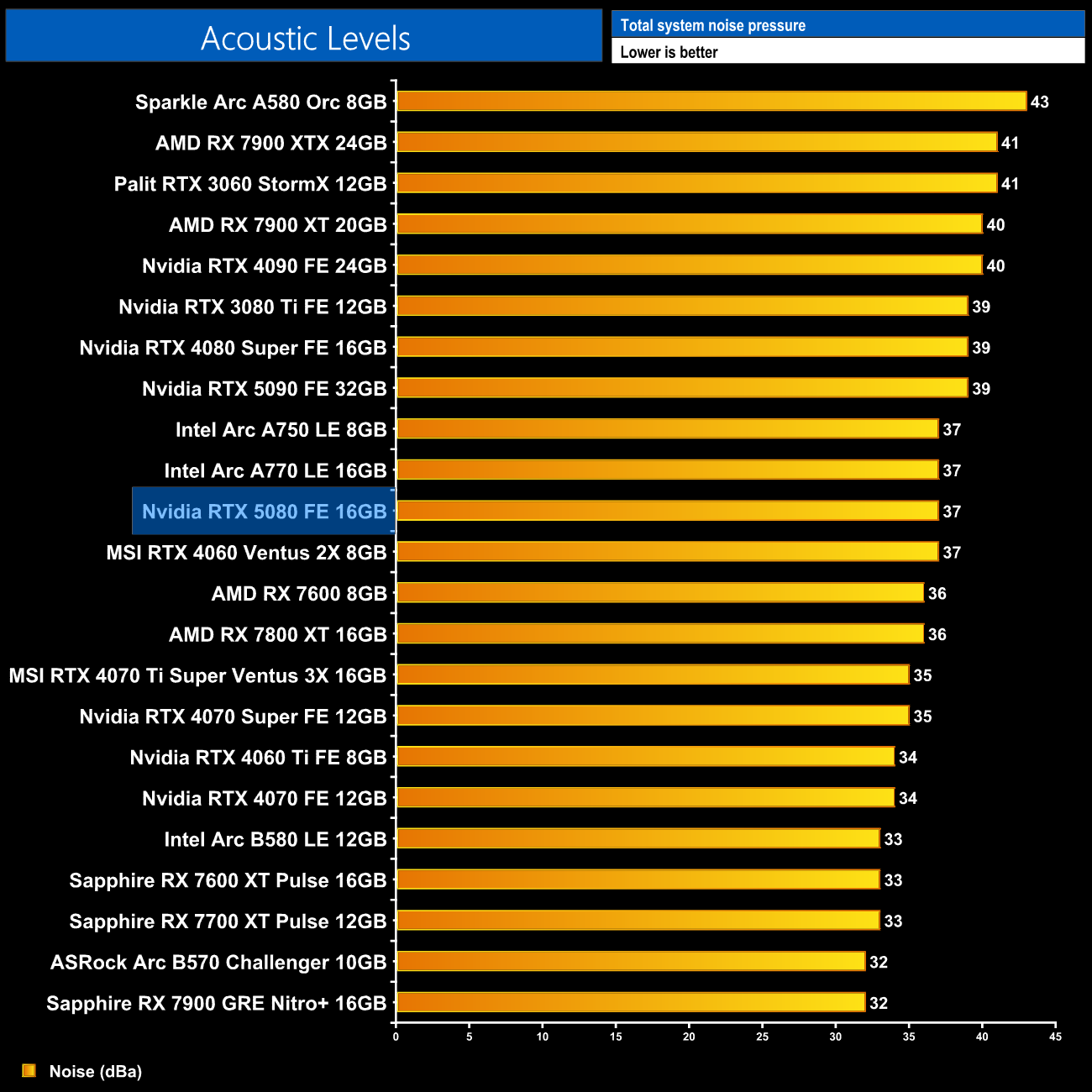
Noise levels are slightly improved over the 5090 FE, too. My 5090 ran the fans at 46%/1585rpm, whereas the 5080 is slightly more relaxed at a 42%/1475rpm speed, reducing noise by 2dBa. I'm also happy to report I didn't notice any coil whine on the 5080.
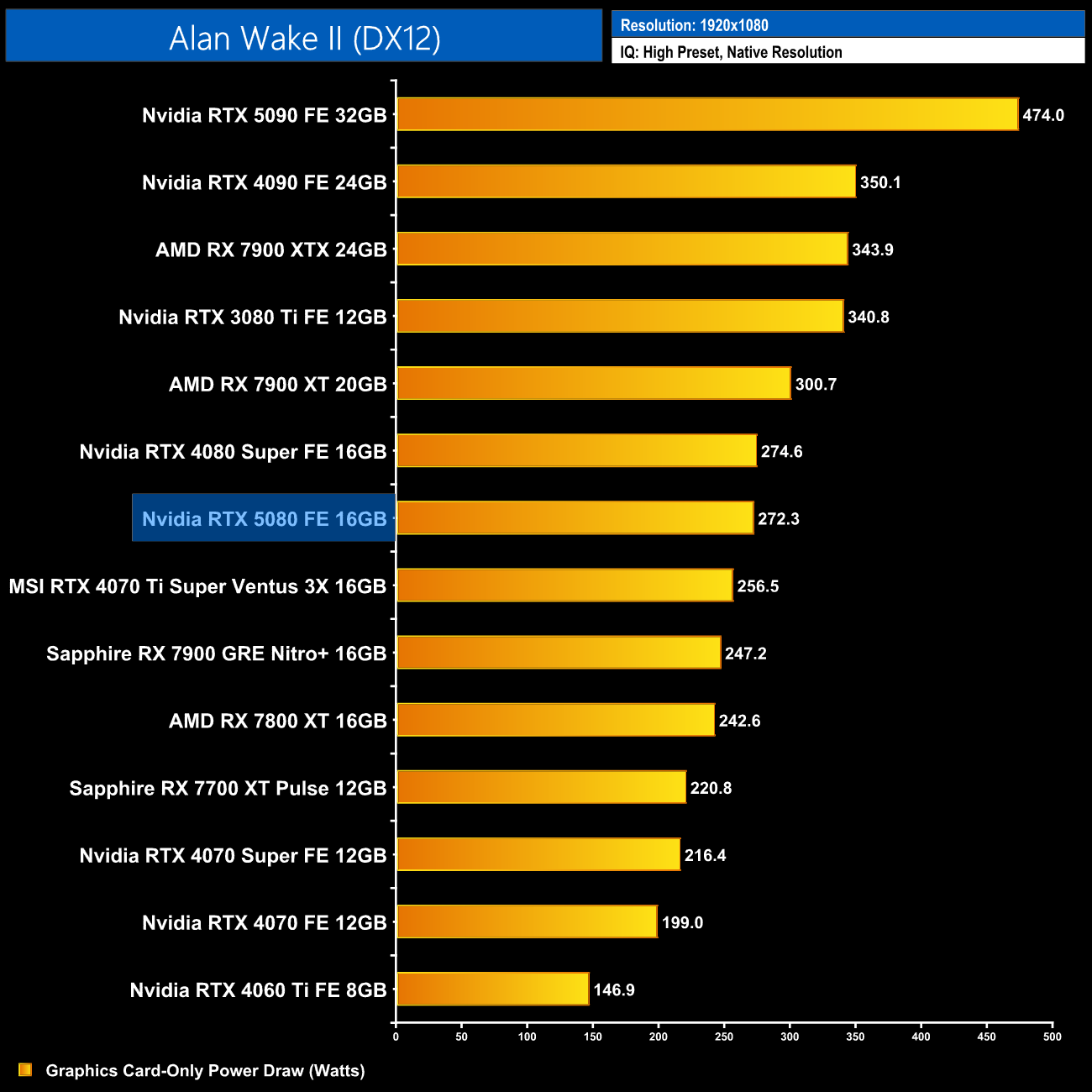
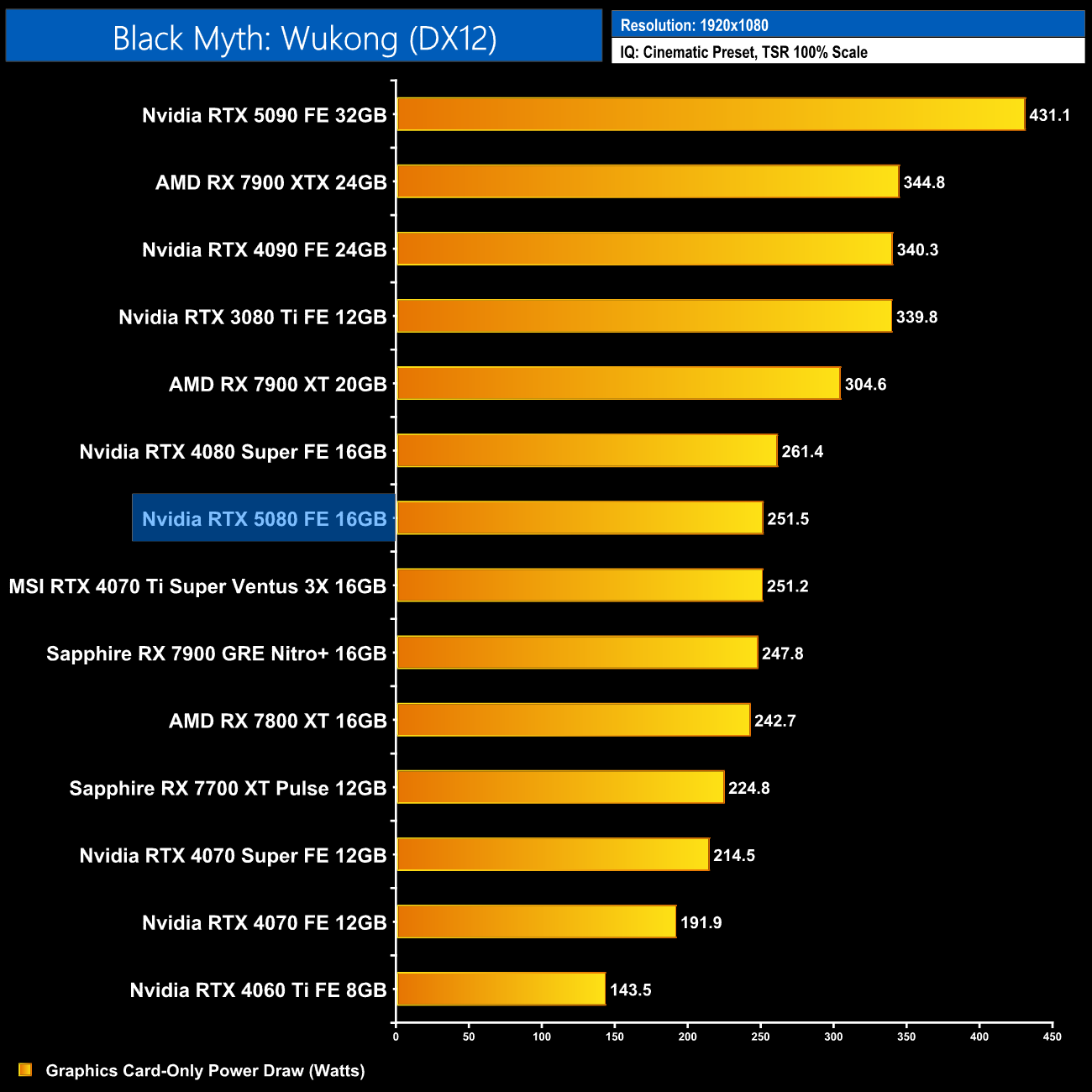
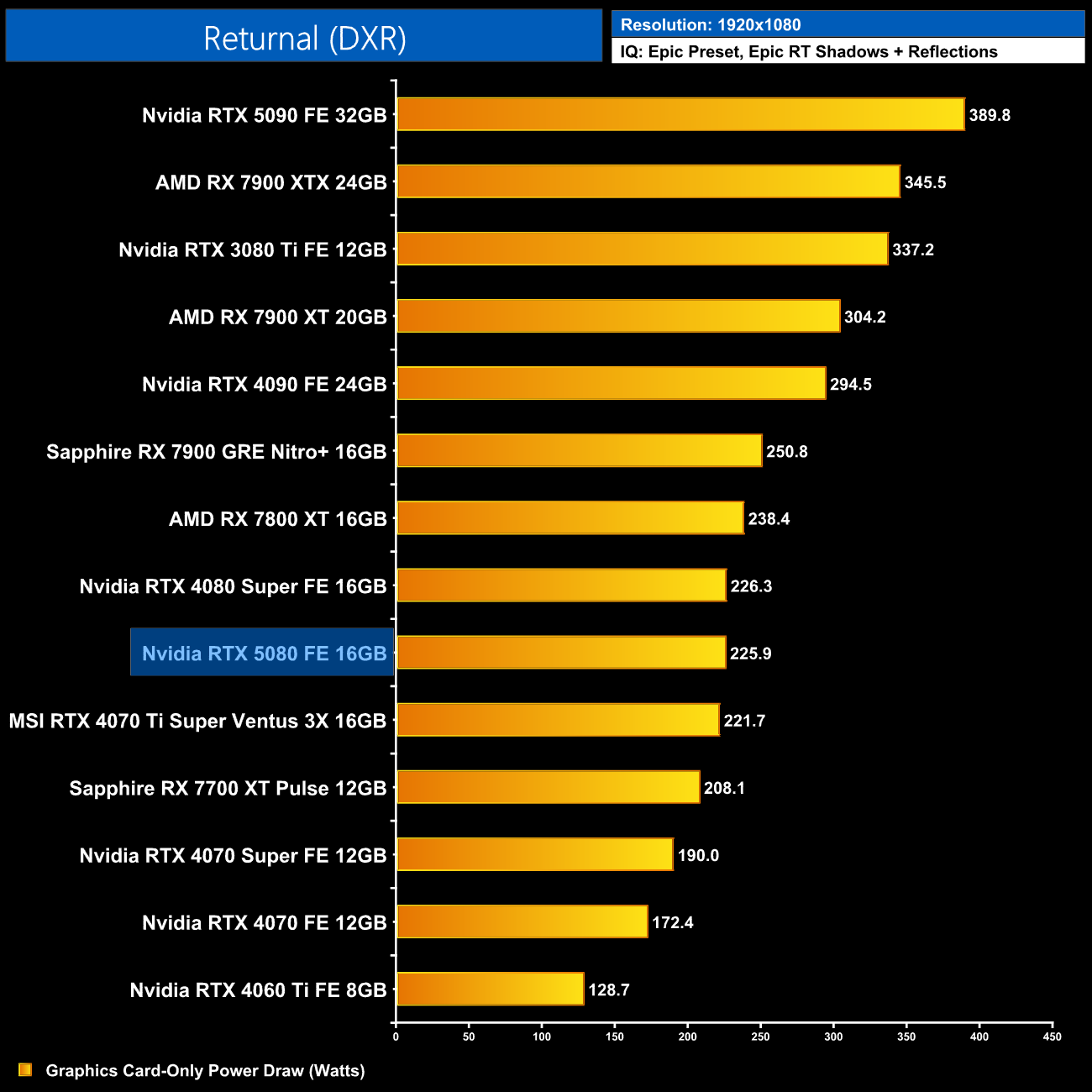
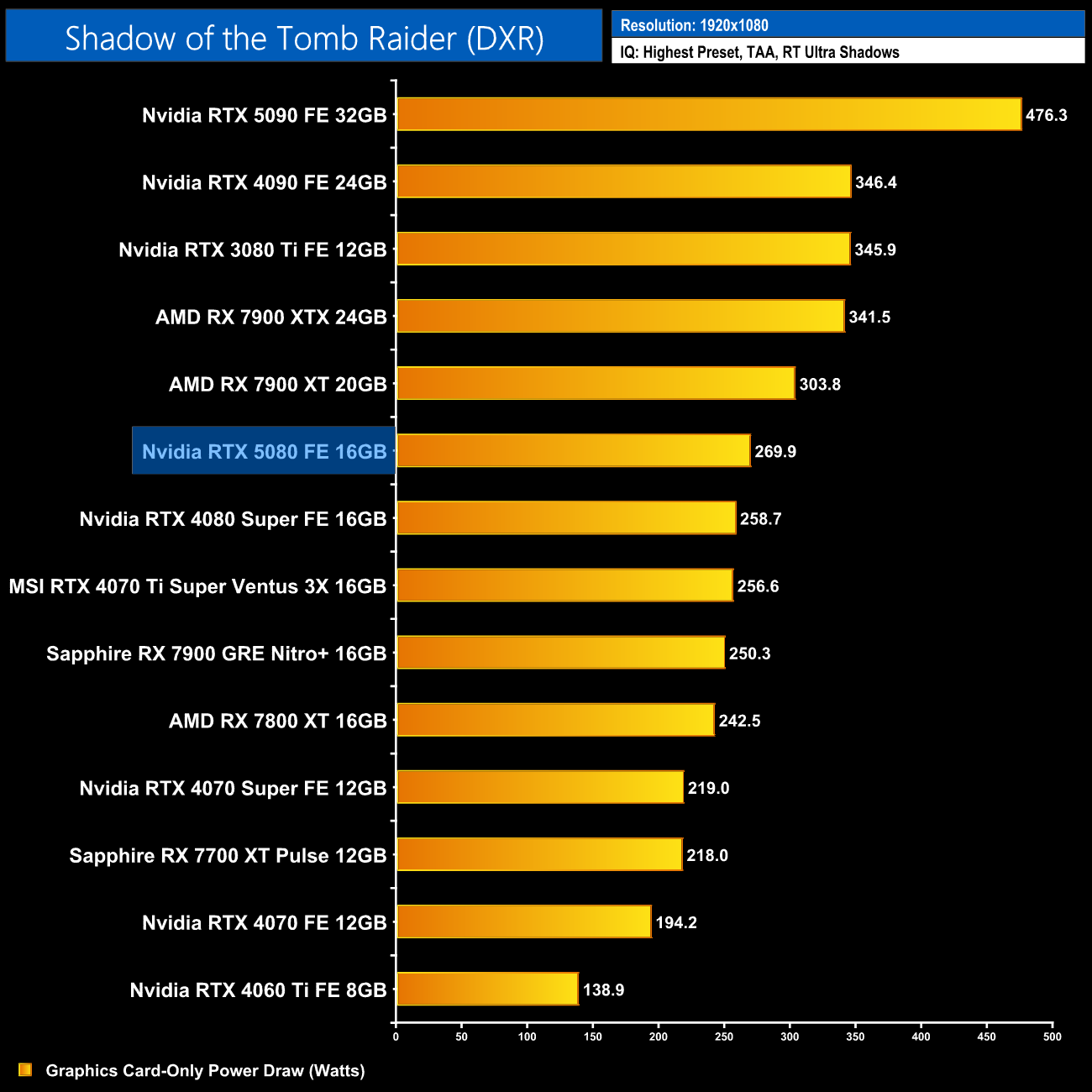
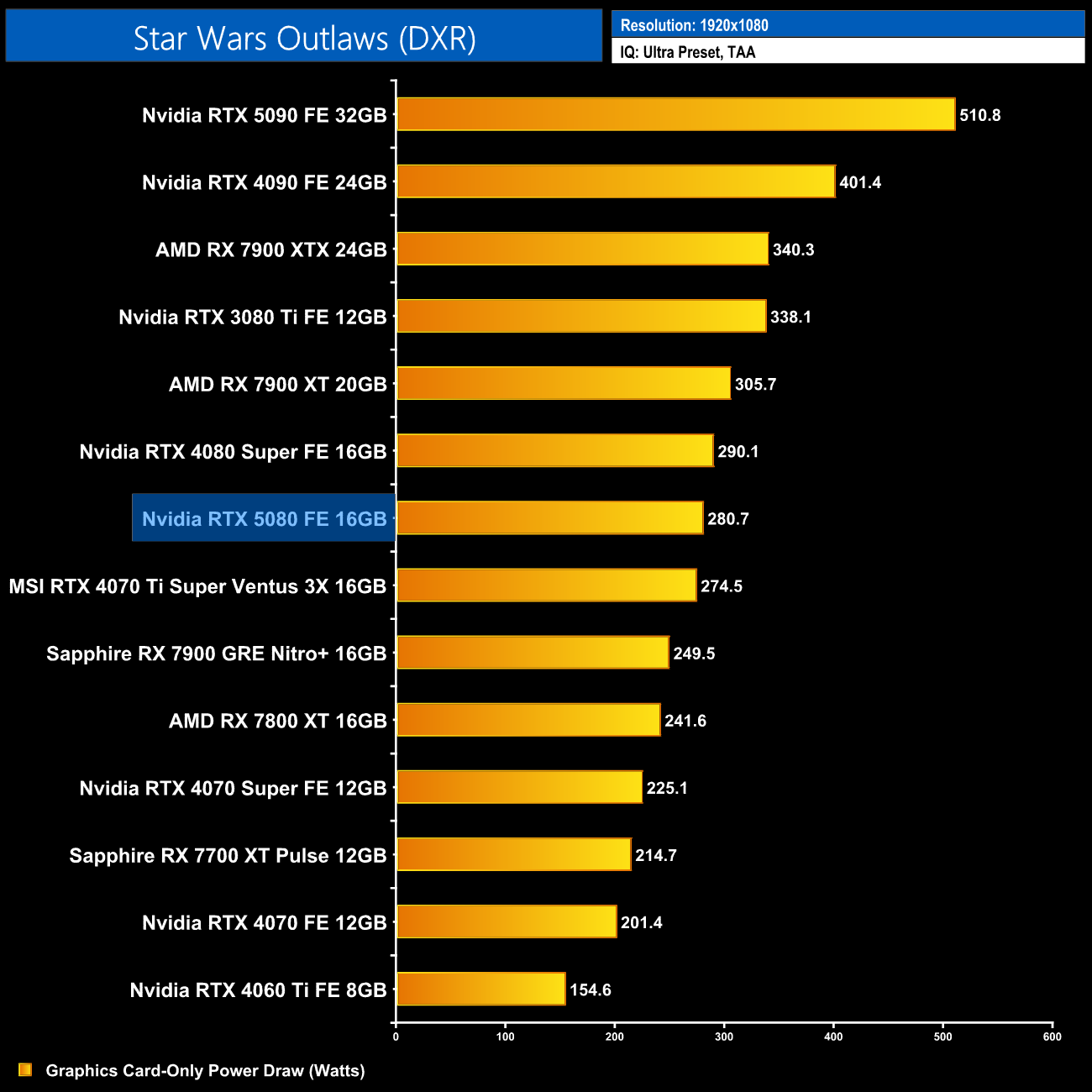
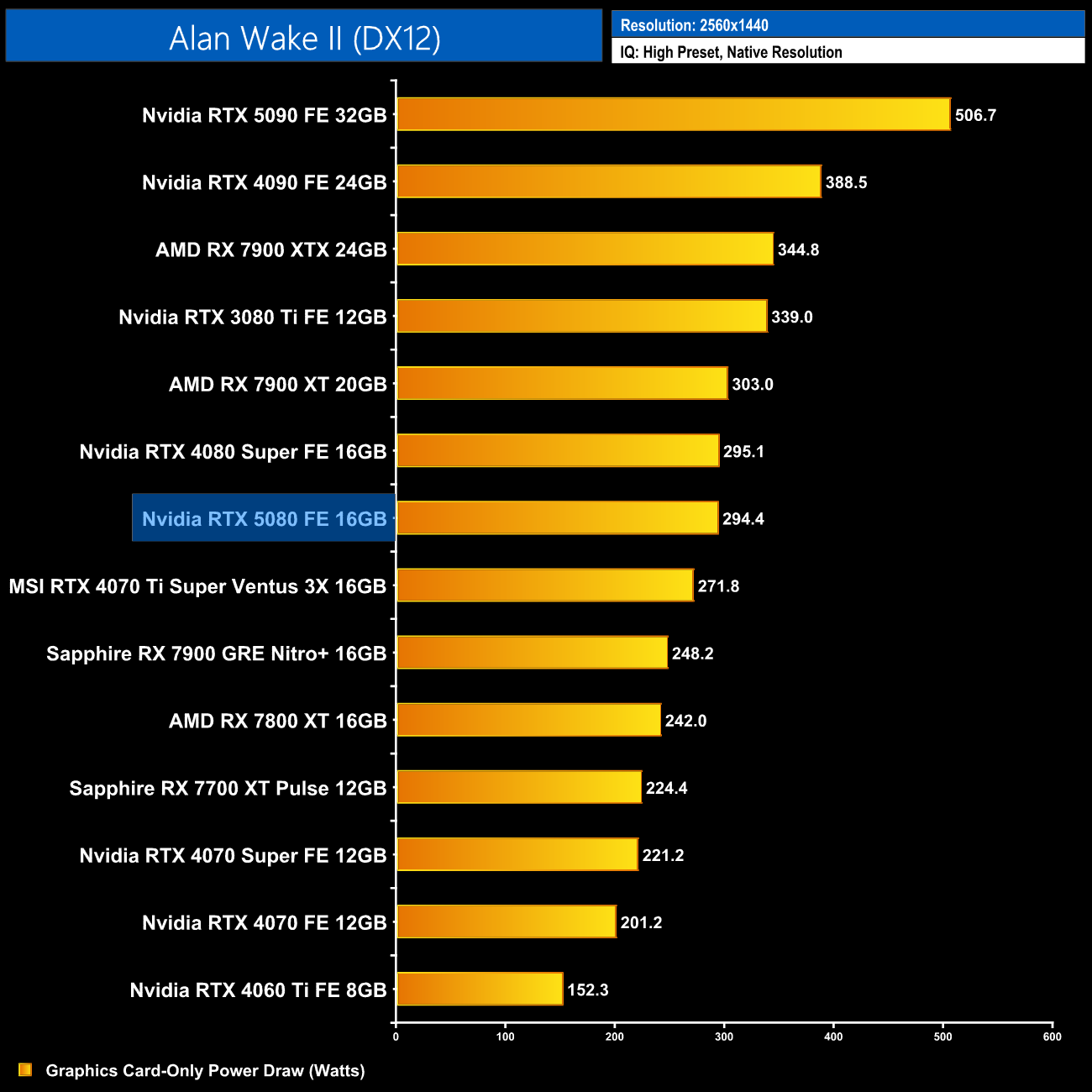
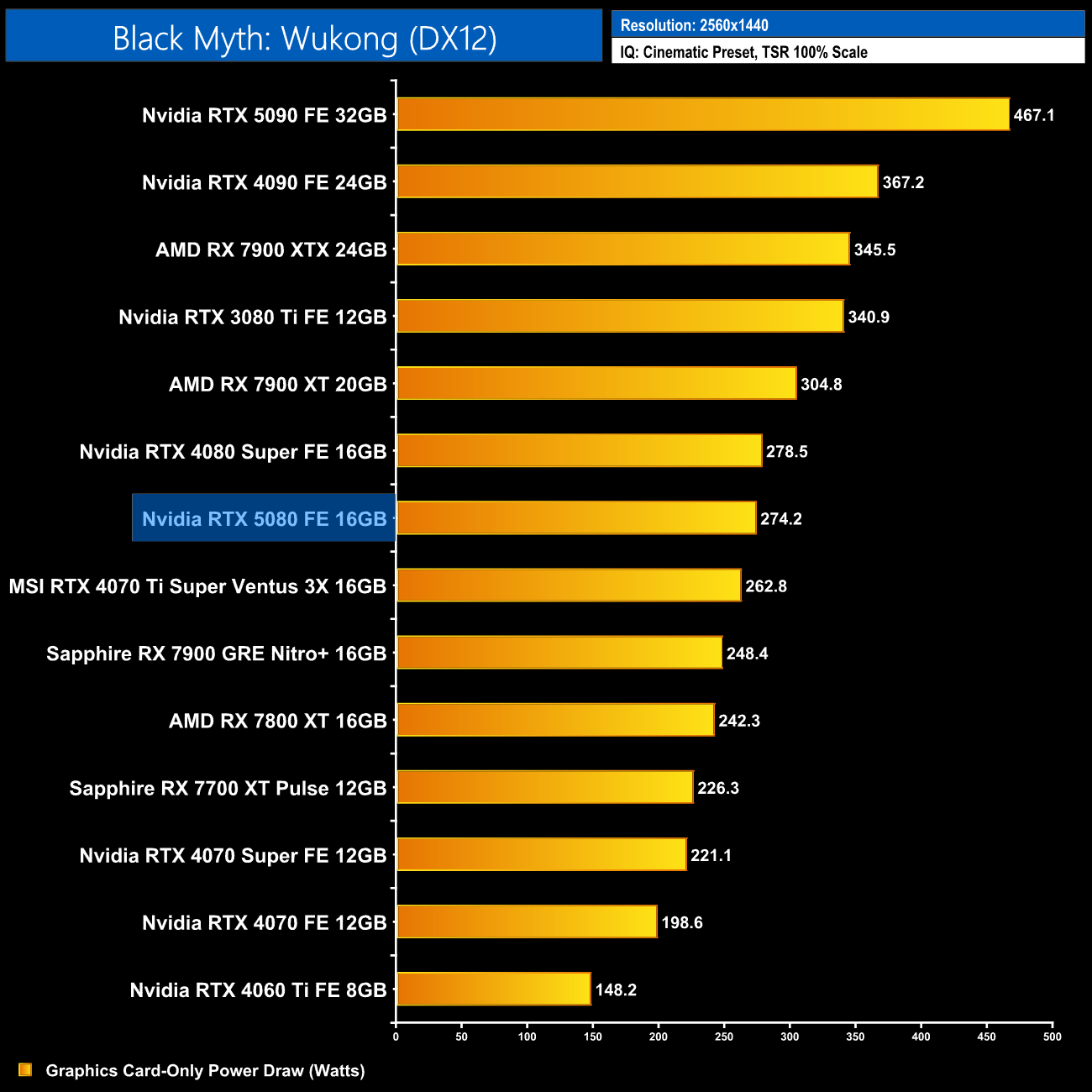
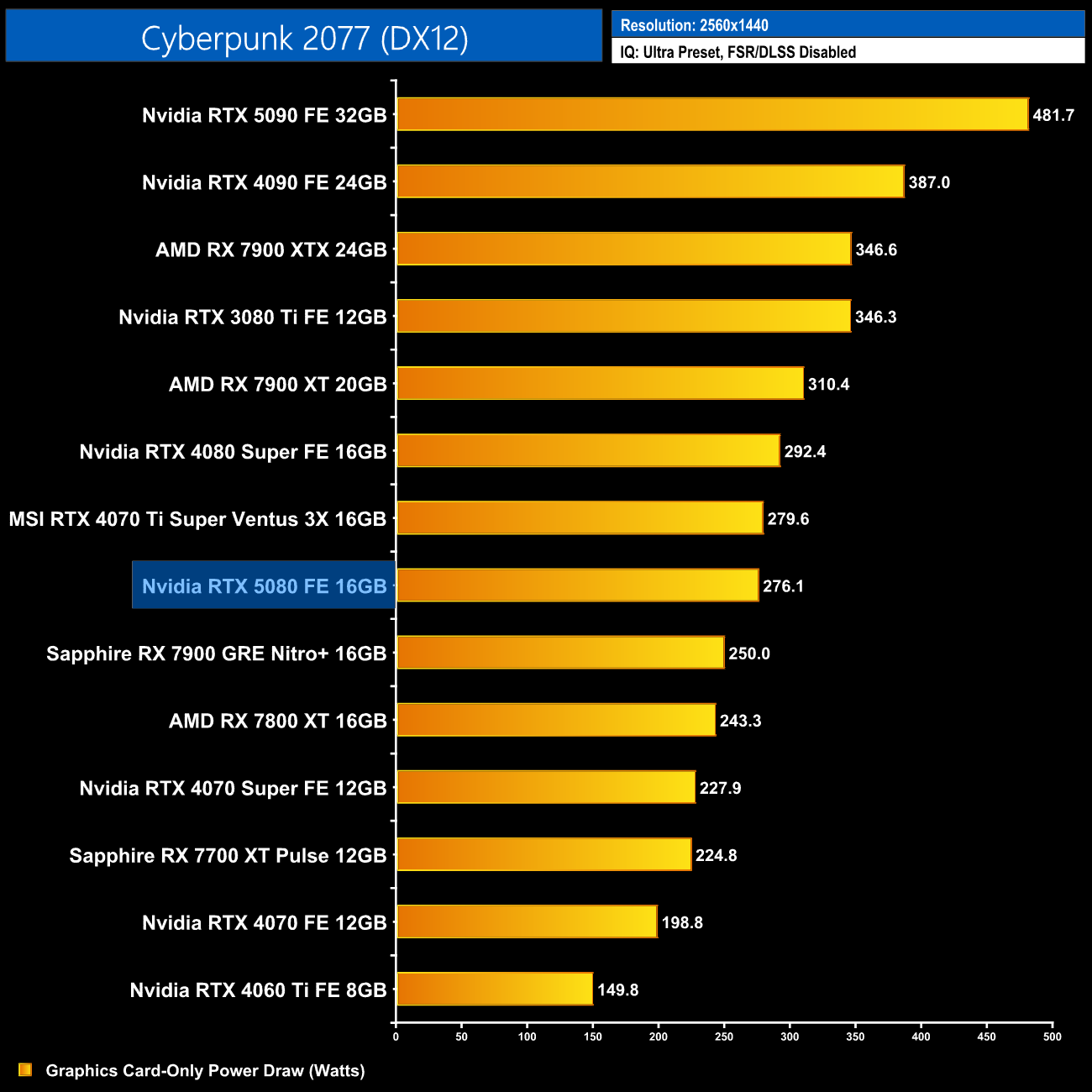
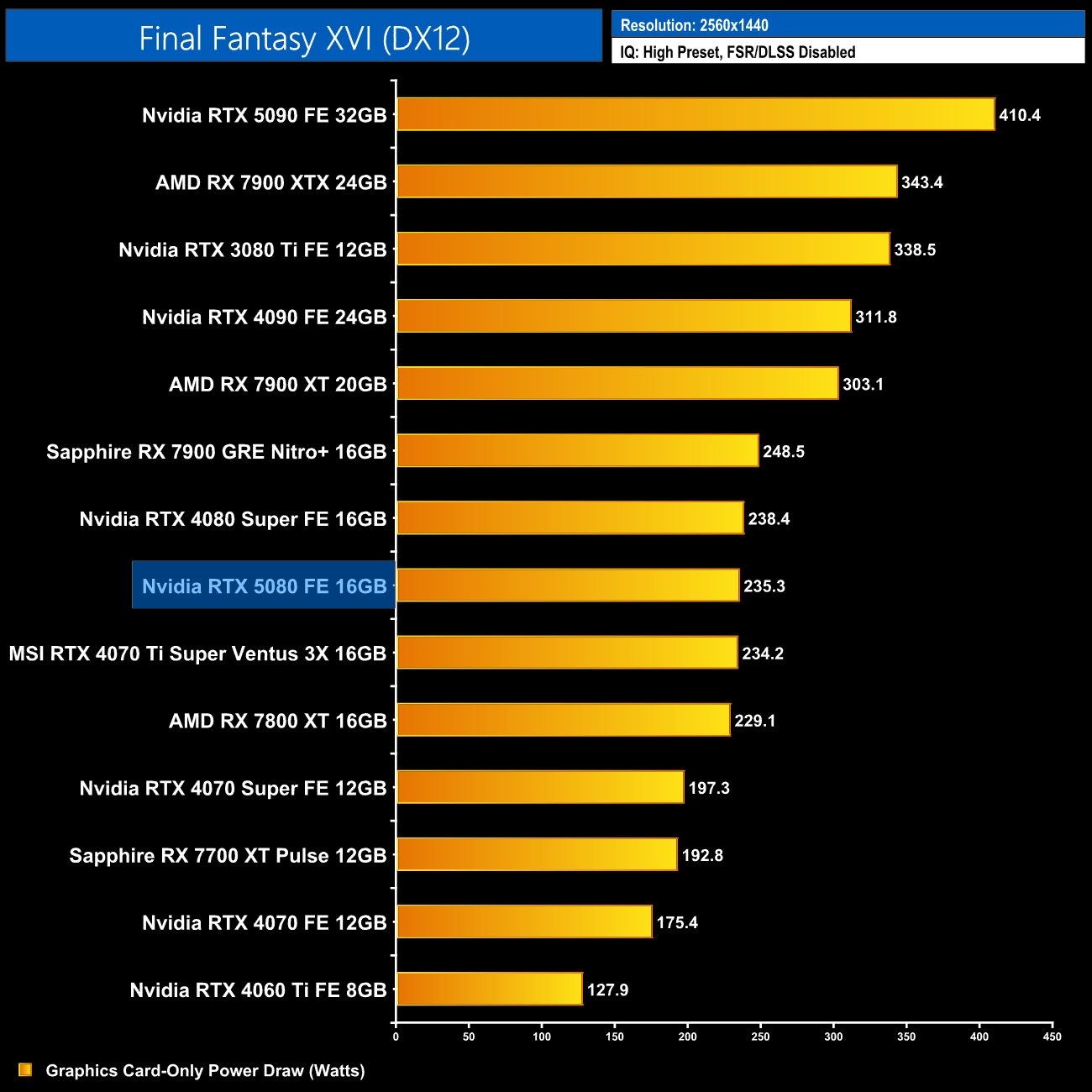
Here we present power draw figures for the graphics card-only, on a per-game basis for all twelve games we tested at 1080p. This is measured using Nvidia's Power Capture Analysis Tool, also known as PCAT. You can read more about our updated power draw testing methodology HERE.
Per-Game Results at 1080p:
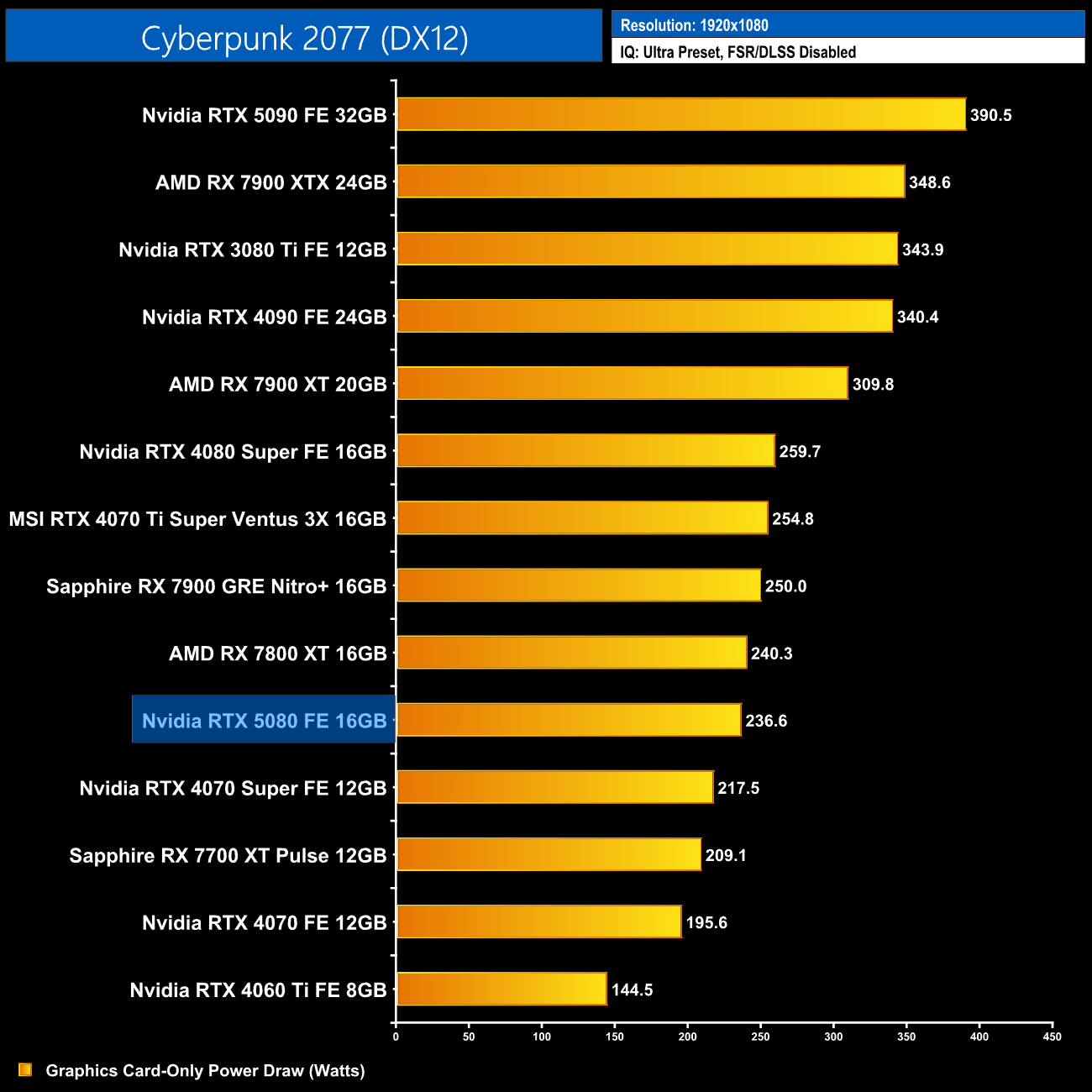
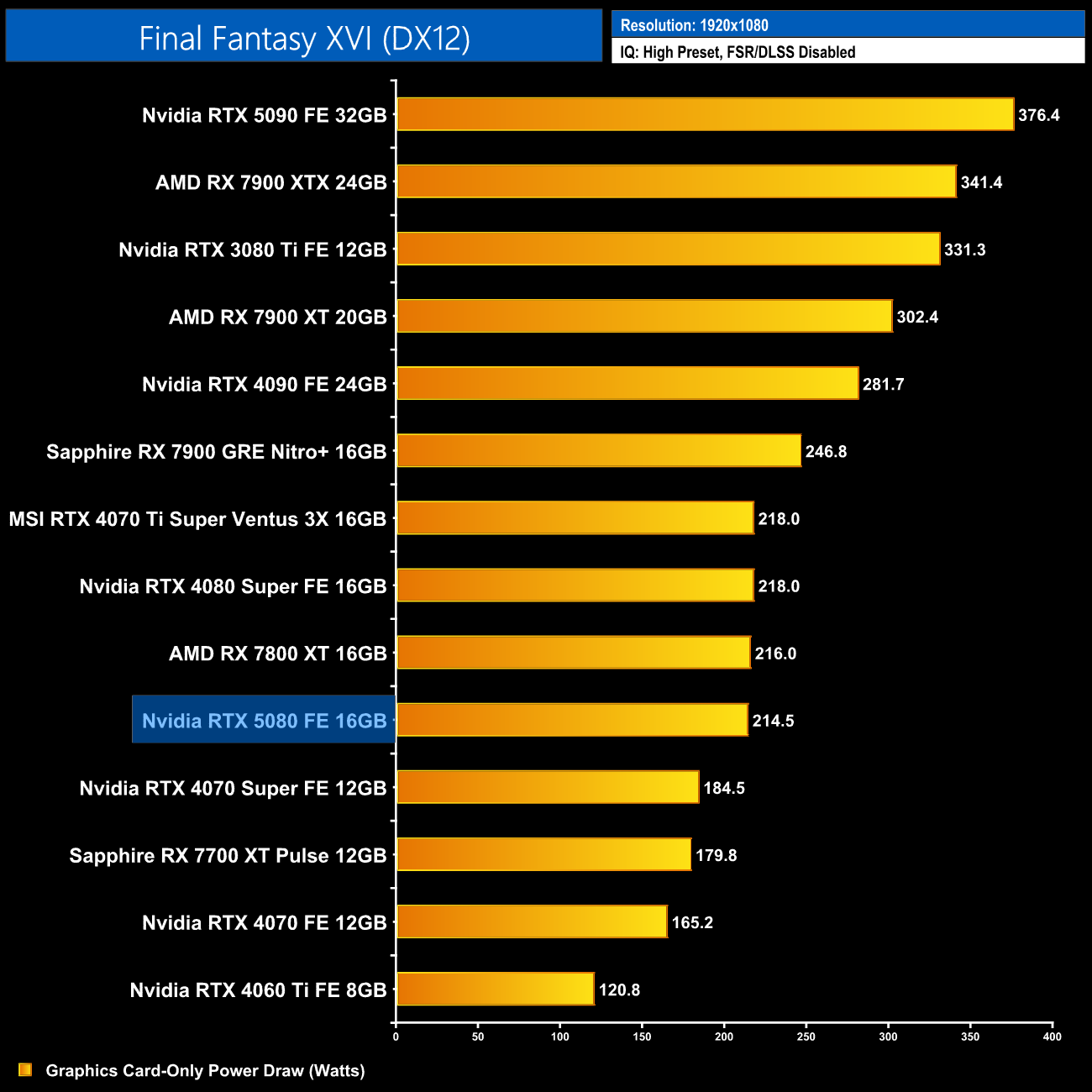
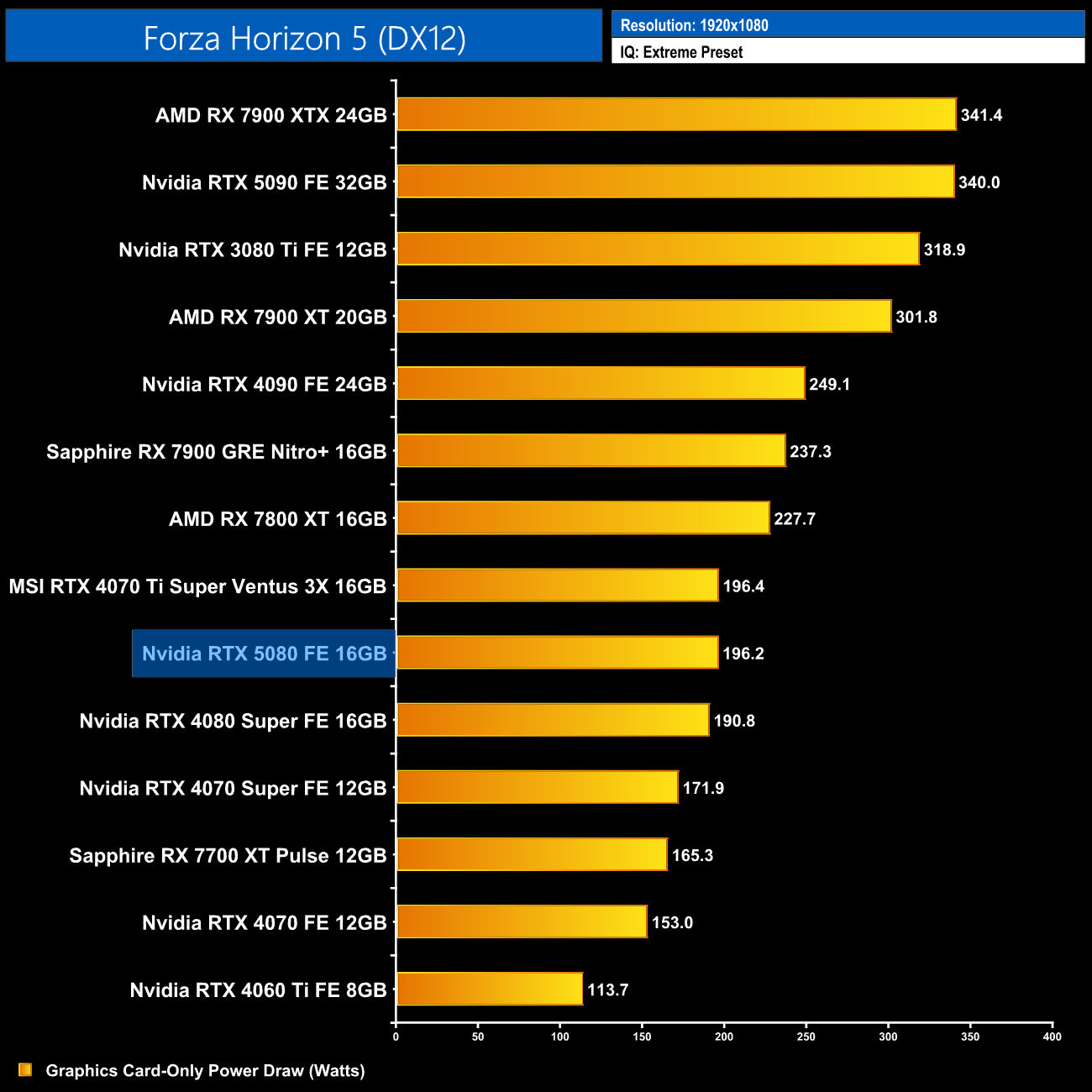
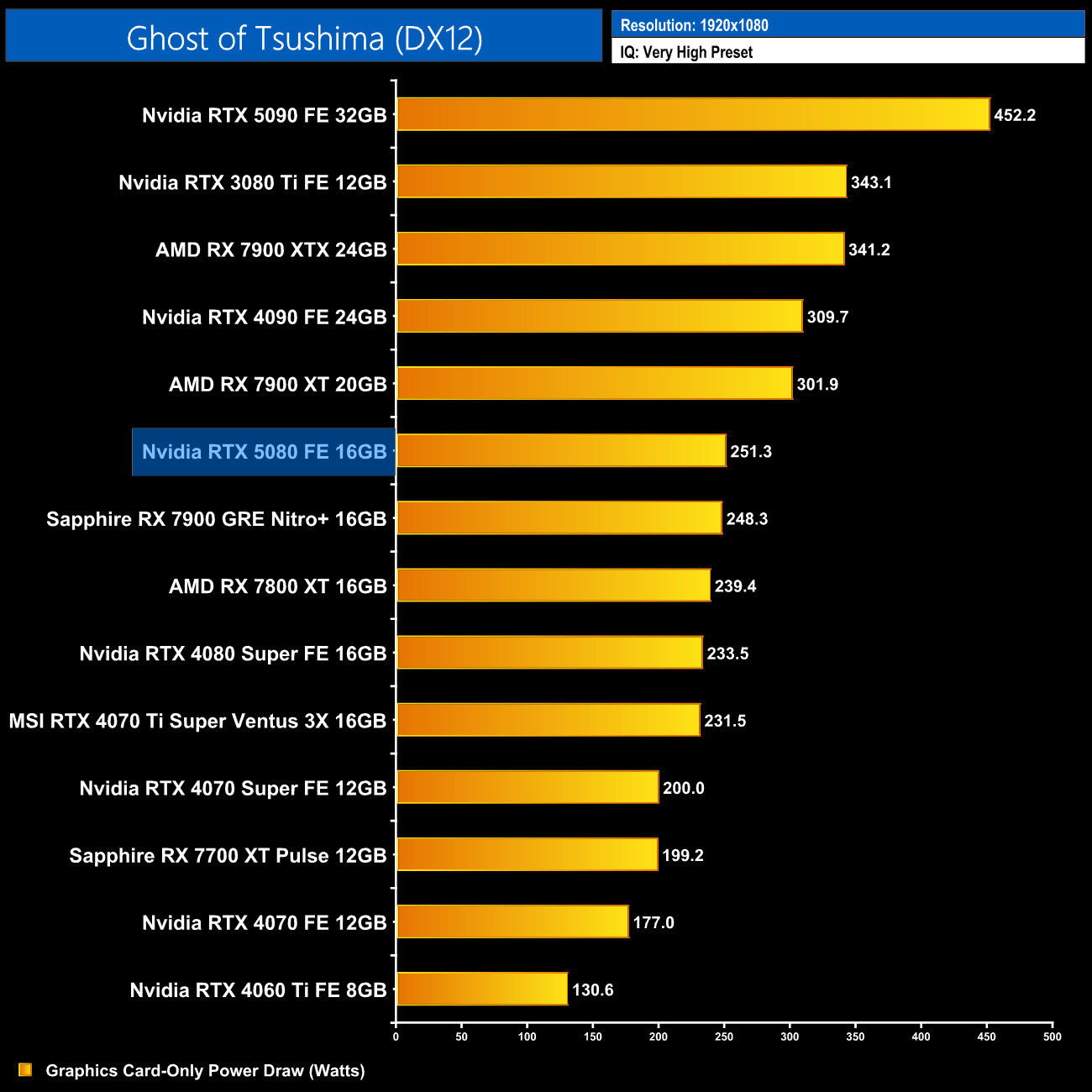
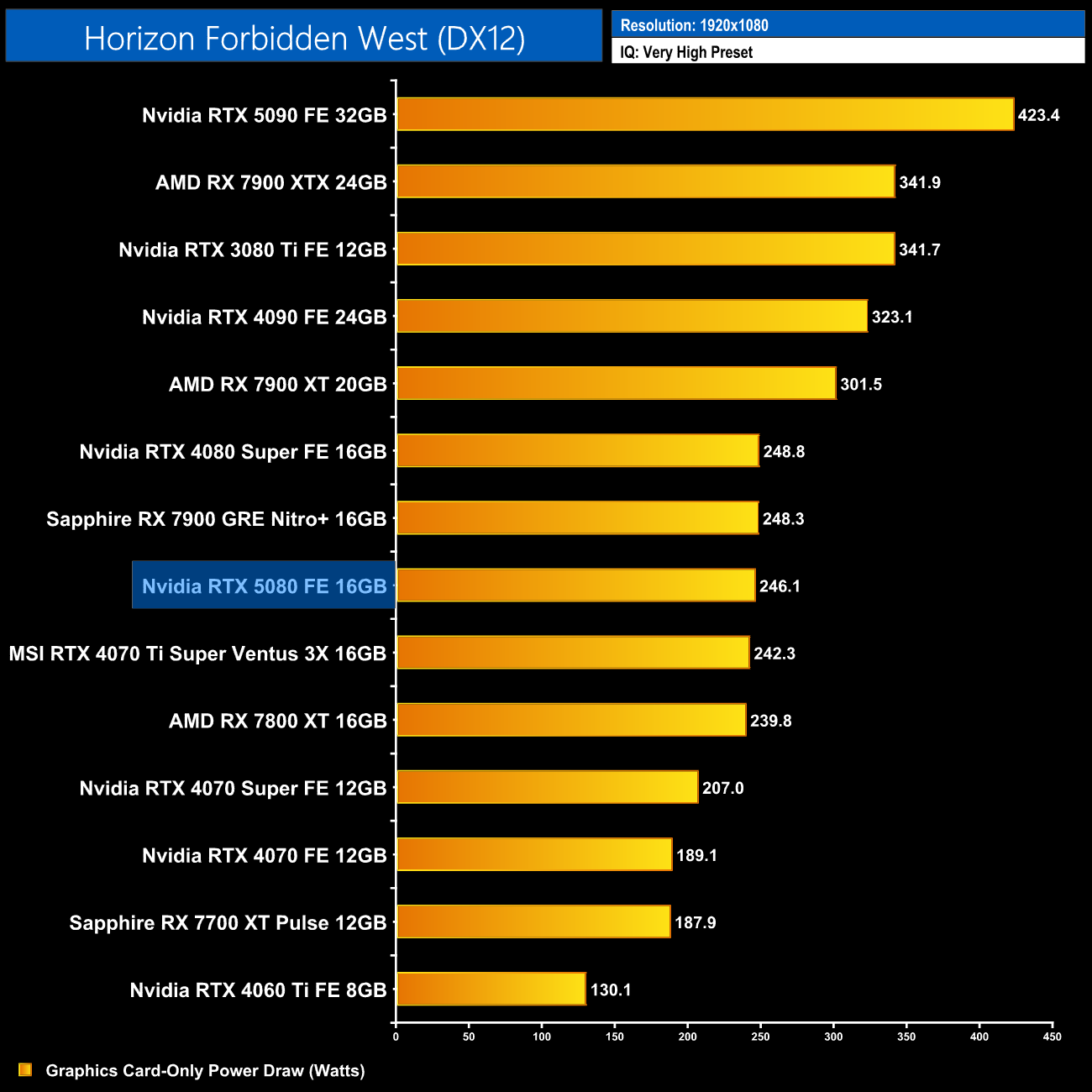
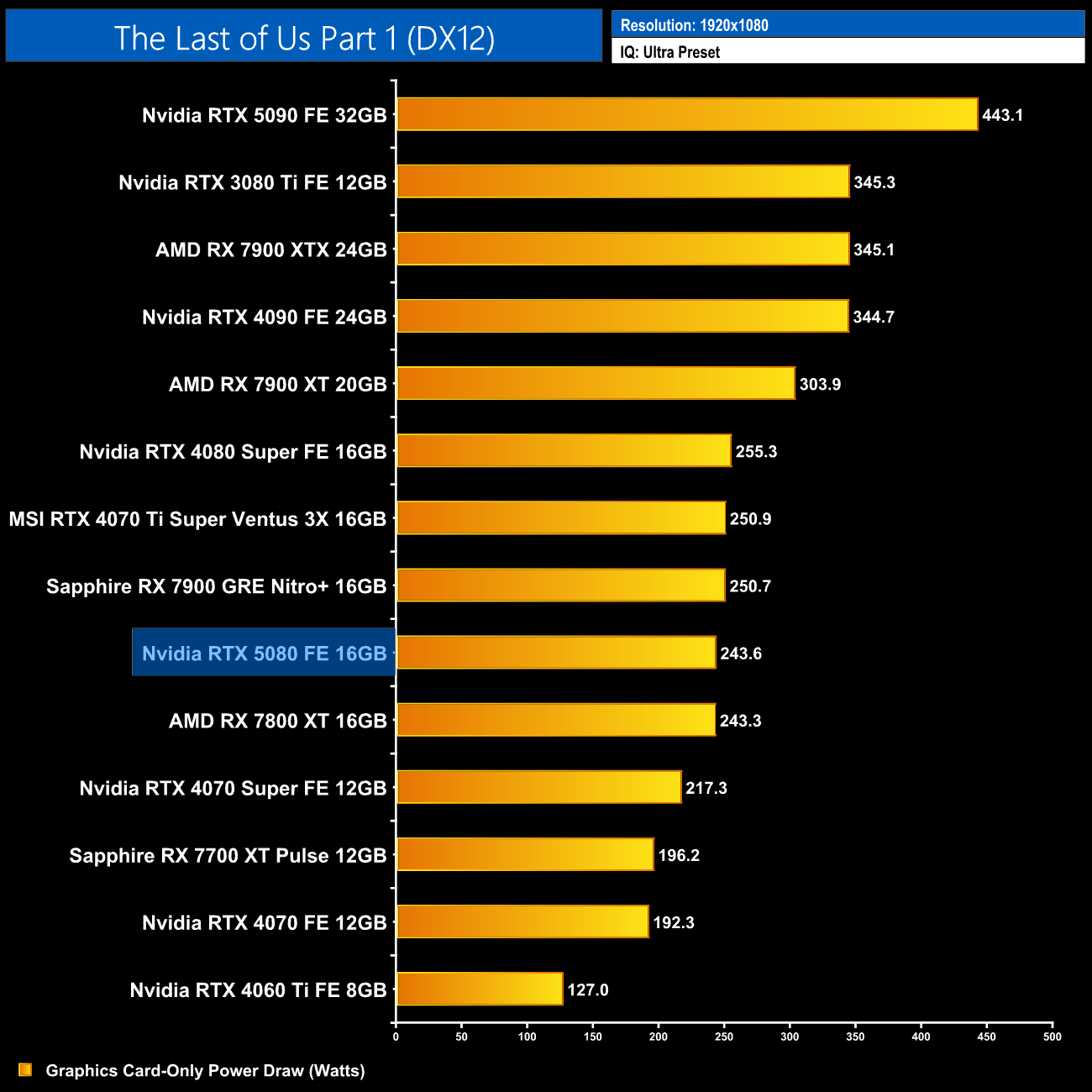
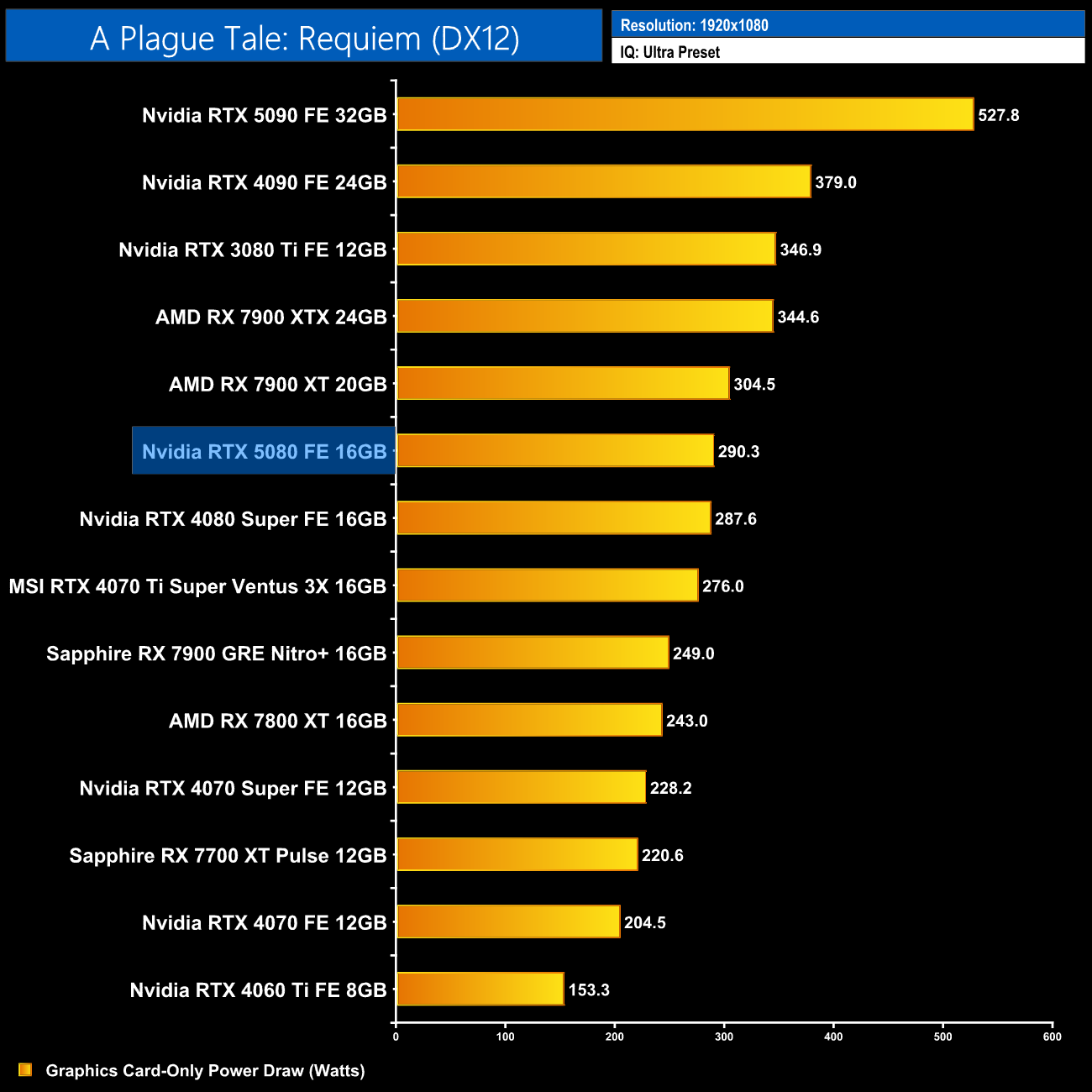
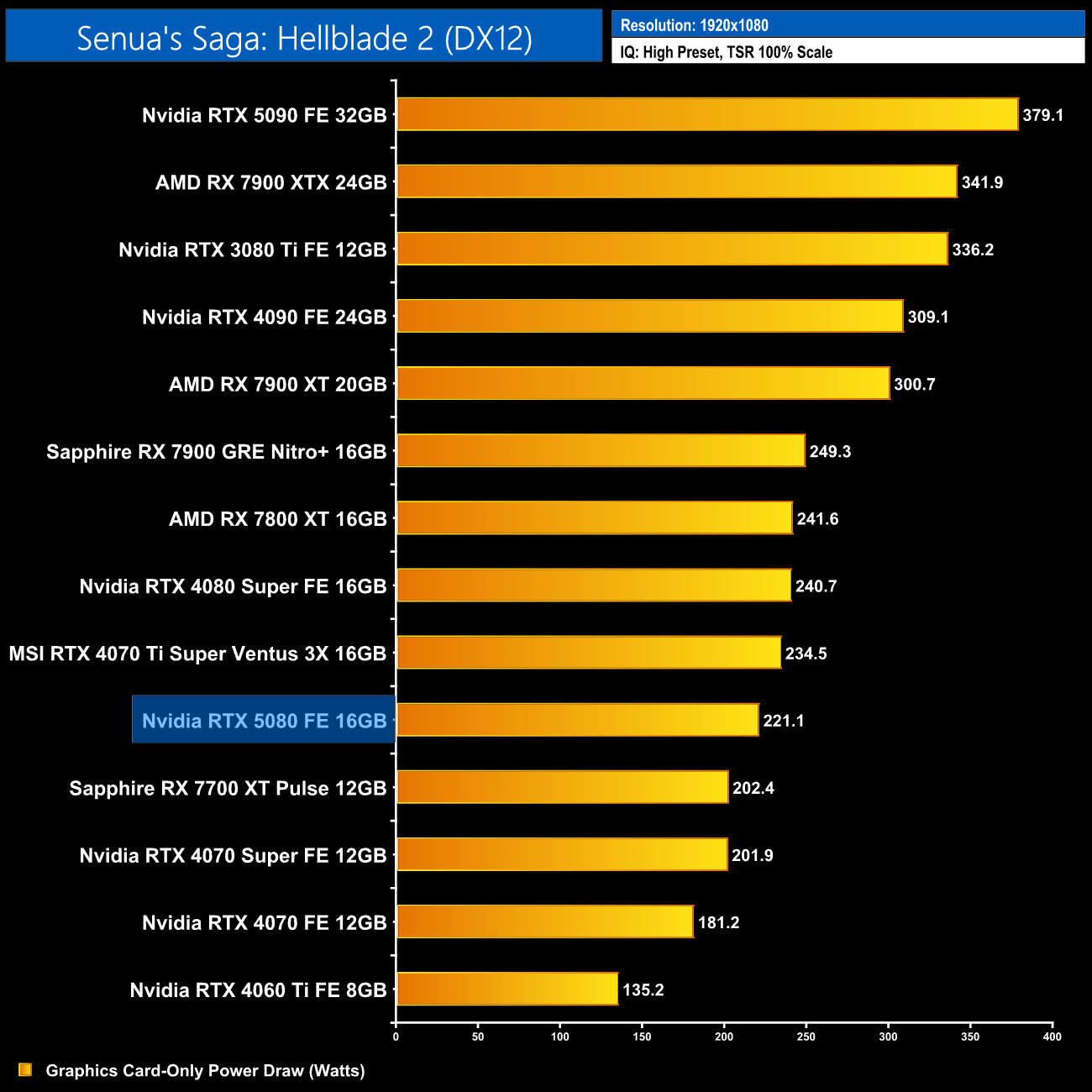
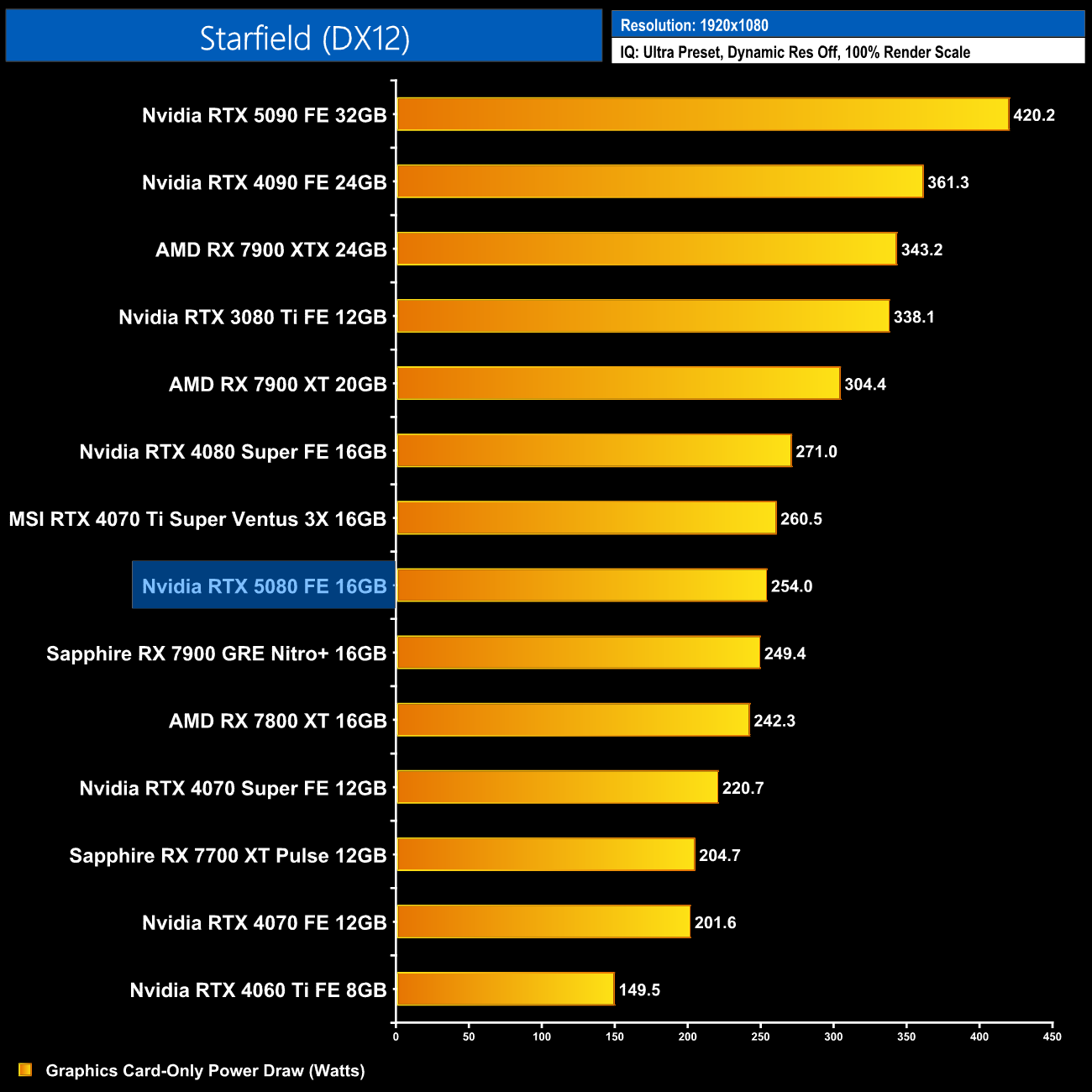
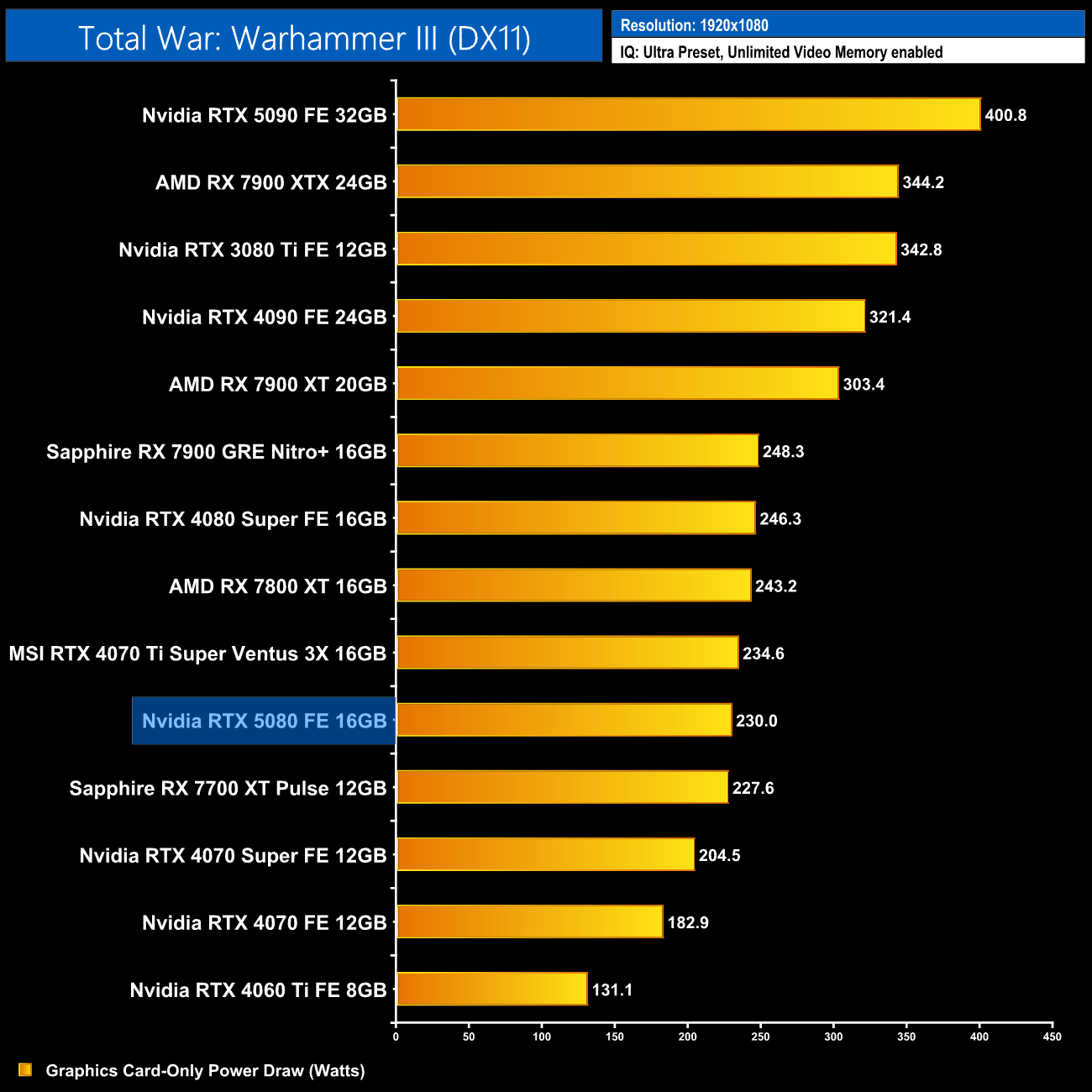
Click to enlarge.
12-Game Average at 1080p:
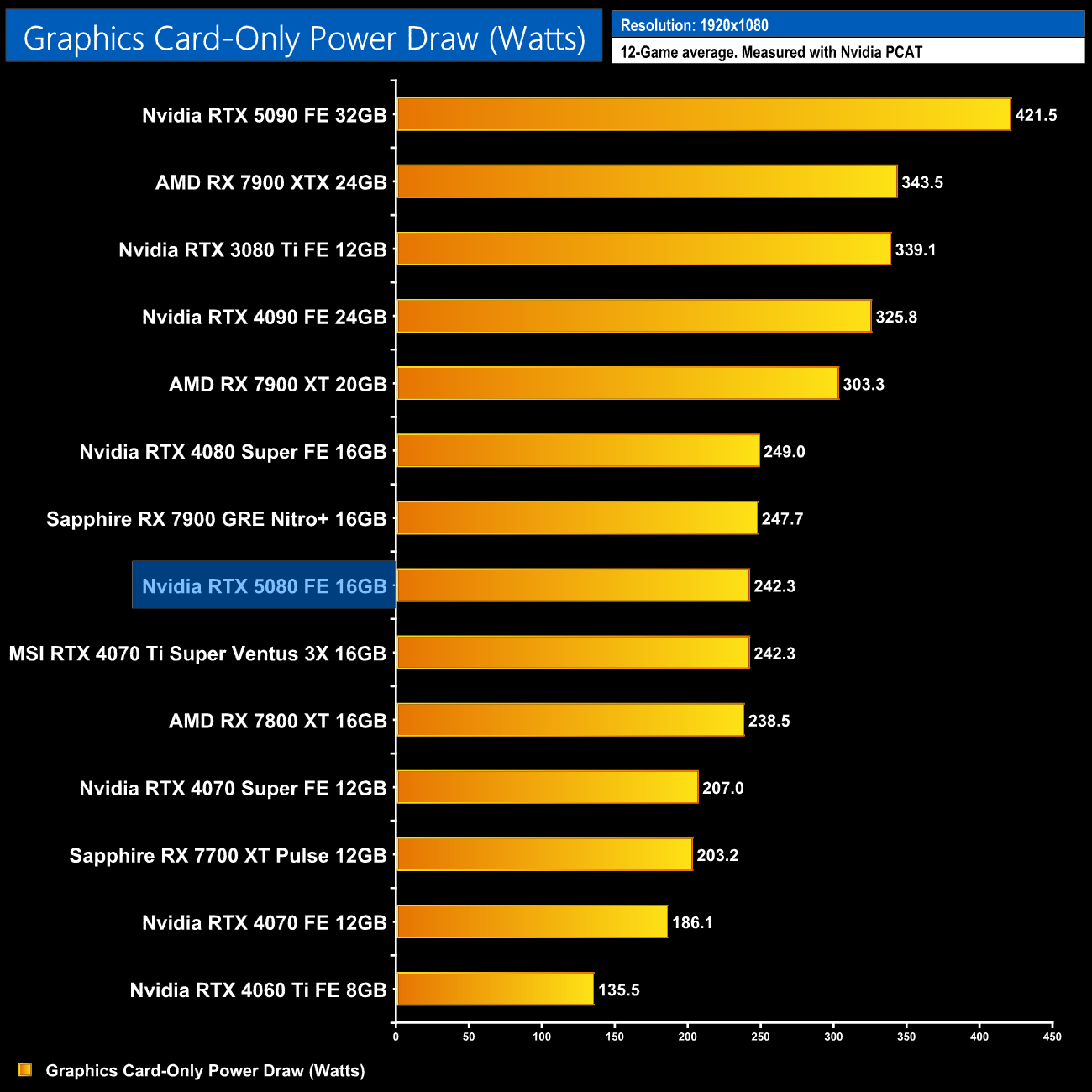
Despite packing a 360W rated TGP, power draw is much lower at 1080p, averaging just 242.3W – on par with the RTX 4070 Ti Super and RX 7800 XT.
Ray tracing results
As a bonus, we now include the power figures for all eight games we test with ray tracing enabled.
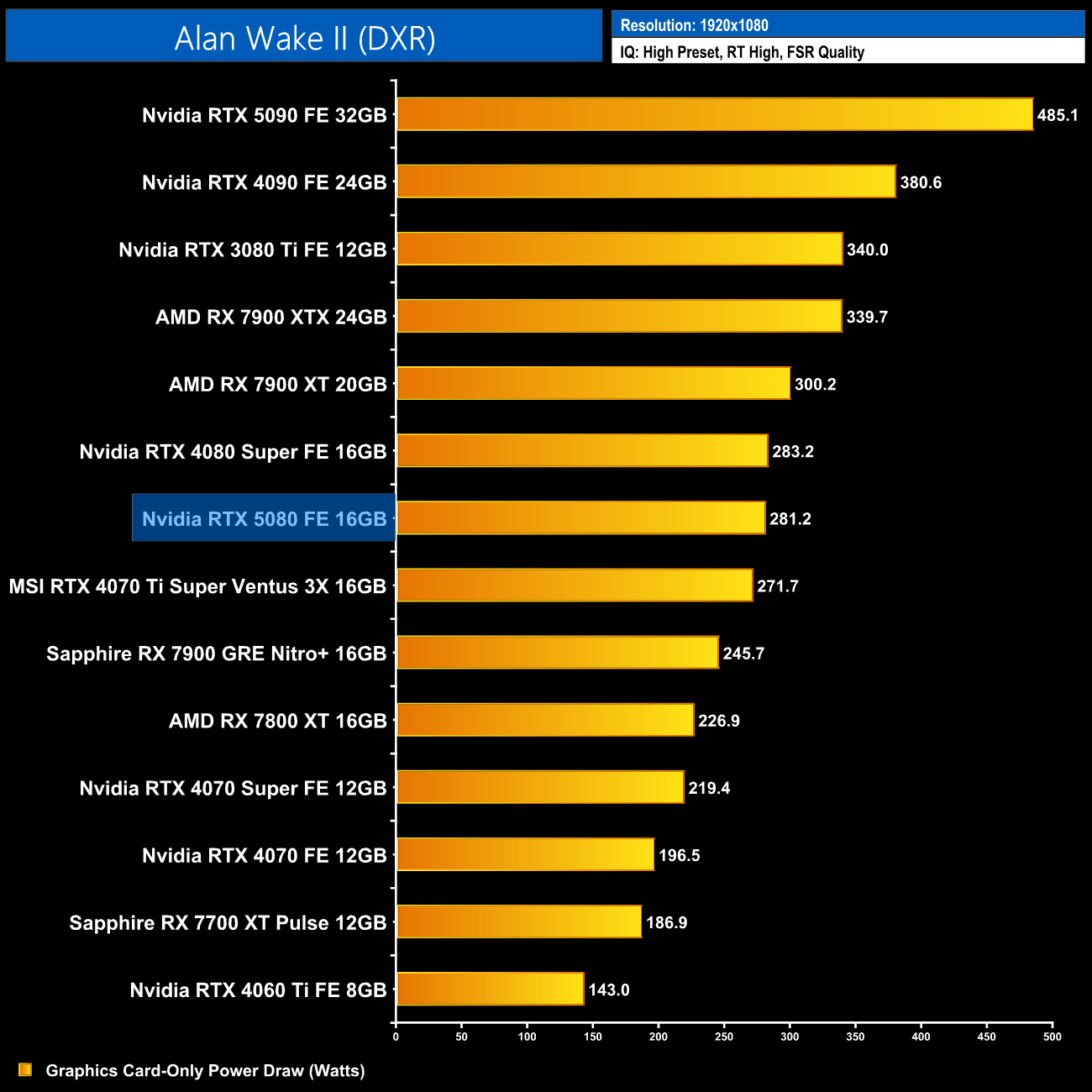
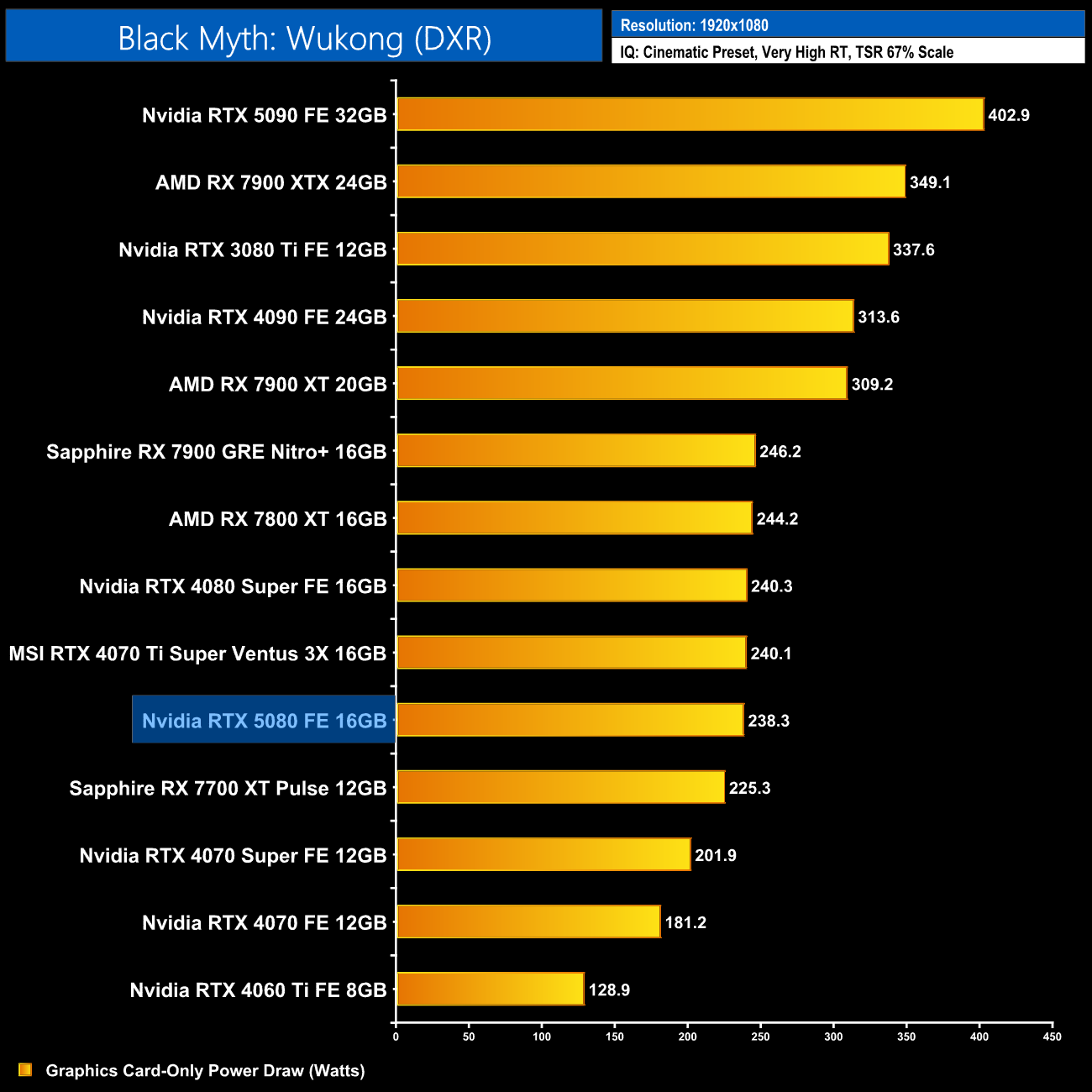
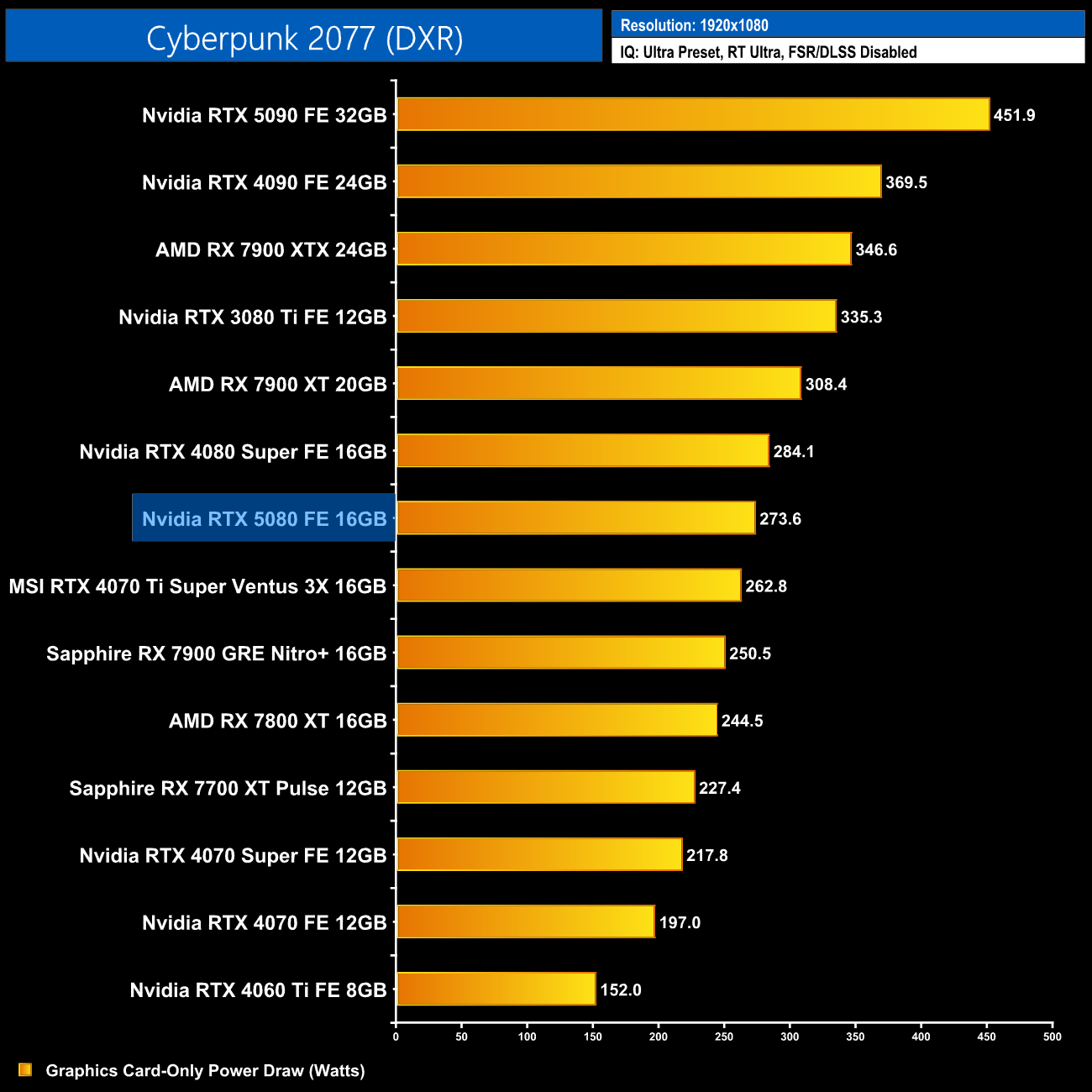
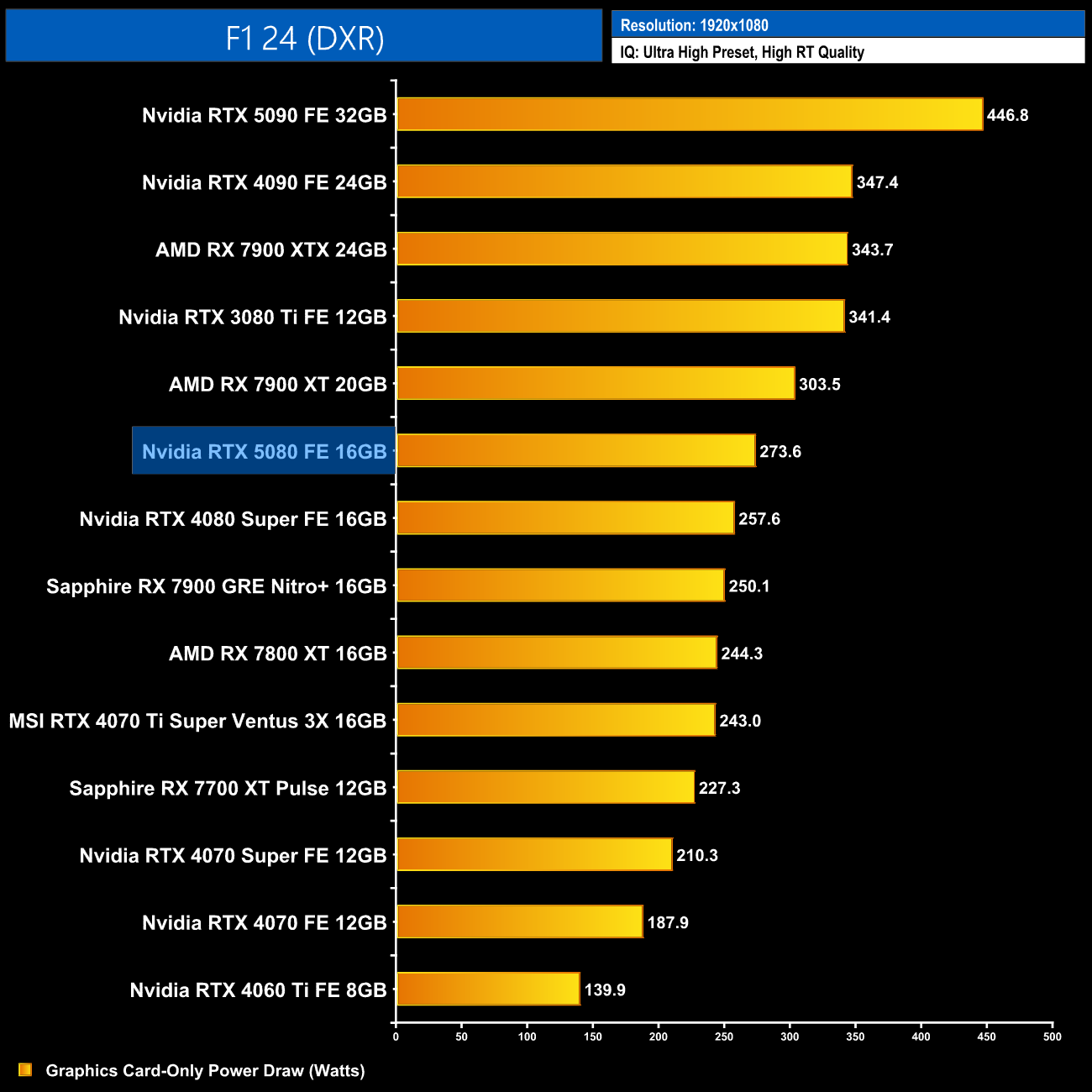
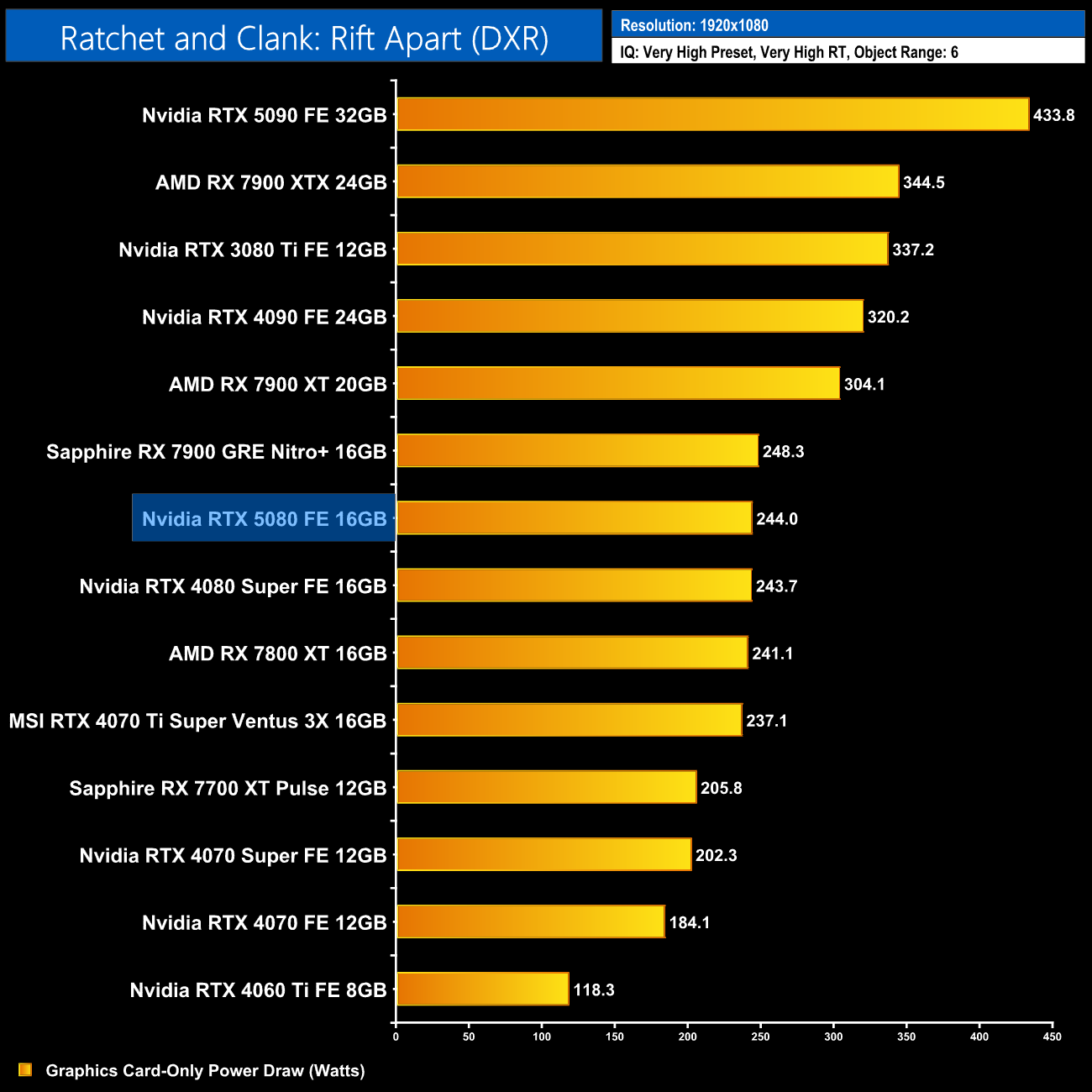
8-Game ray tracing average:
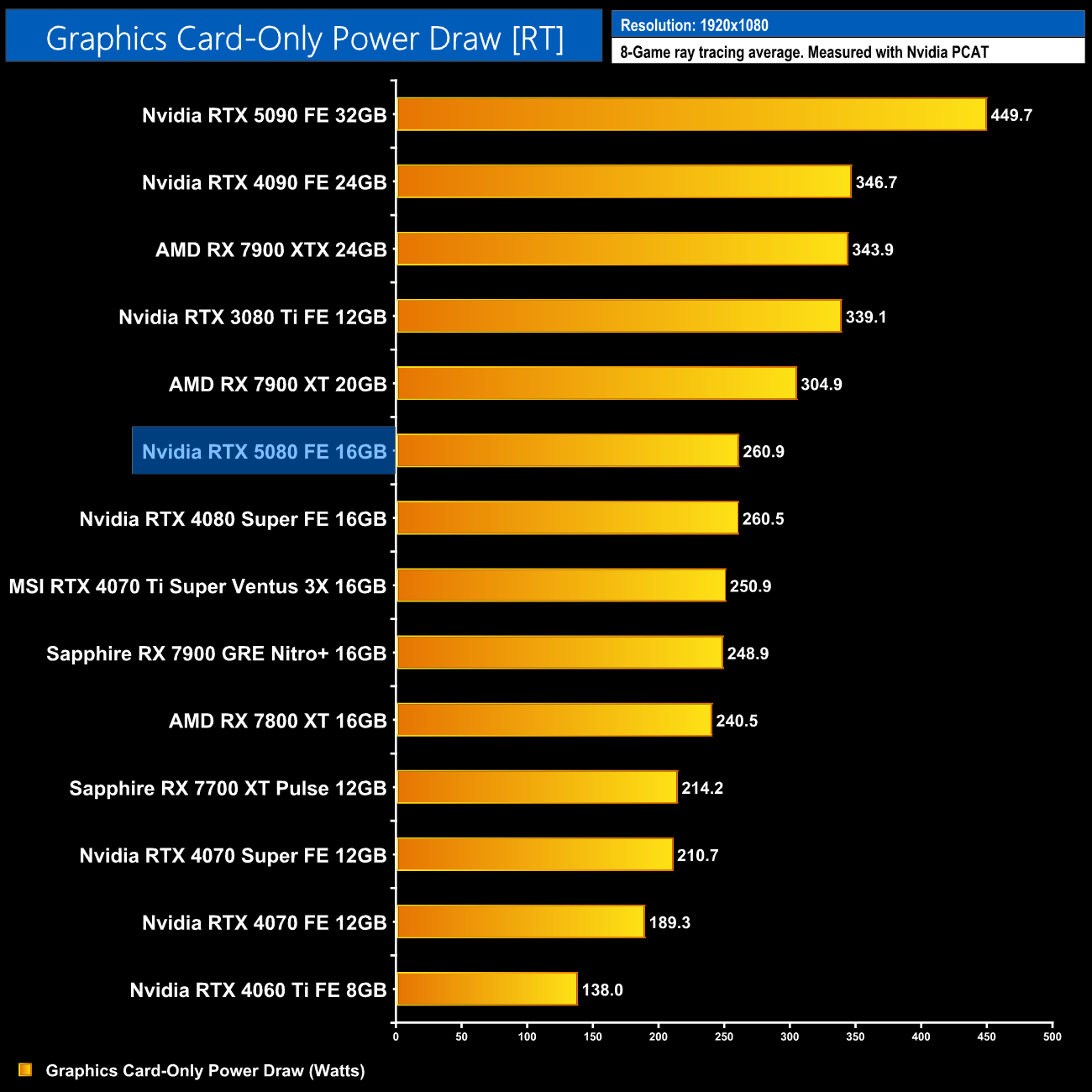
It is slightly higher with ray tracing enabled, but still well below the 360W TGP.
Here we present power draw figures for the graphics card-only, on a per-game basis for all twelve games we tested at 1440p. This is measured using Nvidia's Power Capture Analysis Tool, also known as PCAT. You can read more about our updated power draw testing methodology HERE.
Per-Game Results at 1440p:
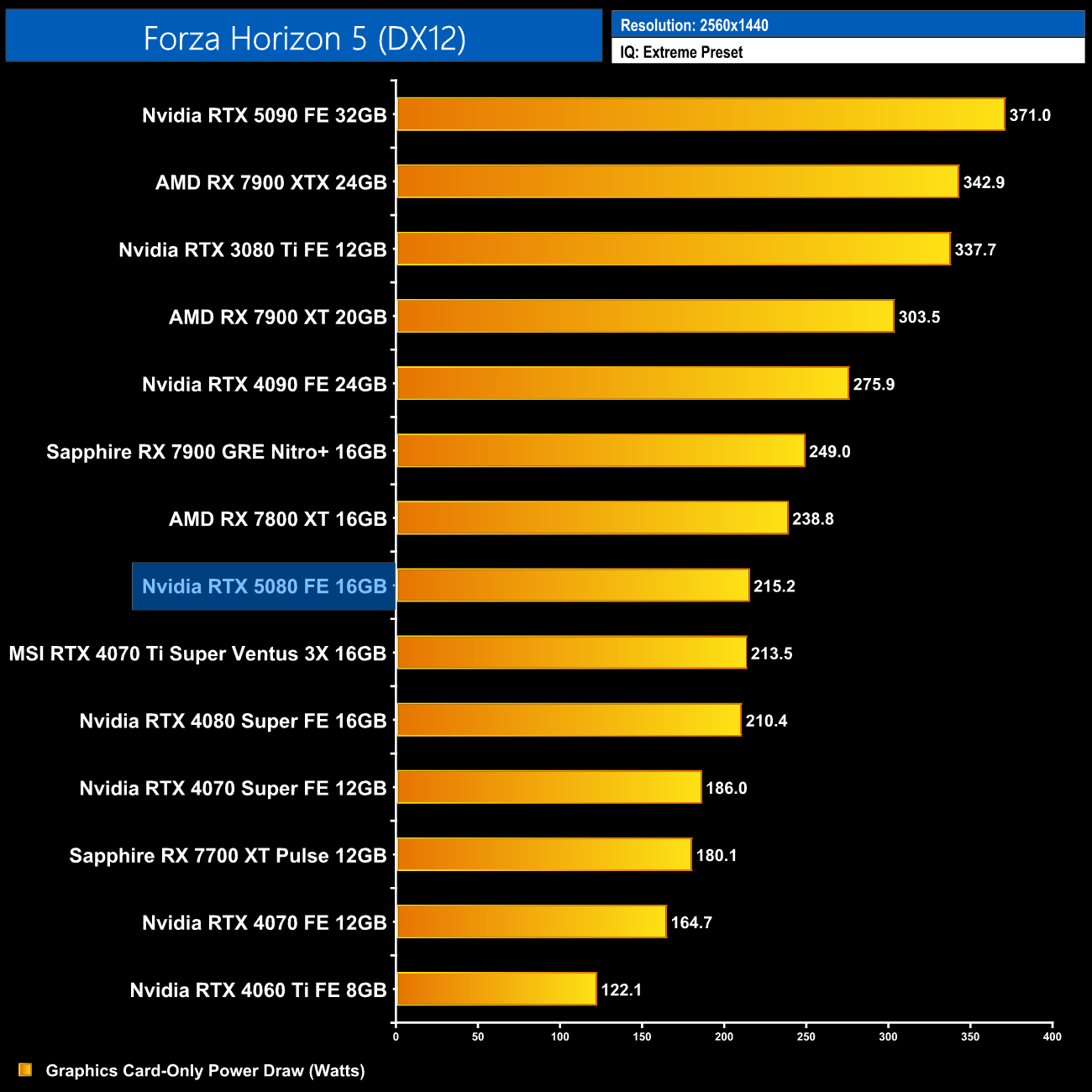

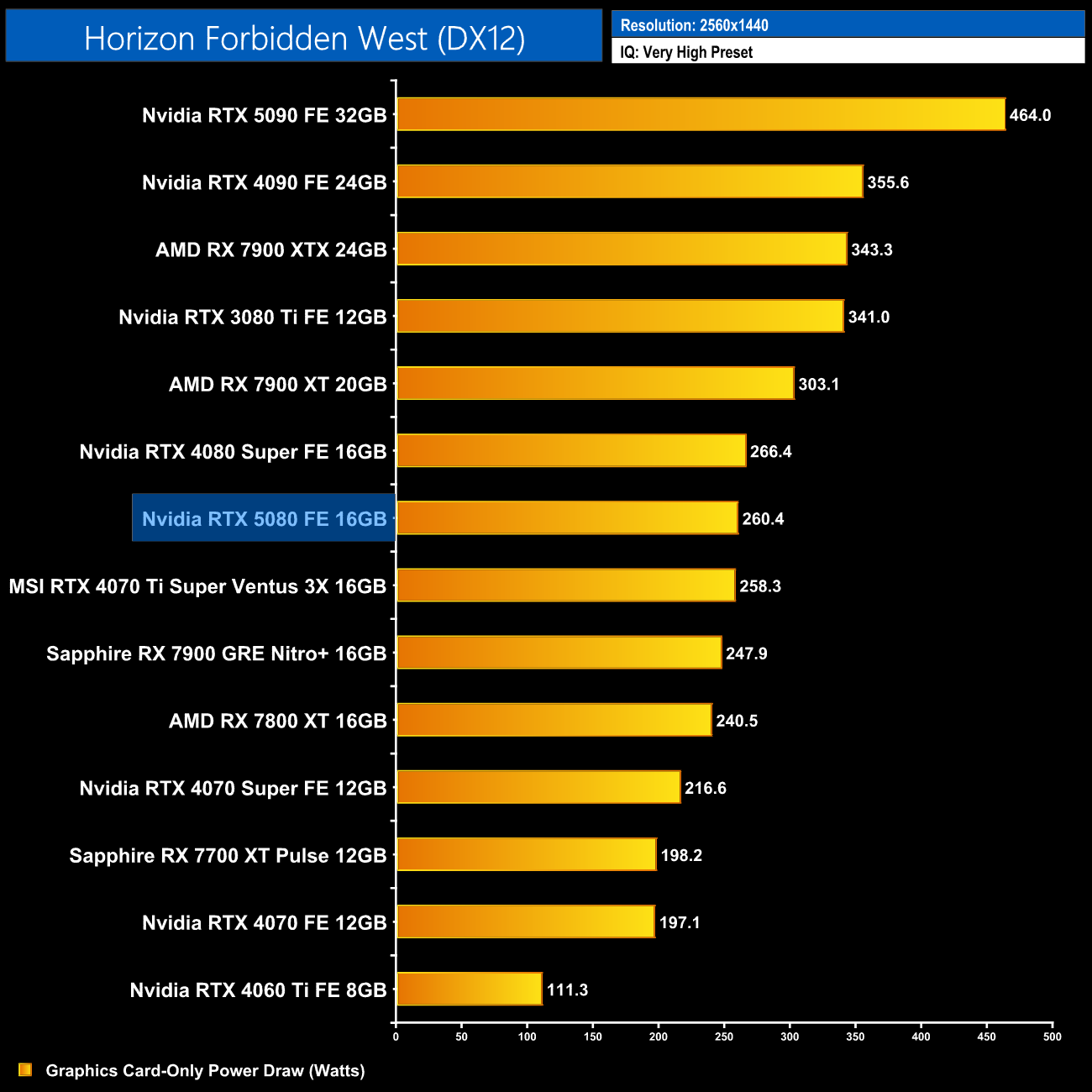
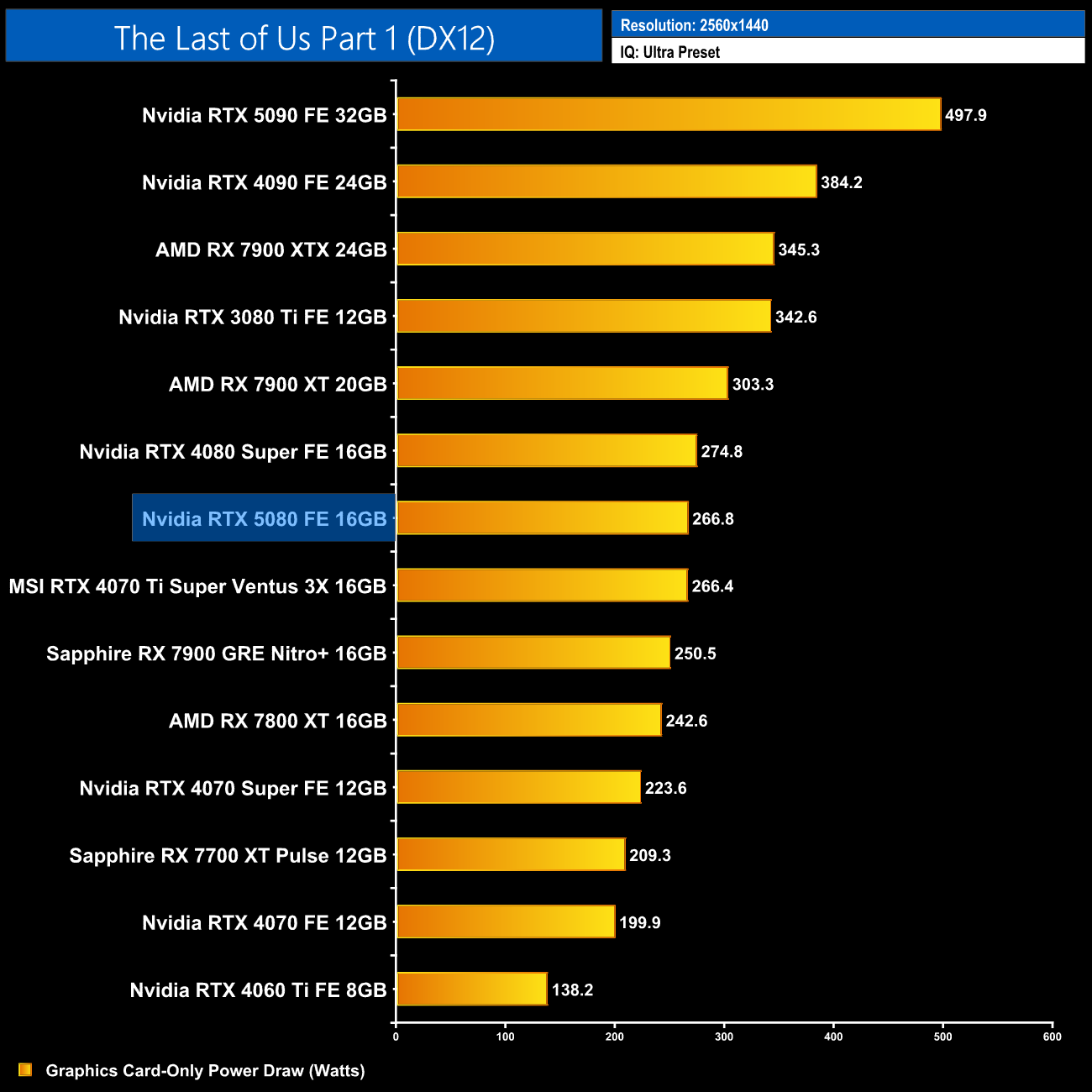
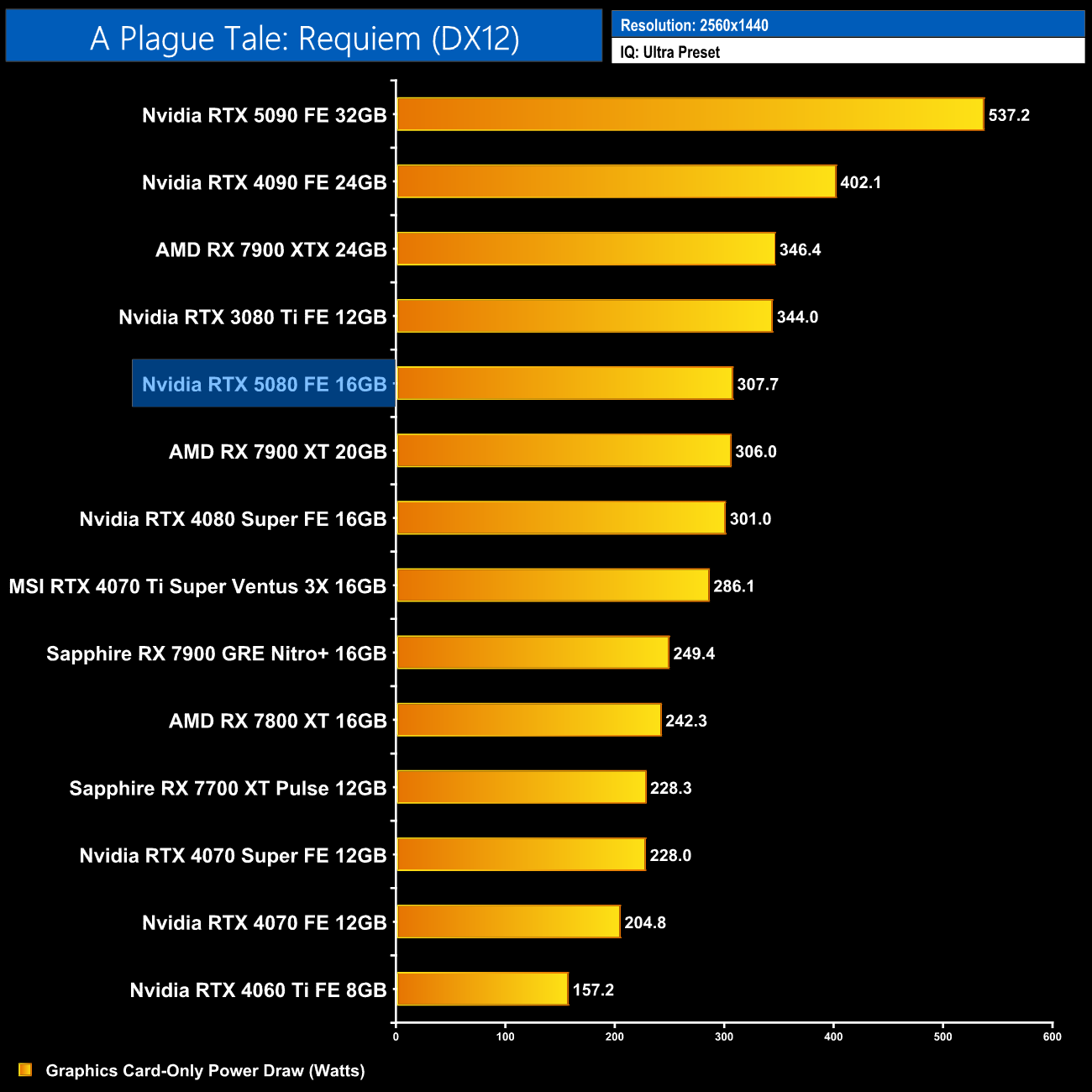
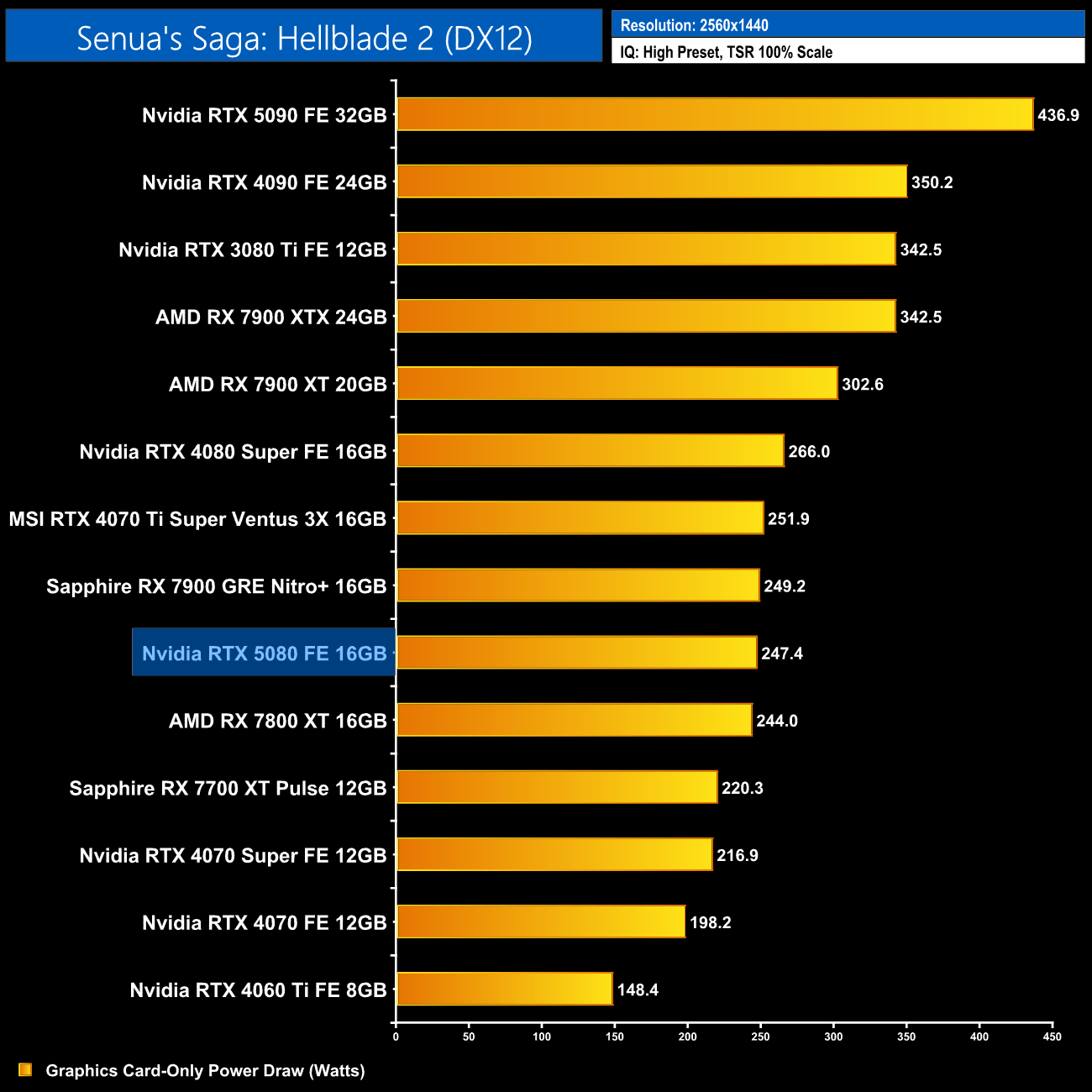
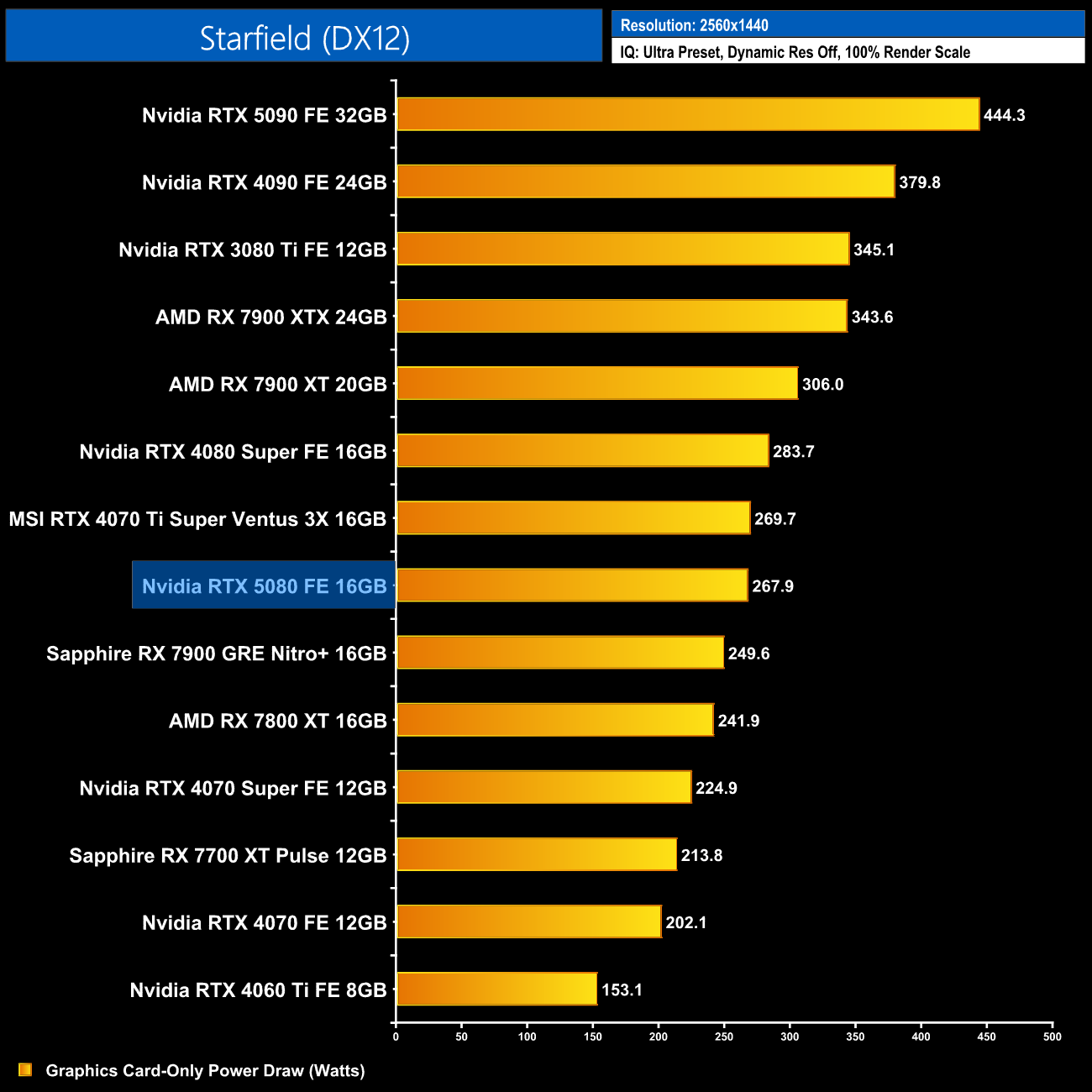
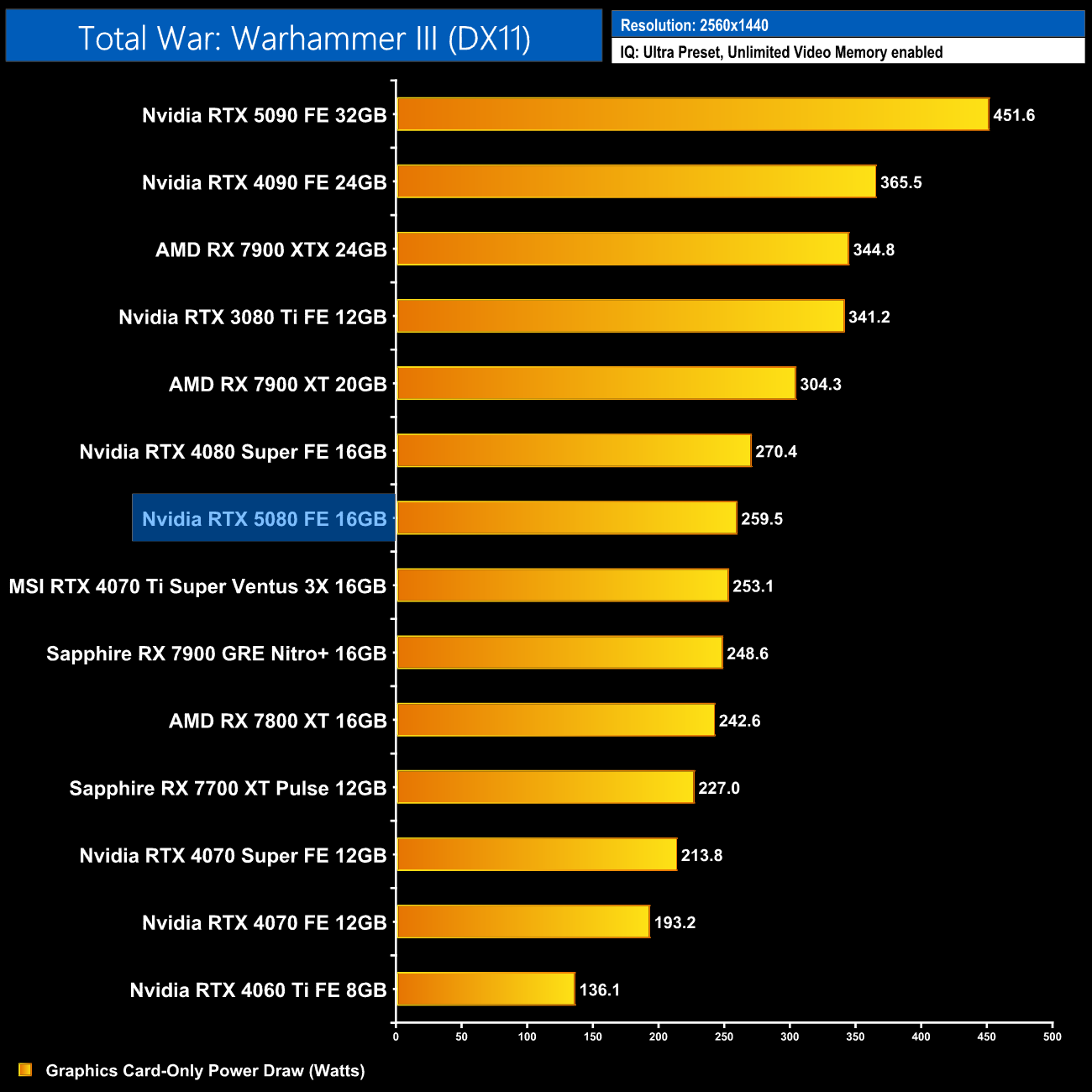
Click to enlarge.
12-Game Average at 1440p:
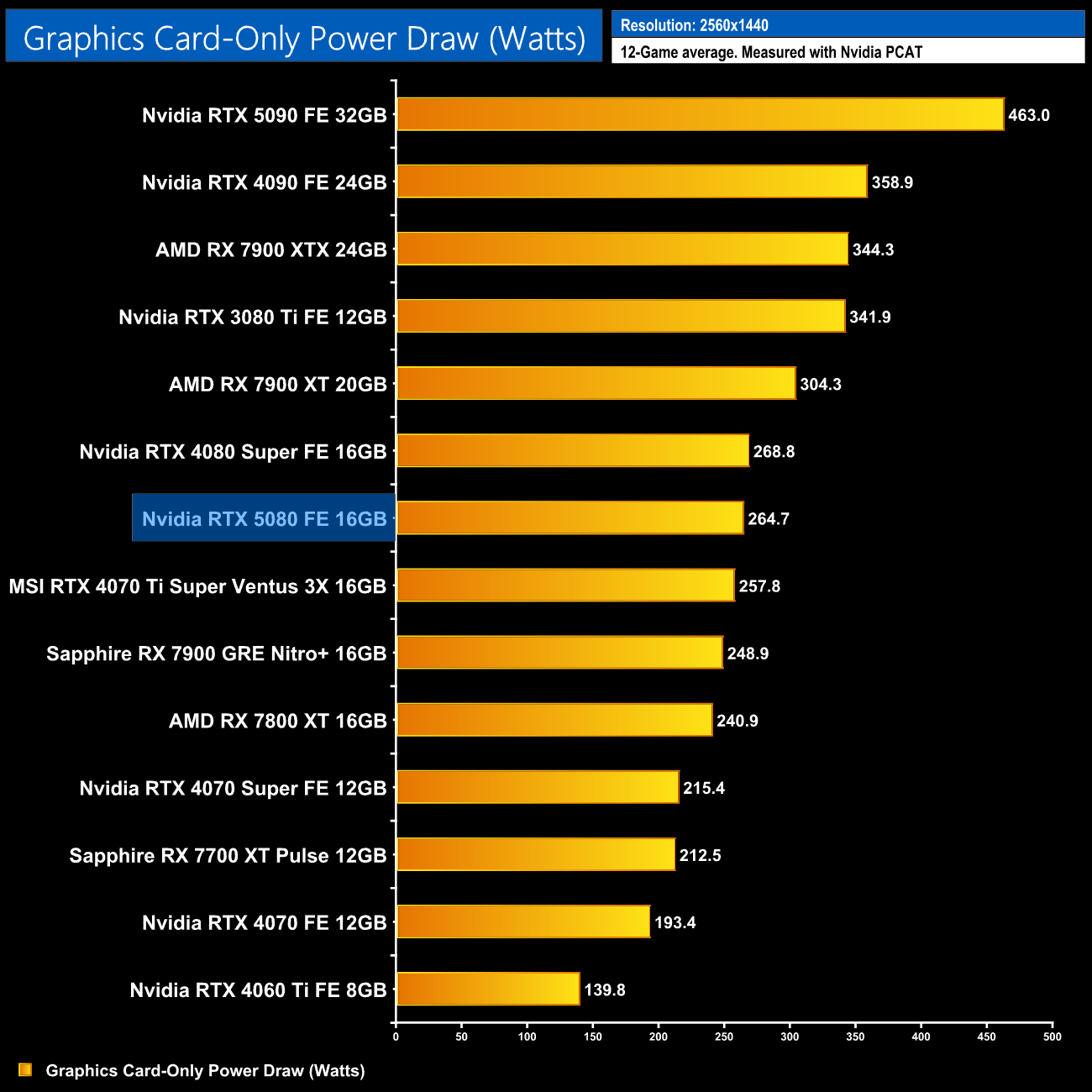
At 1440p, average power has increased compared to 1080p, as we'd expect, but it is actually a handful of Watts less than the RTX 4080 Super.
Ray tracing results
As a bonus, we now include the power figures for all eight games we test with ray tracing enabled.
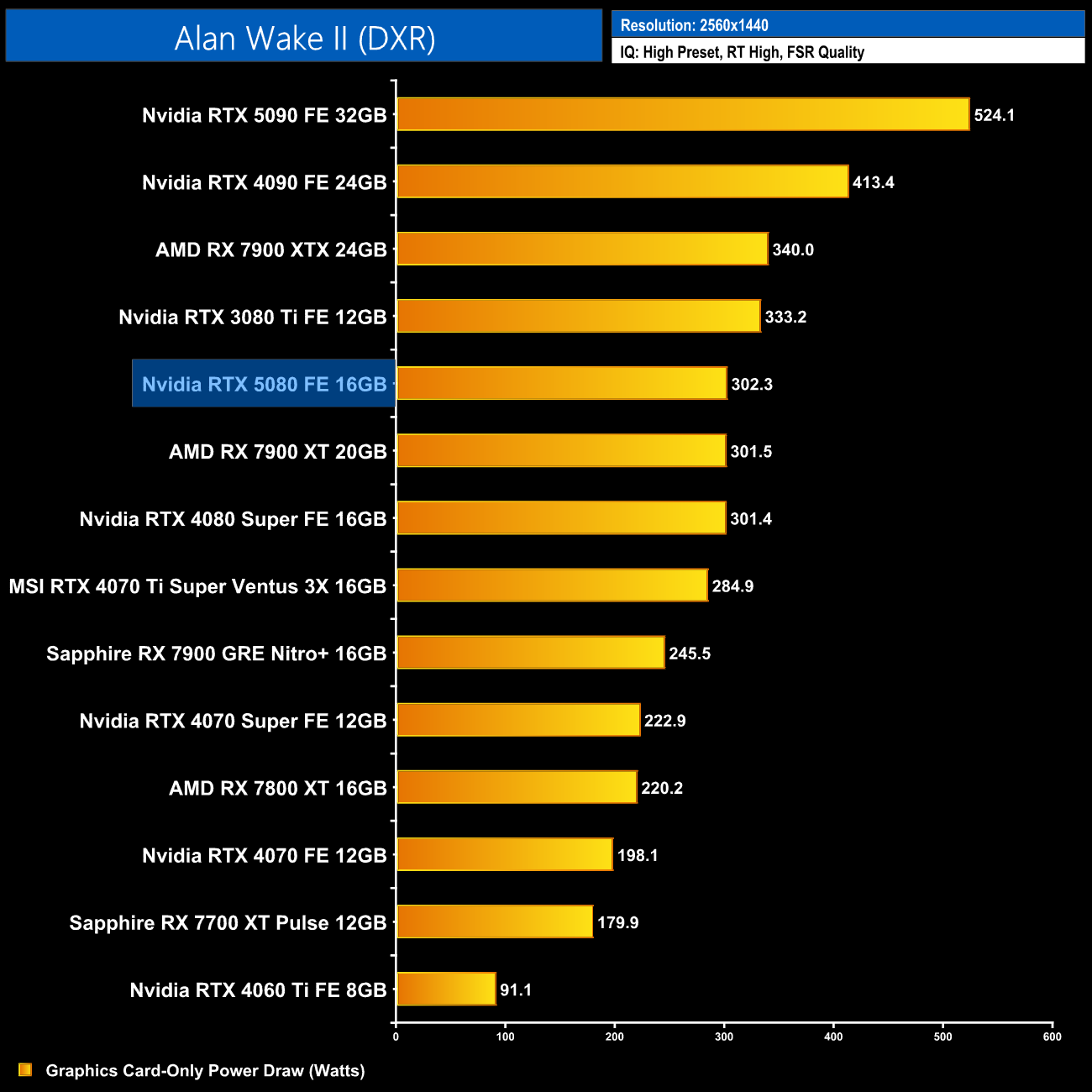
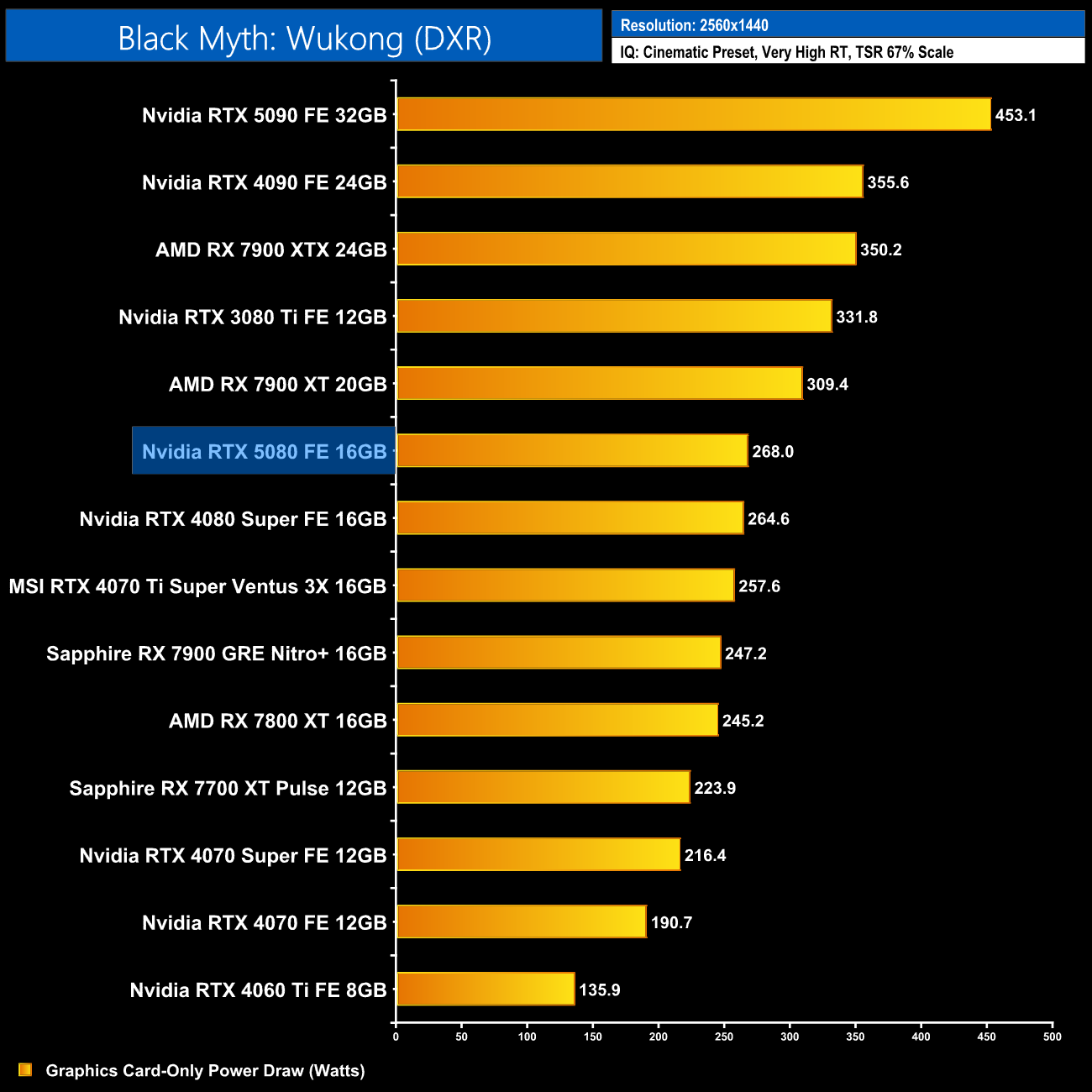
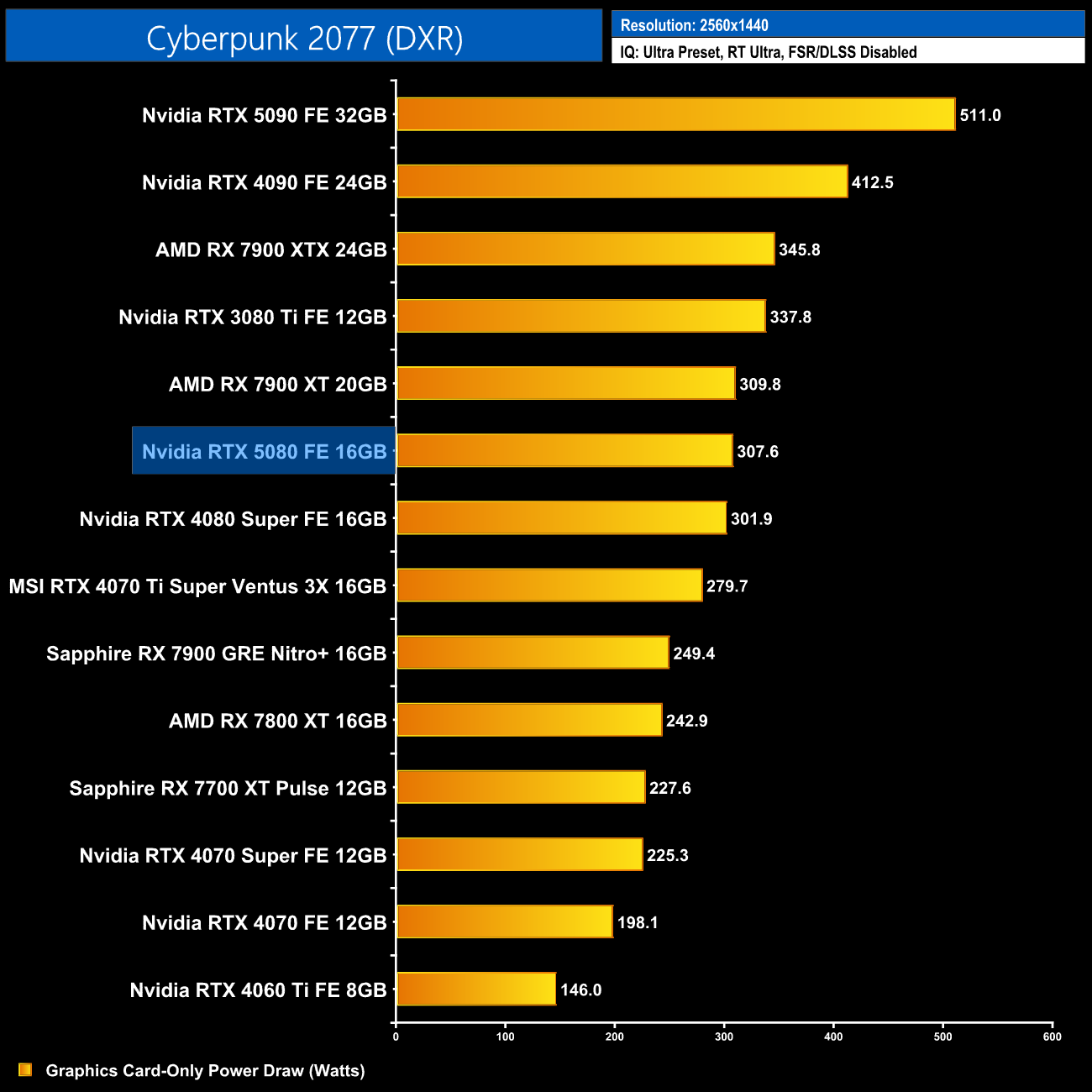
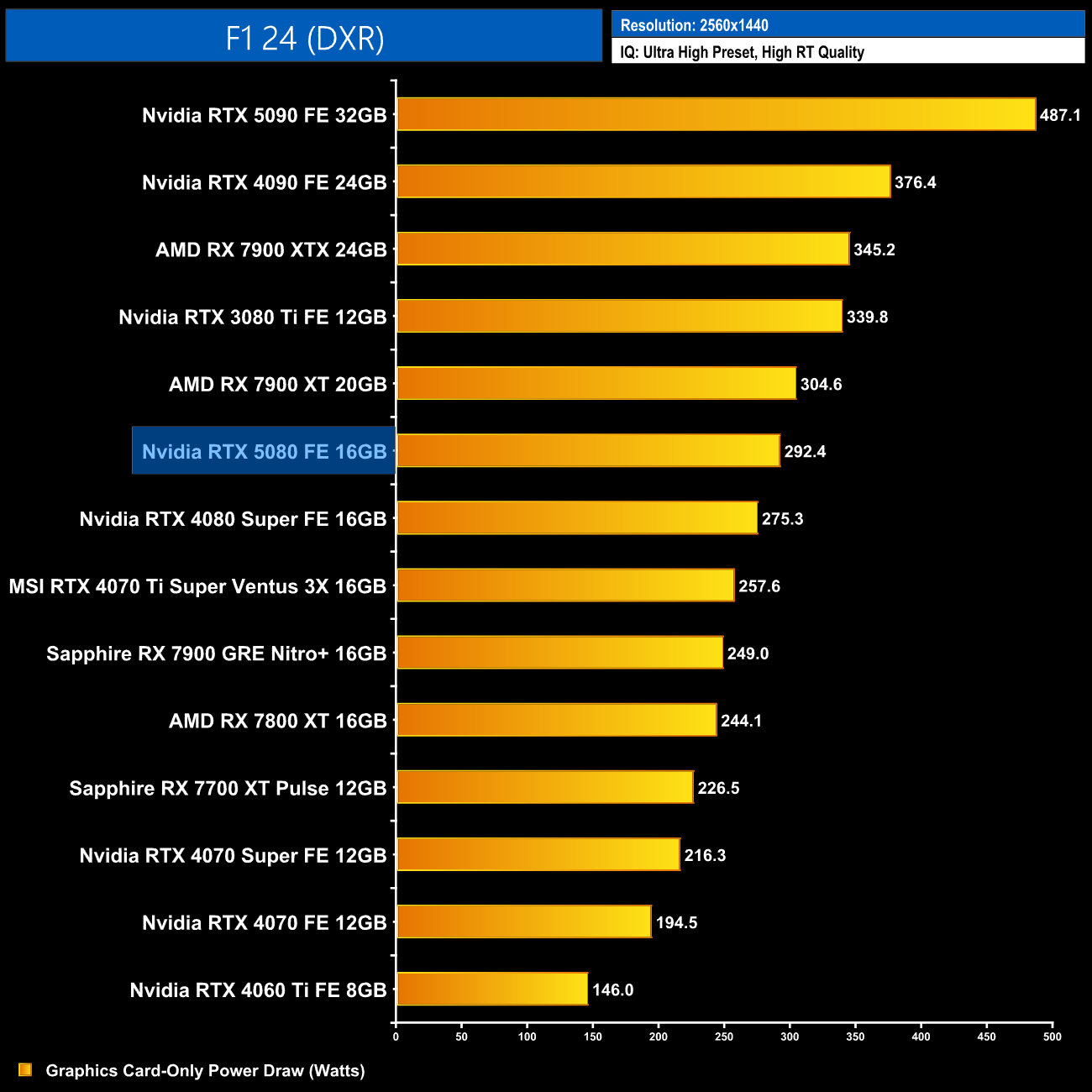
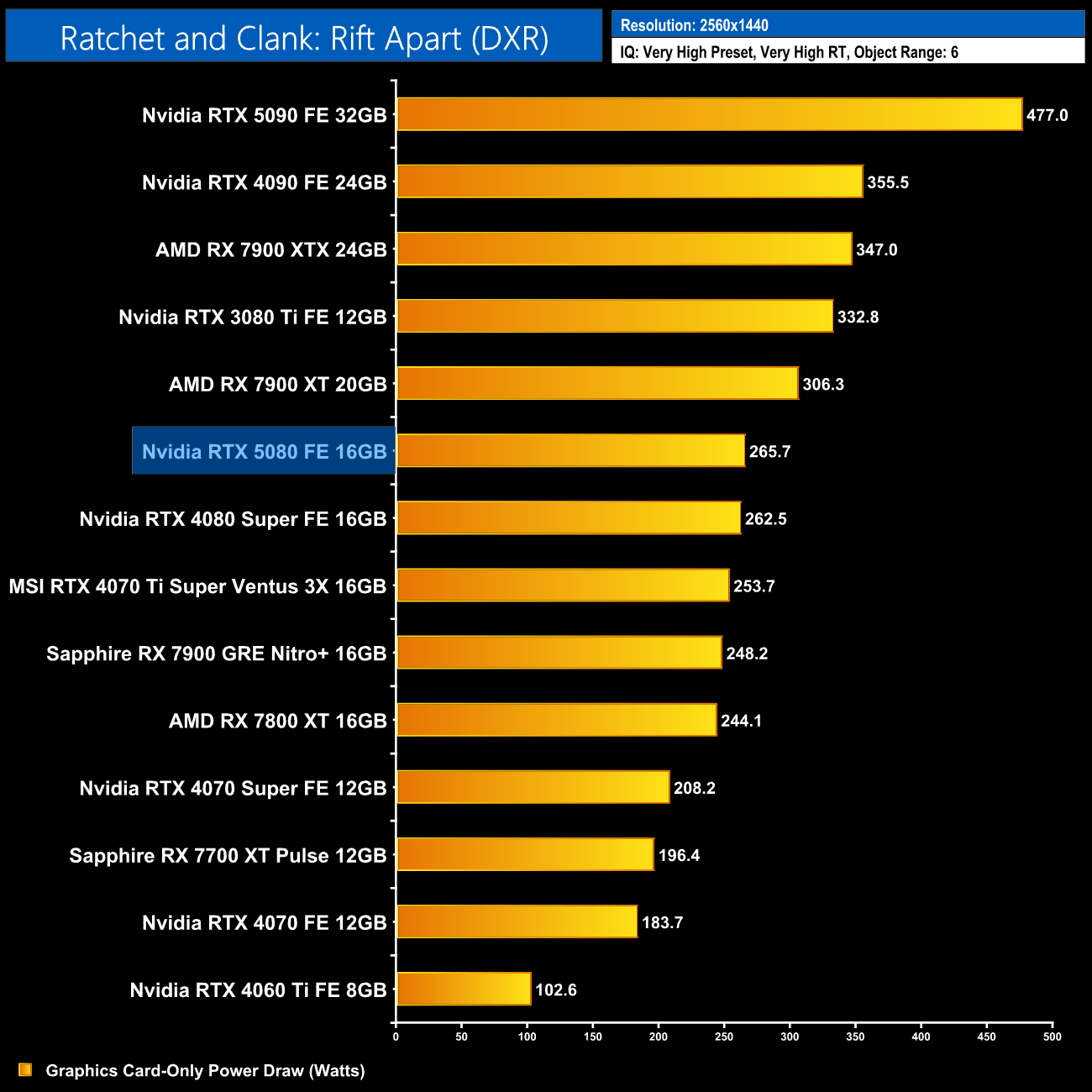
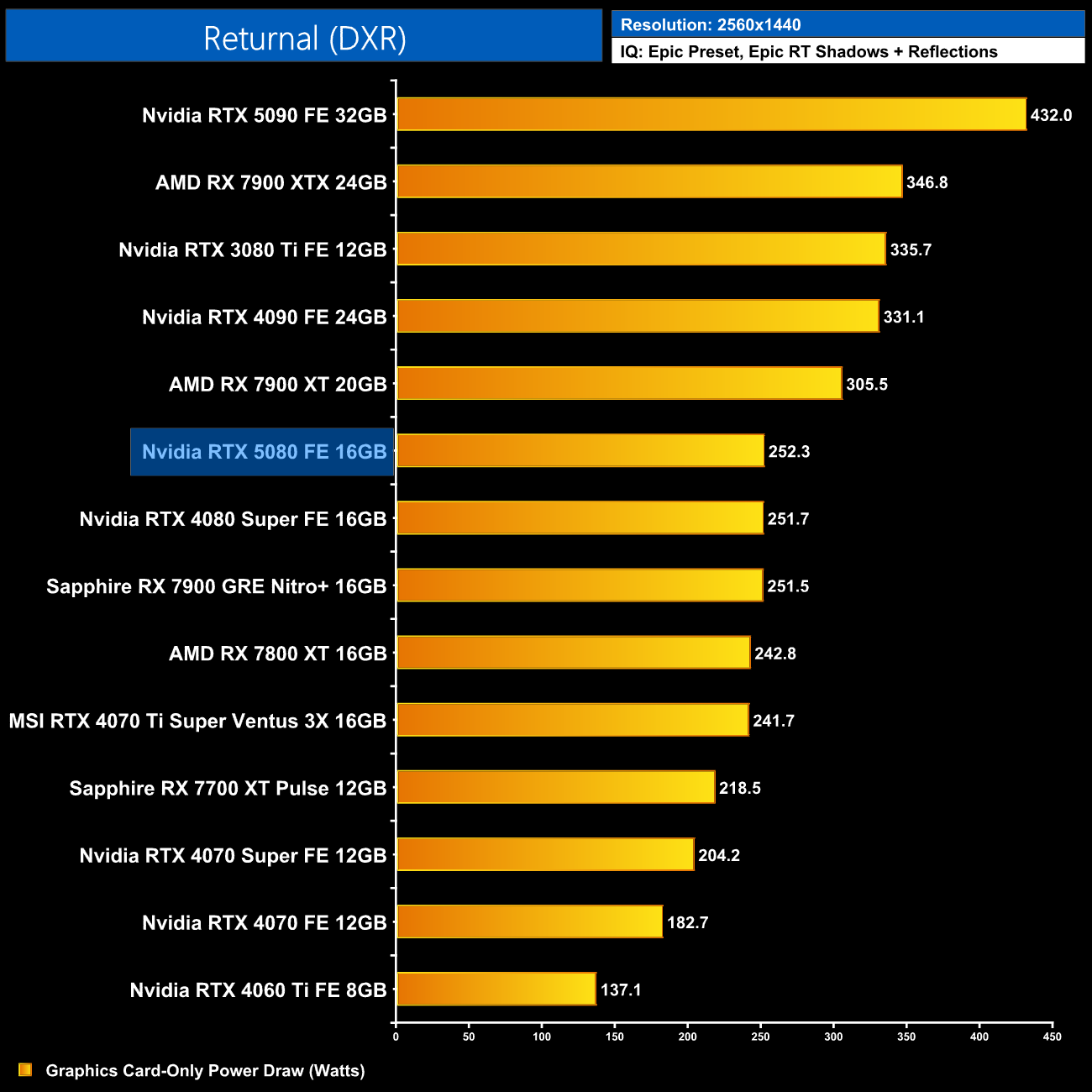
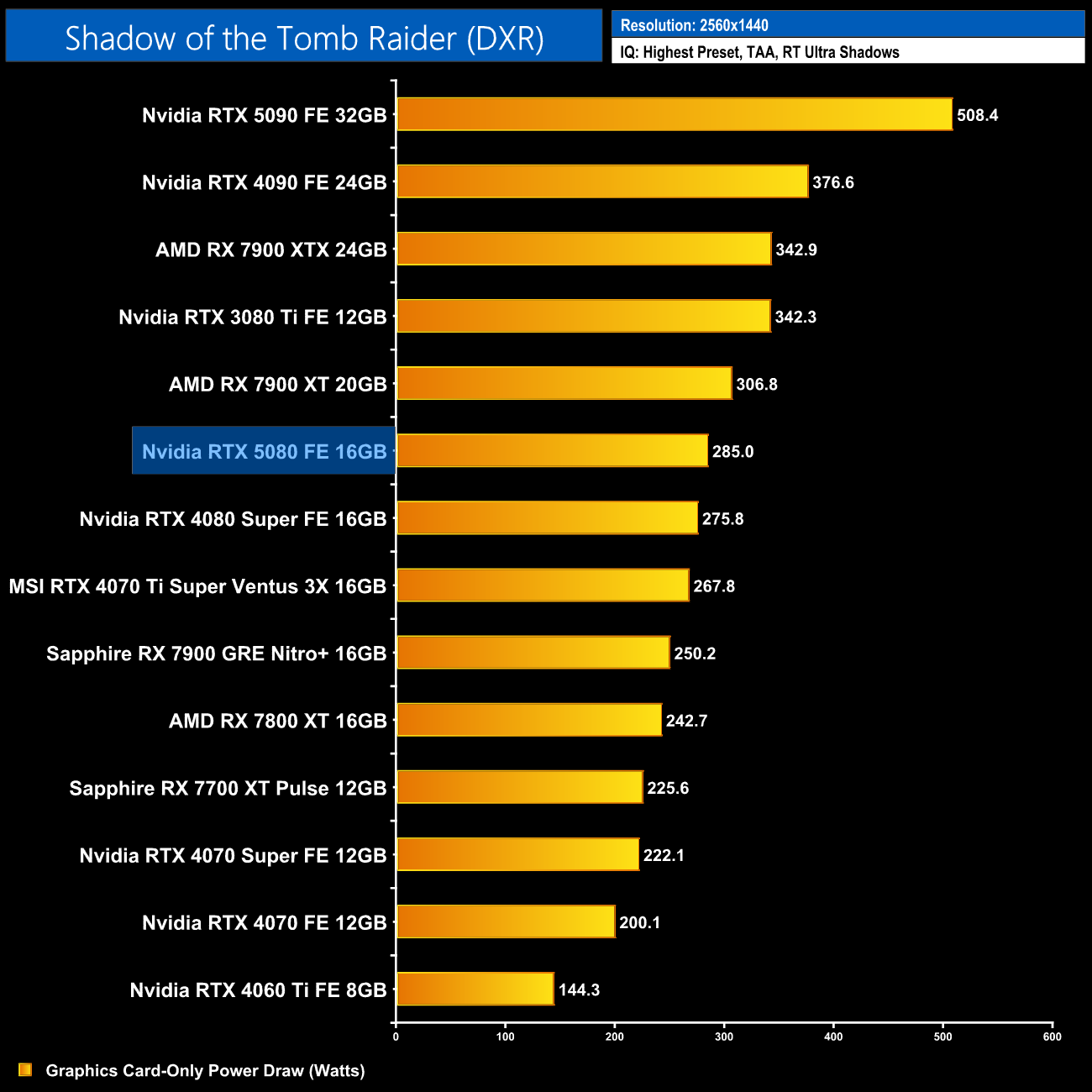
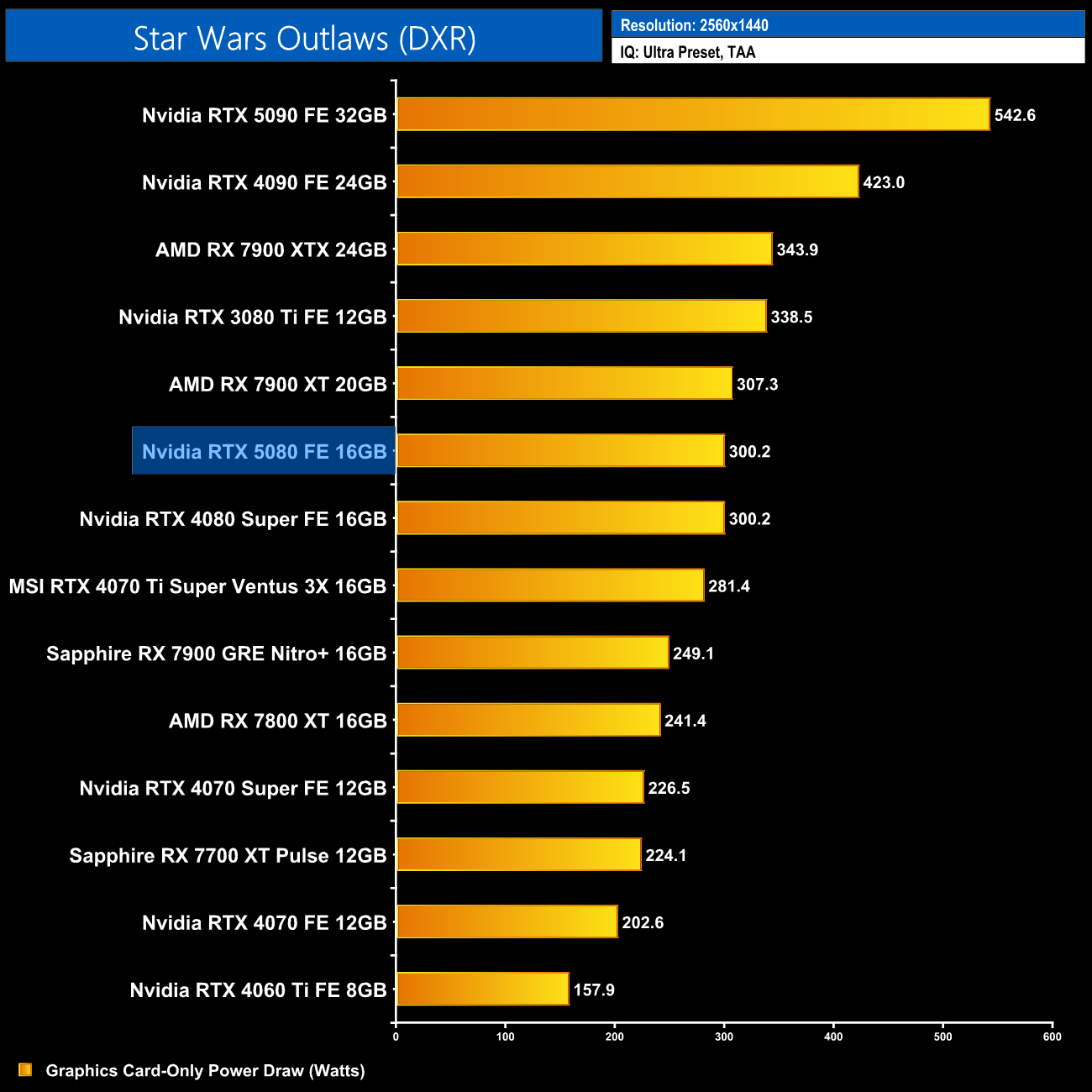
8-Game ray tracing average:
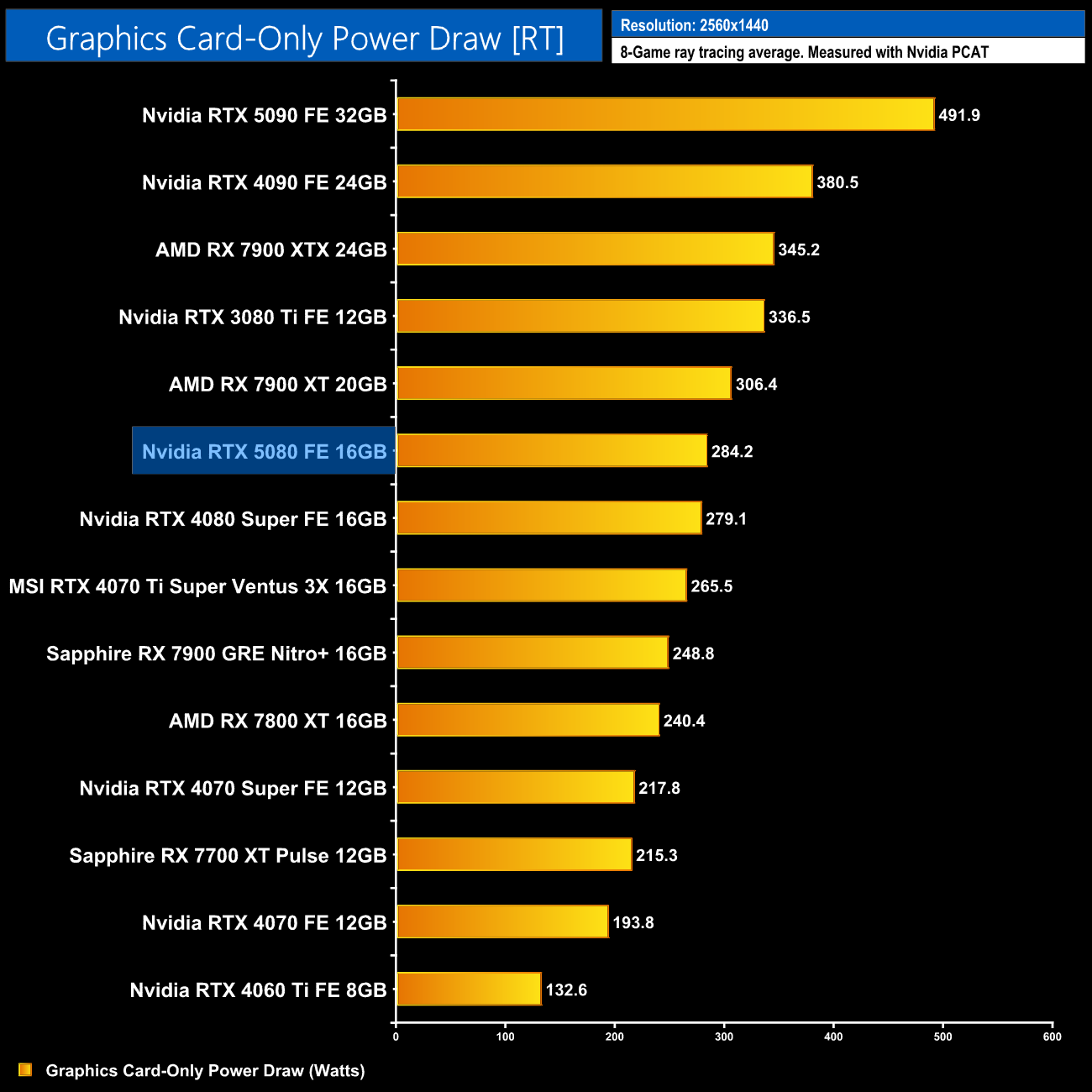
With ray tracing enabled, that situation reverses and now the 5080 pulls 5W more than the 4080 Super.
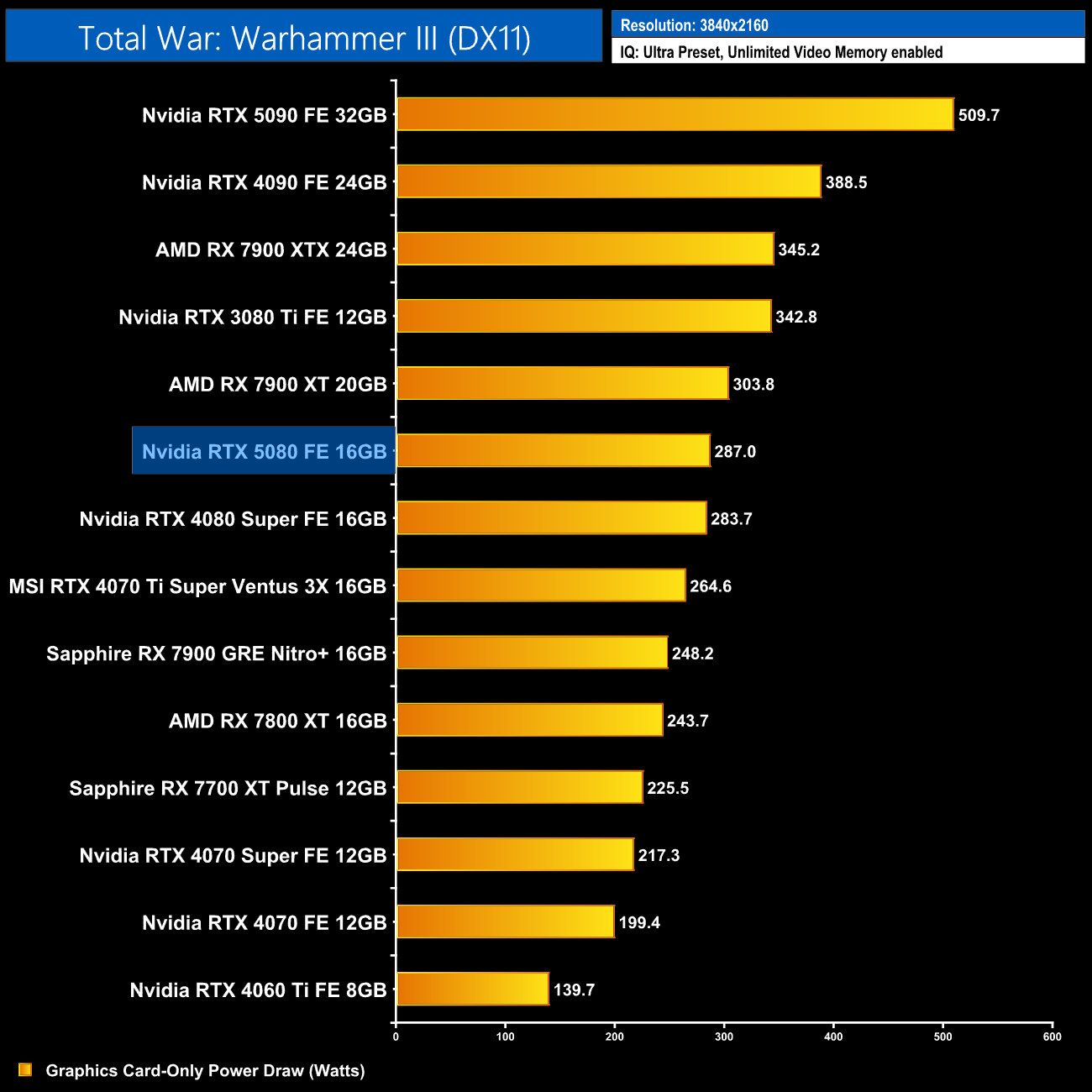
Here we present power draw figures for the graphics card-only, on a per-game basis for all twelve games we tested at 2160p (4K). This is measured using Nvidia's Power Capture Analysis Tool, also known as PCAT. You can read more about our updated power draw testing methodology HERE.
Per-Game Results at 2160p (4K):
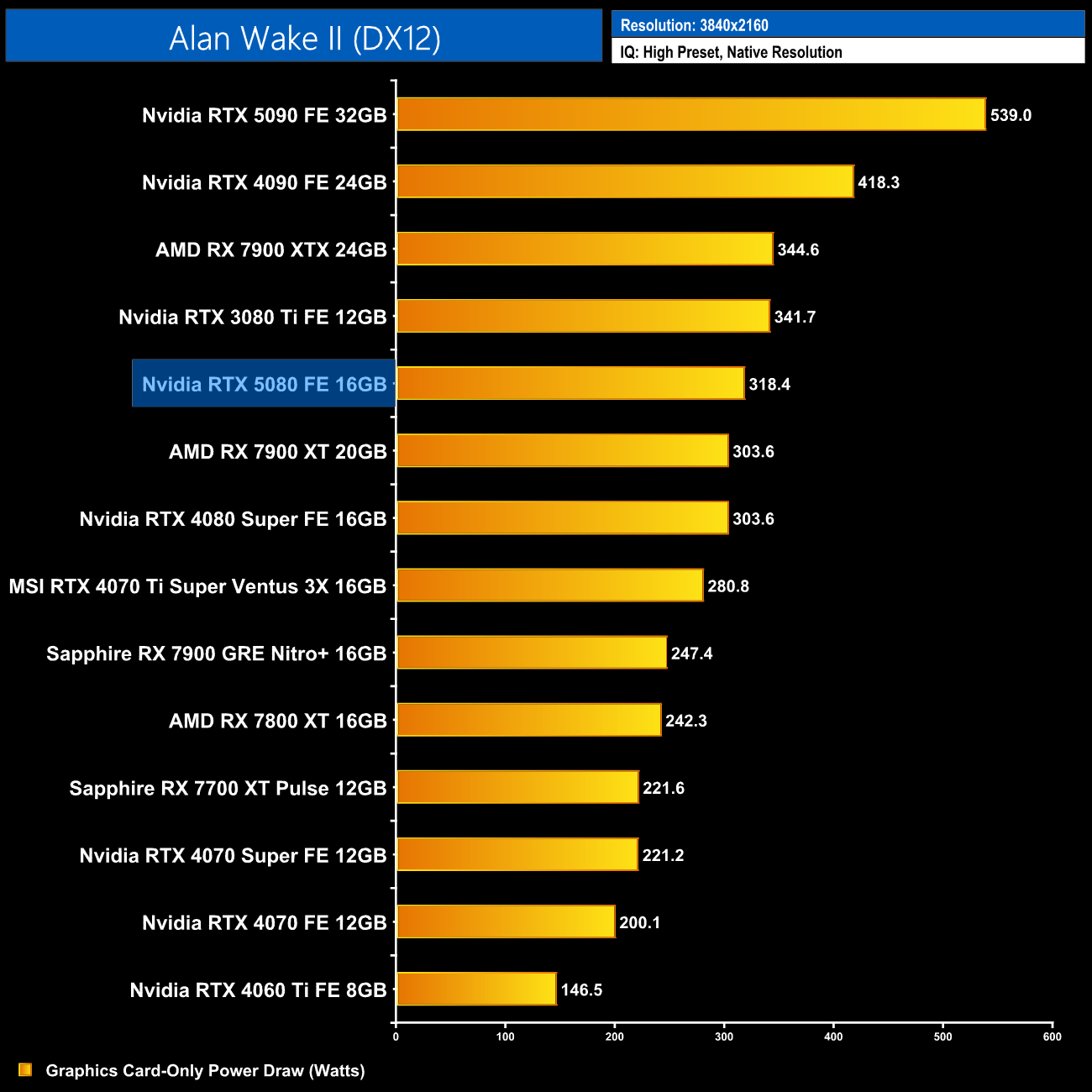
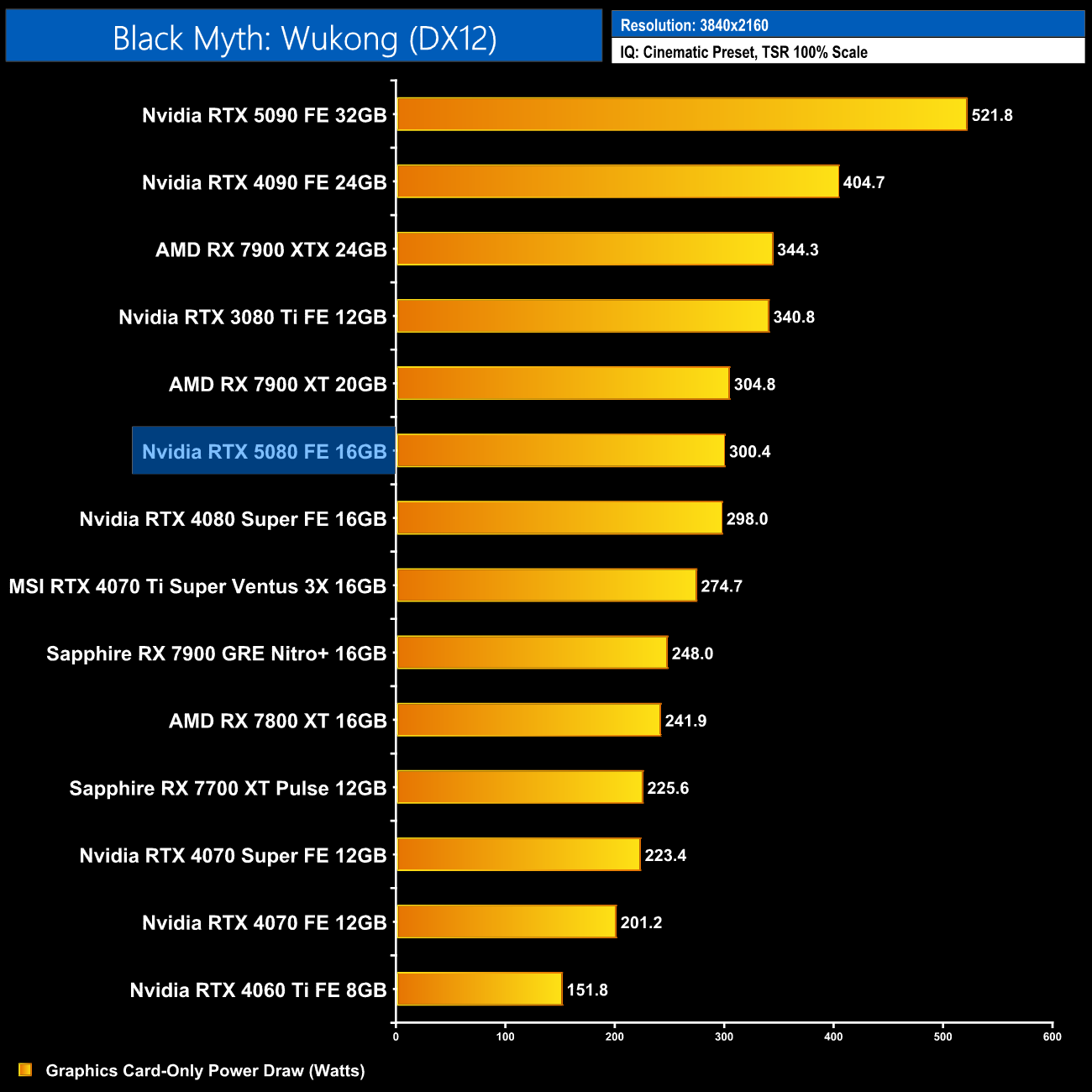
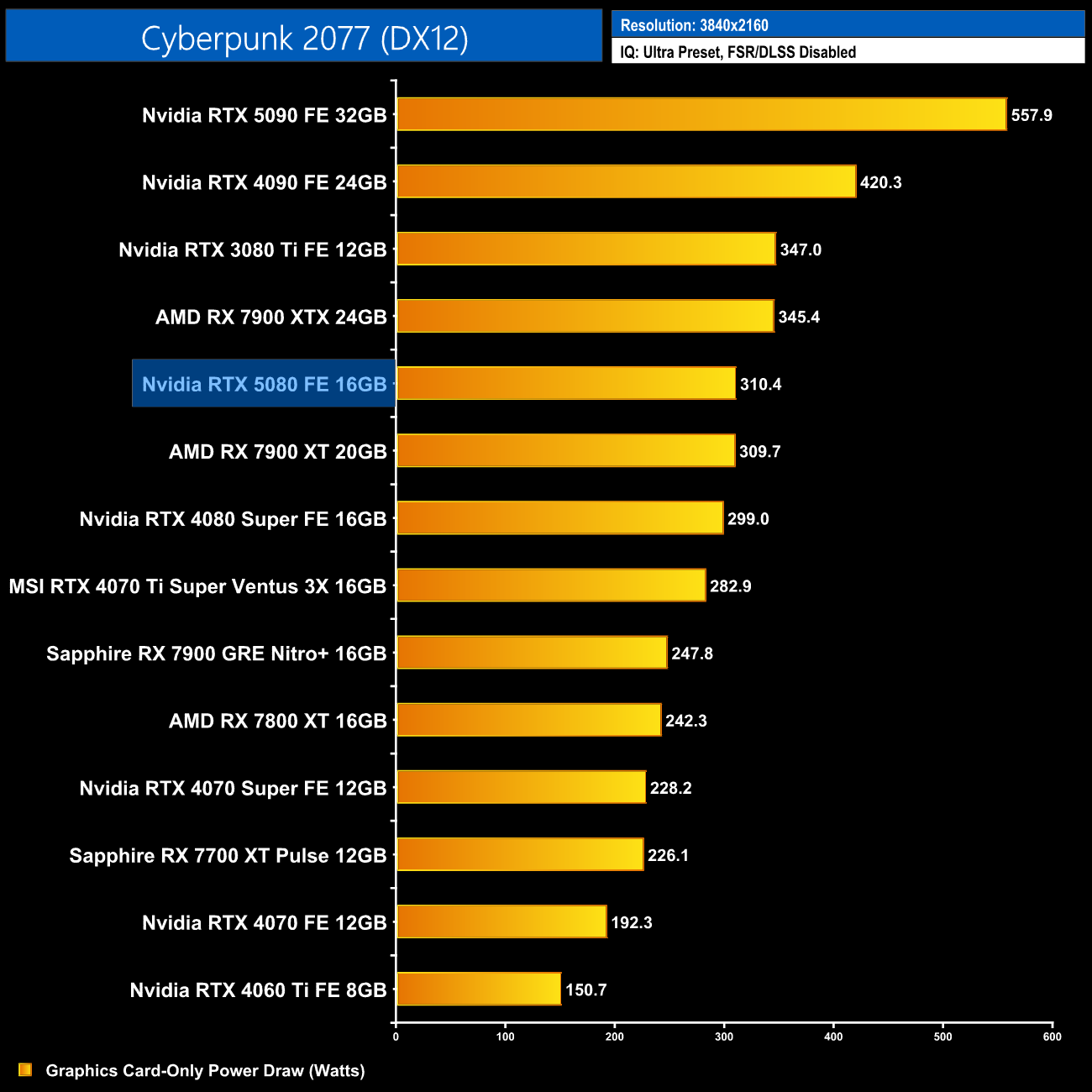
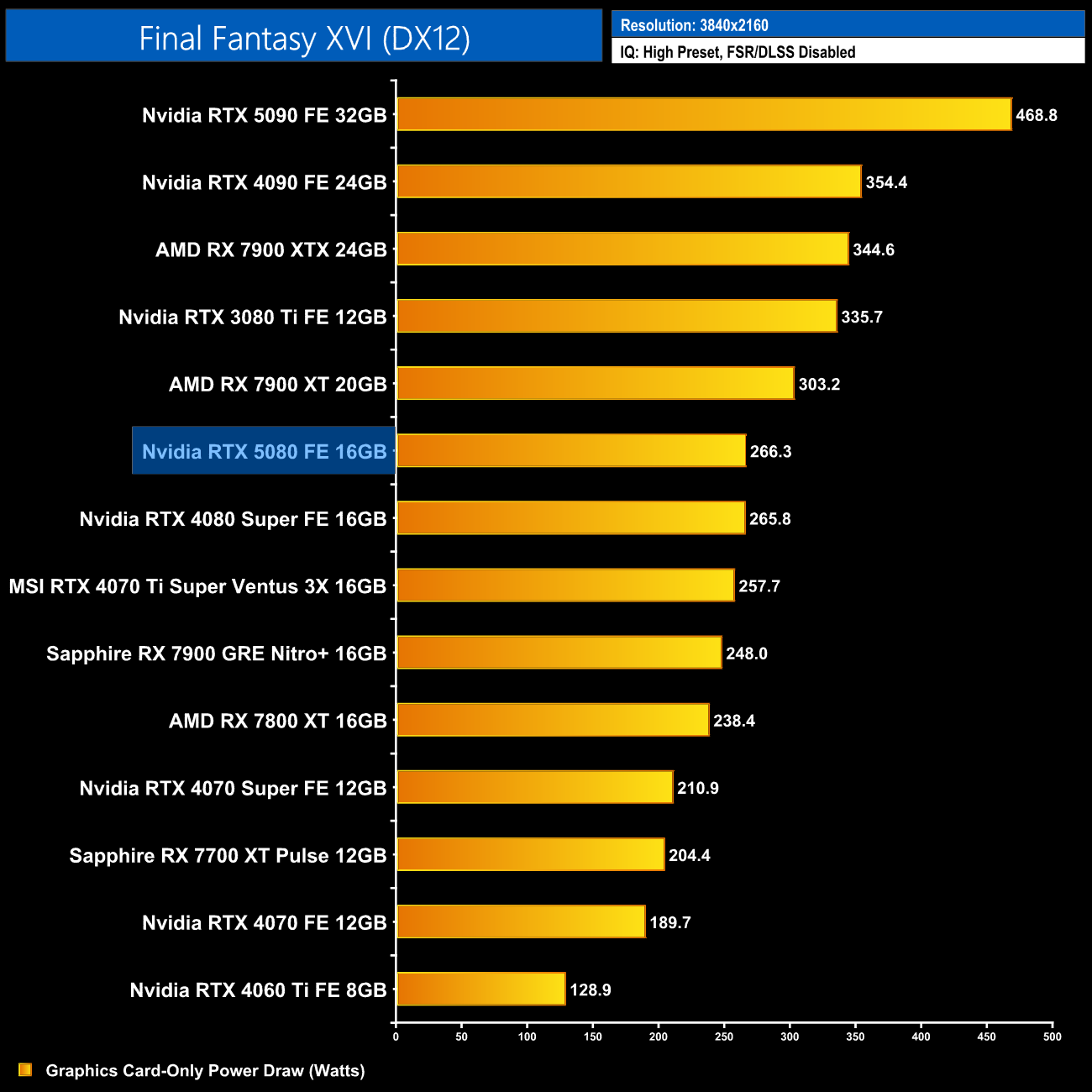
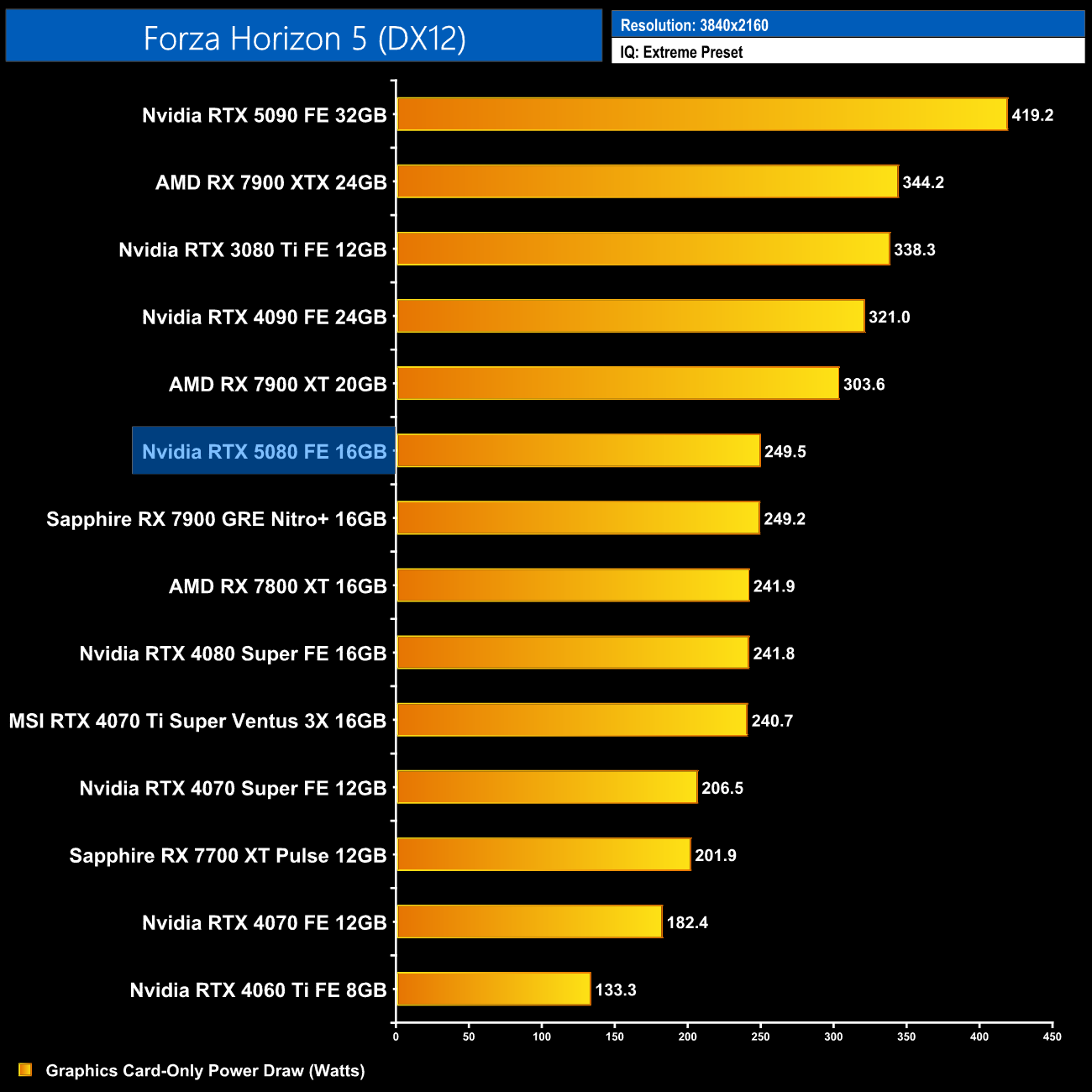
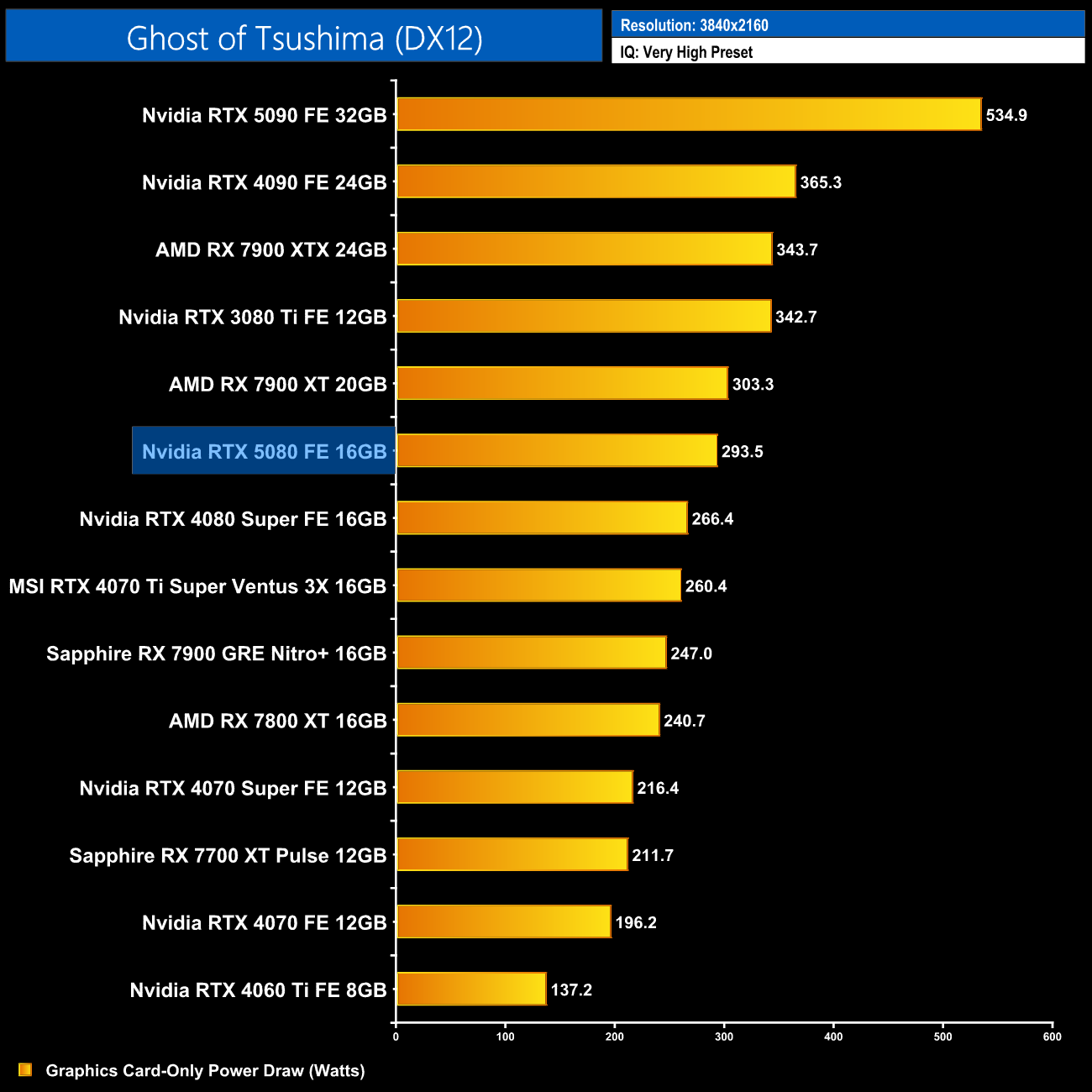
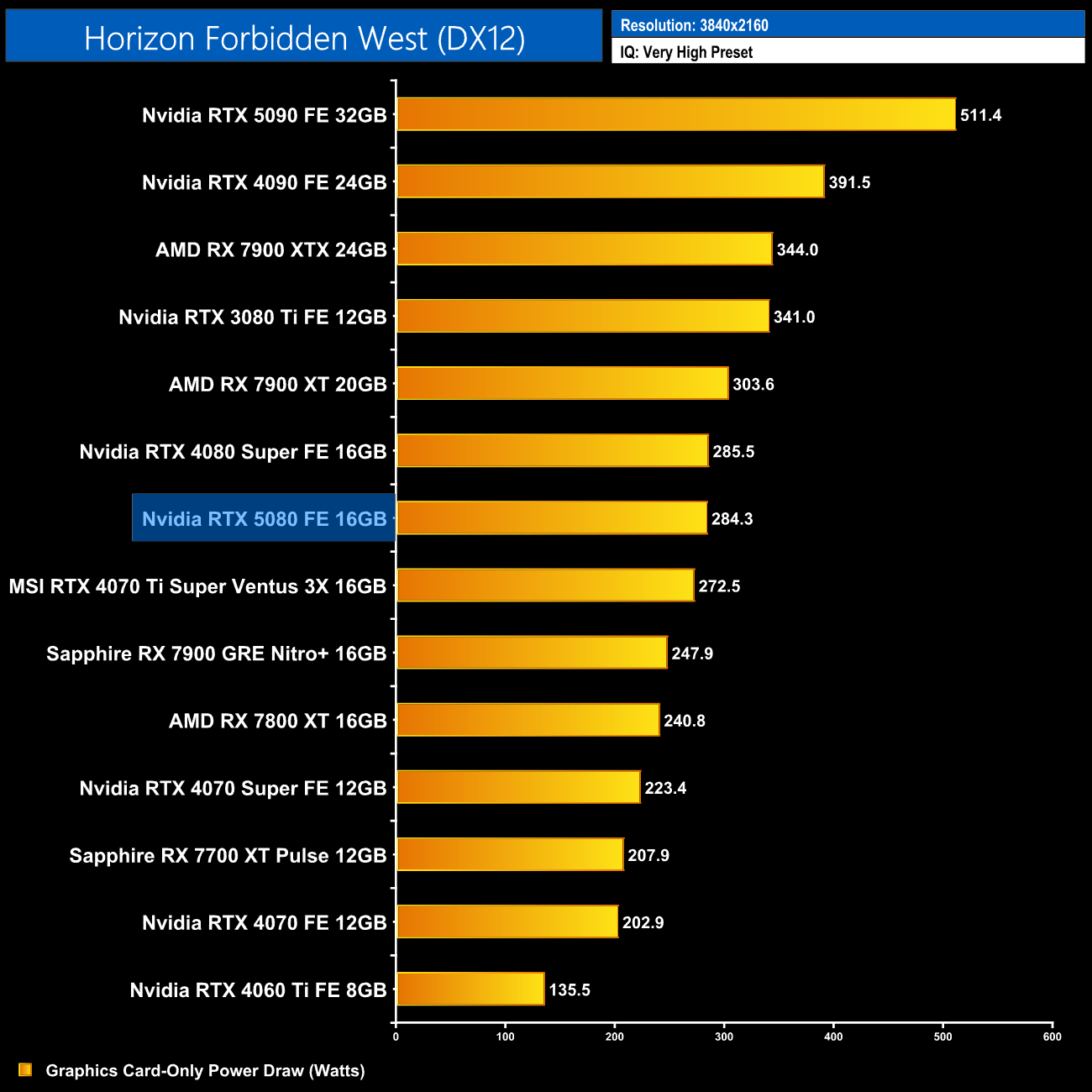
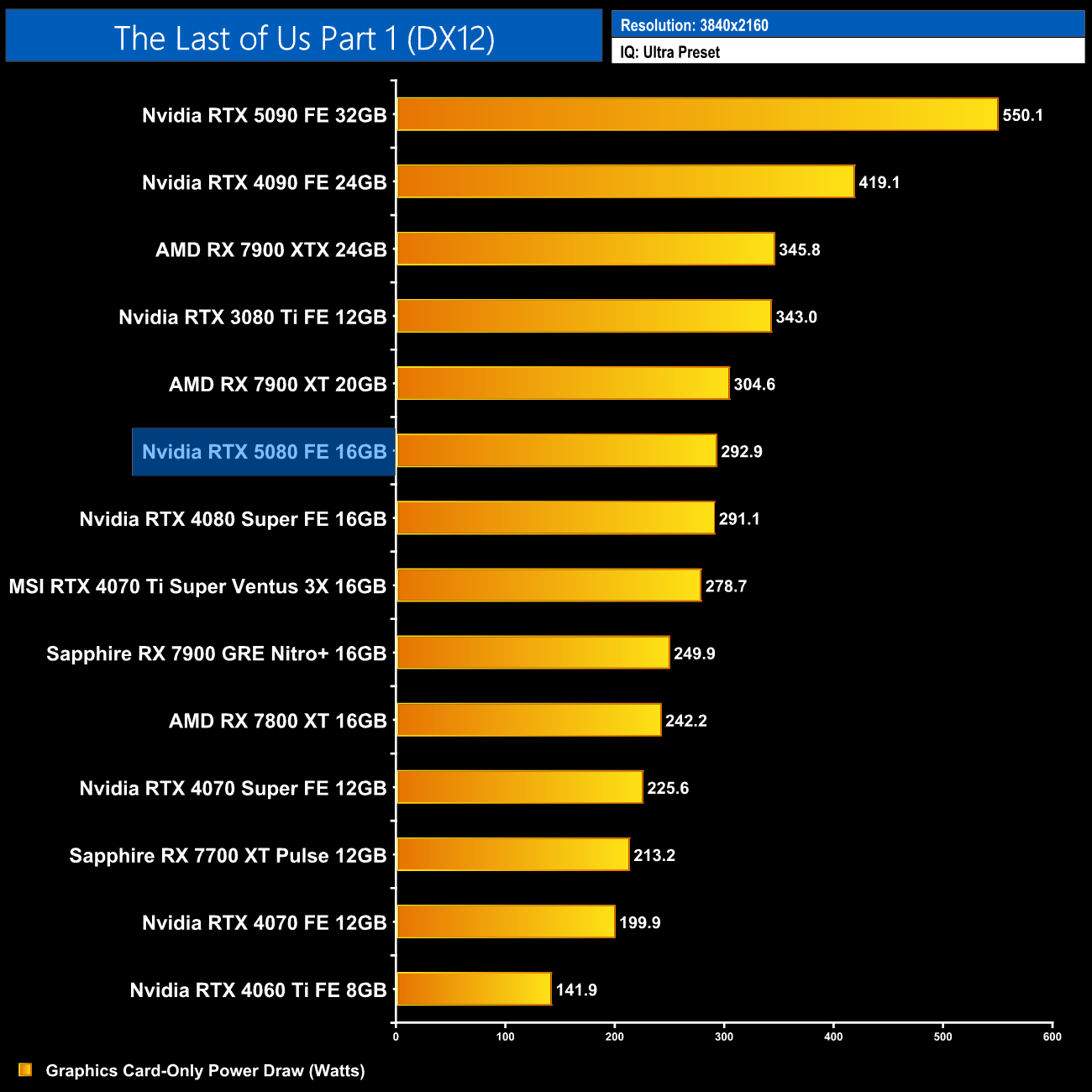
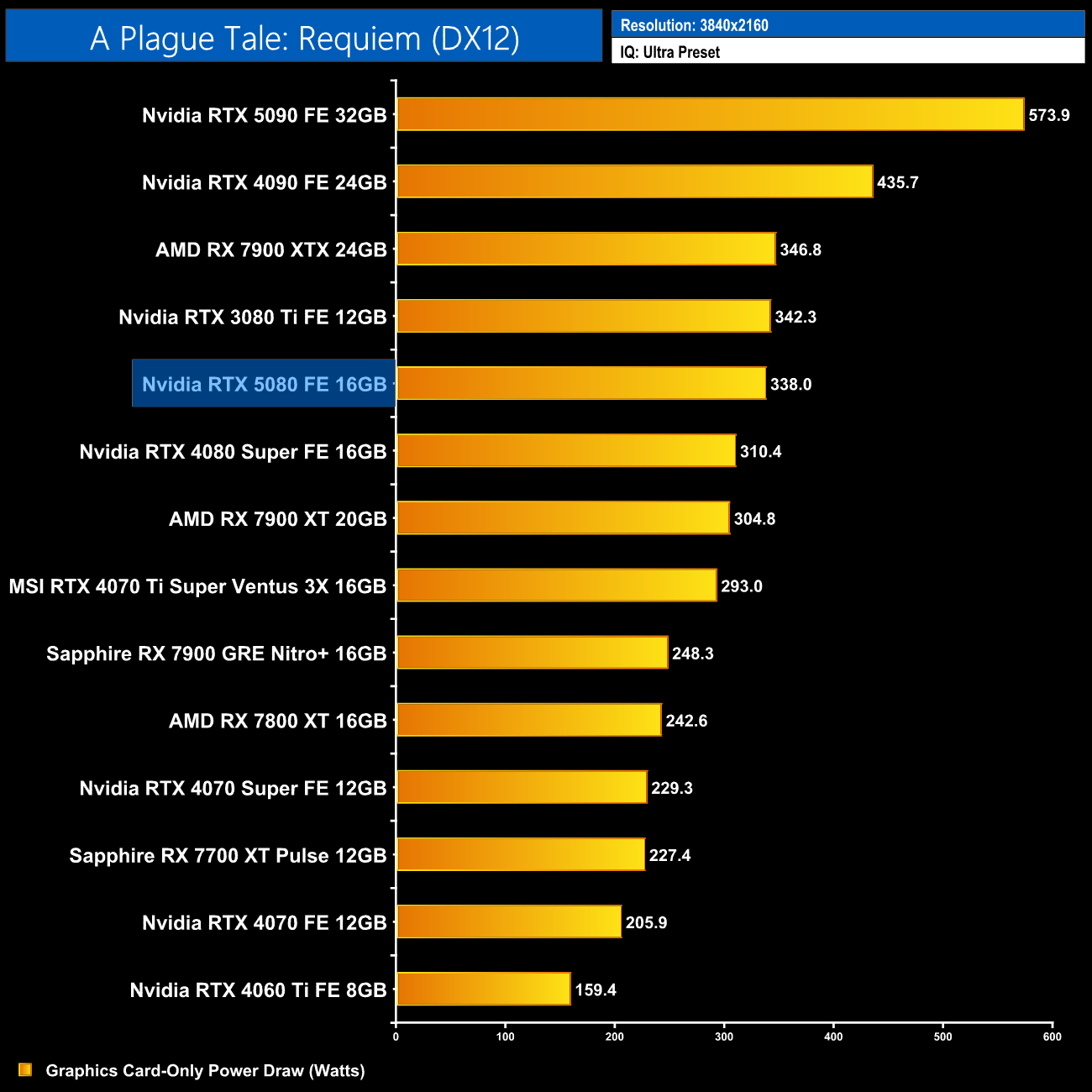
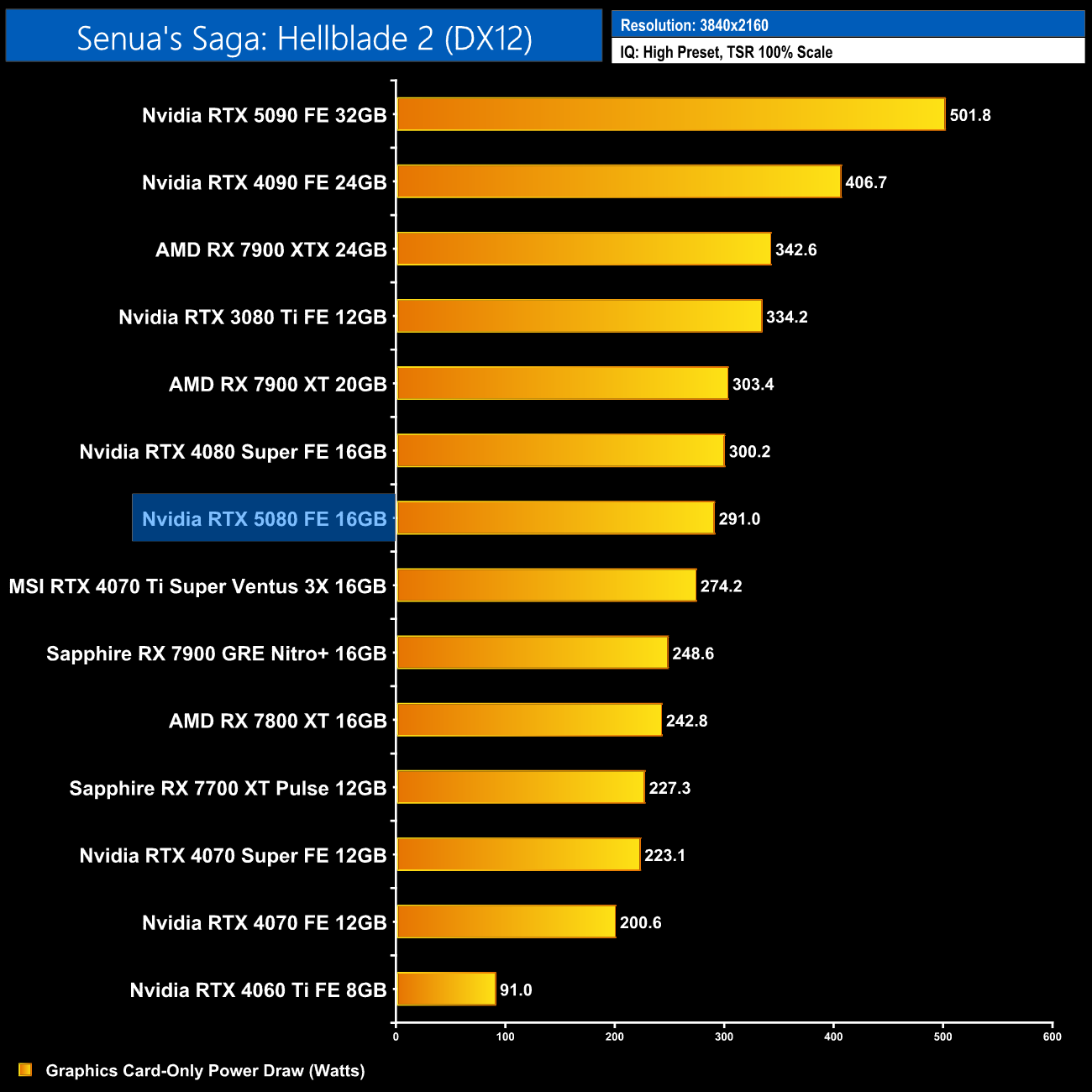
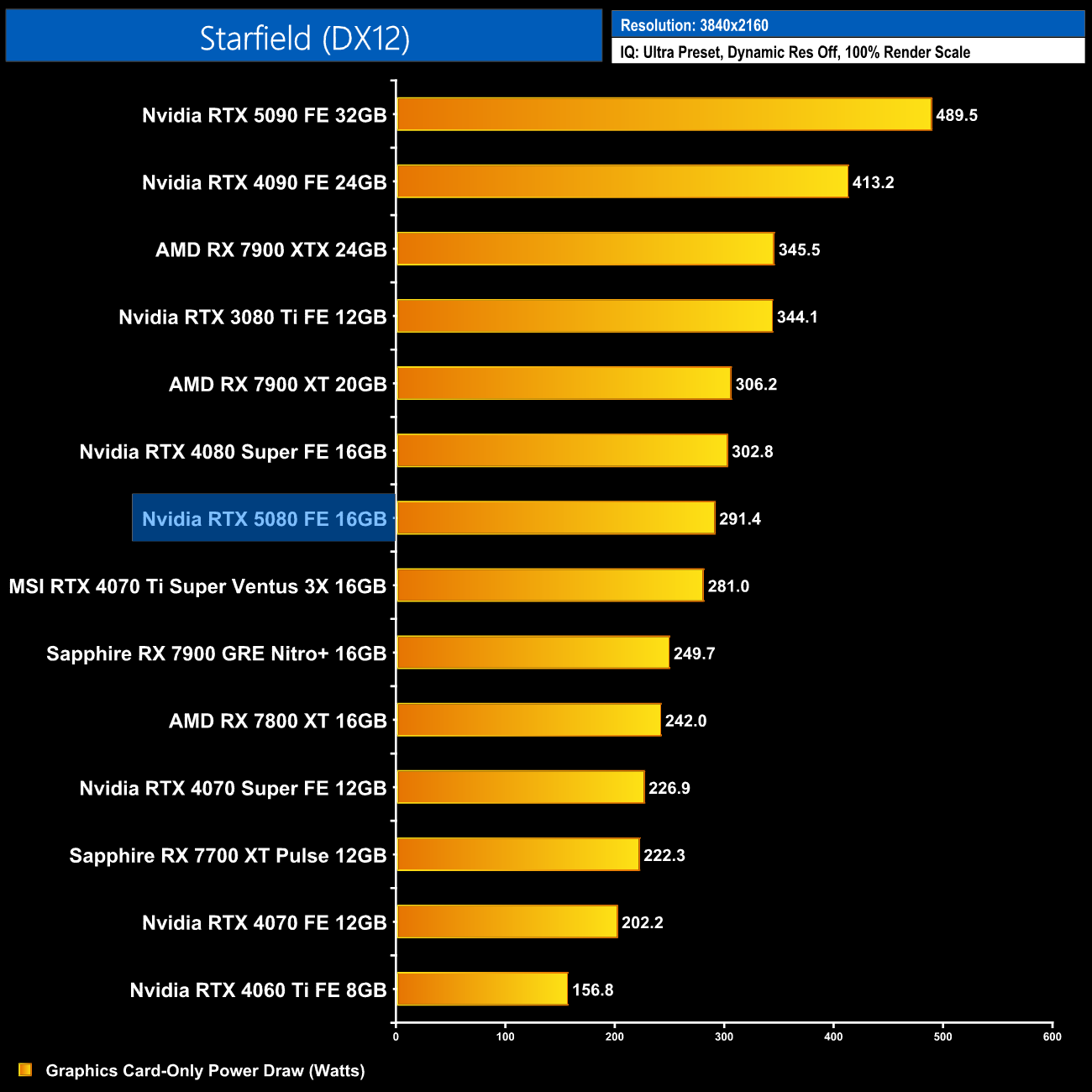
Click to enlarge.
12-Game Average at 2160p (4K):
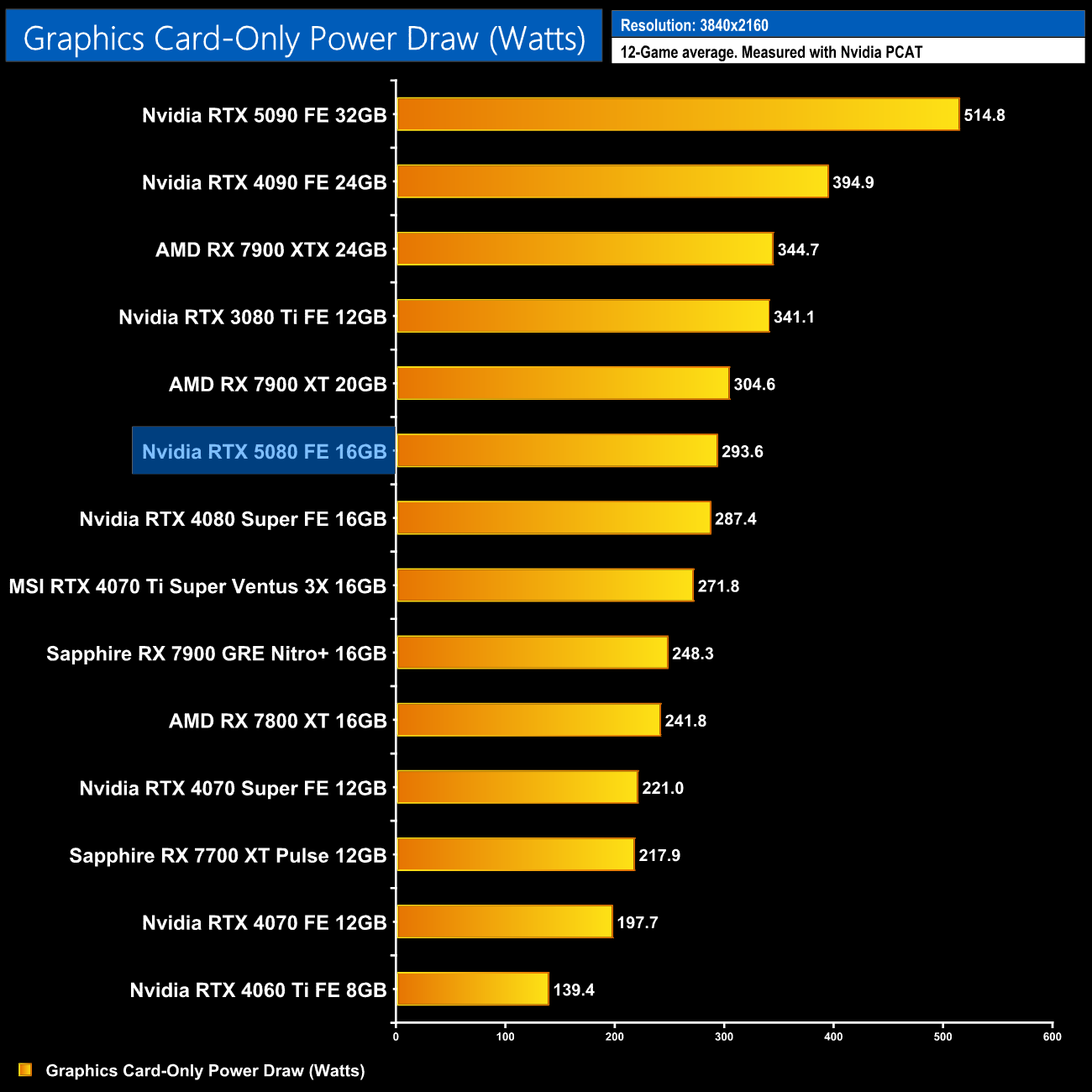
Even at 4K, the RTX 5080 doesn't really come close to its 360W TGP rating. There's a couple of games which see higher power – like Cyberpunk 2077 and A Plague Tale: Requiem – but eight of the twelve games tested saw power draw below 300W. On average, power is just 6W higher than the RTX 4080 Super in my testing, which bodes well for when we come to look at performance per Watt over the next few pages.
Ray tracing results
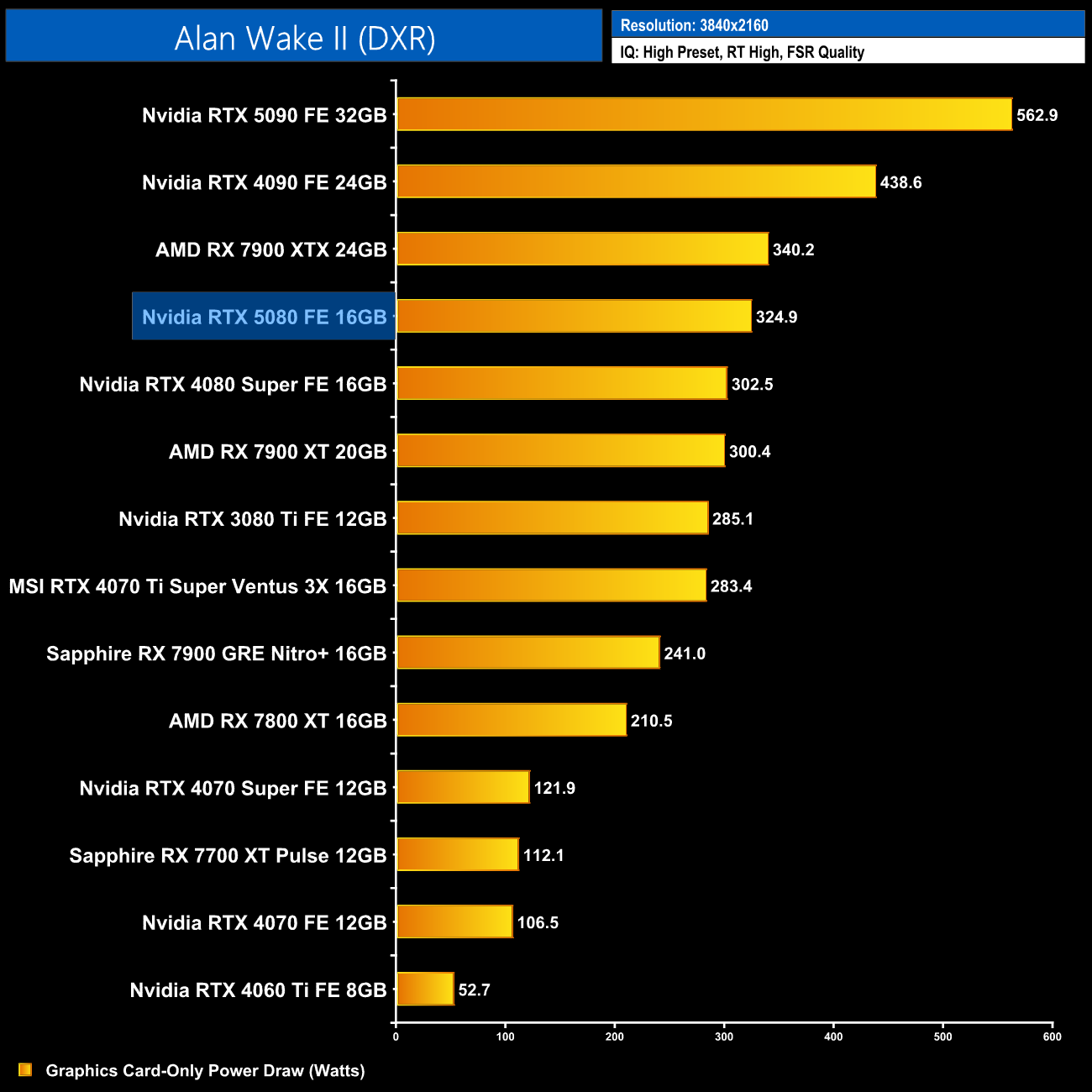
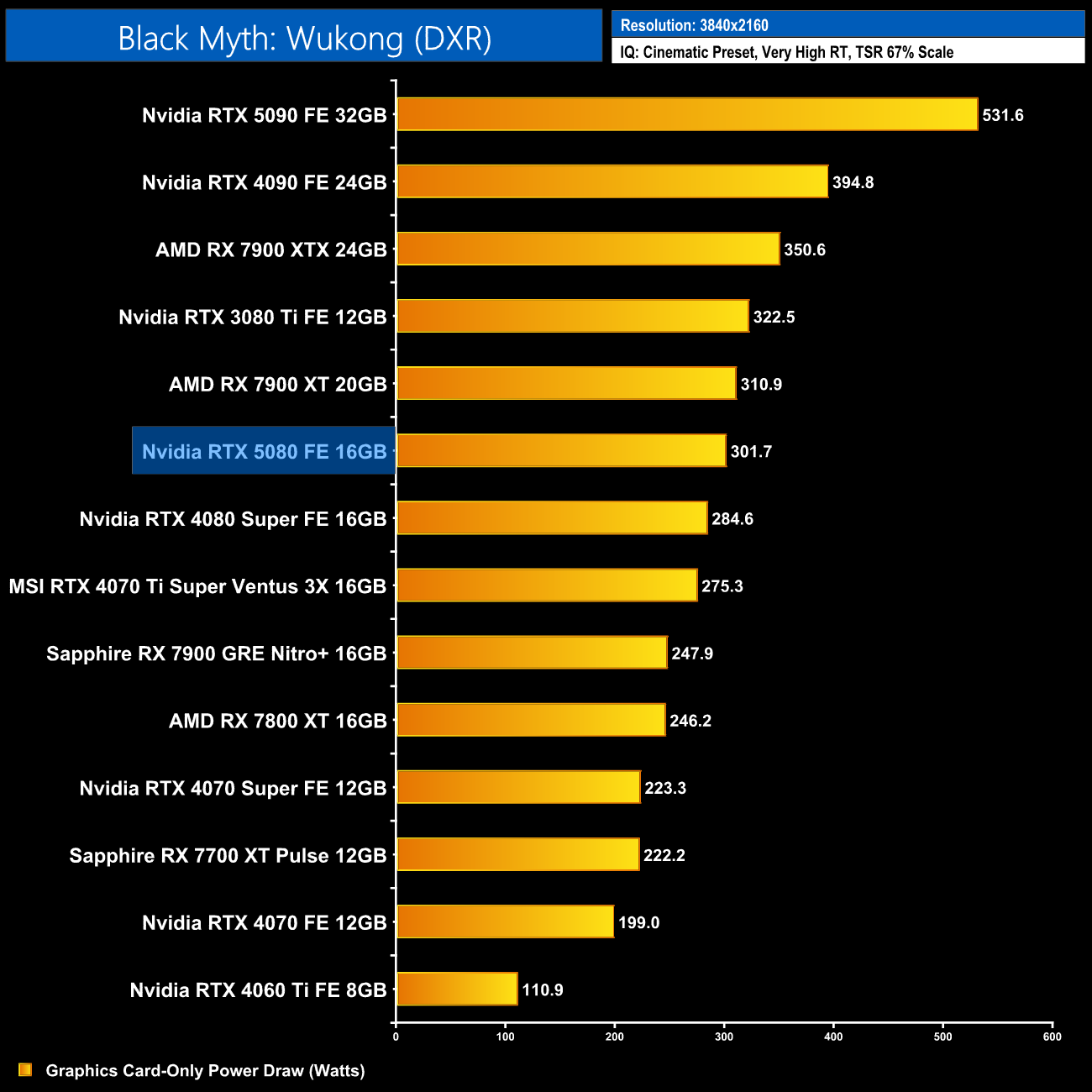
As a bonus, we now include the power figures for all eight games we test with ray tracing enabled.
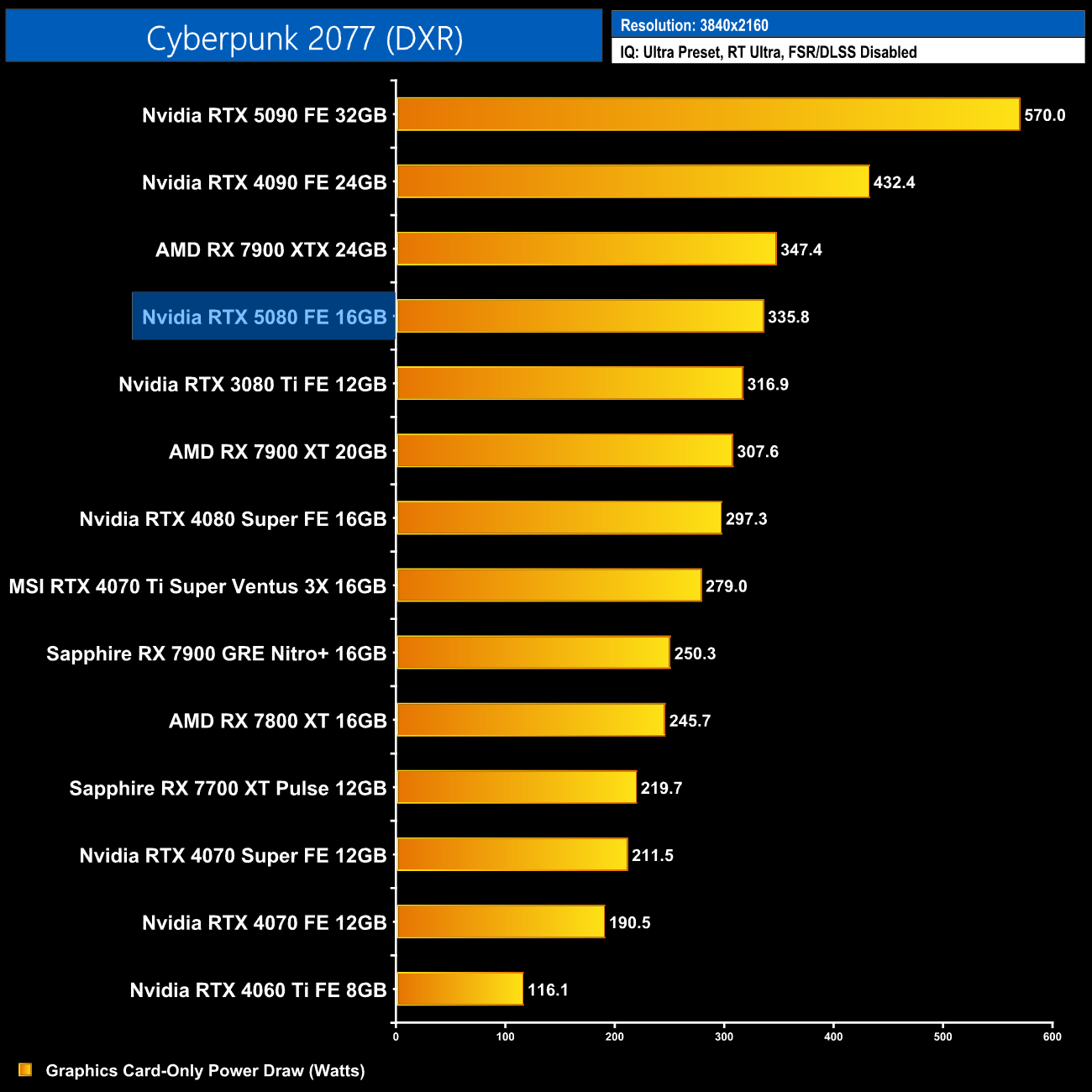
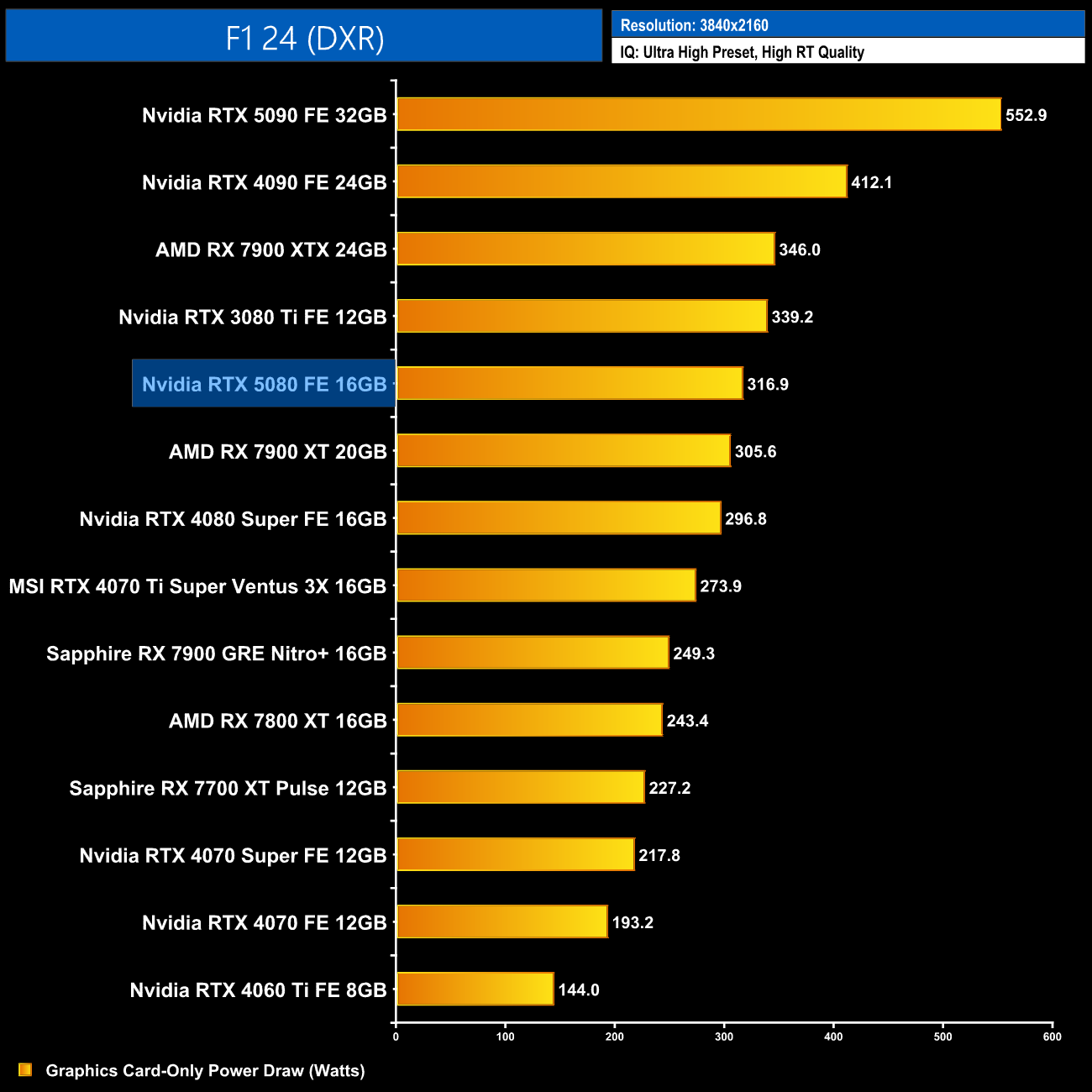
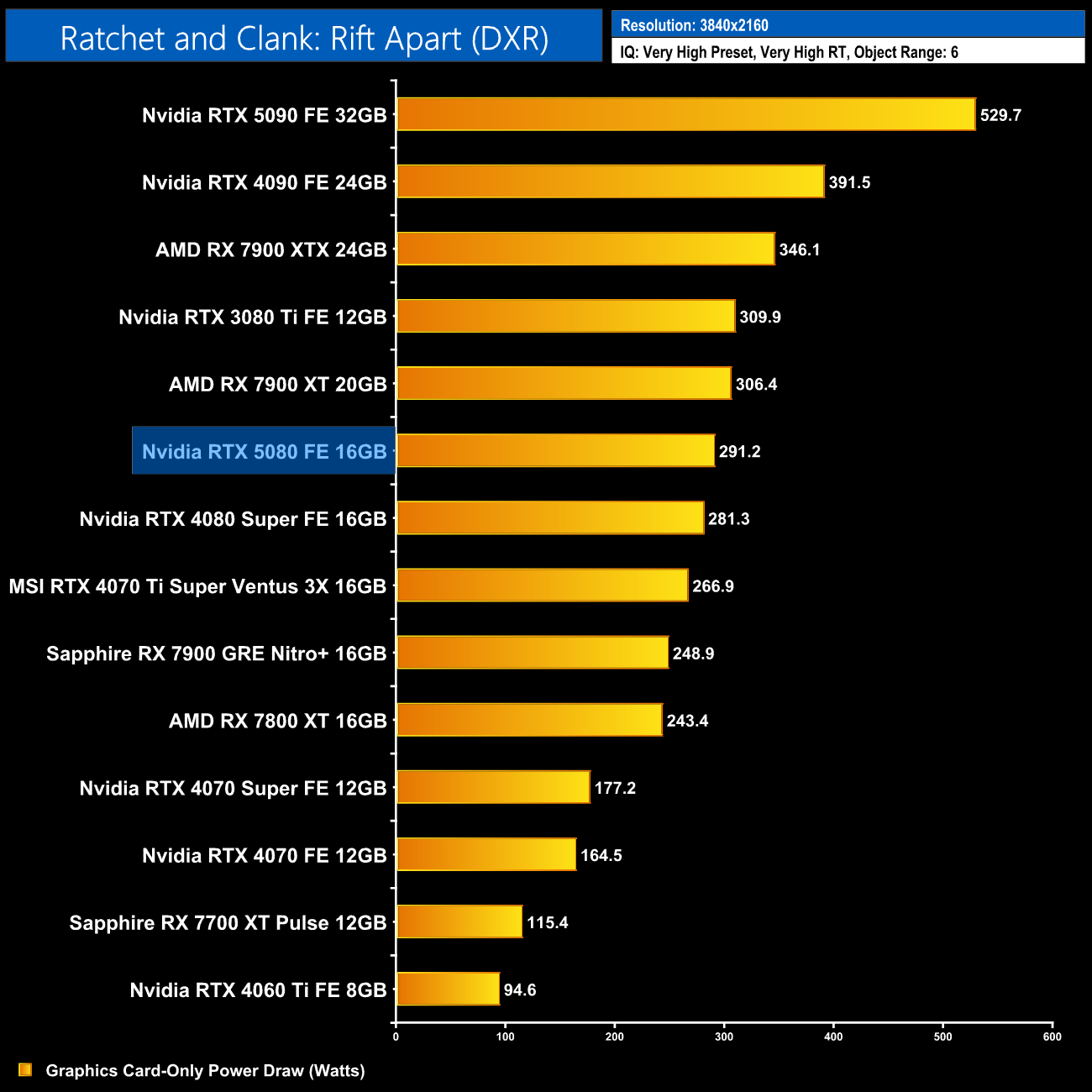
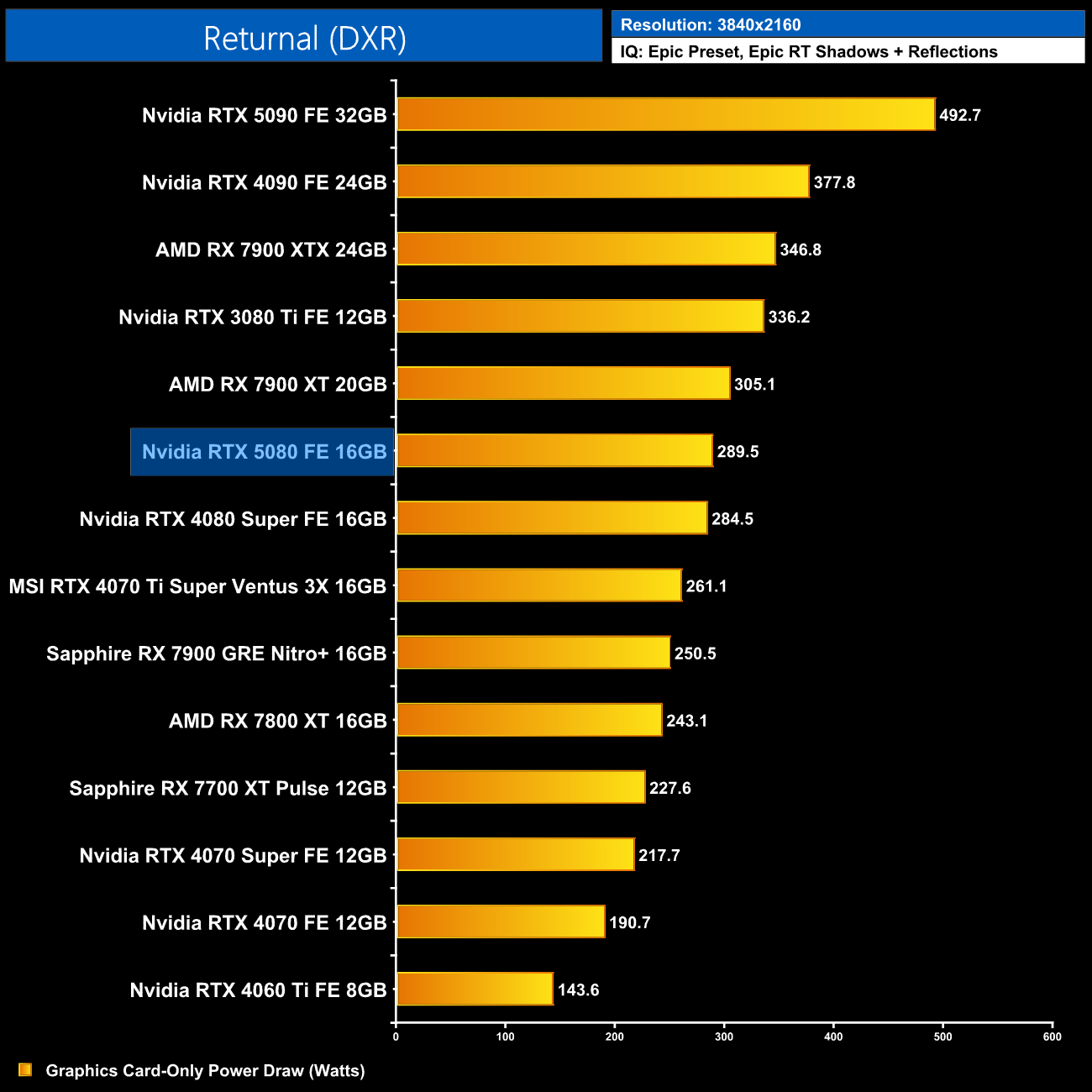
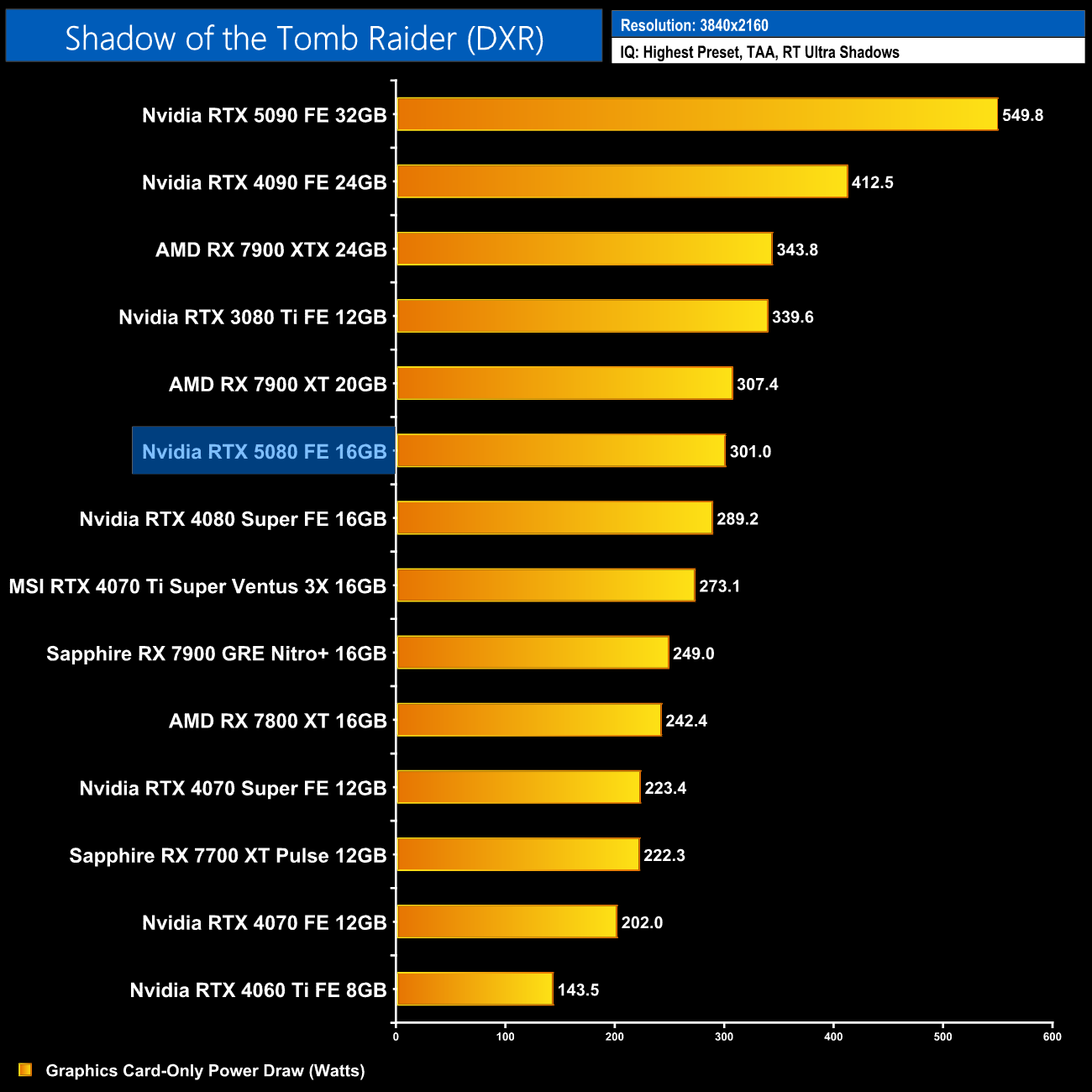
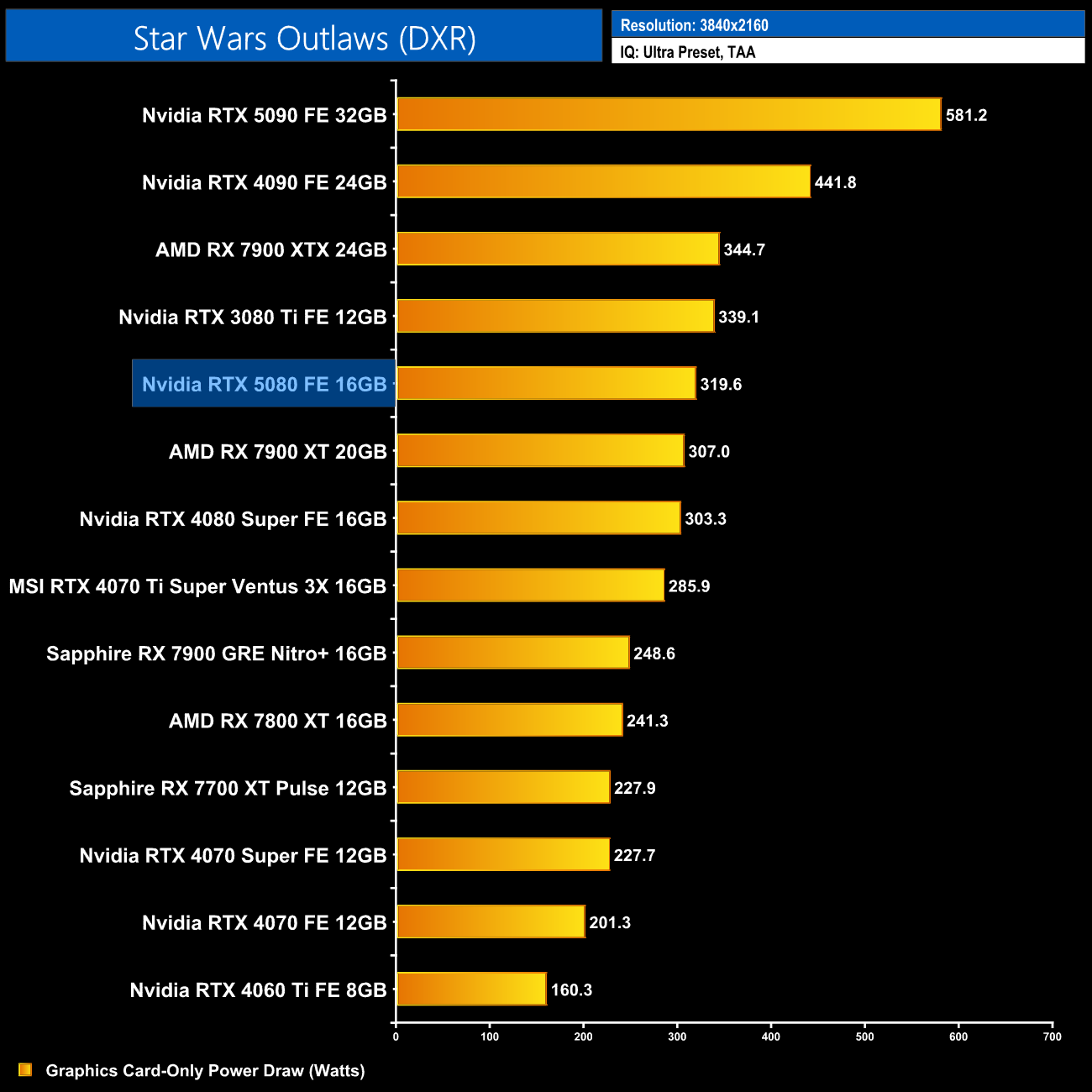
8-Game ray tracing average:
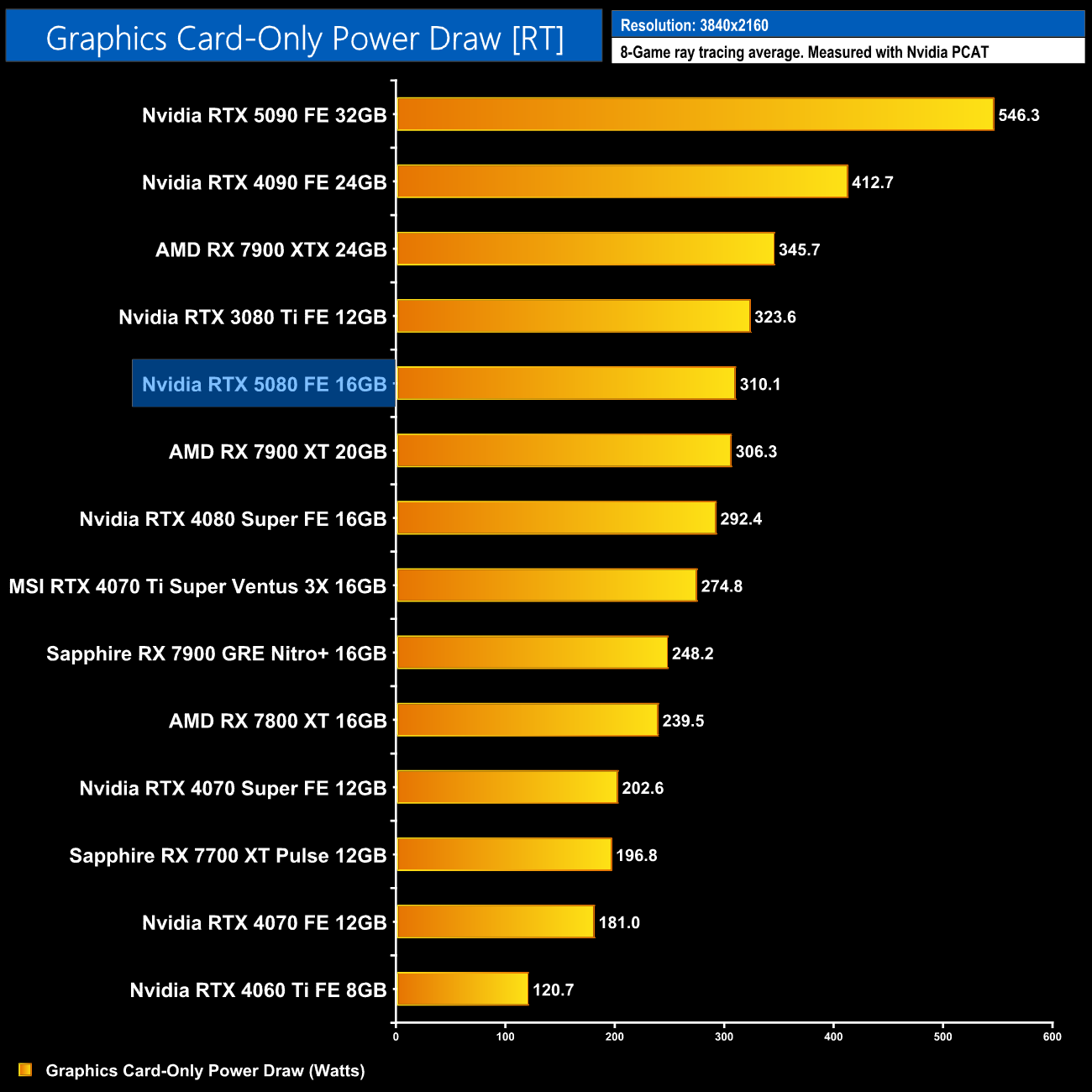
Lastly, power draw at 4K is higher with ray tracing enabled, but still averages just 310W, 50W below the rated TGP.
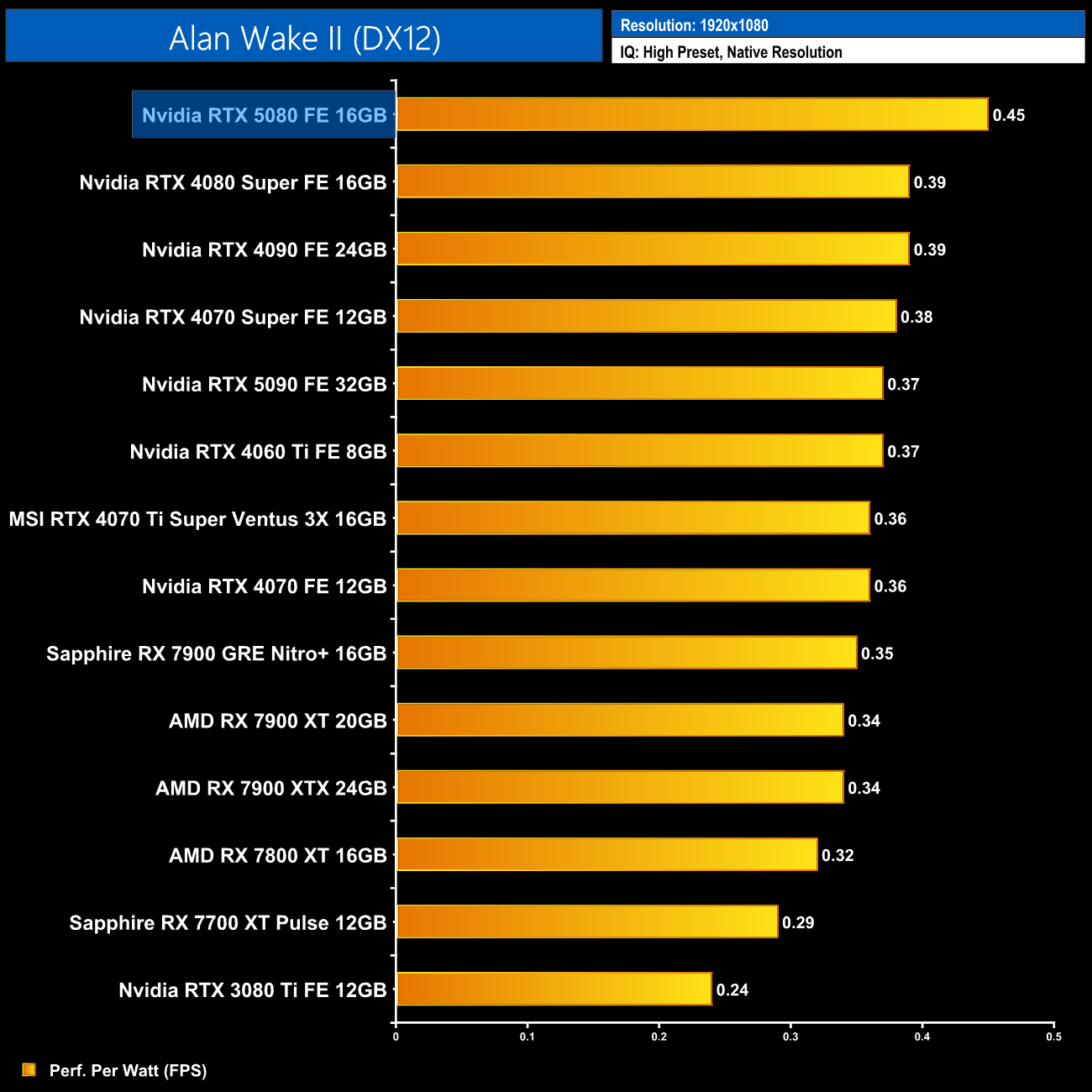
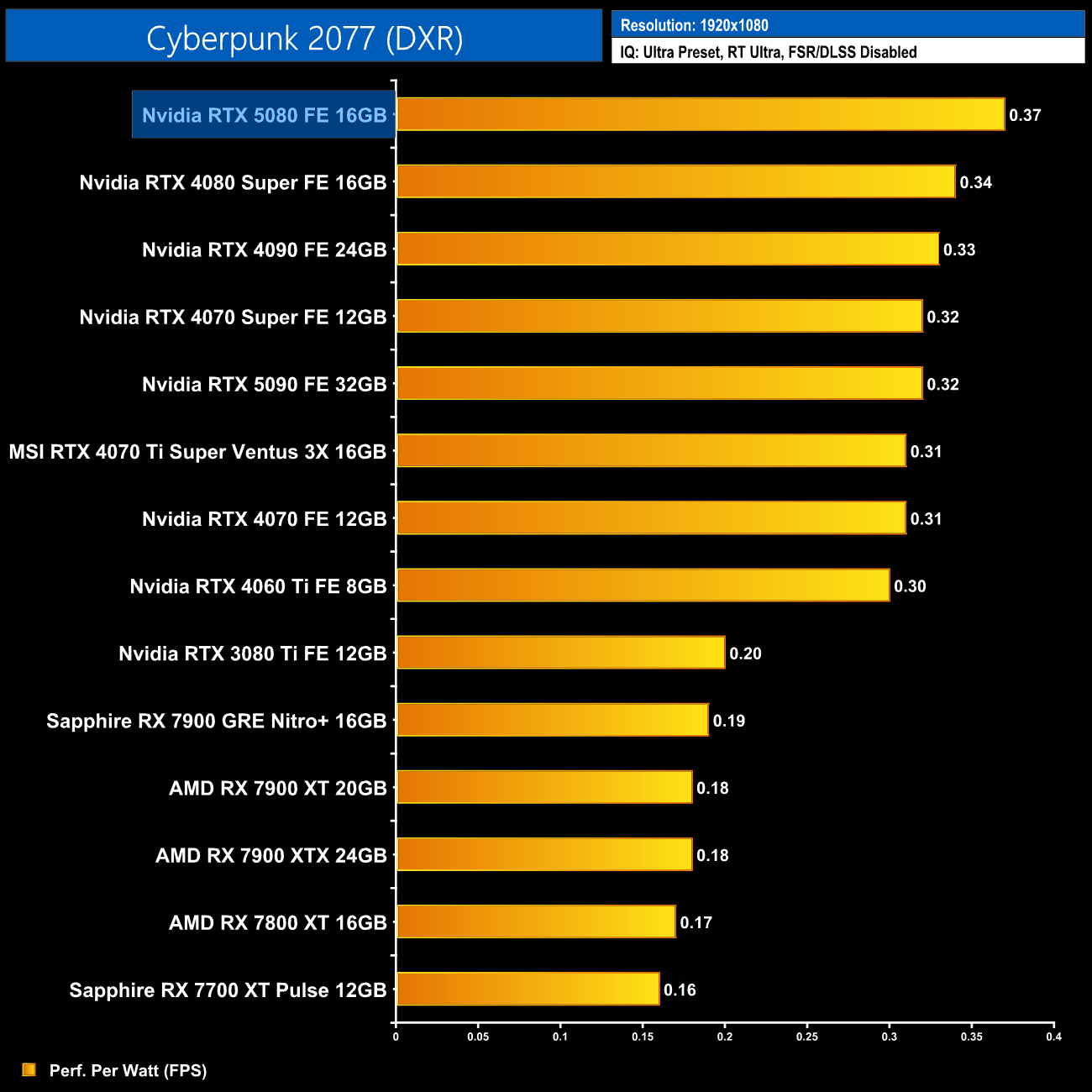
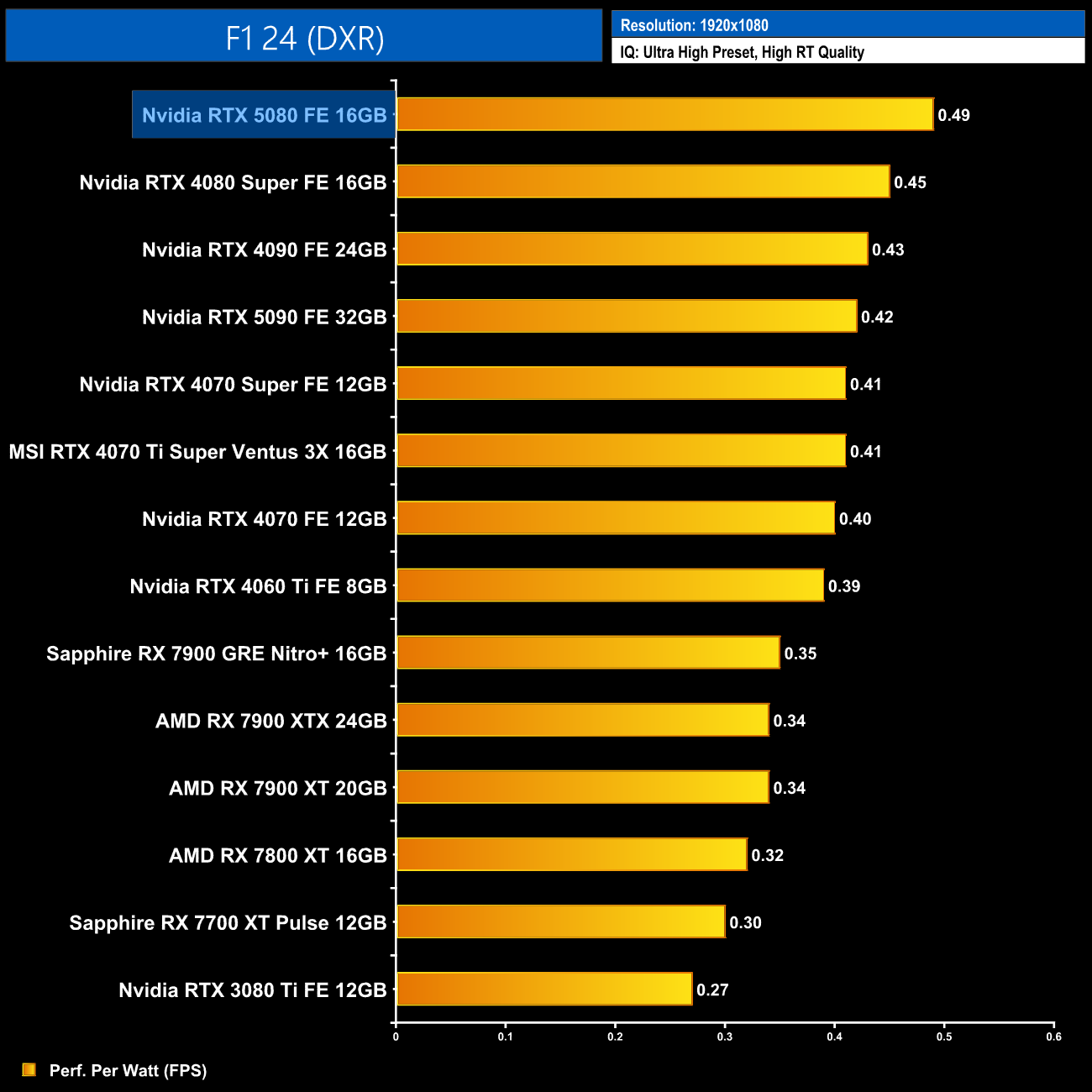
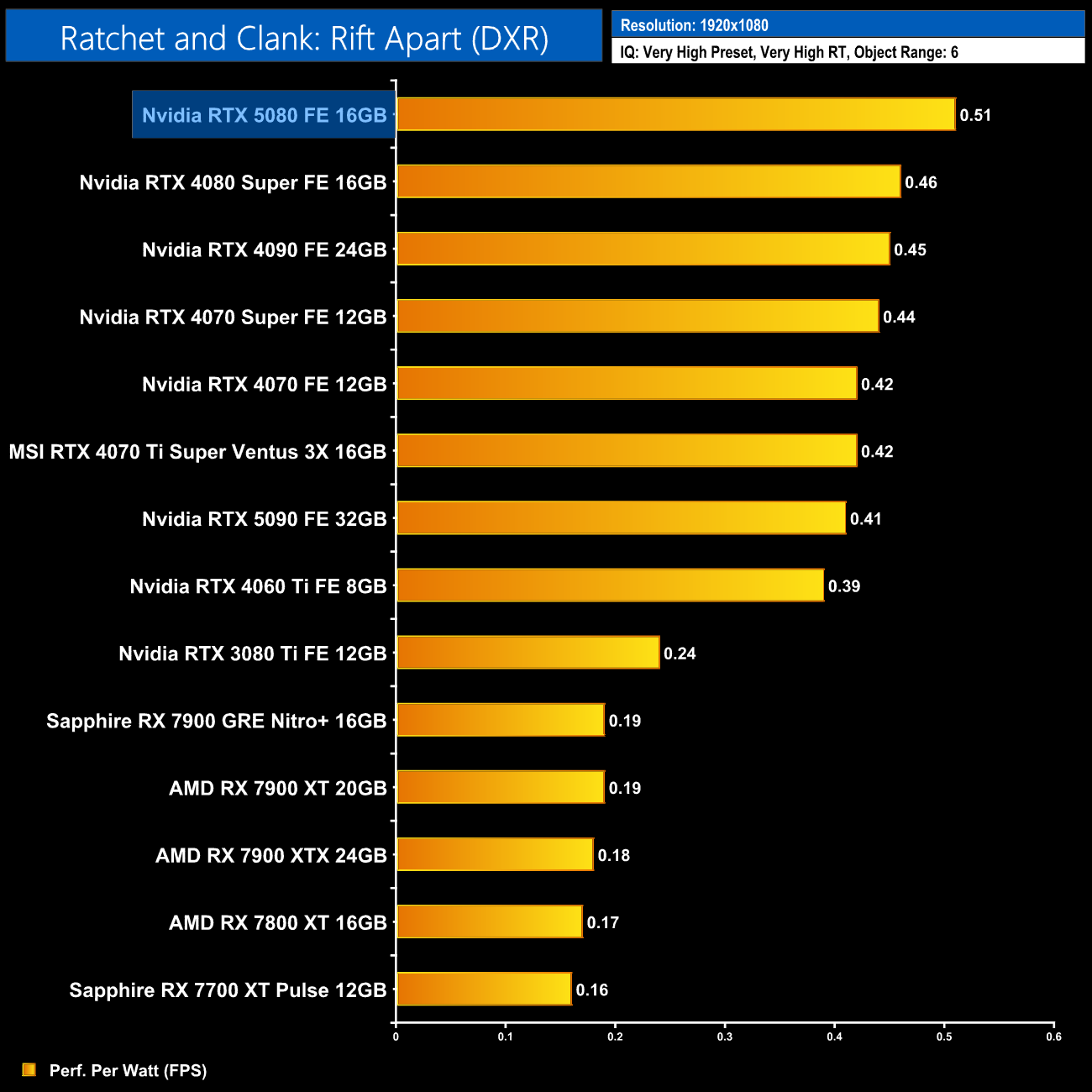
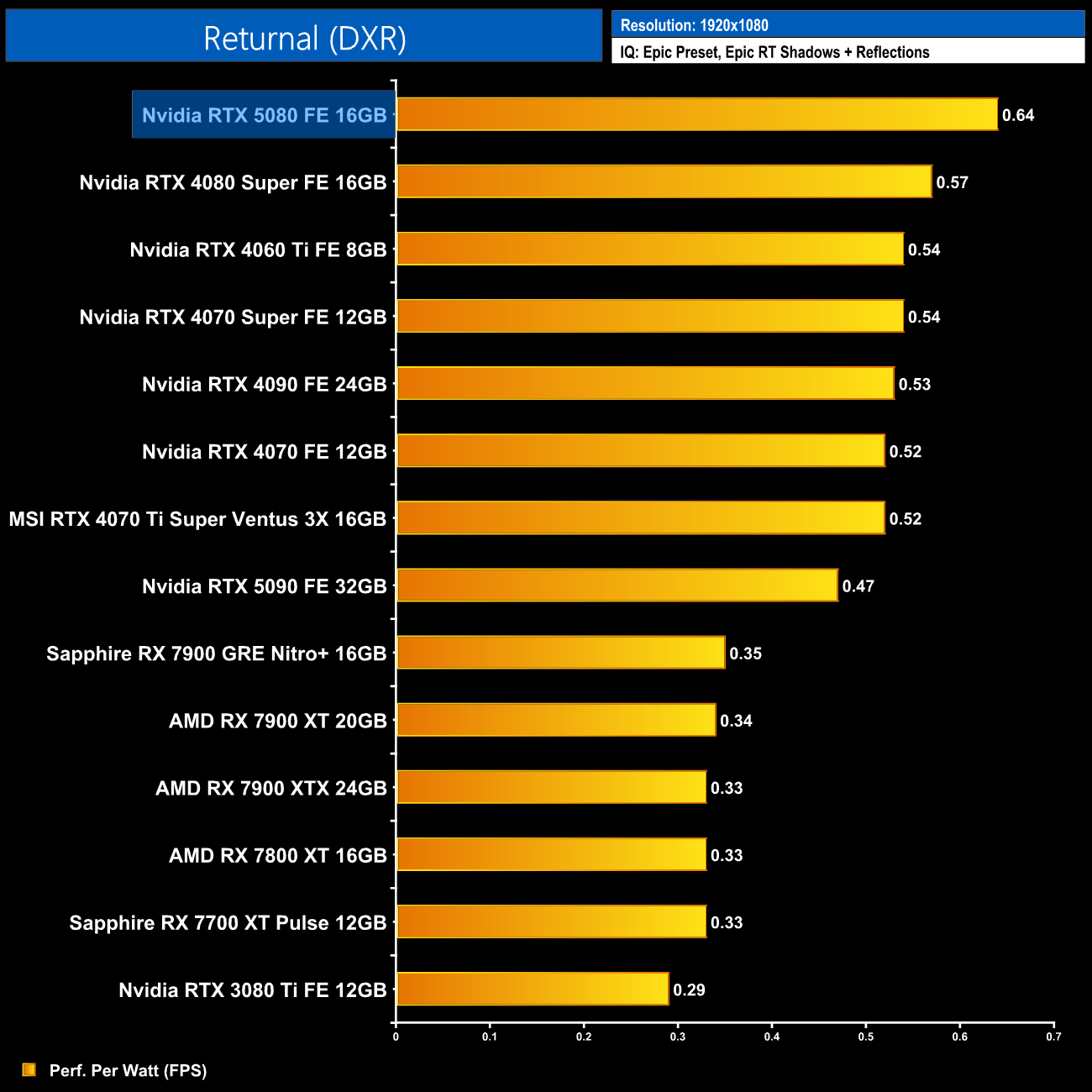
Using the graphics card-only power draw figures presented earlier in the review, here we present performance per Watt on a per-game basis for all twelve games we tested at 1080p.
Per-Game Results at 1080p:
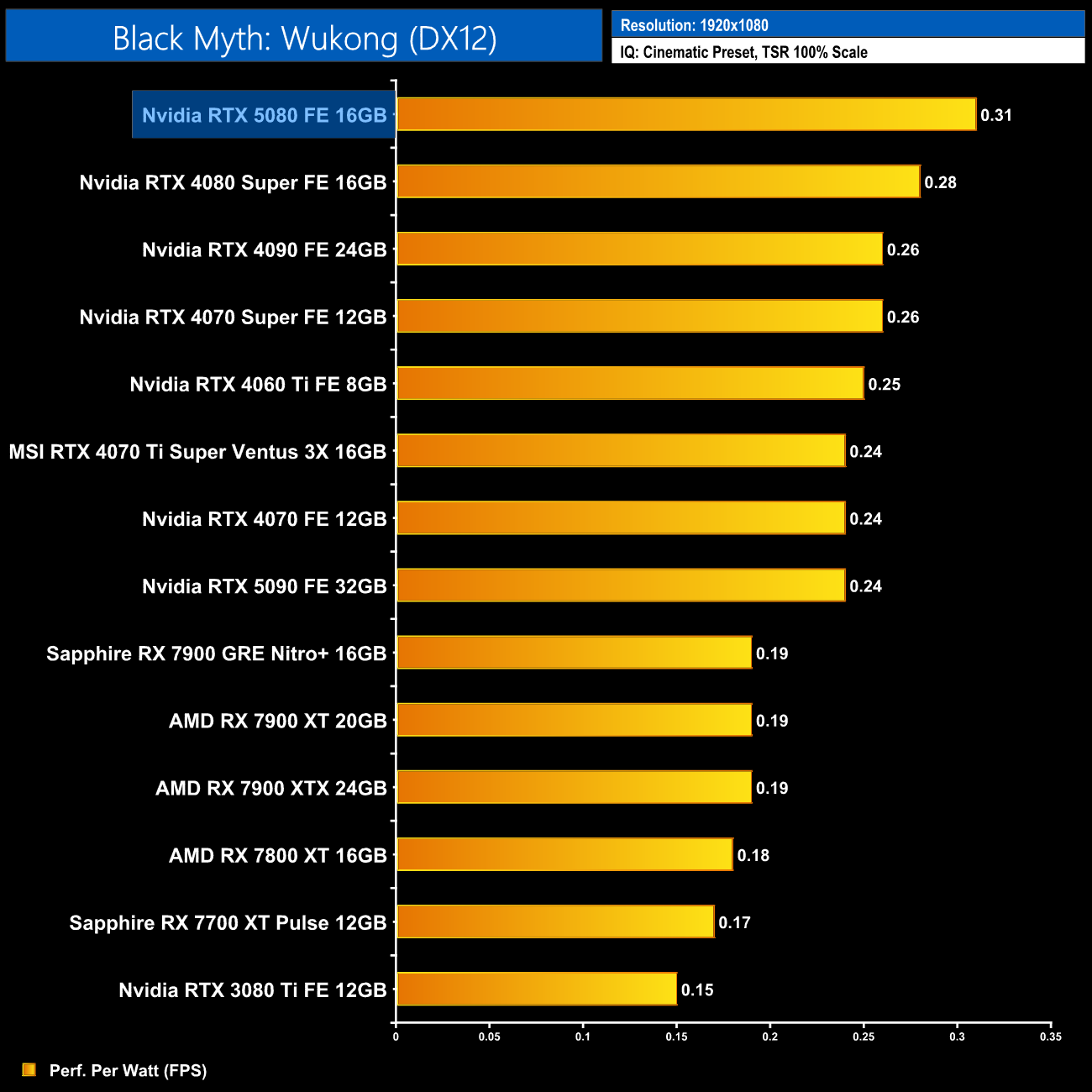
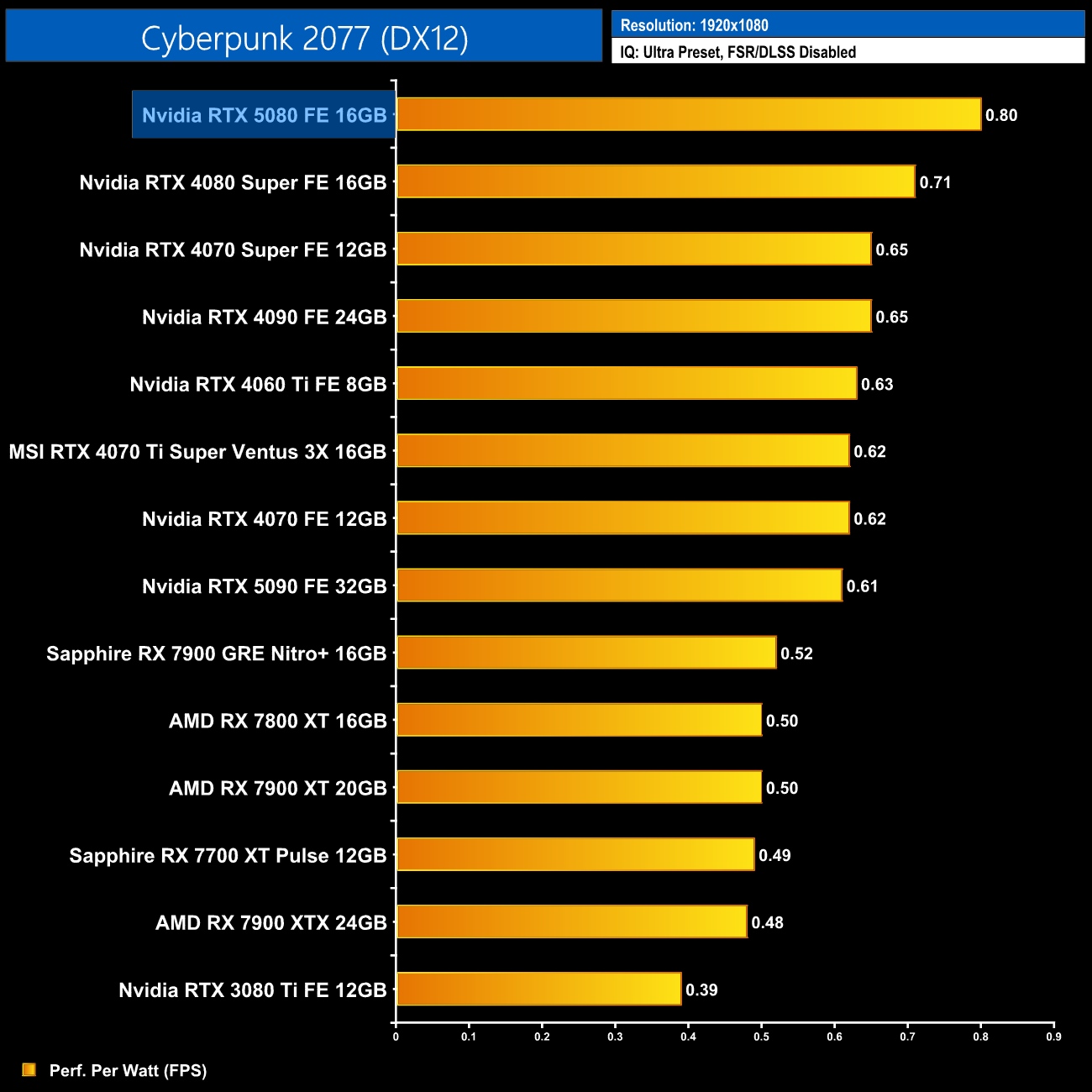
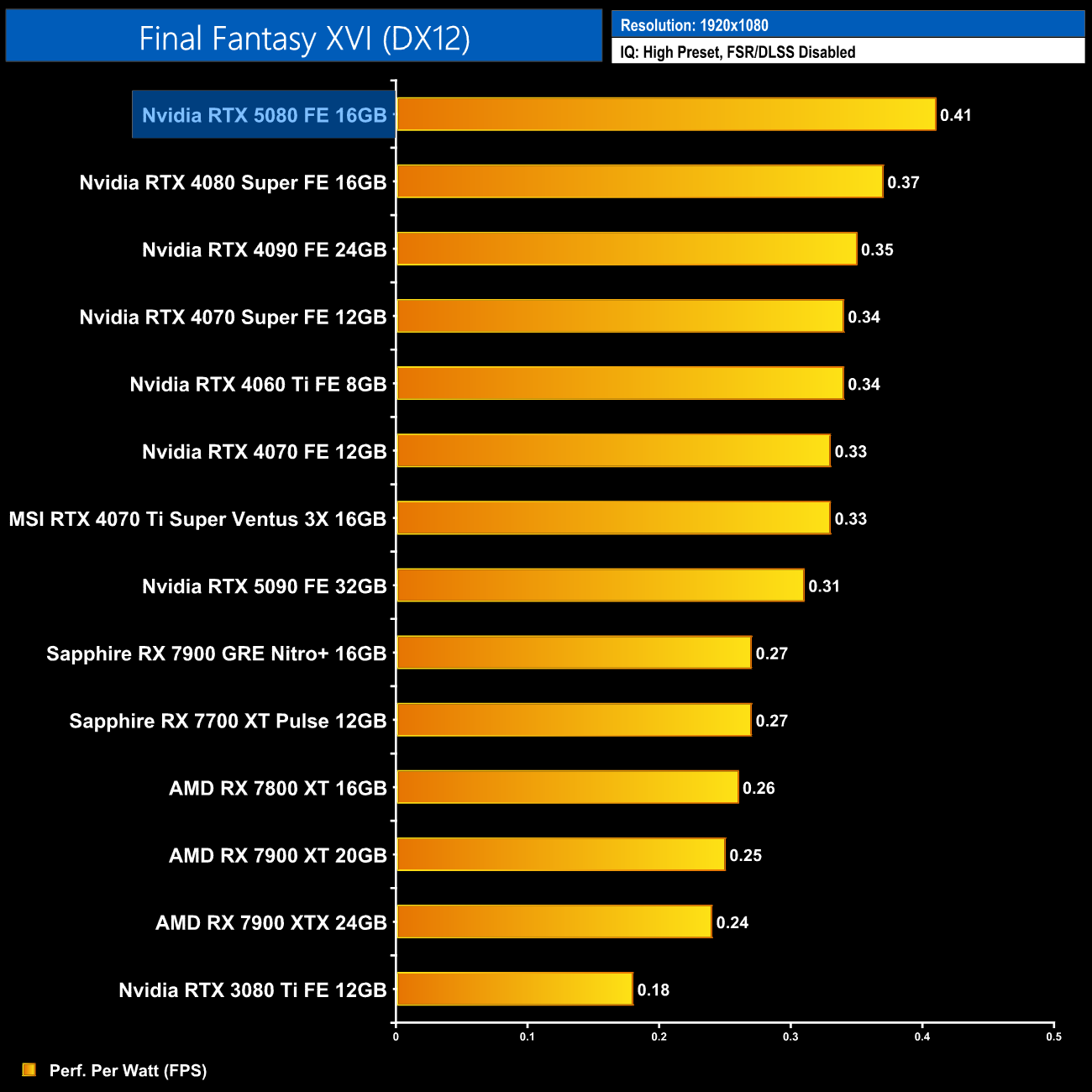

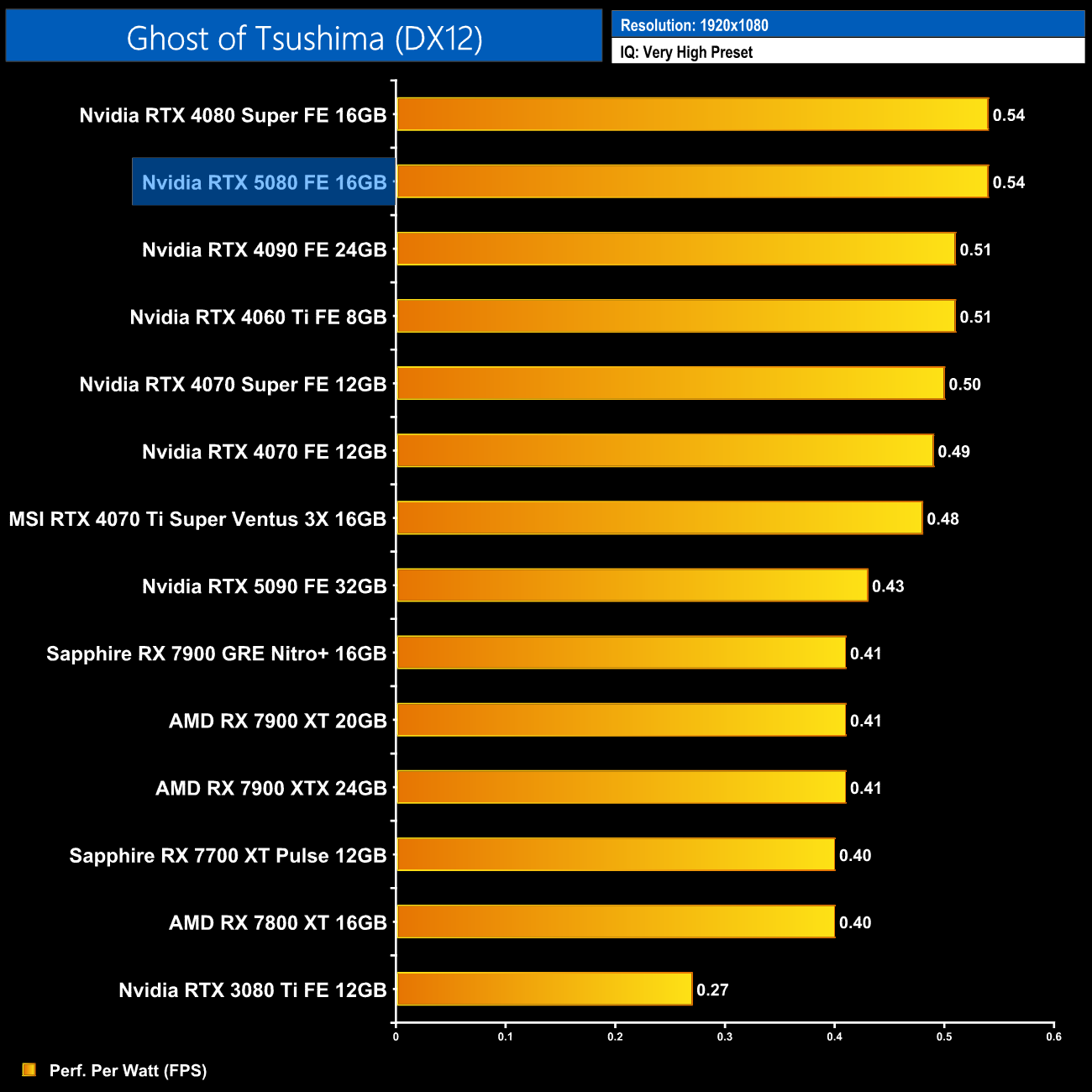
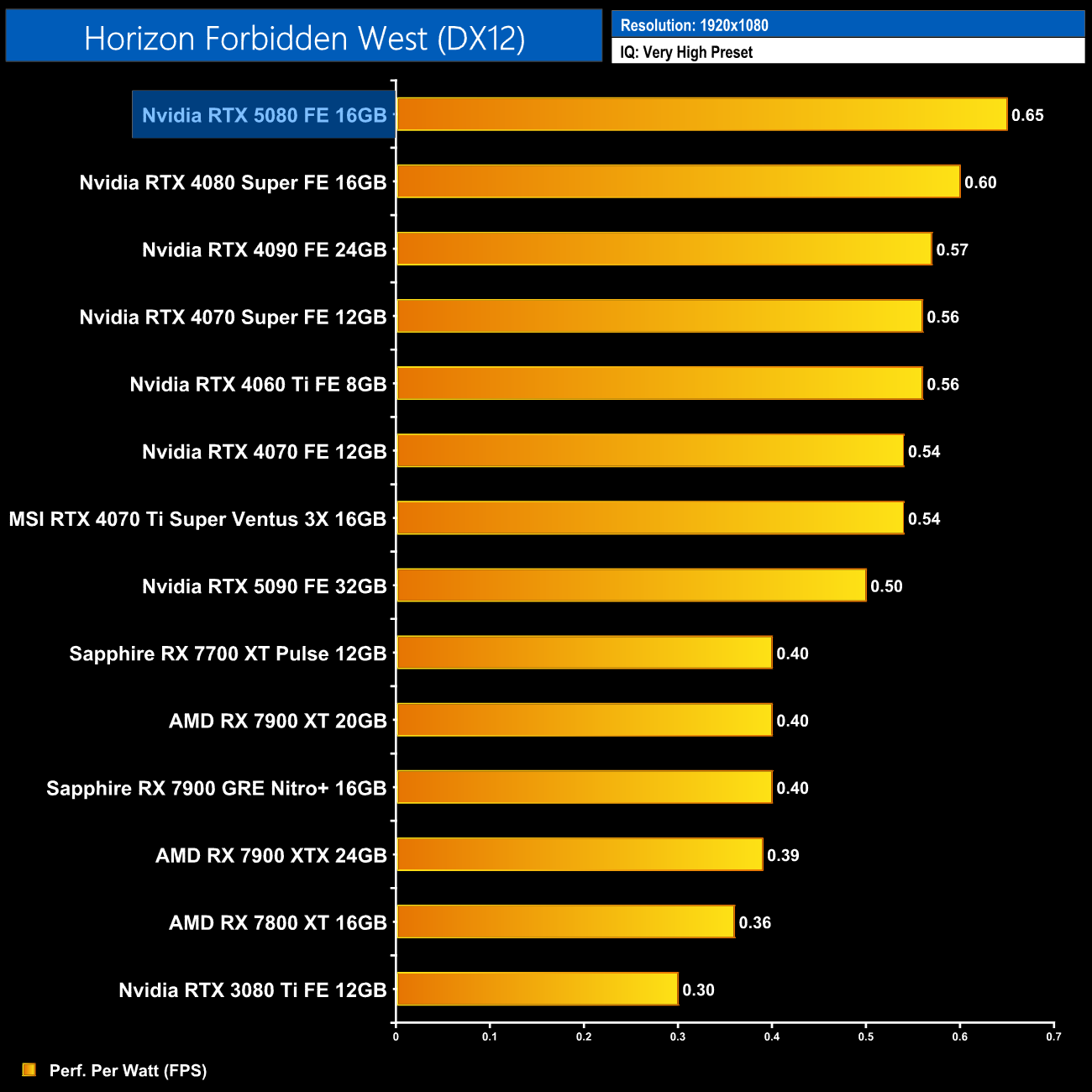

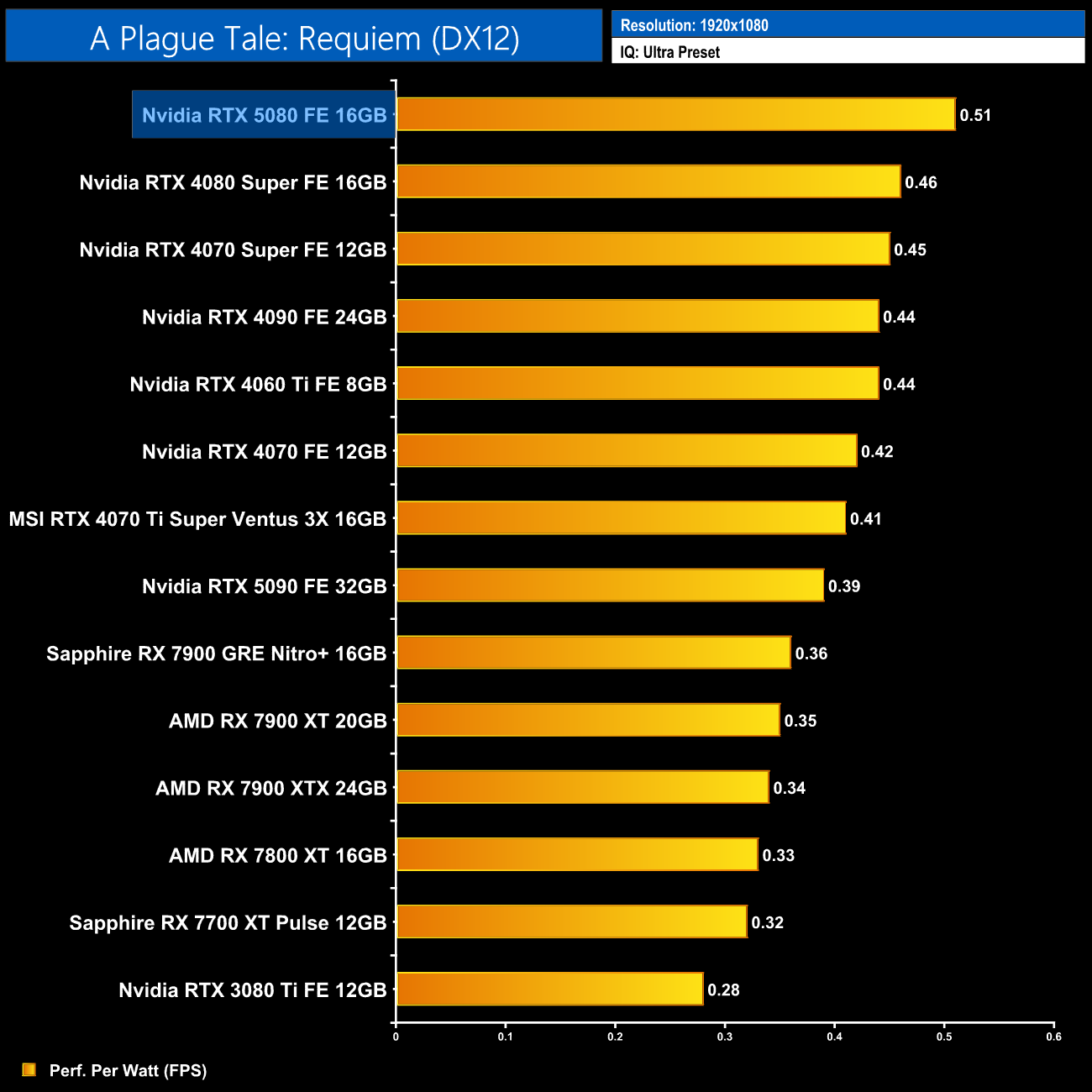
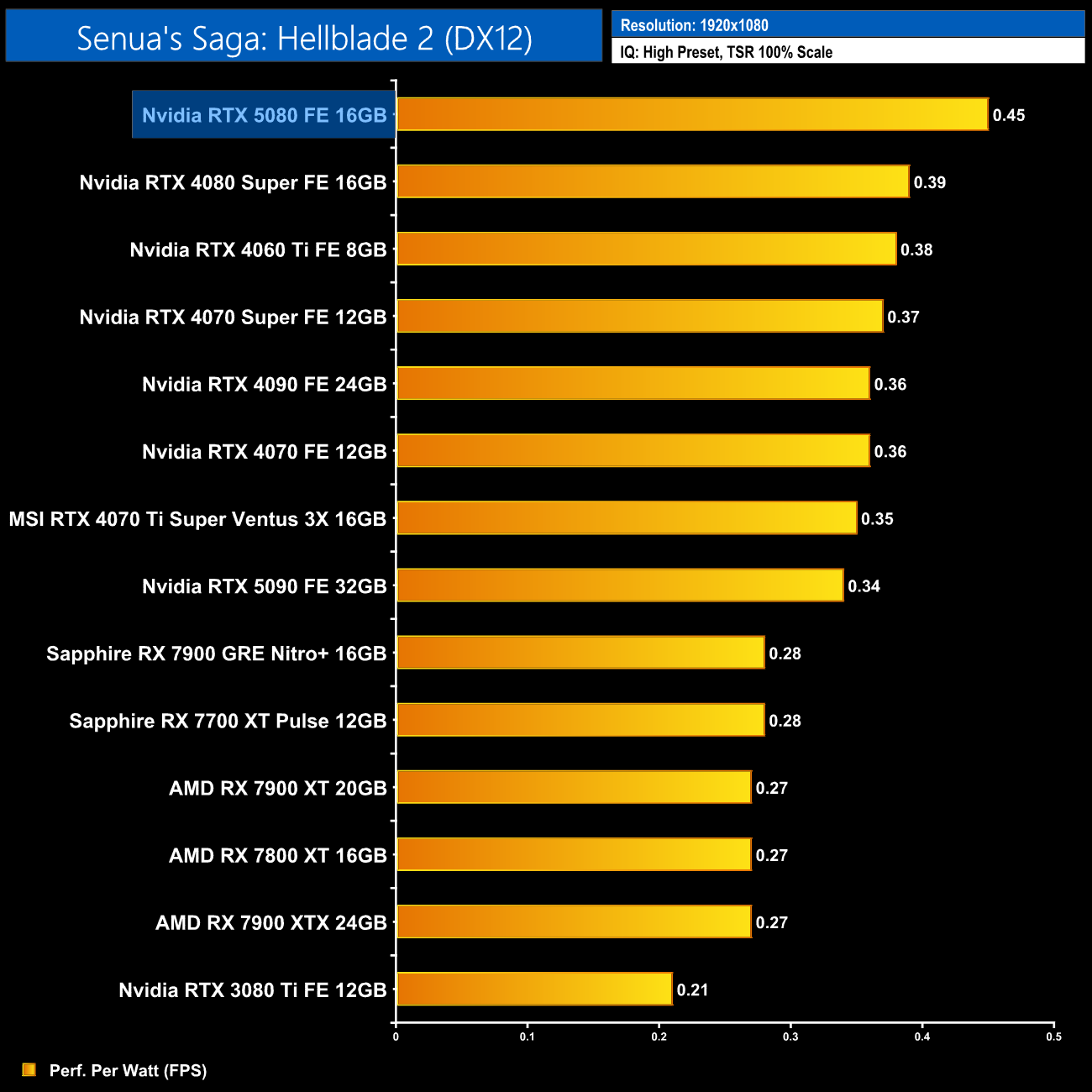
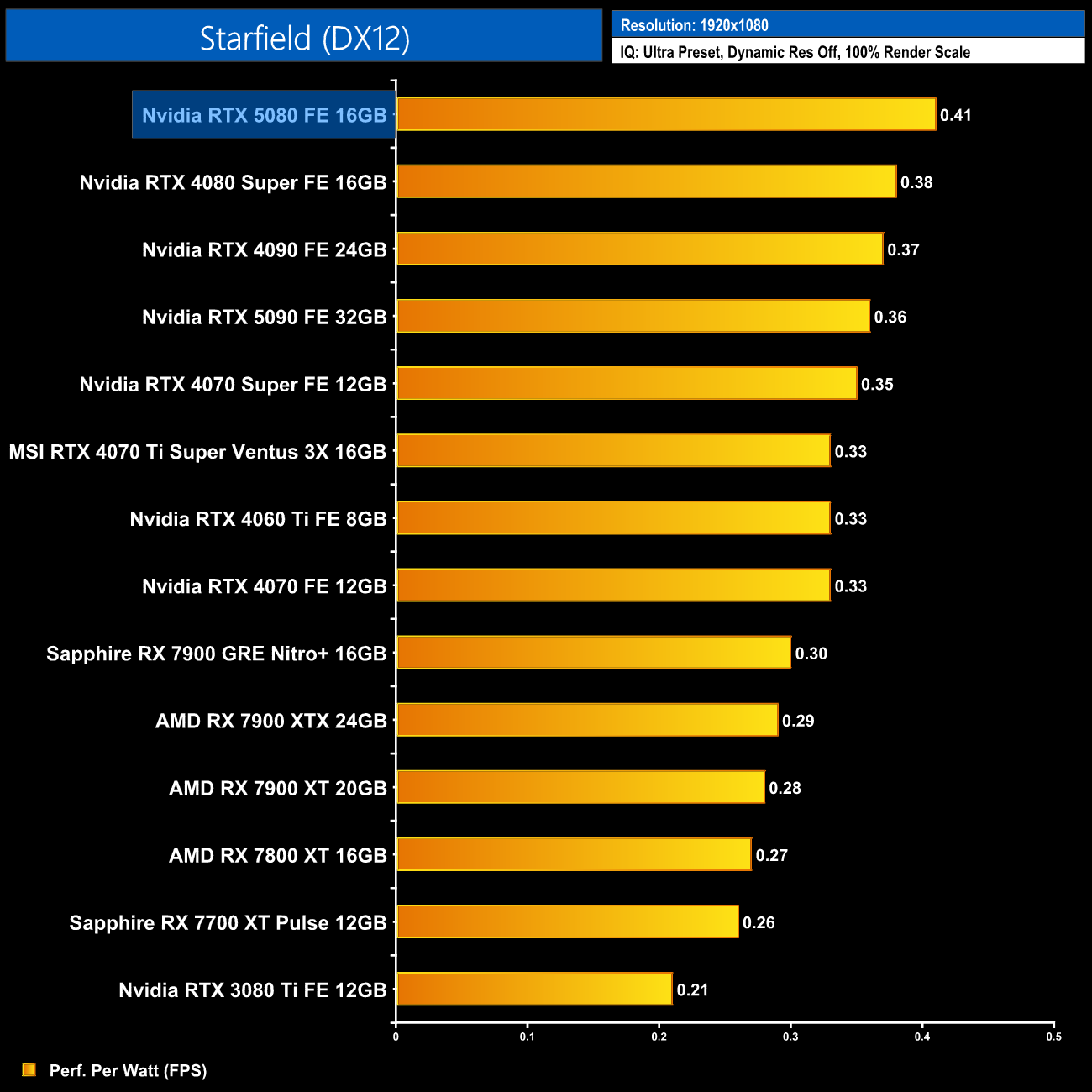
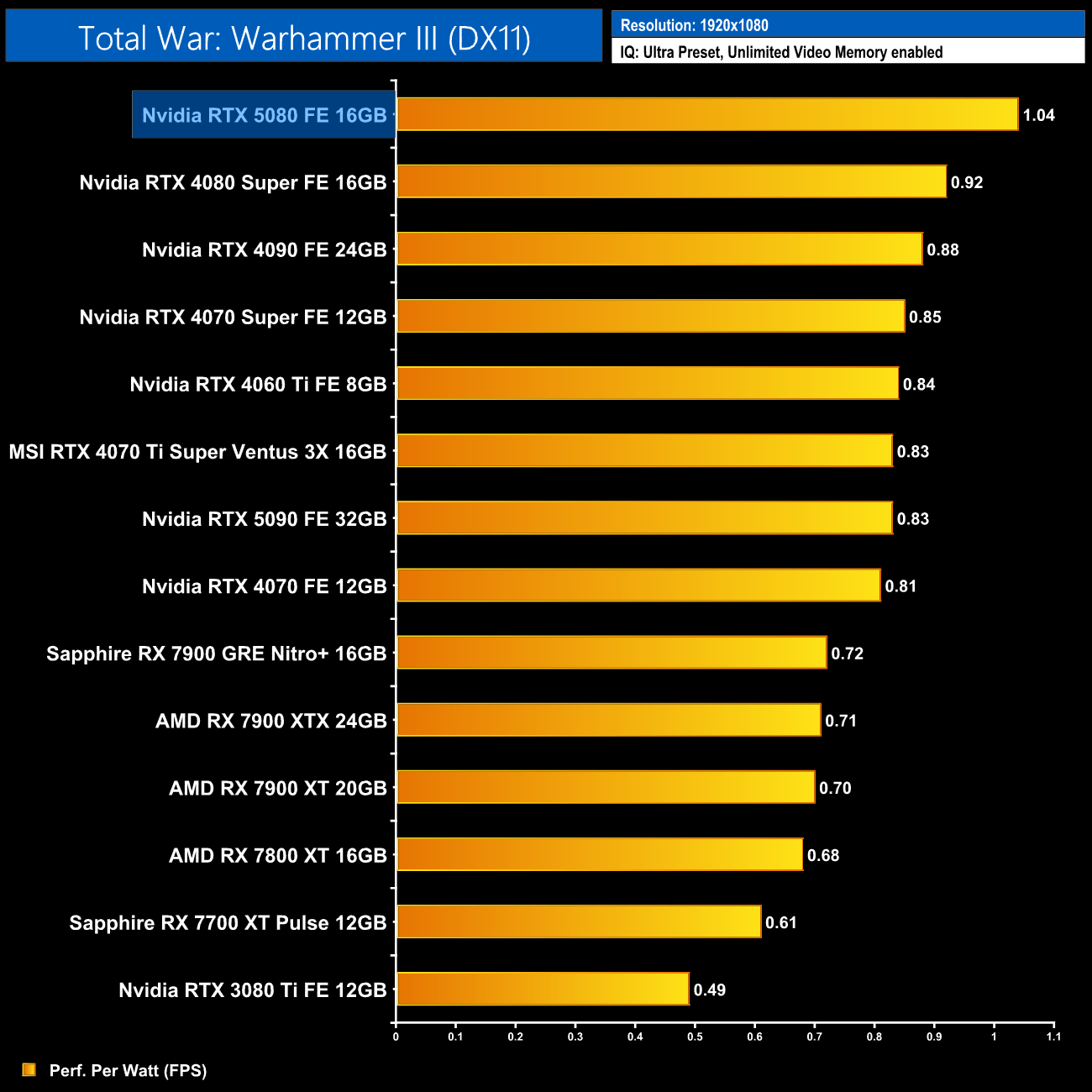
Click to enlarge.
12-Game Average at 1080p:
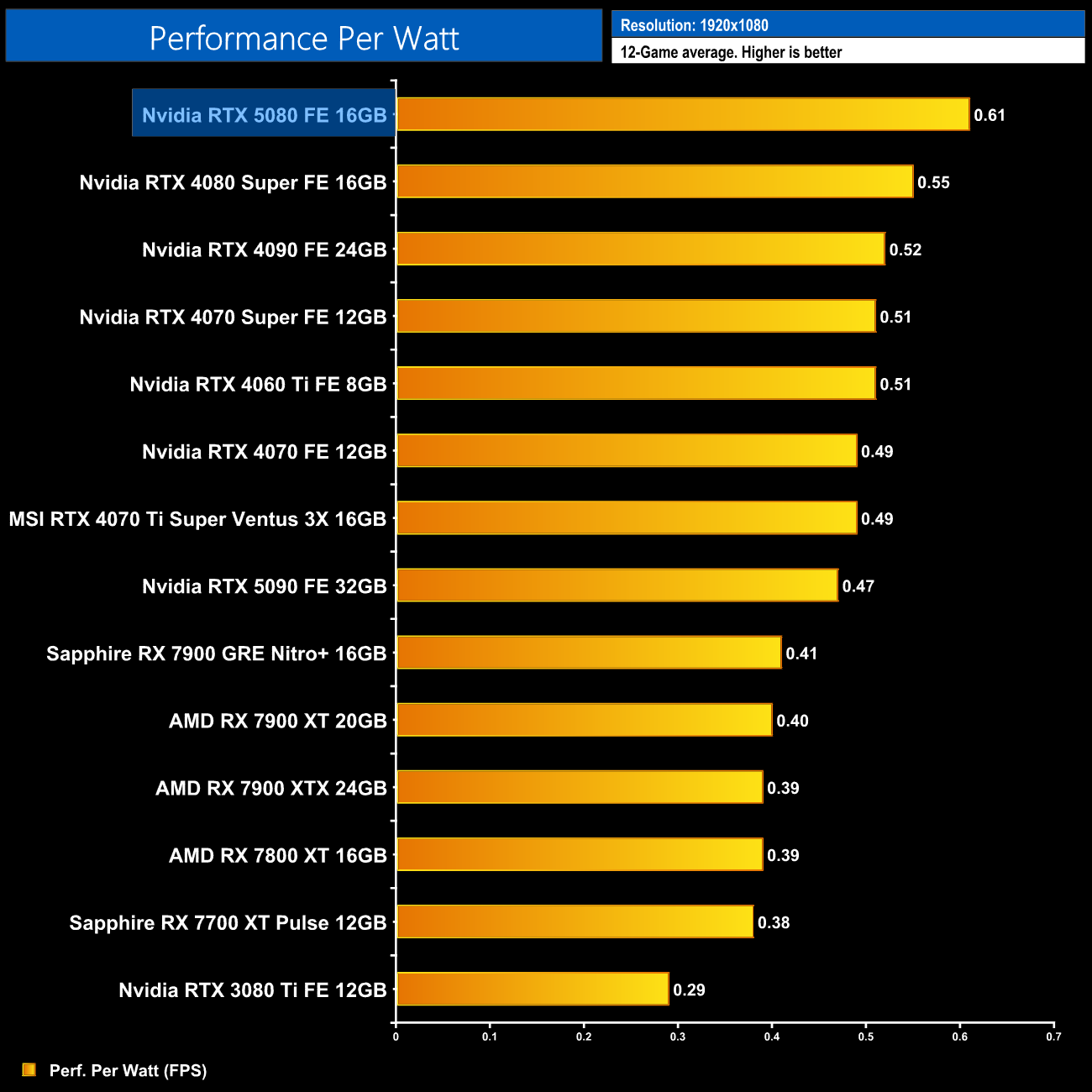
At last – the RTX 5080 does what the RTX 5090 could not, and we have a new performance per Watt champion! At 1080p it is 11% more efficient than the RTX 4080 Super, our previous chart-topper.
Ray tracing results
As a bonus, we now include the power figures for all eight games we test with ray tracing enabled.
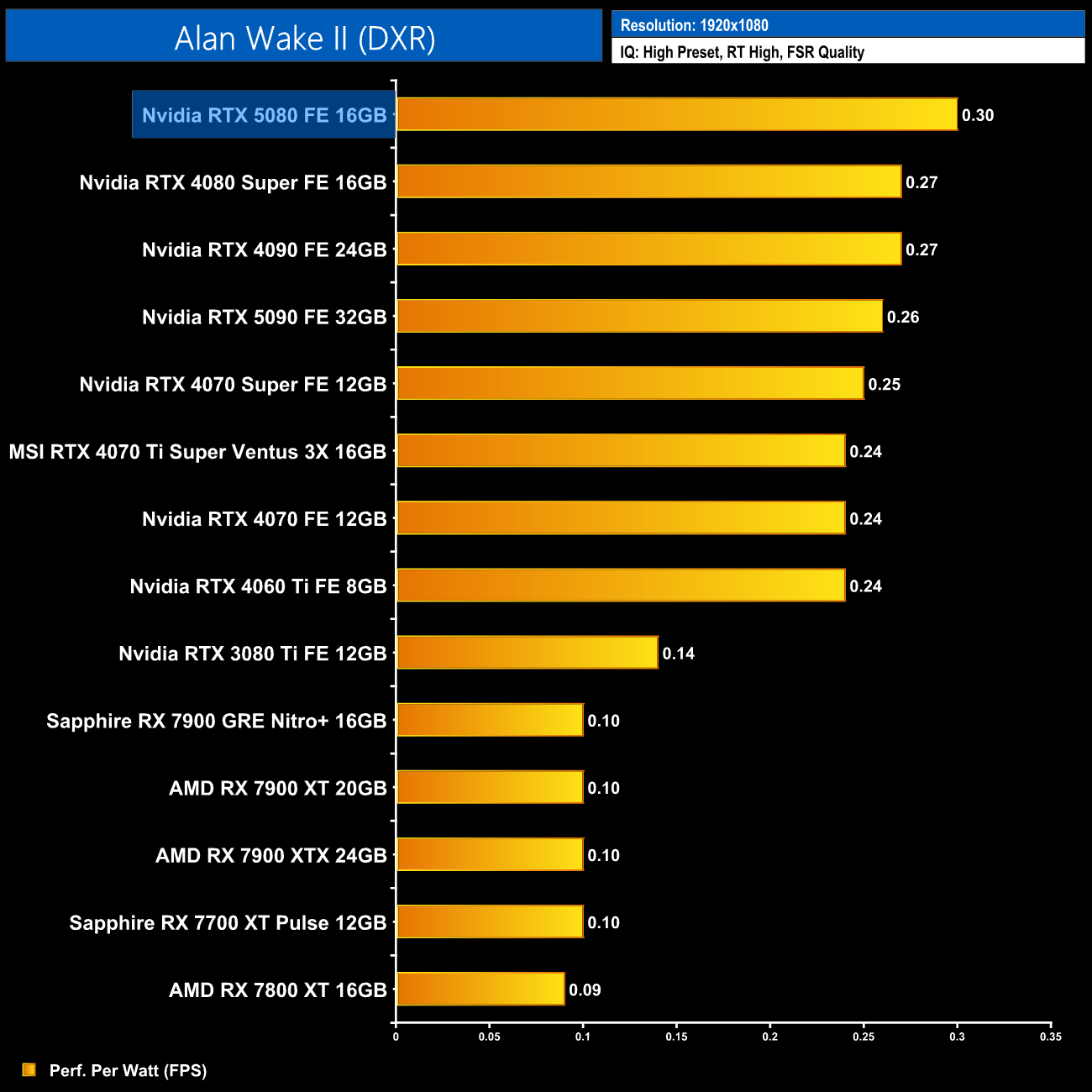
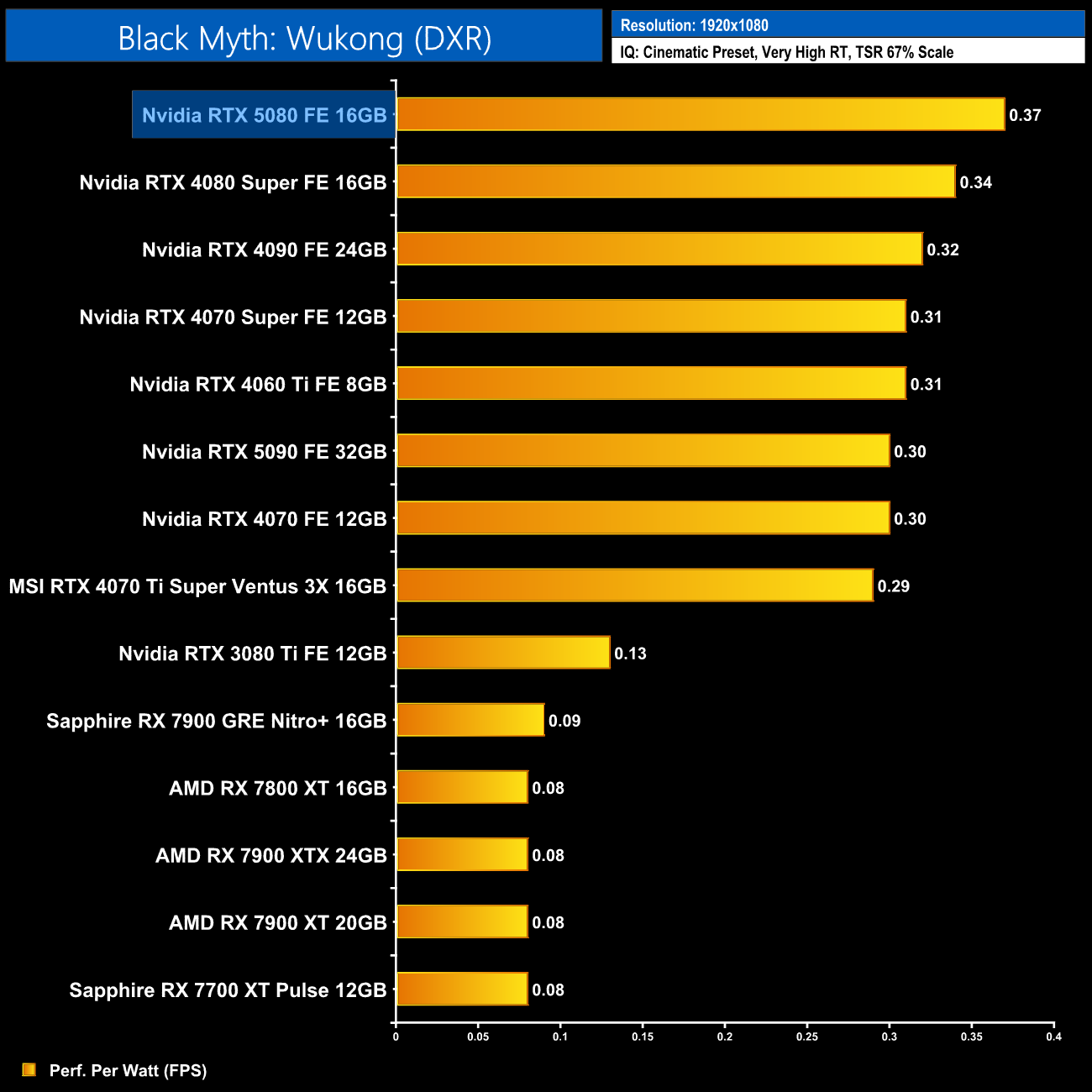
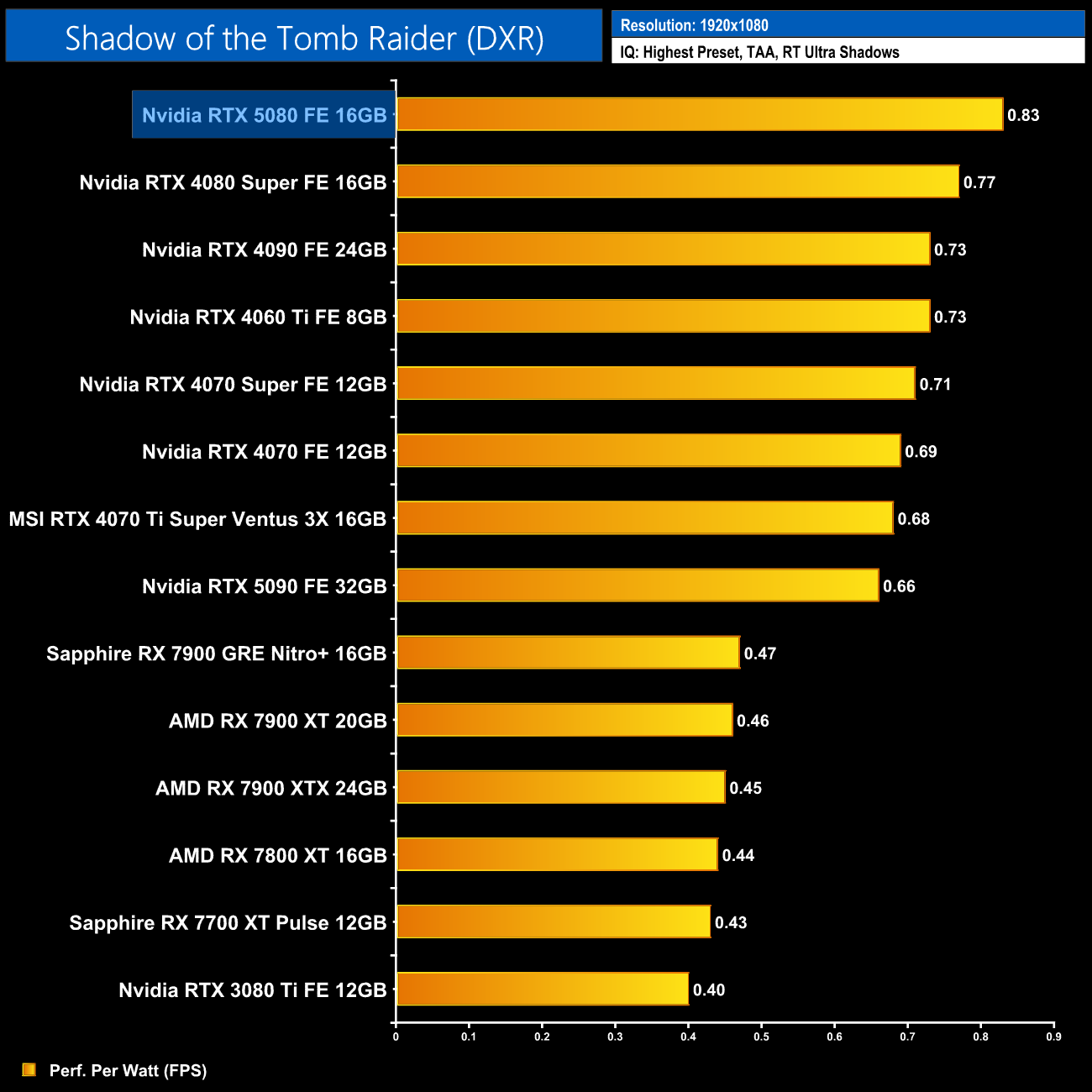
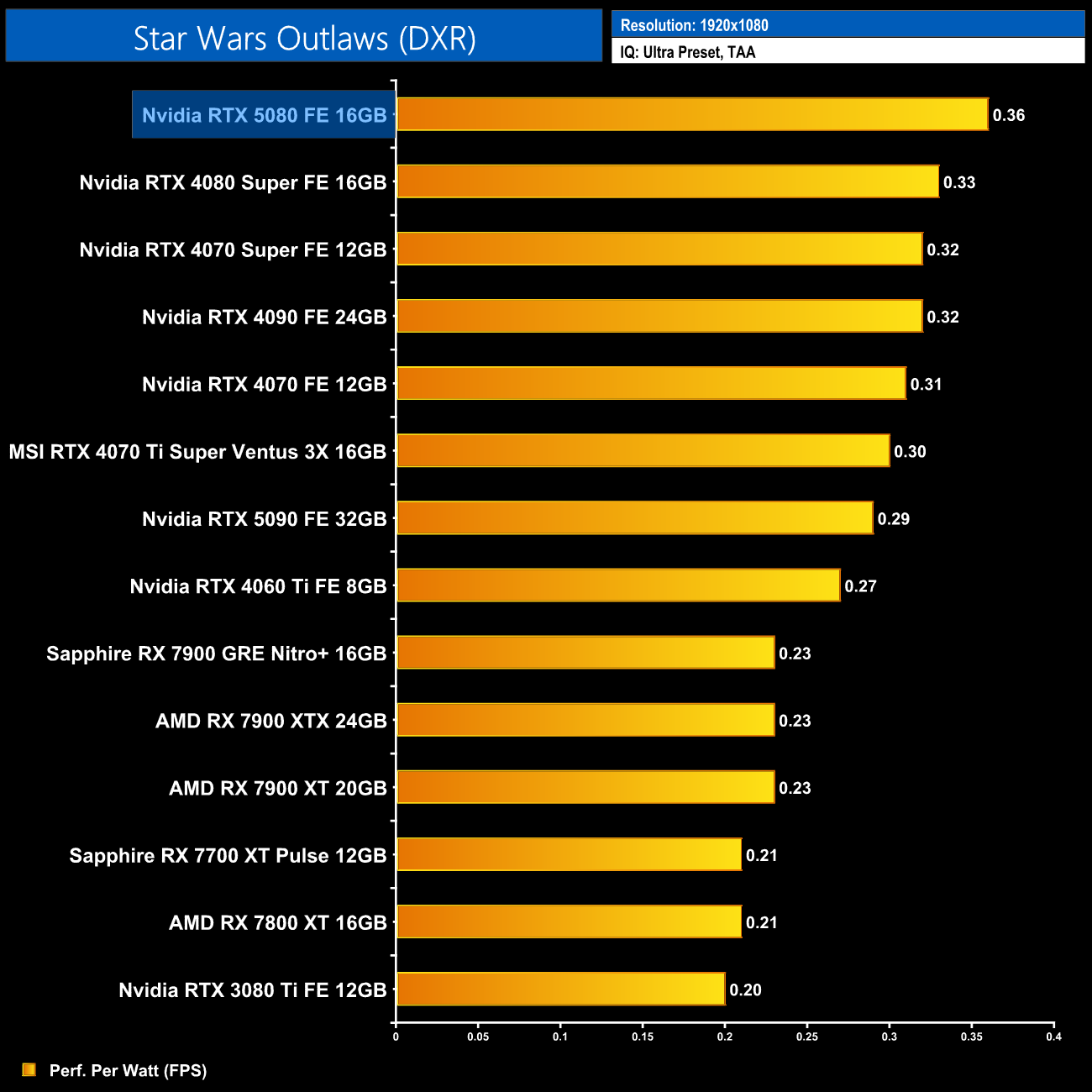
8-Game ray tracing average:
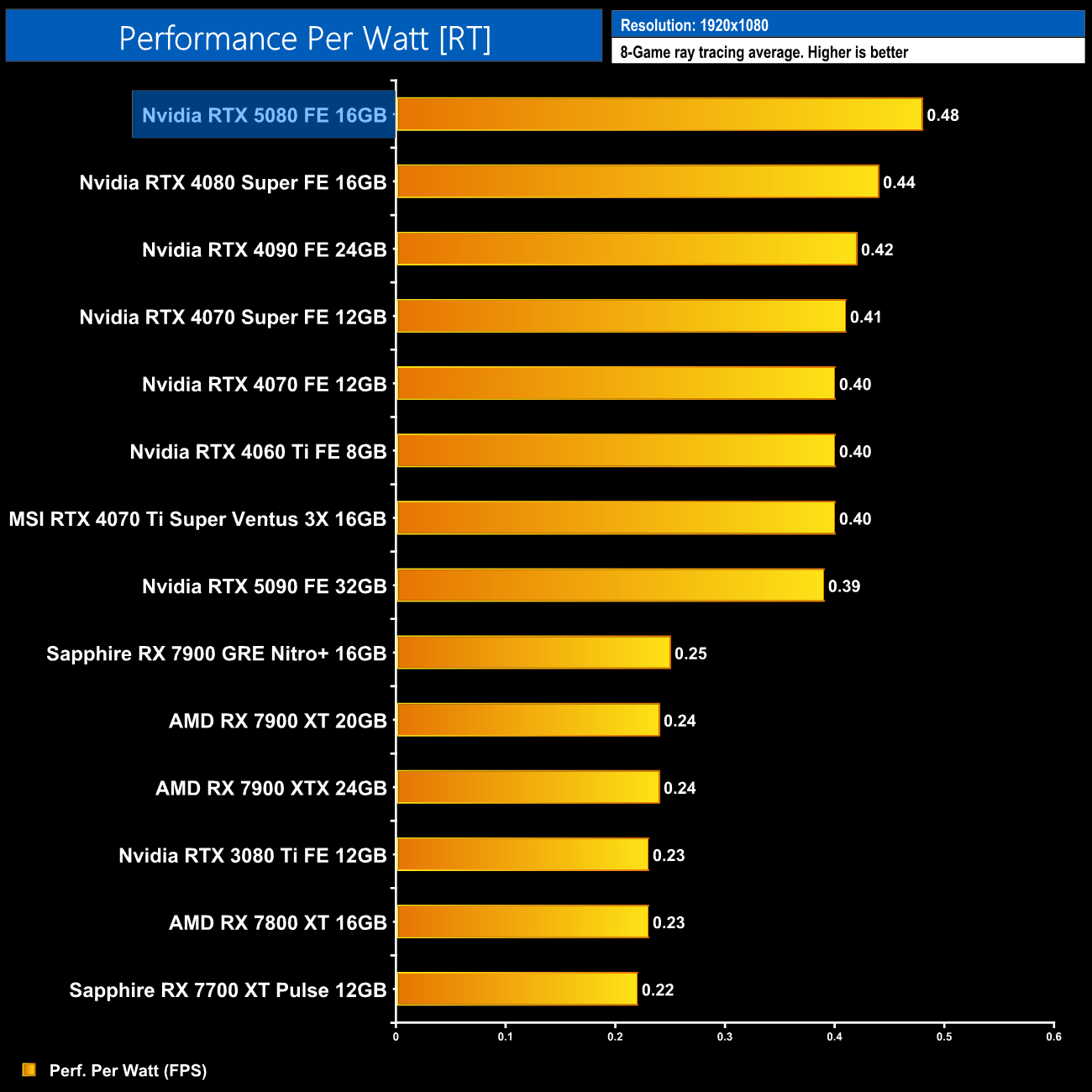
The same is observed when looking at ray tracing performance, too.
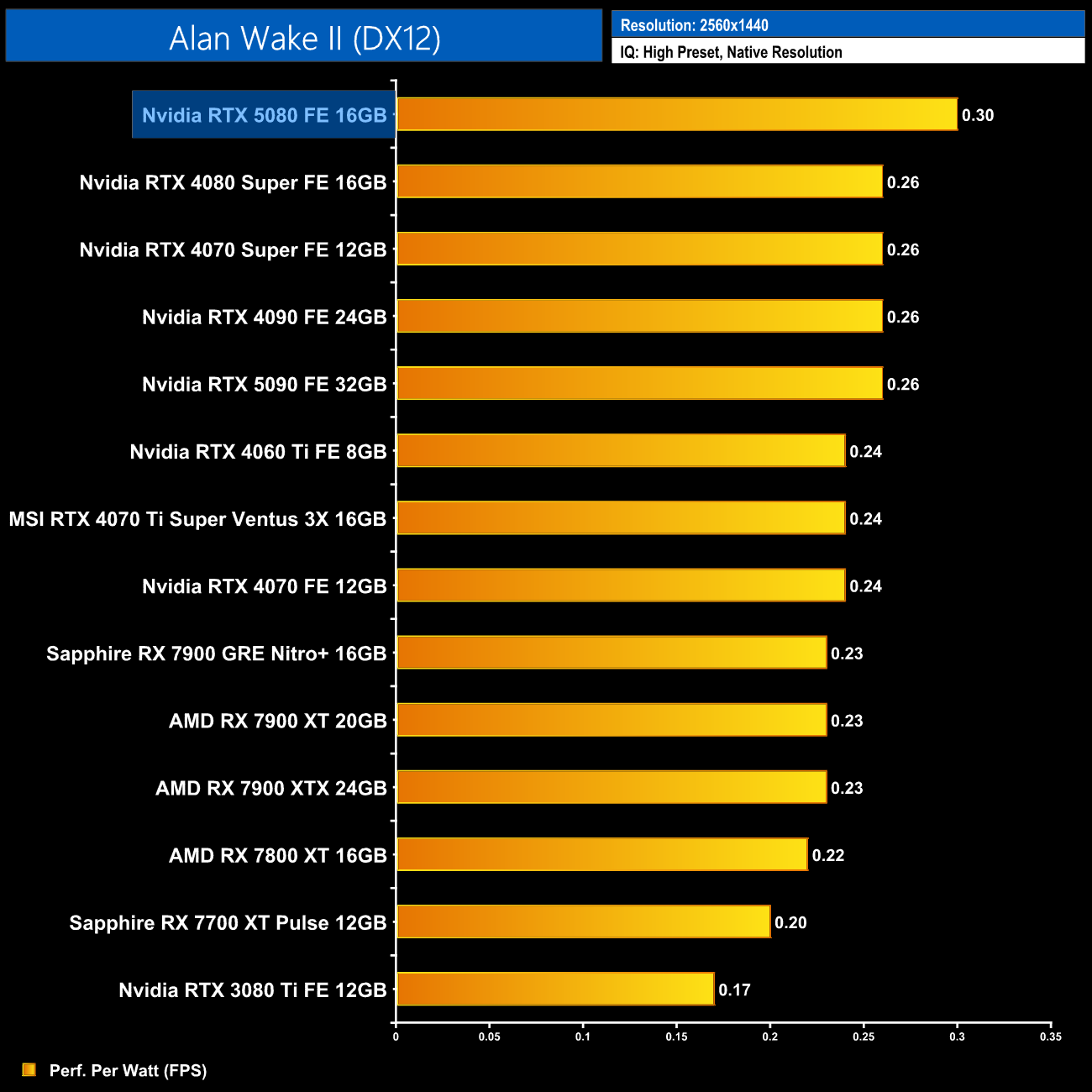
Using the graphics card-only power draw figures presented earlier in the review, here we present performance per Watt on a per-game basis for all twelve games we tested at 1440p.
Per-Game Results at 1440p:
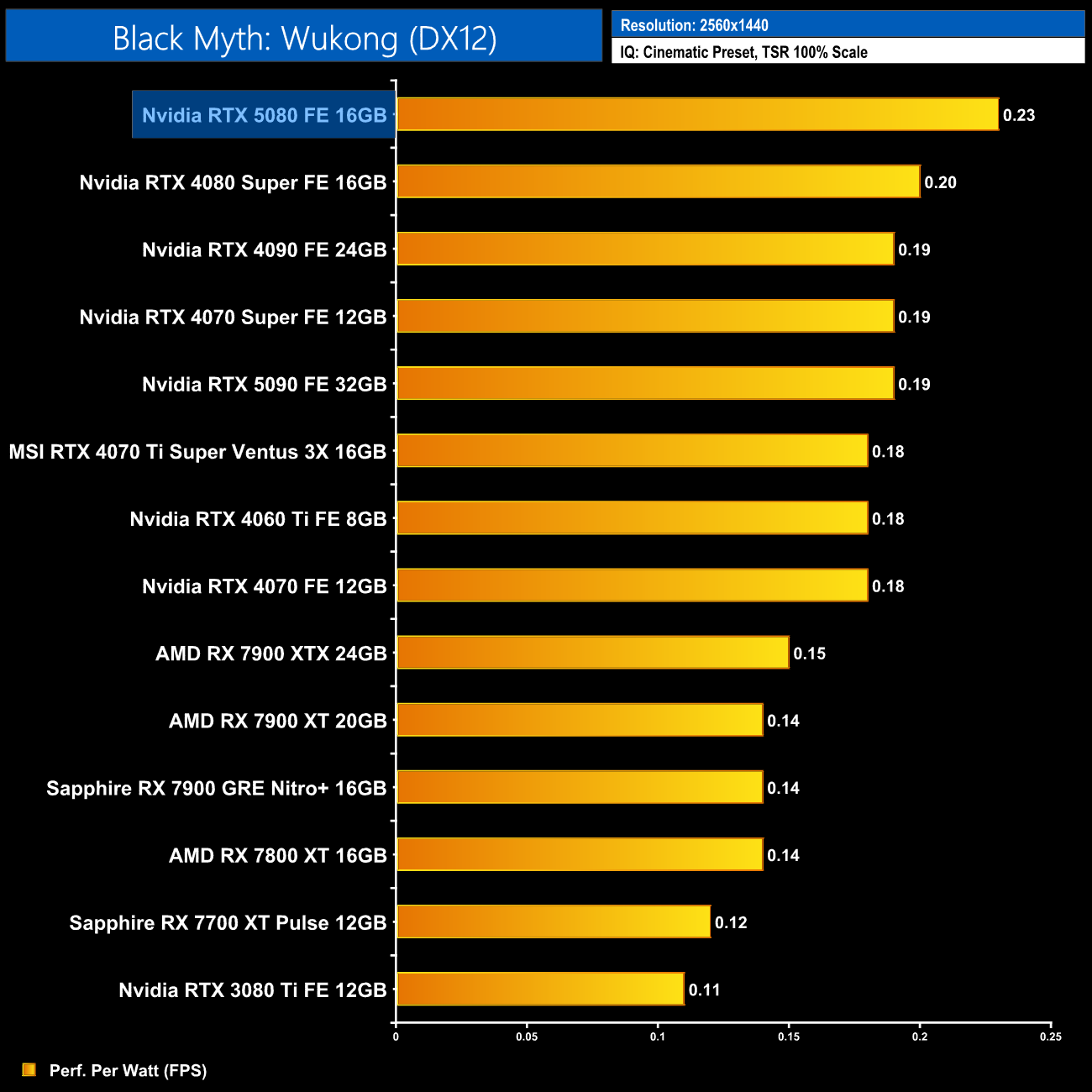
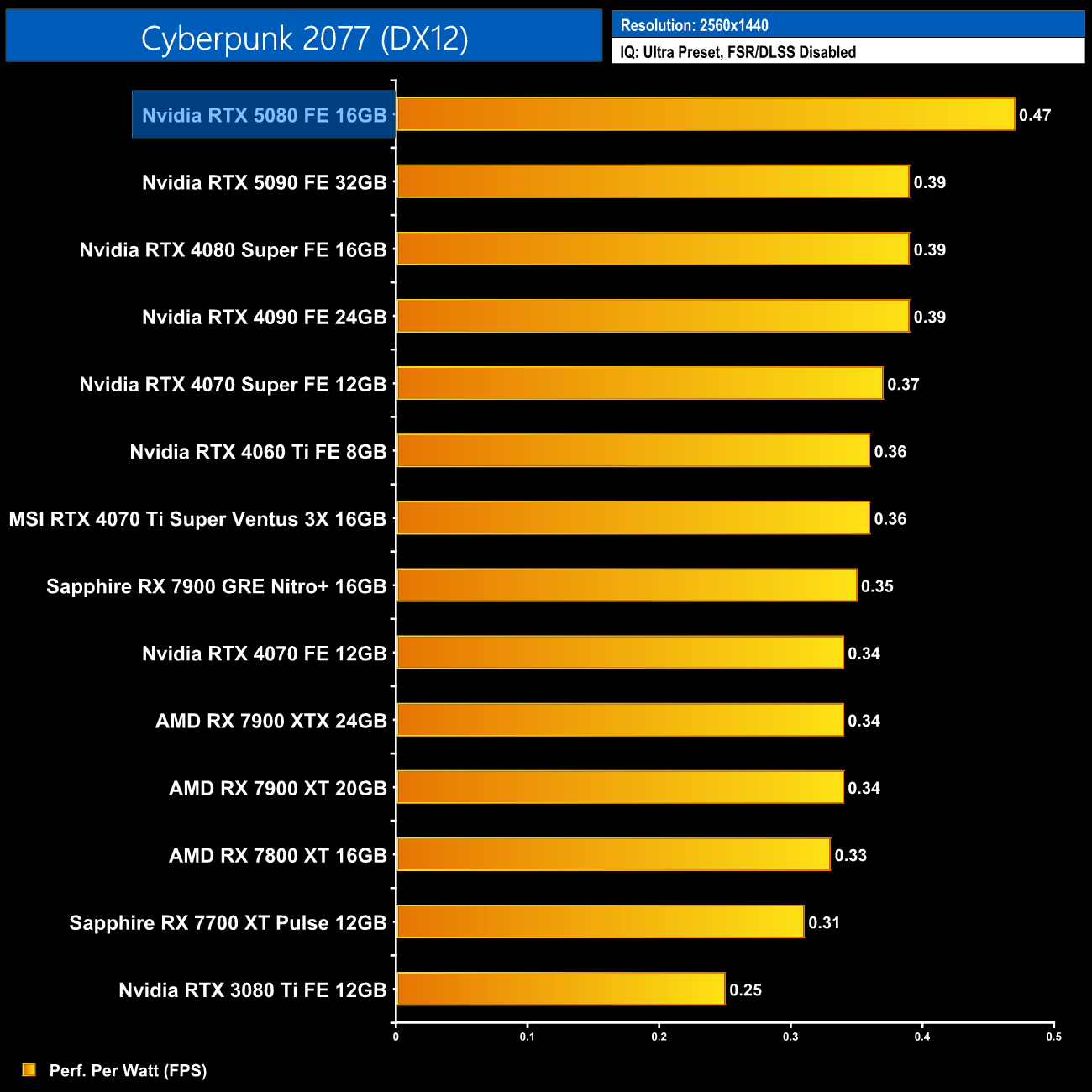
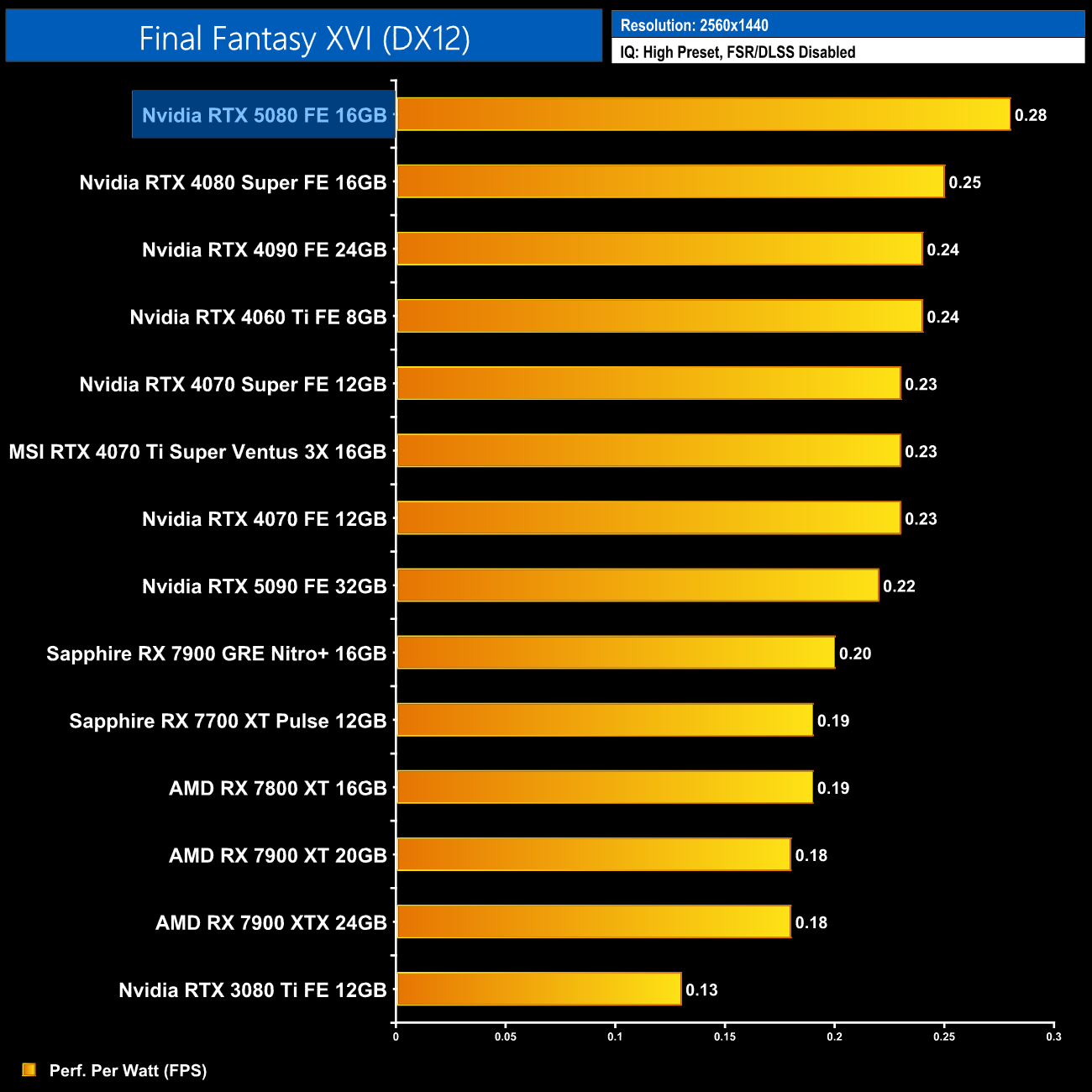
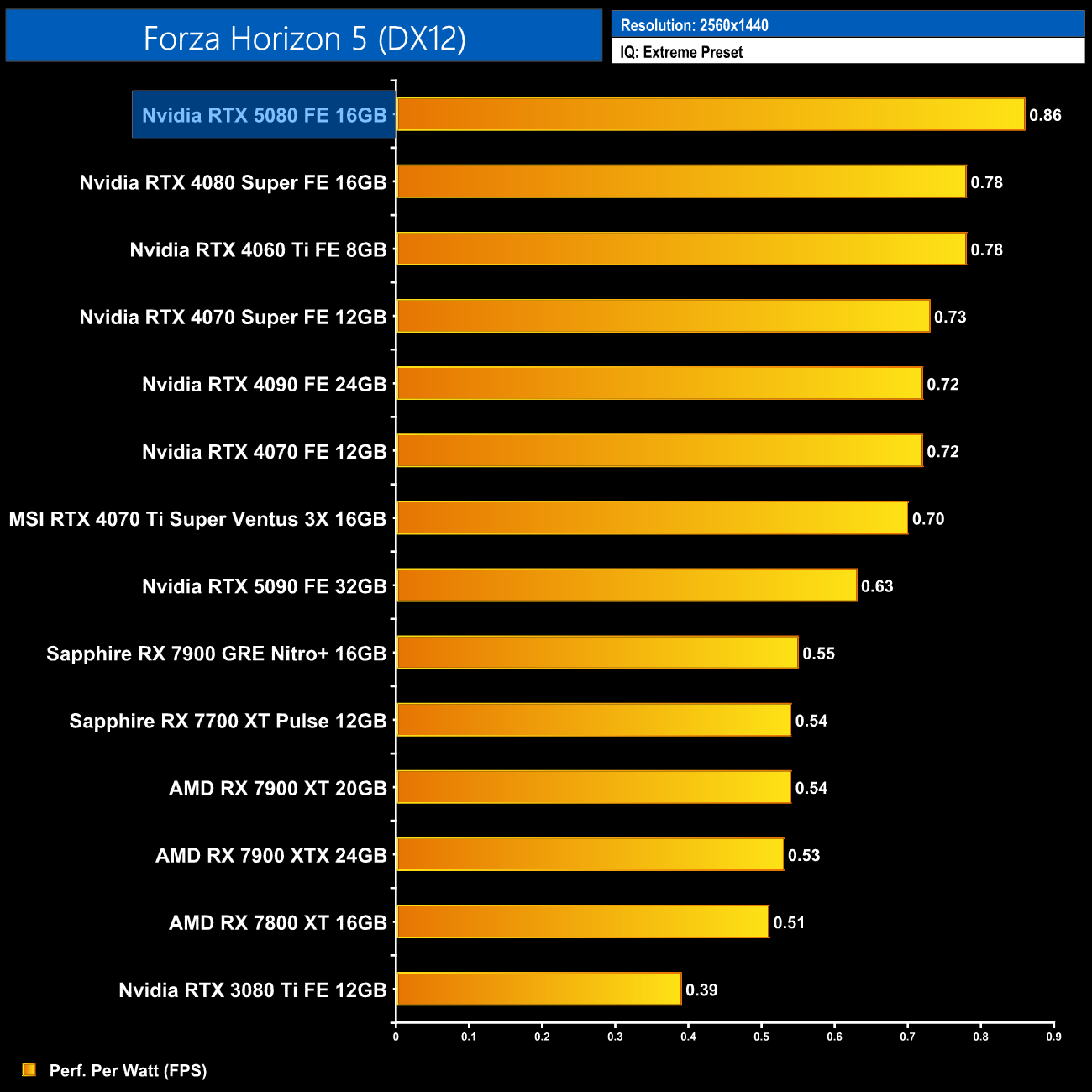
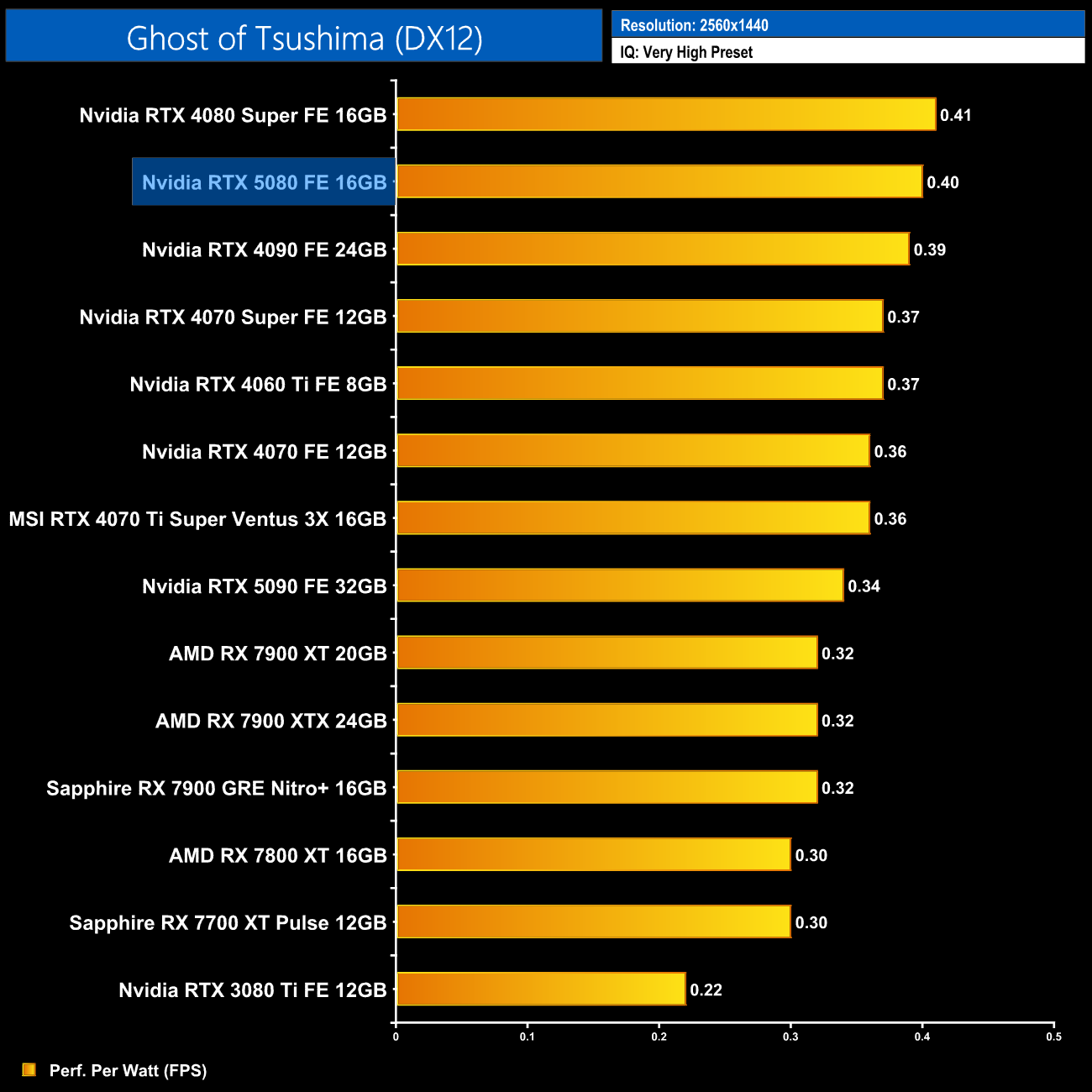
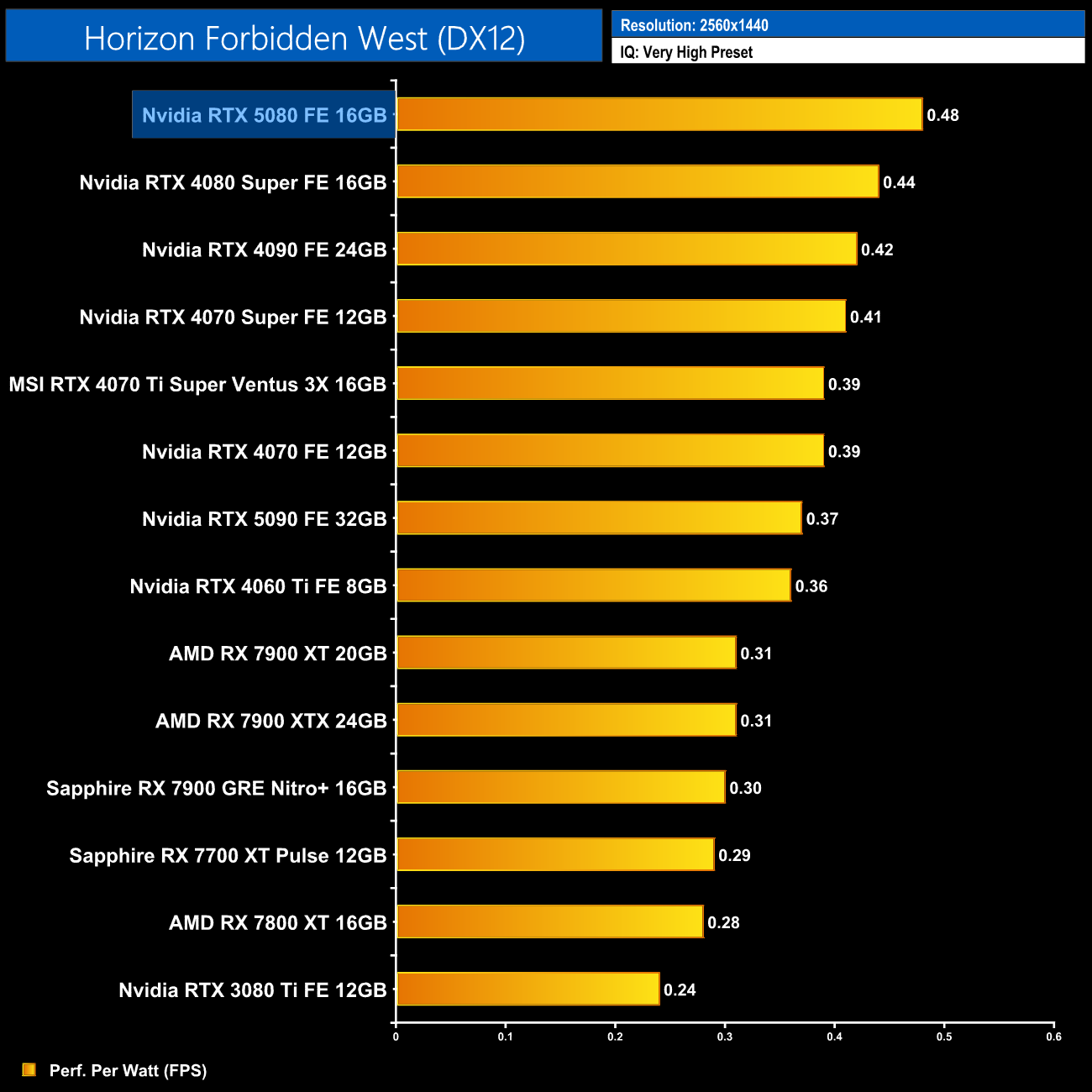
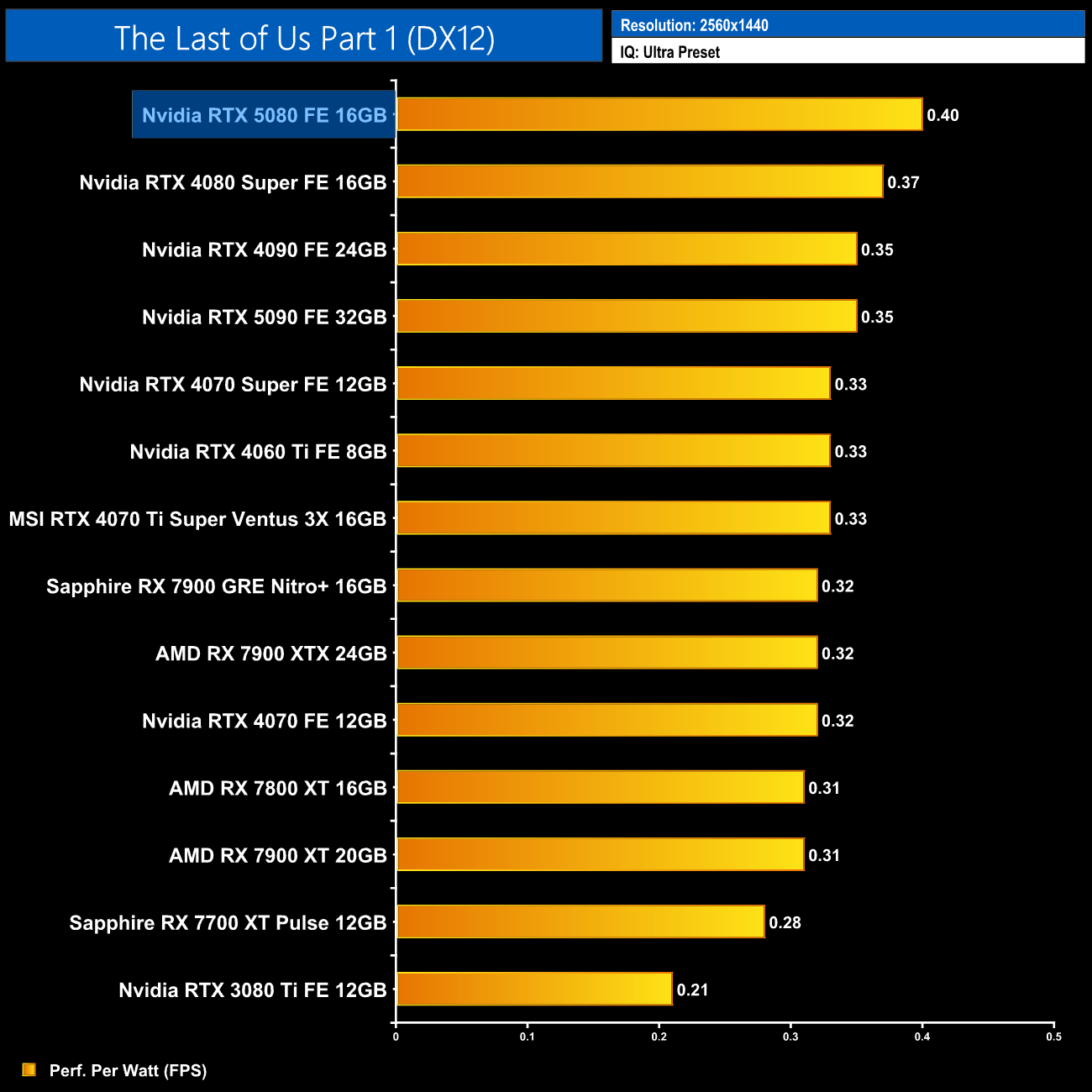
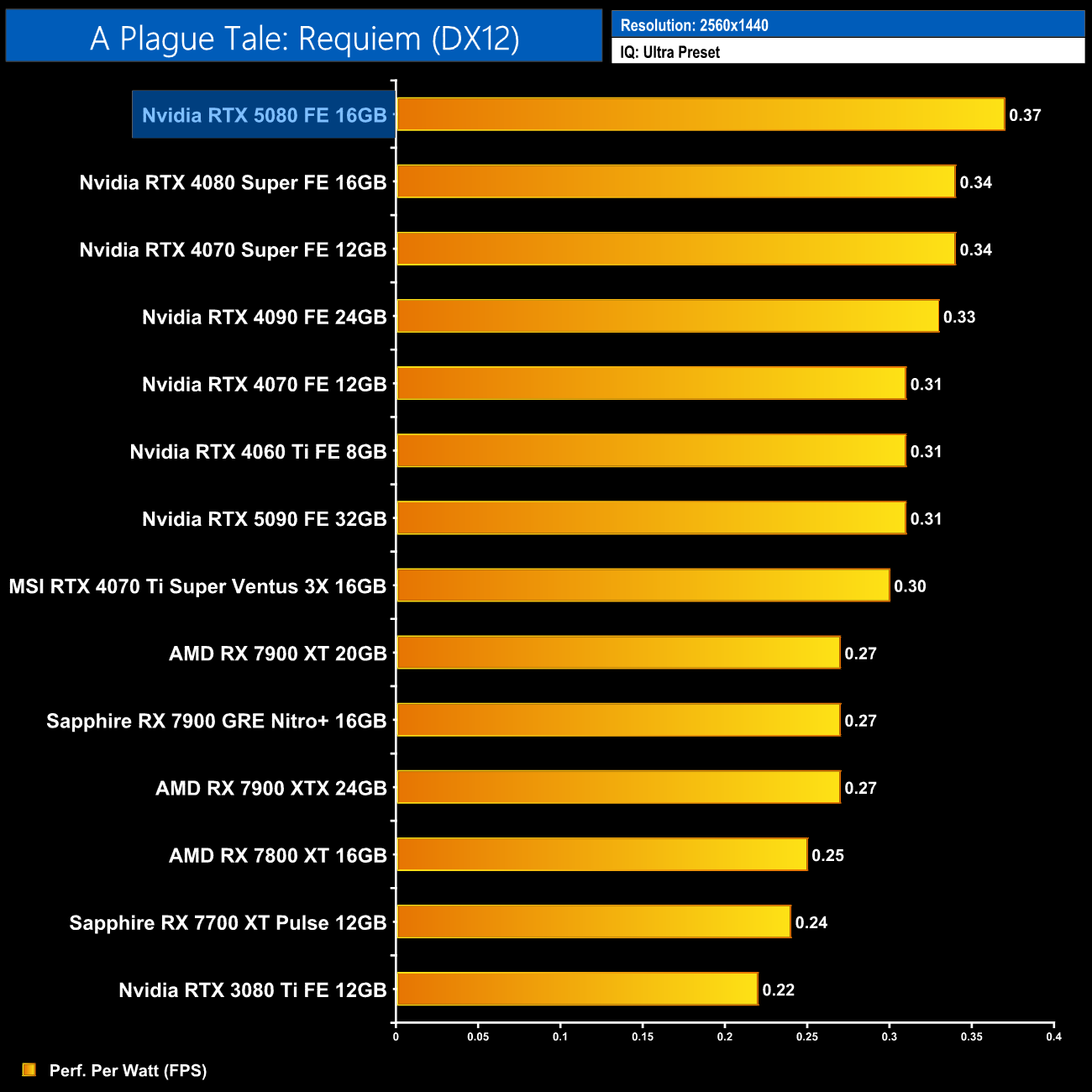
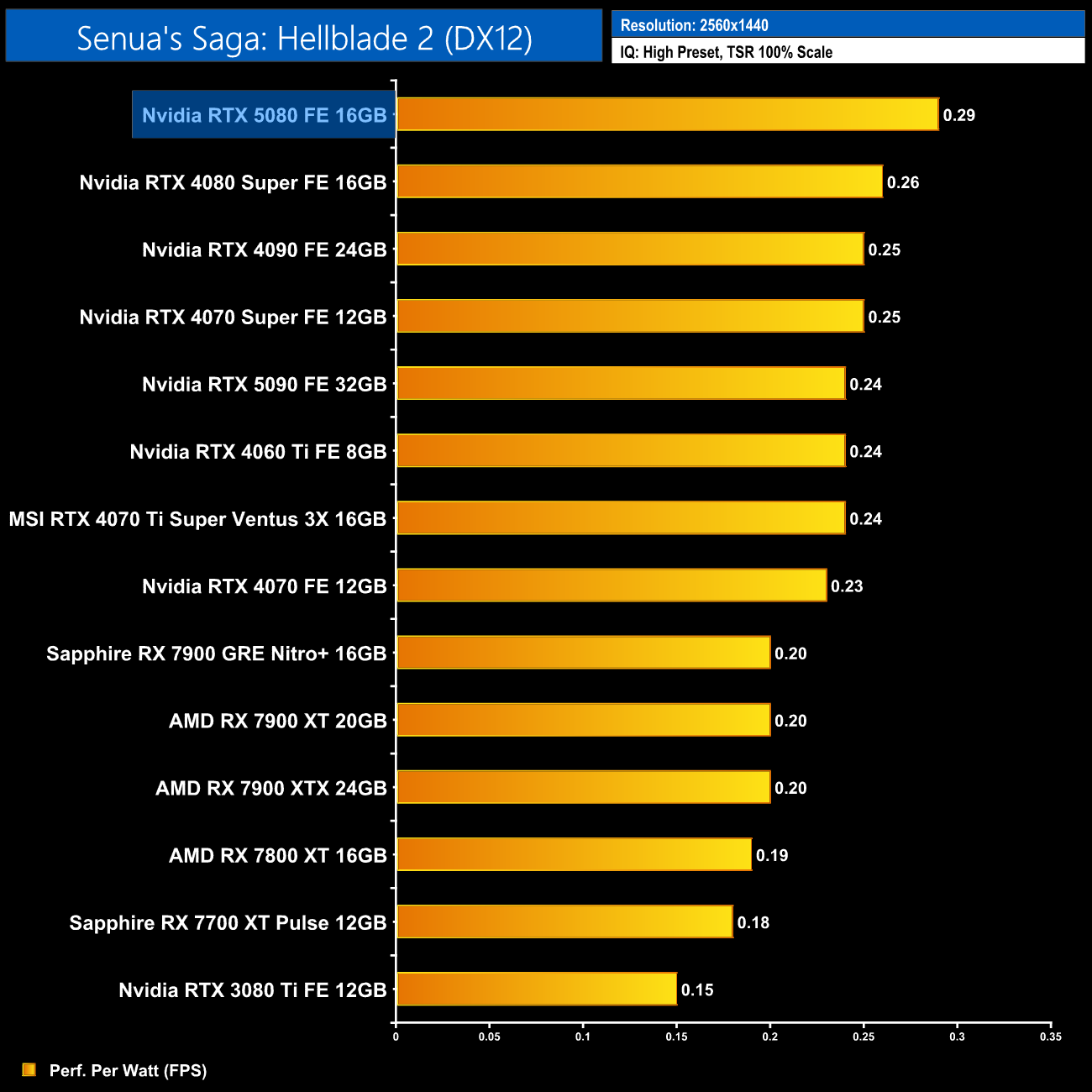
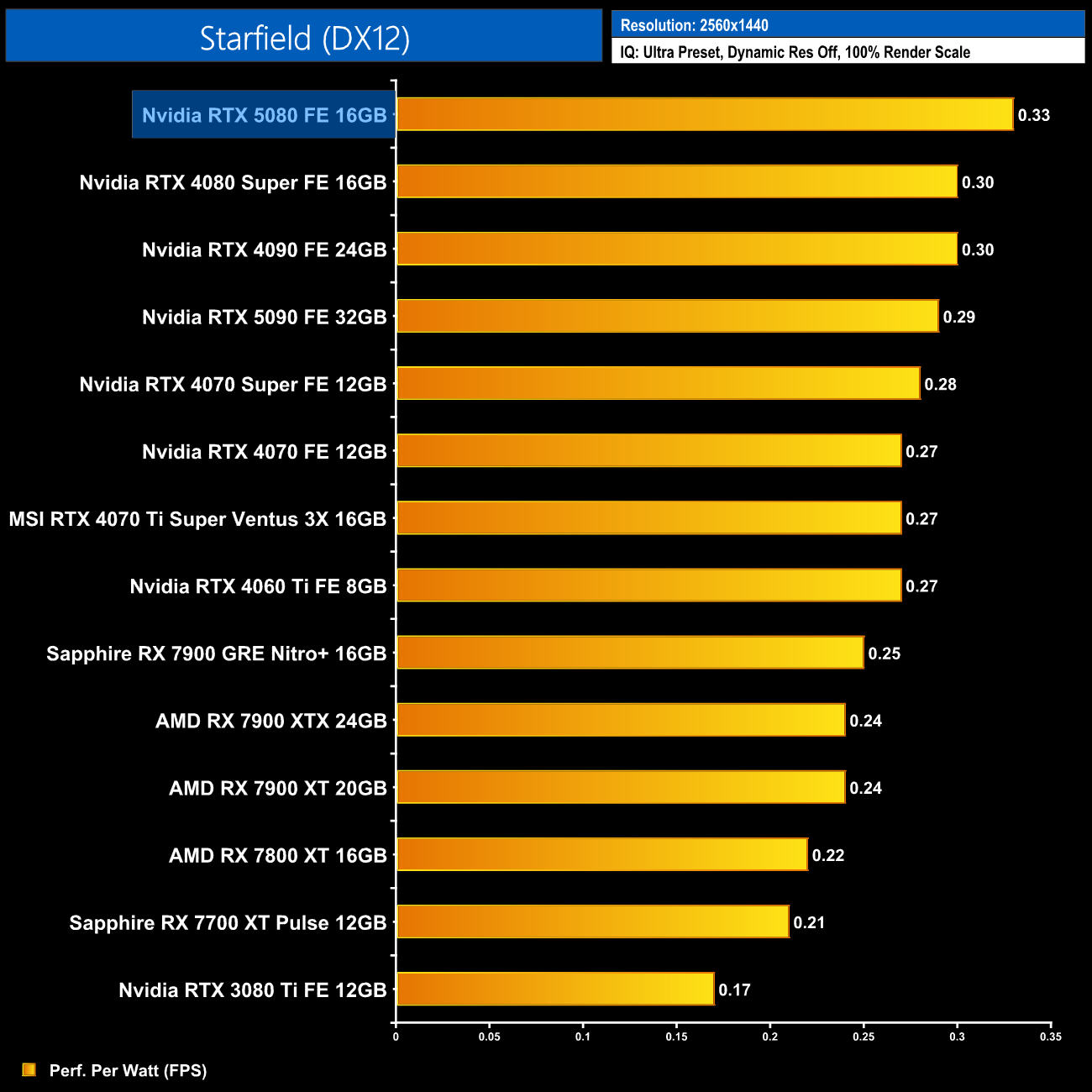

Click to enlarge.
12-Game Average at 1440p:
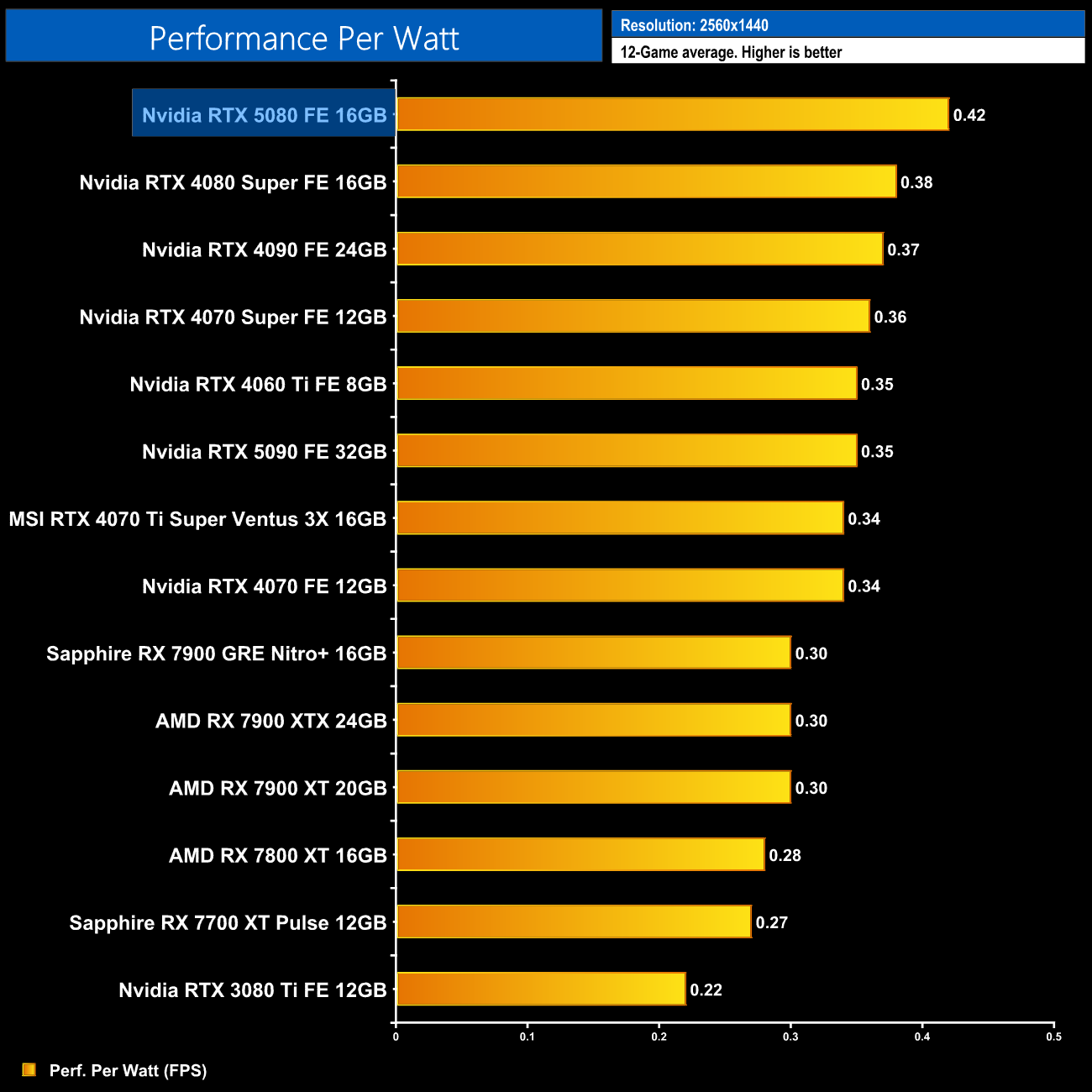
We see a similar margin at 1440p, too, with the RTX 5080 still proving to be 11% more efficient than the RTX 4080 Super.
Ray tracing results
As a bonus, we now include the power figures for all eight games we test with ray tracing enabled.

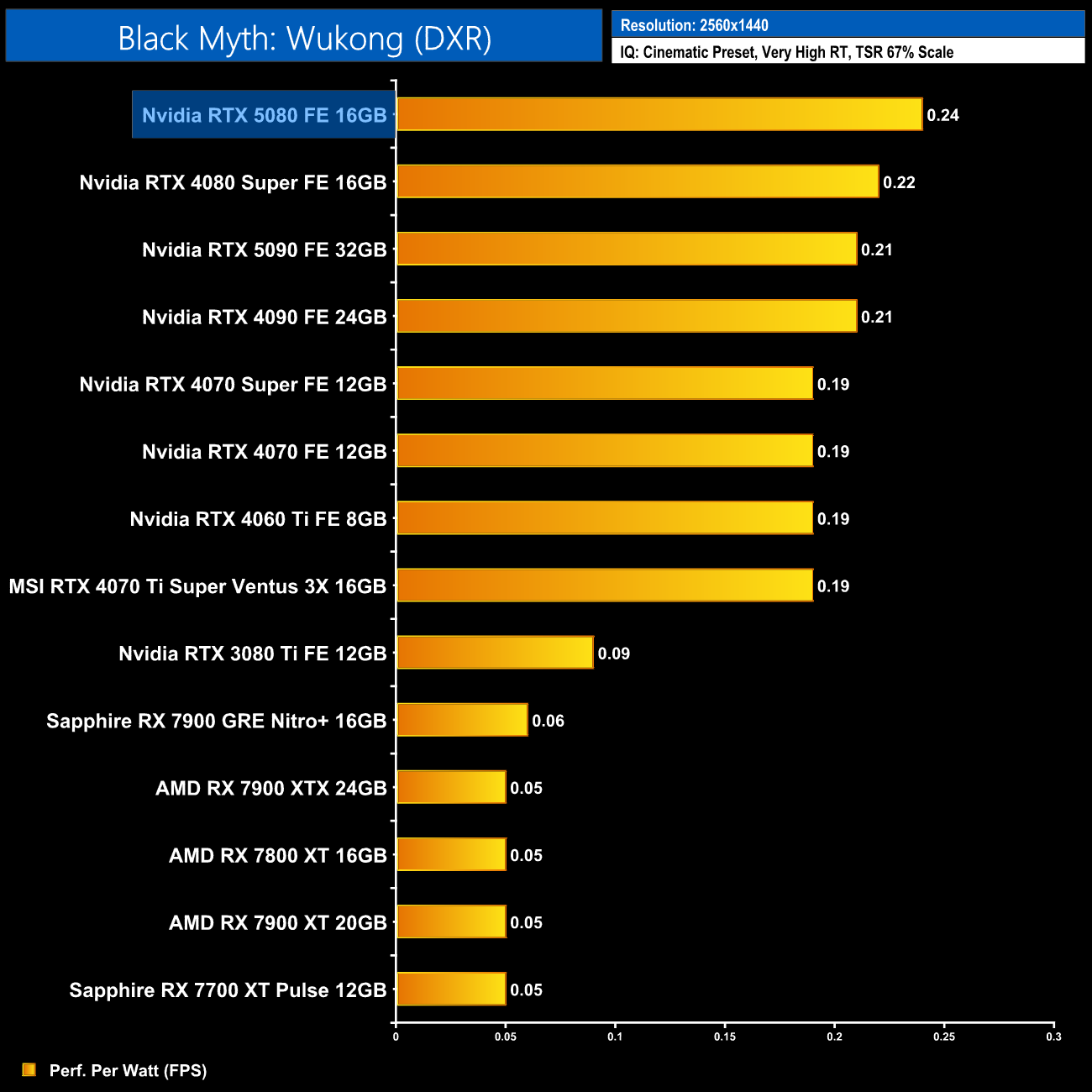
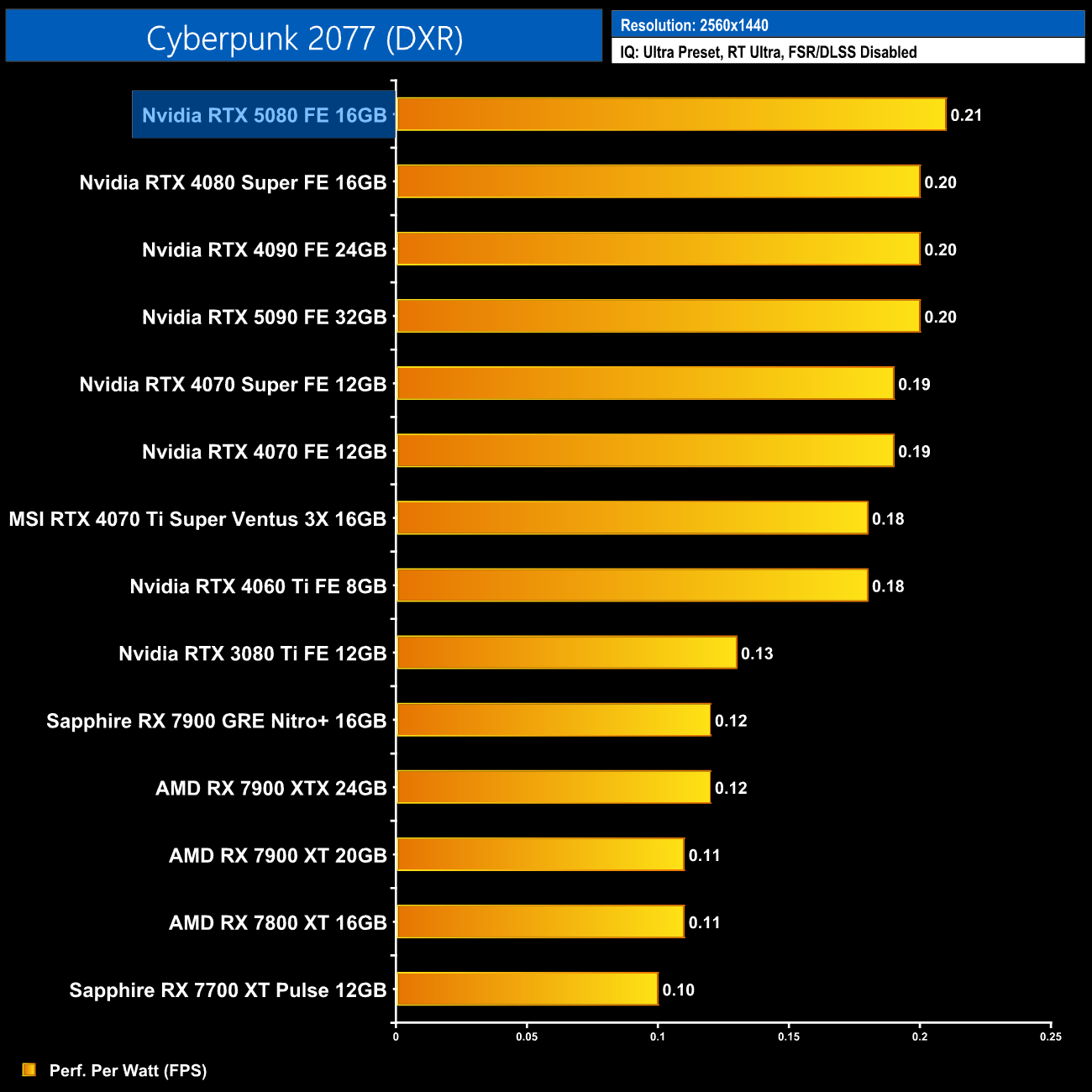
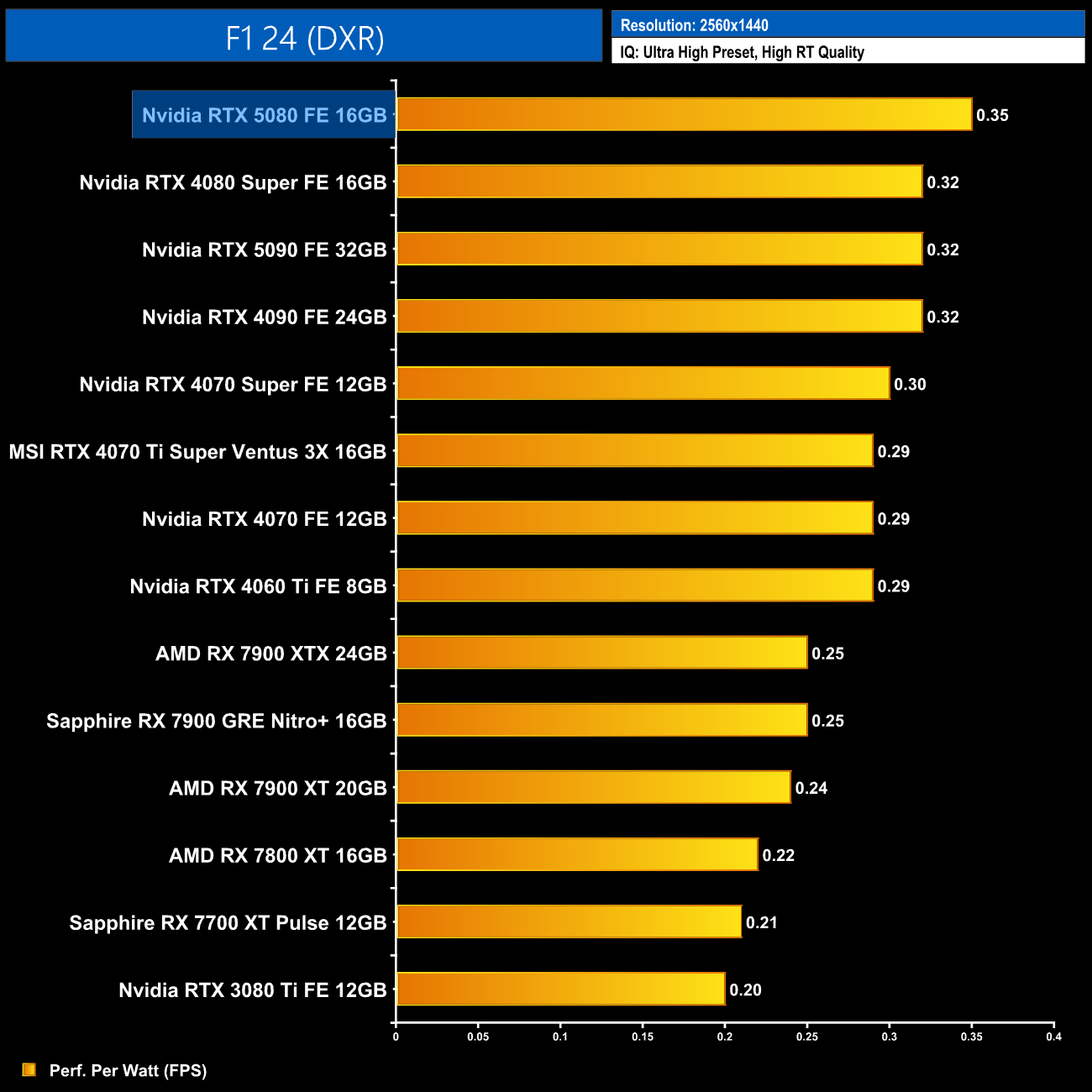
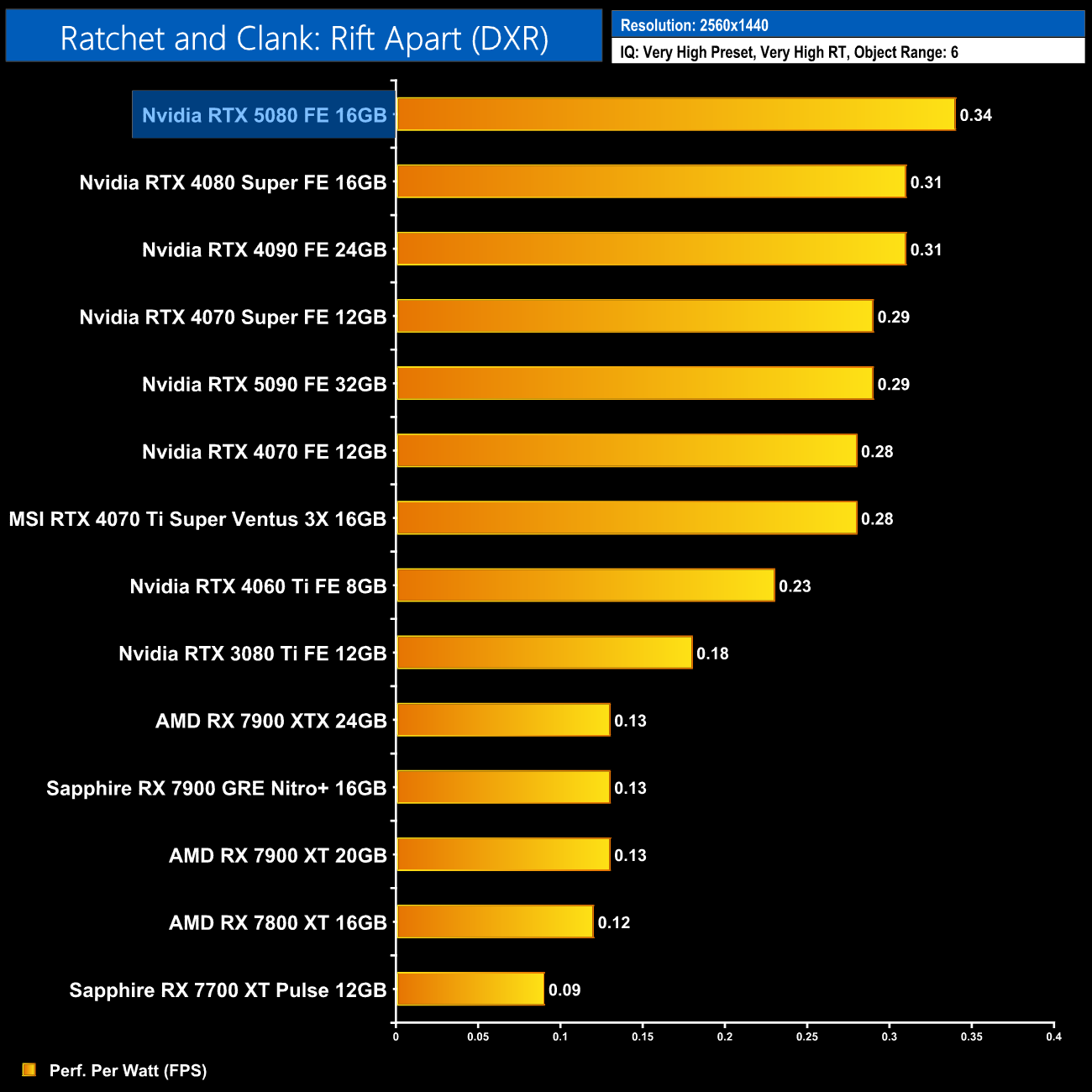
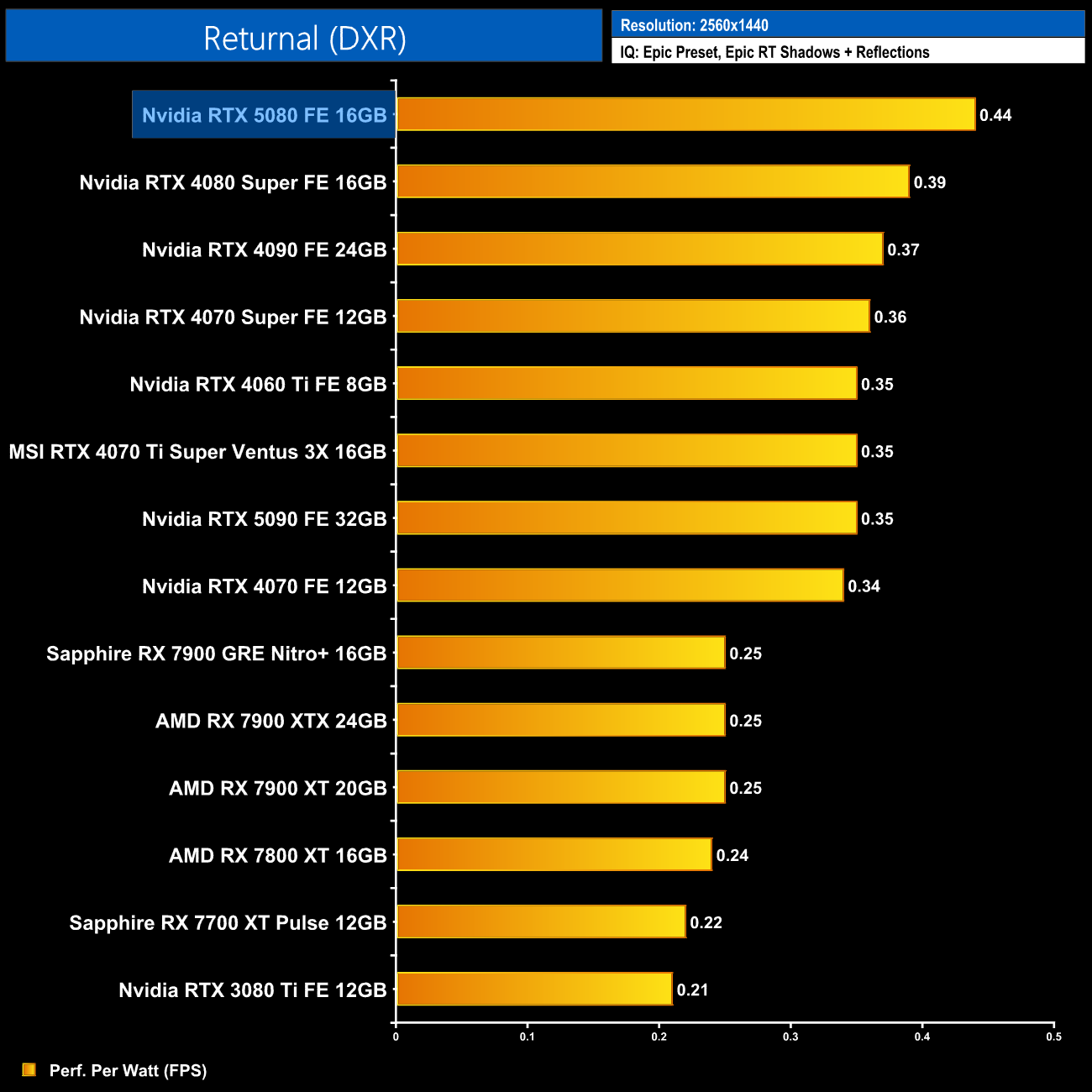
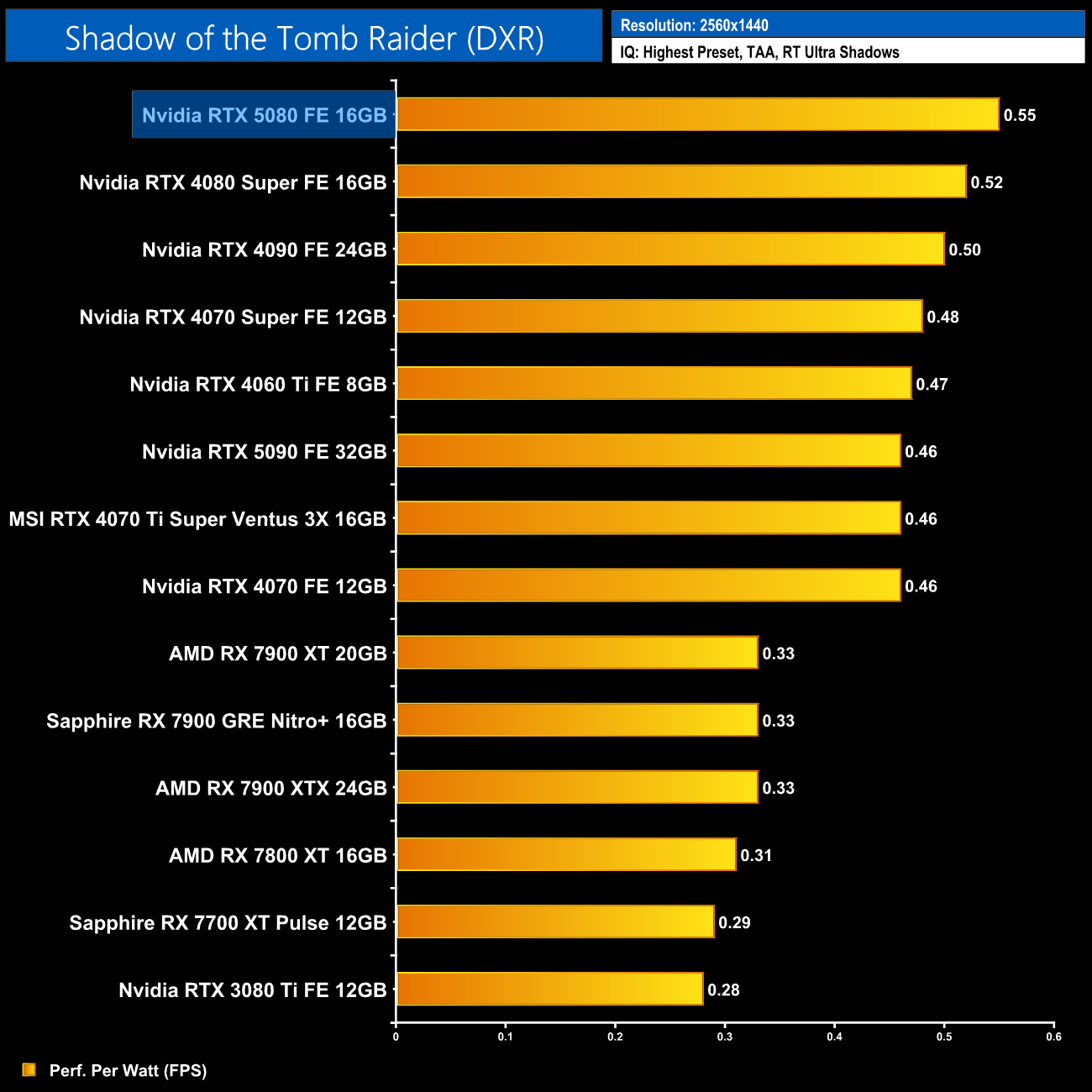
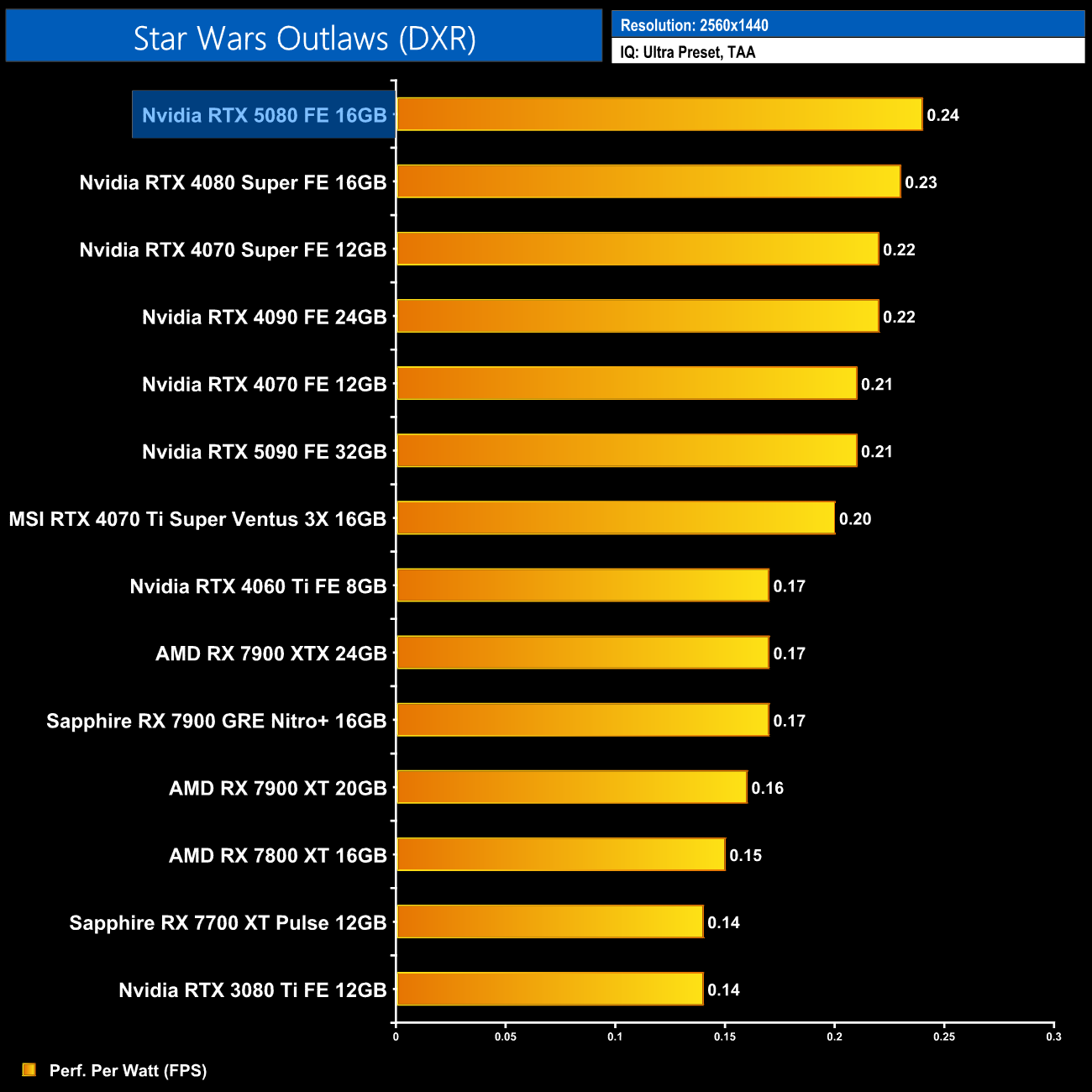
8-Game ray tracing average:
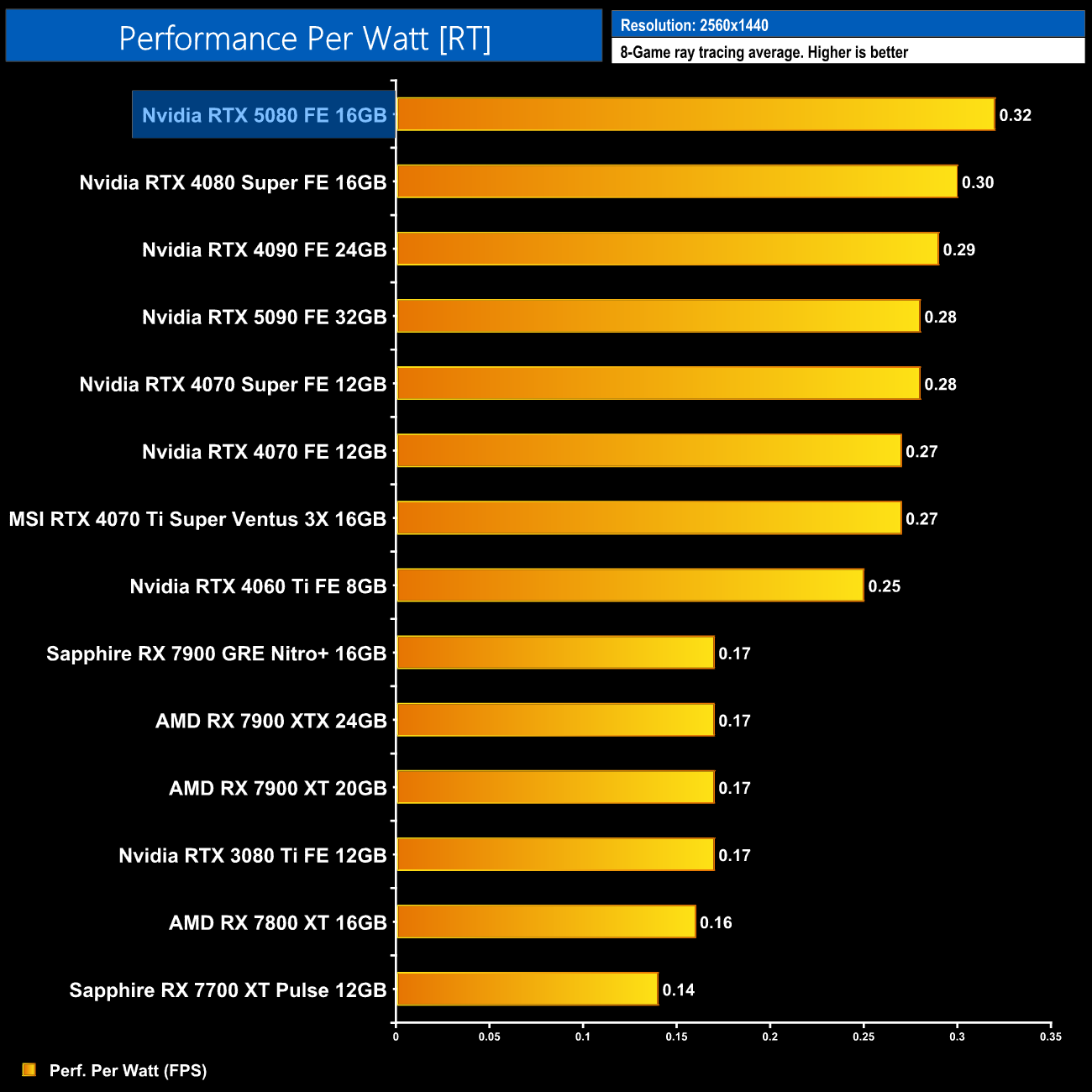
That margin drops to 7% when looking at performance across the eight ray traced games tested.
Using the graphics card-only power draw figures presented earlier in the review, here we present performance per Watt on a per-game basis for all twelve games we tested at 2160p (4K).
Per-Game Results at 2160p (4K):
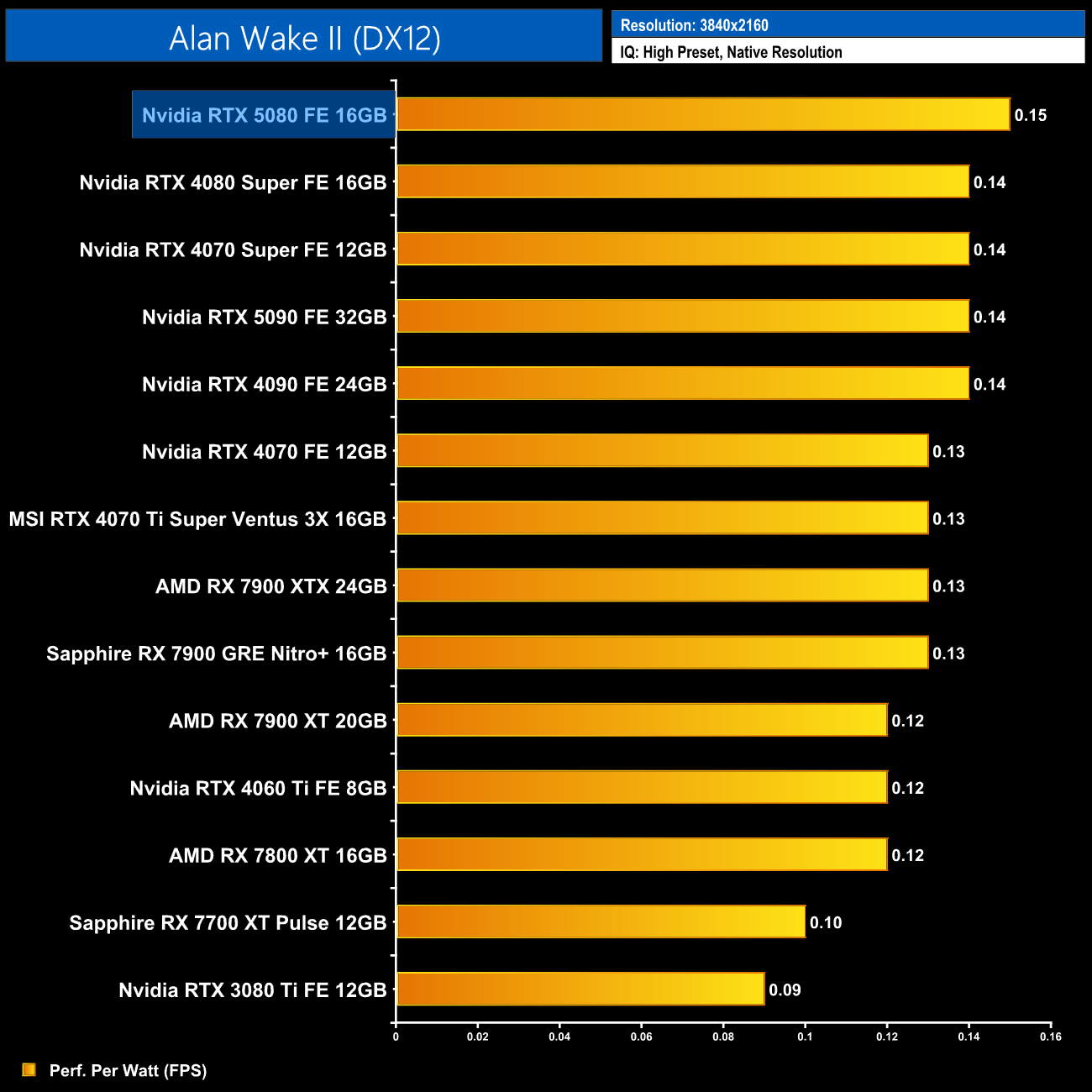
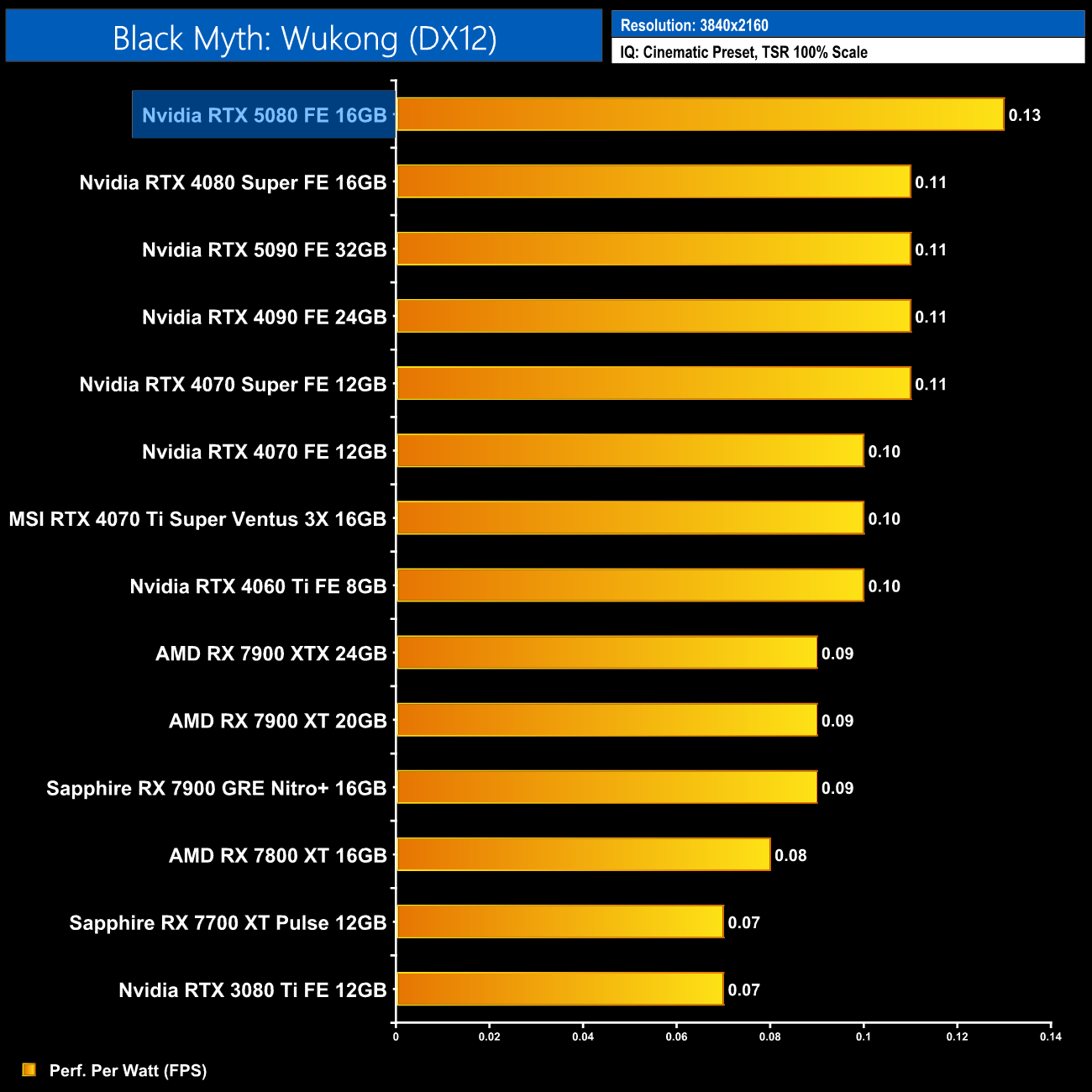

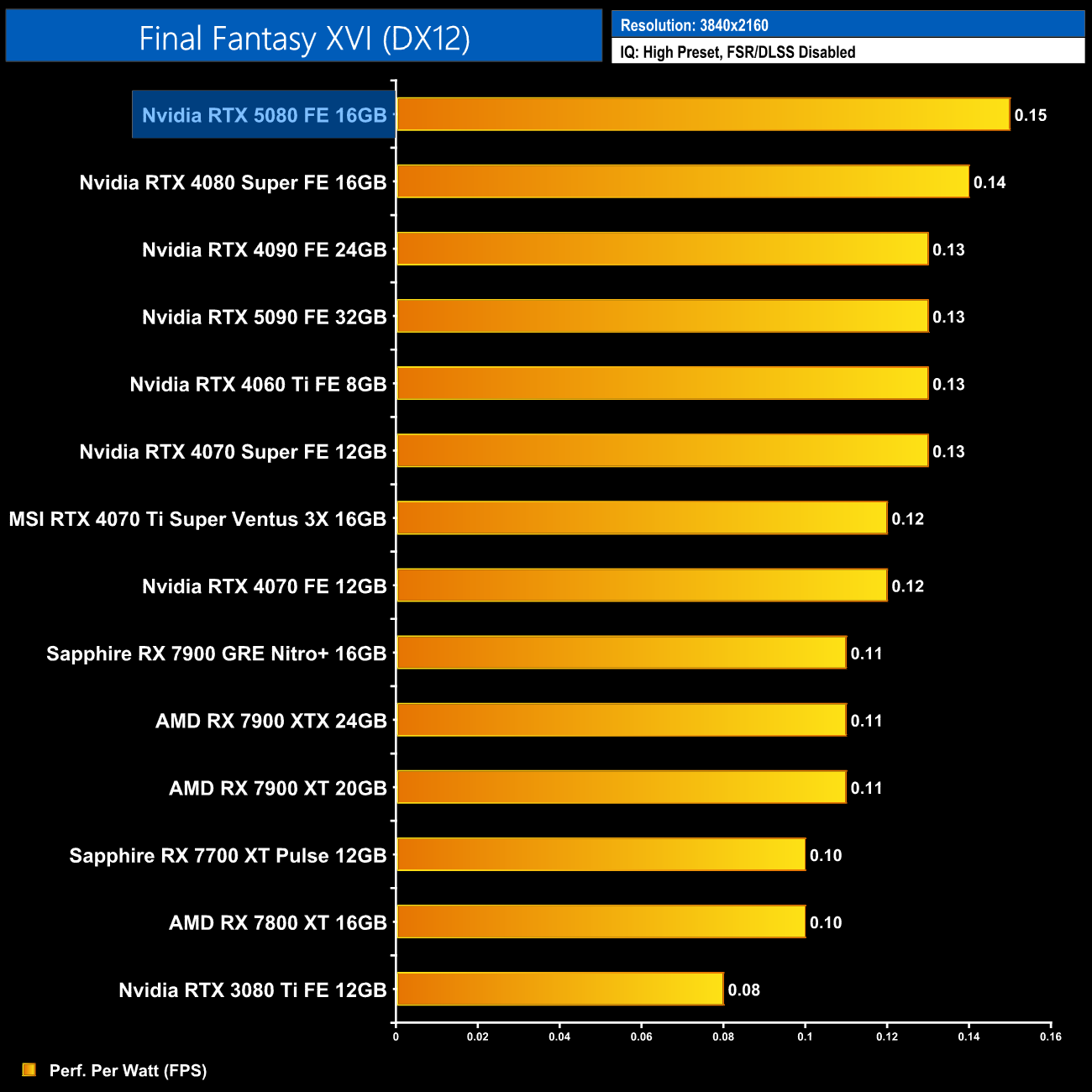
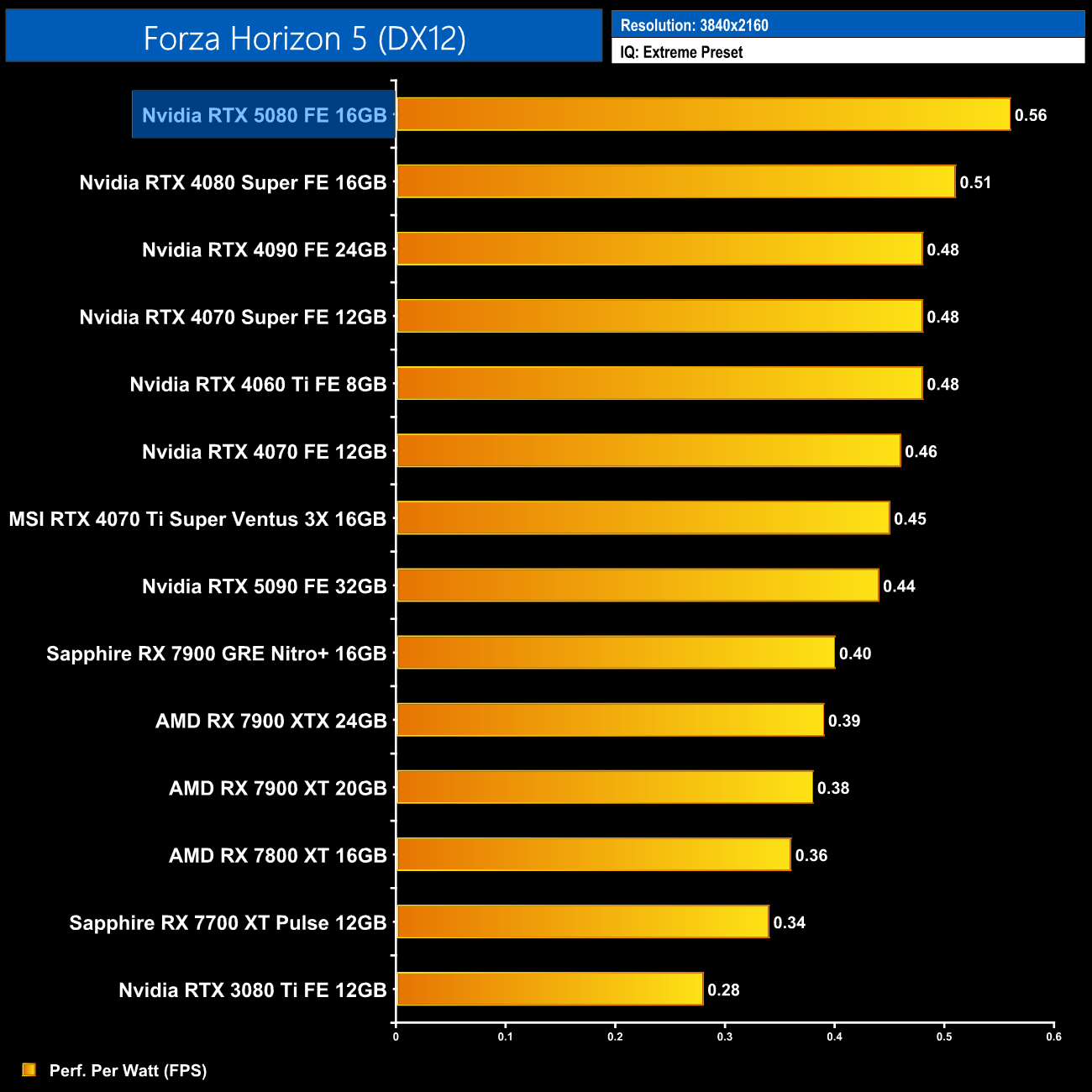
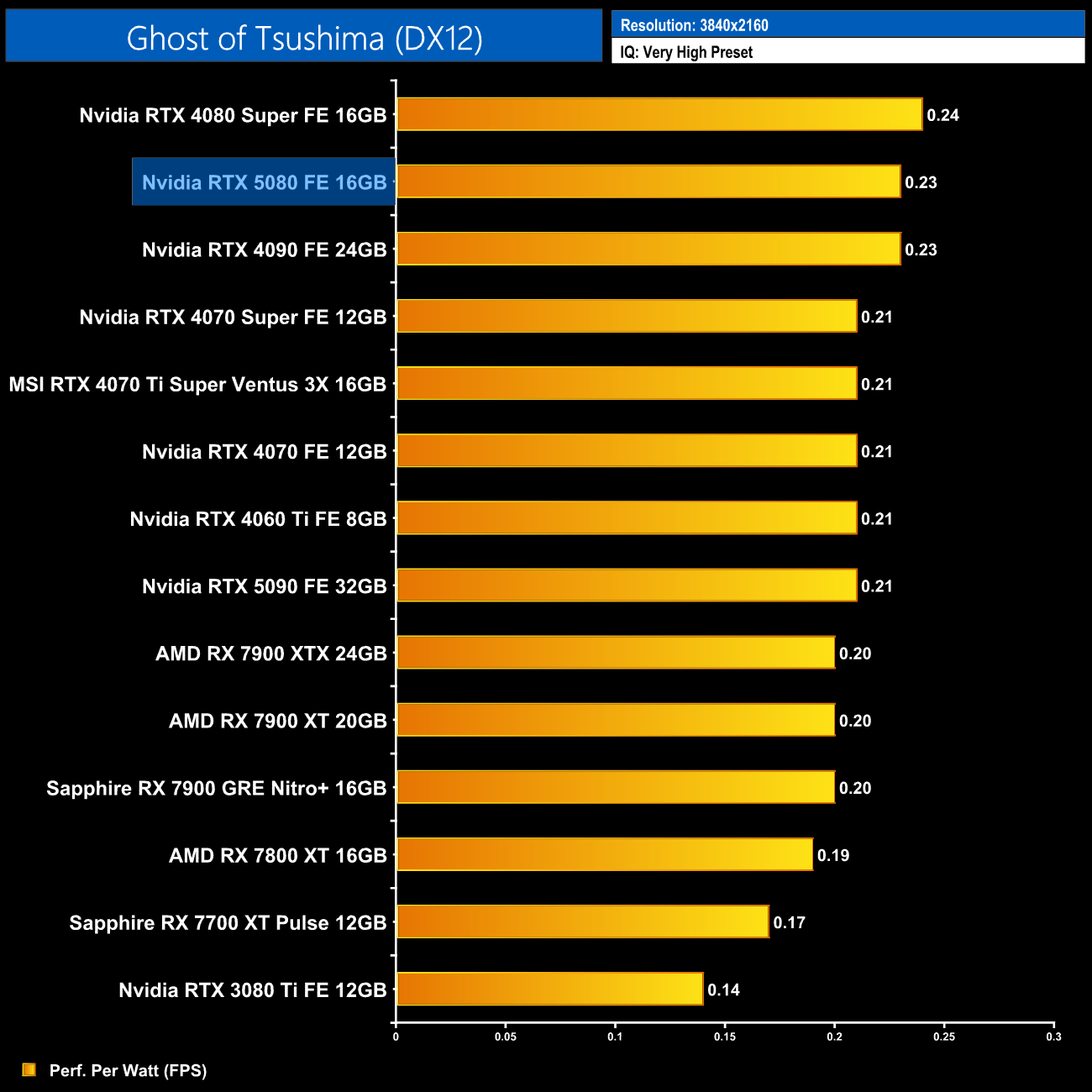
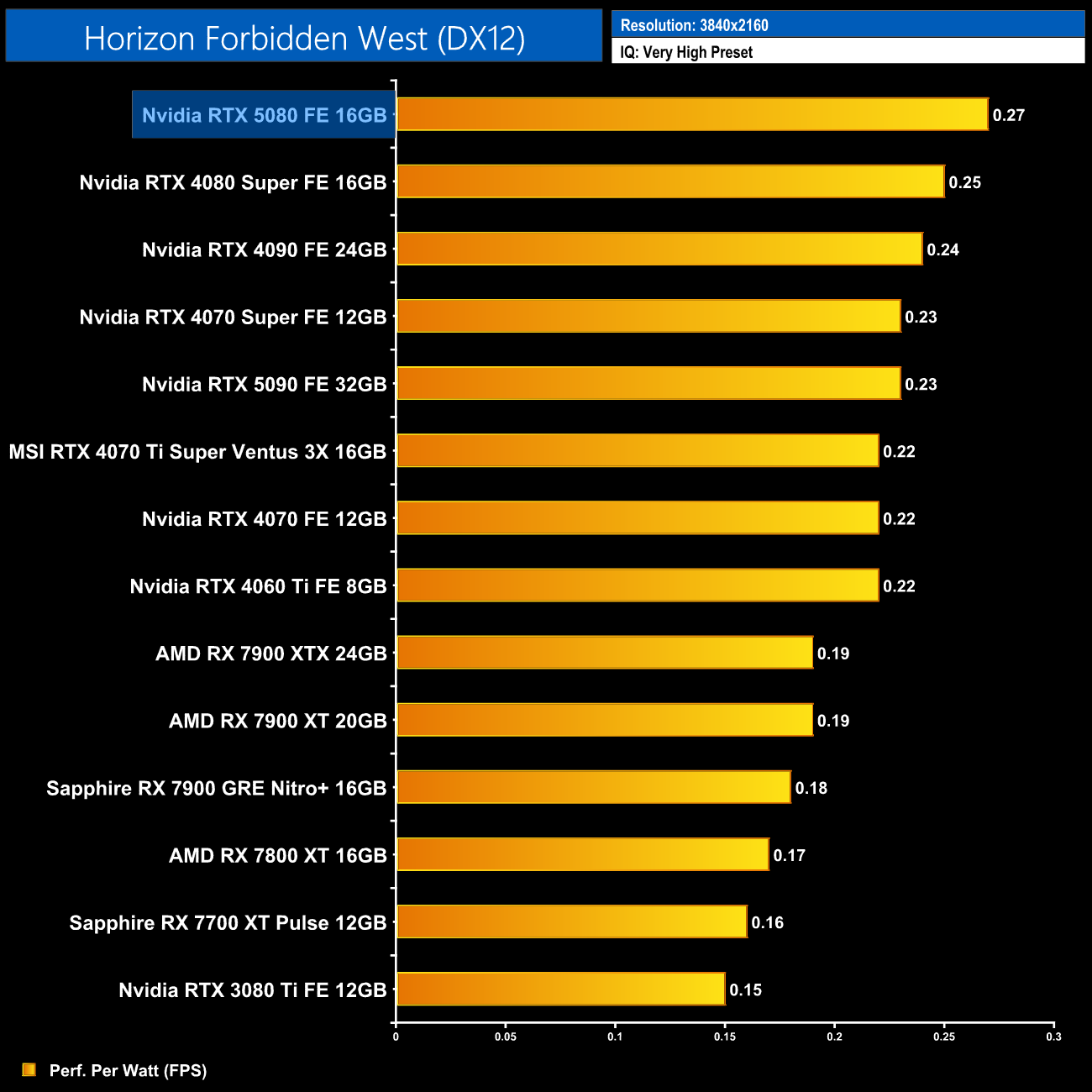
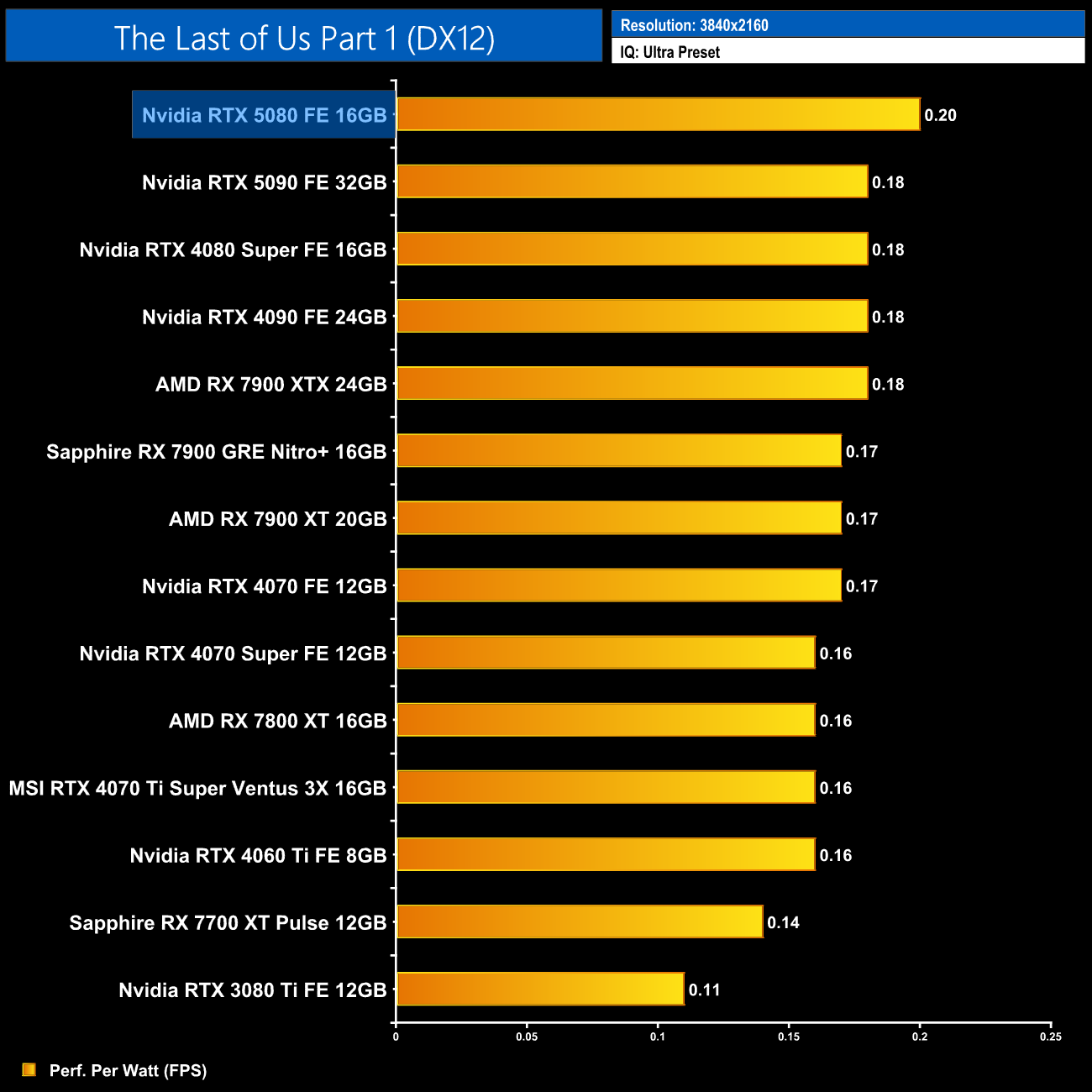
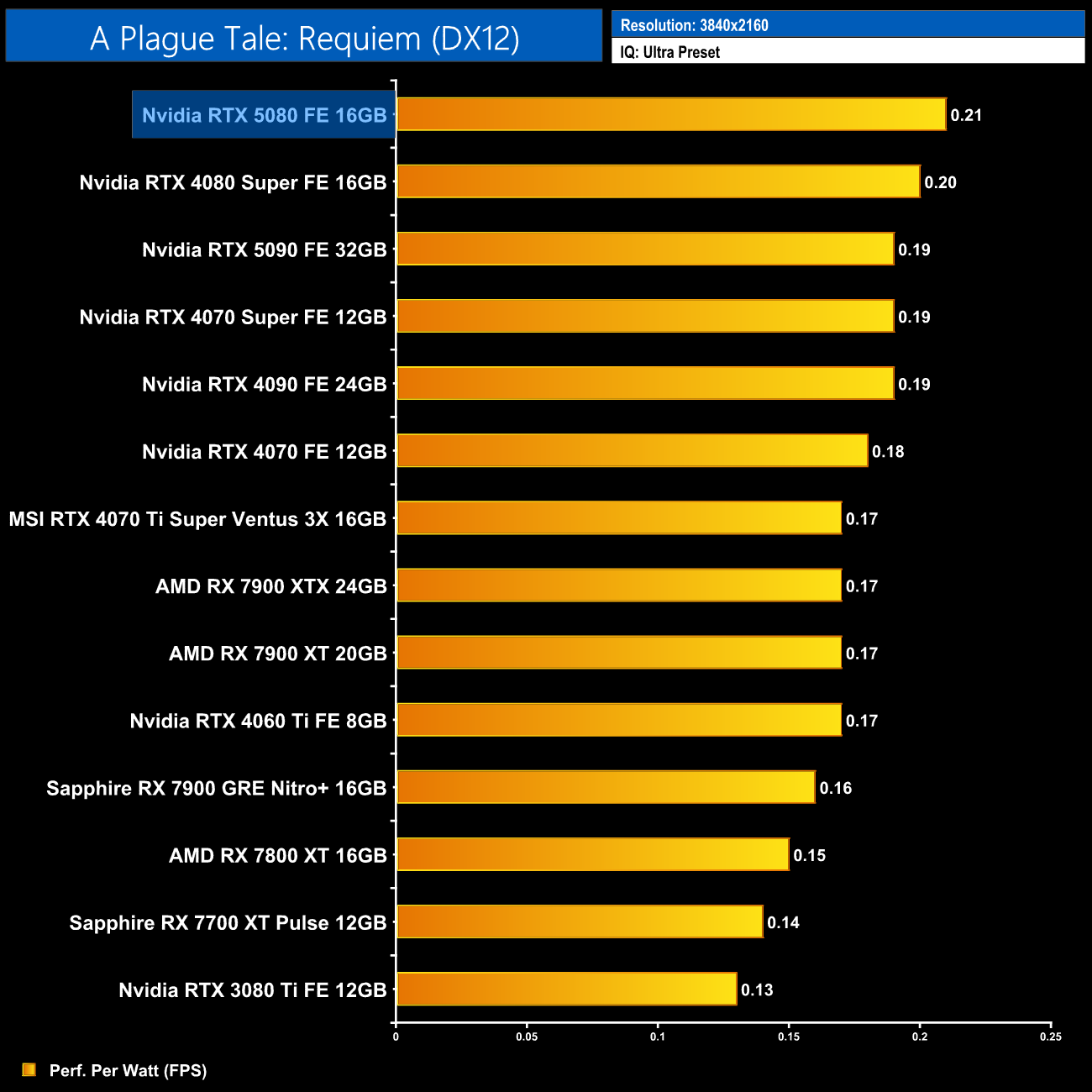
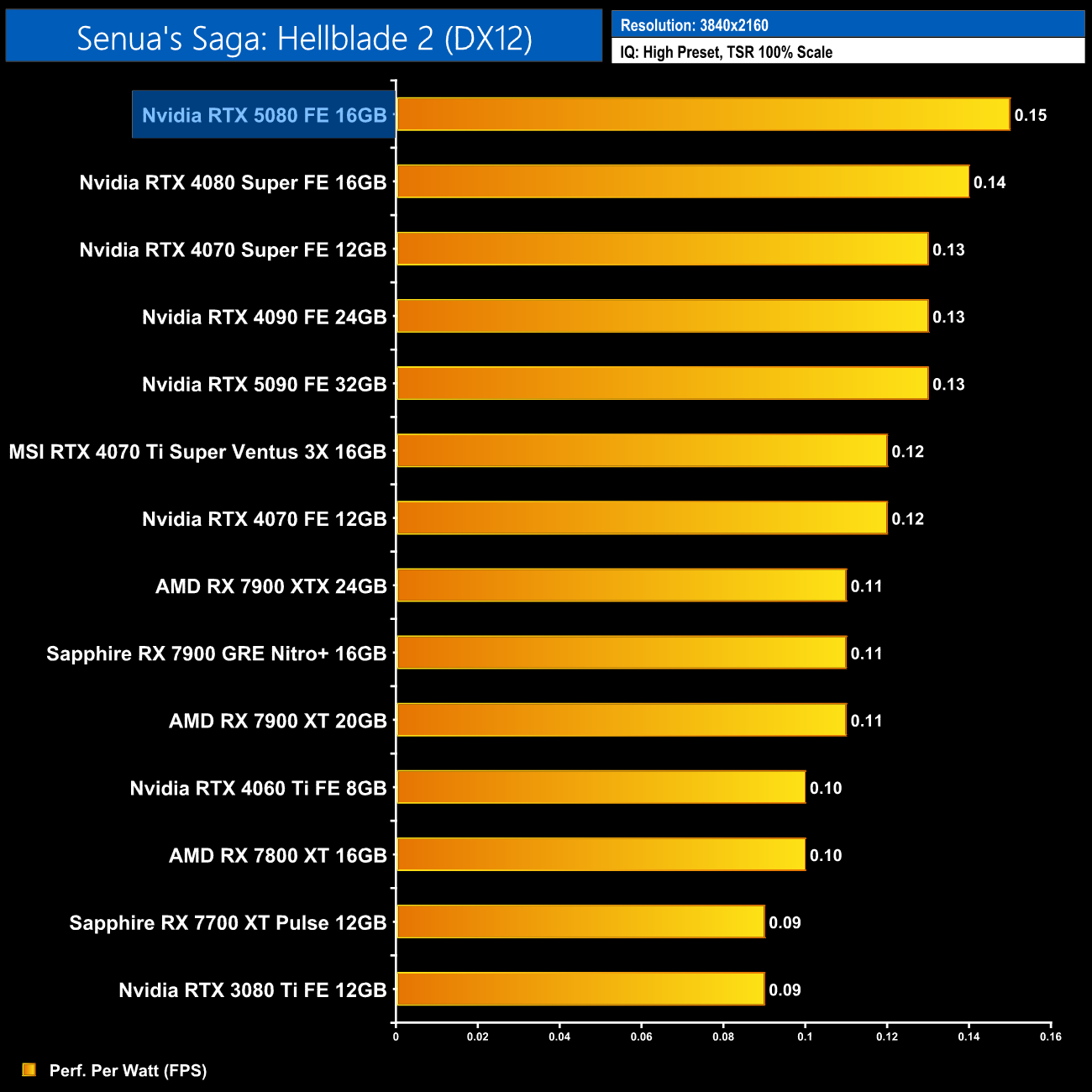
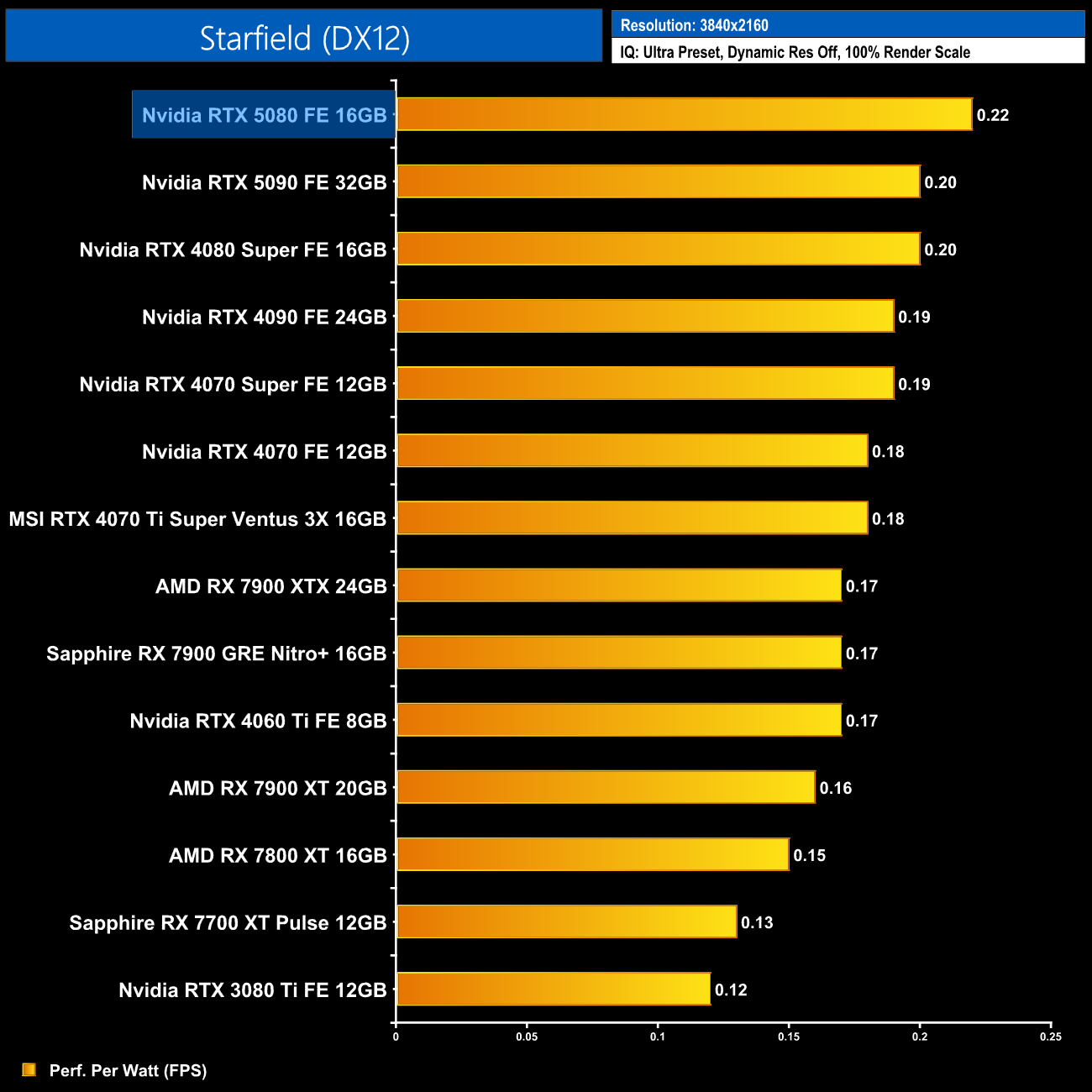
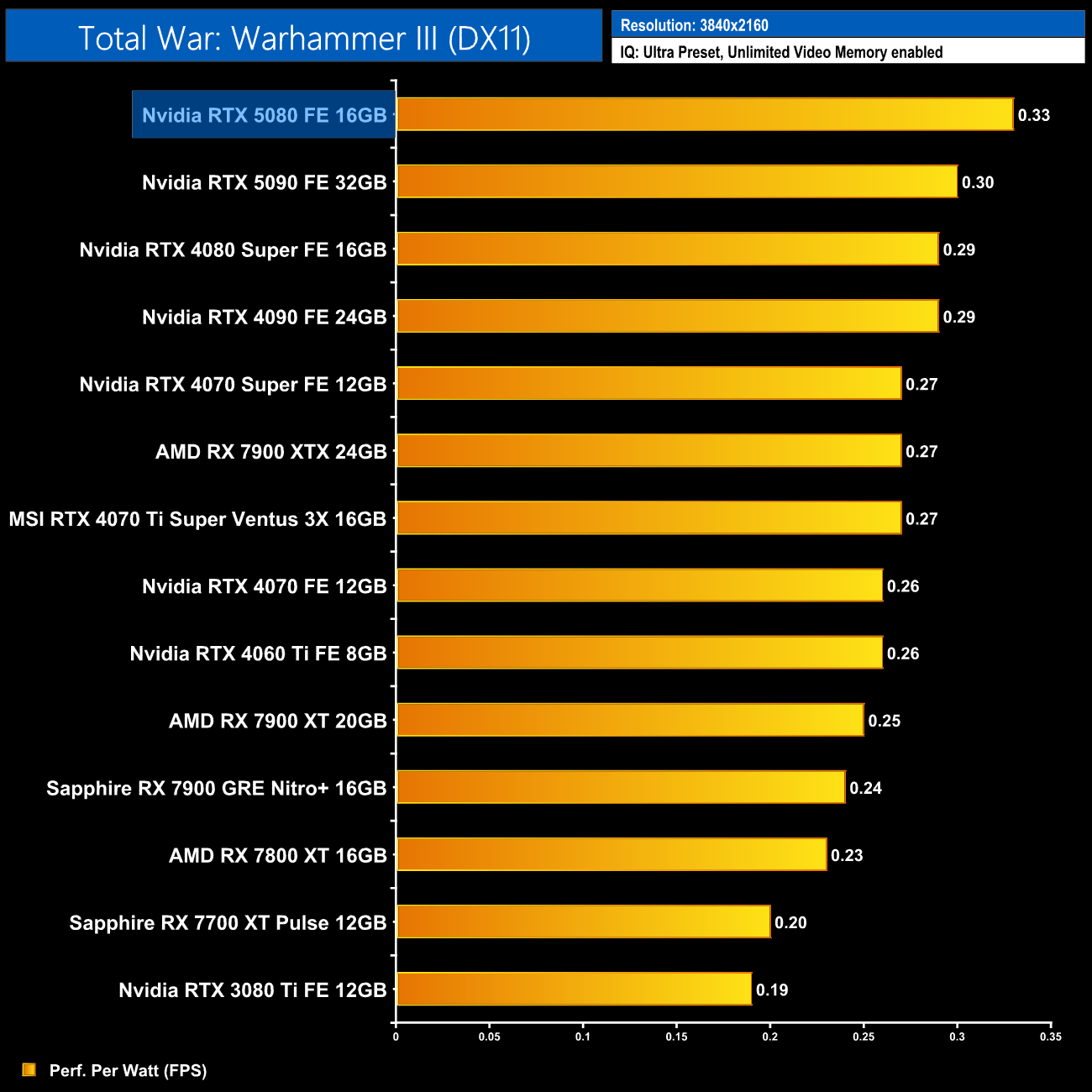
Click to enlarge.
12-Game Average at 2160p (4K):
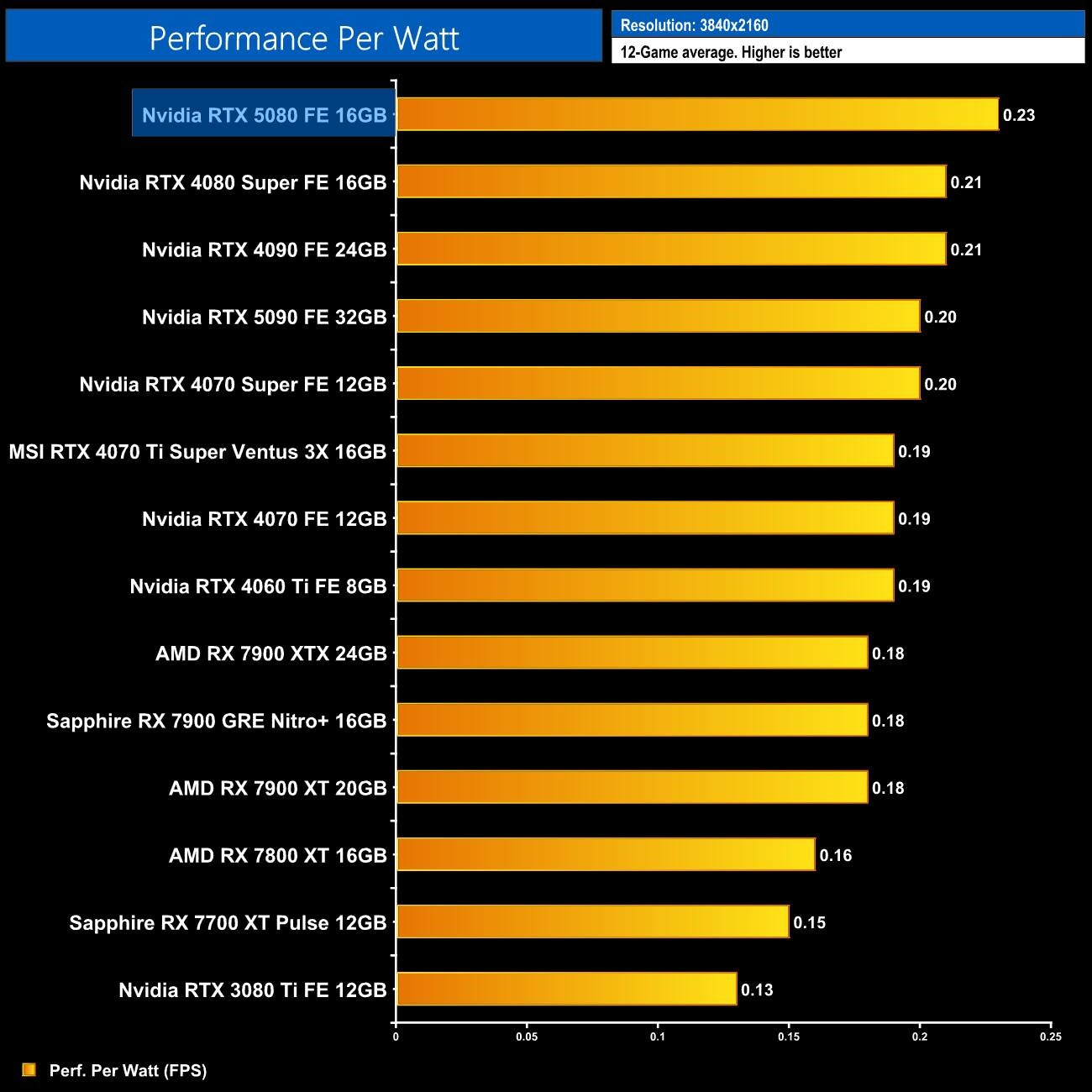
At 4K, performance per Watt comes in 10% higher than the RTX 4080 Super. It's not a massive leap forward by any means, but it does make the RTX 5080 the most efficient GPU we have ever tested. Compared to the RTX 5090, it delivers 12% better performance per Watt, and it's not far off double the efficiency of the RTX 3080 Ti.
Ray tracing results
As a bonus, we now include the power figures for all eight games we test with ray tracing enabled.
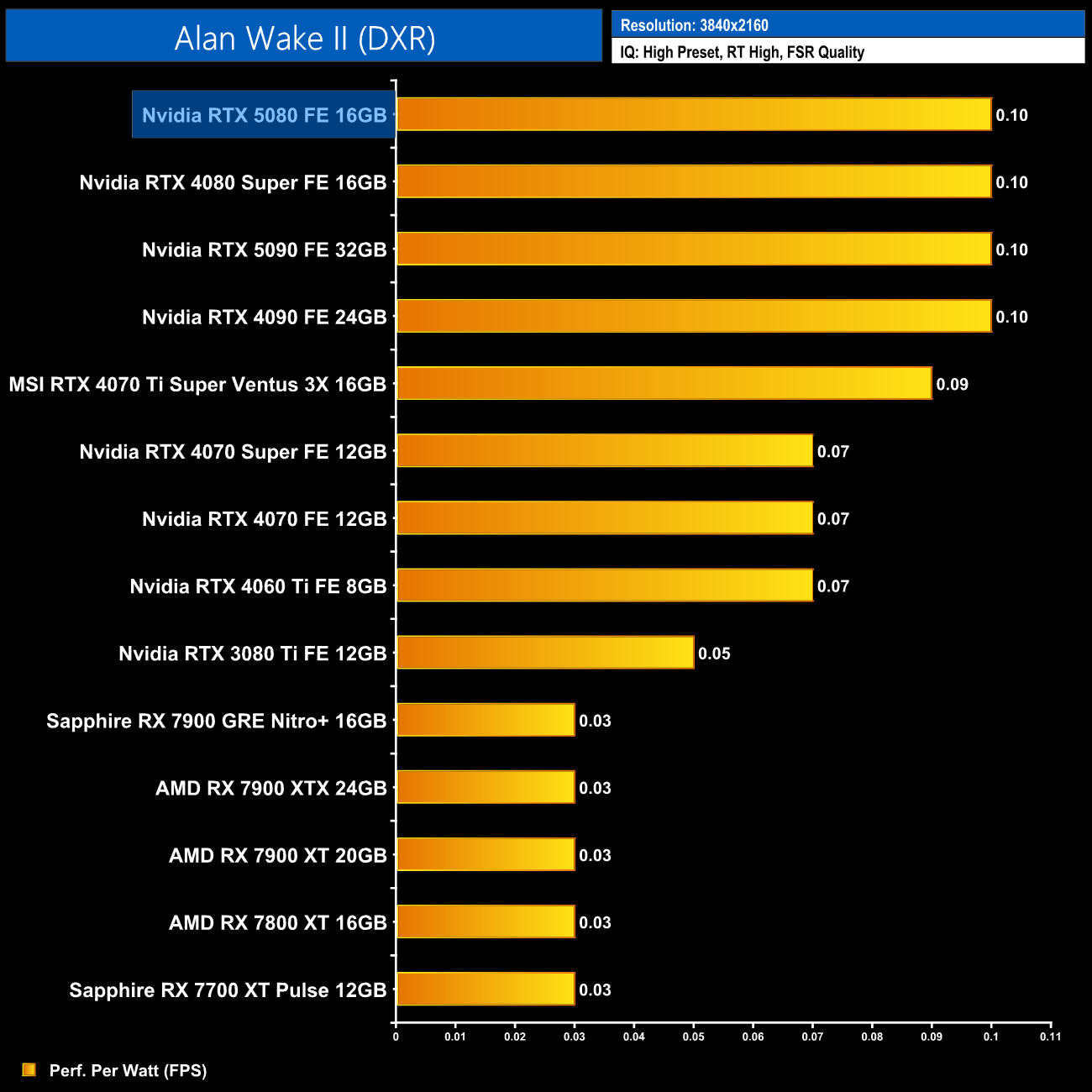
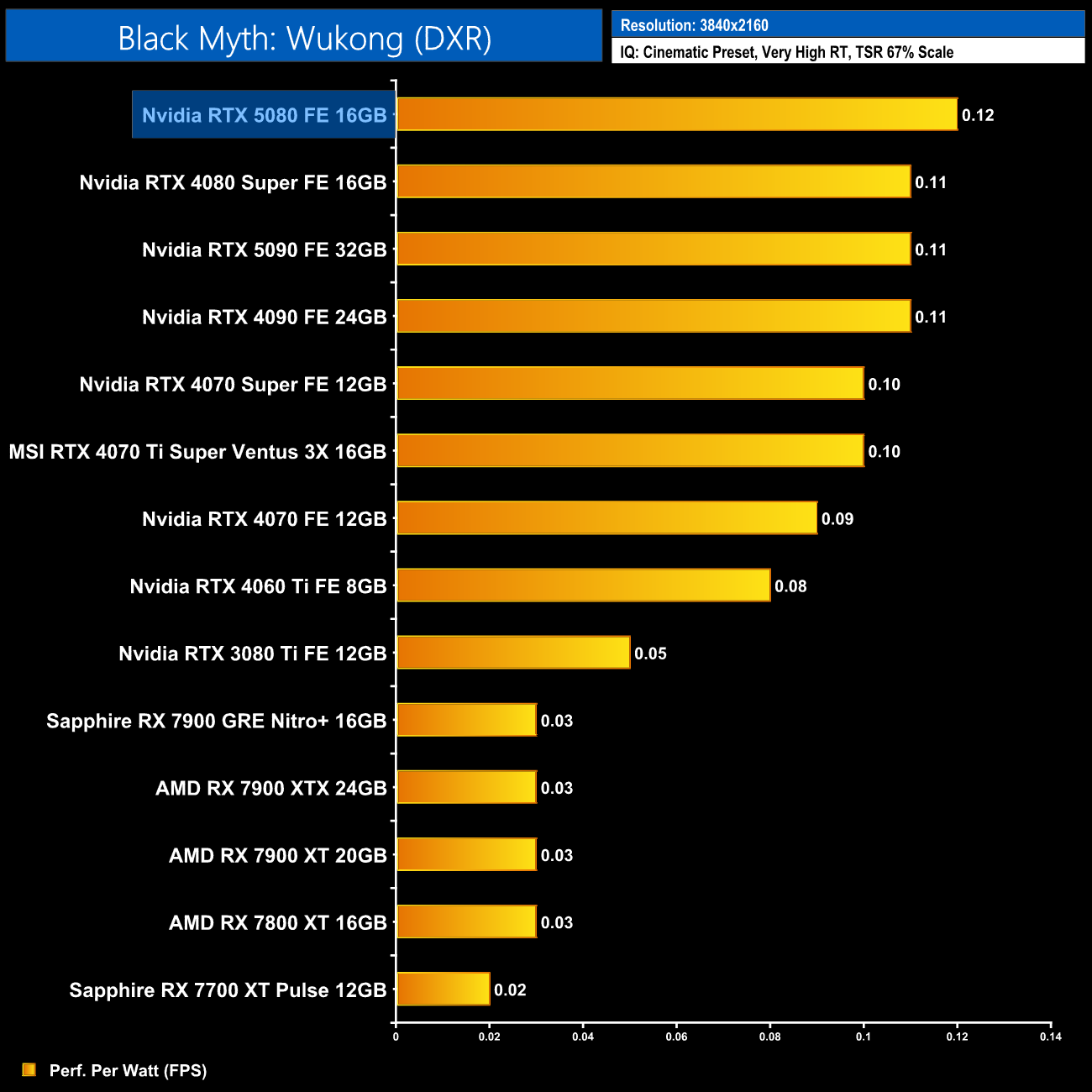
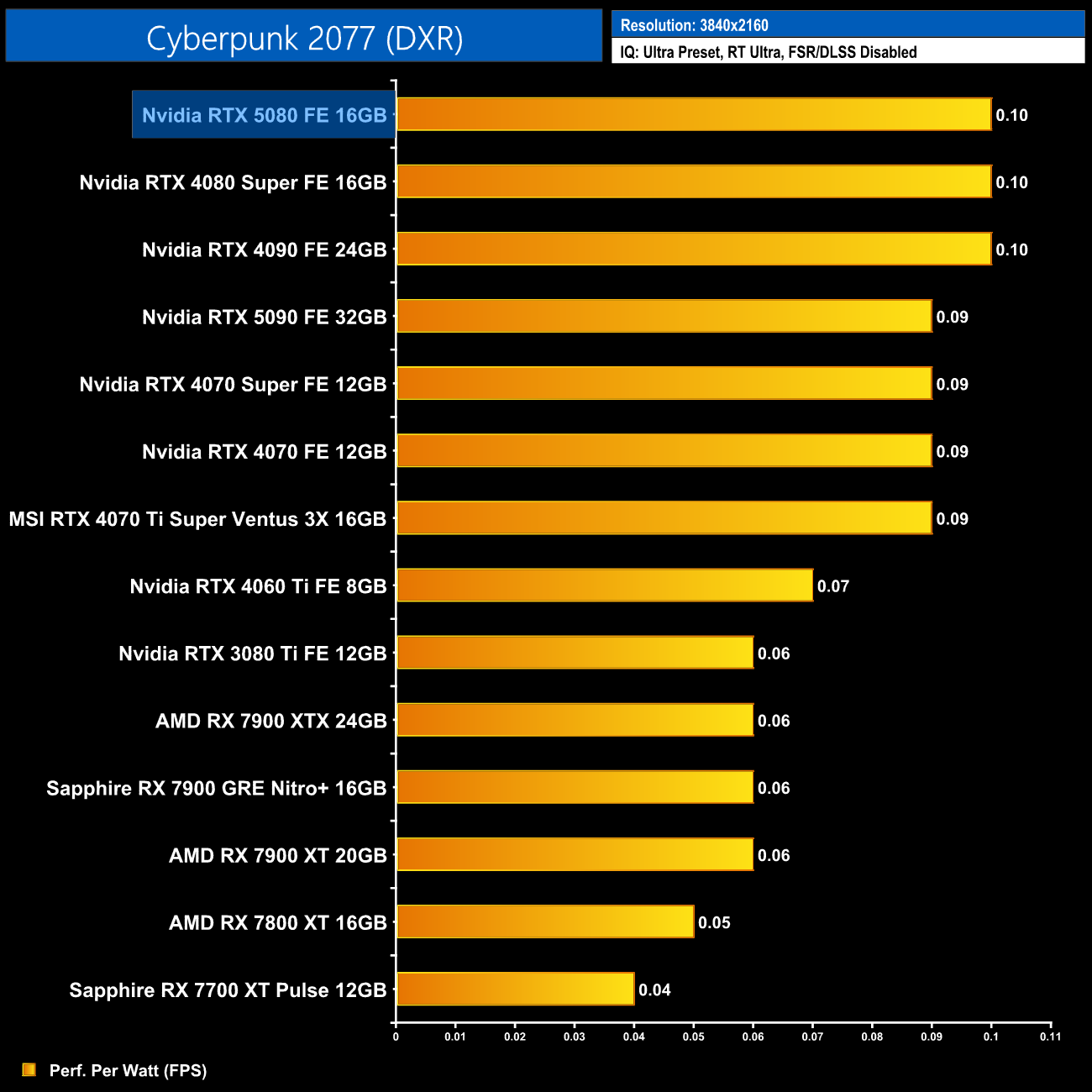
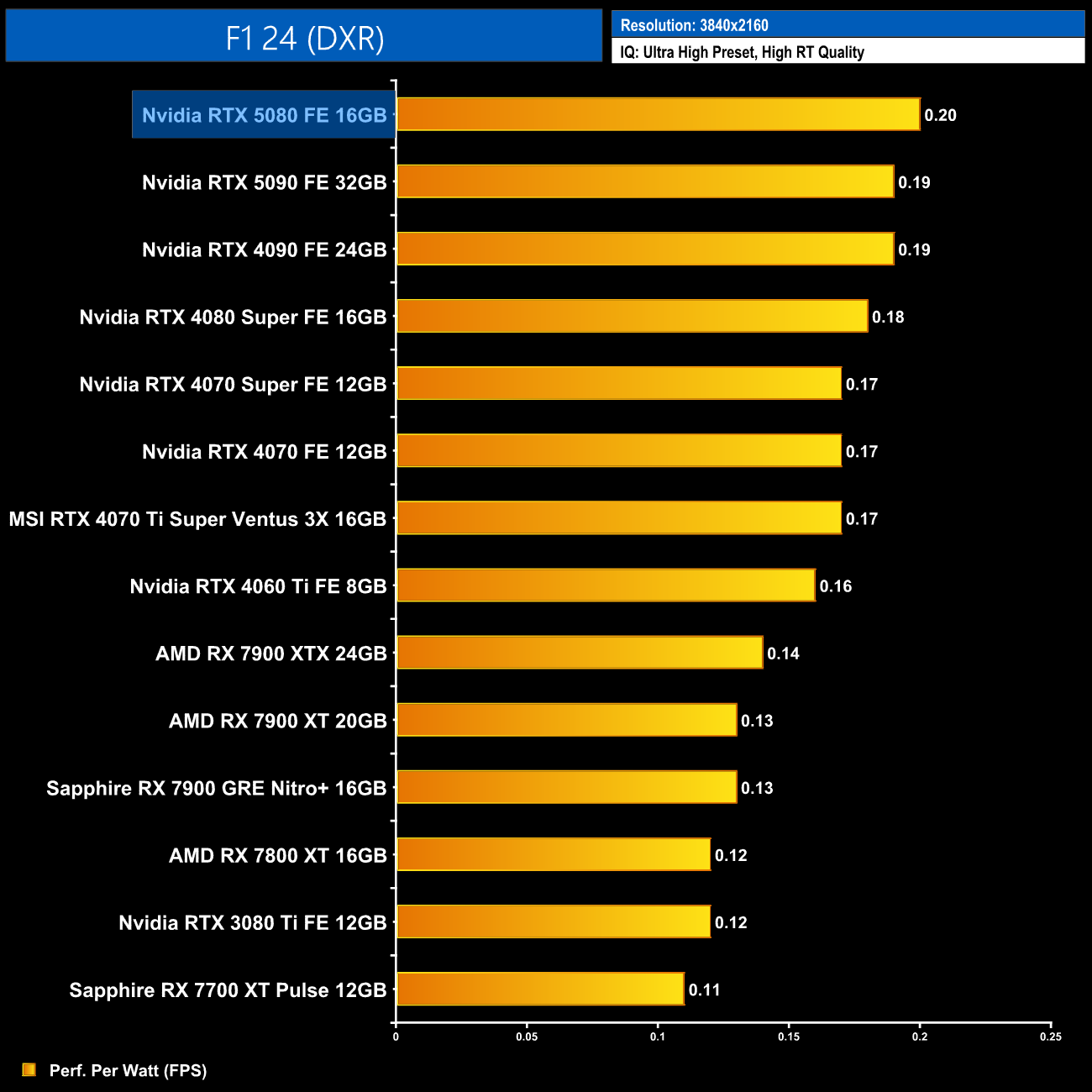
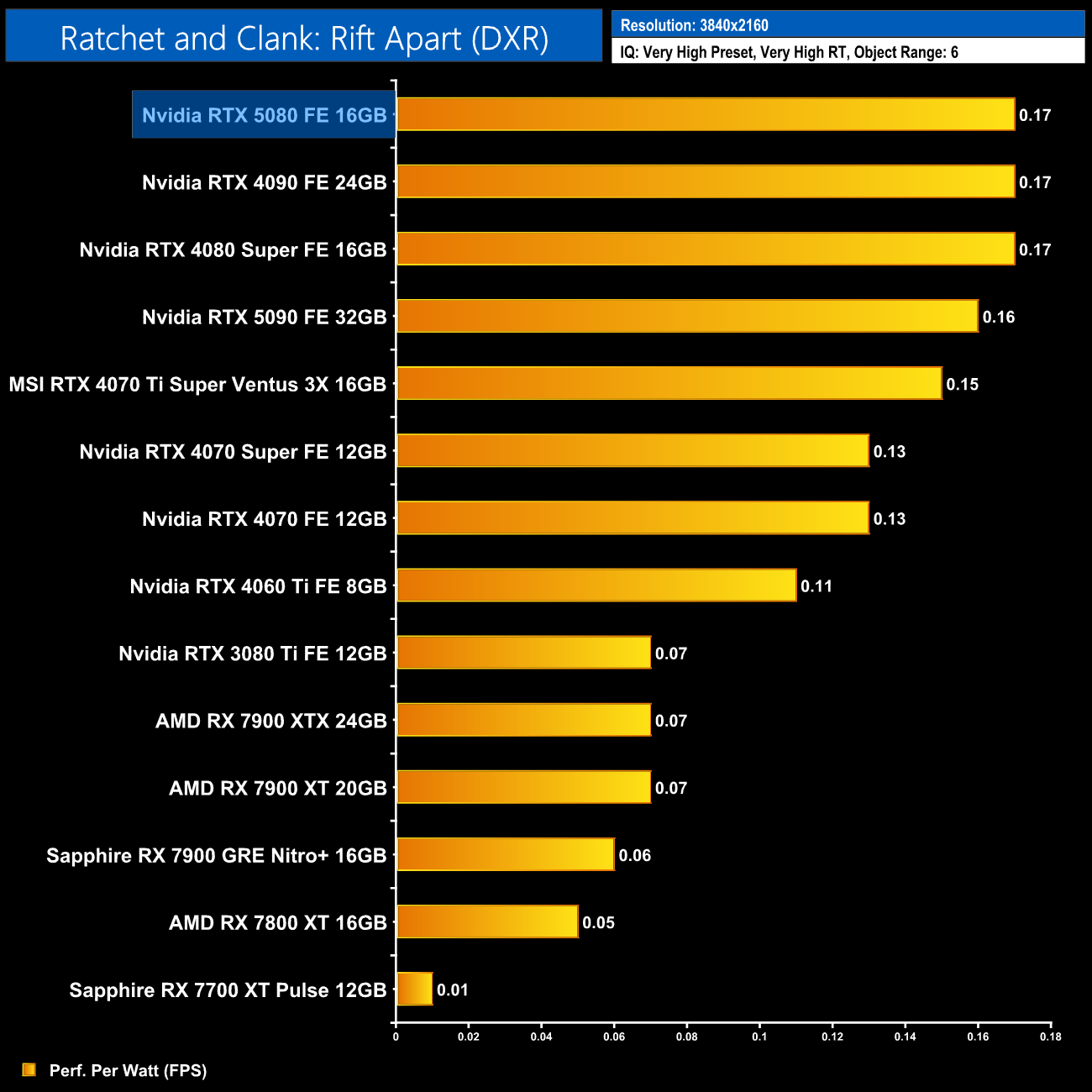
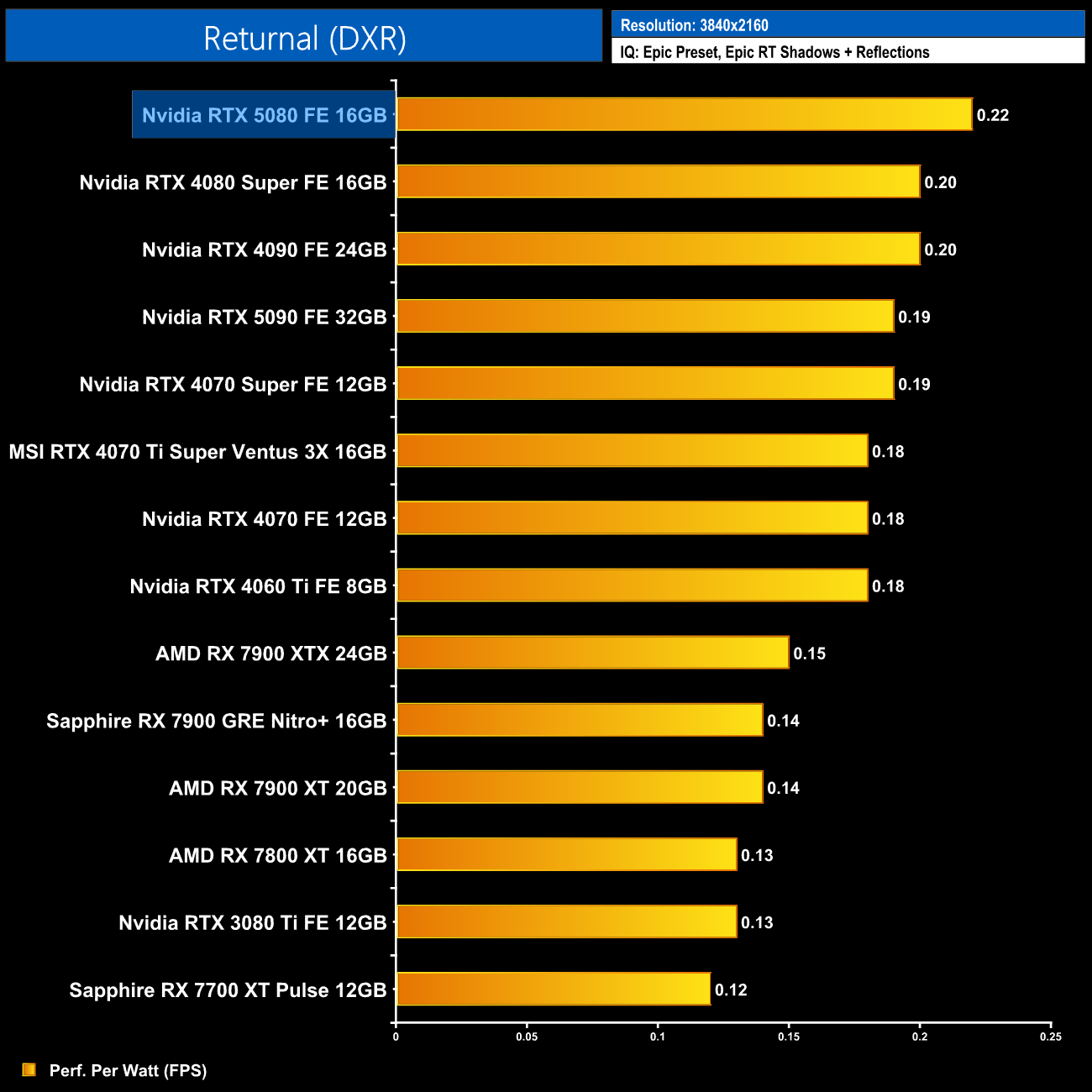
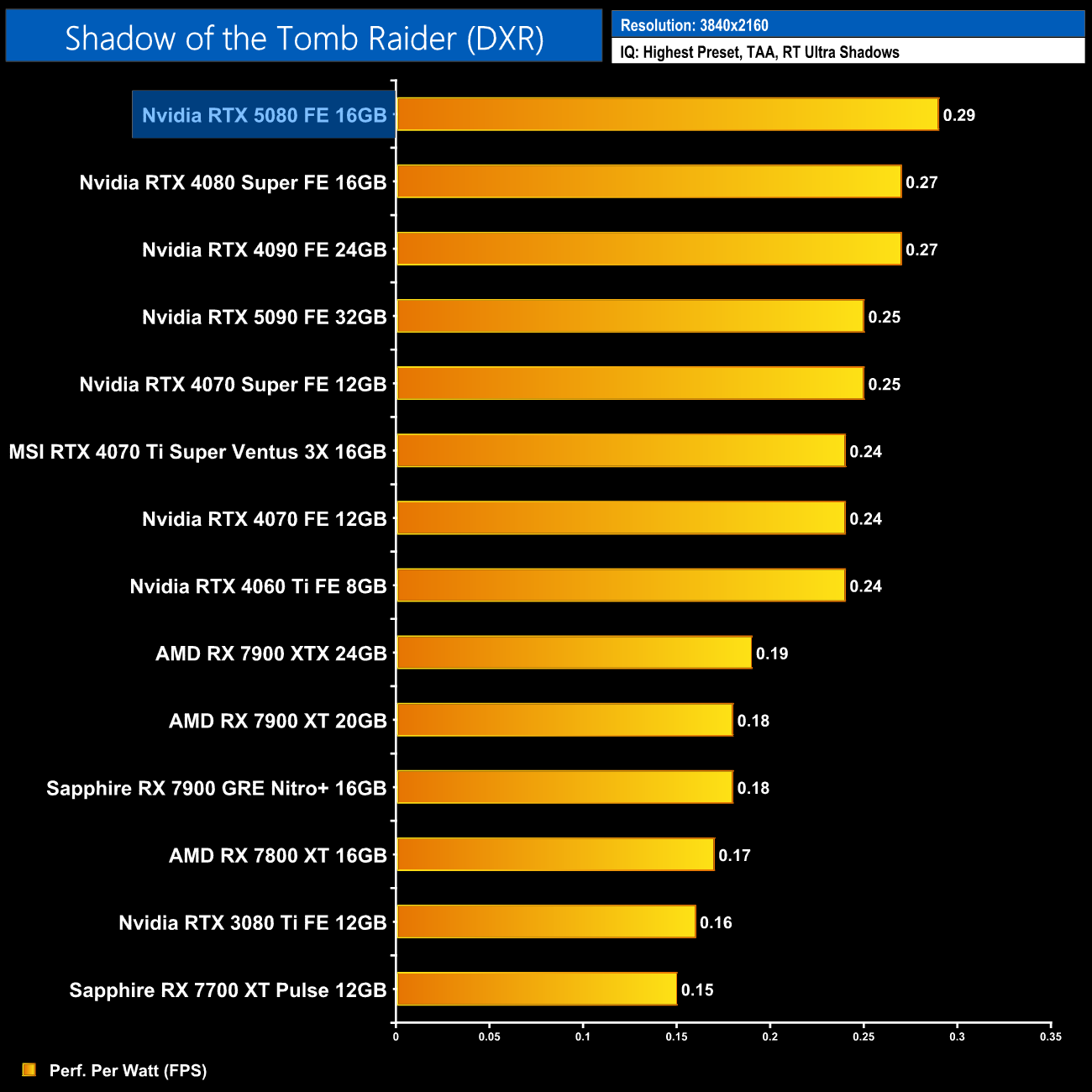
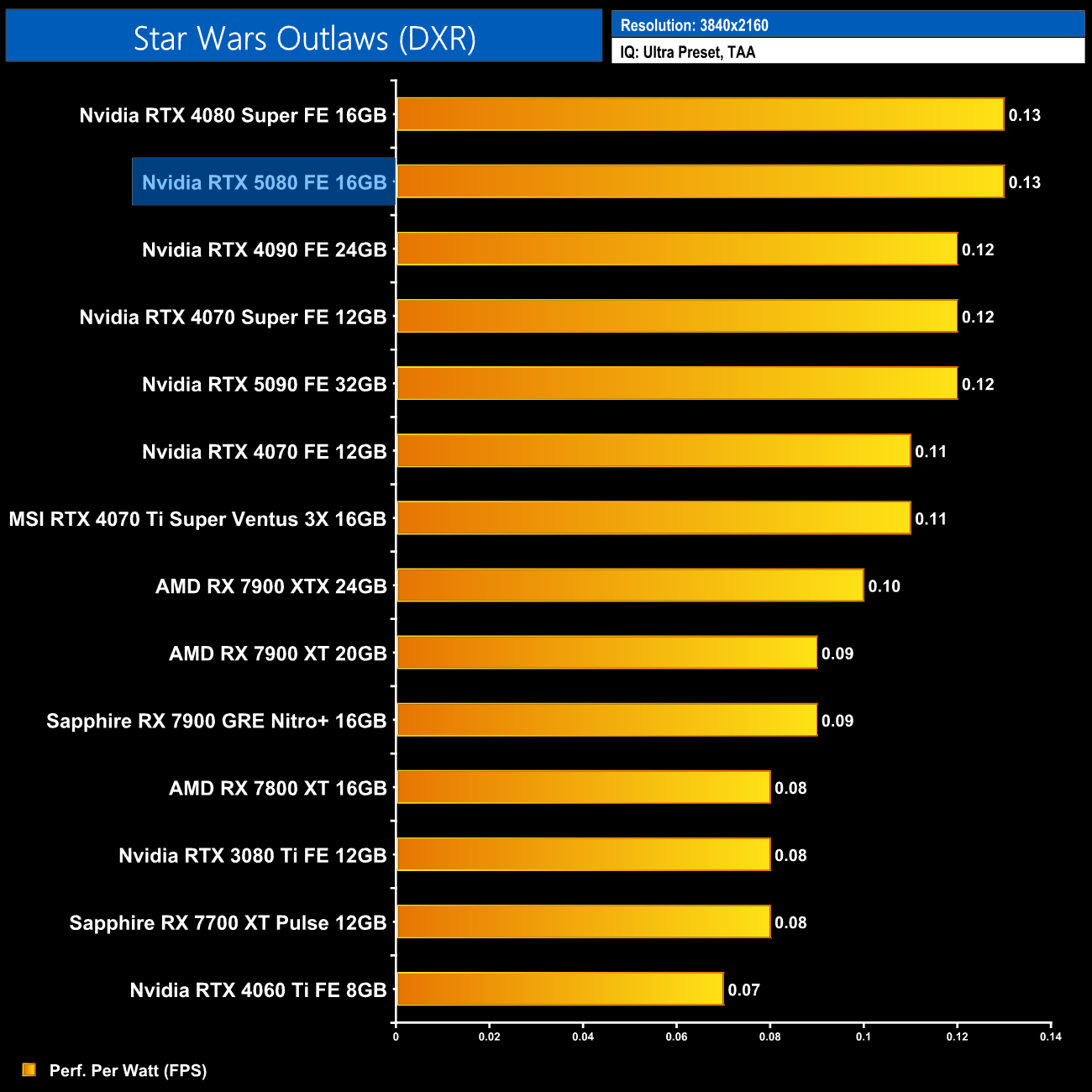
8-Game ray tracing average:
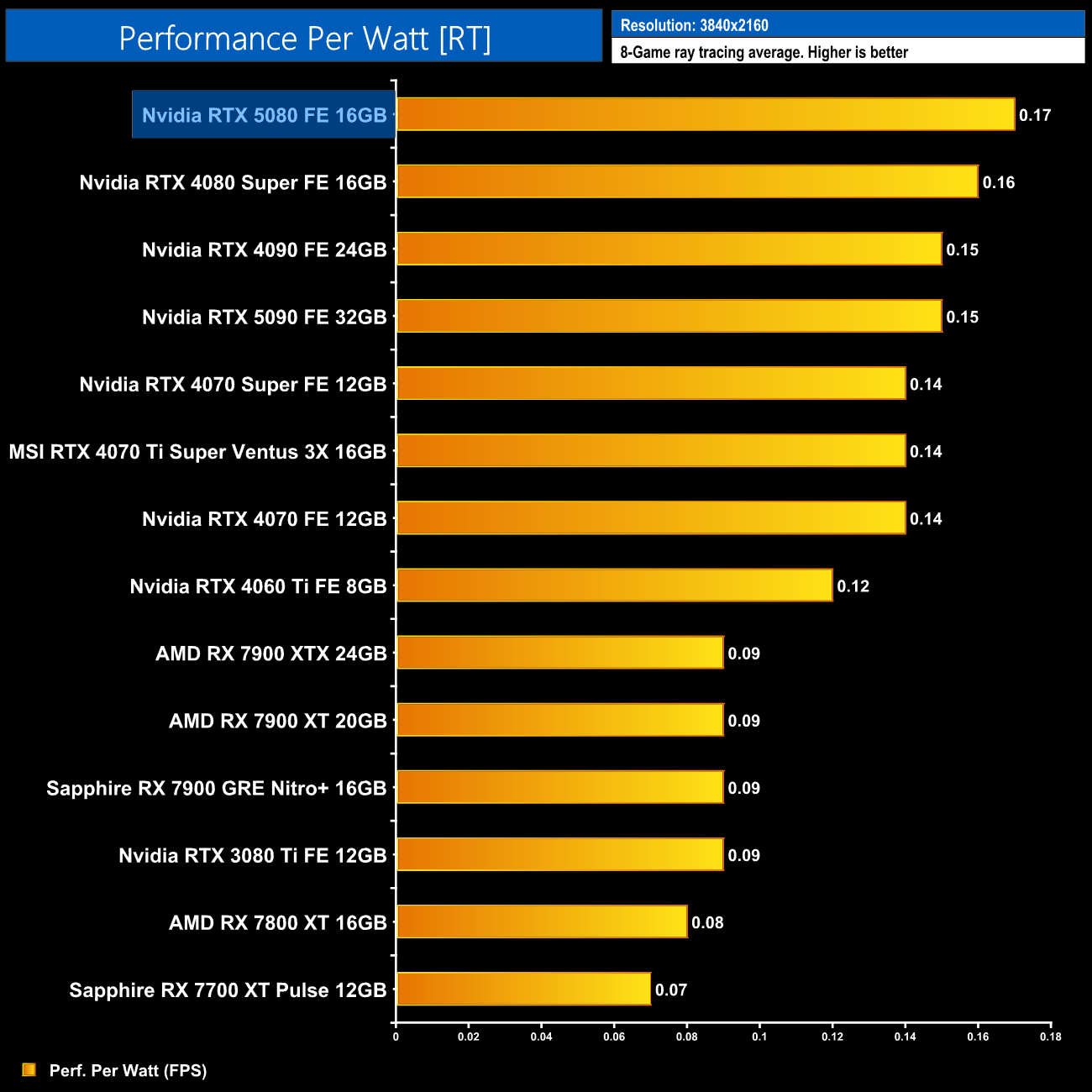
Much the same can be observed when looking at the RT data, with the RTX 5080 still top of the chart.
We measure system-wide power draw from the wall while running A Plague Tale: Requiem for 30 minutes (4K resolution).
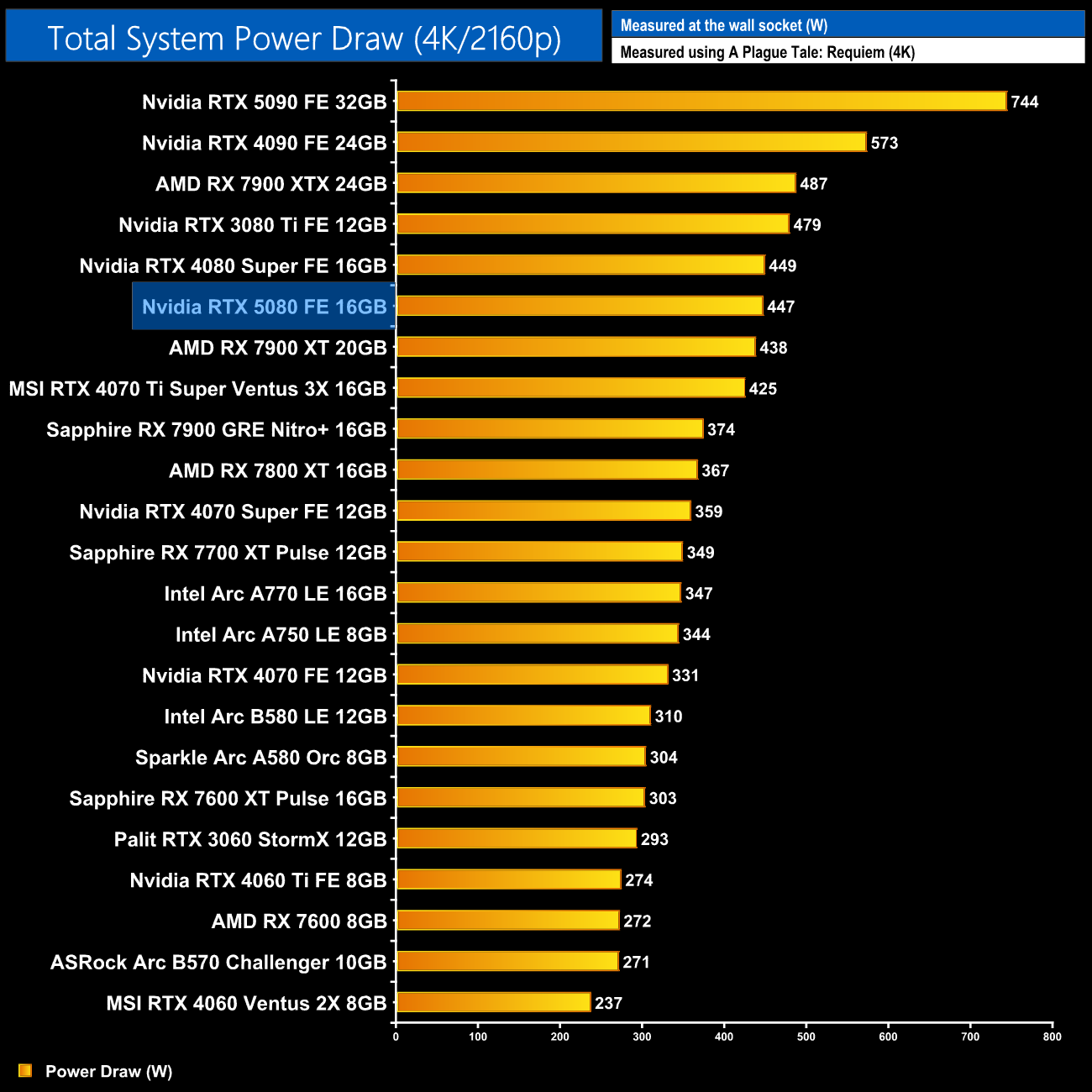
As for total system power draw, measured in A Plague Tale: Requiem, we can see power draw is very similar to the RTX 4080 Super and is only slightly ahead of the RX 7900 XT.
After reviews of the RTX 5090 went live last week, today we have put Nvidia's RTX 5080 through its paces. Hitting the market at a more accessible – but still very expensive – asking price of £979/$999, the RTX 5080 is aimed at gamers with deep pockets who can't quite stump up another grand for the RTX 5090.
That positioning makes the RTX 5080 a direct successor to the RTX 4080 Super, and today we saw performance gains of 13% on average for the new Blackwell GPU. As such, things are surprisingly close up against the RX 7900 XTX, with the 5080 coming in just 8% faster when looking at raster performance. Additionally it is 15% slower than the RTX 4090 and 34% behind the RTX 5090.
When enabling ray tracing, the RTX 5080 does at least crush AMD's current flagship, delivering performance that's 57% better, something we'd certainly expect given Nvidia's prowess in this department. Scaling is otherwise very similar when compared to Nvidia's own GPUs, as the RTX 5080 is 12% faster than the 4080 Super and 19% slower than the RTX 4090.
Now, you're probably thinking it, and I have to agree – those sorts of numbers are clearly disappointing. Just a 13% gain over the previous xx80 SKU is hardly cause for wild celebration, while this class of GPU has never been further behind the Nvidia flagship – gone are the days when something like the RTX 3080 was just 15% slower than the RTX 3090, for basically half the cost.
That said, things don't look quite so bad if we take a step back. Up against the RTX 3080 Ti, for instance, a GPU that launched in mid-2021 for £1049, the RTX 5080 is over 50% faster for rasterisation, and that increases to a 70% margin when looking at ray tracing performance. That means anyone upgrading from an older xx80-class GPU will see a decent improvement, but it's still not a mind-blowing leap forward – after all, the jump from the RTX 2080 to the RTX 3080 was roughly 70% from just a single generation, but that type of gen-on-gen increase seems to be a thing of the past.
For those who use their GPUs for more than just gaming, though, we did see a few instances of more eye-catching performance improvements. AI text generation, particularly using the Llama 2 and Llama 3.1 models, saw scores increase by over 20% compared to the RTX 4080 Super, and the same can be said for V-Ray RTX rendering performance.
On top of that, despite remaining on TSMC's 4N node, the RTX 5080 does bring with it some improvements to overall efficiency. I was concerned to see a performance per Watt regression when testing the RTX 5090, but the 5080 has things back on track and is actually the most efficient GPU we've ever tested. Not by much, admittedly, but performance per Watt has improved by about 10% compared to the RTX 4080 Super, so Nvidia has clearly been able to work in some architectural advantages, even without a die shrink.
Nvidia also points to its new DLSS 4 technology, and specifically Multi Frame Generation, as a key selling point for the RTX 50 series. After first getting hands on with it during the RTX 5090 review, overall behaviour is exactly as expected with the RTX 5080, so I think it's a good feature to have. It's not perfect from a visual perspective and it, crucially, doesn't solve the latency problem of the previous Frame Gen implementation. I'd certainly rather have it than not, but I don't think it's reason alone to upgrade to a Blackwell GPU.
Elsewhere, the Founders Edition design continues to impress us, even if changes have been made versus the RTX 5090. Gone is the 3D Vapour Chamber, for instance, and instead we have a more traditional heatpipe and baseplate cooling solution. It's still a highly effective double flow through cooler, though, resulting in a GPU temperature of just 65C during our thirty minute stress test, while the VRAM topped out at 76C. It'll be interesting to see what Nvidia's partners can do with their custom cards, so stay tuned for those reviews coming up over the next few weeks.
Overall, I think it's fair to say the RTX 5080 is hardly going to set the world alight. It's not terrible, launching at the same price as the outgoing RTX 4080 Super and offering at least some performance gains, but it's only a very small step forward. The unfortunate reality is that Nvidia has little incentive to push this market segment forward given the lack of competition. Sure, the RX 7900 XTX is there or thereabouts when it comes to rasterisation performance, but it gets mullered when looking at ray tracing, efficiency, AI & productivity workloads, plus FSR still isn't on the same level as DLSS, especially given Nvidia's new Transformer-based model.
If the RTX 5090 is really the RTX 4090 Ti, as some have called it, then the RTX 5080 feels more like an RTX 4080 Ti Super rather than a true generational leap. But the fact remains, if you want the fastest graphics card that isn't the RTX 5090, it's really your only option.
RTX 5080 is launching at retail tomorrow, January 30th, with prices starting at £979/$999.
Discuss on our Facebook page HERE.
Pros
- Capable GPU for 4K gaming.
- New performance per Watt leader.
- Dual-slot Founders Edition runs cool and quiet.
- Some improvement to cost per frame and overall value versus the RTX 4080 Super.
- AI and productivity benchmarks showed some bigger-than-expected performance improvements.
- DLSS 4 has improved Ray Reconstruction and Super Resolution scaling.
- Multi Frame Generation enables higher frame rates than would otherwise be possible.
Cons
- Only limited gains over RTX 4080 Super which is disappointing.
- Bigger gulf than ever between the xx80 SKU and series flagship.
- RX 7900 XTX is surprisingly competitive for rasterisation (but falls off in basically every other area).
KitGuru says: The RTX 5080 hasn't blown us away, but it's still the card to get if you're looking to spend around a grand on a new GPU.