KitGuru KitGuru.net – Tech News | Hardware News | Hardware Reviews | IOS | Mobile | Gaming | Graphics Cards


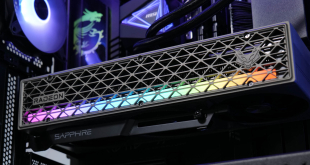
Following our launch-day review of AMD's RX 9070 XT, today we’re analysing the Sapphire Nitro+ partner card. As one of my favourite custom designs from the RX 7000 series, Sapphire has refined its Nitro+ formula even further, introducing an innovative removable backplate for better cable management, a hefty factory overclock and sleek aesthetics. Let’s see what this card is capable of.
Sapphire tells me the RX 9070 XT Nitro+ has a UK MSRP of £699, though at the time of writing it is listed for £720 at Overclockers UK, or £730 at Scan. Either way, it is clearly a high-end 9070 XT card, targeting users who want more than just basic performance, but a range of extra bells and whistles, too.
Timestamps
00:00 Intro
00:35 RX 9070 XT recap
01:13 Meet the Sapphire Nitro+
03:08 Nitro+ PCB and heatsink
03:59 PowerColor Red Devil design
05:38 Red Devil PCB and heatsink
06:25 Test setup
06:55 Thermals and acoustics
08:35 Does Sapphire’s backplate increase temps?
09:12 Game benchmarks, clock speed analysis
09:56 Power draw and 12VHPWR testing
11:40 Overclocking/undervolting
12:38 Closing thoughts
| RX 9070 XT | RX 9070 | RX 7900 GRE | RX 7800 XT | RX 7700 XT | |
| Architecture | RDNA 4 | RDNA 4 | RDNA 3 | RDNA 3 | RDNA 3 |
| Manufacturing Process | TSMC N4 | TSMC N4 | TSMC N5 GCD + N6 MCD | TSMC N5 GCD + N6 MCD | TSMC N5 GCD + N6 MCD |
| Transistor Count | 53.9 billion | 53.9 billion | 57.7 billion | 28.1 billion | 28.1 billion |
| Die Size | 357 mm² | 357 mm² | 300 mm² GCD
220 mm² MCD |
200 mm² GCD
150 mm² MCD |
200 mm² GCD
150 mm² MCD |
| Compute Units | 64 | 56 | 80 | 60 | 54 |
| Ray Accelerators | 64 | 56 | 80 | 60 | 54 |
| Stream Processors | 4096 | 3584 | 5120 | 3840 | 3456 |
| Game GPU Clock | 2400 MHz | 2070 MHz | 1880 MHz | 2124 MHz | 2171 MHz |
| Boost GPU Clock | Up to 2970 MHz | Up to 2520 MHz | Up to 2245 MHz | Up to 2430 MHz | Up to 2544 MHz |
| ROPs | 128 | 128 | 192 | 96 | 96 |
| AMD Infinity Cache | 64MB | 64MB | 64MB | 64MB | 48MB |
| Memory | 16GB GDDR6 | 16GB GDDR6 | 16GB GDDR6 | 16GB GDDR6 | 12GB GDDR6 |
| Memory Data Rate | 20 Gbps | 20 Gbps | 18 Gbps | 19.5 Gbps | 18 Gbps |
| Memory Bandwidth | 645 GB/s | 645 GB/s | 576 GB/s | 624 GB/s | 432 GB/s |
| Memory Interface | 256-bit | 256-bit | 256-bit | 256-bit | 192-bit |
| Board Power | 304W | 220W | 260 W | 263W | 245W |
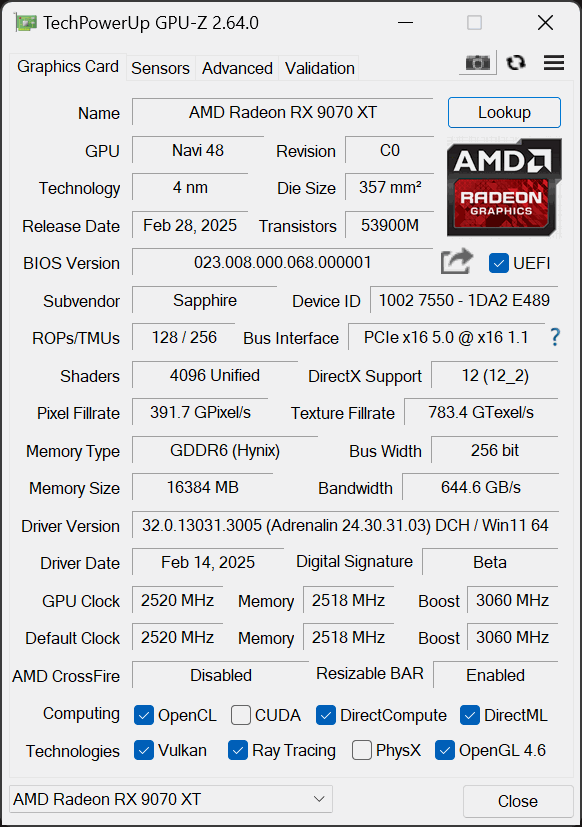
First, let's take a quick look at the specs. The RX 9070 XT is built on the new Navi 48 die, measuring 357mm², and it's worth pointing out this is a monolithic chip, so AMD is not using a chiplet-based design as per RDNA 3. In total, Navi 48 silicon packs in 53.9 billion transistors.
As a full implementation of Navi 48, the RX 9070 XT packs in 64 Compute Units, and each CU houses 64 Stream Processors, for a total of 4096 shaders. There's also 64 Ray Accelerators – one per CU – and 128 ROPs.
As for clock speed, the RX 9070 XT runs notably faster than its sibling, the RX 9070, given it sports a rated game clock of 2400MHz and a boost clock of up to 2970MHz. Sapphire has increased things further however, with a rated boost of 3060MHz.
The memory configuration is the same between both GPUs though, with 16GB of GDDR6 memory clocked at 20Gbps, operating over a 256-bit memory interface, for total memory bandwidth of 645 GB/s. 64MB of Infinity Cache is also present.
Power draw for the RX 9070 XT is rated at 304W Total Board Power (TBP), Sapphire has increased this up to 330W.
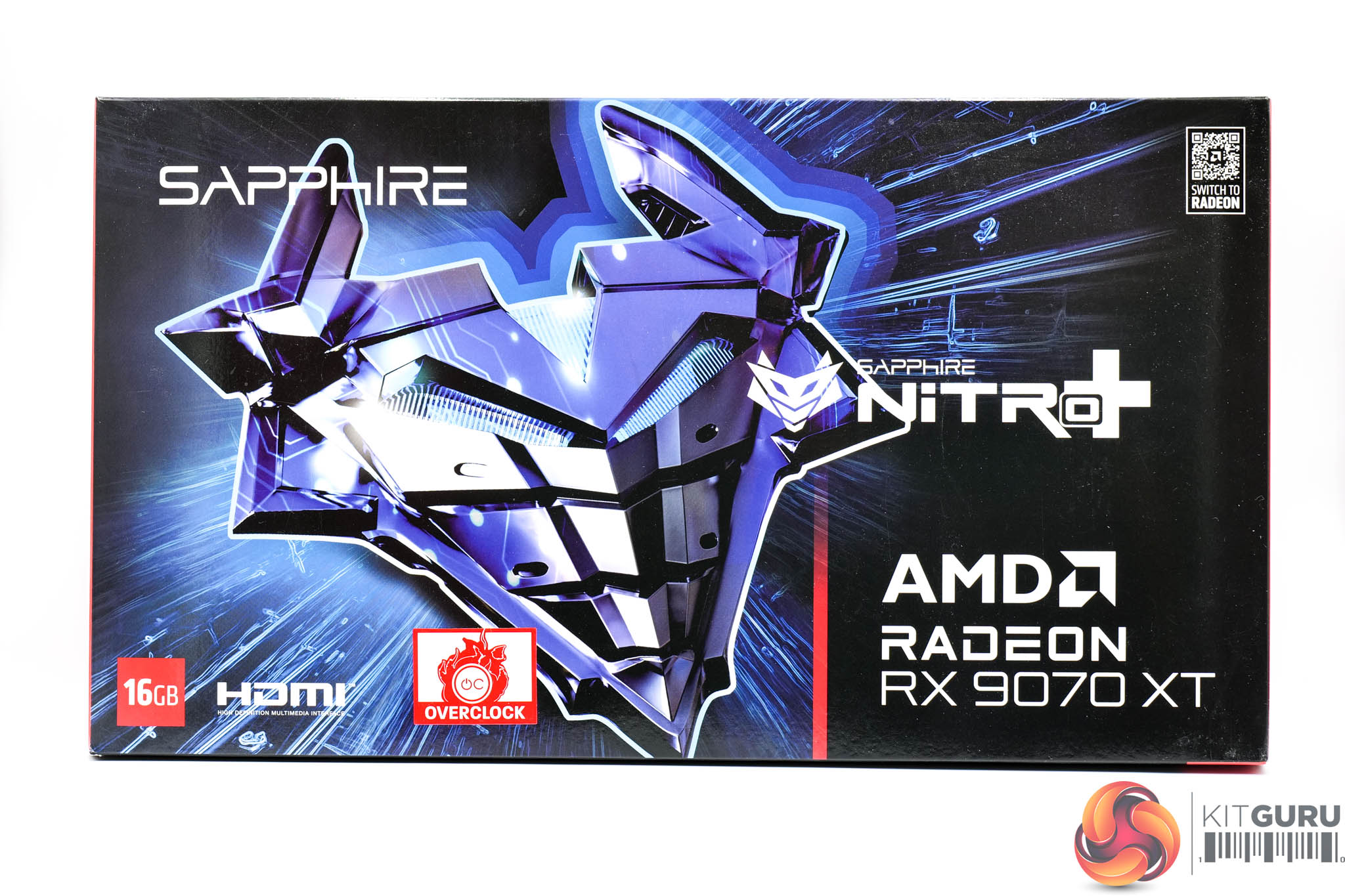
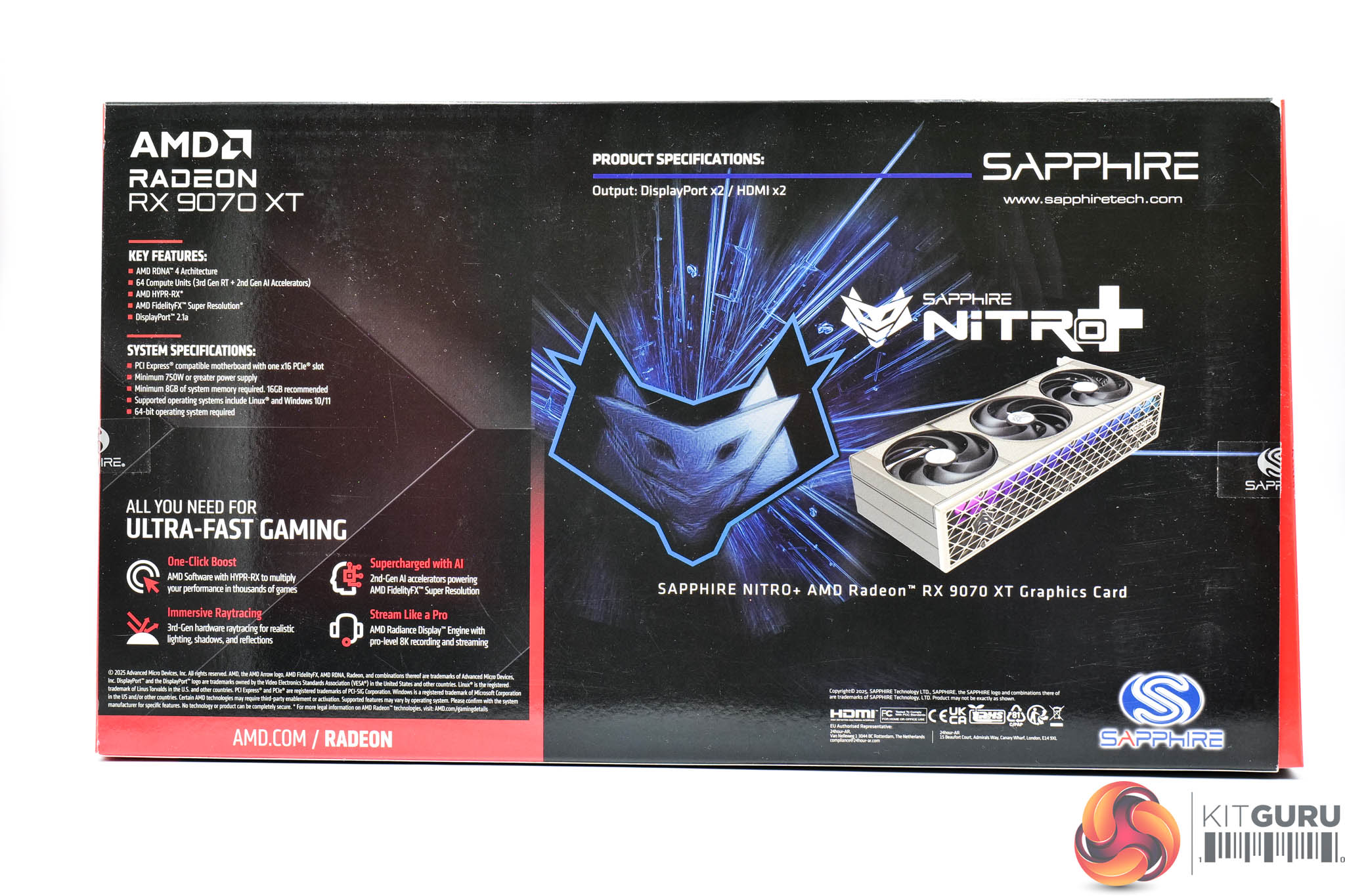
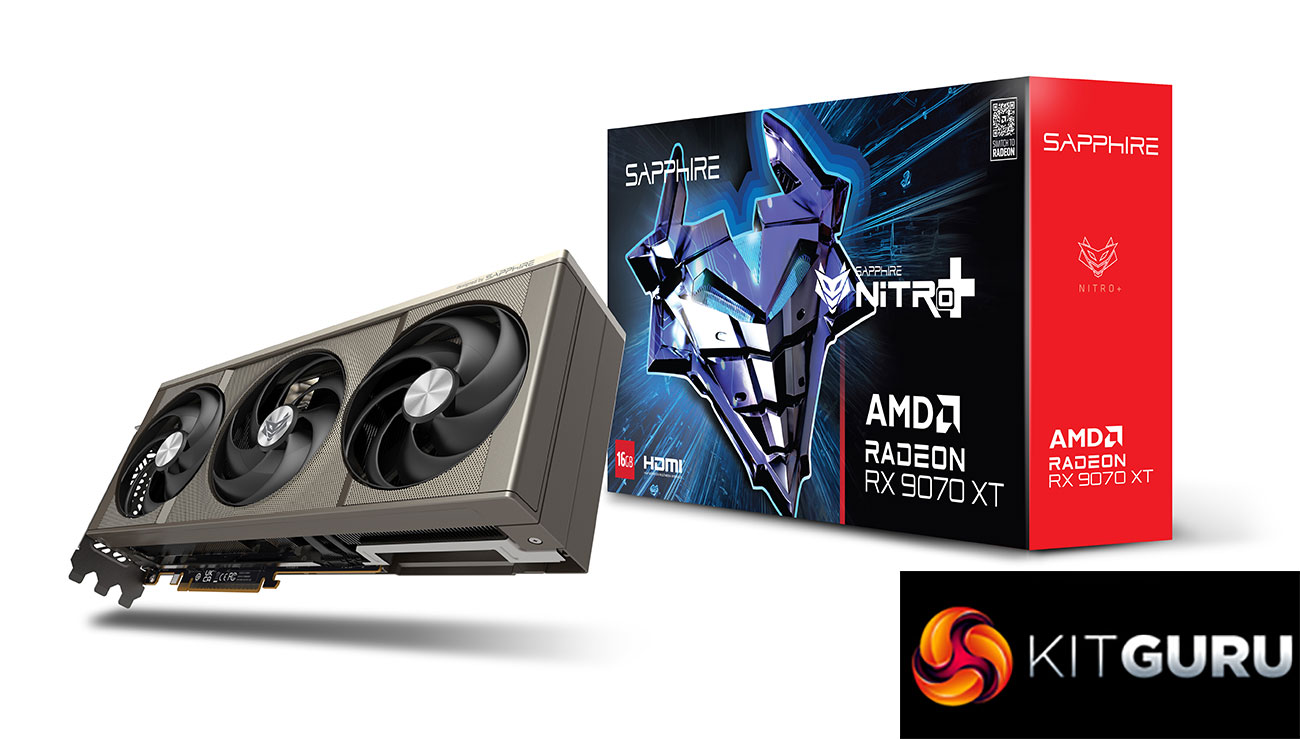
The Sapphire RX 9070 XT Nitro+ ships in a colourful box, with a large Nitro logo on the front, alongside the AMD branding. On the back, Sapphire highlights several key features of the card and RDNA 4 architecture.
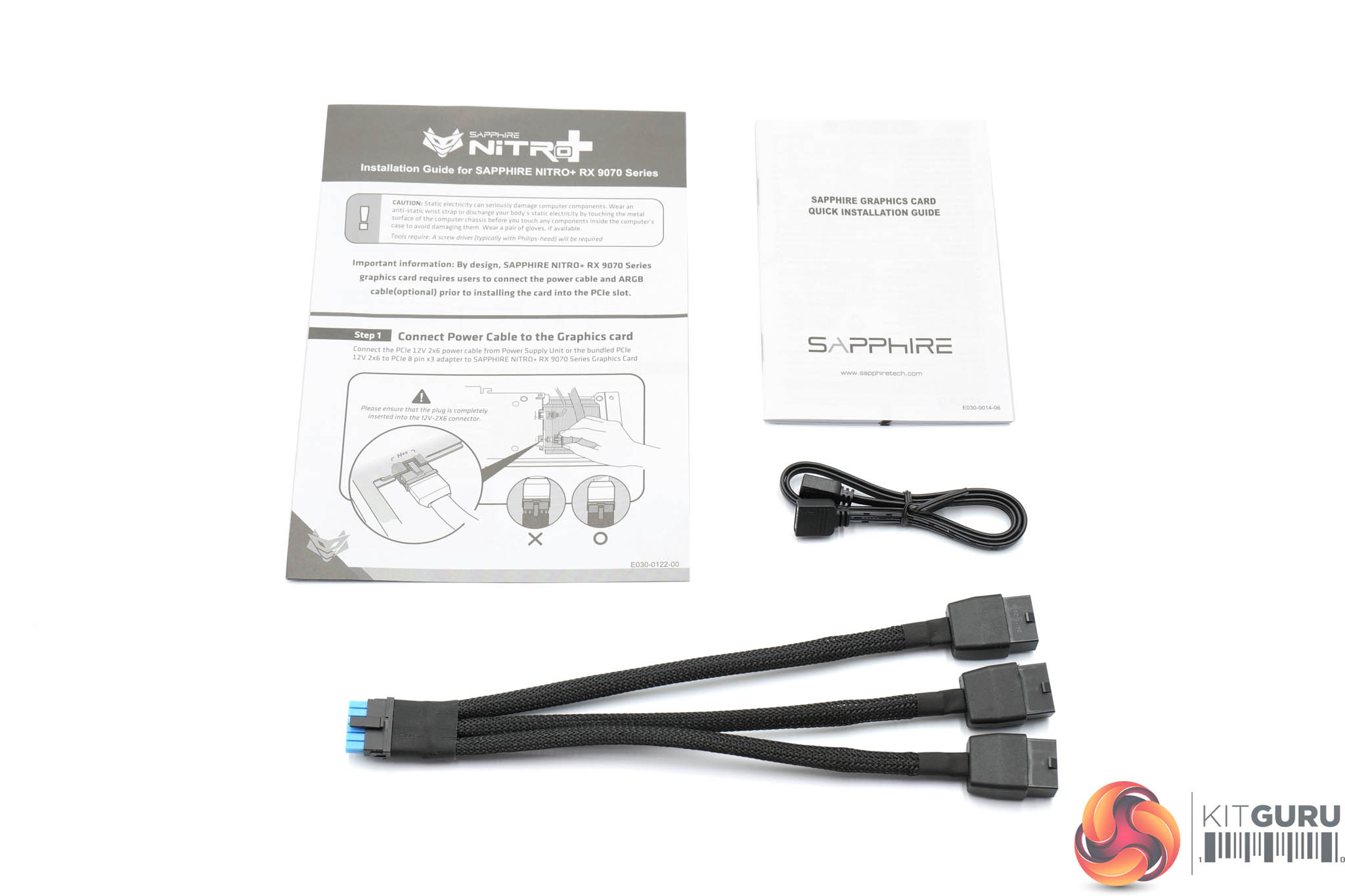
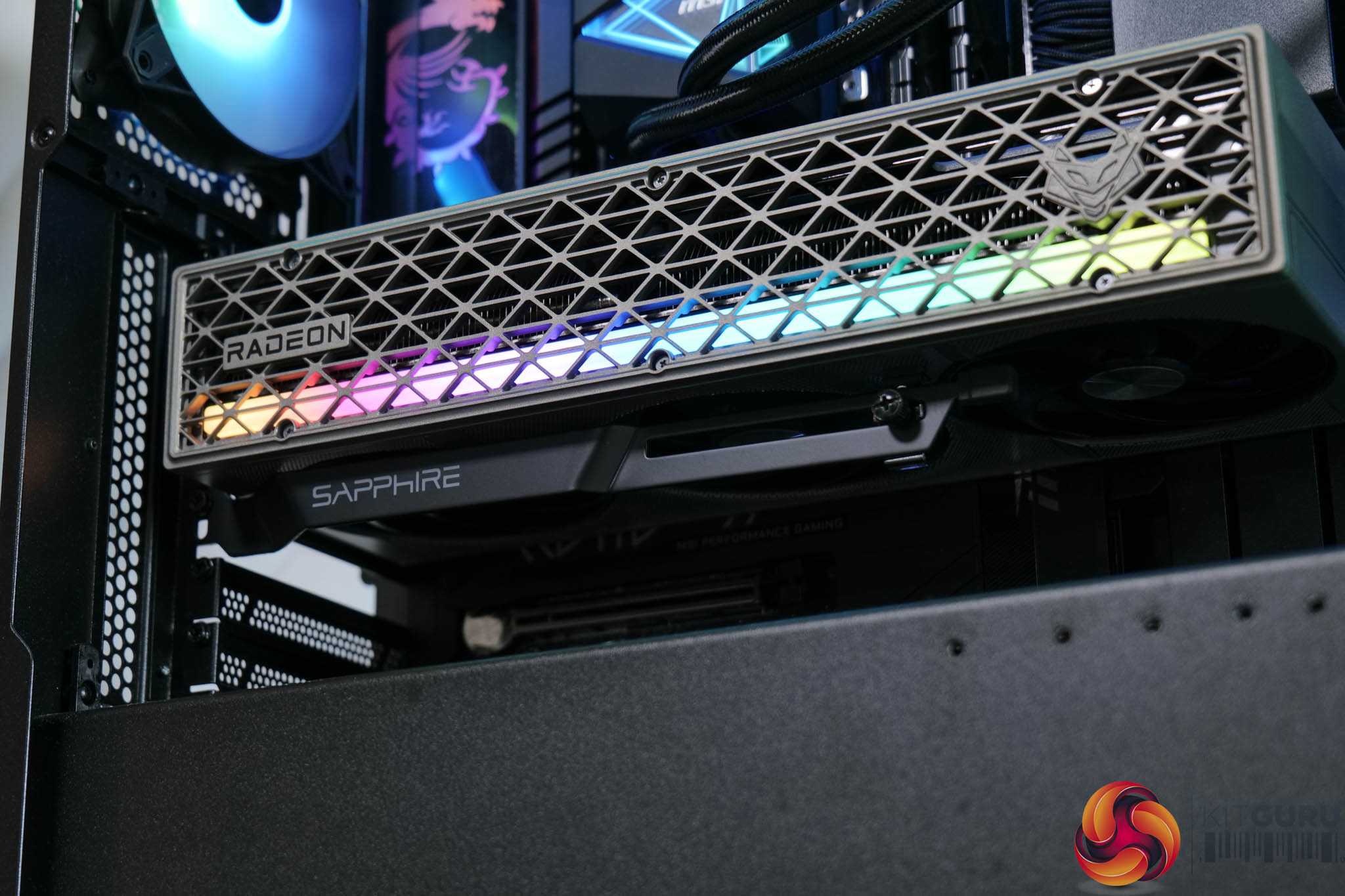
Inside, a couple of quick-start guides are included, along with an ARGB cable and triple 8-pin power adapter. A GPU support bracket also comes bundled, I would have preferred if it was colour matched to the rest of the card, but that's only a minor point.
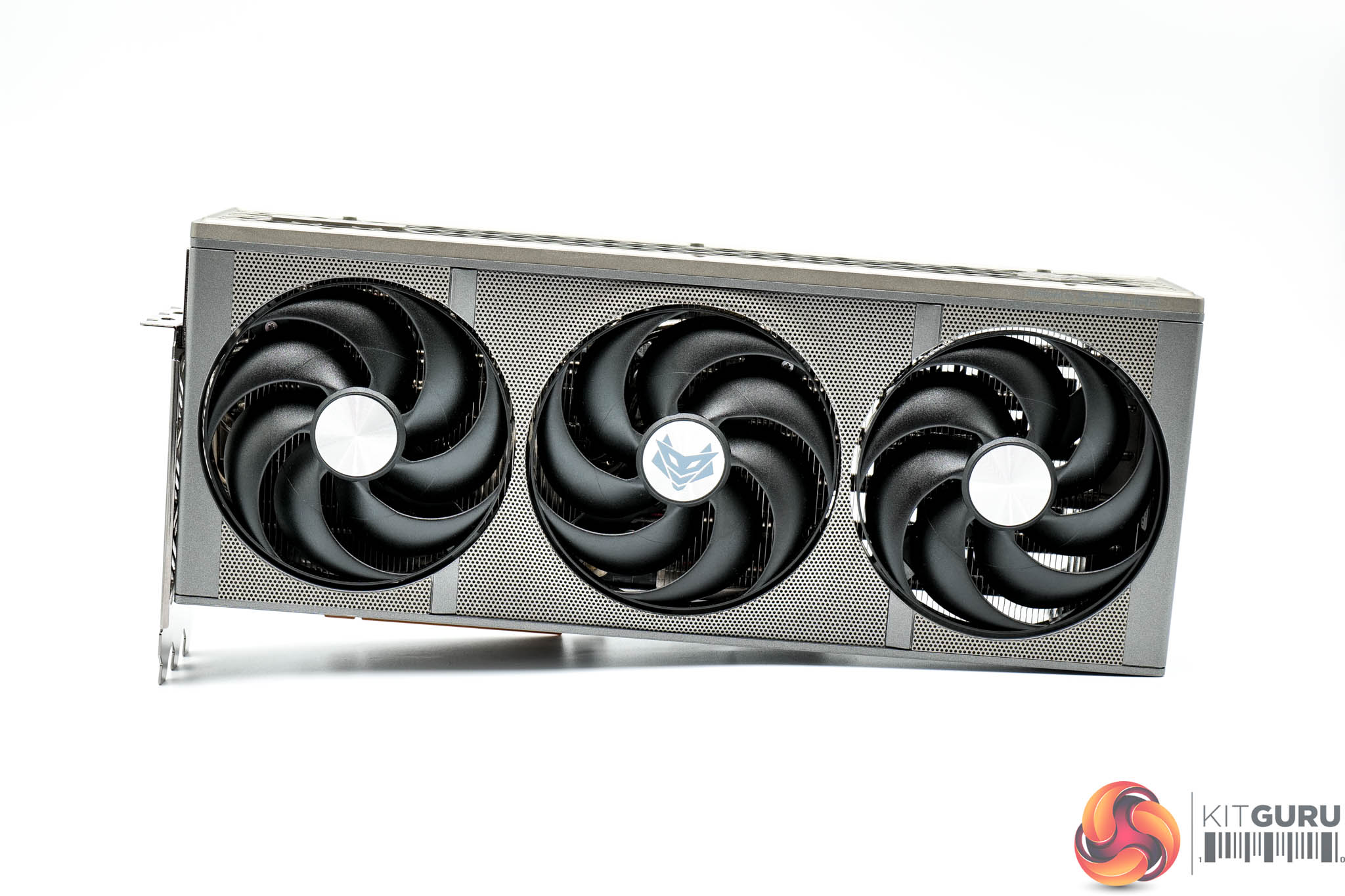
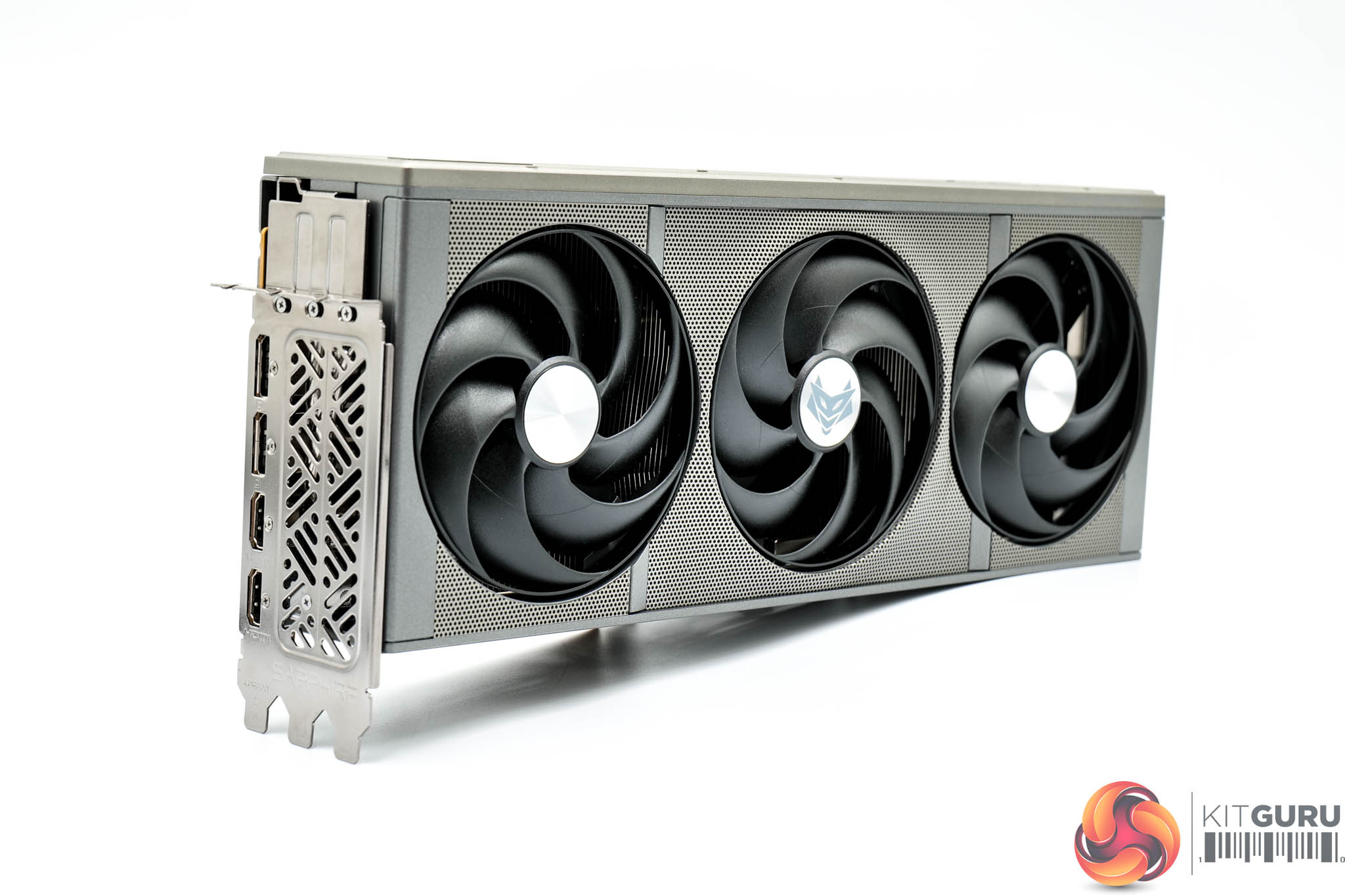
As for the graphics card itself, Sapphire continues to create, in my opinion, beautiful shroud designs. It's clearly a continuation of the overall look from the RX 7000 series, but now there's some perforations in the shroud to add some visual interest, while a grille covers the front side. It just strikes me as a very refined look, and I personally love it.
Sapphire is of course using a triple-fan setup, with three of the company's AeroCurve Fan Blade designs being deployed, each measuring 100mm in diameter.
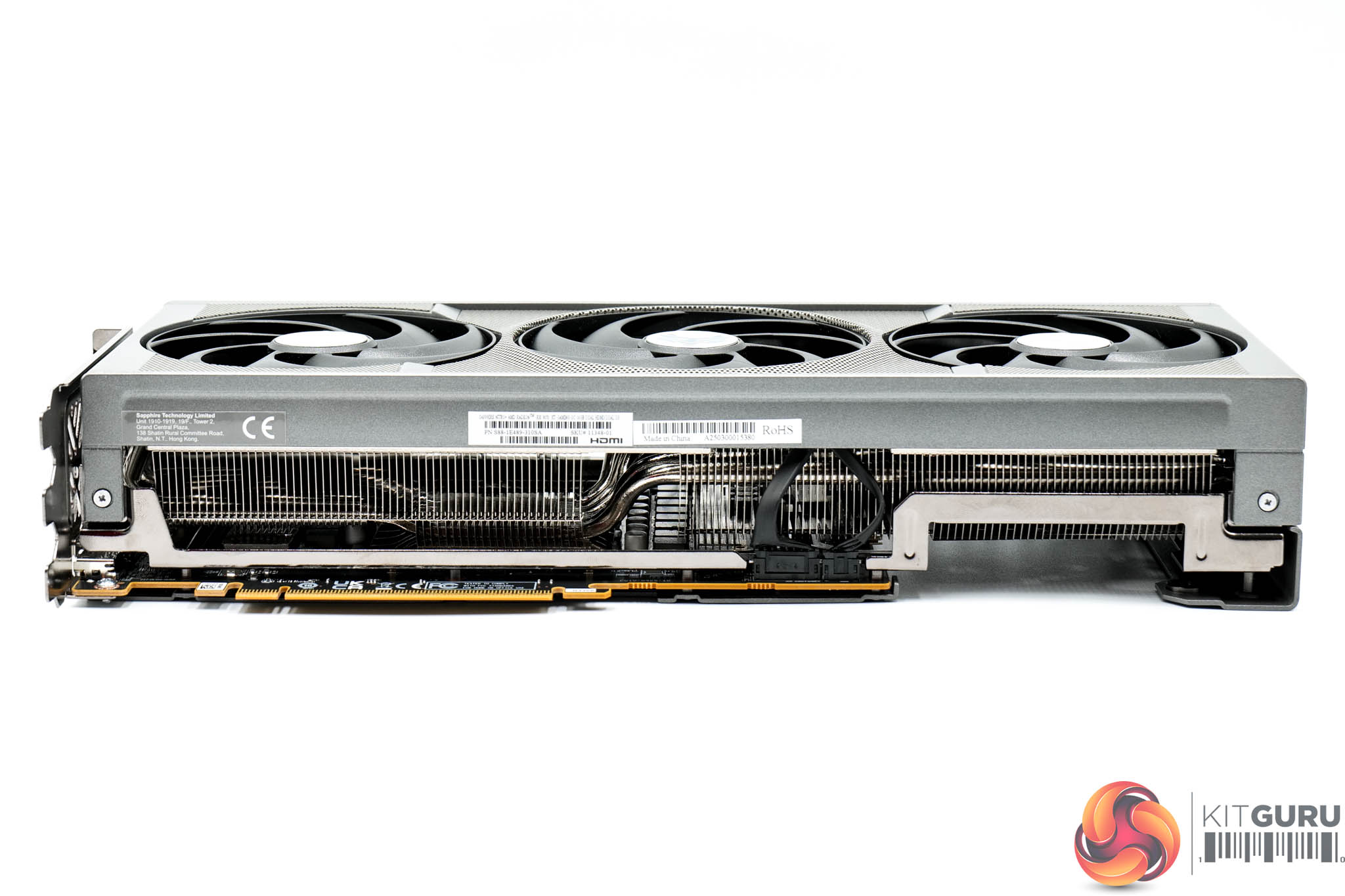
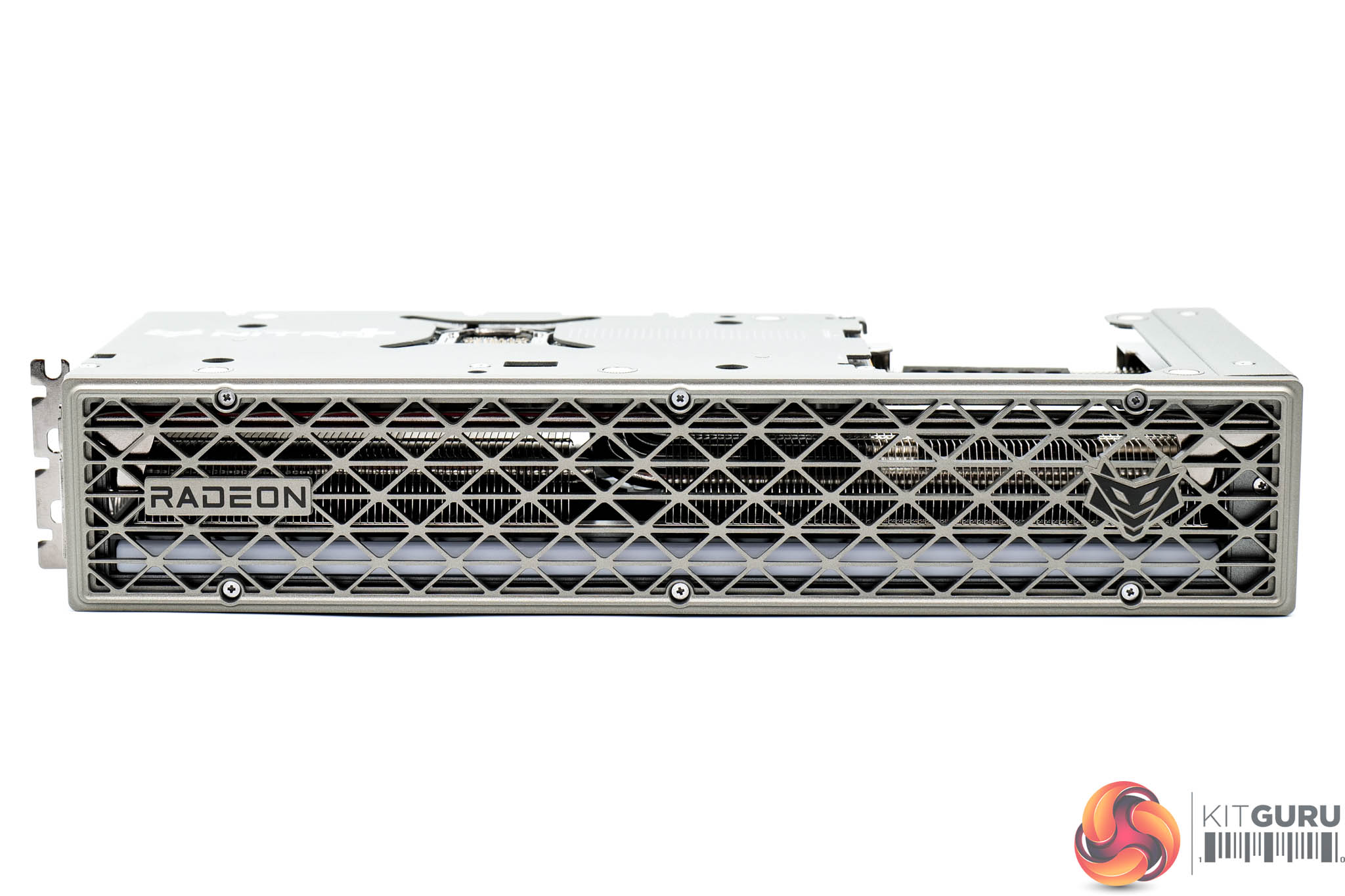
In terms of its size, the Nitro+ measures 330.8 x 128.5 x 65.68mm, so it's just over a triple-slot thickness. It weighs in at 1591g without the backplate cover, or 1898g with it.
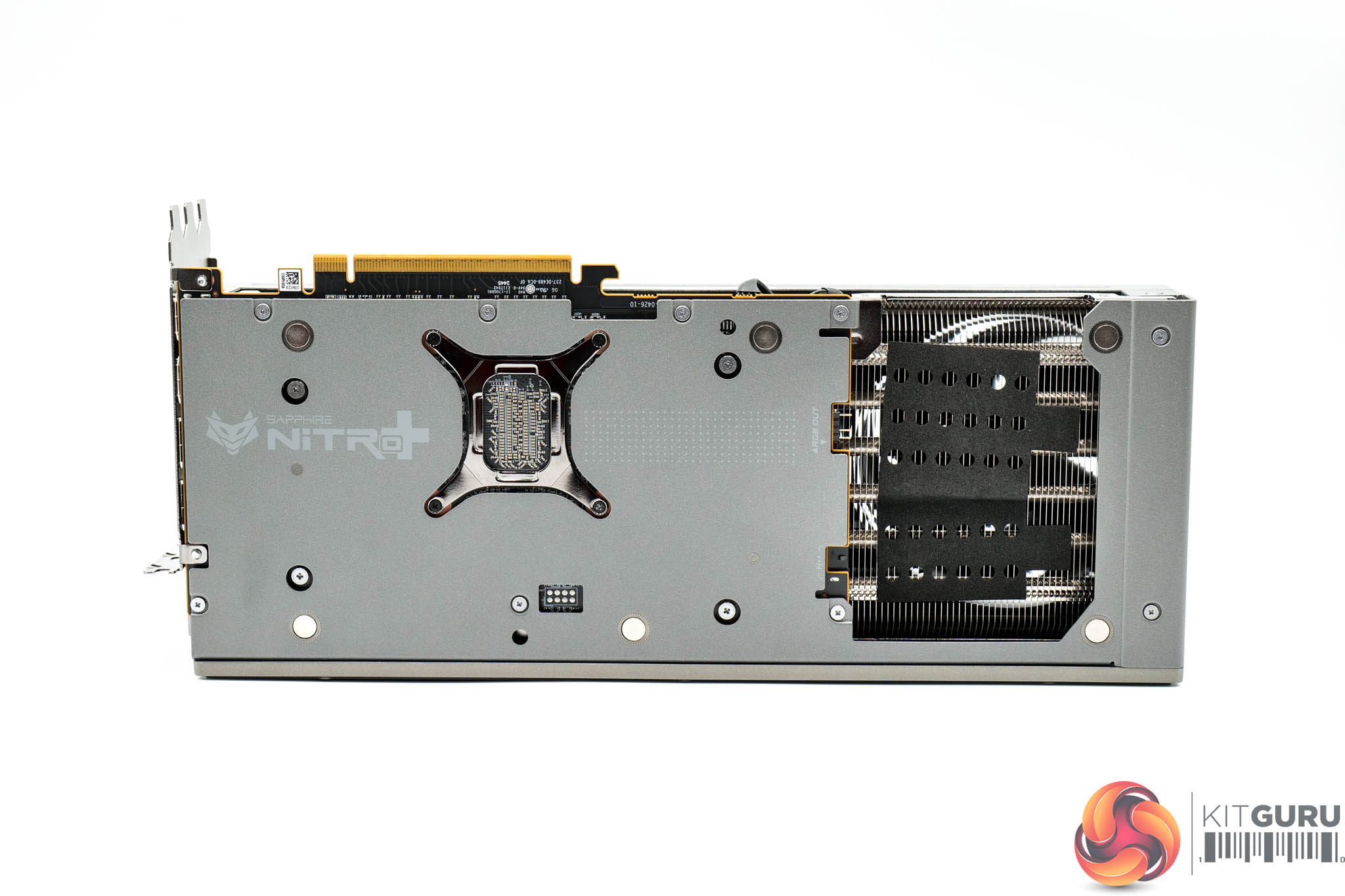
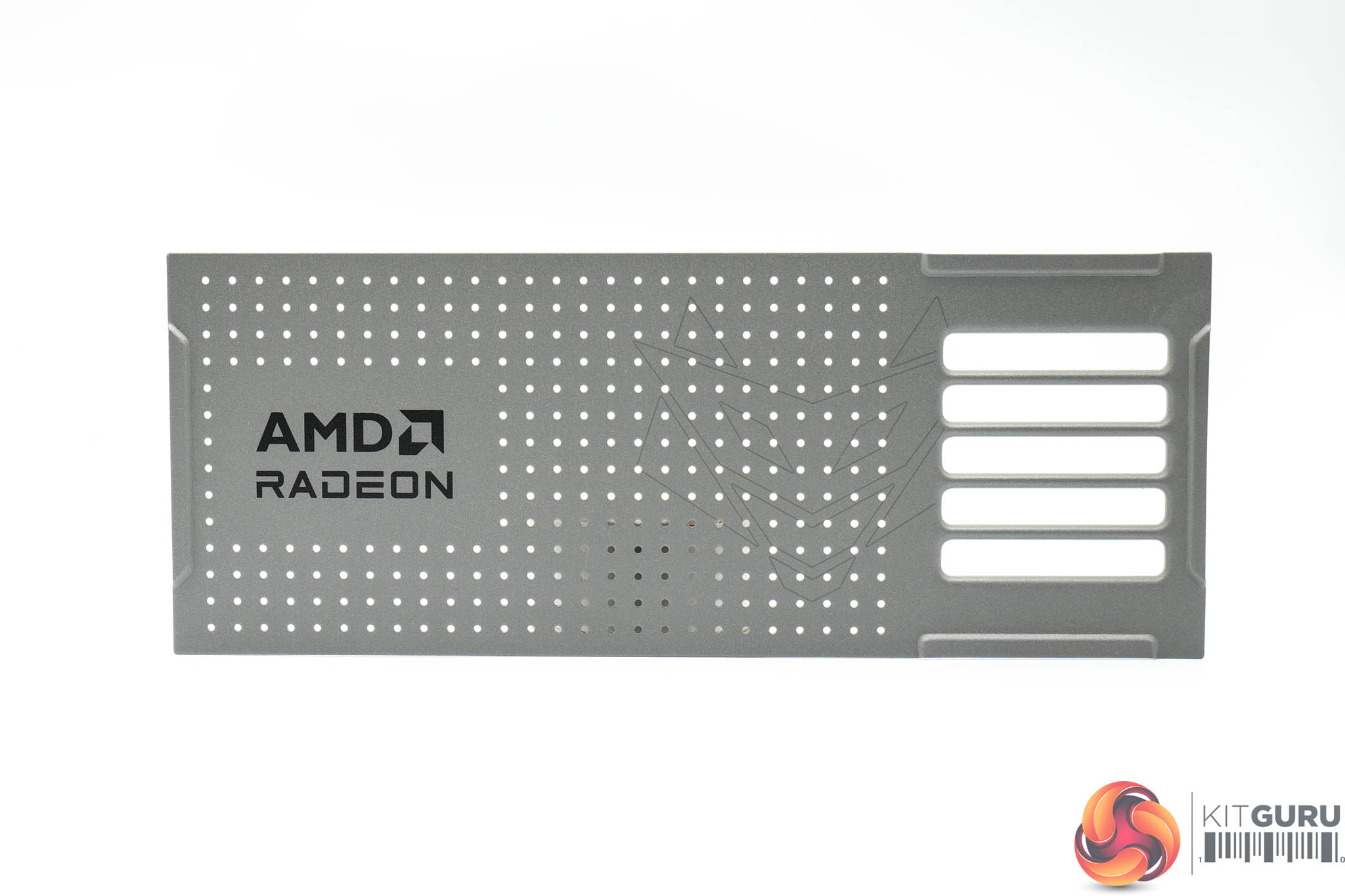
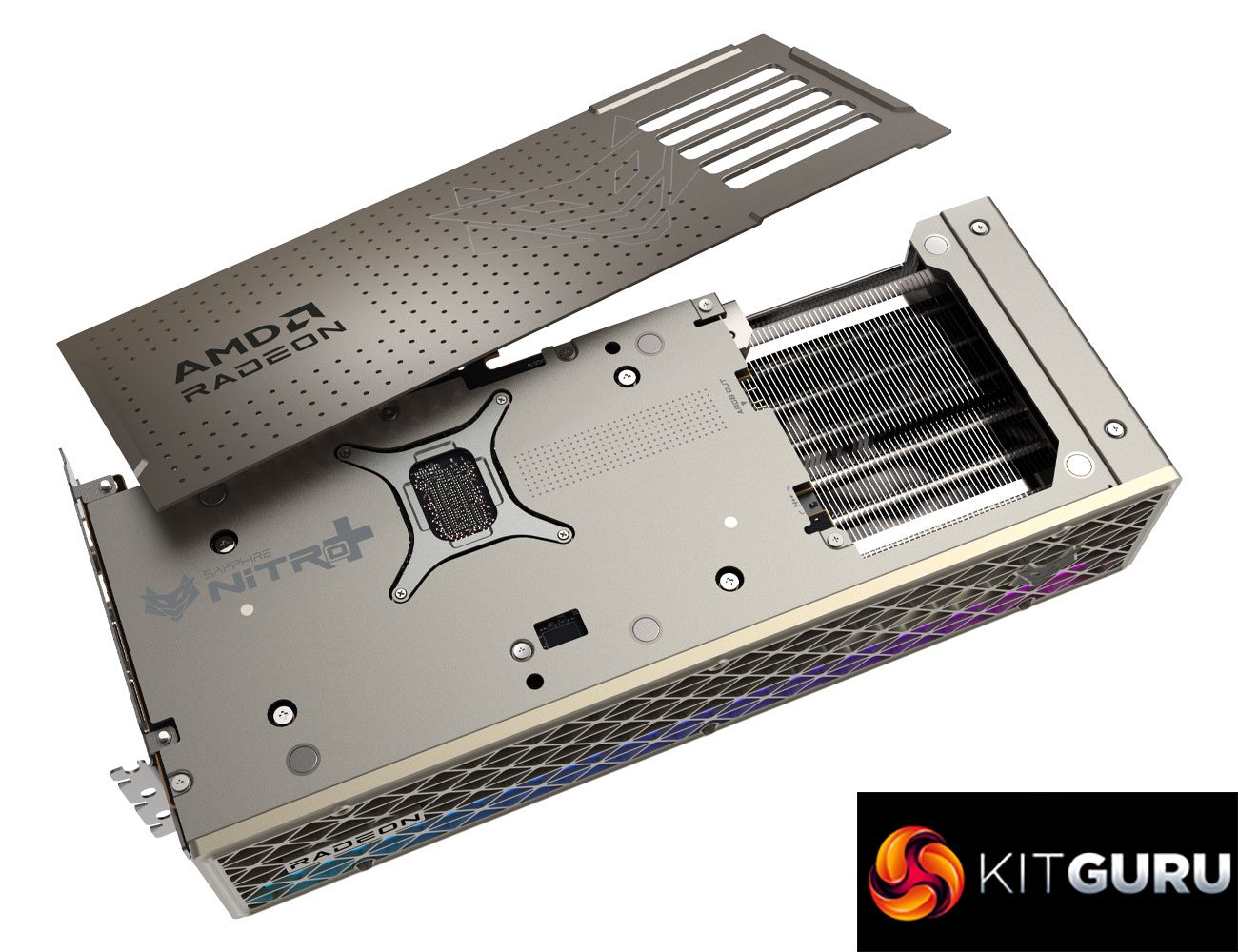
Speaking of the backplate, at first glance it looks fine, but nothing special, with a large cut-out area towards the end of the card. Sapphire actually includes a removable backplate cover, which it calls ‘MagniPlate' and this comes separately in the box.
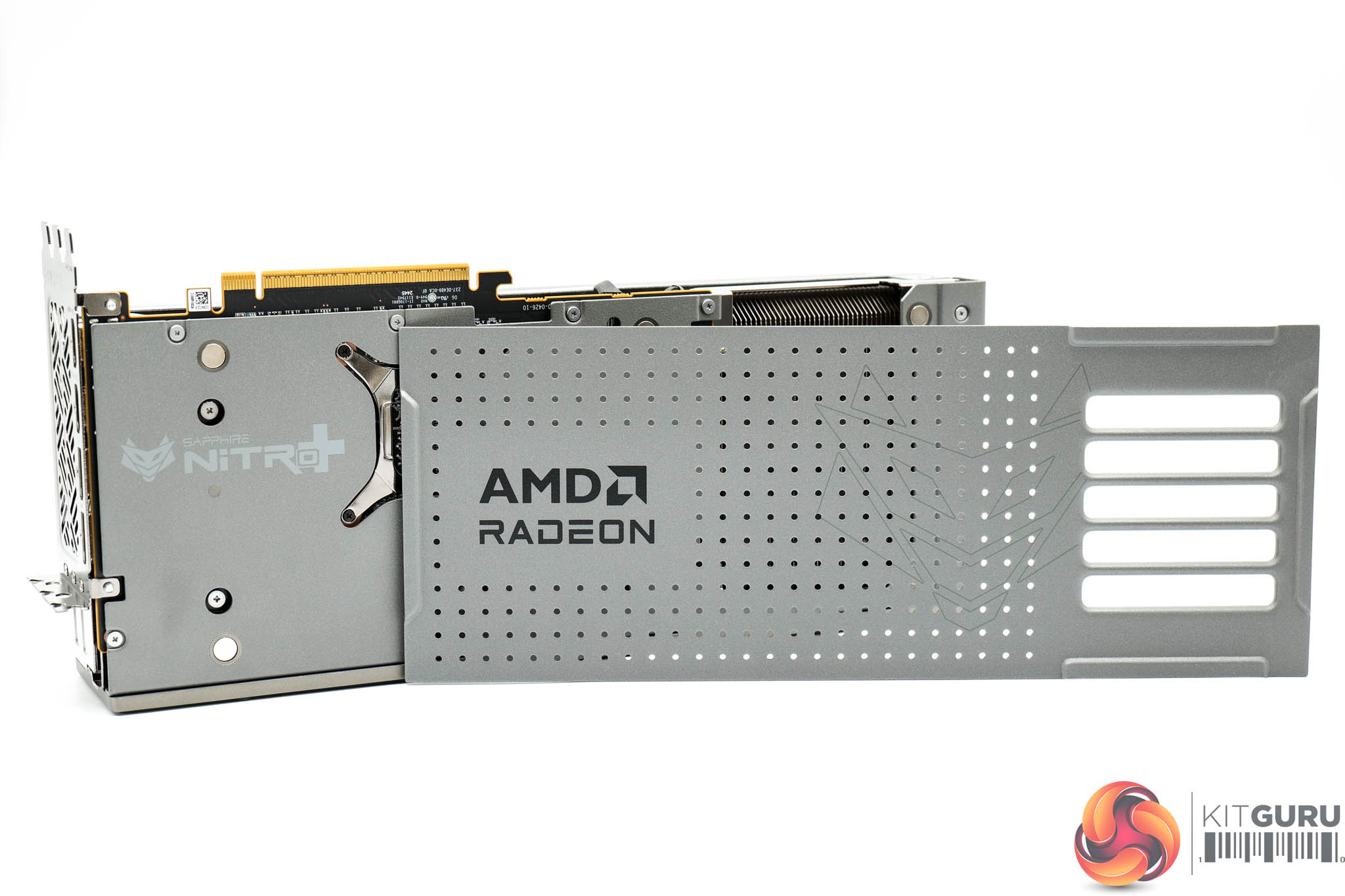
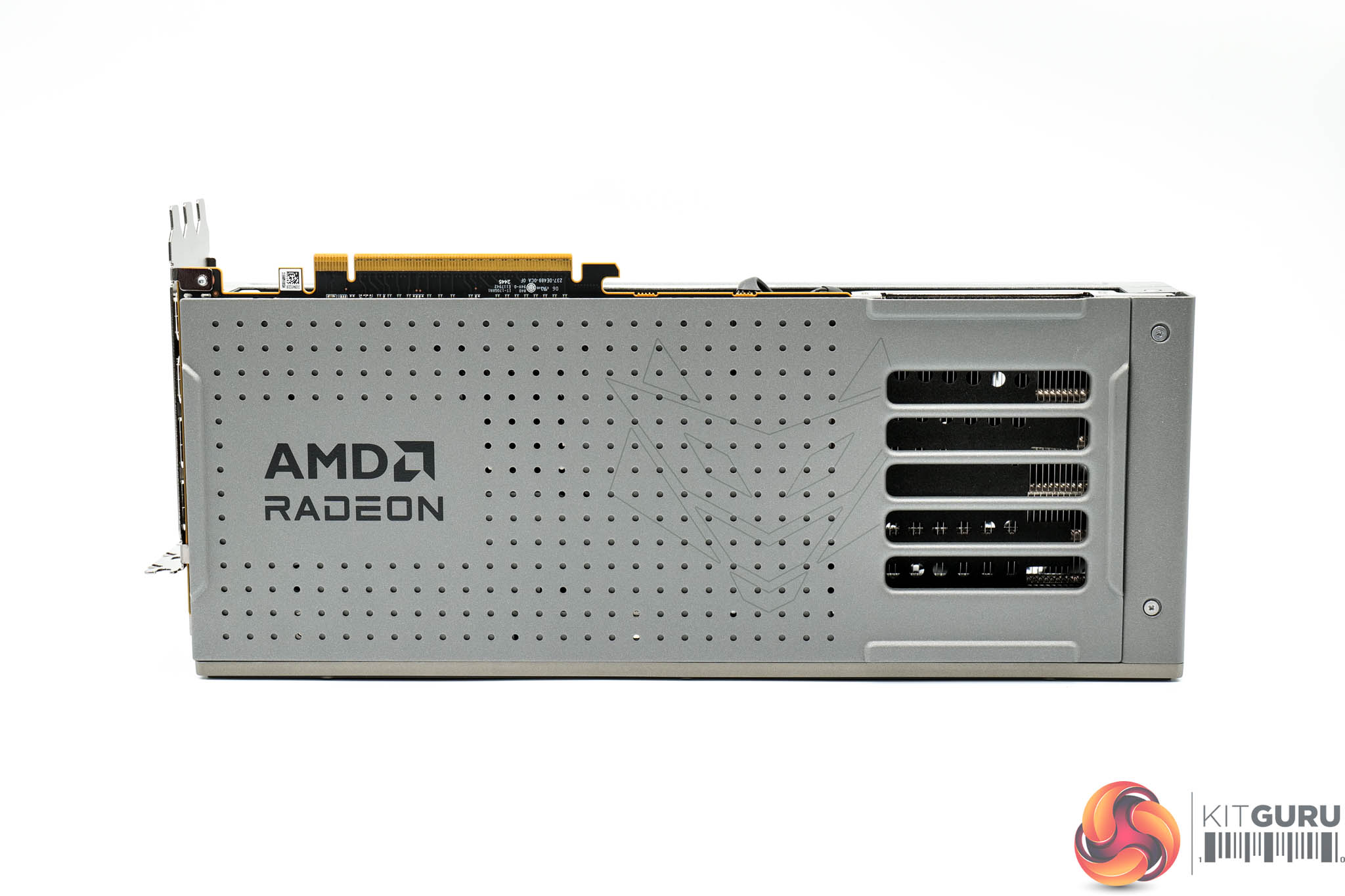
This simply attaches to the back of the card via six very strong magnets, and it instantly cleans up the overall look, with the perforations matching the shroud design.
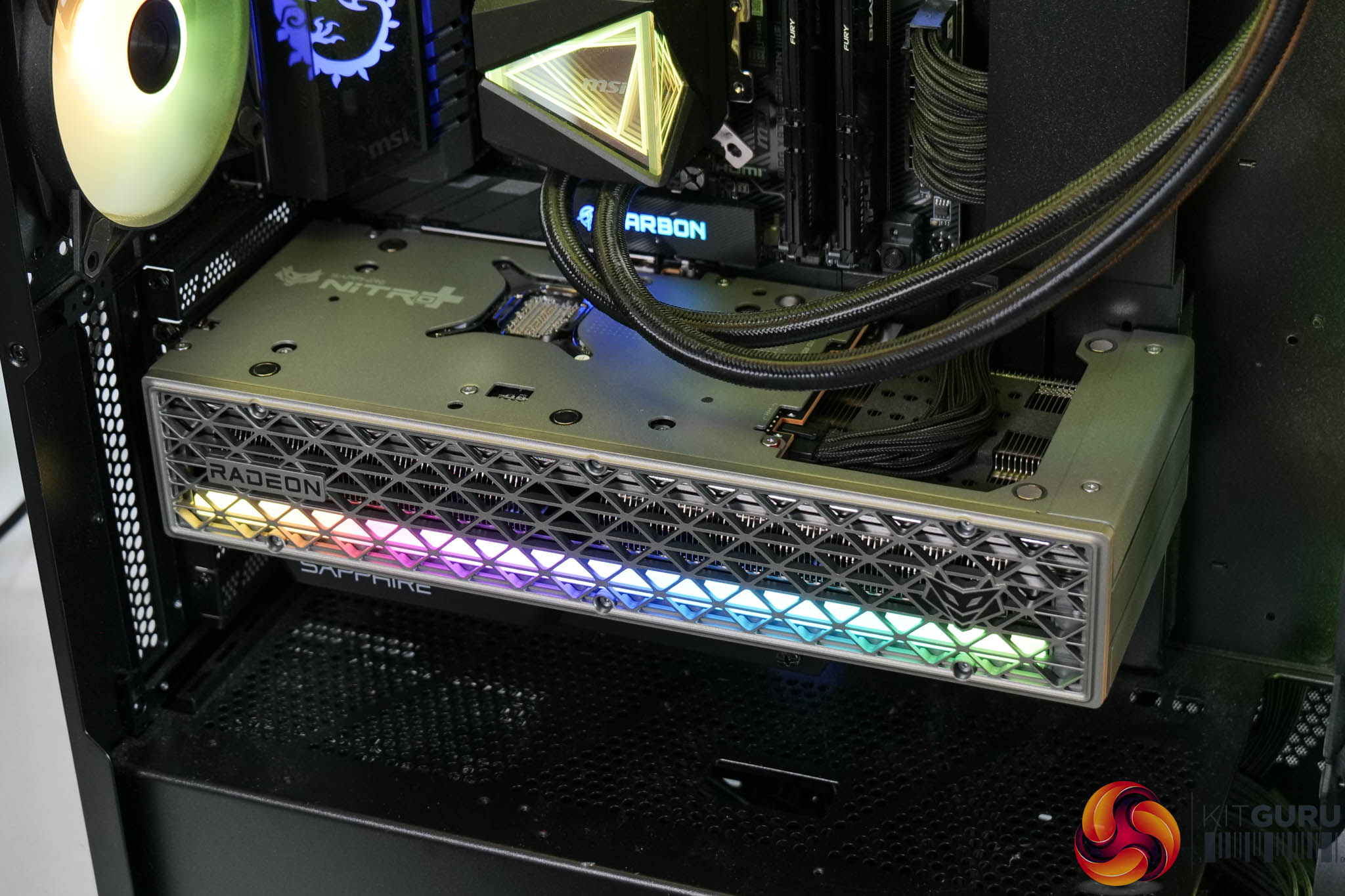

On top of that, the removable cover acts as a way to hide the 12VHPWR cable, which connects to the rear of the PCB. Sapphire's thinking is that the cable can route from the card, straight behind the motherboard tray and out of sight, while the cover means you don't see the cable snaking over the back of the card. It's very clever really and creates a beautiful aesthetic.
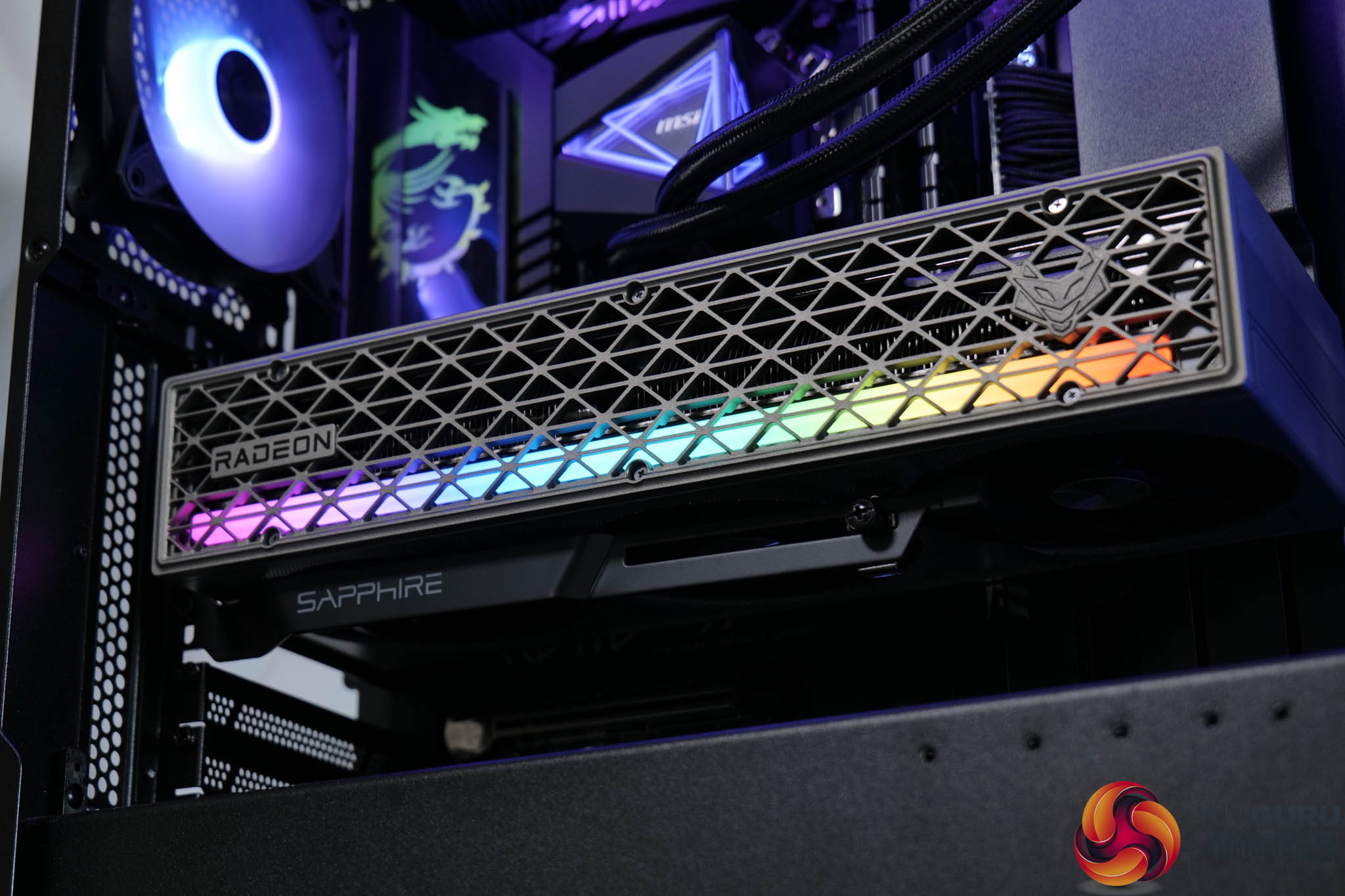
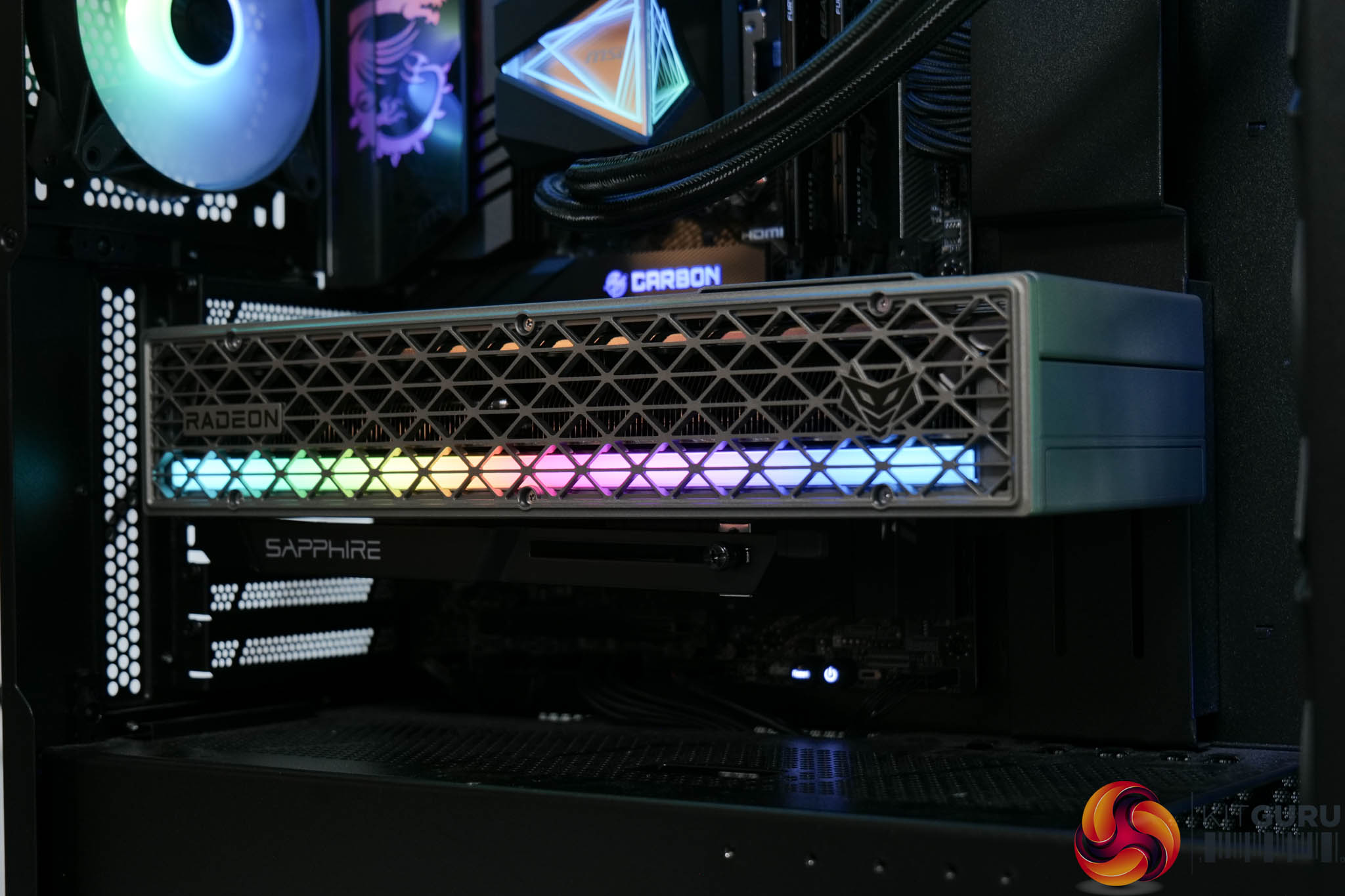
That's only enhanced by the LED strip too, something that's been carried over from the previous generation. It's not too in your face, the LEDs are well diffused, and the lighting can be controlled either in Sapphire's TriXX software or via your motherboard if you attach the ARGB cable.
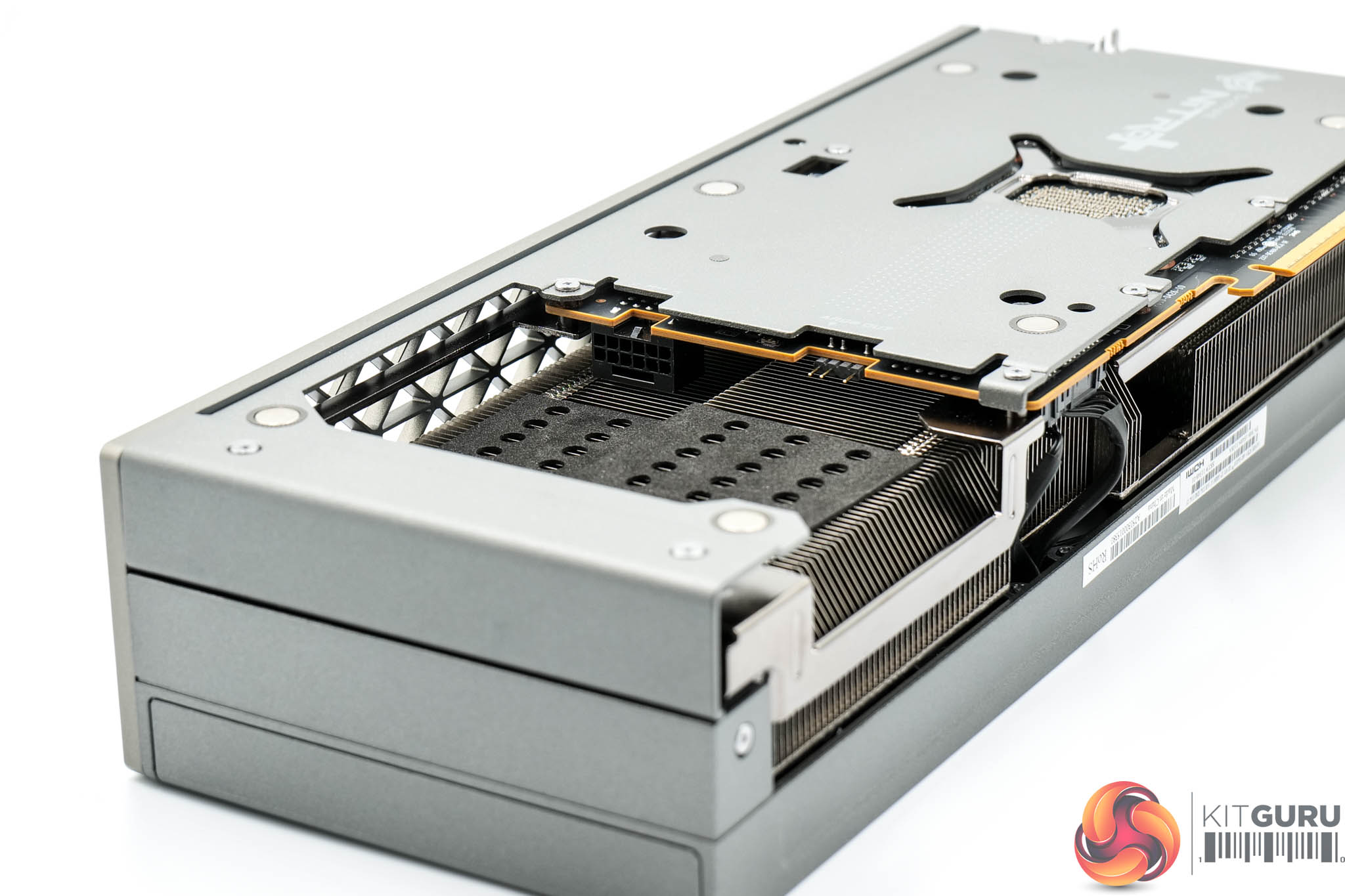
That ARGB header sits on the rear of the PCB, just next to the 12VHPWR connector.
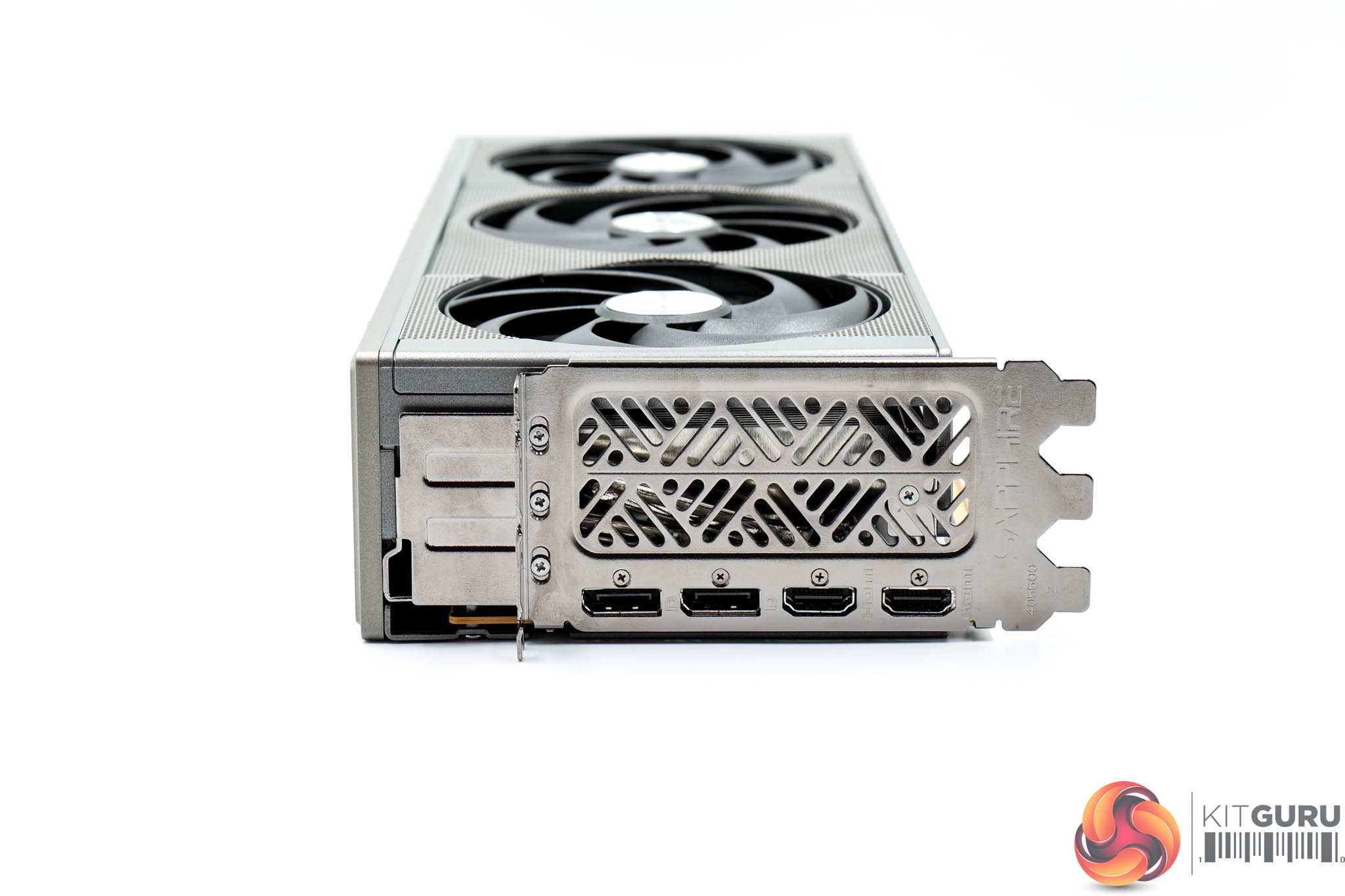
As for display outputs, Sapphire has fitted two HDMI 2.1 and two DisplayPort 2.1 connectors.
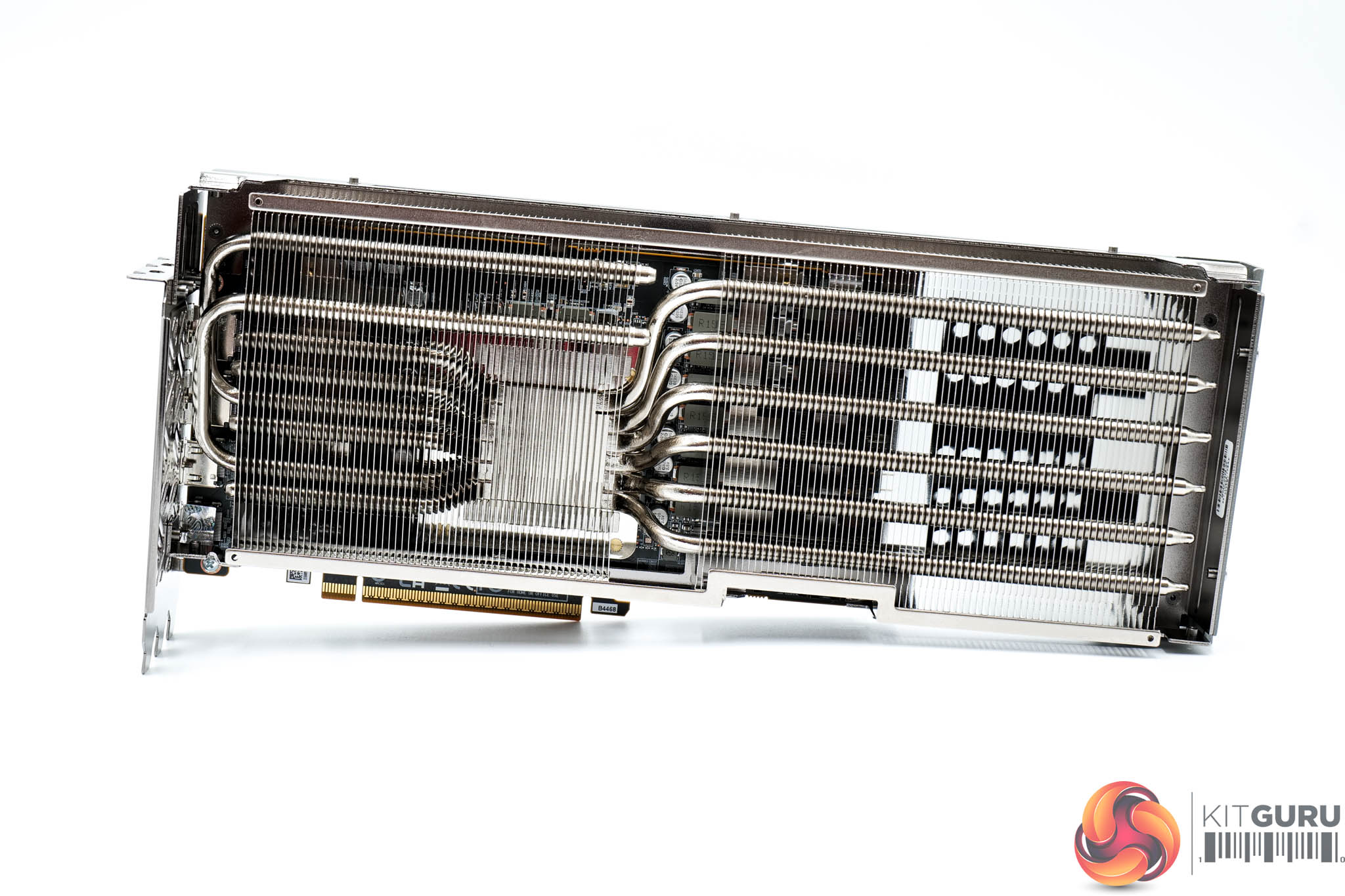
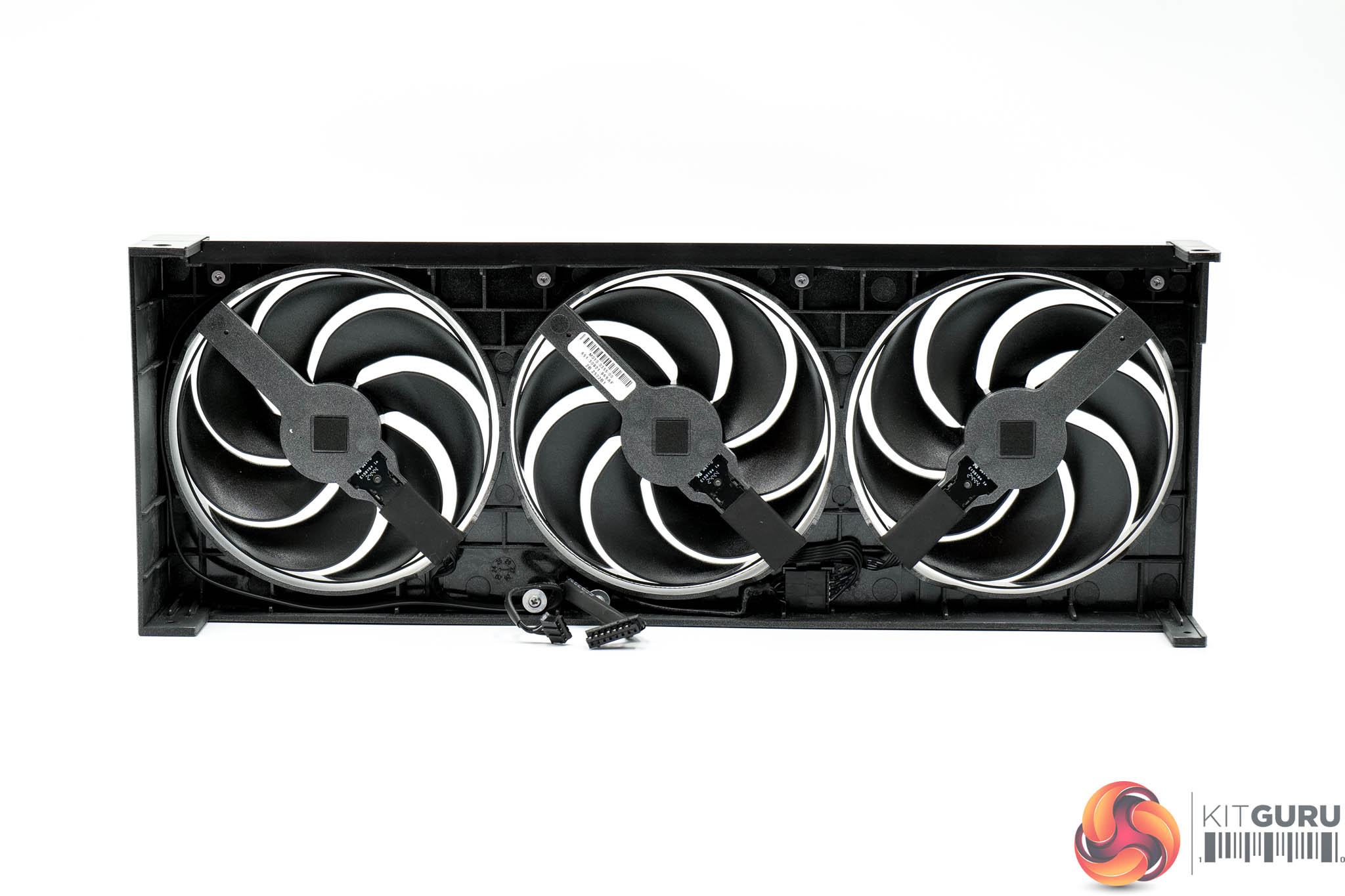
The first thing to know about disassembling the card is that Sapphire has kept its very smart design where the fan shroud can be removed independently from the rest of the heatsink, so you don't need to worry about re-pasting or completely tearing the card down if you only need to replace one fan, for instance.
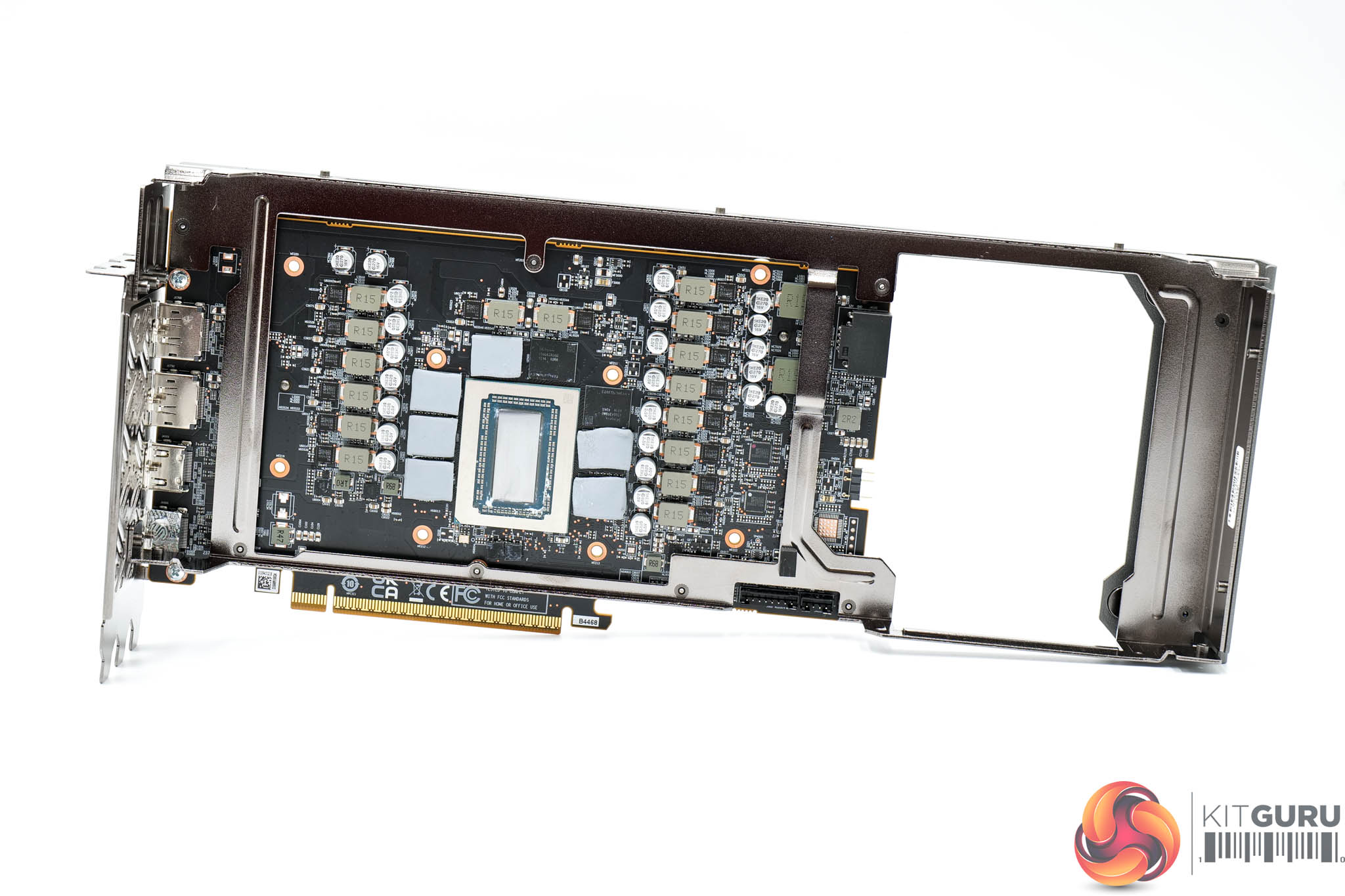
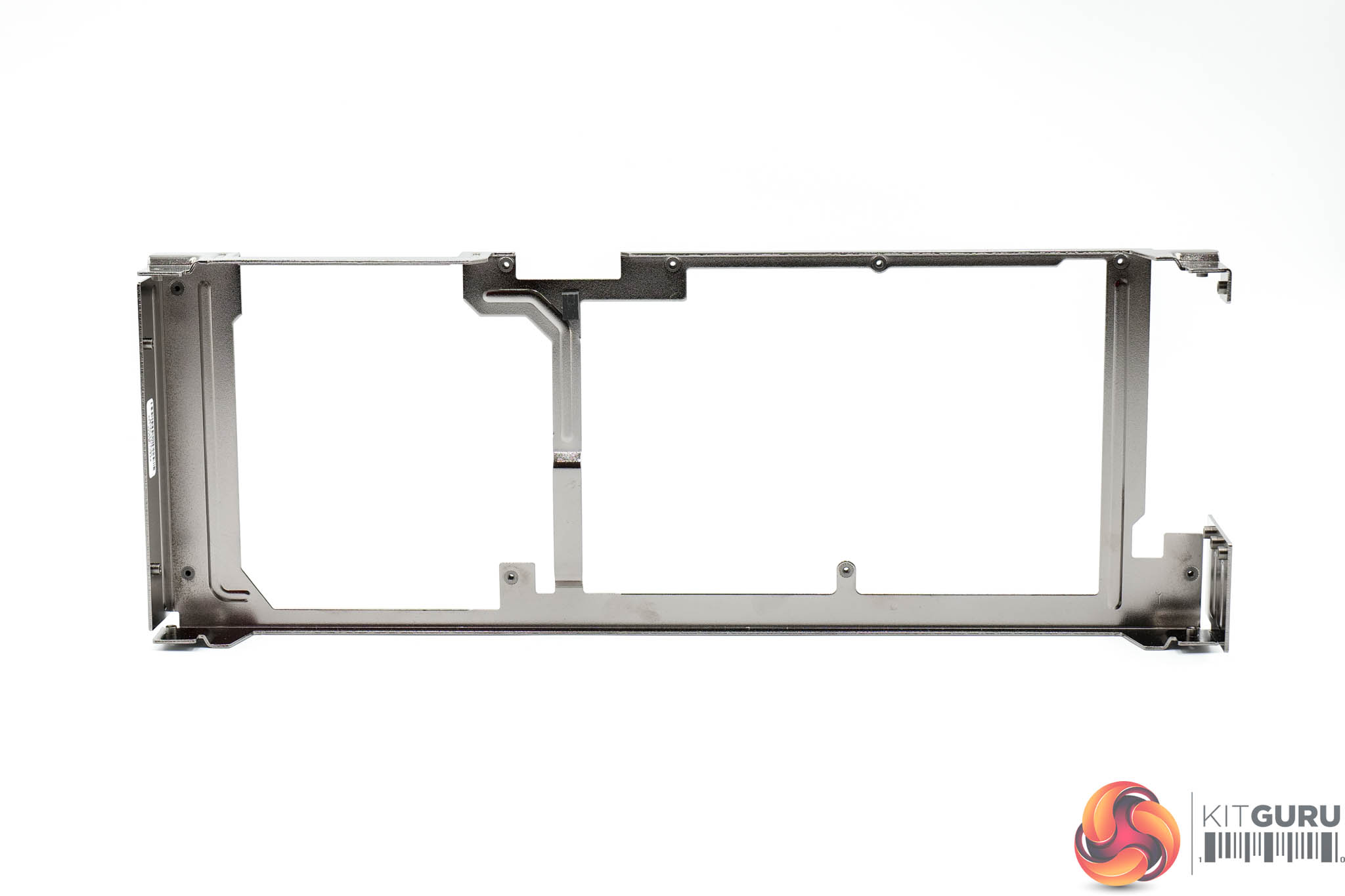
Sapphire has also fitted a steel frame underneath the heatsink to provide extra rigidity, part of the company's ‘Frame Defense' mechanism.

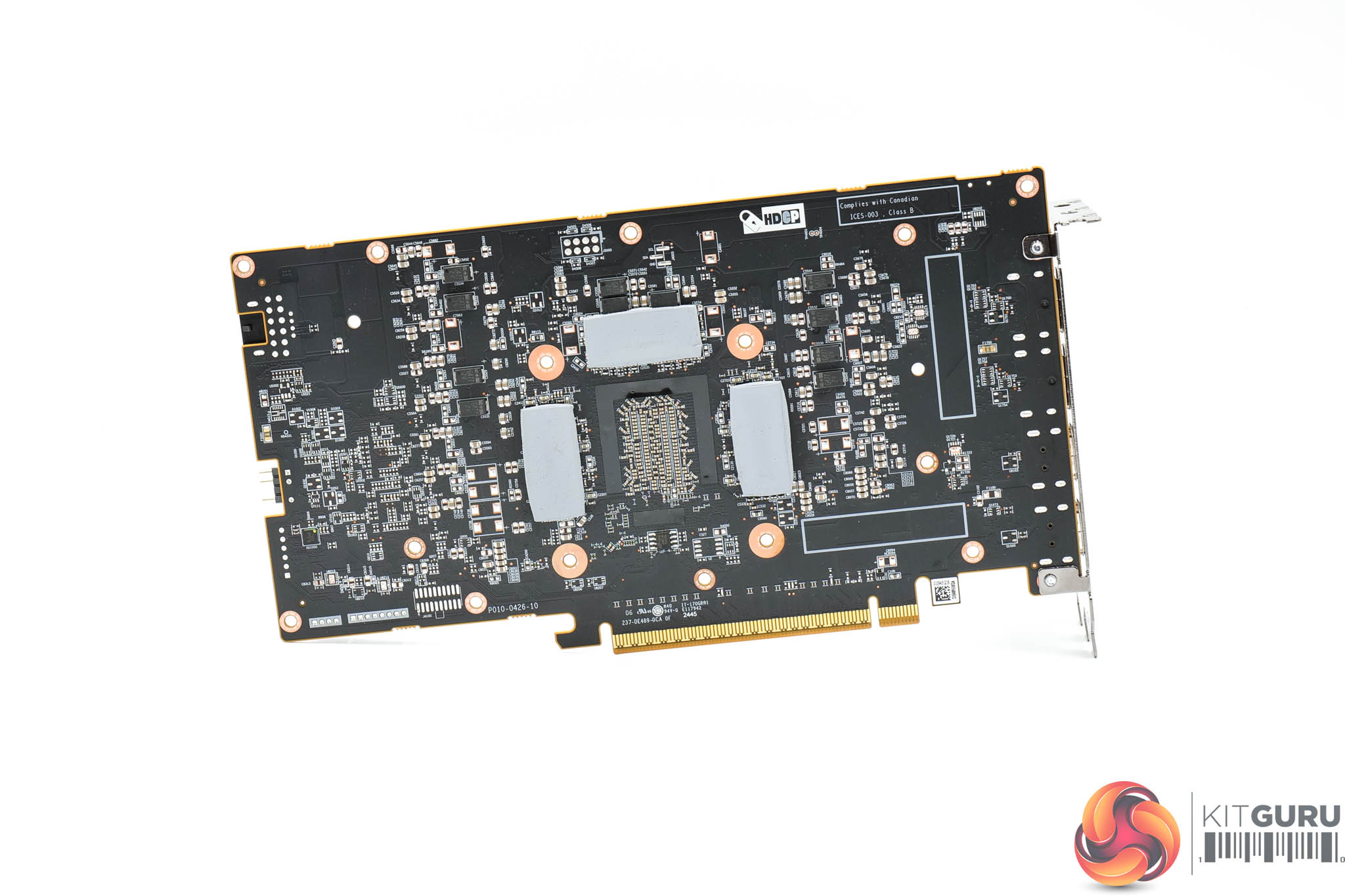
Once you make it to the PCB itself, we can see that Sapphire is using sixteen power phases overall, broken down with 10 phases for the GFX, three for the SOC, two for MVDD and one for VDDCI. These phases are controlled by a pair of Monolithic Power Systems MP2868A controllers, while Monolithic MP87993 MOSFETs are used throughout.
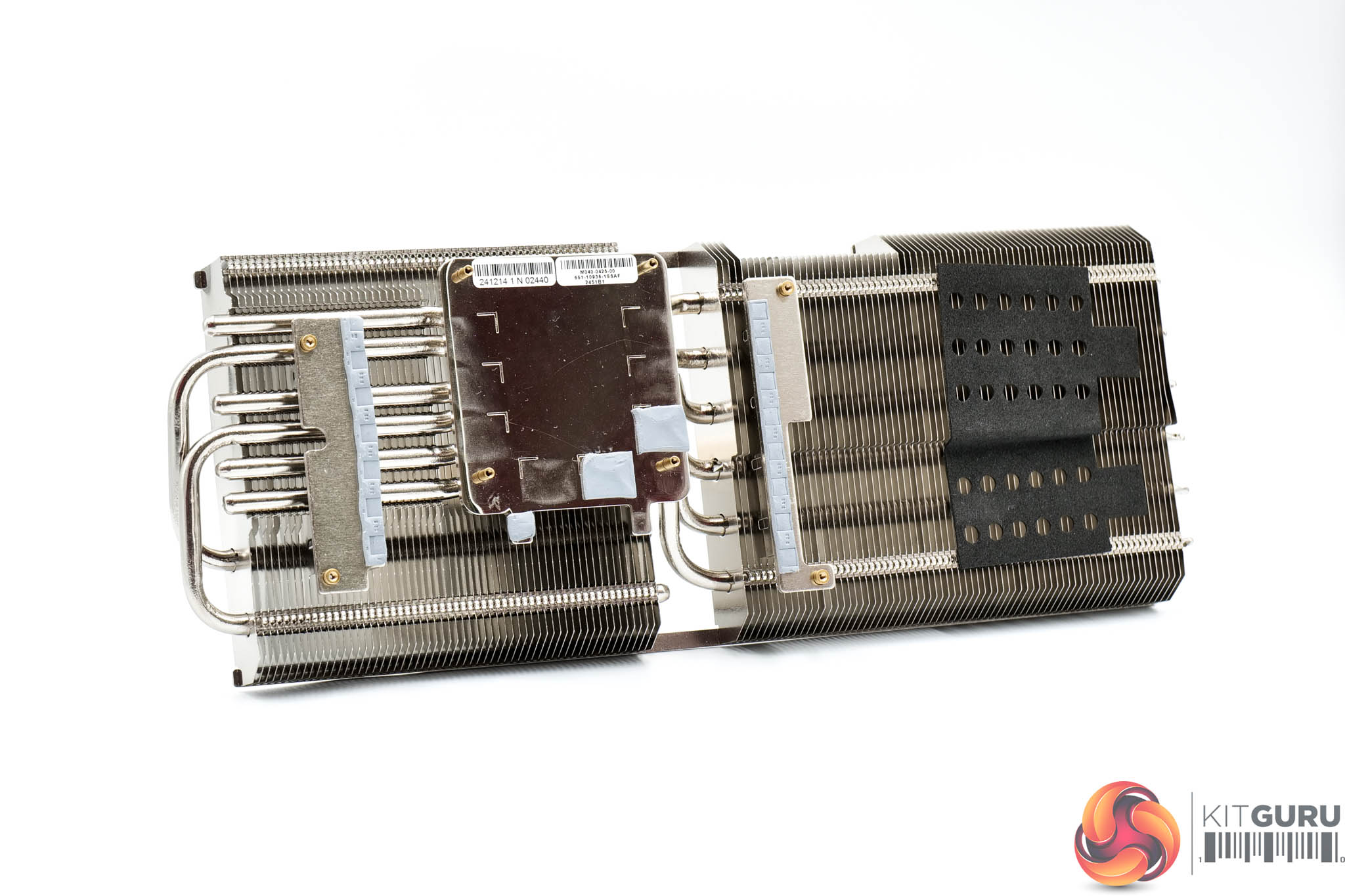
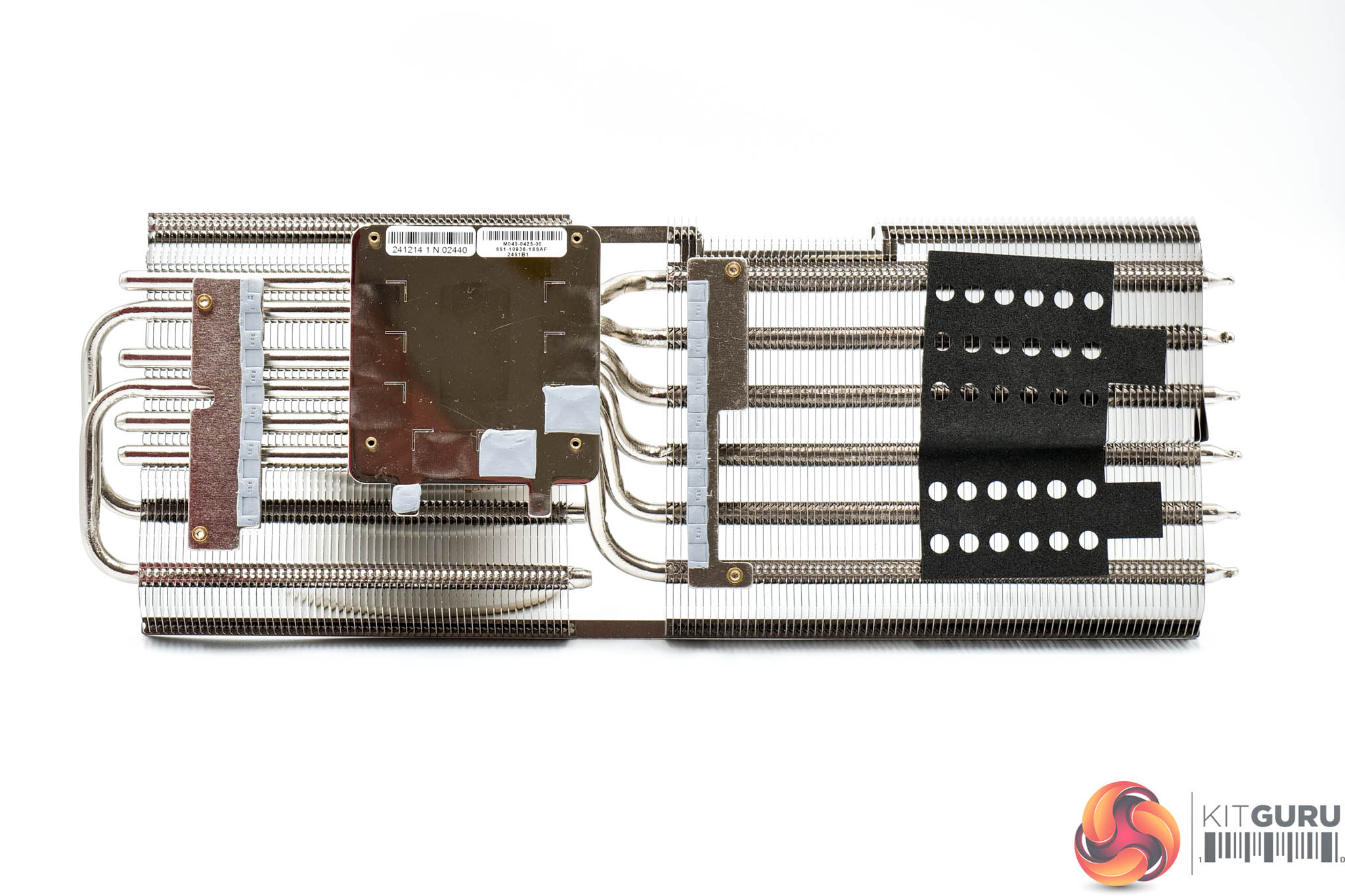
The heatsink utilises six heatpipes, with the GPU and VRAM contacting with a central baseplate. Smaller secondary plates are used to contact the VRM.
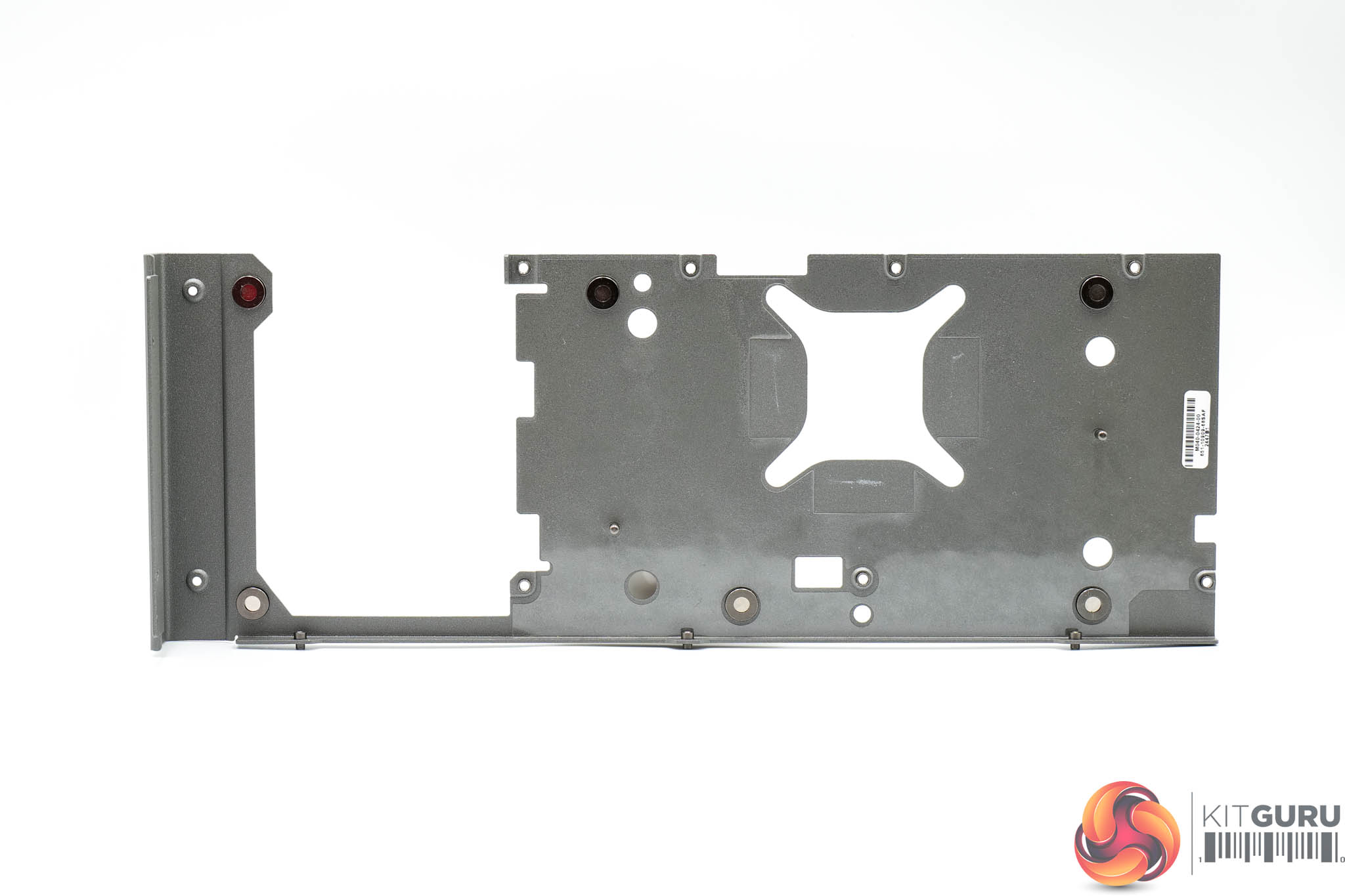
Lastly, the backplate is left bare, but contact is made to the back of the PCB via three thermal pads which sit behind the memory modules.
Driver Notes
- AMD GPUs (except RX 9070 series) were benchmarked with the Adrenalin 24.12.1 driver.
- AMD RX 9070 and RX 9070 XT were benchmarked with the Adrenalin 24.30.31.03 driver supplied to press.
- Nvidia GPUs (except for RTX 50 series) were benchmarked with the 566.14 driver.
- RTX 5090 was benchmarked with the 571.86 driver supplied to press.
- RTX 5080 was benchmarked with the 572.02 driver supplied to press.
- RTX 5070 Ti was benchmarked with the 572.43 driver supplied to press.
- RTX 5070 was benchmarked with the 572.50 driver supplied to press.
Results are only directly comparable where this exact configuration has been used.
Test System:
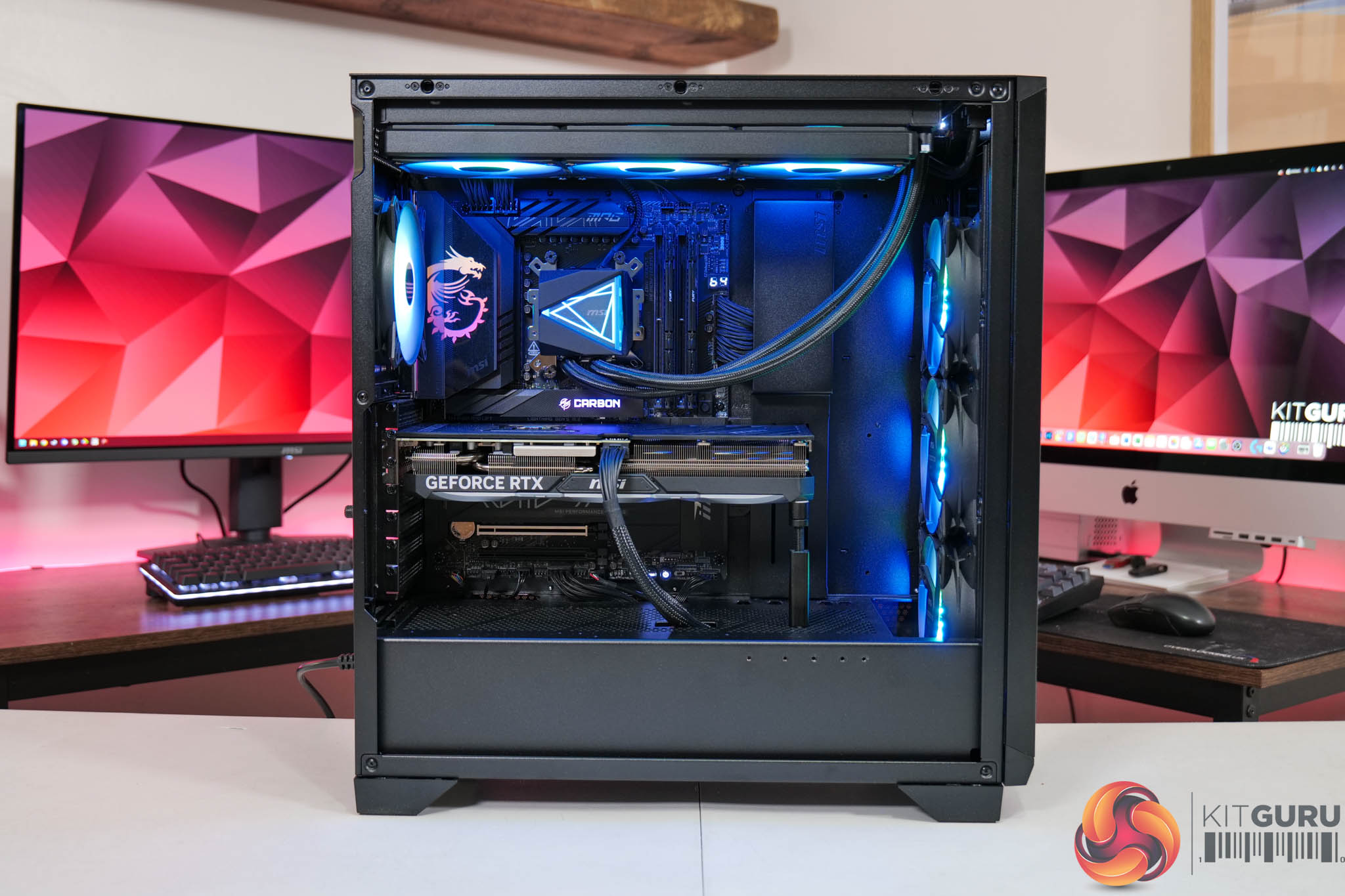
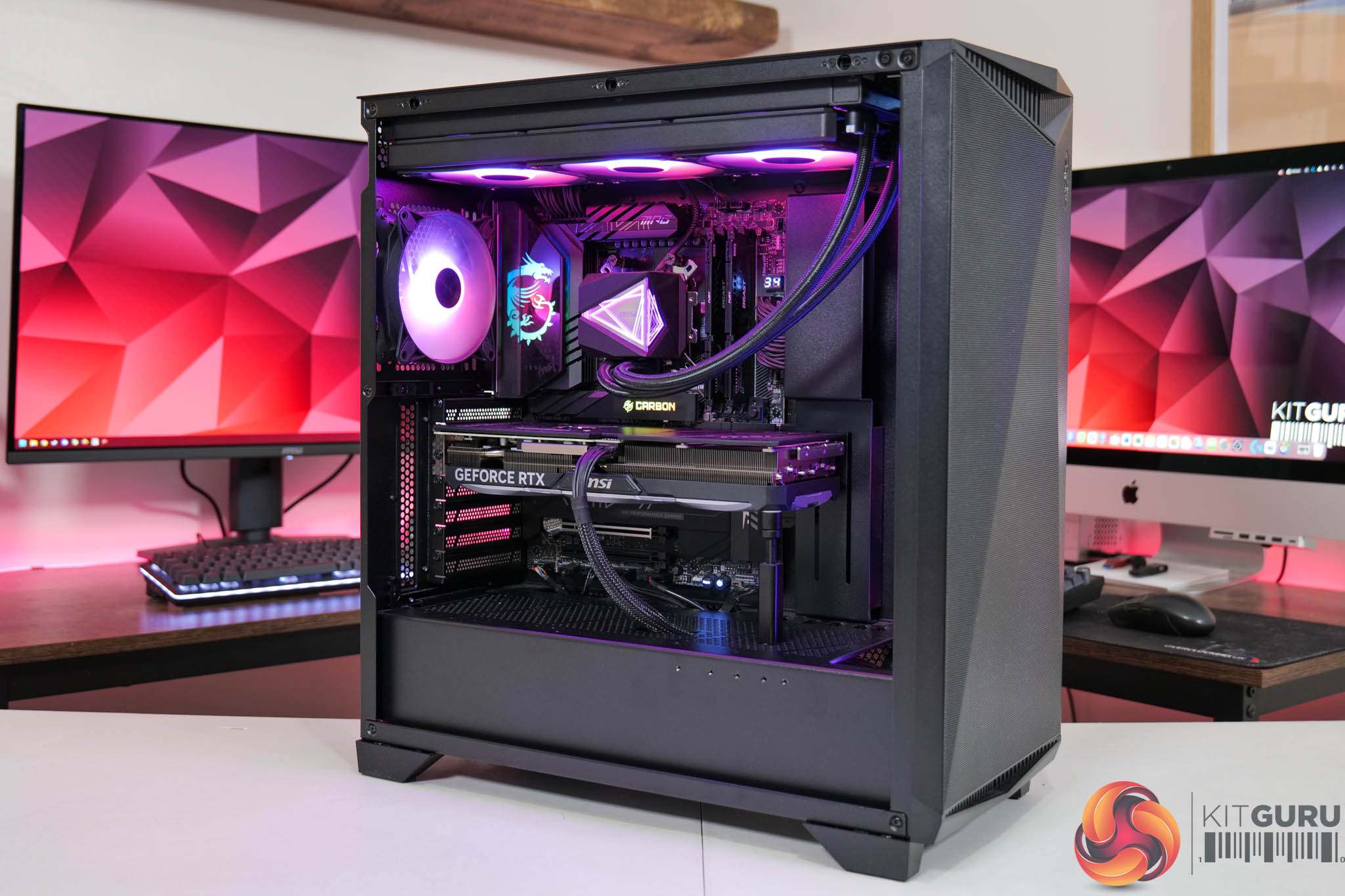
We test using a custom built system powered by MSI, based on AMD's Zen 5 platform. You can view the Powered by MSI store on AWD-IT's website HERE.
| CPU |
AMD Ryzen 7 9800X3D
|
| Motherboard |
MSI MPG X870E Carbon WiFi
|
| Memory |
64GB (2x32GB) Kingston Fury Beast DDR5 6000MT/s CL30
|
| Graphics Card |
Varies
|
| SSD |
4TB Kingston NV3 Gen 4 PCIe NVMe
|
| Chassis | MSI MPG Gungnir 300R Airflow |
| CPU Cooler |
MSI MAG CoreLiquid i360
|
| Power Supply |
MSI MEG Ai1300P
|
| Operating System |
Windows 11 23H2
|
| Monitor |
MSI MPG 321URX QD-OLED
|
| Resizable BAR |
Enabled for all supported GPUs
|
Comparison Graphics Cards List
- ASRock RX 9070 XT Taichi 16GB
- Sapphire RX 9070 Pulse 16GB
- AMD RX 7900 XTX 24GB
- AMD RX 7900 XT 20GB
- Sapphire RX 7900 GRE Nitro+ 16GB
- AMD RX 7800 XT 16GB
- Sapphire RX 7700 XT Pulse 12GB
- Nvidia RTX 5090 FE 32GB
- Nvidia RTX 5080 FE 16GB
- MSI RTX 5070 Ti Ventus 3X 16GB
- Nvidia RTX 5070 FE 12GB
- Nvidia RTX 4090 FE 24GB
- Nvidia RTX 4080 Super FE 16GB
- MSI RTX 4070 Ti Super Ventus 3X 16GB
- Gigabyte RTX 4070 Ti Gaming 12GB
- Nvidia RTX 4070 Super FE 12GB
- Nvidia RTX 4070 FE 12GB
- Nvidia RTX 3080 Ti FE 12GB
- Nvidia RTX 3070 Ti FE 8GB
- Nvidia RTX 3070 FE 8GB
All cards were tested at reference specifications. For factory overclocked cards, this means we manually ‘undo' the overclock via MSI Afterburner or AMD/Intel's built-in tuning tools. Or, for cards like the Sapphire RX 7900 GRE Nitro+, we enable the reference-clocked BIOS instead of the default OC BIOS.
Software and Games List
- Alan Wake II (DX12)
- Black Myth: Wukong (DX12)
- Cyberpunk 2077 (DX12)
- F1 24 (DX12)
- Final Fantasy XVI (DX12)
- Forza Horizon 5 (DX12)
- Ghost of Tsushima (DX12)
- Horizon Forbidden West (DX12)
- The Last of Us Part 1 (DX12)
- A Plague Tale: Requiem (DX12)
- Ratchet and Clank: Rift Apart (DX12)
- Returnal (DX12)
- Senua's Saga: Hellblade 2 (DX12)
- Shadow of the Tomb Raider (DX12)
- Starfield (DX12)
- Star Wars Outlaws (DX12)
- Total War: Warhammer III (DX11)
We run each benchmark/game three times, and present mean averages in our graphs. We use FrameView to measure average frame rates as well as 1% low values (99th percentile) across our three runs.
Here we test three games, all at 3840×2160 resolution using maximum image quality settings.
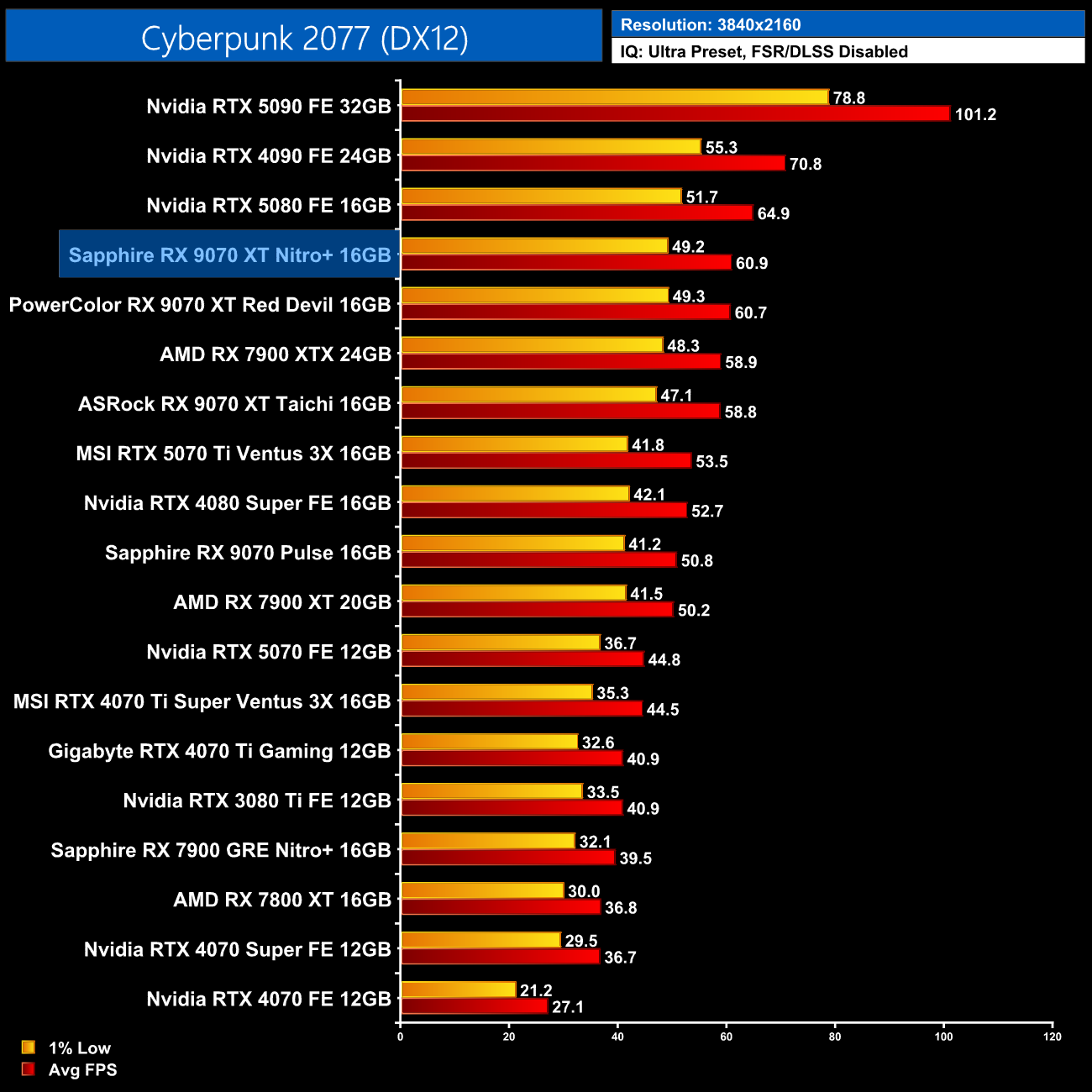
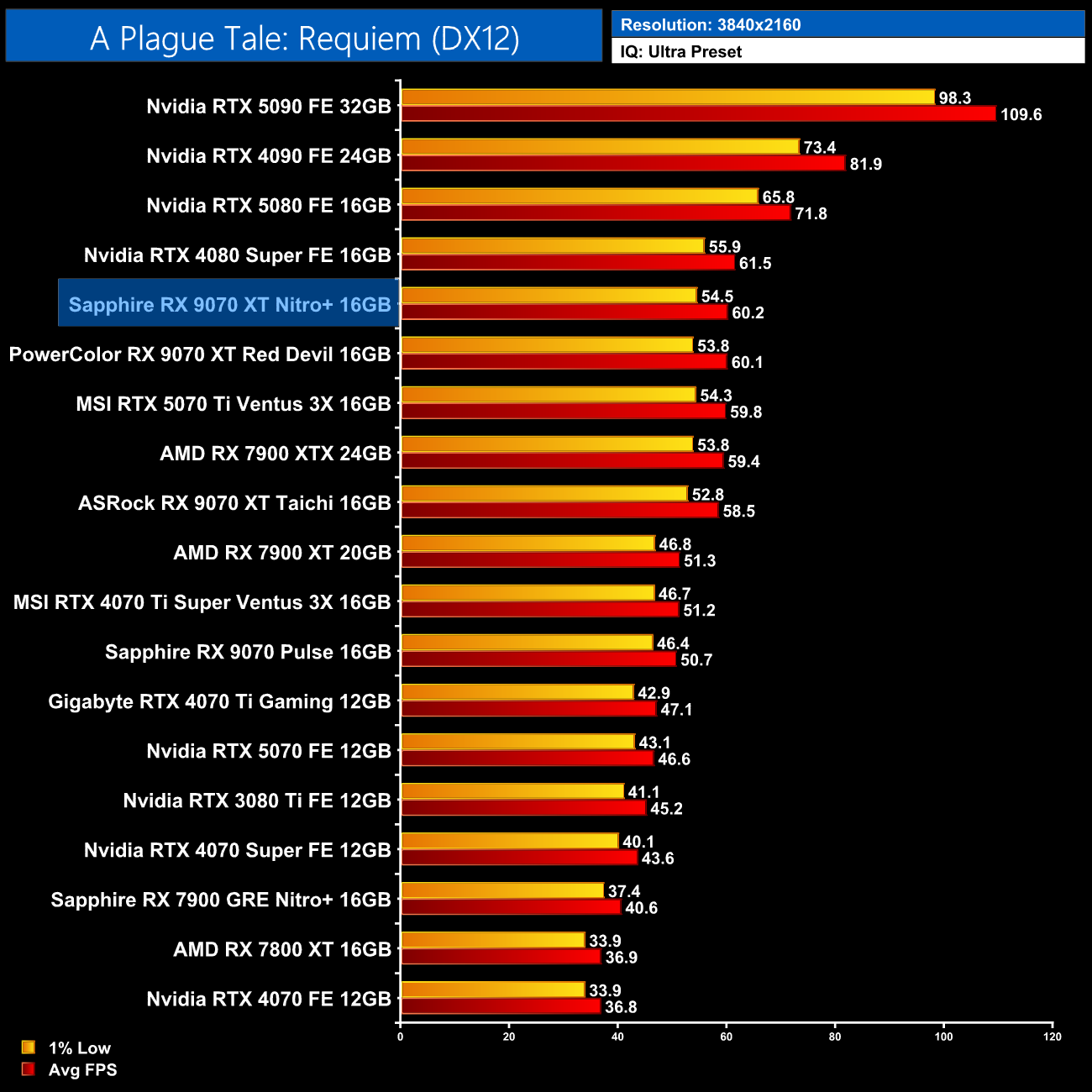
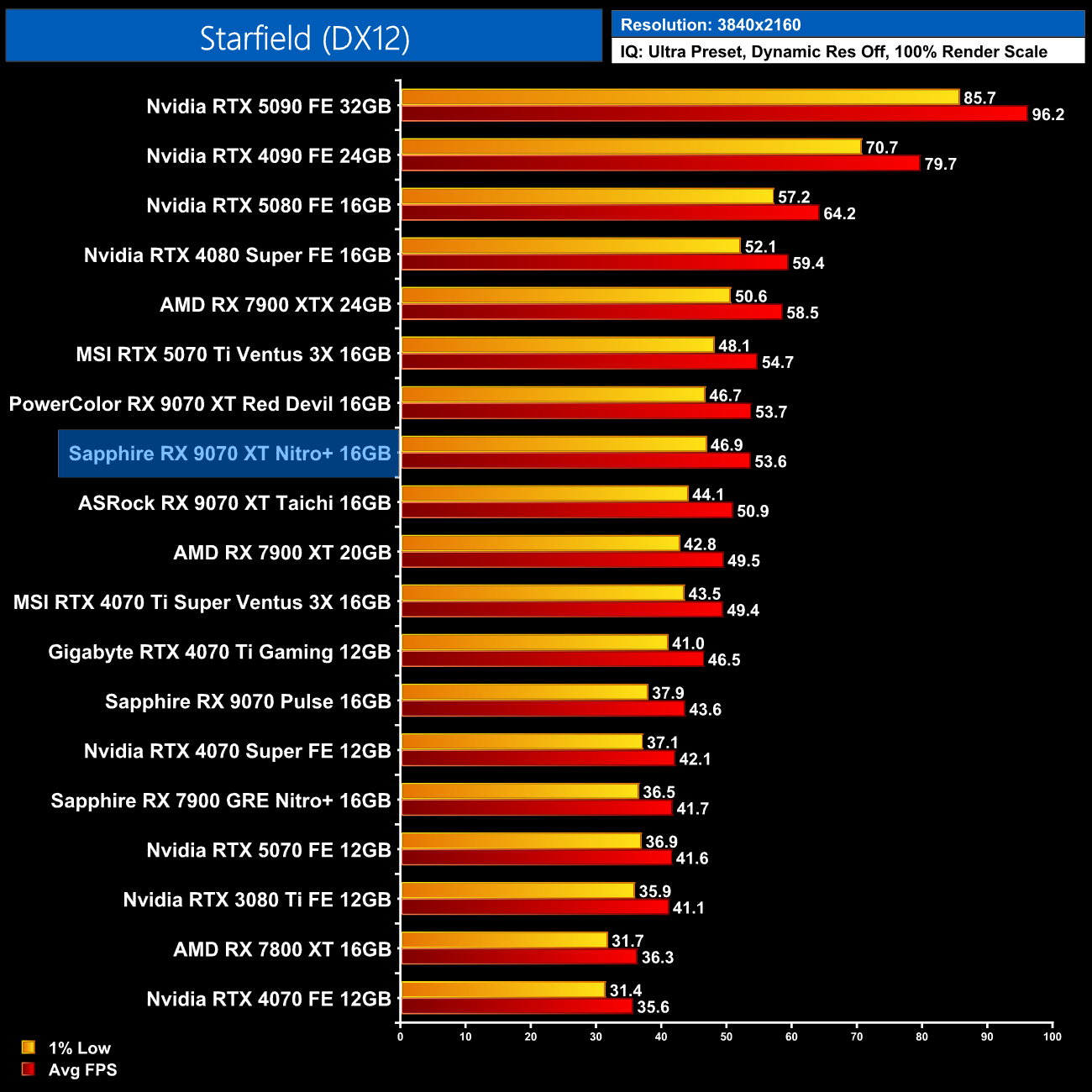
We don't focus too heavily on game benchmarks in our partner card reviews as performance doesn't tend to change a whole lot when comparing different models of the same GPU. We do see a lead for the Nitro+ over the ASRock Taichi model, which we tested at reference specifications for our day 1 review, but even then, the gains are only 2-3fps in these examples.
Here we present the average clock speed for each graphics card while running A Plague Tale: Requiem for 30 minutes. We use GPU-Z to record the GPU core frequency during gameplay. We calculate the average core frequency during the 30 minute run to present here.
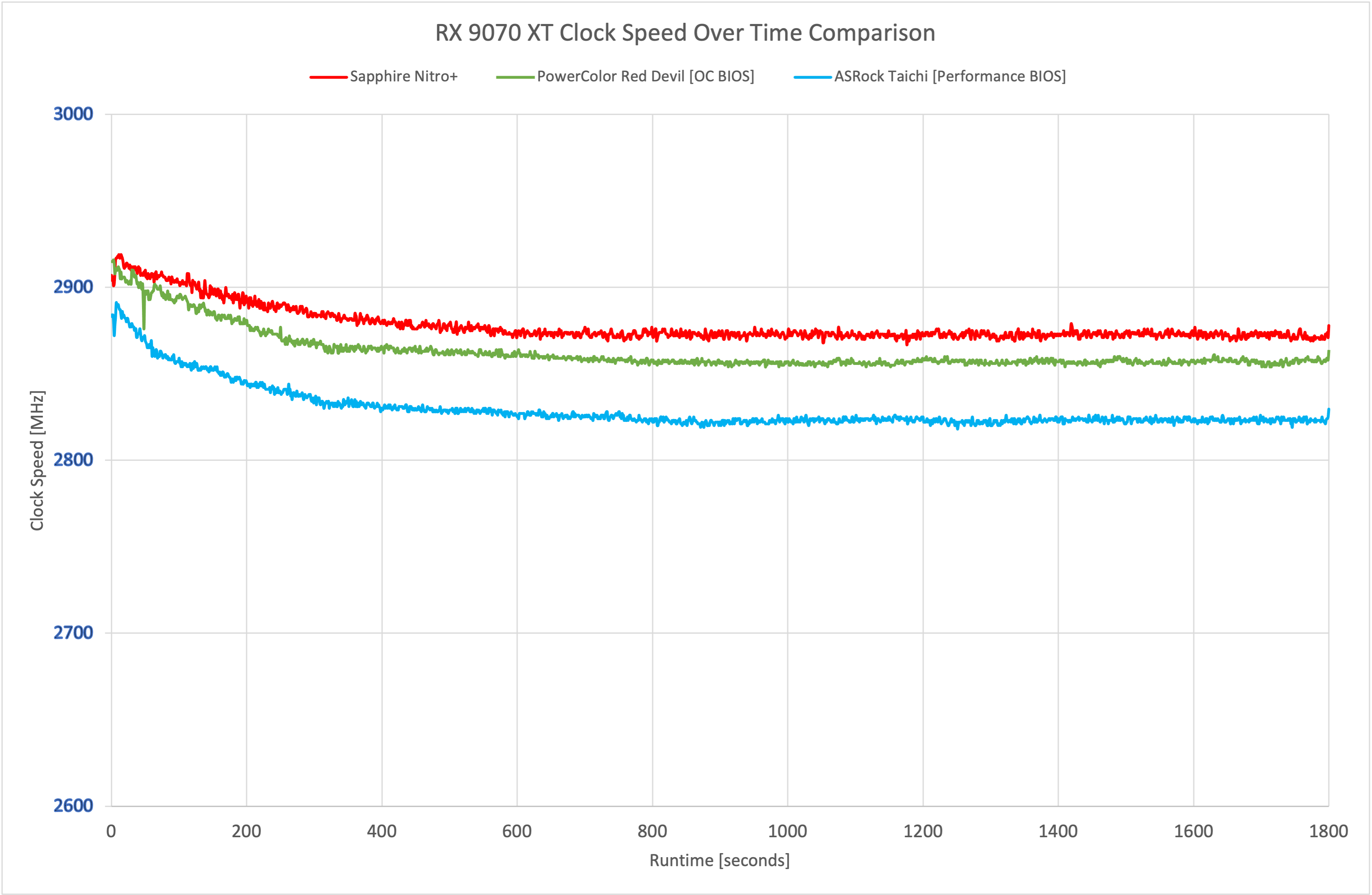
On a technical level, we did see the Nitro+ running the fastest of the three 9070 XTs tested, though the gains are only slight when compared to the PowerColor Red Devil.
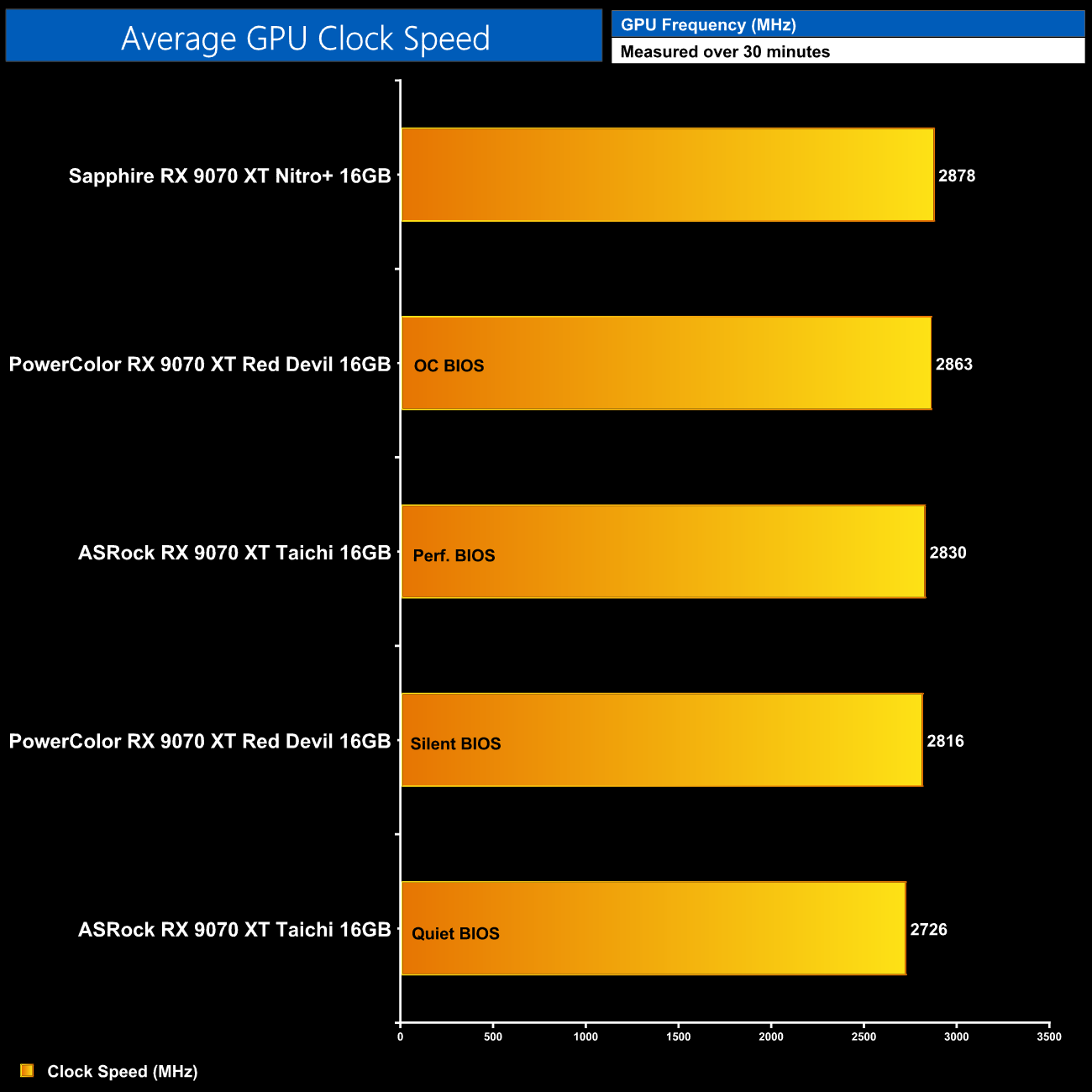
In fact, averaged over the thirty minute stress test, the Nitro+ hit 2878MHz, less than 25MHz ahead of the Red Devil.
For our temperature testing, we measure steady-state GPU temperatures under load. A reading under load comes from running A Plague Tale: Requiem for 30 minutes.
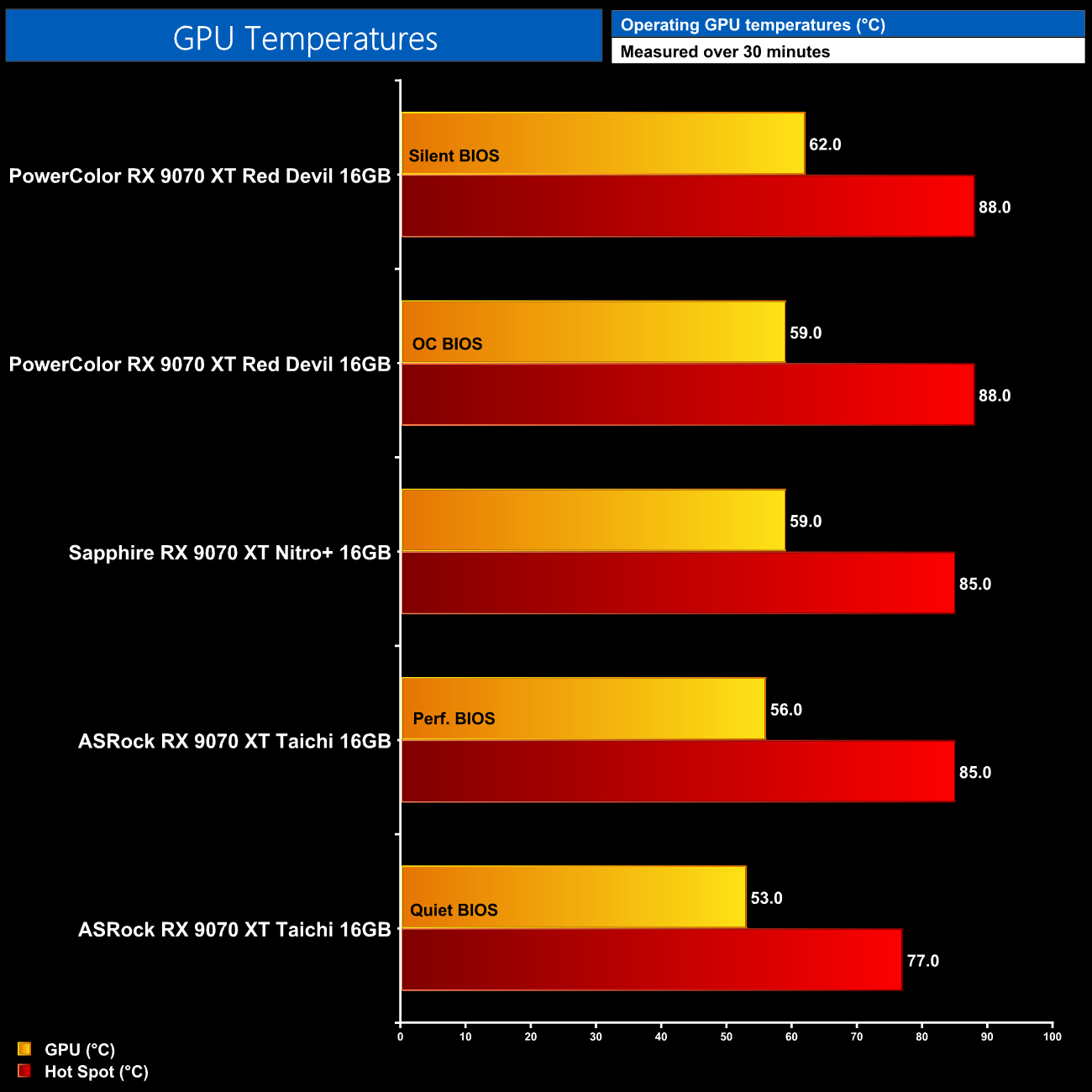
As for out of the box GPU temperatures, all three cards tested deliver very good results, with the Nitro+ sitting in the middle of the pack. The GPU hit 59C, with the hot spot at 85C, so it's very similar to the Taichi and Red Devil.
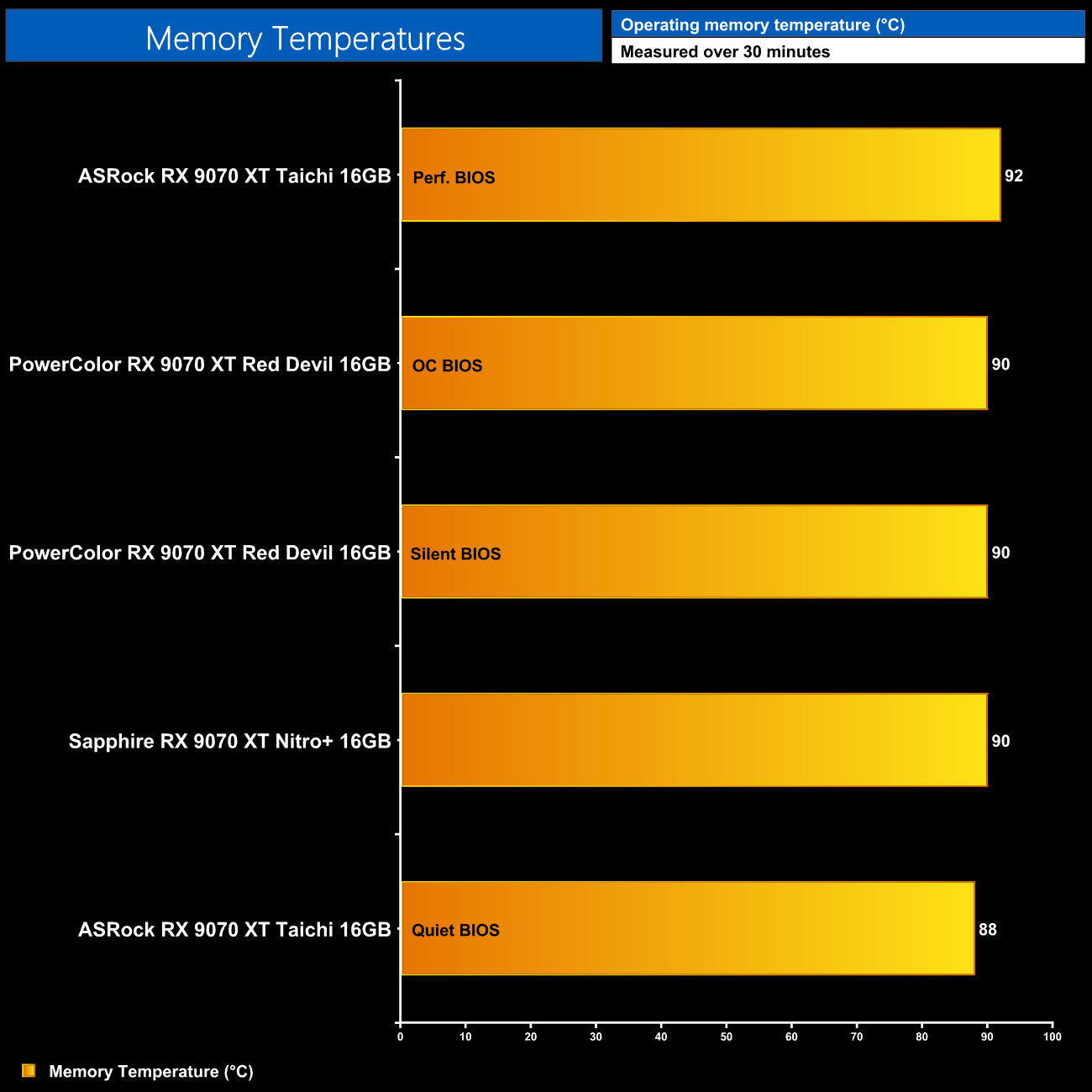
Likewise, memory thermals are basically a wash, with all three cards seeing the memory hit between 88-92C.
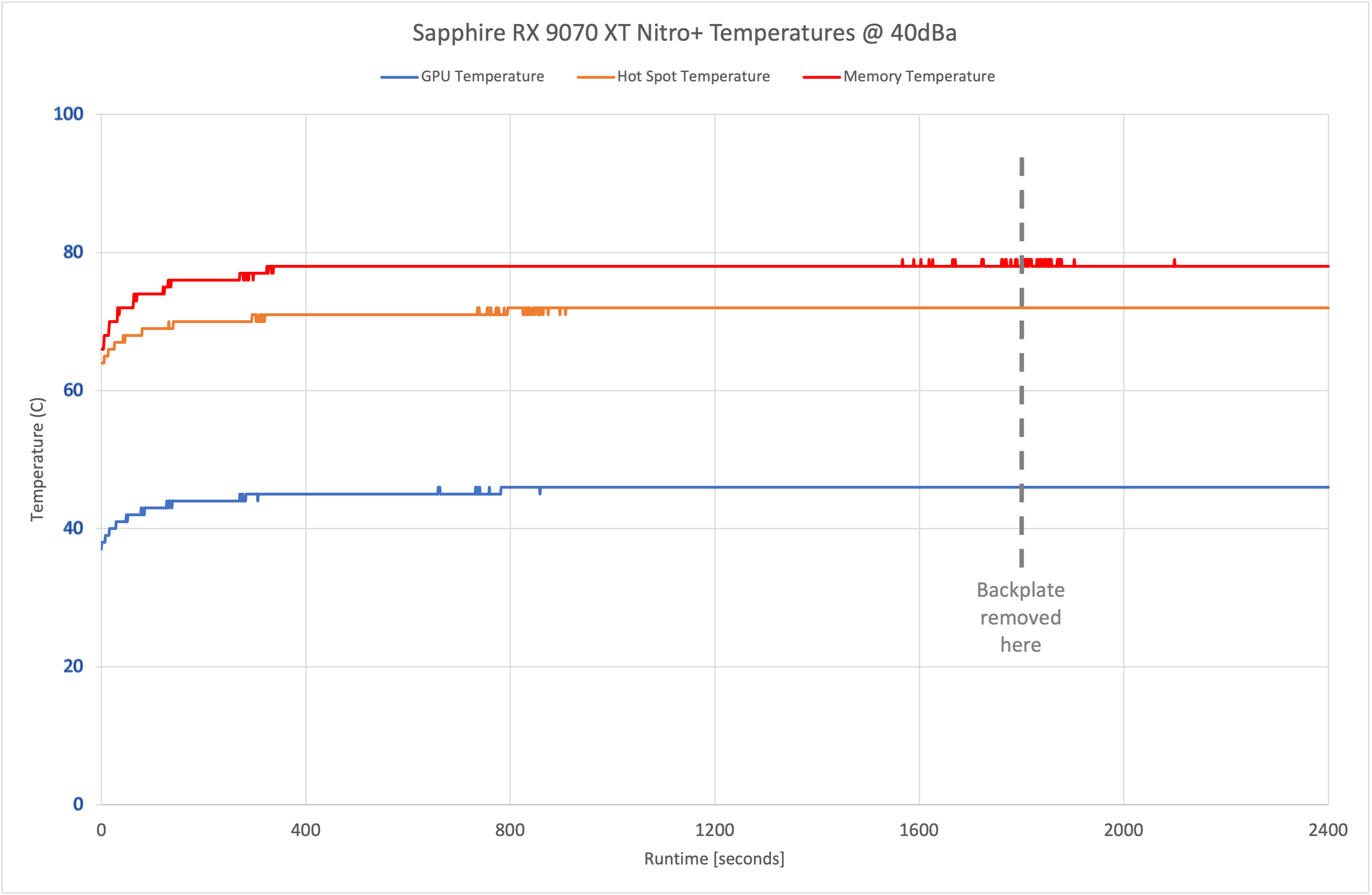
I did want to do just one extra test for the Nitro+ however, as I was curious if adding on the magnetic backplate would hinder airflow through the card and potentially increase temperatures. To test this, I ran the card with a fixed fan speed, normalised to 40dBa (55%/2360rpm), first with the backplate attached, for a thirty minute stress test. I then removed the backplate at the thirty minute mark and let it run for another ten minutes to see if temperatures would drop. As we can see, there was no measurable difference with or without the backplate installed, so it's nothing to worry about.
We take our noise measurements with the sound meter positioned 1 foot from the graphics card. I measured the noise floor to be 32 dBA, thus anything above this level can be attributed to the graphics cards. The power supply is passive for the entire power output range we tested all graphics cards in, while all CPU and system fans were disabled. A reading under load comes from running Cyberpunk 2077 for 30 minutes.
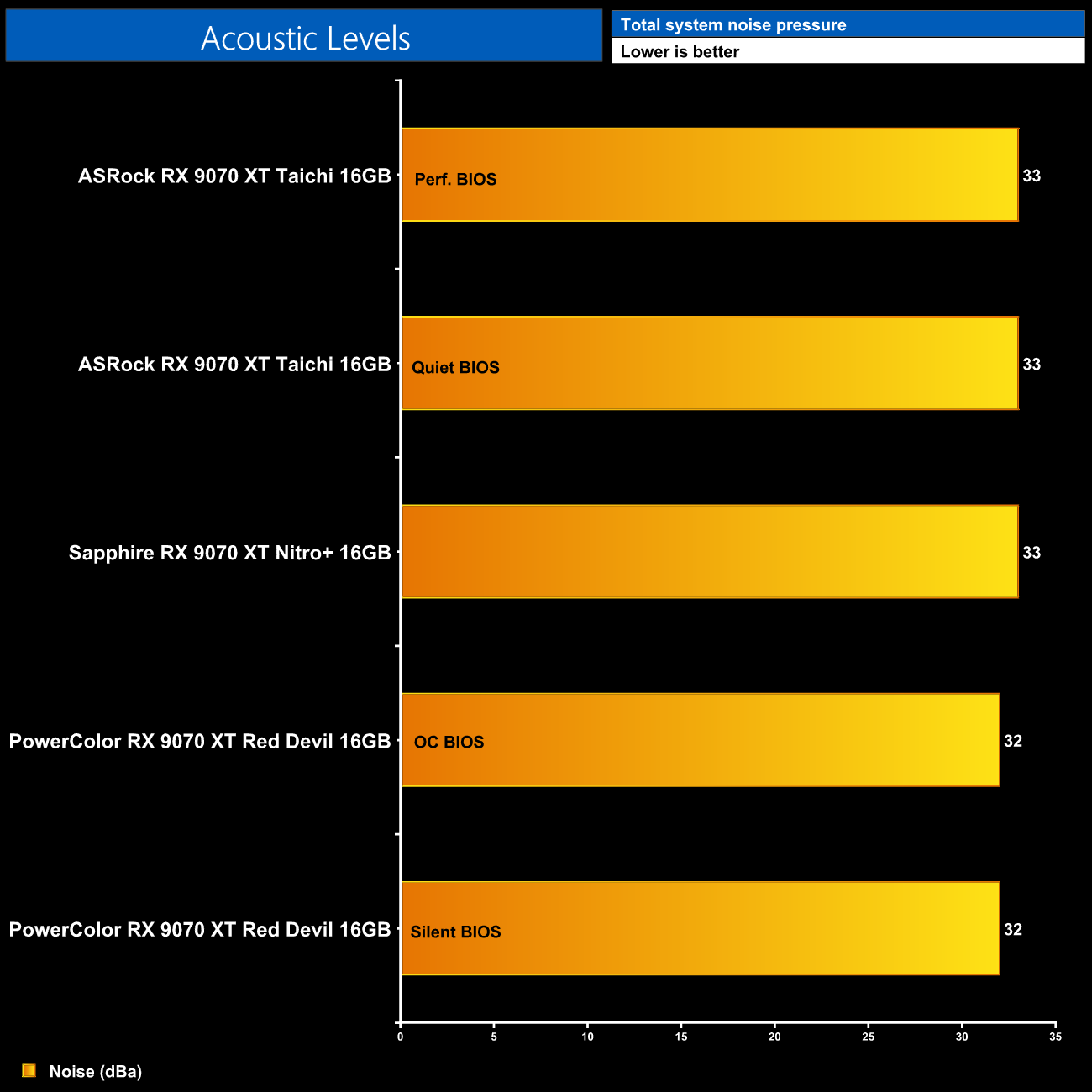
As for out of the box noise levels, we have tested a trio of very quiet graphics cards! The Nitro+ is basically inaudible, hitting just 25%/1215rpm fan speed during my testing. It did register on my sound meter, but it would easily be drowned out by a case fan.
Following on from our stock thermal and acoustic testing, here we re-test the operating temperature of the GPU, but with noise levels normalised to 40dBa. This allows us to measure the efficiency of the overall cooling solution as varying noise levels as a result of more aggressive fan curves are no longer a factor.
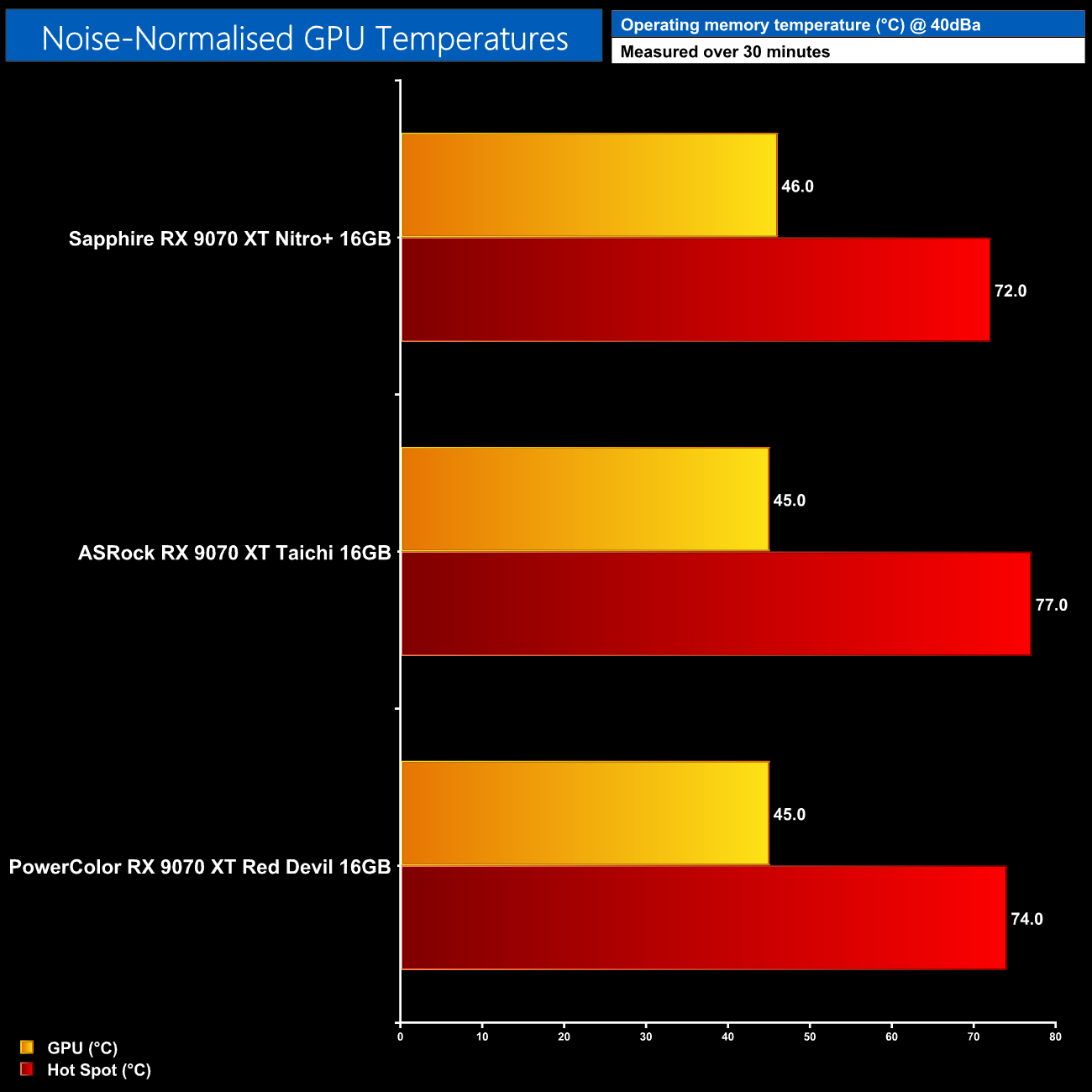
When we ran our noise-normalised test, the results of all three cards basically became indistinguishable. The Nitro+ did offer the lowest hot spot, at 72C, but the GPU metric was at 46C, just 1C hotter than either the Taichi or Red Devil, so close enough to call a tie.
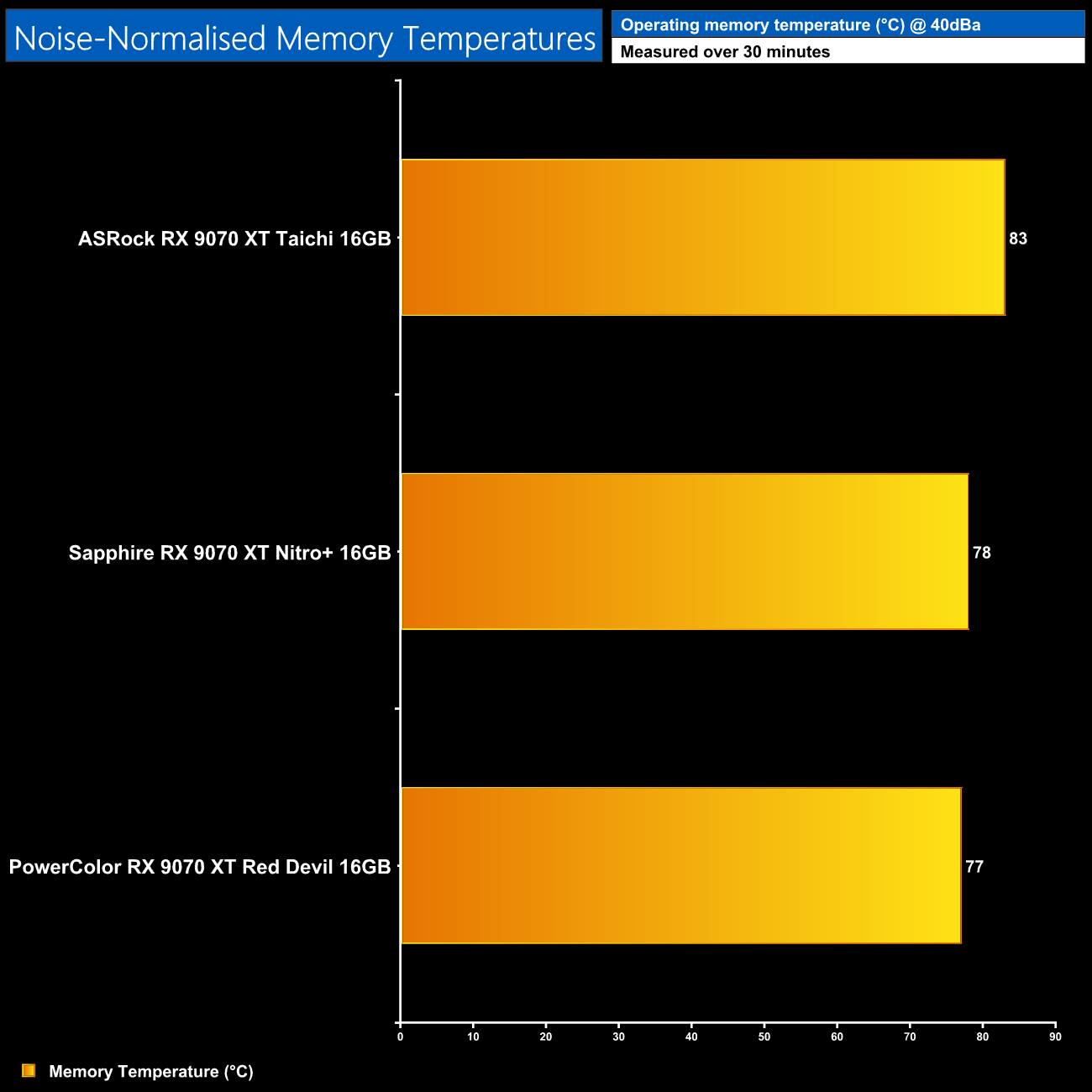
Noise-normalised memory temperatures are also very similar to the Red Devil, though we do see a 5C reduction compared to the Taichi.
Power Draw
We use Nvidia PCAT to measure power draw of the graphics card only, with readings from both the PCIe slot and the PCIe power cables combined into a single figure. We use A Plague Tale: Requiem (4K/2160p) for this testing.
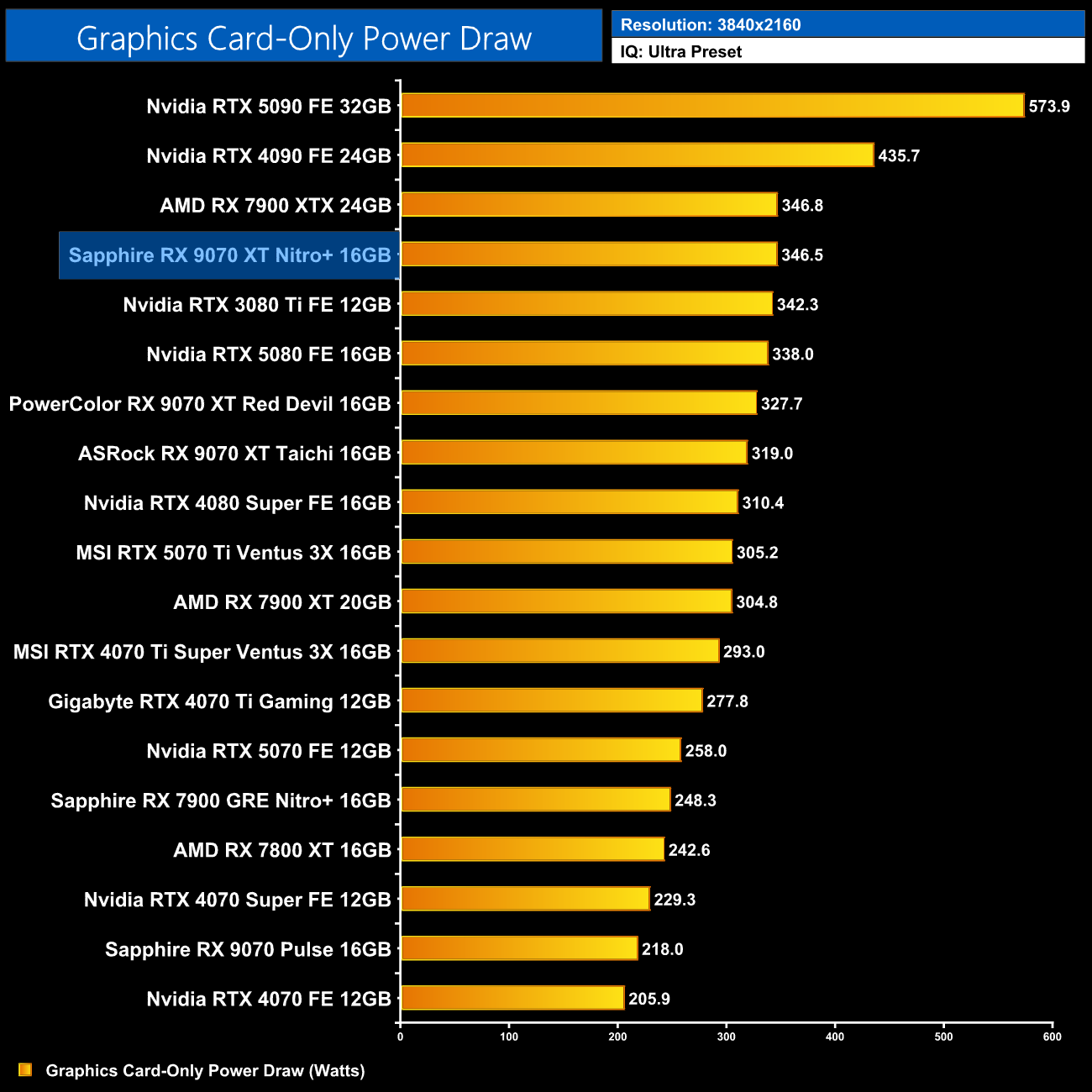
As for power draw, Sapphire rates the Nitro+ with a 330W total board power, but we saw it hitting just below 350W in A Plague Tale: Requiem at 4K, almost 20W more than the PowerColor Red Devil.
Given the Nitro+ also uses the 12VHPWR connector, which has caused more than its fair share of controversy, I also wanted to measure the current flowing over the six 12V wires. Nothing stood out during my testing, with current sitting between 4.4-4.9A, recording just over 28A total. That is completely fine, though Buildzoid did conduct an analysis on his YouTube channel, suggesting that Sapphire has not included any extra failsafe, so if a sub-par cable or connector were to be used, nothing would stop uneven load balancing – as we've seen occur with the RTX 5090, for instance.
However, considering the power draw of the 9070 XT is much lower, there is significantly more safety headroom, and Sapphire told me that the company's ‘engineering teams put the NITRO+ RX 9070 Series through tons of testing to make sure the 12V-2×6 connector is rock solid'.
On top of that, I also used my thermal imaging camera on the power connector and saw temperatures in the mid 60C range around the connector, though the cable itself is even cooler – we also have to factor in that hot air is blowing right over the cable, so that will increase temperatures slightly, but nothing I saw was dangerous or out of spec from my testing.
Performance per Watt
Combining the power draw values shown above with the performance data, we present performance per Watt for each graphics card tested:
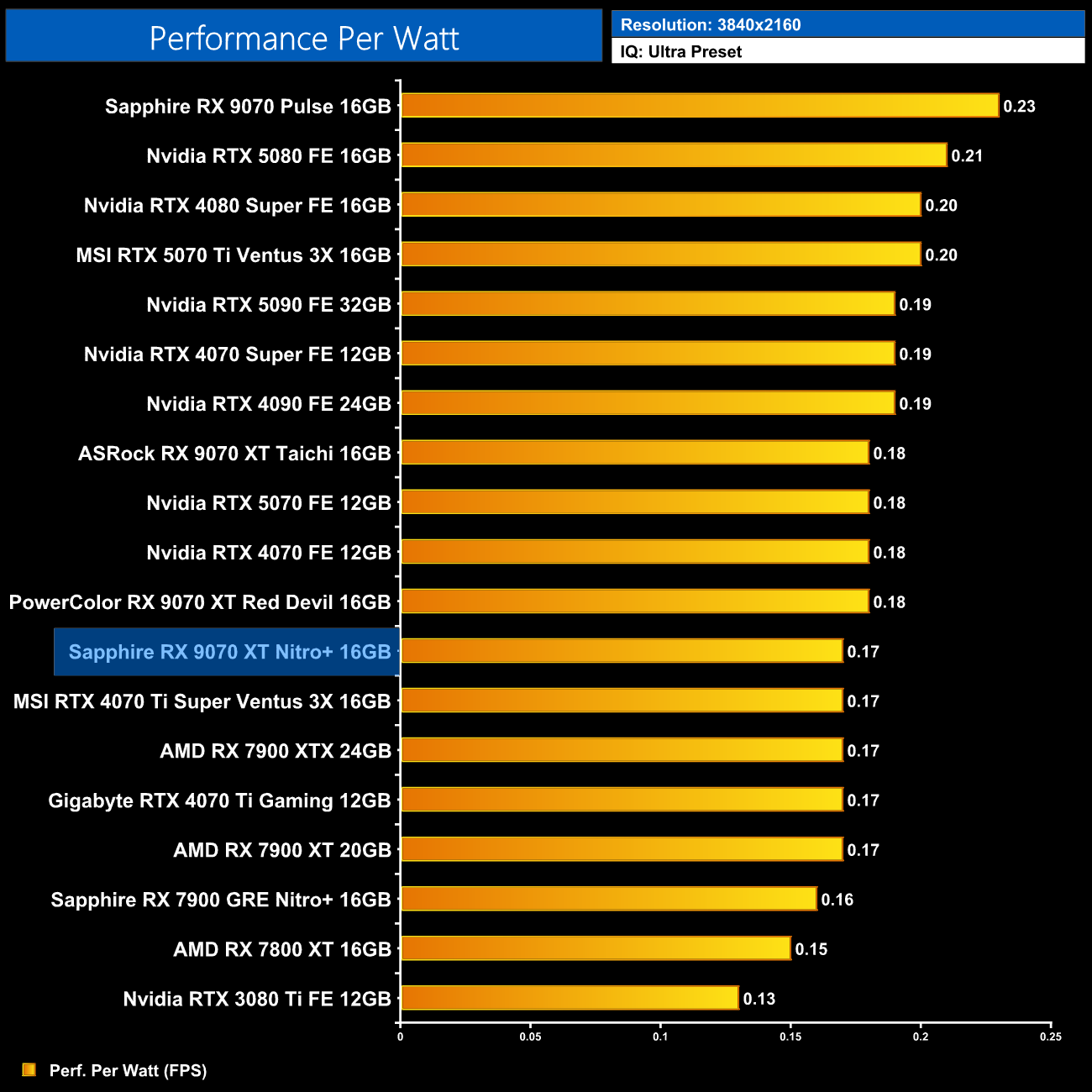
The only downside to Sapphire's higher power draw is that it means efficiency is reduced overall, not by much, but there's a 6% reduction in performance per Watt compared to the Red Devil and Taichi.
For our manual overclocking tests, we use AMD's built-in tuning tool. Our best results are as below.
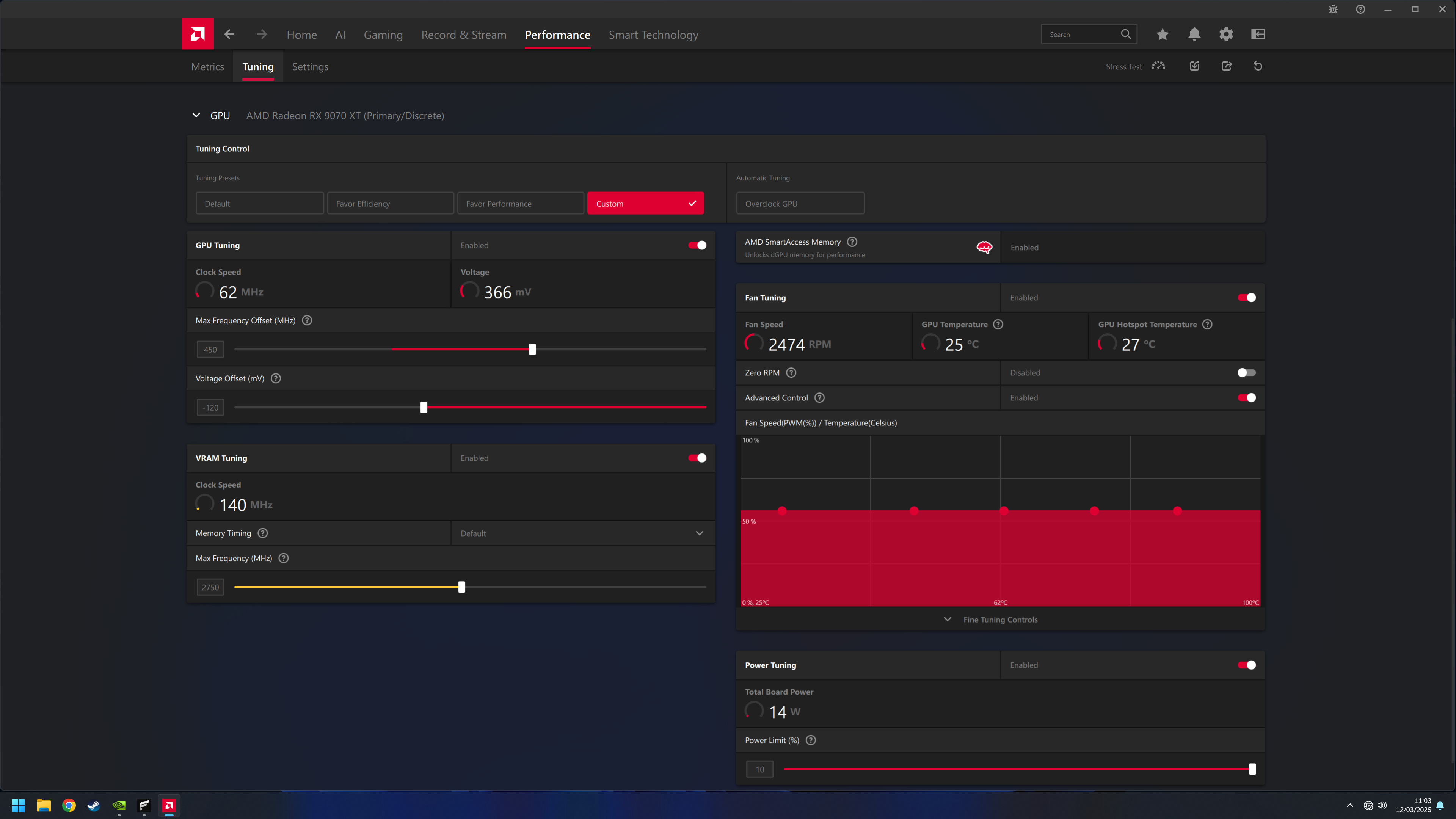
Overclocking the RX 9070 XT is very similar to the RX 7000 series, in the sense that the overclocking bit itself doesn't really matter, but it all depends on how far you can lower voltage. For the Nitro+, I maximised the power limit at +10%, added 450MHz to the GPU clock, set the memory clock to a maximum of 2750MHz, and managed to set a -120mV offset.
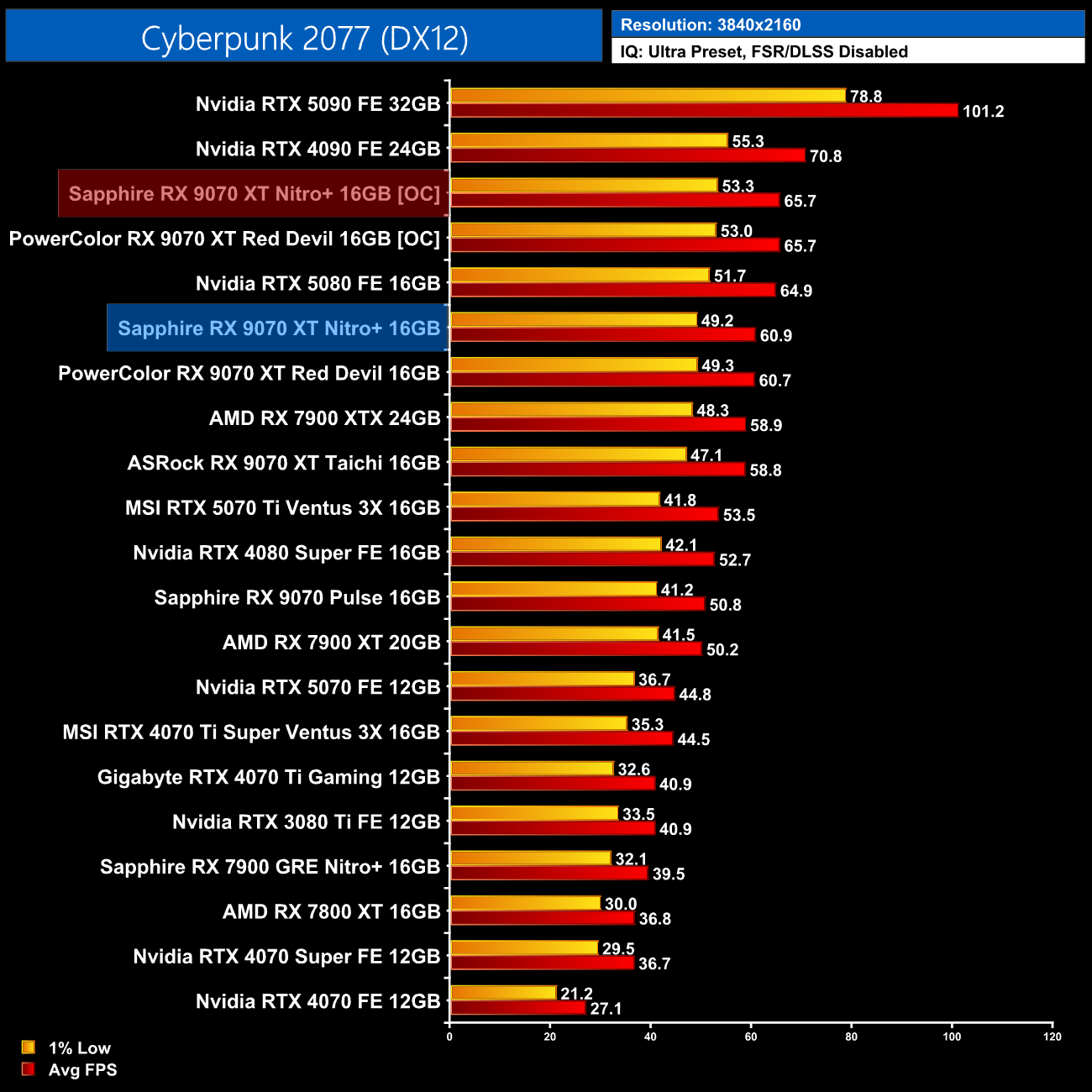
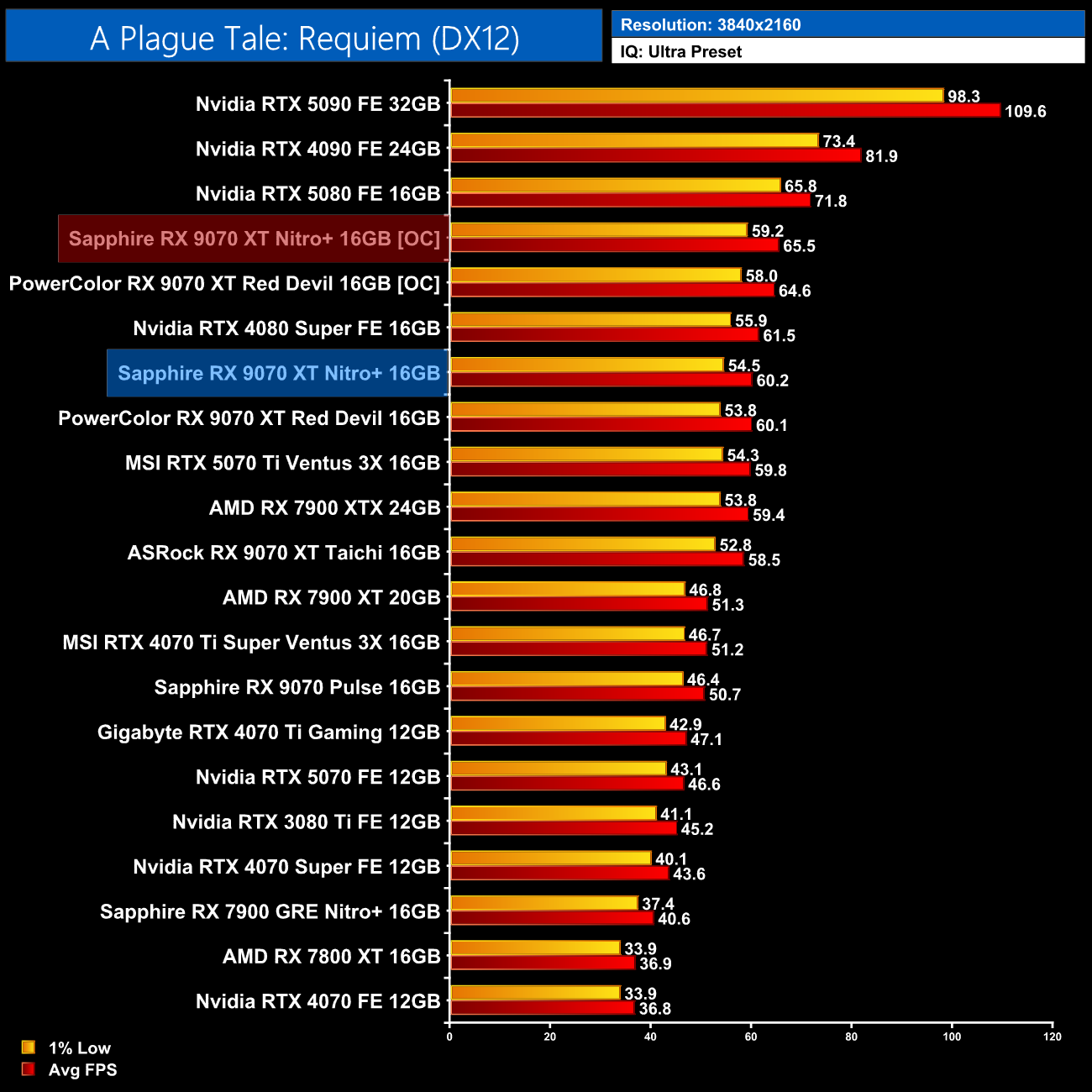
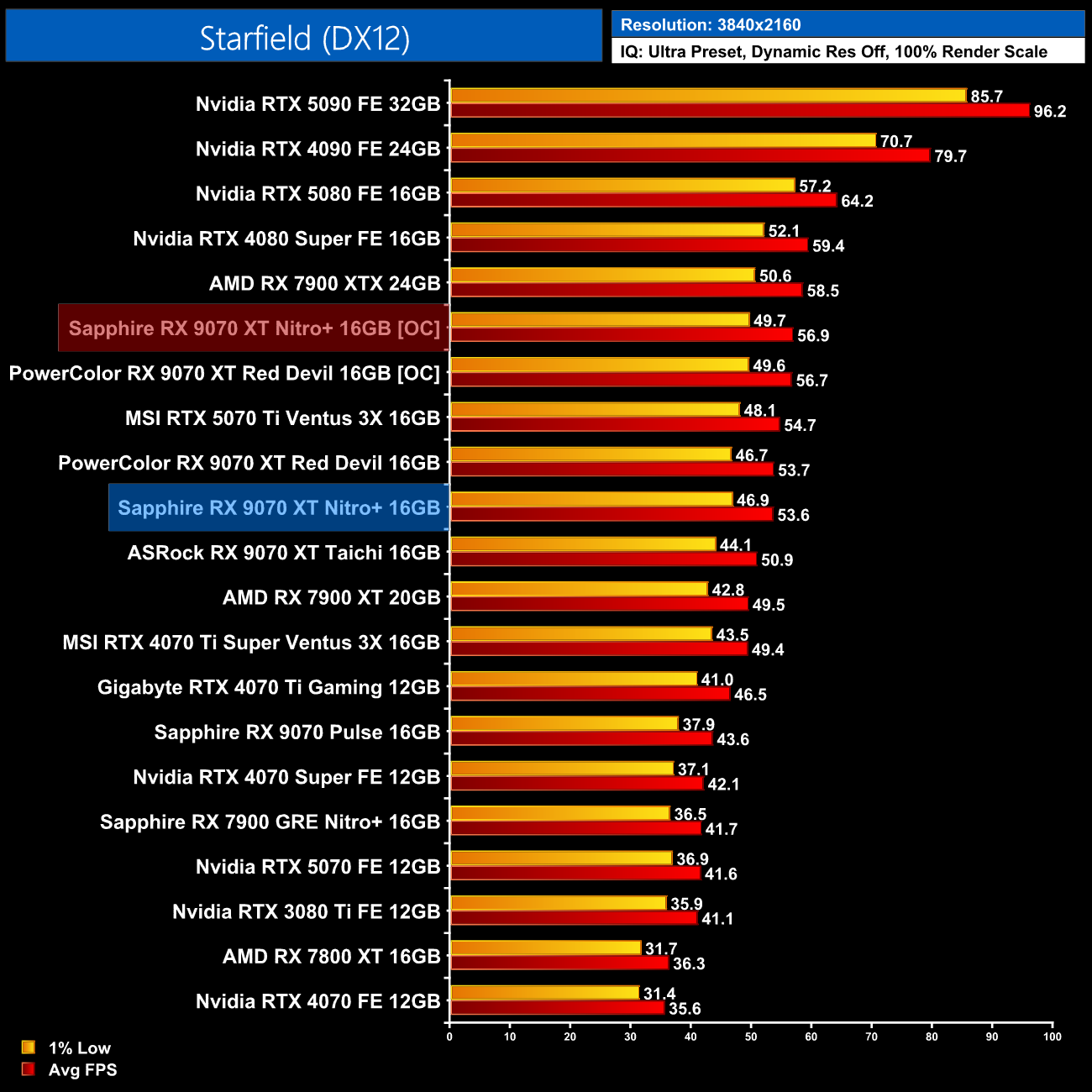
This resulted in performance gains of 6-8% for the Nitro+, which is fine, though also nothing particularly special. Of course, your mileage may vary depending on the silicon lottery and other factors.
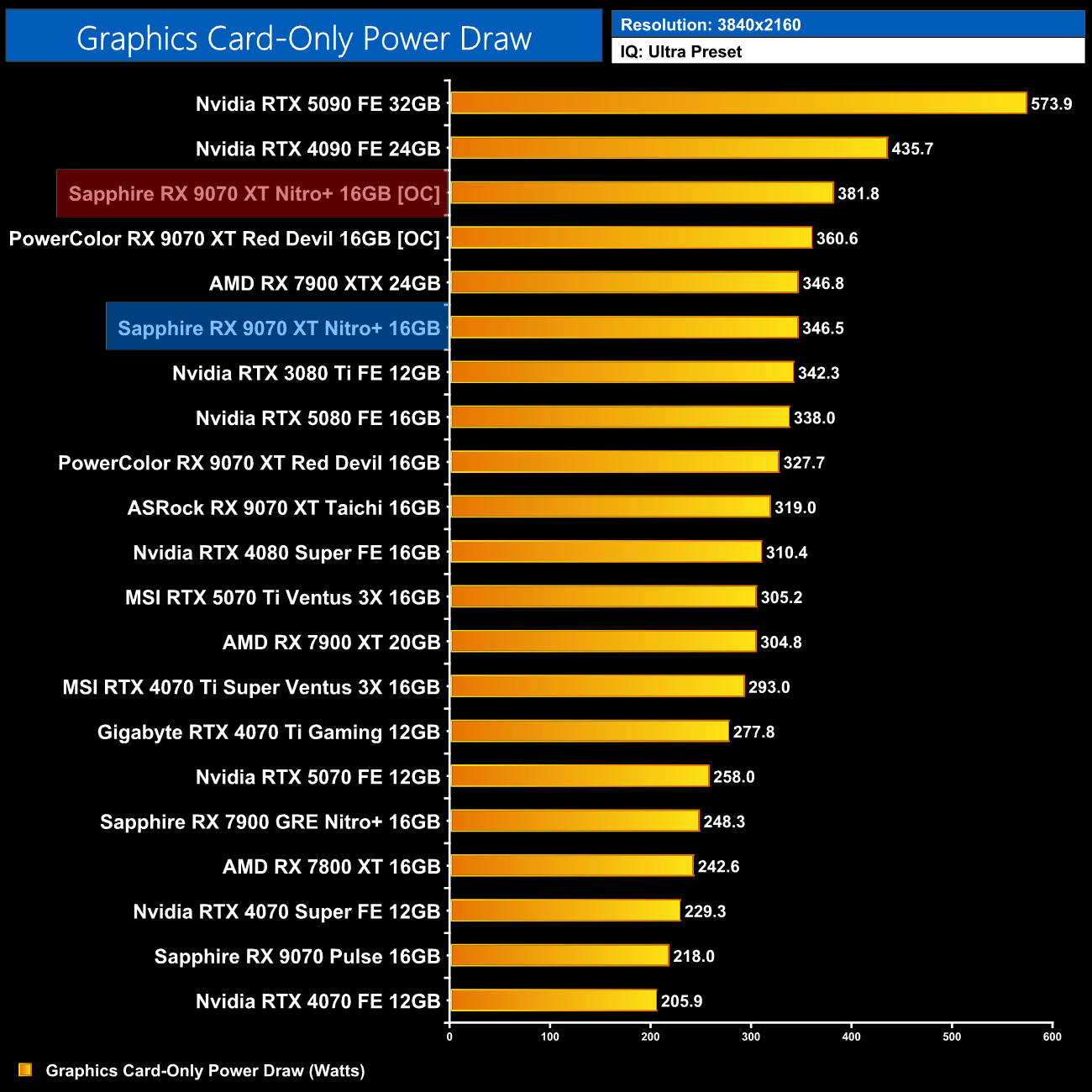
We did see power draw rise a good amount however, hitting just under 382W when overclocked – a 10% increase over stock.
Sapphire has built a strong reputation over the years, manufacturing some of the best AMD partner cards on the market. We thought as much for the RX 7000 series and today our attention has turned to the latest entry in the Nitro+ range – the RX 9070 XT.
While the design is more of an evolution, rather than revolution, I have to say it really is a thing of beauty, offering a clean gun-metal grey colourway, alongside the nifty removable backplate that neatly hides your power connector. Factor in the smart grille over the side of the card and the clean RGB lighting, and I'd be very happy to stick one of these into my personal PC.
Cooling performance is also very solid – we saw similar GPU temperatures to the PowerColor Red Devil, and with the fans spinning at just 1215rpm, it is whisper quiet out of the box.
My only real complaint about the Nitro+ itself is the lack of dual-BIOS -a surprising omission considering it was a mainstay on the previous generation of Nitro+ cards. Considering this is a flagship partner card, with an MSRP of £699, I really would expect to see dual-BIOS as standard – this is a rare misstep from Sapphire.
Pricing also requires some decision, as being a flagship RX 9070 XT partner card, the £699 MSRP represents a significant 22% premium over the baseline MSRP, set by AMD at £575. At the time of writing, listed prices are even higher, hitting £720 at Overclockers UK, or £730 at Scan. That does mean things are creeping much closer to the RTX 5070 Ti than I would like, given the cheapest model is listed for £830 at Scan.
Of course, the Nitro+ will have more features – such as the removable backplate and ARGB lighting – and likely a more sophisticated cooler than an entry-level 5070 Ti, but the fact remains, the closer the 9070 XT gets to the 5070 Ti's price tag, the harder things become for AMD and its partners.
Still, if you are in the market for an RX 9070 XT, the Sapphire Nitro+ is an excellent option – just put the dual-BIOS back, please!
Pros
- Beautiful design.
- Magnetic backplate is a smart addition.
- Runs quiet and cool.
- Healthy factory overclock.
- Gains of 6-8% when overclocked and undervolted.
Cons
- Hefty premium over the baseline MSRP brings pricing closer to the RTX 5070 Ti.
- Lacks dual-BIOS.
KitGuru says: Sapphire's RX 9070 XT Nitro+ is a beautiful graphics card, though the lack of dual-BIOS is an odd move.