 KitGuru KitGuru.net – Tech News | Hardware News | Hardware Reviews | IOS | Mobile | Gaming | Graphics Cards


KitGuru is old in the tooth and likes naming conventions which don't change. With the launch of the Radeon HD 6000 series, AMD has altered its naming strategy. The high end cards will now be the 6900 series (due November) and the 6800 cards that we're looking at today, will actually be sold for less than £200 each, including VAT (we're guessing that's under $250 for our American readers). How much can any gamer get from a graphic card that costs so little?
It seems like only yesterday that nVidia released its first Fermi products to a universally lukewarm reception. Against the subsequent series of lacklustre launches that followed, the GTX460 stood out like a giant. A genuine classic card by anyone's standard. High performance, competitive pricing and an overclocking potential that made everything around it pale in comparison. AMD has finally moved to try and counter this threat with the Radeon HD 6800 series cards.
Before we get into the details of precisely which cards have been tested, we also want to highlight how difficult our final evaluation has been made by the huge price changes we've seen over the past 5 days. Cards like EVGA's GTX460 FTW have dropped from £205 to £175, ahead of the Radeon HD 6800 series launch. In turn, it seems that AMD had some last minute price moves up its corporate sleeve. Tricky, but we've rolled with it – testing first and then making the value decisions right at the end – once we knew precisely what the final pricing will be.
Today we are looking at two boards from AMD's biggest partner – Sapphire. We will be getting up close and personal with both their HD6870 and HD6850 products, seeing how they can hold up against the mighty GTX460 in various flavours.
Firstly we need to address the naming conventions, because many people are already scratching their heads in bewilderment. The HD6870, for instance, isn't a direct replacement for the HD5870 – AMD's goal was to deliver similar levels of performance from the HD6870 but at a much lower price.
The HD5870 first hit the market at £350, while the HD6870 will cost less than £195 … an incredible achievement if the new AMD hardware can go head to head with the giant killing GTX460 – the source of this pricing war.
The ‘Barts' codenamed products are aimed at the sub $250 market, while the forthcoming ‘Cayman' and ‘Antilles' are higher end and significantly more expensive.
|
Sapphire HD6870
|
Sapphire HD6850
|
|
| Core Clock Speed |
900mhz
|
775mhz
|
| Stream Processors |
1120
|
960
|
| ROPs |
32
|
32
|
| Frame Buffer |
1GB GDDR5
|
1GB GDDR5
|
| Compute Power |
2.0 TFLOPs
|
1.5 TFLOPs
|
| Memory Width/Speed |
256bit, 4.2GBPS
|
256bit, 4.0 GBPS
|
| Idle/Load Board Power |
19W/151W
|
19W/127W
|
| Power Connectors |
Dual 6 Pin
|
Single 6 Pin
|
| Display Outputs |
2xDVI + 2x mDP + 1 HDMI
|
2xDVI + 2x mDP + 1 HDMI
|
The new 6800 series has seen hardware architecture changes, with a focus on strengthening tessellation and geometry throughput. Avid readers of KitGuru will have seen over recent months that nVidia Fermi hardware has been leading the way in titles such as UniGine Heaven Benchmark, a synthetic test which relies heavily on Tessellation performance.

The 6800 series has a reconfigured core design which offers up to 2.0 TeraFLOPS and 24 Gigapixels per second performance. The command processor is linked to the graphics engine as seen in the diagram above, with the new generation 7 Tessellator. The Dual rasterizers and 12-14 SIMD engines tied to a 256 bit GDDR5 memory interface help to improve performance beyond the levels of the last generation, while using 25% less silicon.
|
AMD HD5850
|
AMD HD6870
|
|
| Die Size |
334 mm2
|
255mm2
|
| Transistors |
2.15 billion
|
1.7 billion
|
| Memory Bandwidth |
153.6GB/sec
|
134.4 GB/sec
|
| Geometry Throughput |
725 million polygons/sec
|
900 million polygons/sec
|
| SIMD Engines |
18
|
14
|
| Stream Processors |
1440
|
1120
|
| Texture Units |
72
|
56
|
| Z/Stencil ROPs |
128
|
128
|
| Colour ROPs |
32
|
32
|
| Max Board Power |
151W
|
151W
|
| Idle Power |
27W
|
19W
|
The table above shows a direct comparison against the HD5850 and HD6870. The HD6870 has less texture units, SIMD engines, Stream Processors with a lower memory bandwidth but the Geometry throughput has been significantly increases from 725 million polygons per second to 900 million polygons per second. The new design is more efficient and with the die shrink requires less power at idle.

|
Hardware Tessellator Progression
|
||
| Generation 1 |
ATI Radeon 8500
|
Fixed Function PN Triangles (TRUFORM)
|
| Generation 2 |
Microsoft Xbox 360
|
Displacement mapping, adaptive tessellation
|
| Generation 3 |
AMD Radeon HD2000 family
|
Dirext X 10 compatibility
|
| Generation 4 |
AMD Radeon HD 3000 family
|
Direct X 10.1 compatibility
|
| Generation 5 |
AMD Radeon HD 4000 family
|
Performance Enhancements
|
| Generation 6 |
AMD Radeon HD 5000 family
|
Direct X 11 compatibility
|
| Generation 7 |
AMD Radeon HD 6800 Series
|
Improved Thread Management and buffering
|
The updated Tessellation unit, called ‘Generation 7' brings new thread management capabilities as well as buffering enhancements to the table. This means that performance is increased by up to two times when directly compared to the HD5000 series. This should mean that AMD are closely competitive with similarly priced nVidia Fermi hardware, we will look at performance later in this article. AMD's internal testing shows that the HD6870 achieves twice the tessellation performance of the HD5870.

Tessellation is a hotly discussed topic right now, and it is a bone of contention between nVidia and AMD. Our recent interview with Richard Huddy opened a few eyes, as he said “nVidia is pushing a single message and that’s tessellation. Tessellation is about enriching detail, and that’s a good thing, but nVidia is pushing to get as much tessellation as possible into everything. With artificial tests like Stone Giant, which was paid for by nVidia, tessellation can be done down to the single pixel level. Even though that pixel can’t be broken away from the 3 other pixels in its quad. Doing additional processing for each pixel in a group of 4 and then throwing 75% of that work away is just sad.”
AMD's stance on this is “Tessellating the Right Way” – which means a focus on the most efficient tessellation usage models with 16 pixels per polygon combining solid image quality with high levels of performance. Adaptive Tessellation is how they want to approach it, using high levels for objects close to the front of the screen (and in eye shot of the gamers) and then switch to lower levels for distant and simple objects to help improve performance while avoiding geometry aliasing problems.

The image above was captured from Alien V Predator and showcases the new Morphological Anti-Aliasing technique from AMD which is a post process filtering technique accelerated with DirectCompute. It delivers full scene anti Aliasing and it is not limited to polygon edges or alpha tested surfaces. The system is faster than super sampling with similar performance levels to edge detect CFAA, but it applies to all edges. This can be enabled from Catalyst Control Center and is compatible with any Direct X 9/10/11 supported application.

Anistrophic Filtering has also been fine tuned and enhanced with a newly refined algorithm in place. It addresses visible discontinuities in very noisy textures offering smoother transitions between filter levels. It also maintains full performance and angle independence.

The Sapphire HD6850 arrives in a very subdued box with a well endowed lady on the front.There is mention of HDMI 1.4A support (with a cable) and a new overclocking tool called TriXX.

Specifications and information cover the back panel and focus is brought to all the awards Sapphire have earned over the years.

While there's no free game, a comprehensive bundle has been supplied. A power converter cable, VGA adapter, Crossfire connector and high quality HDMI cable. Some literature is included to help inexperienced users. The TriXX software tool was still in development when we received this bundle, however we discuss it more later in the review.


The Sapphire HD6850 is supplied on an attractive blue PCB with custom designed cooler. This is a heatpipe design with an angular blade design keeping everything cool.

This fan is larger than the reference HD6850 design to improve cooling while lowering noise levels.


The Sapphire HD6850 adheres to the AMD reference design with support for 2x mini DP (1.2), HDMI 1.4a, and 2x DL-DVI and SL-DVI connectors. It requires a single 6 pin power connector to operate. We like the fact that this card will expel hot air out the back of the chassis.


The Sapphire cooler is a dual heatpipe design, with two thick pipes running to either side of the heatsink and passing heat through the stacks of fins.


Above, the naked card and a close up of the core and memory chips. These are Hynix H5GQ1H24AFR and we have seen them on many AMD cards in the past.

A GPUZ screenshot of the Sapphire HD6850 solution. The card is supplied at the reference 775mhz core and 1000mhz (4000mhz effective) memory speeds.


The Sapphire HD6870 we received was an early ‘boxless' version so we have no details on what will be supplied within the retail box. We would assume a similar bundle to the HD6850 above. All HD6870's at launch are based around the reference AMD design, so we will not see custom, overclocked solutions until several weeks later.


The Sapphire HD6870 supports 2x mini DP (1.2), HDMI 1.4a, and 2x DL-DVI and SL-DVI connectors. It requires a two 6 pin power connectors to operate. In a similar fashion to the Sapphire HD6850, the HD6870 will expel hot air out the back of the chassis.


The reference HD6870 cooler is quite substantial, with a copper block running out to several small heatpipes. The fan is positioned on the far side so it forces air across the heatsink and out the rear of the case.

A GPUZ overview of the hardware. The Sapphire HD6870 is running at the reference clocks of 900mhz core and 1050mhz (4200mhz effective) via GDDR5 memory.
For the review today we have built a strong system which we feel would fit in well with the audience purchasing these cards. We are using a Core i7 950 Quad Core CPU with 6GB of DDR3 memory. We have applied a moderate overclock to the processor because we know you guys never run anything at reference speeds!
We are also going to limit testing to 1920×1080 (1080) and 1920×1200 as less than 1% of the enthusiast user base reading this will have a 30 inch screen – this will address the widest possible audience.
Test System: Validation here.
Sapphire HD6850
Sapphire HD6870
Other cards:
eVGA GTX460 FTW (850/1000)
nVidia GTX460 Talon Attack (1000/1000 & 810/975)
AMD Reference HD5870 (850/1200)
AMD Reference HD5850 (725/1000)
AMD Reference HD5770 (850/1200)
nVidia Reference GTX460 (675/900)
eVGA GTX460 768MB SC (763/950)
nVidia Reference GTX 460 768MB (675/900)
XFX HD5830 XXX (840/1125)
nVidia Reference GTS 450 (850/1000)
XFX HD5750 XXX (740/1200)
AMD reference HD5750 (700/1150)
Other Hardware:
Processor: Intel Core i7 950 @ 3.6ghz
Cooler: Arctic Cooling Freezer 13
Motherboard: ASRock X58 Extreme 6
Memory: Crucial Ballistix Tracer 1600mhz 6GB (3x2GB)
Power Supply: Thermaltake 750W Toughpower Grand
Chassis: Cooler Master CM 690 II
Monitor: Dell Ultrasharp U2410 (A00)
Software:
Windows 7 Ultimate 64 bit
Unigine Heaven Benchmark
3DMark Vantage
HQV Benchmark
Catalyst 10.9 & 10.10 Driver (12th October WHQL) /ati_catalyst_10.9a_appprofile
Fraps Professional
Steam Client
FurMark
Forceware 260.89 beta
Tessmark
Shader Toy
Technical Monitoring and Test Equipment:
Keithley Integra unit
Thermal Diodes
Raytek Laser Temp Gun 3i LSRC/MT4 Mini Temp
Extech digital sound level meter & SkyTronic DSL 2 Digital Sound Level Meter
Games:
Resident Evil 5
Lost Planet 2
Far Cry 2
Tom Clancy H.A.W.X.
Metro 2033
Alien V Predator
Mafia 2
All the latest BIOS updates and drivers are used during testing. We perform under real world conditions, meaning KitGuru tests all games across five closely matched runs and average out the results to get an accurate median figure.
Unigine provides an interesting way to test hardware. It can be easily adapted to various projects due to its elaborated software design and flexible toolset. A lot of their customers claim that they have never seen such extremely-effective code, which is so easy to understand.
Heaven Benchmark is a DirectX 11 GPU benchmark based on advanced Unigine engine from Unigine Corp. It reveals the enchanting magic of floating islands with a tiny village hidden in the cloudy skies. Interactive mode provides emerging experience of exploring the intricate world of steampunk.
Efficient and well-architected framework makes Unigine highly scalable:
- Multiple API (DirectX 9 / DirectX 10 / DirectX 11 / OpenGL) render
- Cross-platform: MS Windows (XP, Vista, Windows 7) / Linux
- Full support of 32bit and 64bit systems
- Multicore CPU support
- Little / big endian support (ready for game consoles)
- Powerful C++ API
- Comprehensive performance profiling system
- Flexible XML-based data structures

1080p is a standard resolution we use with the Heaven Benchmark on all graphics cards, this means all review results are comparable throughout previous months.
Shaders are set to high, Tessellation to normal, anistrophy to 4 and Anti Aliasing is disabled.

The Sapphire HD6870 scores an average of 35.2 frames per second which brings it past the previous single core AMD flagship, the AMD HD5870. This is a great result for the new architecture and we can already see the potential. The Sapphire HD6850 scores in a similar zone to the GTX460 768MB, just under 30fps.
Futuremark released 3DMark Vantage, on April 28, 2008. It is a benchmark based upon DirectX 10, and therefore will only run under Windows Vista (Service Pack 1 is stated as a requirement) and Windows 7. This is the first edition where the feature-restricted, free of charge version could not be used any number of times. 1280×1024 resolution was used with performance settings.

The Sapphire HD6870 scores 15,722 points in 3DMark Vantage which is an impressive result, only 500 points behind the eVGA GTX460 FTW which is one of the fastest GTX460's on the market at 850 core. For direct comparison the reference clocked GTX460 at 675/900 scores 13,071. The Sapphire HD6850 scores around 12,589 points putting it 500 points ahead of the GTX460 768mz.
Aliens V Predator has proved to be a big seller since the release and Sega have taken the franchise into new territory after taking it from Sierra. AVP is a Direct X 11 supported title and delivers not only advanced shadow rendering but high quality tessellation for the cards on test today.
To test the cards we used a 1080p resolution with DX11, Texture Quality Very High, MSAA Samples 1, 16x AF, ambient occlusion on, shadow complexity high, motion blur on. We use this with most of our graphics card testing so cards are comparable throughout reviews.

The Sapphire HD6870 delivers a final score of around 47 frames per second, a single frame faster than the eVGA GTX460 FTW with a core speed of 850 mhz. A reference clocked GTX460 manages 37.6 frames per second, again around a single frame slower than the reference clocked Sapphire HD6850. These cards are already beginning to look strong.
Far Cry 2 (commonly abbreviated as “FC2 or “fc2″) is an open-ended first-person shooter developed by Ubisoft Montreal and published by Ubisoft. It was released on October 21, 2008 in North America and on October 23, 2008 in Europe and Australia. It was made available on Steam on October 22, 2008. Crytek, the developers of the original game, were not involved in the development of Far Cry 2.
Ubisoft has marketed Far Cry 2 as the true sequel to Far Cry, though the sequel has very few noticeable similarities to the original game. Instead, it features completely new characters and setting, as well as a new style of gameplay that allows the player greater freedom to explore different African landscapes such as deserts, jungles, and savannas. The game takes place in a modern-day East African nation in a state of anarchy and civil war. The player takes control of a mercenary on a lengthy journey to locate and assassinate “The Jackal,” a notorious arms dealer.
Far Cry 2 is still a popular game and the open world environment can be taxing on even the latest hardware available today.
Our settings: 1920×1200 (60Hz), D3D10, Fixed Time Step(No), Disable Artificial Intelligence(No), Full Screen, Anti-Aliasing(4x), VSync(No), Overall Quality(Optimal), Vegetation(High), Shading(High), Terrain(High), Geometry(High), Post FX(High), Texture(High), Shadow(High), Ambient(High), Hdr(Yes), Bloom(Yes), Fire(Very High), Physics(Very High), RealTrees(Very High).

The Sapphire HD6870 hits the top of the pile for reference clocked boards, only behind the MSI Talon at 810-1000 core and the eVGA GTX460 FTW at 850 core. 72 fps works out 7 more than the HD5870 and 18 more than the HD5850. The Sapphire HD6850 storms through with 62 fps, 9 more than the HD5850. The reference clocked GTX460 is slightly behind the HD6870, which is surprising, considering that this particular engine is well known to run much better on nVidia hardware.
Lost Planet 2 is a third-person shooter video game developed and published by Capcom. The game is the sequel to Lost Planet: Extreme Condition which is also made by Capcom, taking place ten years after the events of the first game, on the same fictional planet. The story takes place back on E.D.N. III 10 years after the events of the first game. The snow has melted to reveal jungles and more tropical areas that have taken the place of more frozen regions. The plot begins with Mercenaries fighting against Jungle Pirates.
After destroying a mine, the Mercenaries continue on to evacuate the area, in which a Category-G Akrid appears and attacks them. After being rescued, they find out their evacuation point (Where the Category-G appeared) was a set-up and no pick up team awaited them. Lost Planet 2 runs on the MT-Framework 2.0, an updated version of the engine used in several Capcom-developed games.
We are testing in DX11 mode.


Again the Sapphire HD6870 comes top of the pile when you take away overclocked editions. All the overclocked GTX460's perform exceptionally well with this particular engine, with the MSI Talon at 1000core scoring well over 50 frames per second. The HD6870 does manage to outperform the reference clocked GTX460 however by 2 frames per second. The Sapphire HD6850 manages to hold onto the shirtails of the HD5870, losing out by only a single frame.
Mafia II is a gritty drama which chronicles the rise of World War II veteran Vito Scaletta, the son of Sicilian immigrants. As the game progresses, Vito will join the Falcone Crime Family and become a made man. There are 15 chapters in the game, connected into one storyline.
We tested at 1080p with fullscreen: on, antialiasing:on , Anisotrophic filtering: 16x, Shadow Quality: High, Ambient Occlusion: on, Geometry Detail: High and APEX PhysX: off.

The Sapphire HD6870 outperforms the previous flagship HD5870, marginally. The HD5770 CFx configuration scores well in Mafia 2, leading the pack by a couple of frames per second. The fastest single solution card in this test is the GTX460 Talon which we clocked to a whopping 1000mhz, so it would be expected. The HD5870 managed to outperform all of the other overclocked GTX460 cards however which is impressive, considering this is a reference board.
The HD6850 beat all of the reference clocked GTX460's by at least a couple of frames per second.
The makers of Metro 2033 – 4A Games was founded by people who split off from GSC Game World a year before the release of S.T.A.L.K.E.R.: Shadow of Chernobyl, in particular Oles’ Shiskovtsov and Aleksandr Maksimchuk, the programmers who worked on the development of X-Ray engine used in the S.T.A.L.K.E.R. series. The game utilizes multi-platform 4A Engine, running on Xbox 360, PlayStation 3, and Microsoft Windows. There is some contention regarding whether the engine is based on the pre-release X-Ray engine (as claimed by Sergiy Grygorovych, the founder of GSC Game World, as well as users who have seen the 4A Engine SDK screenshots, citing visual similarities, shared resources, and technical evaluation of the pre-release 4A Engine demo conducted at the request of GSC Game World), or whether the engine is an original development (as claimed by 4A Games and Oles’ Shiskovtsov in particular, who claims it would have been impractical to retrofit the X-ray engine with console support). 4A Engine features Nvidia PhysX support, enhanced AI, and a console SDK for Xbox 360. The PC version includes exclusive features such as DirectX 11 support and has been described as “a love letter to PC gamers” because of the developers’ choice to “make the PC version [especially] phenomenal”.
We tested at 1920×1080 with settings on default ‘normal’

The Sapphire HD6870 is playing, yet again at the top of the field, trailing by 1 frame behind the HD5870 and 4 frames behind the MSI Talon Attack Edition, running at 1000mhz. The Sapphire HD6870 beats all other GTX460 cards, even the GTX460 FTW with a core running at 850mhz. The Sapphire HD6850 also really delivers a great performance with this game, managing to outperform the Talon Attack at 810 core and all other GTX 460's.
Resident Evil 5, known in Japan as Biohazard 5, is a survival horror third-person shooter video game developed and published by Capcom. The game is the seventh installment in the Resident Evil survival horror series, and was released on March 5, 2009 in Japan and on March 13, 2009 in North America and Europe for the PlayStation 3 and Xbox 360. A Windows version of the game was released on September 15, 2009 in North America, September 17 in Japan and September 18 in Europe. Resident Evil 5 revolves around Chris Redfield and Sheva Alomar as they investigate a terrorist threat in Kijuju, a fictional town in Africa.
Within its first three weeks of release, the game sold over 2 million units worldwide and became the best-selling game of the franchise in the United Kingdom. As of December, 2009, Resident Evil 5 has sold 5.3 million copies worldwide since launch, becoming the best selling Resident Evil game ever made.

Resident Evil 5 is a particular favourite running on AMD hardware and we see great results from both Sapphire HD6870 and HD6850. The HD6870 averages over 97 frames per second, just behind the HD5870 and HD5770 in CFx. The 1ghz clocked GTX460 tops the pile with over 109 frames per second.
The Sapphire HD6850 manages to beat the reference clocked GTX460 and the superclocked 768mb GTX 460, both trailing by 6-8 frames.
Tom Clancy HAWX is set in the same universe as Tom Clancy’s Ghost Recon Advanced Warfighter; as Captain Scott Mitchell, the Ghost leader, is featured in a few missions of the missions. Plot elements are carried over from other Tom Clancy games such as the missile defense system found in Tom Clancy’s EndWar. G4′s interview with H.A.W.X’s lead designer Thomas Simon reveals that the game takes place in between Tom Clancy’s Ghost Recon Advanced Warfighter 2 and Tom Clancy’s EndWar.
The player begins the game in 2014 as the player assumes the role of former U.S. Air Force pilot, David Crenshaw, who is part of an elite unit called H.A.W.X (“High Altitude Warfare eXperimental squadron”), provides fire-support missions for the Ghost team carrying out covert operations in Ciudad Juárez, Mexico. However, shortly after the mission, the Air Force decides to deactivate the H.A.W.X squadron and its pilots, including Crenshaw, are recruited into the PMC Artemis Global Security.
We are testing : DX 10.1 with shadows high, sun shafts high, ambient occlusion (SSAO) very high. view distance high, forest high, environment high, texture quality high, HDR on, Engine heat on and DOF on.

Both Sapphire HD6870 and HD6850 beat the reference clocked GTX460 and the superclocked GTX460 768mb board. The HD6850 delivers almost identical performance to the HD5850 and the HD6870 is very close to the MSI GTX460 Talon Attack edition at 810mhz core.
Distributed Computing Technologies Inc. (Distributed.net) is a worldwide distributed computing effort that is attempting to solve large scale compute-intensive projects, by utilizing the combined idle processing cycles of member computers.
RC5-72 is a security-based encryption key project and is a competition to test the security and strength of 72-bit RC5 encryption keys. Packets are fetched from the server via the client, the cruncher tests each packet block of keys and sends the data back to the server. User statistics are logged on the stats server.

This isn't even a close call, with both 6800 series cards screaming ahead in this particular benchmark.
This new GPU tool, called TessMark, is small synthetic graphics benchmark focused on one of the main features of Direct3D 11 and OpenGL 4 capable cards, focusing on GPU tessellation.
Like Unigine Heaven, TessMark allows to select the level of tessellation. The small difference is that TessMark offers four different levels
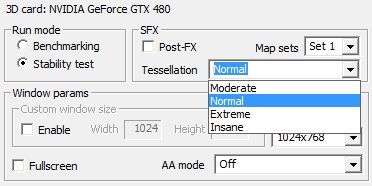
- moderate = tessellation factor of 8
- normal = tessellation factor of 16
- extreme = tessellation factor of 32
- insane = tessellation factor of 64
Moderate and normal levels are levels we’ll find in real world applications like games. Extreme and insane levels are not really realistic ‘real world' tests. We are using the normal settings today.

We were surprised to see such staggering performance from the reference and overclocked GTX460 hardware. We spoke with Jerome from Geeks3d.com who said that ‘TessMark is focused only on the tessellation engine of the DX11 graphics cards'.
AMD told us that this benchmark doesn't mirror a ‘real game' situation at all, but we felt it would be interesting to include, even if it isn't a real world style benchmark.
ShaderToyMark is an OpenGL benchmark, developed with GeeXLab, and focused on pixel shaders only. ShaderToyMark? is a WebGL tool for testing GLSL shaders. Shadertoy utilises several of these shaders running at the same time in the same 3D window.
The contributors of Shader Toy are all famous demomakers and their shaders are real gems. It’s just amazing to see what can clever people do with some sin/cos and other math tricks. ShaderToyMark can be seen as a modest tribute to their fantastic and sometime unreal work.

All cards deliver high frame rates with this benchmark. The HD6870 trails the overclocked eVGA FTW, but beats the reference clocked card. The HD6850 is only 9 points behind the reference clocked GTX460.
HQV Benchmark 2.0 is an updated version of the original tool and it consists of various video clips and test patterns which are designed to evalute motion correction, de-interlacing, decoding, noise reduction, detail enhancement and film cadence detection.
There are two versions of the program, standard definition on DVD and high definition on Bluray. As our audience will be concentrating on HD content so will we.
This has a total of 39 video tests which is increased from 23 in the original and the scoring is also up from a total of 130 to 210. As hardware and software gets more complicated, the software has been tuned to make sure we can thoroughly maximise our analysis.
Read our initial analysis over here.
| HD6870 & HD6850 | |
|
Dial
|
4 |
| Dial with static pattern | 5 |
| Gray Bars | 5 |
| Violin | 5 |
| Stadium 2:2 | 5 |
| Stadium 3:2 | 5 |
| Horizontal Text Scroll | 5 |
| Vertical Text Scroll | 5 |
| Transition to 3:2 Lock | 5 |
| Transition to 2:2 Lock | 0 |
|
2:2:2:4 24 FPS DVCAM Video
|
5 |
|
2:3:3:2 24 FPS DVCam Video
|
5 |
|
3:2:3:2:2 24 FOS Vari-Speed
|
5 |
|
5:5 FPS Animation
|
5 |
|
6:4 12 FPS Animation
|
5 |
|
8:7 8 FPS Animation
|
5 |
|
Interlace Chroma Problem (ICP)
|
5 |
|
Chroma Upsampling Error (CUE)
|
5 |
|
Random Noise: Sailboat
|
5 |
|
Random Noise: Flower
|
5 |
|
Random Noise: Sunrise
|
5 |
|
Random Noise: Harbour Night
|
5 |
|
Scrolling Text
|
5 |
|
Roller Coaster
|
5 |
|
Ferris Wheel
|
5 |
|
Bridge Traffic
|
5 |
|
Text Pattern/ Scrolling Text
|
5 |
|
Roller Coaster
|
5 |
|
Ferris Wheel
|
5 |
|
Bridge Traffic
|
5 |
|
Luminance Frequency Bands
|
5 |
|
Chrominance Frequency Bands
|
5 |
| Vanishing Text | 5 |
|
Resolution Enhancement
|
15 |
|
Theme Park
|
5 |
| Driftwood | 5 |
|
Ferris Wheel
|
5 |
|
Skin Tones
|
7 |
| Total | 196 |
The image quality with Catalyst 10.10 is the best yet, as the driftwood test scores 5 now instead of 2 points, bringing the total to 196 points.
To test power consumption today we are using a Keithley Integra unit and we measure power consumption from the VGA card inputs, not the system wide drain. The best way to get maximum load results is by using Furmark, and even though it is not indicative of a real world situation it shows the limits the card can theoretically demand. The ‘gaming’ results are measured when playing Crysis Warhead and is a more valuable result to take from this.

The power consumption of the HD6800 series is noticeably less than the GTX460. Comparing the reference GTX460 at 170 watt maximum load against the HD6870 and HD6850, we can see a 17 watt and 41 watt difference.
The tests were performed in a controlled air conditioned room with temperatures maintained at a constant 25c – a comfortable environment for the majority of people reading this.
Idle temperatures were measured after sitting at the desktop for 30 minutes. Load measurements were acquired by playing Crysis Warhead for 30 minutes and measuring the peak temperature. We also have included Furmark results, recording maximum temperatures throughout a 30 minute stress test. All fan settings were left on automatic.


The customised solution on the HD6850 delivers great results, with a maximum peak of 60c when gaming. Furmark pushes the core 9c higher, although the fan is very moderately paced, more on this shortly.
The HD6870 is a reference design with the standard AMD cooler and as such gets a little hotter. The results are still very good however, reaching only 65c when gaming.
Return to ambient is a feature we have recently added to our reviews … we measure the time it takes for a solution to return to idle temperatures, immediately after full load. The faster the time, the better the cooler – for example a Noctua NH D14 cooler will return an Intel processor to idle temperatures much faster than a reference cooler. This is a good indication of how quickly a heatsink can dissipate heat.

The improved cooling solution on the Sapphire HD6850 means it can return to idle in 15 seconds, 7 seconds faster than the reference HD6870 cooler. When Sapphire get the chance to enhance the HD6870, we can expect low temperatures and a faster return to idle state.
Recently we have changed our method of measuring noise levels. We have built a system inside a Lian Li chassis with no case fans and have used a fanless cooler on our CPU. We are using a heatpipe based passive power supply and an Intel SSD to keep noise levels to a minimum. The motherboard is also passively cooled. This gives us a build with completely passive cooling and it means we can measure noise of just the graphics card inside the system when we run looped 3dMark tests. Ambient noise in the room is around 20-25dBa. We measure from a distance of around 1 meter from the chassis and 4 foot from the ground to mirror a real world situation.
Why do this? Well this means we can eliminate secondary noise pollution in the test room and concentrate on only the video card. It also brings us slightly closer to industry standards, such as DIN 45635.
KitGuru noise guide
10dBA – Normal Breathing/Rustling Leaves
20-25dBA – Whisper
30dBA – High Quality Computer fan
40dBA – A Bubbling Brook, or a Refridgerator
50dBA – Normal Conversation
60dBA – Laughter
70dBA – Vacuum Cleaner or Hairdryer
80dBA – City Traffic or a Garbage Disposal
90dBA – Motorcycle or Lawnmower
100dBA – MP3 player at maximum output
110dBA – Orchestra
120dBA – Front row rock concert/Jet Engine
130dBA – Threshold of Pain
140dBA – Military Jet take-off/Gunshot (close range)
160dBA – Instant Perforation of eardrum

The HD6870 reference cooler is noticeably louder than the Sapphire customised HD6850, which is quiet. AMD's reference cooling solutions are acceptable, but we know that once Sapphire gives this card a makeover both temperatures and noise will improve.
The HD6850 cooler is great, hovering around 34 dBA when gaming, which is certainly not going to annoy any performance gamer.
When overclocking the Sapphire HD6870 we used Catalyst Control Centre.
Overclocking on reference boards indicates potential speeds a few weeks down the line when AMD partners release their own overclocked solutions with improved coolers and bios configurations.

Our overclocking tests were reasonably successful considering this is a reference cooler, although we didn't find huge overhead on the core. We were limited to 950MHz on the core and 1,140MHz on the memory.
We then wanted to run some tests with our overclocked results, settling on 940MHz core and 1,140MHz memory for the final CrossFireX settings.


The overclock results are healthy, Unigine Heaven Benchmark shows a 2fps increase in and 3DMark Vantage scales with 300 additional points when overclocked.
Overclocking the Sapphire HD6850 in Catalyst Control Center is a futile process as it limits the card to 850MHz, however Sapphire sent over a beta of their new Trixx overclocking tool for the HD6800 series.
We need to point out that the version of TriXX shown in these screenshots might look (and act) slightly differently to the final version bundled with the retail product.


The Sapphire Trixx utility will be bundled with retail versions of the Sapphire HD6850 and it allows the end user to change a plethora of settings, including GPU voltage changes. We managed to get the core to 860mhz without adjusting the voltage.

After cranking the voltage (as we always do!) we managed to get the core stable to 951MHz and the memory to 1132MHz. This is an incredible core increase from 775MHz and although we could just be lucky with this particular sample, it could very well show massive potential headroom with the HD6850 hardware. We would assume 900MHz core would be possible with the majority of Sapphire HD6850 cards.


These increases are huge as the figures show – with the clocks at 950MHz core and 4560MHz effective on the memory, the HD6850 is outscoring the reference clocked HD6870. In 3DMark Vantage, it has managed to score higher than the GTX460 FTW edition!
The Sapphire HD6870 is a fantastic board which manages to keep up with our overclocked GTX460's … sometimes even leading the way, and always in the top grouping. We haven't made it easy for AMD's new mid range flagship product as we have pitted it against some of the most powerful GTX460's available today such as the eVGA GTX460 FTW and the MSI GTX460 Talon Attack.
We are excited to see how Sapphire will modify the HD6870 design later, because we aren't that impressed with the reference cooler. It isn't bad, but it can get a little noisy when pushed hard.
The HD6870 can be clocked a little higher, although all of our samples seemed to be limited to around 950MHz on the core, which is only a 50MHz increase. Memory can be increased from 1000Mhz to around 1140-1150MHz without experiencing an issue. This card will retail at a very competitive £197 inc vat.
The star of this review however is the stunning Sapphire HD6850, which delivers very solid performance levels without breaking the bank. With the price looking to settle at just over £150 inc VAT, this card has surely to be on the shortlist of many people wanting a new gaming card for high resolution gaming.
As we expected, the heatpipe based cooler is excellent, keeping the card running under 60c at all times and the return to idle state is also very impressive, averaging 15 seconds.
The new TriXX overclocking tool from Sapphire however really brings this card into a new playing field, as we managed to get the core to 950MHz (almost 23% up from the stock clock of 775MHz) before it would hardlock. This was achieved by increasing the core voltage to 1299 which raised temperatures by around 10c when loaded (i.e. to 70c when gaming). The effect this overclock had on performance levels was staggering: 12,500 to almost 16,500 in 3DMark Vantage and 7 extra frames in Unigine Heaven Benchmark, bringing it above reference HD6870 levels.
KitGuru says: Sapphire's holding a winning pair here, no doubt. It has to be said again that we have been comparing these cards against the very best, overclocked GTX460 cards on the market. AMD could have launched its second generation DX11 cards with a £400 leviathan. Instead, they have aimed squarely at the best nVidia card on the market and, based on several days' testing, have hit the bull's eye.


Interesting times ahead over the next year. I seriously dont know how they are giong to get much more power out of the new range. I would guess they will need to do more with power management too
They need to work on tesselation. the GTX460 is basically delivering the same tesselation performance as a high end 5870 right now. so I can see a huge focus on this.
Yeah it has to be a focus on tesselation , its their real weakness right now compared to nvidia.
even though I know this article will get some stick from people. its interesting guess work really and it stirs debate. I would say this wont be that far out.
Well going on the past. 3dmark vantage scores are generally slightly below dual card high end configurations of the generation before, so id say this would be close to accurate.
These are mostly just bad assumptions with nothing to back them up. While ATIs next gen gpus will come Q4, there’s no performance data available. Intels’ tic-tacs has nothing to do with ATI gpus and you won’t be seeing 28nm gpus until next summer at the earliest. The next gen gpus were meant to be done on 32nm, but that was cancelled, and it obviously changed plans, so basically we get a new 40nm gen that’s somewhat late considering.
1, Whom do we imagine will be making a 28nm part? There are no fabs with a 28nm mass production node ready for high end GPU parts this year.
2. Northern Islands has been cancelled, Southern Islands is now the codename series for next generation of AMD ATI Radeon cards.
3. Work on the design began far longer ago than the tape-out of Evergreen and Cypress. The lead time on these designs is at least 18-24months before tape-out.
4. ATI’s GPU ‘tock’ team are working with the CPU guys on Fusion. That’s why Evergreen was an incremental improvement of the Terascale SP design in the RV770, and not a brand new architecture. Southern Islands is the same – incremental, with a boost in ‘uncore’ – which can mean boosts in Tessellation performance (not that it means anything outside of benchmarks).
Double performance of 5870? thats not likely, a next gen of gpus never gives double performance from previous gen. maybe 50% over 5870 (6870) in vantage or 20-30% over gtx 480 but i think more like 15-20% sounds reasonable. Don’t forget boys and girls gtx 485 is coming soon (q3 2010) because its a 40nm chip the performance can only come from better clock speeds, power efficiency, drivers, cooling, and improved engineering
Funny 🙂 Never ceases to amaze me how many people take these weekend discussion topics on KG ;’seriously’ and then proceed to slander the whole site. saw rage3d posted about it and some guy was saying how crap everything is here. He clearly never read the 44 page HQV 2.0 benchmark analysis or the power supply article posted a few days ago. (amongst other things). seems its really easy on the net to just take an opinion without any basis for it and then continue slandering something 🙂
Good read this btw, will be interesting to see atis new range of graphics cards, I think tesselation will become a big part of future games, as its such a strong aspect of DX11
Considering current gens are generally more or less twice as fast as the previous generation of cards as death dealer said, 5000 gives twice the performance as 4000, eg 5870 2x~ 4870 more or less. If this is set to be more then just a refresh then that will be true, if theyve just been lazy and not really done much more then a refresh in all this time then probably more like ~1.3x time current performance
Interesting conjecture, and I’m not going to discount it, let’s face it Nvidia and AMD are simply not going to tell us what their strategies are and I’m sure all of the noted factors are very well noted by both teams.
I can’t call it from a technology stand point, although I’m a self confessed Nvidia fan, but I won’t let that colour my view.
It would be interesting if you did a follow up article on the state of play in with 28nm fabrication. Do AMD have the edge here with global foundries? We’ve seen Nvidia struggle with the 40 nm process, would AMD be faced with the same challenges or do they have an edge in tape out technologies and testing. That I’d be interested to read.
It will, in any event, be very interesting, and I’m waiting until after the summer and those cold dark evenings for a PC rebuild and cheaper cards.
@James: Great questions ! Let us try and respond…
1) TSMC completed work on Fab 12 in January this year. They have 28nm capability and, when they opened the Fab, announced that they expected production runs to begin Q4 2010. KitGuru says that a high-end 6000 series part in only likely to move to 28nm IF one of the simpler 5000-series parts moves first. So if there’s an announcement at the next quarterly briefing, we’ll all know for sure!
(For reference, check Anton Shilov’s article on Xbit back on 20th Jan 2010)
2) Not sure where your info comes from. We believe that Northern Islands is this year’s respin and a full update will happen around 12-18 months later. Please reveal your sauces 😉
3) We said that a lot of work happens in parallel. However, you can make changes to the final performance characteristics IF your opponent has already launched all of its key SKUs. That’s a big advantage for AMD. They KNOW where the nVidia products are. Remember, the GTS450, 440, 430 and 420 parts have not launched yet, while the high end parts are already several versions of the silicon down the line. If Fermi had launched in the Sep-Dec time frame, then the GTX460 etc would have been the respins. They are not respins now. They have become v1 launch silicon. Which means the respin for nVidia could be a lot further away. If that makes sense.
4) Possible, but not what we meant. What’s we’re saying is that Intel uses a Tick-Tock as a concept and we feel it’s unlikely for AMD to move a new product (6870) to a new process at the same time. We might be wrong, of course, and we’ll take our lumps if we are. But we believe a smaller product will ‘Tick’ its way to 28nm ahead of 6870.
@Aberkae: What’s your guess ?
@PineappleExpress: Wise words from down under methinks 🙂
No not going to happen this way AMD would not take the risk.
Not now that Nvidia has essentially closed the gap with the GF104 chip and forthcoming GF106 and 108 chips. Nvidia has retaken the $200 mark and with the possibility of a higher power GF104 chip using all 8 SM’s not just the 7 used on the current gtx460 and dual GF104 cards Nvidia is set to sweep across the board.
Both Ati and Nvidia were stung by the 40nm yield issues, ATi will now be looking for a dead certainty to counter Nvidias latest releases and will not risk its now required performance boost on a 28nm process which isn’t even in being yet particularly when they would also be making a new architecture on it without trialing it with a mid range gpu first(just like the mistake Nvidia made with Fermi on the 40nm process).
No Southern Islands on 40nm will be released in Q4 and we will probably see a mid range Southern Island card released in H1 2011 using 28nm process very much like they did with the 4770 on the 40nm process.
How long the Southern Island range will last is another question, it was only a back up plan used becasue of the cancellation of 32nm by the fabs, I don’t think Ati will wait a year from Southern Islands release to release Northern Islands and as soon as they are happy with the 28nm process it will be out , they don’t want to give Nvidia any breathing space just to stretch out the life cycle of Southern Islands which after all was just a back up plan.
http://www.fudzilla.com/graphics/graphics/radeon-hd-6000-is-a-minor-improvement
Fudzilla just posted this, so im guessing were looking at more minor improvements. Such as the uncore part as stated on wiki which improves tessellation performance as someone said above. Which probably means something like 1.3 times evergreen. So im guessing its the phenom x6 to the phenom x4 (without extra cores), just little things like improved process and stuff like that to improve efficency
Also read a comment saying that northern islands has been cancelled, its hasnt been cancelled, only delayed due to glofo/TSMC cancelling its 32nm process and jumping straight to 28nm. So ATI is using southern islands as a filler until northern islands comes around next year. Dunno if anyone else said this didnt read all the comments…
Hopefully southern islands will be good, and create ALOT of competition with GF104 as im looking to get my new build some time around the holiday season
I think the majority of it will end when we have real life simulation of environments and all the in betweens on our screen.
But with the release of Kinect, Wii, Move etc and their successors… you have to wonder if we’ll ever reach the end of the on screen gaming potential as the battle between mouse, keyboard, controller and the hands free experience intensifies.
The transition from whats traditional and the alternatives offered by the consoles may prevent us from reaching the pinnacle of gaming on screen more than any hardware or software bottleneck. \
so let me get this straight they did a benchmark on the 6870 3-6 months before its release date? seems fabricated to me.
Thats why its called a ‘prediction’. You can hardly fabricate a prediction. its guesswork and the reasons why surrounding it.
Haha)) According to the leaked benchmarks of HD6870 (here: http://we.pcinlife.com/thread-1500103-1-1.html ) Your predictions were pretty damn close! 6870 GPU Score in Performance benchmark: 24056.
kitguru prediction ? WRONG ! bench has been leaked !
GTX480 score heaven 2.1 = 970
ATI6718 score heaven 2.1 = 912
LOL – the truth is out there !
I realize some may not like the former post so here are the links !
http://www.geeks3d.com/20100525/quick-test-unigine-heaven-2-1-gtx-480-vs-gtx-470-vs-hd-5870-in-opengl-4-0-and-direct3d-11-in-extreme-tessellation/
http://futuremark.yougamers.com/forum/showthread.php?t=133775
Read it and weep waiters !
SiliconDoc
The prediction of “performance” score of HD6870 in 3DMark Vantage by KitGuru is almost correct! Only of course – If leaked benchmarks are true.
And considering the leaked Heaven 2.1 score – the GTX480 (at stock clock) with the same settings actually scores less then leaked 6870 – somewhere around 750 points. Check this: http://tof.canardpc.com/view/186b5b87-44ec-4000-b8a2-31789867a501.jpg
Ah yes, the anonymous photo shopped pic job with the low 480 score, rofl. The 480 users already busted that ruse.
SiliconDoc
I do not own GTX480, so the score could be photoshopped. But after some searching done on internet – I’m sure that stock GTX480 (without overclock) at 1920×1200 4xAA and extreme tesselation scores LOWER THAN 900 points in Heaven 2.1 (a screenshot here in the end of the page (GTX480 Possibly OVERCLOCKED): http://we.pcinlife.com/thread-1500103-3-1.html). So It’s weaker than 6870 in tesselation according to the leaked tests.
Personally I still hardly believe leaked info, because the increase is so huge it would need some massive arhitecture improvements. Just can’t wait to see the official release to make things clear.
The thank you Daimler, more canned links that link the link I linked in th relinked links.
I already went to ORB and looked up GTX480 scores and saw X15,000+ not uncommon – beating the 11,000+ leaked for 6000 – in xtreme with 1 480 card….
So anyway…
People tell me with a straight internet face the 480 is only 10% faster than the 5870, the 470 is the same as 5850, the 5830 matches the 460, the 5770 beats the 260 and 275 and matches the 285, and on and on and on.
What I’ve been doing for a couple years now is immediately downgrading whatever gigantic full tier lie the ati fans spew as “their take”, a full tier.
To copy the greatest spew heard over and over again for years already (it seems) ” THEY HAVE HAD 8 MONTHS to release and that late it had better be a card that can beat the Nvidia 480 !!!!” ( imagine a raging face and screeching anger).
Can it do Physx and play Cuda ? (not Crysis)
SiliconDoc
I’m not an ATI fan. I’m technology fan. But you are obviously an nVidia fanboy and thats a shame. 🙁
As for xtreme benchmark score in Vantage – make sure you looked not at total score, but GPU Score ONLY! Because Total Score is affected by CPU and Use of PhysX in CPU Tests. Stock clocked GTX480 would never 15,000 mark in GPU Score.