KitGuru KitGuru.net – Tech News | Hardware News | Hardware Reviews | IOS | Mobile | Gaming | Graphics Cards


AMD has published new research detailing a tetrahedral cage ray tracing technique designed to reduce memory and computational costs when rendering animated environments. AMD's Holger Gruen explains that the method encloses dense geometry in deformable cages, enabling real‑time ray tracing of hundreds of millions of animated triangles with significantly reduced memory overhead.
In a demonstration (via Wccftech) running on a Radeon RX 9070 XT, AMD showcased a terrain scene with 25,000 foliage items representing roughly 500 million ray‑traced triangles per frame after level‑of‑detail selection. The scene ran at over 60FPS at 1080p while updating acceleration structures in 3.3ms, compared to over 300ms using conventional bottom‑level acceleration structures. Memory usage for the acceleration structures dropped from up to 80GB to around 1.7GB.
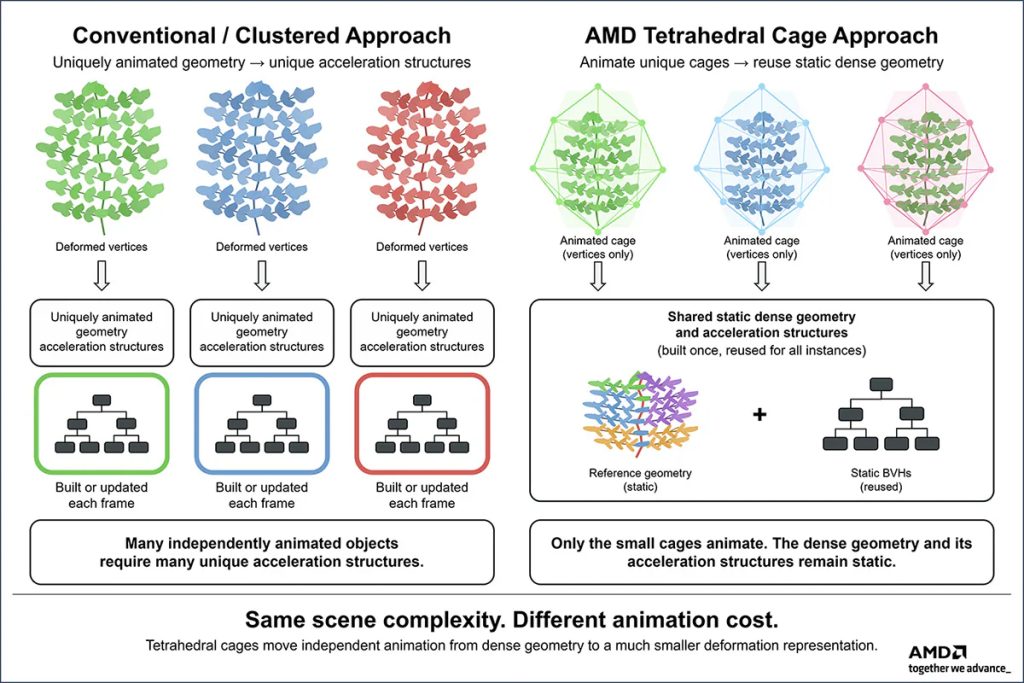
Traditional ray tracing requires independently animated objects to rebuild or update their BVH acceleration structures continuously. AMD’s method instead animates the outer tetrahedral cage while keeping the underlying dense mesh and its BVH static, transforming rays back into the original reference frame during intersection testing.
There are limitations. Tetrahedral cages offer less fine‑grained vertex control, making the technique better suited to dense foliage, grass, crowds and distant characters rather than detailed mesh deformation. The research, published as Ray Tracing Massive Amounts of Animated Geometry, placed third at High‑Performance Graphics 2026. AMD says DirectX Raytracing samples and a C++ library are now in development for wider integration.
KitGuru Says: Do you think techniques like this will become standard for handling large amounts of animated geometry in future games?