 KitGuru KitGuru.net – Tech News | Hardware News | Hardware Reviews | IOS | Mobile | Gaming | Graphics Cards


MSI's mid-range Z97 motherboard is the first to market with on-board USB 3.1 in the connection's Type-C form. With the port providing transfer rates of up to 10Gbps and support for new reversible USB Type-C devices, can MSI's Z97A Gaming 6 prove itself as a good option for users wanting maximum future-proofing of their system?
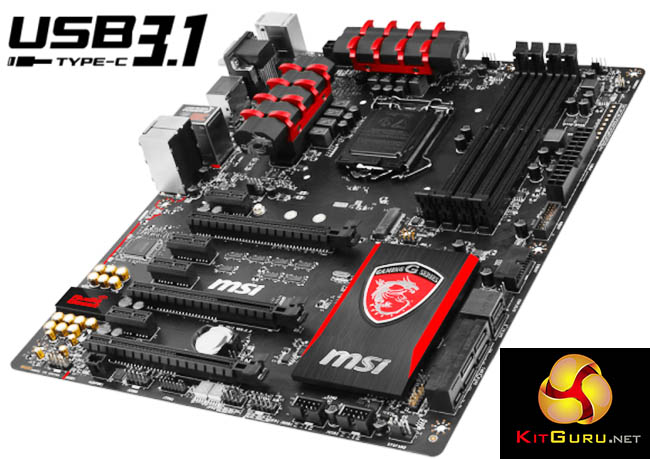
While the main feature of MSI's Z97A Gaming 6 is undoubtedly its USB 3.1 Type-C connector, there are plenty of other features that will appeal to gamers and general users. Support for up to two-card SLI and three-card CrossFire is present, as is an enhanced audio solution built around the Realtek ALC 1150 codec. Killer's E2200 series NIC and its accompanying Network Manager software also make an appearance on the board.
Outfitted in MSI's typical Gaming series style, and with updated support for the recently released Broadwell processors, how will the Z97A Gaming 6 fare in our testing?
Features:
- Supports 4th and 5th Gen Intel® Core™ / Pentium® / Celeron® processors for LGA 1150 socket
- Supports DDR3-3300(OC) Memory
-
USB 3.1: Delivering speeds up to 10Gb/s, USB 3.1 offers performance twice as fast as a regular USB 3.0 connection
- M.2 + USB 3.1 + SATA Express + SATA 6 Gb/s
- Audio Boost 2: Reward Your Ears with True Quality
- Killer Ethernet: Kill Your Lag
- USB Audio Power: Serve Stable 5V Power & Better Signal Transmission over USB
- XSplit Gamecaster V2:Show off Your Skills and Achievements
- OC Genie 4: Overclock in 1 Second
- Click BIOS 4: Easily Fine-tune Your System
- Sound Blaster Cinema 2: Realistic Surround Sound Experience
- Gaming Device Port: Optimized with Triple Gold-plating for High Polling Rate Gaming Devices

More fun with this site kitguru … Keep Reading
< ??????.+ zeldadungeon+ *********….. < Now Go Read More
0
Your first choice kitguru Find Here
All time hit the kitguru Find Here
I saw the bank draft saying $5356 @mk7
.
http://www.GlobalNetMoneyCrowd/lifetime/work...
Only 4 regular USB outputs on the back I/O panel is just too low.
MSI Gaming 5 vs Asrock fatal1ty z97 killer?