KitGuru KitGuru.net – Tech News | Hardware News | Hardware Reviews | IOS | Mobile | Gaming | Graphics Cards


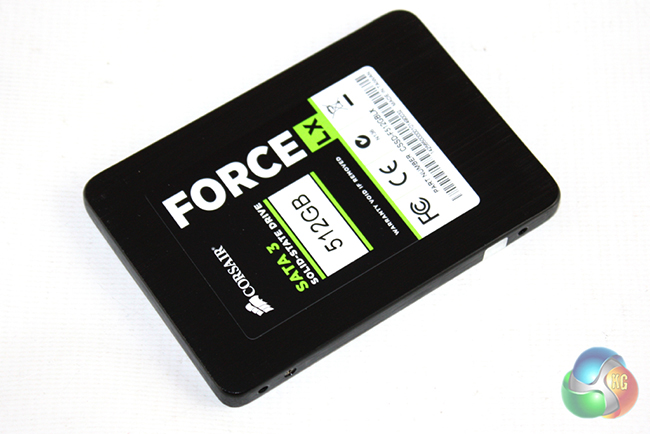
Today we are going to take a look at one of Corsair’s latest solid state drives, the Force LX 512 GB. This is targeted at the mainstream enthusiast audience, seeking to deliver a good balance between cost and performance.
With the price of NAND having come down significantly over the past few years, solid state drives are starting to reach prices which are affordable to the masses. This makes it the perfect time for Corsair to launch the Force LX range of mainstream drives alongside their more established performance ranges.
It’s worth noting, before we start looking at the Corsair Force LX 512 GB in more detail, that this drive is available in 128 GB, 256 GB and 512 GB flavours and that the claimed write performance of each capacity is different.
Corsair claim that all of the drives offer sequential read speed up to 560 MB/s, and the claimed sequential read speeds for the 512 GB, 256 GB and 128 GB models are 450 MB/s, 300 MB/s and 150 MB/s respectively.
Specification
- Interface Type: SATA 6.0 Gb/s (SATA 3).
- Form Factor: 7mm high, 2.5 inch.
- Max Sequential Read (ATTO): Up to 560MB/s.
- Max Sequential Write (ATTO): Up to 450MB/s.
Compatibility
- SATA 3 6Gb/s.
- Backward compatible with SATA II and SATA I.
- Microsoft® Windows® 8, Windows® 8.1, Windows® 7, Vista®, and XP; Macintosh OS X; Linux.
- 2.5″ bay, or 3.5” bay with 2.5” drive support.
- 7mm height for laptop and notebook compatibility.
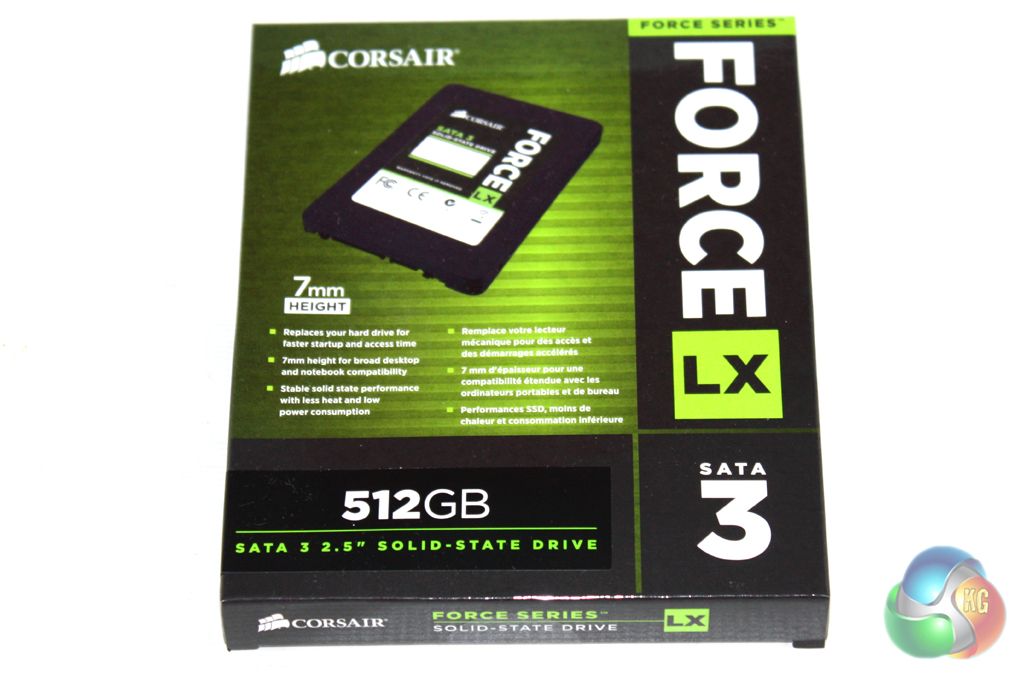
The Corsair Force LX is supplied in a small cardboard packet which is decorated in a green and black livery. The front of the packet features an image of the drive as well as a basic breakdown of the product’s features.
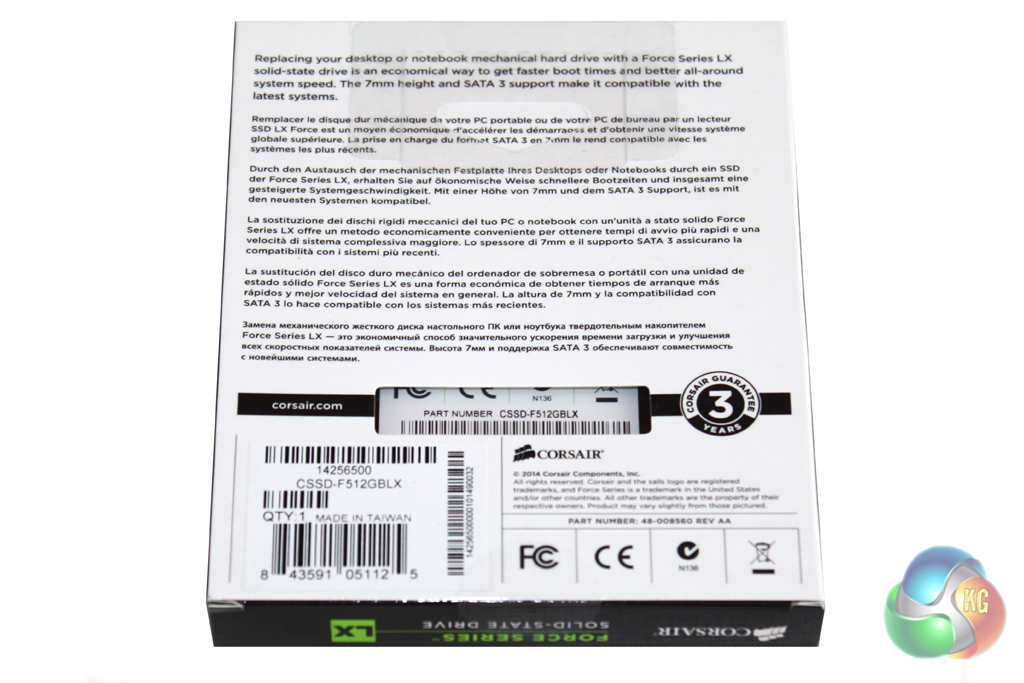
Turning the packet over reveals a promotional blurb in a number of languages, and a small window which lets you check the serial number of the drive without removing it from the packet. There isn’t an accessory bundle included with the drive, only a single leaflet outlining the warranty.
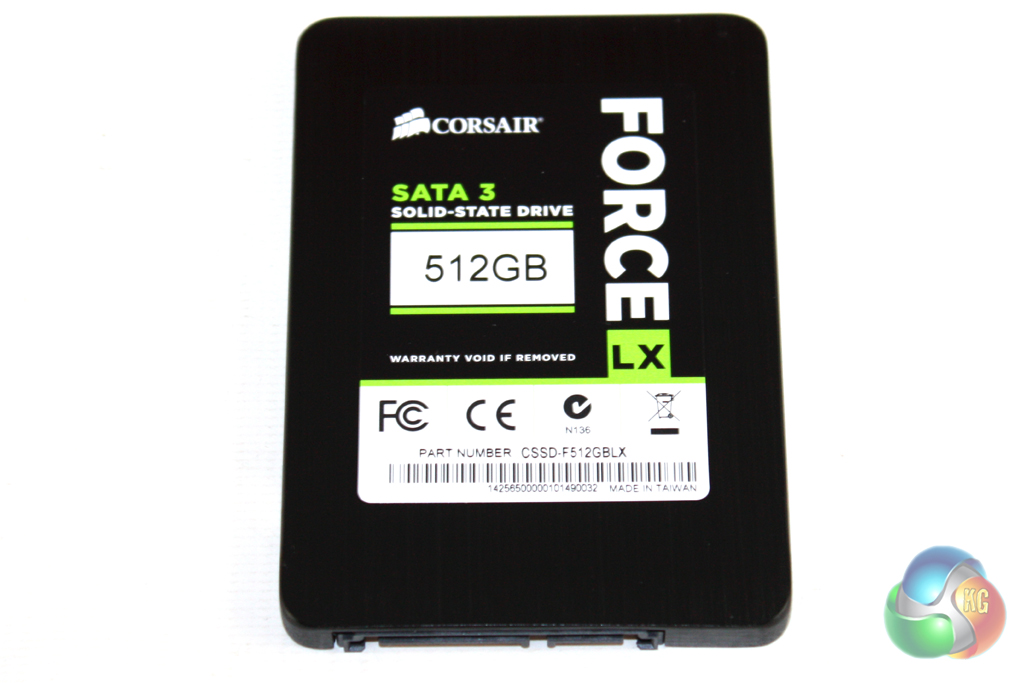
Corsair have chosen to finish the Force LX in black brushed aluminum. This gives it a premium look and feel, and should provide a decent level of protection for the components within.
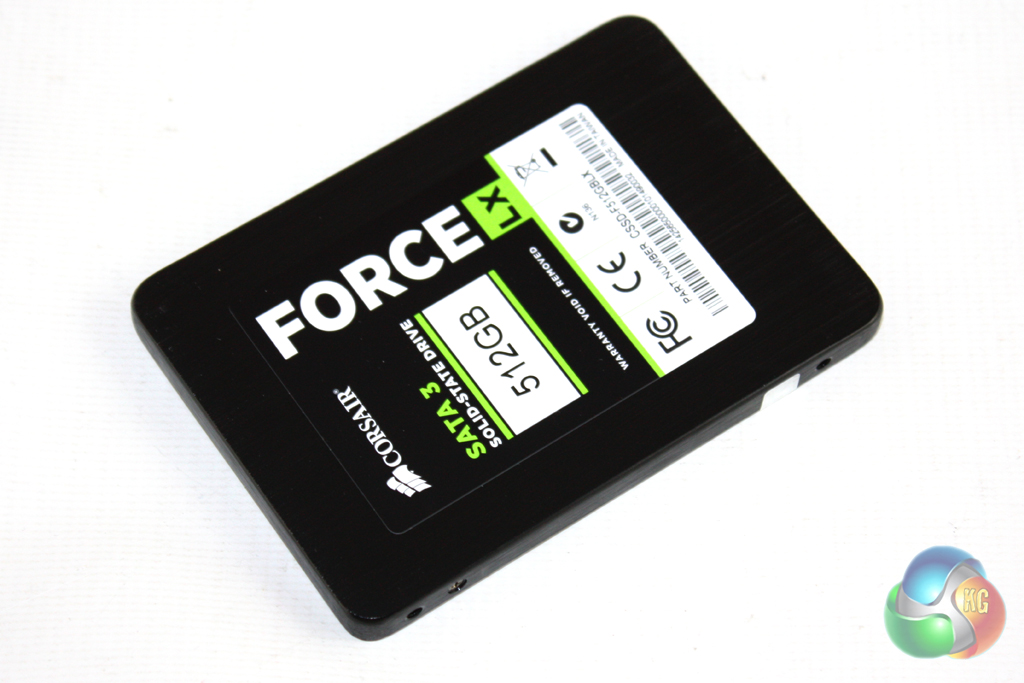
The label on the front of the drive is a similar design to other Corsair drives we have seen in the past, although it uses a black and green colour scheme.
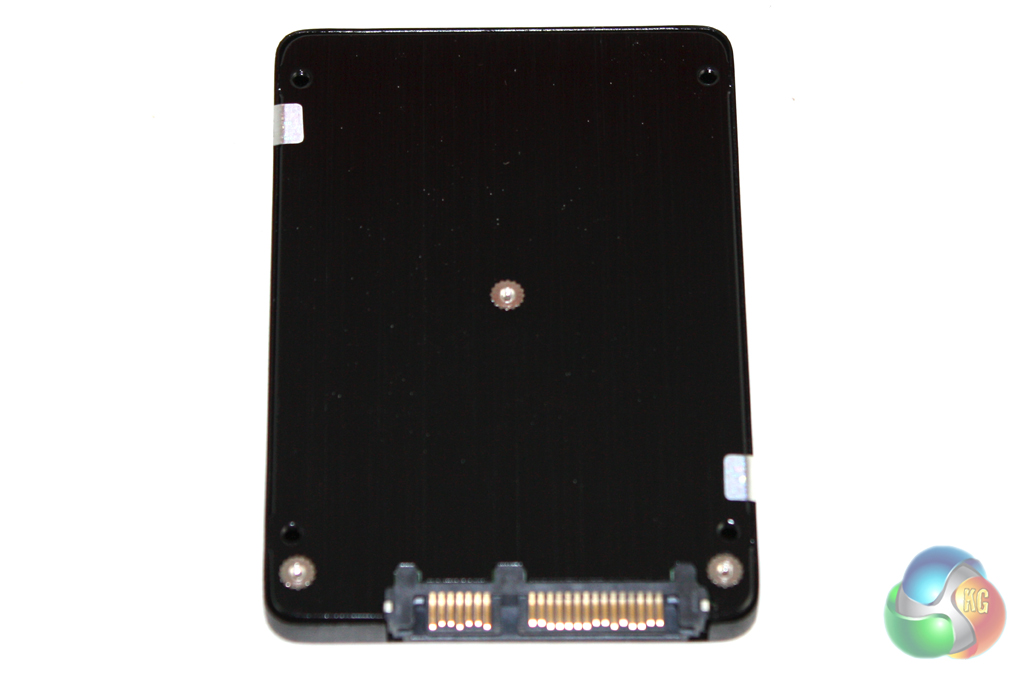
The Force LX occupies the same form factor as a 2.5” hard drive and measures 7mm tall, meaning it should be compatible with most laptops. We gain access to the internal components of the drive by removing two screws on either side of the casing. Two of these are covered with tamper-proof seals, meaning you will void your warranty if they are damaged.
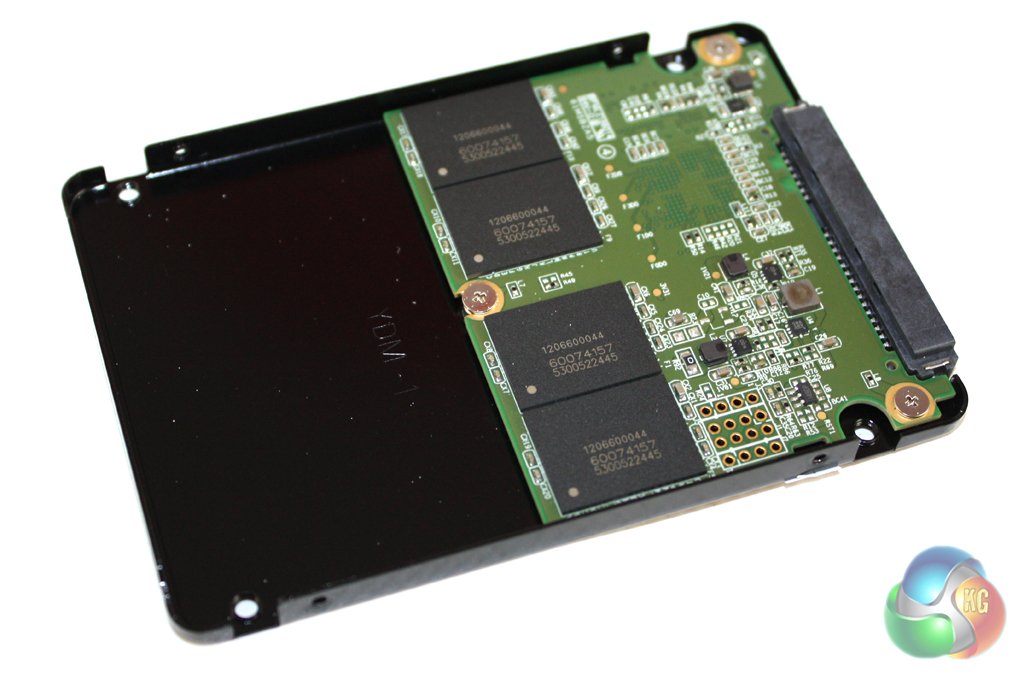
The PCB inside the drive is surprisingly small, only occupying around half of the space within. This is secured to the drive casing with three screws.
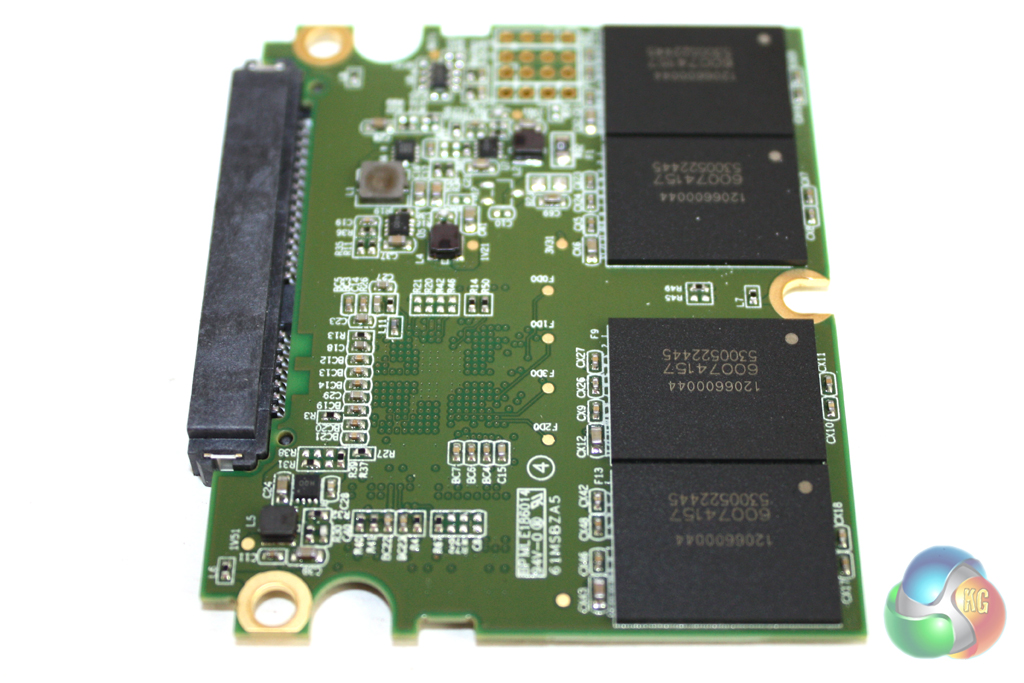
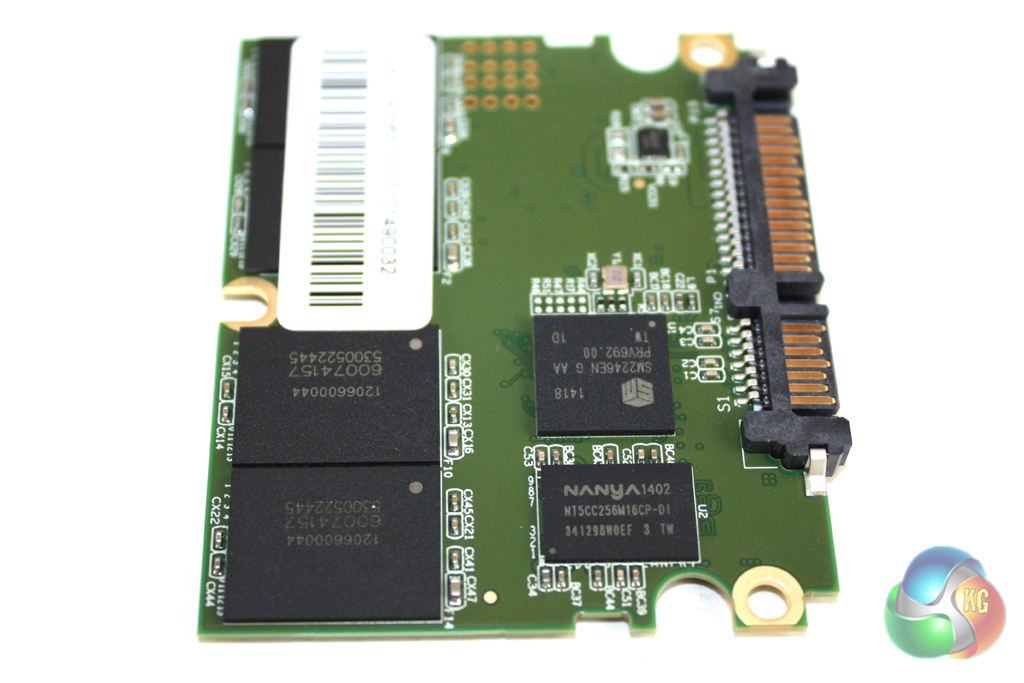
We can see that there are four 64 GB memory chips on either side of the PCB which are IMFT (Intel) 60074157 20nm MLC NAND. We find the SMI SM2246EN controller and 256 MB (DDR3) Nanya NT5CC256M16CP-D1 cache chip on the underside of the PCB.
For testing, the drives are all wiped and reset to factory settings by HDDerase V4. We try to use free or easily available programs and some real world testing so you can compare our findings against your own system.
This is a good way to measure potential upgrade benefits.
Main system:
Kitguru Test Rig 3
Other Drives
OCZ RevoDrive 350 480GB
OCZ RevoDrive 3 x2 480GB
Intel 520 Series 240GB
Intel 730 240GB
Samsung 840 EVO 1TB
OCZ Vector 150 256GB
OCZ Vector 240GB
OCZ Vertex 450 256GB
OCZ Vertex 4 512GB
OCZ Vertex 4 128GB (1.4 fw)
ADATA Premier Pro SP900 128GB
Intel 730 240GB
OCZ RevoDrive Hybrid 1TB HDD/SDD
SanDisk Extreme II 240GB
Corsair Performance Pro 256GB
OCZ Agility 4 256GB
SanDisk Ultra Plus 256GB
Samsung 830 Series 512GB
Patriot Wildfire 240GB
OCZ Vertex 3 240GB MAX IOPS
ADATA S510 120GB
Kingston HyperX 3K 120GB
OCZ Octane 512GB (fw 1.13)
Samsung Spinpoint F3 1TB
Software:
Atto Disk Benchmark.
CrystalMark 3.0.3.
AS SSD.
IOMeter.
All our results were achieved by running each test five times with every configuration this ensures that any glitches are removed from the results. Trim is confirmed as running by typing fsutil behavior query disabledeletenotify into the command line. A response of disabledeletenotify =0 confirms TRIM is active.
Crystalmark is a useful benchmark to measure theoretical performance levels of hard drives and SSD’s. We are using V3.0.3.
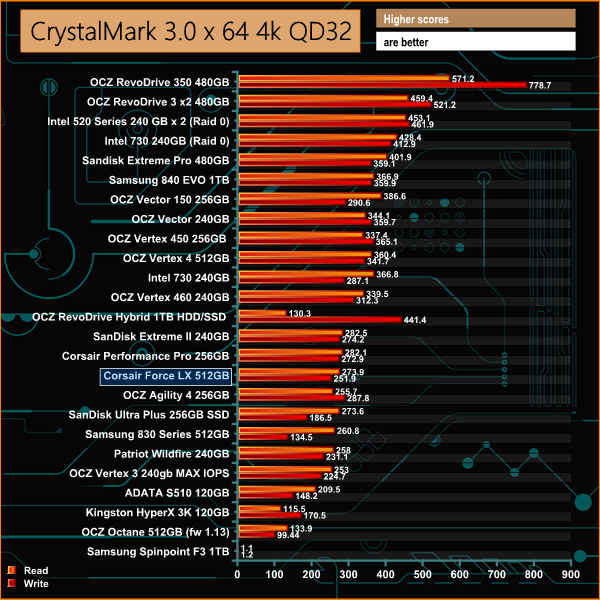
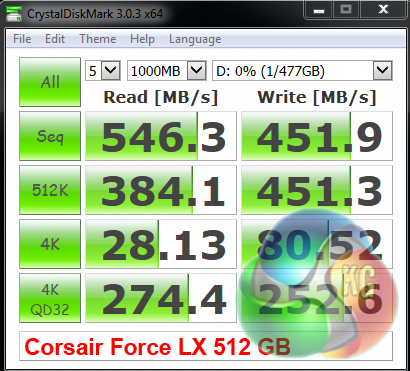
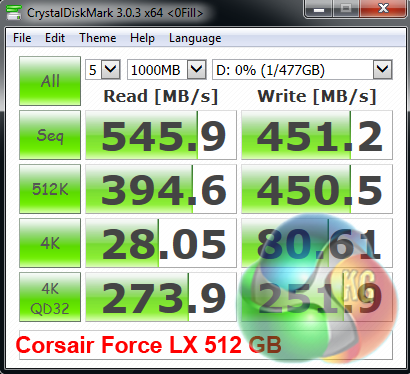
We can see that there are only very small differences in performance between the two tests, showing that the drive deals similarly with both compressible and incompressible data. While sequential read and write speeds are impressive, the 4K QD32 results aren't anything particularly special.
The ATTO Disk Benchmark performance measurement tool is compatible with Microsoft Windows. Measure your storage systems performance with various transfer sizes and test lengths for reads and writes. Several options are available to customize your performance measurement including queue depth, overlapped I/O and even a comparison mode with the option to run continuously. Use ATTO Disk Benchmark to test any manufacturers RAID controllers, storage controllers, host adapters, hard drives and SSD drives and notice that ATTO products will consistently provide the highest level of performance to your storage.
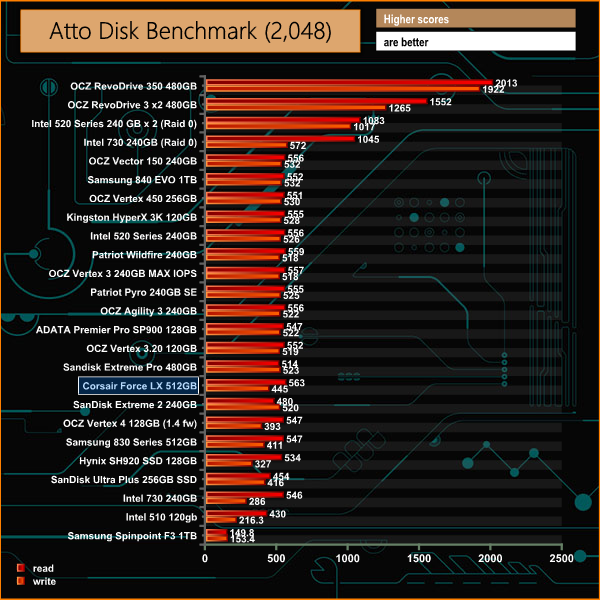
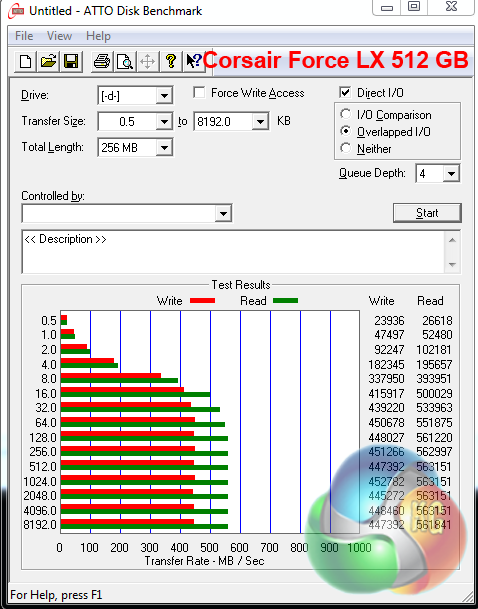
The Force LX achieved an impressive read score in this test, however the write score wasn't quite so impressive.
AS SSD is a great free tool designed just for benching Solid State Drives. It performs an array of sequential read and write tests, as well as random read and write tests with sequential access times over a portion of the drive. AS SSD includes a sub suite of benchmarks with various file pattern algorithms but this is difficult in trying to judge accurate performance figures.
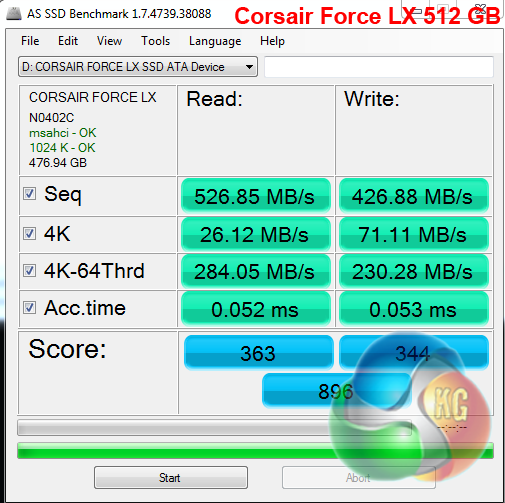
AS SSD tests using incompressible data only which some drives struggle with. The Force LX fairly well, though, particularly in the sequential test.
IOMeter is another open source synthetic benchmarking tool which is able to simulate the various loads placed on hard drive and solid state drive technology.
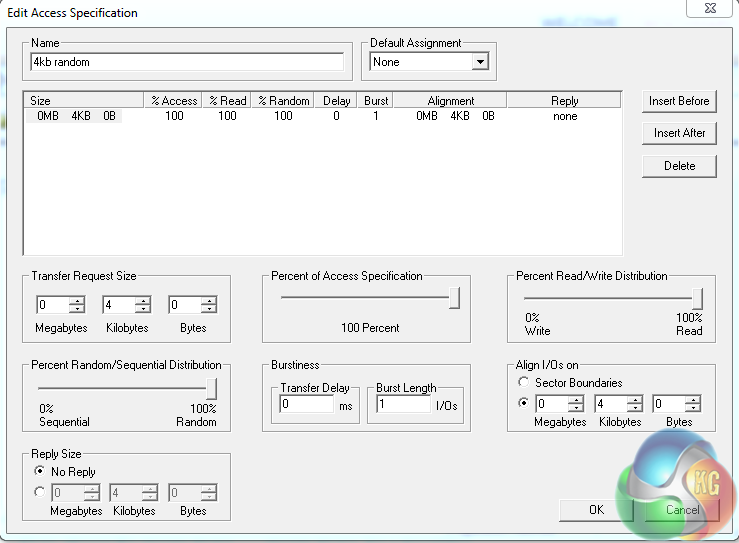
We test with both random read and write 4K tests, as shown above. There are many ways to measure the IOPS performance of a Solid State Drive, so our results will often vary between the manufacturer’s quoted ratings.
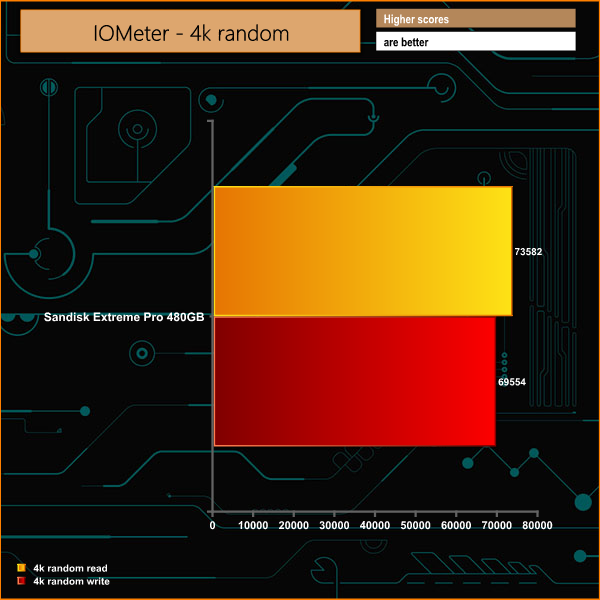
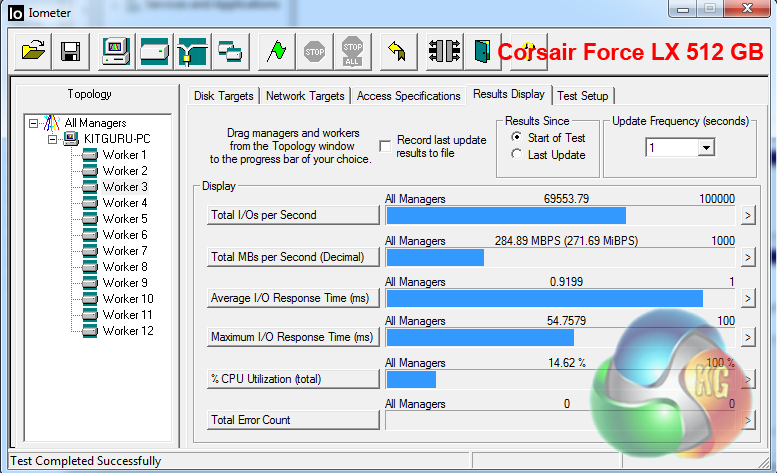
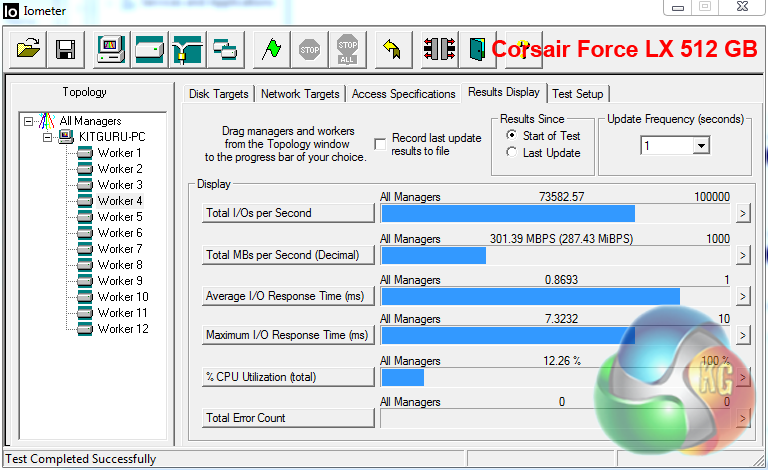
These scores are pretty impressive for a mainstream drive, however it must be noted that there are a number of ways of measuring IOPS so results can differ.
Overall we are pretty impressed with what the Corsair Force LX 512 GB Solid State Drive has to offer. In terms of the physical drive itself, it is very similar to other models we have seen in the past. It feels well put together and the 7 mm form factor means it should be compatible with most laptops.
Even though the Corsair Force LX is one of the lower performance models in Corsair's range, it still produced pretty impressive performance in our tests. Like many Solid State Drives in 2014 it is pushing the limits of the SATA3 interface, with sequential transfer speeds in the mid 500 – 600 MB/s range.
IOPS performance was also pretty impressive for a mainstream drive, achieving around 70,000 IOPS in both read and write tests. The SMI SM2246EN controller proved very capable, dealing well with both compressible and incompressible data. Unlike some older controllers, this model doesn't rely on compression to boost transfer rates.
Corsair have a fairly good reputation when it comes to build quality and customer service and offer a reasonable 3-year warranty with this model. Still, this is nowhere near as impressive as the 10 year warranty which Sandisk offer on some of their latest models.
At £200 from Overclockers UK, the Corsair Force LX 512 GB falls in the lower mid-range of 512 GB drives when it comes to price. This reflects the performance of the drive well, ensuring it is a good buy. However, we might be tempted to purchase two of the cheaper (£90) Corsair Force LX 256 GB drives instead to run in a RAID 0 array. This would save £20 overall and should theoretically offer superior speeds.
Discuss on our Facebook page, over HERE.
Pros
- Solid sequential performance.
- Decent IOPS performance.
- Attractive casing.
Cons
- The 256GB model offers more bang for buck.
KitGuru says: An excellent, effectively priced Solid State Drive from Corsair.