 KitGuru KitGuru.net – Tech News | Hardware News | Hardware Reviews | IOS | Mobile | Gaming | Graphics Cards


While the PCI-Express interface is currently the way forward for performance SSD drives, 3D NAND technology holds the key to SSD capacities never even dreamed of before; Samsung's 16TB PM1633a being the perfect example of this. 3D NAND can help achieve these huge capacities because its fabrication process allows for the creation of much denser NAND chips than the standard 2D Planar process.
Samsung has had quite a head start in offering drives that use 3D NAND into the consumer marketplace but other drive manufacturers are slowly but surely entering the fray. Crucial have thrown their hat into the ring with the MX300 750GB Limited Edition.
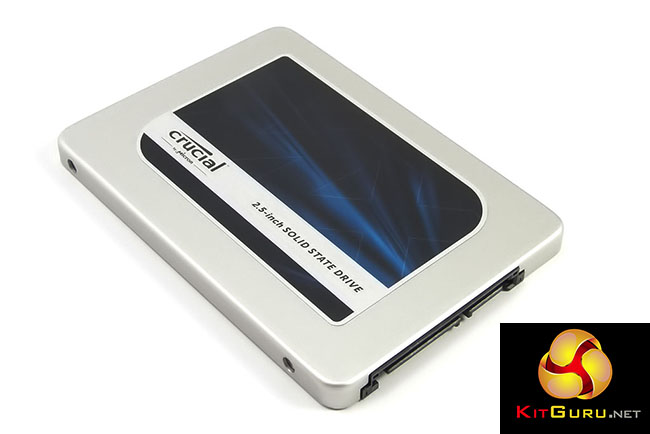
Although most of the press coverage concerning Micron and any talk about 3D NAND is usually based around the companies' tie-up with Intel for the advanced XPoint 3D NAND project, the MX300 series doesn't use that technology. Instead, its uses the companies Gen1 32-layer 3D TLC (3 bits/cell) NAND. At launch, the MX300 family consists of just one drive, the ‘Limited Edition 750GB' – but other capacities are scheduled to follow later in the year.
Crucial quote performance figures for the drive of up to 530MB/s and 510MB/s for sequential read and writes respectively with IOPS performance quoted at 92,000 IOPS and 83,000 IOPS for random read/writes respectively.
According to Crucial, the drive has a TBW endurance figure of 220TB which works out at 120GB per day for 5 years but bear in mind that Crucial only back the drive with a three-year limited warranty.
Physical Specifications:
Usable Capacities: 750GB
NAND Components: Micron 32-layer 3D TLC
Interface: Serial ATA (SATA) 6Gb/s (SATA III)
Form Factor: 7mm, 2.5in
NAND Controller: Marvell 88SS1074-BSW2
Dimensions: 100 x 70 x 7mm
Firmware Version: M0CR011
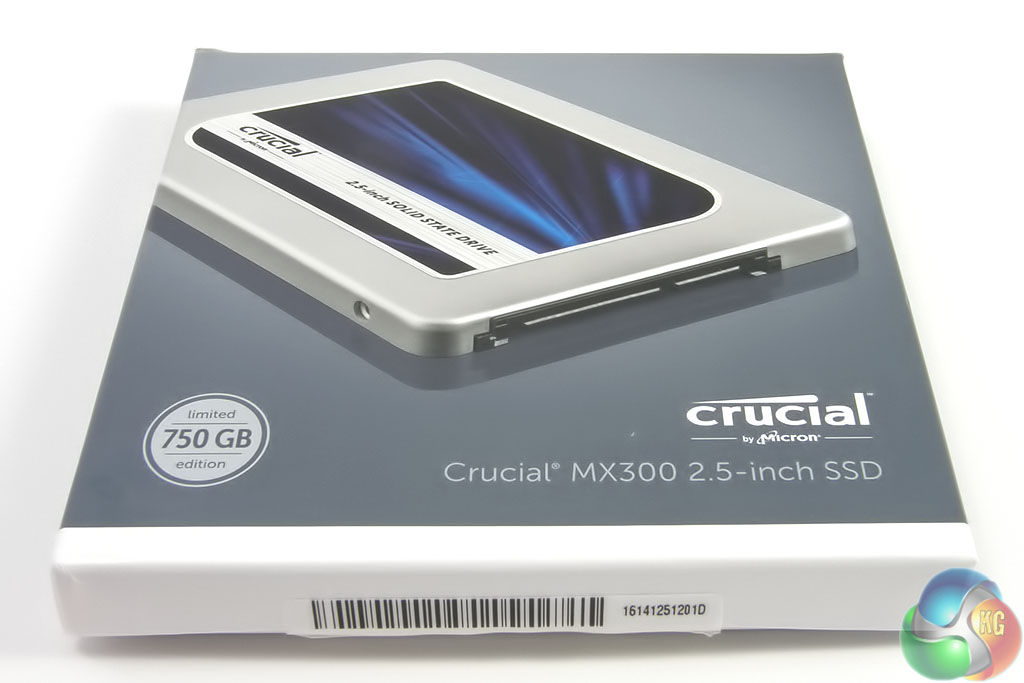
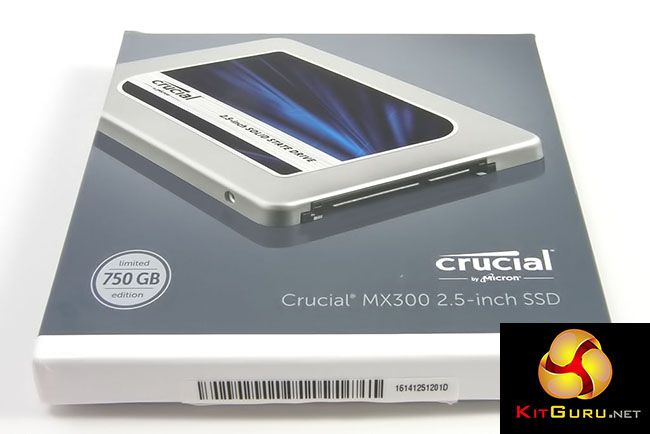
The front of the Crucial MX300 750GB Limited Edition box is dominated by an image of the drive alongside its capacity and format.
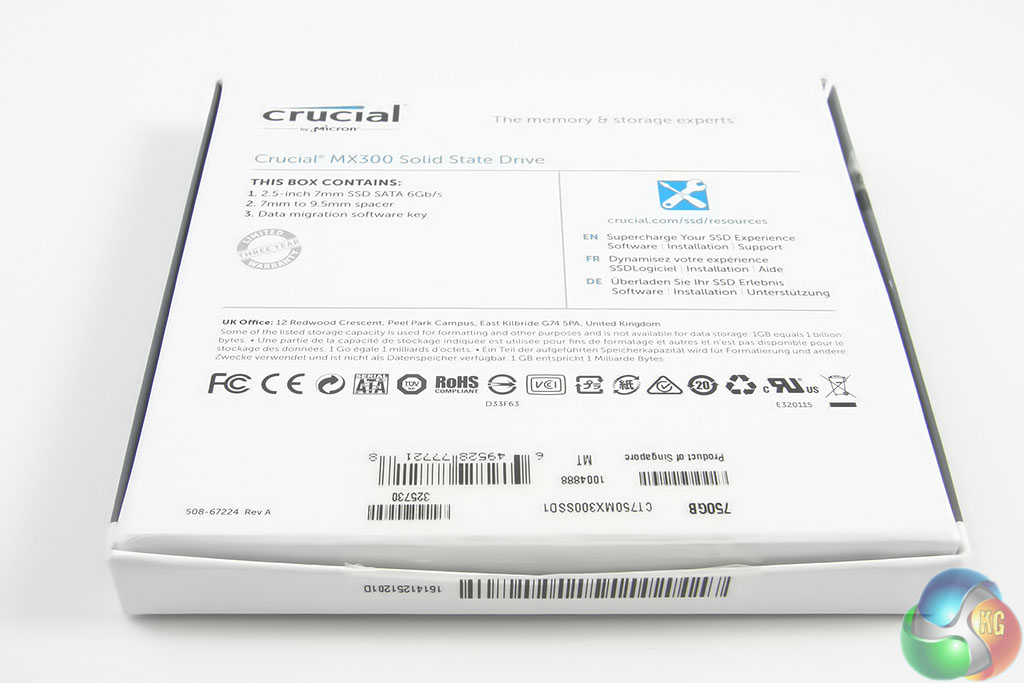
The rear of the box lists what's inside and some marketing information.
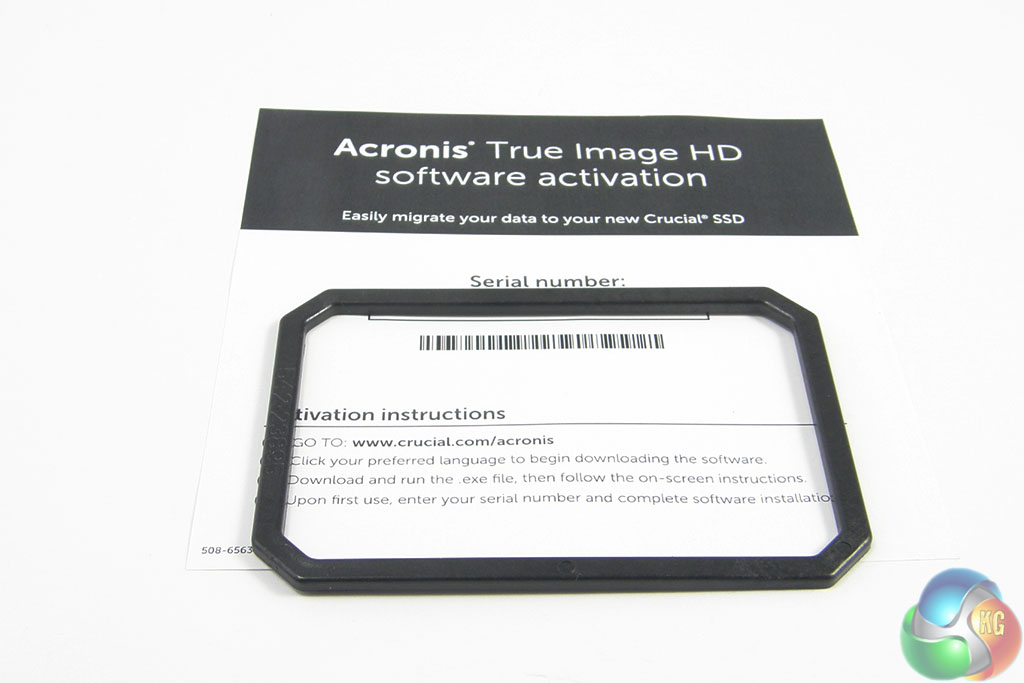
Apart from the drive, the box contains just a 7mm to 9mm spacer which allows the drive to be fitted to deeper notebooks and a software key for the bundled Acronis True Image HD data migration software.
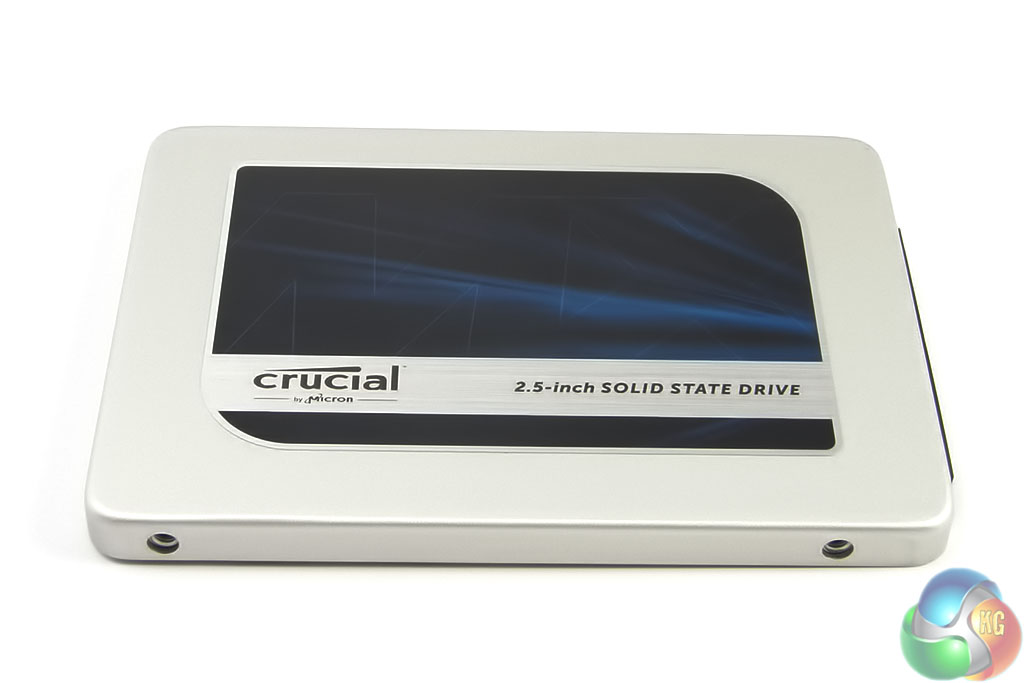
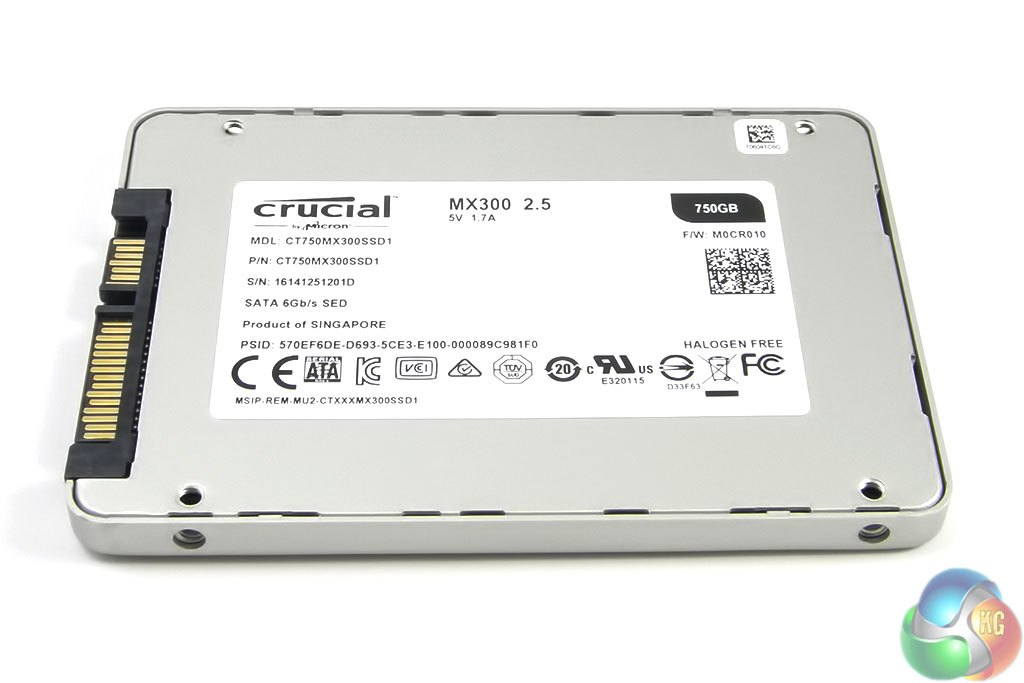
The drive is built on a standard 2.5in 7mm format measuring 100 x 70 x 7mm.
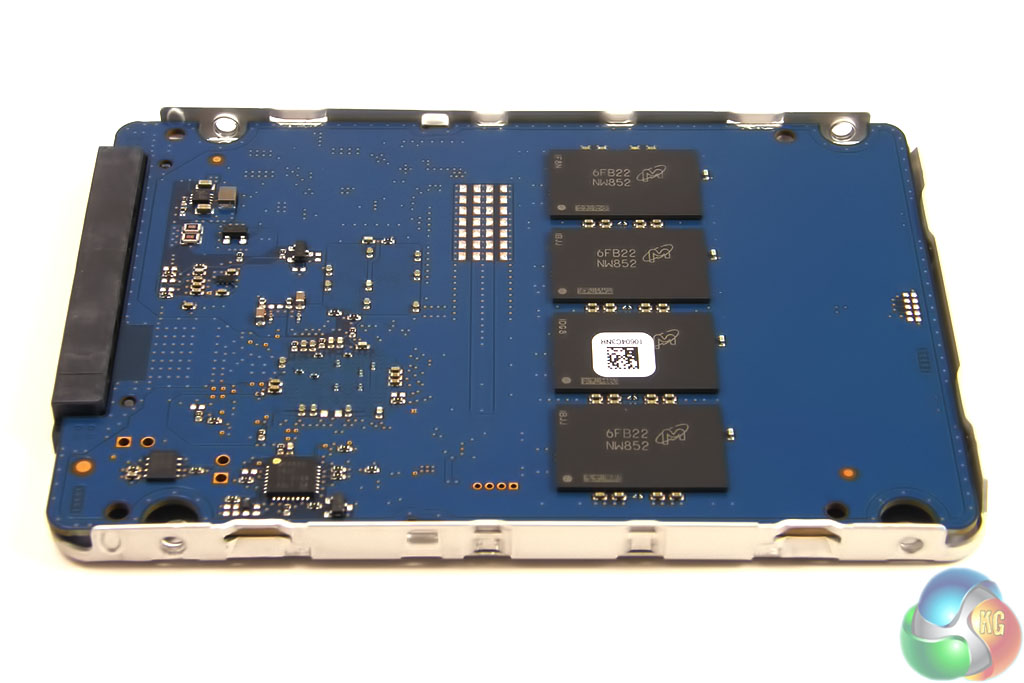
The drive enclosure is of the clipped together type, so to peek inside it you need to need to delicately prise the two halves of the enclosure apart with the weapon of your choice.
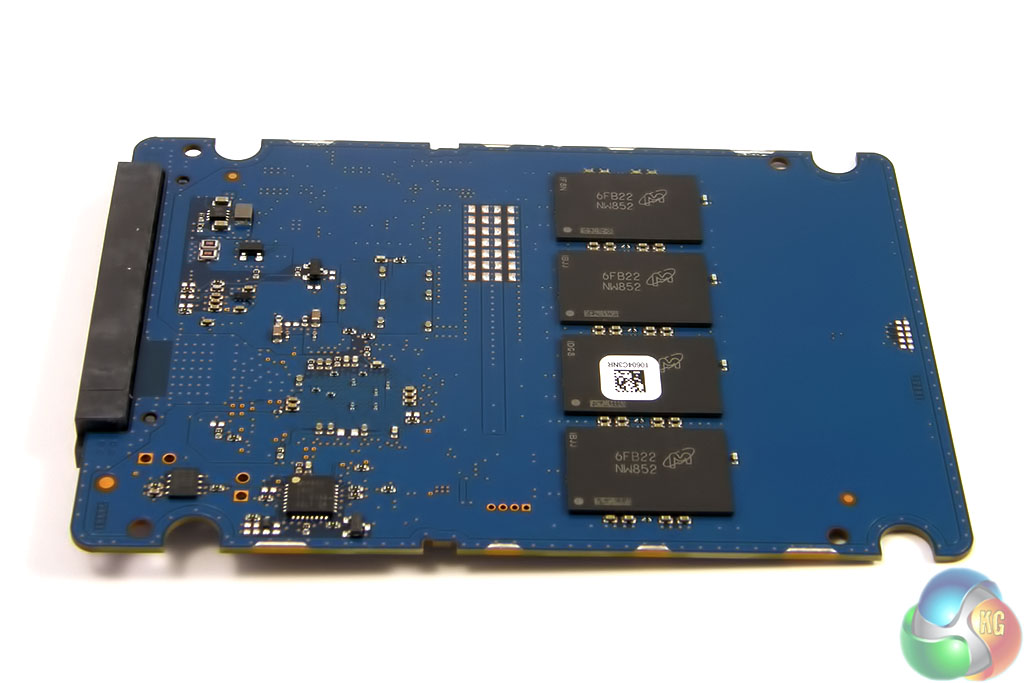
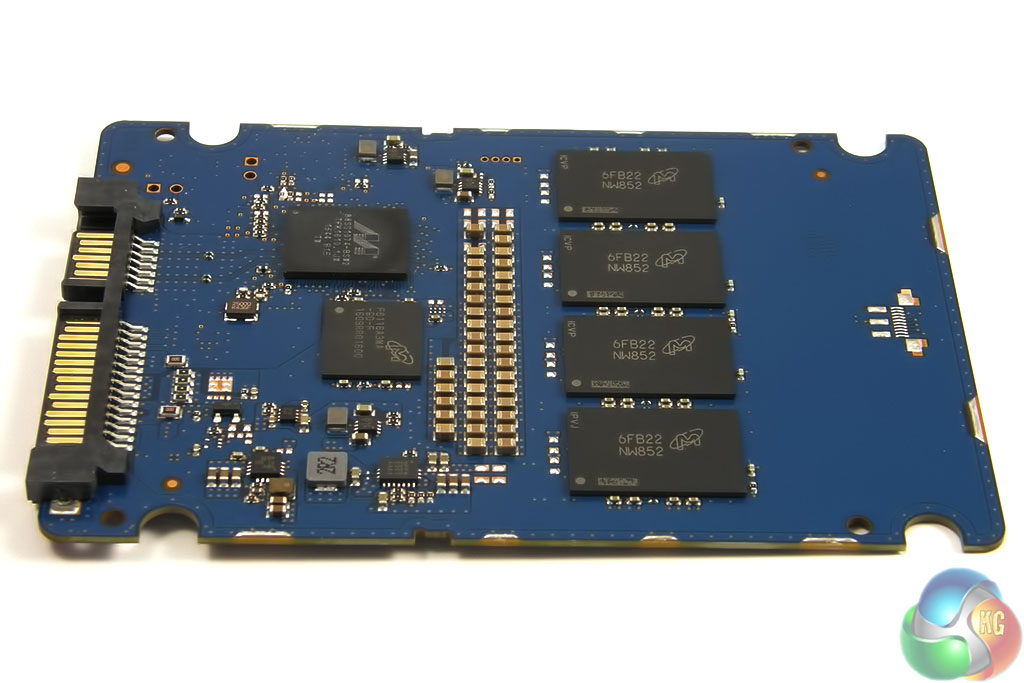
The MX300 750GB capacity is made up of eight Micron 3D TLC NAND packages coded 6FB22. Using Micron's part number decoder reveals it as MT29F768G08EEHBBJ4-3R:B. Each package has two 48GB (384Gb) dies giving the drive a raw capacity of 768GB. The part number also reveals that the NAND uses FortisFlash technology which enables higher endurance than standard TLC NAND.
Four of these packages are on the front of the PCB, the remaining four are housed on the back of the board along with the controller and a single cache IC. The controller is a Marvell 88SS1074-BSW2 four channel IC built on a 28nm process supporting TLC/MLC/SLC and 3D NAND. It also supports DEVSLP (Device Sleep), ONFI 3/Toggle 2 at 400MT/s and 256 AES encryption. The cache is a 512MB of LPDDR3.
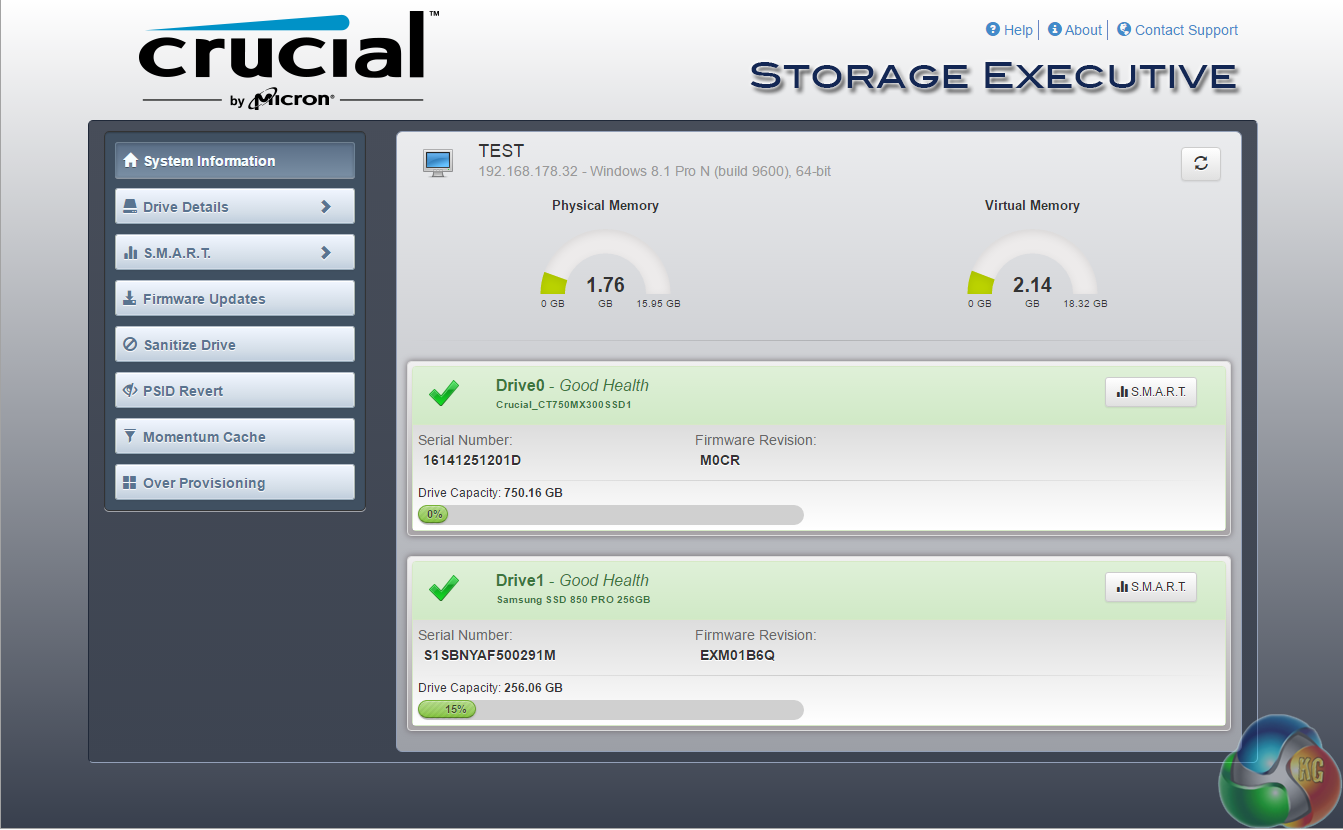
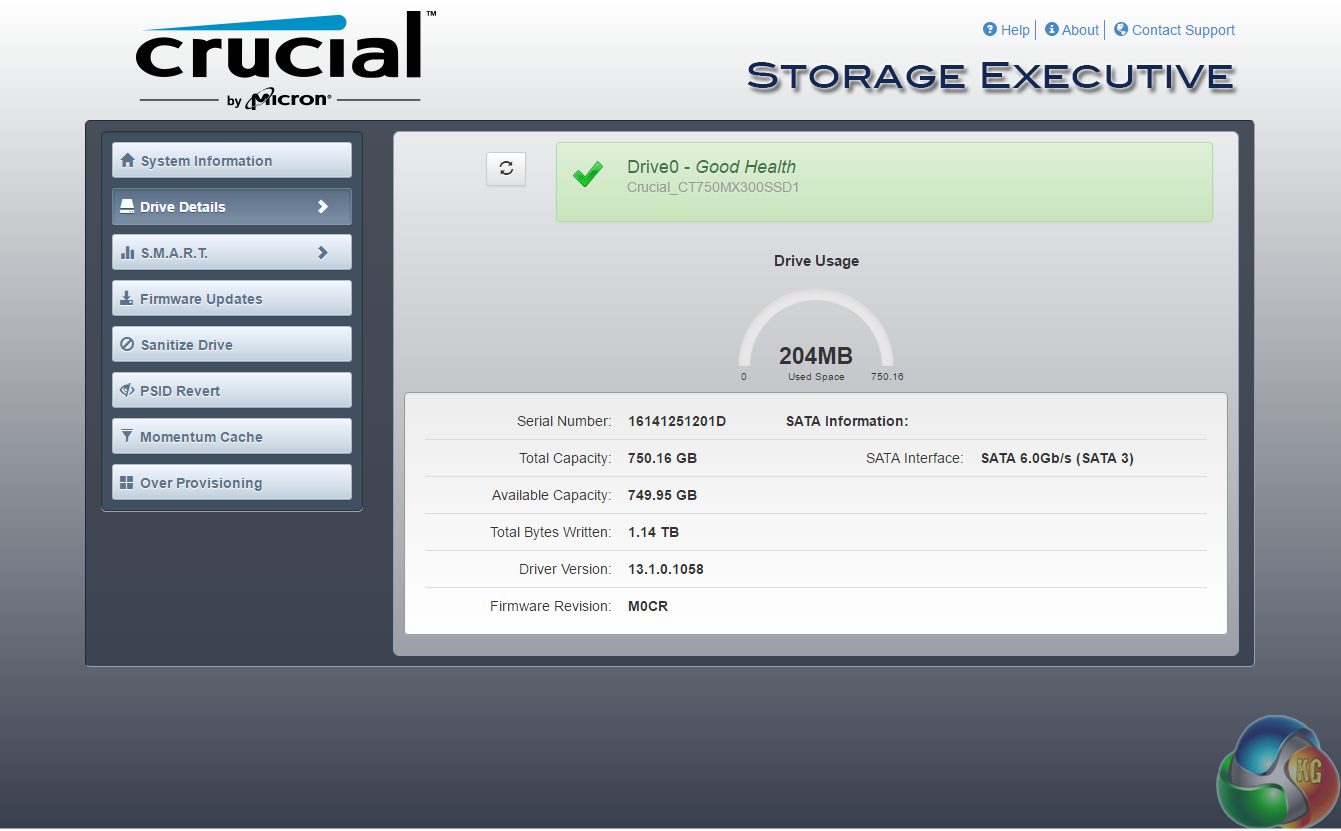
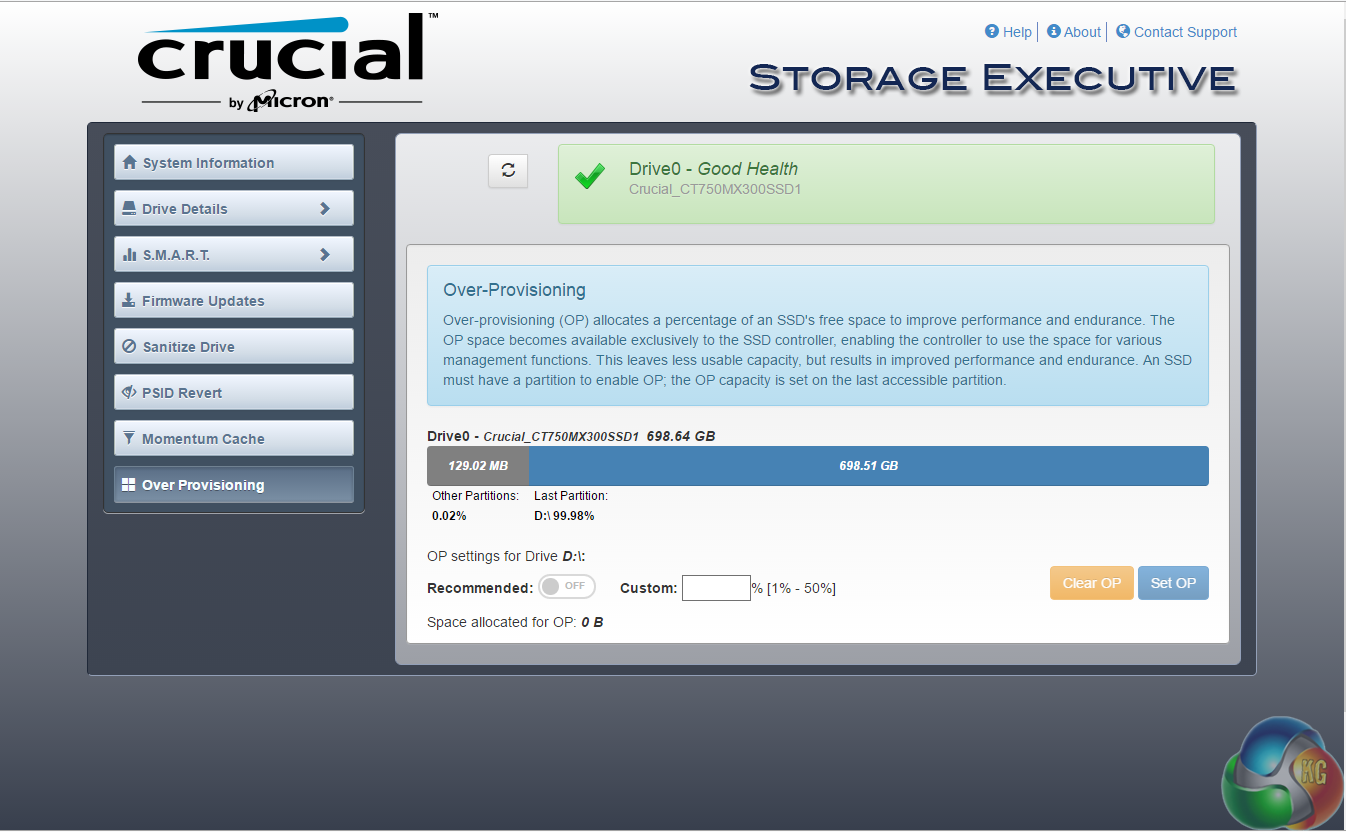
The drive is supported by Crucial's Storage Executive. This software package lets you see how much of the drives capacity is being used, monitor its temperature and the overall health and update to the latest firmware version. It also allows you to reset the drive's encryption password as well as adjusting how much Over Provisioning space the drive uses.
For testing, the drives are all wiped and reset to factory settings by HDDerase V4. We try to use free or easily available programs and some real world testing so you can compare our findings against your own system.
This is a good way to measure potential upgrade benefits.
Main system:
Intel Core i7 4790K with 16GB of DDR3-2133 RAM, Sapphire HD7750 Ultimate and an ASRock Extreme 6 motherboard.
Other drives
Crucial BX100 1TB
Crucial BX200 960GB
Crucial M550 1TB
Crucial MX200 1TB
Kingston SSDNow V310 960GB
Samsung 840 EVO 1TB
Samsung 850 EVO 1TB
SK hynix SE3010 960GB
Ultima Pro X 960GB
Software:
Atto Disk Benchmark.
CrystalMark 3.0.3.
AS SSD.
IOMeter
All our results were achieved by running each test five times with every configuration this ensures that any glitches are removed from the results. Trim is confirmed as running by typing fsutil behavior query disabledeletenotify into the command line. A response of disabledeletenotify =0 confirms TRIM is active.
Crystalmark is a useful benchmark to measure theoretical performance levels of hard drives and SSD’s. We are using V3.0.3.
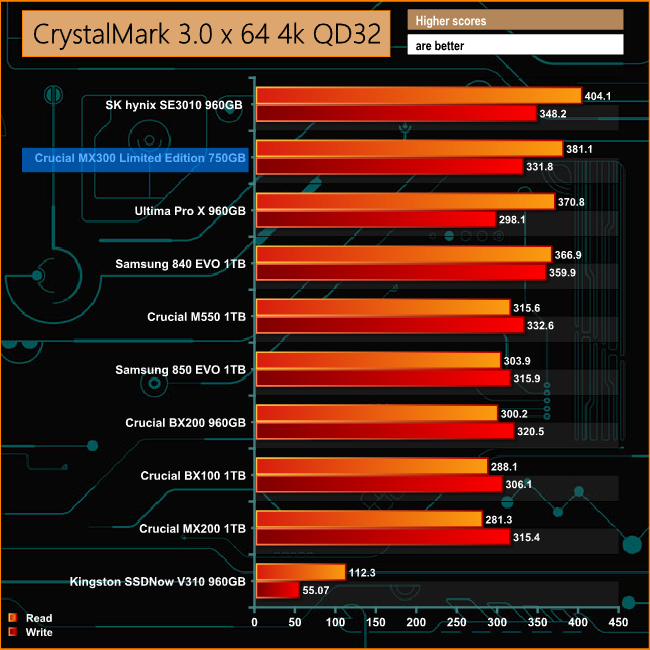
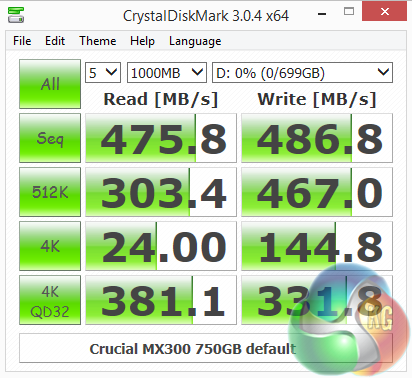

At deeper queue depths the MX300 performs pretty well, and at a shallow depth, the write performance is also very good, not far off the 150MB/s mark. In contrast, the read performance is disappointing. The Marvell controller isn't fussy about the type of data it has to deal with as can be seen by comparing the two sets of CrystalDisk Mark results.
The ATTO Disk Benchmark performance measurement tool is compatible with Microsoft Windows. Measure the storage systems performance with various transfer sizes and test lengths for reads and writes. Several options are available to customize your performance measurement including queue depth, overlapped I/O and even a comparison mode with the option to run continuously.
Use ATTO Disk Benchmark to test any manufacturers RAID controllers, storage controllers, host adapters, hard drives and SSD drives and notice that ATTO products will consistently provide the highest level of performance to your storage.
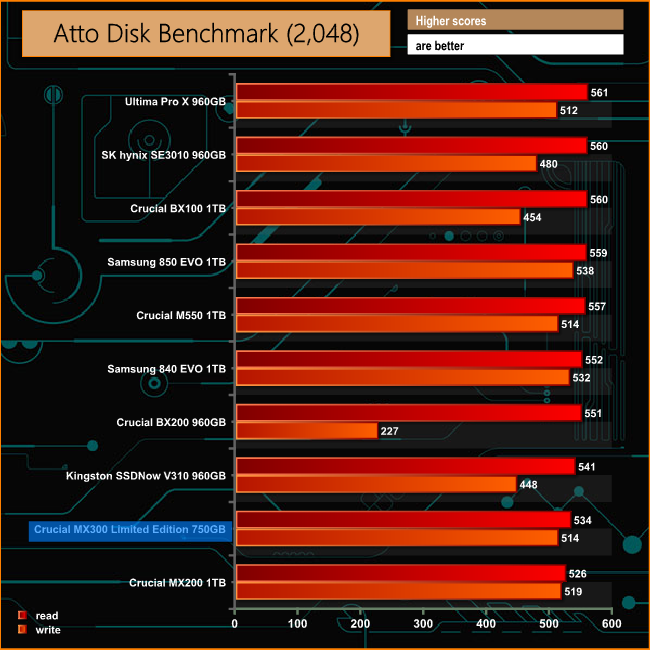
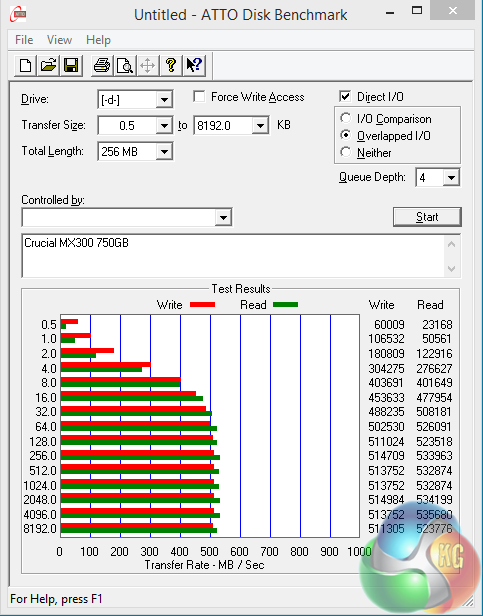
When tested with the ATTO benchmark, the drive confirmed the official sequential read/write figures of 530MB/s for reads and 510MB/s for writes. The read performance isn't going to set the world on fire as can be seen by the graph.
It's a fair bit slower than Samsung's 850 EVO, (the first drive to market using 32-layer 3D TLC NAND) in both read and write performance. It also lags slightly behind Crucial's 2D Planer TLC NAND equipped BX200 when it comes to reads however it completely crushes it when it comes to writes.
AS SSD is a great free tool designed just for benching Solid State Drives. It performs an array of sequential read and write tests, as well as random read and write tests with sequential access times over a portion of the drive. AS SSD includes a sub suite of benchmarks with various file pattern algorithms but this is difficult in trying to judge accurate performance figures.
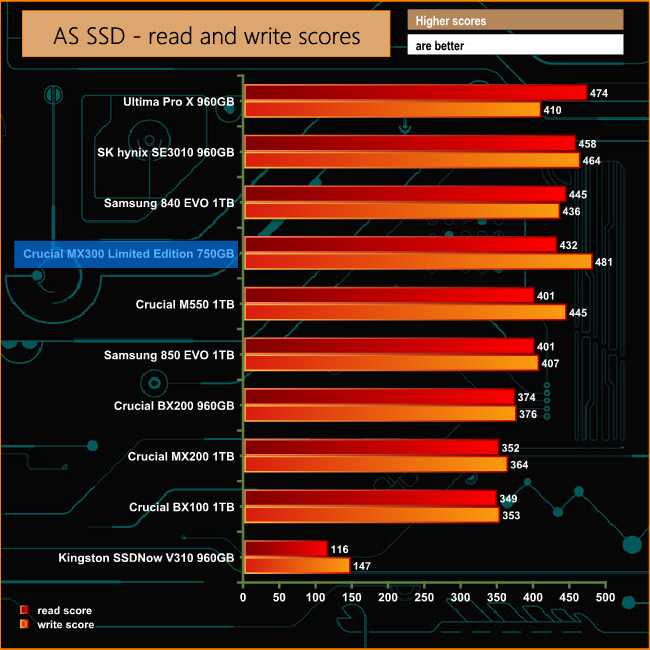
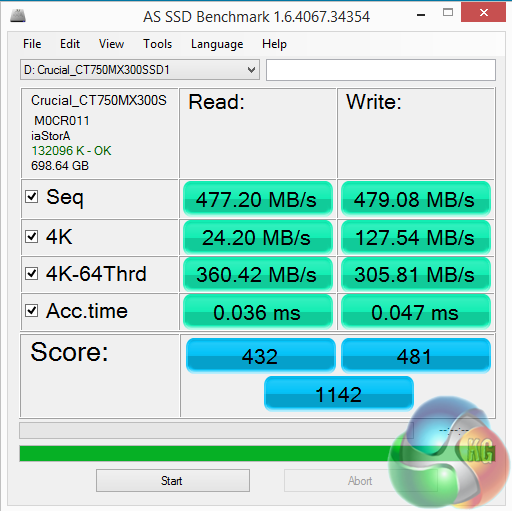
Once again the drive shows pretty strong random write performance which is in marked contrast to how it deals with random reads.
IOMeter is another open source synthetic benchmarking tool which is able to simulate the various loads placed on hard drive and solid state drive technology.
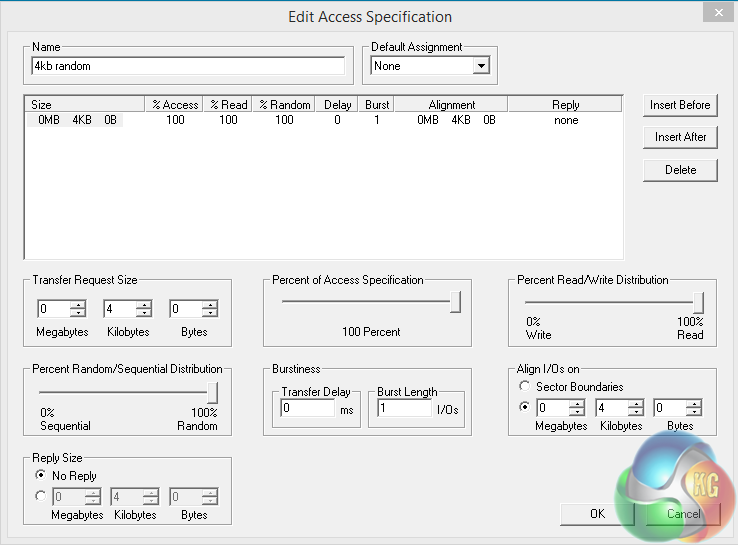
We test with both random read and write 4k tests, as shown above. There are many ways to measure the IOPS performance of a Solid State Drive, so our results will sometimes differ from manufacturer’s quoted ratings. We do test all drives in exactly the same way, so the results are directly comparable.
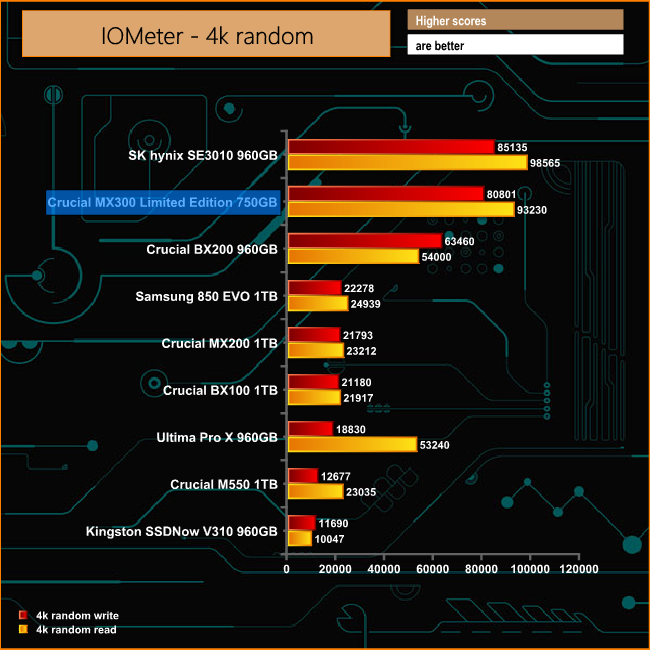
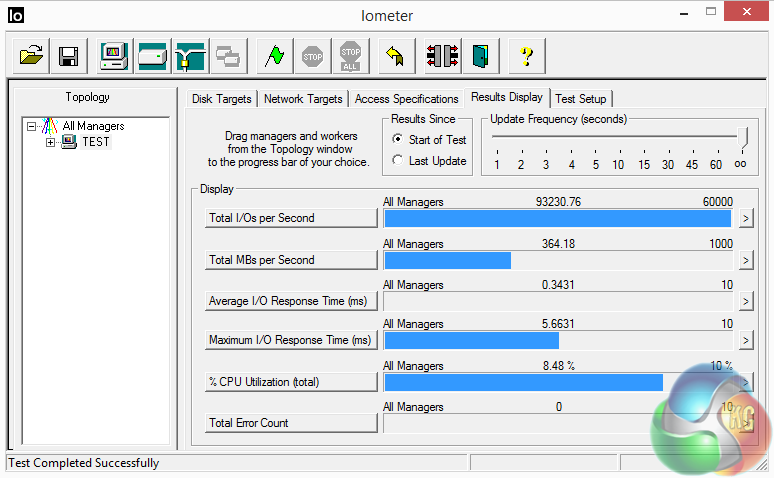
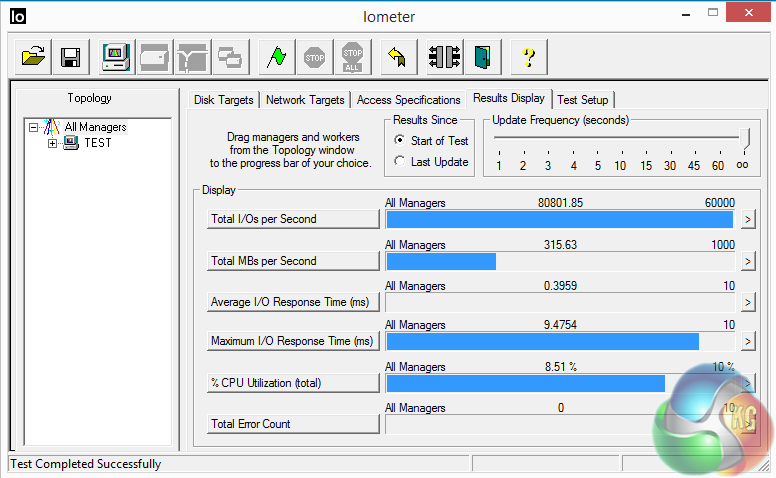
The official IOPS figure for the drive of up to 92,000 IOPS and 83,000 IOPS for random read/writes respectively is pretty much borne out by the test results, although it has to be said the random write figure of 80,801 IOPS is a little shy of the official figure.
To test real life performance of a drive we use a mix of folder/file types and by using the FastCopy utility (which gives a time as well as MB/s result) we record the performance of drive reading from & writing to a 256GB Samsung SSD850 PRO.
60GB Steam folder – 29,521 files.
50GB File folder – 28,523 files.
12GB Movie folder – 24 files (mix of Blu-ray and 4K files).
10GB Photo folder – 621 files (mix of .png, raw and .jpeg images).
10GB Audio folder – 1,483 files (mix of mp3 and .flac files).
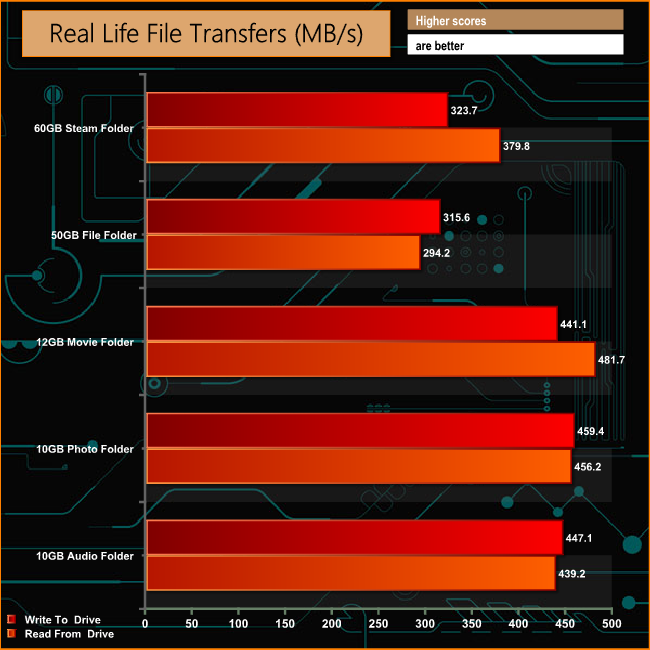
The drive has no problems dealing with real life file transfers although the performance does just drop below the 300MB/s mark when it comes to reading the small bity files of the 50GB File Folder test.
Any new drive entering the 3D NAND SSD fray is going to be compared to Samsung's 3D V-NAND equipped drives. After all the Korean giants have had a huge head start when it comes to bringing 3D NAND drives to market and are currently already producing denser 48-layer NAND to enable huge capacity SSD's whereas Crucial are just leaving the starting blocks using 32-layer NAND. Having said that it's always good to get another player entering the market place.
The MX300's overall sequential read performance left us feeling a bit flat, as 530MB/s is ‘so so' for a drive these days; it's even bettered by Crucial's own 2D TLC NAND equipped BX200. That said, it's sequential write performance and for that matter its 4K write performance tell a different story as both are very good and crush the BX200. But when it's matched to Samsung's mighty 850 EVO it does take a bit of a battering for both sequential reads and writes.
The drives IOPS performance is impressive producing a figure of 93,230 IOPS for reads which exceeds the official figure of 92,000IOPS while writes at 80,801 IOPS fall a little short of the official 83,000 IOPS.
The MX300 750GB Limited Edition is priced at a very competitive £168.99 inc VAT which bodes well for the pricing of the rest of the range coming later this year.
Pros
- 3D NAND
- Strong write performance.
Cons
- 4K read performance.
- Having to wait for smaller capacities to come to market.
Kitguru says: Crucial's entry into the 3D NAND equipped SSD market is a pretty good first attempt and at the very least it gives Samsung some competition at last.


I make close to $6k-$8k /month doing an online job. If you are ready to do simple online work for few hours /day from your couch at home and make solid payment for doing it… This is a gig for you… FAVE.CO/20SSeWe
dfgdfg