KitGuru KitGuru.net – Tech News | Hardware News | Hardware Reviews | IOS | Mobile | Gaming | Graphics Cards


When Intel first introduced their Optane Memory technology it was as in the form of small SSD's with the primary aim of boosting the performance of SATA based drives through SSD caching. The latest incarnation of the technology, the Optane Memory H10, takes this idea further on by combining Optane Memory technology with the latest QLC 3D NAND on a single PCB.
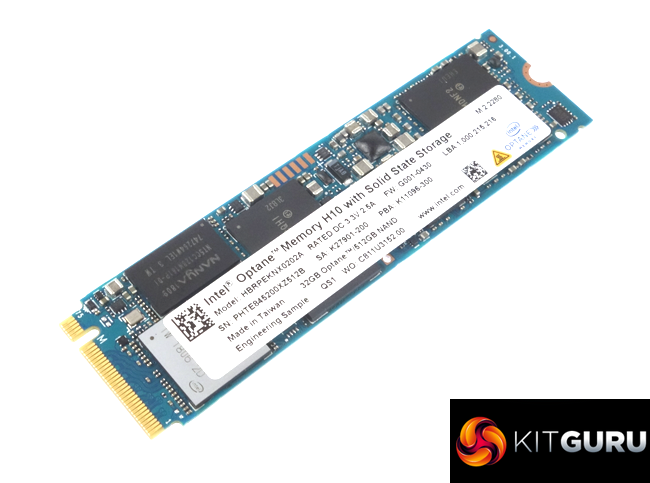
Currently there are three models in Intel's Optane Memory H10 range with varying sizes of Optane memory and QLC (quad-level cell) 3D NAND combinations. There is a single 16GB model that combines 16GB of Optane memory and 256GB of QLC NAND and two 32GB models, one with 512GB of QLC NAND and a flagship 1TB QLC drive.
The official Sequential performance figures for the 512GB version of the H10 are up to 2,300MB/s for reads and up to 1,300MB/s for writes. The 1TB drive is rated at up to 2,400MB/s and 1,800MB/s for read and writes respectively while the entry 250GB model is up to 1,450MB/s for reads and 650MB/s for writes.
Random 4K figures for the 512GB drive are up to 320,000 IOPS for reads with writes coming in at up 250,000. These figures were achieved using an 8GB span. The 1TB drive is rated as up to 330,000 IOPS for reads and 250,000 for writes while the 250GB drive figures are up to 230,000 IOPS and 150,000 IOPS for reads and writes respectively.
Endurance figures for the range are up to 75TBW for the 16GB/256GB model, up to 150TBW for the 32GB/512GB model with the 1TB drive rated at up to 330TBW. Intel back the H10 modules with a 5-year warranty.
Physical Specifications:
Usable Capacities: 512GB
NAND Components: SSD Intel 64L 3D QLC, Optane: Intel 128Gb 3D XPoint
NAND Controller: SSD: Silicon Motion SM2263, Optane: Intel SLL3D
Cache: 256GB DDR3L
Interface: PCIe 3.0 x4 NVMe
Form Factor: M.2
Dimensions: 22 x 80mm
Firmware Version: 17.2
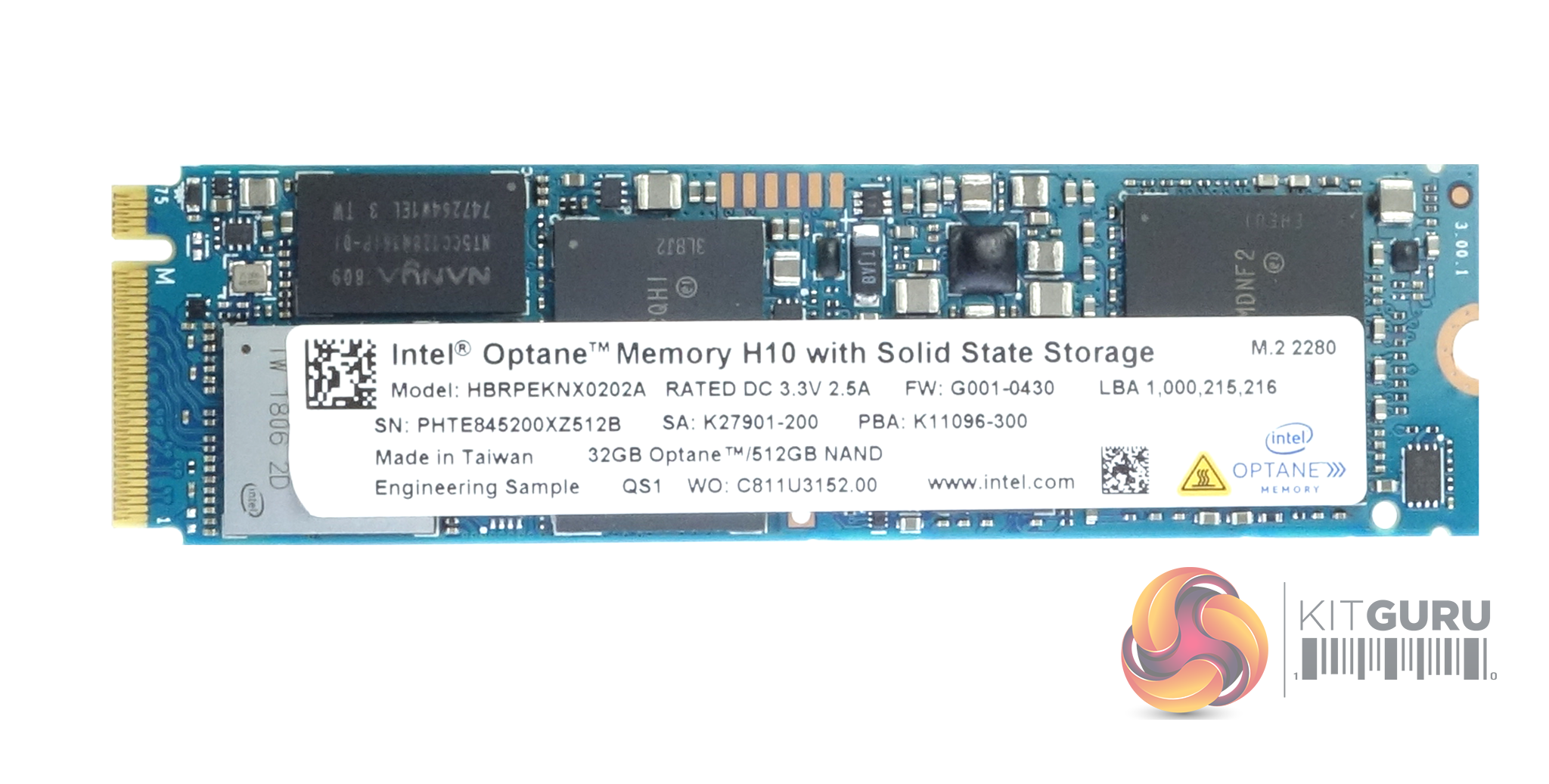
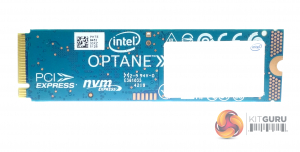
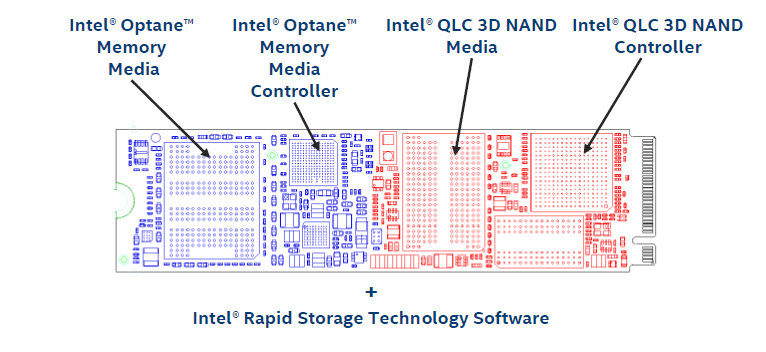
The H10 module is a single sided design; all the components are built on one side of the PCB. Reading from the M.2 interface contacts back, the first IC is a Silicon Motion SM2263 controller, next to which sits a Nanya DRAM package, next up is the Intel 64-layer QLC 3D NAND which the SM2263 looks after.
Then there are the Optane parts of the package; an Intel SLL3D controller and a single Intel 128Gb 3D XPoint NAND package.
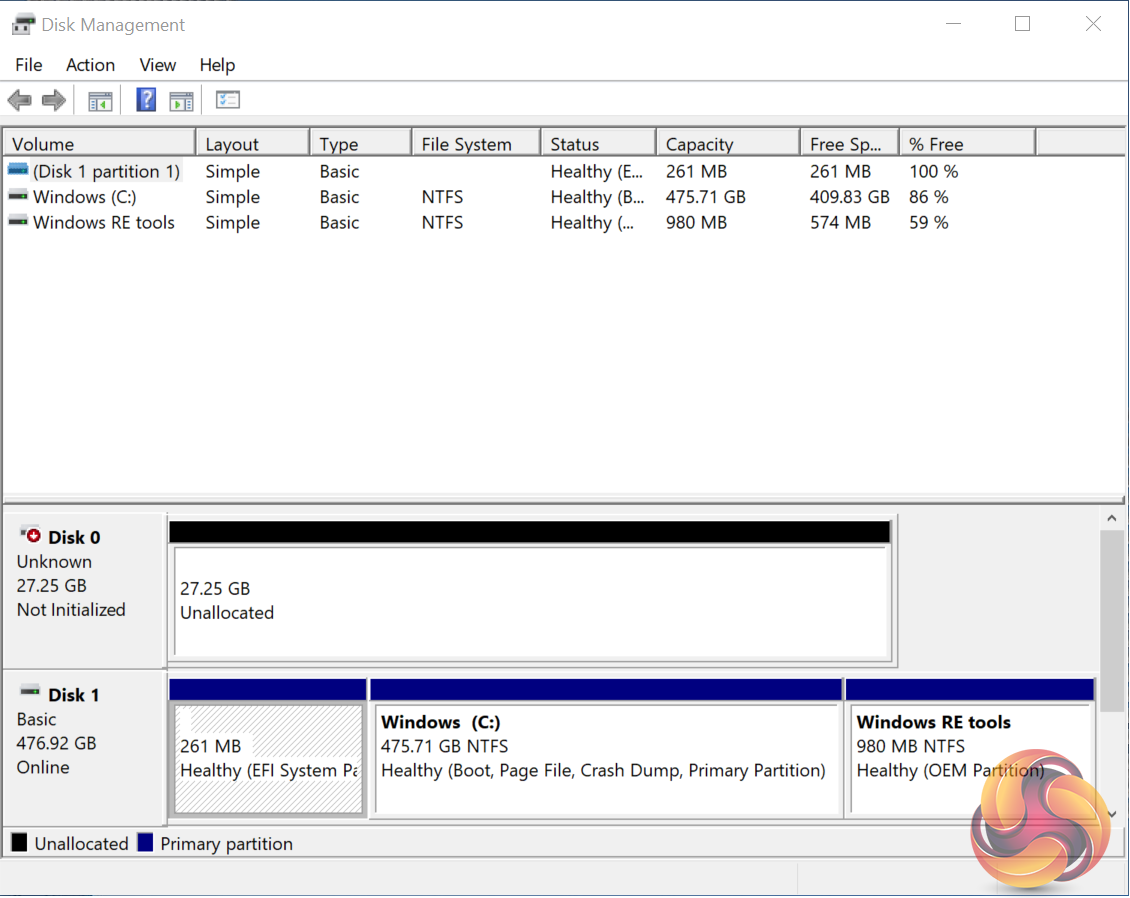
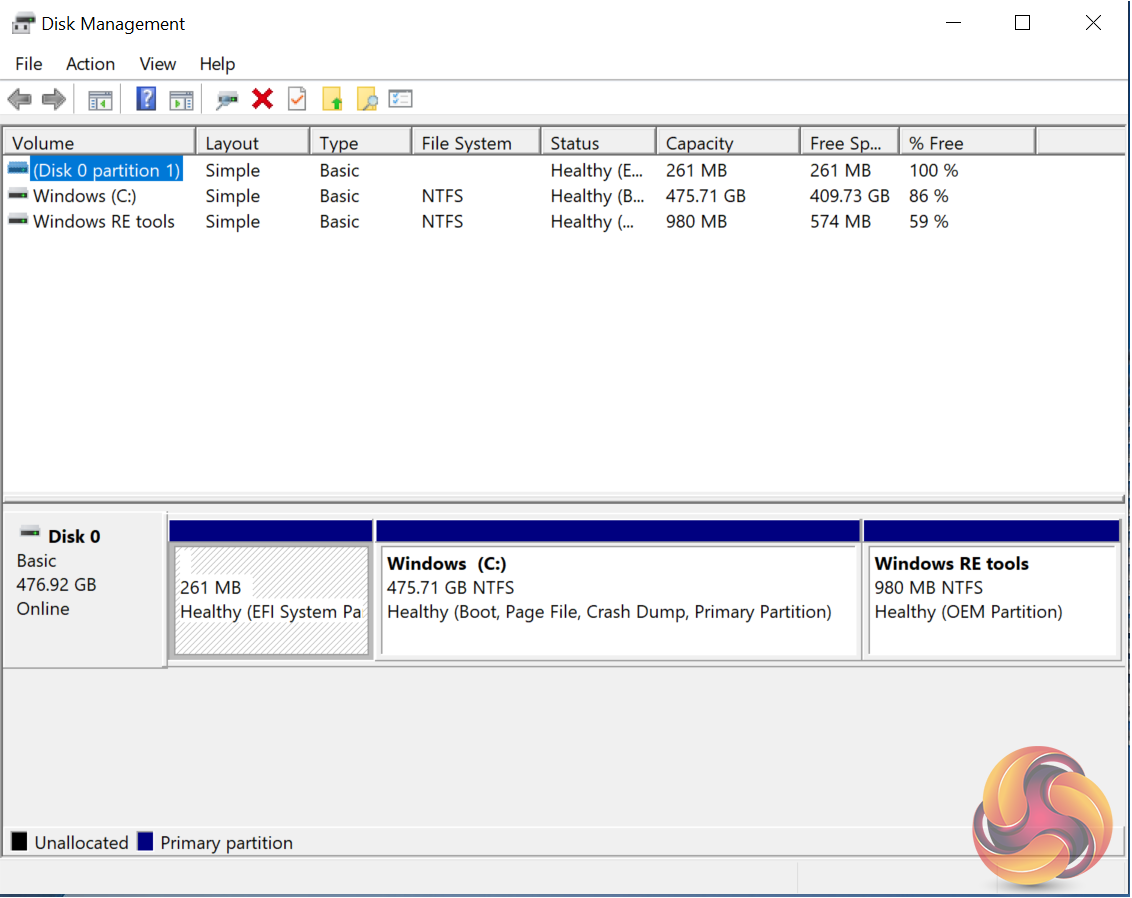
With the Optane part of the drive disabled it appears as an unknown disk, once enabled it becomes transparent to the system.
Intel's Optane Memory H10 is at the time of writing only available as an OEM part, so the 512GB review sample that Intel supplied for this review, came installed in a HP Ultrabook. Ultrabook's and small form factor PCs are the more likely retail platforms that will be a home for the H10.
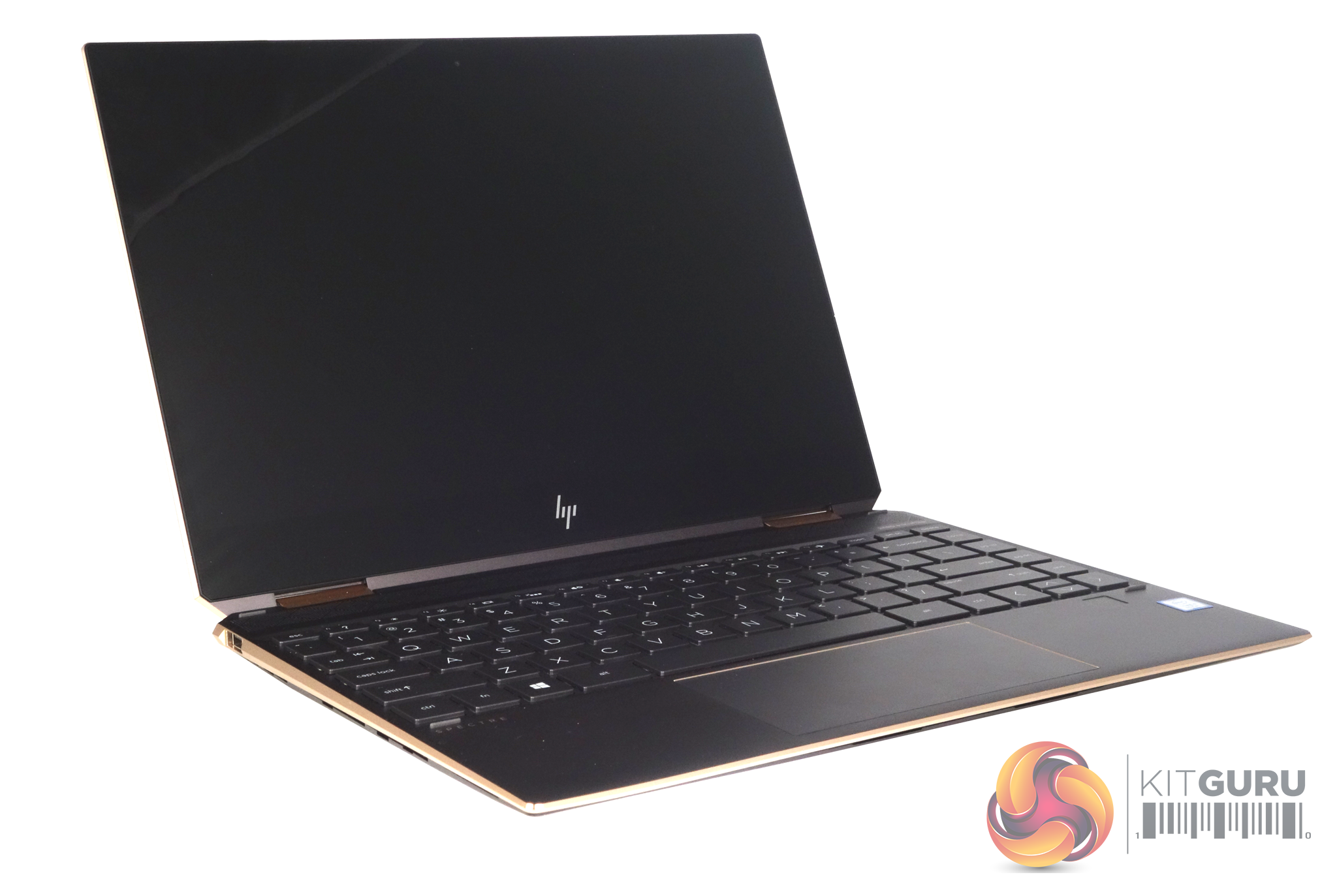
The HP Spectre x360 13” notebook (Intel Core i7-8565U backed by 16GB of memory) is what we used to test both the H10 and the 512GB SSD 760p Intel supplied to compare it against. We tested both and also tested the H10 with the Optane memory disabled to show the difference is any it makes.
Intel Rapid Storage Technology (Intel RST)
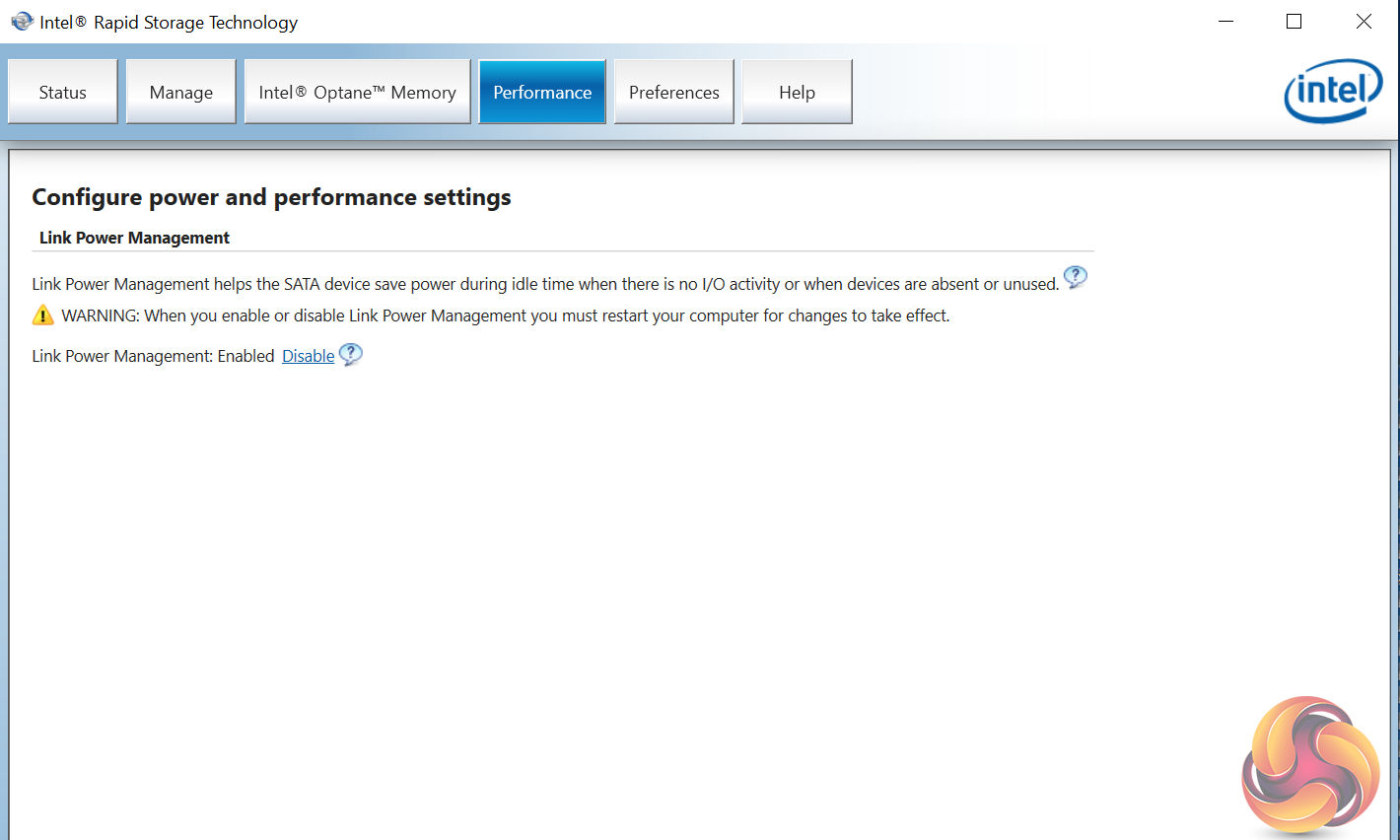
Intel’s Rapid Storage Technology (RST) software makes it easy to configure and to keep an eye on the H10.
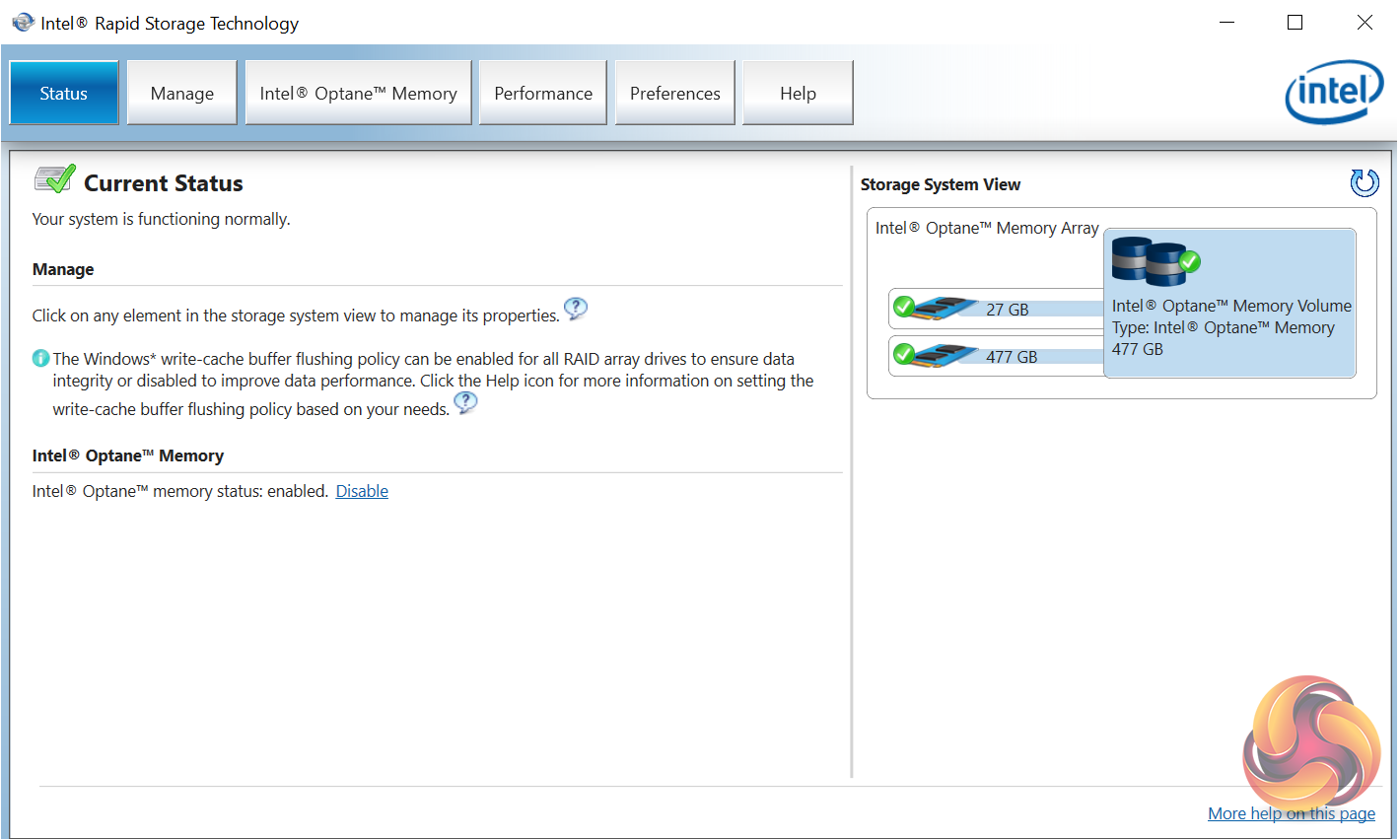
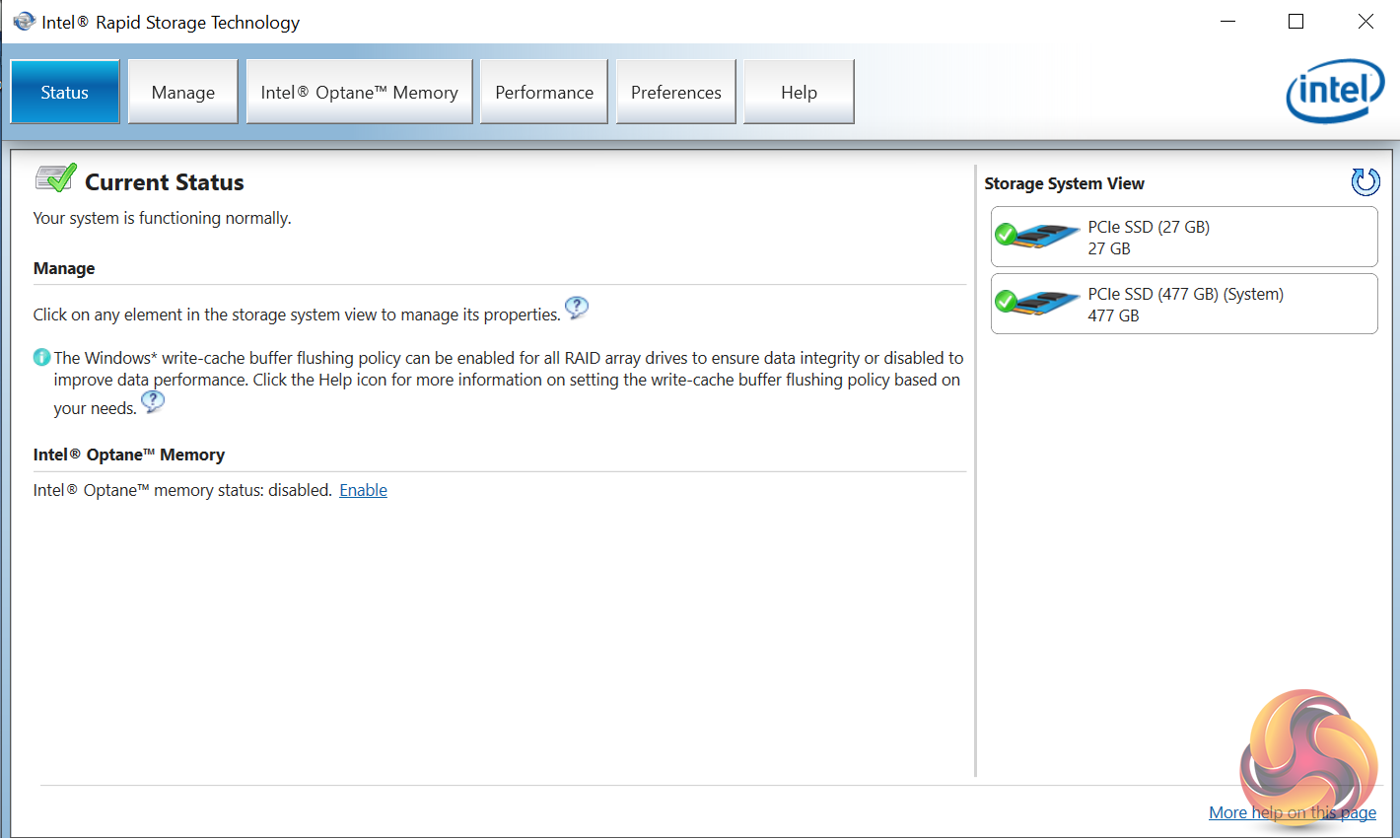
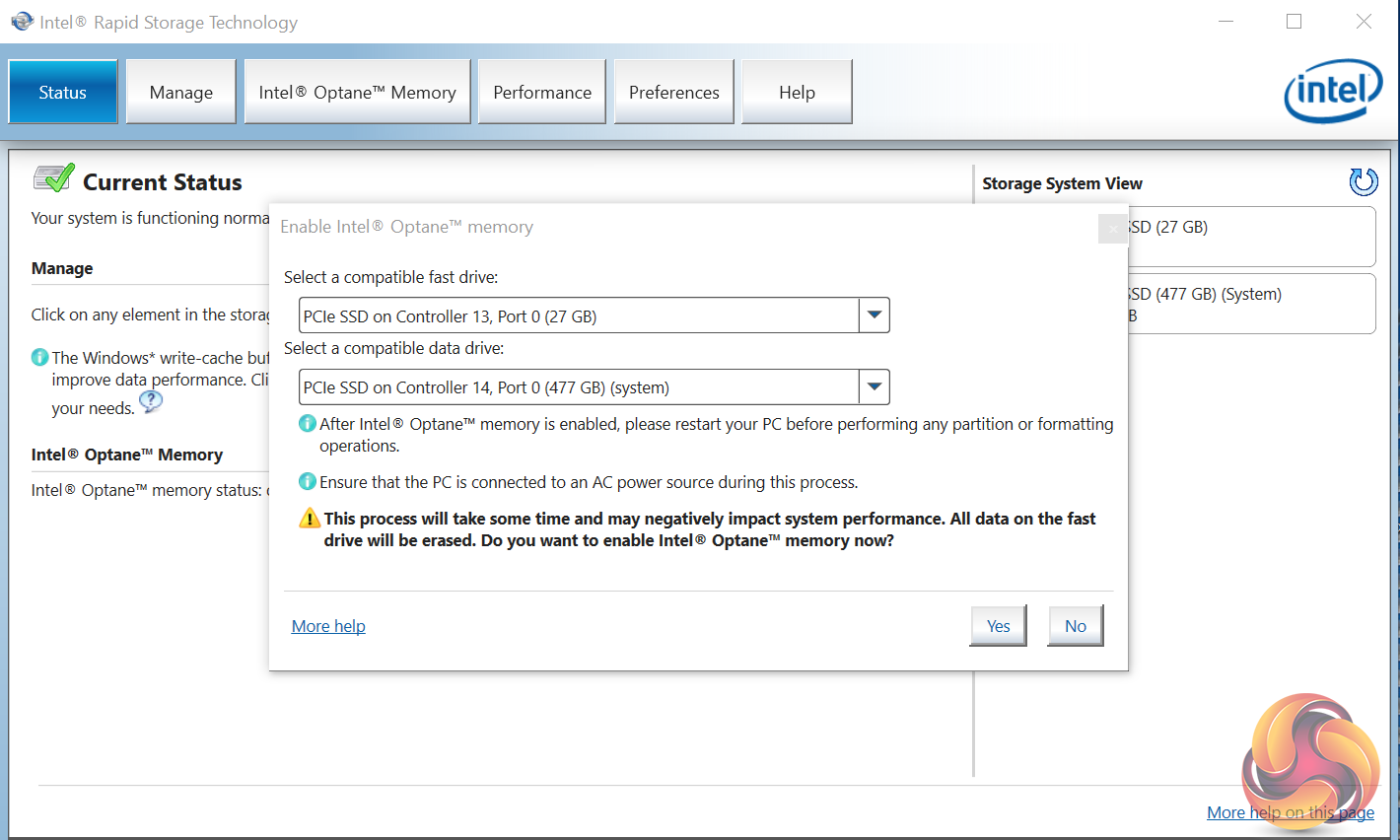
It's easy to enable or disable the Optane memory using the RST technology with a few mouse clicks. Once the software has enabled the changes, it just needs the system to be restarted for the changes to come into effect.
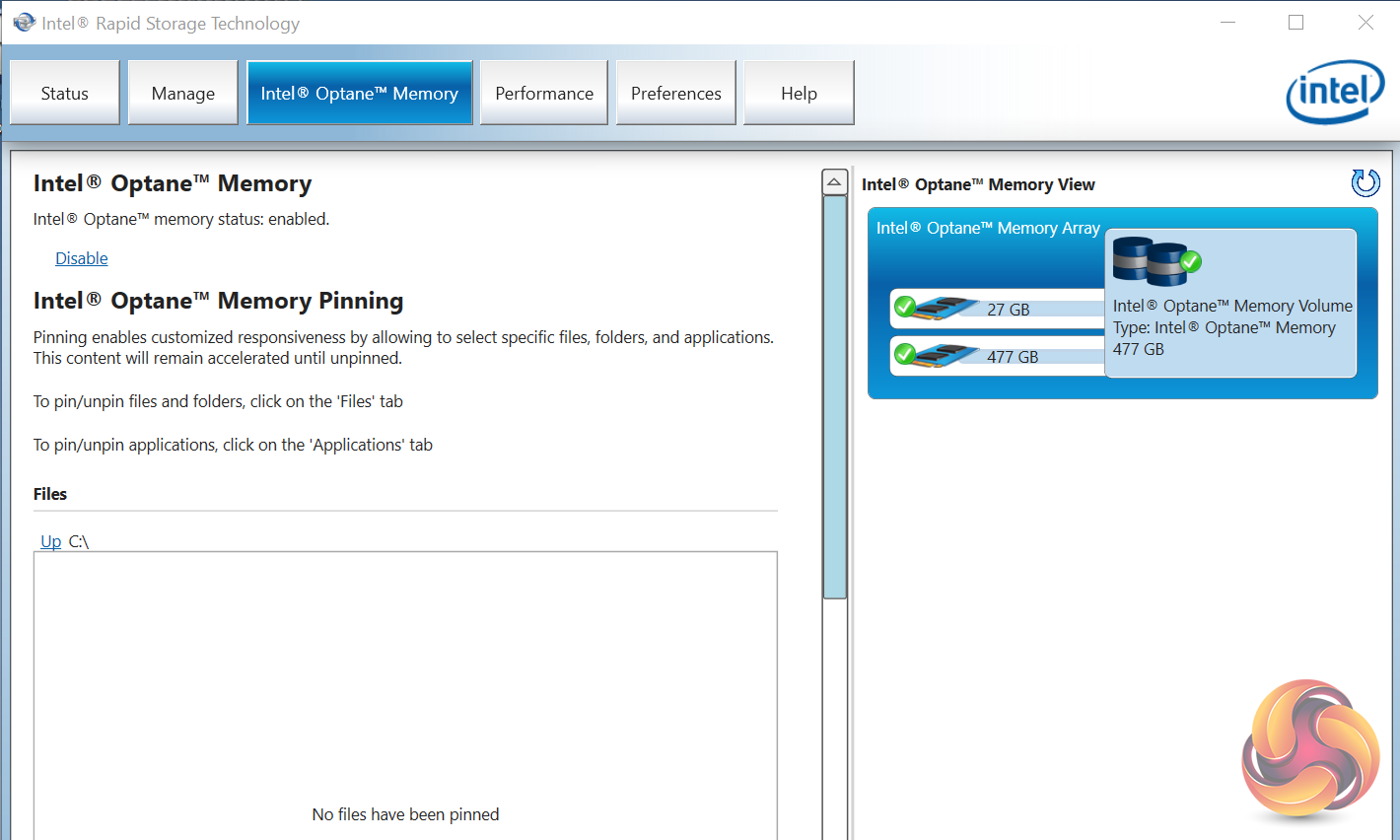
The Intel Optane Memory tab opens a window where you can enable/disable Optane Memory as well as selecting which programs/files/folders you want to be accelerated.
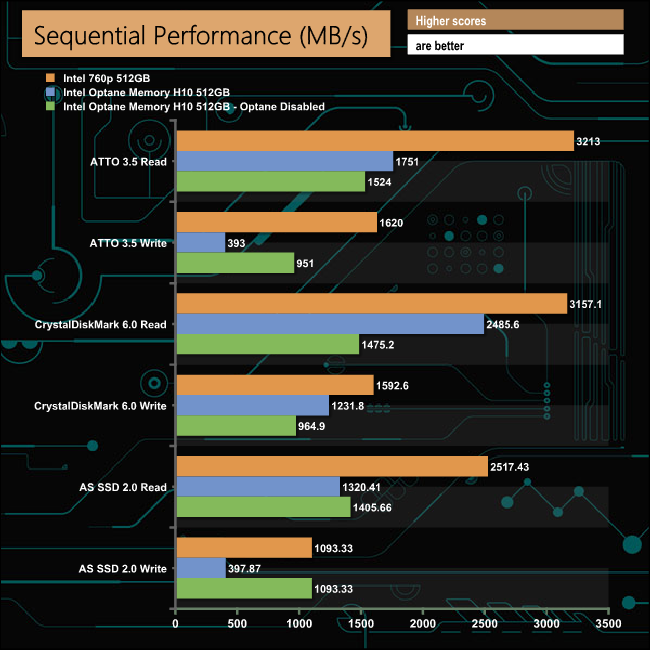
Intel quote official Sequential figures for the 512GB H10 as up to 2,300MB/s for reads and up to 1,300MB/s for writes. As you can see from results graph according to the ATTO and AS SSD benchmarks, the H10 doesn't get anywhere close to either figure. We ran these tests many times to ensure that that they were recognised by the cache.
The low scores of both these benchmarks is down to them not recognising the two parts of the H10 as a complete drive. CrystalDiskMark has no such problem as you can see from the Sequential scores for the drive, with reads at 2,485.6MB/s, faster than the official number and writes at 1,231.8MB/s, which is just below the maximum official figure.
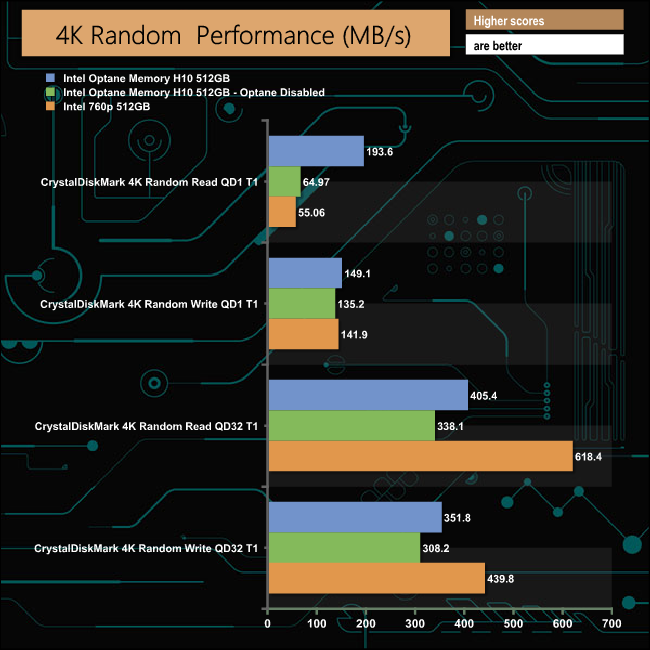
Intel's Optane Memory has been designed to offer high read performance at low queue depths where most of the everyday workloads occur.
As you can see from the 4K QD1 read result in CrystalDiskMark, it certainly makes its mark, with the H10 being three and a half times faster than the standard NAND equipped Intel SSD 760p. Switching to a high queue depth of 32 sees the SSD760p blast past the H10 for both reads and writes.
Futuremark’s PCMark 8 is a very good all-round system benchmark. We used the Standard Storage test which provides a large amount of performance data. The default test runs through the test suite of 10 applications three times. Here we show the total bandwidth performance for each of the individual test suites for the third and final benchmark run.
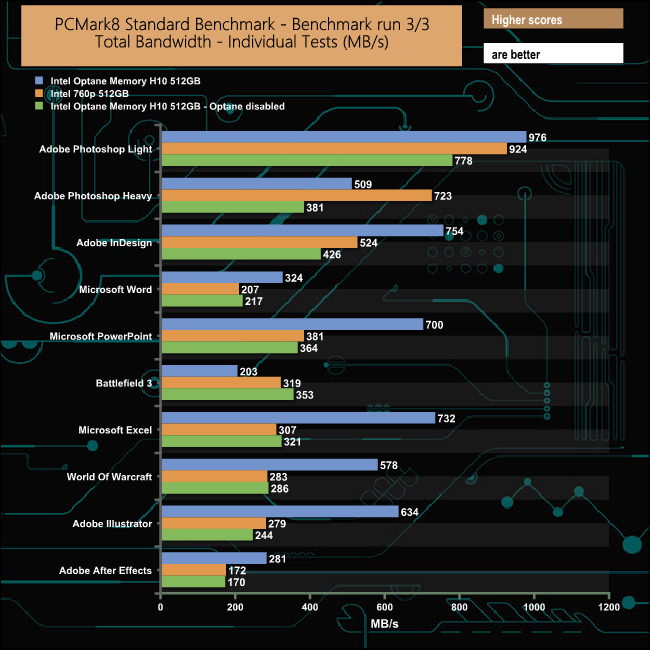
The H10 leads the way in the third and final PCMark 8's Standard Storage test run with the notable exception of the Adobe Photoshop Heavy test trace where the Intel SSD760p is the stronger drive and in the Battlefield 3 trace where both the SSD760p and the H10 with Optane disabled are the faster performers.
In the reviewer's guide that accompanied the Optane Memory H10 module were some suggestions from Intel to test some real-world scenarios found in Intels Representative Usage Guides (RUGs). This involved opening/loading various projects into applications while at the same time copying an 18GB video file between folders on the system using a stopwatch to record the time. The applications used were GIMP, Microsoft Excel 365, Microsoft PowerPoint 365 and Microsoft Word 365. We also timed the launch time of the game, Path of Exile.
We repeated each test 10 times, restarting the HP Spectre x360 and keeping it idle for 5 minutes between each test. We dropped the first run results and then using the average of the rest as the launch time.
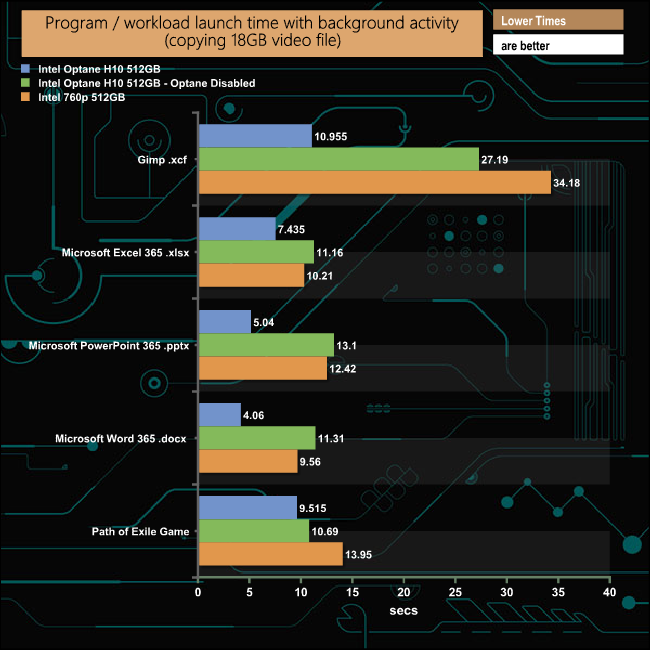
As you can see from the results, the caching of the H10 works very well, the drive being so much faster in these tests than the Intel 760p which itself is no slouch. The most impressive difference comes in the Gimp scenario test.
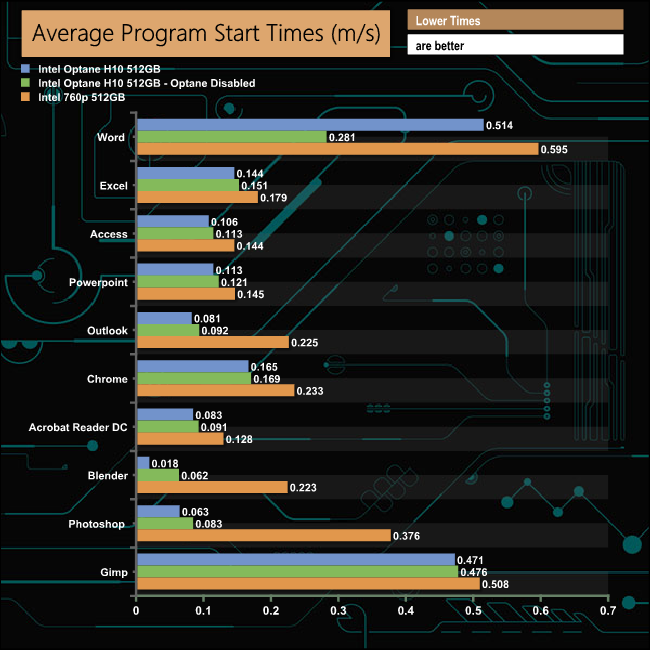
We also timed the start times of a selection of programs with the AppTimer app using the H10 with the Optane memory enabled and disabled as well as the Intel SSD760p to show if the Optane technology makes any difference. The answer is yes, it does, but remember we are talking milliseconds here, so it maybe not that noticeable at all in many cases.
Intel announced the Intel Optane Memory H10 at the beginning of 2019 at CES and it heralds a new line of products from Intel, combining the low queue depth performance of Optane's 3D Xpoint memory with the higher capacity and much cheaper NAND flash memory. In the case of the H10, that means QLC (quad-level cell) NAND.
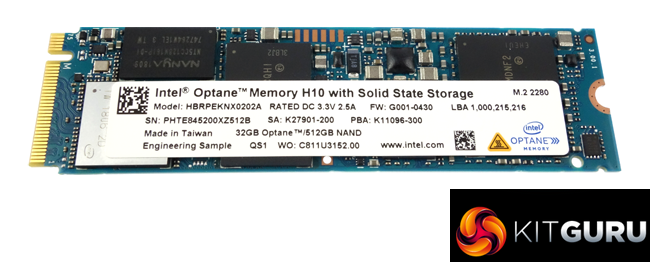
In its first incarnation Intel's Optane Memory was rolled out as very small SSD's used as SSD cache devices to boost the performance of slower SATA based drives in a system. With the H10 this idea has developed so now both the Optane memory and the standard NAND are both installed on the same M.2 format PCB.
Although the H10 uses a PCIe x4 interface, the four PCIe lanes are split between the two sets of major components on the PCB because basically the H10 is two drives sitting on one PCB. The Optane memory drive uses an Intel SLL3D controller and 128Gb 3D XPoint memory while the standard QLC NAND is looked after by a Silicon Motion SM2263 controller.
Making sure that everything works smoothly is Intel's Rapid Storage Technology (RST) caching software and drive suite. When it comes to compatibility, Intel state that the Optane Memory H10 only works in Windows 10 64-bit systems using 8th and 9th generation Intel processors and chipsets. Also any motherboard BIOS needs to fully support Optane memory.
Intel quote Sequential performance for the 512GB H10 as up to 2,300MB/s for reads and up to 1,300MB/s for writes, figures we could confirm with testing. The review sample produced a read score of 2,485.6MB/s with writes at 1,231.8MB/s.
Intel's Optane technology is designed to offer the best performance, particularly reads, at low latencies and queue depths where the vast majority of everyday workloads occur. We could confirm this with the 4K CrystalDiskMark tests. At a queue depth of 1, the H10 produced a random read score of 193.6MB which completely outclassed the Intel SSD 760p drive using standard NAND which gave a score of 55.06MB/s. However deepening the queue depth to 32 saw the results switch, with the SSD760p (618.4MB/s) read performance trouncing the H10's 405.4MB/s.
While the Optane Memory H10 showed some real potential, hopefully it will lead to a drive that uses a single controller to look after both Optane and NAND technologies without having to split up PCIe lanes.
At the time of writing this review you can't buy the Optane Memory H10 in the retail sector as it's a OEM part but time will tell if Intel decide to launch retail versions of it.
Pro
- Caching technology works well.
- Easy to set-up.
Cons
- OEM part only at present.
- Only works with 8th and 9th generation Intel processors and chipsets.
- 1TB maximum capacity.
Kitguru says: The Intel Optane Memory H10 worked well and showed impressive performance when multitasking real-world applications.