KitGuru KitGuru.net – Tech News | Hardware News | Hardware Reviews | IOS | Mobile | Gaming | Graphics Cards


We also tested the drive in a number of workload scenarios that it might face in real life. The IOMeter settings we used to test with are listed below:-
Database Server
Transfer Size: 4K Reads: 67% Writes: 33% Random: 100%
Boundary: 4K Outstanding IO: 1 – 128 Threads/Workers: 4
Exchange Email 4K
Transfer Size: 4K Reads: 67% Writes: 33% Random: 100%
Boundary: 4K Outstanding IO: 128 Threads/Workers: 4
Exchange Email 8K
Transfer Size: 84K Reads: 67% Writes: 33% Random: 100%
Boundary: 8K Outstanding IO: 64 Threads/Workers: 4
Exchange Email 32K
Transfer Size: 32K Reads: 67% Writes: 33% Random: 100%
Boundary: 4K Outstanding IO: 128 Threads/Workers: 4
Media Streaming
Transfer Size: 64K Reads: 98% Writes: 2% Sequential: 100%
Boundary: 4K Outstanding IO: 64 Threads/Workers: 8
Search Engine A
Transfer Size: 4K Reads: 100% Writes: 0% Random: 100%
Boundary: 4K Outstanding IO: 128 Threads/Workers:8
Search Engine B
Transfer Size: 8K Reads: 100% Writes: 0% Random: 100%
Boundary: 4K Outstanding IO: 128 Threads/Workers:8
Web File Server 4KB
Transfer Size: 8K Reads: 95% Writes: 5% Random: 75%
Boundary: 4K Outstanding IO: 32 Threads/Workers: 8
Web File Server 8KB
Transfer Size: 8K Reads: 95% Writes: 5% Random: 75%
Boundary: 4K Outstanding IO: 64 Threads/Workers: 8
Web File Server 64KB
Transfer Size: 64K Reads: 95% Writes 5% Random: 75%
Boundary: 4K Outstanding IO: 64 Threads/Workers: 8
Web Server Log
Transfer Size: 8K Reads: 0% Writes: 100% Random: 100%
Boundary: 4K Outstanding IO: 128 Threads/Workers: 4
Video On Demand
Transfer Size: 512K Reads: 100% Writes: 0% Random: 100%
Boundary: 4K Outstanding IO: 64 Threads/Workers: 8
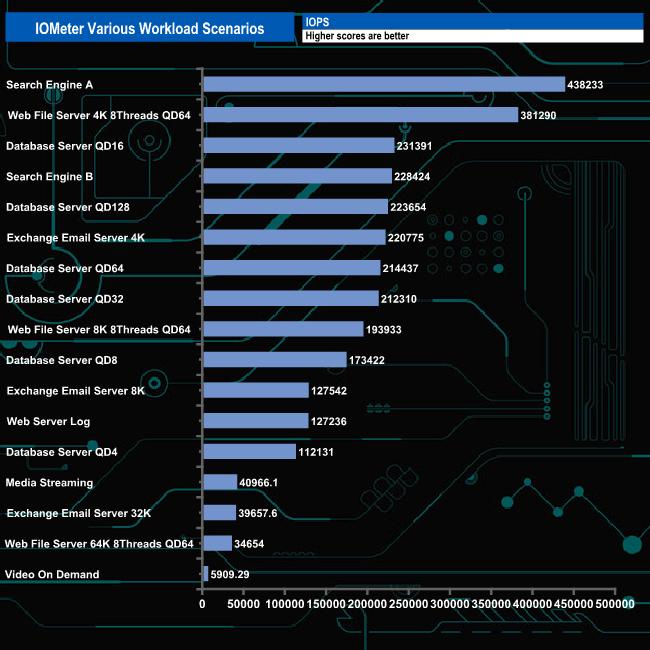
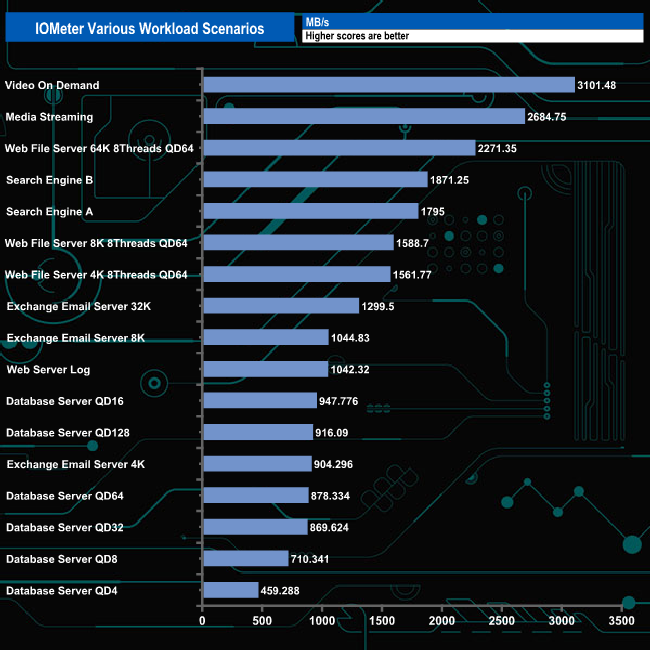
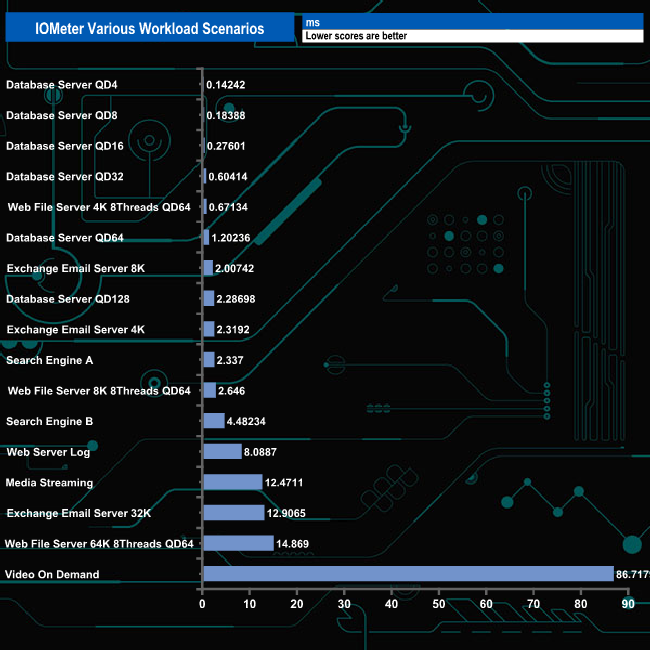
As you might expect for a drive designed to handle most of these scenarios, the DC1500M tackles these tests very efficiently with some strong bandwidth figures.