KitGuru KitGuru.net – Tech News | Hardware News | Hardware Reviews | IOS | Mobile | Gaming | Graphics Cards


Lexar's latest addition to their range of external SSDs is the SL500 Portable, aimed at mainstream photographers, creators and other professionals. It uses a USB 3.2 Gen 2 X2 interface for fast data transfers and retails for under £180 here in the UK.
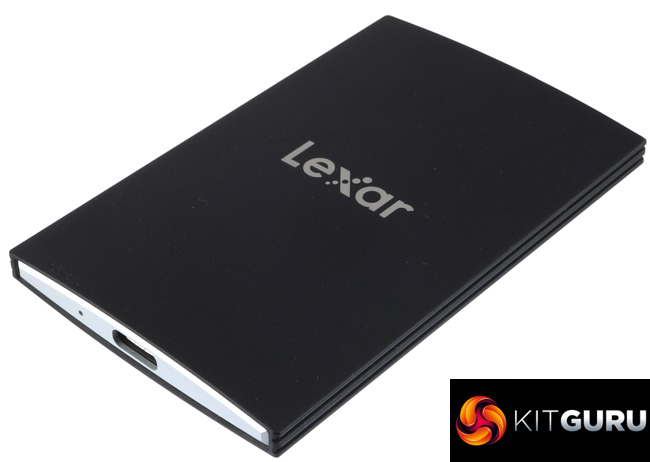
Small enough to fit comfortably in the hand, Lexar's SL500 Portable comes in just two capacities (at the time of writing); 2TB (the drive we are reviewing here) and a 1TB drive. A flagship 4TB model is due sometime in Q2. It's powered by a Silicon Motion SM2320 controller running at its full USB 3.2 Gen2 x 2 speed, 20Gbps but Lexar hasn't disclosed what NAND is in the drive.
Lexar rates the drive as up to 2,000MB/s for reads and up to 1,800MB/s for writes. The drive supports 256-but AES encryption which Lexar makes use of with their DataShield software that is bundled with the drive.
Lexar backs the drive with a 5-year warranty.
Physical Specifications:
- Usable Capacities: 2TB
- NAND Components: n/s.
- NAND Controller: Silicon Motion SM2320.
- Interface: USB 3.2 Gen2 x 2 speed (20Gbps).
- Form Factor: external.
- Dimensions: 85 x 54 x 7.8mm.
- Drive Weight: 43g.
Firmware Version: 1000
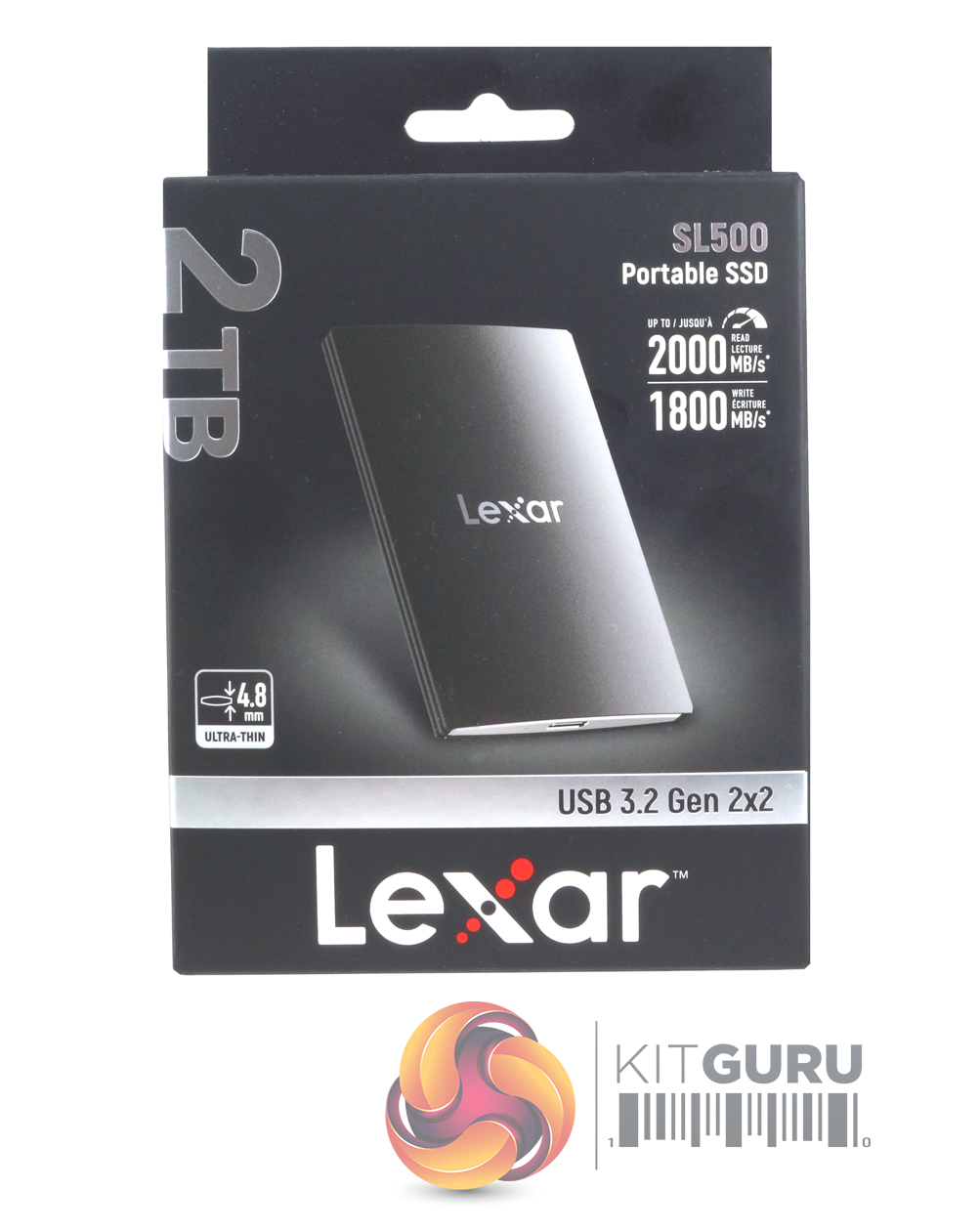
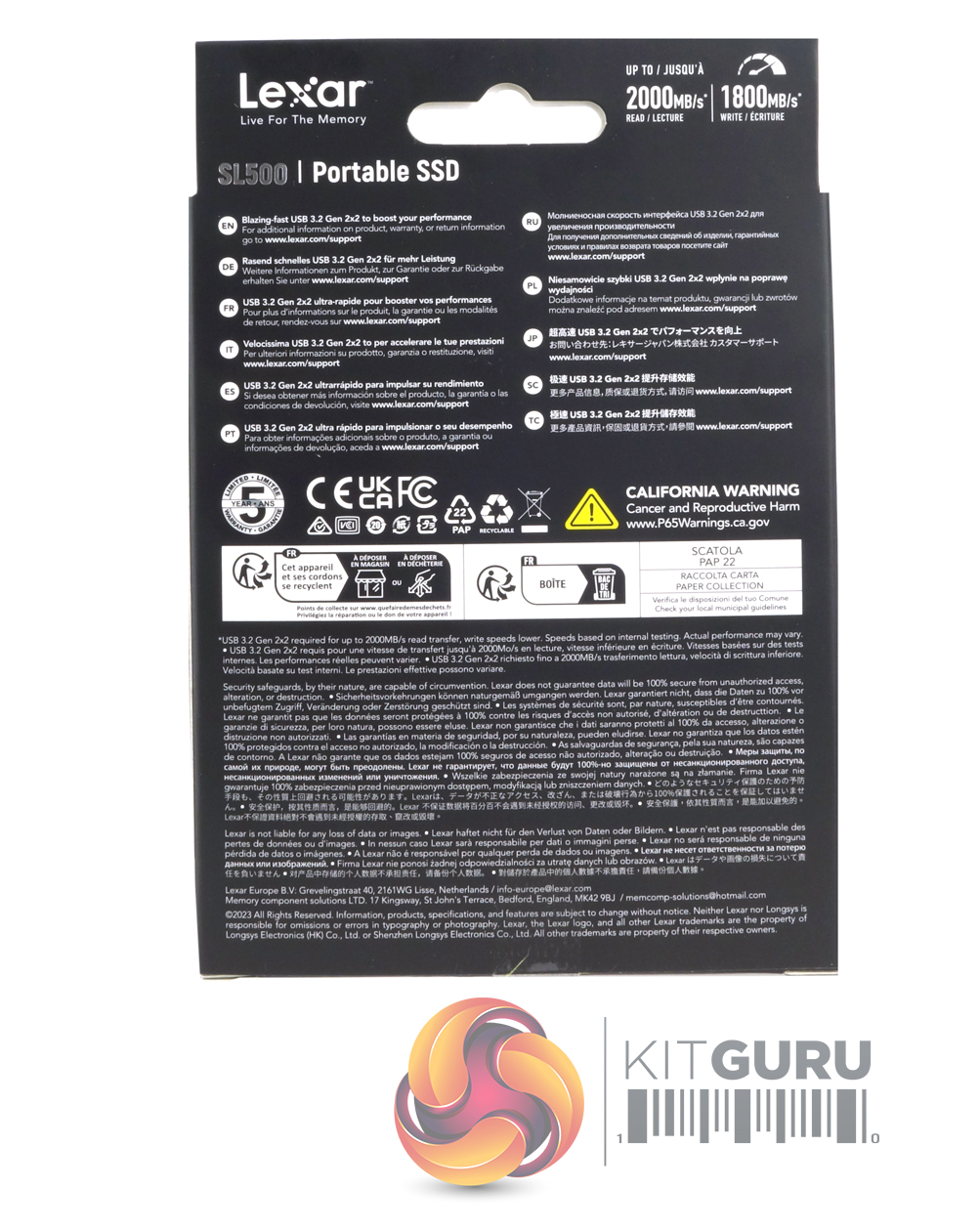
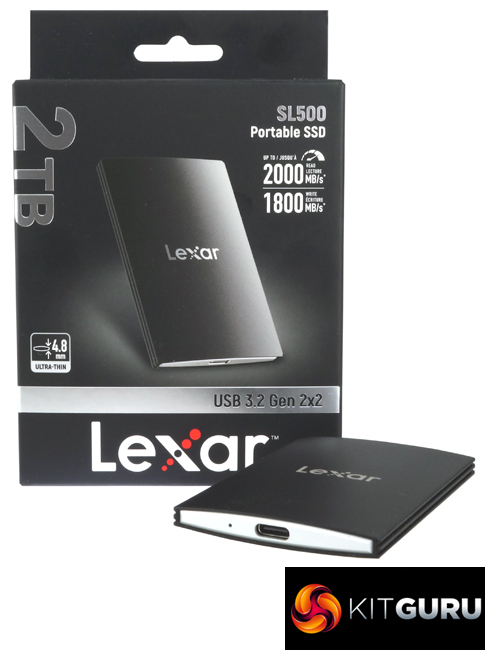
Lexar's SL500 comes in a fairly compact box with an image of the drive on the front which is about three-quarters the size of the actual drive. The drive read/write ratings are displayed to the upper right of the image. To the lower left is a small diagram showing how thin the drive is at its thinnest, while above this and along the box edge is the drive capacity. The back of the box has some multi-lingual drive information.
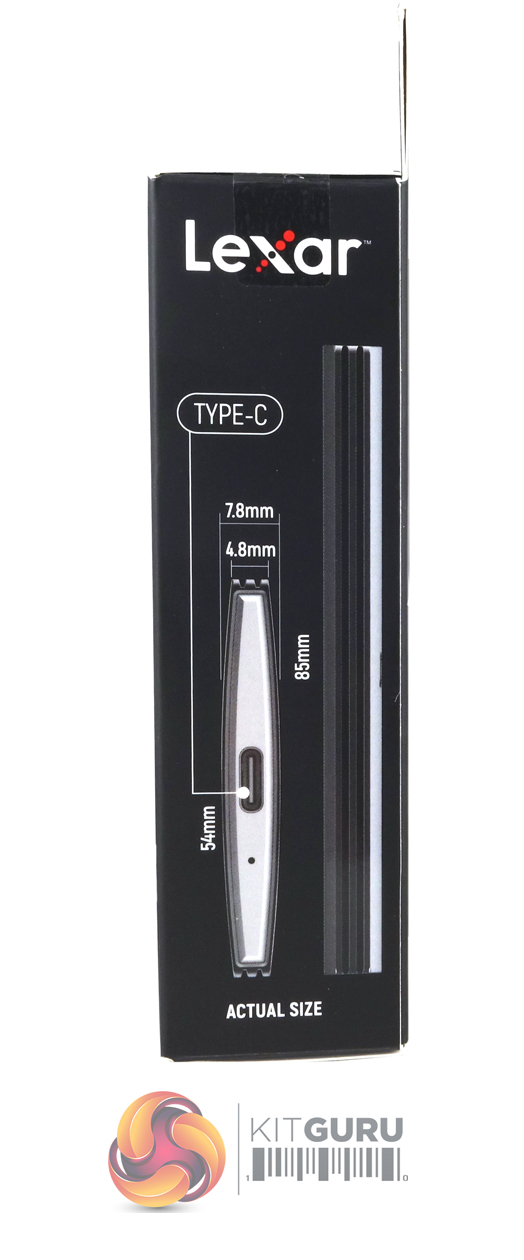
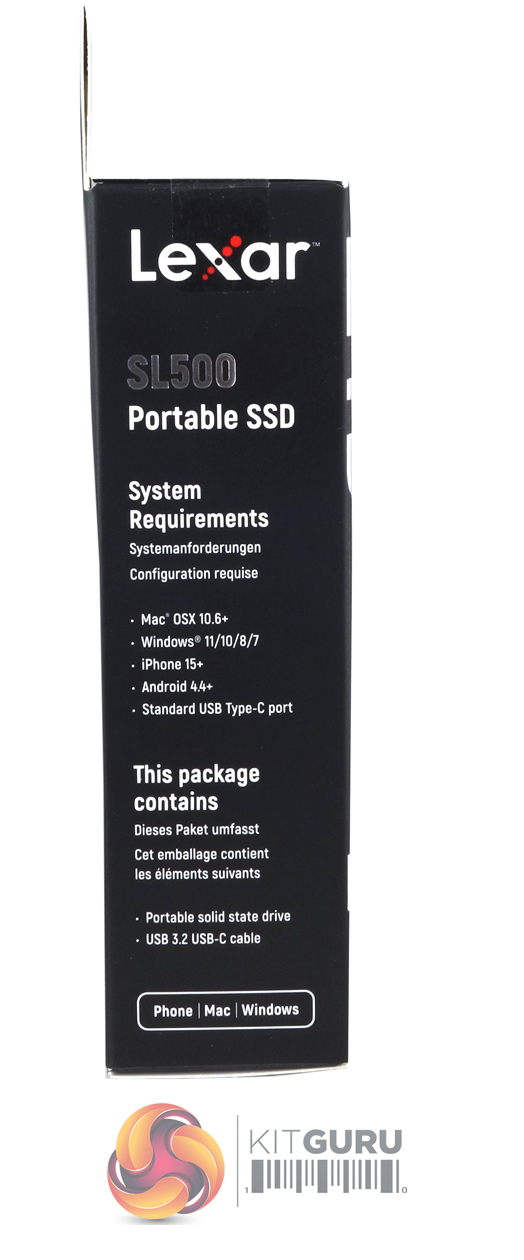
One side of the box shows the drive shows a full-size image of the drive, complete with dimensions while the other end displays system requirements and what the box contains.
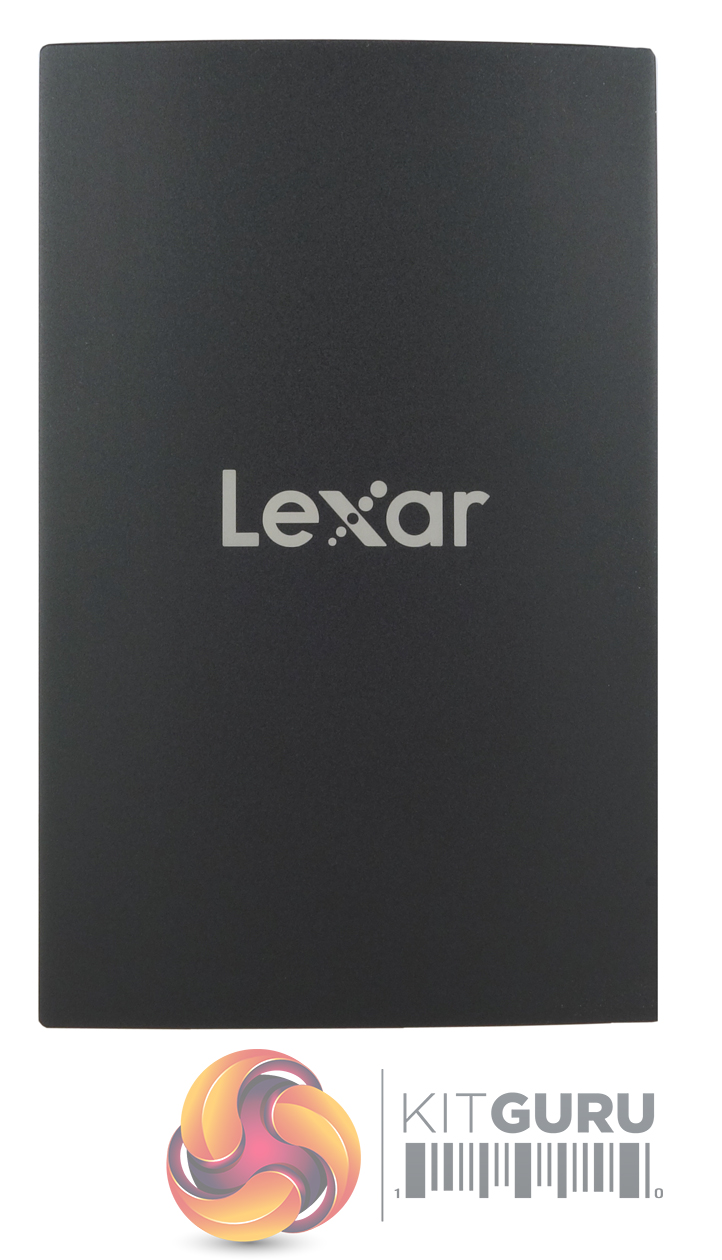
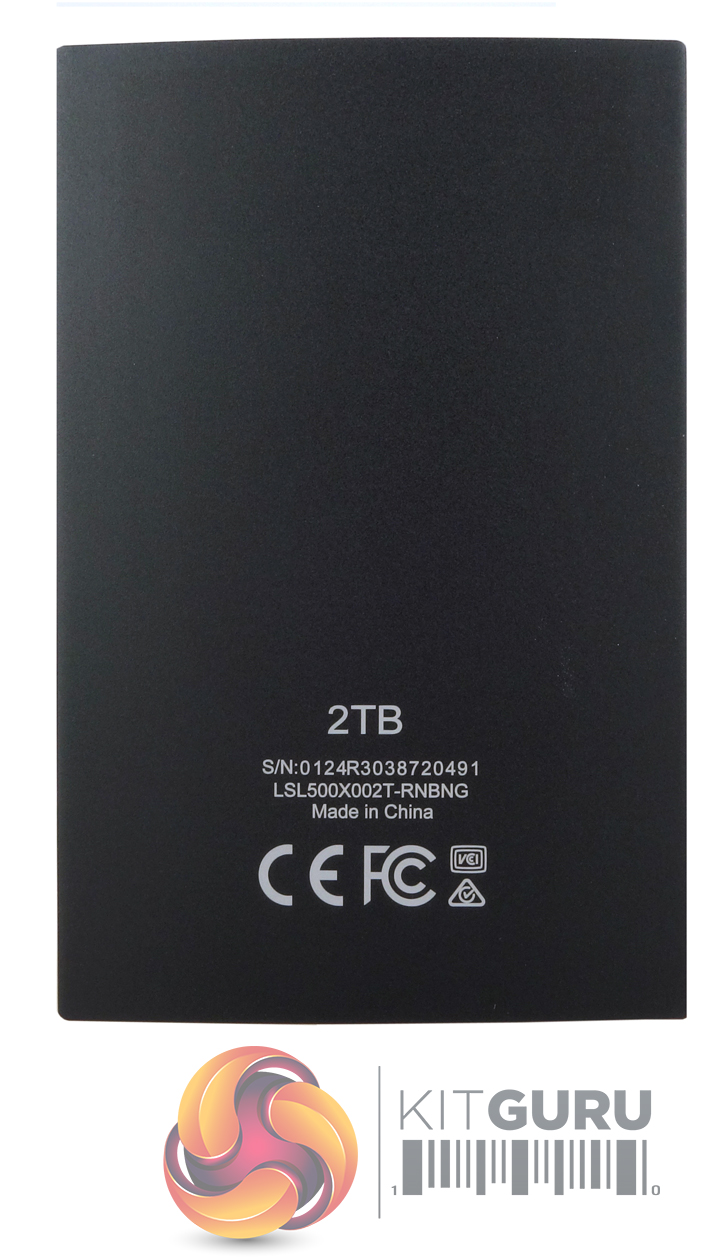
Lexar's SL500 is another very small USB 3.2 Gen2 x 2 drive measuring 85 x 54 x 7.8mm (it is only 4.8mm at its thinnest part) and it weighs in at just 43g. Made with a solid aluminium unibody construction the drive fits and feels comfortable in your hand. Both long sides of the drive have grooves cut into them to aid cooling and to keep a grip on the drive.
The SL500's compact size is thanks to the controller it uses. Silicon Motion's SM2320 controller is a single-chip USB 3.2 Gen2 x 2 solution, it doesn't need a bridging chip, so that particular space requirement isn't needed hence the small platform size. Lexar has it running at full whack in the SL500 (20Gb/s). The SM2320 is a four-channel controller (in a 9mm x 9mm package) supporting speeds of up to 2,100 MB/s and 2,000 MB/s for reads and writes respectively. It supports 3D TLC/QLC NAND up to 4TB capacity. The controller also brings Fingerprint Secure, AES 128/256 and TCG Opal security options.
Lexar hasn't stated what NAND the SL500 is using but every other tiny USB 3.2 Gen2 x 2 drive we've tested using the SM2320 uses 176-Layer 3D TLC Flash.
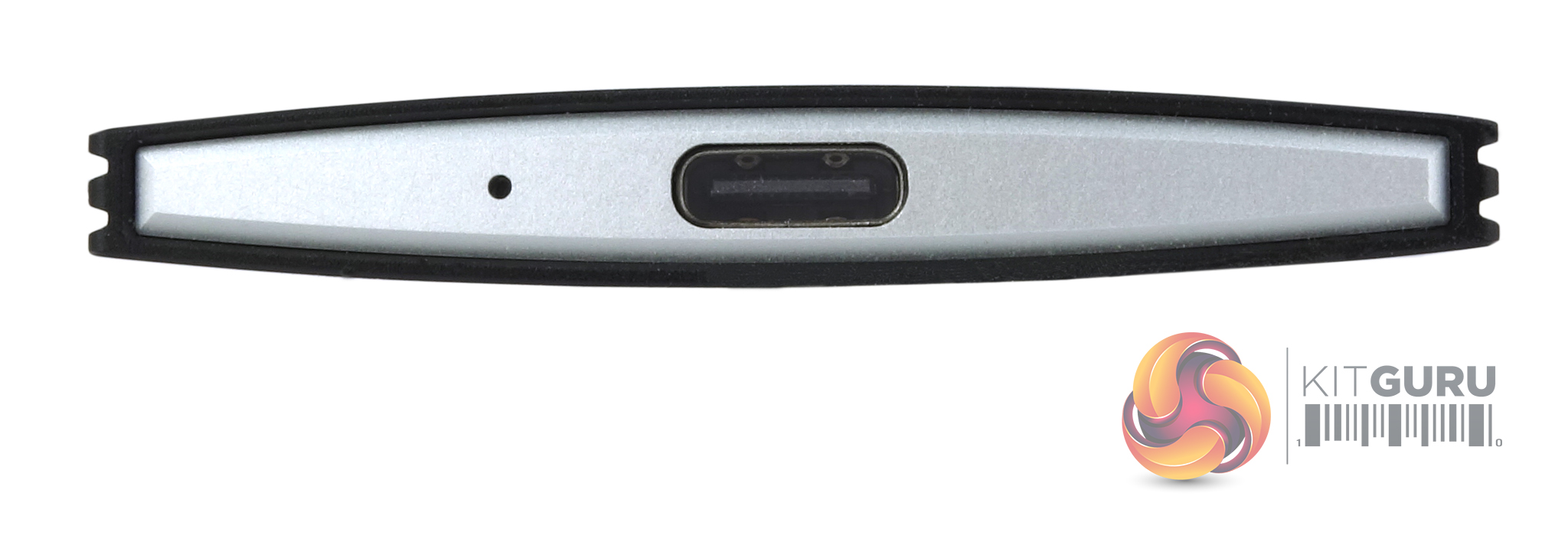
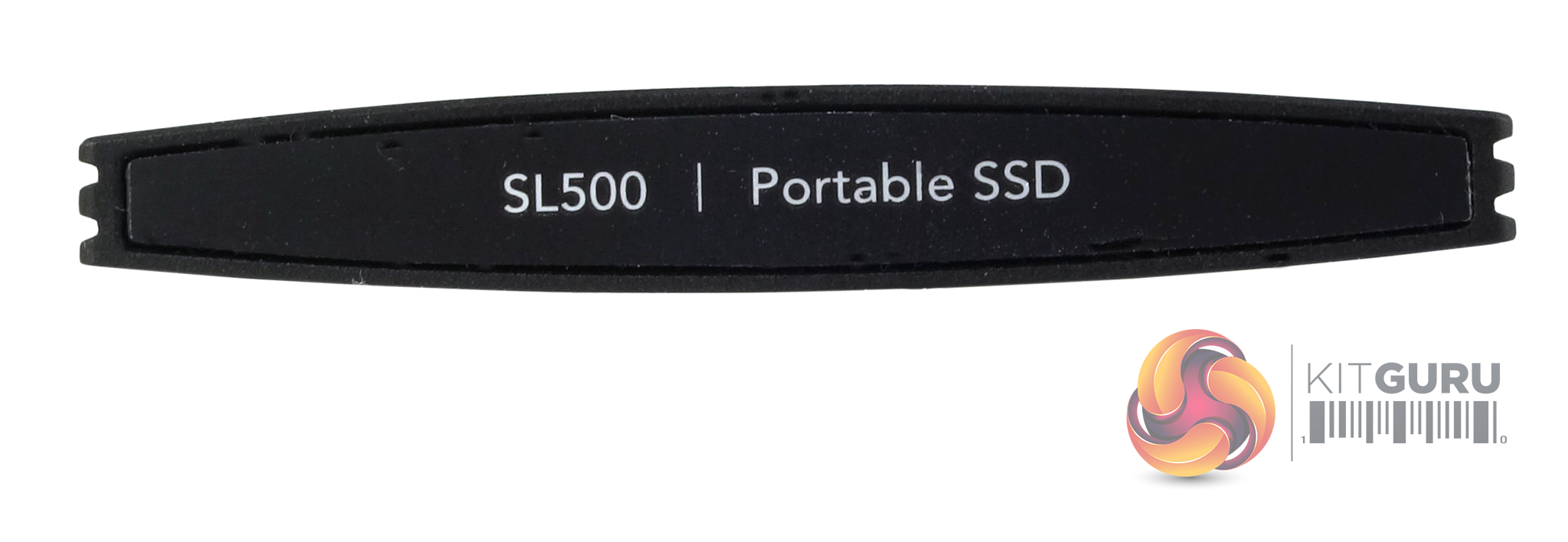
The Lexar SL500 uses a USB-C port, with the interface clocked at full USB 3.2 Gen2 x 2 speed (20Gbps).
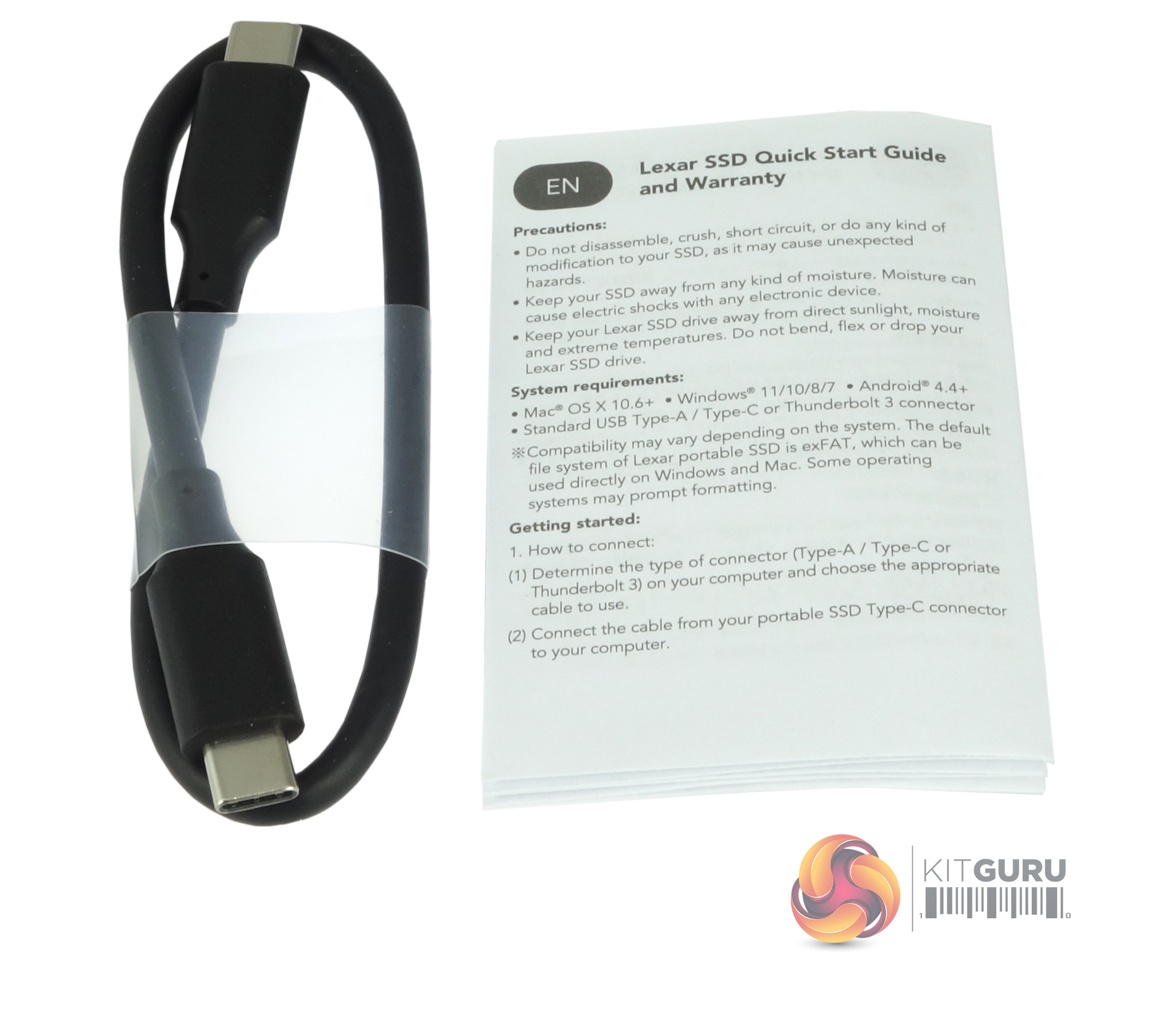
All that comes in the box with the drive is a USB-C to USB-C cable (which could do with being a wee bit longer) and a Quick Start Guide.
Out of the box, the drive is factory formatted as exFAT but to run some of our tests we re-formatted it as NTFS. To test the drive at its full USB 3.2 Gen2 x 2 speed we used a Gigabyte GC-USB 3.2 GEN2X2 (rev1.1) expansion card. Many thanks to Gigabyte for supplying us with the card.
CrystalDiskMark is a useful benchmark to measure the theoretical performance levels of hard drives and SSDs. We are using V8.
The ATTO Disk Benchmark performance measurement tool is compatible with Microsoft Windows. Measure your storage system performance with various transfer sizes and test lengths for reads and writes. Several options are available to customize your performance measurement including queue depth, overlapped I/O and even a comparison mode with the option to run continuously. Use ATTO Disk Benchmark to test any manufacturer's RAID controllers, storage controllers, host adapters, hard drives and SSD drives and notice that ATTO products will consistently provide the highest level of performance to your storage.
AS SSD is a great free tool designed just for benching Solid State Drives. It performs an array of sequential read-and-write tests, as well as random read-and-write tests with sequential access times over a portion of the drive. AS SSD includes a sub suite of benchmarks with various file pattern algorithms but this is difficult in trying to judge accurate performance figures.
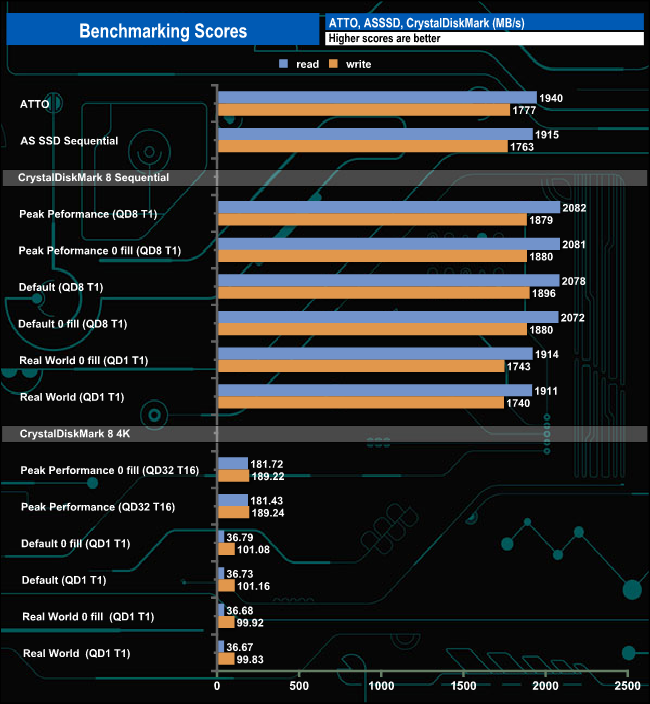
Lexar quote transfer speeds of up to 2,000MB/s and up to 1,800MB/s for reads and writes respectively. Using the ATTO and AS SSD benchmarks the drive came up a little short of these official maximums. The best read scores we saw were 1,940MB/s and 1,915MB/s for ATTO and AS SSD respectively with writes at 1,777MB/s for ATTO and 1,763MB/s for ASSSD. Switching over to the CrystalDiskMark 8 benchmark the drive gave up a best-read score of 2,082MB/s (Peak Performance default profile) with 1,896MB/s for writes (default-test) so confirming the official figures.
The fastest 4K performance came in the Peak Performance profile (QD32 16 threads) at 181.72MB/s for reads and 189.24MB/s for writes. Dropping down to a more real-life-like QD1 T1 setting the fastest we saw was 36.79MB/s for reads and 101.16MB/s for writes.
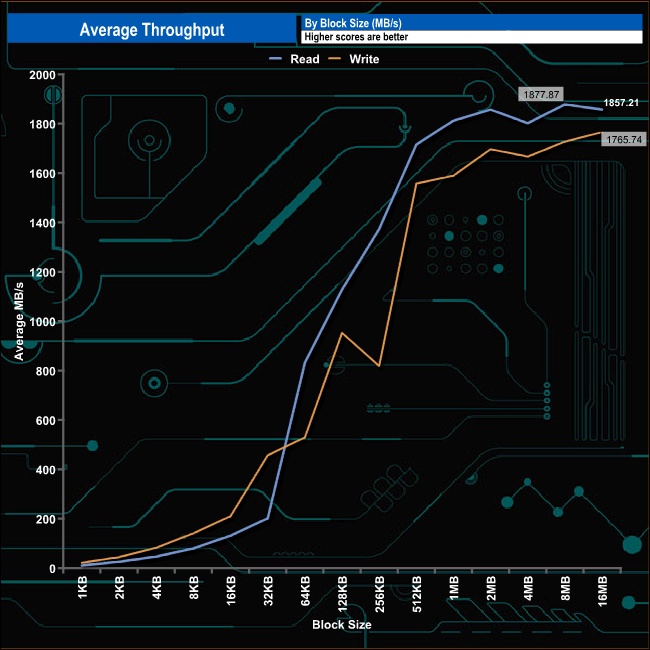
Lexar rates the SL500 at up to 2,000MB/s for Sequential reads and 1,800MB/s for writes. In our throughput tests, the drive didn't quite hit those official maximums with a peak read figure of 1,877MB/s (8MB block) with writes peaking at 1,765MB/s (16MB). At the 256KB block mark the write performance of the drive drops but it recovers quickly enough. Although the tested read/write figures are shy of the official ratings, the drive still offers strong performance.
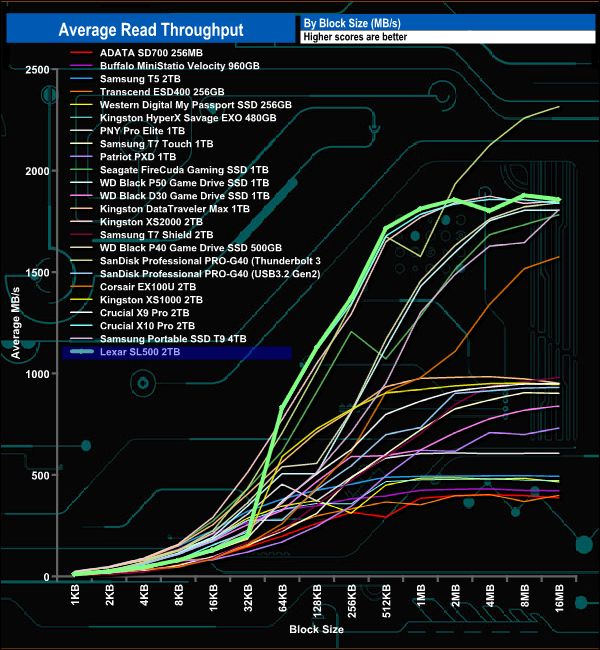
In the read-throughput test, the drive peaked at the 8MB Block at 1,877.87MB/s before dropping back slightly to finish the test run at 1,857.21MB/s.
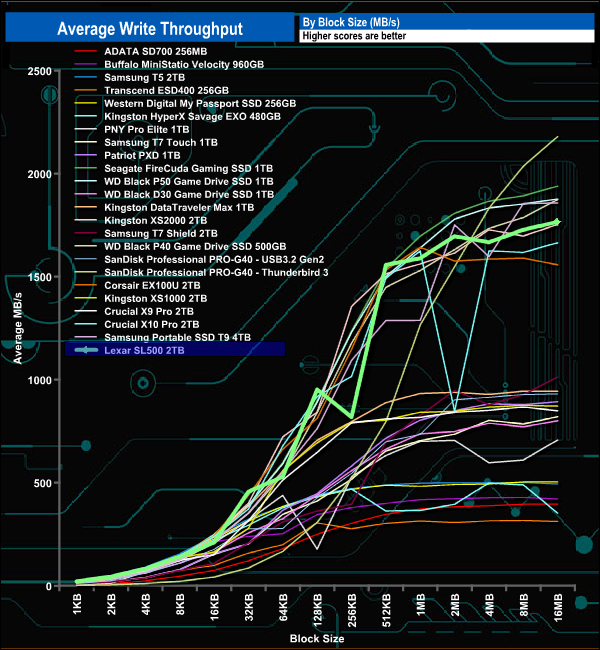
In the write throughput test, the performance of the drive isn't exactly a smooth curve and between the 128KB and 256KB blocks the performance falls away but the drive soon recovers to finish the the test run at 1,765.74MB/s, the peak figure the drive manages in this test
The PCMark 10 Data Drive Benchmark has been designed to test drives that are used for storing files rather than applications. You can also use this test with NAS drives, USB sticks, memory cards, and other external storage devices.
The Data Drive Benchmark uses 3 traces, running 3 passes with each trace.
Trace 1. Copying 339 JPEG files, 2.37 GB in total, in to the target drive (write test).
Trace 2. Making a copy of the JPEG files (read-write test).
Trace 3. Copying the JPEG files to another drive (read test)
Here we show the total bandwidth performance for each of the individual traces.
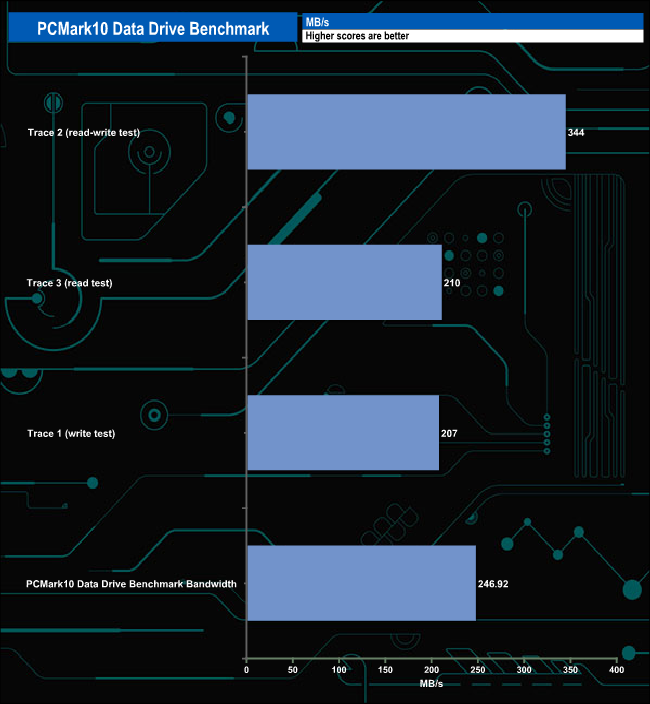
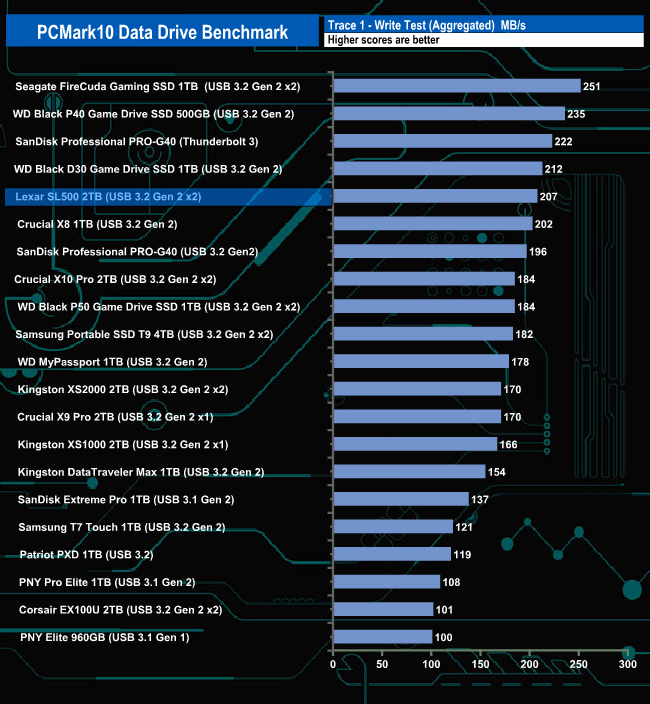
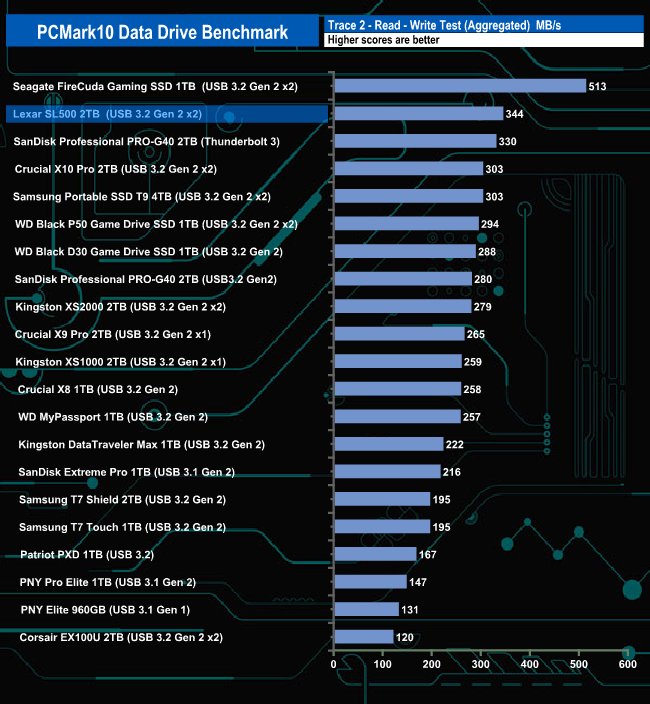
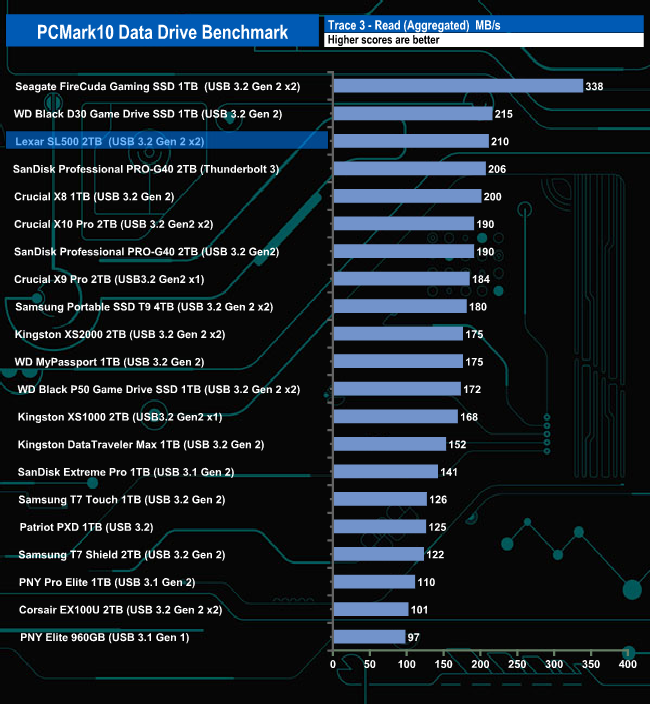
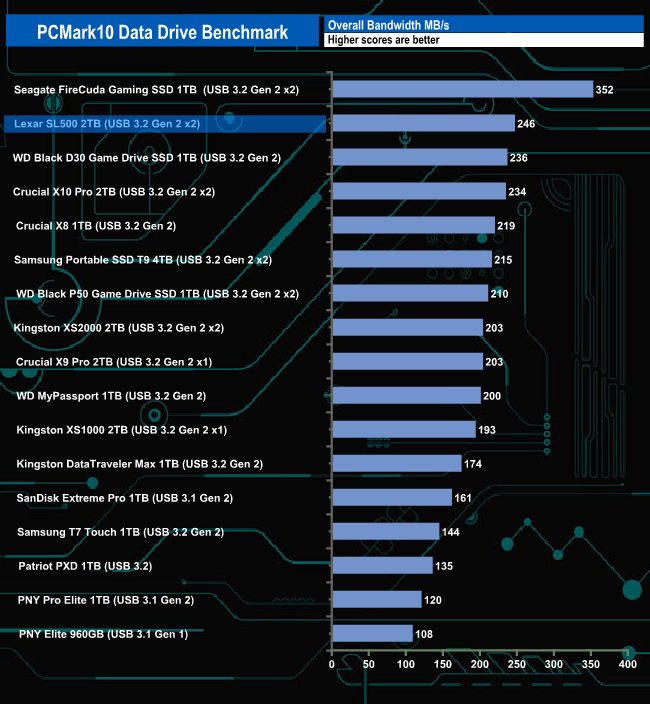
Lexar's SL500 does pretty well in PCMark 10 Data Drive Benchmark. It sits in the top 5 drives for all three parts of the benchmark run (Read-Write, Read and Write traces) with the Write test appearing to be the weakest of the three. Its overall bandwidth figure of 246MB/s is good enough to see the drive sit in second place on our results chart behind Seagate's FireCuda Gaming SSD.
We also tested the time it took to import and export a mix of files from/to the SL500 into various programs.
The programmes we used were:
Microsoft Office (Word, Excel and PowerPoint)
Adobe Acrobat Reader
Adobe Photoshop
VideoPad
Audacity
We also timed moving a Win 10 backup file to and from the drive and launching a game from the XXX.
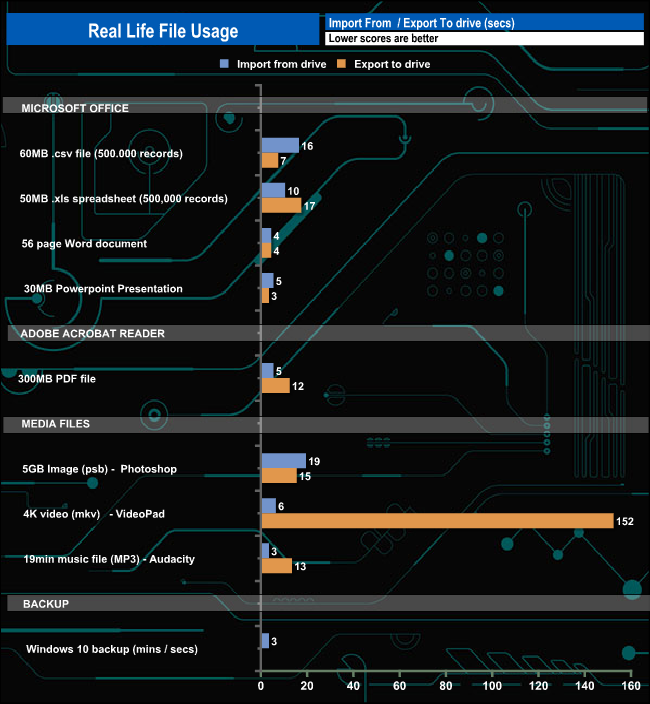
The SL500 shows strong performance for the load / save tests. It takes just 3 minutes to copy the Windows 10 backup (100GB) to the drive while exporting a 2.6GB 4K video from the app to the drive took 152 seconds.
To test the real-life performance of a drive we use a mix of folder/file types and by using the FastCopy utility (which gives a time as well as MB/s result) we record the performance of drive reading from & writing to a 2TB Seagate FireCuda 510.
Transfer Details:
Windows 10 backup – 118GB.
Data file – 100GB.
BluRay Movie – 42GB.
Windows 11 iso – 5.4GB.
File folder – 50GB – 28,523 files.
Steam folder – 222GB (8 games: Alien Isolation, Battlefield 4, BioShock Infinite, Crysis 3, Grand Theft Auto V, Shadow Of Mordor, Skyrim, The Witcher3 Wild Hunt).
Movie demos 8K – 21GB – (11 demos).
Raw Movie Clips 4K – 16GB – (9 MP4V files).
Movie folder – 12GB – 15 files – (8 @ .MKV, 4 @ .MOV, 3 @ MP4).
Photo Folder – 10GB – 304 files – (171 @ .RAW, 105 @ JPG, 21 @ .CR2, 5 @ .DNG).
Audio Folder – 10GB – 1,483 files – (1479 @ MP3, 4 @ .FLAC files).
Single large image – 5GB – 1.5bn pixel photo.
3D Printer File Folder – 4.25GB – (166 files – 105 @ .STL, 38 @ .FBX, 11 @ .blend, 5 @ .lwo, 4 @ .OBJ, 3@ .3ds).
AutoCAD File Folder – 1.5GB (80 files – 60 @ .DWG and 20 @.DXF).
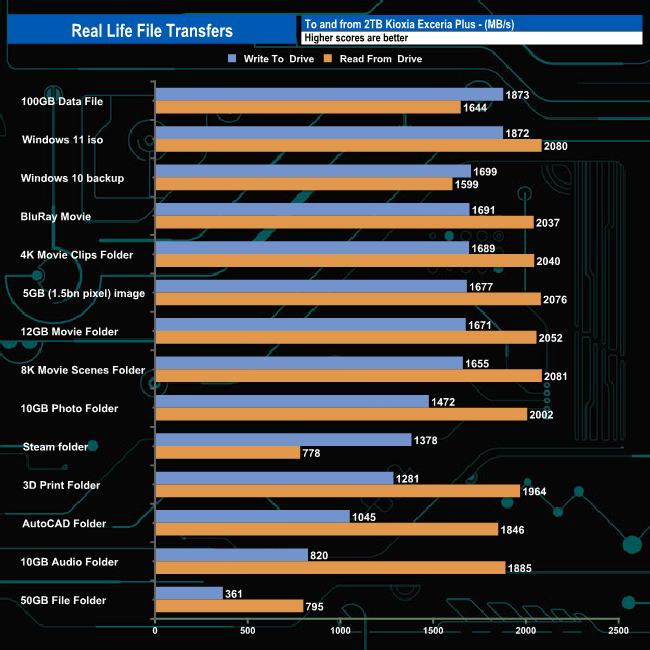
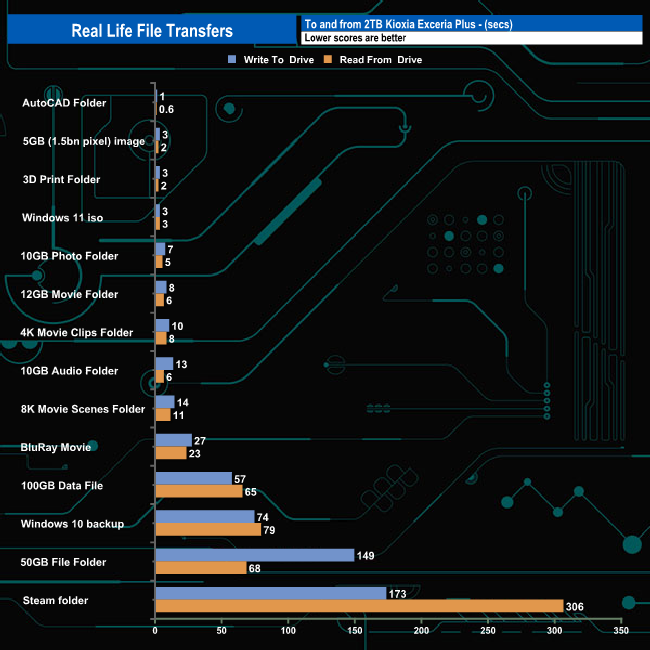
The 2TB Lexar SL500 averaged 1,441.71MB/s when in write mode for the 14 file transfers with an average time for the fourteen of 38secs. The fastest write speed was for the 100GB data file at 1,873MB/s (57secs) while the slowest was for the 50GB file folder at 361MB/s (149secs). When it came to reading the fourteen tests the drive averaged a faster 1,77.07MB/s (42 secs). This time it was the Windows 11 iso transfer that was the fastest at 2,080MB/s (3secs) and the slowest the Steam folder transfer at 778MB/s (306s). The drive topped the 2GB/s mark in seven out of the fourteen read transfers and passed the 1GB/s mark in all bar two of the remaining tests.
Lexar's latest addition to quite an extensive range of portable SSDs is the compact SL500. The SL500 is the third Lexar drive to make use of a USB 3.2 Gen2 x 2 interface, joining the SL660 BLAZE Gaming and Professional SL600 drives. At the time of writing this review, there are only two models of the SL500 available, the 2TB drive we are looking at here and a 1TB drive. A 4TB version is due sometime in Q2.
The drive uses a Silicon Motion SM2320 controller with the built-in interface running at its full USB 3.2 Gen2 x 2 (20Gbps) speed. The SM2320 is a four-channel, single-chip USB 3.2 Gen2 x 2 solution which does away with the need for a bridging chip to make the interface work at full speeds. The controller comes in a tiny 9mm x 9mm package which together with the space saved by doing away with a bridge chip means that the SL500 is very compact, measuring just 85 x 54 x 7.8mm (more or less the size of a credit card) and weighing in at just 43g.
At the time of writing, we couldn't find what NAND the drive was using but other drives we've tested and reviewed with the SM2320 have been using 176-Layer 3D TLC NAND.
Lexar rates the drive as up to 2,000MB/s for reads and up to 1,800MB/s for writes. Using the ATTO and ASSSD benchmarks to test the drive we couldn't quite reach those official maximums with the best read/write scores for those two benchmarks coming from ATTO at 1,940MB/s and 1,777MB/s for reads and writes respectively. ASSSD scores were a little slower at 1,915MB/s for reads and 1,763MB/s for writes. Switching over to the CrystalDiskMark 8 benchmark we saw test results that confirmed the official maximums. The best read result we saw was 2,082MB/s (Peak Performance profile test, QD8 T1) while the best write result of 1,896MB/s came from the default test, again with QD8 T1 settings.
With our real-life file transfers we saw read performance go over the 2GB/s mark in seven out of the fourteen tests, the fastest being the Windows 11 iso transfer at 2,080MB/s. Of the remaining seven tests, five topped 1GB/s. When it came to write performance twelve of the transfers were over 1GB/s with the fastest being the 100GB Data File at 1,873MB/s.
The SL500 is compatible with PC, Mac, Android devices, iPhone 15 series and gaming consoles. It is also compatible with Apple's Pro Res codec allowing video to be shot and saved straight to the drive at full 4K and 60FPS with an iPhone 15 Pro or Pro Max.
Pre-loaded on the drive is Lexar's DataShield software, which allows you to create a private safe on the drive to which you can drag and drop files. The safe is password protected and any files are automatically encrypted.
We found the 2TB Lexar SL500 on Amazon.co.uk for £178.99 (inc VAT) HERE.
Pros
- Fast performance.
- Design.
- DataShield software.
- Apple's Pro Res support.
Cons
- Couldn't quite hit the official maximum speeds with some of our testing.
- Needs a USB 3.2 Gen 2 x2 port to get the best performance out of it.
KitGuru says: Another very small but quick external SSD with loads of capacity and one which comes with the added benefit of a bundled utility to keep your files safe from harm using password protection and encryption.