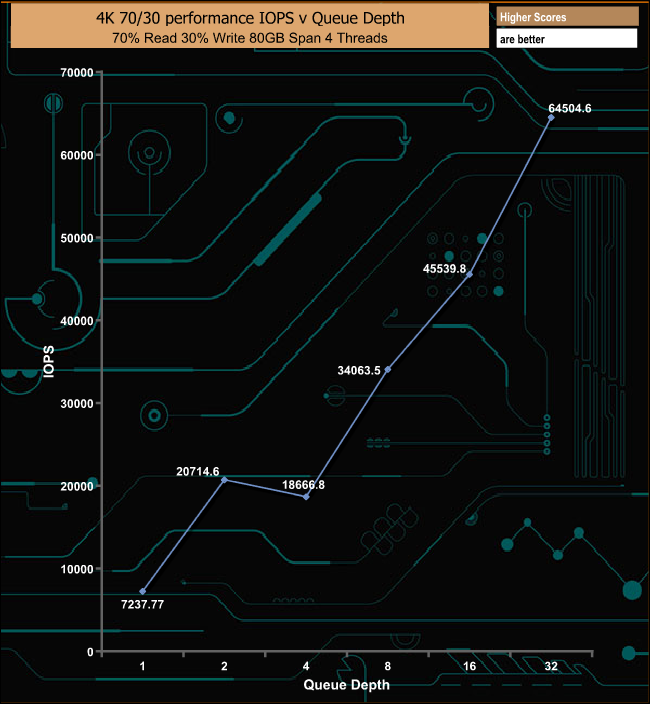
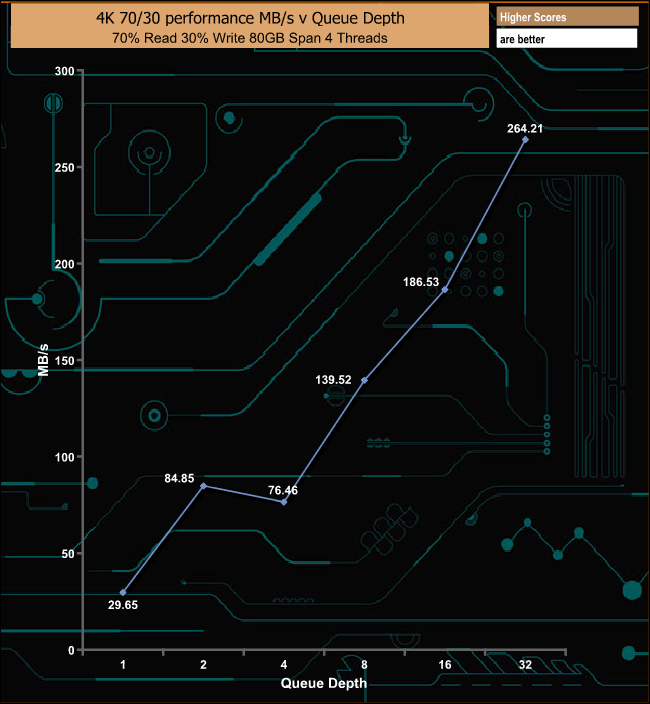
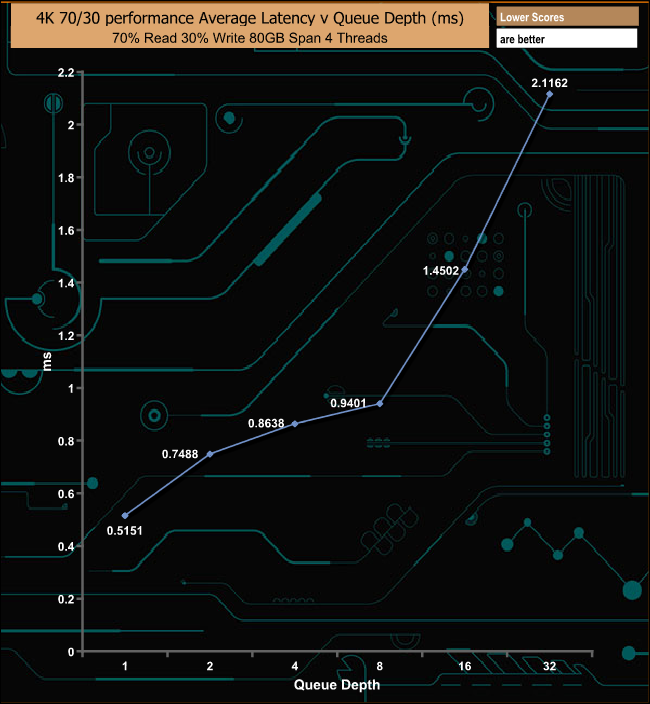
The P300 is Patriot's latest NVMe drive, with the company hoping this SSD will be able to grab a share of the highly lucrative entry-level NVMe market segment. Using a Silicon Motion controller, and coming in a little over £110, is Patriot onto a winner? There are two versions of the P300, the US (Phison PS5013-E13T controller) and Regional (Silicon Motion SM2263XT controller) and all versions use 96-layer 3D TLC NAND. Five models make up the P300 product lines; 128GB, 256GB, 512GB, 1TB (Patriot supplied us with a Regional version for review) and the flagship 2TB drive. Sequential performance for the 1TB unit is stated as up to 2,100MB/s for reads and up to 1,650MB/s for writes. The entry model 128GB drive is rated as up to 1,600MB/s for reads and 600MB/s for writes. The 256GB and 512GB drives share the same 1,700MB/s read figure with the 256GB drive rated as up to 1,100MB/s for writes and the 512MB/s, a 100MB/s faster at 1,200MB/s. The flagship 2TB model shares the same Sequential read/write figures as the 1TB drive. The 1TB drive is rated as up to 290,000 IOPs for random reads while writes are up to 260,000 IOPS. In fact, all five drives in the P300 line-up have the same 290,000 IOPS figure while the 256GB, 512GB and 2TB drive share the 260,000 IOPS figures. The 128GB drive makes do with a write 4K figure of up to 150,000K. Power figures for the 1TB drive are 2.28W full speed and 0.38W for Idle. The official endurance rating for the 1TB drive is 320TB TBW and Patriot back the drive with a 3-year warranty. Physical Specifications: Usable Capacities: 1TB. NAND Components: 96-Layer 3D TLC NAND. NAND Controller: Silicon Motion SM2263XT (4-channel). Cache: DRAMless (uses HMB (Host Memory Buffer) technology). Interface: PCIe Gen3 NVMe 1.3. Form Factor: M.2 2280. Dimensions: 80 x 22 x 3mm. Drive Weight: 9g. Firmware Version: T0214B0L Patriot's P300 comes mounted in a blister pack with the drive's capacity clearly labelled at the top of the pack. The rear of the pack has multilingual bullet points highlighting some of the drives features along with a couple of icons displaying the drive's compatibility with Windows and MAC systems. The P300 is built on a single-sided PCB. Under the large white product sticker sit two 512GB 96-Layer 3D TLC NAND packages along with the Silicon Motion SM2263XT 4-channel controller. The SM2263XT is a DRAM-less design that uses HMB (Host Memory Buffer) technology to perform caching duties so there is no cache IC to find room for. For testing, the drives are all wiped and reset to factory settings by HDDerase V4. We try to use free or easily available programs and some real-world testing so you can compare our findings against your own system. This is a good way to measure potential upgrade benefits. Main system: AMD Ryzen 5 3600X, 16GB DDR4-2400, Sapphire R9 390 Nitro and an MSI MPG X570 Gaming Edge Wifi motherboard Other drives Corsair Force MP510 960GB Crucial P1 1TB Kingston KC2000 1TB Kingston KC2500 1TB Patriot Viper VPR100 RGB 1TB Patriot Viper VPN100 1TB PNY CS3030 1TB Seagate FireCuda 510 1TB Samsung SSD970 PRO 1TB Samsung SSD960 EVO 1TB Samsung SSD960 EVO Plus 1TB Kioxia Exceria Plus 2TB Kioxia BG4 1TB Kioxia XG6 1TB Western Digital Black SN750 1TB Western Digital Black SN750 1TB with Heatsink Western Digital Blue SN550 1TB Software: Atto Disk Benchmark 4. CrystalMark 6.0.0. AS SSD 2.0. IOMeter. Futuremark PC Mark 10 All our results were achieved by running each test five times with every configuration this ensures that any glitches are removed from the results. Trim is confirmed as running by typing fsutil behavior query disabledeletenotify into the command line. A response of disabledeletenotify =0 confirms TRIM is active. CrystalDiskMark is a useful benchmark to measure theoretical performance levels of hard drives and SSD’s. We are using v6.0. For an entry-level drive, the P300 does surprisingly well in CrystalDiskMark QD32 test beating some higher-end drives. From looking at the two benchmark result screens, it seems that the controller doesn't have a preference about the type of data it's being asked to handle. At shallow QD of 1, the P300 still performs well, particularly its write performance. The latest version of CrystalDiskMark, version 7, includes a couple of profiles that can be used for testing – Peak Performance and Real World. The result screens for these two profiles not only display MB/s results but also IOPS and latency. Looking at the Peak Performance results for Sequential read/write performance we could confirm the official Sequential read figure of 2,100MB/s, with the tested drive producing 2,135MB/s. Tested writes at 1,732MB/s bettered the official 1,650MB/s. We also used CrystalDiskMark 7 to test the random performance of the drive at lower queue depths (where most of the everyday workloads occur) using 1 to 4 threads. The read performance climbs smoothly throughout the tested queue depths and threads. 49 In the 4K random write tests, the results are a mixed bag. Using a single thread, the drive climbs pretty steadily from QD1 to QD4 ending the test run at 204MB/s (49,898 IOPS). With 2 and 3 threads the drive peaks at QD 2 before dropping back a little while the 4-threaded test peaked at a QD of 1. The ATTO Disk Benchmark performance measurement tool is compatible with Microsoft Windows. Measure your storage systems performance with various transfer sizes and test lengths for reads and writes. Several options are available to customize your performance measurement including queue depth, overlapped I/O and even a comparison mode with the option to run continuously. Use ATTO Disk Benchmark to test any manufacturers RAID controllers, storage controllers, host adapters, hard drives and SSD drives and notice that ATTO products will consistently provide the highest level of performance to your storage. Patriot rate the 1TB P300 as up to 2,100MB/s and 1,650MB/s for Sequential read and writes respectively. Testing the review drive with the ATTO benchmark we couldn't reach those maximum figures, with reads at 1,970MB/s but tested writes were a lot closer to the official figure at 1,610MB/s. AS SSD is a great free tool designed just for benching Solid State Drives. It performs an array of sequential read and write tests, as well as random read and write tests with sequential access times over a portion of the drive. AS SSD includes a sub suite of benchmarks with various file pattern algorithms but this is difficult in trying to judge accurate performance figures. In the AS-SSD benchmark, the drive offered stronger write performance than read with a score of 1401 with reads at 1069. IOMeter is another open-source synthetic benchmarking tool which is able to simulate the various loads placed on the hard drive and solid-state drive technology. There are many ways to measure the IOPS performance of a Solid State Drive, so our results will sometimes differ from the manufacturer’s quoted ratings. We do test all drives in exactly the same way, so the results are directly comparable. We test 128KB Sequential read and write and random read and write 4k tests. The test setup’s for the tests are listed below. Each is run five times. 128KB Sequential Read / Write. Transfer Request Size: 128KB Span: 8GB Thread(s): 1, Outstanding I/O: 1-32 Test Run: 20 minutes per test 4K Sustained Random Read / Write. Transfer Request Size: 4KB Span: 80GB Thread(s): 4, Outstanding I/O: 1-32 Test Run: 20 minutes per test 4K Random 70/30 mix Read/Write. Transfer Request Size: 4KB Span: 80GB Reads: 70% Writes: 30% Thread(s): 4 Outstanding I/O: 2 – 32 Test Run: 20 minutes. Using our own Sequential tests we could confirm the official maximum read figure of 2,100MB/s with a tested figure of 2,137.72MB/s at a queue depth of 4. The best write figure we saw was 1,836.78MB/s (QD8) which betters the official 1,650MB/s. 128KB Sequential Read Performance v QD The P300's Sequential read performance falls away from its nearest competitors as the queue depth deepens. 128KB Sequential Write Performance v QD Not only are the tested Sequential write results faster than the official figure of 1,650MB/s it also is very consistent through all the tested queue depths. The 1TB drive is rated as up to 290,000 IOPs for random reads. With our four-threaded tests, we couldn't get anywhere close to that figure, the best we saw was 108,351 IOPS at a queue depth of 16. We then ran some quick tests using 8 threads at a queue depth of 32 and got a lot closer to the maximum official figure with a result of 243,794 IOPS. 4K Random Read v QD Performance The Patriot P300 didn’t perform too well in our sustained 4K random read test, sitting close to the bottom of our result charts at all the tested queue depths. Officially the drive is rated for random 4K writes up to 260,000 IOPS. As you can see from our results we couldn't get anywhere close to this figure with our 4-threaded tests, the best result we got was 56,898 IOPS at a queue depth of 32. As with the random reads, we tested the drive at a queue depth of 32 using eight threads and got a figure of 236,662 IOPS, a lot closer to the official figure. 4K Random Write v QD Performance As with the random read testing, the P300 doesn't handle our 4K random write tests, sitting at the bottom of all but one of our result charts. In our 4K 70/30 mixed read/write test the drive stumbled at the QD4 mark but quickly recovered to finish the test run at 264.21MB/s (64,504 IOPS). In our read throughput test, the P300 peaks at 1,749MB/s at a QD of 16, a good deal short of the official 2,100MB/s maximum rating of the drive. In the write throughput test, the drive actually does a little better than the official 1,650MB/s rating at 1,686MB/s at a QD of 2. For the long term performance stability test, we set the drive up to run a 20-minute 4K random test with a 30% write, 70% read split, at a Queue Depth of 256 over the entire disk. The 1TB P300 averaged 11,236 IOPS for the test, with a performance stability of 57.6%, which is pretty good for this class of drive. The PCMark 10 Full System Drive Benchmark uses a wide-ranging set of real-world traces from popular applications and common tasks to fully test the performance of the fastest modern drives. The benchmark is designed to measure the performance of fast system drives using the SATA bus at the low end and devices connected via PCI Express at the high end. The goal of the benchmark is to show meaningful real-world performance differences between fast storage technologies such as SATA, NVMe, and Intel’s Optane. The Full System Drive Benchmark uses 23 traces, running 3 passes with each trace. It typically takes an hour to run. Traces used: Booting Windows 10. Adobe Acrobat – starting the application until usable. Adobe Illustrator – starting the application until usable Adobe Premiere Pro – starting the application until usable. Adobe Photoshop – starting the application until usable. Battlefield V – starting the game until the main menu. Call of Duty Black Ops 4 – starting the game until the main menu. Overwatch – starting the game until main menu. Using Adobe After Effects. Using Microsoft Excel. Using Adobe Illustrator. Using Adobe InDesign. Using Microsoft PowerPoint. Using Adobe Photoshop (heavy use). Using Adobe Photoshop (light use). cp1 Copying 4 ISO image files, 20 GB in total, from a secondary drive to the target drive (write test). cp2 Making a copy of the ISO files (read-write test). cp3 Copying the ISO to a secondary drive (read test). cps1Copying 339 JPEG files, 2.37 GB in total, to the target drive (write test). cps2 Making a copy of the JPEG files (read-write test). cps3 Copying the JPEG files to another drive (read test). The best performance by far in the creative group of tests was the 580MB/s from the Adobe Photoshop heavy use test trace. The drive showed strong performance in the cp1, cp2 and cp3 file transfer tests. We've only just started to use the PCMark 10 Full System Drive Benchmark so overall bandwidth chart is a little short of drives but we will continue to add drives as we test them. The P300 does quite well overall considering it's an entry-level drive, its bandwidth result isn't too far behind the much more capable Viper VPR100, also from Patriot. To test real life performance of a drive we use a mix of folder/file types and by using the FastCopy utility (which gives a time as well as MB/s result) we record the performance of drive reading from & writing to a 256GB Samsung SSD850 PRO. We use the following folder/file types: 100GB data file. 60GB iso image. 60GB Steam folder – 29,521 files. 50GB File folder – 28,523 files. 12GB Movie folder – (15 files - 8 @ .MKV, 4 @ .MOV, 3 @ MP4). 10GB Photo folder – (304 files - 171 @ .RAW, 105 @ JPG, 21 @ .CR2, 5 @ .DNG). 10GB Audio folder – (1,483 files - 1479 @ MP3, 4 @ .FLAC files). 5GB (1.5bn pixel) photo. BluRay Movie - 42GB. 21GB 8K Movie demos - (11 demos) 16GB 4K Raw Movie Clips - (9 MP4V files). 4.25GB 3D Printer File Folder - (166 files - 105 @ .STL, 38 @ .FBX, 11 @ .blend, 5 @ .lwo, 4 @ .OBJ, 3@ .3ds). 1.5GB AutoCAD File Folder (80 files - 60 @ .DWG and 20 @.DXF). Our real-life file transfers didn't cause the P300 any real problems. The fastest transfer was the AutoCAD folder (3 secs) while it comes as no surprise to see the 50GB file folder transfer as the slowest. To get a measure of how much faster PCIe NVMe drives are than standard SATA SSD's we use the same files but transfer to and from a 512GB Toshiba OCZ RD400: Using the NVMe drive to transfer the files to and from the P300 saw the AutoCAD folder once again take the top spot. Similarly, the 50GB file folder transfer was once again the slowest but saw the transfer time reduce from 398 seconds to 335 seconds to write the folder to the drive with the time for reading the data back again reduced from 459 seconds to 355 seconds. In the recent past we've looked at drives from Patriot's Gaming product line; the VPN100, VPR100 and the mighty PCIe Gen4 VP4100. This time we get to look at a drive from the other end of the food chain, the entry-level P300 from the standard Patriot range. There are two distinct versions of the P300 drive, US and Regional. The US version uses a PS5013-E13T controller while the Regional version uses a Silicon Motion SM2263XT controller. Regardless of which controller, the drive uses 96-layer 3D TLC NAND and is a DRAMless design that relies on HMB (Host Memory Buffer) technology for caching duties. Five drives make up the P300 product line; 128GB, 256GB, 512GB, 1TB (the drive Patriot kindly supplied for review) and a flagship 2TB model. Performance-wise the 1TB P300 is rated as up to 2,100MB/s and 1,650MB/s for Sequential read/writes respectively. When we tested the drive with the ATTO benchmark we couldn't quite reach those maximum official numbers, with reads of 1,970MB/s and writes at 1,610MB/s. However, using our own Sequential benchmarks we could indeed confirm the Patriot figures with tested read performance of 2,137MB/s and writes at 1,836MB/s. The 1TB drive is rated as up to 290,000 IOPs for random reads while writes are up to 260,000 IOPS. However, using our standard 4-threaded tests we couldn't get close to either of those official maximums. The best read figure we got was 108,351 IOPS at a QD of 16 while the best write figure was a low 56,898 IOPS at a queue depth of 32. However, a quick test using 8 threads at a queue depth of 32 yielded a read result of 243,794 IOPS and a write score of 236,662 IOPS, much closer to those official scores. One other thing to note is that the P300 doesn't have any software management utility to support it which is a bit of a shame. We found the 1TB P300 Regional Edition on CCL Computers for £114.93 (inc VAT) HERE. Discuss on our Facebook page HERE. Pros Sequential performance. Single-sided layout. Cons Tested 4K results were disappointing against the official ratings. Lack of software management utility. Only a 3-year warranty. KitGuru says: The P300 is a decent enough drive but it's aimed at an extremely competitive market segment which already contains some very well known, better-performing drives. It could do with a bit of tweaking to the price to give it a better chance.