 KitGuru KitGuru.net – Tech News | Hardware News | Hardware Reviews | IOS | Mobile | Gaming | Graphics Cards


Small form-factor multi-GPU project Quantum concept personal computer that Advanced Micro Devices demonstrated earlier this year was an impressive piece of hardware. Unfortunately, it may never really hit the market, despite of early claims by the company. Richard Huddy, chief scientist of AMD, claims that even if project Quantum will be made commercially, it will be a very rare product.
“I don’t know whether we have an OEM who is committed to building something like it,” said Richard Huddy in an interview with PCR. “We built it as a concept PC, so like concept cars it’s not usually practical to take it straight to market, that wouldn’t make a great deal of sense. But it’s not far from that.”
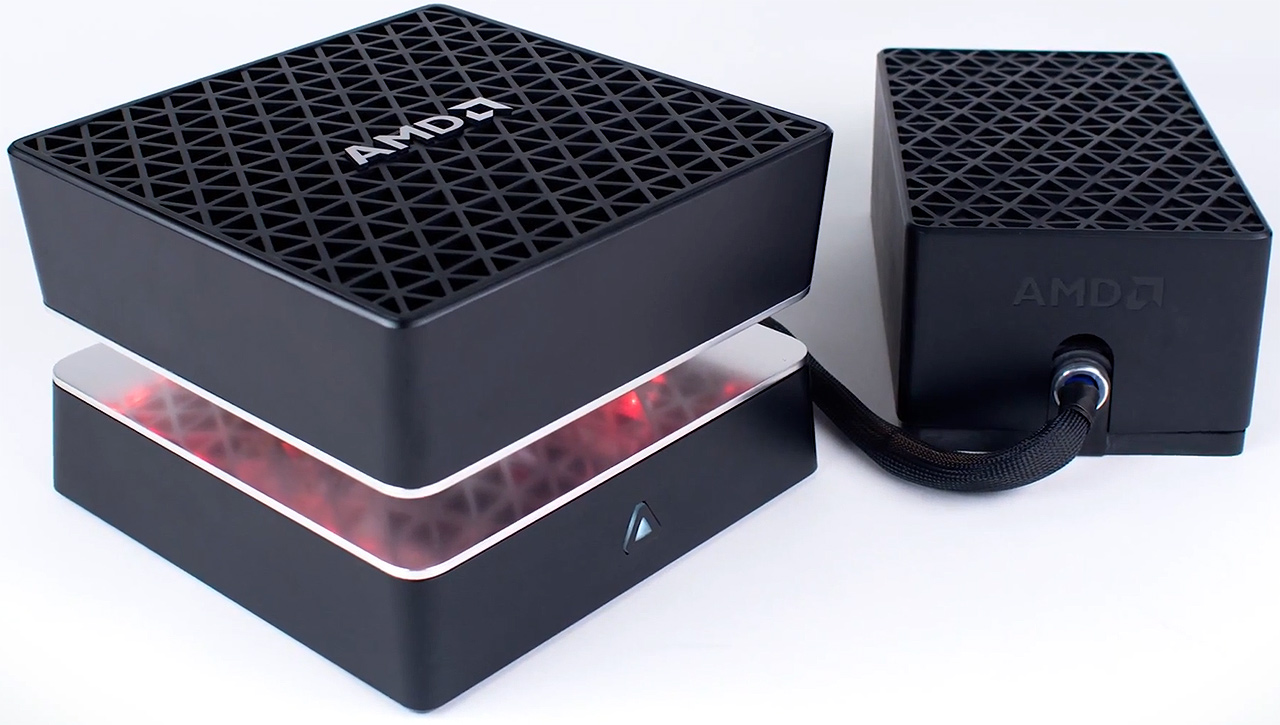
AMD’s project Quantum concept is powered by a customized version of Asrock’s Z97E-ITX/ac mainboard, Intel Corp.’s Core i7-4790K “Devil’s Canyon” processor as well as dual-chip AMD’s Radeon R9 Fury X2. The system sports innovative liquid cooling system as well as a dual-chamber design. The PC was specifically built to demonstrate ultimate performance in 4K ultra HD (3840*2160) resolution.
The project Quantum was designed by AMD Innovation Lab to demonstrate what can be done, which is exactly what the system did. It attracted attention to itself as well as to AMD’s forthcoming flagship Radeon R9 Fury X2 graphics card operating in CrossFireX mode with 8GB of HBM memory in total.
Unfortunately, since project Quantum uses a lot of custom components, it is unlikely that it will be made commercially since making custom components in low volume is economically inefficient, whereas making them in high volume may not make sense since demand for such systems would likely be limited.
“I would think that if we have the right kind of conversations with some of these OEMs, then we might well turn it into a real product,” said Mr. Huddy. “In that case, it will probably be a very small number. Maybe only one or at most a handful of PC manufacturers who would bring that to market, potentially. It’s a custom piece, not a high volume piece, but it is a thing of beauty.”
Discuss on our Facebook page, HERE.
KitGuru Says: There are a lot of advanced mini-ITX and micro-ATX PC chassis available today that allow to build high-performance PCs. Obviously, AMD's project Quantum looks remarkable, but would you pay extra money for such design?

If this were true, why did you bother showing the system in the first place?
Just (open) license the case if it’s going to trash can anyway and someone will be interested to build and sell it. You, AMD, will still get sales for your GPU.
I’m willing to bet steam console vendors will be the first one in line to sell this
Again, concepts justs flash out potentila, show people what we are capable of doing
The case is only part of the expense, the semi-custom Mobo, PSU, and custom cooling make up a large part of it.
A nice concept, maybe in a year or so’s time they can make something like it more viable.
It was almost all off the self parts. At least, that’s what they said at the time. And I can well believe it. PC manufacturers have been really quite lazy in taking the mini-itx form factor and really rolling with it to make a tiny, but powerful, gaming pc.
AMD being AMD.
Big ass AMD logo on the top but its got an Intel CPU..