KitGuru KitGuru.net – Tech News | Hardware News | Hardware Reviews | IOS | Mobile | Gaming | Graphics Cards


To measure idle temperatures, a reading was taken after having Windows open on the desktop for 30 minutes. A reading under load was taken with Prime 95’s SmallFFt test running alongside 3DMark Fire Strike.
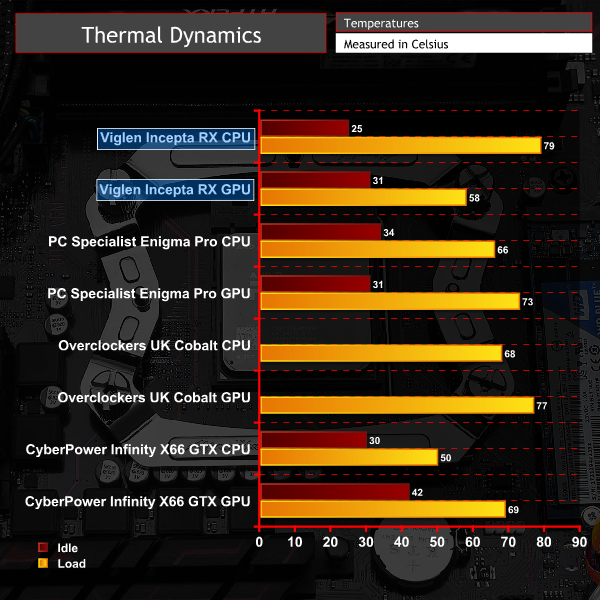
Despite the CPU overclock, decent GPU and lack of input fans, the Viglen performed well in every thermal benchmark. Its peak GPU and GPU temperatures of 79°C and 58°C are absolutely fine – on par with most other machines that arrive with an overclocked processor and graphics card.
We didn’t have any throttling issues, either: even at load the CPU ran its eight cores at its 4GHz overclocked speed, and the GPU rattled along at 1,275MHz in even the toughest tests.
It’s quiet, too. Its 40db idle noise output is middling and easy to disguise beneath a desk or with speakers, and it only rose to 45db in our toughest stress-tests – so it won’t make a lot of extra noise during tough work assignments.