KitGuru KitGuru.net – Tech News | Hardware News | Hardware Reviews | IOS | Mobile | Gaming | Graphics Cards


A new leak shows that Intel is working on a new affordable NUC powered by Jasper Lake processors. Codenamed ‘Atlas Canyon', the NUC 11 Essential leak details its specifications and a possible release date, which might be as late as Q1 2022 due to the ongoing chip shortage.
The leak, which was shared by FanlessTech, shows Intel has apparently removed the 2.5-inch drive from its predecessor and replaced it with an M.2 slot. The small and compact casing includes an active cooling system, but a fanless system seems doable given the low TDP.
The slide below shows that there will be three CPU options: the 4C/4T Pentium Silver J6005 (up to 3.3GHz), the 4C/4T Celeron J5105 (up to 2.9 GHz), and the 2C/2T Celeron J4505 (up to 2.7 GHz). The NUC 11 Essential support up to 16GB of DDR4-2933 memory in dual-channel configuration and up to 2x 4K displays. Some models include 64GB of eMMC storage.
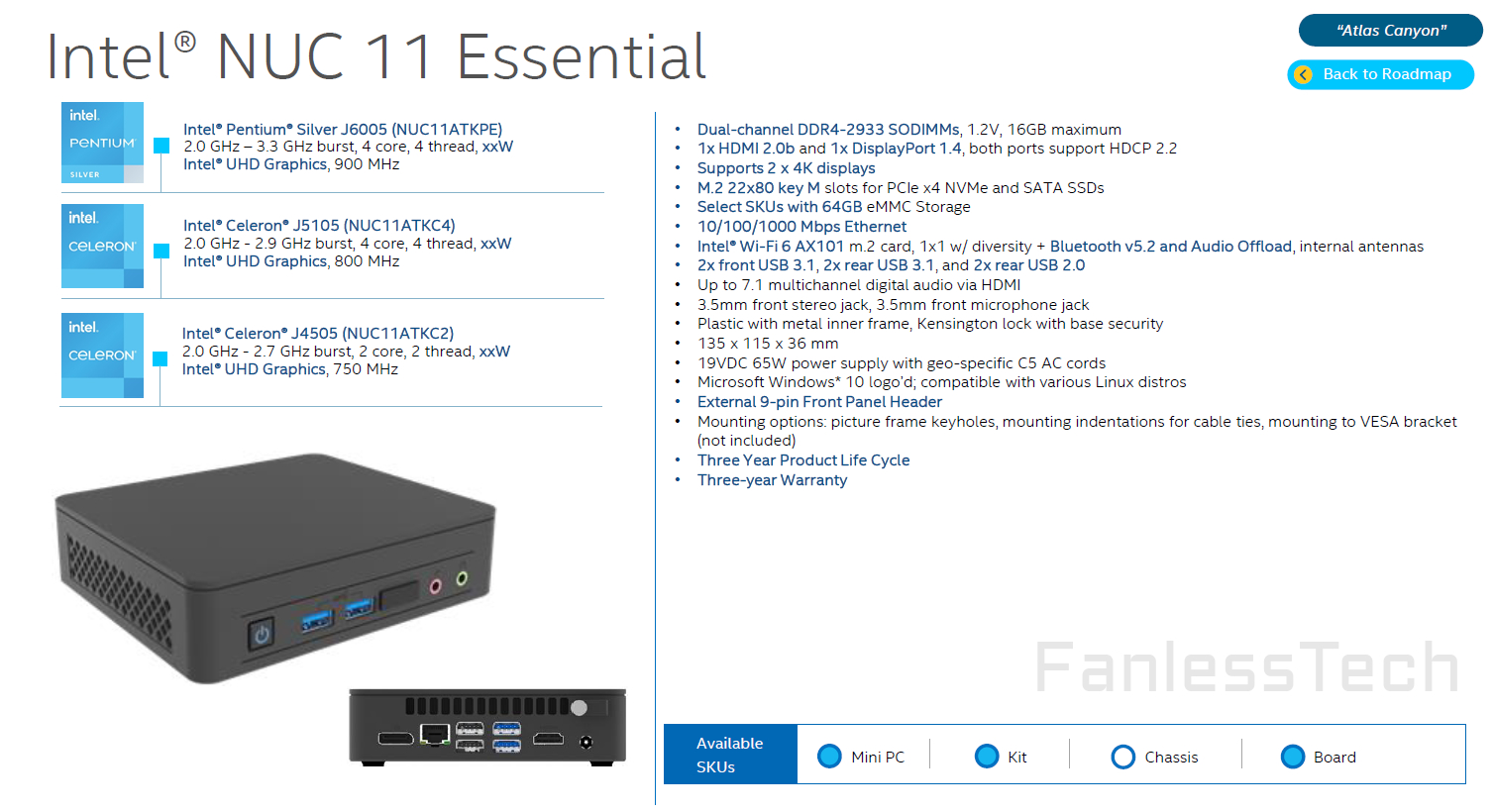
Image credit: FanlessTech
Featuring a vast set of connectivity ports and features, the NUC 11 Essential supports Wi-Fi 6, Bluetooth 5.2, and 1Gbps Ethernet connectivity. As for the ports, there's an HDMI 2.0b port, a DisplayPort 1.4, 2x front USB-A 3.1 ports, 2x rear USB-A 3.1 ports, 2x rear USB-A 2.0 ports, an audio-in 3.5mm jack, and an audio-out 3.5mm jack.
The NUC 11 Essential will be reportedly available as a mini PC, a barebone kit, and as a board only. All should feature a 3-year warranty.
Discuss on our Facebook page, HERE.
KitGuru says: Despite its entry-level specs, the NUC 11 Essential is very useful as a media PC for the living room or as a work computer that can be mounted on the back of a mid-size monitor to save some desk space.