KitGuru KitGuru.net – Tech News | Hardware News | Hardware Reviews | IOS | Mobile | Gaming | Graphics Cards


Supermicro has launched a new X12 generation 4-socket SuperServer designed to accommodate the new 3rd Gen Intel Xeon Scalable Processors. The new SuperServer is capable of supporting “four 3rd Gen Intel Xeon Scalable Processors, up to 18TB of System Memory Capacity, 24 Hot-swap NVM-e drives, and Enhanced Security”.
Last week, Intel announced its new 3rd Gen Xeon Scalable processors and now Supermicro has announced a new X12 generation 4-socket server that is designed for the new series. The server features support for 100Gb/s networking together with “OCP3.0 compliant Advanced IO Module form-factor” as well as Root-of-Trust (RoT) implementation which enhances security.
The server is capable of handling up to a total of 112 Xeon cores with its 4 CPU sockets, while the server interconnects have been doubled from 3 UPI lanes to 6 UPI lanes to improve system latency and throughput. Supermicro's SuperServer also supports up to ten PCI-E expansions or six single-width GPU cards and 2000-watt high-efficiency power supplies, as well as four swappable fans.
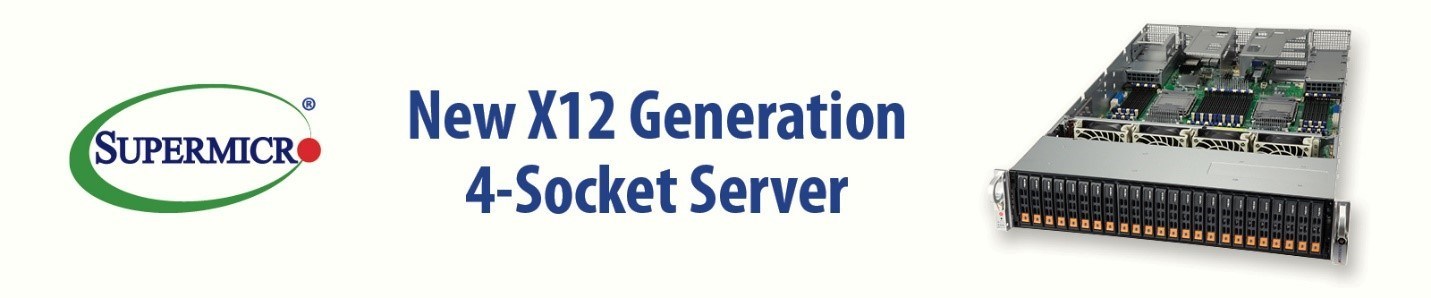
Image credit: SuperMicro
“As Supermicro’s first X12 generation system, this new 4-socket server is our most robust enterprise-class platform featuring the most powerful Intel Xeon Scalable Processors, Intel Optane DC Persistent Memory, and a new silicon based Root-of-Trust implementation for enhanced security” said Charles Liang, CEO and president of Supermicro. “This new SuperServer provides a powerful and trusted foundation for your most secure and mission critical workloads in enterprise, cloud-scale, or hybrid environments.”
Pricing and availability details for the SuperServer have yet to be announced. The official press release from Supermicro can be read HERE.
Discuss on our Facebook page HERE.
KitGuru says: What are your thoughts on the new X12 generation 4-socket server from Supermicro?