 KitGuru KitGuru.net – Tech News | Hardware News | Hardware Reviews | IOS | Mobile | Gaming | Graphics Cards


All leading makers of mainboards recently introduced motherboards that support 10Gb/s USB 3.1, but only a few of these platforms actually feature the new reversible USB type-C connectors. Notebook manufacturers appear to be even more conservative and except Apple’s new MacBook, no laptop uses the new interconnection tech. Nonetheless, this is going to change.
Asustek Computer is working on a new gaming notebook that will feature, among other things, the new USB 3.1 type-C reversible connector, reports DigiTimes web-site. The new notebooks are projected to hit the market in the second half of this year, but it is unclear whether the PCs will be powered by Intel’s upcoming “Skylake” processors or will use currently available hardware.
Dell also plans to release a new version of its 11” Venue Pro tablet in September or October. One of the key innovations of the device are projected to be Windows 10 operating system as well as USB type-C connector.
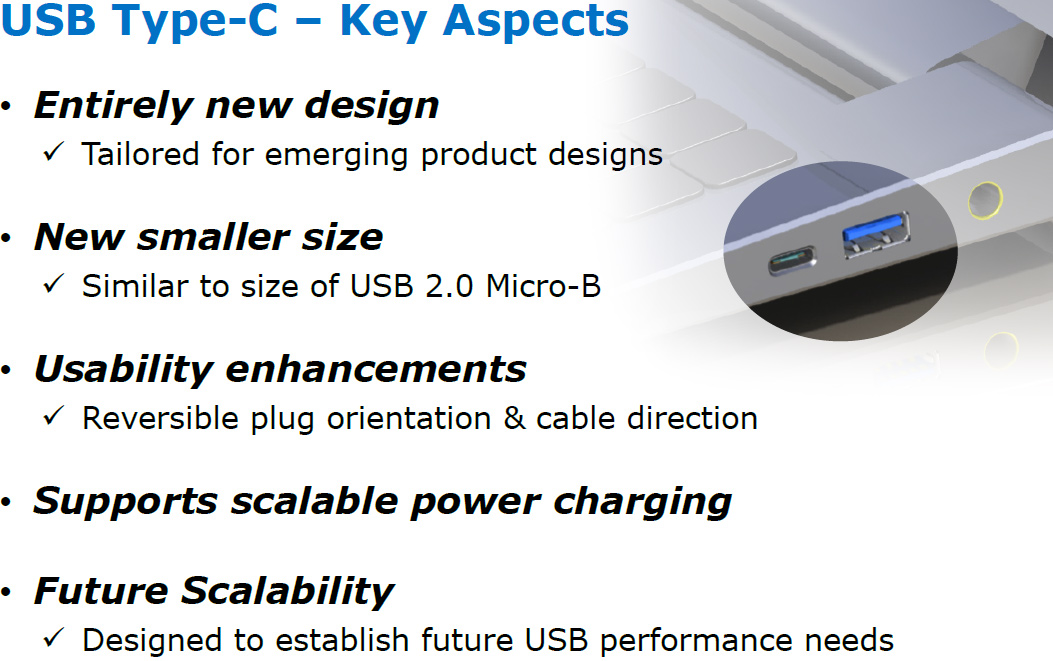
At present it is unclear why makers of mobile PCs do not embrace the new USB type-C connectors. Potentially, the new interconnection technology could be a significant selling point of notebooks. Perhaps, some makers want to add USB 3.1 type-C to platforms that are based on the upcoming Intel “Skylake” microprocessors as well as Microsoft's Windows 10 operating system.
Asustek and Dell did not comment on the news-story.
Discuss on our Facebook page, HERE.
KitGuru Says: Since makers of peripherals are not releasing new devices with USB type-C connectors, PC makers will naturally lack enthusiasm about the new technology as well. Still, keeping in mind all the advantages that the USB 3.1 type-C has, it is sad to see that the industry is adopting it so slowly.

The Macbook is not the only current laptop to support USB type-C. There are two USB 3.1 Type C ports on the Google Chromebook Pixel (2015). Nonetheless, it will be good to see these ports available on more devices.