KitGuru KitGuru.net – Tech News | Hardware News | Hardware Reviews | IOS | Mobile | Gaming | Graphics Cards


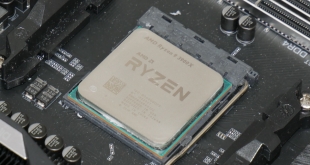
AMD has launched its Zen 2 architecture in the form of the Ryzen 3000 processors. Slotting directly into the now well-established AM4 platform, AMD is leveraging the improvements brought about by TSMC’s 7nm FinFET process technology, in addition to its own process design work and architectural improvements compared to Zen and Zen+.
We’ll be focussing on two CPUs today – the twelve-core, 24-thread Ryzen 9 3900X which is priced at £480 and designed to compete with Intel’s Core i9-9900K. The other contender is AMD’s Ryzen 7 3700X – an eight-core, 16-thread CPU that sports a 65W TDP and £320 asking price that positions it firmly against the Core i7-9700K.
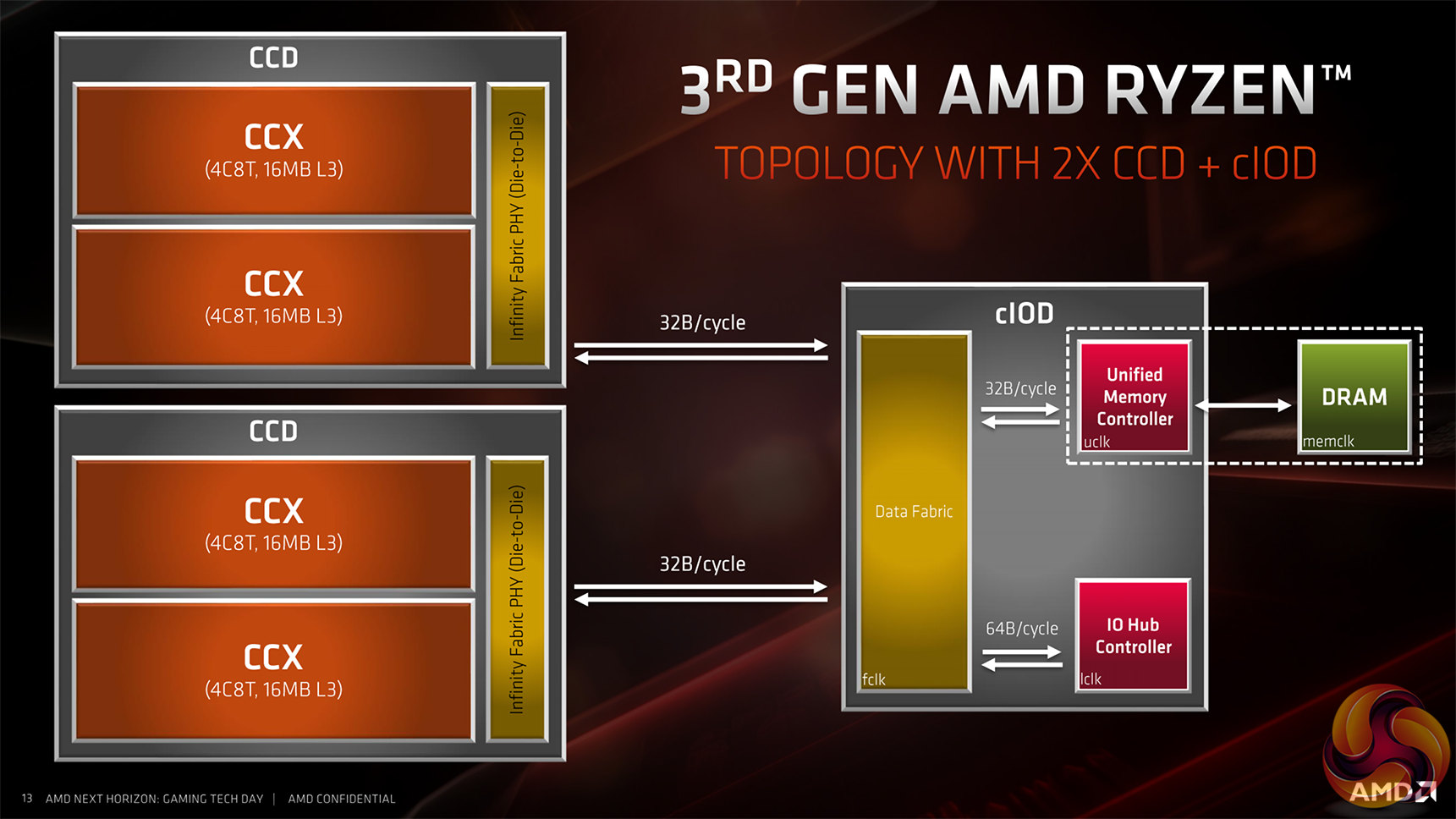
Ryzen 3000 is fabbed on TSMC’s 7nm FinFET process technology, putting AMD in an interesting position where it now has a clear process technology advantage over Intel whose Coffee Lake products use the company’s 14nm++ node. That’s not the whole story though, as the Ryzen 3000 CPUs are made from segregated chiplets that are split as cores and cache in a CCD, which combines two CCXs, and an IO chiplet that handles less-performance-sensitive operations such as memory control and IO management. The 74mm2, 3.9 Billion transistor CCD chiplets – one in the case of eight-cores and below and two for the 12 and 16 core parts – connect to the 125mm2, 2.09 billion transistor IO chiplet via AMD’s Infinity Fabric.
Importantly, this approach allows AMD to produce the less-performance-sensitive IO chiplet using a (presumably cheaper) and more battle-tested 12nm process node, while the critical cores and cache leverage the performance enhancement and power reduction opportunities from TSMC's comparatively immature 7nm process. Another advantage is that this approach allows AMD and TSMC to manufacture physically smaller chips than a comparable monolithic part would require, thus inherently increasing yields and therefore reducing consumer pricing by driving down dead costs via failed chips.
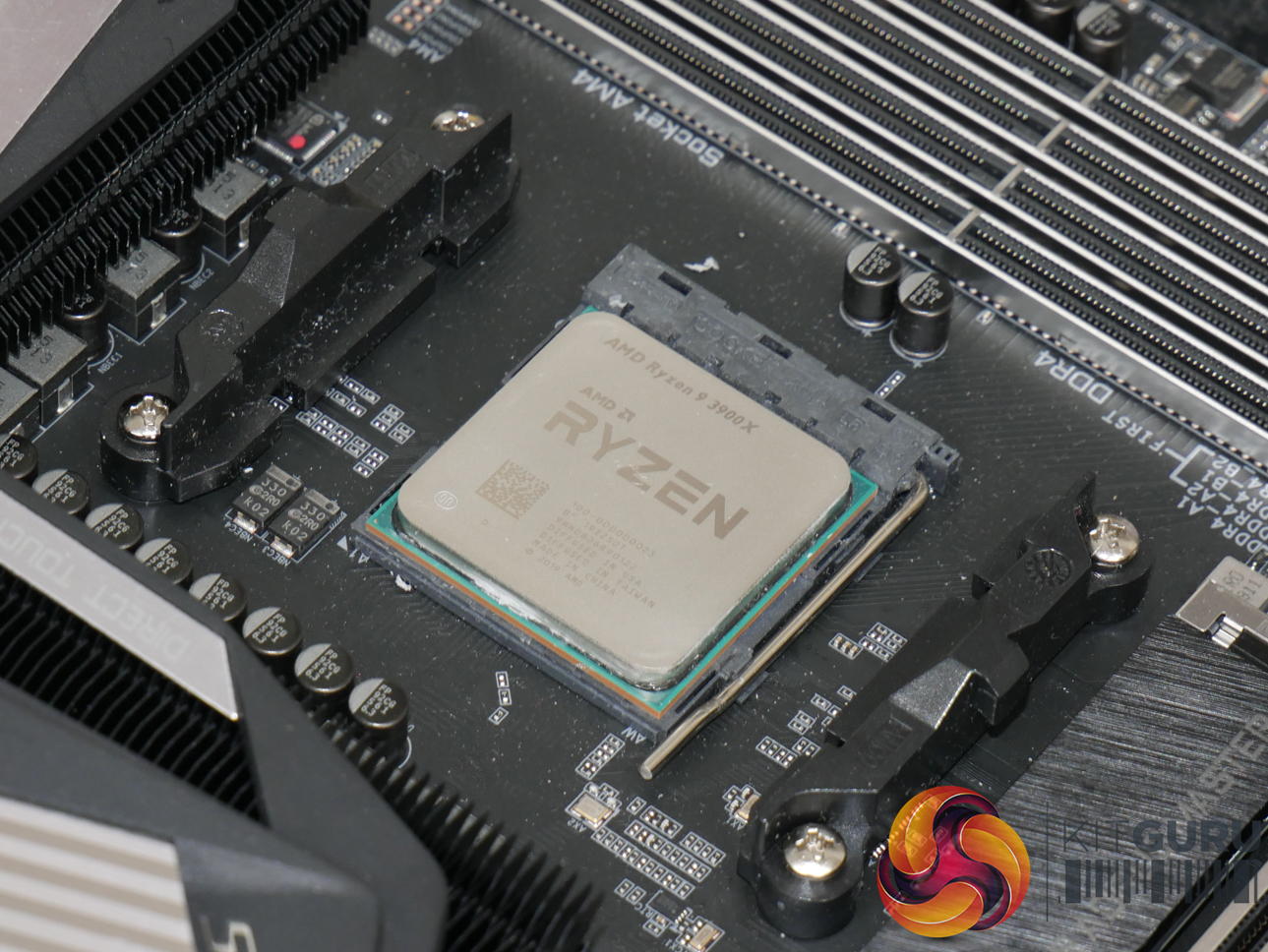
One of the key architectural improvements for Zen 2 is the application of double the L3 cache compared to Zen and Zen+. Now, each CCX gets 16MB of L3 cache and AMD is keen to highlight that this should help gaming performance by terming the CPU’s total cache amount as GameCache. Another of those Zen 2 improvements is single-op AVX-256 support which should significantly improve performance in heavy AVX workloads compared to Zen and Zen+.
Also worth mention, given the current CPU climate, is that AMD has outlined that Ryzen 3000 has the relevant security mitigations in hardware for the likes of Spectre.
| CPU | AMD Ryzen 9 3900X |
AMD Ryzen 7 3700X |
AMD Ryzen 7 2700X | AMD Ryzen 7 1800X | Intel Core i9 9900K | Intel Core i7 9700K |
| CPU Architecture | Zen 2 | Zen 2 | Zen+ | Zen | Coffee Lake | Coffee Lake |
| CPU Socket | AM4 | AM4 | AM4 | AM4 | LGA 1151 rev. 2 | LGA 1151 rev. 2 |
| Core / Threads |
12 / 24 | 8 / 16 | 8 / 16 | 8 / 16 | 8 / 16 | 8 / 8 |
| Base Frequency | 3.8GHz | 3.6GHz | 3.7GHz | 3.6GHz | 3.6GHz | 3.6GHz |
| All-Core Frequency | Up to 4.6GHz | Up to 4.4GHz | Up to 4.3GHz | Typically 3.7GHz | 4.7GHz | 4.6GHz |
| Boost Frequency | Up to 4.6GHz | Up to 4.4GHz | Up to 4.3GHz | 4.0GHz | 5.0 GHz | 4.9GHz |
| Unlocked Core Multiplier | Yes (x0.25 granularity) | Yes (x0.25 granularity) | Yes (x0.25 granularity) | Yes (x0.25 granularity) | Yes (x1 granularity) | Yes (x1 granularity) |
| L3 Cache | 64MB | 32MB | 16MB | 16MB | 16MB | 12MB |
| Max. Memory Channels |
2 (DDR4) | 2 (DDR4) | 2 (DDR4) | 2 (DDR4) | 2 (DDR4) | 2 (DDR4) |
| Max. Memory Frequency (Native) |
2667 to 3200MHz | 2667 to 3200MHz | 1866 to 2933MHz | 1866 to 2667MHz | 2666MHz | 2666MHz |
| CPU PCIe Lanes | 16+4+4 PCIe Gen 4 | 16+4+4 PCIe Gen 4 | 16+4+4 PCIe Gen 3 | 16+4+4 PCIe Gen 3 | 16 PCIe Gen 3 | 16 PCIe Gen 3 |
| Manufacturing Process | 7nm | 7nm | 12nm | 14nm | 14nm++ | 14nm++ |
| TDP | 105W | 65W | 105W | 95W | 95W | 95W |
| MSRP | $499 | $329 | $329 | $499 | $488-499 | $374-385 |
| UK Street Price (July 2019) | £480 | £320 | £260 | Approx. £225 | Approx. £485 | Approx. £380 |
Focusing on the Ryzen 9 3900X, this £480 processor leverages twelve cores and 24 threads split across four CCXs on two CCDs. The maximum boost frequency is quoted as 4.6GHz with the base clock set at 3.8GHz. Despite offering higher frequencies versus Zen+ and increasing the amount of cache to 70MB (6MB L2 and 64MB L3), AMD maintains a 105W TDP that looks highly impressive next to Intel’s competitors, as well as AMD's own.
Switching focus to the Ryzen 7 3700X, the £320 chip offers eight cores and sixteen threads split across two fully-configured CCXs on a single full CCD. Maximum boost frequency is quoted as 4.4GHz, with the base clock set at 3.6GHz. TDP of this part is 65W which is aggressive given its market position that places it against Intel’s Core i7-9700K. The 3700X has 36MB of total cache split as 4MB for L2 (512KB per core) and 32MB of L3 (16MB per CCX).
One interesting comparison between eight- and twelve-core Ryzen 3000 parts is the CCX/CCD configuration. It would be reasonable to imply that the fully-functional, single-CCD eight-core chips are technically superior silicon to the six-core (eight minus two) CCDs used for the twelve core part. We presented this logic to AMD at their tech day in Los Angeles and were quickly corrected on this thought process.
AMD's staff were keen to highlight that ‘superior‘ silicon can mean many things. In this case, it looks like the binning process is primarily driven by positioning on the voltage-frequency and frequency-temperature curves, hence the twelve-core chip's ability to run at faster clock speeds. So it's not necessarily a case of two cores being bad, per se. It is, perhaps, more of a case of two cores per CCD being less efficient at higher frequencies than their neighbours.
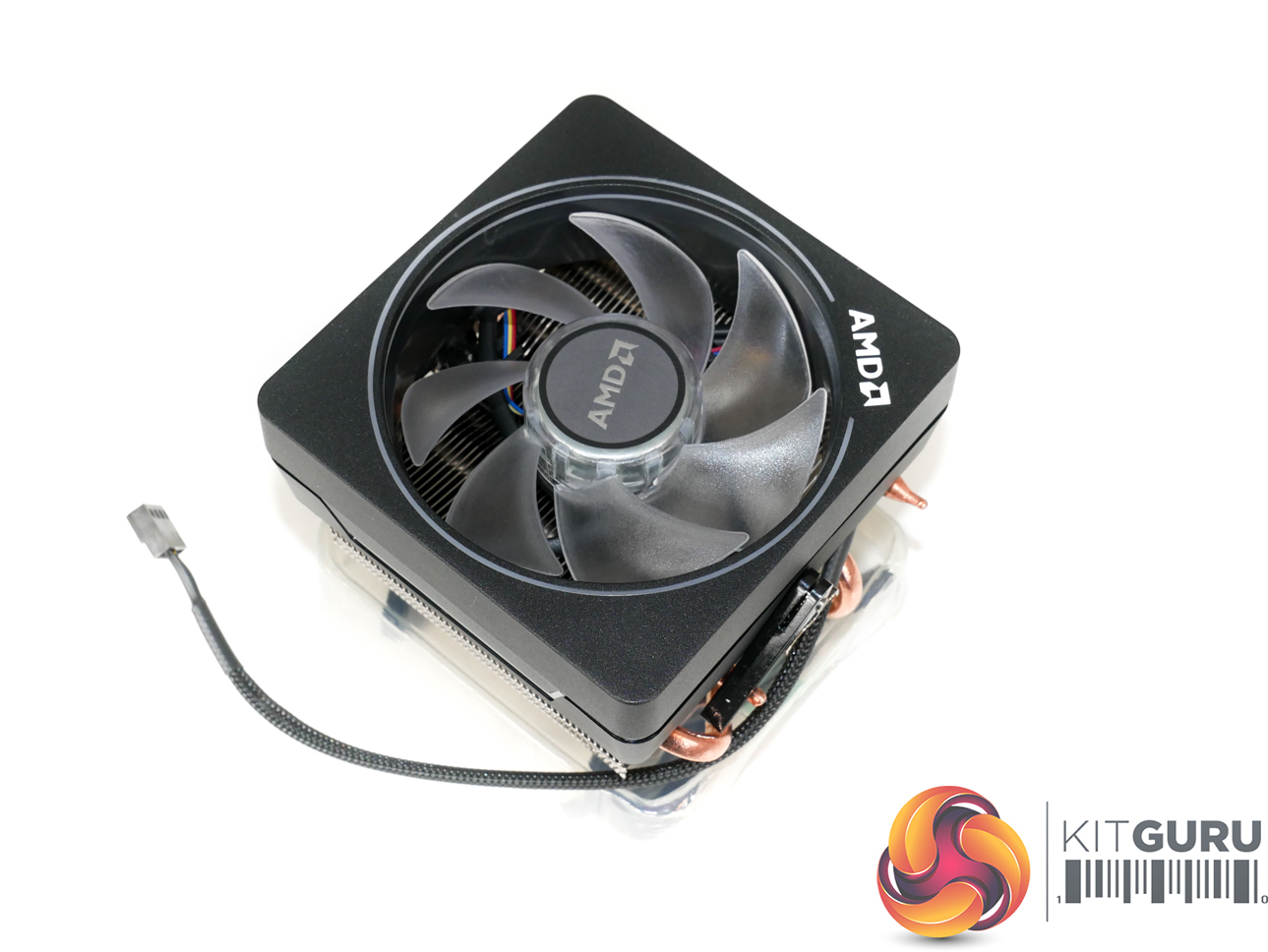
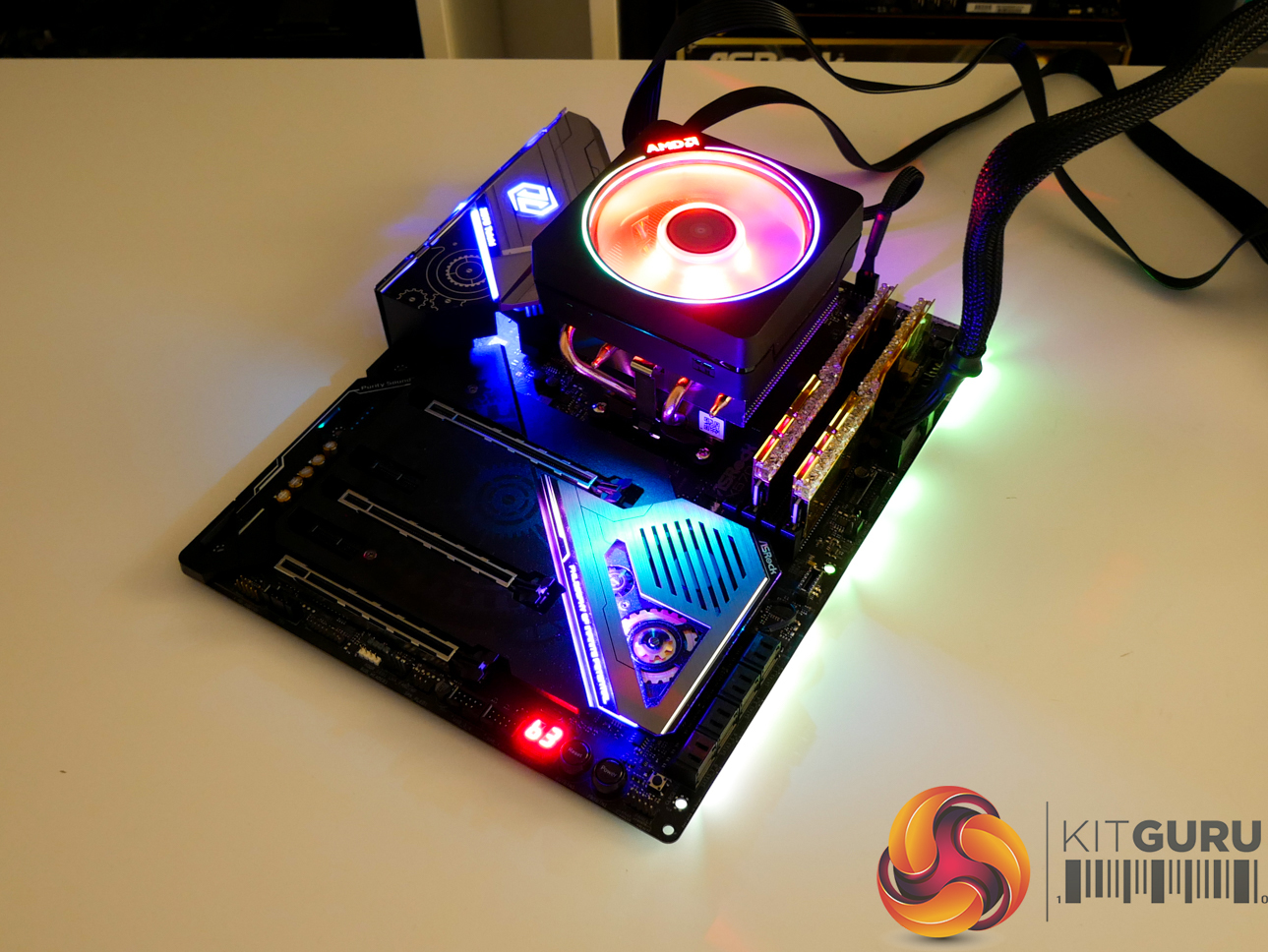
Both CPUs ship with the Wraith Prism RGB CPU cooler. While this is an undeniable value-add for the £320, 65W Ryzen 7 3700X, I'd wager that it'll be a fancy paperweight to many enthusiasts buying the Ryzen 9 3900X. I'd personally prefer another £20 knocked off the Ryzen 9 3900X and no cooler in the package, though I guess the economics of scale are against me on that one. The RGB LED lighting looks superb and software control and synchronisation is available.
AMD keeps its promise of supporting AM4 as a usable, worthwhile platform with the launch of Zen 2-based Ryzen 3000 CPUs. All of the AM4 chips will slot into existing motherboards, though that's not to say that they will necessarily work well or be officially supported. Support with older chipsets, such as B350 and X370, is primarily driven by the motherboard vendor's plans. X470 and B450 support looks to be more widespread in general. Also important alongside a BIOS update is whether the board's VRMs are strong enough to handle a dozen Zen 2 cores.
For now, we’d recommend sticking with X570 if you’re buying the twelve core, though there are certainly higher-end X470 boards that will run the chip fine. We have yet to do extensive testing with older chipset boards using the Ryzen 9 3900X. I struggle to see any VRM or major performance problems if you decide to use the 65W 3700X with a good B450/X470 motherboard, provided BIOS support is available. Again though, we have not tested that scenario yet.
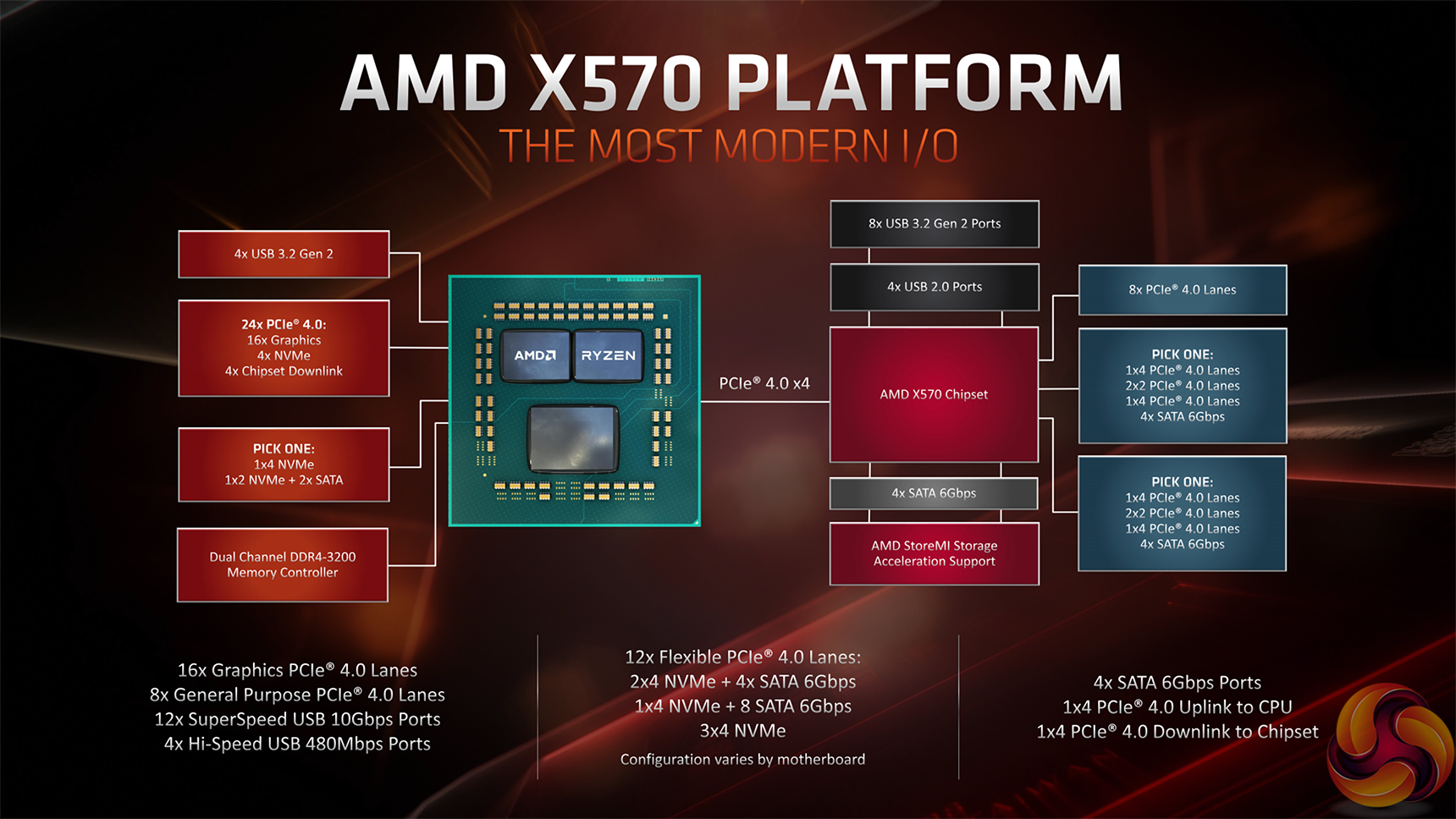
As with all Zen 2 processors on AM4, twenty-four PCI Gen 4 lanes are available as 16+4+4 allowing for sixteen lanes to a GPU, four lanes to an SSD, and then four lanes to connect to the chipset. The X570 chipset also offers PCIe Gen 4 compatibility, giving AMD a position of clear strength when it comes to capacity for high-bandwidth expansion devices. And as shown by the block diagram, expansion capacity is plentiful with X570 and Ryzen 3000.
Free PCIe Gen 4 lanes can be used to deliver 10GbE networking, high-speed RAID cards can hang off the chipset, and NVMe devices are very well catered for. AMD creates an interesting scenario whereby PCIe Gen 4 NVMe SSDs can be used without their data being forced through the bandwidth-limited chipset connection en route to the CPU.
This is a contrast to Intel's Z390 platform whereby data processed on a chipset-fed SSD must pass through the DMI link with Intel's CPU. That's fine for one high-speed PCIe Gen 4 drive but isn't so good when multiple SSDs are fighting for the DMI link's bandwidth.
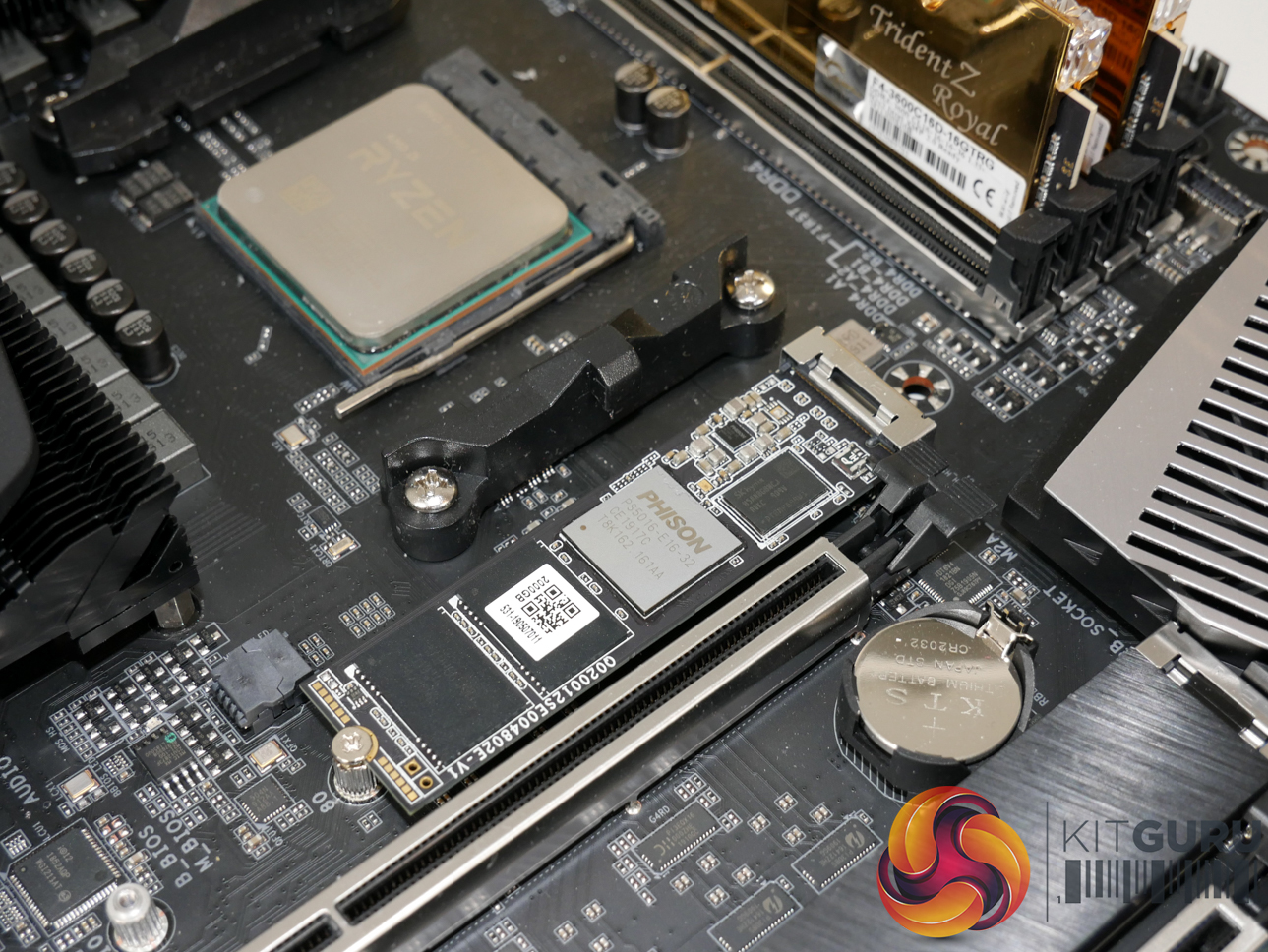
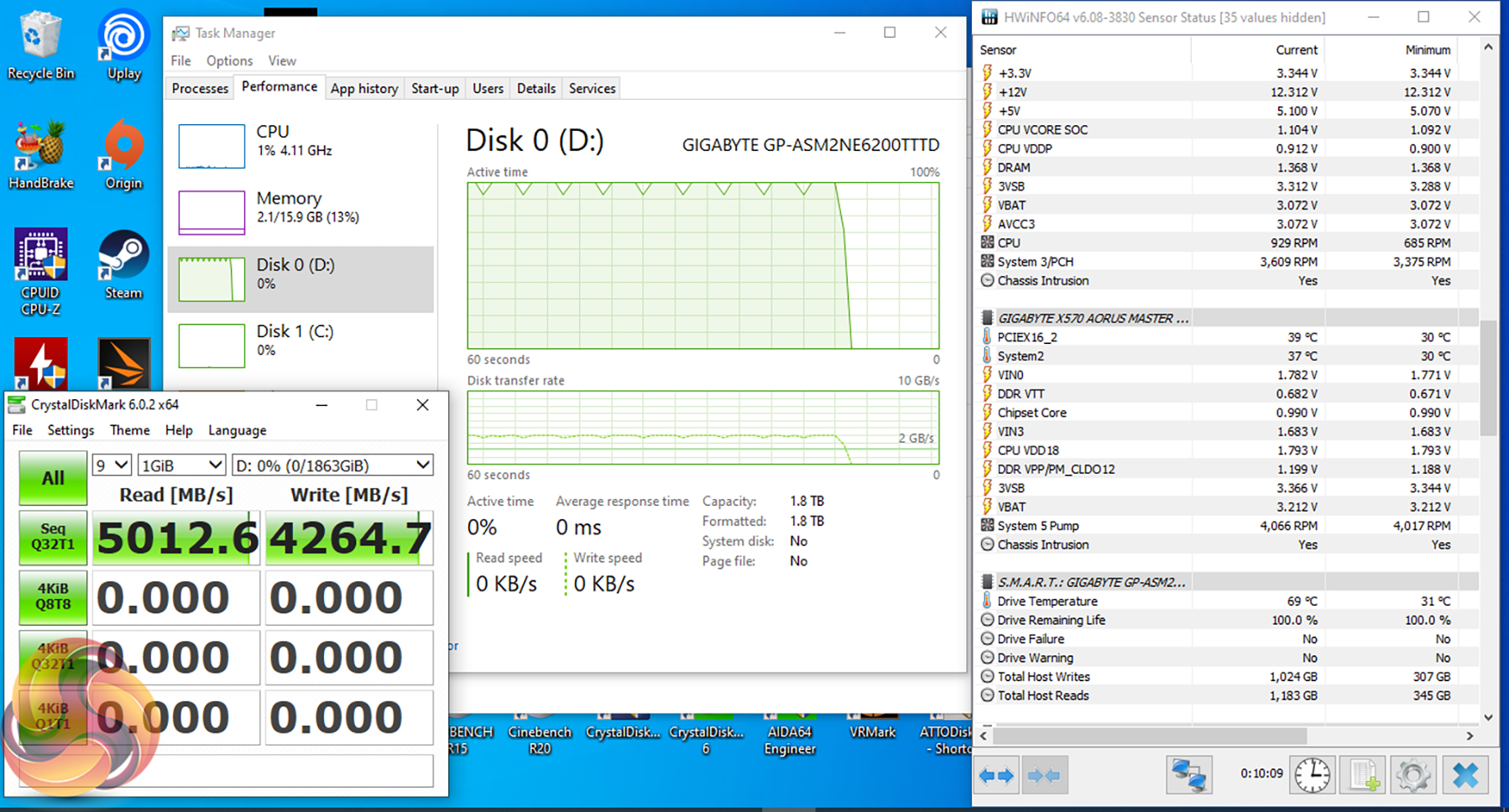
Storage performance is one of the biggest benefits of the X570 platform and its PCIe Gen 4 capability. We managed to push past 5GBps on the Gigabyte Aorus PCIe NVMe Gen 4 SSD.
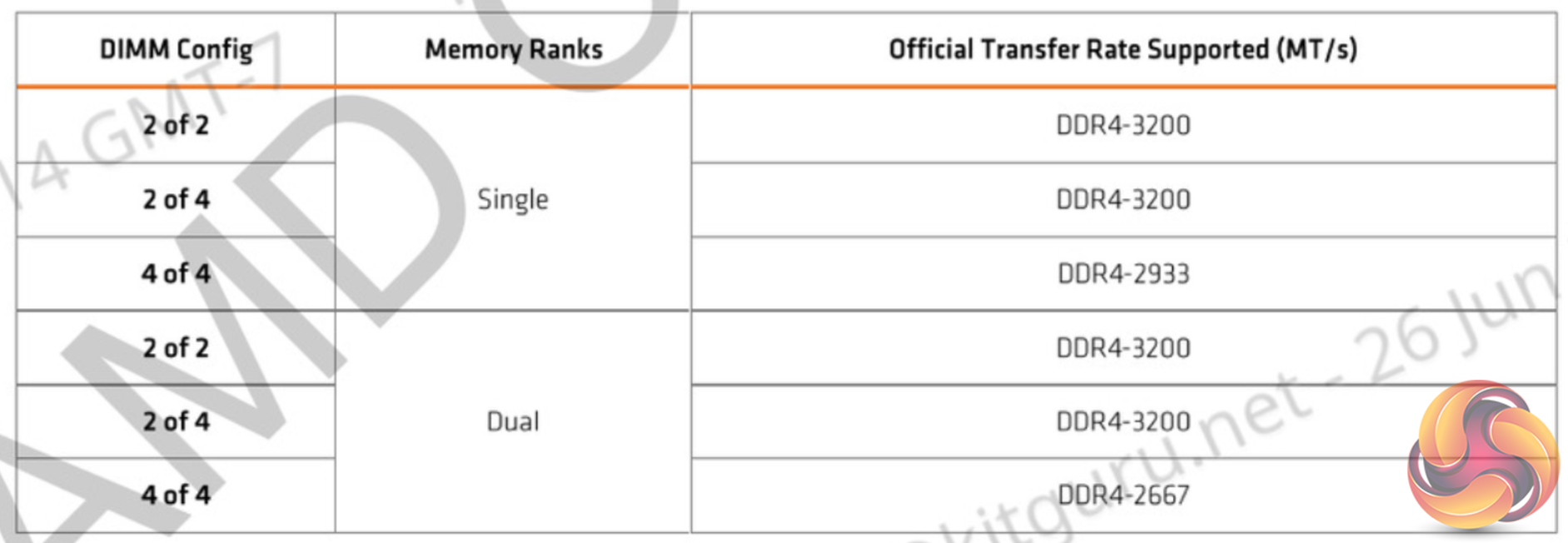
Memory support is improved with Zen 2 by way of a better integrated memory controller (IMC). AMD highlights DDR4 support up to 3200MHz, depending on DRAM configuration, out of the box. Motherboard vendors are keen to highlight support for 4000MHz+ DDR4 kits, though we’d recommend sticking to DDR4-3600MHz as a maximum to avoid triggering a reduction in the memory controller clock speed that will impart higher latency (and poorer performance) into one’s system.
The memory controller and Infinity Fabric clock speeds cannot pass 1800MHz in their auto configuration. As such, when 3600MHz DDR4 RAM is installed, the DRAM frequency is 1800MHz, the memory controller frequency is 1800MHz, and the Infinity Fabric frequency is 1800MHz. Push beyond this to 3866MHz, and the DRAM clock now sits at 1933MHz but the Infinity Fabric does not push past 1800MHz. The memory controller, however, now operates on a 2:1 divider with the DRAM clock, rather than 1:1 previously. This forces its speed to halve.
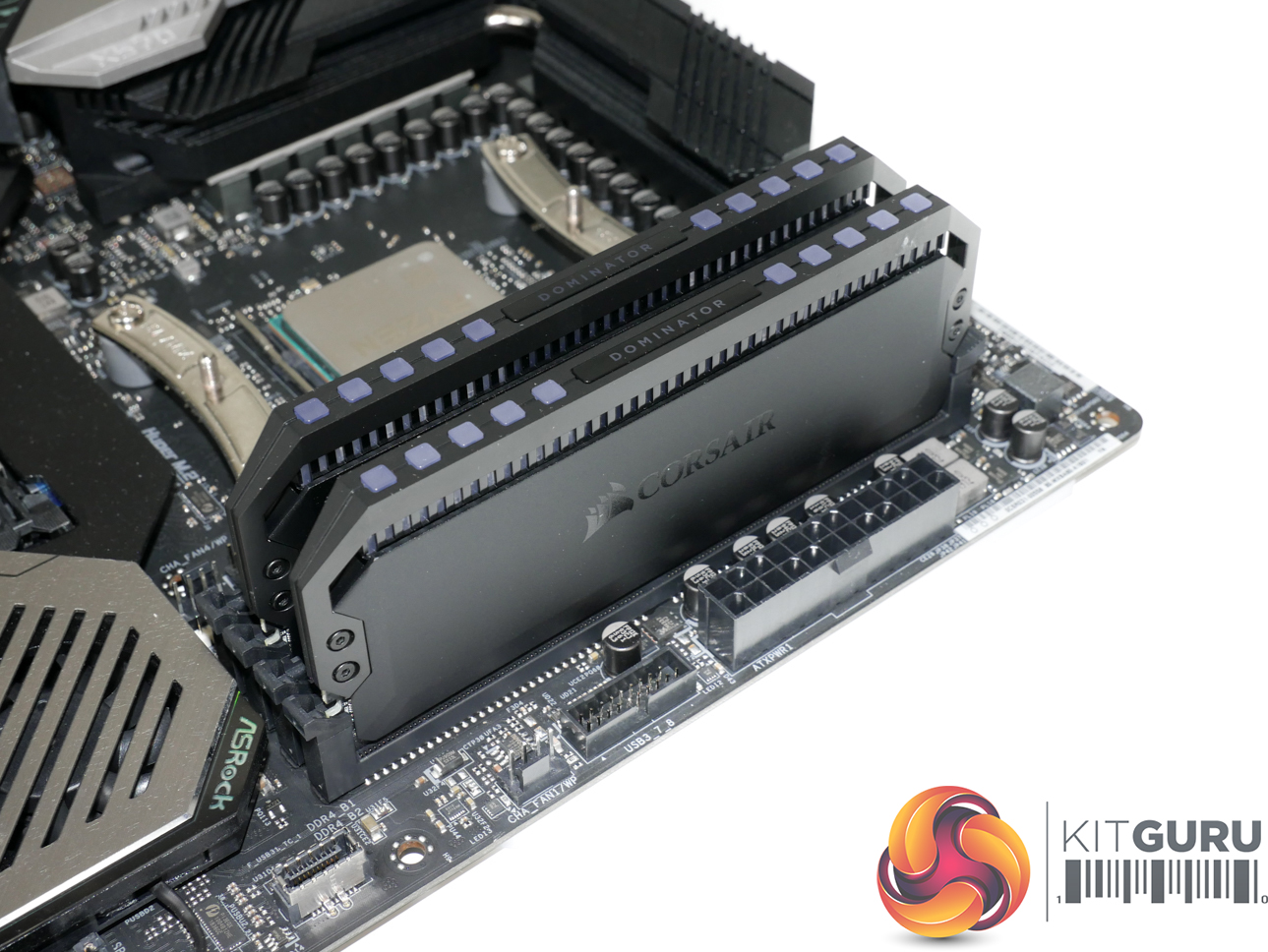
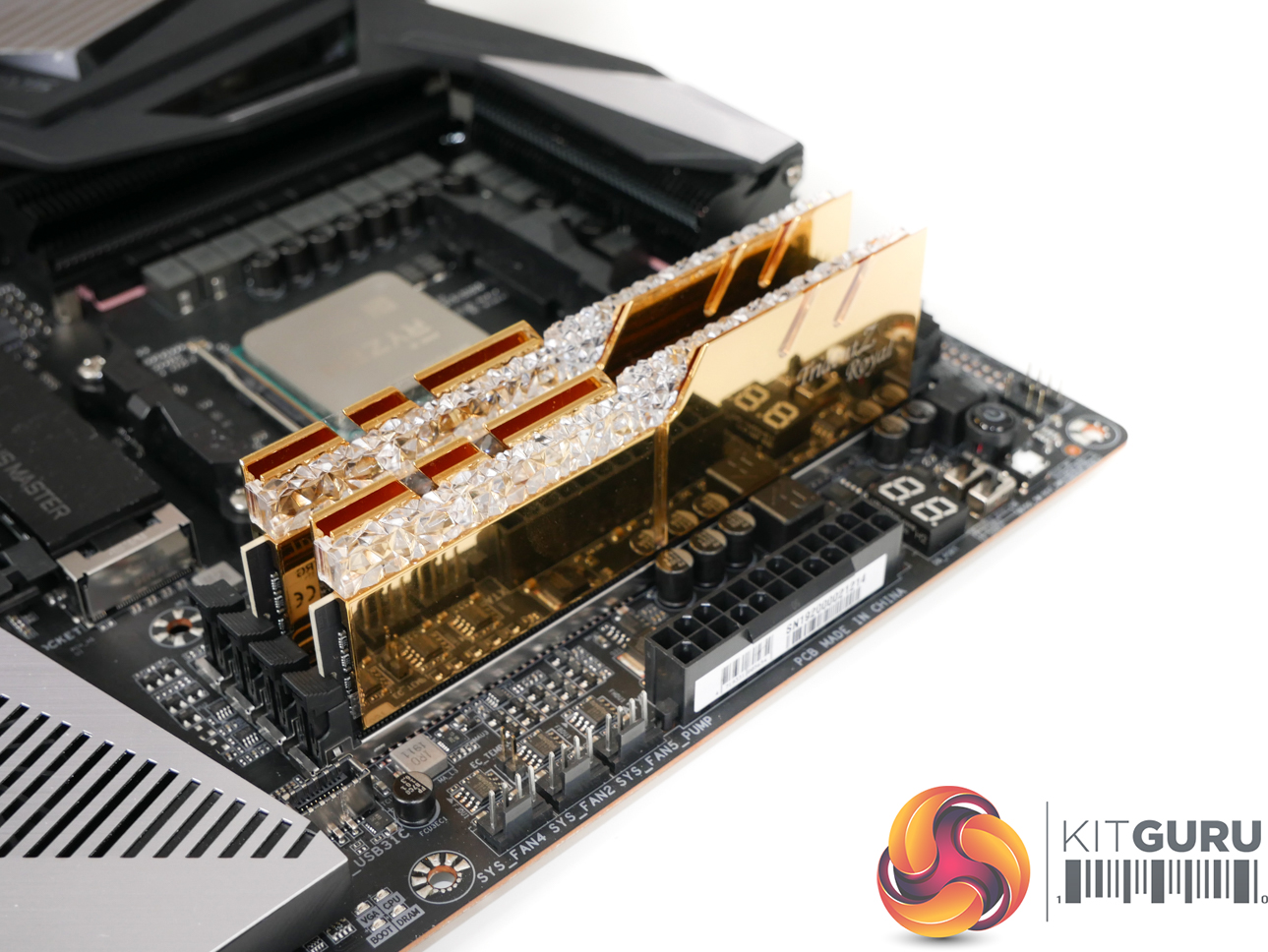
That's why we recommend sticking to 3600MHz at this point, until further testing has been done to highlight the impact of the slower memory controller frequency. AMD's own testing suggests that the switch forces a latency penalty as the memory controller is simply operating at a lower clock speed.
Our objective with CPU overclocking is to hit frequencies that we think will be achievable for daily use by the platform’s buyers. As such, we test with sensible cooling hardware in the 240mm Corsair H100X, be quiet! Dark Rock Pro 4, and Noctua NH-D15. We also used sensible voltages that lead to manageable thermal results.
Stability is confirmed by running multiple Cinebench tests, Handbrake video conversion, and AIDA64 CPU, FPU, and Cache stress test for at least 1 hour. We do not use Prime95 as we have found it to be overly demanding as a stress test application with the more recent AVX-capable versions.
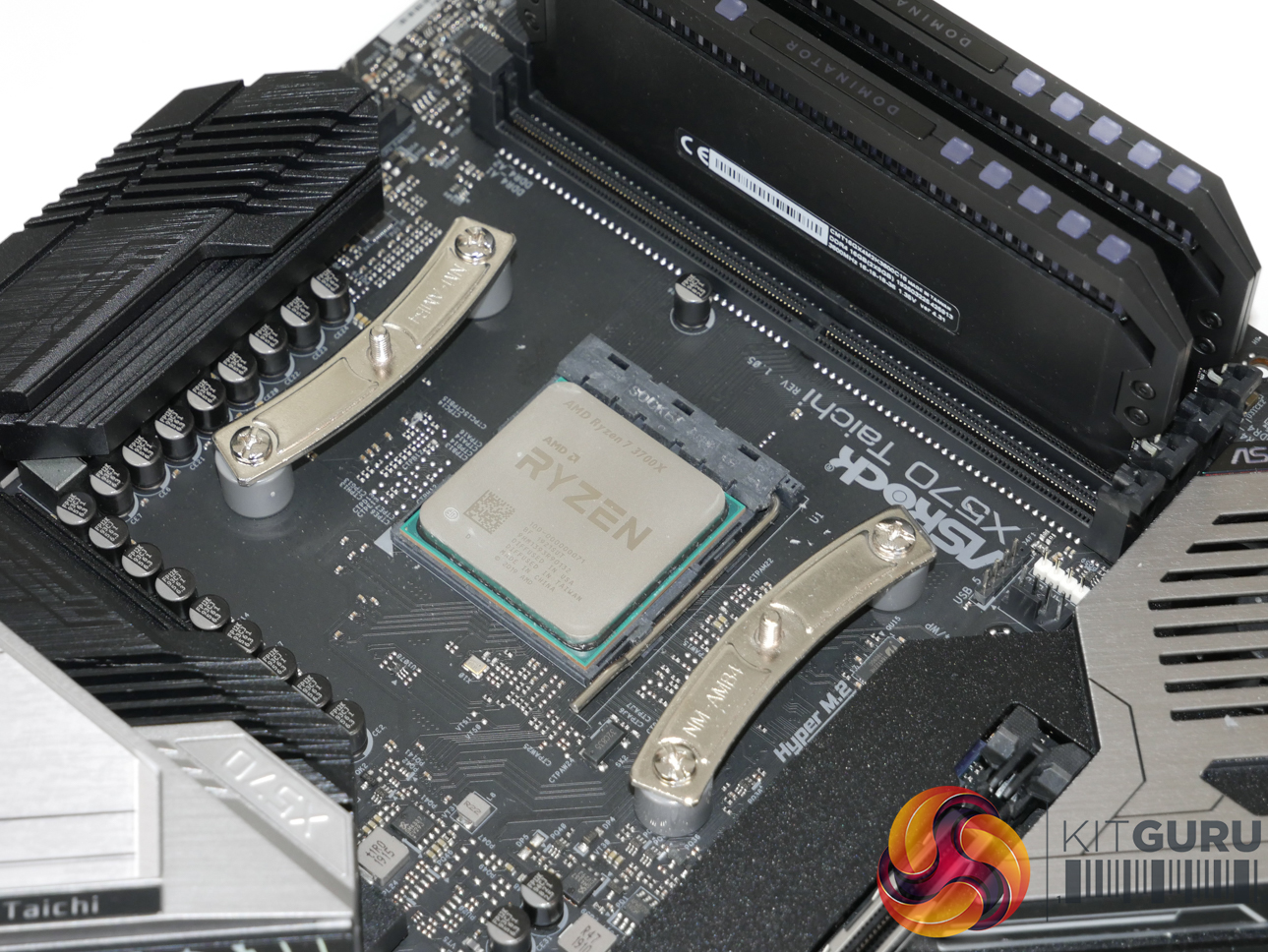
The partnering hardware of choice are the Gigabyte X570 Aorus Master and ASRock X570 Taichi motherboards, 16GB of 3200MHz CL14 DDR4, and a Seasonic Prime 1000W Titanium PSU.
Ryzen 9 3900X Frequencies:
We saw the 3900X generally hovering around 4000-4100MHz during stock-clocked testing.
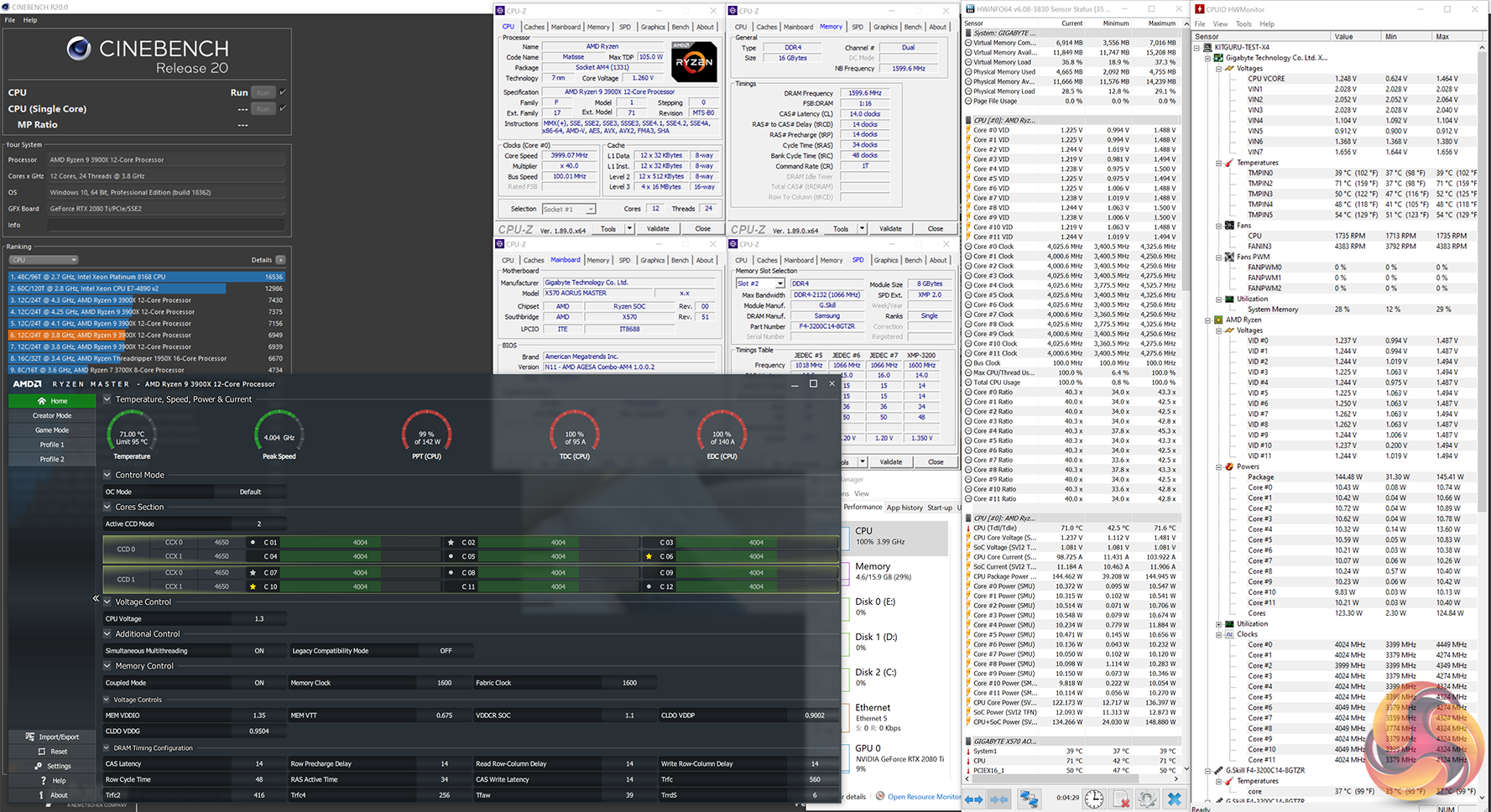
Auto overclocking was a little boring to be honest. Precision Boost 2 allows the CPU to extract most of its performance automatically, leaving little left for manual tinkerers to obtain.
Precision Boost Overdrive (PBO) automatic overclocking gave us an extra 100-or-so MHz for short duration loads, allowing the 3900X to sit closer to 4150 or 4175MHz before the extended stress forced its frequency down. There’s another option that tries to force a frequency offset of up to 200MHz on top of PBO, but we didn’t have any real luck with this.
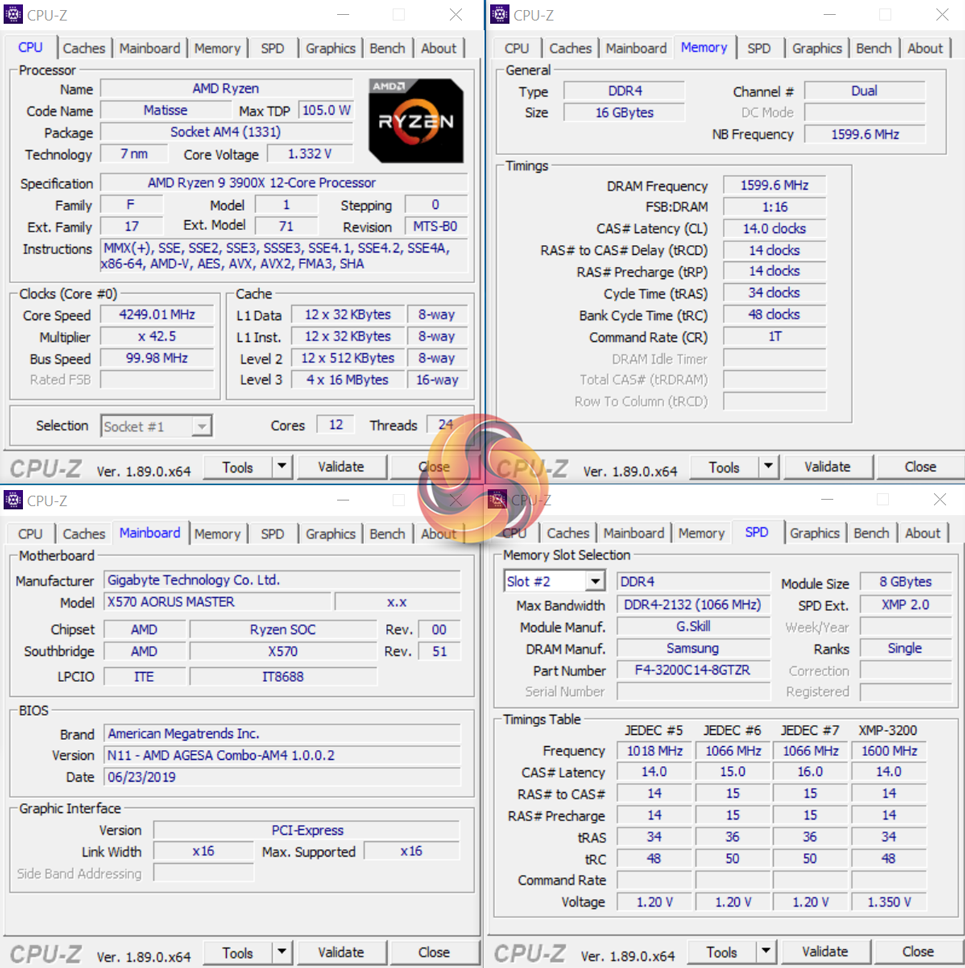
Overclocking with 1.4V pushed the Ryzen 9 3900X very close to the throttling point with our Corsair H100X AIO. 4250MHz was the highest stable frequency that we could manage. 4300MHz was bootable and held Windows stability, however, Cinebench and Blender tests would throw up unusual errors.
We settled for 4.25GHz all-core frequency and were able to back the voltage down a little to 1.35-1.375V while still maintaining stability.
Ryzen 7 3700X Frequencies:
The Ryzen 7 3700X generally operated at around 3950-4050MHz, though there were scenarios where the chip would maintain 4.1GHz all-core for extended periods.
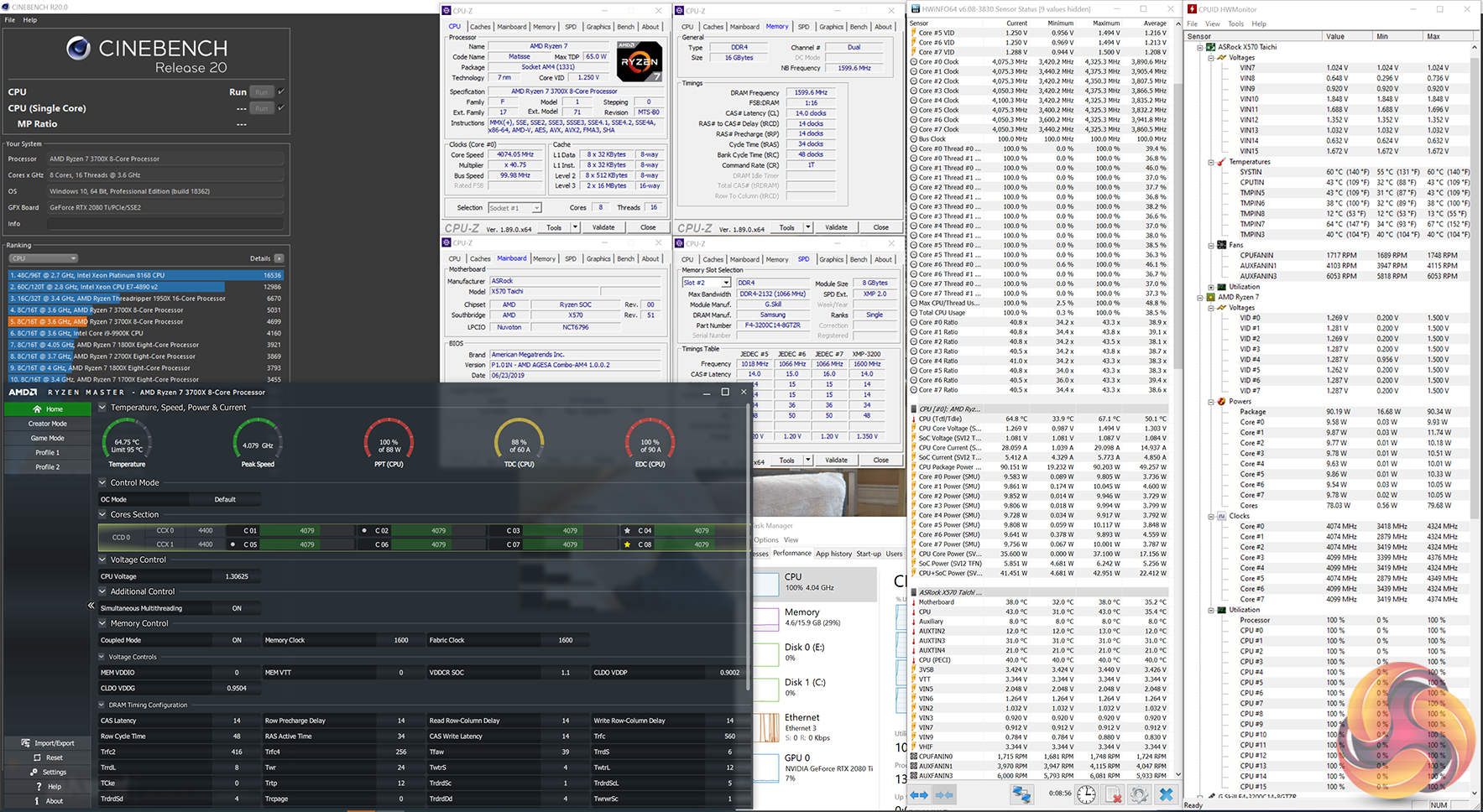
Auto overclocking using PBO was very similar to the experience with the 12-core part. We managed to squeeze around an extra 100MHz maximum performance, though this number reduced once sustained load was applied and the chip hovered around 4125MHz on all cores.
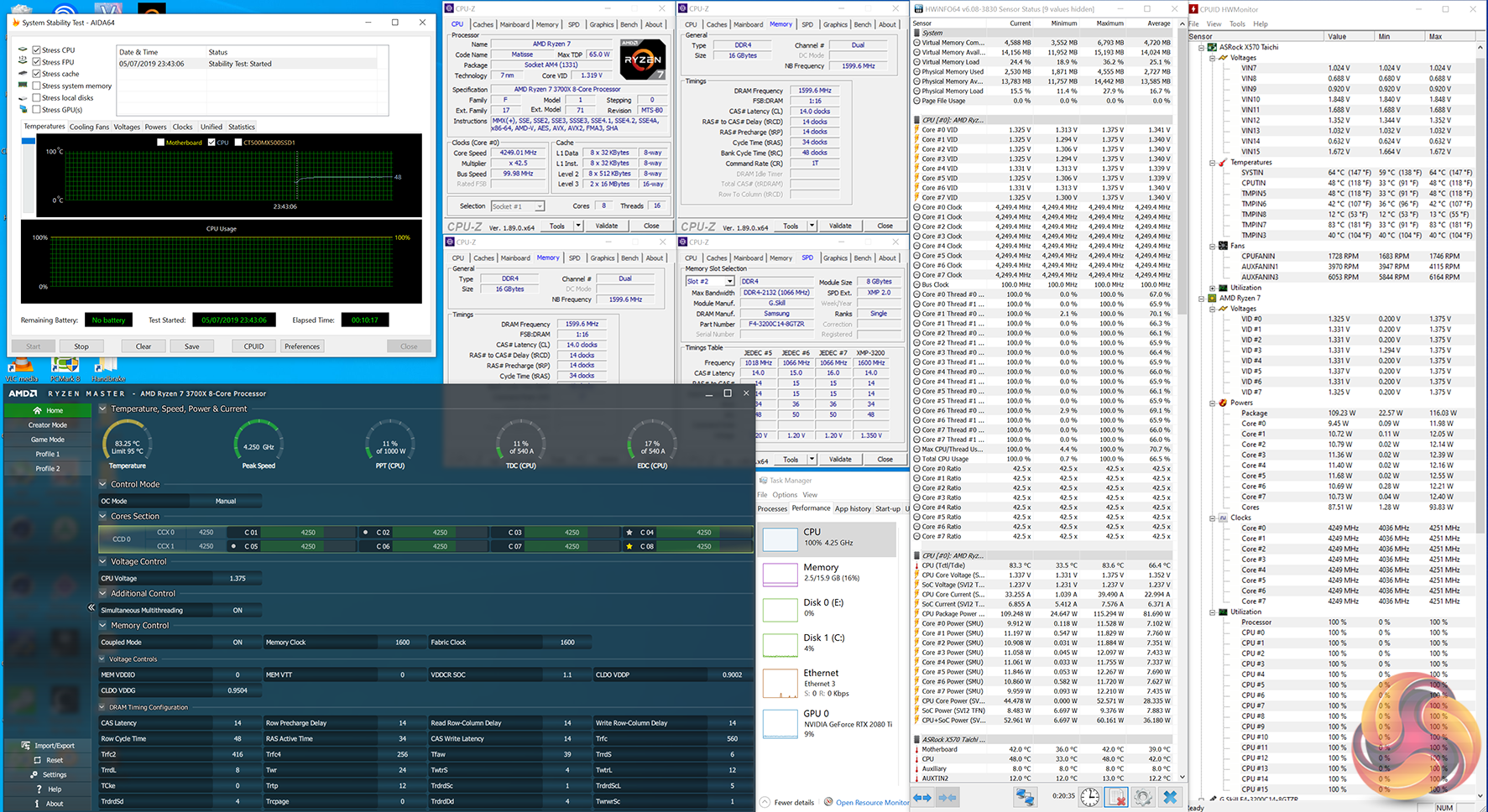
Our manual overclocking experience was practically identical to that of the 3900X, though this time we were less thermally limited. 1.4V delivered 4.3GHz with the same unusual behaviour, while 4.25GHz allowed for complete stability. We managed to decrease the voltage further while maintaining stability.
1.35-1.375V is likely to be perfectly adequate for a 4.25GHz all-core speed on the Ryzen 7 3700X, based on our testing.
Overclocking comments:
4.25GHz at 1.4V on a 12-core chip is a decent result given AMD’s application of the new 7nm process technology. However, many people will be hoping to push further. One way of looking at this is, as with Ryzen 2000, AMD gives you most of the CPU performance by default out of the box, so you don’t really have much room to push the chip further.
Personally, I’d be inclined to enjoy the PB2 benefits of the chips at their stock clocks and settle for around 100-150MHz lower all-core frequency.
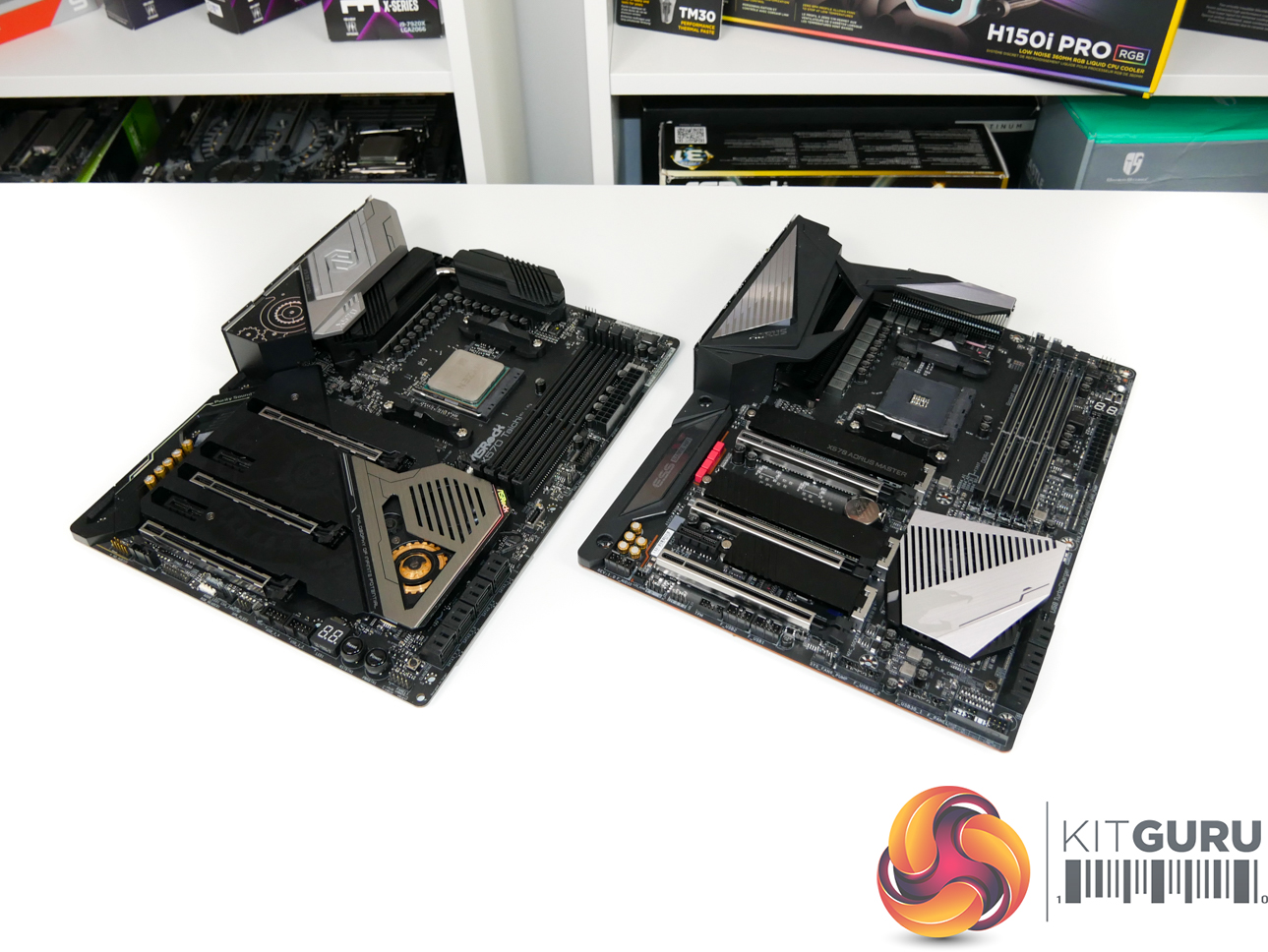
We will be outlining the Ryzen 3000 CPUs' performance while using ASRock X570 Taichi and Gigabyte X570 Aorus Master Socket AM4 X570 motherboards. A 16GB (2x8GB) kit of 3200MHz CL14 DDR4 memory serves our test system.
Today's comparison processors come in the form of:
- Skylake-X i9-7920X (12C24T).
- Coffee Lake i7-9700K (8C8T) and i9-9900K (8C16T).
- Pinnacle Ridge Ryzen 7 2700X (8C16T) and Ryzen 5 2600X (6C12T).
- Summit Ridge Ryzen 7 1800X (8C16T).
Each processor is tested at its default out-of-the-box settings. We also include reasonable overclocking performance data where relevant. For the Intel Coffee Lake CPUs, forced turbo is enabled by default when XMP is enabled and, in most scenarios, cannot be disabled. As such, we test using the forced turbo frequencies with the i9-9900K and i7-9700K. All-core load frequencies for the tested chips are as follows:
- Ryzen 9 3900X = 3.975-4.1GHz.
- Ryzen 7 3700X = 3.95-4.1GHz.
- Core i9-7920X = 3.8GHz (most of the time, with AVX workloads or synthetic stress tests dropping to 3.4GHz and below).
- Core i9-9900K = 4.7GHz.
- Core i7-9700K = 4.6GHz.
- Ryzen 7 2700X = Around 3.95GHz.
- Ryzen 5 2600X = Around 3.975-4.0GHz.
- Ryzen 7 1800X = 3.65GHz.
CPU Test System Common Components:
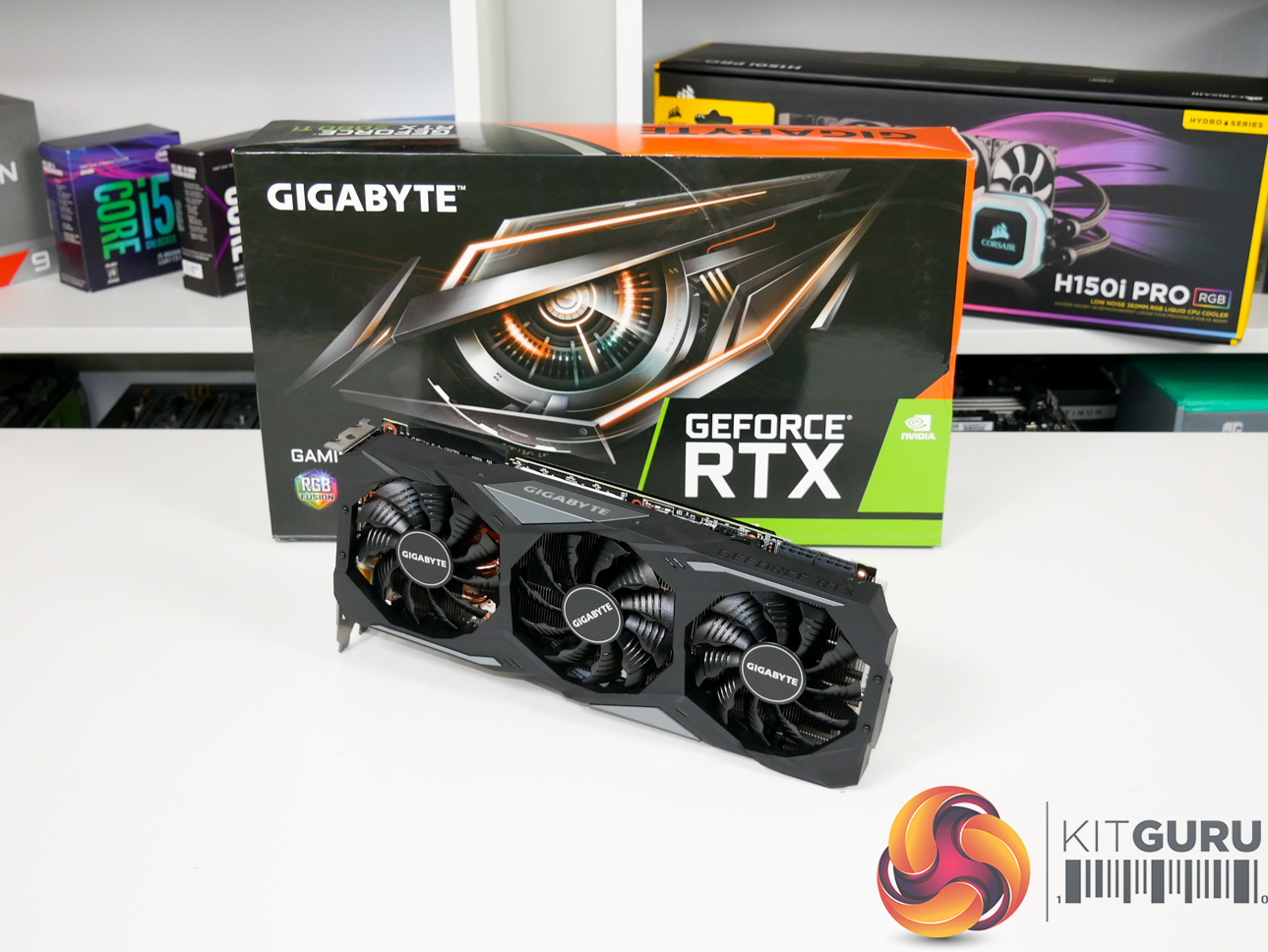
- Graphics Card: Gigabyte Aorus RTX 2080 Ti Gaming OC 11G (custom fan curve to eliminate thermal throttling).
- Memory: 16GB (2x8GB) G.Skill TridentZ 3200MHz 14-14-14-34 DDR4 @ 1.35V (4x8GB for quad-channel systems).
- CPU Cooler: Corsair H100X.
- Games SSD: Crucial MX300 750GB.
- Power Supply: Seasonic Prime Titanium 1000W.
- Operating System: Windows 10 Pro 64-bit 1903 Update.
Ryzen 3000 AM4 System (Ryzen 7 3700X, Ryzen 9 3900X):
- Ryzen 7 3700X CPU: AMD Ryzen 7 3700X ‘Matisse' 8 cores, 16 threads (4.25GHz @ 1.35-1.375V overclocked).
- Ryzen 9 3900X CPU: AMD Ryzen 9 3900X ‘Matisse' 12 cores, 24 threads (4.25GHz @ 1.35-1.4V overclocked).
- Motherboard: ASRock X570 Taichi & Gigabyte X570 Aorus Master (AM4, X570, AGESA Combo-AM4 1.0.0.2).
- System Drive: WD Black SN750 500GB.
Ryzen 1000 & 2000 AM4 System (Ryzen 5 2600X, Ryzen 7 1800X, Ryzen 7 2700X):
- Ryzen 7 1800X CPU: AMD Ryzen 7 1800X ‘Summit Ridge' 8 cores, 16 threads (4.0GHz @ 1.4V overclocked).
- Ryzen 5 2600X CPU: AMD Ryzen 5 2600X ‘Pinnacle Ridge' 6 cores, 12 threads.
- Ryzen 7 2700X CPU: AMD Ryzen 7 2700X ‘Pinnacle Ridge' 8 cores, 16 threads.
- Motherboard: ASUS Crosshair VII Hero (Wi-Fi) (AM4, X470, AGESA Combo-AM4 0.0.7.2).
- System Drive: ADATA SX950 240GB.
Coffee Lake LGA 1151 System (i7-9700K, i9-9900K):
- i7-9700K CPU: Intel Core i7-9700K ‘Coffee Lake' 8 cores, 8 threads (5.0GHz @ 1.3V overclocked).
- i9-9900K CPU: Intel Core i9-9900K ‘Coffee Lake' 8 cores, 16 threads (4.9GHz @ 1.3V overclocked).
- Motherboard: Gigabyte Z390 Aorus Master (LGA 1151 rev. 2, Z390).
- System Drive: Plextor M9Pe 512GB.
Skylake-X LGA 2066 System (i9-7920X):
- i9-7920X CPU: Intel Core i9-7920X ‘Skylake-X' 12 cores, 24 threads.
- Motherboard: ASRock X299 Taichi XE (LGA 2066, X299).
- System Drive: Corsair Neutron XT 480GB.
Software:
- AMD Chipset Drivers v1.07.07.0725 (pre-release).
- GeForce 430.86 VGA drivers.
Tests:
Productivity-related:
- Cinebench R15 – All-core & single-core CPU benchmark (CPU)
- Cinebench R20 – All-core & single-core CPU benchmark (CPU)
- Blender 2.79b – All-core rendering of the BMW benchmark (CPU)
- HandBrake x264 – Convert 1440p60 H264 video to 1080p60 H264 using the YouTube HQ 1080p60 preset (CPU)
- HandBrake x265 – Convert 4K30 100Mbps H264 video to 1080p30 40Mbps H265 using the H.265 MKV 1080p30 preset (CPU)
- 7-Zip – Built-in 7-Zip benchmark test (CPU & Memory)
- SiSoft Sandra – Memory bandwidth (Memory)
- AIDA64 – Memory bandwidth, memory latency, memory & cache latency (Memory)
Gaming-related:
- 3DMark Time Spy – Time Spy (DX12) test (Gaming)
- Deus Ex: Mankind Divided – Built-in benchmark tool, 1920 x 1080, Ultra quality preset, no AA, DX12 version (Gaming)
- Far Cry 5 – Built-in benchmark tool, 1920 x 1080, Ultra quality preset, DX12 (Gaming)
- Ghost Recon: Wildlands – Built-in benchmark tool, 1920 x 1080, Ultra quality preset, DX12 (Gaming)
- Grand Theft Auto V – Built-in benchmark tool, 1920 x 1080, Maximum quality settings, Maximum Advanced Graphics, DX11 (Gaming)
- Hitman 2 – Built-in benchmark tool – Mumbai scene, 1920 x 1080, Ultra quality preset, DX12 (Gaming)
- Shadow of the Tomb Raider – Built-in benchmark tool, 1920 x 1080, Highest quality preset, no AA, DX12 version (Gaming)
Cinebench
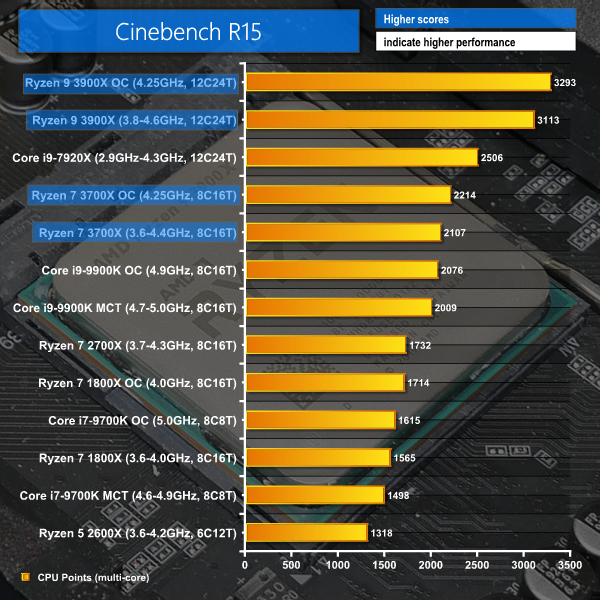
Starting with everybody’s favourite – Cinebench R15 – we see AMD cementing their already-strong position obtained through Zen. The twelve-core, 24-thread Ryzen 9 3900X takes top spot in our chart, even before overclocking, handily beating out the significantly more expensive Intel HEDT 12-core chip. Overclocking boosts the 3900X’s score by a little over 100 points but you’d have to be pushing pretty hard to make the doubts of stability and poorer power efficiency worth it over the stock configuration, in my opinion.
Breaking past 3000 points on a mainstream platform is impressive, to say the least! Equally impressive is the Ryzen 9 3900X’s ability to outperform the similarly-priced Core i9-9900K by a margin of 55%.
Switching focus to the eight-core Ryzen 7 3700X and we see another excellent showing for the chip based on AMD’s new Zen 2 architecture. Out-of-the-box speeds, with a strong CPU cooler, allow the 3700X to outperform Intel’s Core i9-9900K – a chip that costs around 50% more. Again, overclocking isn’t particularly worthwhile given the limited frequency headroom available on our sample. The value on offer from AMD is unquestionable when analysing Cinebench performance.
Looking at the price competitor – Intel’s eight-core, eight-thread Core i7-9700K – the 65W Ryzen 7 3700X outperforms that part by 41%. Not bad for a chip that only requires 65W of cooling grunt to operate correctly.
Compared to previous generation eight-core, 16-thread Ryzen chips – the 1800X and 2700X – we see a performance uptick for the 3700X of 35% and 22% respectively. That performance improvement is driven by a combination of the frequency advantage permitted by AMD’s 7nm design process, in addition to the under-the-hood architectural improvements for Zen 2.
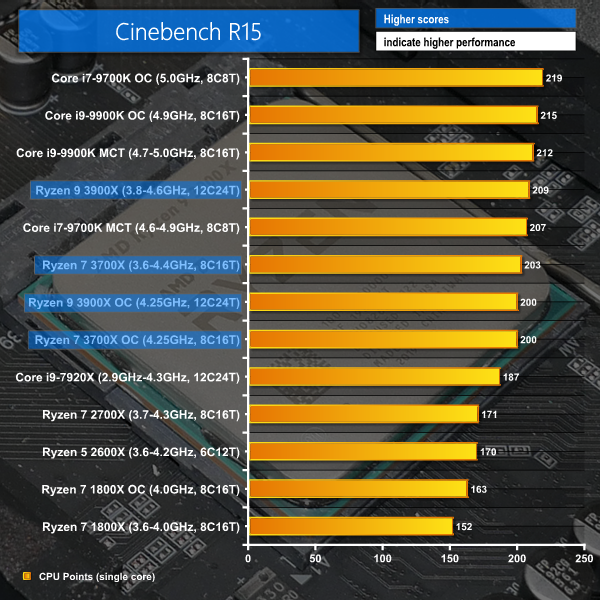
Let’s take a look at single-thread performance in Cinebench R15 – an area where AMD has historically struggled against Intel.
Aided by the preferential boost frequencies that Precision Boost 2 gives to Ryzen 3000 chips, the Zen 2 offerings deliver respectable score in this single-threaded test. Intel’s highly-clocked Skylake architecture in the Coffee Lake Core i7 and Core i9 CPUs still tops the chart. However, AMD has practically eliminated the single-threaded performance deficit that was significant with Zen and Zen+.
Now, the percentage loss versus Intel Core i7-9700K and i9-9900K sits at around 1-2% – close enough to call the scores almost even. A significant improvement over the circa-15% performance loss expected when comparing the Zen+ 2700X to the Coffee Lake i7-9700K and i9-9900K .
Impressively for Ryzen 3000 is the ability for AMD to compete strongly with Intel’s single-threaded performance, despite Team Blue maintaining the significant frequency advantage provided by the robust 14nm++ process technology. Clock-for-clock, the architecture in Zen 2 looks strong, even compared with Intel’s Skylake. The Skylake-X Core i9-7920X highlights this point perfectly, with its more constricted boost clock speeds that are comparable to Ryzen 3000 forcing Intel’s 12-core HEDT chip to sit behind the AMD Zen 2 options in single-threaded performance.
Versus 3200MHz C14 RAM, 3600MHz C16 DDR4 with the Ryzen 9 3900X delivers a 0.4% performance improvement for the multi-threaded test and 0.0% for the single-threaded test.
Cinebench R20
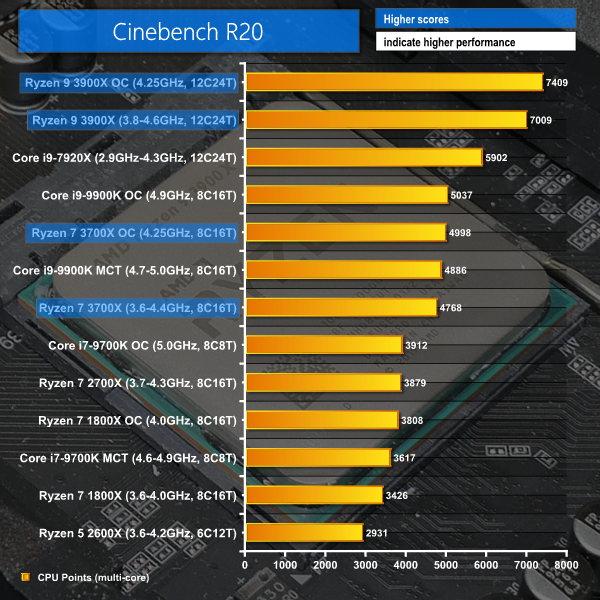
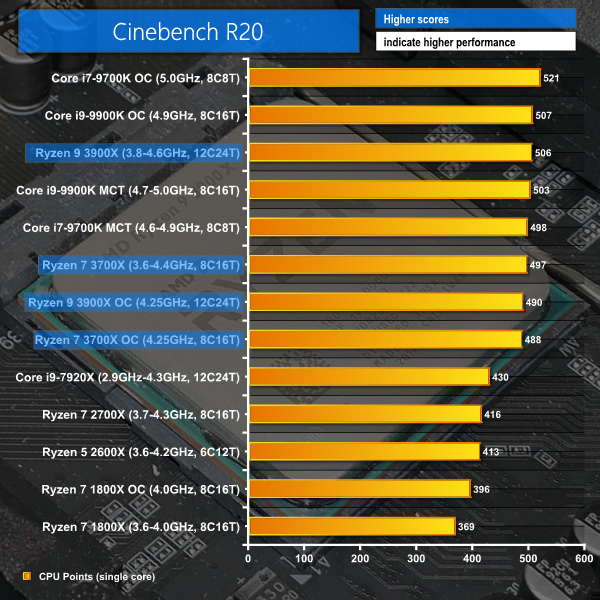
A new addition to our test suite is Cinebench R20. The longer benchmark run gives us a good opportunity to examine performance over extended load periods, thus allowing short-duration boost frequencies to settle down into long-duration speeds.
The multi-threaded performance picture is very similar to that of Cinebench R15. AMD’s Ryzen 9 3900X still tops the chart, comfortably, with the nearest competitor – Intel’s 12-core HEDT Core i9-7920X – sitting 1100 points or 16% behind. This time, however, Intel’s Core i9-9900K leapfrogs the Ryzen 7 3700X. This jump is largely influenced by the forced-turbo speeds of Intel’s chip when used with our Gigabyte motherboard, in addition to the slightly reduced all-core frequency for the 3700X in this longer benchmark run.
Against the Core i7-9700K, Ryzen 7 3700X wins by a comfortable 32% margin. The 23% performance jump versus AMD’s Zen+ Ryzen 7 2700X is also noteworthy.
Zen 2 continues to prove its single-threaded might with strong shows in the Cinebench R20 1T test. Both of the Ryzen 3000 chips place closely enough to Intel’s Coffee Lake competitors to call this result a tie. The 12-core Ryzen 9 3900X outperforms the 12-core i9-7920X by a healthy 18%, while the single-threaded performance uplift from the OG Ryzen 7 1800X is a sizeable 37%. Not bad for two generations and 22 months' worth of work.
Versus 3200MHz C14 RAM, 3600MHz C16 DDR4 with the Ryzen 9 3900X delivers a 0.3% performance improvement for the multi-threaded test and a 0.7% improvement for the single-threaded test.
Blender BMW Benchmark
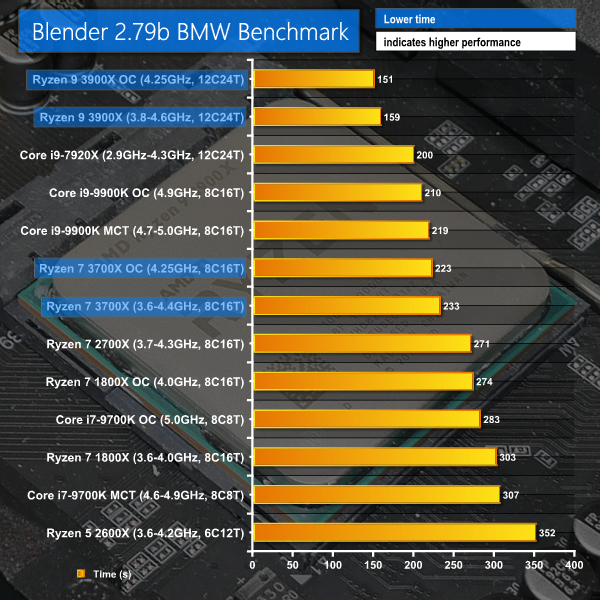
Unsurprisingly at this point, AMD takes another commanding victory in the heavily multi-threaded Blender test. The Ryzen 9 3900X completes the BMW benchmark in 159 seconds – a full 41 seconds faster than the i9-7920X which translates into a 20% performance improvement. AMD’s ability to maintain full clock speed through the Blender test is one of the key factors for its heavy performance increase versus the Intel HEDT part that reverts down to AVX-type operating frequencies close to the 3GHz mark.
And compared to the equally expensive Core i9-9900K, those 50% added threads for the AMD Zen 2 chip give it a performance lead of 27% against the Intel octa-core.
AMD’s Ryzen 7 3700X cannot match the i9-9900K in this test, largely due to the superior operating frequency of Intel’s 14nm++ chip. Compared to its price competitor, however, the 3700X outperforms the straight-eight i7-9700K by a healthy 24% margin. Even pushing the i7 to 5.0GHz only allows the performance deficit to be reduced to 18% versus the stock 3700X.
And looking at the Ryzen predecessors, AMD’s eight-core Zen 2 part is 14% quicker than the 2700X and 23% faster than the 1800X. That 14% improvement over the 2700X speaks loudly for AMD’s architectural improvements with Zen 2 as the all-core clock speeds for both parts will be similar in this lengthy workload.
Versus 3200MHz C14 RAM, 3600MHz C16 DDR4 with the Ryzen 9 3900X delivers no performance improvement for Blender.
If you do a lot of CPU-based rendering using Blender, AMD’s Ryzen 9 3900X is a superb choice and the Ryzen 7 3700X is also a strong offering at its lower price point.
7-Zip
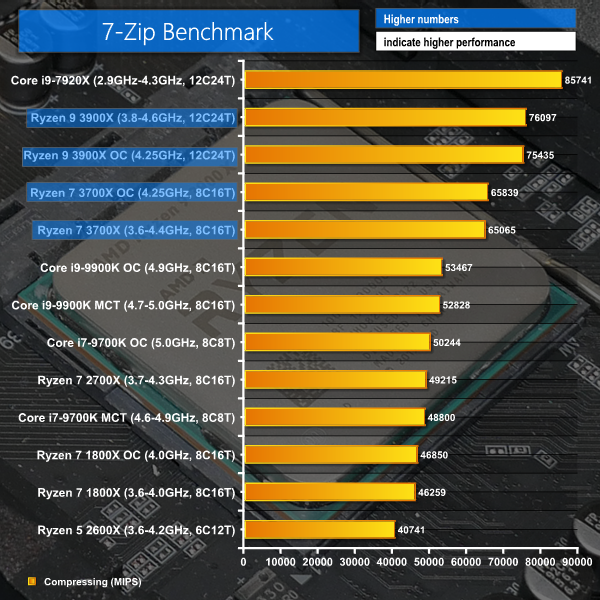
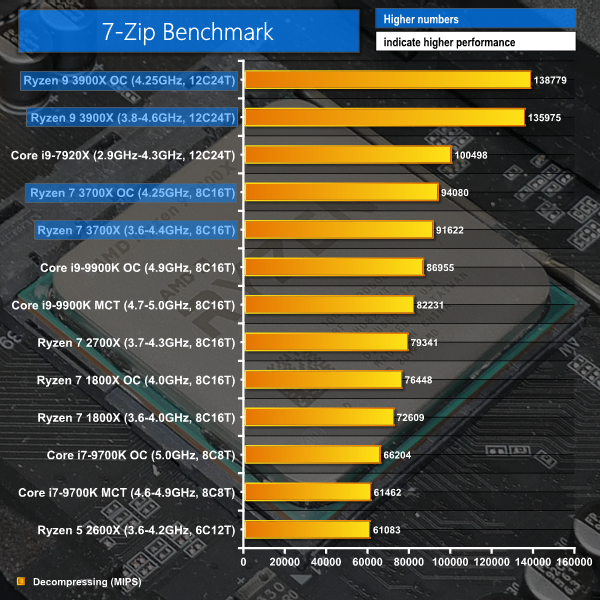
In 7-Zip, the Core i9-7920X takes a comfortable victory, which is also aided by quad-channel DDR4. The performance uplift for the HEDT i9 versus Ryzen 9 3900X is 13%. Overclocking AMD’s chip does little to improve this loss as the boost clocks are more inflexible with a manual overclock. Compared to the price-competitive Core i9-9900K, however, AMD’s 12-core part is 44% quicker.
The Ryzen 7 3700X outperforms the Core i7-9700K and shows us how the improved Zen 2 architecture has boosted compression performance in 7-Zip versus the Zen and Zen+ predecessors.
Switching focus to decompression – an area where AMD’s Zen architecture has historically performed well – and we see Ryzen 9 3900X rise back to the top of the performance chart. Ryzen 9 3900X is 65% faster than the Core i9-9900K and Ryzen 7 3700X beats the i7-9700K by 49%.
If your workloads involve heavy amounts of decompression using 7-Zip, AMD’s Ryzen 3000 chips look like even better value options than their 2700X and 1800X predecessors did. With that said, there are still scenarios where the improved memory bandwidth of Intel’s HEDT part can pay dividends. That’s more of an area where Threadripper competes, though.
Versus 3200MHz CL14 RAM, 3600MHz C16 DDR4 with the Ryzen 9 3900X delivers a 3.8% performance improvement for compression and a 1.2% improvement for the decompression.
Handbrake
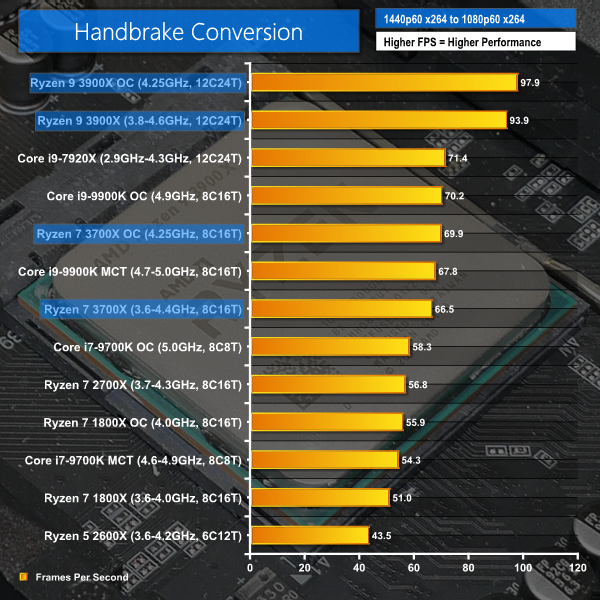
The trend is becoming rather predictable at this point. Handbrake x264 conversion flies on the 12-core Ryzen 9 3900X, with strong utilisation of all 24 threads being observed when converting our 1440p60 game recording. Thanks to its ability to maintain high boost clocks throughout the conversion process, rather than reduce down to AVX-type clock speeds in the region of 3GHz like the i9-7920X, the AMD Zen 2 flagship absolutely destroys the HEDT Intel CPU in this test. The performance improvement versus Intel’s similarly-priced Core i9-9900K is also significant at 38.5%.
Switching focus to the Ryzen 7 3700X, AMD’s eight-core, sixteen-thread 65W Zen 2 part comfortably outperforms the Core i7-9700K by 22%, though the Coffee Lake chip’s strong overclocking capacity does claw back some performance. Ryzen 7 3700X is actually very competitive against the more expensive Core i9-9900K, despite Intel’s part consuming close to twice the amount of power. And compared to the Zen and Zen+ eight-core predecessors, the Zen 2 octa-core is in a completely different performance league.
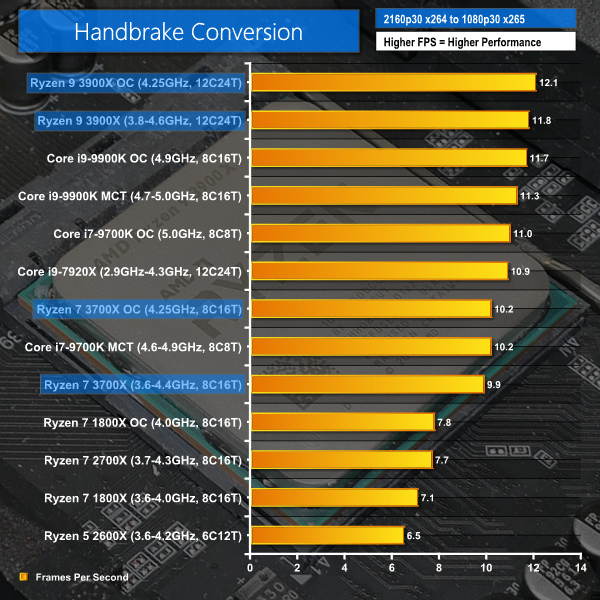
One of AMD’s biggest Zen 2 architectural improvements is the single-op AVX256 support. This looks to be paying dividend in our Handbrake x265 conversion test. That’s even despite the software package’s inability to fully utilise even 16 threads with our 100Mbps 4K30 to 40Mbps 1080p30 conversion.
AMD takes a win with the Ryzen 9 3900X, but the highly-clocked Core i9-9900K is very close behind thanks to its sixteen threads operating at higher frequencies than the not-fully-utilised 3900X. Versus the 12-core Intel HEDT i9-7920X, the Ryzen 9 3900X is 8% faster thanks to its higher operating frequency than the Intel chip that reverts down to AVX clock speeds.
Intel’s Core i7-9700K enjoys a 3% victory against the Ryzen 7 3700X. That victory is heavily frequency driven, as proven by the even wider victory for the 9700K when both chips are overclocked. Compared to the limited AVX performance of the Zen and Zen+ CPUs, both Zen 2 chips position themselves in different performance tiers to the AM4 parts of yesteryear. The 3700X, for example, is 29% faster than the Zen+ 2700X and that victory is driven almost entirely by architectural improvements to Zen 2’s AVX performance.
If you have a loft full of Blu-rays ready for Handbrake to convert onto your home server, AMD’s Ryzen 9 3900X looks to be an excellent choice, though the Intel Coffee Lake chips prove worthy competitors for x265 media.
Sandra Memory Bandwidth

AIDA64 Memory Performance
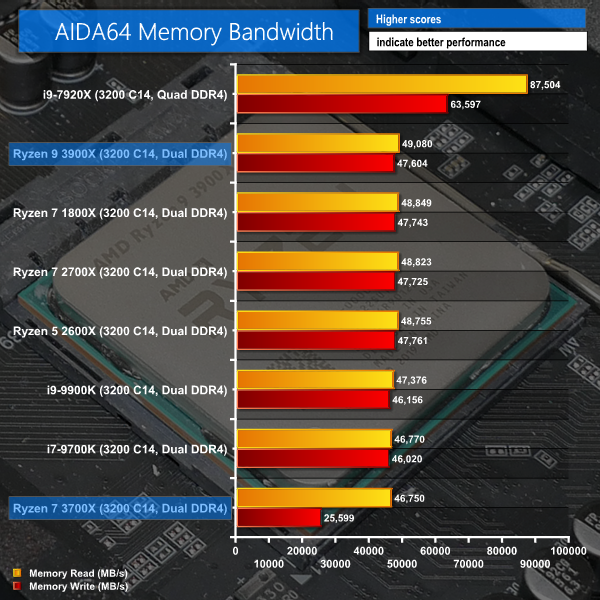
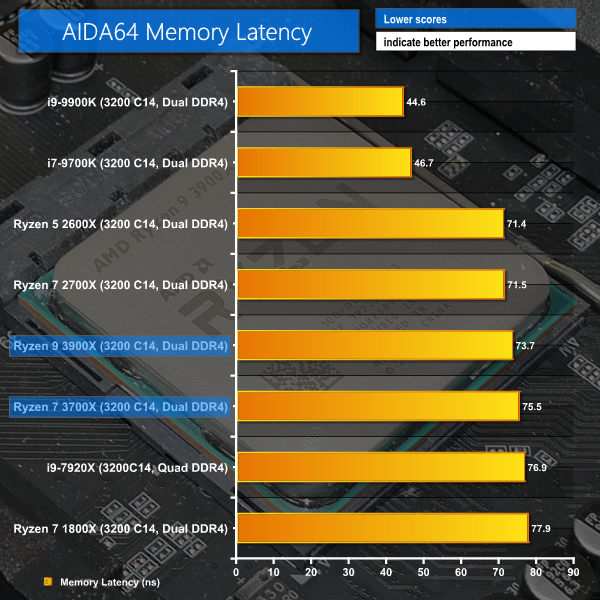
Memory bandwidth is close to where we'd expect it for 3200MHz C14 DDR4 in dual-channel mode. There is a slight performance reduction for Zen 2 versus Zen and Zen+ and this is perhaps attributable to the memory controller's residency in the segregated IO chiplet.
We checked with AMD regarding the roughly half-speed memory write performance from our Ryzen 7 3700X in AIDA64. According to the response, this is to be expected given the application of one CCD for the eight-core Zen 2 part, as opposed to two CCD and therefore two links to the memory controller in the IO die for the 12-core chip.
Memory latency from Zen 2 is comparable to that of Zen and Zen+. This performance is, again, in spite of the segregated IO die for Zen 2 parts.
As a point of reference, AMD's claimed cache latency improvements look to hold true. Our SiSoft Sandra Cache and Memory Bandwidth test delivers 58.9ns for the Zen Ryzen 7 1800X, 52.6ns for the Zen+ Ryzen 7 2700X, and 33.1ns for the Zen 2 Ryzen 7 3700X and Ryzen 9 3900X. Running 3600MHz C16 DDR4 with Ryzen 9 3900X reduces that latency figure by 6% down to 31.1ns.
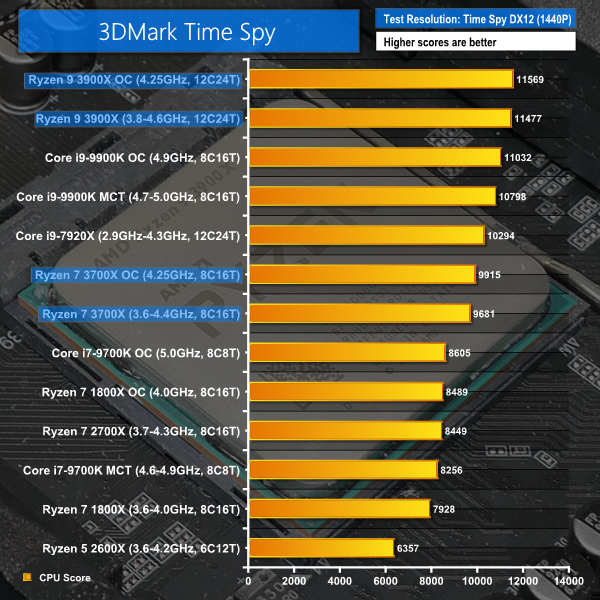
3DMark
Deus Ex: Mankind Divided
Despite its age, Deus Ex: Mankind Divided remains a demanding title even for modern hardware. We use the game's built-in benchmark with quality set to Ultra, MSAA disabled, and DX12 mode.
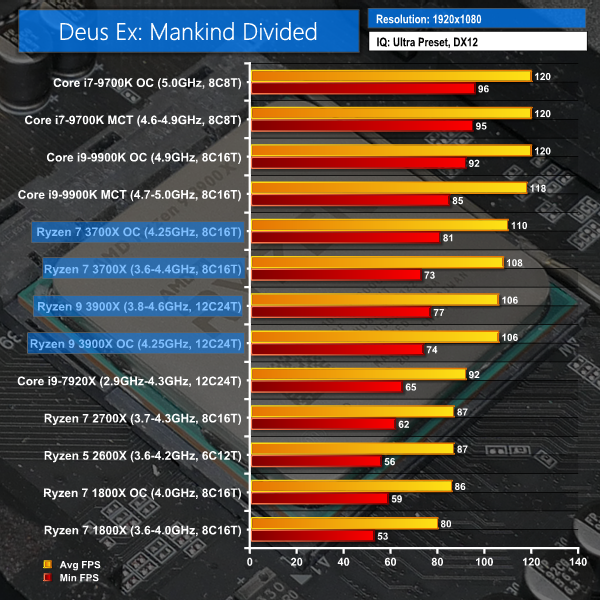
Deus Ex: Mankind Divided gives us an early indication of AMD’s Zen 2 gaming performance. Running at the high refresh rates permitted by the popular 1080P resolution and a Gigabyte Aorus RTX 2080 Ti graphics card, we see that Intel still rules the show when it comes to all-out gaming performance.
AMD has, however, made significant strides in closing the performance gap to Intel’s Skylake-based CPU. Rather than the roughly 30% performance deficit we see with Zen and Zen+ versus the Coffee Lake i9 and i7, Ryzen 3000 manages around 90% of the performance offered by Intel’s market leaders. Both Ryzen 3000 chips are able to push past 100 FPS, making them valid options for high refresh rate gamers.
Far Cry 5
We use the Far Cry 5 built-in benchmark with quality set to Ultra.
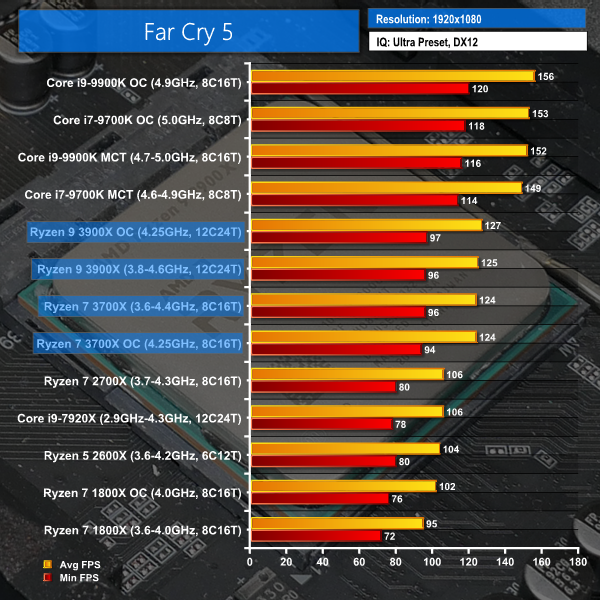
Far Cry’s Dunia engine tends to favour Intel hardware and that’s exactly what we see in our chart. With the Intel chips hovering around 150 FPS on average, AMD’s Ryzen 3000 sits closer to 125 FPS and with lower minimums. Again though, AMD’s Zen 2 gaming improvements have managed to reduce the deficit to the Coffee Lake i7 and i9 from around 30-35% in the cases of Zen and Zen+ to around 15% for Ryzen 3000.
Put into context, however, Ryzen 3000 delivering 85% of the Core i9-9900K’s gaming performance with a game engine that tends to prefer Team Blue can be considered a solid result for AMD. The average performance of the Ryzen chips at more than 120 FPS means that high refresh rate gamers can still justifiably consider the AMD processors for their gaming or multi-purpose machine, despite their numerical performance disadvantage versus Intel.
Versus 3200MHz CL14 RAM, 3600MHz C16 DDR4 with the Ryzen 9 3900X delivers a 3.5% performance improvement for average and minimum FPS in Far Cry 5.
Grand Theft Auto V
Grand Theft Auto V remains an immensely popular game for PC gamers and as such retains its place in our test suite. The DX11-built game engine is capable of providing heavy stress to a number of system components, including the GPU, CPU, and Memory.
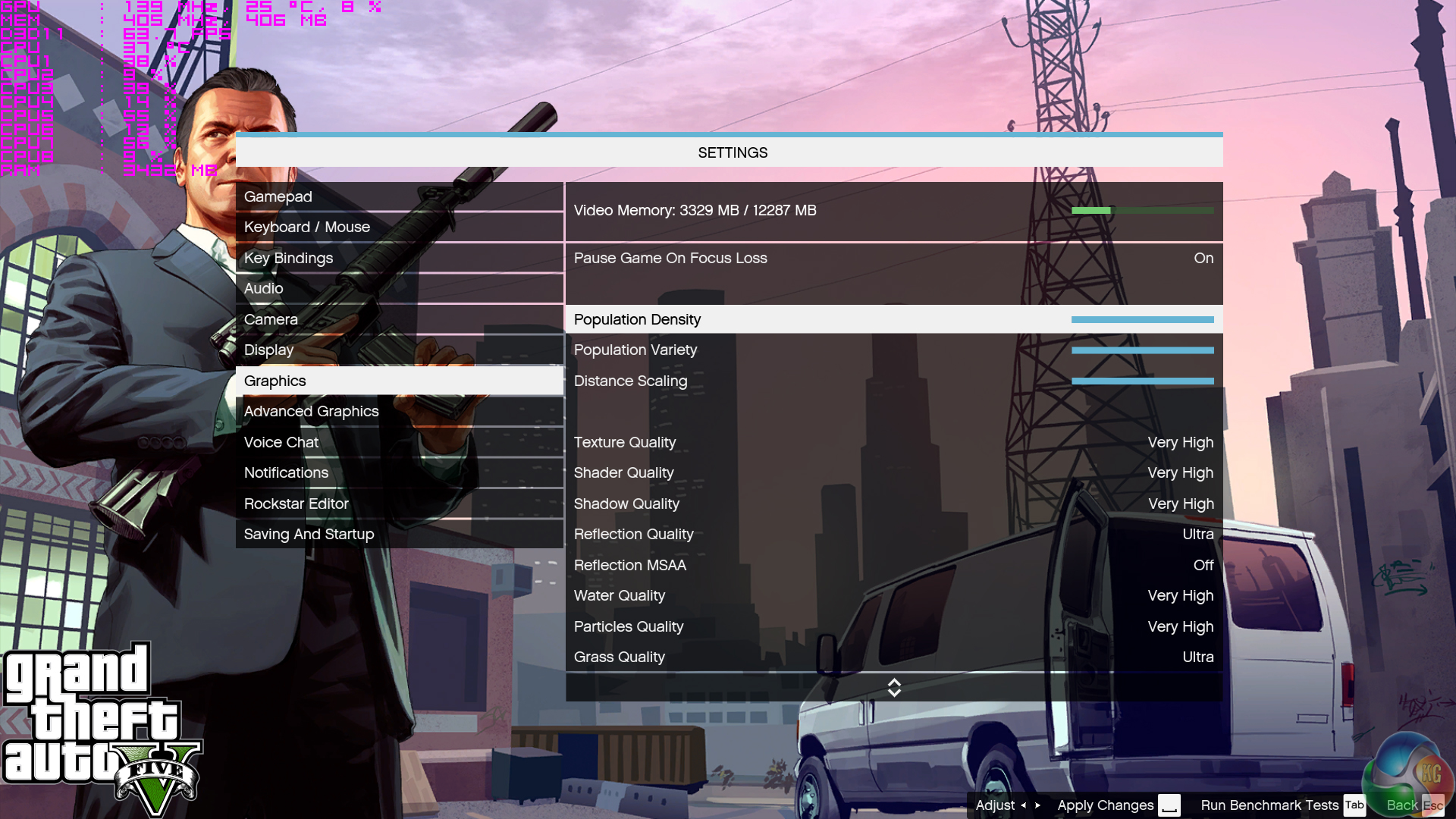
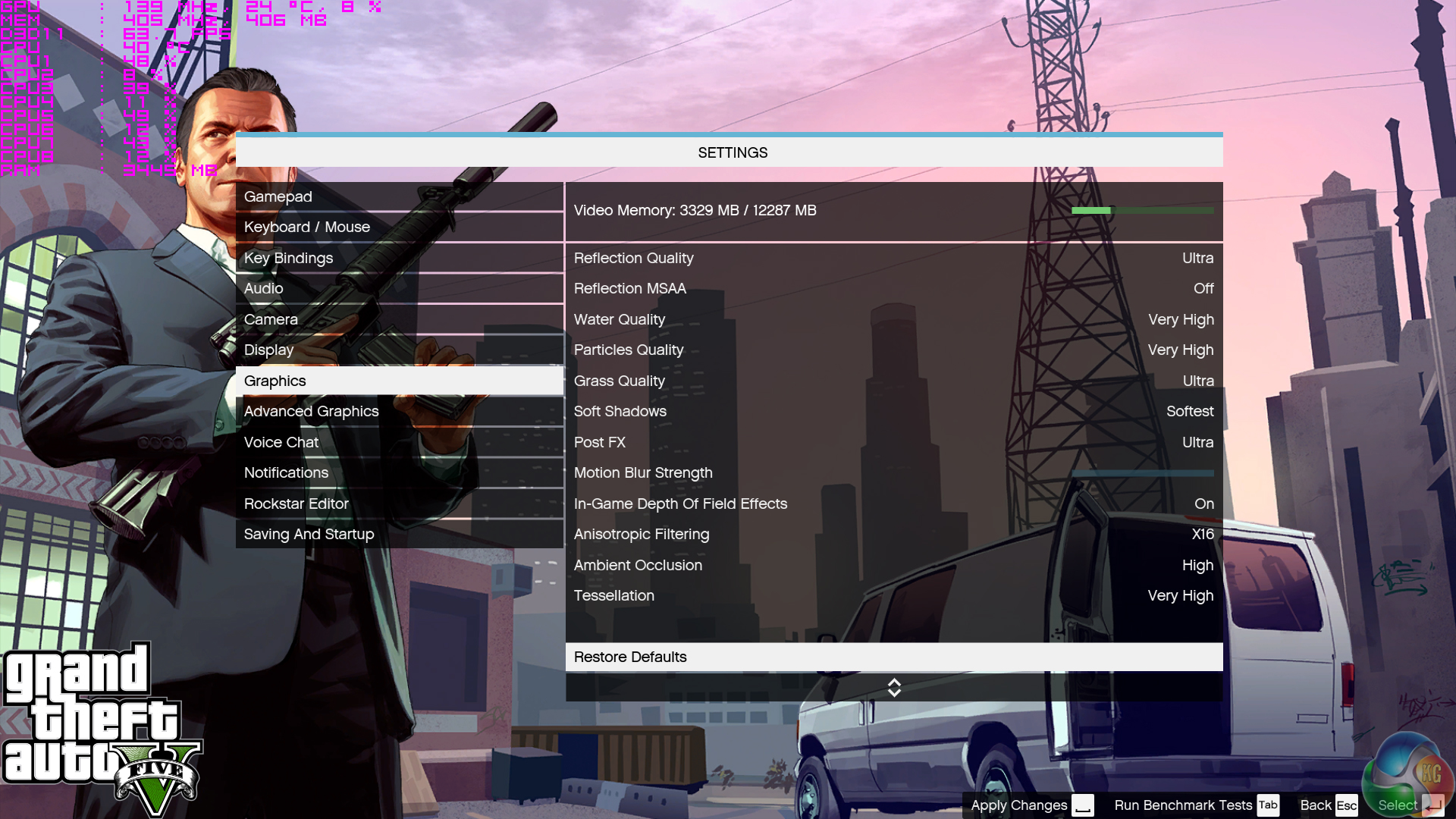
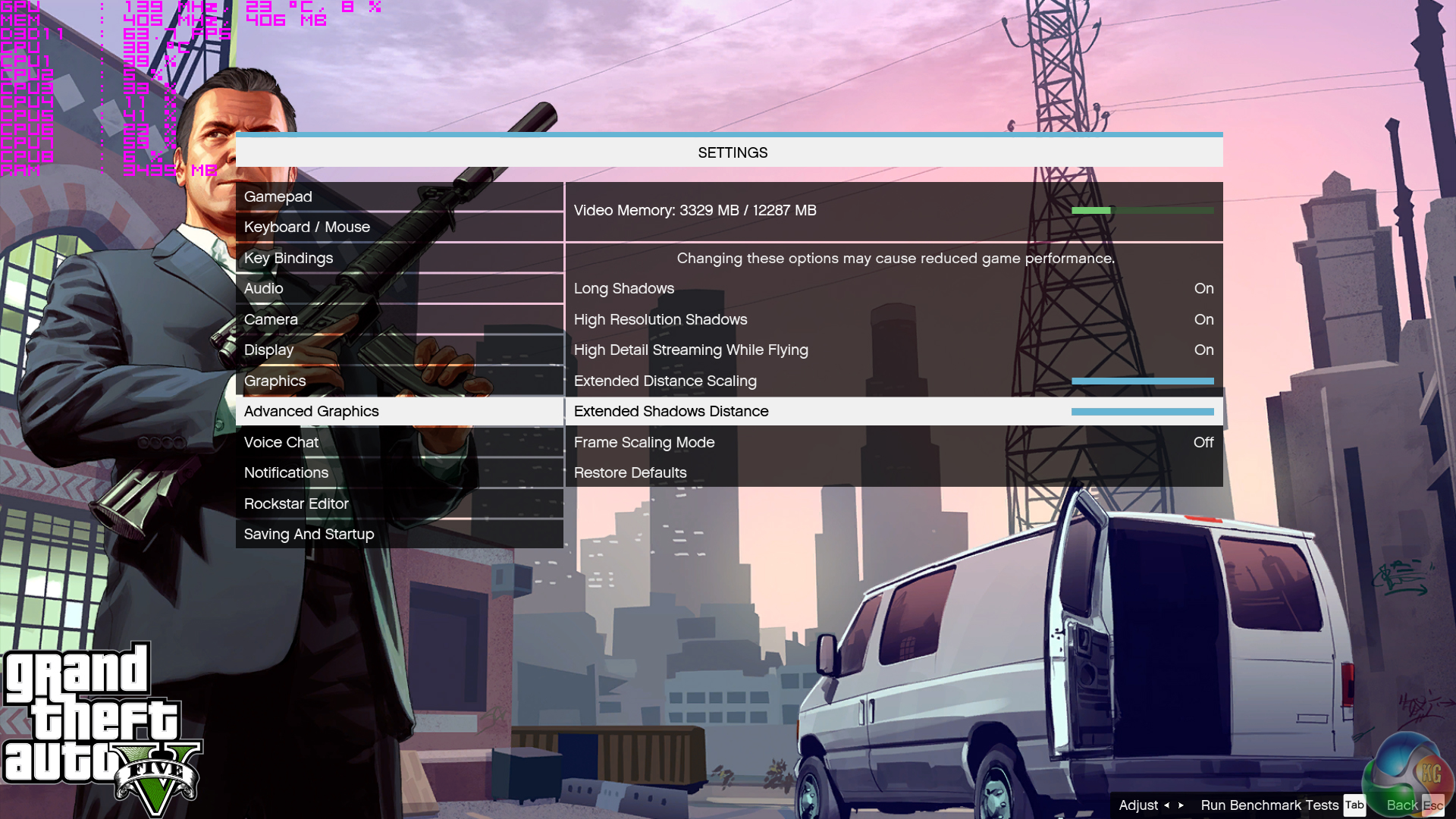
We run the built-in benchmark using a 1080p resolution and generally Maximum quality settings (including Advanced Graphics).

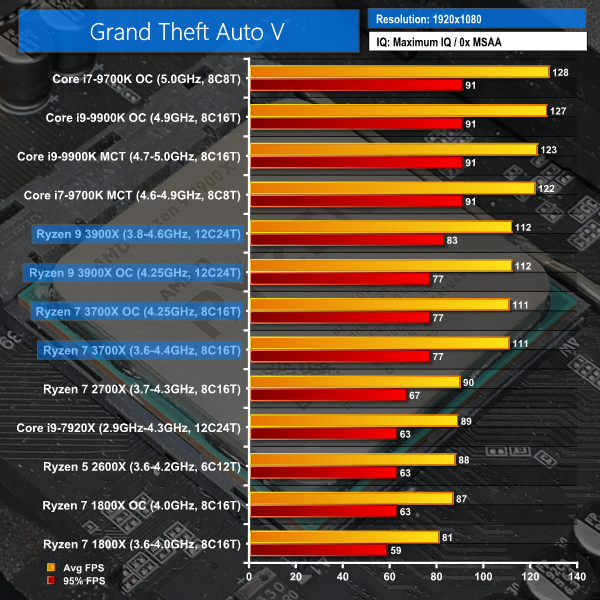
Old but still immensely popular, GTA V gives us a good look at how a CPU-demanding title coded with the limitations of the DX11 API performs on Ryzen 3000.
Unsurprisingly, Intel wins again. The highly-clocked 9900K and 9700K prove just how desirable fast frequencies are to games. Averaging between 120 and 130 FPS, the two Intel chips outperform their Ryzen 3000 rivals by a little over 10% on average. 95% FPS values are also superior on the Intel chips, proving their respective thread count deficit to be a non-factor for GTA V.
Taking a step back and looking at AMD’s performance, it is impressive to see Ryzen 3000 now offering around 90% of the gaming performance of Intel’s market leaders, compared to the 65-75% values we see with Ryzen 1000 and 2000. No longer are you forced to go Intel if you want to consistently push a title such as GTA V past 100 FPS on a high refresh rate monitor. That’s good to see, even if Intel does still offer the outright fastest gaming performance in GTA V.
Ghost Recon Wildlands
We run the built-in benchmark using a 1080P resolution and the Ultra quality preset.
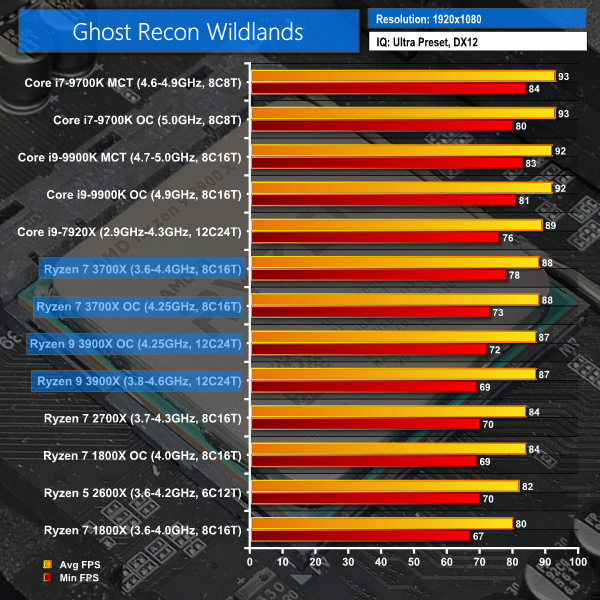
Ghost Recon Wildlands is demanding on the GPU when using its ultra preset, even at 1080P. As such, we see little performance difference between all CPUs on show. Intel’s Coffee Lake chips still sit firmly at the top of the chart, partnered by the HEDT 7920X, with around 5% higher performance than the Ryzen 3000 processors.
Average CPU usage during the benchmark run was 27% for the 9900K compared to 20% for the Ryzen 9 3900X. Likewise, the 9700K required 37% CPU usage while the Ryzen 7 3700X averaged 27%. For game streamers, that increased free CPU capacity on the Ryzen 3000 CPUs may prove more useful than the 5% higher average frame rates on the Intel chips. Intel’s Coffee Lake competitors did, however, show consistently strong minimum FPS values.
Versus 3200MHz CL14 RAM, 3600MHz C16 DDR4 with the Ryzen 9 3900X delivers a 0.4% performance improvement for average FPS and a sizeable increase of 7.5% for minimum FPS in Ghost Recon Wildlands.
Hitman 2
We run the built-in benchmark using the Mumbai scene with image quality set to Ultra and the DirectX 12 mode enabled.
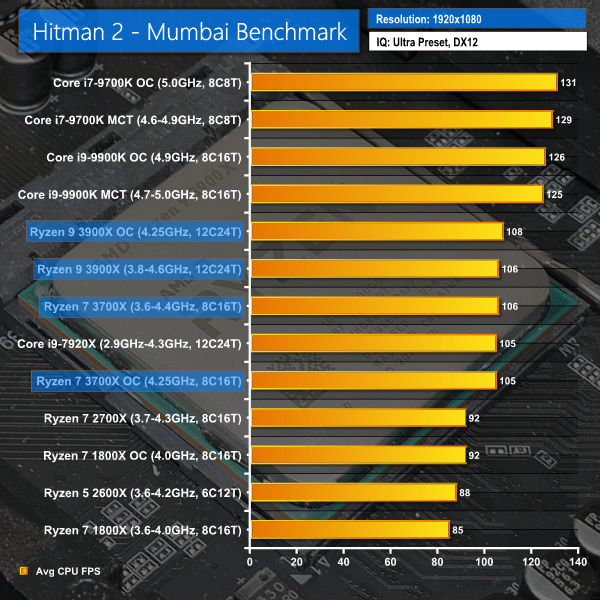
The performance increase from Zen and Zen+ to Zen 2 is less pronounced in Hitman 2 and, as such, the Ryzen 3000 performance deficit to Coffee Lake’s best sits around 15%. If you want to push past 120 FPS on average with a strong GPU such as our Aorus RTX 2080 Ti, Intel’s 9700K and 9900K are the best choices.
With that said, both Ryzen 3000 chips manage to offer frame rates higher than 105 on average, placing them in a performance section where even high refresh rate gamers would be happy enough with the FPS values attained. The same could not be said about Zen and Zen+, so AMD’s gaming improvements with Zen 2 prove worthwhile here.
Shadow of the Tomb Raider
We run the built-in benchmark using the DirectX 12 mode, anti-aliasing disabled, and the Highest quality preset.
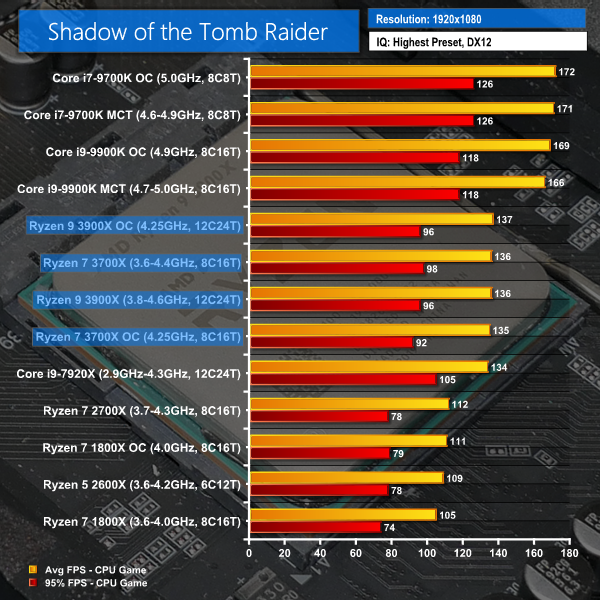
The trend continues. Intel’s Core i7-9700K and i9-9900K place at the top of the performance chart in Shadow of the Tomb Raider. With average FPS values around the 170 FPS-mark, this is pushing to the point where the results are beyond what most people would aim for.
Both Ryzen 3000 chips manage excellent average frame rate values of more than 135 FPS, though the low values do drop below 100 FPS. It’s hard to complain about an average FPS of more than 135 FPS, even if Intel chips are around 25% faster. I struggle to see a scenario where even high refresh rate gamers will be disappointed by Ryzen 3000’s performance in a AAA title such as Shadow of the Tomb Raider. The same could not be said about the Ryzen predecessors so, again, AMD’s Zen 2 gaming improvements look to be worthwhile.
Versus 3200MHz CL14 RAM, 3600MHz C16 DDR4 with the Ryzen 9 3900X delivers a 3.9% performance improvement for average FPS and increases 95% FPS by 3.8%.
The market for people buying an expensive CPU and using it for gaming at 1080p is likely to be limited. What 1080p does is give a good indication of the CPU's raw gaming performance as GPU power is sufficient to push frame rates to a level where the CPU and memory limitations can be observed.
We supplement the 1080p gaming results with a pair of games tested at 2560×1440 resolution. We chose Deus Ex: Mankind Divided and Far Cry 5 as the former is particularly GPU heavy at higher resolutions and the latter is a (relatively) computationally-heavy, open-world game.
Deus Ex: Mankind Divided
We run the built-in benchmark using a 2560×1440 resolution and the same settings as the 1080p test (Ultra preset).
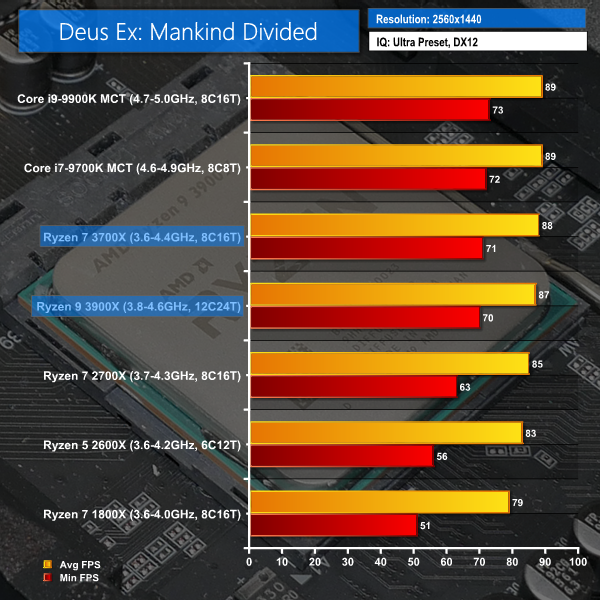
Push up to 1440p in Deus Ex and the performance difference between Coffee Lake and Ryzen 3000 disappears as the GPU struggles to cope with the enhanced demand placed on its silicon.
Far Cry 5
We run the built-in benchmark using a 2560×1440 resolution and the same settings as the 1080p test (Ultra preset).
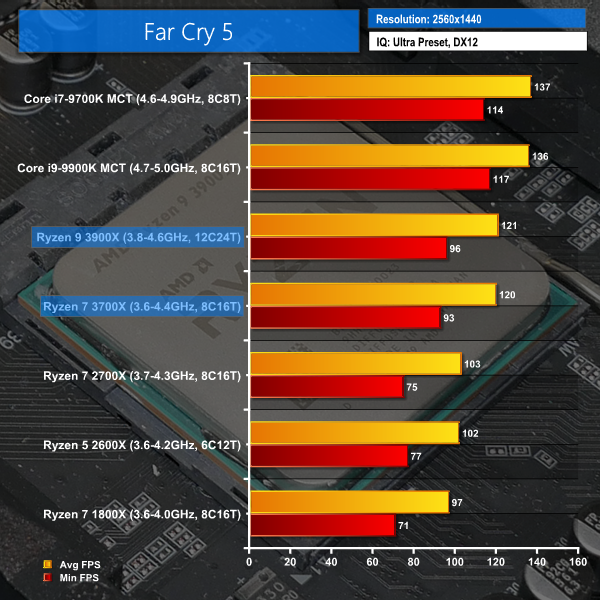
Up the resolution to 1440p and our Gigabyte RTX 2080 Ti cannot push past 140 FPS on average. So with Intel’s chips now sitting at around 135 FPS average and the AMD chips still offering just over 120 FPS, the performance deficit has been cut.
In other words, Intel’s Coffee Lake i9 and i7 are still the best options for 1440p 120/144Hz gamers but the performance drop to AMD’s Ryzen 7 3000 CPUs can be considered relatively small. The same could not be said for Zen and Zen+, so credit to AMD where credit is due.
We leave the system to idle on the Windows 10 desktop for 10 minutes before taking a power draw reading (and averaging the result, if necessary due to Ryzen's sensor drift). For CPU load results, we read the power draw while producing approximately 5 minutes worth of runs of the Cinebench R20 multi-threaded test. We also run 10 minutes of AIDA64 stress test.
Both Cinebench and AIDA64 are used as some CPUs – most notably Intel's Core processors when operating under default turbo conditions – will heavily reduce their clock speed with the AIDA64 workload, thus giving an unrepresentative reading.
The power consumption of our entire test system (at the wall) is shown in the chart. The same test parameters were used for temperature readings.
Power Consumption
Power draw readings are accurate to around +/-5W under heavy load due to instantaneous fluctuations in the value. We use a Titanium-rated Seasonic 1000W Prime PSU (with 8-pin plus 4-pin or 8-pin plus 8-pin power connectors where possible).
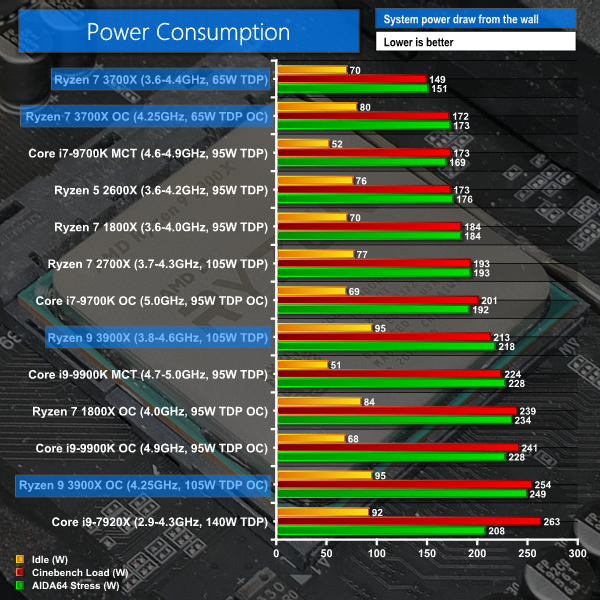
Power consumption is an area where AMD performs particularly well with Ryzen 3000. Focusing first on the 12-core Ryzen 9 3900X, maximum CPU-load system draw from the wall was just under 220W compared to just under 230W for the Core i9-9900K. Looking at the Cinebench numbers, that same 10 Watt delta between the two CPUs holds consistent, despite the Ryzen part’s significant performance advantage.
As is the case for AMD’s smart Precision Boost 2 algorithm, these numbers will depend upon factors such as cooling potential, motherboard VRM quality, and individual CPU silicon. Nevertheless, AMD’s Zen 2 12-core part pulling less juice from the wall than Intel’s eight-core 9900K is impressive to see.
The Ryzen 7 3700X is the real power consumption king, maintaining system-wide power draw of around 150W at full CPU load. That’s a full 75W less than the 9900K which the 3700X manages to compete against in Cinebench R20.
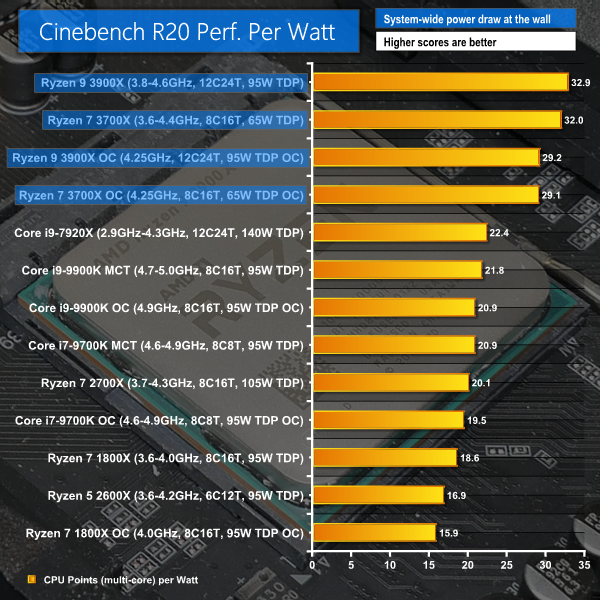
Cinebench performance per Watt numbers show that Ryzen 3000 chips are in a league of their own with values of 32.0 for the 3700X and 32.9 for the 3900X, compared to 20.9 for the 9700K and 21.8 for the 9900K. Blender shows the same performance per Watt trend.
Temperatures
Temperature recordings were taken using a 240mm Corsair H100X all-in-one liquid cooler with its two fans running at their 1700 RPM maximum. Ambient temperatures were around 25-27°C in the hot UK summer weather (and normalised to 25°C where there were slight fluctuations).
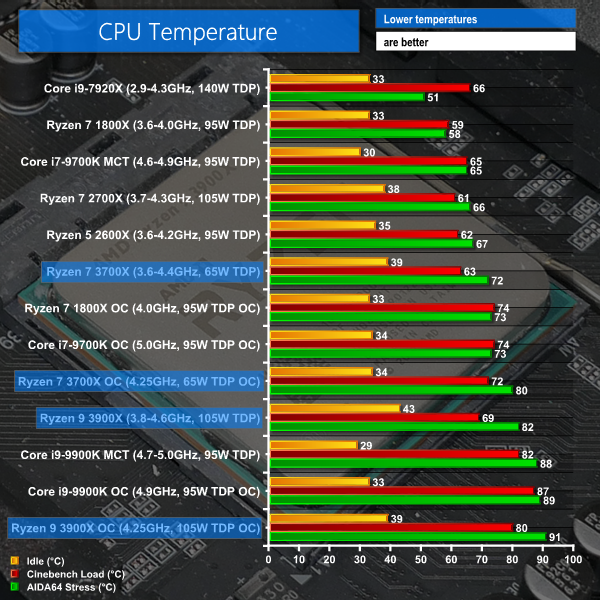
Using a 240mm AIO, the Ryzen 9 3900X certainly takes the cooling capacity available and throws its Precision Boost 2 algorithm at it. Sustained stress test load in AIDA64 pushed the CPU temperature to 82C, though Cinebench did tend to stay at a lower level. Throw overclocking into the mix and it is difficult to cool our tested 1.35-4V VCore unless your ambient levels are lower than the typical UK house in summer weather. This looks like a CPU that could benefit from a high performance 360mm AIO or full custom liquid cooling if you want to push past 1.4V.
The Ryzen 7 3700X also proved to be a hot runner, pushing past 70C in our AIDA stress test. The more manageable heat output of this chip means that strong air coolers such as the be quiet! Dark Rock Pro 4 can be used to cool it comfortably out of the box and also when overclocked with 1.35-1.40V.
Temperatures for Ryzen 3000 are high – there’s no denying that. AMD’s Precision Boost 2 algorithm pushes CPU performance when there’s headroom, so don’t necessarily expect to see lower temperatures with improved cooling configurations as the algorithm is likely to simply push frequency further.
AMD’s Zen 2 architecture in the Ryzen 3000 CPUs has delivered its side of the deal and the ability to squeeze twelve cores into a 105W package, thanks to smart design and the 7nm TSMC FinFET process, makes the Ryzen 9 3900X a success. The new AM4 flagship absolutely deserves its title, with productivity performance that is significantly higher than anything we have ever seen on a mainstream platform, power efficiency that is vastly superior to that of Intel’s Core i9-9900K, and gaming performance that is good enough for even high refresh rate gamers.
Those performance, efficiency, and gaming points hold true for the cheaper Ryzen 7 3700X, with AMD's 65W Zen 2 part competing fiercely against the power-hungry and more expensive Core i9-9900K in many productivity tests.
Improved memory frequency support is good to see and we did observe noticeable performance improvements when shifting to a 3600MHz C16 kit. We would, however, recommend staying to a maximum memory frequency of 3600MHz until further testing is shown. 3733MHz and faster kits force a divider switch from 1:1 to 2:1 for the memory controller, thus halving its operating frequency. This will impart a latency penalty that is likely reduce overall system performance. The TL;DR version of this is to buy a 3600MHz kit with solid timings.
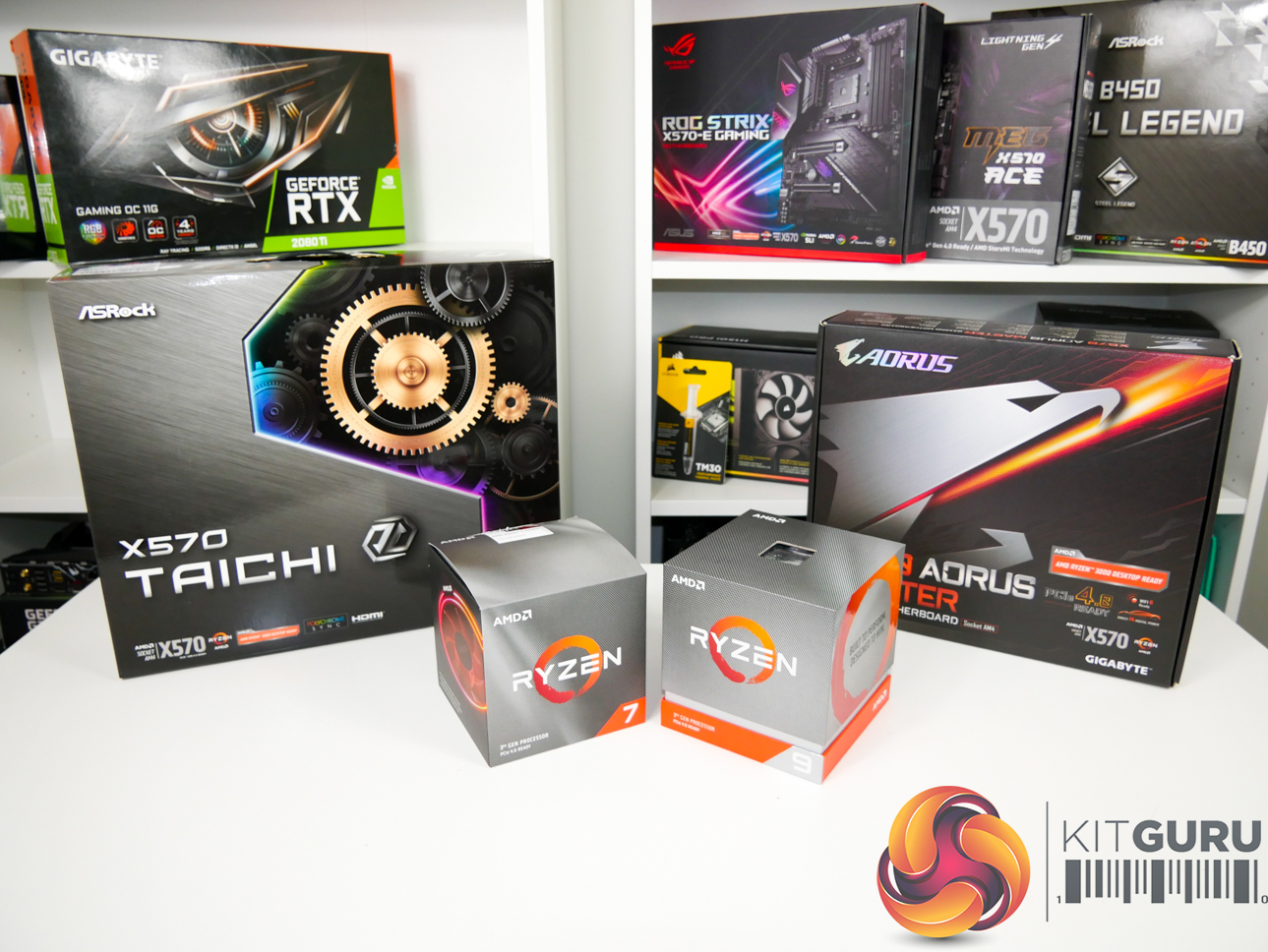
The Ryzen 3000 operating frequencies are fine. It seems a little harsh to be criticising AMD’s operating frequencies when the chip is fabbed on a brand new smaller process node that would typically come with reduced operating frequencies – anybody remember Intel’s 14nm Broadwell for desktop? Overclocking is limited to maybe a couple of hundred MHz or so but this is primarily due to the smarts of AMD’s Precision Boost 2 algorithm that automatically squeezes performance from the individual chip. I’d argue that stock PB2 operating speeds, or perhaps even the extra 100-or-so MHz delivered by Precision Boost Overdrive are the best way to run Ryzen 3000.
Performance per dollar, or pound, is simply excellent. AMD is, yet again, punching at performance levels far beyond its price point and, in intense productivity tasks, consistently outperforming its nearest price competitors from Team Blue. That logic holds true for both the Ryzen 9 3900X and the Ryzen 7 3700X. Recent price drops for Ryzen 2000 CPUs adjust the value picture slightly. However, the architectural and performance improvements of the Zen 2 Ryzen 3000 chips make them worth their price premium over Zen+.
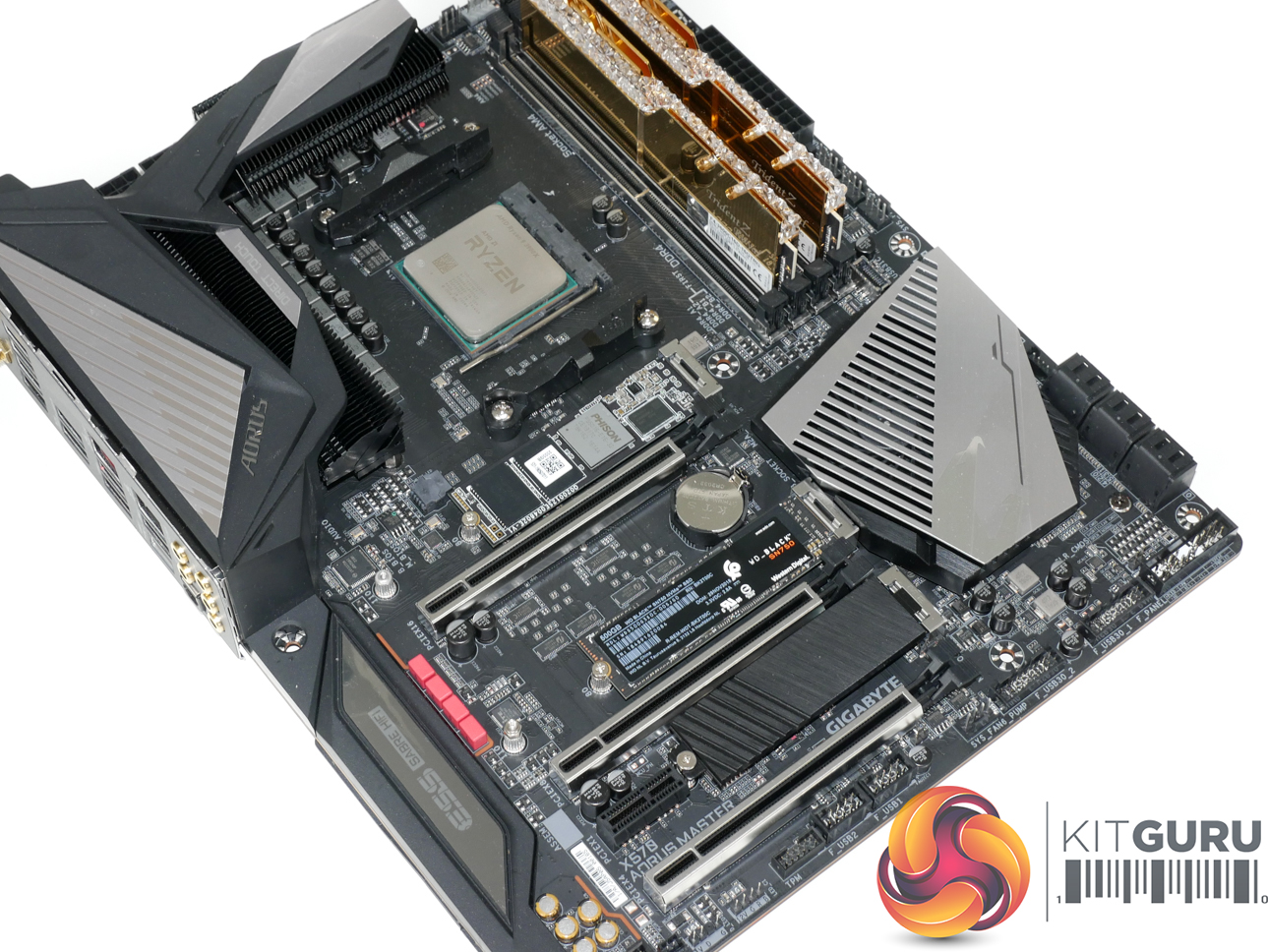
One of the main complaints regarding the Ryzen 3000 series and its positioning on the AM4 platform will be the cost of X570 motherboards. These offerings aren’t cheap, with even entry-level models starting at around £170, and B550 offerings are perhaps six months away. With that said, support for PCIe Gen 4 seems to be one factor that makes the cost increase seem somewhat reasonable. Higher storage speeds permitted by Gen 4 are going to make for interesting use cases.
It may not be such a bad idea for Ryzen 7 or Ryzen 5 buyers to consider a B450 or X470 board if PCIe Gen 4 is of no current use to you. The same logic holds true for 12-core Ryzen 9 buyers, but the strength of the motherboard VRM is far more important for keeping this power-hungry chip happy.
Gaming performance is an area where Intel still wins. The Core i7-9700K and i9-9900K repeatedly prove themselves as the best gaming CPUs on the market. If you only care about gaming and nothing else, either of those Intel chips is the best option. However, if you’re an enthusiast gamer who does more with your system than just game, Ryzen 3000 proves itself to be the go-to all-round option. You get the benefits of excellent multi-threaded and single-threaded productivity performance, while game numbers are still sufficient to please even high refresh rate gamers. And that’s before taking the advantages of the X570 chipset into account.
AMD does, however, deserve credit for the sizeable percentage gain that Zen 2 has brought to game performance. Whether it is due to the slightly improved clock speed, enhanced AVX support, or the healthy serving of AMD GameCache, the average gaming performance improvement over Zen and Zen+ is large and consistent.
Zen 2 has delivered and both the Ryzen 7 3700X and Ryzen 9 3900X look like extremely compelling options. The £320 eight-core, 65W chip trades blows with Intel’s more expensive and more power-hungry i9-9900K in productivity tasks and AMD is outperforming the similarly-priced i7-9700K. Likewise, the £480 Ryzen 9 3900X and its twelve cores outperform the similarly-priced i9-9900K in productivity tasks and gives AMD’s mainstream platform real ability to steal some of the HEDT market.
Suggesting that Ryzen 9 3900X delivers overall bang-for-buck would be an understatement.

The whole range of Ryzen 3000 CPUs can be found on Overclockers UK HERE.
Pros:
- Superb productivity performance in multi-threaded and single-threaded workloads.
- Excellent value compared to Intel competitors.
- Manageable power consumption with excellent efficiency values.
- Precision Boost 2 algorithm works very well.
- Strong high-speed memory capability.
- Native PCIe Gen 4.0 support.
- Included RGB LED CPU cooler.
- Potential backwards compatibility with 2-year-old X370-era motherboards.
- Scalable bundle cost thanks to the broad AM4 platform.
Cons:
- Gaming performance is still slower than Intel Coffee Lake at the ultra-high-end.
- Platform cost is high due to expensive X570 motherboards.
- Maximum frequency capability is limited compared to Intel, even when overclocking.
KitGuru says: AMD has delivered excellent performance, remarkable power efficiency, and an outstanding value proposition with the 7nm Zen 2-based Ryzen 7 3700X and Ryzen 9 3900X. Roll on the 16-core in September.