KitGuru KitGuru.net – Tech News | Hardware News | Hardware Reviews | IOS | Mobile | Gaming | Graphics Cards


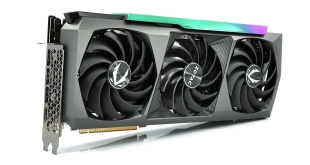
In our fourth RTX 3090 Ti review, we turn our attention to Zotac and the Amp Extreme Holo. As Zotac's flagship graphics card, the Amp Extreme Holo comes factory overclocked, with dual-BIOS support and plenty of RGB lighting. Priced just under the £1900 mark, is this a card to consider if you want the fastest gaming GPU on the market right now?
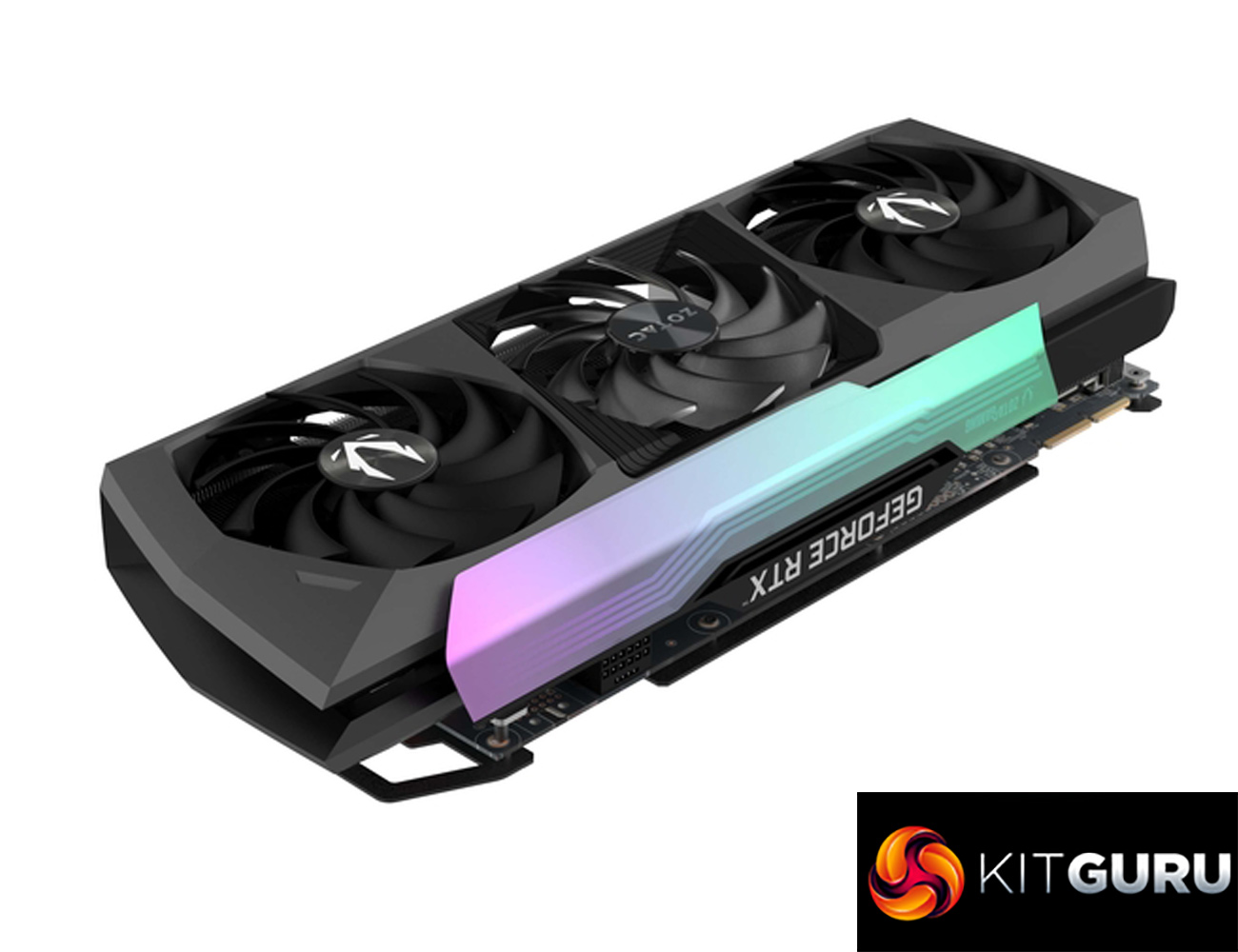
If the Zotac RTX 3090 Ti Amp Extreme Holo looks familiar, that's probably because we reviewed the original RTX 3090 version last June. The 3090 Ti version picks up exactly where the non-Ti model left off however, with a smart-looking HoloBlack cooler design, metal backplate and three beefy 100mm fans.
Today we compare it against the likes of MSI's Suprim X, Palit's GameRock OC and the Aorus Xtreme Waterforce, looking at gaming performance, thermals, acoustics and more.
| RTX 3090 Ti | RTX 3090 | RTX 3080 Ti | RTX 3080 | RTX 3070 | |
| SMs | 84 | 82 | 80 | 68 | 46 |
| CUDA Cores | 10752 | 10496 | 10240 | 8704 | 5888 |
| Tensor Cores | 336 | 328 | 320 | 272 | 184 |
| RT Cores | 84 | 82 | 80 | 68 | 46 |
| Texture Units | 336 | 328 | 320 | 272 | 184 |
| ROPs | 112 | 112 | 112 | 96 | 96 |
| GPU Boost Clock | 1860 MHz | 1695 MHz | 1665 MHz | 1710 MHz | 1725 MHz |
| Memory Data Rate | 21 Gbps | 19.5 Gbps | 19 Gbps | 19 Gbps | 14 Gbps |
| Total Video Memory | 24GB GDDR6X | 24GB GDDR6X | 12GB GDDR6X | 10GB GDDR6X | 8GB GDDR6 |
| Memory Interface | 384-bit | 384-bit | 384-bit | 320-bit | 256-bit |
| Memory Bandwidth | 1008 GB/Sec | 936 GB/Sec | 912 GB/Sec | 760 GB/Sec | 448 GB/Sec |
| TGP | 450W | 350W | 350W | 320W | 220W |
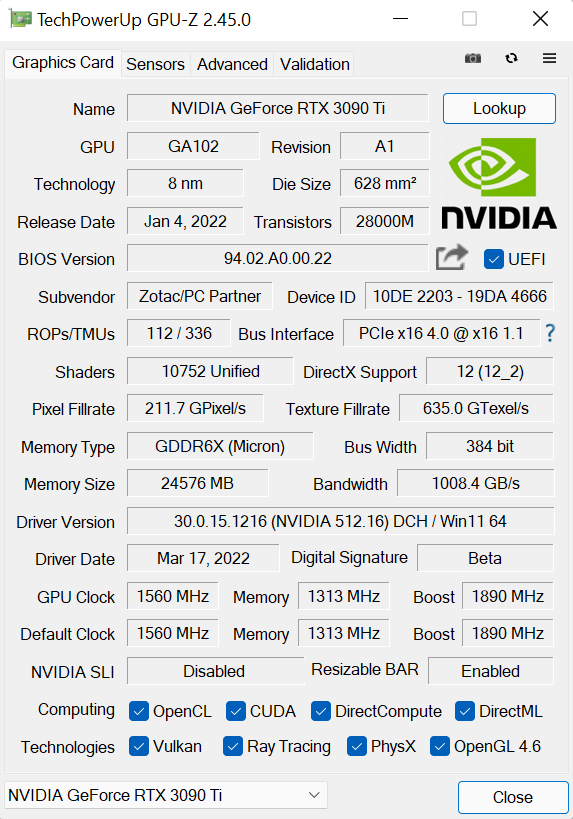
Let’s first recap the exact makeup of this GPU however. The RTX 3090 Ti uses GA102 silicon, but it’s the first time we have seen a fully populated die. That means the RTX 3090 Ti incorporates 84 Streaming Multiprocessors (SMs), and thanks to Ampere’s SM structure with its two FP32 datapaths, each SM houses 128 CUDA cores, giving a total of 10752. This is an increase of 256 cores compared to the RTX 3090, an extra 2.4%.
Ampere also places one RT core, and four Tensor cores, in each SM, giving a total of 84 RT cores and 336 Tensor cores. This is accompanied by 336 texture units and 112 ROPs which are housed directly within each graphics processing cluster (GPC), with 16 ROPs per GPC, and 7 GPCs in total for RTX 3090 Ti.
Clock speed is another area where Nvidia has made improvements compared to the RTX 3090. The RTX 3090 Ti has a reference clock of 1860 MHz, a boost of 165 MHz against the RTX 3090, though of course the Amp Extreme Holo comes factory overclocked. We test real-world clock speed behaviour later in this review.
For the memory, Nvidia is using the same 384-bit bus as found with the RTX 3090. The memory allocation itself remains with 24GB of GDDR6X, but the kicker is these modules themselves have been upgraded to new 21Gbps chips. This brings total memory bandwidth up to over 1TB/s, hitting 1008GB/s to be precise.
Lastly, for total graphics power, Nvidia rates the RTX 3090 Ti for 450W, an increase of 100W, or 28.6% compared to the vanilla RTX 3090. The Amp Extreme Holo does not push this further.
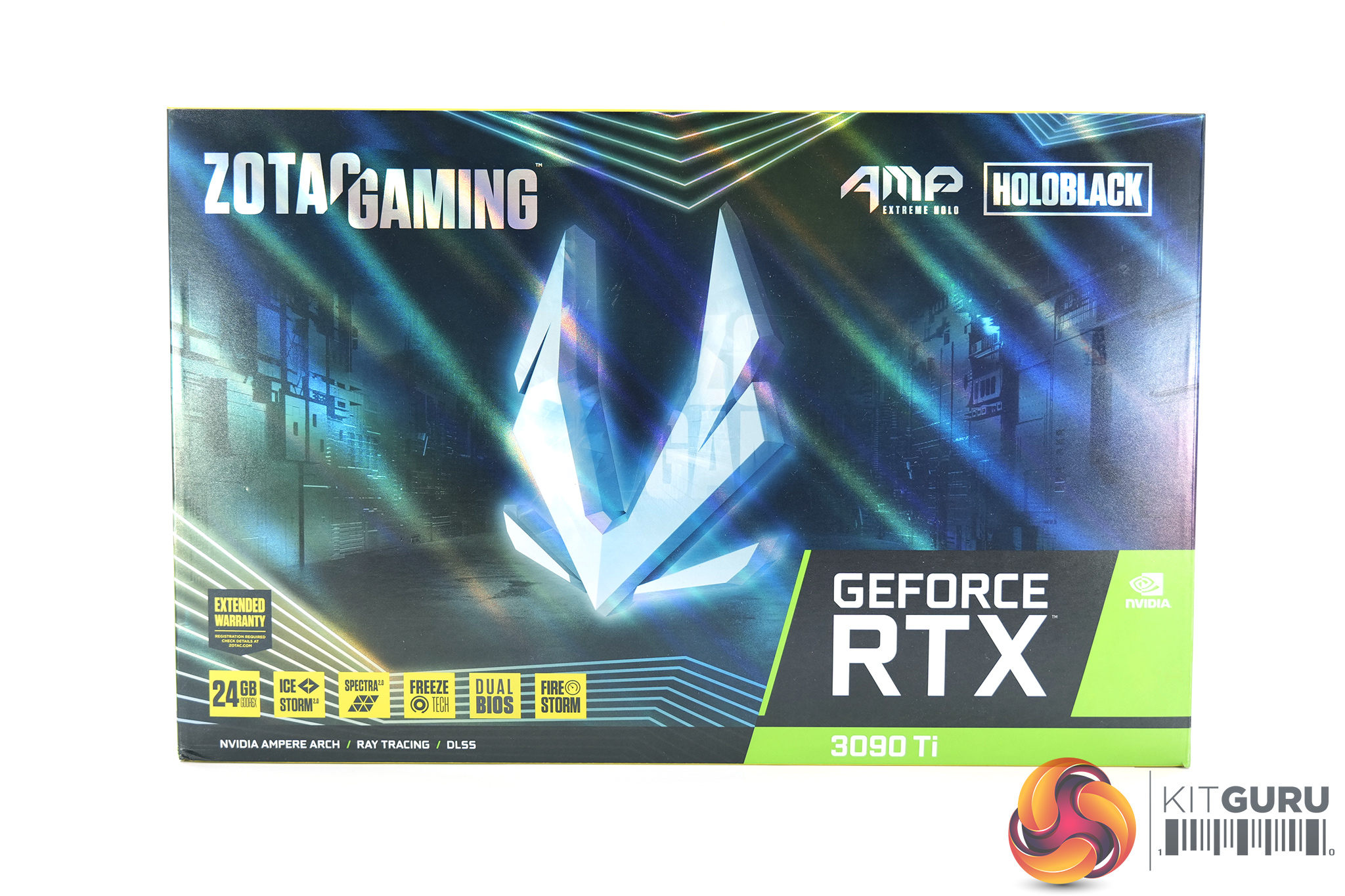
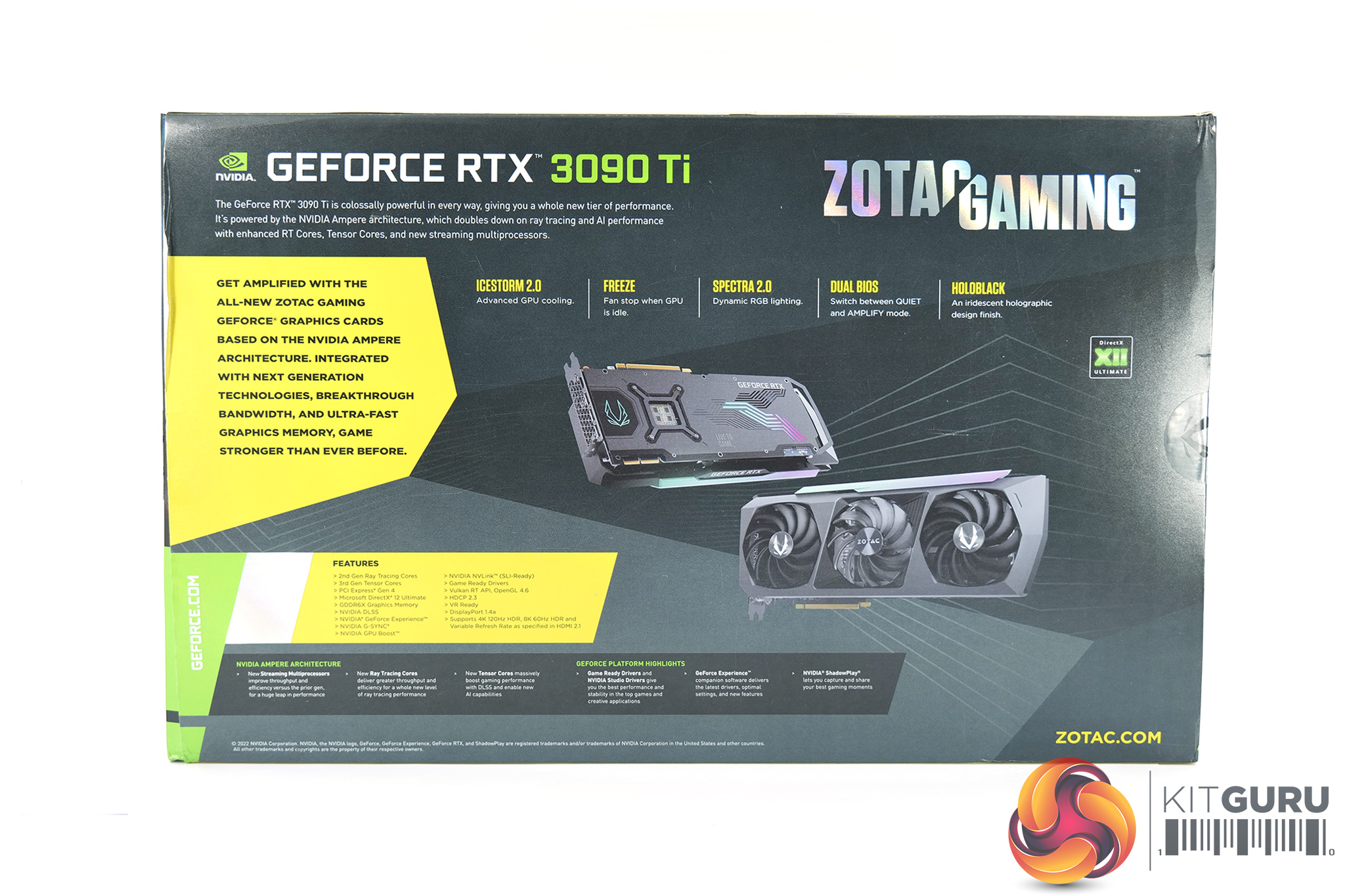
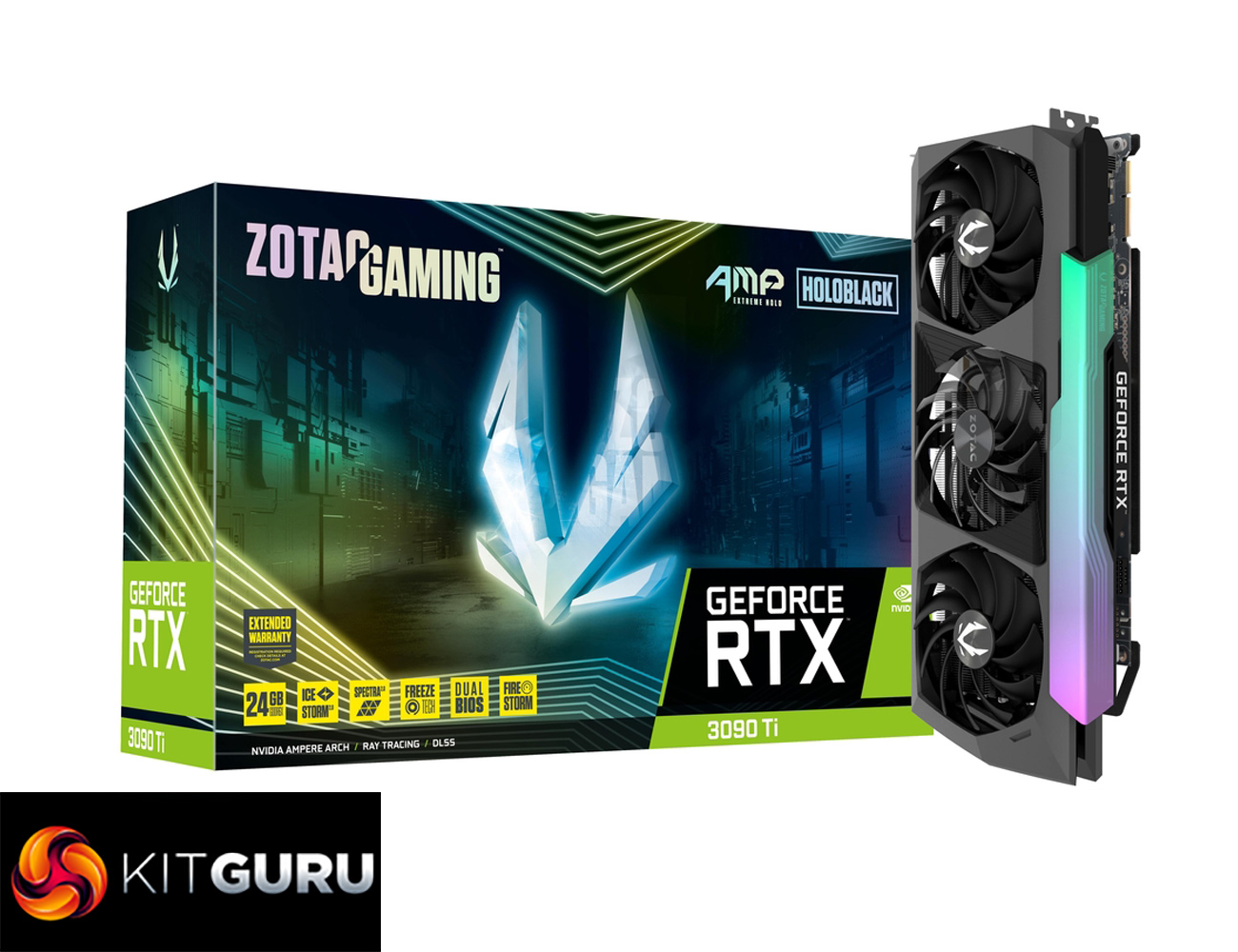
The Zotac RTX 3090 Ti Amp Extreme Holo ships in an attractive blue box, with the Zotac logo taking pride of place in the middle.
On the back, Zotac highlights a handful of key features of the card.
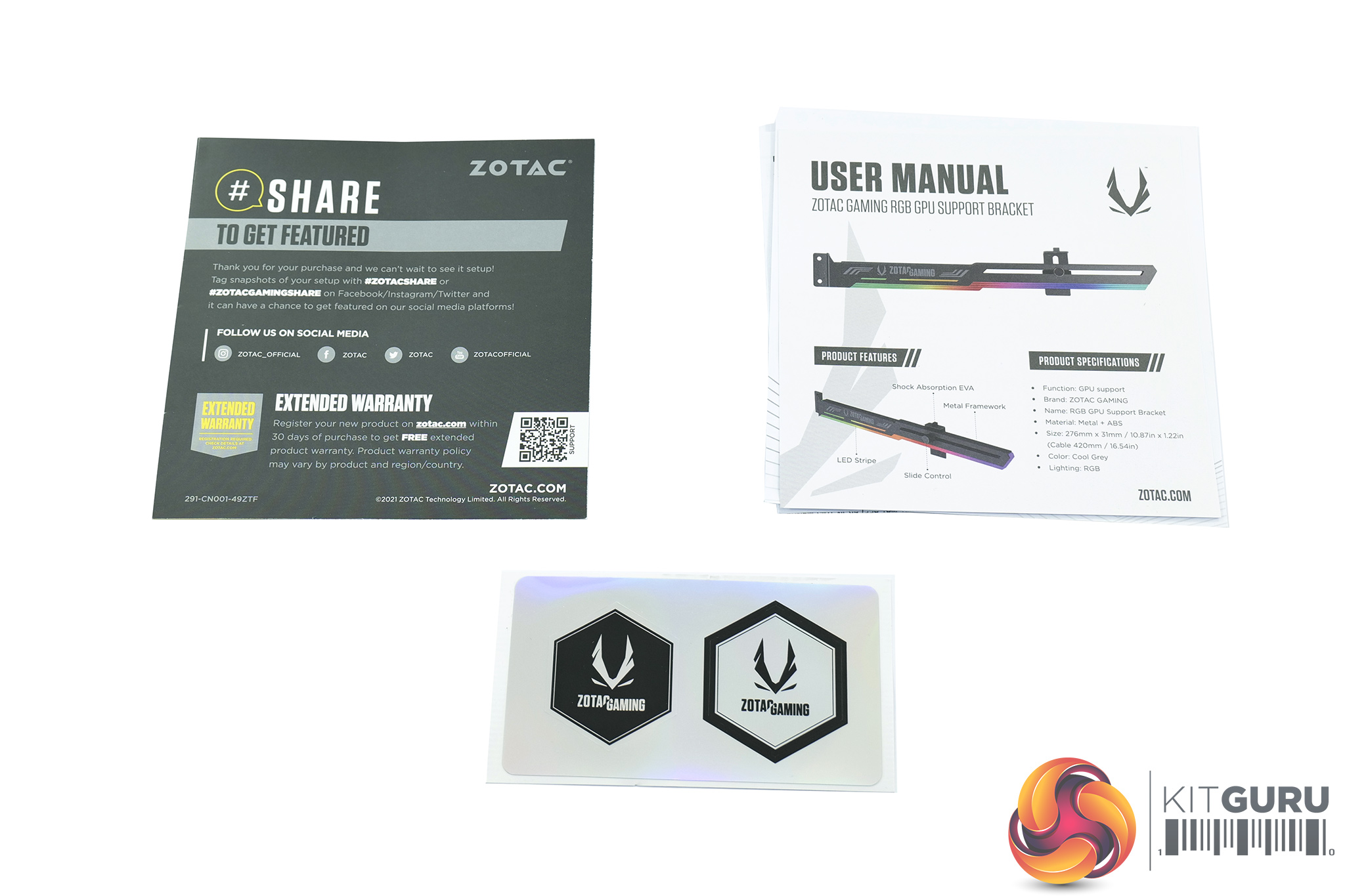
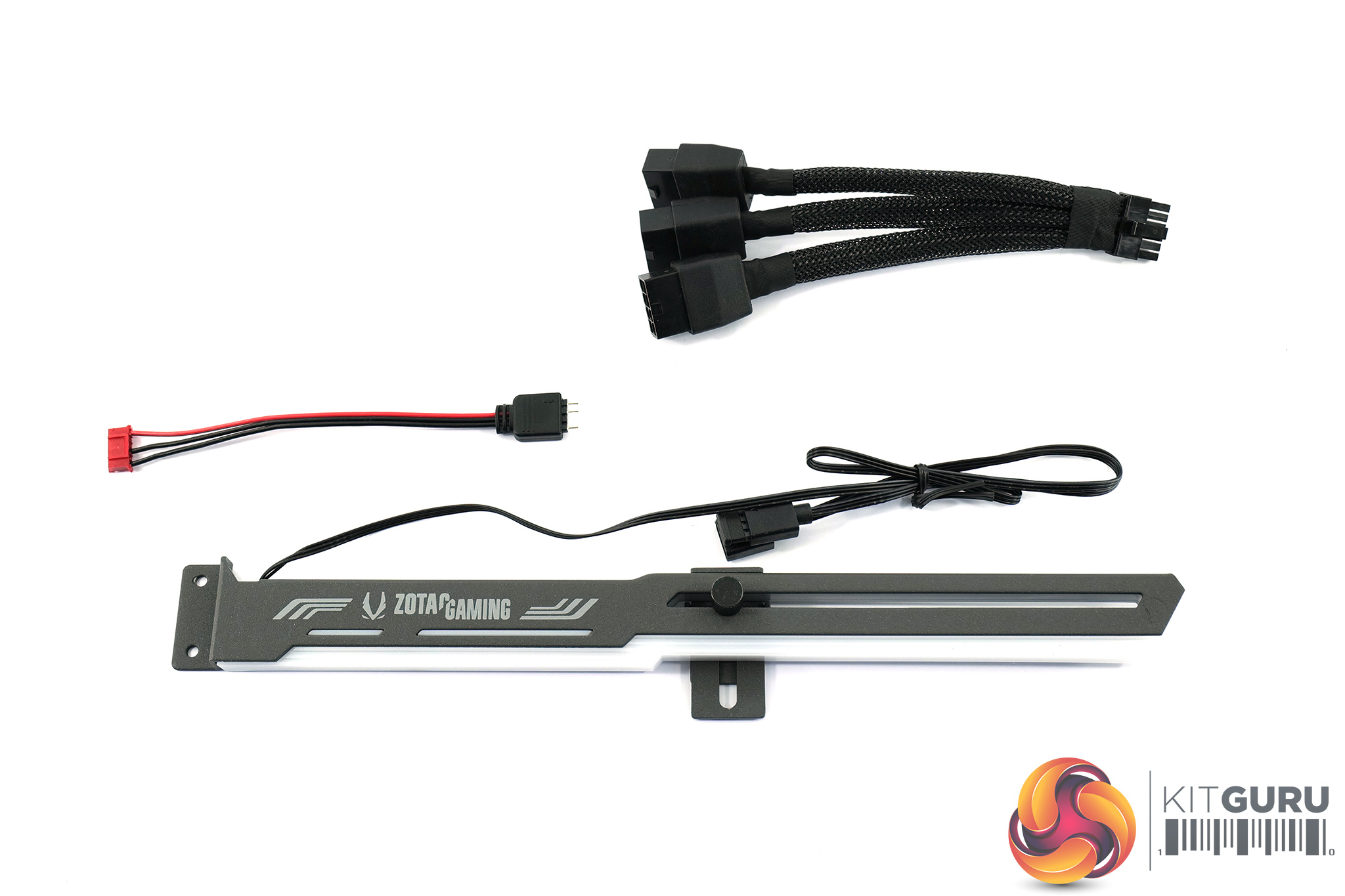
Inside, we get a bunch of leaflets and documentation, as well as a couple of stickers. More interesting is the GPU support bracket, which is RGB-equipped, and a power adaptor is also included for the PCIe Gen5 16-pin header that is used on the card.
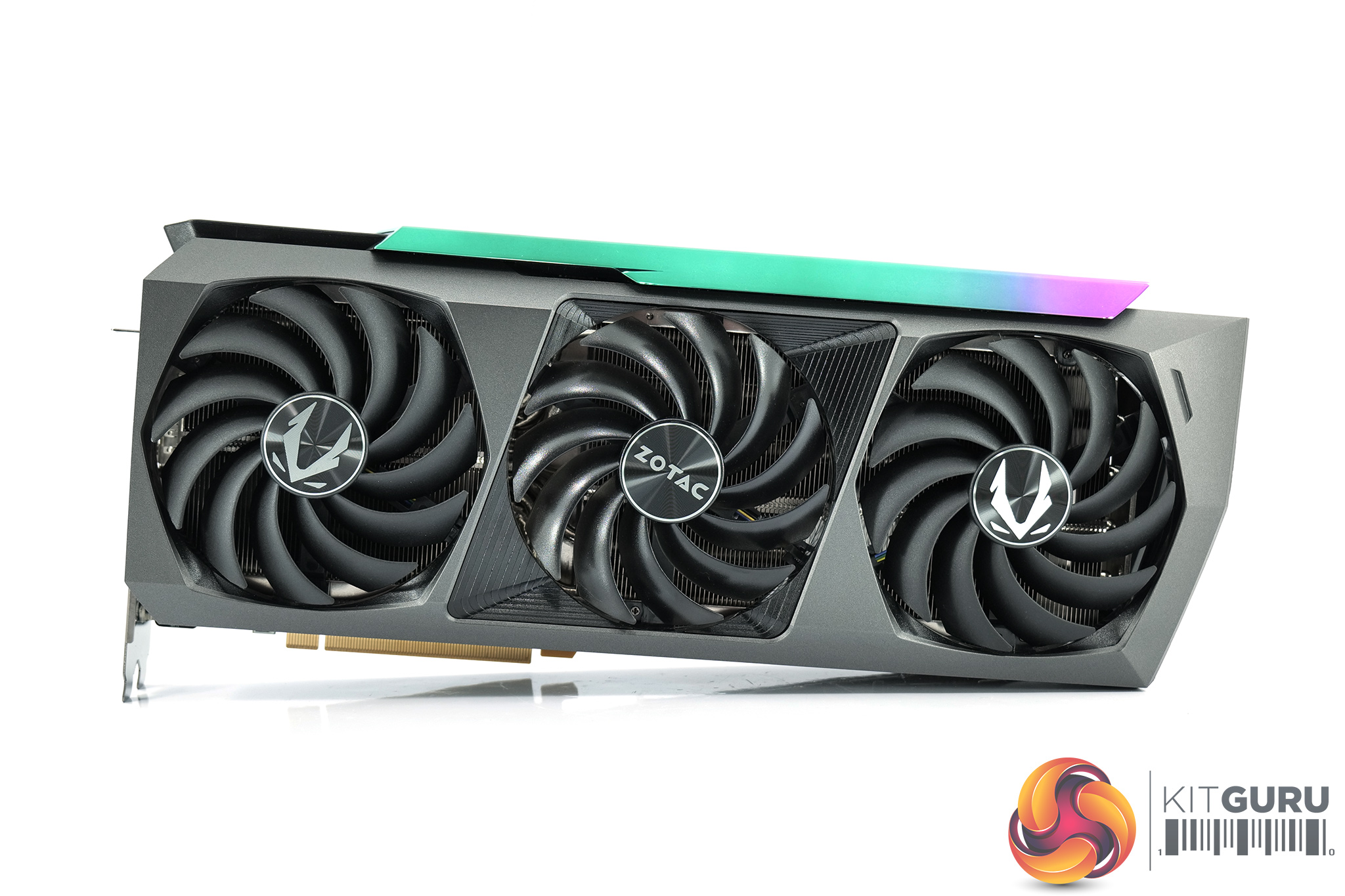
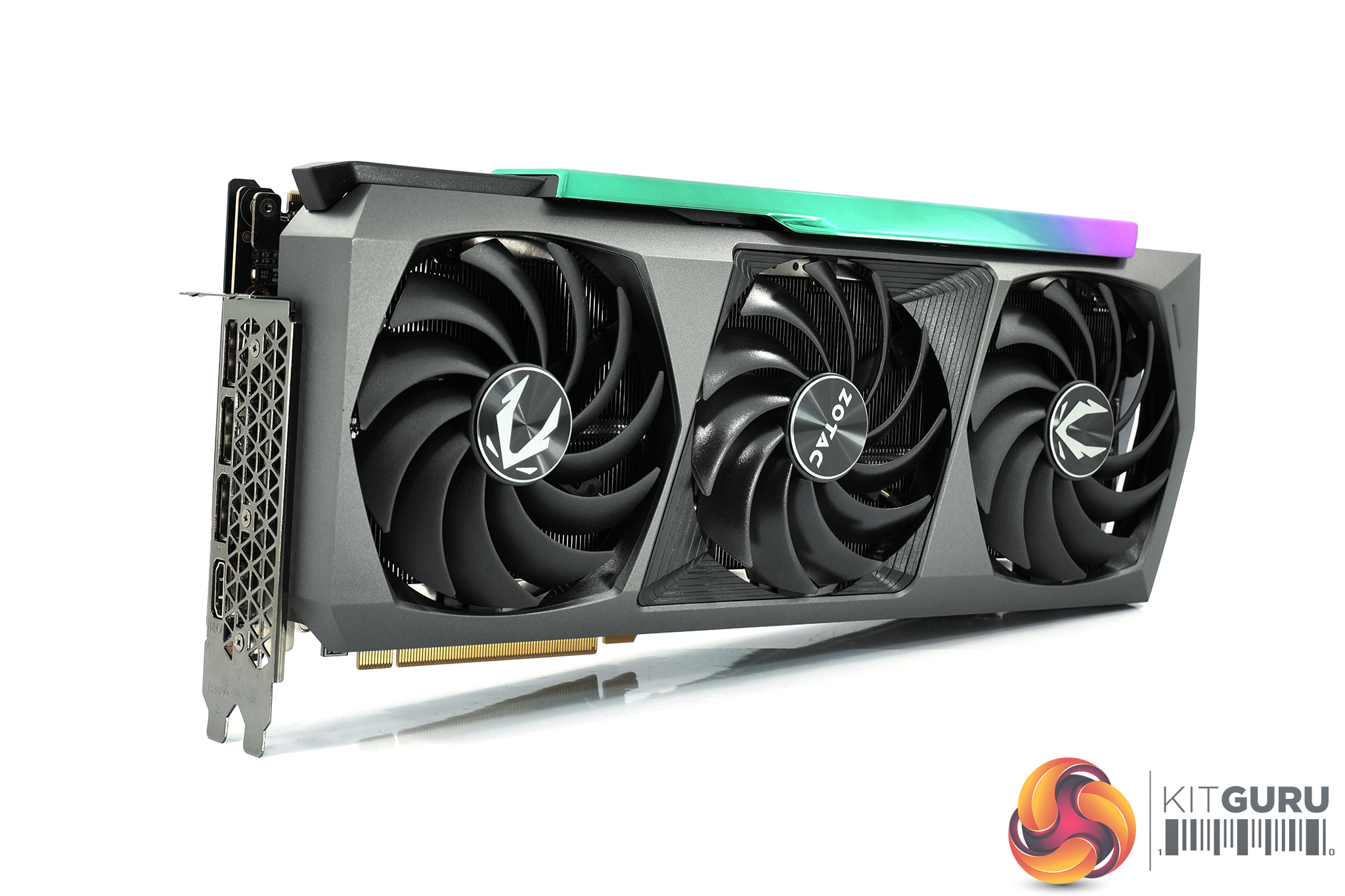
Taking a look at the card itself, as we mentioned on the first page, the design is very similar to the RTX 3090 Amp Extreme Holo. Zotac is using a dark grey plastic shroud, but your eye has probably been drawn by the holographic plastic section on the top of the card – this is one of the card's RGB zones, as shown below.
As part of the HoloBlack cooler design, we can also note three 100mm fans. Interestingly, both of the outer fans have solid, matte fan blades whereas the central fan has glossy, translucent fan blades.
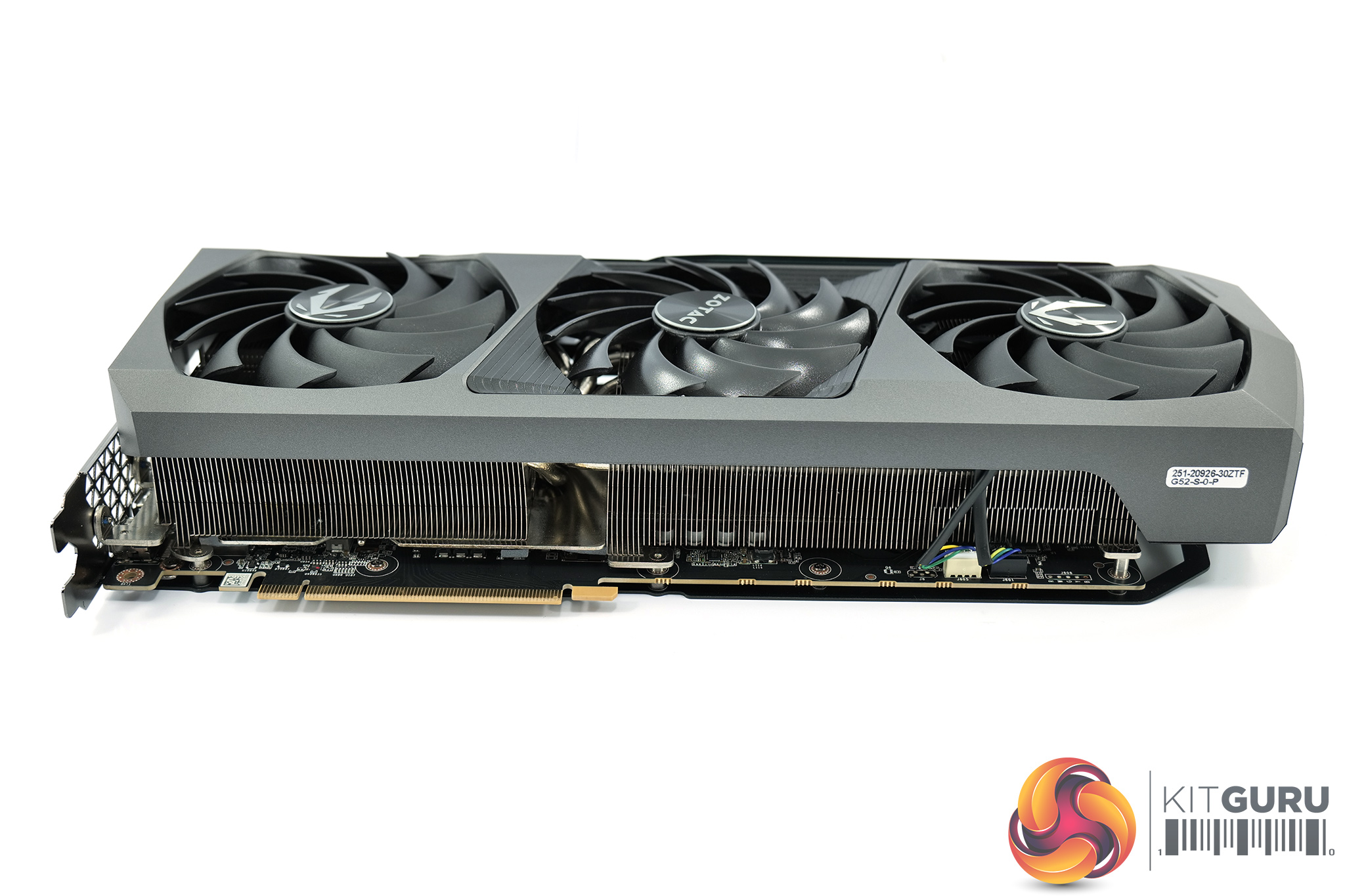
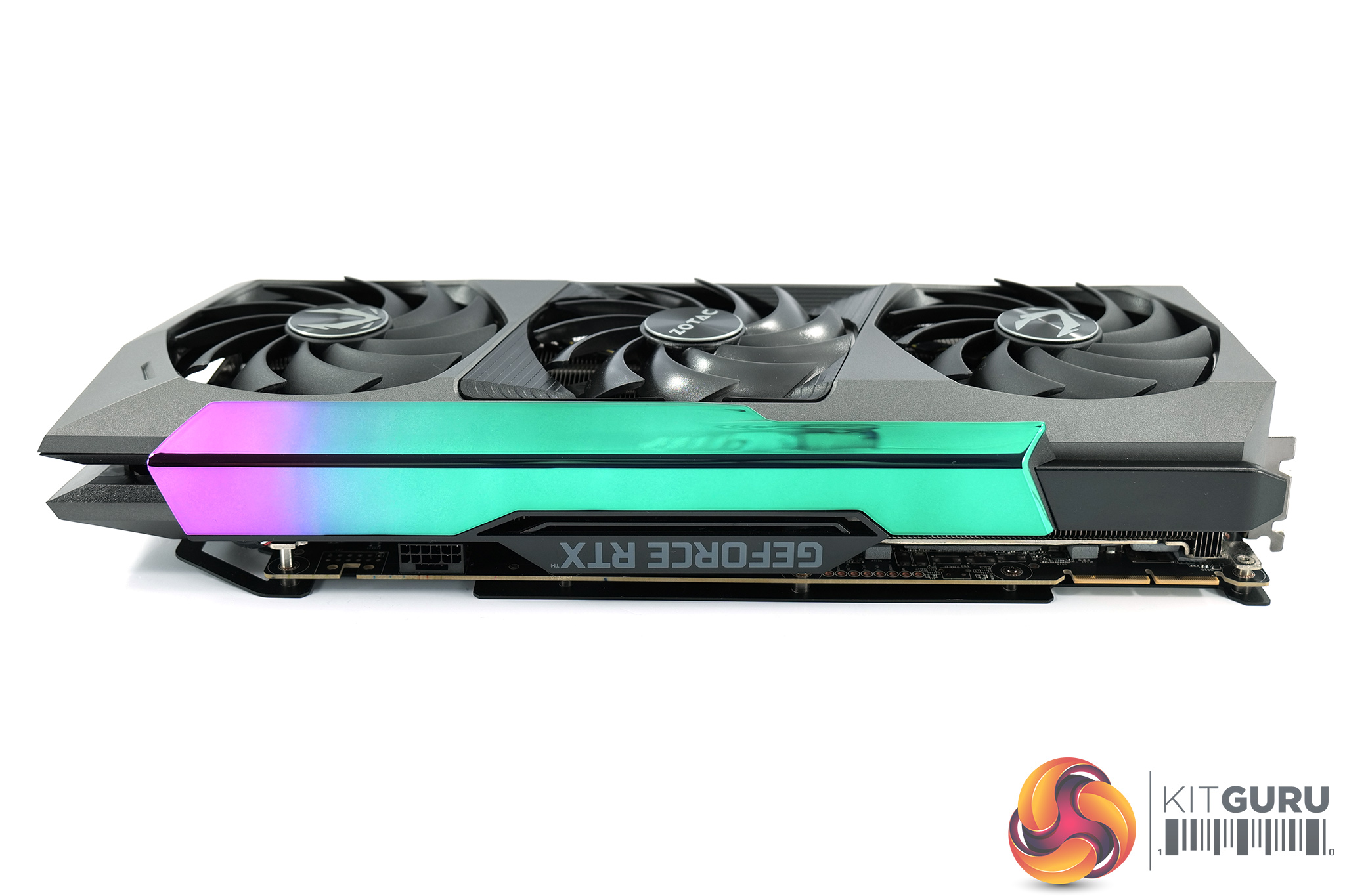
As with any RTX 3090 Ti, the Amp Extreme Holo is absolutely massive, measuring 355.9mm x 149.7mm x 63.9mm. That makes it a proper triple-slot card, and it is very long too, so definitely double-check that this will fit in your case. You may want to use that included support bracket too, as the card weighs 2.08KG on my scales.
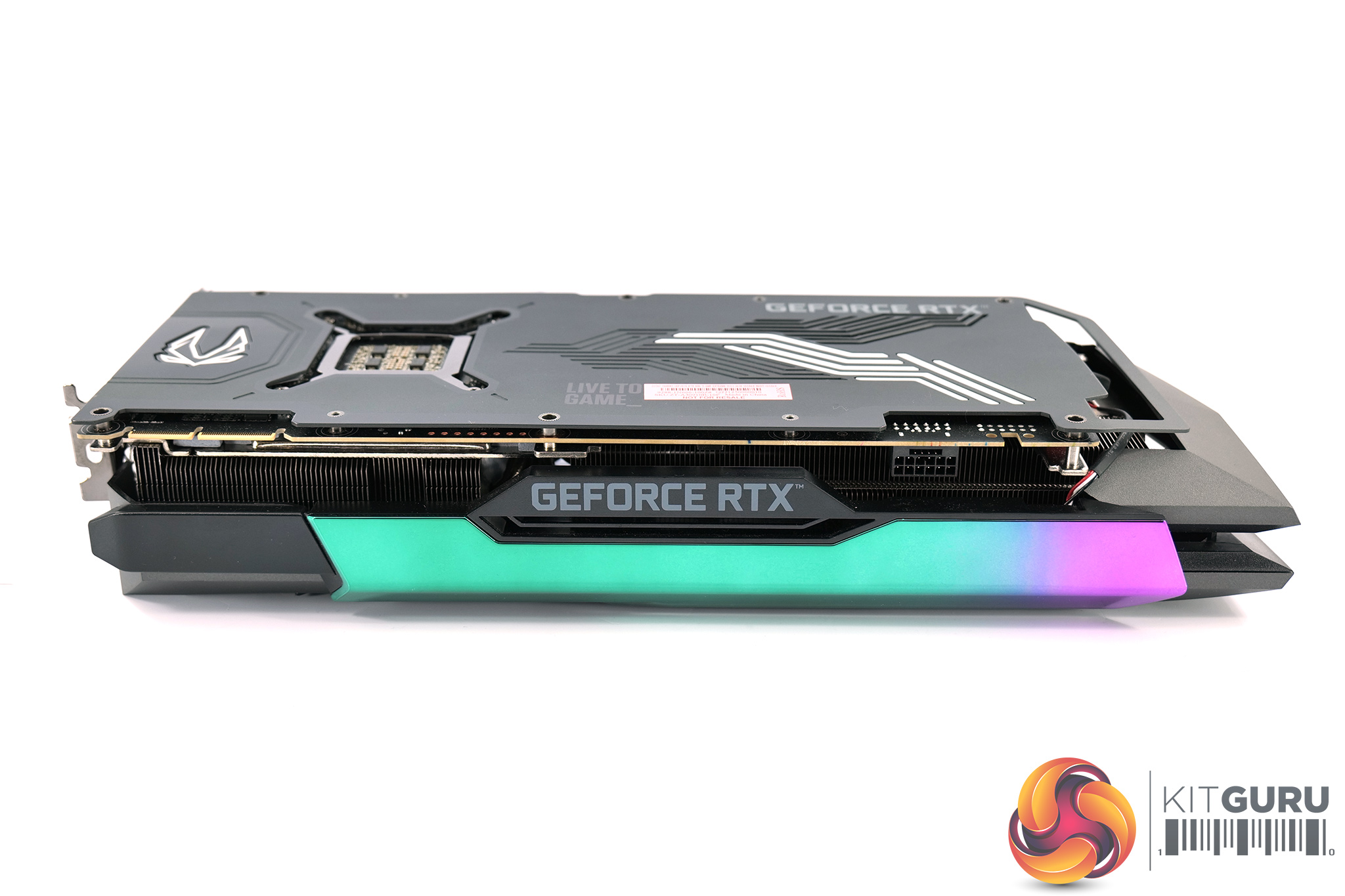
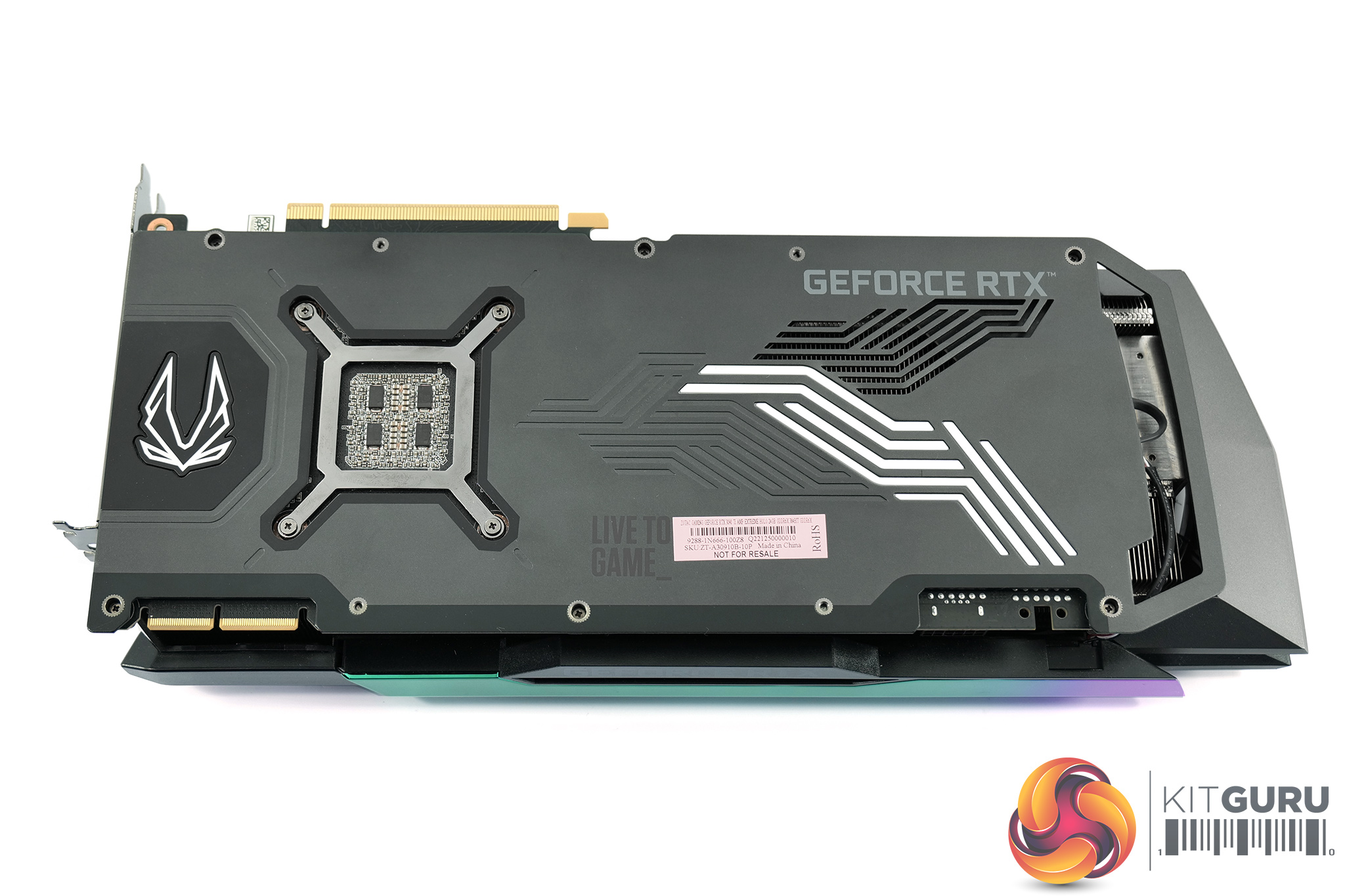
Here we get another good look at the holographic section on the card, while we can also note the metal backplate that is used. This features two RGB lighting sections – the Zotac logo on the left side, as well as the angular LED strips over towards the end of the card.
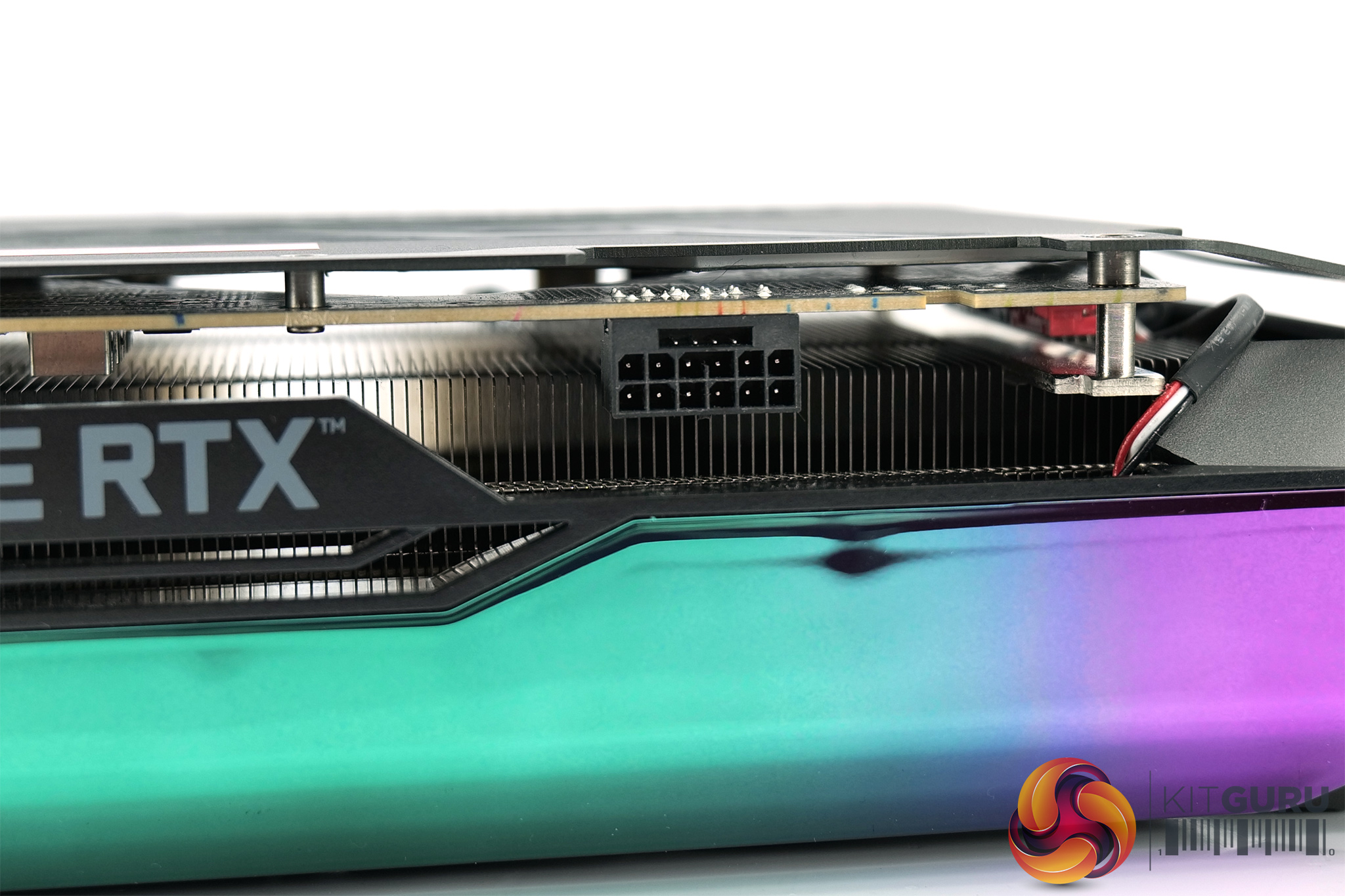
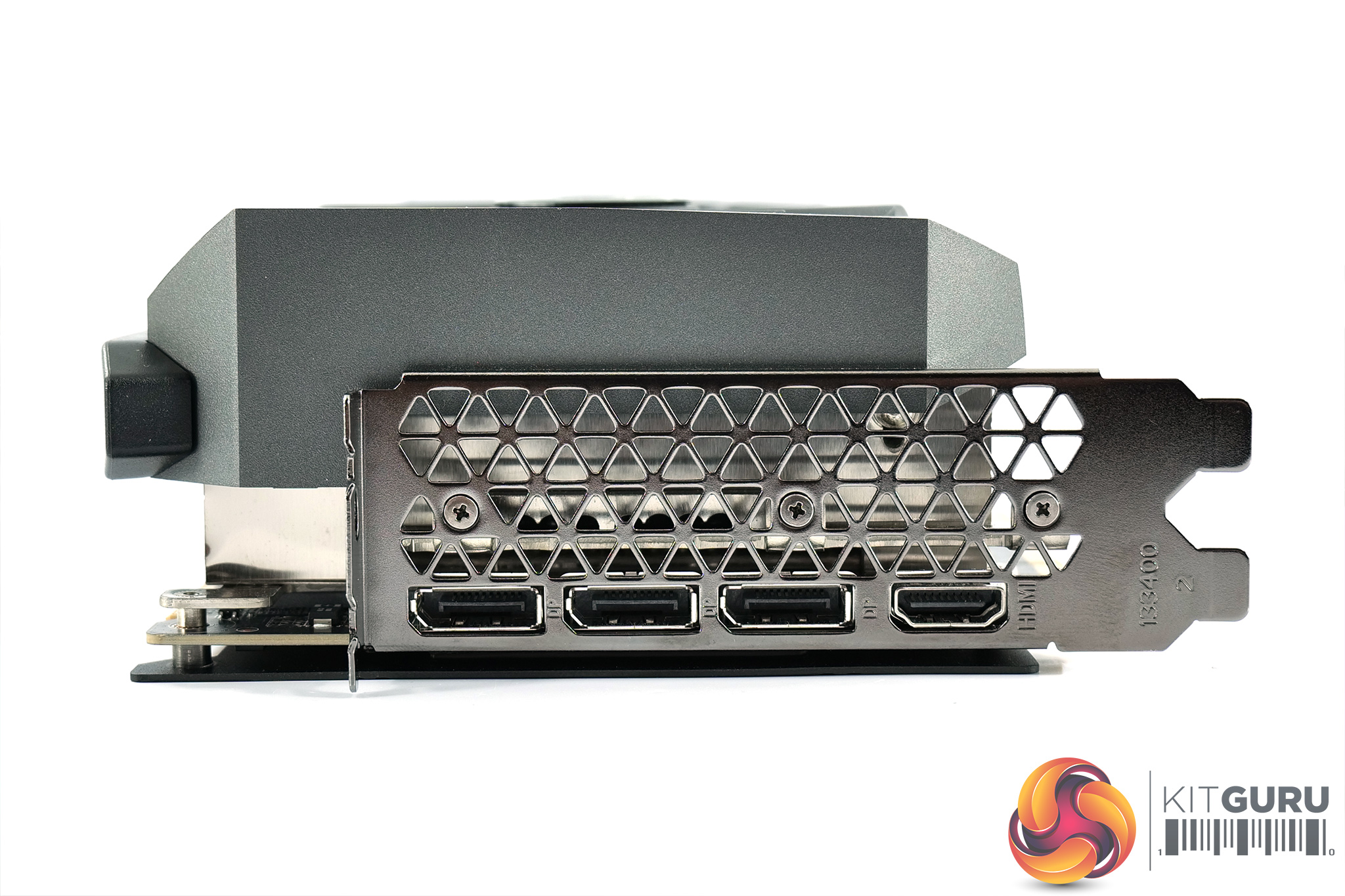
For power, we find a single PCIe Gen5 16-pin connector. Display outputs consist of 3x DisplayPort 1.4 and 1x HDMI 2.1.
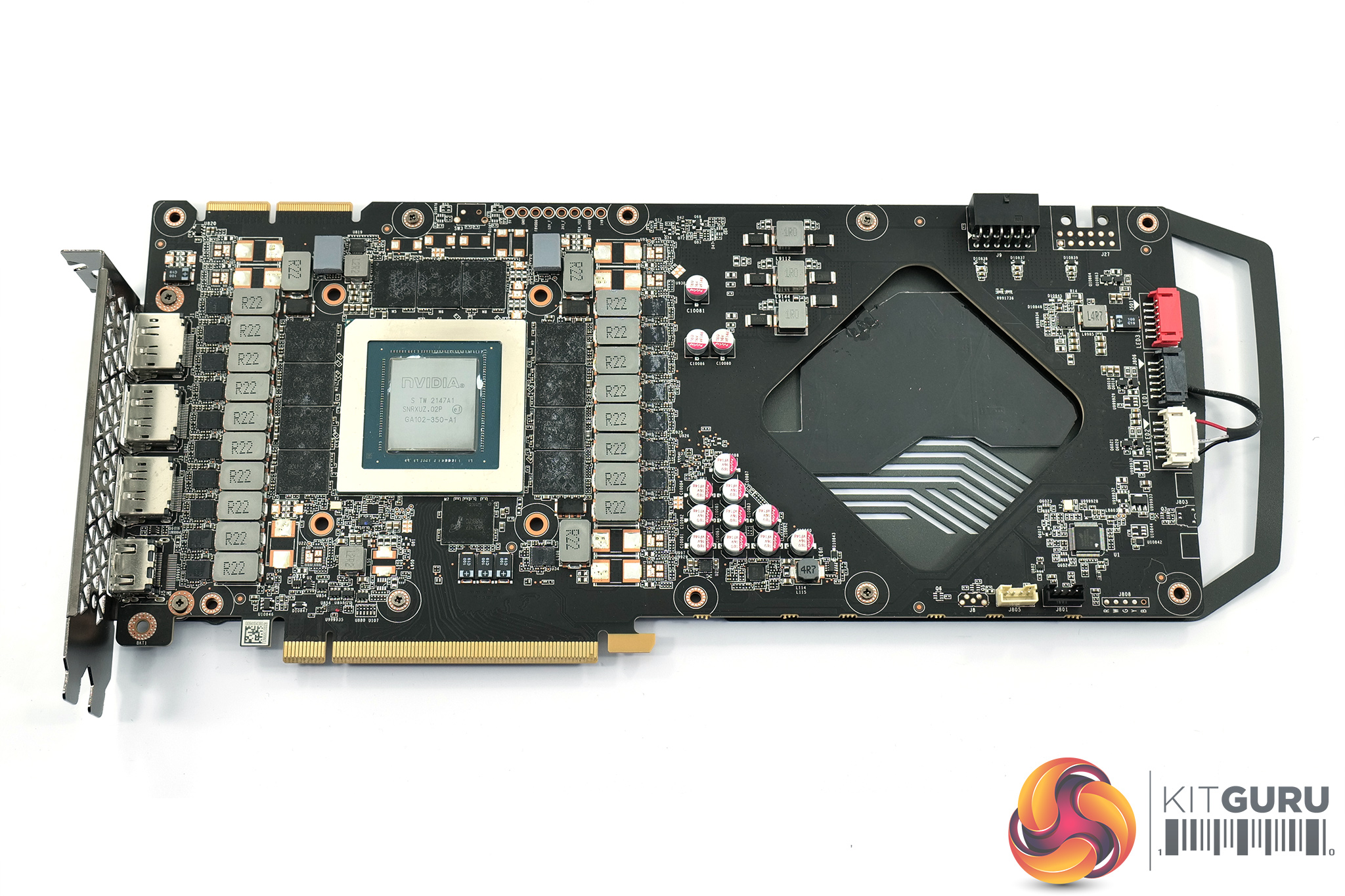
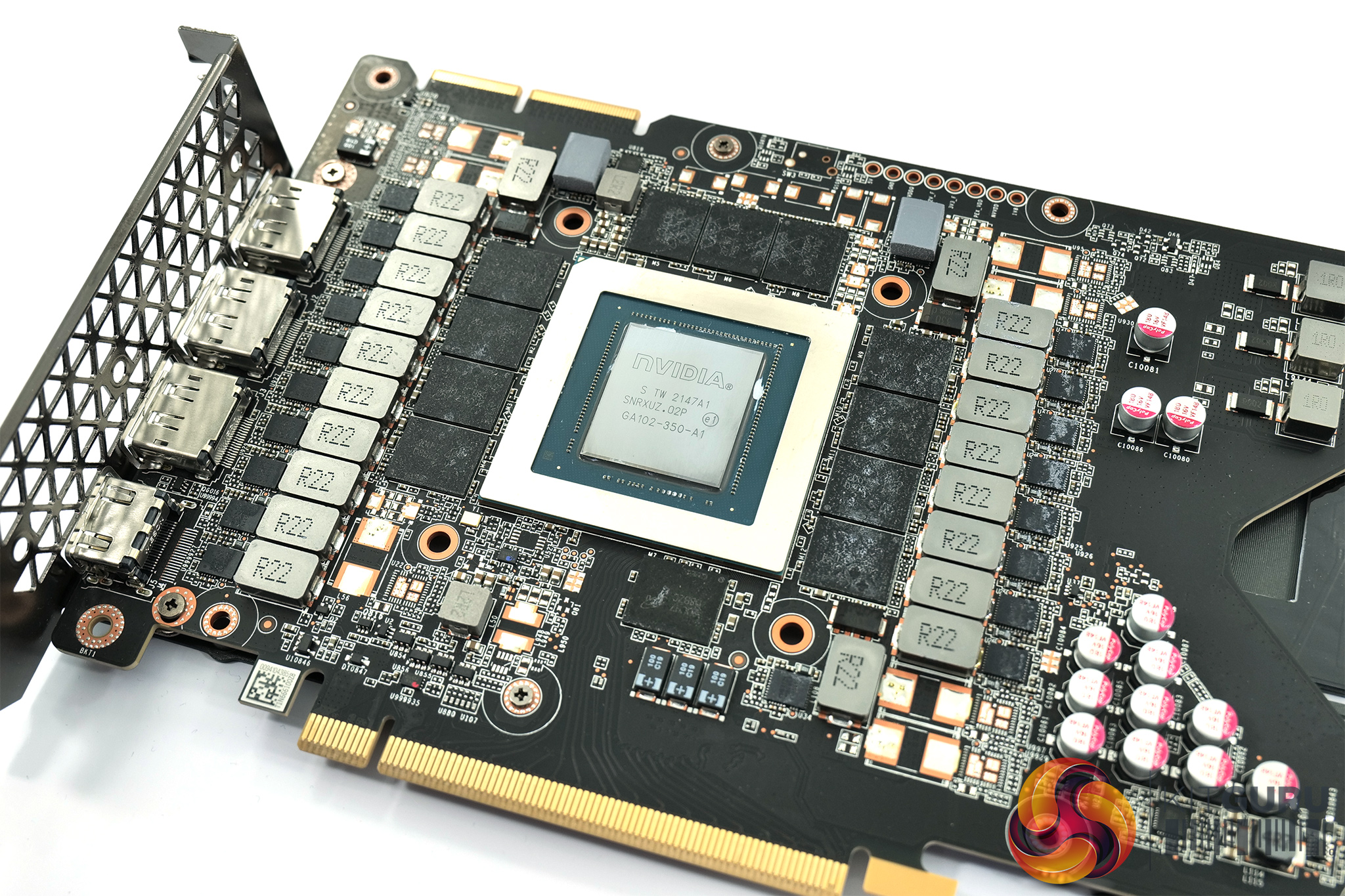
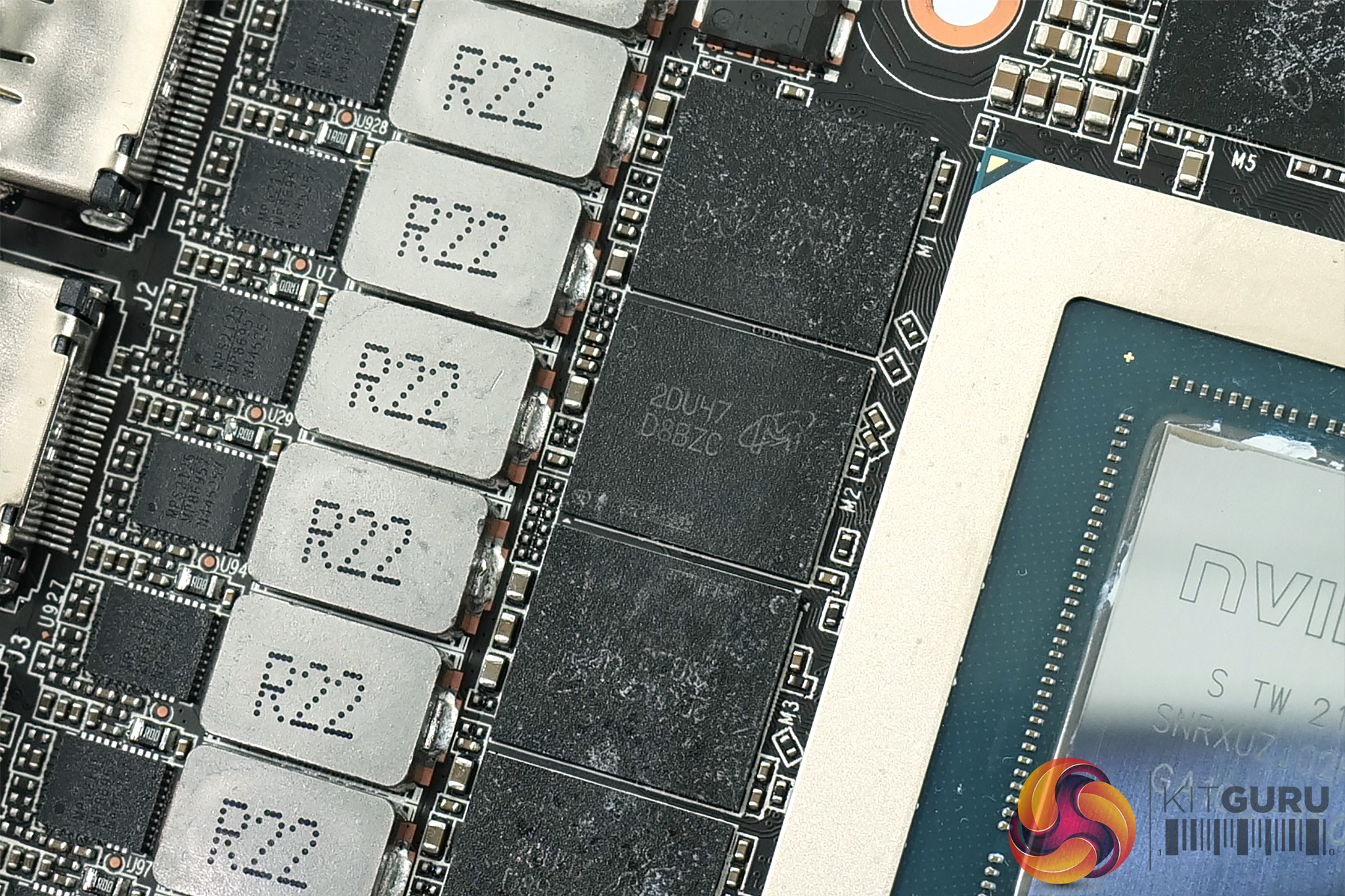
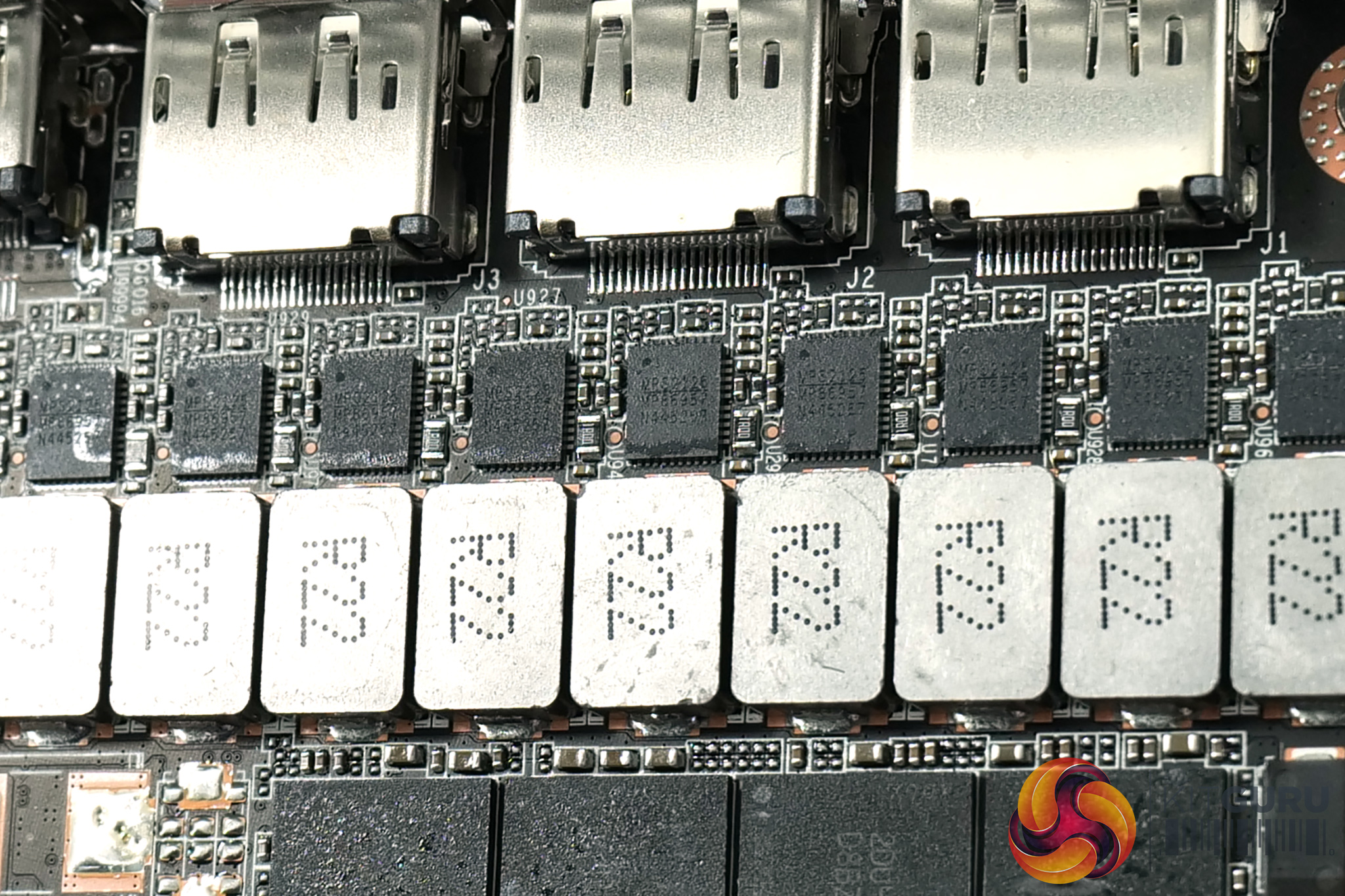
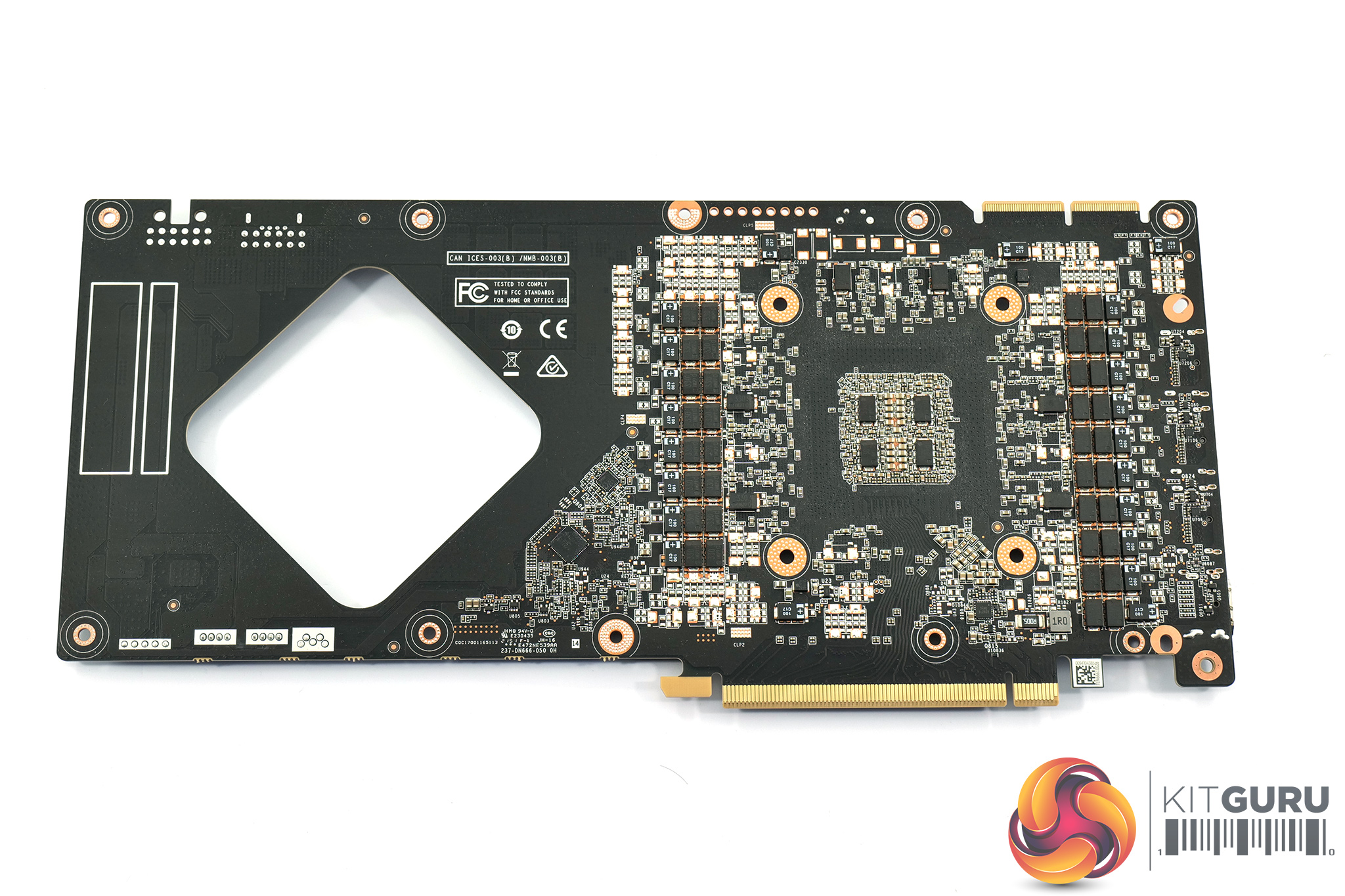
Opening up the card to look at the PCB, the first thing to note is the unusual diamond-shaped cut-out in the PCB itself – there's just a big hole to the right of the GPU and memory chips. In theory this would allow for airflow to pass straight through the heatsink and PCB, but Zotac has mystifyingly blocked this cut-out with the card's backplate, allowing on a very small amount of airflow out thanks to a few tiny cut-outs in the metal.
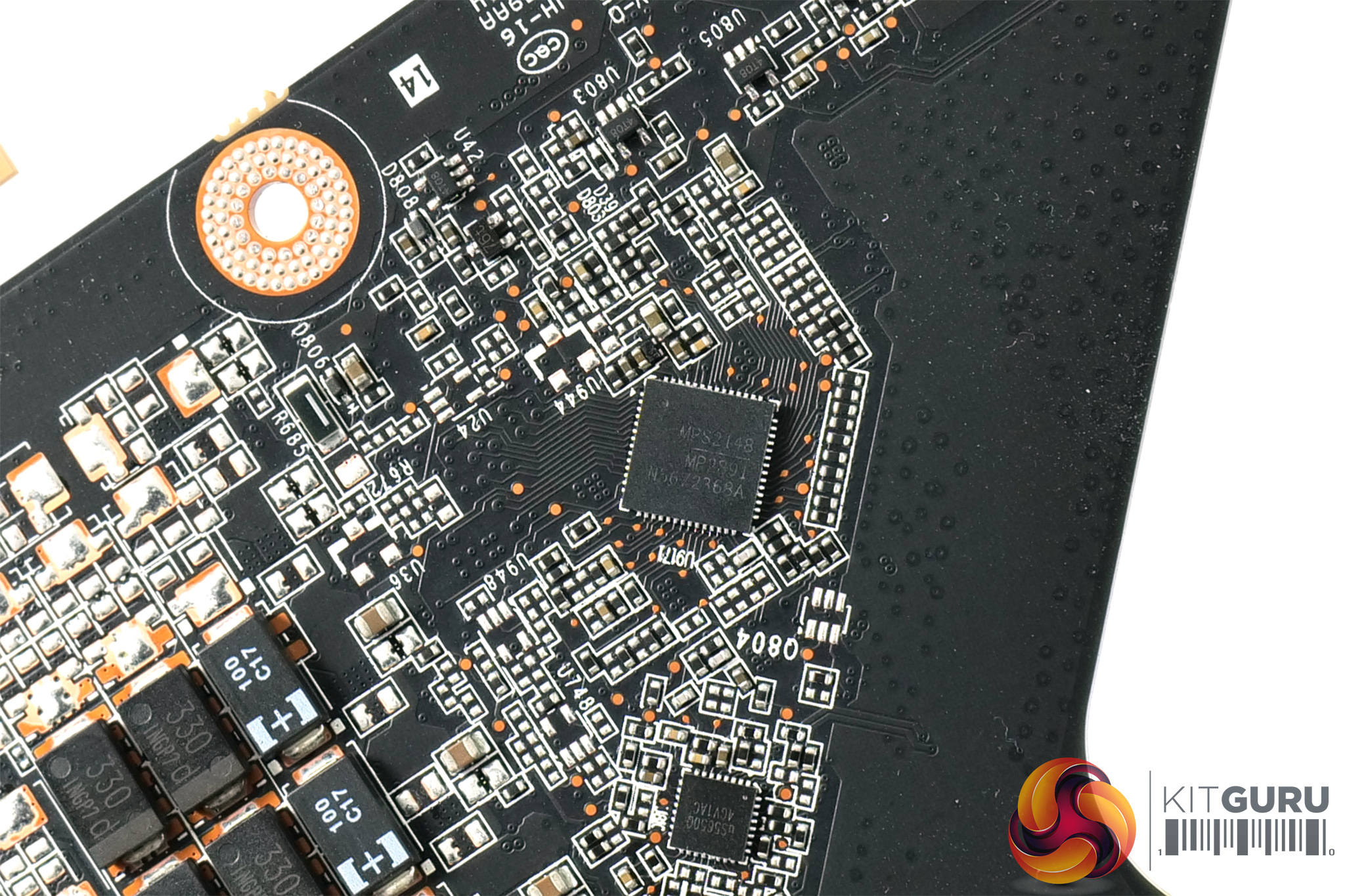
Still, we can note a whopping 18-phase VRM for the GPU and a 3-phase VRM for the memory, with Monolithic Power Systems MP86597 MOSFETs used, each rated for 70A. A MPS MP2981 controller is used. We can also note 12x 2GB GDDR6X memory modules from Micron, carrying the D8BZC model code.
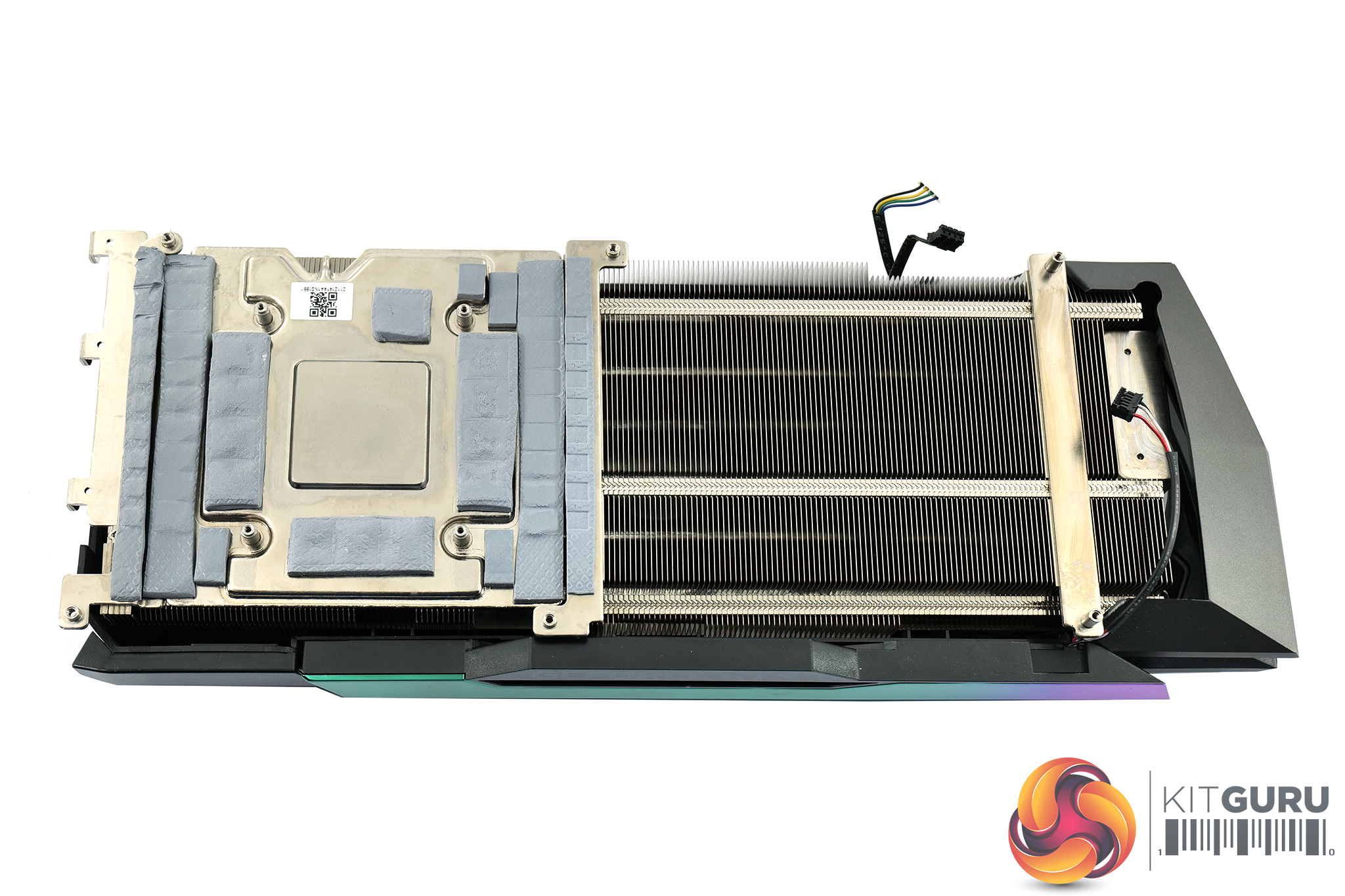
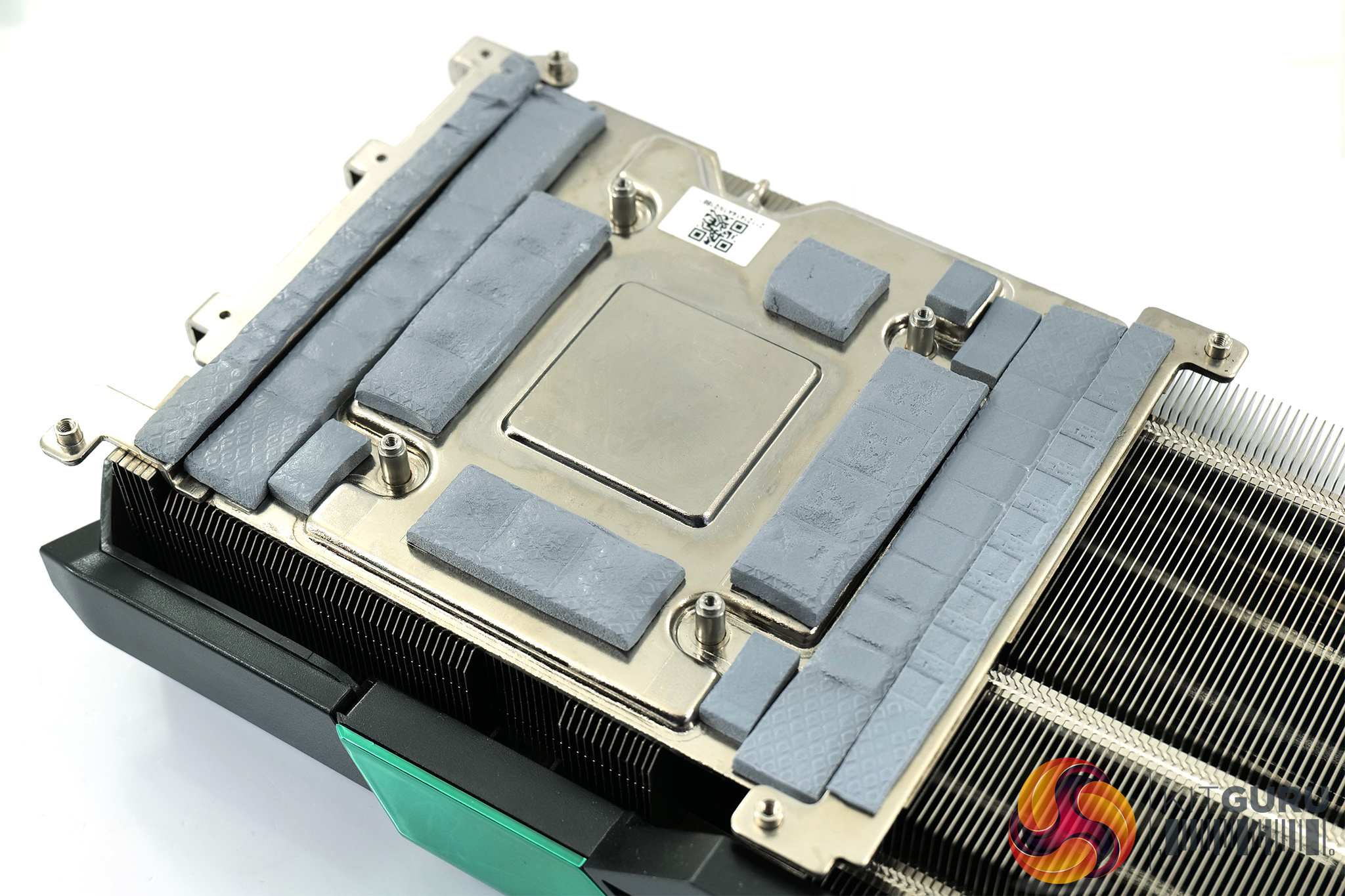
As for the heatsink, not only is it a beast of a unit, with eight heatpipes used, but it also boasts a vapour chamber – something we very rarely see from AIB card designs. The GPU and memory sit directly above said chamber, while the VRM contacts with a baseplate to either side.
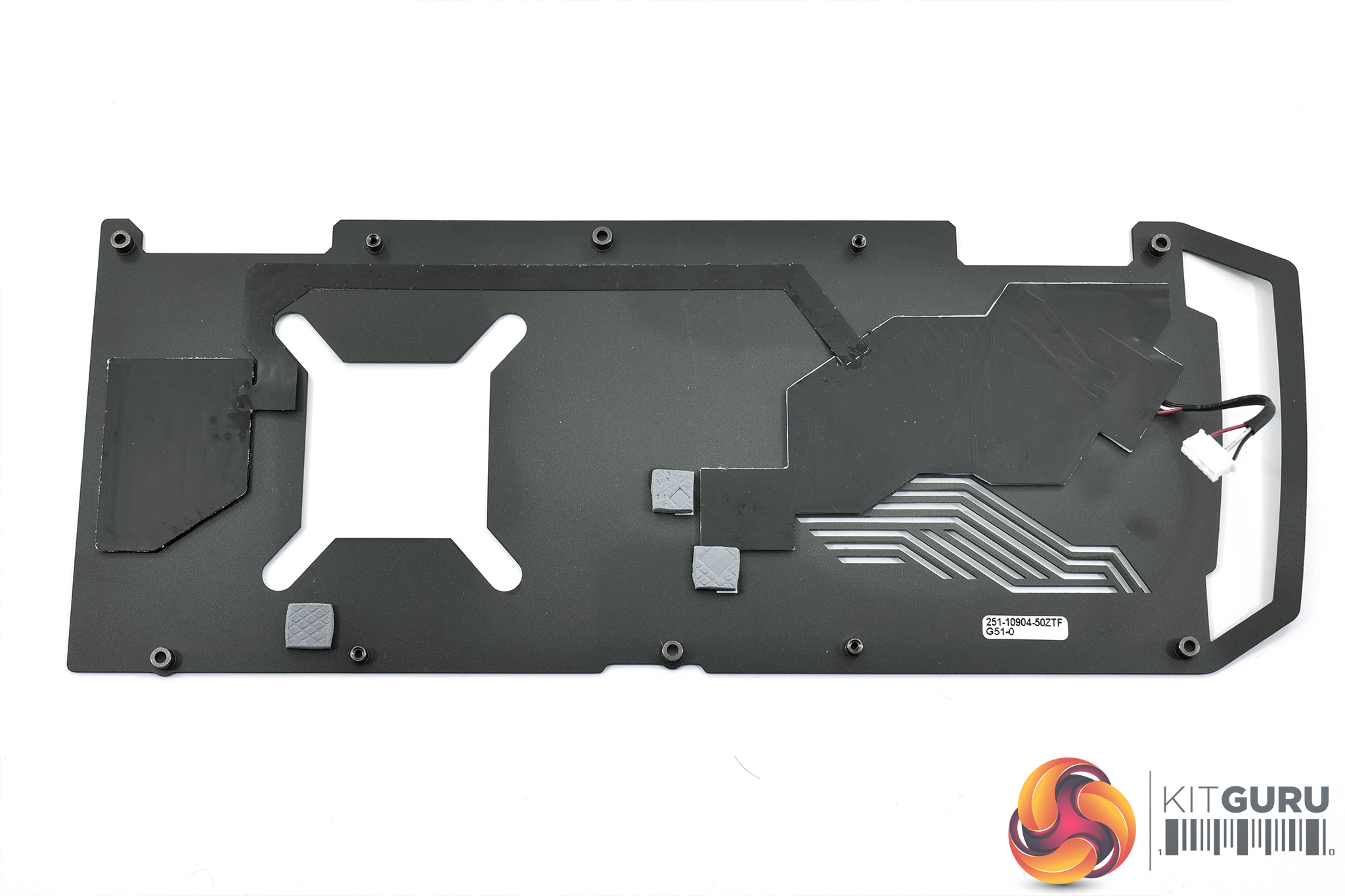
Here we get a look at the underside of the metal backplate – only three small thermal pads are used, one of which sits over the MP2981 controller.
RGB Showcase:
Lastly, in the video above you can get a look at the RGB lighting, which is controlled via Zotac's FireStorm software. It looks clean, shines through very well and is also nice and bright, so for RGB lovers I can have no complaints.
Driver Notes
- All AMD GPUs were benchmarked with the public Adrenalin 22.3.1 driver.
- All Nvidia GPUs (except RTX 3090 Ti) were benchmarked with the 511.79 driver.
- RTX 3090 Ti was benchmarked with the 512.16 driver supplied to press.
Test System:
We test using the a custom built system powered by MSI, based on Intel’s Alder Lake platform. You can read more about this system HERE and check out MSI on the CCL webstore HERE.
| CPU |
Intel Core i9-12900K
|
| Motherboard |
MSI MEG Z690 Unify
|
| Memory |
32GB (2x16GB) ADATA XPG Lancer DDR5 6000MHz
CL 40-40-40
|
| Graphics Card |
Varies
|
| SSD |
2TB MSI Spatium M480
|
| Chassis | MSI MPG Velox 100P Airflow |
| CPU Cooler |
MSI MEG CoreLiquid S360
|
| Power Supply |
Corsair 1200W HX Series Modular 80 Plus Platinum
|
| Operating System |
Windows 11 Pro 21H2
|
| Monitor |
MSI Optix MPG321UR-QD
|
| Resizable BAR |
Enabled for all supported GPUs
|
Comparison Graphics Cards List
- AMD RX 6800 XT 16GB
- AMD RX 6900 XT 16GB
- ASUS RTX 3080 TUF Gaming 10GB
- Nvidia RTX 3080 Ti FE 12GB
- Gigabyte RTX 3090 Eagle 24GB
- Gigabyte Aorus RTX 3090 Ti Xtreme Waterforce 24GB
- MSI RTX 3090 Ti Suprim X 24GB
- Palit RTX 3090 Ti GameRock OC 24GB
Software and Games List
- 3DMark Fire Strike & Fire Strike Ultra (DX11 Synthetic)
- 3DMark Time Spy (DX12 Synthetic)
- Cyberpunk 2077 (DX12)
- F1 2021 (DX12)
- Far Cry 6 (DX12)
- Horizon Zero Dawn (DX12)
- Total War: Warhammer III (DX11)
We run each benchmark/game three times, and present mean averages in our graphs. We use FrameView to measure average frame rates as well as 1% low values across our three runs.
Fire Strike is a showcase DirectX 11 benchmark for modern gaming PCs. Its ambitious real-time graphics are rendered with detail and complexity far beyond other DirectX 11 benchmarks and games. Fire Strike includes two graphics tests, a physics test and a combined test that stresses the CPU and GPU. (UL).
3DMark Time Spy is a DirectX 12 benchmark test for Windows 10 gaming PCs. Time Spy is one of the first DirectX 12 apps to be built the right way from the ground up to fully realize the performance gains that the new API offers. With its pure DirectX 12 engine, which supports new API features like asynchronous compute, explicit multi-adapter, and multi-threading, Time Spy is the ideal test for benchmarking the latest graphics cards. (UL).
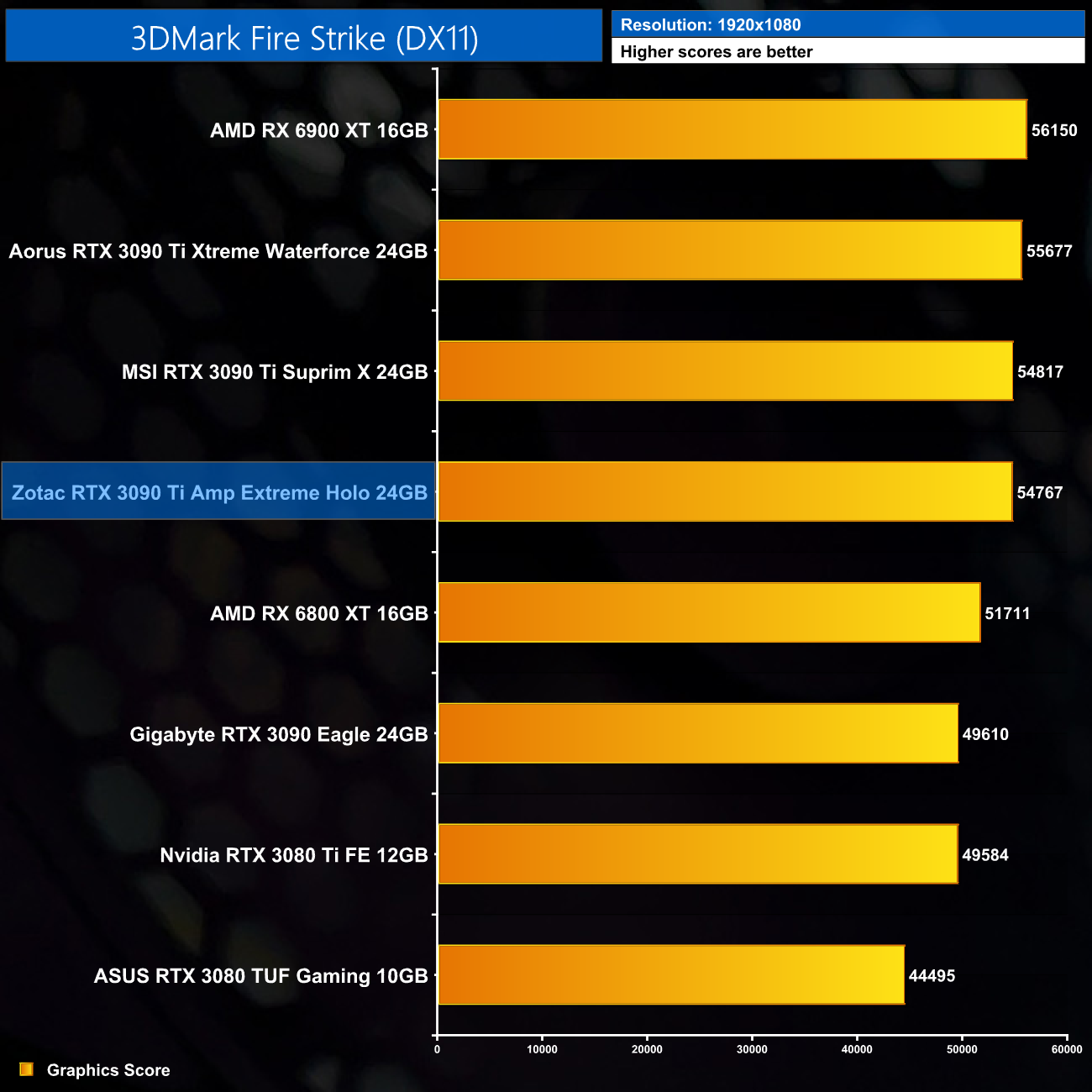
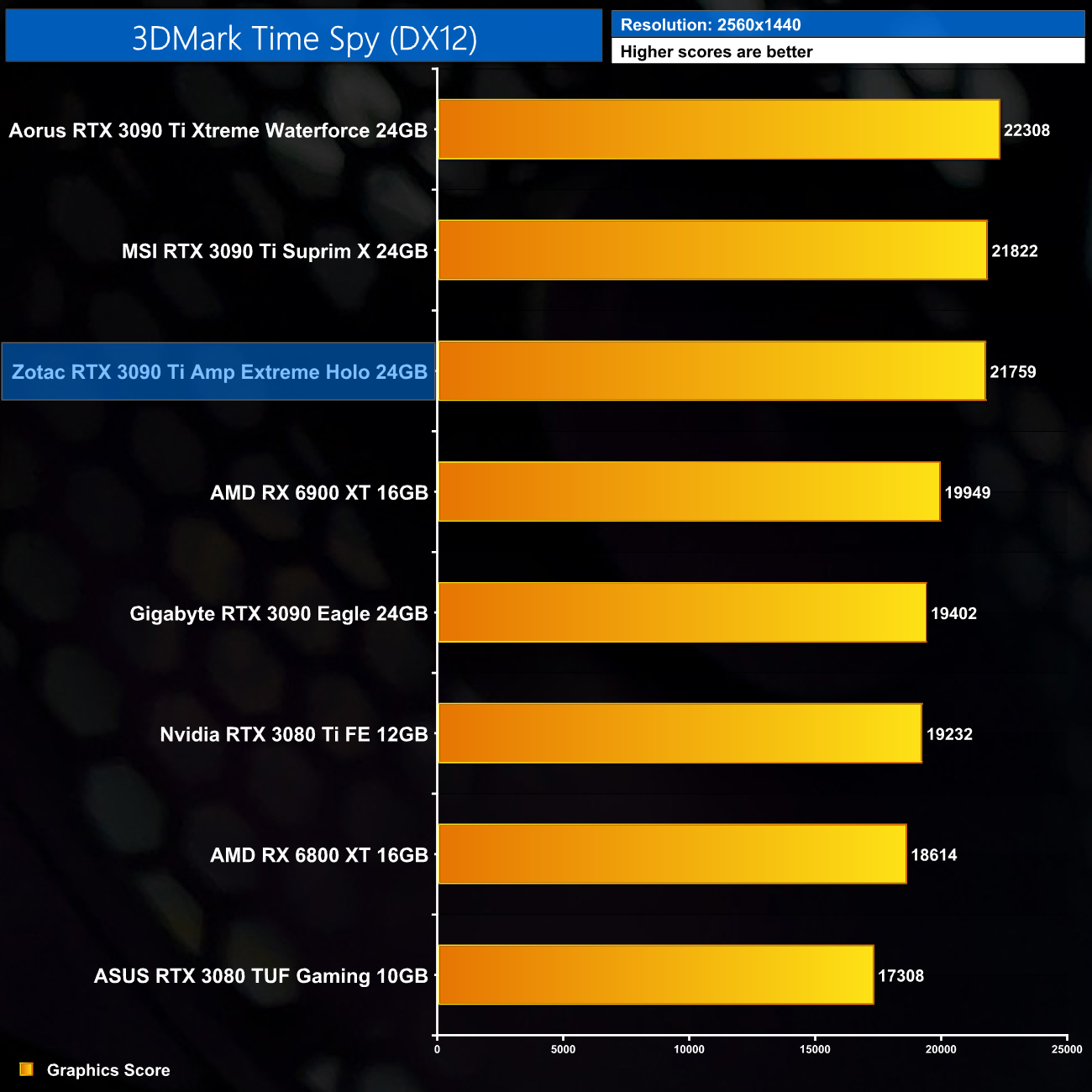
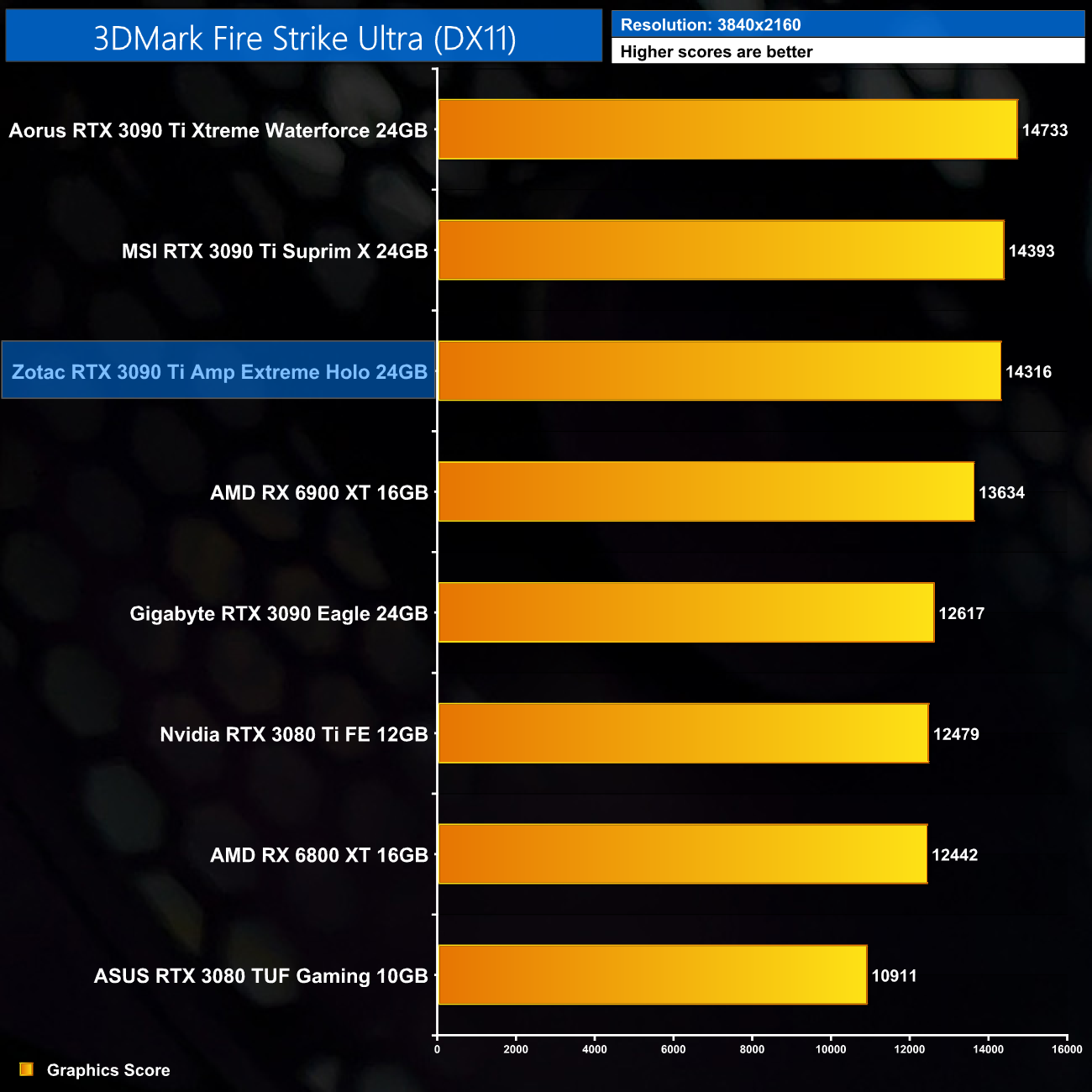
Kicking off with our 3DMark benchmarks, the results here are as expected. The Amp Extreme Holo is delivering almost identical scores to the MSI Suprim X, coming within a single percentage point of that card in all three benchmarks shown.
Real-time ray tracing is incredibly demanding. The latest graphics cards have dedicated hardware that’s optimized for ray-tracing. The 3DMark DirectX Raytracing feature test measures the performance of this dedicated hardware. Instead of using traditional rendering techniques, the whole scene is ray-traced and drawn in one pass. The result of the test depends entirely on ray-tracing performance. (UL).
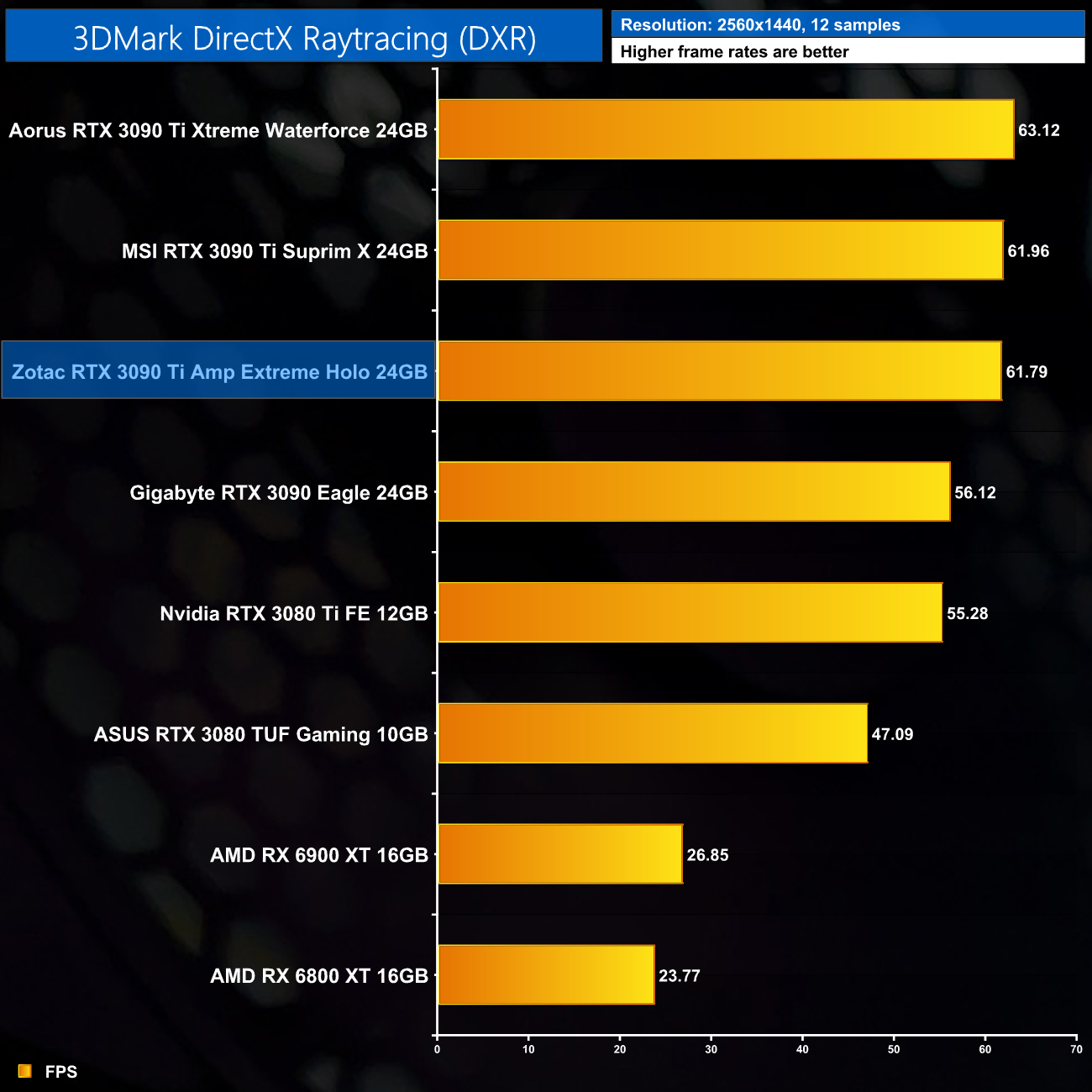
Similarly, for the DXR Featuretest, the Amp Extreme Holo is just 0.17FPS behind the Suprim X, though it is slightly further behind than the Aorus Xtreme Waterforce – but that is to be expected considering the Waterforce uses a 360mm AIO…
Here we test five games, all at 3840×2160 resolution using maximum image quality settings.
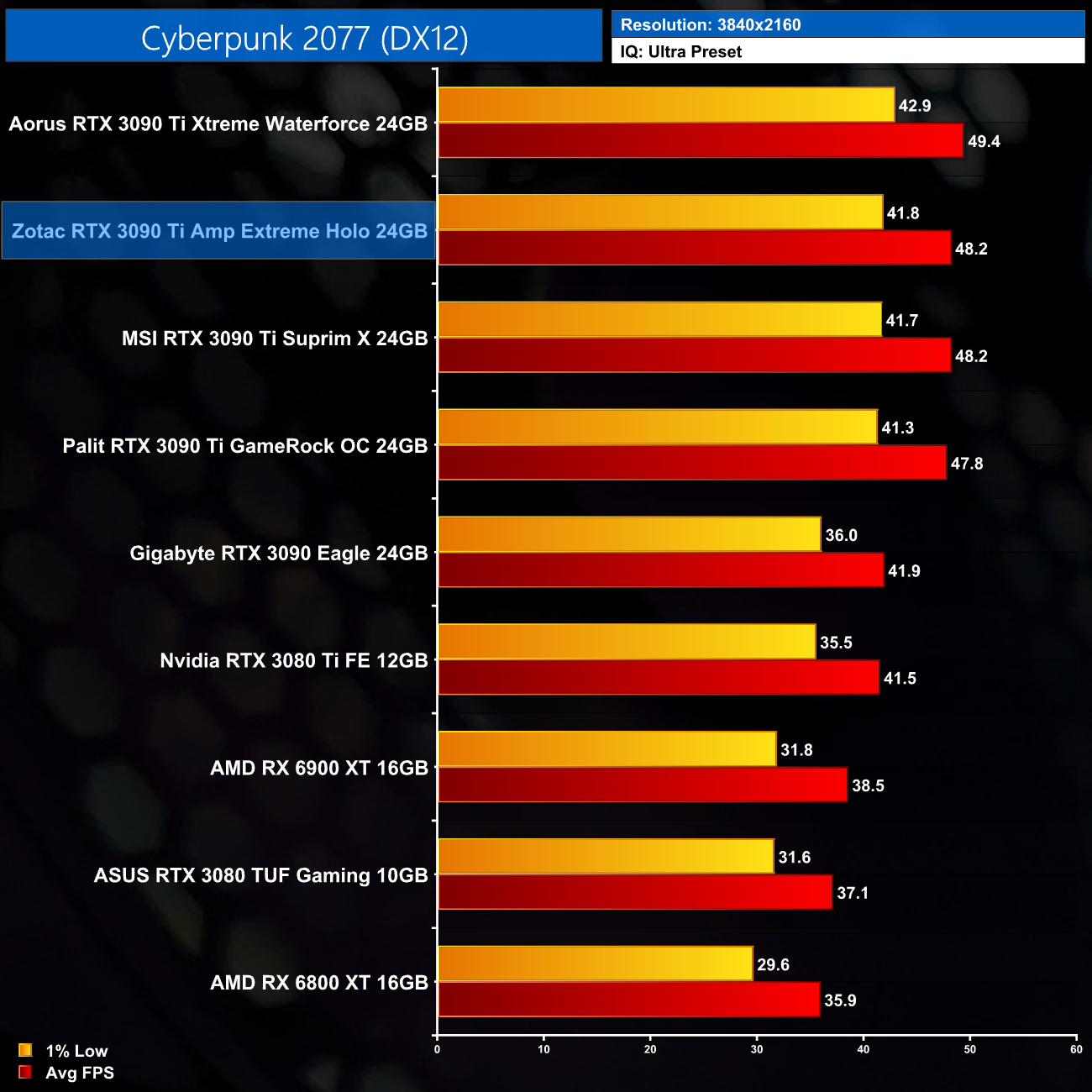
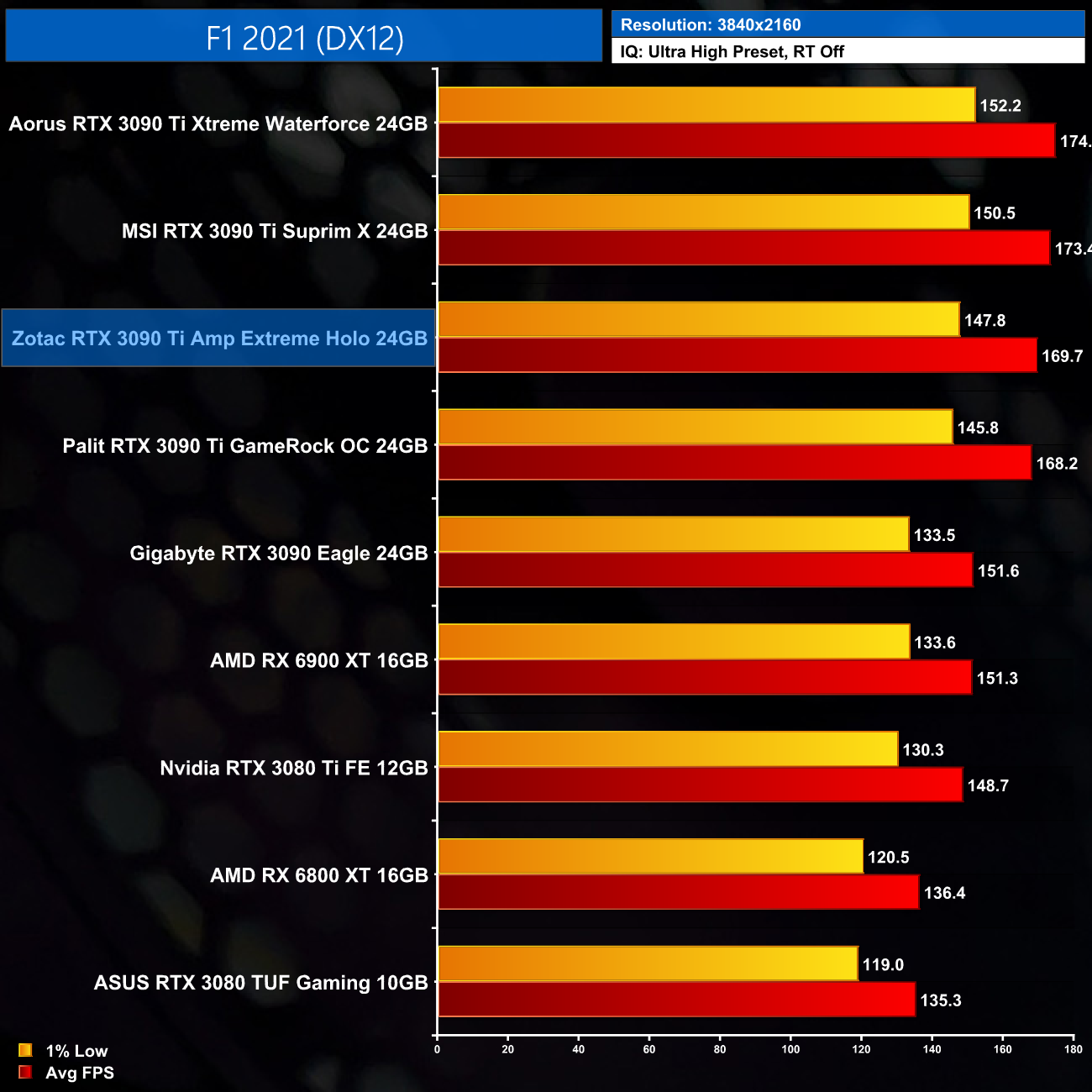
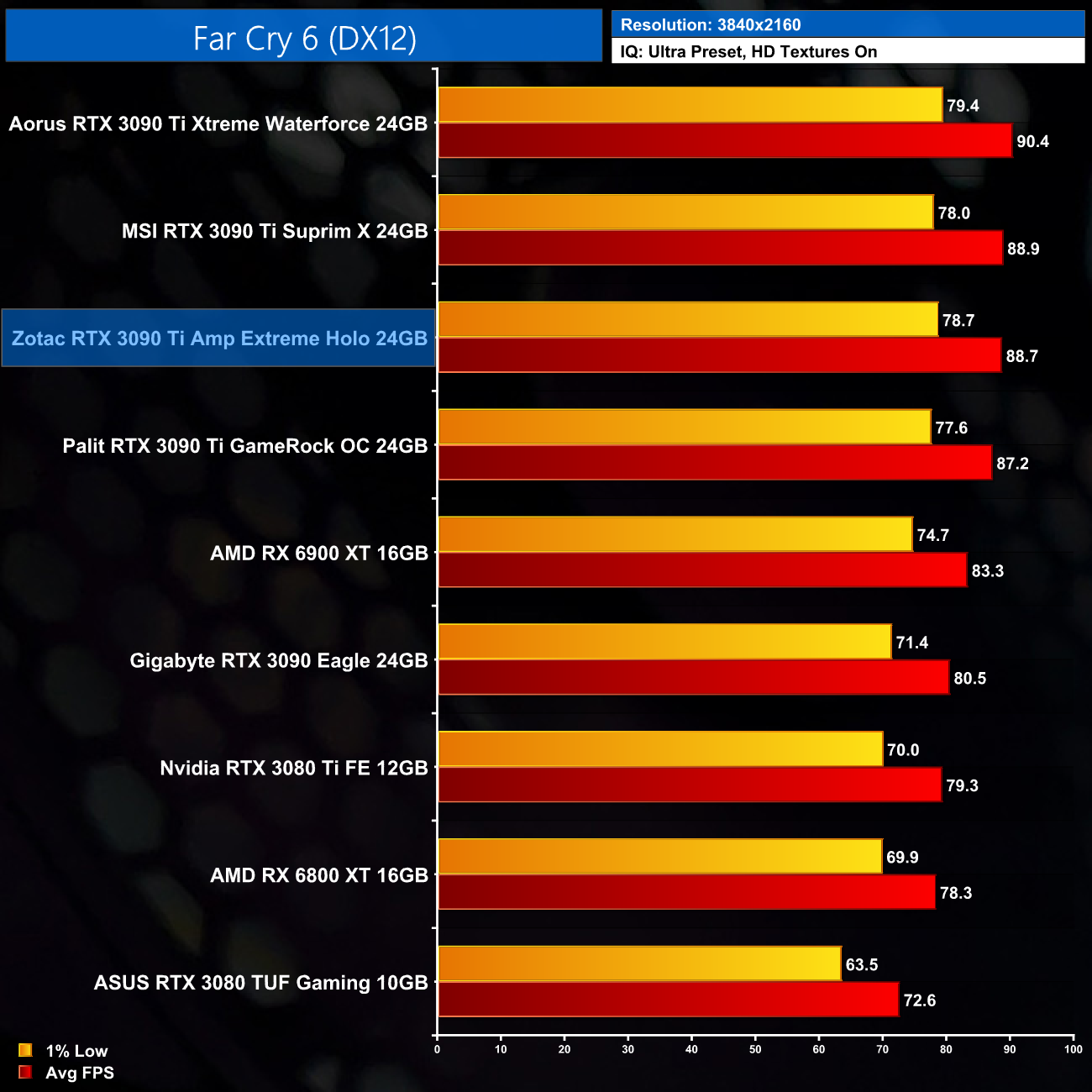
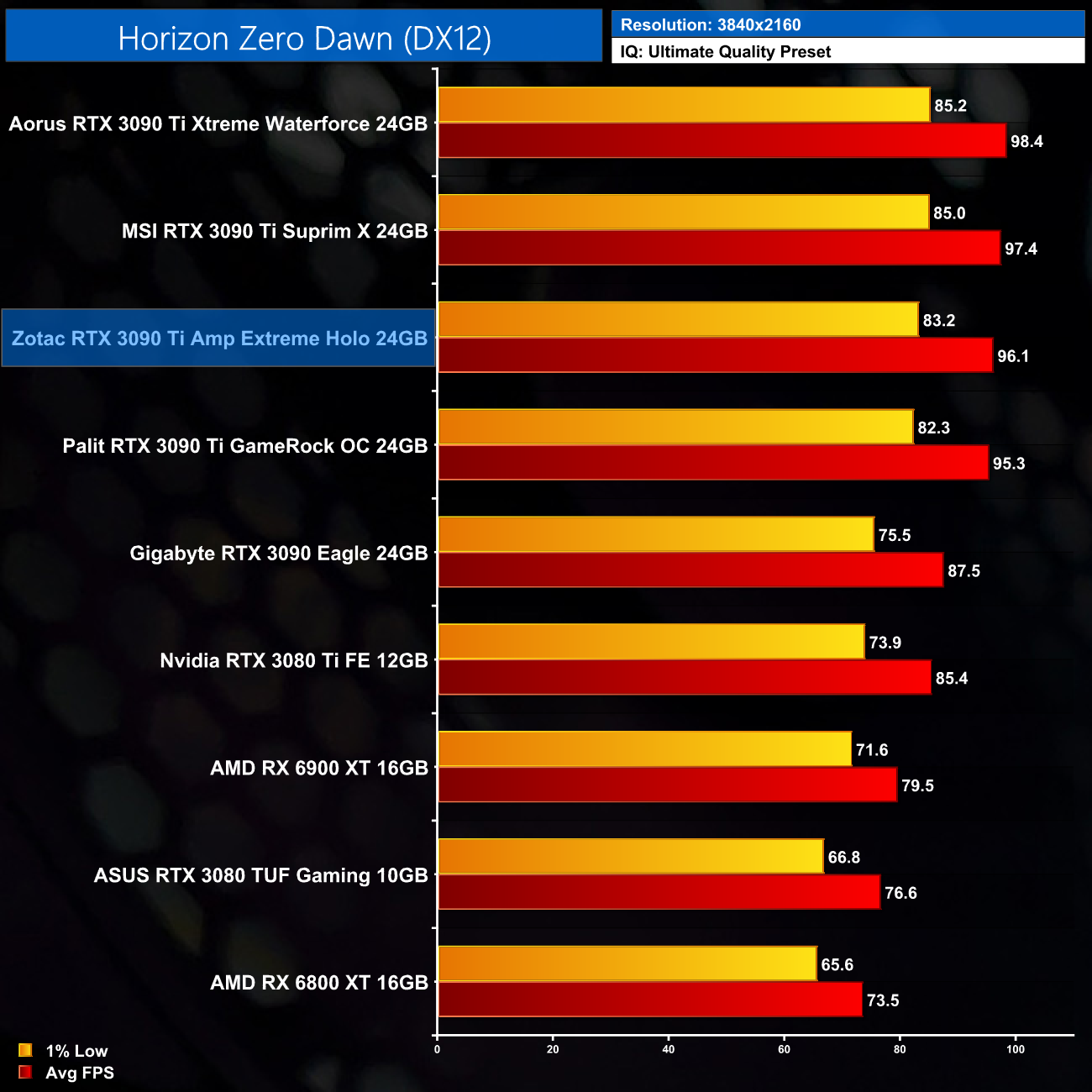
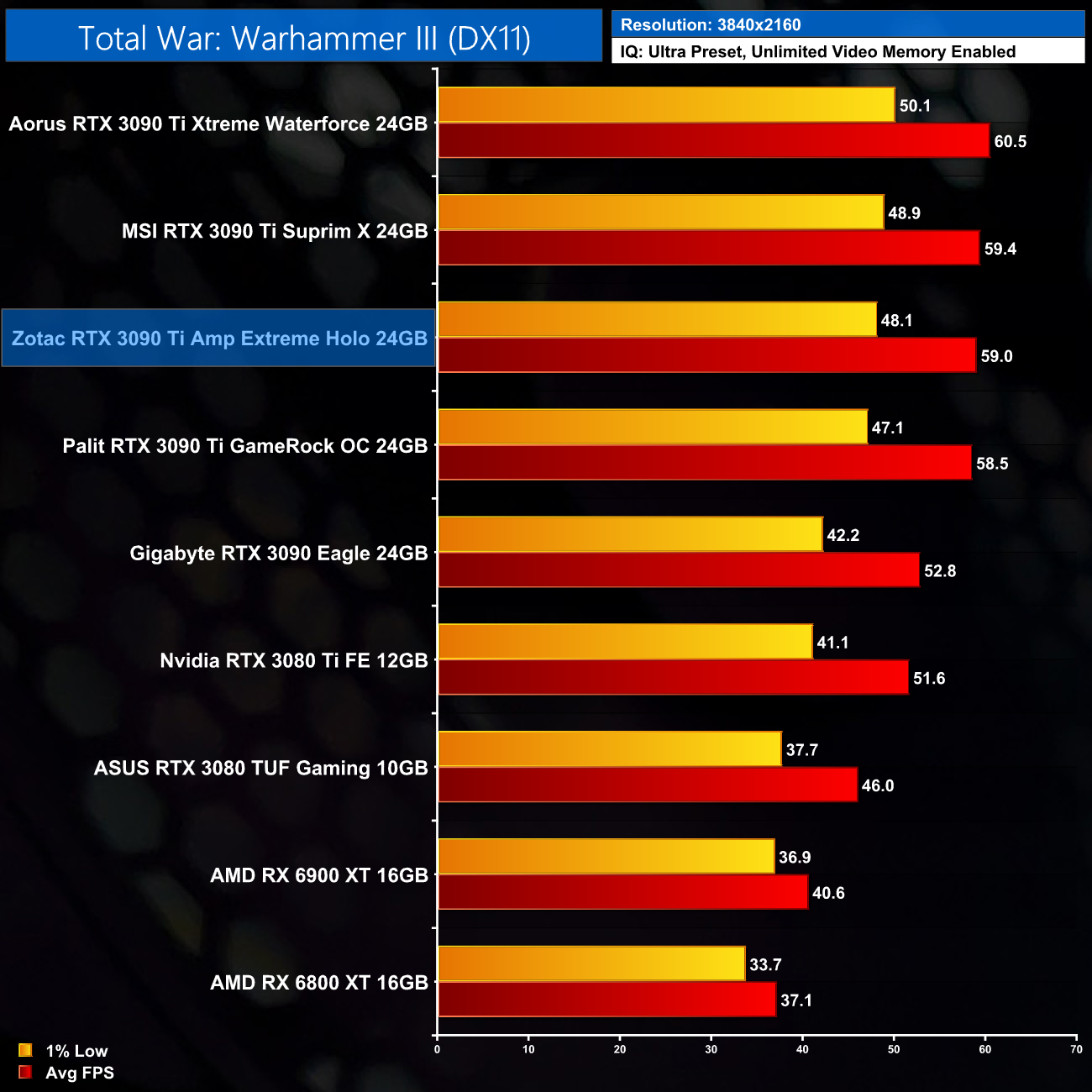
Having tested five different titles at 4K resolution, there is clearly no significant difference in gaming performance between the Amp Extreme Holo and its competitors. Compared to the MSI Suprim X, Zotac's card is on average 1% slower – but as you can see from the charts, that is often a difference of less than a single frame, so functionally speaking the cards are just as fast as each other.
Here we present the average clock speed for each graphics card while running Cyberpunk 2077 for 30 minutes. We use GPU-Z to record the GPU core frequency during gameplay. We calculate the average core frequency during the 30 minute run to present here.
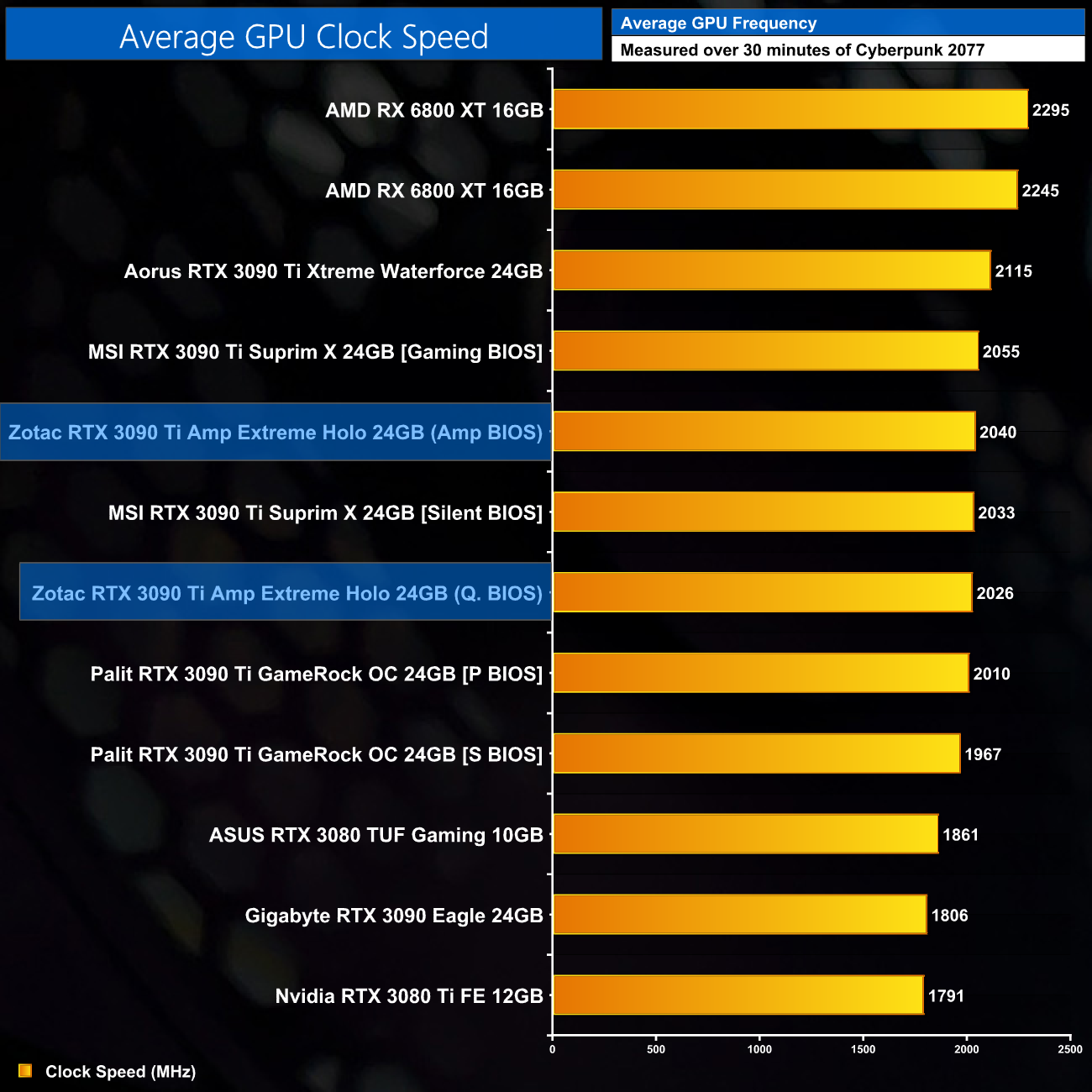
The reason we saw such similar gaming performance between the Amp Extreme Holo and the Suprim X becomes clear when looking at average operating clock speed. The Amp Extreme Holo ran at 2040MHz over the duration of our stress test, just 15MHz slower than the Suprim X – explaining the near-identical game benchmark results.
We also tested both BIOS modes for the Amp Extreme Holo. The only difference between both BIOS is the fan speed – so power limit and rated clock speed is exactly the same. That said, the different to fan speed does affect GPU temperatures, which in turn affects the GPU Boost algorithm, so the Quiet BIOS does run fractionally slower, but only by 14MHz, so it's barely even worth mentioning.
For our temperature testing, we measure the peak GPU core temperature under load. A reading under load comes from running Cyberpunk 2077 for 30 minutes.
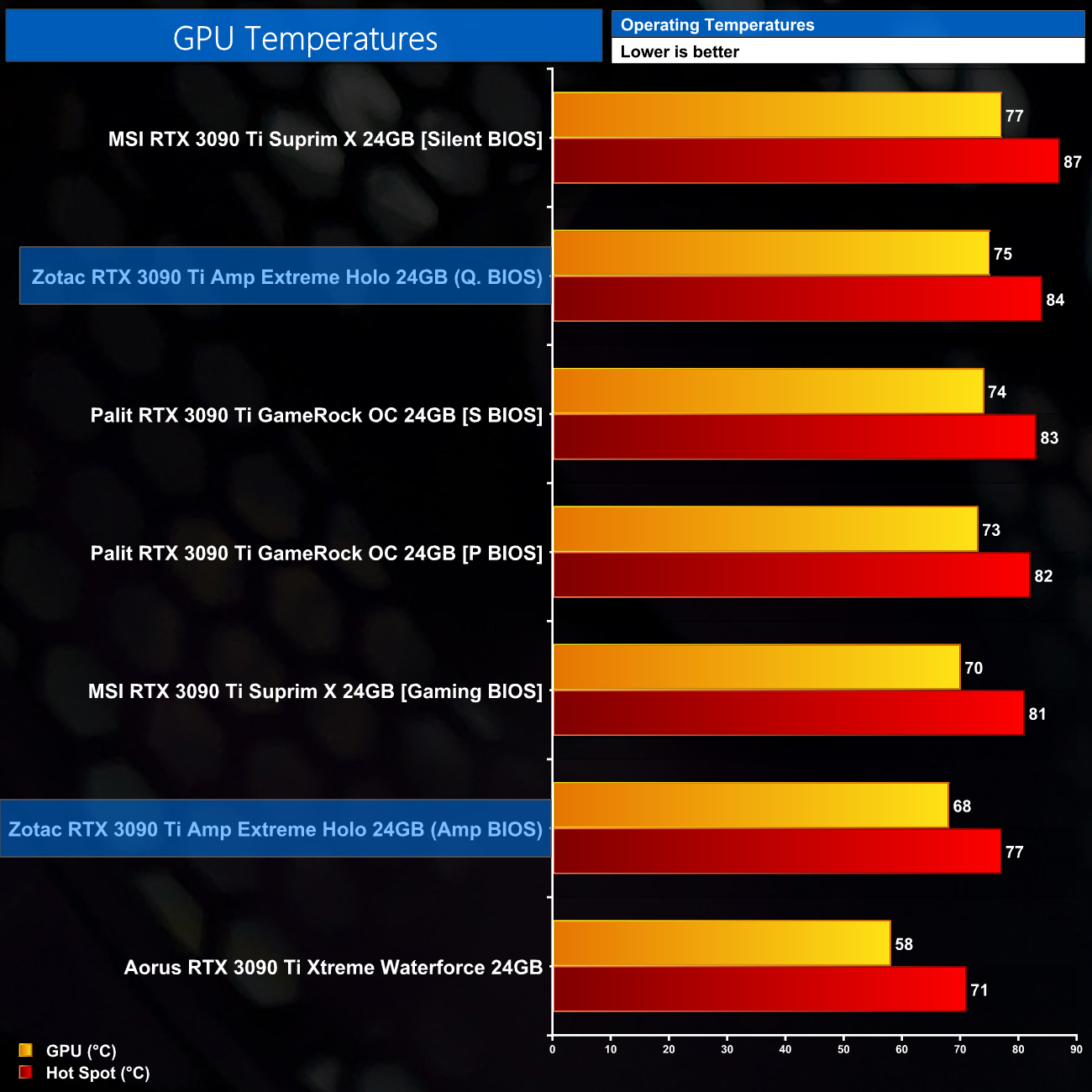
We can see a much greater difference in thermal performance when comparing the Amp Extreme Holo's two BIOS modes. The Amp BIOS saw the GPU peak at 68C, with a hotspot of 77C, compared to the Quiet BIOS which saw the GPU peak 8C hotter. Both results are still very competitive, and the Amp BIOS is actually the coolest temperatures we've seen from an air-cooled RTX 3090 Ti.
For our temperature testing, we measure the peak memory temperature under load. A reading under load comes from running Cyberpunk 2077 for 30 minutes.
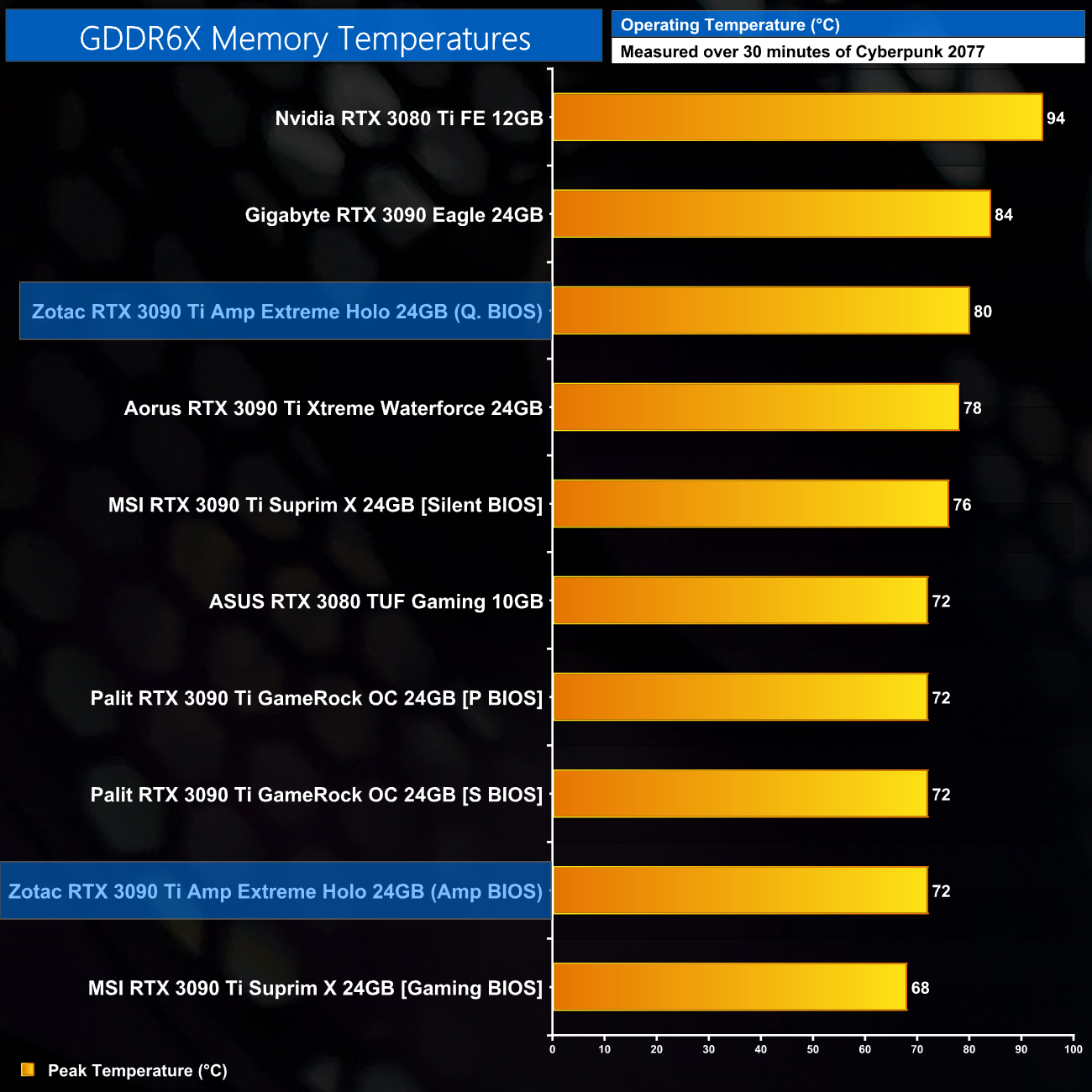
Likewise, GDDR6X temperatures are no problem for the Amp Extreme Holo. The Amp BIOS saw a peak of just 72C, while the Quiet BIOS saw the memory run 8C hotter. Both results are absolutely fine for memory of this calibre and are competitive against the likes of the Palit GameRock OC and MSI Suprim X.
We take our noise measurements with the sound meter positioned 1 foot from the graphics card. I measured the noise floor to be 32 dBA, thus anything above this level can be attributed to the graphics cards. The power supply is passive for the entire power output range we tested all graphics cards in, while all CPU and system fans were disabled. A reading under load comes from running Cyberpunk 2077 for 30 minutes.
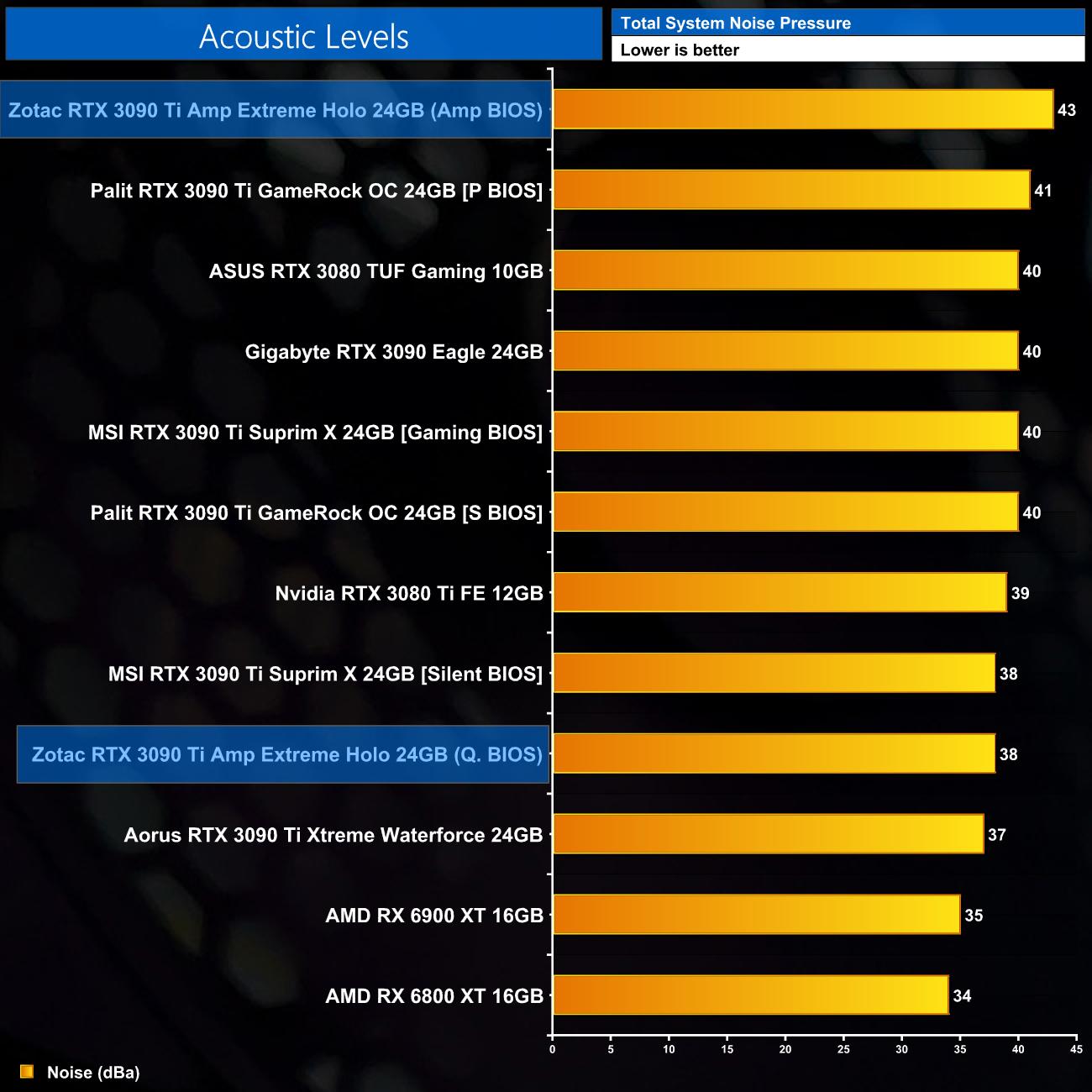
Part of the Amp BIOS' impressive thermal performance is explained by fan noise – the three 100mm fans ramp up to 56%, or 1820rpm, and that is quite audible, even over my chassis and AIO fans. The good news is the Quiet BIOS is much easier on the ears, running the fans at 46%, or 1480rpm, matching the noise levels of the MSI Suprim X when using its Silent BIOS.
Following on from our stock thermal and acoustic testing, here we re-test the operating temperature of the GPU, but with noise levels normalised to 40dBa. This allows us to measure the efficiency of the overall cooling solution as varying noise levels as a result of more aggressive fan curves are no longer a factor.
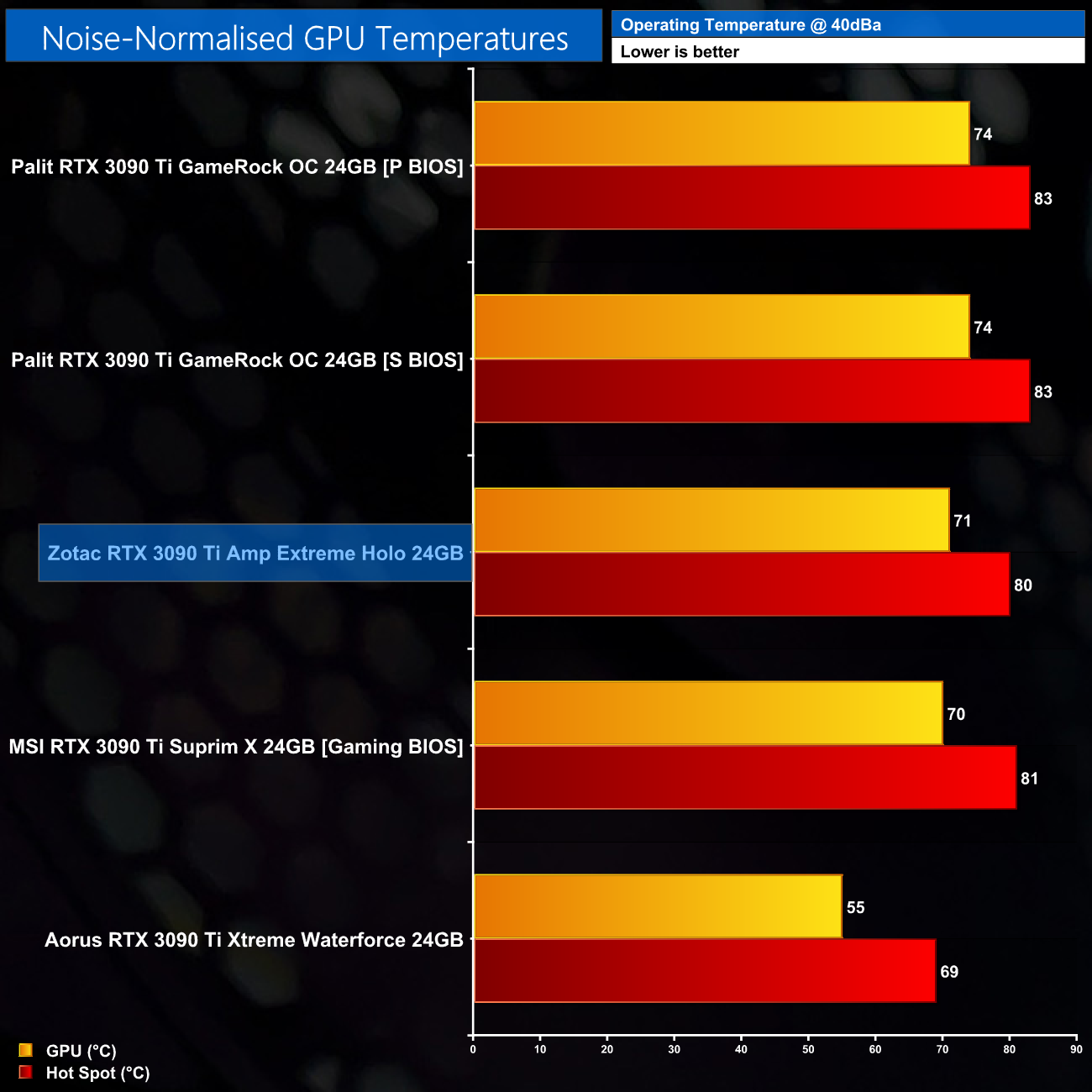
Removing noise levels from the equation, here we look at noise-normalised thermals. One thing to note here is that we can't account for differences in power – the Amp Extreme Holo has a 450W power target, compared to 480W for the MSI Suprim X, for instance. Still, this gives us our best look at apples-to-apples cooler comparisons, with the Amp Extreme Holo proving competitive once again. It runs 3C cooler than the GameRock OC, and just 1C hotter than the Suprim X.
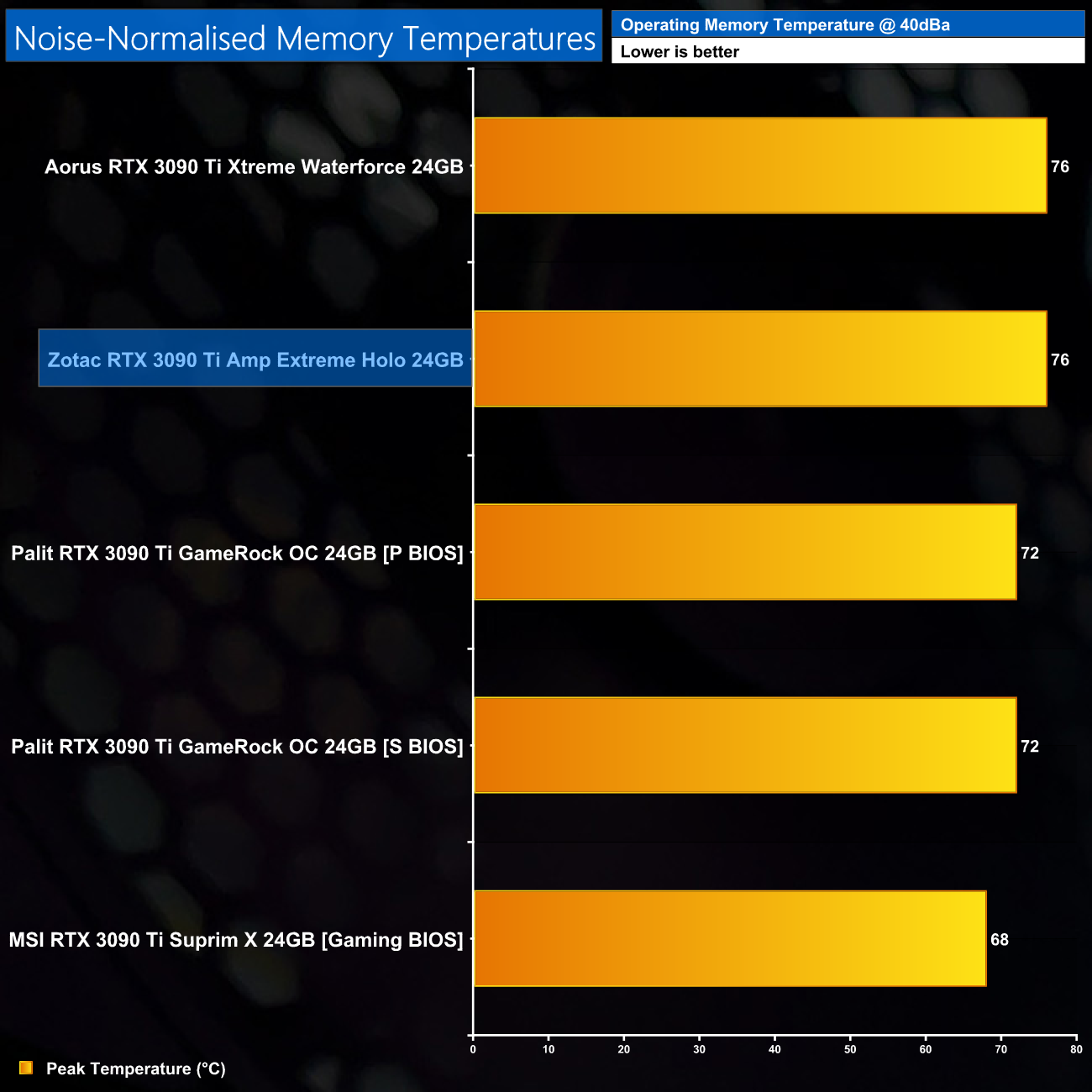
Memory temperatures are slightly higher when noise-normalised, coming in 8C hotter than the Suprim X, but the results are still absolutely fine and well within the thermal limits of these memory modules.
We measure system-wide power draw from the wall while running Cyberpunk 2077 for 30 minutes.
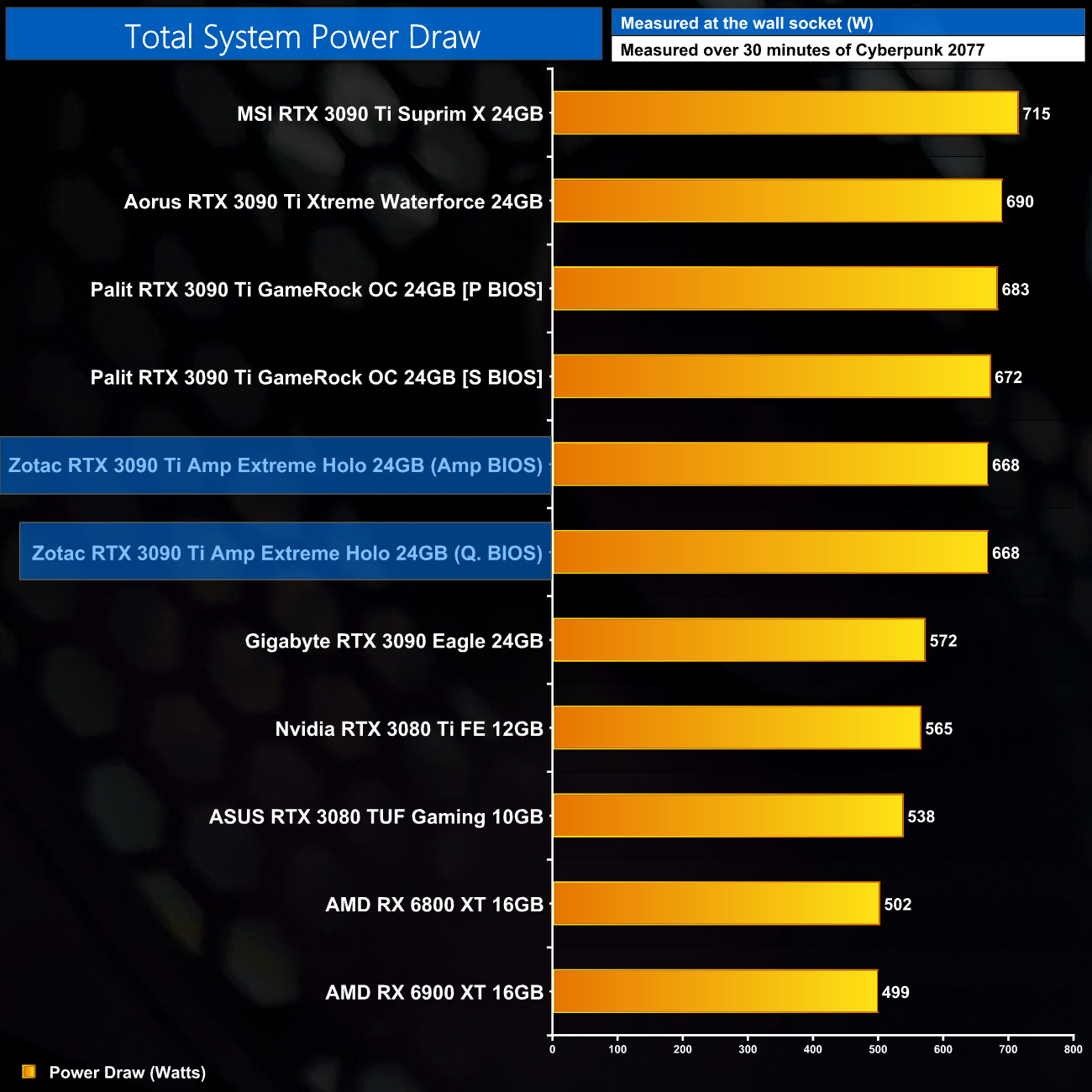
Of the four RTX 3090 Tis we have now tested, the Amp Extreme Holo has the lowest power target of them all, so understandably its total system power is the lowest. It's still very high, mind you, coming in just shy of 670W, so you will still need a very decent PSU.
We also use Nvidia PCAT to measure power draw of the graphics card only, with readings from both the PCIe slot and the PCIe power cables combined into a single figure. This provides us with significantly more accurate data to work with as it is measuring only the GPU power, and not total system power which is a fundamentally imprecise measurement.
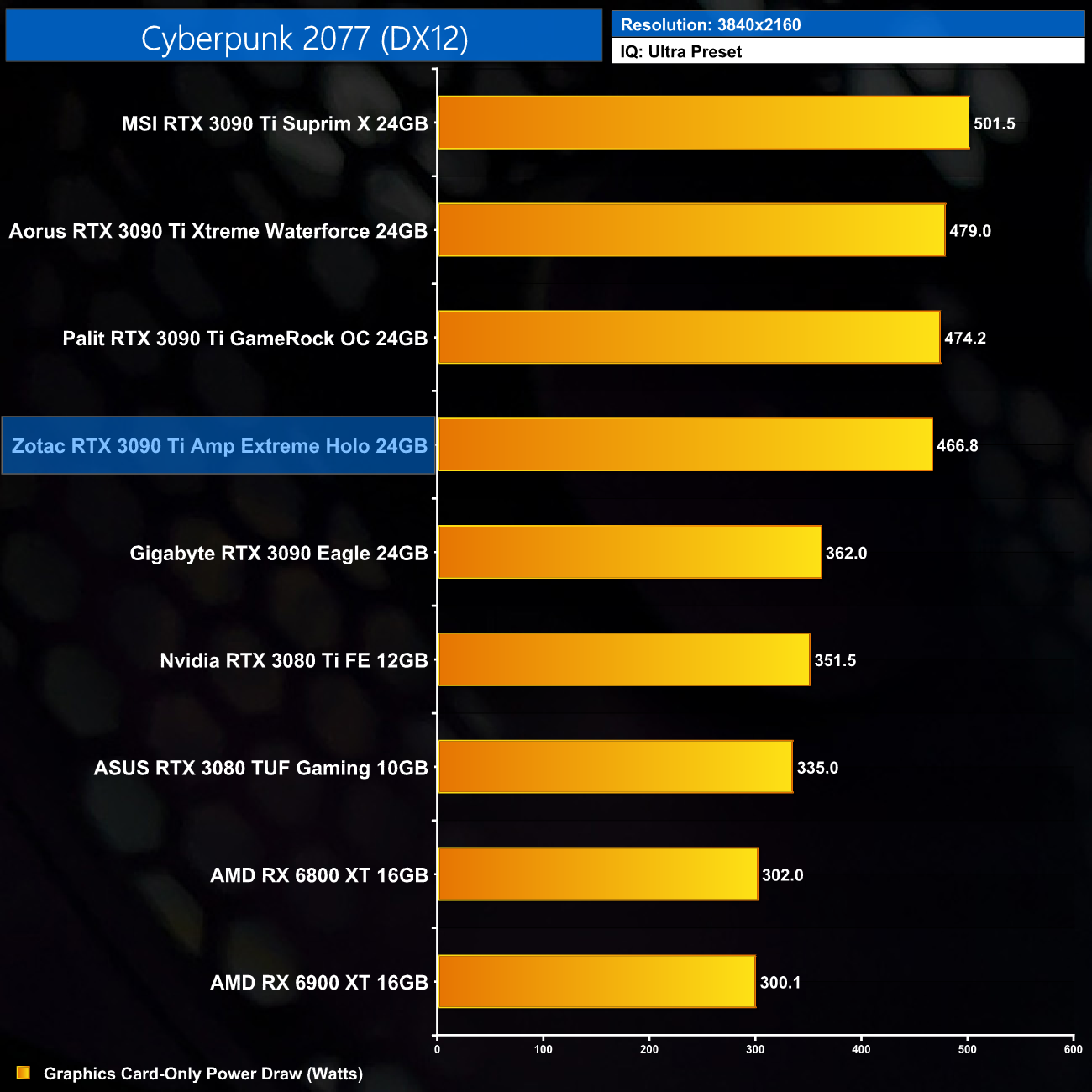
Despite the 450W power target, we actually saw the Amp Extreme Holo exceed that value, drawing just under 467W in Cyberpunk 2077. It's still the most frugal RTX 3090 Ti we've tested, but not by a lot.
For our manual overclocking tests, we used MSI Afterburner. Our best results are as below.
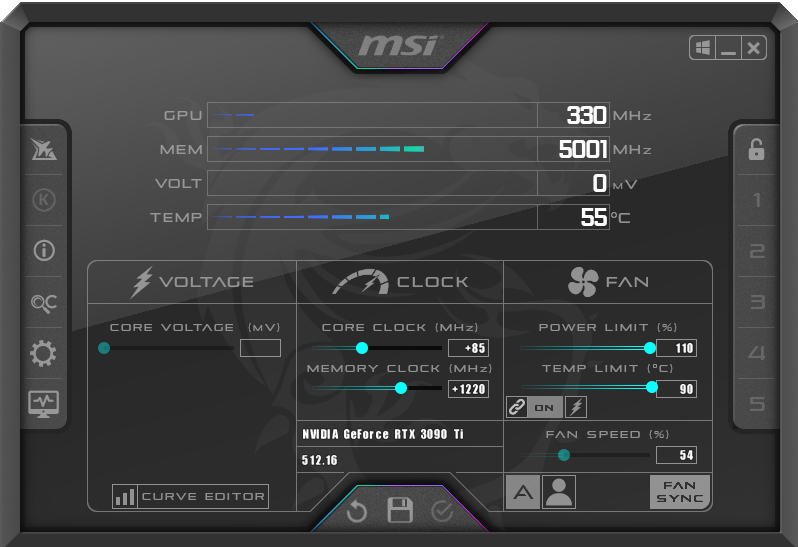
With the power limit set to its maximum value (110%), we were able to add 85MHz to the GPU and 1220MHz to the GDDR6X memory.
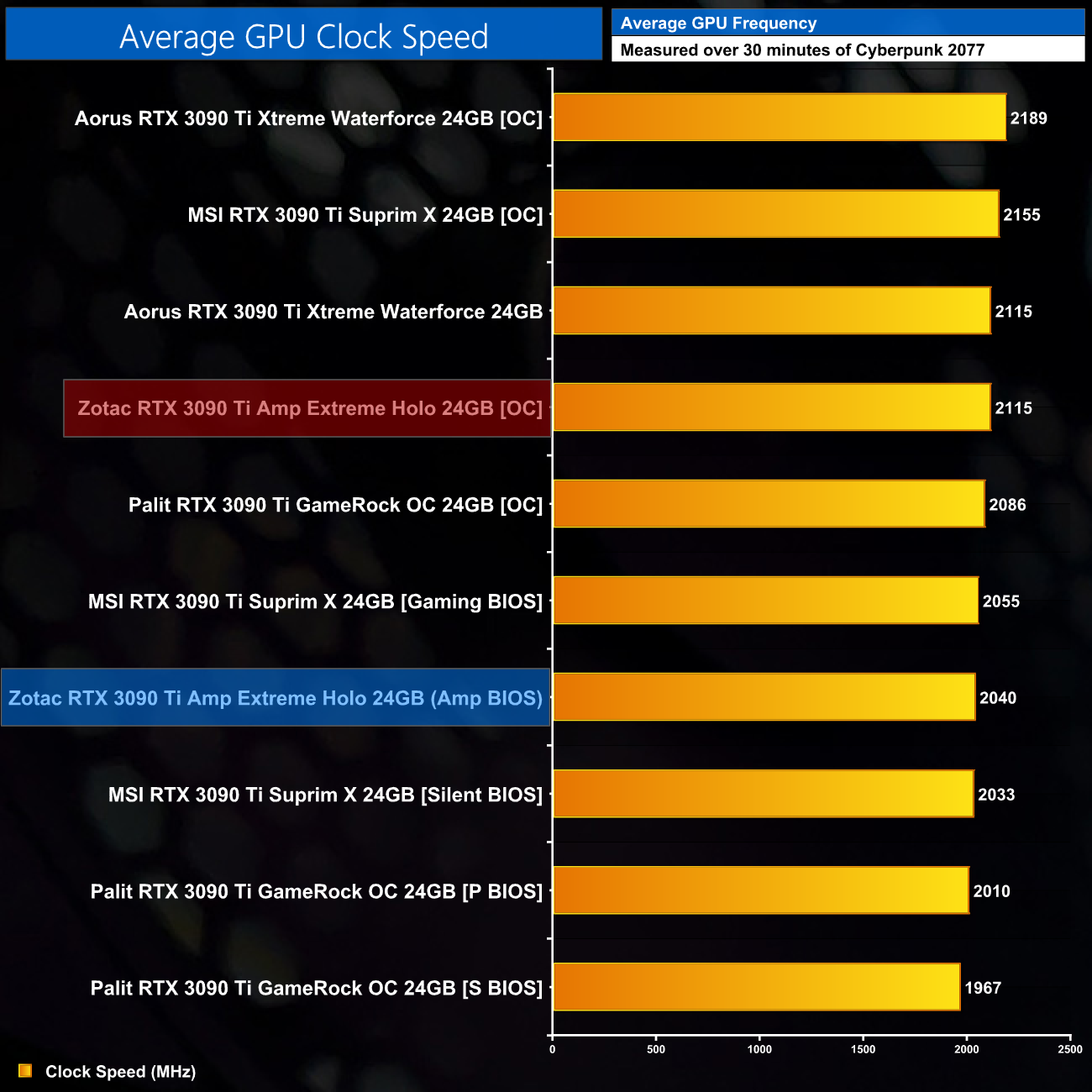
This resulted in a real-world clock speed of exactly 2115MHz, meaning the MSI Suprim X ran 40MHz faster when overclocked.
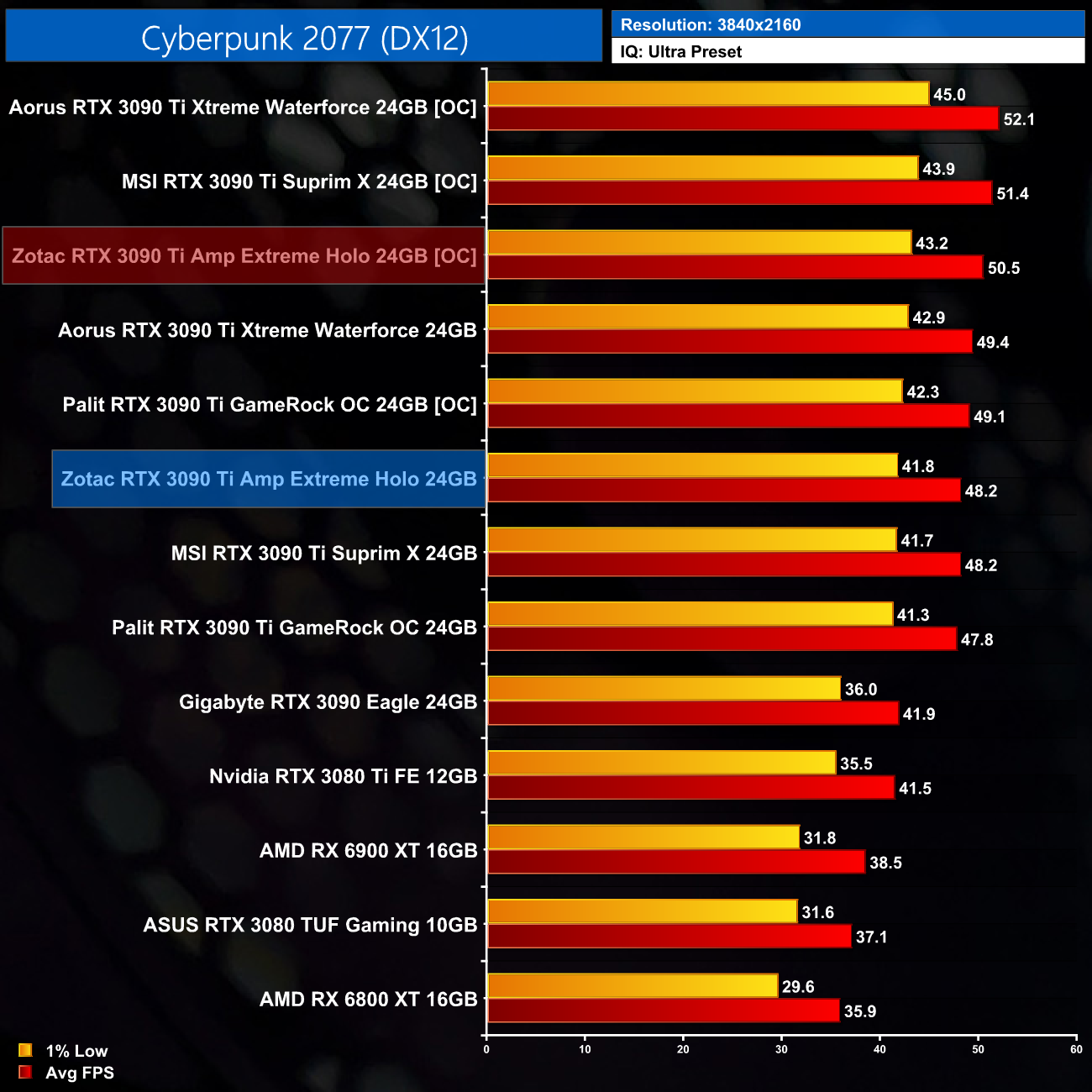
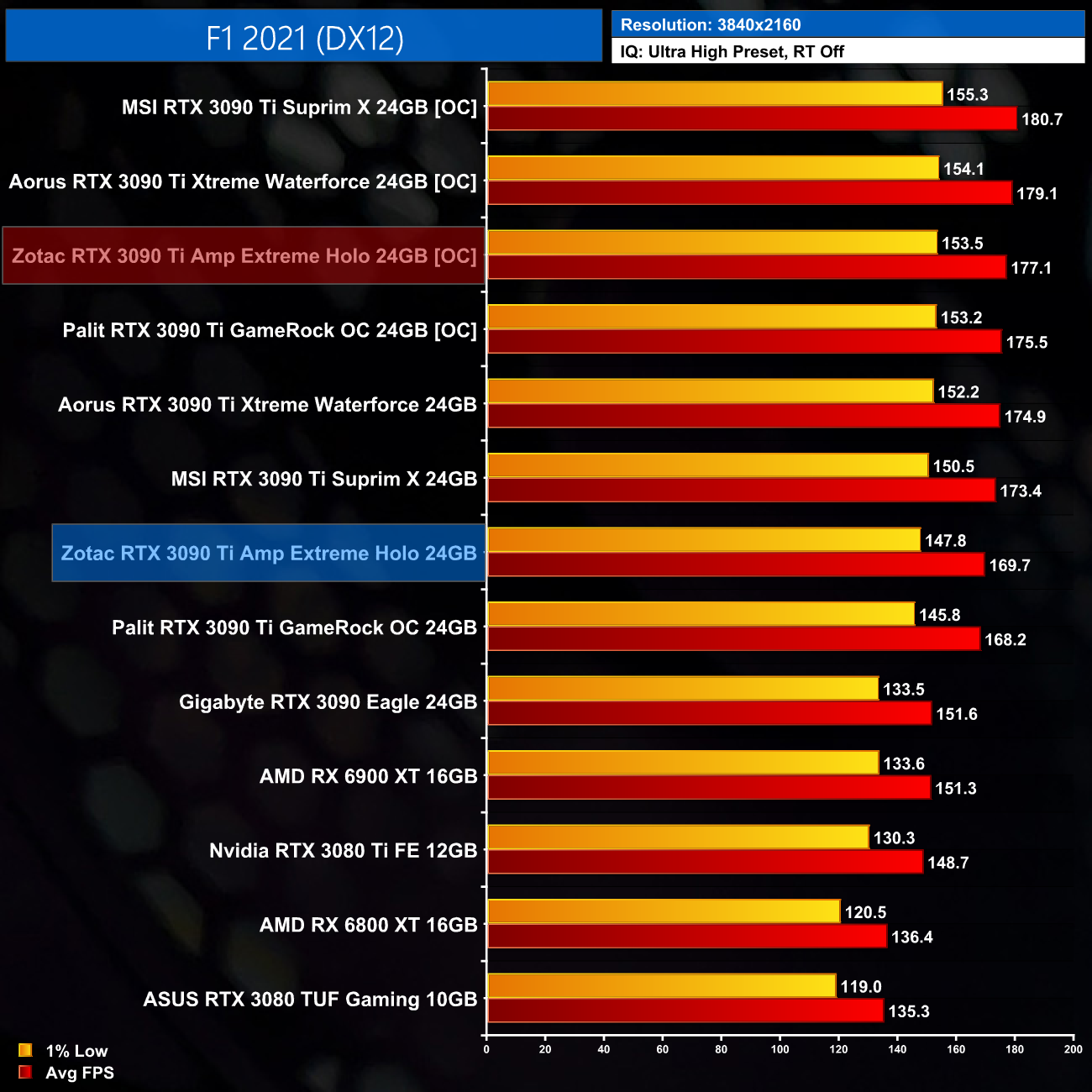
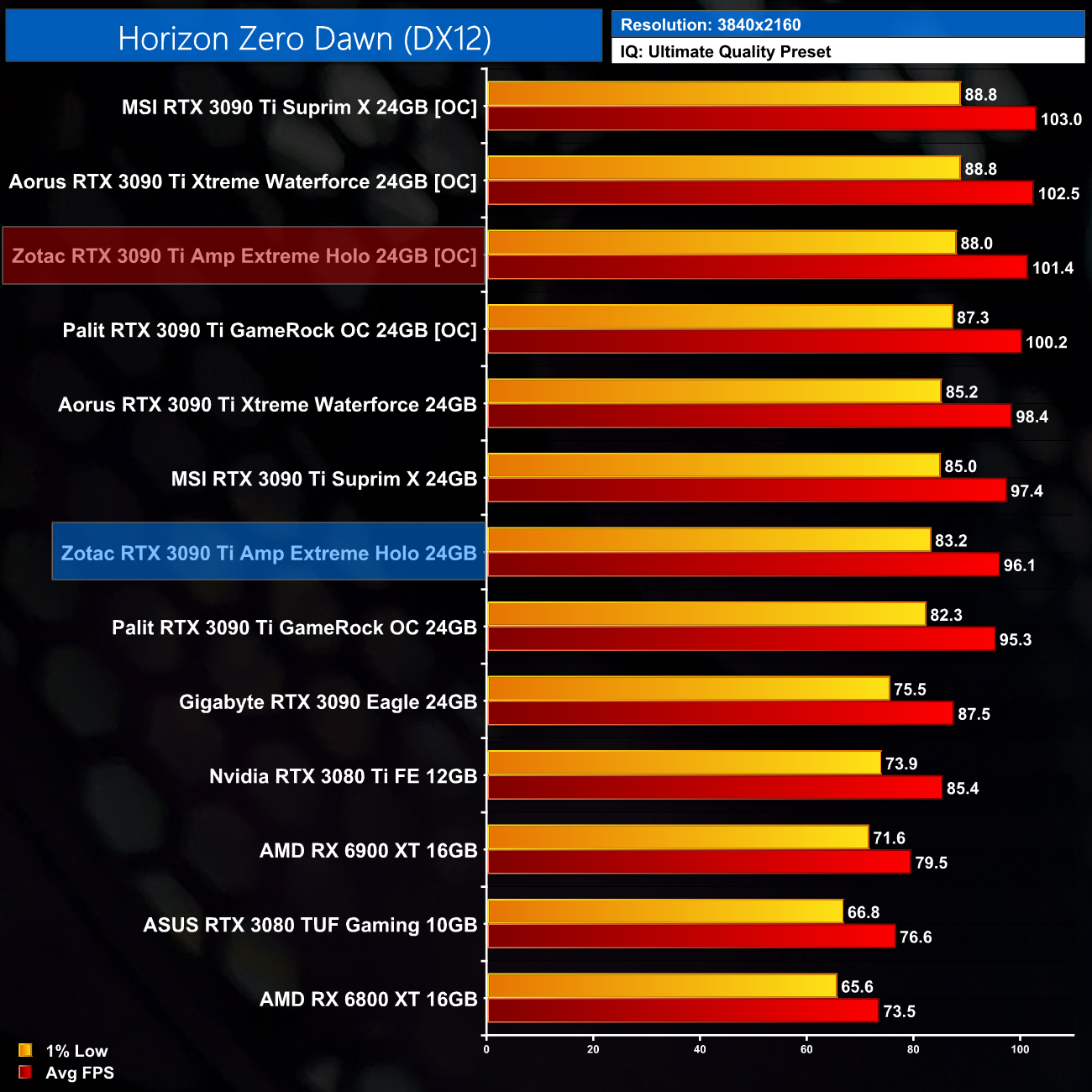
The extra frequency on both the GPU and the memory saw gaming performance increase by 4-6% in the title we re-tested. It's not a whole lot, but could be worth doing if you want to extract every last drop of performance from the GPU.
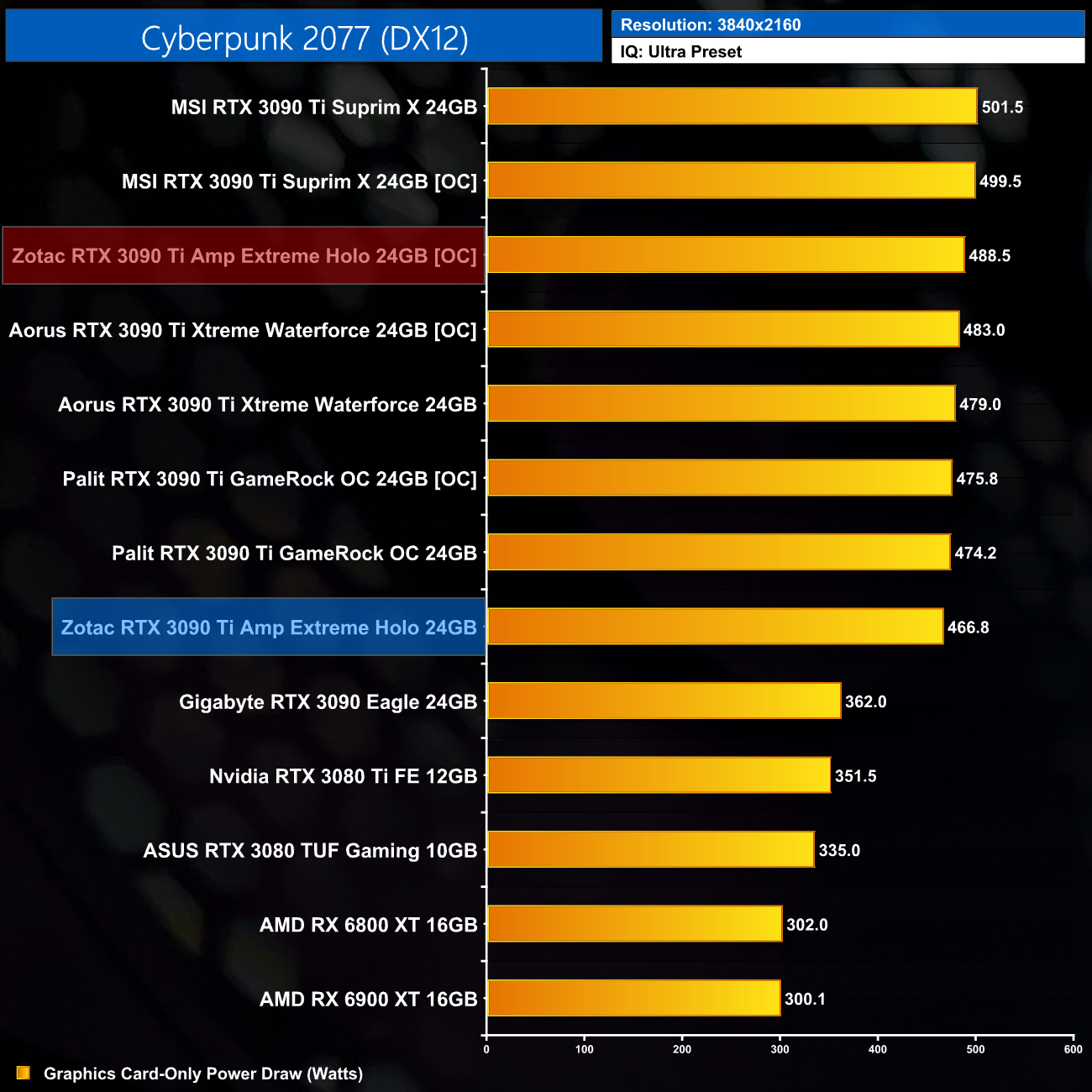
Power draw did rise as well however, from 467W up to 489W, but what's an extra 22W of juice when you're spending nearly £2000 on a graphics card?
Today's review has been our fourth look at an aftermarket RTX 3090 Ti, and the Zotac RTX 3090 Ti Amp Extreme Holo has proven to be a solid addition to the mix.
Regular readers may well have got a dose of deja-vu when seeing the shroud and RGB implementation, as it is near identical to the RTX 3090 Amp Extreme Holo that we reviewed last year, but that is no bad thing. I personally think it is an attractive design, with the holographic section being particularly eye-catching, while the multi-zone RGB lighting will be sure to please those looking for a bit of bling in their systems.
Performance from the card is pretty much what we'd expect, too. Zotac didn't go with the most aggressive factory overclock we've seen, yet the Amp Extreme Holo was trading blows with the MSI Suprim X in every single game we tested. In short, this RTX 3090 Ti delivers RTX 3090 Ti performance, so we can have no complaints there.
Its cooler is also a solid performer. It's not the absolute best we've tested in terms of noise-normalised thermals – for an air-cooled card, the MSI Suprim X does offer lower GPU and memory temperatures – but the differences are small. Its Quiet BIOS is very easy on the ears however, so you won't be disturbed by fan noise if you do opt for that BIOS mode.
Speaking of the BIOS situation, that is my one real complaint for the Amp Extreme Holo. The card does feature dual-BIOS, but it is only accessible through Zotac's FireStorm software – there's no physical switch on the card. This does mean you don’t have to open up your case every time you want to switch between the two BIOS. But I'd argue one of the main benefits to a dual-BIOS switch is that you can manually flick over to the other BIOS if one became bricked, and that is just not an option here.
Additionally, the only difference switching between the Amplify and Quiet BIOS is the fan speed, so I’m not sure why a user wouldn’t just manually change the fan speed instead of switching BIOS, which itself requires a system restart.
That one quirk aside, the Zotac RTX 3090 Ti Amp Extreme Holo is a solid all-round performer, with no major weaknesses in terms of its gaming performance, thermals or noise levels. If you're looking for an RTX 3090 Ti and like the HoloBlack design, it will serve you well.

We found it on sale for £1898.99 on Overclockers UK HERE.
Discuss on our Facebook page HERE.
Pros
- Smart design with attractive holographic section.
- Eye-catching RGB implementation.
- Just as fast as any other RTX 3090 Ti.
- Solid thermal and acoustic performance.
Cons
- No physical dual-BIOS switch.
- MSI's Suprim X is slightly cooler-running when noise-normalised.
KitGuru says: Zotac's Amp Extreme Holo looks good and performs well. The software-only dual-BIOS implementation is an interesting quirk, but it's still worth buying if you're in the market for an RTX 3090 Ti.